Phonetic Connections Teacher Guide
Science of Reading Alignment
Phonetic Connections
A Master Alignment & Lesson Planning Guide for 73 High-Frequency Words
Teacher Reference
Page 1: Syllable Types
Instructional Framework
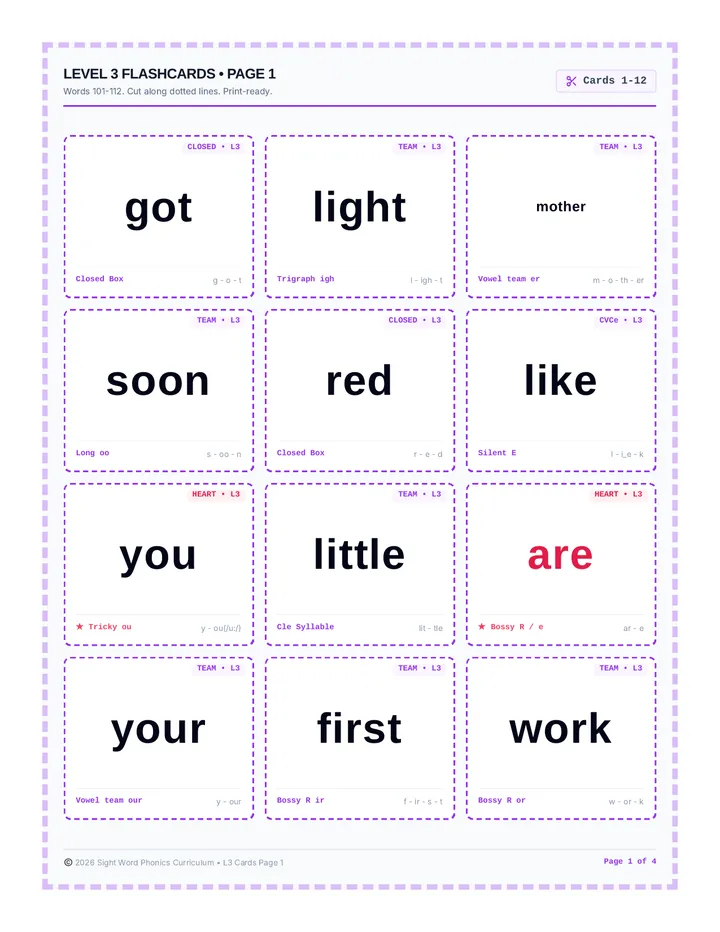
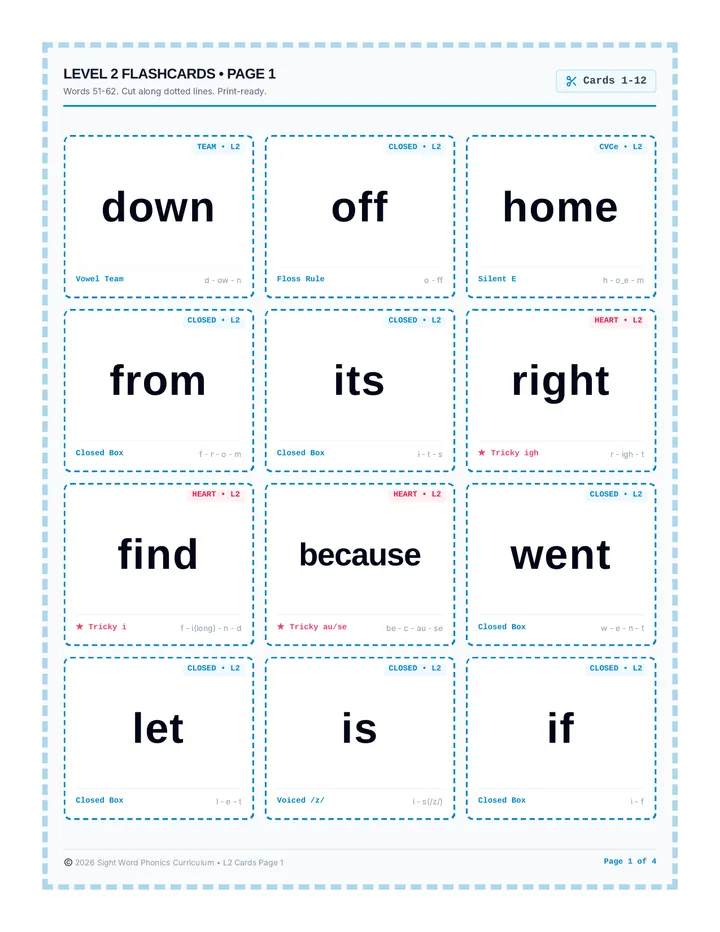
High-frequency words should not be taught through rote visual memorization. Instead, group them by their phonetic spelling patterns. This allows students to apply orthographic mapping, connecting the sounds (phonemes) to the letters (graphemes) they already know, leaving only the "tricky" parts to be learned as "heart parts."
Part 1: Fully Decodable Syllable Structures
1. Open Syllables 8 Words
Single-syllable words ending in a vowel, representing a long vowel sound.
Long e sound:
Single-syllable base words.
we be she he me
Long i sound (spelled with y):
"y" acts as a long "i" at the end of single syllables.
by my try
2. VCe Silent-E 5 Words
The final silent "e" signals the preceding vowel to represent its long vowel sound.
Long a sound:
make made
Long i sound:
like time
Long o sound:
home
3. Closed Exceptions & Digraphs 4 Words
Vowels represent long sounds despite being closed in by a consonant cluster, or use regular long vowel digraphs.
Closed Exceptions:
Vowels are long before -nd or -ld blends.
find (-nd) old (-ld)
Special Long Vowel Graphemes:
Phonically stable complex vowel spellings.
light (-igh) thing (-ing)
Aligning High-Frequency Vocabulary with Phonics Progression Page 1 of 3
Science of Reading Alignment
Phonetic Connections
A Master Alignment & Lesson Planning Guide for 73 High-Frequency Words
Teacher Reference
Page 2: Vowel Teams & R-Controlled
Part 2: Vowel Teams & R-Controlled Vowels
4. Regular Vowel Teams & Diphthongs 24 Words
ee & ea (Long e sound):
need keep each eat sea
ay (Long a sound):
day say may way play today
oo (Long /u:/ Sound):
food too room soon
oo (Short /ʊ/ Sound):
look book good took
ow & ou (Diphthongs /aʊ/ and /oʊ/):
how now house about show
5. R-Controlled Vowels & Syllables 10 Words
Vowels followed by "r" that change sound, creating stable phonetic patterns.
"or" Spelling:
Standard /ɔːr/ sound.
for or more before
"-er" & "-ir" Spelling:
Standard /ɜːr/ sound.
under after never over first
"-air" Team:
Vowel team + "r" blend.
air
Aligning High-Frequency Vocabulary with Phonics Progression Page 2 of 3
Science of Reading Alignment
Phonetic Connections
A Master Alignment & Lesson Planning Guide for 73 High-Frequency Words
Teacher Reference
Page 3: Heart Words Alignment
Part 3: Irregular spelling patterns (Heart Words)
These 22 words contain irregular or low-frequency spelling parts (marked in bold red). Call out the regular, decodable parts first to promote orthographic mapping, and teach the "heart part" explicitly.
| Tricky Word | Decodable Part(s) | Heart Part | Phonetic Explanation / Lesson Planning Note |
|---|
| you / your | /y/ (y) | ou / our | "ou" represents /u:/ (as in "food"); "our" makes /ɔːr/ sound. |
| some | /s/ (s), /m/ (m) | o_e | VCe looks like long o; actually represents short u (/ʌ/). |
| their / they | /th/ (th) | eir / ey | "eir" makes /ɛər/ (homophone of there); "ey" makes long a /eɪ/. |
| would / could | /w/, /k/, /d/ | ould | "ould" spelling with a silent "l" represents short /ʊ/. |
| door | /d/, /r/ | oo | "oo" unexpectedly represents the /ɔːr/ ("or") sound. |
| because | be-, /c/, /s/ | au / -se | "au" represents short o /ɒ/; silent e follows standard s. |
| have | /h/, /v/ | a_e | Looks like long a (silent e); represents short a /æ/. |
| who | None | who | Highly irregular: "wh" represents /h/; "o" represents /u:/. |
| again | a-, /g/, /n/ | ai | The vowel digraph "ai" represents short e /ɛ/. |
| other / mother | /th/, -er | o | "o" represents short u /ʌ/ (historical sound change). |
| any / many | -ny / /m/, -ny | a | The "a" represents short e /ɛ/ instead of /æ/. |
| only / also | -ly / -so | on- / al- | "only" has long o in closed syllable. "also" has "al-" as /ɔːl/. |
| work | /w/, /k/ | or | "or" after "w" changes to represent the /ɜːr/ sound. |
| very / family | /v/, -ry / fam-, -ly | e / i | "very" has open short e. "family" has weak/schwa middle vowel. |
| don't | /d/, -n't | o | Contraction; "o" represents long o instead of short o. |
Aligning High-Frequency Vocabulary with Phonics Progression Page 3 of 3