The student worksheet for the 'Modifier Mechanics' activity. Provides designated 'Units' for students to glue their repaired sentence strips and write out any necessary revisions. Balanced across two pages for adequate working space.
A creative project choice board for the 'Saving Winslow' book club final week, offering options like a character suitcase, town newspaper, song/poem, or connection map.
Instructional slides for Week 4 of the 'Saving Winslow' book club, now including a final creative project showcase slide.
Student activity journal for Week 4 of the 'Saving Winslow' book club, focusing on final character evolution and the book's message.
Instructional slides for Week 3 of the 'Saving Winslow' book club, focusing on synthesizing themes and the concept of resilience.
Student activity journal for Week 3 of the 'Saving Winslow' book club, focusing on synthesizing themes and the vocabulary term 'resilience'.
Instructional slides for Week 2 of the 'Saving Winslow' book club, focusing on Nora's character and the SWBST summary method.
Student activity journal for Week 2 of the 'Saving Winslow' book club, focusing on Nora's character and summarizing using the SWBST method.
Instructional slides for Week 1 of the 'Saving Winslow' book club, introducing Louie and modeling the vocabulary word map.
Student activity journal for Week 1 of the 'Saving Winslow' book club, featuring character analysis of Louie and Gus and a vocabulary word map for 'fragile'.
Updated Teacher Club Guide for 'Saving Winslow' to include details about the final creative project choice board and presentation day.
A comprehensive teacher's facilitation guide for the Extreme Weather Experts unit, including lesson overviews, instructional tips, and differentiation strategies.
A student synthesis worksheet for the final lesson, featuring a comparison matrix and a structured writing area for a comprehensive evidentiary paragraph.
Instructional slides for the Storm Synthesis lesson, focusing on comparing and contrasting tornadoes and hurricanes using evidence from multiple texts.
A reading comprehension and writing worksheet about hurricanes, featuring a text passage, a "Paragraph Power" graphic organizer, and a final writing area.
Instructional slides for the Hurricane Highways lesson, focusing on hurricane terminology and teaching the "Paragraph Power" (Topic, Details, Conclusion) writing structure.
A reading comprehension worksheet about tornado formation, featuring a text passage, vocabulary matching, and text-based analysis questions.
Instructional slides for the Tornado Tactics lesson, introducing key vocabulary, lesson objectives, and close reading strategies for informational texts.
A teacher resource rubric for grading the 'Unlocked Hearts' culmination projects, with clear criteria for evidence, depth, and creativity.
A final project choice board for 'The Tiger Rising', offering students creative and analytical ways to synthesize the novel's themes, symbols, and character arcs.
A teacher guide for the 'Tiger Rising' book club unit, including instructional goals, pacing suggestions, discussion sparks, and vocabulary answer keys for all three chapter groups.
A visual presentation for teaching Chapters 21-30 of 'The Tiger Rising', exploring the climax of the story, the resolution of Rob's grief, and the central themes of freedom and connection.
A visual presentation for teaching Chapters 11-20 of 'The Tiger Rising', focusing on Rob's wood carvings, Willie May's character, and the development of the central secret.
A visual presentation for teaching Chapters 1-10 of 'The Tiger Rising', featuring discussion prompts on setting, metaphors (the suitcase), and character introductions.
A student workbook for Chapters 21-30 of 'The Tiger Rising', featuring vocabulary, a plot mountain activity, and thematic synthesis on the meaning of freedom.
A student workbook for Chapters 11-20 of 'The Tiger Rising', including vocabulary, a Venn diagram comparing Rob and Sistine, and a main idea activity.
A student workbook for Chapters 1-10 of 'The Tiger Rising', featuring vocabulary exercises, character analysis of Rob's 'suitcase', and a summary template.
Final book club celebration slides for 'The Tiger Rising'. Includes reflection prompts, a metaphor game, instructions for the 'Carving Circle' activity, and final thematic quotes.
Visual presentation slides for Week 5 of the book club, focusing on character strength, final vocabulary review, and theme synthesis. Key topics include Sistine's name symbolism, the theme of letting go, and final reflections.
Visual presentation slides for Week 4 of the book club, focusing on Chapters 30 and overall story analysis. Key themes include the resolution of the story, the symbolism of the tiger, and Rob's personal transformation.
Visual presentation slides for Week 3 of the book club, focusing on Chapters 20-29. Key themes include the encounter with the tiger, the metaphor of the leg sadness, and the emotional climax of the story.
Visual presentation slides for Week 2 of the book club, focusing on Chapters 10-15. Key themes include wood carving as expression, Willie May's advice, and the metaphor of cages.
Visual presentation slides for Week 1 of the book club, summarizing Chapters 1-9. Key topics include the Kentucky Star metaphor, Week 1 vocabulary review, and the initial connection between Rob and Sistine.
Visual presentation slides for Lesson 17, walking students through the full summary of 'The Tiger Rising' using the SWBST strategy and the 'Story Suitcase' metaphor.
Final vocabulary review presentation slides, covering matching, sentence application, and a final thematic reflection on the word that best represents Rob's journey.
Visual presentation slides for Lesson 2, focusing on Chapters 2-3. Topics include vocabulary (unstoppable, commotion), summary of the bus scene, and a synthesis of Rob and Sistine's contrasting character strategies.
Visual presentation slides for Lesson 1, covering Chapter 1 introduction, background building, vocabulary (intense, persistent), SWBST summary strategy, and synthesis of the setting.
A polished, architect-themed mini rubric for 5th grade literary essays. It provides clear criteria for Structure, Evidence (Development), and Conventions, along with dedicated sections for strengths, goals, and scoring.
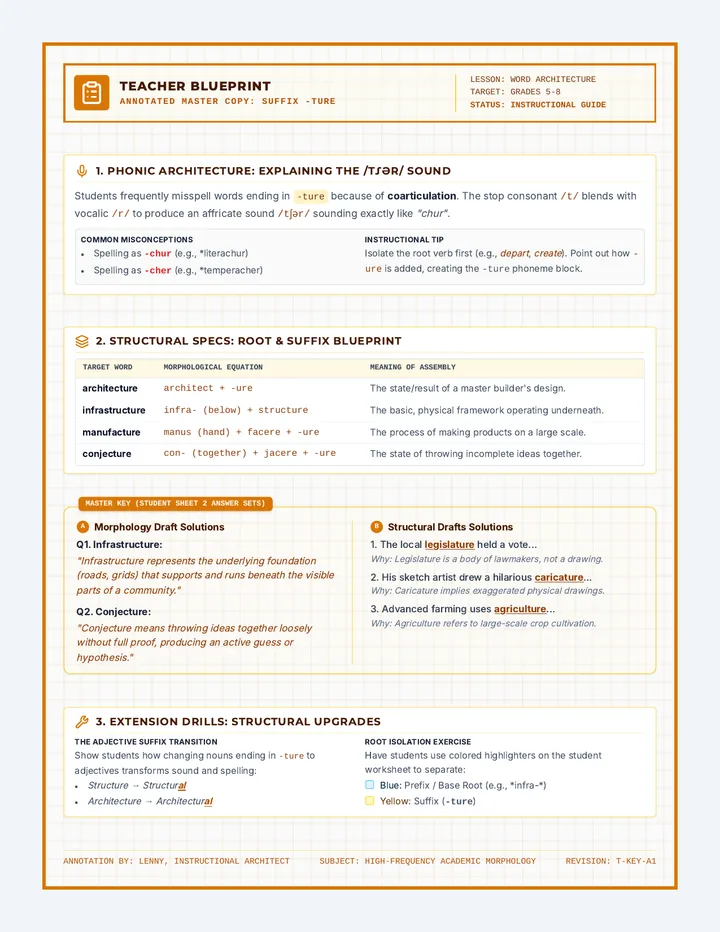
A professional instructional guide for teachers, including lesson objectives, pacing suggestions, answer keys for student activities, and differentiation strategies.
A revision checklist and visual mapping tool to help students analyze and improve the sentence rhythm and variation in their own narrative writing drafts.
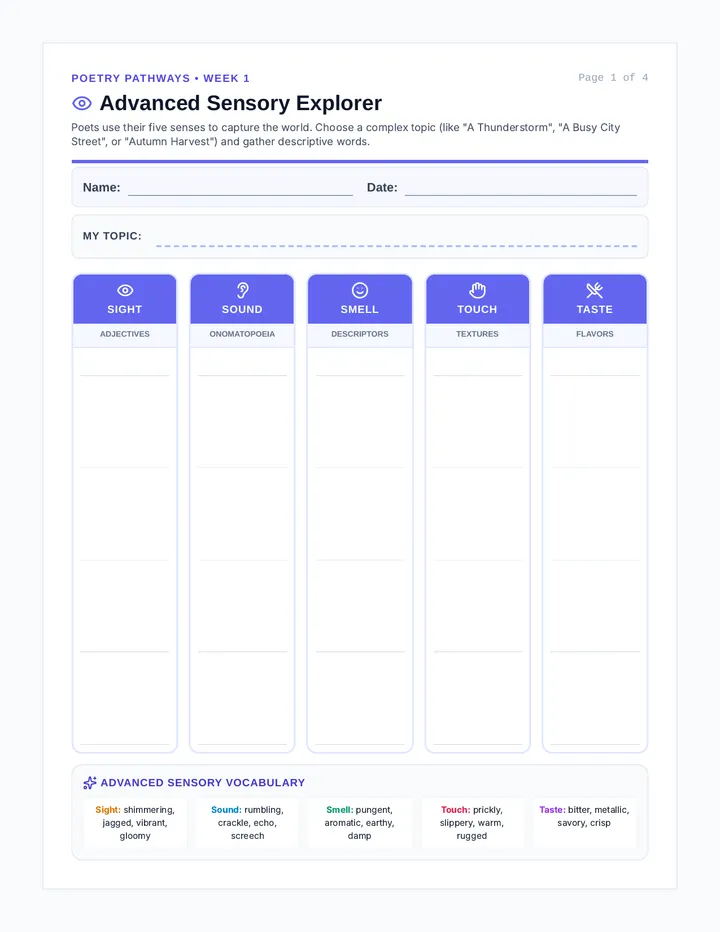
A sentence-building worksheet where students unscramble sophisticated examples and construct their own varied sentences using specific structural requirements.