Light STAAR Paired Assessment
STAAR Reading Language Arts • Grade 3 Paired Passages Assessment
Name:
Date:
Teacher:
Score:
Directions: Read the next two selections. Then choose the best answer to each question.
Selection 1 • Informational
What Is Light?
From Chapter 1 of Adventures in Light and Sound
1
Did you know that the sun is the greatest source of light for our planet, Earth? But what is light? Why is it so important?
2
Hot gases of the sun give off both light and heat. Light carries energy, with long wavelengths carrying the least and short wavelengths carrying the most. When you think of something with lots of energy, what comes to mind? Do you think of something fast like a race car or something with great force like a strong wind knocking down a tree? Believe it or not, light can be many times more energetic than a car or the wind.
3
Light travels at 186,000 miles every second in a vacuum. At that speed, light can go around Earth more than seven times every second! No human-made machine can go that fast—not even a jet plane or rocket!
4
One way that light travels, including light from the sun, is in the form of waves. Scientists can measure how long light waves are. Waves can be different sizes—some are long and some are short. Some light waves are visible and some are invisible. Whether you can see light or not depends on the length of the wave. The longest wavelength of visible light is seen as red, and the shortest wavelength is violet. Short wavelengths carry the most energy.
5
The sun gives off what is called white light. Perhaps you think of sunlight as having no color at all, or as being yellow. It may surprise you to know that white light is made up of all the colors of the rainbow. White light includes light of different wavelengths, including all the colors we can see. Of all the wavelengths in sunlight, there is just a little more of the yellow wavelengths that reach our eyes than the other colors. This is why the sun looks yellow against a blue sky.
6
Although the sun is the greatest source of visible light, there are also other sources of light. Other stars in the night sky provide light, though they are not as bright as the sun during the day. The moon is not a star and does not give off its own light. In our everyday lives, light bulbs also provide white light using electricity. When the electricity goes off during a bad storm, people sometimes use other sources of light, like flashlights or candles.
7
Light is important for many reasons. Sunlight warms Earth; without it, Earth would be freezing cold. Sunlight is also needed for plants to grow. In addition, without light, there would be no colors. Try to imagine a world in which there is no light—no sun, no stars, no candles, and no light bulbs. Without light, you would not be able to see anything!
White Light: Mix of all visible rainbow colors
Speed: 186,000 miles per second
Waves: Red = Longest • Violet = Shortest (Most Energy)
GO ON ➤
STAAR Grade 3 • Paired Passages Selection 2
Selection 2 • Fiction
The Storm and the Secret Rainbow
by Elena Morales
1
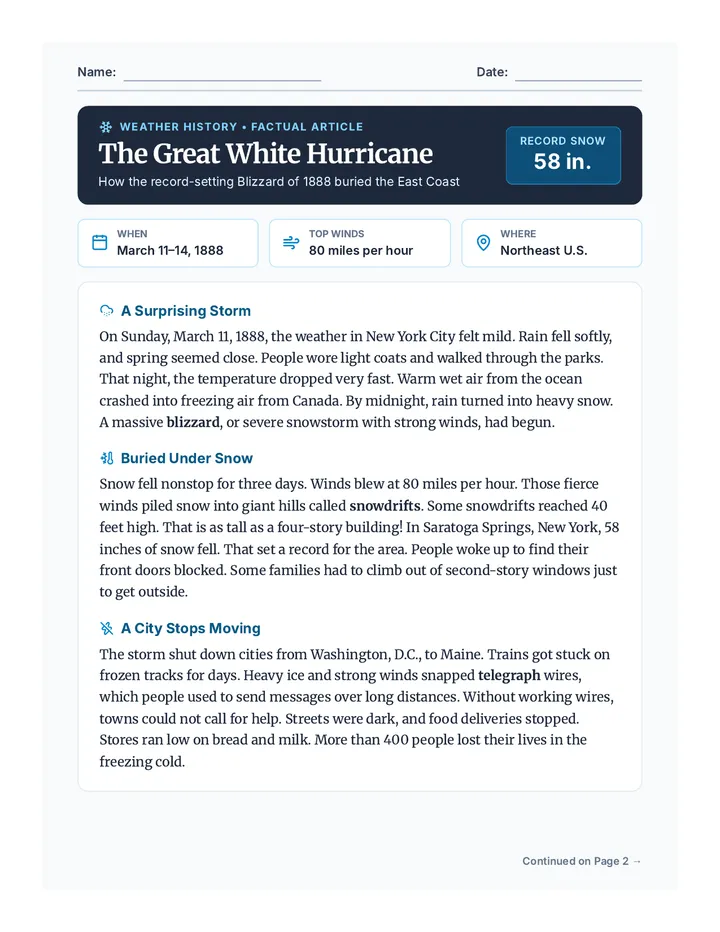
Thunder rumbled like bowling balls rolling across the roof. Outside, heavy raindrops tapped furiously against the living room window. Nine-year-old Maya and her little brother Caleb were sitting on the rug, stacking a tall wooden block tower. Suddenly, with a sharp zap, every lamp clicked off. The television went black, and the hum of the refrigerator stopped. Total darkness swallowed the room.
2
"Maya?" Caleb whispered, his voice trembling in the pitch-black shadows. "I can’t see my hands! What happened to all the lights?"
3
"It’s just a blackout from the storm," Maya replied gently. "Don’t move, Caleb. Mom is coming." In a moment, their mother entered carrying a glowing beeswax candle. The tiny flame flickered softly, casting a warm yellow circle on the floor. She handed Maya a sturdy metal flashlight. "The electric power might be out for a while," Mom said. "Keep this flashlight close."
4
Caleb huddled under his fleece blanket, frowning at his blocks. "A tiny candle and one flashlight aren’t bright enough," he grumbled. "Without the big ceiling bulbs, everything looks spooky and gray. There are no colors in the dark!"
5
Maya smiled as an idea sparked in her mind. That very morning in science class, Mr. Ramos had taught them about light energy. "You’re right that we need light to see colors," Maya said, clicking the flashlight on. A bright white beam shone across the floor. "Without light, our eyes can’t see anything. But did you know this plain white beam is actually packed with every color of the rainbow?"
6
Caleb tilted his head. "It just looks like plain white light to me."
7
"Watch this," Maya said eagerly. She walked over to the window where their grandmother’s faceted glass suncatcher hung. Maya lifted the heavy crystal prism and aimed the flashlight’s beam straight through its clear edges. Instantly, the glass bent the white light. A brilliant band of red, orange, yellow, green, blue, and violet exploded across the dark wall!
8
Caleb gasped as the vibrant colors danced across his wooden blocks. He reached out and touched the glowing stripe of violet. "Whoa! The white light had all those colors hidden inside?"
9
"It sure did," Maya laughed. "Even in the darkest storm, light always has energy and color to share."
Illustration: Maya shines her flashlight through the crystal prism during the blackout. Science in Action
RED (Long Wave) GREEN VIOLET (Short Wave)
GO ON ➤
STAAR Grade 3 • Paired Passages Questions 1–3
Use "What Is Light?" and "The Storm and the Secret Rainbow" to answer questions 1–3.
1
Which idea is presented in BOTH the informational text "What Is Light?" and the story "The Storm and the Secret Rainbow"?
A White light is made up of all the colors of the rainbow.
B Light travels at a speed of 186,000 miles every second.
C A glass prism is needed to make light inside a dark room.
D The moon shines brightly by making its own visible light.
2
How is the informational text "What Is Light?" DIFFERENT from the story "The Storm and the Secret Rainbow"?
A Only "What Is Light?" explains how light is needed for plants to grow.
B Only "What Is Light?" mentions using flashlights and candles during a storm.
C Only "What Is Light?" shows that people cannot see without light.
D Only "What Is Light?" names the colors red and violet.
3
How are the author of "What Is Light?" and Maya in "The Storm and the Secret Rainbow" SIMILAR?
A They both use a crystal suncatcher to bend light into a rainbow.
B They both explain that light carries energy and lets people see colors.
C They both compare the speed of light to a fast race car.
D They both feel afraid when a thunderstorm turns off the lights.
GO ON ➤
STAAR Grade 3 • Paired Passages Questions 4–6
Use "What Is Light?" and "The Storm and the Secret Rainbow" to answer questions 4–6.
4
Which detail about light is included in BOTH "What Is Light?" and "The Storm and the Secret Rainbow"?
A People can use candles or flashlights when electric lights go out.
B Sunlight warms Earth because hot gases on the sun give off heat.
C Short wavelengths of light carry more energy than long wavelengths.
D A wooden block tower looks gray when ceiling lamps turn off.
5
How is Caleb in "The Storm and the Secret Rainbow" DIFFERENT from the reader addressed in "What Is Light?"?
A Only Caleb learns about white light by watching a flashlight shine through a prism.
B Only Caleb thinks about what a place looks like without light.
C Only Caleb sees yellow light coming from a source.
D Only Caleb learns that white light contains every color of the rainbow.
6
Short Constructed Response
Read the question carefully. Then write your response in the box provided.
How do BOTH "What Is Light?" and "The Storm and the Secret Rainbow" show why light is important? Support your answer with evidence from BOTH selections.
BE SURE YOU HAVE RECORDED ALL OF YOUR ANSWERS ON THE ANSWER DOCUMENT.
STOP