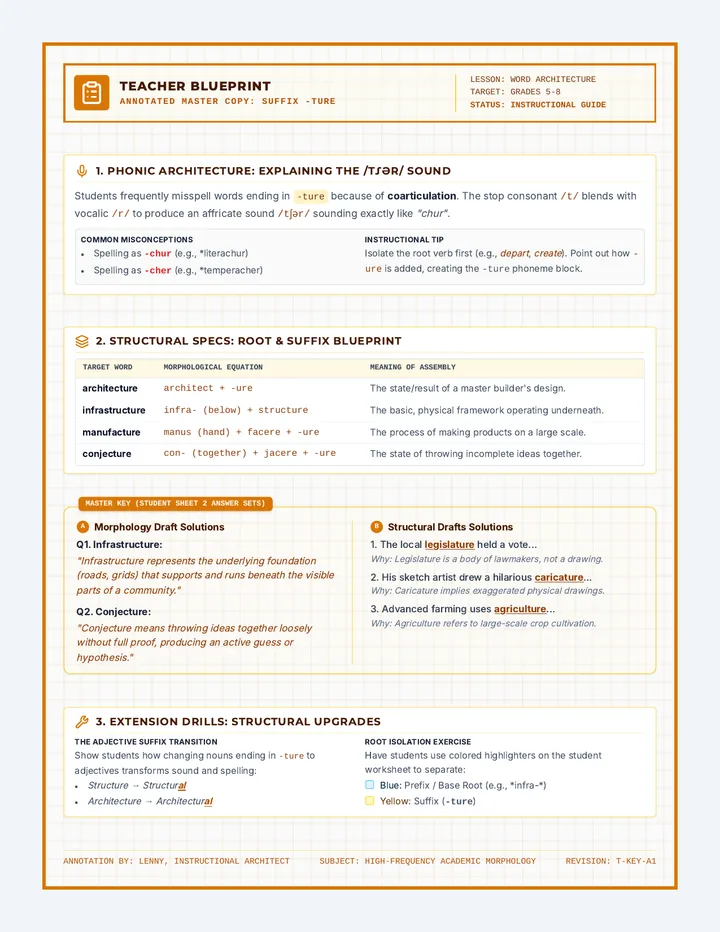
A student template for Lesson 5 where students create illustrated etymology cards for advanced vocabulary. Each card includes space for the word, its morphological breakdown, etymological history, definition, and illustration.
A one-page guide for parents on helping middle schoolers master vocabulary, featuring context clue strategies (IDEAS), Greek and Latin roots, and academic vocabulary tips.
A resource list for parents featuring standard-aligned discussion prompts for fiction and non-fiction, along with a curated list of free digital literacy tools.
A one-page guide for middle school parents explaining the shift in literacy expectations from elementary to middle school, with actionable habits and standards-aligned tips.
A set of three printable reading strategy bookmarks for middle school parents, providing quick prompts for before, during, and after reading, evidence-based questioning, and making connections.
A single-page book review worksheet where students can rate 'The Watsons Go to Birmingham – 1963', provide their own plot summary, and identify their favorite and least favorite moments. This version uses fixed-height elements and stable CSS to ensure reliability when printing.
A comprehensive answer key for teachers comparing the book and movie versions of 'The Watsons Go to Birmingham', featuring character changes, plot adjustments, and ending variations.
A single-page student worksheet featuring a category-based comparison table to analyze differences between 'The Watsons Go to Birmingham' novel and its movie adaptation. This version uses fixed-height elements to ensure reliability when printing.
A facilitation guide for teachers, providing a suggested lesson flow, discussion prompts, and strategies for addressing common student misconceptions about figurative language.
Teacher answer key for the Scene Study Worksheet, providing clear identifications and sample explanations for each figurative language example.
A practice worksheet where students identify simile, metaphor, personification, and hyperbole in sentences inspired by movies, music, and school life. Includes space for explanation of meaning.
An engaging slide deck introducing simile, metaphor, personification, and hyperbole using movie, music, and school-life examples. Features a cinematic theme with "Spot the FigLang" practice slides.
A poem drafting worksheet for students to curate their collected words and assemble their final 'found' poetry stanzas, including a reflection section.
A student field journal for the 'Stanza Scout' nature walk, featuring sections for sensory observations, noun/verb collection, and a visual artifact sketch area.
A visual slide presentation for 'The Stanza Scout' lesson, defining found poetry, outlining sensory scouting techniques, and providing guidelines for the nature walk and poem construction.
A detailed teacher's lesson plan for 'The Stanza Scout' poetry unit, including objectives, CCSS standards, required materials, and a step-by-step instructional guide.
A visual presentation for teaching Chapters 14 and 15 of *The Watsons Go to Birmingham—1963*, focusing on sensory analysis, character motivation, and the R.A.C.E. strategy.
A teacher's answer key and guide for the Chapter 14 and 15 analysis of *The Watsons Go to Birmingham—1963*, featuring exemplary R.A.C.E. responses and discussion prompts.
An exit ticket for Chapter 15 of *The Watsons Go to Birmingham—1963*, requiring students to explain Kenny's motivation for hiding in the Pet Hotel using the R.A.C.E. strategy.
An exit ticket for Chapter 14 of *The Watsons Go to Birmingham—1963*, prompting students to analyze the use of sound and silence to create mood using the R.A.C.E. strategy.
A facilitation guide and answer key for the Topic Sentence Architects lesson. It provides differentiated instructional focuses for WIDA level 3 and 4 students, sophisticated example responses, non-examples for teacher reference, and specific strategies for academic language growth.
A slide deck for introducing the concept of a two-part topic sentence (Topic + Clear Idea). It includes visual analogies, differentiated examples for WIDA levels 3 and 4, and sentence starters for Developing and Expanding learners.
A worksheet for WIDA level 3-4 students to practice writing topic sentences. It includes a visual formula, differentiated sentence starters for Developing and Expanding levels, and a graphic organizer for guided practice.
A completed model of the Pitch Perfect project to show students what a successful poster and paragraph look like, using a fictional "Ever-Cloud Pillow" as the example.
A comprehensive teacher's guide for the Pitch Perfect project, including lesson goals, facilitation tips, a detailed grading rubric, and differentiation strategies.
A clean, high-impact poster template designed for students to illustrate their product and write their persuasive pitch. Includes visual markers for rhetorical appeals and a structured layout.
A detailed planning worksheet to help students brainstorm their product, identify their target audience, and map out their rhetorical strategies before creating their final poster. Includes the pitch narrative draft section.
A comprehensive slide deck introducing the rhetorical triangle (ethos, pathos, logos) with modern examples, project requirements, and a model example of the "Ever-Cloud Pillow" project.
Teacher answer key for the Word Lab Guided Notes and Mastery Check, including proficiency scales and grading guides for Grade 6 NC standard RI 6.4. Revised to fit all content onto a single page for easier reference.