Wind Weavers Paired Test
Grade 3 Reading Language Arts
Paired Reading Assessment
Name:
Date:
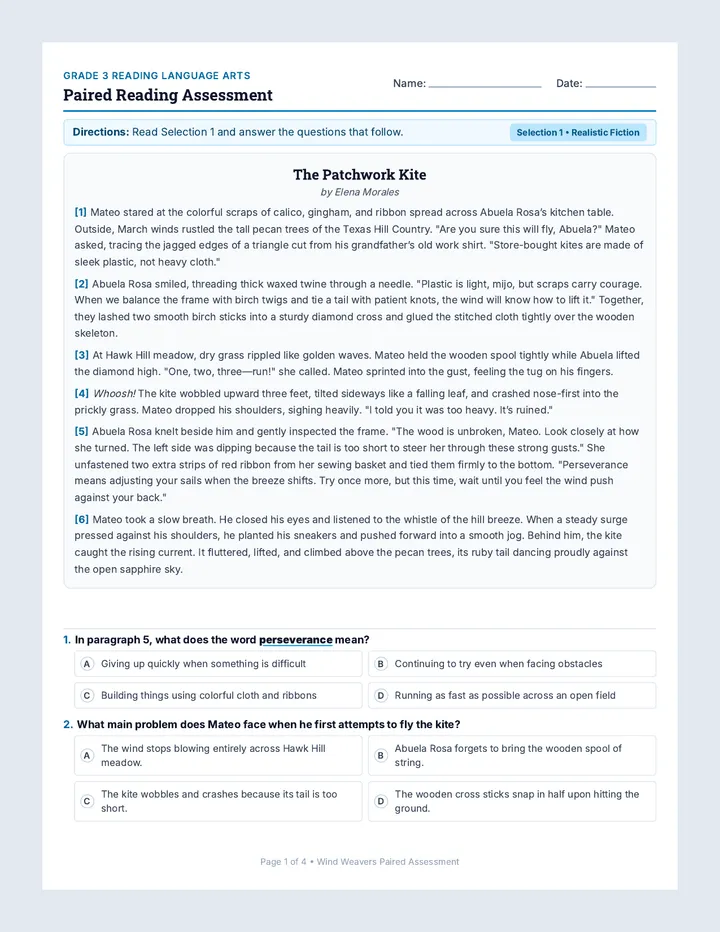
Directions: Read Selection 1 and answer the questions that follow.
Selection 1 • Realistic Fiction
The Patchwork Kite
by Elena Morales
[1]Mateo stared at the colorful scraps of calico, gingham, and ribbon spread across Abuela Rosa’s kitchen table. Outside, March winds rustled the tall pecan trees of the Texas Hill Country. "Are you sure this will fly, Abuela?" Mateo asked, tracing the jagged edges of a triangle cut from his grandfather’s old work shirt. "Store-bought kites are made of sleek plastic, not heavy cloth."
[2]Abuela Rosa smiled, threading thick waxed twine through a needle. "Plastic is light, mijo, but scraps carry courage. When we balance the frame with birch twigs and tie a tail with patient knots, the wind will know how to lift it." Together, they lashed two smooth birch sticks into a sturdy diamond cross and glued the stitched cloth tightly over the wooden skeleton.
[3]At Hawk Hill meadow, dry grass rippled like golden waves. Mateo held the wooden spool tightly while Abuela lifted the diamond high. "One, two, three—run!" she called. Mateo sprinted into the gust, feeling the tug on his fingers.
[4]Whoosh! The kite wobbled upward three feet, tilted sideways like a falling leaf, and crashed nose-first into the prickly grass. Mateo dropped his shoulders, sighing heavily. "I told you it was too heavy. It’s ruined."
[5]Abuela Rosa knelt beside him and gently inspected the frame. "The wood is unbroken, Mateo. Look closely at how she turned. The left side was dipping because the tail is too short to steer her through these strong gusts." She unfastened two extra strips of red ribbon from her sewing basket and tied them firmly to the bottom. "Perseverance means adjusting your sails when the breeze shifts. Try once more, but this time, wait until you feel the wind push against your back."
[6]Mateo took a slow breath. He closed his eyes and listened to the whistle of the hill breeze. When a steady surge pressed against his shoulders, he planted his sneakers and pushed forward into a smooth jog. Behind him, the kite caught the rising current. It fluttered, lifted, and climbed above the pecan trees, its ruby tail dancing proudly against the open sapphire sky.
- In paragraph 5, what does the word perseverance mean?
A Giving up quickly when something is difficult
B Continuing to try even when facing obstacles
C Building things using colorful cloth and ribbons
D Running as fast as possible across an open field
- What main problem does Mateo face when he first attempts to fly the kite?
A The wind stops blowing entirely across Hawk Hill meadow.
B Abuela Rosa forgets to bring the wooden spool of string.
C The kite wobbles and crashes because its tail is too short.
D The wooden cross sticks snap in half upon hitting the ground.
Page 1 of 4 • Wind Weavers Paired Assessment
Selection 1 (Continued) & Selection 2 Grade 3 Reading Assessment
- How does Abuela Rosa help Mateo become successful?
A She buys him a store-bought plastic kite from town.
B She diagnoses the kite's balance and encourages him to retry.
C She runs across the meadow while he sits in the grass.
D She sews a completely new kite using lighter cloth.
- How does the setting of Hawk Hill meadow influence the plot of the story?
A The open hill provides space and the rising breeze needed to lift the kite.
B The tall pecan trees trap the kite so Mateo cannot retrieve it.
C The rainy weather forces them to pack up their supplies quickly.
D The steep rocky cliffs prevent Mateo from finding a safe place to run.
- Which sentence best states the central theme or lesson of "The Patchwork Kite"?
A Store-bought toys are always more reliable than handmade toys.
B With patience and adjustments, initial failure can turn into success.
C Working alone is easier than accepting advice from older family members.
D Spring winds are too unpredictable for safe outdoor activities.
Directions: Now read Selection 2, a poem about a kite, and answer the questions.
Selection 2 • Poetry
Wind Dancer
by Julian Vance
Stanza 1
1 A diamond born of stick and thread,
2 Awakens from its grassy bed.
3 It feels the breathing of the skies,
4 And spreads its patchwork wings to rise.
Stanza 2
5 Up, up beyond the pecan boughs,
6 Above the barn and grazing cows,
7 It tugs my fingers, wild and bold,
8 A restless secret I must hold.
Stanza 3
9 With ribbon tail of crimson bright,
10 It loops and pirouettes in light,
11 A gallant diver in the blue,
12 Riding the gusts that tumble through.
Stanza 4
13 No heavy hands can keep it low;
14 It teaches my own feet to go
15 Leaping with joy across the hill,
16 Where daring hearts can climb at will.
- How is the poem "Wind Dancer" organized?
A It has four stanzas with four rhyming lines each (AABB pattern).
B It has three stanzas that tell a story without using any rhymes.
C It is written as one long single stanza without any line breaks.
D It contains six short stanzas that describe different seasons.
Page 2 of 4 • Wind Weavers Paired Assessment
Selection 2 (Poem) & Paired Questions Grade 3 Reading Assessment
- In lines 9–10, the phrase "With ribbon tail of crimson bright, / It loops and pirouettes in light" appeals mainly to the reader's sense of —
A hearing, by describing the sound of whistling string
B sight, by creating a vivid picture of colorful, dancing movement
C touch, by showing how cold the wind feels on the skin
D smell, by describing the sweet scent of hillside clover
- Read line 3 from the poem:
"It feels the breathing of the skies,"
The poet uses personification in this line to show that the wind —
A is an invisible force that seems alive, moving with energy
B is freezing cold and difficult for animals to endure
C is too gentle and still to lift anything off the meadow
D is angry because the kite has entered its territory
- In Stanza 4 (lines 13–16), how does the speaker feel while holding the kite?
A Nervous that the string will snap and lose the kite forever
B Tired and bored after standing in the field for several hours
C Inspired and joyful, feeling connected to the kite’s flight
D Disappointed that the kite did not fly as high as expected
Paired Questions: Use BOTH "The Patchwork Kite" and "Wind Dancer" to answer questions 10–11.
Across Both Texts
- How are the main themes of BOTH "The Patchwork Kite" and "Wind Dancer" similar?
A Both show that spending money on store items is better than making them.
B Both express that simple handmade creations can bring deep joy and freedom.
C Both demonstrate that high winds make flying toys dangerous and unsafe.
D Both suggest that farm animals are disturbed by objects soaring in the sky.
- How is Mateo’s experience in the story DIFFERENT from the speaker’s experience in the poem?
A Mateo experiences doubt and must solve a problem first, while the poem focuses on celebration.
B Mateo flies his kite in a city park, while the speaker flies a kite on a tall mountain.
C Mateo builds his kite alone, while the speaker works alongside a grandparent.
D Mateo's kite never flies successfully, while the speaker's kite soars instantly.
Page 3 of 4 • Wind Weavers Paired Assessment
Selection Synthesis • Constructed Response Grade 3 Reading Assessment
Item 12 • Short Constructed Response (SCR) 2 Points Max • TEKS 3.6E & 3.7C
In "The Patchwork Kite," Abuela Rosa tells Mateo that "scraps carry courage." In "Wind Dancer," the speaker says the kite teaches "daring hearts [to] climb at will."
- Explain how BOTH selections show that patience and courage help someone achieve something meaningful. Write your response in the box below and include text evidence from BOTH texts to support your answer.
Student Self-Checklist
- I clearly stated how courage/patience brings success.
- I gave specific proof from "The Patchwork Kite".
- I gave specific proof from the poem "Wind Dancer".
- I checked capitalization, spelling, and periods.
STAAR 2-Point Rubric Guide
Score 2: Complete explanation connecting courage and patience to success with accurate text evidence from both selections.
Score 1: Partial explanation or evidence cited from only one selection.
Score 0: Response is inaccurate, vague, or contains no relevant text evidence.
Page 4 of 4 • Wind Weavers Paired Assessment
Wind Weavers Answer Guide
Teacher Resource • STAAR & TEKS Alignment
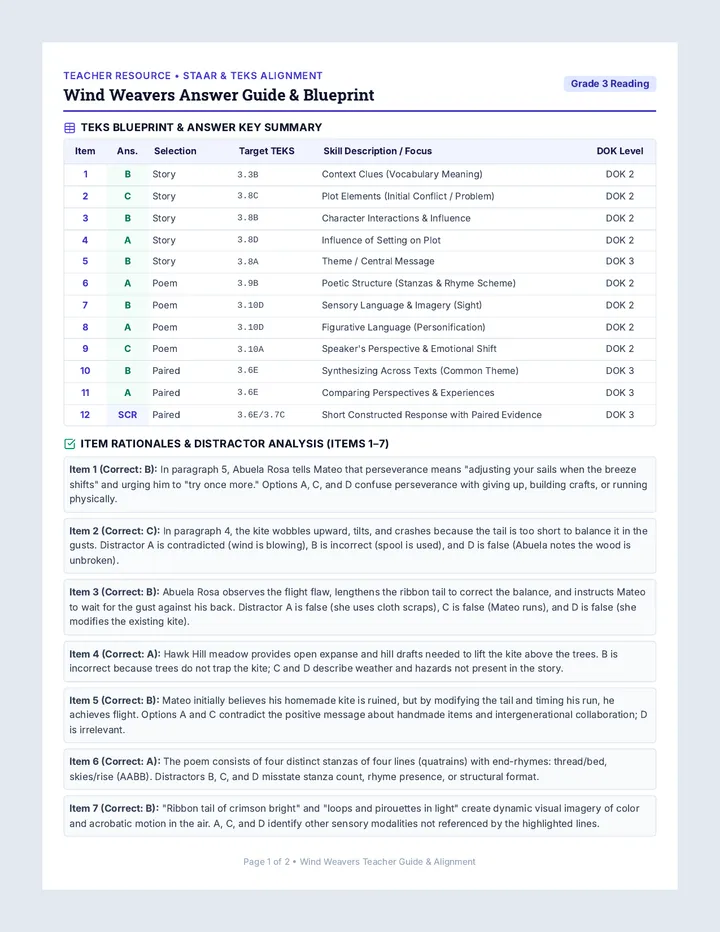
Wind Weavers Answer Guide & Blueprint
Grade 3 Reading
TEKS Blueprint & Answer Key Summary
| Item |
Ans. |
Selection |
Target TEKS |
Skill Description / Focus |
DOK Level |
| 1 |
B |
Story |
3.3B |
Context Clues (Vocabulary Meaning) |
DOK 2 |
| 2 |
C |
Story |
3.8C |
Plot Elements (Initial Conflict / Problem) |
DOK 2 |
| 3 |
B |
Story |
3.8B |
Character Interactions & Influence |
DOK 2 |
| 4 |
A |
Story |
3.8D |
Influence of Setting on Plot |
DOK 2 |
| 5 |
B |
Story |
3.8A |
Theme / Central Message |
DOK 3 |
| 6 |
A |
Poem |
3.9B |
Poetic Structure (Stanzas & Rhyme Scheme) |
DOK 2 |
| 7 |
B |
Poem |
3.10D |
Sensory Language & Imagery (Sight) |
DOK 2 |
| 8 |
A |
Poem |
3.10D |
Figurative Language (Personification) |
DOK 2 |
| 9 |
C |
Poem |
3.10A |
Speaker's Perspective & Emotional Shift |
DOK 2 |
| 10 |
B |
Paired |
3.6E |
Synthesizing Across Texts (Common Theme) |
DOK 3 |
| 11 |
A |
Paired |
3.6E |
Comparing Perspectives & Experiences |
DOK 3 |
| 12 |
SCR |
Paired |
3.6E/3.7C |
Short Constructed Response with Paired Evidence |
DOK 3 |
Item Rationales & Distractor Analysis (Items 1–7)
Item 1 (Correct: B): In paragraph 5, Abuela Rosa tells Mateo that perseverance means "adjusting your sails when the breeze shifts" and urging him to "try once more." Options A, C, and D confuse perseverance with giving up, building crafts, or running physically.
Item 2 (Correct: C): In paragraph 4, the kite wobbles upward, tilts, and crashes because the tail is too short to balance it in the gusts. Distractor A is contradicted (wind is blowing), B is incorrect (spool is used), and D is false (Abuela notes the wood is unbroken).
Item 3 (Correct: B): Abuela Rosa observes the flight flaw, lengthens the ribbon tail to correct the balance, and instructs Mateo to wait for the gust against his back. Distractor A is false (she uses cloth scraps), C is false (Mateo runs), and D is false (she modifies the existing kite).
Item 4 (Correct: A): Hawk Hill meadow provides open expanse and hill drafts needed to lift the kite above the trees. B is incorrect because trees do not trap the kite; C and D describe weather and hazards not present in the story.
Item 5 (Correct: B): Mateo initially believes his homemade kite is ruined, but by modifying the tail and timing his run, he achieves flight. Options A and C contradict the positive message about handmade items and intergenerational collaboration; D is irrelevant.
Item 6 (Correct: A): The poem consists of four distinct stanzas of four lines (quatrains) with end-rhymes: thread/bed, skies/rise (AABB). Distractors B, C, and D misstate stanza count, rhyme presence, or structural format.
Item 7 (Correct: B): "Ribbon tail of crimson bright" and "loops and pirouettes in light" create dynamic visual imagery of color and acrobatic motion in the air. A, C, and D identify other sensory modalities not referenced by the highlighted lines.
Page 1 of 2 • Wind Weavers Teacher Guide & Alignment
Item Rationales (8–11) & SCR Exemplar Guide Grade 3 Reading Assessment
Item Rationales (Items 8–11)
Item 8 (Correct: A): Attributing "breathing" to the skies gives the atmospheric breeze lifelike energy, depicting the wind as an active partner that lifts the kite. Distractors B, C, and D assign inaccurate negative or static traits to the wind.
Item 9 (Correct: C): In Stanza 4, the kite teaches the speaker's feet to go "leaping with joy" and inspires "daring hearts [to] climb at will." Options A, B, and D convey fatigue, fear, or disappointment, contradicting the speaker's exhilaration.
Item 10 (Correct: B): Both selections celebrate the joy, wonder, and liberation found in a simple handmade kite constructed of sticks and scrap fabric. Distractors A, C, and D promote commercialism or danger not present in either text.
Item 11 (Correct: A): Mateo faces doubt, a crash, and problem-solving before succeeding, whereas the poem presents the soaring kite as an already jubilant, fluid experience. Distractors B, C, and D invent false factual differences.
Item 12 Constructed Response Rubric & Exemplars (TEKS 3.6E & 3.7C)
Score Point 2 (Full Credit Exemplar) Complete & Supported
"Both selections show that having patience and courage helps you succeed. In 'The Patchwork Kite,' Mateo gets frustrated when his kite crashes, but Abuela teaches him that 'scraps carry courage' and helps him add ribbons to fix the tail so it can finally fly. In 'Wind Dancer,' the speaker shows courage because the kite 'teaches my own feet to go leaping with joy' where 'daring hearts can climb.' Both texts prove that trying again and not giving up lets you reach high goals."
Teacher Analysis: The student clearly answers both parts of the prompt, explains the central theme across both selections, and integrates accurate textual evidence from both the story and the poem.
Score Point 1 (Partial Credit) Single-Text Evidence
"Patience helps you succeed because Mateo didn't quit when the kite fell. Abuela tied ribbons to the tail and Mateo waited for the breeze to push his back, then it flew high over the pecan trees."
Teacher Analysis: Student provides a strong explanation and evidence for "The Patchwork Kite," but omits any evidence or analysis from "Wind Dancer."
Score Point 0 (No Credit) Vague / Unsupported
"Both texts are about kites flying in the sky on a windy day."
Teacher Analysis: Simply states a general topic without addressing patience or courage, and includes no evidence from either selection.
Targeted Reteach & Intervention Strategies
• Items 1–5 (Fiction TEKS): Use a story arc graphic organizer to model how character reactions to conflict reveal theme (3.8A/C).
• Items 6–9 (Poetry TEKS): Have students annotate rhyming pairs and highlight sensory phrases that create mental pictures (3.9B, 3.10D).
• Items 10–12 (Synthesis TEKS): Guide students with a Venn diagram comparing character obstacles vs. feelings across both genres (3.6E).
Page 2 of 2 • Wind Weavers Teacher Guide & Alignment