Lenny.com
Explore
Create
ActivitiesNewMathEnglish Language ArtsScience & EngineeringSocial StudiesGlobal LanguagesHealth & Physical EducationSpecial EducationCounseling & Life SkillsArts & CreativityESL
Lenny.com
Lenny.com
Explore
Create
ActivitiesNewMathEnglish Language ArtsScience & EngineeringSocial StudiesGlobal LanguagesHealth & Physical EducationSpecial EducationCounseling & Life SkillsArts & CreativityESL
Lenny.com
Lenny.com

Solutions

Lenny for EducatorsLenny for SchoolsLenny for Districts

Product

ExploreSign inCreateSupportAbout

Resources

Getting startedMTSS Acceleration Program

© 2026 Lenny Learning Inc.

TermsPrivacyAccessibility
LinkedInInstagramX
Lenny
English Language ArtsPhonics & Reading FoundationsLetter IdentificationLearn Letters A-ZLowercase and Uppercase LettersConsonants and VowelsLetter-Sound AssociationsLetter-Sound Associations: LowercaseLetter-Sound Associations: UppercaseBeginning and Ending SoundsRhymingBlending And SegmentingShort VowelsShort Vowel SoundsConsonant BlendsConsonant DigraphsBlends, Digraphs, and TrigraphsDigraphs, Blends, and Silent LettersLong Vowel SoundsLong Vowel PatternsShort and Long VowelsShort and Long Vowel PatternsSilent EVowel SoundsVowel TeamsR-Controlled VowelsDiphthongs: Oi, Oy, Ou, OwVariant VowelsVariant, Diphthong, And R Vowel PatternsSoft G And CSight WordsIrregular WordsWord RecognitionSyllablesSyllable TypesTwo-Syllable WordsMultisyllabic WordsPhoneme ManipulationDecodable TextsVocabularyAction WordsQuestion WordsNouns and AdjectivesClassify WordsCompound WordsSynonyms and AntonymsHomophonesHomophones and HomonymsShades of MeaningContext CluesPrefixes and SuffixesGreek and Latin RootsAnalogiesIdioms and AdagesForeign Words and ExpressionsWord Choice and UsageReference SkillsReading ComprehensionRead-Along Literary TextsRead-Along Informational TextsReality vs. FictionStory ElementsCharacterSequenceMain IdeaCause And EffectCompare And ContrastReading StrategiesText StructureAuthor's PurposeAuthor's Purpose And ToneAuthor's PerspectivePoint Of ViewThemeInference And ThemeInference And AnalysisPoetry ElementsLiterary DevicesAnalyzing LiteratureAnalyzing Informational TextsComparing TextsAudience, Purpose, And ToneBusiness DocumentsNovel StudyNonfiction Book StudyGrammar & MechanicsSentencesNounsVerbsAdjectivesPronounsCapitalizationPunctuationContractionsConjunctionsPrepositionsArticlesAdjectives And AdverbsVerb TypesVerb TensePronouns And AntecedentsPronoun TypesSubject-Verb AgreementDirect And Indirect ObjectsSentences, Fragments, And Run-OnsPhrases And ClausesCommasSemicolons, Colons, And CommasDashes, Hyphens, And EllipsesSpellingAbbreviationsFormattingVerb Tense And MoodMisplaced ModifiersWritingDescriptive DetailsCreative WritingOpinion WritingTopic SentencesOrganizing WritingLinking WordsSentence VarietyIntroductions And ConclusionsPersuasive And Opinion WritingExpository WritingPersuasive StrategiesDeveloping And Supporting ArgumentsTopic Sentences And Thesis StatementsSummarizingResearch SkillsEditing And RevisingActive And Passive Voice=Writing Clearly And ConciselyDebate & Public SpeakingPublic Speaking BasicsPersuasive TechniquesClaims and EvidenceTypes of ArgumentsReasoning TypesLogical FallaciesTopic ResearchOrganizing EvidenceDebate Speech OrganizationAttacking and Defending ArgumentsClash and EngagementImpact CalculusQuestioning and Cross-ExaminationCritical ThinkingInformal LogicFormal LogicInductive Reasoning

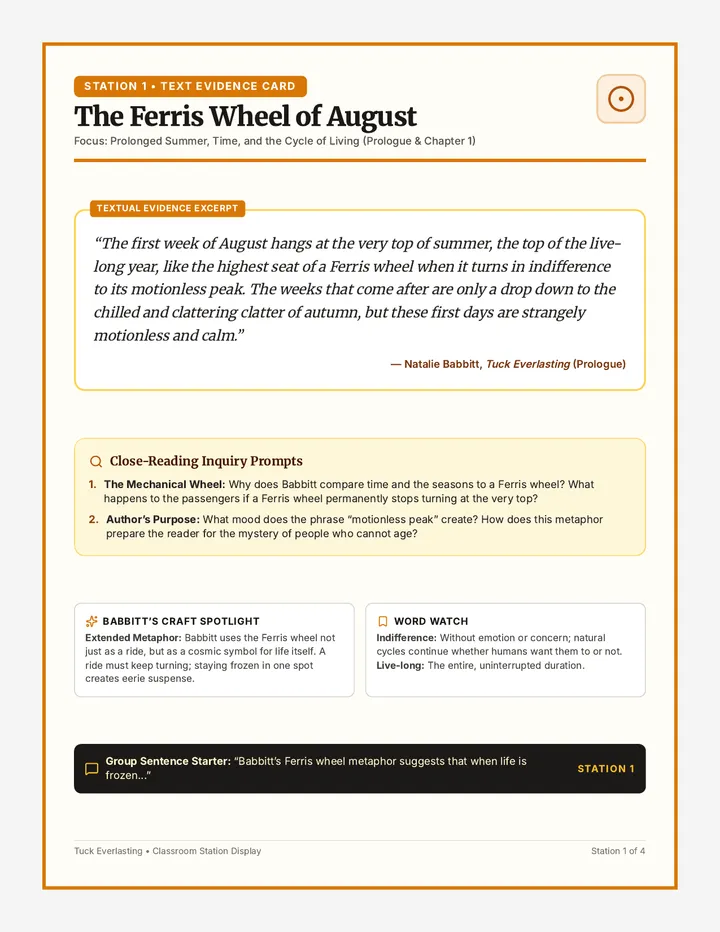
Wheel of August

A collaborative 6th-grade ELA lesson analyzing chapters 1-4 of *Tuck Everlasting*. Students investigate Natalie Babbitt's craft, motifs, and contrasting imagery to determine the author's purpose and how it introduces central themes of time, mortality, and change.

KMKierstyn Murley

Wheel of August

A collaborative 6th-grade ELA lesson analyzing chapters 1-4 of *Tuck Everlasting*. Students investigate Natalie Babbitt's craft, motifs, and contrasting imagery to determine the author's purpose and how it introduces central themes of time, mortality, and change.

KMKierstyn Murley

Motif: Confinement & Growth

“‘I’m not being watched every minute... I want to do something that would make some kind of difference in the world.’ The toad blinked, calm and dry.”

1. Why does Winnie confess her desire to run away to a toad rather than a family member? What does the toad represent?

2. How does Winnie’s feeling of being “trapped” mirror the Tucks’ condition, even though their lives are opposites?

Group Synthesis: Determining Babbitt’s Purpose & Perspective (RL.6.6)

Prompt: Synthesizing all four stations, what is Natalie Babbitt’s perspective on the cycle of life, and what is her purpose in opening the novel with images of motionless wheels, locked gates, and frozen lives? State your group’s claim and support it with two specific pieces of evidence from Chapters 1–4.

Tuck Everlasting • Collaborative Text Analysis Page 2 of 2

Facilitation Notes & Assessment Exemplars

Station Probing Prompts, Rubric Criteria & Differentiation

RL.6.6 Evaluation Guide

Station Facilitation & Probing Questions (4 Stations)

Station 1 (Ferris Wheel):

Prompt: “What happens if a Ferris wheel stops turning? Are riders enjoying the view, or are they trapped? How does this connect to August?”

Station 2 (Cottage vs. Wood):

Prompt: “Look at the word ‘touch-me-not.’ Who is trying to keep control? What is hidden in the wood that doesn't need fences to protect itself?”

Station 3 (Tuck's Heaven Dream):

Prompt: “Why does Tuck smile when dreaming of heaven? In heaven, do people live forever or move on? Why would someone who cannot die envy heaven?”

Station 4 (Winnie & The Toad):

Prompt: “Why does Winnie want to make a difference? What is the difference between living behind a fence and making an impact on the world?”

Exemplar RL.6.6 Response (Proficient / Advanced) Score: 4/4

“Natalie Babbitt’s purpose in Chapters 1–4 is to challenge the reader’s assumption that living forever is wonderful. Instead, she shows that life requires movement, growth, and change. She conveys this first through the Ferris wheel metaphor in Chapter 1, explaining that summer ‘hangs at the very top’ like a paused wheel, warning the reader that freezing time creates an unnatural pause. Furthermore, in Chapter 2, she portrays Angus Tuck smiling only when he dreams of heaven, demonstrating that having unlimited time without aging feels like a trap rather than a gift. Through these symbols and character desires, Babbitt prepares readers to understand that mortality gives life its value.”

Targeted Differentiation Strategies

Striving Readers / ELL

Provide pre-highlighted excerpts in the novel. Offer sentence frames: “Babbitt compares _____ to _____ in order to show that _____.”

On-Grade Learners

Encourage students to analyze the contrasting diction between the "proud, touch-me-not" Foster yard and the "ancient, breathing" ash trees in Treegap wood.

Advanced / Extensions

Challenge students to analyze the Man in the Yellow Suit (Ch. 4) as a thematic foil: How does greed for immortality contrast with the Tucks' exhaustion?

Common Student Misconception to Address

Misconception: Students often mistake the author’s purpose as simply “to tell an entertaining mystery about a magic spring.”
Correction: Emphasize that Babbitt is writing an allegorical fable. She uses the fantasy element of the spring to explore a philosophical truth: that endless life without change is stagnant.

Tuck Everlasting Instructional Guide • Standard RL.6.6 Page 2 of 2

The Wisdom of the Cows:

Babbitt’s Craft Spotlight

Juxtaposition: By placing a manicured lawn with an iron gate right against an untamed forest, Babbitt contrasts human obsession with control against nature’s spontaneous, wild freedom.

Word Watch

Touch-me-not: Refers to both an aloof personality and a plant whose pods burst if touched; signals unfriendliness.
Veered: Suddenly changed direction or path.

Group Sentence Starter: “By making the Foster cottage feel like a prison, Babbitt conveys that...”

Station 2

Tuck Everlasting • Classroom Station Display Station 2 of 4

STATION 3 • TEXT EVIDENCE CARD

The Tuck Family’s Condition

Focus: Immortality, Heaviness, and the Music Box (Chapter 2)

Textual Evidence Excerpt

“‘What’s the good of having all that time if you can’t enjoy it?’ Tuck asked... He was dreaming he was in heaven and had never heard of Treegap... Mae smiled. She reached into her pocket and brought out a little music box painted with flowers... The sweet notes tinkled out into the quiet room.”

— Natalie Babbitt, Tuck Everlasting (Chapter 2)

Close-Reading Inquiry Prompts

  1. The Heaven Dream: Most people think of heaven as eternal life, but for Angus Tuck, heaven means finally being able to die and move on. What does this paradox reveal about his perspective?

  2. The Music Box Symbol: Mae Tuck carries her painted music box everywhere she goes. Why is music so comforting to a family whose time has stood still for 87 years?

Babbitt’s Craft Spotlight

Character Foils & Subversion: Authors usually portray immortality as a triumphant superpower. Babbitt subverts this trope by depicting the Tucks as weary, melancholic, and burdened by endless days.

Word Watch

Immortality: Endless life; never dying.
Resignation: Accepting an unchangeable fate with quiet patience rather than joy.

Group Sentence Starter: “Tuck’s dream of heaven shows that Babbitt views death not as an enemy, but as...”

Station 3

Tuck Everlasting • Classroom Station Display Station 3 of 4

STATION 4 • TEXT EVIDENCE CARD

Winnie & The Toad

Focus: Confinement, Rebellion, and the Desire for Growth (Chapters 3 & 4)

Textual Evidence Excerpt

“Winnie Foster sat on the grass just inside the fence and watched a large toad... ‘See?’ said Winnie to the toad. ‘I’m not being watched every minute... It’d be better if I had a brother or a sister, then there’d be someone else to watch... I want to do something that would make some kind of difference in the world.’”

— Natalie Babbitt, Tuck Everlasting (Chapter 3)

Close-Reading Inquiry Prompts

  1. The Fence Barrier: Winnie sits just inside the gate talking to a creature that sits outside. What does the iron fence physically and emotionally represent to a ten-year-old girl?

  2. Making a Difference: Winnie declares she wants to make a difference in the world. How does her desire to grow and act connect with the book's central theme that life cannot stand still?

Babbitt’s Craft Spotlight

Internal Conflict through Dialogue: Winnie speaks aloud to an impassive toad because she cannot communicate her yearning to her rigid parents. The toad serves as a silent mirror of nature.

Word Watch

Confined: Restrained within limits; prevented from moving or growing freely.
Impudence: Behavior that is bold, disrespectful, or daring to challenge rules.

Group Sentence Starter: “Winnie’s conversation with the toad reveals that Babbitt believes human beings need...”

Station 4

Tuck Everlasting • Classroom Station Display Station 4 of 4
You might also like

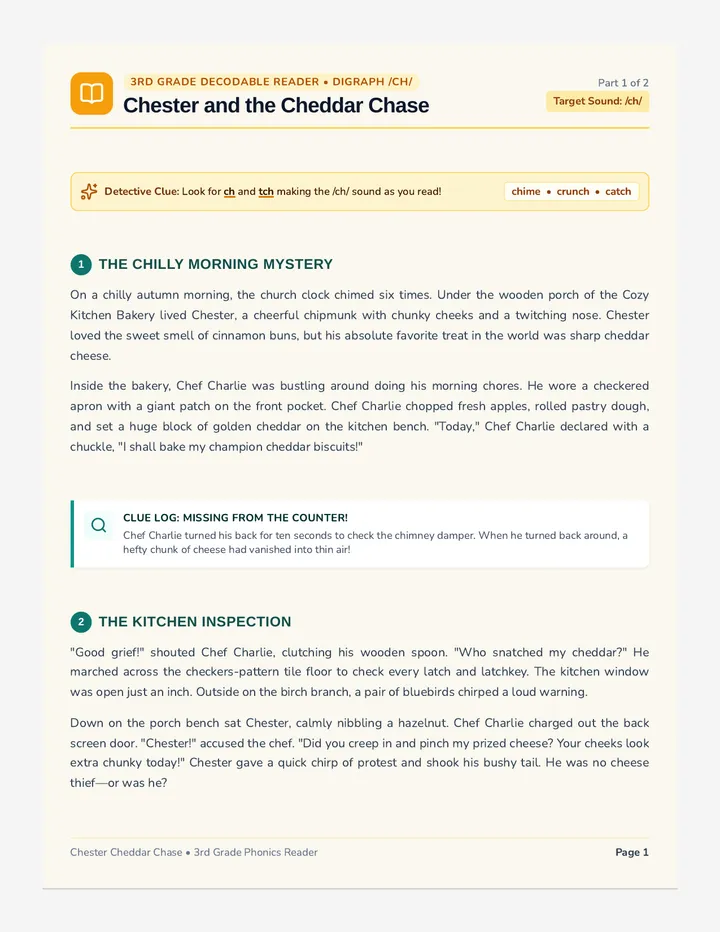
Chester Cheddar Chase Story

Chester Mystery Unit

A comprehensive multi-day third-grade reading, phonics, and writing unit focused on the digraph /ch/, narrative story progression, and mystery dialogue conventions.

V

victoria.lesniak

7
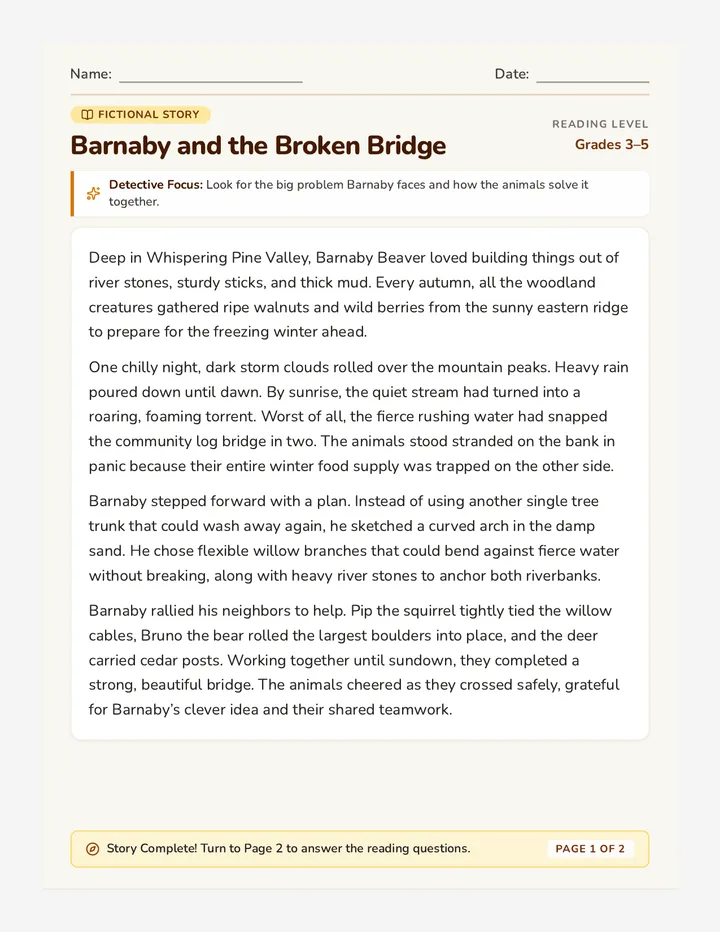
Barnaby Bridge Fiction Activity

Story Sleuths

A targeted two-part reading comprehension lesson featuring one fictional narrative and one informational nonfiction passage. Both texts focus on identifying the main idea, supporting details, and problem-and-solution text structures with high-legibility, large-print formatting.

JA

Jamie Asack

3
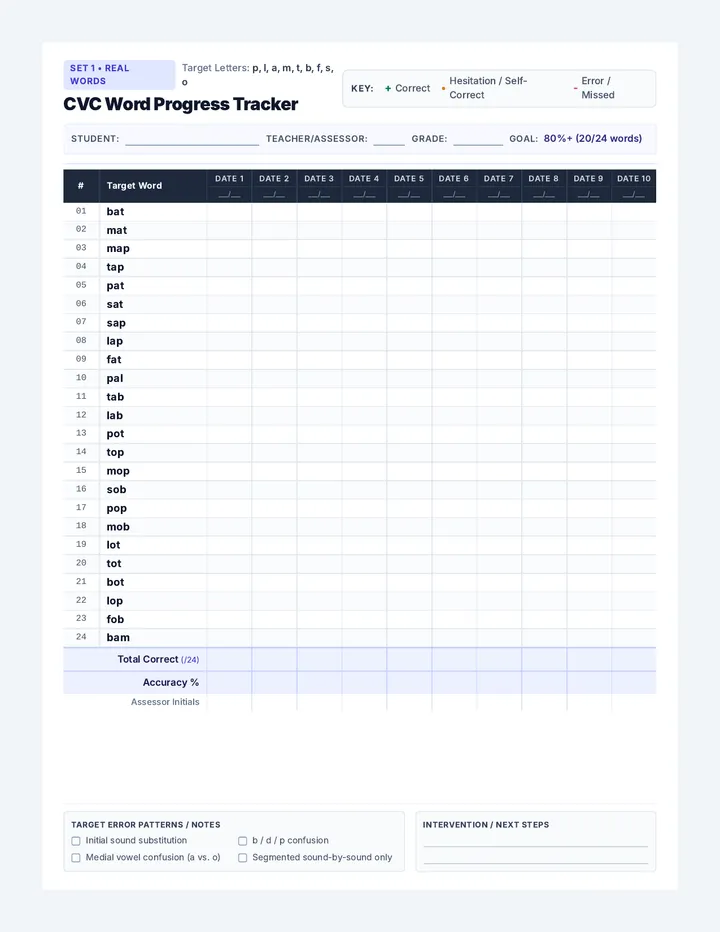
CVC Blending Progress Tracker

CVC Blending Progress Tracker

A comprehensive single-page CVC progress monitoring tracking sheet for 24 real words across 10 assessment dates, featuring student details, a scoring key, alternating row tracking, and summary score rows.

R

RENEE.ALGER

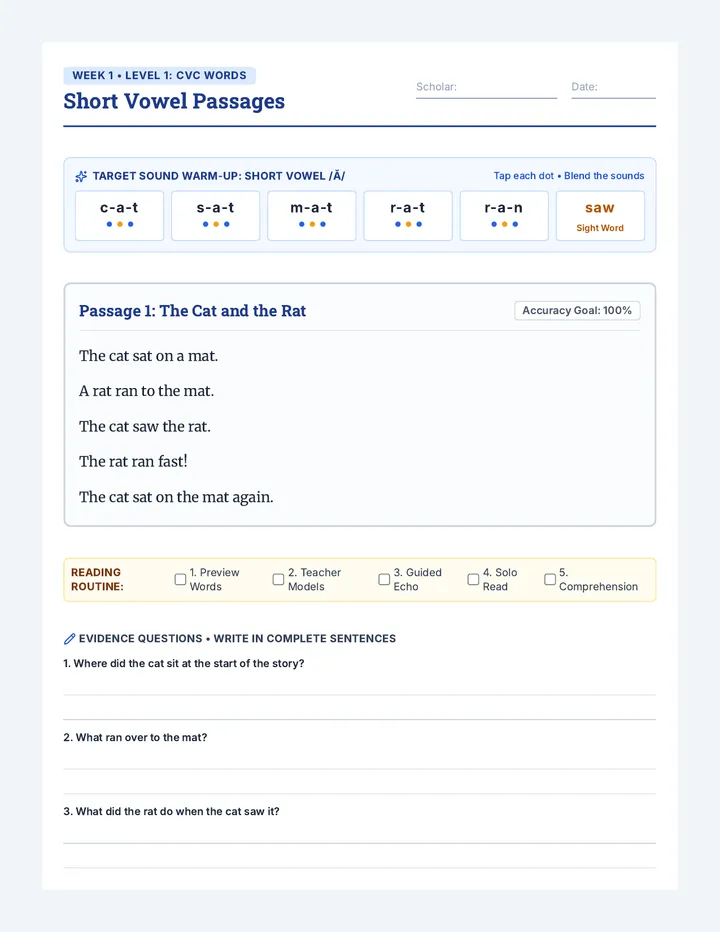
Short Vowel Passages Worksheet

Phonics Scholar Pathway

An eight-week tier-two reading intervention sequence guiding elementary scholars from decodable CVC short vowels through complex multisyllabic words and fluent comprehension. Each week provides structured decodable passages, targeted word banks, text-dependent comprehension questions, and systematic fluency tracking.

B

Bhoovaragavaswamym

8
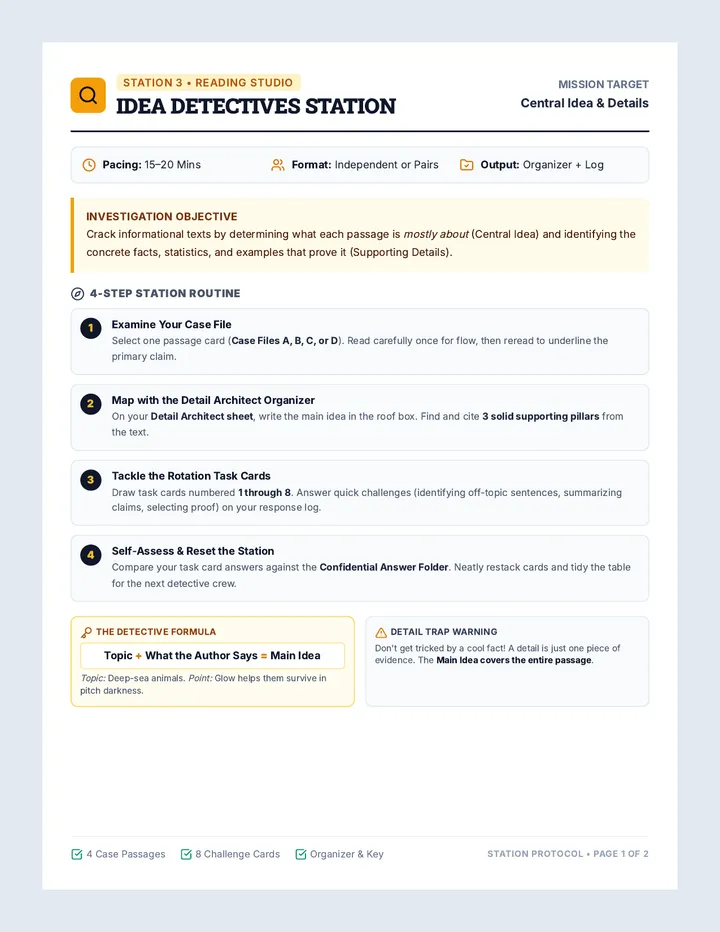
Idea Detectives Station Kit

Idea Detectives

A comprehensive literacy station where students analyze informational texts to uncover central ideas and supporting evidence. Features engaging detective-themed station directions, rotation challenge cards, graphic organizers, and self-checking keys.

BA

Becky Arkins

4
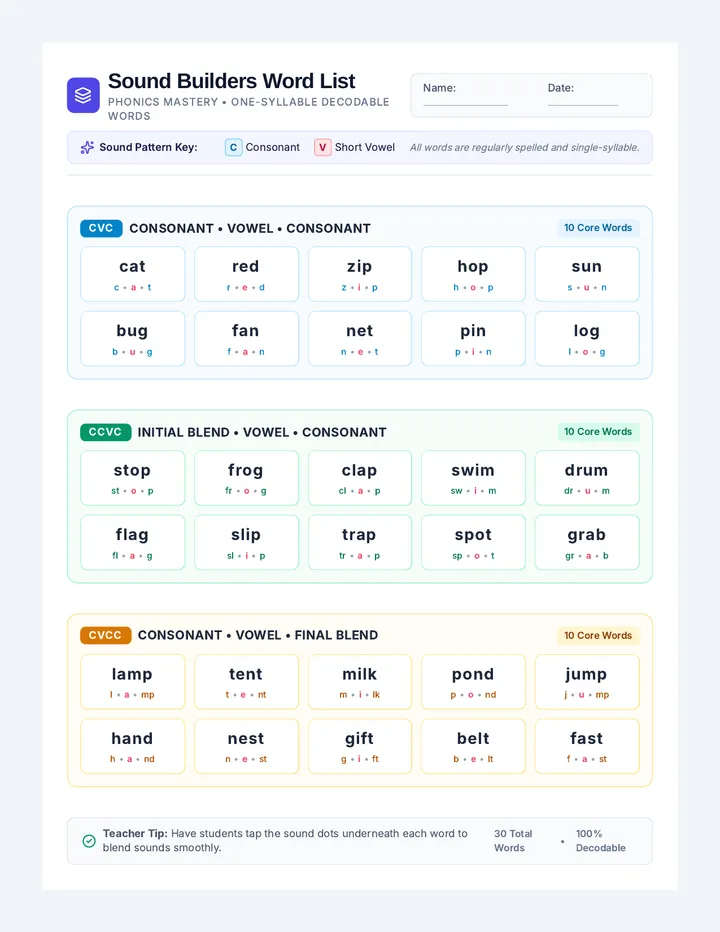
Sound Builders Word List

Sound Builders Word List

A grade-level phonics reference and practice list featuring 10 decodable words for each foundational pattern: CVC, CCVC, and CVCC. Features sound mapping cues and clear consonant-vowel structure breakdowns for early literacy instruction.

AW

Arielle West

Fluency Flight Tracker Sheet

Fluency Spark Academy

A comprehensive 4-week balanced fluency curriculum designed for 4th-grade students needing targeted support in accuracy, pacing, phrasing, and expression. Structured around quick 5-to-10 minute daily partner and whole-group routines for 20 students, featuring engaging high-interest texts and student self-tracking systems.

KM

Kelly Messer

9
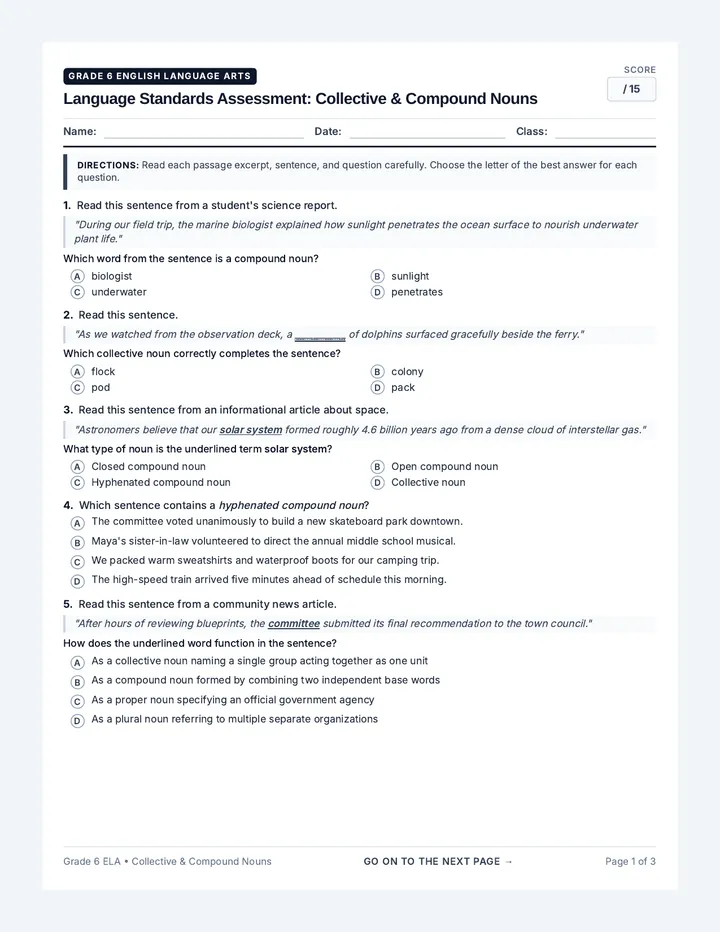
Noun Detectives Quiz

Noun Mastery

A comprehensive 6th-grade grammar assessment unit focusing on collective and compound nouns, featuring NYS ELA exam-aligned questions and an educator reference key.

A

aglenn

2
Wheel of August Station Cards

Wheel of August Station Cards

A four-page printable set of large classroom station display cards for *Tuck Everlasting* chapters 1-4. Features primary text excerpts, close-reading lenses, craft spotlights, vocabulary definitions, and group discussion sentence starters for each of the four stations.

KM

Kierstyn Murley

Syllable Division Slides

Word Cipher Academy

A targeted upper-elementary and middle school phonics intervention sequence designed to decode multisyllabic academic words through syllable division, advanced vowel teams, and morphemic analysis. Structured with a mature codebreaking theme to engage older striving readers without feeling juvenile.

Lenny Avatar
Lenny
9
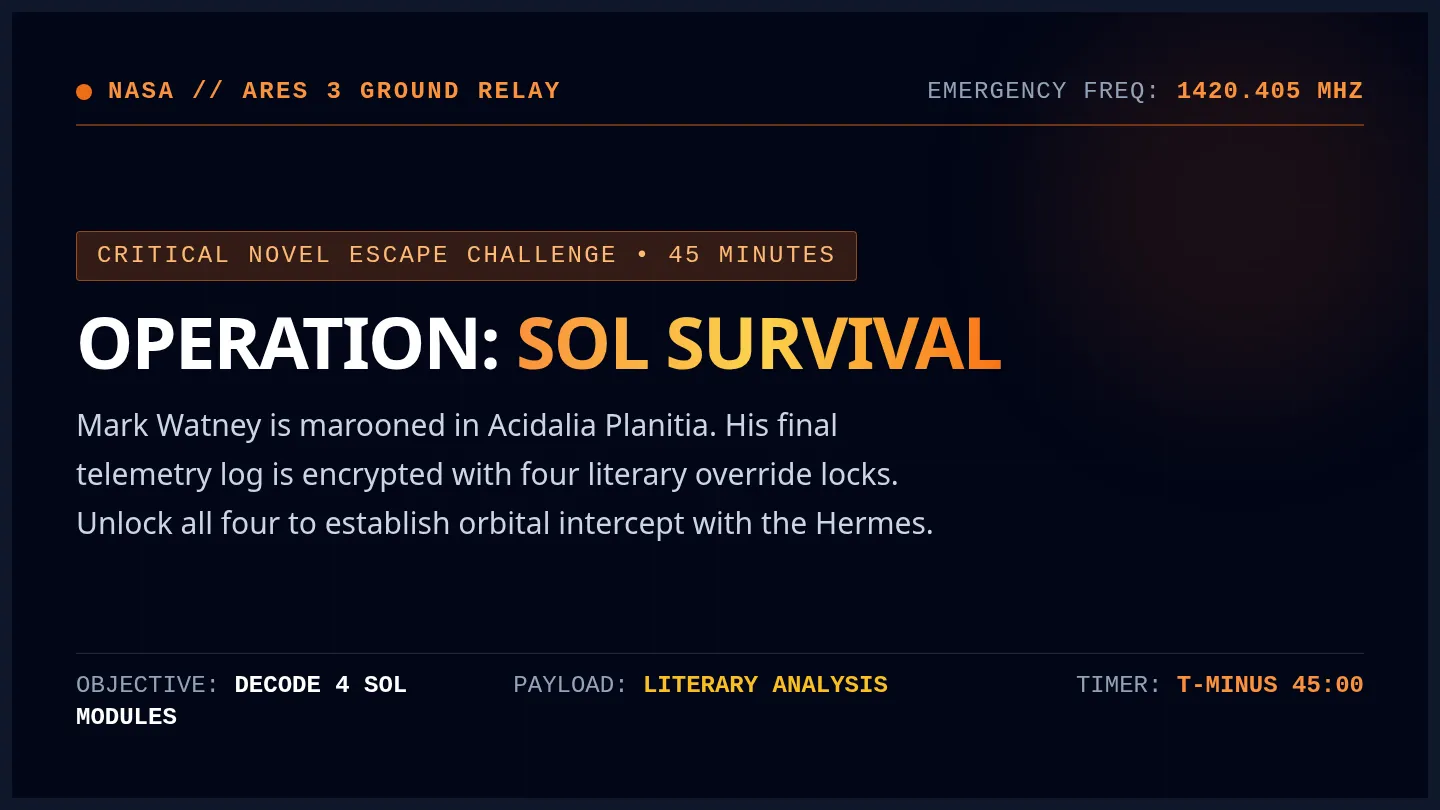
Ares Protocol Briefing Slides

Ares Escape Mission

A high-stakes 45–60 minute cooperative escape room challenge reviewing Andy Weir's 'The Martian'. High school English students analyze epistolary voice, conflict types, thematic motifs, and characterization to decode emergency override sequences and secure Mark Watney's orbital rendezvous.

MC

Makaela Carias

3
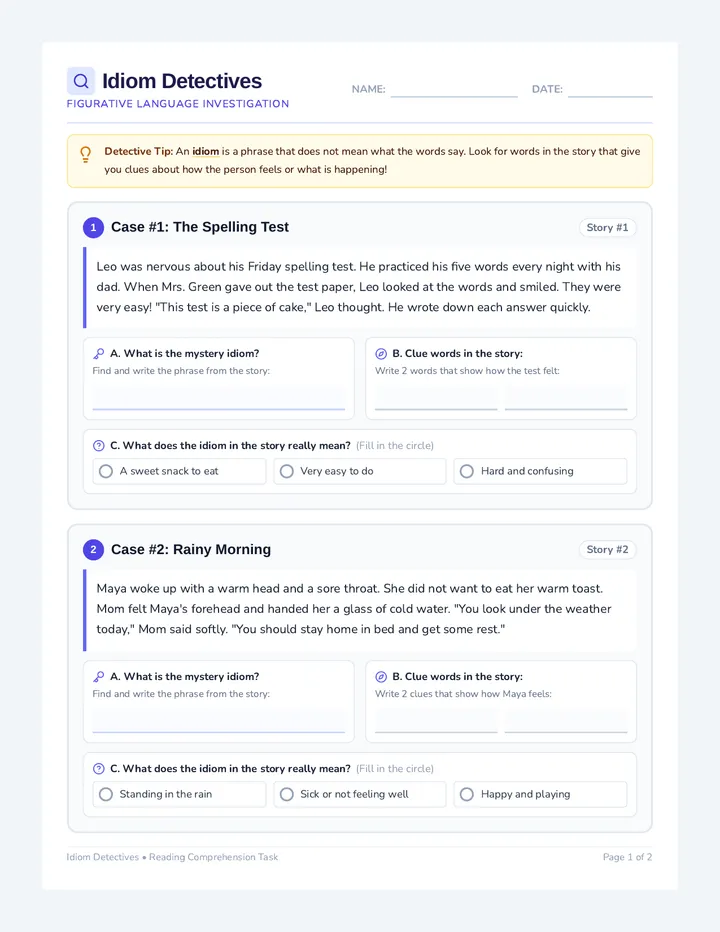
Idiom Detectives Worksheet

Idiom Detectives Worksheet

A 2-page printable reading worksheet designed for 6th grade students with autism and language impairment reading at a 2nd grade level. Features three short, decodable stories containing common idioms without any visual highlighting, requiring students to independently locate the figurative phrase, identify context clues, and select the real meaning.

VD

Victoria Dinjian