Topic Detectives Teacher Guide Grade 2 ELA • Standard RI.2.2
Topic Detectives: Teacher Guide
Small Group + Follow-Up
3 × 15-Min Activities
Standard RI.2.2: Identify the main topic of a multi-paragraph text as well as the focus of specific paragraphs within the text.
Teacher Tip: After each 15-minute small group, send students back to their seats with Page 3 (Independent Follow-Up) of that activity packet—scaffolded for students just beginning to tell topics from details.
Activity 1: Bug Safari Worksheet (15 Min)
Guided Highlight & Map
Materials: Bug Safari Worksheet (Pages 1–2 for small group; Page 3 for independent follow-up).
Min 1–4: Launch & Read
Preview Amazing Backyard Bugs . Ask: "What will the whole text be about?" Choral-read Paragraph 1 together.
Min 5–10: Clue Hunt
Read Paragraphs 2 & 3 in pairs. Underline repeated clue words in each paragraph to find its specific focus.
Min 11–15: Map & Share
Complete Page 2 organizer: write each paragraph's focus first, then connect them to name the Main Topic.
Independent Follow-Up (Page 3): Students match Paragraphs 1–3 to their focus, circle the Main Topic, and finish a sentence frame with one detail.
Activity 2: Ocean Builders Activity (15 Min)
Hands-On Card Sort
Materials: Ocean Builders Activity Page 1, Page 2 Clue Cards (pre-cut), Page 3 (independent follow-up).
Min 1–4: Read Together
Read Ocean Builders: Coral Reefs aloud, pausing after each paragraph: "What was that part mostly about?"
Min 5–11: Sort & Prove
In pairs, match 1 Clue Card to the Main Topic and 1 to each paragraph, leaving 2 distractors out.
Min 12–15: Record Evidence
Record the matching card letters on Page 1 and write one detail from each paragraph to prove the match.
Independent Follow-Up (Page 3): Students read a short 2-paragraph text (Starfish of the Sea ), circle the Main Topic, and sort Big Focus vs. Small Detail.
Topic Detectives • RI.2.2 Small Group Set Page 1 of 2
Activity 3: Weather Watchers Exit Ticket (15 Min)
Quick Check & Explain
Materials: Weather Watchers Exit Ticket (Pages 1–2 for small group; Page 3 for independent follow-up).
Min 1–5: Independent Read
Students whisper-read Wild Weather Wonders and jot a 1–2 word margin note next to each paragraph.
Min 6–12: Exit Ticket
Students complete Questions 1–4 on Page 2 independently while you observe who confuses a detail with a focus.
Min 13–15: Debrief
Review Q1 and Q2 together. Have 2 students share their text evidence for Q3 and Q4.
Independent Follow-Up (Page 3): Students use a Word Bank to fill in the Main Topic and paragraph focuses, then draw or write one weather detail.
Support & Scaffolds
Echo Reading: Read each paragraph aloud first, then have students echo-read before identifying the focus.Sentence Frames: "The main topic is ___." / "Paragraph ___ focuses on ___."
Extension Challenge
Subheading Writer: Have early finishers invent a 2–4 word subheading for each paragraph.Evidence Hunt: Highlight the single best sentence in each paragraph that proves its focus.
Answer Keys (Small Group & Follow-Ups)
Activity 1: Bug Safari Worksheet
Small Group: Main Topic: How backyard bugs are helpful • P1: Ants • P2: Ladybugs • P3: Honeybees.
Follow-Up (Page 3): Part A: P1 → Ants digging tunnels; P2 → Ladybugs eating garden pests; P3 → Honeybees making honey • Part B: B .
Activity 2: Ocean Builders Activity
Card Sort: Main Topic: C • P1: A • P2: F • P3: D (Distractors: B, E) .
Follow-Up (Page 3): Q1: A • Q2: "Most starfish have five arms" = Small Detail ; "How starfish move..." = Big Focus ; "They use tiny tube feet..." = Small Detail .
Activity 3: Weather Watchers Exit Ticket
Small Group: Q1: B • Q2: C • Q3: Thunderstorms • Q4: Blizzards. Follow-Up (Page 3): 1. wild weather; 2. thunderstorms; 3. tornadoes; 4. blizzards.
Topic Detectives • RI.2.2 Small Group Set Page 2 of 2
Bug Safari Worksheet Name: ___________________________ Date: ______________
Activity 1 • 15-Minute Small Group
Bug Safari: Topic Hunt
Directions: Read the three paragraphs below. Underline important clue words in each paragraph. Then turn to Page 2 to record each paragraph's focus and the main topic of the whole text.
Amazing Backyard Bugs
1
Tiny ants are some of the hardest workers in your backyard. They live together in large groups called colonies. Worker ants march in long lines to carry crumbs and seeds back to their underground nests. By digging tunnels in the dirt, ants also help air and water reach plant roots.
2
Bright red ladybugs are a gardener's best friend. Even though they look cute, ladybugs are hungry hunters. A single ladybug can eat dozens of tiny green pests called aphids in one day. Because aphids harm leaves and stems, ladybugs help keep garden plants healthy and strong.
3
Fuzzy honeybees buzz from flower to flower all summer long. As a bee drinks sweet nectar, yellow dust called pollen sticks to its legs. When the bee visits the next flower, it drops off that pollen so new seeds and fruits can grow. Back at the hive, bees turn the nectar into sweet honey.
Detective Tip: Each paragraph zooms in on one bug. The main topic connects all three paragraphs!
Name: ___________________________ Date: ______________
Topic Detective Organizer
Write the focus of each paragraph first, then write the main topic of the whole text.
Paragraph 1 Focus: What is Paragraph 1 mostly about?
Paragraph 2 Focus: What is Paragraph 2 mostly about?
Paragraph 3 Focus: What is Paragraph 3 mostly about?
Main Topic: What is the WHOLE text mostly about?
Activity 1 • Bug Safari: Topic Hunt
Name: ___________________________ Date: ______________
Activity 1 • Independent Follow-Up
Bug Clues: Match & Circle
Part A: Match Each Paragraph to Its Focus
Draw a line from each paragraph on the left to what it is mostly about on the right.
Paragraph 1
Paragraph 2
Paragraph 3
Honeybees making honey
Ants digging tunnels
Ladybugs eating garden pests
Part B: Circle the Main Topic of the whole passage.
A. How ants dig tunnels in the dirt
B. How backyard bugs help plants and gardens
C. Why honeybees like sweet flowers
Part C: Write One Detail You Learned
Finish the sentence using one fact from the passage:
One detail from the text is that
Activity 1 • Independent Follow-Up
Ocean Builders Activity Name: ___________________________ Date: ______________
Activity 2 • 15-Minute Small Group
Ocean Builders: Card Sort & Prove
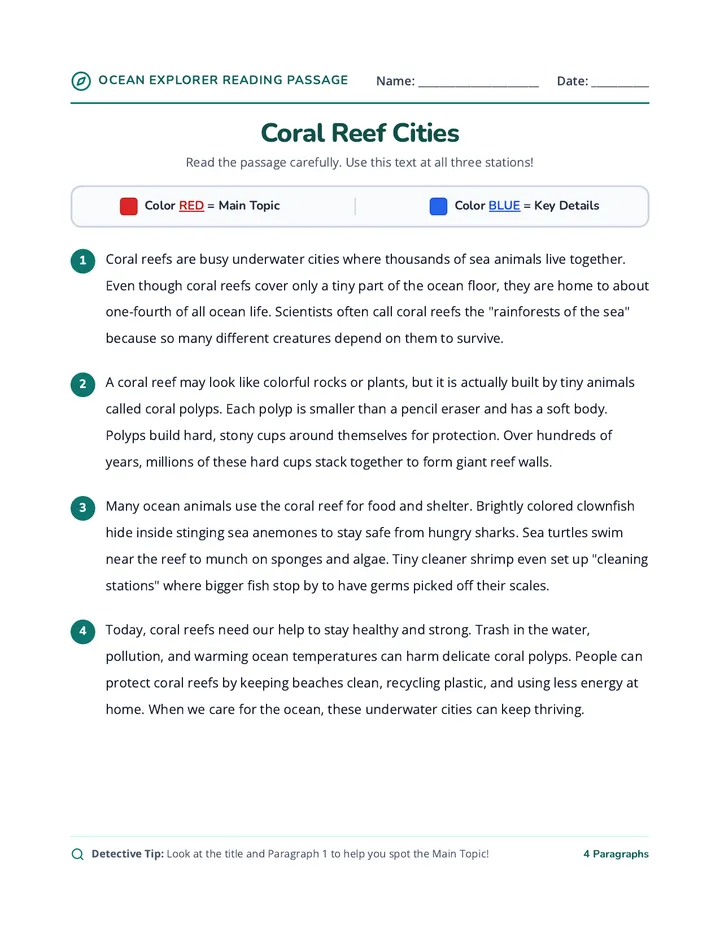
Ocean Builders: Coral Reefs
[Paragraph 1] Coral reefs look like colorful underwater gardens, but coral is actually made of tiny animals! Each little coral animal builds a hard, rocky shell around itself. Over hundreds of years, millions of these tiny shells stack together to form giant reefs.
[Paragraph 2] A coral reef is like a busy city for sea creatures. Clownfish hide safely inside stinging sea anemones, while sea turtles swim past to nibble on sponges. Crabs, eels, and octopuses also find food and shelter inside the reef's rocky caves.
[Paragraph 3] Today, coral reefs need our help to stay healthy. Warm ocean water and trash can harm the tiny coral animals. People can protect reefs by keeping beaches clean, recycling plastic, and never touching coral when they swim.
Directions: Match a Clue Card (A–F) to each row below. Then write one detail from the text to prove your match.
Part of Text
Card Letter
One Detail That Proves It
Main Topic (Whole Text)
Paragraph 1 Focus
Paragraph 2 Focus
Paragraph 3 Focus
Activity 2 • Ocean Builders: Card Sort & Prove
Ocean Builders: Focus Clue Cards
Cut apart the 6 cards below. Watch out: 2 cards are distractors that do not match!
Card A
What coral is made of and how tiny coral animals build rocky reefs
Ocean Builders
Card B
How great white sharks hunt for fish in deep, cold ocean water
Ocean Builders
Card C
Coral reefs: what they are, who lives in them, and how to protect them
Ocean Builders
Card D
Why coral reefs are in danger and ways people can keep them safe
Ocean Builders
Card E
How wind pushes ocean water to make tall waves on sandy beaches
Ocean Builders
Card F
The many sea animals that find food and shelter in coral reefs
Ocean Builders
Activity 2 • Cuttable Clue Cards (1 set per pair or small group)
Name: ___________________________ Date: ______________
Activity 2 • Independent Follow-Up
Starfish: Topic or Detail?
Starfish of the Sea
[1] Starfish are colorful ocean animals shaped like stars. Most starfish have five arms, but some can have even more! Their bumpy skin helps keep them safe from hungry fish.
[2] Starfish move slowly across the ocean floor. They use hundreds of tiny tube feet under their arms to crawl over rocks and sand.
1. Circle the Main Topic of the whole passage.
A. What starfish look like and how they move
B. Why starfish have bumpy skin
C. How starfish crawl over rocks
2. Big Focus or Small Detail? Circle one for each sentence.
"Most starfish have five arms." Big Focus / Small Detail
"How starfish move across the ocean floor." Big Focus / Small Detail
"They use tiny tube feet to crawl." Big Focus / Small Detail
Activity 2 • Independent Follow-Up
Weather Watchers Exit Ticket Name: ___________________________ Date: ______________
Activity 3 • 15-Minute Small Group
Weather Watchers: Exit Ticket
Directions: Read the passage carefully. Think about what the whole text is about and what each paragraph focuses on. Then answer Questions 1–4 on Page 2.
Wild Weather Wonders
1
Thunderstorms bring sudden rain, bright flashes, and loud booms. Inside tall, dark storm clouds, tiny drops of water bump together. This creates electricity that shoots across the sky as lightning. Right after you see lightning, you hear the booming sound of thunder.
2
A tornado is a spinning column of wind that reaches from a storm cloud down to the ground. Tornadoes form when warm, wet air meets cool, dry air and starts to twist. Their fast winds can lift heavy objects and knock down trees as they move across flat land.
3
Blizzards are powerful winter snowstorms with freezing temperatures and fierce winds. During a blizzard, heavy snow blows sideways so fast that it is hard to see across the street. Snowdrifts can pile up high against doors and cover roads until snowplows clear them away.
Check Yourself: Can you name the focus of Paragraph 1, 2, and 3 in just a few words?
Name: ___________________________ Date: ______________
Show What You Know (RI.2.2)
1. What is the main topic of the whole passage?
A. How snowplows clear winter roads
B. Different kinds of wild weather and what happens during them
C. Why lightning is brighter than thunder
D. How warm air and cool air mix in the summer
2. What is the focus of Paragraph 2?
A. How raindrops make lightning inside dark clouds
B. Why blizzards make it hard to see across the street
C. How tornadoes form and move with spinning winds
D. Where people should hide during a thunderstorm
3. What is the focus of Paragraph 1? Write one detail from Paragraph 1 that shows this.
4. What is the focus of Paragraph 3? Write one detail from Paragraph 3 that shows this.
Activity 3 • Weather Watchers: Exit Ticket
Name: ___________________________ Date: ______________
Activity 3 • Independent Follow-Up
Weather Clues: Word Bank Check
Word Bank
thunderstorms tornadoes blizzards wild weather
Part A: Use the Word Bank to finish each sentence.
1. The main topic of the whole passage is ________________________.
2. Paragraph 1 focuses on ________________________.
3. Paragraph 2 focuses on ________________________.
4. Paragraph 3 focuses on ________________________.
Part B: Draw or Write One Weather Detail
Pick one storm from the passage. Draw a picture or write one detail about what happens during that storm.
Activity 3 • Independent Follow-Up