A literacy and language lesson based on 'Olympig!' by Victoria Jamieson, focusing on sequencing with transition words and writing about personal resilience with TELPAS scaffolds.
A lesson introducing various suffixes through the lens of women's lacrosse, featuring word analysis and a six-paragraph reading passage.
A collection of visual anchor charts and notebook inserts to help students master common spelling rules including the FLOSS rule and the C/K/CK spelling choice.
Focuses on blending individual phonemes into words and segmenting words into phonemes using visual mats and movement-based activities.
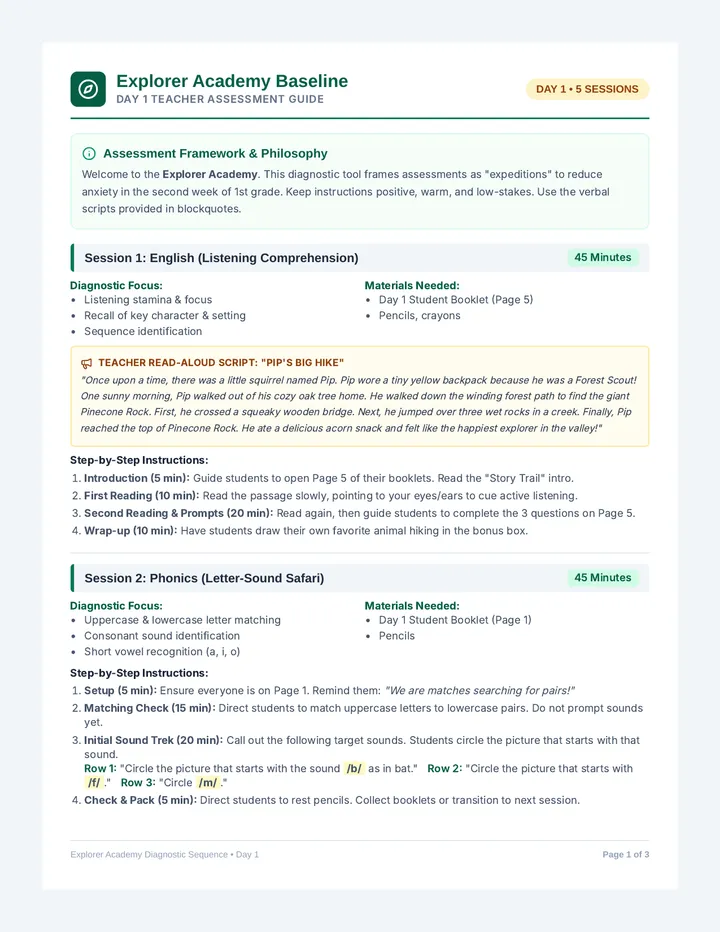
Focuses on isolating and identifying initial and final sounds in words through scripted detective-themed activities and picture sorts.
A lesson focused on comparing and contrasting two non-fiction texts about animal migration, designed with accessible reading levels for 5th-grade students.
A lesson exploring how authors use everyday objects to represent deeper abstract ideas, helping students decode layers of meaning in literature.
A full-length practice experience featuring an informational passage, tiered evidence-based questions, and a narrative writing task.
A strategy-focused guide to help students master EBSR questions and vocabulary in context through the lens of a detective's investigative blueprint.
Five days of quick ELA warm-ups to build stamina and recall for key test-taking strategies and vocabulary skills.
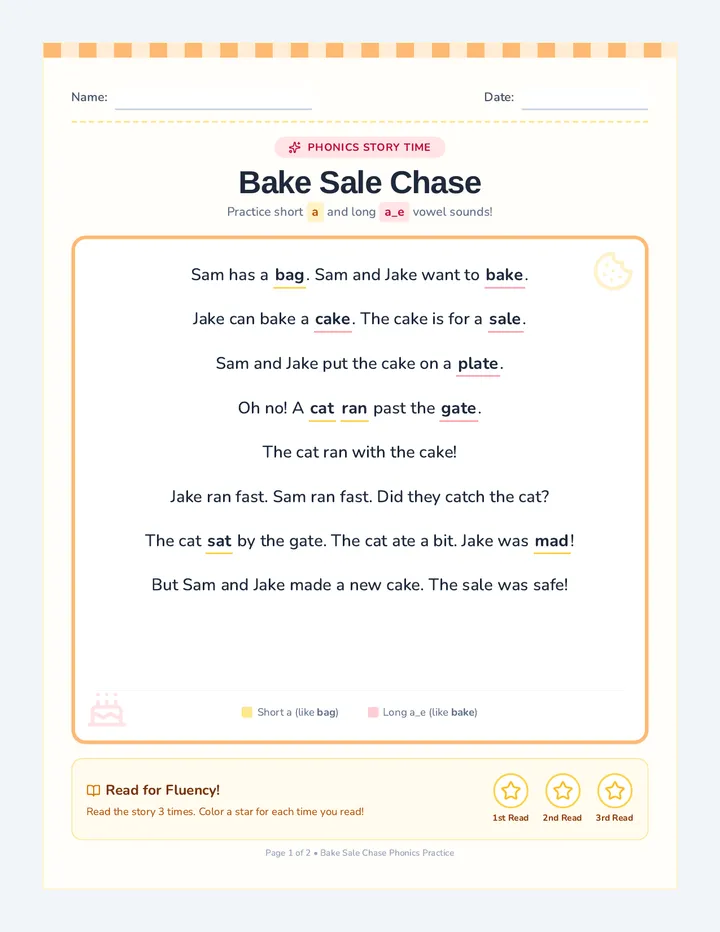
A collection of activities and assessments focused on decoding nonsense words to build phonics fluency and blending skills for 1st grade students. Includes speed drills, sorting activities, and a progress tracker for teachers.
This lesson focuses on beginning three-letter s-blends (str, spr, scr) through a nature-themed reading passage and associated activities to build fluency, decoding skills, and spelling accuracy.
A lesson exploring the emotion of awe and descriptive language through the book 'Awe' by Chana Stiefel, designed for 3rd and 4th-grade students.
A simplified independent work packet about the myth of Orpheus and Eurydice, designed for middle school students at a second-grade reading level. The lesson explores the power of music, love, and the consequences of looking back through accessible texts and structured comprehension tasks.
In this lesson, students become 'Plot Investigators' to distinguish between a story's topic and its main idea. Using mystery-themed tools like a 3-2-1 countdown and the RACES writing strategy, students will learn to extract key evidence from fables and short stories to construct well-supported thematic statements.
A focused look at Chapter 19 of The Westing Game, exploring Crow's internal struggle, the evolving partnership between Denton and Chris, and Turtle's stock market strategy.
A lesson focused on teaching students how to write compelling book reviews by using specific transition phrases to connect their opinions with text-based evidence.
A Readers Theater lesson focusing on Wilson Step 5.2 concepts, including open syllable prefixes with closed and V-E base words. Students practice fluency and decoding through a robotic-themed script and word study activities.