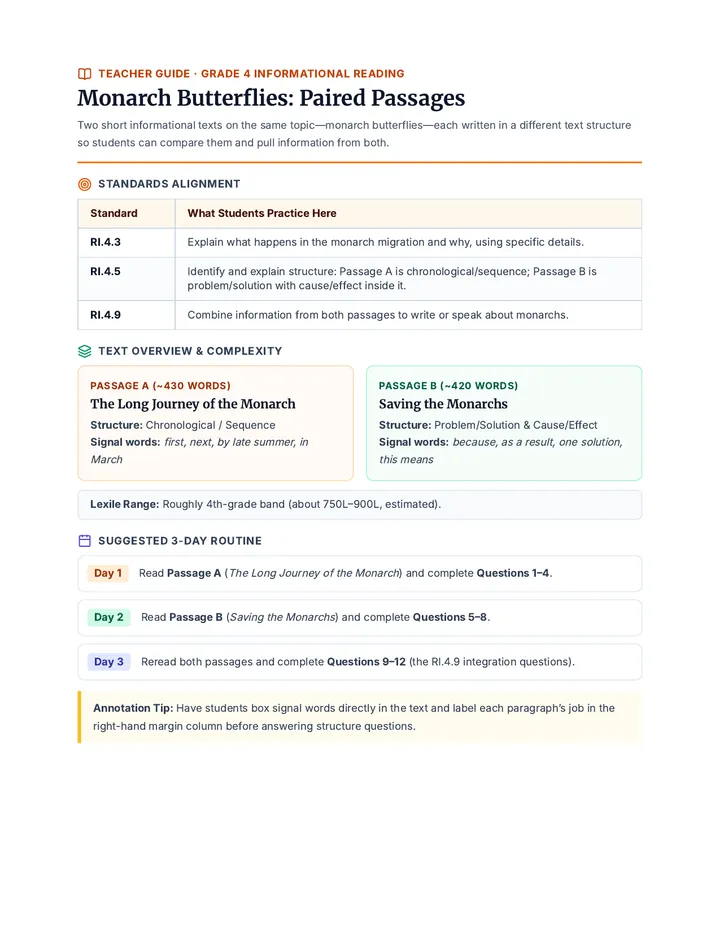
Monarch Migration Passages
Passage A · Informational Text
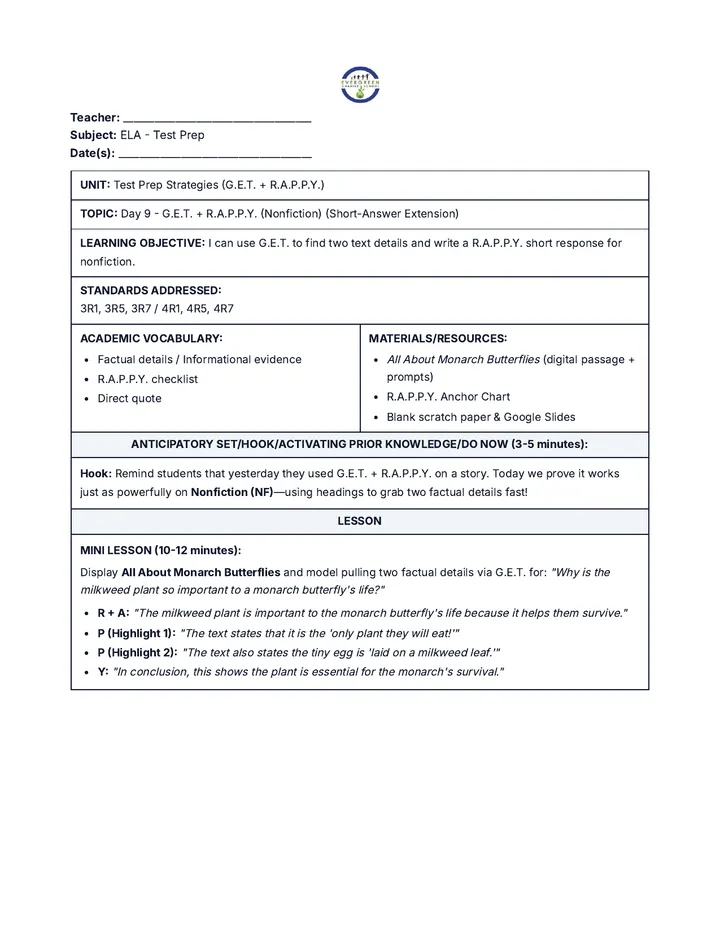
Name: ________________________ Date: ____________
The Long Journey of the Monarch
Active Reading: As you read, box sequence signal words (like first or in March) and label each paragraph’s job in the margin.
[1] Every year, millions of orange and black monarch butterflies make one of the longest trips of any insect on Earth. Monarchs that live east of the Rocky Mountains fly as far as 3,000 miles to reach the mountains of central Mexico. What makes this trip even more amazing is that no single butterfly ever finishes the whole round trip.
[2] The journey begins in early spring. In March, monarchs that spent the winter in Mexico wake up and start flying north. When they reach Texas and the southern United States, the females lay their eggs. They lay them only on milkweed plants, because milkweed is the only food monarch caterpillars can eat. Soon after laying their eggs, these butterflies die.
[3] Next, the eggs hatch into tiny caterpillars. The caterpillars eat milkweed leaves and grow quickly. After about two weeks, each caterpillar forms a hard green case called a chrysalis. Inside the chrysalis, its body changes completely. About ten days later, a new adult butterfly comes out.
[4] These new butterflies keep moving north. They live only two to six weeks, so they lay their own eggs along the way and then die. Their children continue the trip. Over the spring and summer, three or four generations of monarchs are born, each one traveling a little farther north. By summer, monarchs have spread across the northern United States and southern Canada.
[5] By late summer, something different happens. As the days grow shorter and cooler, a special generation of monarchs is born. Scientists sometimes call it the “super generation.” These butterflies do not lay eggs right away. Instead, they save their energy for a long flight south. Because they do not spend energy on laying eggs, they can live up to eight months, much longer than their parents and grandparents.
[6] In September and October, the super generation flies south. The butterflies use the position of the sun to find their direction. They also ride warm rising air, the way a hawk glides, so they can travel far without flapping too much. They stop to drink nectar from flowers to fuel the trip.
[7] Finally, in November, they arrive in the fir forests high in the mountains of Mexico. Millions of monarchs cluster together on the trees, so many that branches can bend under their weight. The cool mountain air keeps them resting quietly all winter. Then, when March comes again, they fly north, and the cycle starts over. Amazingly, these butterflies find the same forests their great-great-grandparents left, even though they have never been there before.
Paragraph Job
[1]
[2]
[3]
[4]
[5]
[6]
[7]
Passage B · Informational Text
Name: ________________________ Date: ____________
Saving the Monarchs
Active Reading: As you read, box problem/solution & cause/effect signal words (like because or one solution) and label each paragraph’s job.
[1] Monarch butterflies are in trouble. Scientists count monarchs in Mexico each winter by measuring how much forest the butterflies cover. In the winter of 1996–1997, monarchs covered about 45 acres of trees. In some recent winters, they covered fewer than 3 acres. That means there are far fewer monarchs than there used to be. Why is this happening, and what can people do about it?
[2] The biggest problem is that monarchs are losing milkweed. Female monarchs lay eggs only on milkweed, and caterpillars cannot eat anything else. Over the years, many fields, roadsides, and empty lots where milkweed once grew have been turned into farms, roads, and neighborhoods. Some weed killers also wipe out milkweed growing near crops. As a result, monarchs have fewer places to lay eggs, so fewer caterpillars survive to become butterflies.
[3] Monarchs also face problems at the end of their journey. They spend the winter in a small number of mountain forests in Mexico. When trees in these forests are cut down, the butterflies lose the shelter that protects them from cold, wind, and rain. In addition, extreme weather, such as hot, dry summers or sudden winter storms, can kill large numbers of monarchs at once.
[4] The good news is that people are working on solutions. One solution is to plant more milkweed. Families, schools, and towns are planting native milkweed in gardens, parks, and along highways. Many people also plant flowers that bloom in late summer and fall. These flowers give migrating butterflies the nectar they need for energy. Some of these gardens are registered as “Monarch Waystations,” which are like rest stops along the butterflies’ route.
[5] Another solution is protecting the winter forests. Mexico has set aside a large area of the mountains as the Monarch Butterfly Biosphere Reserve. Rules limit tree cutting there, and local people work as guides and forest guards. This protects the trees and gives families a way to earn money from keeping the forest healthy.
[6] Finally, scientists need help keeping track of monarchs, and kids can help. Through citizen science programs, students count caterpillars in their schoolyards or place tiny, lightweight stickers on butterflies’ wings. When a tagged butterfly is found later, sometimes in Mexico, scientists learn how far and how fast it traveled.
[7] Saving the monarch will take many people working together across three countries: Canada, the United States, and Mexico. Because the butterflies need help at every stop on their journey, every milkweed plant counts.
Paragraph Job
[1]
[2]
[3]
[4]
[5]
[6]
[7]
Monarch Comprehension Questions
Monarch Migration Questions
Name: ________________________ Date: ____________
Before You Answer Each Question
- Read the question twice. Underline what it is asking you to find.
- Read the hint. Go back to the paragraph it names and reread it.
- Find the exact words in the text that support your choice.
- Circle the best answer using the text as your proof.
Passage A: The Long Journey of the Monarch
1. (RI.4.3 · DOK 2) Why can monarchs in the “super generation” live up to eight months?
A.They eat more milkweed than other monarchs.
B.They save energy by not laying eggs right away.
C.They live in the cool mountains all year.
D.They fly shorter distances than their parents.
Hint: Reread Passage A, paragraph 5. Find the word because. The words after it give the reason.
2. (RI.4.3 · DOK 2) Paragraph 1 says no single butterfly finishes the whole round trip. Based on paragraphs 2 and 4, why is this true?
A.Monarchs get lost on the way north and cannot find Mexico again.
B.Butterflies die soon after laying eggs, and each new generation lives only two to six weeks.
C.Only the butterflies born in Canada are strong enough to fly south.
D.Monarchs stop flying when winter arrives and stay in the United States.
Hint: In paragraph 2, find what happens to the butterflies “soon after laying their eggs.” In paragraph 4, check how long the new butterflies live.
3. (RI.4.5 · DOK 2)
Part A: How is Passage A mostly organized?
A.Compare and contrast
B.Problem and solution
C.Chronological order (sequence)
D.Question and answer
Part B: Which group of words from the passage best supports your answer to Part A?
A.“one of the longest trips of any insect on Earth”
B.“In March … Next … By late summer … Finally, in November”
C.“the only food monarch caterpillars can eat”
D.“the way a hawk glides”
Hint: Look at the time words you boxed in Passage A (like In March or Next). For Part B, pick the choice made of those time words.
4. (RI.4.5 · DOK 3) Paragraph 5 begins, “By late summer, something different happens.” Why did the author place this paragraph after paragraphs 2–4 and use the words “something different”?
A.To show that the super generation breaks the repeating pattern of laying eggs and dying quickly
B.To explain why monarch caterpillars stop eating milkweed leaves in the fall
C.To describe how monarchs build nests in the northern United States
D.To show that the migration ends in late summer instead of continuing south
Hint: Compare the repeating pattern in paragraphs 2–4 with what changes in paragraph 5.
Passage B: Saving the Monarchs Page 2
5. (RI.4.3 · DOK 2) Which statement best completes the cause-and-effect chain from paragraph 2?
Fields and roadsides become farms, roads, and neighborhoods
→
?
→
Fewer caterpillars survive to become butterflies.
A.Monarchs fly faster to find new forests in Canada.
B.Milkweed disappears, so monarchs have fewer places to lay eggs.
C.Extreme winter storms freeze the milkweed leaves in Mexico.
D.People plant Monarch Waystations along highways and in parks.
Hint: Reread Passage B, paragraph 2. Find the signal words As a result to see what happens to milkweed.
6. (RI.4.5 · DOK 2)
Part A: How is Passage B mostly organized?
A.Chronological order
B.Problem and solution
C.Compare and contrast
D.Description
Part B: In which paragraph does the author begin to describe solutions?
A.Paragraph 1
B.Paragraph 2
C.Paragraph 3
D.Paragraph 4
Hint: Skim the first sentence of each paragraph in Passage B for signal phrases like The good news or One solution.
7. (RI.4.5 · DOK 3) The author explains the causes of the monarchs’ problems (paragraphs 2–3) before describing solutions (paragraphs 4–6). Why is this a helpful order?
A.It shows that monarchs only face problems during the winter months.
B.It proves that planting flowers is more important than saving forests.
C.It helps the reader understand what is wrong first so each solution makes sense.
D.It tells the events of the monarch migration in chronological order.
Hint: Match a problem from paragraph 2 or 3 with its solution in paragraphs 4–6. Would the solution make sense without the problem?
8. (RI.4.3 · DOK 3) How does the Monarch Butterfly Biosphere Reserve help both butterflies and local people in a way that protects monarchs over time?
A.It gives people jobs protecting the forest, so they have a reason to keep the trees safe for monarchs.
B.It pays families to catch monarchs and move them to warmer gardens each winter.
C.It allows unlimited tree cutting so towns can build more schools and parks.
D.It teaches students how to plant milkweed in Mexico during the summer.
Hint: Reread Passage B, paragraph 5. Look at how keeping the forest healthy helps both the trees and local families.
Using Both Passages Page 3
9. (RI.4.9 · DOK 2) Which fact appears in BOTH passages?
A.Weed killers can destroy milkweed near crops.
B.Female monarchs lay their eggs only on milkweed.
C.Students place stickers on butterflies’ wings.
D.Monarchs use the sun to find their direction.
Hint: Check each choice in BOTH passages. Paragraph 2 of each passage is a good place to start.
10. (RI.4.9 · DOK 3) Passage A says monarchs stop to drink nectar on their flight south. Passage B says people plant flowers that bloom in late summer and fall. How do these details connect?
A.Monarchs only drink nectar in the spring when they lay eggs on milkweed.
B.Late-blooming flowers are open in September and October right when monarchs need fuel to fly south.
C.Flowers that bloom in summer and fall help caterpillars grow inside their chrysalis.
D.Monarchs use the bright colors of fall flowers instead of the sun to find their direction.
Hint: In Passage A, paragraph 6, check which months monarchs fly south. Compare those months with Passage B, paragraph 4.
11. (RI.4.9 · DOK 3) Passage B says monarchs “need help at every stop on their journey.” Which pair correctly matches a stage from Passage A with a problem or solution from Passage B?
A.Spring in the southern U.S. (Passage A) → Tree cutting in Mexico’s mountain forests (Passage B)
B.Summer in northern U.S. & Canada (Passage A) → Planting late-fall flowers for the flight south (Passage B)
C.Fall flight south in Sept.–Oct. (Passage A) → Planting late-blooming flowers and tagging butterflies (Passage B)
D.Winter resting in Mexico (Passage A) → Weed killers wiping out milkweed near crops (Passage B)
Hint: Check that both the season and the location match between Passage A and Passage B.
12. (RI.4.5 + RI.4.9 · DOK 3) If you wanted to use evidence from BOTH passages to convince your town to plant milkweed, which pair of facts would be strongest?
A.Monarchs fly 3,000 miles (Passage A) and use the sun to find direction (Passage B).
B.Caterpillars can only eat milkweed (Passage A) and monarch forest cover dropped from 45 acres to under 3 acres as milkweed disappeared (Passage B).
C.The super generation lives eight months (Passage A) and students put stickers on wings (Passage B).
D.Monarchs rest in cool mountain air (Passage A) and Mexico created a forest reserve (Passage B).
Hint: Look for one fact from EACH passage that proves why milkweed matters—especially facts with convincing numbers.
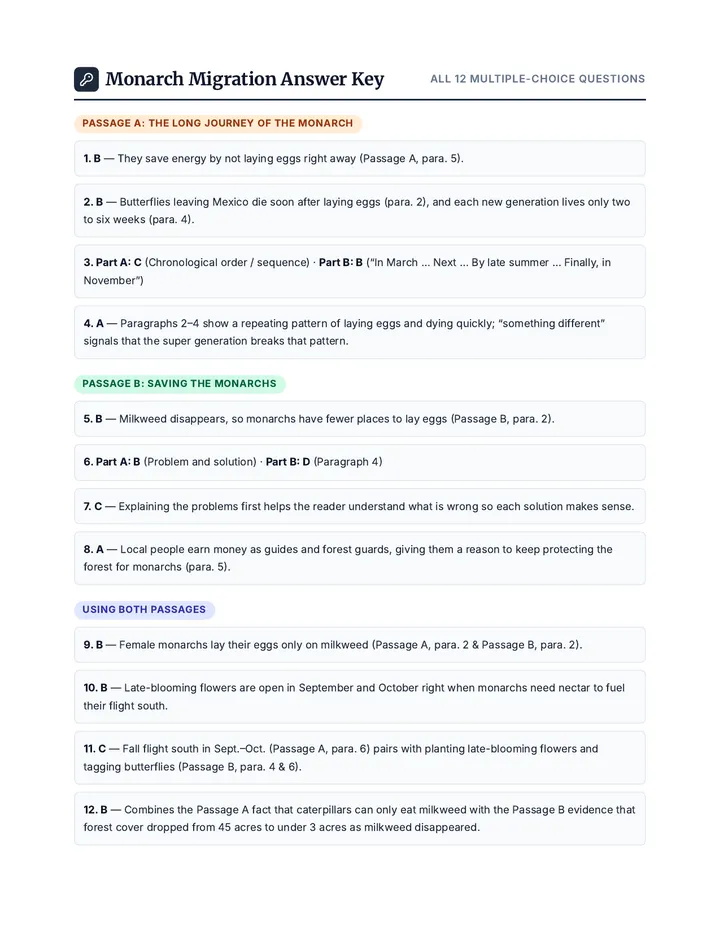
Monarch Migration Answer Key
Monarch Migration Answer Key
All 12 Multiple-Choice Questions
Passage A: The Long Journey of the Monarch
1. B — They save energy by not laying eggs right away (Passage A, para. 5).
2. B — Butterflies leaving Mexico die soon after laying eggs (para. 2), and each new generation lives only two to six weeks (para. 4).
3. Part A: C (Chronological order / sequence) · Part B: B (“In March … Next … By late summer … Finally, in November”)
4. A — Paragraphs 2–4 show a repeating pattern of laying eggs and dying quickly; “something different” signals that the super generation breaks that pattern.
Passage B: Saving the Monarchs
5. B — Milkweed disappears, so monarchs have fewer places to lay eggs (Passage B, para. 2).
6. Part A: B (Problem and solution) · Part B: D (Paragraph 4)
7. C — Explaining the problems first helps the reader understand what is wrong so each solution makes sense.
8. A — Local people earn money as guides and forest guards, giving them a reason to keep protecting the forest for monarchs (para. 5).
Using Both Passages
9. B — Female monarchs lay their eggs only on milkweed (Passage A, para. 2 & Passage B, para. 2).
10. B — Late-blooming flowers are open in September and October right when monarchs need nectar to fuel their flight south.
11. C — Fall flight south in Sept.–Oct. (Passage A, para. 6) pairs with planting late-blooming flowers and tagging butterflies (Passage B, para. 4 & 6).
12. B — Combines the Passage A fact that caterpillars can only eat milkweed with the Passage B evidence that forest cover dropped from 45 acres to under 3 acres as milkweed disappeared.