Clue Catchers Slide Deck 3rd Grade Reading • TEKS 3.6(G)
15-Minute Target Reteach
Mission: Deep Sea Clue Detectives
Crack the Code: Key Ideas & Details
Not all details carry the same weight! Today we evaluate clues to find the true Key Idea of non-fiction texts.
Step 1
Spot the Topic
Step 2
Weigh the Details
Step 3
Unlock Key Idea
The Detective Anchor Chart
How to test if a detail is a Pillar Clue or just Extra Glitter
TEKS 3.6(G)
Key Supporting Details
These are the strong pillars that hold up the main roof!
They tell what the whole section is mostly about.
If you take them away, the author’s big point collapses.
Connects directly to the title and heading.
💡 Ask: "Does this detail prove the author's main message?"
Interesting Extra Facts
These are fun decorations that make reading enjoyable!
They are 100% true and fascinating!
BUT they only describe one tiny detail or fun fact.
STAAR questions use them as trap answer choices!
⚠️ Trap Alert: "Just because it's true doesn't mean it's the Key Idea!"
Formula: Topic + What Key Details Mostly Teach Us = KEY IDEA
I DO
Teacher Modeling: The Anglerfish
Watch Lenny evaluate details
Excerpt: The Anglerfish
Deep in the pitch-black ocean, female anglerfish use a glowing bulb to catch prey. The light dangles from a long spine above its mouth. Small, curious fish swim close to inspect the glowing blue-green ball. In a flash, the anglerfish snaps its razor-sharp jaw shut. Female anglerfish can grow up to three feet long, while males are only the size of a teacup.
Supporting Detail
"A glowing light dangles above its mouth to lure fish."
Why: Shows HOW it hunts in the dark!
Interesting Extra Fact
"Males are only the size of a small teacup."
Why: Fascinating size fact, but doesn't explain hunting!
⭐ Model Key Idea:
The anglerfish uses a glowing lure to catch food in the dark ocean.
Notice how the Key Idea combines the topic + the most important detail !
WE DO
Detective Challenge: Vote the Key Idea!
Work together as a crew
Read Aloud with Partner:
"Flashlight fish have special light organs directly under their eyes. They use these glowing lights like headlights to spot food, signal to friends, and scare away hungry enemies. If danger approaches, the fish can slide a dark skin flap over the light to turn it off instantly."
Which detail best supports the idea that glowing helps the flashlight fish survive?
A
The fish have organs under their eyes.
(Location fact only - does not show how it survives)
B
Lights help them spot food and scare predators.
(Pillar detail proving survival advantages!)
Quick Crew Check: Choice B proves how and why the light keeps the fish alive!
5-Minute Reteach Stations
Hands-on practice to cement detail evaluation skills
Stations Rotations
STATION 1 Hands-On Sort
The Detail Sorter
Take the 6 octopus clue cards. Sort them into two zones:
Zone 1
Key Pillar Clues
Zone 2
Interesting Extras
Goal: Defend why 2 cards are just fun trivia, not key pillars!
STATION 2 Writing Challenge
Headline Hunters
Read 3 mini ocean creature cards. Evaluate the 3 clues given on each card.
Your Reporter Task:
Write one catchy Key Idea Headline that sums up the main point of all 3 clues!
Goal: Synthesize details into a single master key idea sentence!
Timer: 5 Minutes per activity Teacher will circulate to check evidence justifications
STAAR Short Constructed Response (SCR)
How to score a perfect 2 out of 2 points on STAAR 2.0
2-Point Goal
1. State
Answer the Question
Name the key idea directly using words from the prompt.
"The key idea of paragraph 2 is..."
2. Cite
Provide Text Clues
Quote or paraphrase a key supporting detail from the text.
"The text states that..."
3. Explain
Connect the Clue
Tell how your text detail proves the key idea.
"This detail proves that..."
Today's Exit Ticket Prompt:
"Based on the passage, what is the key idea of paragraph 2? Explain how details support your answer."
Worksheet Page 2
Deep Sea Clues Worksheet Deep Sea Clues Worksheet
TEKS 3.6(G) • Evaluate Details to Determine Key Ideas
Name:
Date:
Mission: As you read, ask: "Does this detail carry the weight of the main message, or is it just extra glitter?"
Informational Text STAAR Grade 3 Level
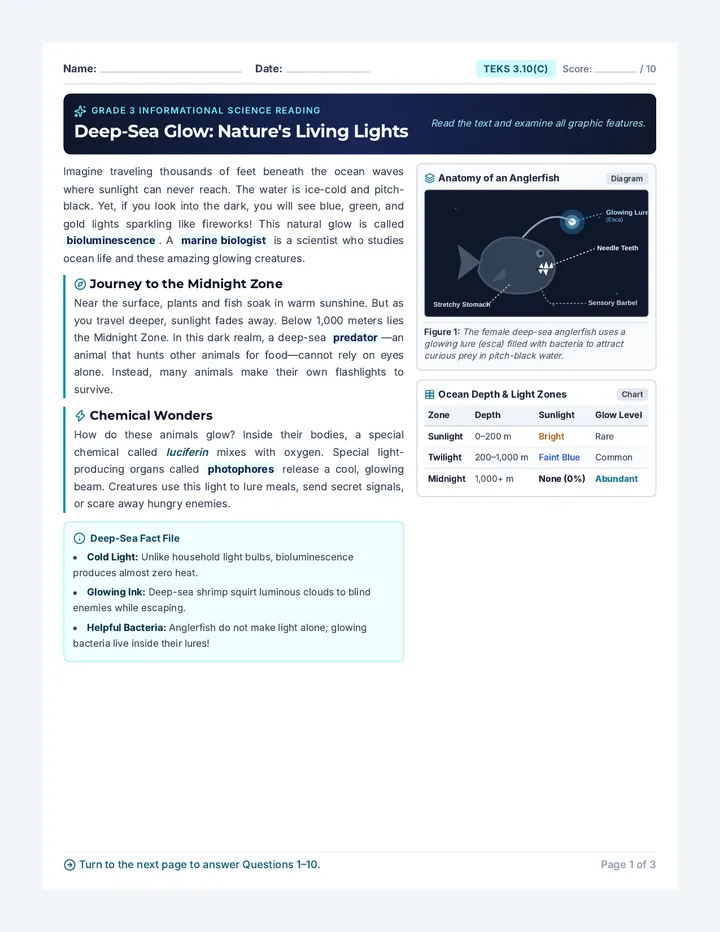
Glow in the Deep: Secrets of the Midnight Zone
1 Over three thousand feet beneath the ocean’s surface lies the midnight zone. In this deep world, sunlight cannot reach. The water is ice-cold, and the darkness is total. Yet, if you traveled down into this abyss, you would see magical flashes of blue, green, and gold. Most creatures living here have a superpower called bioluminescence, which means they can make their own glowing light.
2 Many midnight zone animals rely on their light to find food in the black water. For example, the anglerfish carries a glowing lure that dangles right over its sharp teeth. Small, curious sea animals swim straight toward the light and become dinner. The flashlight fish has glowing bean-shaped pouches beneath each eye that shine forward like car headlights, helping it spot tiny prey swimming nearby. Without this living light, these predators would starve in the dark.
3 Other ocean animals use bioluminescence as a clever defense against predators. When a hungry fish chases a deep-sea opossum shrimp, the shrimp shoots a cloud of glowing blue liquid into the hunter’s eyes. The flash blinds the predator, giving the tiny shrimp time to dart away. Similarly, the deep-sea comb jelly pulses with bright rippling lights to startle enemies and escape before being caught.
4 Exploring the midnight zone is difficult because the deep water has crushing pressure. Today, scientists send robotic submersibles equipped with sensitive cameras to film these glowing marvels. Marine biologists believe thousands of undiscovered creatures are still waiting in the dark sea.
Part A: Evaluate the Details
Check ONE box for each clue from Paragraph 2
| Detail From Paragraph 2 | Key Supporting Detail"The anglerfish carries a glowing lure that dangles right over its sharp teeth to catch prey." |
|
|
| 2. "The pouches beneath the flashlight fish's eyes are shaped like beans." |
|
|
| 3. "Flashlight fish use their glowing lights like headlights to spot food in the dark." |
|
|
Idea Detectives Reteach • TEKS 3.6(G) Turn to Page 2 for Questions & Short Constructed Response → Page 1 of 2
STAAR 2.0 PRACTICE Passage: Glow in the Deep
Student Name:
Question 1 • TEKS 3.6(G) Multiple Choice
Which sentence best states the key idea of paragraph 3?
A Oppossum shrimp shoot glowing blue liquid when chased by enemies.
B Deep-sea animals use bioluminescence to protect themselves and escape danger.
C Comb jellies have rippling lights that can surprise larger predators.
D Predators in the deep ocean have trouble seeing blue glowing lights.
Question 2 STAAR Short Constructed Response (SCR)
2 Points
Read the question carefully. Then enter your answer in the box provided.
Based on paragraph 2 of the passage, what is the key idea? Explain how details in the text support this key idea.
Student Response Box: Write in complete sentences using text evidence
SCR 2-Point Self-Checklist:
1. Stated the Key Idea 2. Cited 2 text details 3. Explained the connection
Idea Detectives Reteach • TEKS 3.6(G) STAAR Grade 3 Reading Intervention Page 2 of 2
Detail Detective Station Cards Station 1
The Detail Sorter: Octopus Camouflage
TEKS 3.6(G) • Distinguish Key Supporting Details from Extra Facts
Partner / Group Station
Time: 5 Minutes
TOPIC PASSAGE: Read this mini-passage first
"The mimic octopus has an astonishing defense system. In seconds, it can change both its skin pattern and its body shape to impersonate venomous predators like lionfish, sea snakes, and jellyfish. By transforming into dangerous sea creatures, it terrifies hungry sharks and successfully escapes attack."
Clue Cards (Evaluate each detail card below) Match each card to Zone A or Zone B
CARD #1 Detail
It flattens its body and twists its arms to look like a venomous sea snake.
CARD #2 Detail
It was first discovered by scientists off the coast of Indonesia in 1998.
CARD #3 Detail
By impersonating dangerous predators, it scares away hungry sharks.
CARD #4 Detail
Like all octopuses, it has three hearts and blue copper-based blood.
CARD #5 Detail
Its special skin cells allow it to copy patterns and colors in under two seconds.
CARD #6 Detail
An adult mimic octopus usually measures about two feet in total length.
Student Sorting Mat: Write the Card Numbers Below Target Key Idea: The mimic octopus uses disguise to protect itself.
Zone A: Key Supporting Details 3 Cards
These details directly prove HOW the octopus protects itself:
Card # ________ Why: proves camouflage
Card # ________ Why: proves disguise
Card # ________ Why: proves survival
Zone B: Interesting Extra Facts 3 Cards
True and cool, but DO NOT prove how disguise saves it:
Card # ________ Extra trivia
Card # ________ Extra trivia
Card # ________ Extra trivia
Idea Detectives Reteach Station 1 Turn page for Station 2: Headline Hunters → Station Sheet 1 of 2
Station 2
Headline Hunters: Newsroom Challenge
TEKS 3.6(G) • Synthesize Supporting Details into a 1-Sentence Key Idea
Independent / Pair Station
Time: 5 Minutes
Instructions: Read the clues for each deep-sea oddity. Write a punchy Key Idea Headline that sums up the main point!
Story #1: The Giant Isopod Ocean Floor Scavenger
Investigative Clues:
It crawls along the pitch-black ocean floor searching for fallen whale carcasses.
Its tough armored shell protects it from freezing temperatures and crushing pressure.
It can survive up to five years without eating a single bite when food is scarce.
Your Key Idea Headline (What do all 3 clues prove about the giant isopod?):
Story #2: The Vampire Squid Oxygen-Deprived Abyss
Investigative Clues:
It lives in the "shadow zone" where there is almost zero oxygen in the water.
Its slow-moving body uses very little energy so it does not need much oxygen to breathe.
It feeds gently on floating bits of organic dust rather than actively chasing prey.
Your Key Idea Headline (What do all 3 clues prove about the vampire squid?):
Story #3: The Yeti Crab Hydrothermal Vents
Investigative Clues:
It lives huddled around boiling-hot underwater volcanic geysers to stay warm.
Its furry claws trap deep-sea bacteria that it harvests and eats for food.
Its pale white color and lack of eyes suit life where sunlight never penetrates.
Your Key Idea Headline (What do all 3 clues prove about the yeti crab?):
Idea Detectives Reteach Station 2 Great reporters evaluate clues to find the big story! Station Sheet 2 of 2
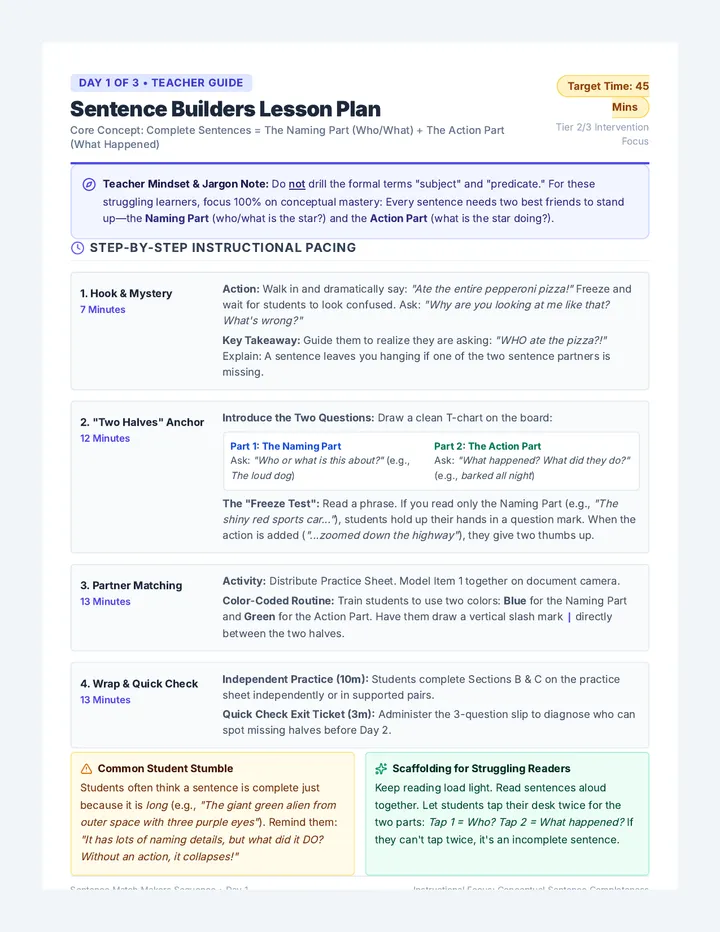
Reteach Mastery Teacher Guide Reteach Mastery Teacher Guide
TEKS 3.6(G) Reteach • 15-Minute Intervention Blueprint
Target: 15 Minutes
15-Minute Micro-Pacing Schedule
00:00 - 03:00 3 Min
Hook & Anchor Chart
Project Slide 1-2. Teach formula: Topic + Pillar Details = Key Idea . Contrast with "Cool Extra Facts".
Key Cue: "Pillars hold the roof!"
03:00 - 07:00 4 Min
Explicit I Do & We Do
Slide 3: Model Anglerfish think-aloud. Slide 4: Flashlight Fish partner vote between Choice A and B.
Checks: Cold-call 2 students
07:00 - 12:00 5 Min
Stations & Part A
Divide room into 2 Stations (or small groups). Group 1: Octopus Sort. Group 2: Headline Hunters.
Teacher floats for Tier 2/3
12:00 - 15:00 3 Min
STAAR SCR Exit Ticket
Worksheet Page 2: Question 1 (MC) and Question 2 (2-Point SCR prompt). Collect as post-check.
Goal: 85%+ score 2/2 on SCR
STAAR Short Constructed Response (SCR) 2-Point Rubric
TEA Aligned
Score Point 2 Complete
States correct key idea AND supports with specific text evidence from paragraph 2 with clear explanation.
Exemplar: "The key idea of paragraph 2 is that deep-sea animals use glowing light to catch prey. The text says the anglerfish uses a glowing lure over its teeth to attract fish, and flashlight fish use lights like headlights to spot food."
Score Point 1 Partial
States key idea but gives weak/incomplete evidence, OR gives accurate details without stating the key idea clearly.
Exemplar: "Animals in the ocean make their own light to hunt food like the anglerfish does with its teeth."
Score Point 0 Insufficient
Response is incorrect, irrelevant, or simply copies a sentence from the text without identifying the key idea.
Exemplar: "The midnight zone is three thousand feet deep and very dark."
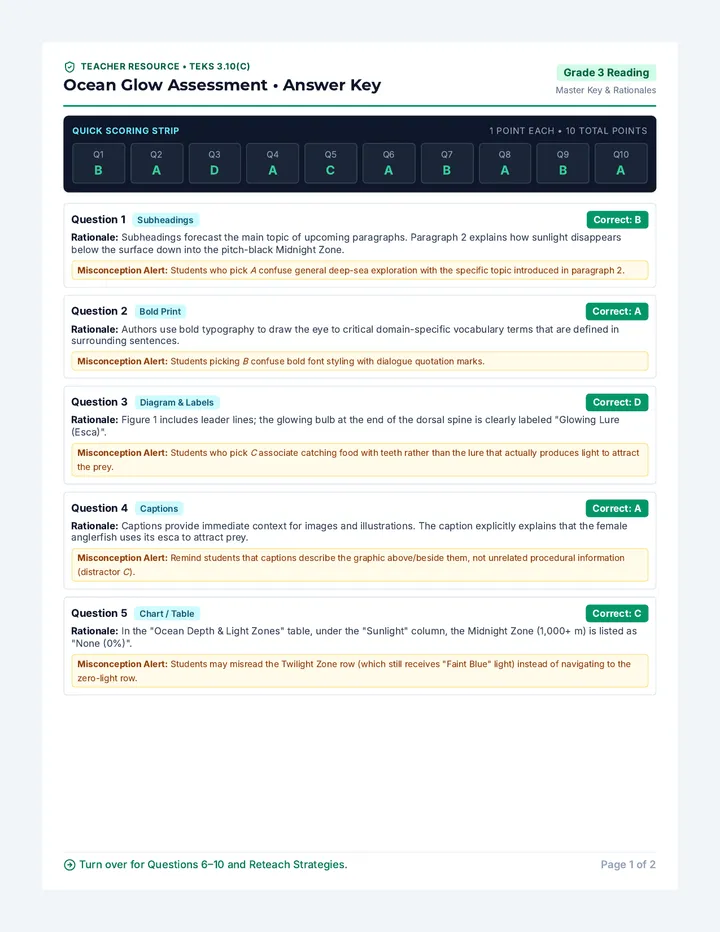
Master Answer Key
Worksheet Answers:
Part A #1: Key Supporting DetailPart A #2: Interesting Extra FactPart A #3: Key Supporting DetailPart B (Q1): B (Defense & escape)
Station 1: Octopus Sort
Zone A (Pillars): Cards #1, #3, #5 (Sea snake pose, scaring sharks, 2-sec camouflage)Zone B (Extra Facts): Cards #2, #4, #6 (1998 discovery, 3 hearts/copper blood, 2 ft size)
Station 2: Headline Hunters
Story 1: Giant isopods are tough scavengers built to survive deep-sea starvation.Story 2: Vampire squids survive low oxygen by moving slowly and saving energy.Story 3: Yeti crabs survive scalding volcanic vents by harvesting bacteria on their fur.
15-Second Corrective Reroutes for Common Misconceptions
Misconception: Student chooses an interesting fact because "it was the coolest sentence.""That IS super cool! But if you deleted that sentence, would the author still be teaching you how the animal catches food? Yes! So that's extra glitter, not a pillar!"
Misconception: Student writes a 1-word topic like "Fish" as the key idea on the SCR."Good start on the topic! Now add the action: What does the text teach us about WHAT those fish DO with their lights?"
TEKS 3.6(G) Reteach Guide High-Impact 15-Minute Reading Intervention Guide Page 1 of 1