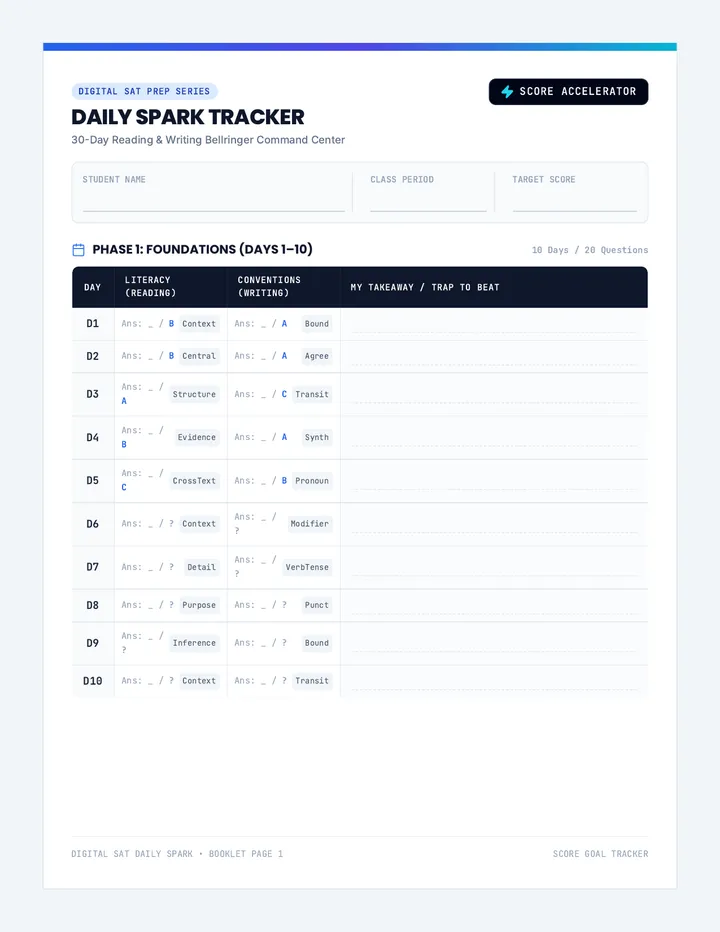
Update your tracker. Next session is Day 2. Next Day
Day 2 Question 1 • Sentence Structure: Run-ons
Slide 6
Select the best version of the underlined text:
The research paper was incredibly thorough it covered every major advancement in gene editing.
A it covered every major advancement
B ; it covered every major advancement
C thorough, it covered every major advancement
D thorough, covering every major advancement
Record your initial answer on your tracker. Next Slide for Answer
Day 2 • Q1 Answer
Slide 7
Correct Choice: B
"; it covered every major..."
The sentence contains two independent clauses without any punctuation between them, creating a run-on sentence (or fused sentence). Option B correctly uses a semicolon to separate the two complete thoughts. Option C is a comma splice, and Option D alters the grammar syntactically but is poorly phrased.
Grit Takeaway / Hint
A fused run-on occurs when two clauses are mashed together without any punctuation. Use a semicolon or a comma + coordinate conjunction.
Write the takeaway in the "Key Takeaway" column of your tracker. Next Question
Day 2 Question 2 • Pronoun-Antecedent Agreement
Slide 8
Select the best version of the underlined text:
Each of the students must submit their final thesis proposal by Friday afternoon.
A their
B his or her
C its
D they
Record your initial answer on your tracker. Next Slide for Answer
Day 2 • Q2 Answer
Slide 9
Correct Choice: B
"his or her"
The pronoun's antecedent is "Each", which is an singular indefinite pronoun. Under standardized test standards (like TSIA2), singular antecedents require singular possessive pronouns. Therefore, the singular "his or her" is correct, rather than the plural "their".
Grit Takeaway / Hint
Words ending in "-one", "-body", or "-each" are always singular. Use "his or her" or singular possessive determiners instead of "their" on the test.
Update your tracker. Next session is Day 3. Next Day
Day 3 Question 1 • Punctuation: Colons & Semicolons
Slide 10
Select the best version of the underlined text:
The archeologist discovered three ancient tools a bronze dagger, a clay vessel, and a stone tablet.
A tools a bronze dagger, a clay vessel, and a stone tablet.
B tools: a bronze dagger, a clay vessel, and a stone tablet.
C tools; a bronze dagger, a clay vessel, and a stone tablet.
D tools, being a bronze dagger, a clay vessel, and a stone tablet.
Record your initial answer on your tracker. Next Slide for Answer
Day 3 • Q1 Answer
Slide 11
Correct Choice: B
"tools: a bronze dagger..."
A colon (:) is used to introduce a list that follows a complete independent clause. In this sentence, "The archeologist discovered three ancient tools" is a complete sentence, and the colon correctly sets off the explanatory list of tools. A semicolon (Option C) is incorrect because it must connect two complete clauses.
Grit Takeaway / Hint
A colon must always be preceded by a complete independent clause. Never place a colon directly after a verb (like "discovered") or a preposition (like "such as").
Write the takeaway in the "Key Takeaway" column of your tracker. Next Question
Day 3 Question 2 • Sentence Structure: Dangling Modifiers
Slide 12
Select the best version of the underlined text:
Walking through the dense forest, a rare species of orchid was spotted by the hiker.
A Walking through the dense forest, a rare species of orchid was spotted by the hiker.
B Walking through the dense forest, the hiker spotted a rare species of orchid.
C While walking through the dense forest, a rare species of orchid was seen.
D To walk through the dense forest, the hiker spotted a rare orchid.
Record your initial answer on your tracker. Next Slide for Answer
Day 3 • Q2 Answer
Slide 13
Correct Choice: B
"Walking through the dense forest, the hiker..."
The opening phrase "Walking through the dense forest" is a participial phrase that acts as an adjective. It must modify the noun immediately following the comma. In Option A, the noun is "a rare species of orchid," implying the orchid itself was walking. Option B correctly places the logical subject ("the hiker") immediately after the modifier.
Grit Takeaway / Hint
When a sentence starts with an action modifier (an "-ing" or "-ed" phrase), ask: "Who or what did this action?" Place that subject directly after the comma.
Update your tracker. Next session is Day 4. Next Day
Day 4 Question 1 • Subject-Verb Agreement
Slide 14
Select the best version of the underlined text:
The scent of pine needles, combined with the crisp morning air, remind me of my childhood home in Maine.
A remind
B reminds
C reminding
D are reminding
Record your initial answer on your tracker. Next Slide for Answer
Day 4 • Q1 Answer
Slide 15
Correct Choice: B
"reminds"
The grammatical subject is "scent", which is singular. The prepositional phrase "of pine needles" and the parenthetical modifier "combined with the crisp morning air" do not change the subject's number. Singular subject "scent" requires the singular verb "reminds".
Grit Takeaway / Hint
Stripping out the prepositional phrases and parenthetical structures from the sentence path will immediately make the true subject-verb connection clear.
Write the takeaway in the "Key Takeaway" column of your tracker. Next Question
Day 4 Question 2 • Punctuation: Non-Essential Clauses
Slide 16
Select the best version of the underlined text:
My older sister who is a senior software engineer helped me design my first mobile application.
A who is a senior software engineer
B , who is a senior software engineer,
C who is a senior software engineer,
D ; who is a senior software engineer;
Record your initial answer on your tracker. Next Slide for Answer
Day 4 • Q2 Answer
Slide 17
Correct Choice: B
", who is a senior software engineer,"
The relative clause "who is a senior software engineer" is a non-essential (non-restrictive) clause. It provides extra information about "sister," but is not required to identify which sister is being discussed (it's "my older sister"). Non-essential clauses must be set off with a pair of commas on both sides.
Grit Takeaway / Hint
If you can drop a clause from a sentence without changing its fundamental meaning, it is non-essential and needs commas around it. "That" clauses are always essential; "which/who" clauses are often non-essential.
Update your tracker. Next session is Day 5. Next Day
Day 5 Question 1 • Sentence Structure: Fragments
Slide 18
Select the best version of the underlined text:
Although the software update was intended to improve system speed and prevent frequent crashes.
A Although the software update was intended to improve system speed and prevent frequent crashes.
B The software update was intended to improve system speed and prevent frequent crashes.
C While the software update was intended to improve system speed; it prevented crashes.
D Despite the software update was intended to improve system speed.
Record your initial answer on your tracker. Next Slide for Answer
Day 5 • Q1 Answer
Slide 19
Correct Choice: B
"The software update was intended..."
The original sentence starts with the subordinating conjunction "Although", which turns the entire structure into a dependent clause. Without an independent clause to follow, this is a sentence fragment. Removing "Although" (Option B) transforms the clause into a complete independent clause.
Grit Takeaway / Hint
A dependent clause cannot stand alone as a sentence. To fix a fragment, either connect it to an independent clause or remove the subordinating conjunction (since, because, although, while).
Write the takeaway in the "Key Takeaway" column of your tracker. Next Question
Day 5 Question 2 • Punctuation: Apostrophes
Slide 20
Select the best version of the underlined text:
The employees lounge was renovated over the weekend to include new comfortable seating.
A employees lounge
B employee's lounge
C employees' lounge
D employees's lounge
Record your initial answer on your tracker. Next Slide for Answer
Day 5 • Q2 Answer
Slide 21
Correct Choice: C
"employees' lounge"
The lounge is shared by multiple employees, making it a plural possessive noun. For regular plural nouns that end in -s (like "employees"), possession is indicated by placing an apostrophe after the s (employees'). Option B would indicate the lounge belongs to only a single employee, which is contextually incorrect.
Grit Takeaway / Hint
Singular possessive = 's (dog's bone).
Regular plural possessive = s' (dogs' bones).
Irregular plural possessive = 's (children's toys).
Update your tracker. Next session is Day 6. Next Day
Day 6 Question 1 • Agreement: Verb Tense Consistency
Slide 22
Select the best version of the underlined text:
Yesterday, the scientist presented her findings to the board and demonstrates the new prototype.
A demonstrates
B demonstrated
C will demonstrate
D demonstrating
Record your initial answer on your tracker. Next Slide for Answer
Day 6 • Q1 Answer
Slide 23
Correct Choice: B
"demonstrated"
The sentence describes actions that occurred in the past, established by the adverb "Yesterday" and the past tense verb "presented". To maintain grammatical consistency, the second verb in the compound predicate must also be in the past tense: "demonstrated" (Option B).
Grit Takeaway / Hint
Do not shift verb tenses unnecessarily within a sentence. Match subsequent verbs with the established timeframe of the passage.
Write the takeaway in the "Key Takeaway" column of your tracker. Next Question
Day 6 Question 2 • Sentence Structure: Coordinating Conjunctions
Slide 24
Select the best version of the underlined text:
The weather forecast predicted heavy rain yet the outdoor concert was held anyway.
A yet the outdoor concert was held anyway.
B , yet the outdoor concert was held anyway.
C yet, the outdoor concert was held anyway.
D , the outdoor concert was held anyway.
Record your initial answer on your tracker. Next Slide for Answer
Day 6 • Q2 Answer
Slide 25
Correct Choice: B
", yet the outdoor concert..."
The sentence consists of two complete independent clauses: "The weather forecast predicted heavy rain" and "the outdoor concert was held anyway." When joining two independent clauses using a coordinating conjunction (FANBOYS: for, and, nor, but, or, yet, so), a comma must be placed before the conjunction (Option B).
Grit Takeaway / Hint
Remember FANBOYS. If you have complete clauses on both sides of a coordinate conjunction, you must include a comma before it.
Update your tracker. Next session is Day 7. Next Day
Day 7 Question 1 • Pronoun Case: Who vs Whom
Slide 26
Select the best version of the underlined text:
The community leader who the mayor honored yesterday has lived in the neighborhood for forty years.
A who
B whom
C whose
D which
Record your initial answer on your tracker. Next Slide for Answer
Day 7 • Q1 Answer
Slide 27
Correct Choice: B
"whom"
The pronoun acts as the object of the verb "honored" in the relative clause ("the mayor honored [him/whom] yesterday"). "Who" is used for subjective case (subjects), whereas "Whom" is required for objective case (objects). Therefore, "whom" (Option B) is correct.
Grit Takeaway / Hint
Use the He/Him shortcut. Rephrase the clause: "The mayor honored him" (not "he"). Since "him" ends with -m, use "whom" (which also ends with -m).
Write the takeaway in the "Key Takeaway" column of your tracker. Next Question
Day 7 Question 2 • Punctuation: Semicolons
Slide 28
Select the best version of the underlined text:
The library will close early today however it will reopen tomorrow at the normal time.
A however it will reopen
B ; however, it will reopen
C , however, it will reopen
D however, it will reopen
Record your initial answer on your tracker. Next Slide for Answer
Day 7 • Q2 Answer
Slide 29
Correct Choice: B
"; however, it..."
The sentence joins two complete independent clauses using a conjunctive adverb ("however"). To avoid a comma splice, a conjunctive adverb connecting independent clauses must be preceded by a semicolon (;) and followed by a comma (,). Option B is correct.
Grit Takeaway / Hint
Conjunctive adverbs (however, therefore, consequently, furthermore) cannot link clauses on their own. Use: Semicolon + Adverb + Comma.
Update your tracker. Next session is Day 8. Next Day
Day 8 Question 1 • Punctuation: Comma Splices
Slide 30
Select the best version of the underlined text:
Art is not merely a hobby for Elena, it is a fundamental part of her identity.
A Elena, it is a fundamental part of her identity.
B Elena; it is a fundamental part of her identity.
C Elena it is a fundamental part of her identity.
D Elena, being a fundamental part of her identity.
Record your initial answer on your tracker. Next Slide for Answer
Day 8 • Q1 Answer
Slide 31
Correct Choice: B
"Elena; it is a fundamental..."
The original structure is a classic comma splice, fusing two complete independent clauses using only a comma. Semicolons are the perfect punctuation tool to link closely related, complete thoughts without standard coordinating conjunctions. Option B is correct.
Grit Takeaway / Hint
If you have a complete subject and verb on both sides of a comma, you have a comma splice. Semicolons fix them cleanly.
Write the takeaway in the "Key Takeaway" column of your tracker. Next Question
Day 8 Question 2 • Subject-Verb Agreement (Neither/Nor)
Slide 32
Select the best version of the underlined text:
Neither the lead vocalist nor the backup musicians is ready for the sound check.
A is ready
B are ready
C being ready
D has been ready
Record your initial answer on your tracker. Next Slide for Answer
Day 8 • Q2 Answer
Slide 33
Correct Choice: B
"are ready"
When subjects are joined by the correlative conjunctions "either... or" or "neither... nor", the verb agrees with the closest subject. Here, the closest subject is "backup musicians" (plural), which requires the plural verb "are ready" (Option B).
Grit Takeaway / Hint
With "neither... nor" or "either... or", the subject closest to the verb determines if it is singular or plural.
Update your tracker. Next session is Day 9. Next Day
Day 9 Question 1 • Sentence Structure: Parallel Structure
Slide 34
Select the best version of the underlined text:
Successful entrepreneurs must be skilled at managing budgets, delegating tasks, and they must negotiate contracts.
A they must negotiate contracts.
B negotiating contracts.
C negotiate contracts.
D contracts must be negotiated.
Record your initial answer on your tracker. Next Slide for Answer
Day 9 • Q1 Answer
Slide 35
Correct Choice: B
"negotiating contracts."
The sentence contains a list of skills following the preposition "at": "managing budgets" (gerund phrase) and "delegating tasks" (gerund phrase). To maintain parallel structure, the third item in the list must also use a gerund (-ing phrase): "negotiating contracts." (Option B).
Grit Takeaway / Hint
When listing elements in a series, verify that they all share the exact same grammatical pattern (all nouns, all infinitives, or all -ing gerunds).
Write the takeaway in the "Key Takeaway" column of your tracker. Next Question
Day 9 Question 2 • Punctuation: Colons
Slide 36
Select the best version of the underlined text:
The math tutor offered one central piece of advice practice the hardest formulas first.
A advice practice the hardest formulas first.
B advice: practice the hardest formulas first.
C advice, practice the hardest formulas first.
D advice; practice the hardest formulas first.
Record your initial answer on your tracker. Next Slide for Answer
Day 9 • Q2 Answer
Slide 37
Correct Choice: B
"advice: practice the hardest..."
The sentence sets up an expectation with "one central piece of advice". A colon (:) is the correct punctuation mark to introduce a single-item explanation, rule, or elaboration after an independent clause. Semicolons (Option D) require complete clauses on both sides, which does not fit the imperative nature here as naturally.
Grit Takeaway / Hint
Use a colon to deliver on an expectation set by the first independent clause. It acts as an arrow pointing directly to the explanation.
Update your tracker. Next session is Day 10. Next Day
Day 10 Question 1 • Sentence Structure: Misplaced Modifiers
Slide 38
Select the best version of the underlined text:
The chef served a delicious pasta dish to the guests topped with fresh parmesan cheese.
A pasta dish to the guests topped with fresh parmesan cheese.
B pasta dish, topped with fresh parmesan cheese, to the guests.
C topped with fresh parmesan cheese pasta dish to the guests.
D pasta dish to the guests that was topped with fresh parmesan cheese.
Record your initial answer on your tracker. Next Slide for Answer
Day 10 • Q1 Answer
Slide 39
Correct Choice: B
"pasta dish, topped with..."
In the original sentence, the participial phrase "topped with fresh parmesan cheese" is separated from the noun it is supposed to describe ("pasta dish") and placed next to "guests." This creates a misplaced modifier, implying that the guests themselves were topped with cheese. Option B places the modifying phrase adjacent to "pasta dish," correcting the error.
Grit Takeaway / Hint
Keep modifiers as close as possible to the nouns they describe. If a modifying phrase wanders away, it will modify the wrong noun.
Write the takeaway in the "Key Takeaway" column of your tracker. Next Question
Day 10 Question 2 • Pronoun-Antecedent Agreement
Slide 40
Select the best version of the underlined text:
Either the project manager or the designers will present his or her draft tomorrow.
A his or her
B their
C its
D they
Record your initial answer on your tracker. Next Slide for Answer
Day 10 • Q2 Answer
Slide 41
Correct Choice: B
"their"
When antecedents are joined by "or" or "nor", the possessive pronoun must agree with the closest antecedent. Here, the closest antecedent is "designers" (plural). Therefore, the plural possessive pronoun "their" (Option B) is grammatically correct.
Grit Takeaway / Hint
The proximity rule applies to pronouns as well! "Either [singular] or [plural] designers -> their." "Either [plural] designers or [singular] manager -> his or her."
Update your tracker. Next session is Day 11. Next Day
Day 11 Question 1 • Sentence Structure: Fragments
Slide 42
Select the best version of the underlined text:
Since the local bakery began offering gluten-free options and vegan pastries.
A Since the local bakery began offering gluten-free options and vegan pastries.
B The local bakery began offering gluten-free options and vegan pastries.
C Since the local bakery began offering gluten-free options, and vegan pastries.
D Although the local bakery began offering gluten-free options and vegan pastries.
Record your initial answer on your tracker. Next Slide for Answer
Day 11 • Q1 Answer
Slide 43
Correct Choice: B
"The local bakery began..."
The original structure begins with "Since", turning what would be an independent clause into a subordinate (dependent) clause. Because there is no accompanying main clause, this is a sentence fragment. Removing the subordinating conjunction "Since" (Option B) resolves it into a grammatically complete sentence.
Grit Takeaway / Hint
A dependent clause fragment can be cured by deleting the subordinating marker (like since, because, although) or by attaching it to an independent clause using a comma.
Write the takeaway in the "Key Takeaway" column of your tracker. Next Question
Day 11 Question 2 • Punctuation: Series Commas
Slide 44
Select the best version of the underlined text:
For the camping trip, we packed a durable tent, sleeping bags and a portable stove.
A and a portable stove.
B , and a portable stove.
C , and, a portable stove.
D and, a portable stove.
Record your initial answer on your tracker. Next Slide for Answer
Day 11 • Q2 Answer
Slide 45
Correct Choice: B
", and a portable stove."
Standard academic punctuation conventions tested on the TSIA2 strictly require the use of the serial comma (or Oxford comma). This means that in a list of three or more items (tent, sleeping bags, and stove), a comma must be placed immediately before the coordinating conjunction "and" (Option B).
Grit Takeaway / Hint
Always include the final comma before the "and" in lists on standardized English tests. It prevents ambiguity and maintains stylistic standards.
Update your tracker. Next session is Day 12. Next Day
Day 12 Question 1 • Agreement: Verb Tense Consistency
Slide 46
Select the best version of the underlined text:
As the film progresses, the main character realizes her mistake and repaired her broken relationship.
A repaired
B repairs
C has repaired
D repairing
Record your initial answer on your tracker. Next Slide for Answer
Day 12 • Q1 Answer
Slide 47
Correct Choice: B
"repairs"
The sentence is written in the literary present tense, established by the verbs "progresses" and "realizes". To maintain grammatical consistency within the sentence, the final verb "repaired" must also be present tense: "repairs" (Option B).
Grit Takeaway / Hint
When discussing events in books, films, or literary passages, stick to the present tense ("historical present") unless there is a clear logical shift in time.
Write the takeaway in the "Key Takeaway" column of your tracker. Next Question
Day 12 Question 2 • Punctuation: Dashes
Slide 48
Select the best version of the underlined text:
The antique grandfather clock a family heirloom from 1820 suddenly stopped chiming at midnight.
A clock a family heirloom from 1820 suddenly
B clock, a family heirloom from 1820 suddenly
C clock—a family heirloom from 1820—suddenly
D clock; a family heirloom from 1820; suddenly
Record your initial answer on your tracker. Next Slide for Answer
Day 12 • Q2 Answer
Slide 49
Correct Choice: C
"clock—a family heirloom...—suddenly"
The phrase "a family heirloom from 1820" is parenthetical non-essential information. It can be set off with a pair of commas or a pair of em dashes (—). Option C correctly uses matching dashes on both sides. Option B is incorrect because it uses a comma on only one side, leaving the parenthesis unclosed.
Grit Takeaway / Hint
Dashes must match! If you open an appositive with a dash, you must close it with a dash (or use commas on both sides). Never mix one of each.
Update your tracker. Next session is Day 13. Next Day
Day 13 Question 1 • Pronoun Case: Compound Objects
Slide 50
Select the best version of the underlined text:
The biology professor invited my classmate and I to assist with the laboratory experiments.
A I
B me
C myself
D we
Record your initial answer on your tracker. Next Slide for Answer
Day 13 • Q1 Answer
Slide 51
Correct Choice: B
"me"
The pronoun is part of a compound grammatical object ("my classmate and [me/I]") receiving the action of the verb "invited". Object pronouns must be in the objective case (me, him, her, us, them). "Me" (Option B) is correct.
Grit Takeaway / Hint
Drop the other person to test compound pronouns. You would say "invited me" (not "invited I"). Therefore, "invited my classmate and me" is correct.
Write the takeaway in the "Key Takeaway" column of your tracker. Next Question
Day 13 Question 2 • Sentence Structure: Comma Splices
Slide 52
Select the best version of the underlined text:
The software company released a statement, they admitted to the server breach.
A statement, they admitted to the server breach.
B statement; admitting to the server breach.
C statement in which they admitted to the server breach.
D statement, in which they admitted to the server breach.
Record your initial answer on your tracker. Next Slide for Answer
Day 13 • Q2 Answer
Slide 53
Correct Choice: C
"statement in which they..."
The original structure is a comma splice. Option C resolves this by replacing the second independent clause with an essential relative clause starting with "in which", turning it into a subordinate modifier of "statement". This creates a single grammatically correct sentence.
Grit Takeaway / Hint
You can fix a comma splice by transforming one of the independent clauses into a subordinate (dependent) relative clause using markers like "which", "where", or "in which".
Update your tracker. Next session is Day 14. Next Day
Day 14 Question 1 • Subject-Verb: Nouns Ending in -ics
Slide 54
Select the best version of the underlined text:
Statistics are a challenging course for many first-year university students.
A are
B is
C being
D were
Record your initial answer on your tracker. Next Slide for Answer
Day 14 • Q1 Answer
Slide 55
Correct Choice: B
"is"
Nouns representing fields of study or single disciplines that end in "-ics" (Statistics, Physics, Economics, Mathematics) are singular in number when referring to the course/subject. Therefore, they require the singular verb "is" (Option B) rather than "are".
Grit Takeaway / Hint
Do not let final "s" letters on disciplines fool you into choosing plural verbs. "Mathematics is..." "Physics is..." "Statistics is..."
Write the takeaway in the "Key Takeaway" column of your tracker. Next Question
Day 14 Question 2 • Punctuation: Apostrophes (Its vs It's)
Slide 56
Select the best version of the underlined text:
The smartphone was praised for it's sleek design and exceptional battery life.
A it's
B its
C its'
D its's
Record your initial answer on your tracker. Next Slide for Answer
Day 14 • Q2 Answer
Slide 57
Correct Choice: B
"its"
"Its" is the possessive form of the singular neuter pronoun "it". Unlike regular nouns which use an apostrophe for possession, possessive pronouns (its, his, her, whose, their) never use apostrophes. "It's" is a contraction meaning "it is" or "it has". Option B is correct.
Grit Takeaway / Hint
Do the "It Is" test. If you can substitute "it is" into the sentence and it makes sense, use it's. If not, use possessive its. ("its' " is not a word!).
Update your tracker. Next session is Day 15. Next Day
Day 15 Question 1 • Sentence Structure: Correlative Conjunctions
Slide 58
Select the best version of the underlined text:
The corporate training program was designed not only to improve public speaking skills but also for teaching active listening.
A for teaching active listening.
B to teach active listening.
C active listening was taught.
D teach active listening.
Record your initial answer on your tracker. Next Slide for Answer
Day 15 • Q1 Answer
Slide 59
Correct Choice: B
"to teach active listening."
Correlative conjunctions like "not only... but also..." require parallel structure. The grammatical element following "not only" is an infinitive phrase ("to improve public speaking"). Therefore, the element following "but also" must also be an infinitive phrase: "to teach active listening." (Option B).
Grit Takeaway / Hint
"Not only X but also Y." The grammatical structure of X and Y must match perfectly to maintain parallel momentum.
Write the takeaway in the "Key Takeaway" column of your tracker. Next Question
Day 15 Question 2 • Punctuation: Conjunctive Adverbs
Slide 60
Select the best version of the underlined text:
The marketing campaign increased brand awareness, therefore, sales doubled within six weeks.
A awareness, therefore, sales doubled within six weeks.
B awareness; therefore, sales doubled within six weeks.
C awareness, therefore sales doubled within six weeks.
D awareness; therefore sales doubled within six weeks.
Record your initial answer on your tracker. Next Slide for Answer
Day 15 • Q2 Answer
Slide 61
Correct Choice: B
"awareness; therefore, sales..."
The conjunctive adverb "therefore" acts as a transition between two independent clauses. To connect these clauses grammatically and avoid a comma splice, you must use a semicolon (;) before the adverb and a comma (,) directly after it (Option B).
Grit Takeaway / Hint
Conjunctive adverbs (therefore, however, consequently) are too weak to weld two sentences with just commas. Semicolon before, comma after.
Update your tracker. Next session is Day 15 Summary. Next Slide
TSIA2 ELAR PREP CHALLENGE COMPLETE
You have completed the 15-Day Grammar Grit TSIA2 Review.
Step 1
Tally your final score out of 30 on Page 2.
Step 2
Complete the Action Plan & strengths section.
Step 3
Keep this tracker to review before test day.
Daily practice leads to test day confidence! GRAMMAR GRIT REVIEW