Students learn the DOSA-SCOMP mnemonic to master adjective order and understand when to use commas with coordinate adjectives. The lesson includes a warm-up, video analysis, sorting activity, and creative closure.
A deep dive into Edgar Allan Poe's 'The Raven' through a modern, accessible adaptation. Students explore themes of grief, symbolism, and the haunting atmosphere of the classic poem.
A focused set of materials covering the climactic events of late November in the novel Tangerine, focusing on plot recall and key character interactions.
A visual introduction to the first five books of The Odyssey, focusing on Telemachus's struggle in Ithaca and Odysseus's departure from Calypso's island, designed for beginning English Language Learners.
A 5th-grade MCAS-aligned ELA review focusing on environmental protection. Students read two informational passages about ocean plastic solutions, answer multiple-choice questions, and write a comparative open response.
A 5th-grade ELA lesson focused on comparing and contrasting character experiences through two realistic fiction passages about overcoming challenges. Students will practice MCAS-style multiple-choice and open-response questions.
A comprehensive Grade 5 ELA review focused on analyzing character growth and transformation. Students will read three unique short stories and practice writing evidence-based responses using a structured claim-evidence-conclusion format aligned with MCAS expectations.
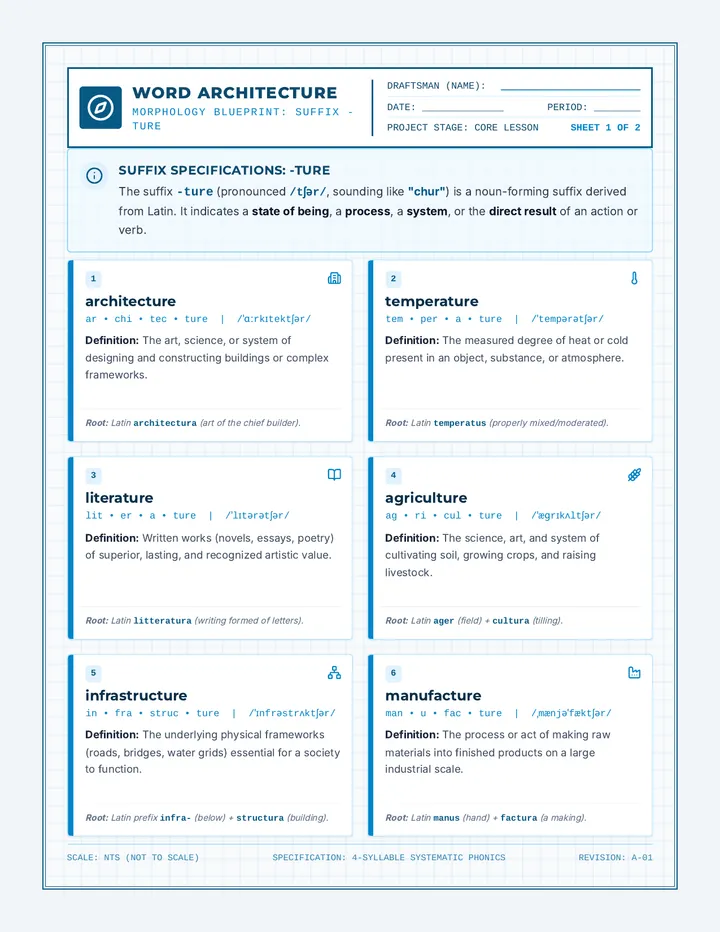
A lesson introducing various suffixes through the lens of women's lacrosse, featuring word analysis and a six-paragraph reading passage.
A comprehensive two-part summative assessment for the novel 'A Long Walk to Water', featuring multiple-choice questions, short responses, and a thematic comparison essay involving 'The Boy Who Harnessed the Wind' and 'MAUS'.
A collection of visual anchor charts and notebook inserts to help students master common spelling rules including the FLOSS rule and the C/K/CK spelling choice.
A mini-lesson focused on the art of explaining and analyzing evidence within an argument body paragraph, designed for 6th-grade students.
A lesson focused on comparing and contrasting two non-fiction texts about animal migration, designed with accessible reading levels for 5th-grade students.
A deep dive into the profound symbolism of Elie Wiesel's 'Night'. Students examine how literal objects like night, fire, and the yellow star represent abstract concepts of faith, dehumanization, and survival through textual evidence and guided discussion.
A lesson exploring how authors use everyday objects to represent deeper abstract ideas, helping students decode layers of meaning in literature.
A full-length practice experience featuring an informational passage, tiered evidence-based questions, and a narrative writing task.
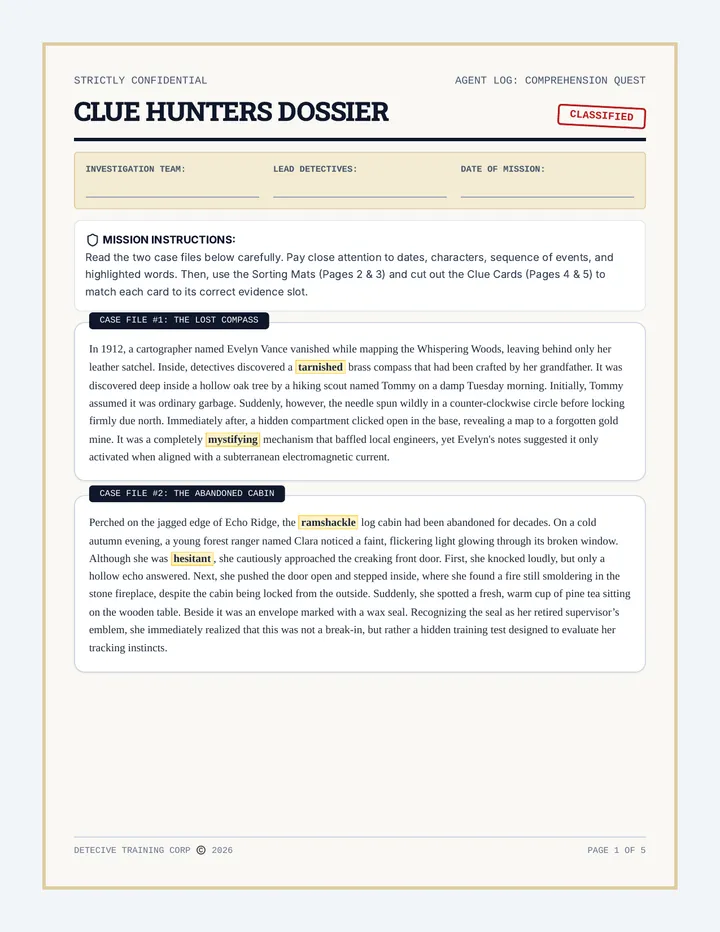
A strategy-focused guide to help students master EBSR questions and vocabulary in context through the lens of a detective's investigative blueprint.
Five days of quick ELA warm-ups to build stamina and recall for key test-taking strategies and vocabulary skills.
A simplified independent work packet about the myth of Orpheus and Eurydice, designed for middle school students at a second-grade reading level. The lesson explores the power of music, love, and the consequences of looking back through accessible texts and structured comprehension tasks.
In this lesson, students become 'Plot Investigators' to distinguish between a story's topic and its main idea. Using mystery-themed tools like a 3-2-1 countdown and the RACES writing strategy, students will learn to extract key evidence from fables and short stories to construct well-supported thematic statements.
A focused look at Chapter 19 of The Westing Game, exploring Crow's internal struggle, the evolving partnership between Denton and Chris, and Turtle's stock market strategy.
A self-paced Social Studies lesson for 6th grade focused on the Silk Road as an ancient global network, integrating rigorous primary source analysis and geography skills.
A full-length 8th-grade STAAR reading practice assessment, including 30 multiple-choice questions, two SCRs, and one ECR based on informational and fiction passages.
A lesson focused on teaching students how to write compelling book reviews by using specific transition phrases to connect their opinions with text-based evidence.
A rigorous informational reading and writing assignment focused on the mycorrhizal network, designed to practice SCR and ECR skills with an emphasis on organization, evidence, and sentence variety.
A comprehensive lesson on identifying and fixing sentence fragments using visual supports, color-coding, and step-by-step practice tailored for neurodivergent learners.
A foundational grammar lesson focusing on sentence structure through visual scaffolds and color-coding. Students learn to identify fragments, complete sentences, and run-ons using a 'Construction' metaphor.
Students analyze Frederick Douglass's use of figurative language in Chapter 11 of his narrative to understand how he conveys his transition from a fugitive to a committed abolitionist and his final message regarding the necessity of ending slavery.
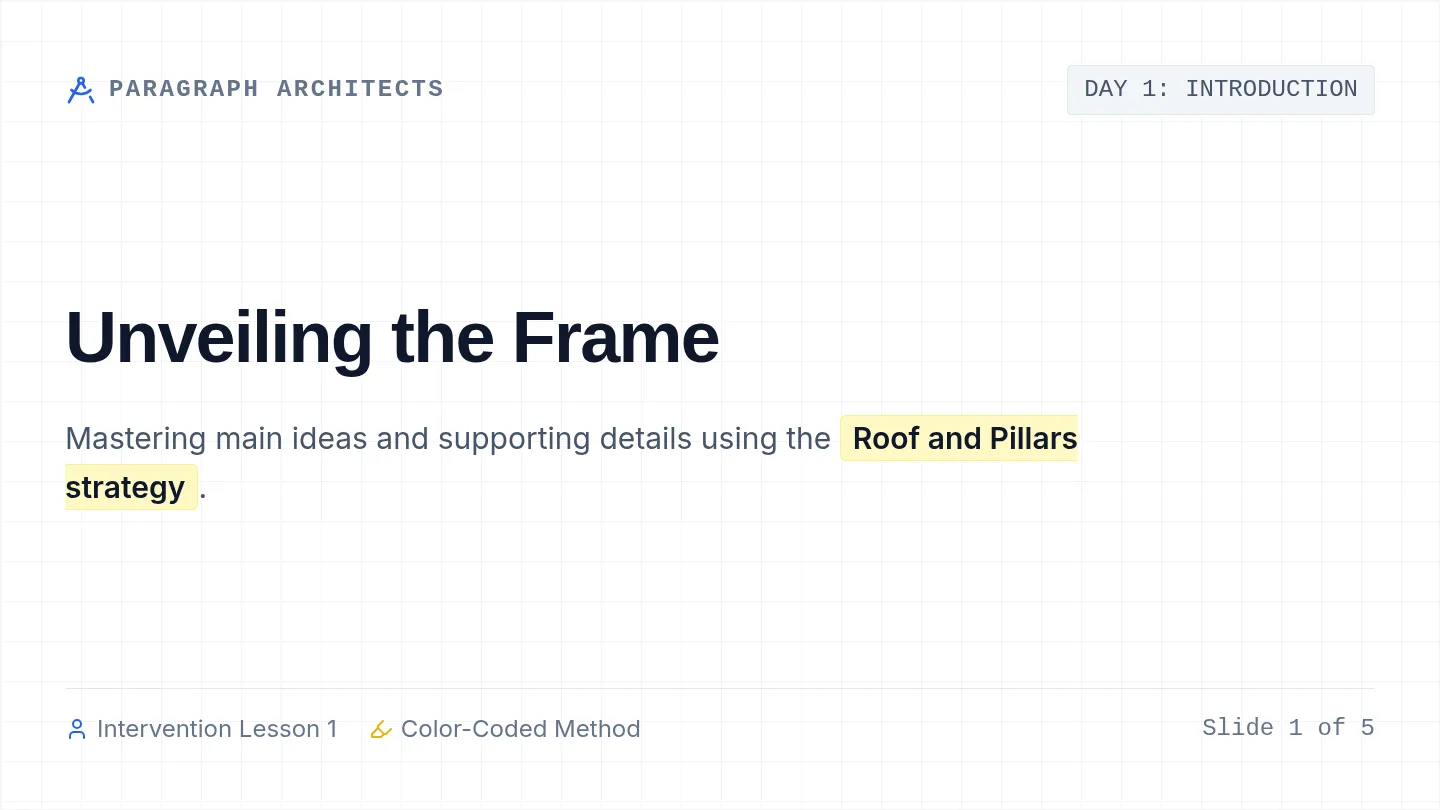
A lesson focused on identifying main ideas and supporting details in complex non-fiction texts, using an 'Information Architect' theme to visualize text structure.
A quick-start guide to mastering the three essential components of an argumentative essay introduction: the hook, the bridge, and the claim.
A lesson focused on identifying the main idea or theme of a story by analyzing character growth and turning it into a universal life lesson supported by evidence.
A comprehensive lesson on understanding semantic nuance and intensity through 'The Synonym Spectrum', focusing on emotions, movement, and weather vocabulary.
This lesson explores the nuances of academic verbs, teaching students to distinguish between different 'shades of meaning' to improve writing precision and tone.
An 8th-grade ELA lesson focused on deconstructing digital media messages through the lens of rhetorical appeals (ethos, pathos, logos) and identifying bias in various online formats. Students transition from passive consumers to critical analysts of news clips, social media, and advertisements.
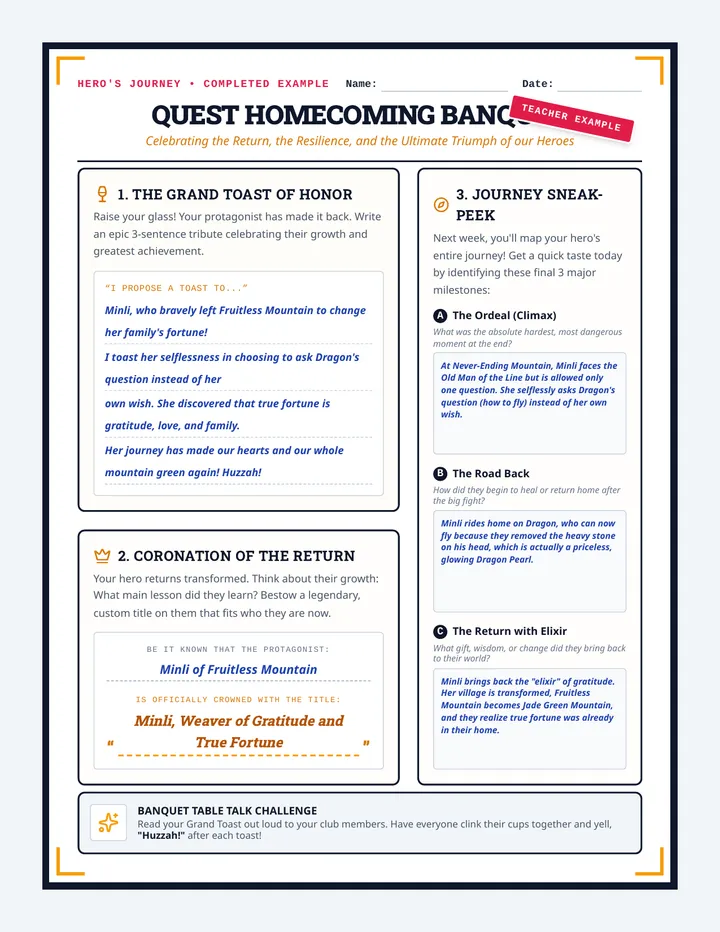
An 8th-grade ELA lesson exploring the Hero's Journey framework. Students analyze recurring narrative patterns across classic and modern texts, culminating in a creative mapping project that visualizes the monomyth structure.
A deep-dive character analysis lesson where students perform a 'Character Autopsy' using textual evidence to map internal traits and external motivations. Students function as forensic literary analysts to uncover the 'DNA' of a protagonist or antagonist.
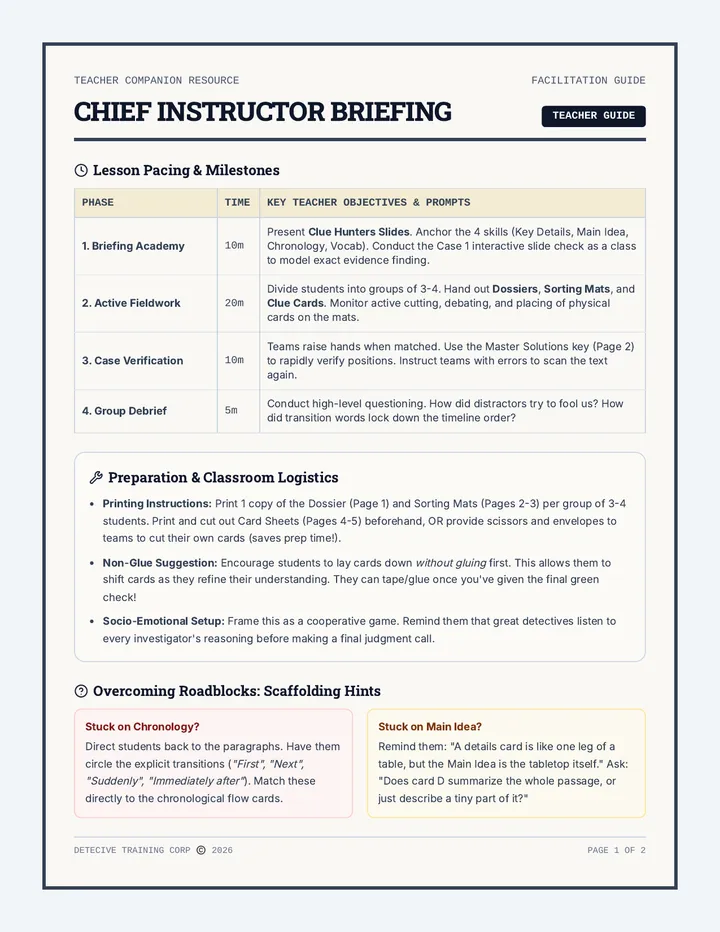
A high-energy station rotation review focusing on identifying theme and main idea in various text types, designed for 5th-grade MCAS preparation with a spy-themed mission.
A 50-minute lesson on the academic action verb 'Synthesize.' Students learn to combine information from multiple sources to create a new, original conclusion using the 'Laboratory Mix' method.