A 1st-grade introduction to contractions using the concept of 'clues' and the 'flying comma' (apostrophe) to decode shortened words. Students will watch a guided video, hunt for apostrophes in a story, and practice forming their own contractions.
Cumulative review of all consonant-le patterns through mixed word lists, sentence reading, and a final fluency passage.
Practice decoding and encoding consonant-le words that include r-controlled or magic e syllables, such as 'purple' and 'beetle'.
Explore how the first syllable (open or closed) determines the vowel sound in consonant-le words, contrasting pairs like 'apple' and 'maple'.
Introduce the consonant-le syllable type and the 'count back 3' rule for dividing words. Focus on words with closed first syllables like 'bubble' and 'candle'.
Foundational literacy support for the Nature's Balance unit, focusing on CVC/CVCe blending, unit vocabulary, and sentence frames.
A bridge between decoding and fluent reading, this lesson focuses on mastering R-controlled vowels through speed drills, phrase scooping, and repeated reading of short, engaging passages. Students will shift from individual sound isolation to smooth, connected reading.
A comprehensive writing unit designed for newcomer multilingual learners to draft a fictional story about a clever rabbit. This lesson includes vocabulary building, structured planning with a brain frame, and scaffolded drafting.
A collection of 10 short stories designed for beginning readers, focusing on CVC words and high-frequency sight words with visual comprehension support.
A 45-minute grade 5 ESL lesson focused on researching extreme weather using multiple sources. Students investigate tornadoes, hurricanes, or blizzards to build knowledge through structured investigation.
A 45-minute ESL lesson for 5th graders to analyze how point of view influences the description of events using the classic fable of The Three Little Pigs versus the Wolf's perspective.
Students will learn to summarize narrative texts using the 'Somebody Wanted But So Then' (SWBST) framework. This lesson is designed for Grade 4 ESL students at the developing/intermediate level, focusing on identifying key plot elements and synthesizing them into a concise summary.
A 45-minute ESL lesson for Grade 5 students focused on the future perfect tense through the lens of space exploration and interstellar travel. Students will learn to form and use the future perfect to describe completed actions in the future.
A 45-minute Grade 4 ESL lesson focused on decoding unfamiliar words using morphology (un-, re-, dis-, -ful, -less, -able) and context clues. Students act as word scientists to break down and build words within sentences.
A 45-minute ESL lesson for 5th grade focusing on decoding word meanings using common prefixes, suffixes, and Greek/Latin roots. Students act as 'Word Scientists' in a lab to disassemble and rebuild complex vocabulary.
A 45-minute ESL lesson for 4th graders to decode and build words using the roots tele, photo, graph, and aud. students will act as 'Word Scientists' in a laboratory-themed environment.
A comprehensive review of Oregon's 6th-grade ELA standards for Reading Literature and Informational Text, designed to prepare students for the OSAS assessment using a Pacific Northwest field guide theme.
A focused lesson on decoding and blending words with the -tch trigraph, using a kitchen-themed approach to engage students in fluency drills.
A set of materials for assessing and practicing 47 key graphemes, including high-visibility flashcards and a comprehensive teacher tracking sheet.
A reading comprehension lesson focusing on identifying and decoding common initial consonant blends through a garden-themed story.
A handwriting practice lesson focused on spring-themed sentences, designed to help 1st and 2nd grade students improve their letter formation and sentence structure while celebrating the season.
A hands-on board game experience where students explore the forest of compound words, practicing how to decompose words and match visual parts to create new ones.
A phonics-focused lesson exploring the African savanna using CVC, VCe, and consonant digraphs through a decodable reading passage and comprehension check.
A foundational lesson for Kindergarten SDC students focusing on the letter A, its short sound, and its formation using Handwriting Without Tears principles.
Focuses on emergent writing and composition through play-based storytelling and symbolic representation. Children discover that their marks on paper can communicate thoughts, emotions, and stories to others.
Focuses on print awareness and letter knowledge through meaningful, context-rich exploration. Students discover how symbols represent language in their environment and begin to master letter shapes and sounds through creative play.
Focuses on developing phonological and phonemic awareness through playful sound discrimination, rhyming, and rhythm. Children build an ear for the sounds of language in a collaborative, active environment.
Focuses on building robust oral language and vocabulary through dramatic play, storytelling, and collaborative conversation. Teachers use 'Deeper Learning' strategies to scaffold high-level thinking in early childhood.
This lesson introduces students to active reading strategies and stamina-building techniques to improve focus and comprehension during independent reading. It uses an 'explorer' theme to frame reading as a mission of discovery.
A 1st-grade lesson exploring Arctic, Rainforest, and Desert habitats. The curriculum focuses on advanced decoding skills including digraphs (sh, ch, th, ck), consonant blends (initial and final), and CVCe patterns. Students engage with more complex decodable texts and informative habitat facts.
A comprehensive 4th-grade poetry unit focusing on figurative language, theme, and setting analysis, culminating in student-authored original poems aligned with Illinois ELA standards.
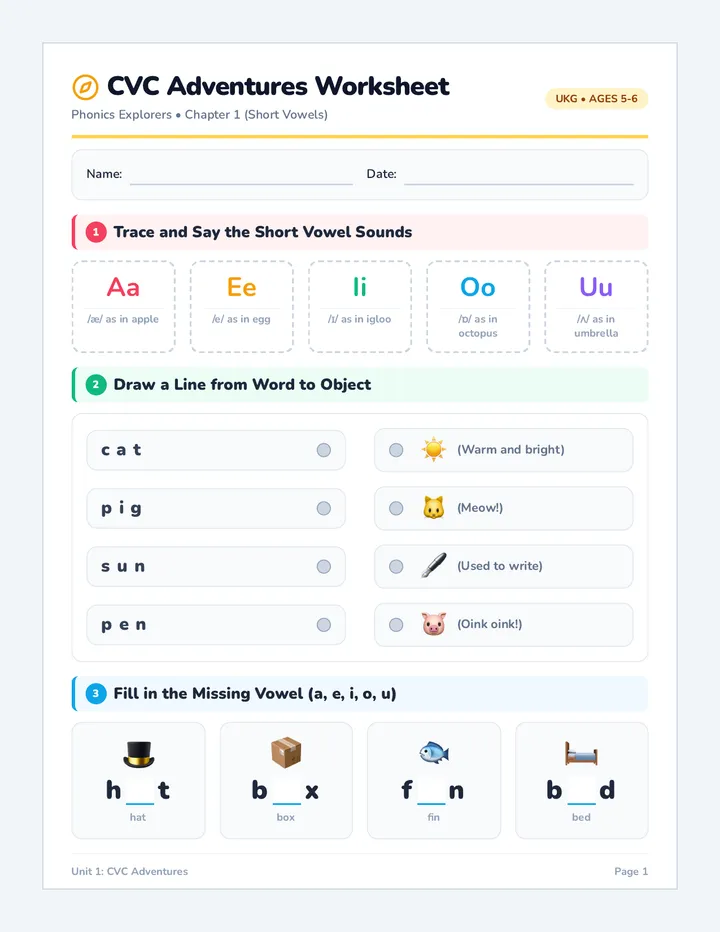
A foundational phonics lesson for kindergarteners focusing on 3-letter CVC words with short 'a' and short 'i' sounds, practiced through memory matching and clip-card recognition.
A collection of foldable vowel desk tents designed for phonemic awareness activities and classroom desk displays. Each tent features clear lettering and a visual keyword to help students identify short vowel sounds.
A collection of fluency triangle cards designed for 1st-grade students to build reading stamina and speed. These cards focus on CVC word families and high-frequency sight words through a progressive sentence-building approach.
An interactive small-group game focusing on reading and writing CVC words across all five vowels through a magical quest-themed board game.
A foundational phonics lesson focused on the Arctic, using a decodable reader to practice CVC, CVCe, r-controlled vowels, and digraphs.
A first-grade lesson focusing on the Arctic habitat while practicing CVC and VCe (silent e) decoding skills through a leveled reader and follow-up activities.
Students visit the savannah to practice decoding r-controlled vowels (ar, er, ir, or, ur) in the context of grassland wildlife.
Students journey through the desert, focusing on Vowel-Consonant-e (VCe) patterns within habitat-themed texts.
Students explore the Arctic habitat while practicing CVC words and common digraphs in a decodable format.
Fluency practice with decodable text and a review game to celebrate mastery of the 'qu' sound.
Application of 'qu' knowledge through guided spelling and sentence dictation.
Focus on irregular high-frequency words and reading connected sentences featuring 'qu' words.
Practicing blending and building words with 'qu' using letter chains and word sorts.
Introduction to the 'qu' buddy system and the /kw/ sound through phonemic awareness and visual drills.
A comprehensive reading lesson based on 'Because of Winn-Dixie' focusing on story structure, character development, and key vocabulary for 4th grade.
A phonics-based lesson focused on building and manipulating CVC words through word ladders, helping students understand how changing a single letter creates a new word.
Teacher-facing resources including answer keys and instructional guides for the Syllable Mastery Series.