Caesar Key Ideas Questions
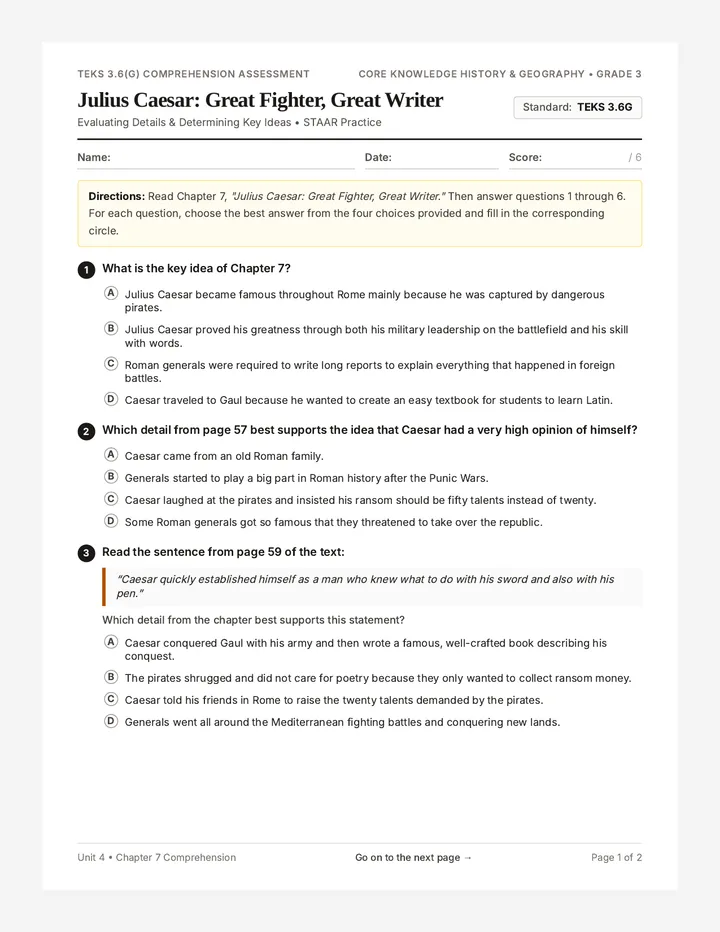
TEKS 3.6(G) Comprehension Assessment Core Knowledge History & Geography • Grade 3
Julius Caesar: Great Fighter, Great Writer
Evaluating Details & Determining Key Ideas • STAAR Practice
Standard: TEKS 3.6G
Name:
Date:
Score: / 6
Directions: Read Chapter 7, "Julius Caesar: Great Fighter, Great Writer." Then answer questions 1 through 6. For each question, choose the best answer from the four choices provided and fill in the corresponding circle.
1
What is the key idea of Chapter 7?
A Julius Caesar became famous throughout Rome mainly because he was captured by dangerous pirates.
B Julius Caesar proved his greatness through both his military leadership on the battlefield and his skill with words.
C Roman generals were required to write long reports to explain everything that happened in foreign battles.
D Caesar traveled to Gaul because he wanted to create an easy textbook for students to learn Latin.
2
Which detail from page 57 best supports the idea that Caesar had a very high opinion of himself?
A Caesar came from an old Roman family.
B Generals started to play a big part in Roman history after the Punic Wars.
C Caesar laughed at the pirates and insisted his ransom should be fifty talents instead of twenty.
D Some Roman generals got so famous that they threatened to take over the republic.
3
Read the sentence from page 59 of the text:
“Caesar quickly established himself as a man who knew what to do with his sword and also with his pen.”
Which detail from the chapter best supports this statement?
A Caesar conquered Gaul with his army and then wrote a famous, well-crafted book describing his conquest.
B The pirates shrugged and did not care for poetry because they only wanted to collect ransom money.
C Caesar told his friends in Rome to raise the twenty talents demanded by the pirates.
D Generals went all around the Mediterranean fighting battles and conquering new lands.
Unit 4 • Chapter 7 Comprehension Go on to the next page → Page 1 of 2
Julius Caesar: Great Fighter, Great Writer TEKS 3.6(G) • STAAR Review
4
What is the key idea of the section describing Caesar's report to Rome (pages 59–61)?
A Caesar preferred writing a brief, powerful message showing his swift victory rather than a lengthy report.
B Caesar forgot to include important details about the revolt in Asia because he was in a hurry.
C Roman leaders were angry at Caesar for refusing to write several pages about his battle.
D Caesar wanted to keep his military victory a secret from the people living in ancient Rome.
5
Which detail from page 61 best supports the idea that Caesar was an extraordinarily skilled and lasting writer?
A The land that the Romans called Gaul is known today as the country of France.
B His book on the Gallic Wars is so clear and well-written that teachers still use it today to teach Latin.
C The first sentence of his book translates to “The whole of Gaul is divided into three parts.”
D Gaul was not part of Roman civilization when Caesar marched his army in.
6
Why does the author include the detail about Caesar returning with ships and fighters to punish the pirates (page 59)?
A To show that Caesar was determined and backed up his proud words with decisive action.
B To demonstrate that the pirates had refused to accept the fifty talents of ransom money.
C To explain why Caesar decided to give up writing poetry and focus entirely on being a soldier.
D To prove that the Roman republic ordered Caesar to wipe out all piracy in the Mediterranean.
Student Response Grid Bubble in your chosen answer for each question
1
A B C D
2
A B C D
3
A B C D
4
A B C D
5
A B C D
6
A B C D
Unit 4 • Chapter 7 Comprehension • STOP • You have finished the assessment. Page 2 of 2
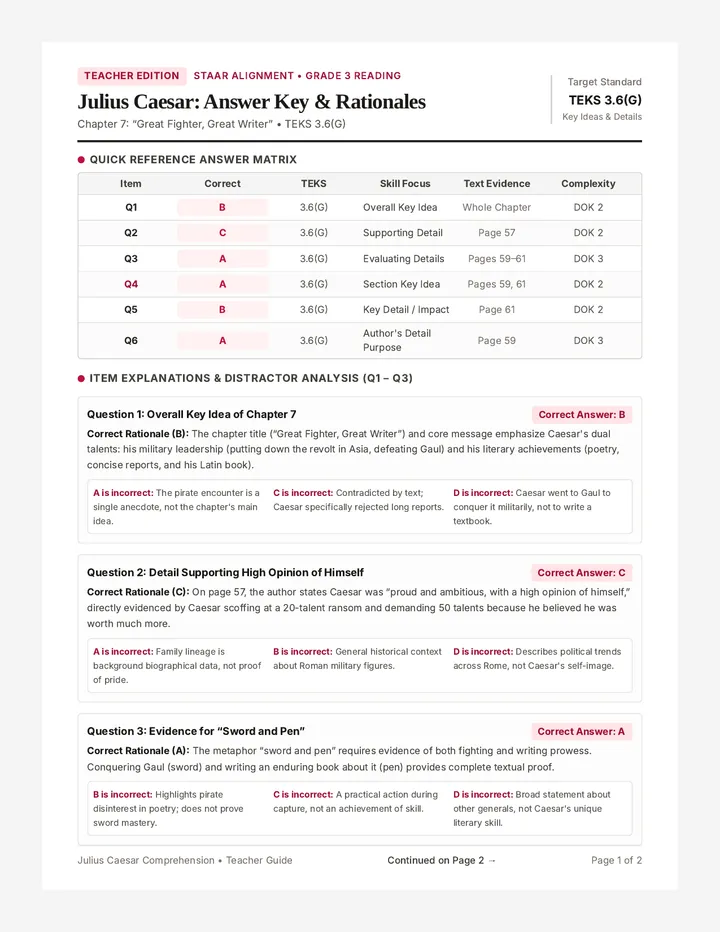
Caesar Key Ideas Answer Key
Teacher Edition STAAR Alignment • Grade 3 Reading
Julius Caesar: Answer Key & Rationales
Chapter 7: “Great Fighter, Great Writer” • TEKS 3.6(G)
Target Standard TEKS 3.6(G) Key Ideas & Details
Quick Reference Answer Matrix
Item Correct TEKS Skill Focus Text Evidence Complexity
Q1 B 3.6(G) Overall Key Idea Whole Chapter DOK 2
Q2 C 3.6(G) Supporting Detail Page 57 DOK 2
Q3 A 3.6(G) Evaluating Details Pages 59–61 DOK 3
Q4 A 3.6(G) Section Key Idea Pages 59, 61 DOK 2
Q5 B 3.6(G) Key Detail / Impact Page 61 DOK 2
Q6 A 3.6(G) Author's Detail Purpose Page 59 DOK 3
Item Explanations & Distractor Analysis (Q1 – Q3)
Question 1: Overall Key Idea of Chapter 7 Correct Answer: B
Correct Rationale (B): The chapter title (“Great Fighter, Great Writer”) and core message emphasize Caesar's dual talents: his military leadership (putting down the revolt in Asia, defeating Gaul) and his literary achievements (poetry, concise reports, and his Latin book).
A is incorrect: The pirate encounter is a single anecdote, not the chapter's main idea.
C is incorrect: Contradicted by text; Caesar specifically rejected long reports.
D is incorrect: Caesar went to Gaul to conquer it militarily, not to write a textbook.
Question 2: Detail Supporting High Opinion of Himself Correct Answer: C
Correct Rationale (C): On page 57, the author states Caesar was “proud and ambitious, with a high opinion of himself,” directly evidenced by Caesar scoffing at a 20-talent ransom and demanding 50 talents because he believed he was worth much more.
A is incorrect: Family lineage is background biographical data, not proof of pride.
B is incorrect: General historical context about Roman military figures.
D is incorrect: Describes political trends across Rome, not Caesar's self-image.
Question 3: Evidence for “Sword and Pen” Correct Answer: A
Correct Rationale (A): The metaphor “sword and pen” requires evidence of both fighting and writing prowess. Conquering Gaul (sword) and writing an enduring book about it (pen) provides complete textual proof.
B is incorrect: Highlights pirate disinterest in poetry; does not prove sword mastery.
C is incorrect: A practical action during capture, not an achievement of skill.
D is incorrect: Broad statement about other generals, not Caesar's unique literary skill.
Julius Caesar Comprehension • Teacher Guide Continued on Page 2 → Page 1 of 2
Julius Caesar: Answer Key & Rationales Teacher Guidance • Page 2
Item Explanations & Distractor Analysis (Q4 – Q6)
Question 4: Key Idea of Caesar's Report Section Correct Answer: A
Correct Rationale (A): Pages 59 and 61 contrast the customary multi-page reports with Caesar's legendary three-word report (“Veni, vidi, vici”), conveying that Caesar valued conciseness and dramatic impact.
B is incorrect: Caesar did not forget details; he deliberately crafted a concise message.
C is incorrect: The passage never indicates Roman leaders were dissatisfied.
D is incorrect: Caesar sent the report directly to Rome to publicize his triumph.
Question 5: Detail Supporting Caesar as Lasting Writer Correct Answer: B
Correct Rationale (B): Page 61 explicitly concludes with the fact that educators worldwide still read and use his book on the Gallic Wars today because of its exceptional clarity and literary quality.
A is incorrect: Modern geographical information about France, not proof of writing quality.
C is incorrect: Quotes the opening sentence but does not explain its lasting pedagogical use.
D is incorrect: A historical fact about Gaul's status before Roman conquest.
Question 6: Purpose of Pirate Punishment Detail Correct Answer: A
Correct Rationale (A): When captured, Caesar told the pirates he would return to punish them. Their disbelief and his subsequent return with hired ships demonstrate that Caesar was a man of resolute will who enforced his word.
B is incorrect: The pirates did collect the ransom and released him as agreed.
C is incorrect: Caesar did not stop writing; he later penned famous reports and books.
D is incorrect: Caesar acted independently to avenge his personal insult, not under Senate orders.
TEKS 3.6(G) Instructional Coaching & Small Group Prompts
• Common Student Misconception
Third graders often mistake an exciting, vivid narrative detail (e.g., getting captured by pirates or saying 50 talents) for the central key idea of the whole passage. Remind students that key ideas must span the entire text (both fighting AND writing), rather than just one episode.
• Guided Reteach Questioning Stems
• “Does this detail tell what the whole chapter is about, or just one part?”
• “How does the author connect Caesar's sword to his pen across pages 57–61?”
• “Why did the author choose to tell us about the three Latin words?”
Julius Caesar Comprehension • Teacher Guide End of Answer Key • TEKS 3.6(G) Page 2 of 2