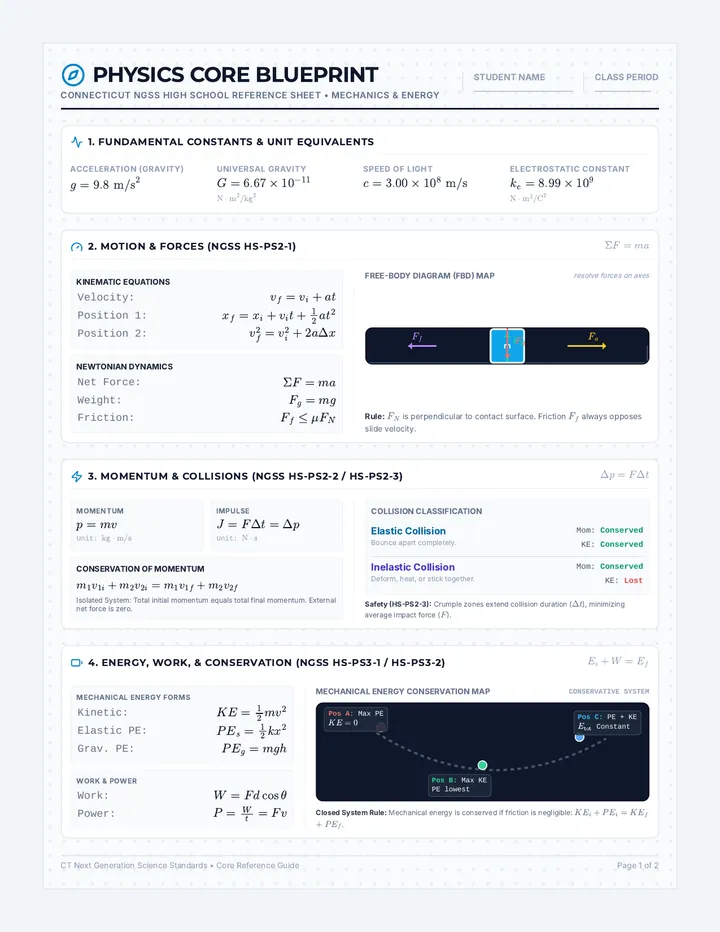
Fundamental principles of force, motion, and energy across classical and modern contexts. Examines matter properties, wave behavior, thermodynamics, and electromagnetism through mechanics and atomic studies.
A comprehensive 5-lesson unit for 4th graders exploring the properties of light energy, including how it travels, reflects, refracts, and interacts with different materials.
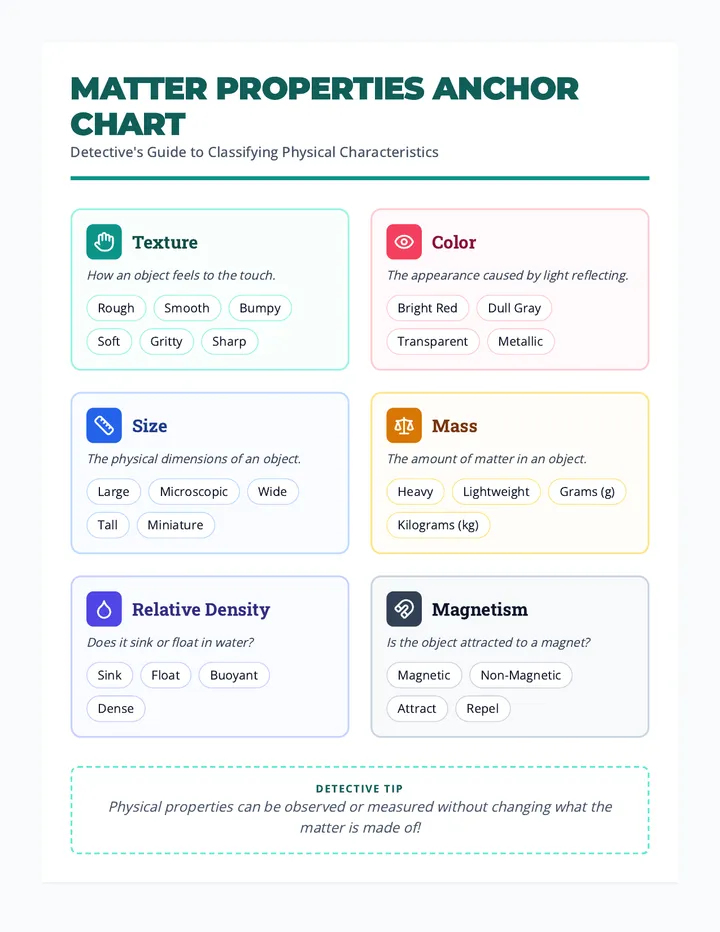
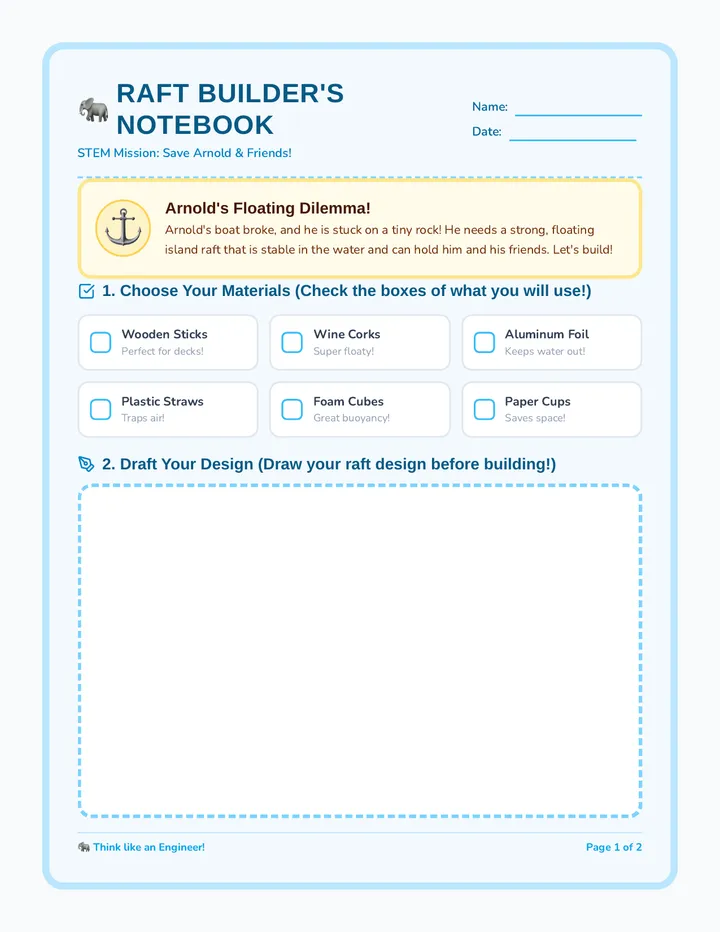
A 1st-grade science sequence focused on identifying physical properties of materials and understanding the relationship between a material's structure and its function. Students explore real-world examples and use creative problem-solving to explain why specific materials are chosen for objects.
A graduate-level exploration of sustainable set design, focusing on ecoscenography, material science, modular engineering, and digital fabrication to move the theater industry toward a circular economy.
A project-based physics sequence where 10th-grade students act as environmental engineers to design, build, and test a multi-stage water filtration system. Students explore physical properties of mixtures, separation techniques, and engineering design constraints.
Students act as environmental engineers designing a multi-stage water filtration system. They explore sedimentation, decanting, and various filtration media to solve a real-world water contamination challenge.
This 9th-grade physics and chemistry sequence explores the classification of matter through physical properties. Students progress from macroscopic observations to microscopic particle diagrams, conducting labs to distinguish between pure substances, homogeneous mixtures, and heterogeneous mixtures using evidence-based reasoning.
A 5-lesson unit for 7th-grade science exploring industrial separation techniques through simulations, engineering challenges, and systems thinking. Students act as process engineers to solve real-world problems like recycling, oil spills, mining, and water scarcity.
A 5-lesson engineering sequence where 7th-grade students analyze contaminated water, investigate filtration materials, and design, build, and test multi-stage filtration systems to explore separation science.
A foundational physics sequence for 2nd graders to explore heterogeneous mixtures through hands-on sorting, mixing, and separating activities. Students learn that individual components retain their properties when physically combined and develop strategies to separate them based on size, shape, and magnetism.
A hands-on engineering unit where 2nd-grade students explore how to separate mixtures using particle size. They will design and test multi-stage water filtration systems to solve a real-world problem.
An industrial engineering-focused sequence for 11th-grade physics investigating how physical properties (density, magnetism, conductivity) dictate large-scale separation methods in recycling, mining, and environmental cleanup. Students analyze the physics of centrifuges, eddy currents, and the economic trade-offs of engineering design.
This sequence explores how geometric properties like surface area to volume ratios, stress distribution, and packing efficiency dictate engineering design choices in physics and aerospace.
Students explore how geometric shapes like triangles and squares contribute to structural stability through hands-on building and testing. They apply their knowledge of vertices and sides to engineering challenges, concluding with a design review of their own stable structures.
A Pre-K physics sequence exploring three-dimensional solids. Students investigate the properties of spheres, cubes, cylinders, and cones through hands-on experimentation with rolling, stacking, and sliding to understand how shape dictates movement and stability.
A hands-on physics sequence for Pre-K students to explore reflection, material properties, and light paths using mirrors and shiny objects. Students move from self-observation to problem-solving with periscopes and pattern creation.
A 2nd-grade physics sequence focused on light reflection, where students act as 'Light Engineers' to manipulate beams using mirrors through gamified challenges and a final maze design project.
A 2nd-grade chemistry sequence where students transform into lab technicians to master measuring liquid volume and mass. Through hands-on 'Lab Mixing Station' activities, students learn to use beakers, graduated cylinders, and balance scales to follow precise formulas for chemical reactions.
A kindergarten physics sequence where students explore how light interacts with different materials, moving from basic transparency testing to designing and building their own suncatchers.
A hands-on exploration of magnetism for 2nd-grade students, focusing on material properties, metal identification, and force through barriers. Students move from basic classification to evidence-based prediction.
A systematic Kindergarten sequence exploring the properties of magnetic materials through prediction, testing, and data recording, culminating in a nuanced understanding that not all metals are magnetic.
An undergraduate-level exploration of solid-state crystallography, moving from real-space lattice geometry and packing efficiency to the mathematical abstraction of reciprocal space and X-ray diffraction analysis. Students master the geometric principles that govern material properties at the atomic scale.
This sequence bridges the gap between abstract geometry and physical law by introducing group theory as a tool for analyzing physical systems. Students classify shapes, translate operations into matrix algebra, derive conservation laws via Noether's Theorem, and apply symmetry to quantum selection rules.
This sequence explores the physics of rotational inertia through the lens of geometry. Students transition from point-mass calculations to analyzing extended rigid bodies, investigating how the spatial distribution of mass affects an object's resistance to angular acceleration.
This sequence investigates the Square-Cube Law and scaling relationships, examining how changes in an object's dimension affect its surface area, volume, and physical behavior. Students analyze biological constraints, structural engineering limits, and thermal properties through the lens of geometric proportions.
A Pre-K engineering sequence exploring shape composition, stability, and structural design through hands-on block play and spatial reasoning challenges.
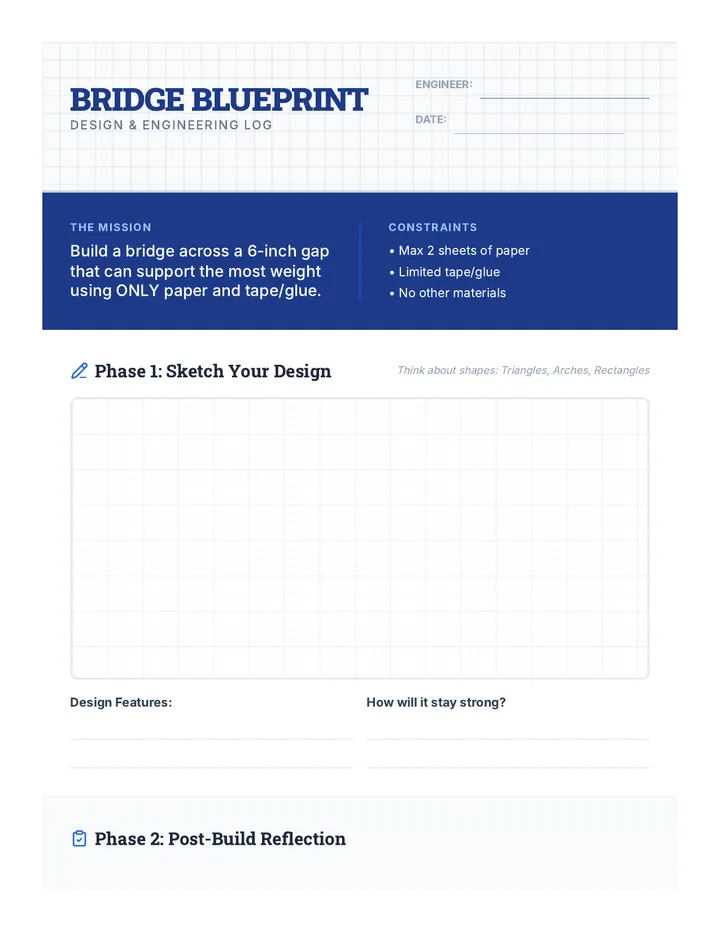
Students investigate how geometric properties influence the stability and function of structures. They analyze triangles versus squares, identify shapes in real-world bridges, and design structures under geometric constraints.
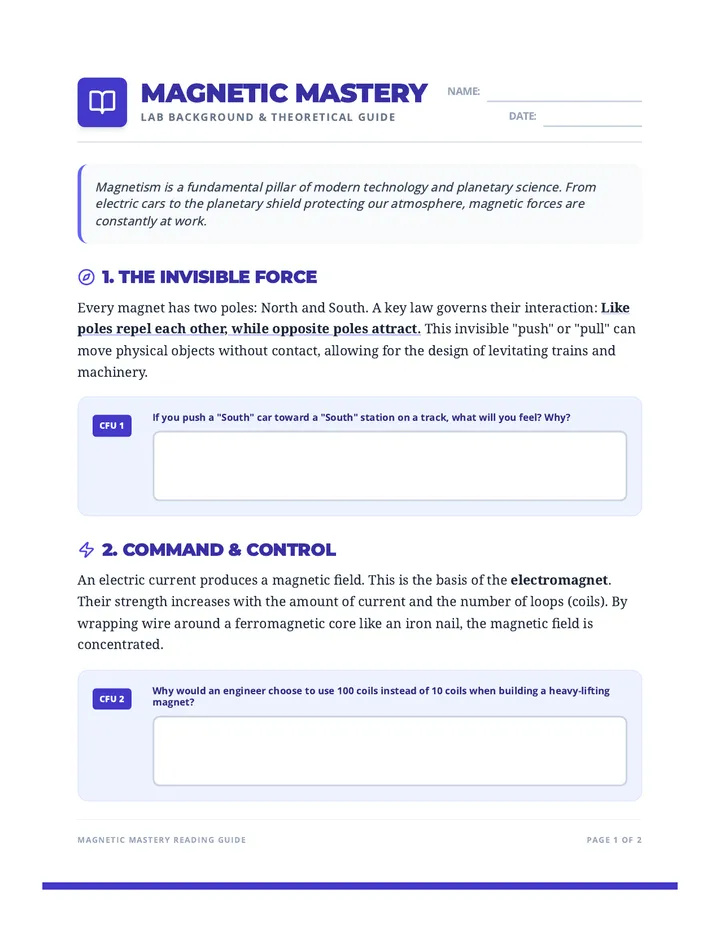
A comprehensive unit exploring the fundamentals of electricity, magnetism, and how they combine in circuits, focusing on energy transformations and hands-on visuals.
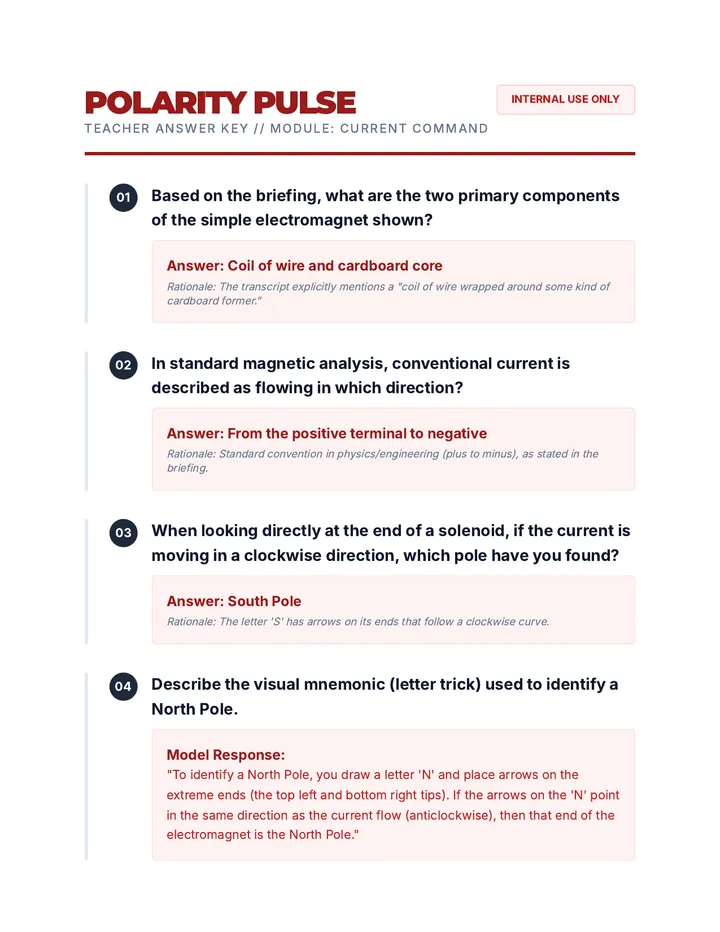
A hands-on introductory sequence where 3rd-grade students explore the relationship between electricity and magnetism by building their own electromagnets.
A Kindergarten through 2nd-grade art-integrated science unit exploring the properties of magnets through creative character design and hands-on testing.
This high school physics sequence explores the industrial scale-up of mixture separation techniques, focusing on the physics of centrifugation, magnetism, oil-water interactions, and reverse osmosis. Students evaluate trade-offs between efficiency, cost, and environmental impact through simulations and case studies.
Students investigate the physical properties of matter to design and execute protocols for separating complex mixtures. The sequence moves from theoretical classification of matter to practical laboratory techniques, culminating in a performance task where students isolate components from a four-part mixture.
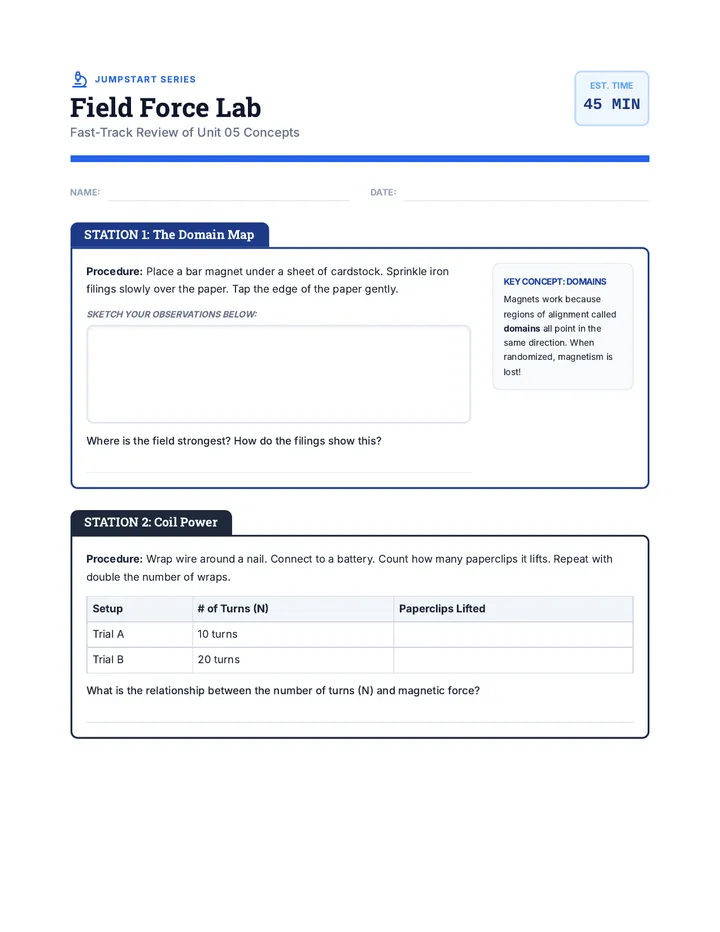
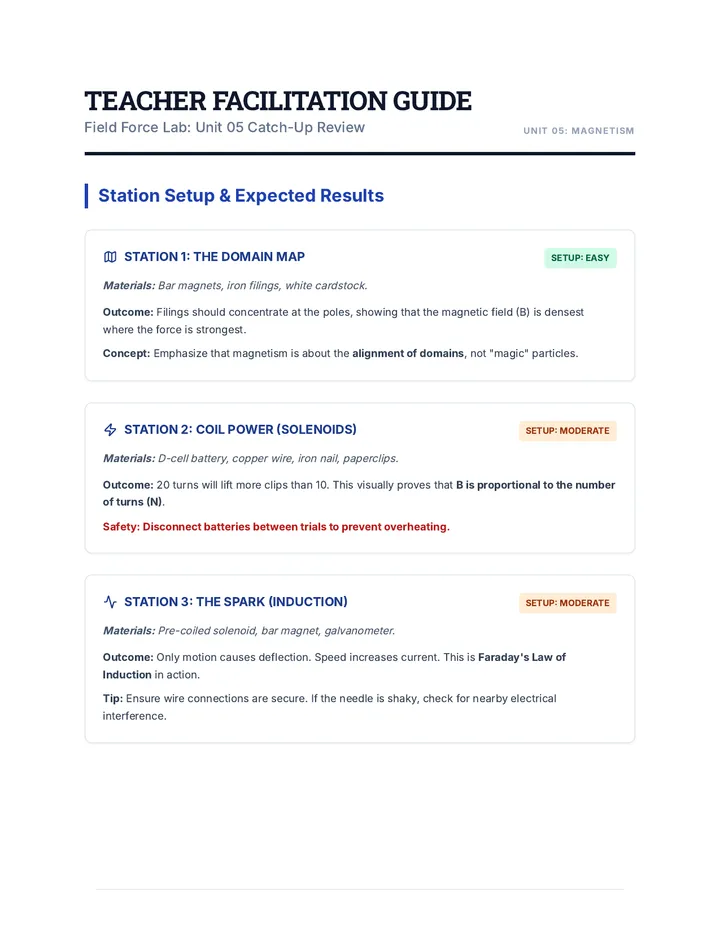
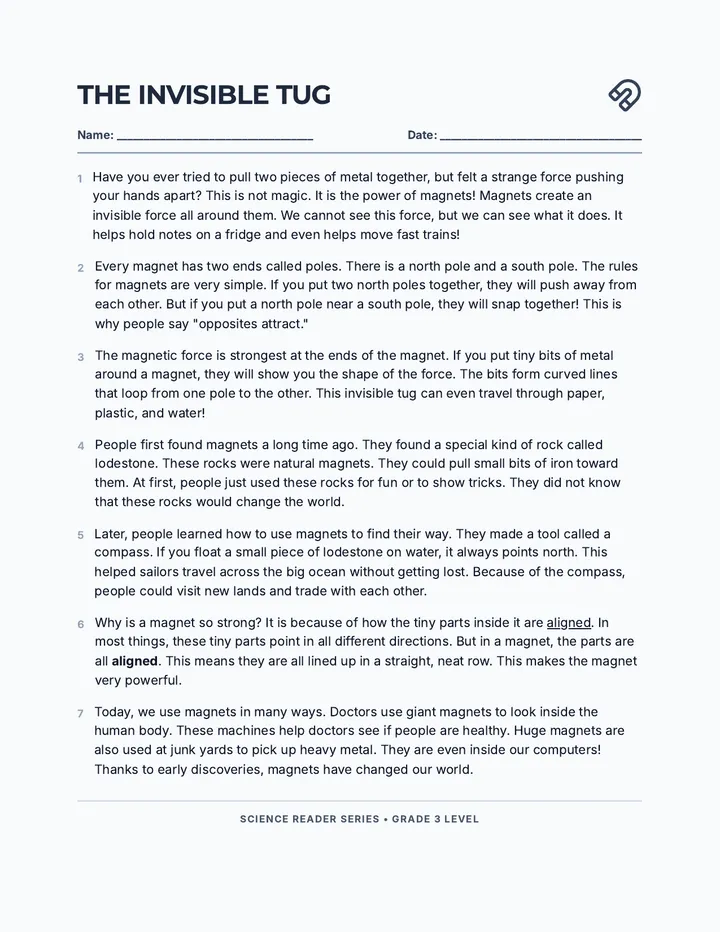
This 5-lesson sequence for 2nd graders focuses on the invisible properties of magnetism. Students move from simple observation of iron filings to measuring magnetic strength, testing the effect of distance, and using compasses to map magnetic fields, concluding with a comparison of different magnet types.
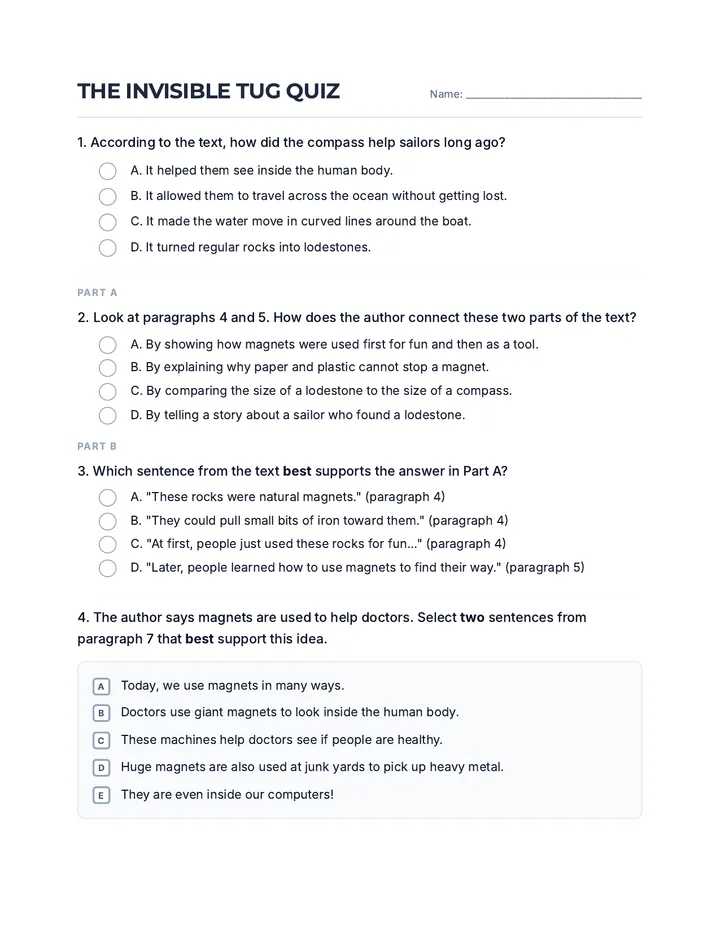
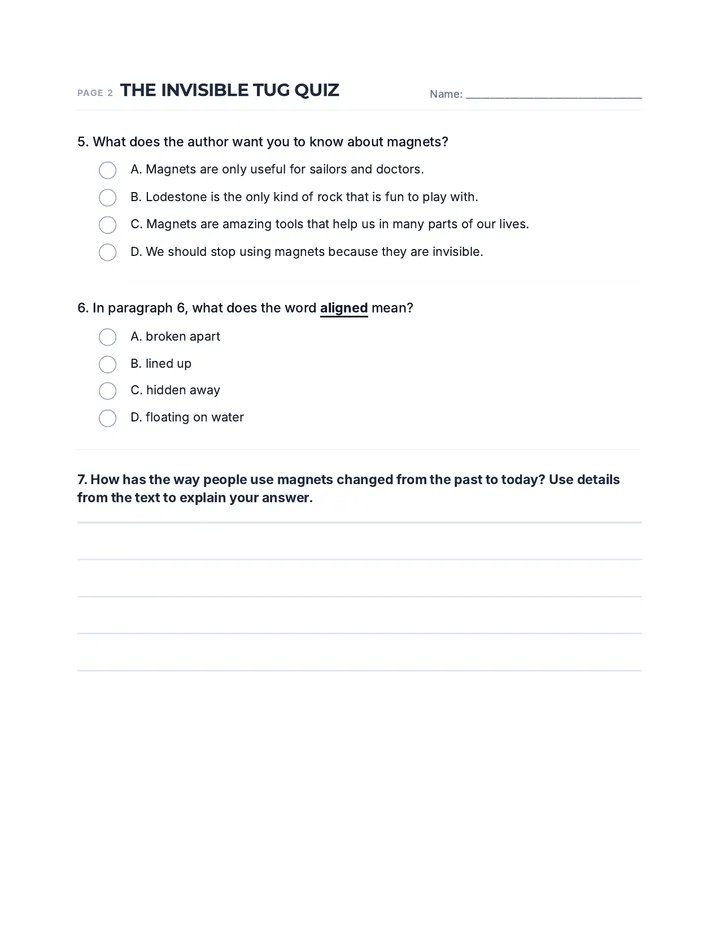
A 2nd-grade physics sequence exploring the invisible forces of magnetism, specifically focusing on poles, attraction, repulsion, and practical applications like movement and levitation.
A project-based sequence for 2nd graders to apply magnetism concepts to engineering. Students analyze real-world magnetic objects, brainstorm solutions to common problems, and prototype their own magnetic inventions.
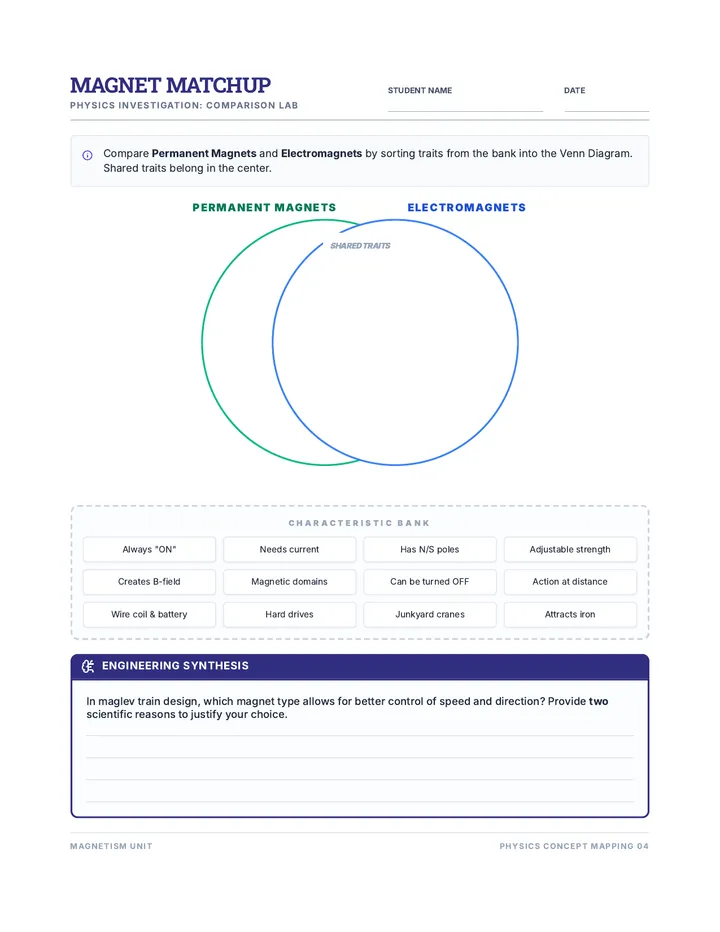
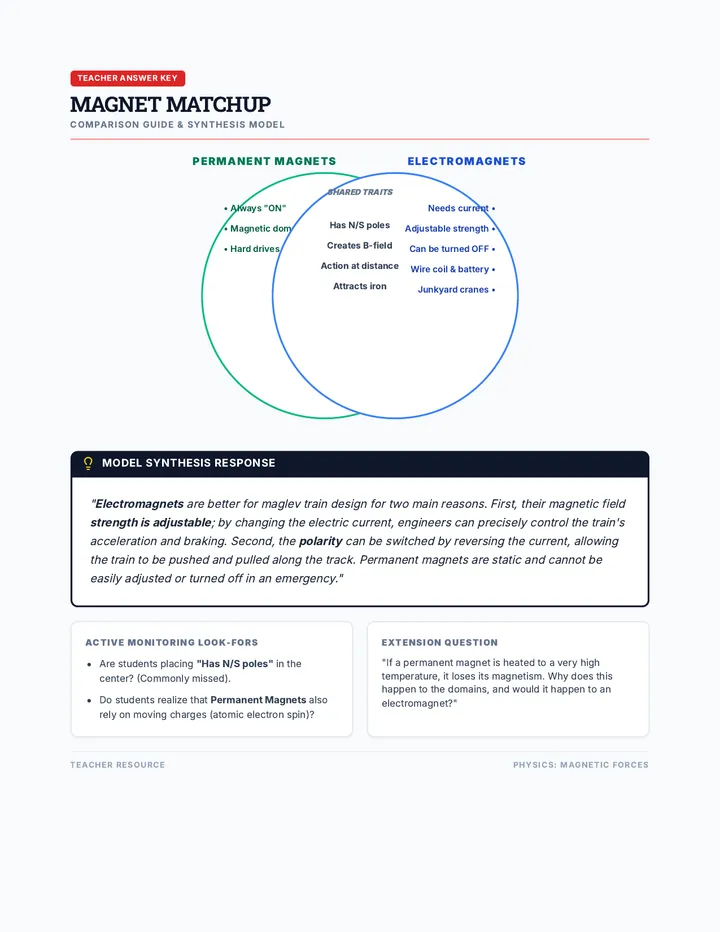
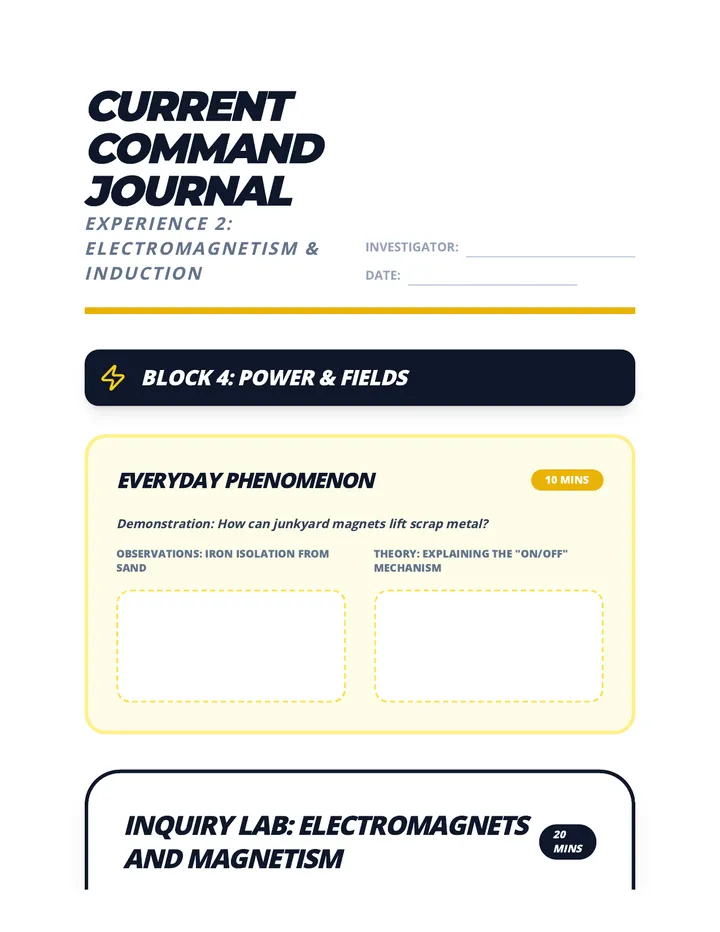
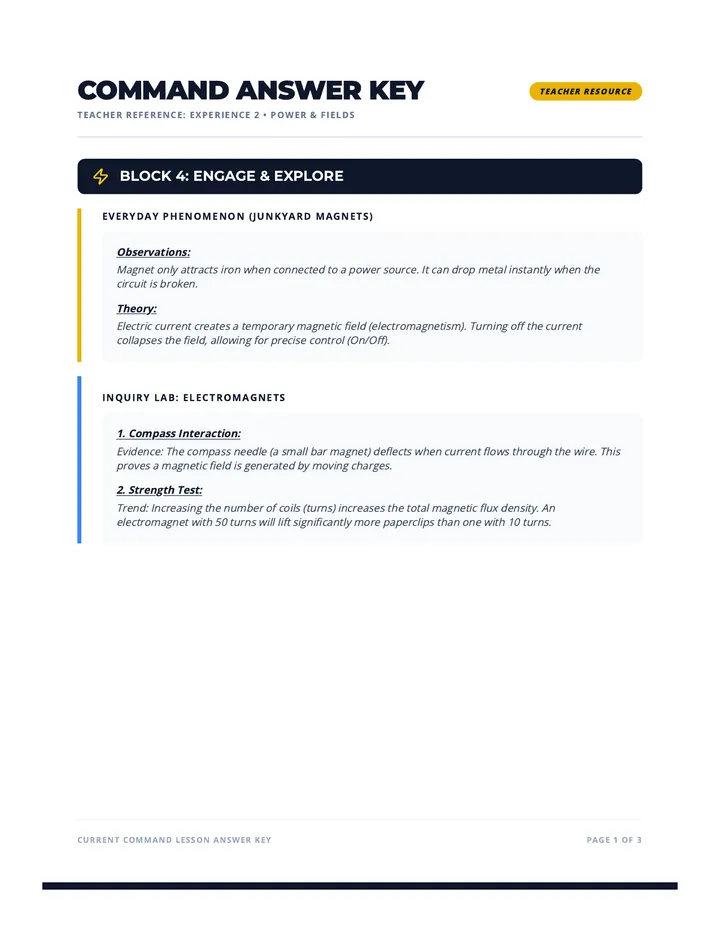
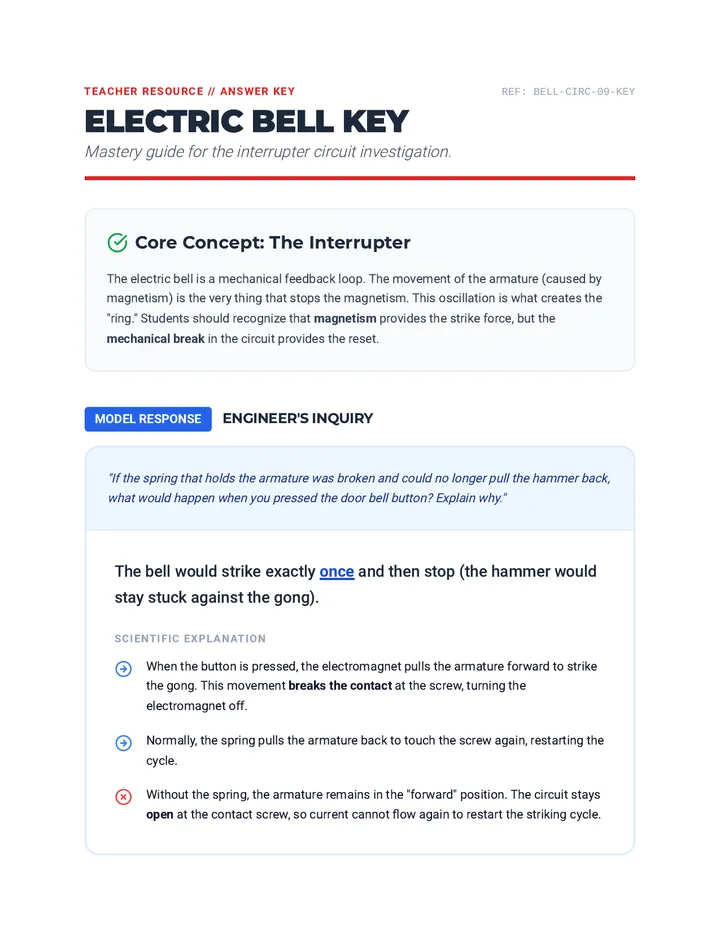
This sequence bridges the gap between electricity and magnetism by introducing simple electromagnets. Students discover that electricity can create a temporary magnetic field that can be turned on and off, contrasting with the permanent magnets they studied previously. The sequence builds from a simple circuit to constructing a functional electromagnet and simulating a scrap yard crane. By the end, students understand that magnetism can be controlled electronically.
A Kindergarten science sequence exploring the practical uses of magnets in daily life, from kitchen gadgets to high-speed trains and navigation. Students learn through hands-on inquiry, case studies, and safety workshops to understand that magnetism is a foundational part of modern technology.
A high-energy, game-based sequence for Kindergarten students to explore the invisible forces of magnetism, including repulsion, attraction, and field strength. students engage in hands-on simulations and interactive challenges to understand how magnets interact with the world.
A project-based kindergarten physics unit where students explore how magnets work through barriers to design mazes, fishing tools, and retrieval devices.
This project-based sequence explores magnetic systems through the lens of engineering. Students apply their knowledge of attraction and repulsion to solve friction problems, culminating in the design and prototyping of a Maglev vehicle.
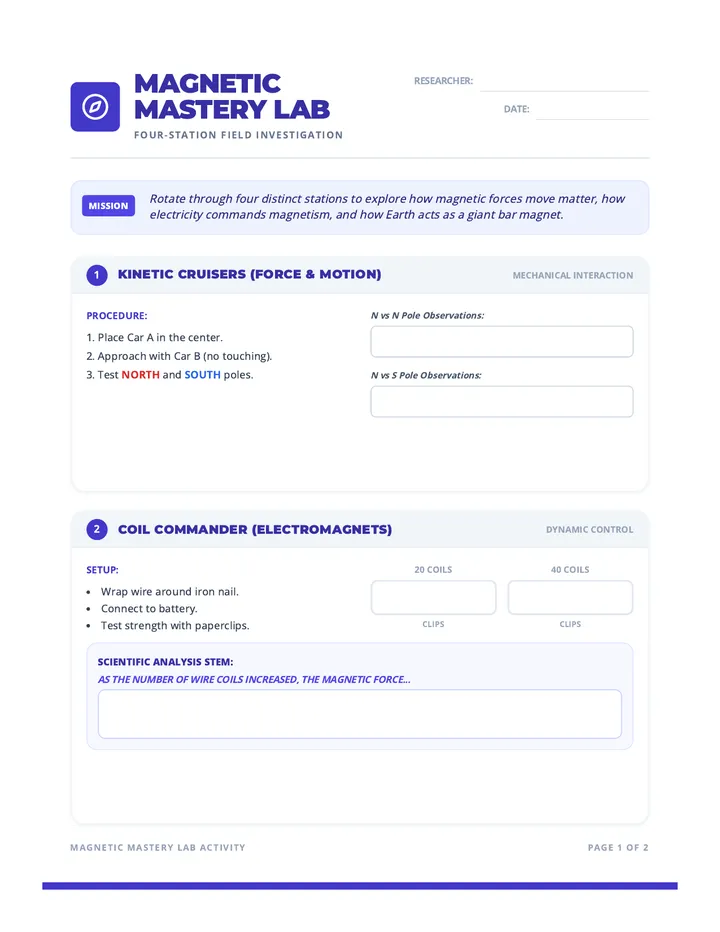
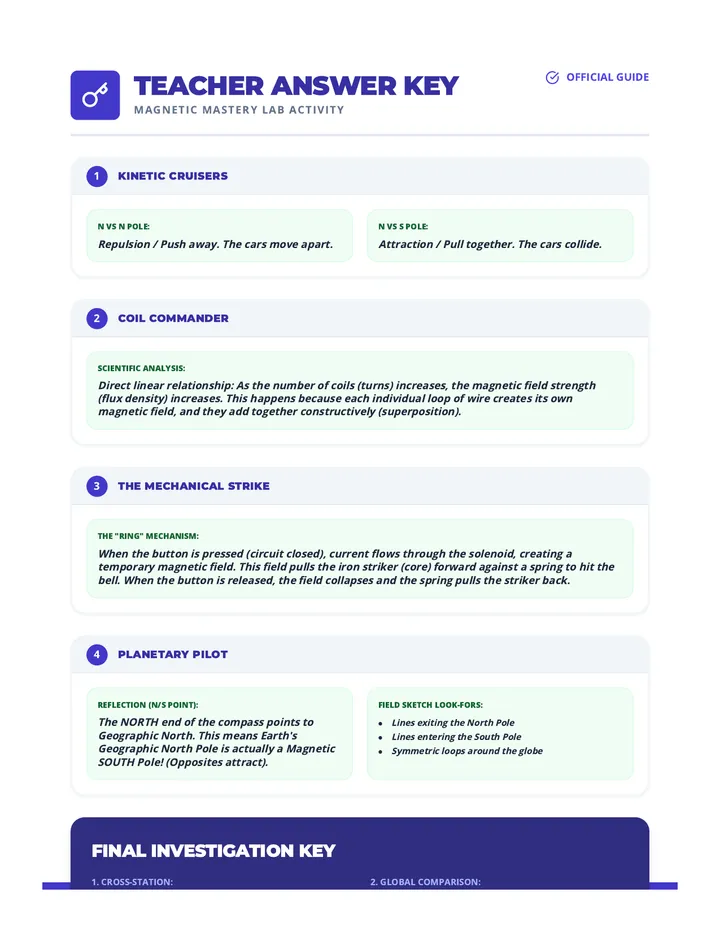
A hands-on physics sequence for 4th graders exploring magnetism through discovery, visualization, and experimentation. Students investigate magnetic materials, polarity, field patterns, and Earth's magnetic force.
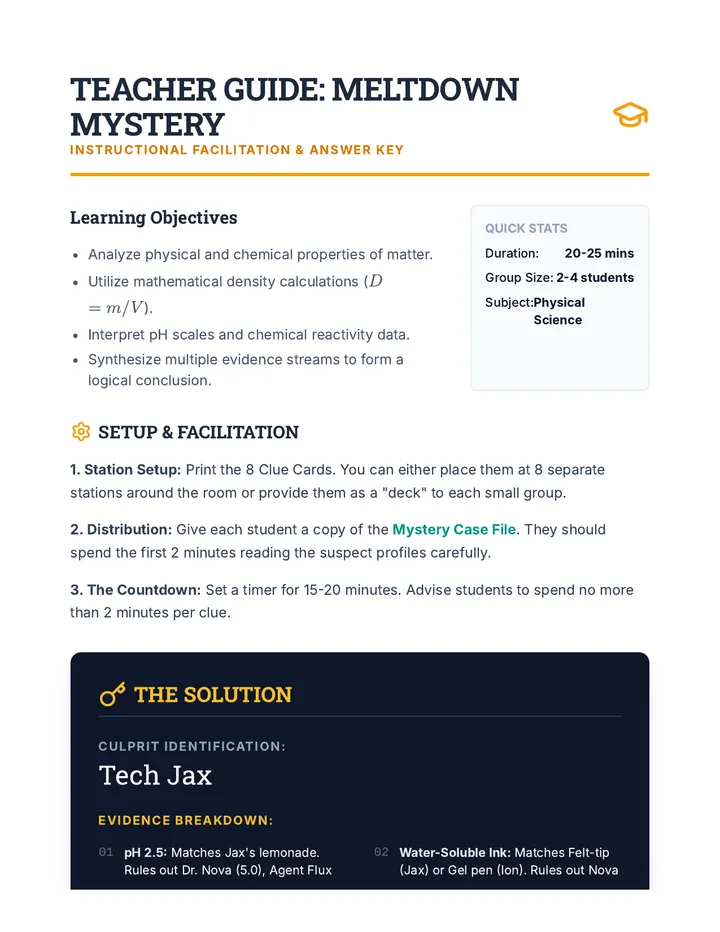
A lesson sequence focused on the scientific method, using a mystery box activity to practice observation, hypothesis formation, and experimentation. Students explore the historical roots of the method and apply it to solve physical puzzles.
A foundational science unit for early elementary students exploring the concepts of energy, force, and gravity through hands-on investigation and real-world observation.
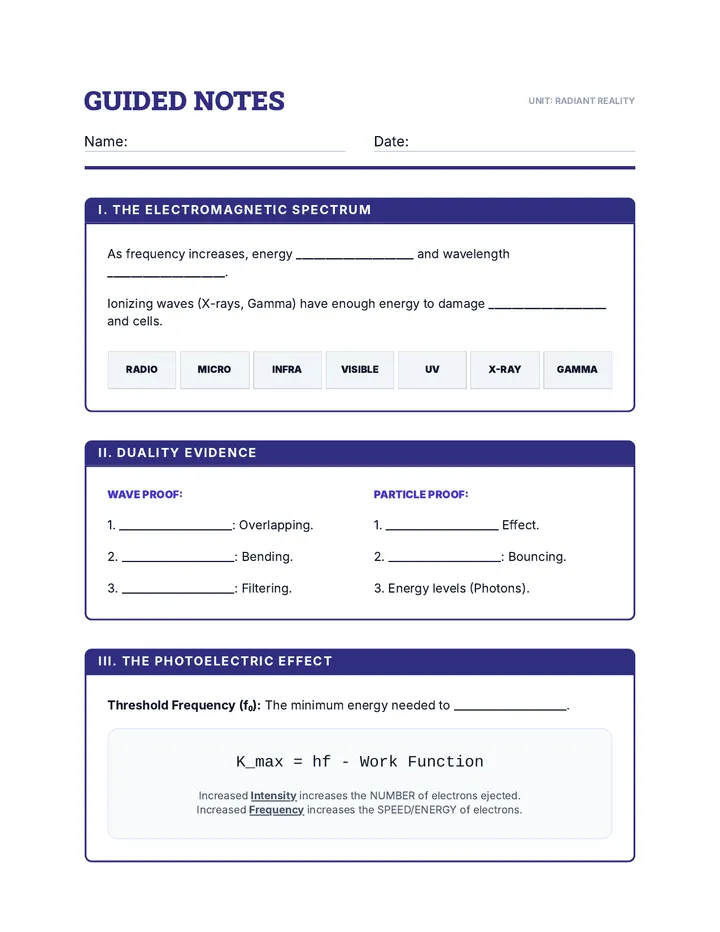
A unit on wave properties and their applications in physical science, focusing on electromagnetic radiation and mechanical waves.
A 9th-grade physics sequence exploring the distinct properties of solutions, colloids, and suspensions based on particle size, stability, and light interaction.
This sequence explores the physics of colloids, suspensions, and heterogeneous systems. Students investigate particle size scales, light scattering (Tyndall effect), fluid dynamics (Stokes' Law), and surface tension to understand how complex mixtures behave and how to engineer stable consumer products.
A graduate-level exploration of psychophysical methodology, focusing on the mathematical frameworks of Signal Detection Theory and Bayesian inference in sensory systems. Students will master the calculation of sensitivity and bias, ROC analysis, and threshold measurement techniques.
A 2nd-grade science unit exploring renewable and non-renewable energy resources through hands-on inquiry, experiments, and a final design challenge. Students learn to distinguish between different energy sources and understand the importance of sustainability.
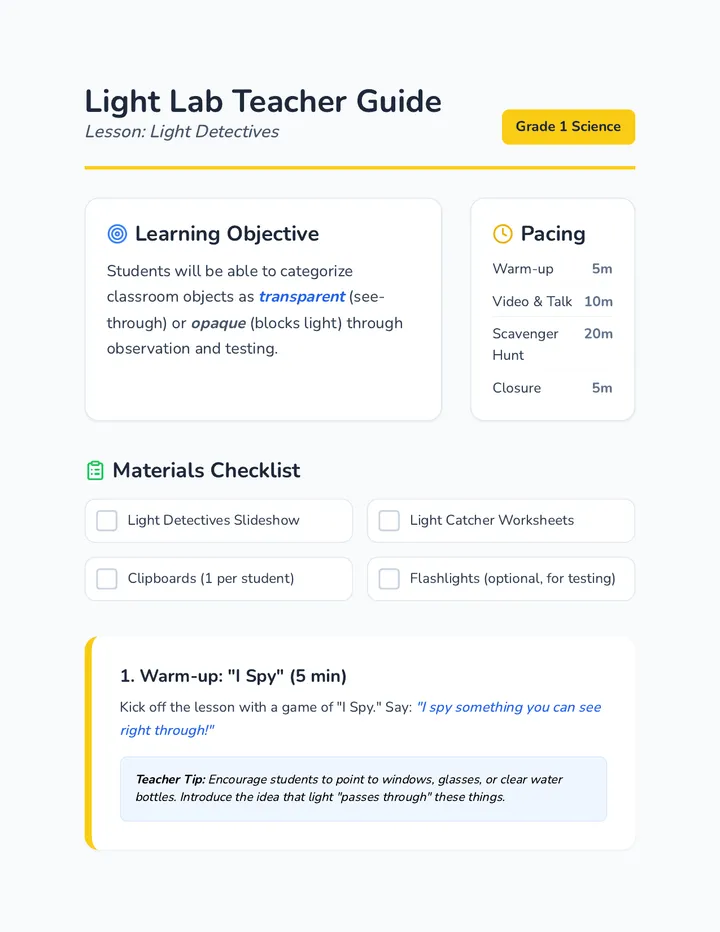
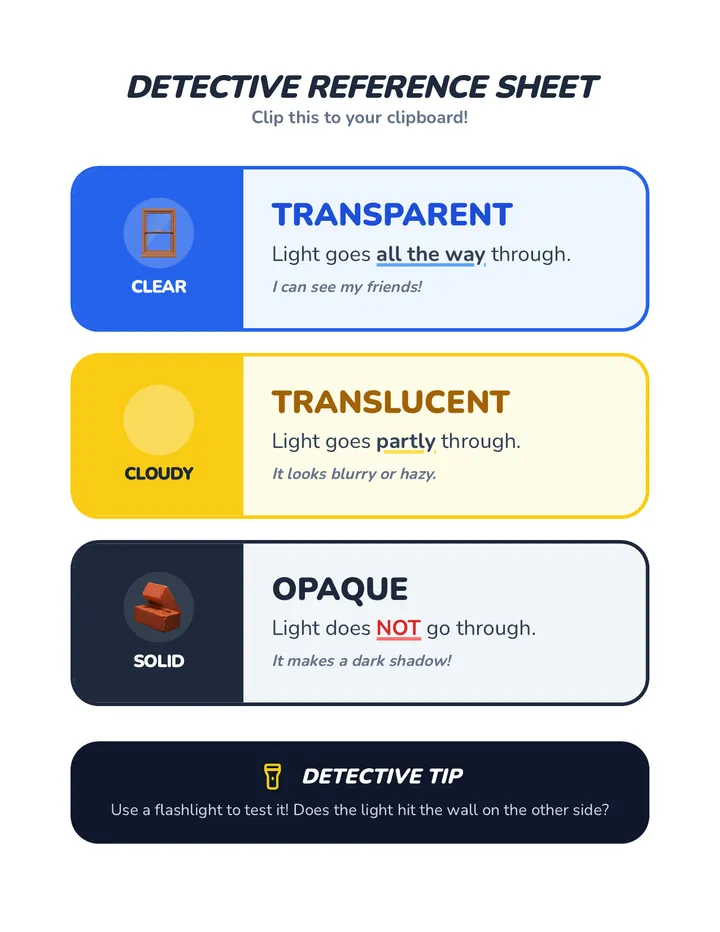
A Pre-K physics unit exploring transparency, translucency, and opacity through hands-on flashlight testing, color filters, water refraction, and art projects. Students develop observation and sorting skills as they investigate how light interacts with different materials.
A Pre-K science sequence exploring light sources, natural vs. artificial light, rainbows, color mixing, and sensory light play. Students engage in inquiry-based hunts, sorting activities, and engineering with light tables.
A 2nd-grade science unit exploring light refraction and the visible spectrum through hands-on experimentation with water, lenses, and prisms.
Students explore the physics of light through hands-on shadow experimentation, culminating in a shadow puppet performance that demonstrates their understanding of light sources, objects, and spatial relationships.
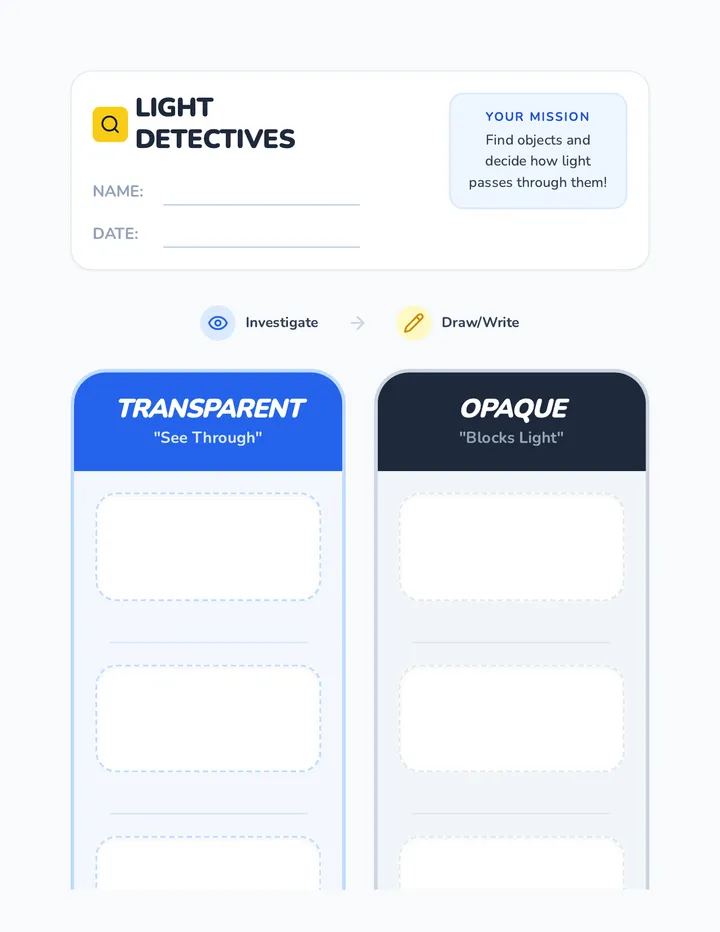
A 2nd-grade science sequence where students investigate how light interacts with materials, culminating in a design challenge to block light effectively. Students progress from identifying light sources to classifying materials as transparent, translucent, and opaque.
A Kindergarten science sequence exploring the physics of light through reflection. Students engage in hands-on activities with mirrors and flashlights to understand how light bounces, travels in straight lines, and creates symmetry.
An inquiry-based exploration for Kindergarteners to understand light sources, the formation of shadows, and how moving objects can change shadow size and shape. Students move from classroom investigations to outdoor observations and creative shadow puppet storytelling.
A comprehensive graduate-level exploration of spatial audio engineering, psychoacoustics, and immersive sound design for theater. This sequence bridges the gap between theoretical acoustics and practical, large-scale system engineering.
This graduate-level sequence bridges the gap between vocal science and pedagogical practice, exploring acoustics, registration, and diagnostics. Students move from theoretical physics of sound to practical clinical observation of the singing voice.
A scientific exploration of how instruments produce sound, categorized by vibration mechanics and physical properties. Students investigate the four main instrument families through the lens of acoustics and physics.
A graduate-level exploration of the biophysics and neural coding of the auditory system. This sequence covers everything from fluid dynamics in the cochlea to central processing and prosthetic engineering.
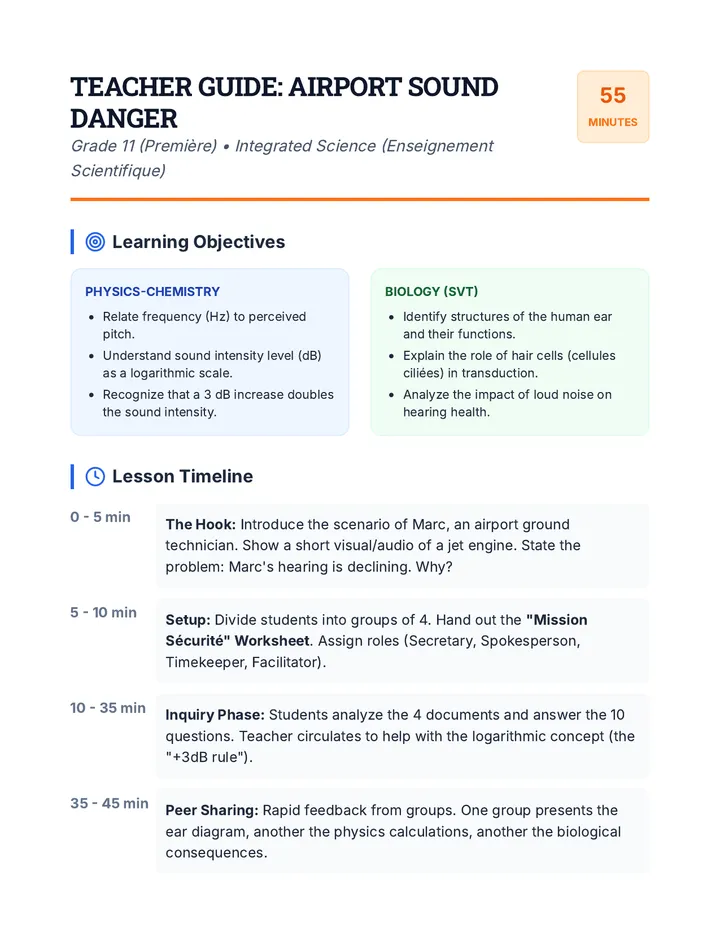
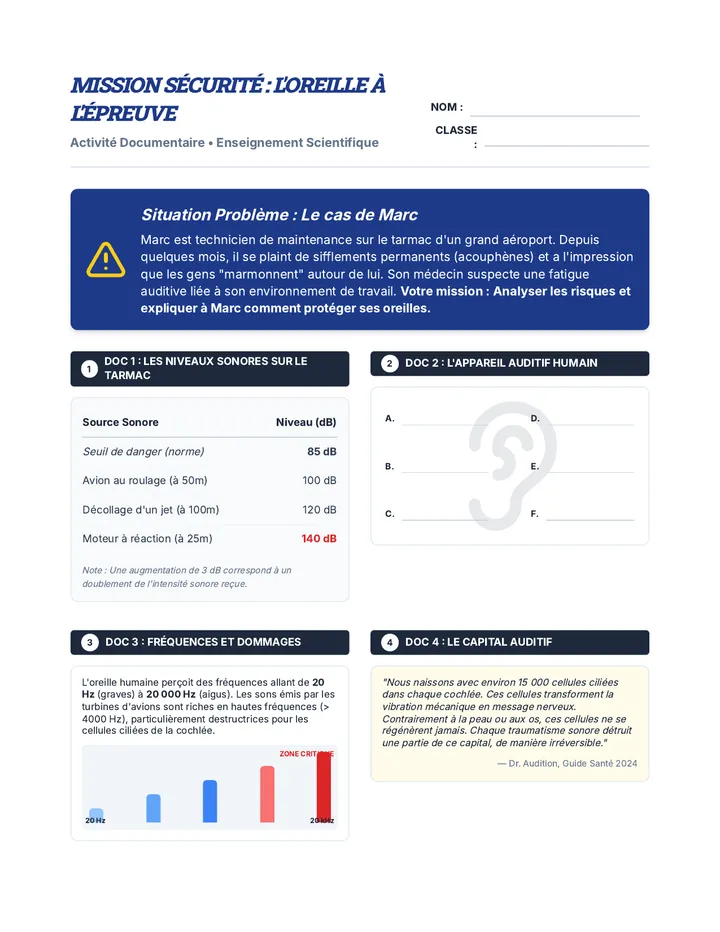
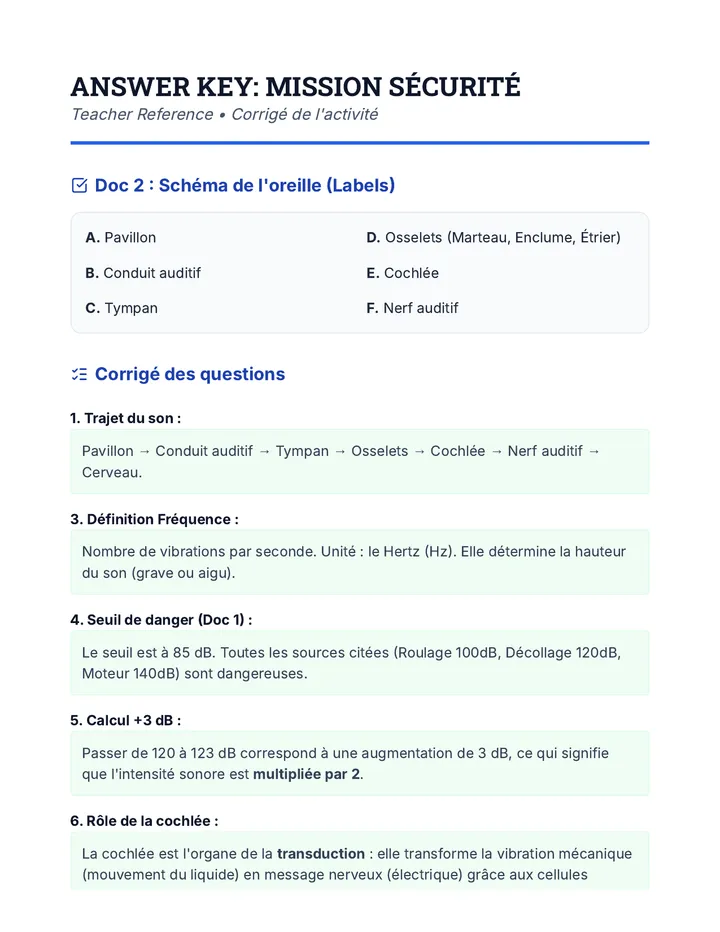
This sequence explores the auditory system, moving from the physics of sound waves to the complex anatomy of the ear and the psychology of pitch perception. Students will investigate how we localize sounds and analyze the physiological causes and prevention of hearing loss.
Students explore how materials interact with light, moving from shadows and opacity to transparency and translucency, culminating in a sunshade design challenge.
A project-based sequence for 3rd graders exploring the engineering applications of magnetic forces, from everyday technology to electromagnets and mag-lev trains.
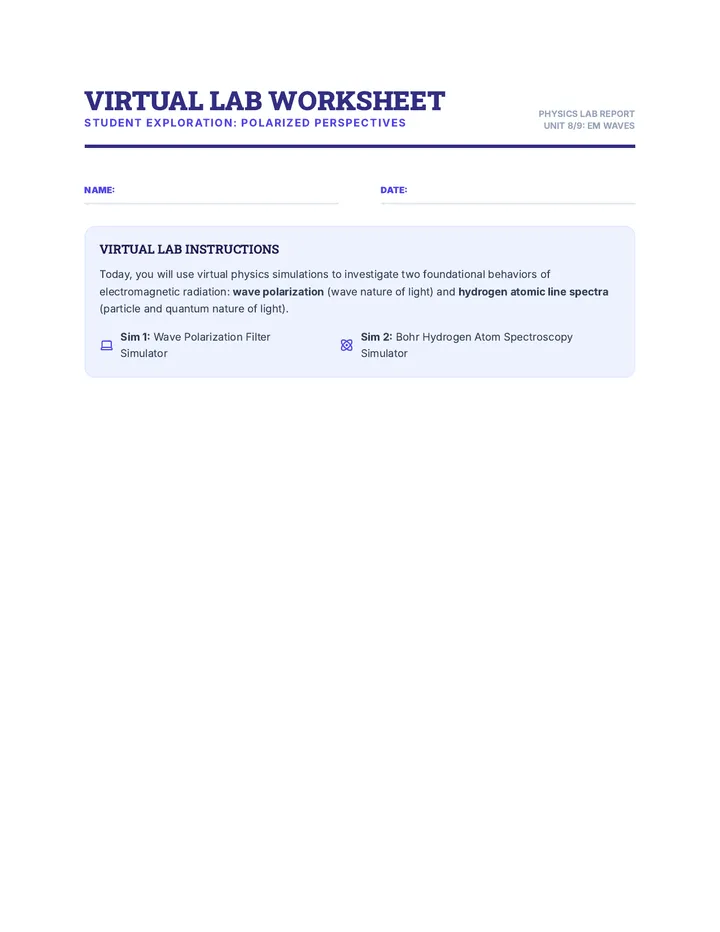
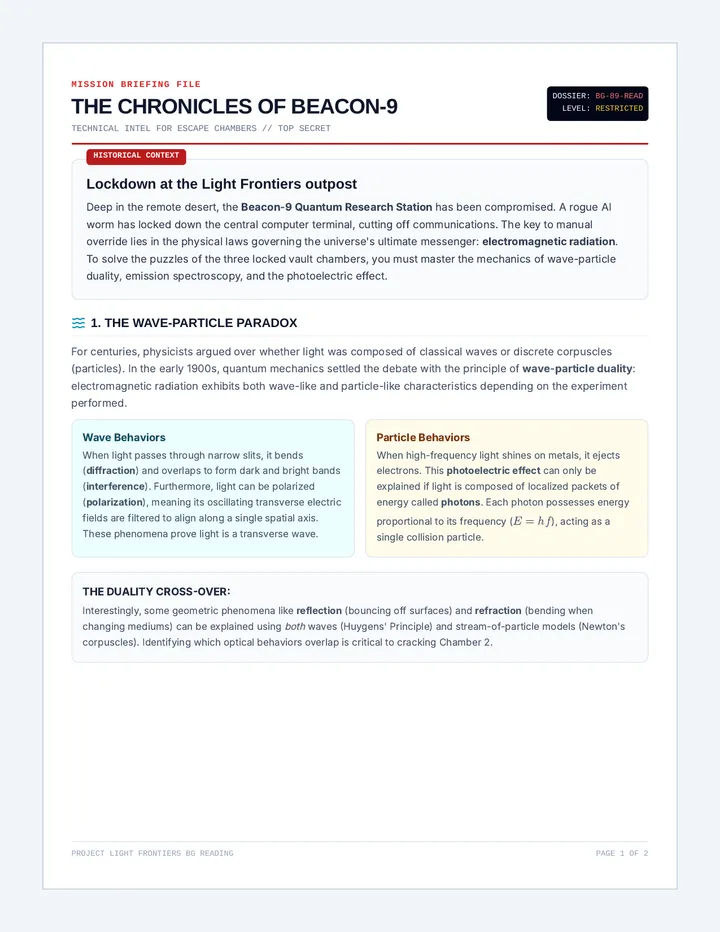
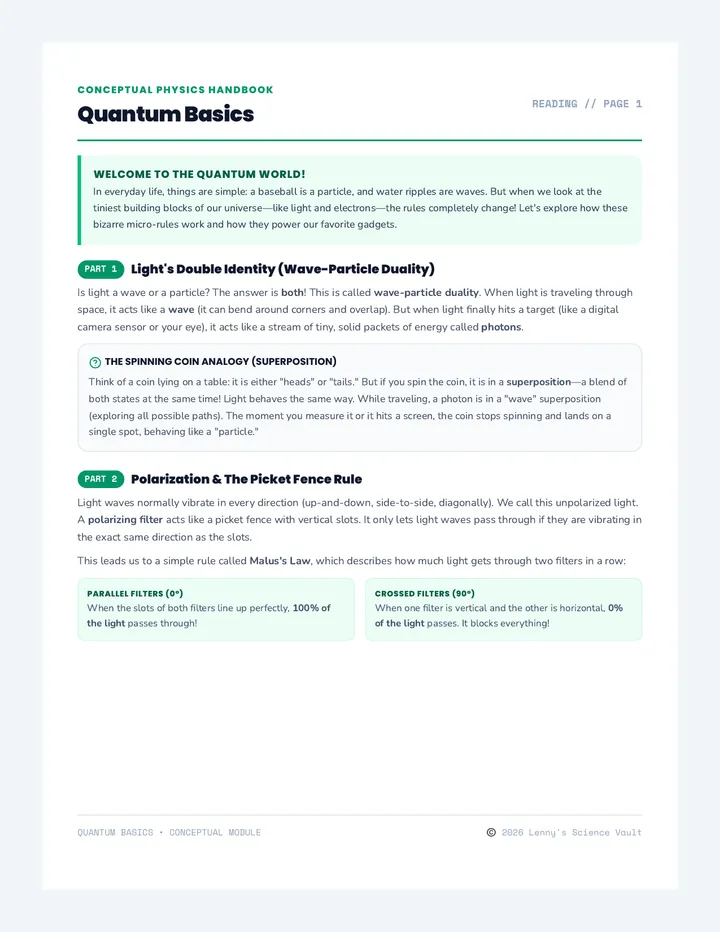
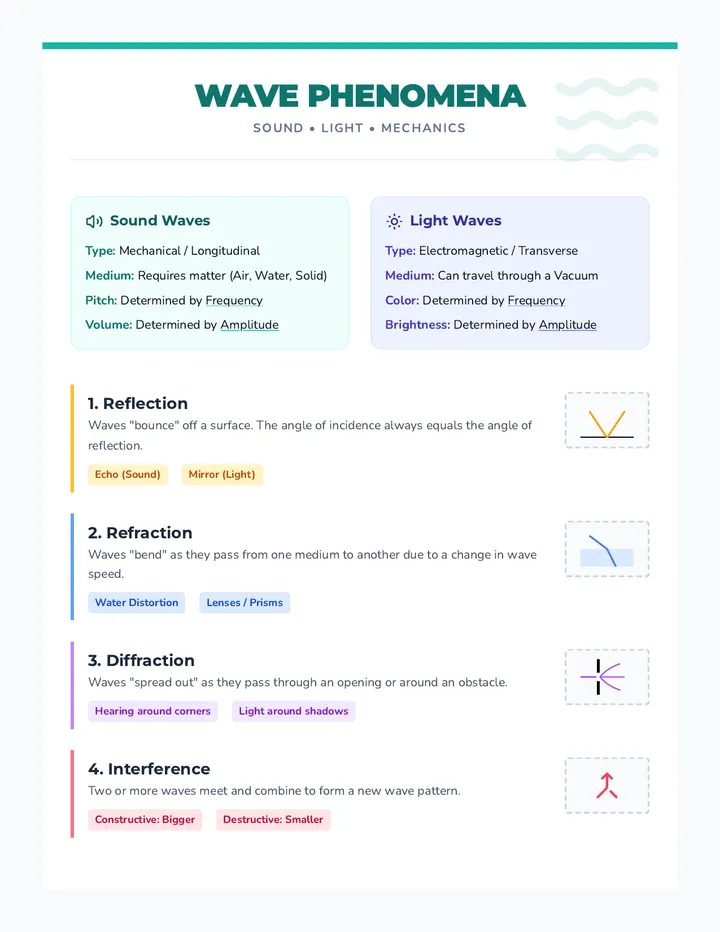
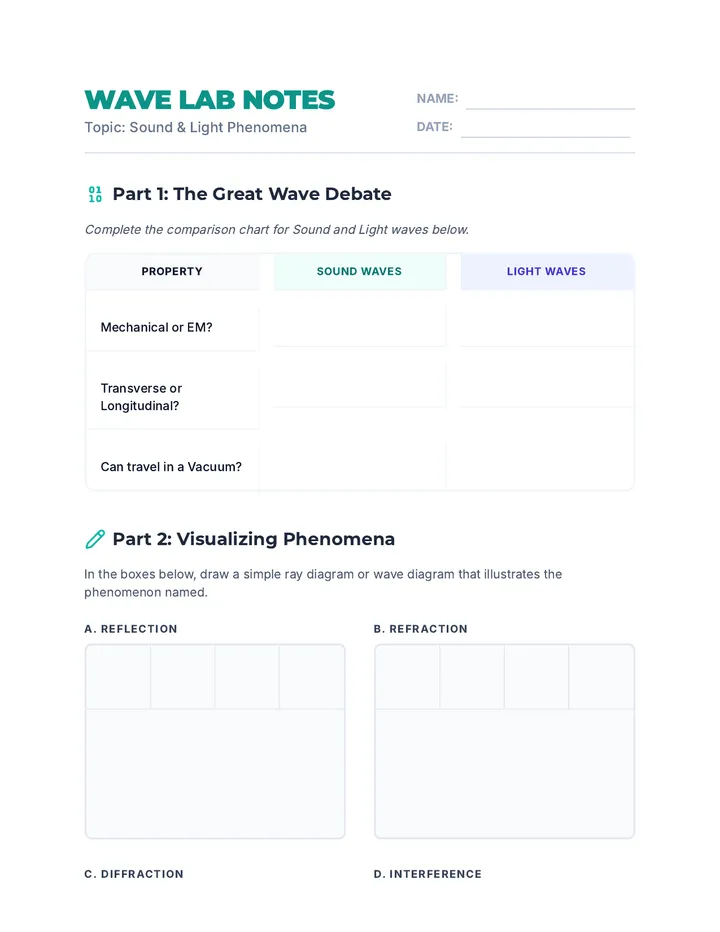
An inquiry-driven physics sequence exploring the wave nature of light through reflection, refraction, diffraction, and polarization, culminating in applications of optical technology.
A comprehensive sequence for undergraduate students exploring the engineering of electromagnetic waves, from the physics of wave generation in antennas to the complex system design of wireless communication links.
This 5-lesson sequence for 6th-grade students explores the biological impacts of electromagnetic radiation. Students distinguish between ionizing and non-ionizing types, investigate UV intensity, test sun-protection materials, and evaluate the use of high-energy radiation in medicine.
Cette séquence de 4 séances de 45 minutes explore le principe d'inertie pour les élèves de seconde. Elle combine histoire des sciences, simulations numériques et résolution de problèmes pour comprendre la relation entre forces et mouvement.
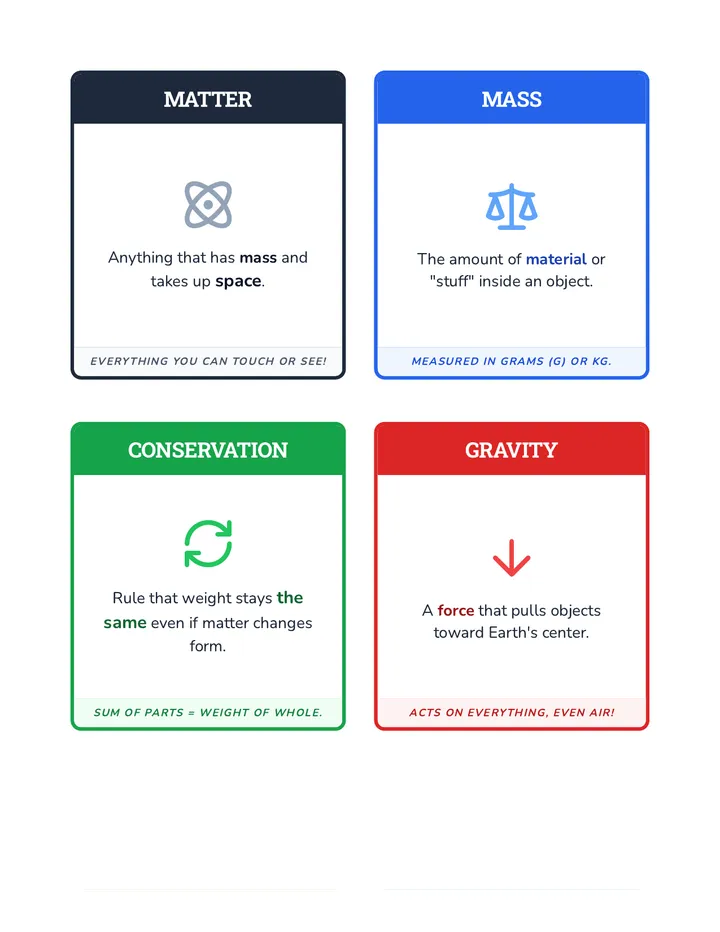
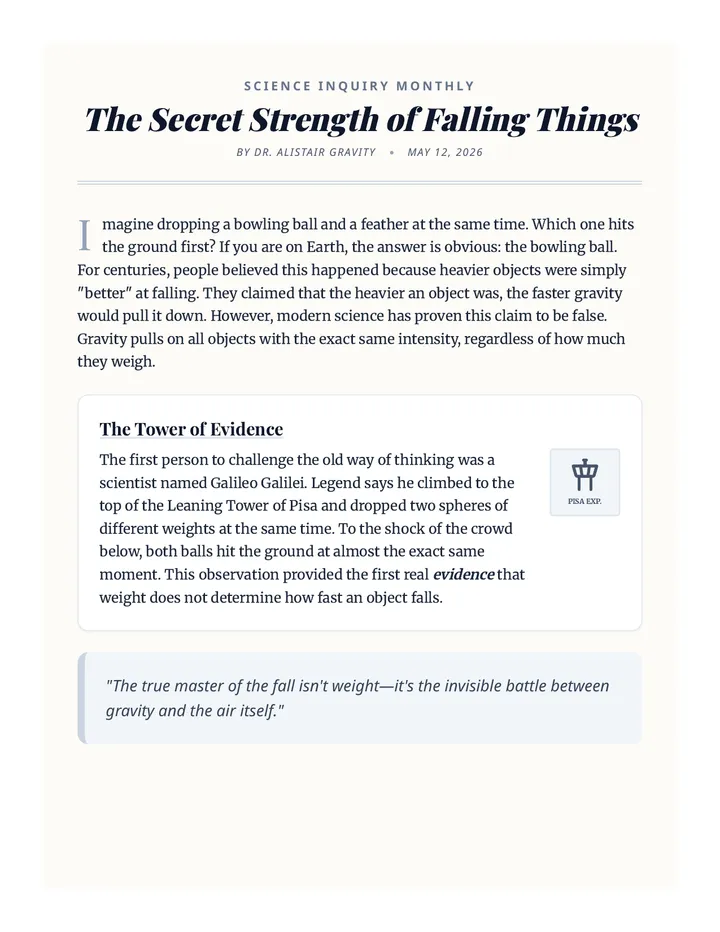
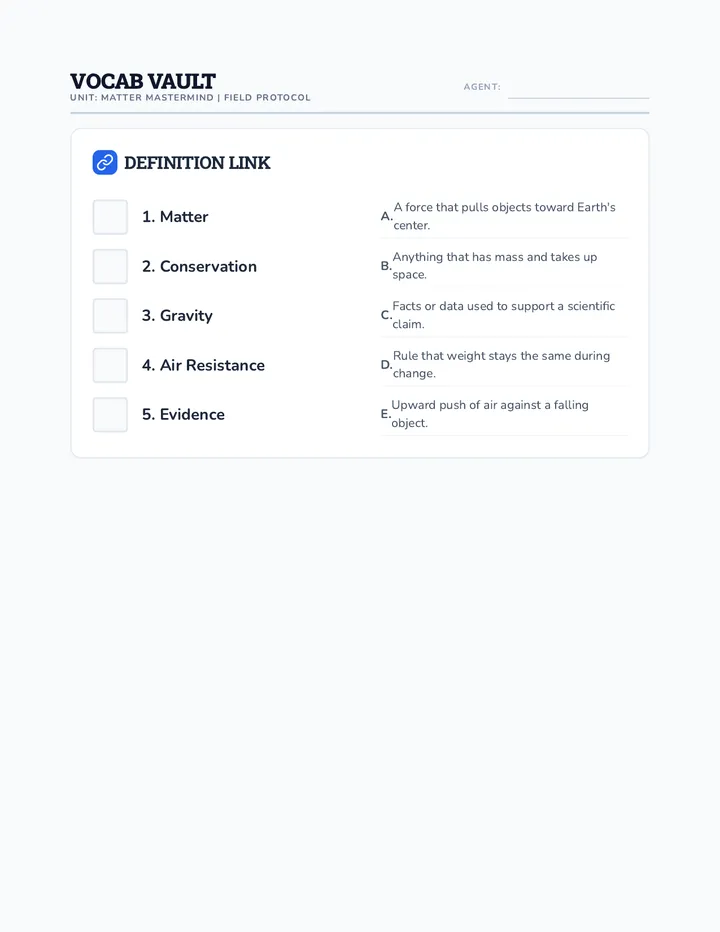
A hands-on exploration of physics and forces, focusing on gravity, motion, and air resistance through engineering challenges.
A lesson focused on Galileo's gravitational experiments and the mathematical resolution of the 'gravity paradox,' where mass cancels out in the calculation of acceleration. Students conduct a hands-on lab using bottles of different masses to test empirical results against theoretical models.
A sequence focused on physical science and engineering, specifically exploring gravity, air resistance, and the engineering design process through parachute construction.
A hands-on introductory sequence for early elementary students to explore the mechanics of levers and fulcrums using everyday classroom objects.
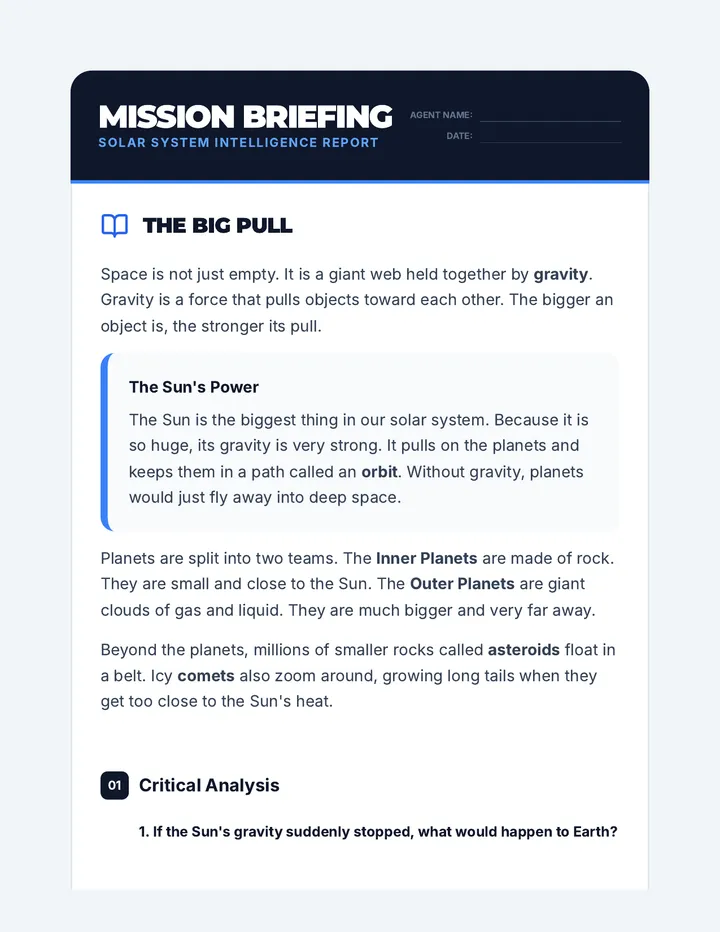
A sequence focused on understanding the origins and structure of our solar system, starting with the formation of the sun and planets from a cloud of dust and gas.
A science investigation into the forces of gravity and friction, specifically focusing on how surface materials affect the speed of objects on a slide. Students use mini-ramps and various materials to test their hypotheses.
A comprehensive lesson sequence exploring gravity as an invisible pull force, featuring hands-on experiments, video analysis, and historical context.
A series of integrated PE and Science lessons exploring the physics of human movement, biomechanics, and exercise physiology for early elementary students.
A physics-focused unit exploring the relationship between mass, weight, and force, emphasizing mathematical modeling and unit conversions.
A short sequence exploring the physics of motion, specifically focusing on how forces like friction and gravity allow us to predict an object's behavior. Students move from intuitive observation to data-driven calculation and scientific investigation.
A technical sequence for graduate students exploring the engineering principles behind theatrical automation, from rigging physics to PLC control systems.
A graduate-level sequence exploring the intersection of structural engineering, physics, and project management in theatrical technical direction. Students master load calculations, CAD for fabrication, automation mechanics, budgeting, and rigging safety.
A high-level physics and engineering sequence focusing on the industrial mechanics of separating heterogeneous mixtures. Students analyze filtration, centrifugation, cyclonic separation, and energy efficiency through case studies and process optimization.
A comprehensive undergraduate sequence analyzing the biomechanical and physiological foundations of track events, from sprint mechanics to endurance energy systems and periodized training design.
This undergraduate-level sequence explores the engineering principles of industrial separation processes. Students progress from fundamental mass balance and process flow diagrams to specialized technologies like membrane filtration, centrifugation, and large-scale evaporation, culminating in an integrated plant design project.
A high-level paleoecology sequence for 12th graders focusing on interpreting fossils as biological and environmental data. Students explore functional morphology, isotopic climate proxies, extinction dynamics, and hominid evolution to reconstruct ancient worlds.
A comprehensive undergraduate sequence on rigid body mechanics, focusing on mass distribution, inertia tensors, and rotational stability through the lens of tensor geometry.
A lesson sequence for K-2 students focusing on scientific inquiry, making predictions, and using tools to measure and compare mass. Students learn to distinguish between mass (how heavy) and volume (how big) through hands-on experiments.
A science sequence for 4th graders focused on the 'Ask, Predict, Test, Decide' framework, using everyday mysteries to teach the scientific method.
A Kindergarten sequence exploring the practical, real-world applications of magnets in daily life, from home gadgets and recycling centers to global navigation and electronics. Students transition from observation to invention, culminating in designing their own magnetic tool.
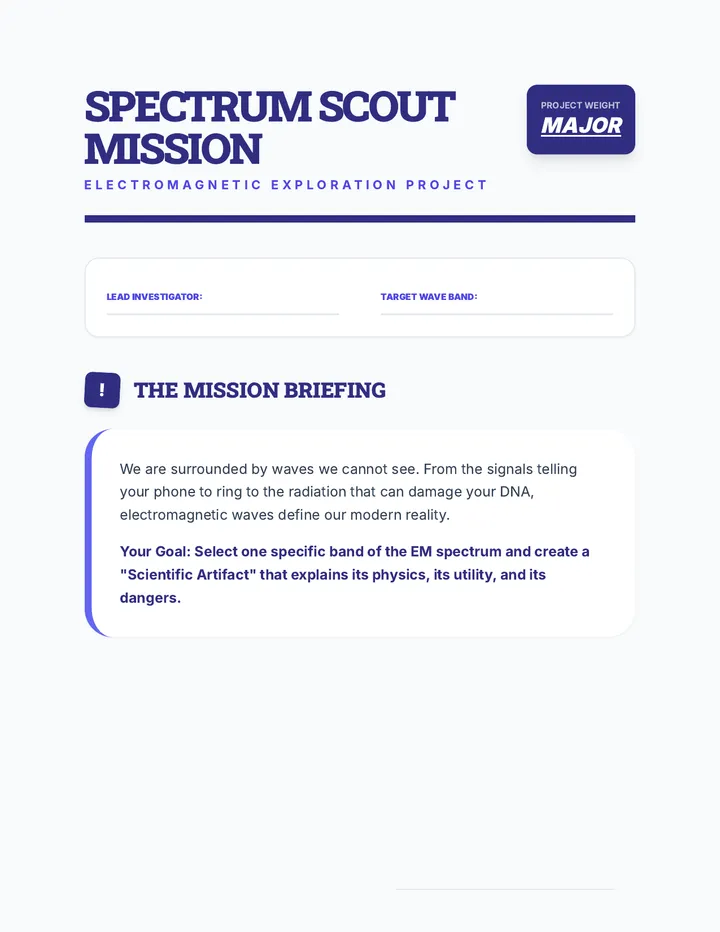
This sequence guides 8th-grade students through the physical and mathematical properties of electromagnetic waves, moving from basic wave types to complex calculations and the full scale of the electromagnetic spectrum. Students explore the inverse relationship between frequency and wavelength through inquiry-based labs and synthesis projects.
A 10th-grade physics unit focused on the astronomical applications of electromagnetic waves. Students analyze light to determine the composition, temperature, and motion of celestial bodies using Wien's Law, spectral analysis, and the Doppler Effect.
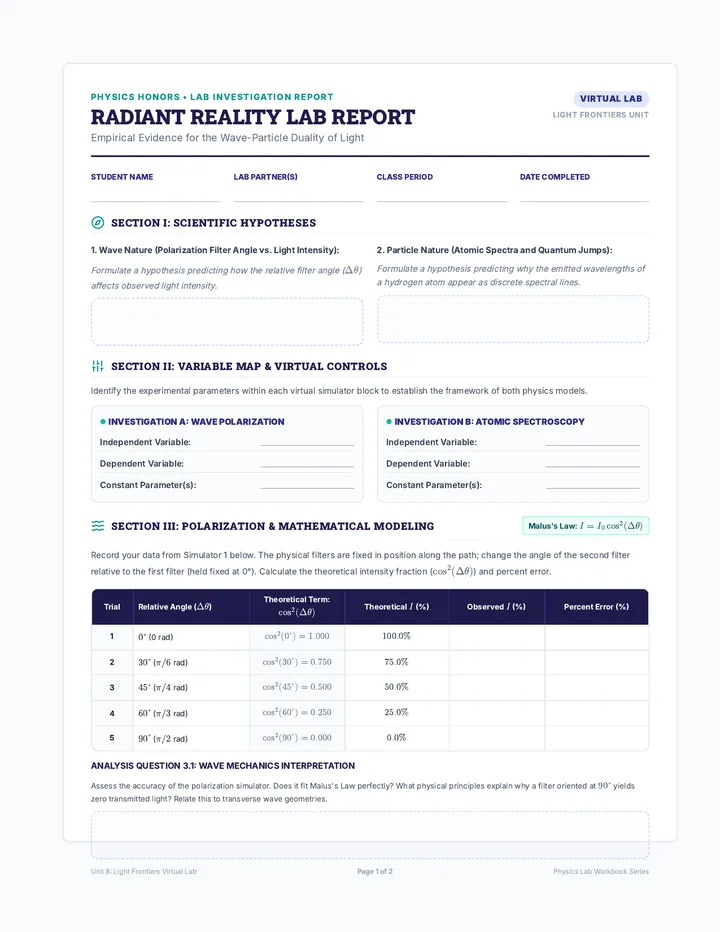
A 10th-grade physics sequence exploring the wave nature of light through polarization, diffraction, interference, and spectroscopy. Students gather experimental evidence to support the wave model of light.
This graduate-level sequence bridges classical wave mechanics and quantum physics, exploring the mathematical formalisms of the Schrödinger equation, wave packets, tunneling, and perturbation theory through a wave-centric lens.
This advanced graduate-level sequence explores the engineering of acoustic metamaterials, covering phononic crystals, negative refraction, transformation acoustics, solitons, and topological states. Students bridge the gap between solid-state physics theory and mechanical engineering to design materials with properties that defy conventional physical intuition.
An undergraduate physics sequence exploring sound waves, resonance, beats, the Doppler effect, and spectral analysis. It connects fundamental wave mechanics with engineering applications in acoustics and music.
A 4th-grade physics sequence exploring how waves (sound and light) encode and transmit information. Students learn about analog signals, Morse code, binary patterns, and system design through hands-on simulations.
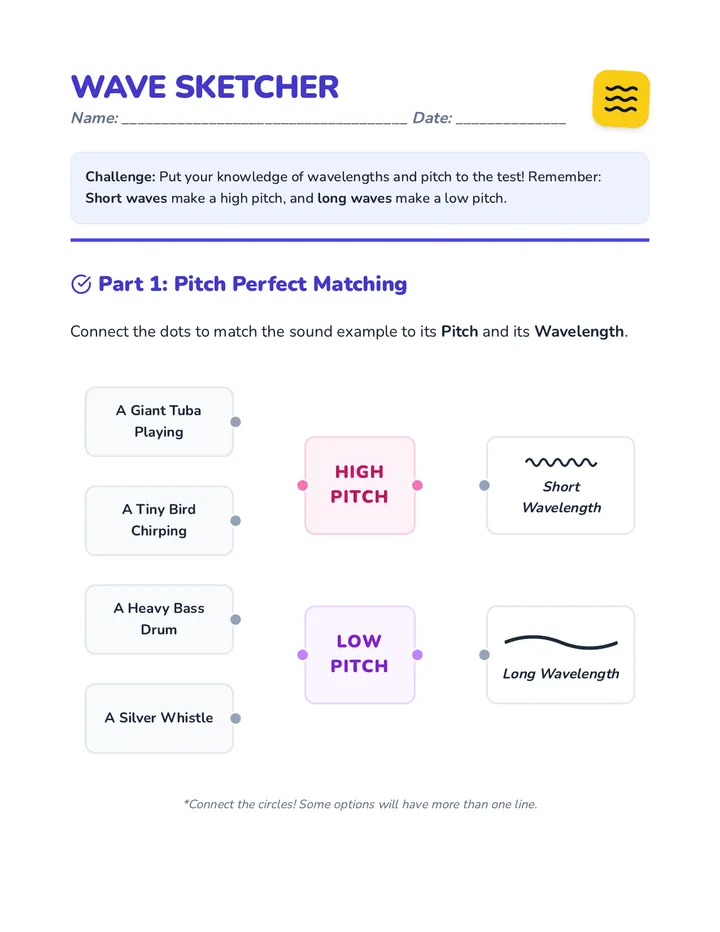
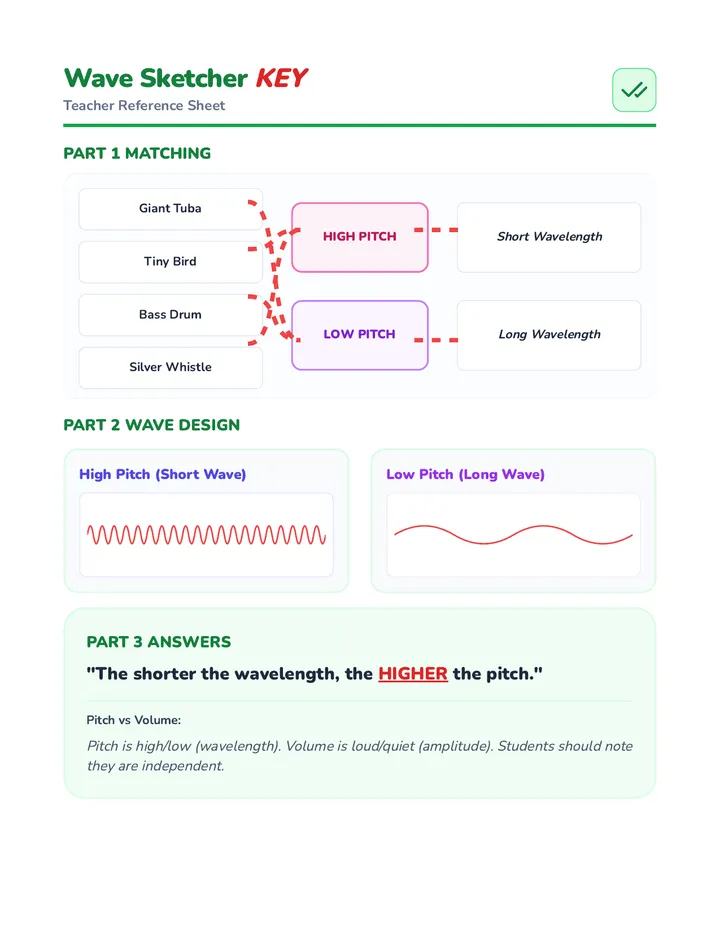
Students investigate the physics of sound, focusing on the relationship between vibration, volume, and pitch. The sequence utilizes a project-based approach where students design and test musical instruments to apply their understanding of wave properties. Learners explore how changing the physical characteristics of an object alters the sound waves it produces. The unit concludes with an acoustic engineering showcase.
A project-based physics sequence exploring acoustics, resonance, and wave phenomena. Students progress from basic sound propagation to engineering their own acoustic devices, applying principles of harmonics, beats, and the Doppler effect.
A comprehensive 5-week sequence exploring the physical properties of water, the engineering of water filtration, and the complex systems of Virginia's watersheds. Students move from hands-on engineering to chemical properties and finally to large-scale environmental systems.
A comprehensive sequence on the physics and chemistry of chromatography, covering stationary and mobile phases, Rf value calculations, polarity, and forensic applications. Students progress from basic paper chromatography to thin-layer chromatography (TLC) in a series of inquiry-based labs.
This sequence explores how thermal energy is used to separate homogeneous mixtures. Students progress from understanding solubility and saturation to performing evaporation and distillation labs, ultimately connecting these laboratory skills to industrial applications like oil refining.
A conceptual 5-lesson sequence for 7th-grade science focusing on particle modeling to differentiate between pure substances and mixtures. Students use visualization and modeling to understand chemical vs. physical changes and the conservation of mass.
A project-based sequence where 12th-grade students act as environmental engineers to design, test, and optimize a multi-stage separation protocol for a complex hazardous waste mixture. Students apply physical principles of density, solubility, and boiling points to isolate pure substances.
A deep dive into chromatography as a method for separating complex homogeneous mixtures based on differential affinity. Students explore the physics of adsorption and capillary action, moving from paper chromatography to interpreting data from Gas Chromatography (GC) and High-Performance Liquid Chromatography (HPLC).
A quantitative exploration of mixtures and solutions where students use measurement to prove that mass is conserved even when substances dissolve or change state. Students progress from simple mixtures of solids to complex solutions and recovery through evaporation.
A forensic-themed science unit where 5th-grade students explore mixtures and solubility. Through the technique of chromatography, they solve a mystery by separating pigments and analyzing how different solvents interact with matter.
This workshop-style sequence teaches 5th-grade students to separate mixtures using physical properties. Students progress from simple mechanical sorting (sieving, magnetism) to advanced methods (filtration, evaporation, density), culminating in a project-based challenge to separate a complex mixture.
A 2nd-grade science sequence exploring physical changes, solubility, and evaporation. Students investigate if dissolved solids can be recovered through evaporation, connecting classroom experiments to real-world salt harvesting.
A collection of science and phonics resources designed for hands-on classroom activities.
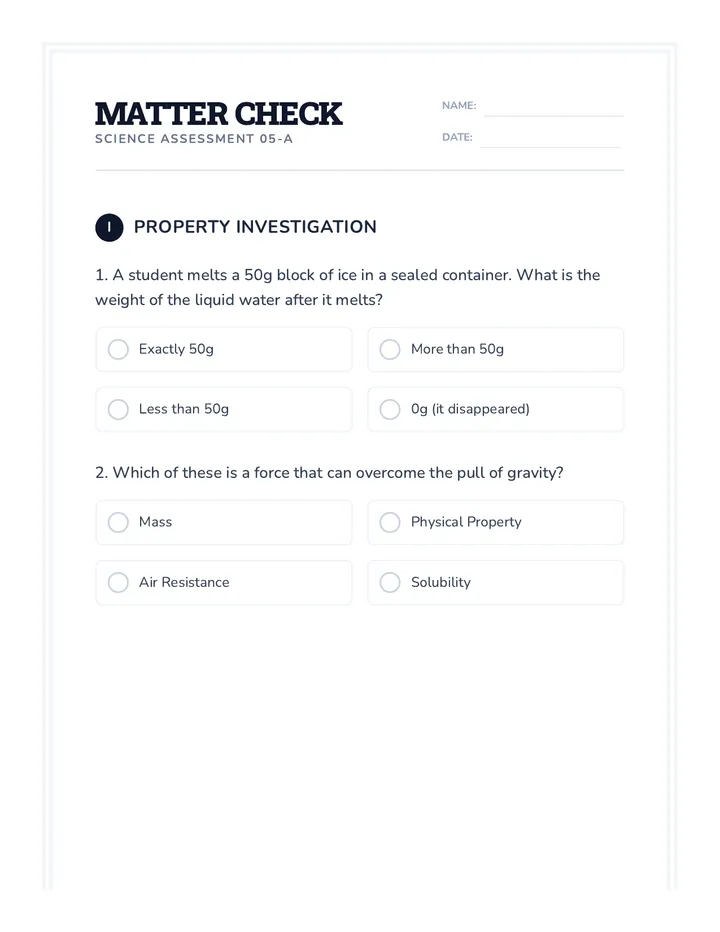
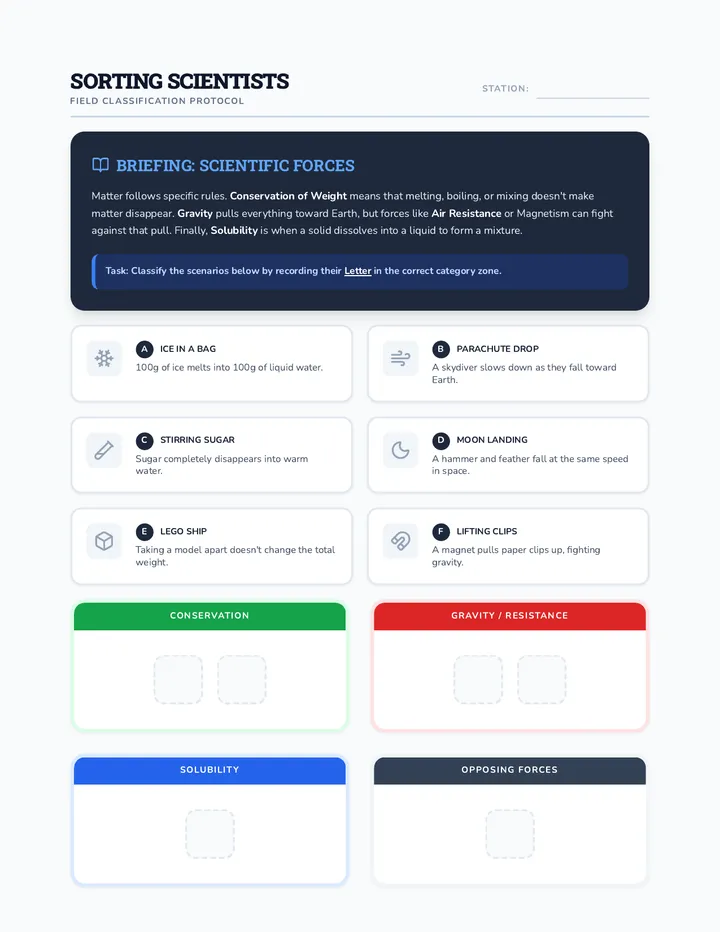
A lesson sequence exploring the conservation of matter through reversible and irreversible changes, including hands-on weighing activities and video analysis.
A comprehensive workshop-based sequence exploring thermal separation techniques, from basic evaporation to industrial fractional distillation. Students master the physics of phase changes and boiling points to separate liquid mixtures.
This sequence explores the thermodynamic principles governing the separation of mixtures through phase changes. Students analyze intermolecular forces, vapor pressure (Raoult's Law), fractional distillation, crystallization kinetics, and membrane-based desalination, bridging the gap between molecular physics and industrial applications.
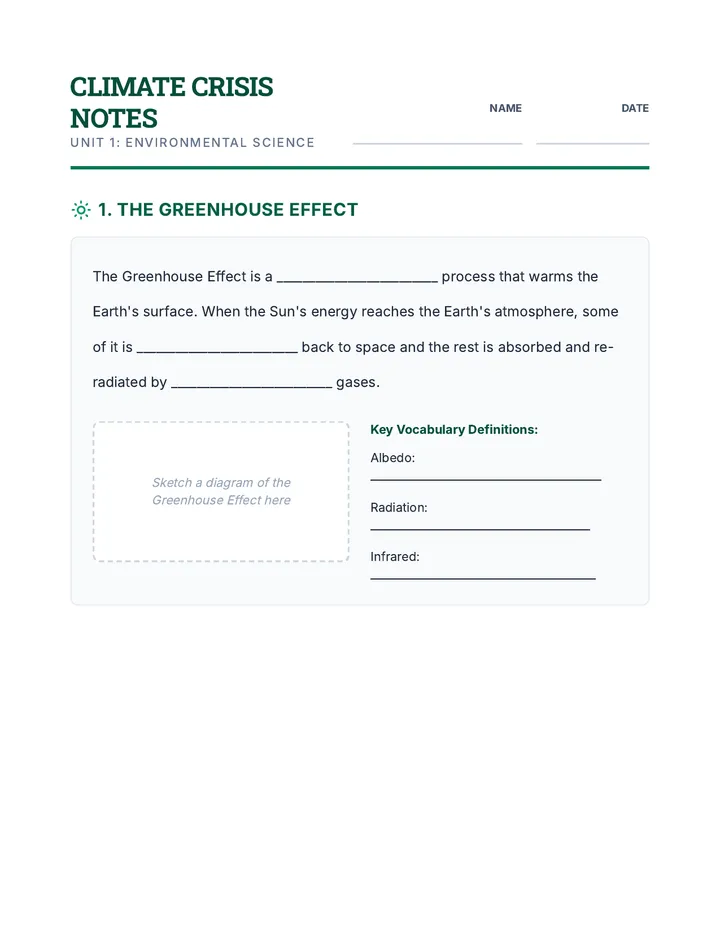
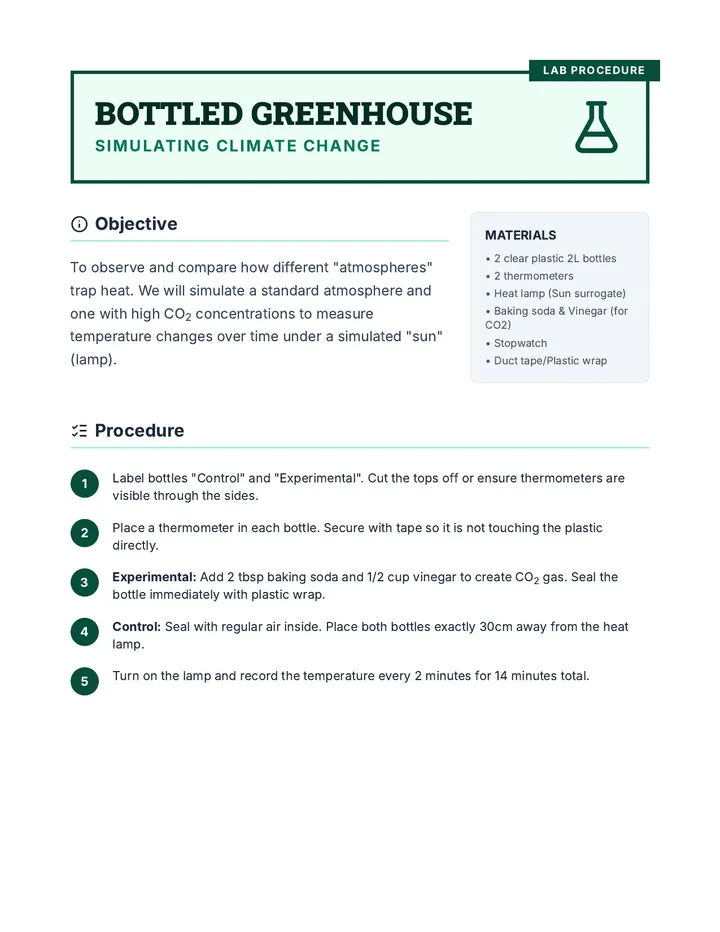
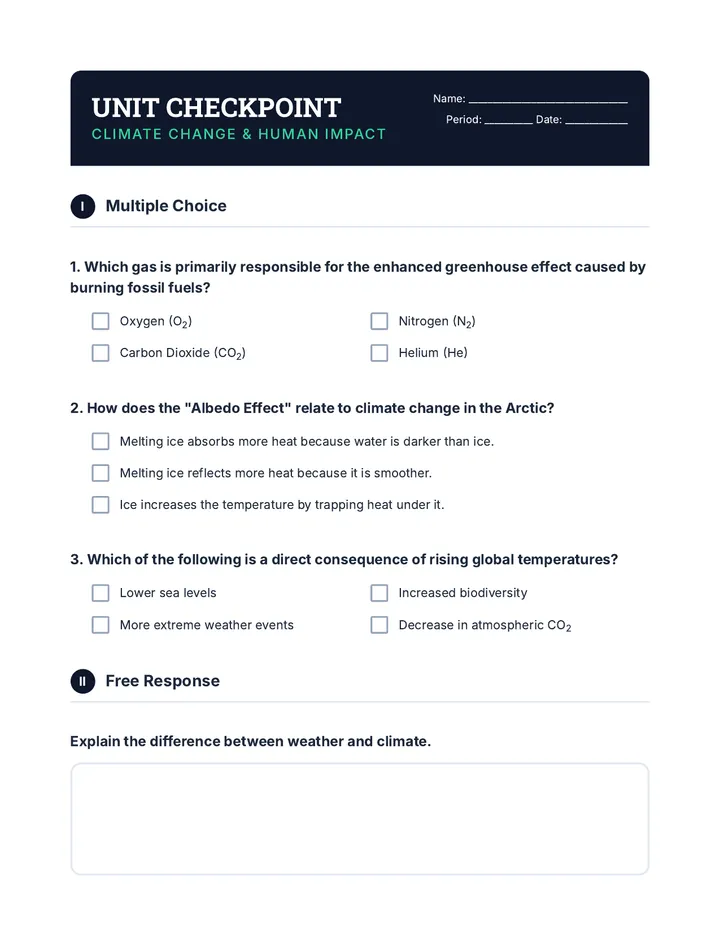
Cette séquence pédagogique de 6 heures explore les mécanismes scientifiques de l'effet de serre, l'impact des activités humaines sur le climat et les enjeux futurs liés au réchauffement climatique. Elle est conçue pour les élèves de Première et Terminale dans le cadre de l'Enseignement Scientifique.
A lesson sequence focusing on the differences between renewable and non-renewable energy sources, culminating in a town council role-play debate. Students explore energy transformations and evaluate the environmental and economic impacts of different power sources.
A high-school level exploration of thermodynamics, focusing on the connection between entropy, enthalpy, and Gibbs Free Energy to predict chemical spontaneity.
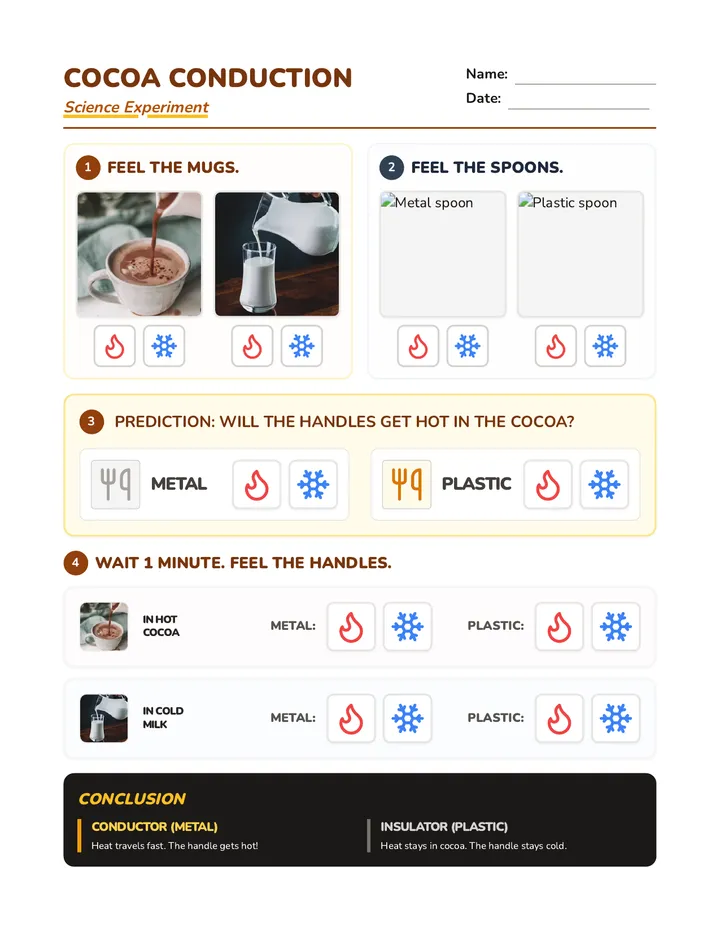
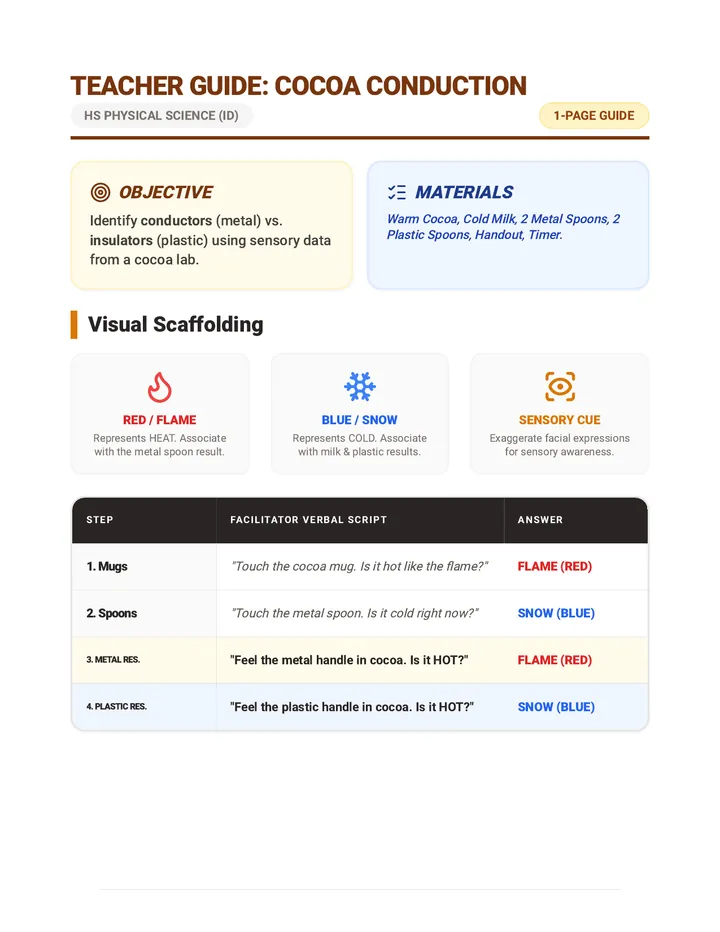
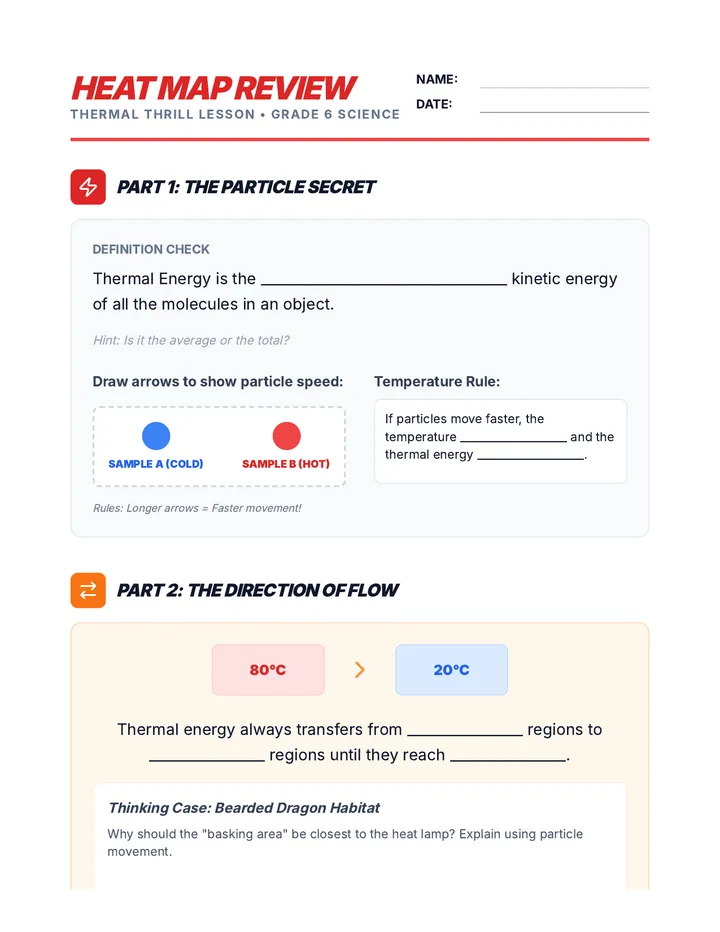
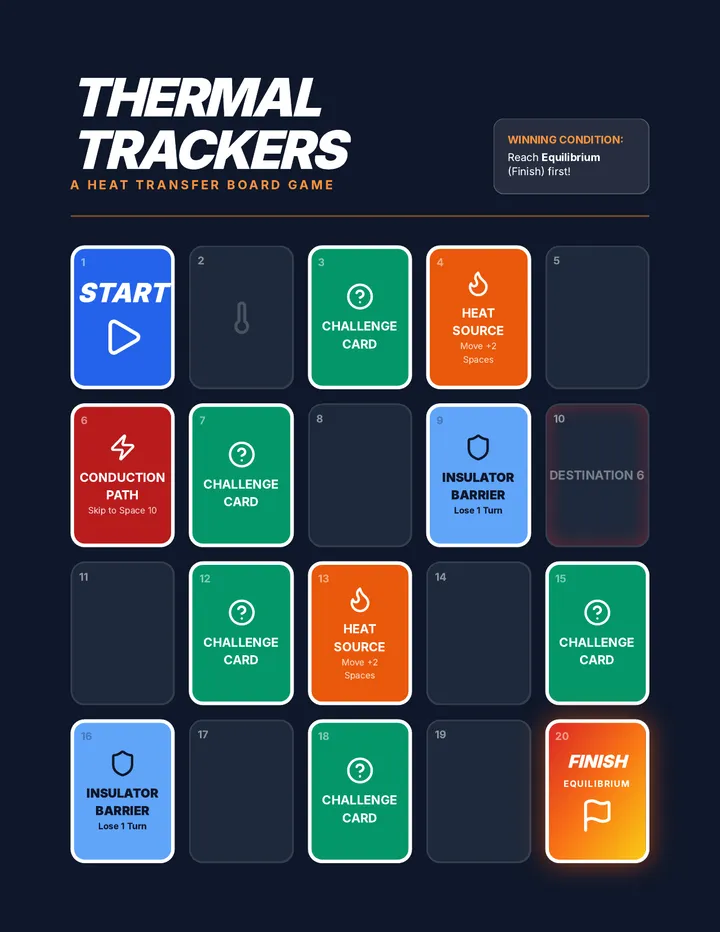
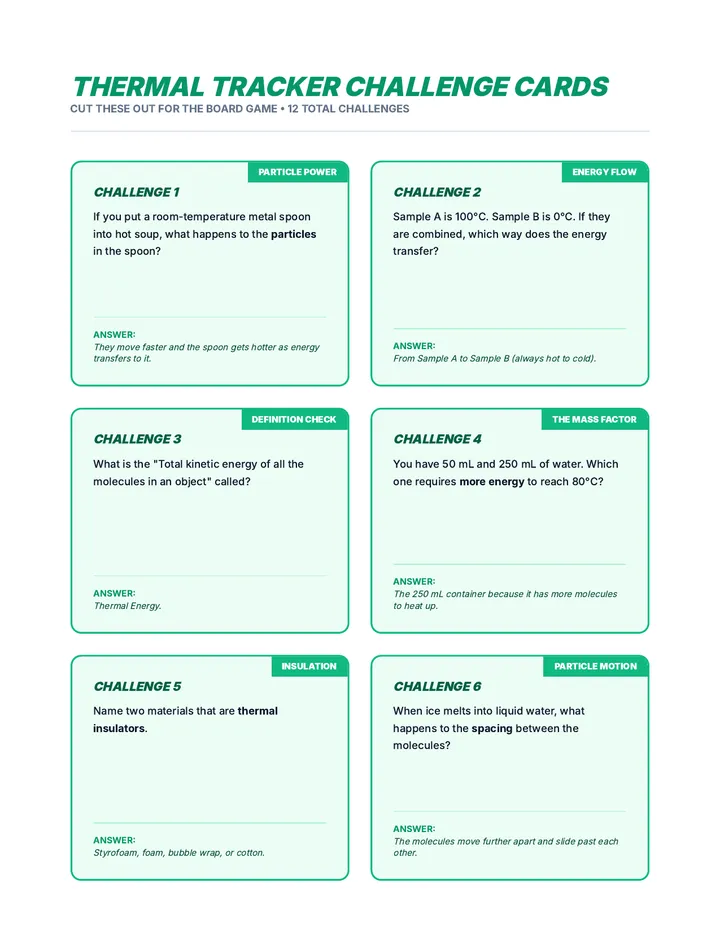
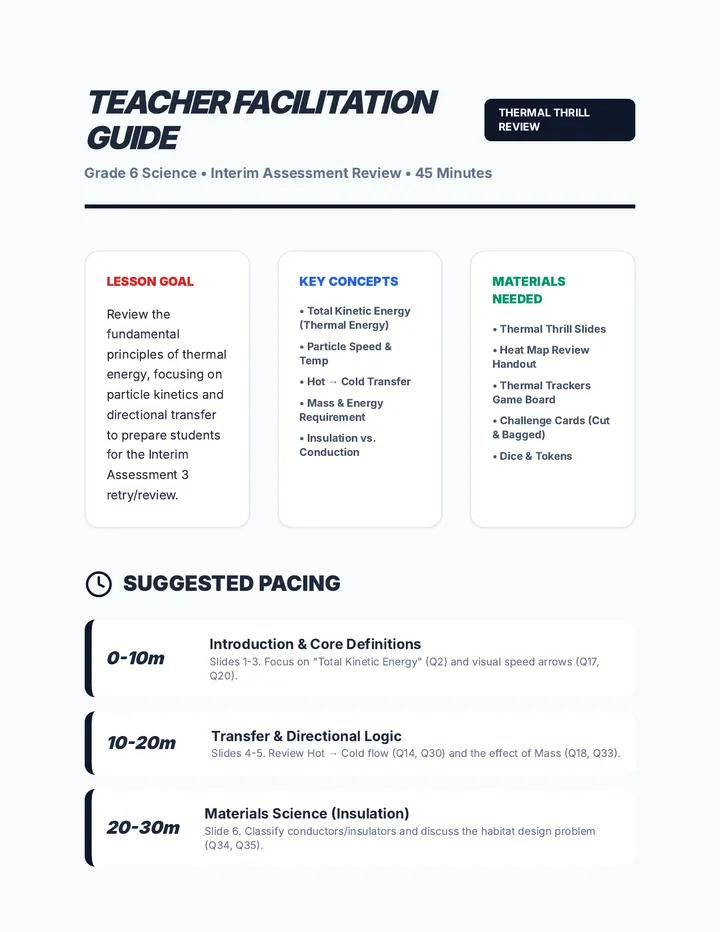
A comprehensive lesson sequence exploring the three modes of heat transfer (conduction, convection, and radiation) and the concept of thermal equilibrium using real-world scenarios and particle-level explanations.
A beginner's introduction to electricity and circuits for 2nd graders, focusing on the three essential components: power source, path, and load. Students explore how electricity travels in a loop through video, discussion, and hands-on labeling activities.
A comprehensive unit exploring the global transition from fossil fuels to renewable energy sources, focusing on technological advancements, economic challenges, and environmental necessity.
A middle school science unit exploring energy forms, transformations, and the fundamental laws governing the physical world.
An engineering-focused unit where 8th-grade students design, build, and test water filtration systems, applying concepts of heterogeneous and homogeneous mixtures to solve real-world water purification challenges.
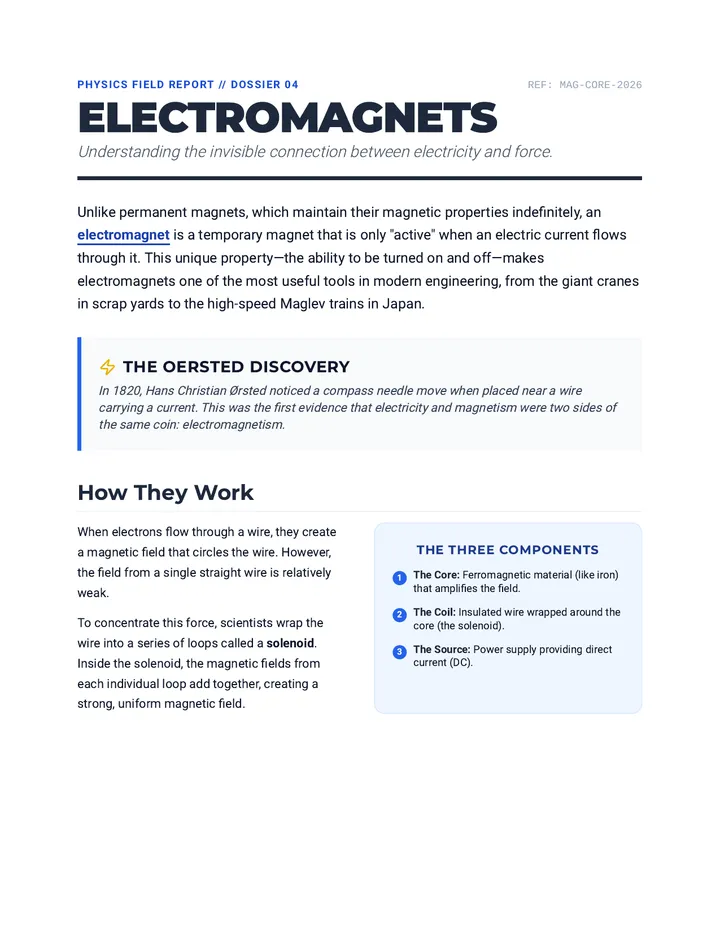
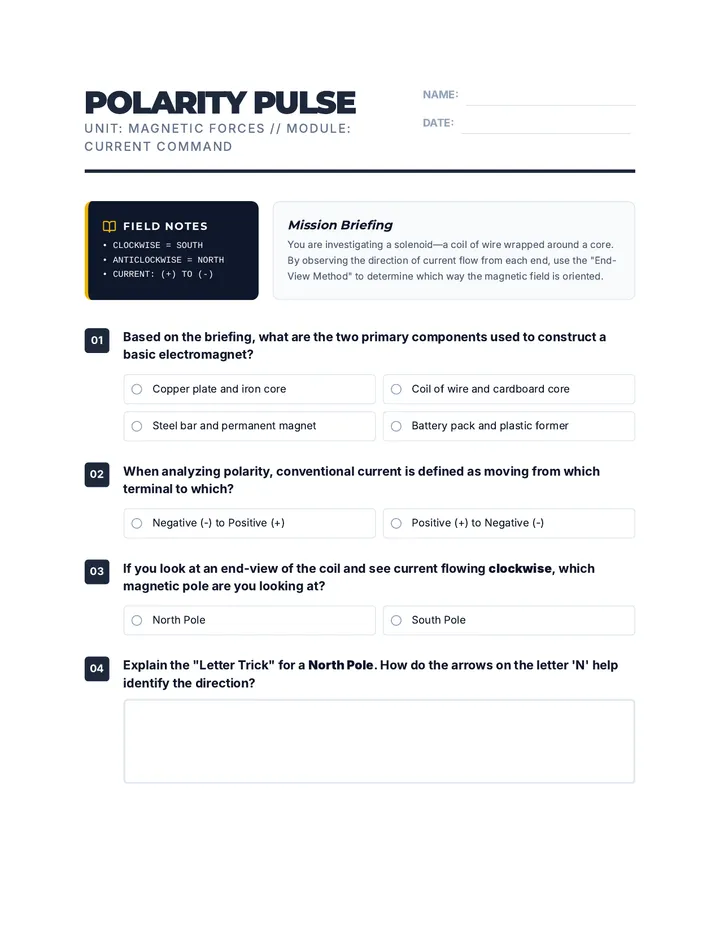
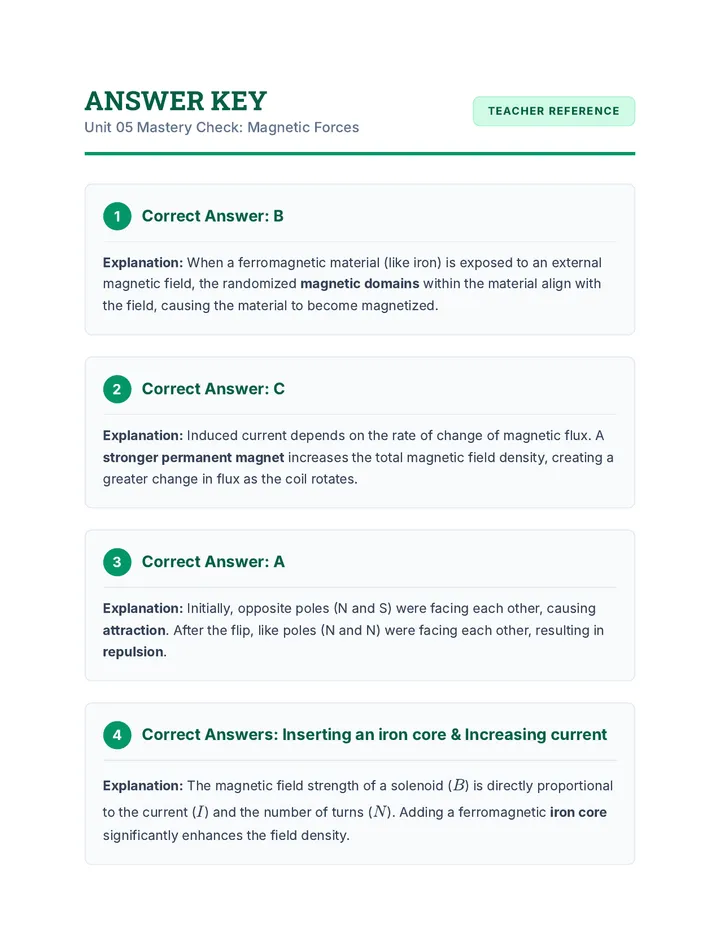
A hands-on physics sequence for 4th graders exploring the link between electricity and magnetism. Students build, test, and manipulate electromagnets to understand how variables affect magnetic strength.
A Kindergarten science and engineering sequence that explores the properties of magnets through hands-on building challenges, temporary magnet creation, and artistic design. Students progress from basic construction to understanding how magnets can be 'made' and used to solve design problems.
A 5th-grade project-based sequence where students act as materials engineers. They investigate physical properties like hardness, flexibility, conductivity, and transparency through systematic testing to design a protective transport container.
A hands-on introductory physics sequence for 1st graders exploring how electricity can create temporary magnetic fields. Students build simple electromagnets, compare them to permanent magnets, and discover real-world engineering applications like scrap metal cranes.
This advanced 2nd-grade sequence explores the connection between electricity and magnetism. Students build their own electromagnets, learn about circuits, and experiment with variables to increase magnetic strength.
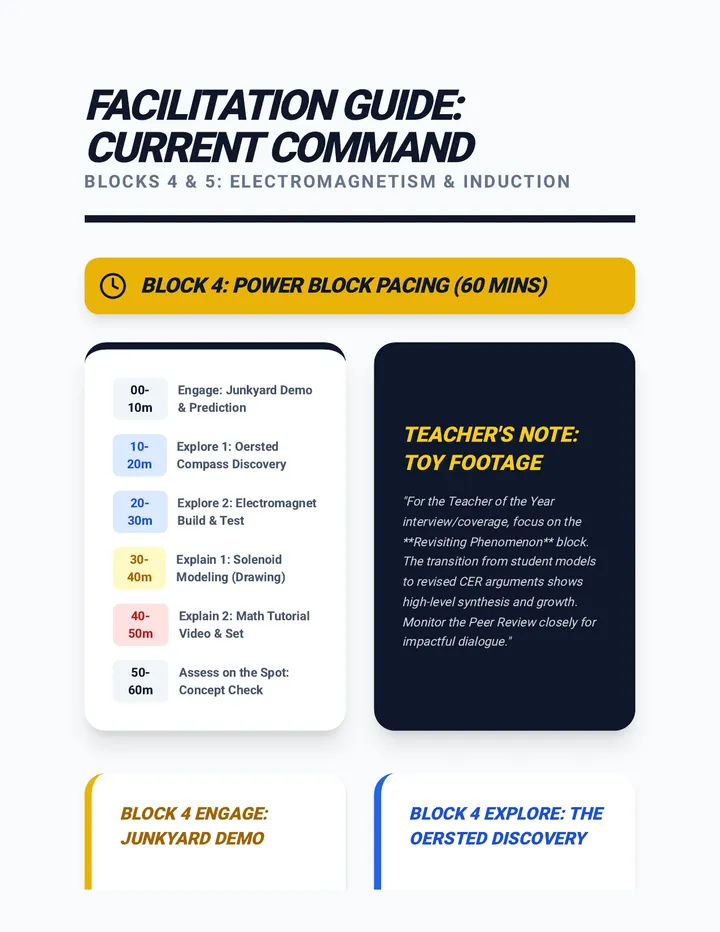
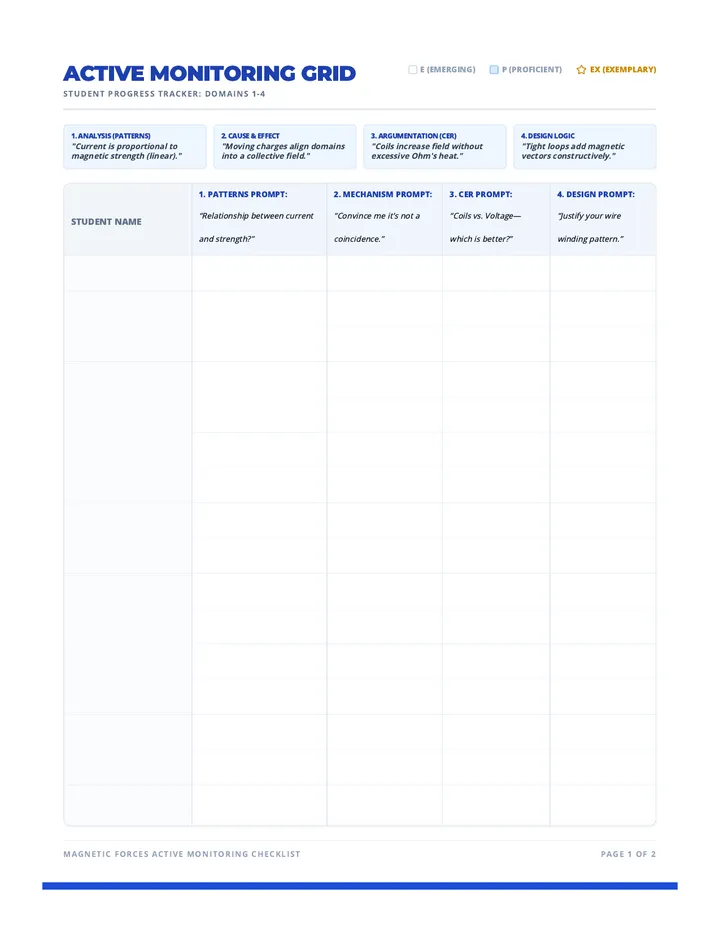
A 5-lesson project-based sequence where 5th-grade students explore the relationship between electricity and magnetism, culminating in the design and optimization of an electromagnetic crane. Students progress from discovering Oersted's effect to conducting controlled experiments on coils and voltage before applying their knowledge to an engineering challenge.
This sequence explores the practical applications of magnetism in transportation and navigation. Students investigate Earth's magnetic field, the mechanics of magnetic levitation (Maglev), the function of magnetic motors, and the trade-offs of implementing high-tech magnetic infrastructure.
A hands-on engineering unit where 4th graders explore the relationship between electricity and magnetism. Students build, test, and optimize electromagnets to solve a real-world scrap yard sorting challenge.
A hands-on engineering sequence where students explore the relationship between electricity and magnetism. Students build electromagnets, test variables to optimize strength, and design a sorting system to solve a real-world recycling problem.
A hands-on exploration of magnetic forces and electromagnetism, from basic pole interactions to engineering solutions using temporary magnets. Students visualize invisible fields and manipulate variables to control magnetic strength.
A comprehensive 5th-grade engineering sequence exploring electrical circuits, material conductivity, series and parallel pathways, and electromagnetism through hands-on inquiry and prototyping.
This skill-building sequence focuses on the thermal properties of mixtures, specifically how boiling points and phase changes allow for separation via evaporation and distillation. Students explore the physics of vapor pressure and energy transfer required to separate a solvent from a solute.
An undergraduate-level sequence exploring the thermodynamic and physical principles of mixtures, covering entropy, enthalpy, phase equilibria, and practical separation techniques like distillation and recrystallization.
A 1st Grade sequence focused on environmental stewardship, the 3 Rs (Reduce, Reuse, Recycle), renewable energy, and personal conservation commitments. Students explore the impact of waste and learn practical ways to protect Earth's resources.
A 2nd-grade inquiry-based sequence exploring the four stages of the water cycle through hands-on experiments, modeling, and scientific observation. Students move from investigating individual physical changes (evaporation, condensation) to synthesizing these processes into a complete, closed-system model.
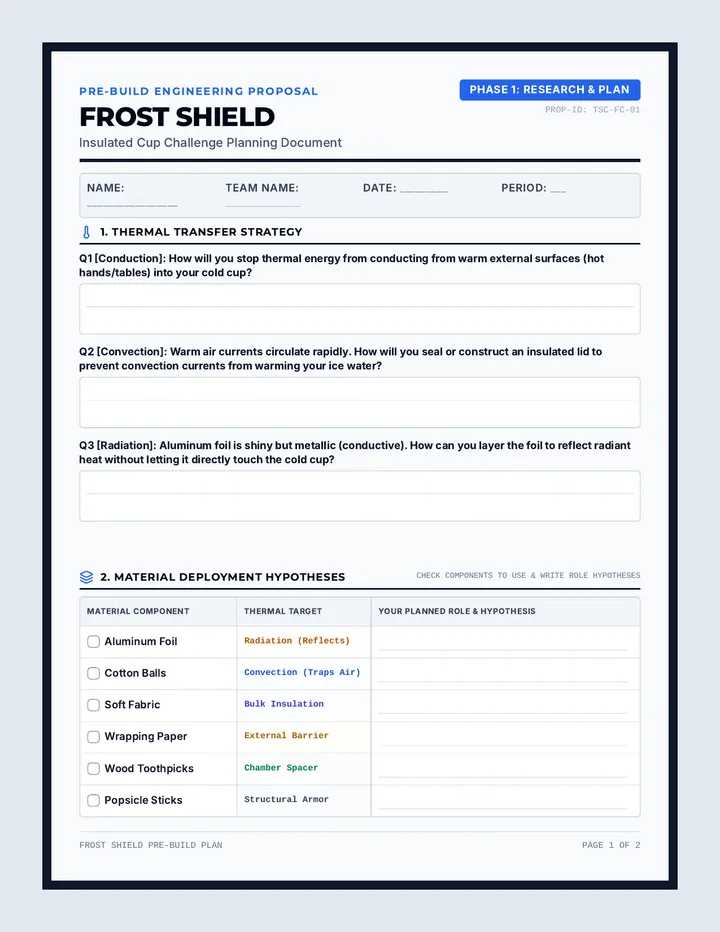
An engineering-focused sequence where 4th graders explore heat transfer and phase changes to design a container that prevents ice from melting. Students progress from understanding basic heat flow to testing insulators and building functional prototypes.
An inquiry-driven exploration of particle theory and phase changes for 4th-grade students. Learners investigate how heat energy influences particle movement across solids, liquids, and gases through hands-on simulations and data-driven experiments.
A 3rd-grade physics sequence where students use kinesthetic simulations and game-based learning to model how particle movement changes during phase transitions. Students 'become' the particles to understand how heat energy leads to transitions between solids, liquids, and gases.
This inquiry-based sequence guides third-grade students through the observable processes of phase changes using water as a primary model. Students investigate solids, liquids, and gases, discovering how adding or removing heat energy causes reversible changes of state.
An inquiry-based exploration of the three states of matter and how temperature changes cause materials to transition between solid, liquid, and gas. students will engage in hands-on labs involving melting, freezing, evaporation, and condensation to understand physical changes.
A 2nd-grade physics unit exploring sources of heat, friction, solar energy, and the difference between reversible and irreversible changes through heating. Students act as 'Thermal Detectives' to investigate how heat behaves in their world.
Students explore how heating and cooling cause materials to change states between solids and liquids. Through hands-on investigation, learners observe water, wax, and food items to understand that some changes are reversible while others are not.
A Kindergarten science sequence exploring how heating and cooling change states of matter, specifically moving between solids and liquids using ice, chocolate, and juice.
A graduate-level series on simulating thermodynamic systems using Monte Carlo and Molecular Dynamics. Students progress from basic Metropolis sampling to advanced free energy calculations and phase equilibrium simulations, culminating in a full Lennard-Jones fluid project.
This skill-building sequence focuses on the application of coordinate geometry to solve physics problems involving vectors and kinematics. Students progress from 2D coordinate systems to 3D spatial vectors and parabolic trajectories, mastering the translation of physical motion into geometric models.
An advanced physics sequence exploring the mathematical and physical determination of the Center of Mass (COM). Students progress from discrete particle systems to continuous mass distributions using coordinate geometry and integral calculus, culminating in real-world stability analysis.
A 12th-grade physics unit that frames 2D momentum conservation through the lens of forensic accident reconstruction. Students master vector analysis and simultaneous equations to determine fault in a complex intersection crash case study.
A high school physics sequence focused on the experimental analysis of momentum and energy conservation across different collision types, from perfectly inelastic to elastic interactions and explosions.
A 5-lesson unit exploring momentum and collisions through digital simulations and mathematical modeling. Students investigate conservation laws, energy transfers, and vector components in frictionless environments.
A 9th-grade physics sequence applying momentum and impulse principles to forensic accident reconstruction and sports biomechanics. Students act as forensic investigators to solve cases using conservation of momentum and work-energy theorems.
A comprehensive undergraduate physics sequence exploring linear momentum conservation through system analysis, 1D/2D collisions, and forensic reconstruction. Students progress from theoretical foundations to complex real-world applications in accident investigation.
A 10th-grade physics sequence that applies momentum and impulse principles to forensic accident reconstruction. Students take on the role of forensic engineers to determine fault in vehicle collisions using conservation laws.
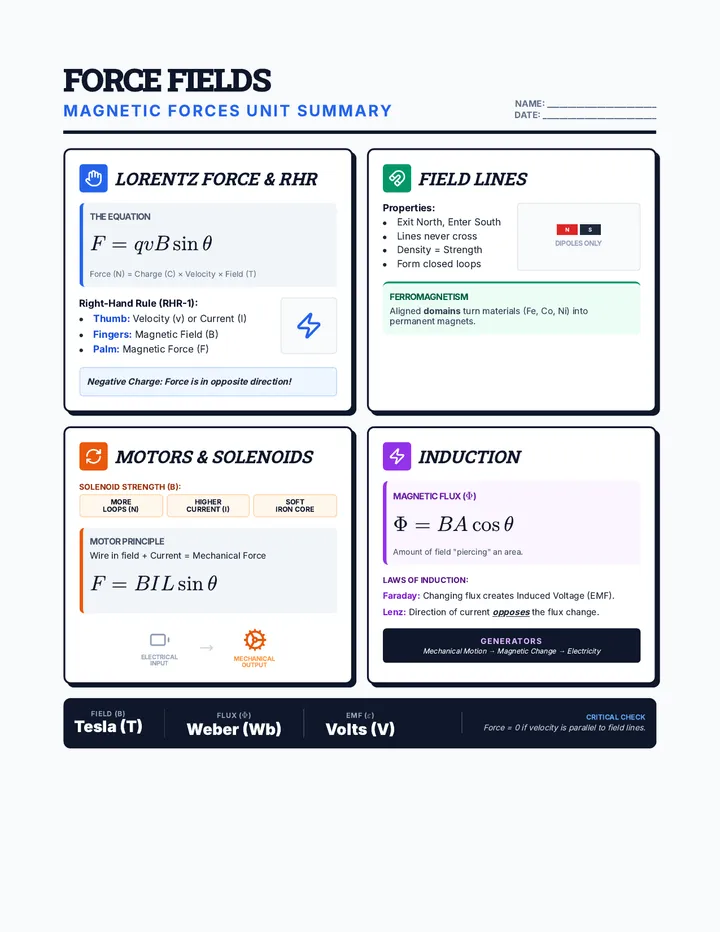
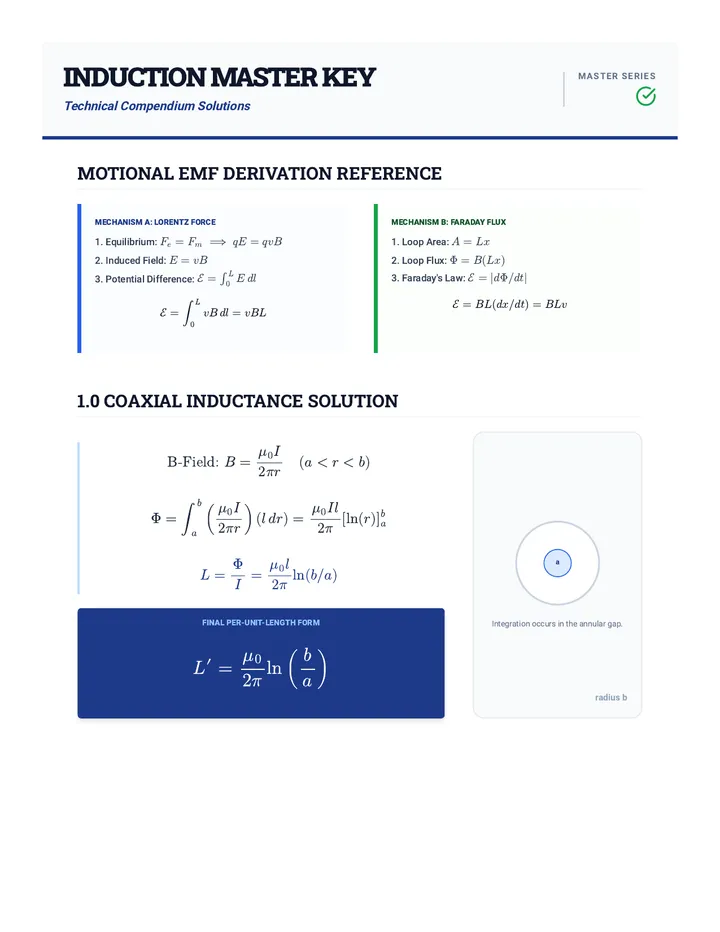
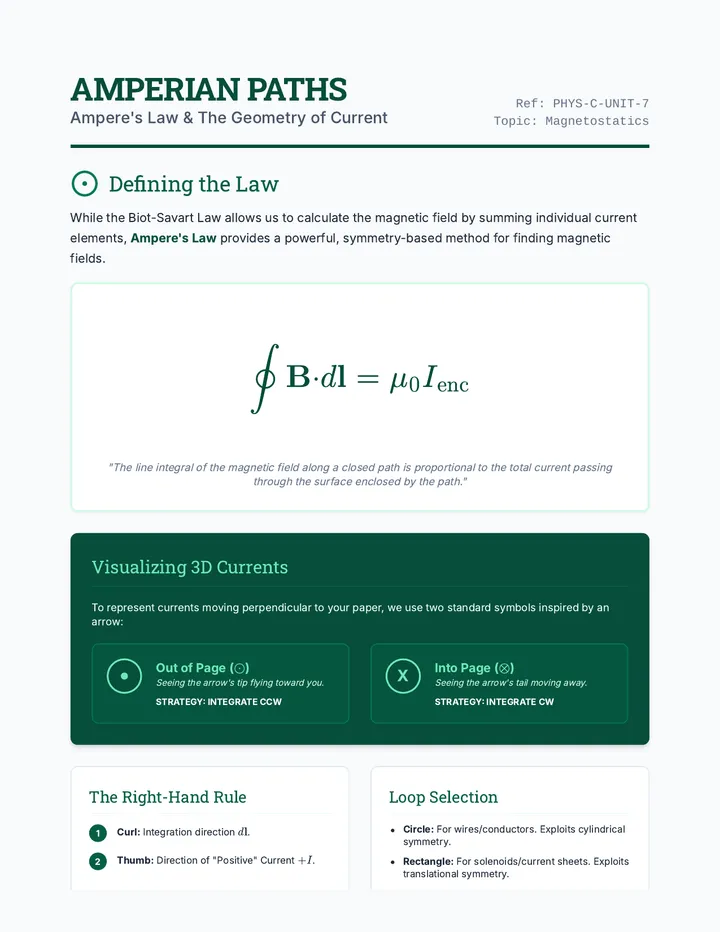
An undergraduate-level physics sequence exploring the fundamental principles of magnetostatics, including Lorentz forces, field generation via Biot-Savart and Ampere's Laws, and the properties of magnetic materials.
This 12th-grade engineering sequence explores the mathematical foundations of robotics, moving from degrees of freedom to complex forward and inverse kinematics, trajectory planning, and full-system simulation. Students bridge abstract linear algebra with physical mechanical motion.
A comprehensive undergraduate sequence on feedback control systems in robotics, covering PID, stability analysis, state-space modeling, LQR optimal control, and trajectory tracking. Students bridge the gap between mathematical theory and physical implementation through simulations and hardware-focused labs.
A comprehensive sequence for undergraduate engineering students on the perception layer of robotics. It covers sensor noise modeling, Bayesian filters, Kalman filters (KF and EKF), and the fundamentals of SLAM, focusing on how robots interpret noisy real-world data to build a reliable world model.
A comprehensive 8th-grade robotics sequence focused on sensor integration. Students progress from basic analog/digital signal understanding to complex sensor fusion, enabling robots to perceive and navigate their environment autonomously.
A comprehensive undergraduate-level sequence covering the mathematical foundations of robotics, from classical DH kinematics and Lagrangian dynamics to modern AI-driven path planning and reinforcement learning.
A graduate-level sequence exploring gravitational dynamics, the Collisionless Boltzmann Equation, and the role of dark matter in galactic evolution, culminating in N-body merger simulations.
A comprehensive 5-lesson sequence exploring gravity's role in the solar system, from local Earth-bound observations to complex orbital mechanics. Students use simulations, physical models, and mathematical calculations to understand how gravity and inertia shape our universe.
A rigorous undergraduate sequence exploring the mathematical and physical principles of celestial motion, from Keplerian derivations to computational N-body simulations and orbital mission planning.
This undergraduate-level sequence covers the mathematical and geometric principles of plate tectonics on a spherical Earth. Students will master Euler's Rotation Theorem, calculate linear velocities, construct relative velocity triangles, analyze triple junction stability, and synthesize global plate circuits to reconstruct past plate configurations.
A graduate-level exploration of the harmonic oscillator's role as the bridge between classical mechanics, statistical thermodynamics, and quantum field theory. This sequence focuses on algebraic operator methods, coherent states, and the statistical foundations of modern physics.
This graduate-level sequence explores nonlinear dynamics, moving from simple harmonic motion to complex chaotic systems. Students master perturbation techniques, multiple scales, and the analysis of bistable and chaotic behaviors.
A graduate-level exploration of coupled oscillators, eigenmode analysis, and the transition from discrete systems to continuum wave mechanics. Students master the mathematical tools of linear algebra and Lagrangian mechanics to describe collective physical behaviors.
This sequence bridges theoretical physics and signal processing by examining driven, damped oscillators through the lens of Green's functions. Students progress from basic damped motion to solving complex inhomogeneous equations using impulse response techniques and spectral analysis.
An advanced graduate-level exploration of oscillatory systems through the lens of Lagrangian and Hamiltonian mechanics, phase space topology, and action-angle variables. Students move from geometric interpretations of stability to powerful analytical techniques for integrable systems.
This project-based sequence explores Simple Harmonic Motion (SHM) through the lens of engineering. Students investigate forced oscillations, resonance, and damping, using real-world case studies like the Tacoma Narrows Bridge and skyscrapers to understand how engineers mitigate structural failure.
A comprehensive 5-lesson sequence for 11th-grade physics students exploring the dynamics of simple and physical pendulums. From isolating variables and testing the Small Angle Approximation to calculating local gravity and proving Earth's rotation, students engage in hands-on experimentation and rigorous data analysis.
This sequence explores the mathematical modeling of Simple Harmonic Motion, connecting uniform circular motion to trigonometric functions. Students learn to graph and derive position, velocity, and acceleration equations, understanding the phase relationships and physical parameters that define oscillatory motion.
An inquiry-based exploration of Simple Harmonic Motion, focusing on Hooke's Law, restoring forces, and the physical parameters that determine oscillation period. Students progress from qualitative observations of elasticity to quantitative modeling and prediction.
A high-level physics and engineering sequence where 12th-grade students design, model, and test seismic isolation systems. Students apply Simple Harmonic Motion (SHM) principles to solve real-world structural engineering challenges.
A comprehensive 12th-grade physics sequence exploring real-world oscillations. Students progress from basic damping types to the complex physics of resonance and its engineering applications in skyscrapers and bridges.
A comprehensive 12th-grade physics unit exploring the mechanics of pendulums, the derivation of harmonic motion through the small-angle approximation, and the experimental determination of gravitational acceleration.
This sequence explores the kinematics of Simple Harmonic Motion (SHM), guiding students through the derivation of sinusoidal motion from circular projections to the application of phase constants in complex problem solving. Students analyze position, velocity, and acceleration graphs to understand the mathematical foundations of periodic systems.
A comprehensive 12th-grade physics sequence exploring the dynamics and energy of mass-spring systems, moving from Hooke's Law to energy conservation and vertical oscillators.
This undergraduate physics sequence explores the dynamics of coupled oscillators. Students use linear algebra to solve for normal modes and eigenfrequencies, analyze energy transfer in weakly coupled systems, and derive the wave equation by taking the continuum limit of an N-mass chain.
An undergraduate-level physics sequence exploring damped and driven oscillations. Students move from basic SHM to modeling energy dissipation (viscous damping), analyzing regimes (underdamped, critically damped, overdamped), and mastering forced oscillations including resonance and vibration isolation engineering.
This undergraduate physics sequence explores the experimental verification of Simple Harmonic Motion through the lens of spring-mass systems. Students progress from static Hooke's Law measurements to advanced dynamic analysis, accounting for effective spring mass and complex configurations.
This sequence explores angular simple harmonic motion through the study of simple, physical, and torsional pendulums. It emphasizes the small-angle approximation, Taylor series expansions, and rigid body dynamics, concluding with non-linear effects at large amplitudes.
This sequence establishes the rigorous mathematical framework necessary for analyzing Simple Harmonic Motion (SHM) at the university level, covering derivations, kinematics, initial conditions, energy, and phasor representations.
A high-school physics sequence connecting 3D coordinate geometry to real-world drone navigation and vector displacement. Students learn to calculate distances in 3D space using the Pythagorean theorem and apply these skills to urban flight path planning.
A comprehensive 11th-grade physics and engineering unit exploring how geometric properties like polygon rigidity and 3D spatial relationships dictate the structural integrity of trusses, space frames, and architectural designs. Students progress from 2D vector analysis to building and testing optimized 3D structures.
A project-based sequence for 12th-grade physics students focusing on the intersection of geometry and structural engineering. Students analyze forces, torque, and material properties to design and optimize stable static structures.
This sequence immerses undergraduate students in the technical science of analog navigation, moving from topographic map interpretation to complex field-based orienteering. Students master contour analysis, magnetic declination, triangulation, and dead reckoning to navigate wilderness environments without electronic aids.
A high-school physics sequence for 12th graders exploring momentum and impulse through the lens of rocketry and variable mass systems. Students progress from simple recoil to the complexities of the rocket equation and orbital maneuvers.
A mastery-based sequence for 12th-grade physics students focusing on the mathematical derivation and application of linear momentum, impulse-momentum theorem, and conservation principles in one-dimensional systems.
An inquiry-driven physics sequence for 9th graders to discover the Law of Conservation of Momentum through hands-on experimentation with carts, collisions, and recoil. Students move from conceptual understanding of 'systems' to mathematical modeling of elastic and inelastic interactions.
A foundational physics unit exploring the mathematical relationship between mass, velocity, force, and time. Students move from basic momentum calculations to complex impulse-momentum theorem applications and graphical analysis.
A project-based unit where 4th-grade students investigate renewable and non-renewable energy sources through hands-on modeling and engineering design. The sequence concludes with students designing a sustainable energy portfolio for a fictional community.
An advanced physics sequence exploring the engineering applications of periodic properties. Students investigate band theory, semiconductor doping, magnetic domains, and alloy formation to solve material science challenges.
A comprehensive undergraduate-level sequence covering digital logic, ALU design, sequential memory, datapath architecture, and control unit logic. Students progress from basic gates to a fully functional CPU model.
This sequence bridges the gap between physics and computer science by exploring digital logic, from binary states and basic logic gates to the construction of complex combinational and sequential circuits used in modern CPUs.
A comprehensive 5-lesson unit for 10th-grade students exploring the physical and logical foundations of modern computing, from transistors to memory cells. Students build a conceptual and practical understanding of how binary arithmetic and logic are executed by hardware.
This sequence explores the interface between computing systems and the physical world through microcontrollers and peripherals. Students shift focus from general-purpose computing to embedded systems, learning how digital code controls analog components through GPIO, ADC, Serial Communication, and PWM.
A project-based sequence where students design custom computer architectures, analyzing components from the Von Neumann model to modern performance benchmarks. Students act as systems architects, balancing cost, thermal constraints, and data throughput for specialized industry needs.
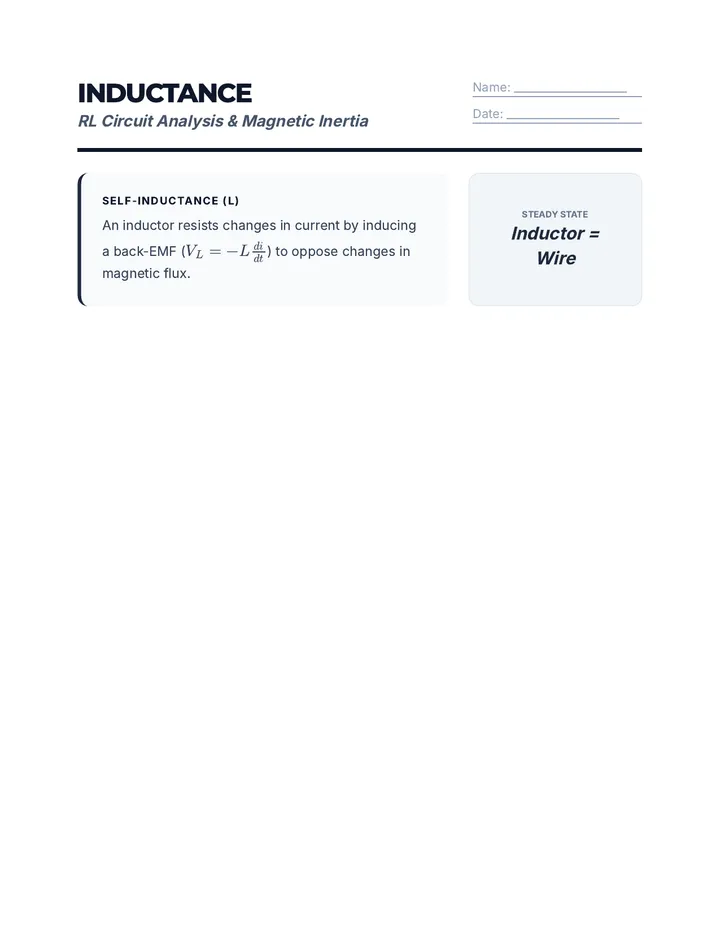
This advanced physics sequence for graduate students explores the mathematical modeling and synthesis of complex electrical networks. Utilizing graph theory and state-space analysis, students learn to simplify, solve, and predict the stability of large-scale linear and nonlinear systems, culminating in the analysis of interconnected two-port networks.
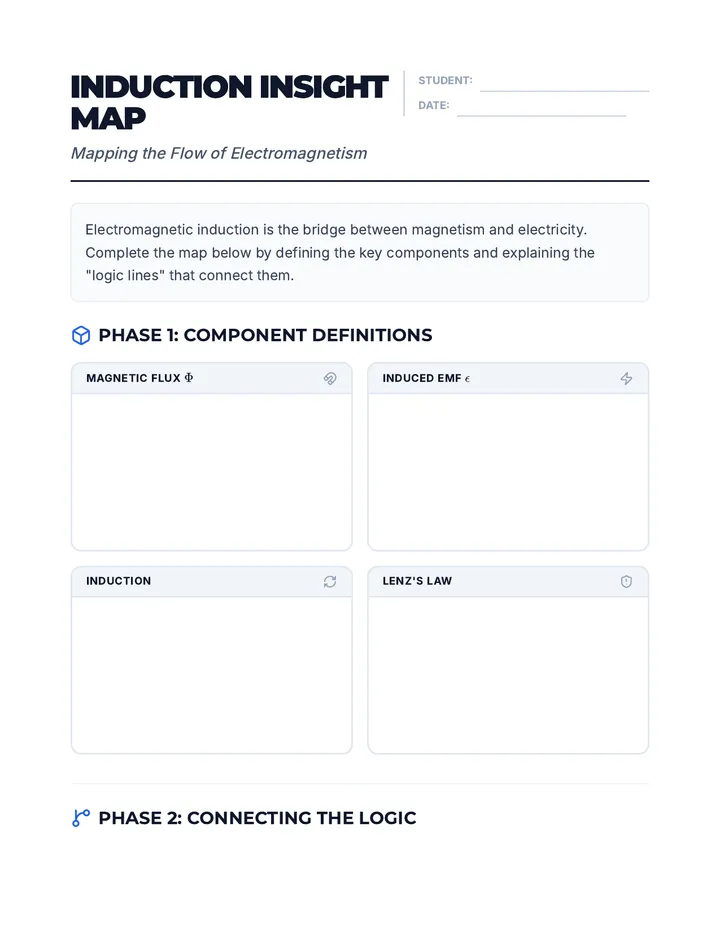
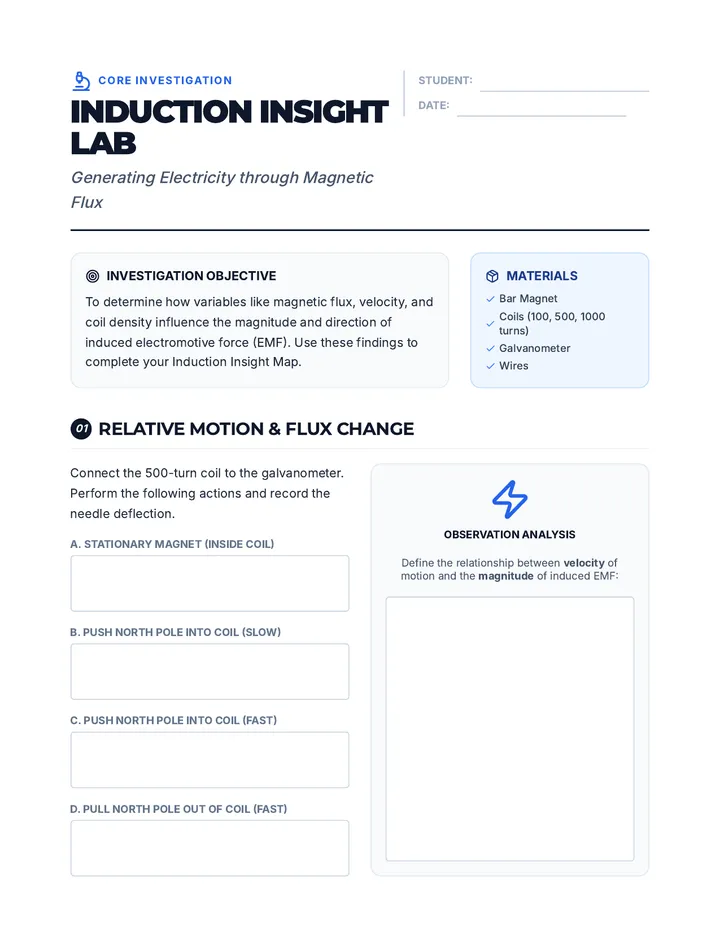
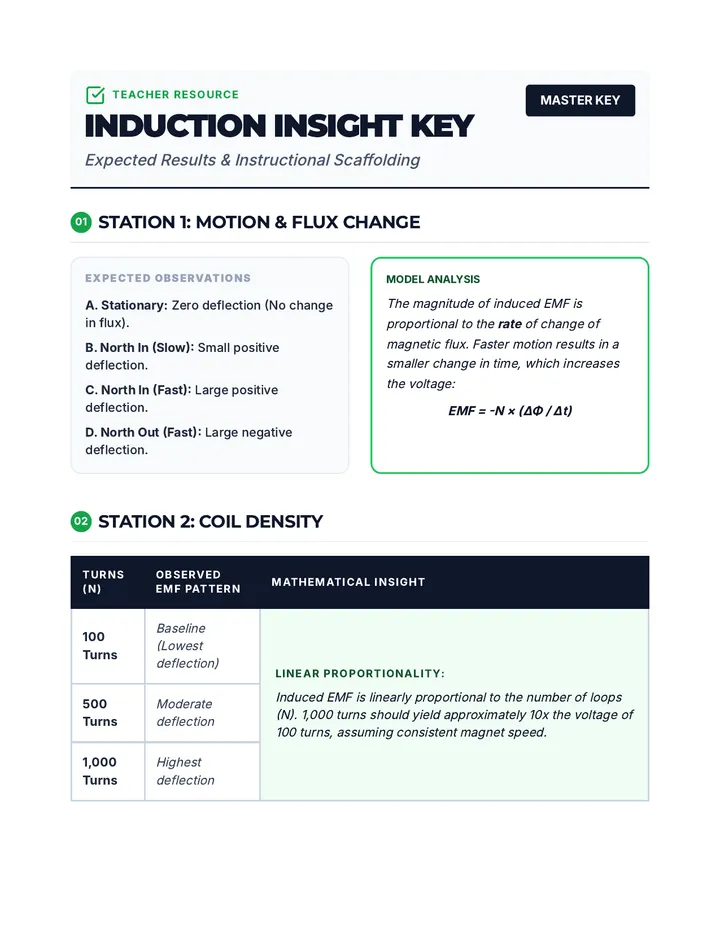
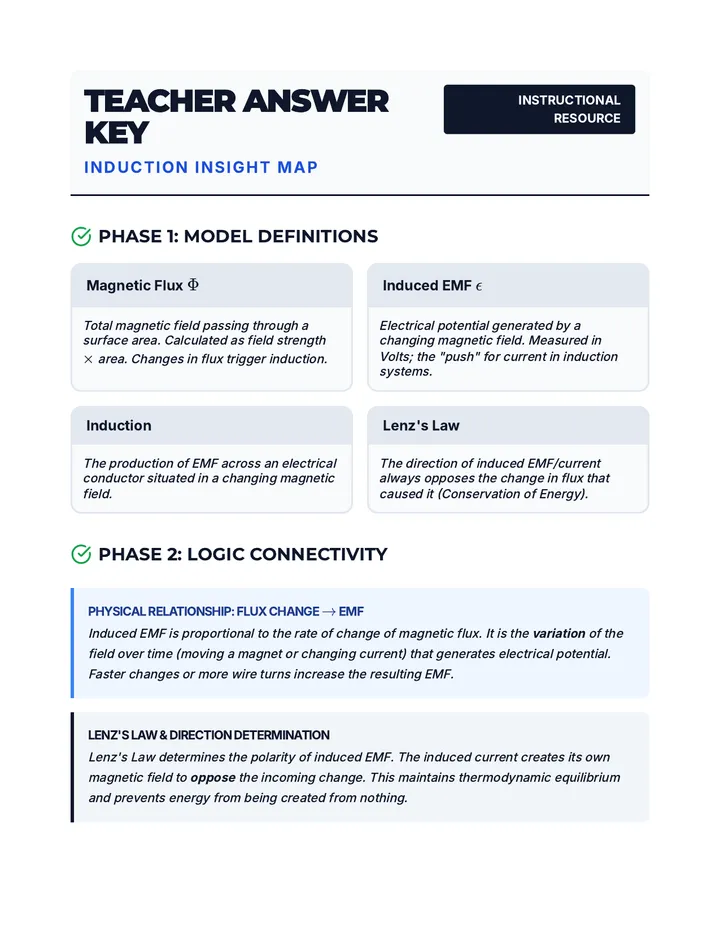
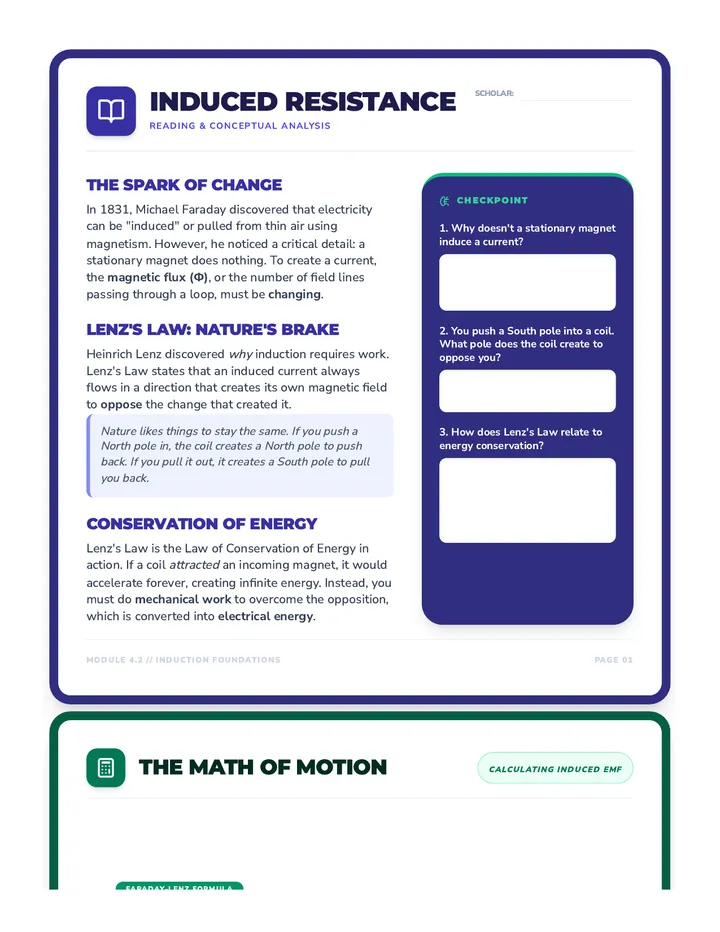
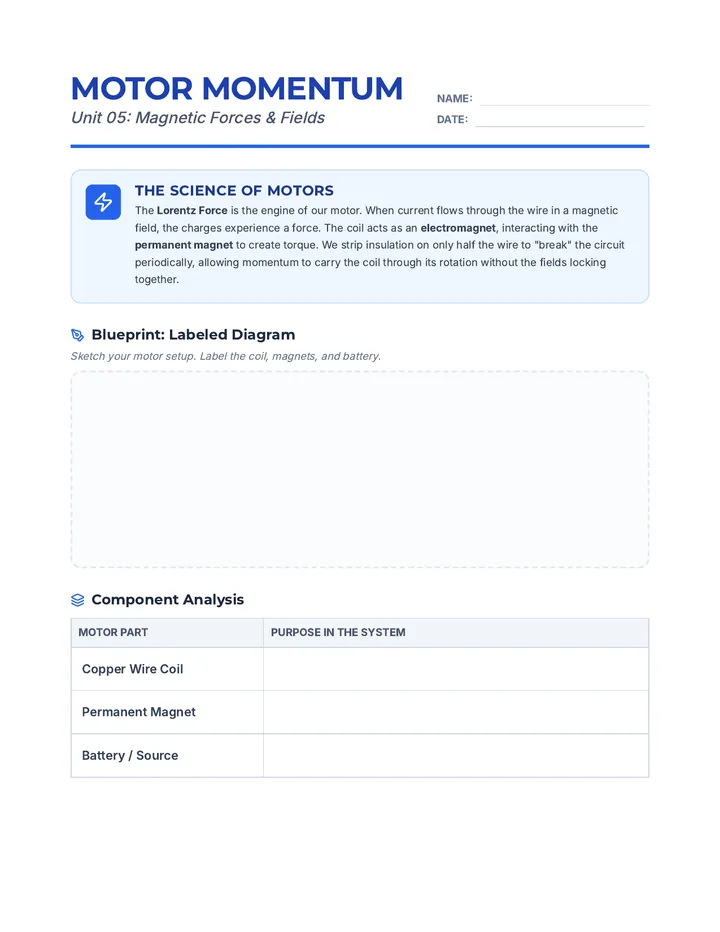
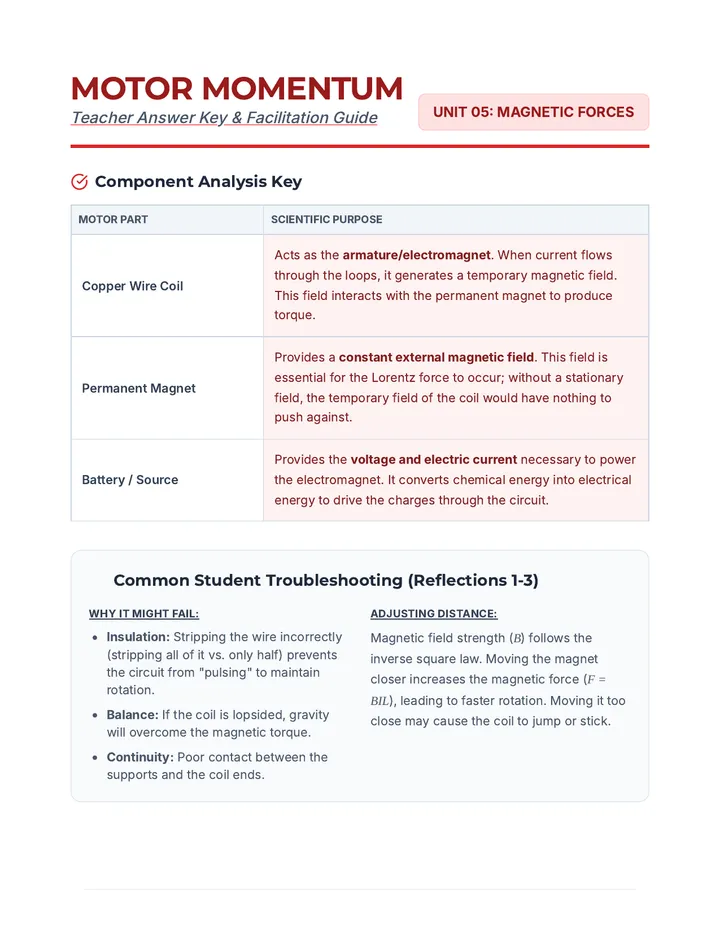
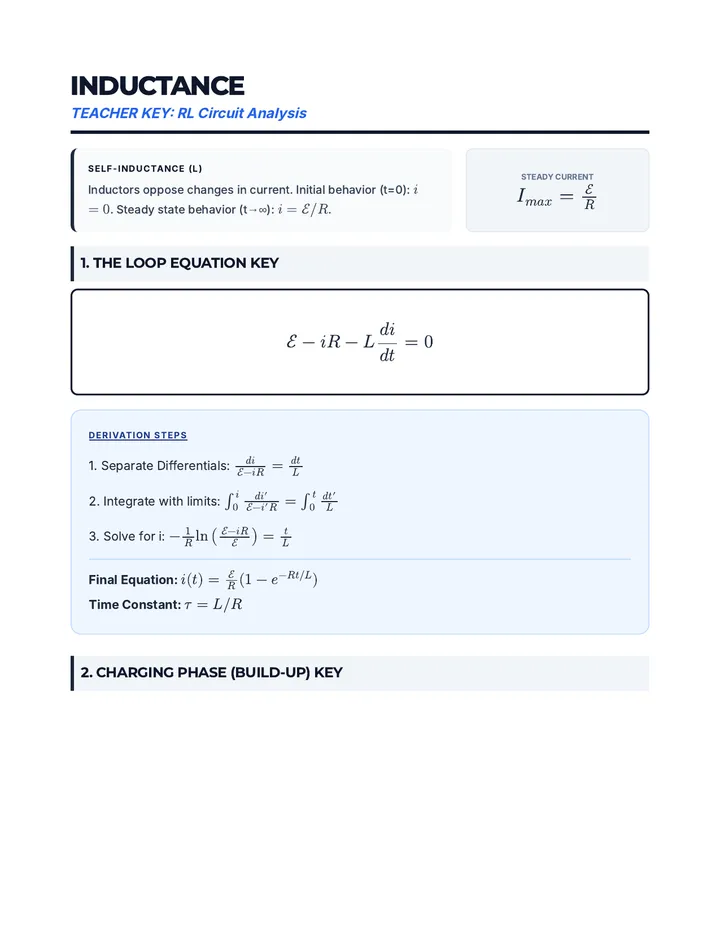
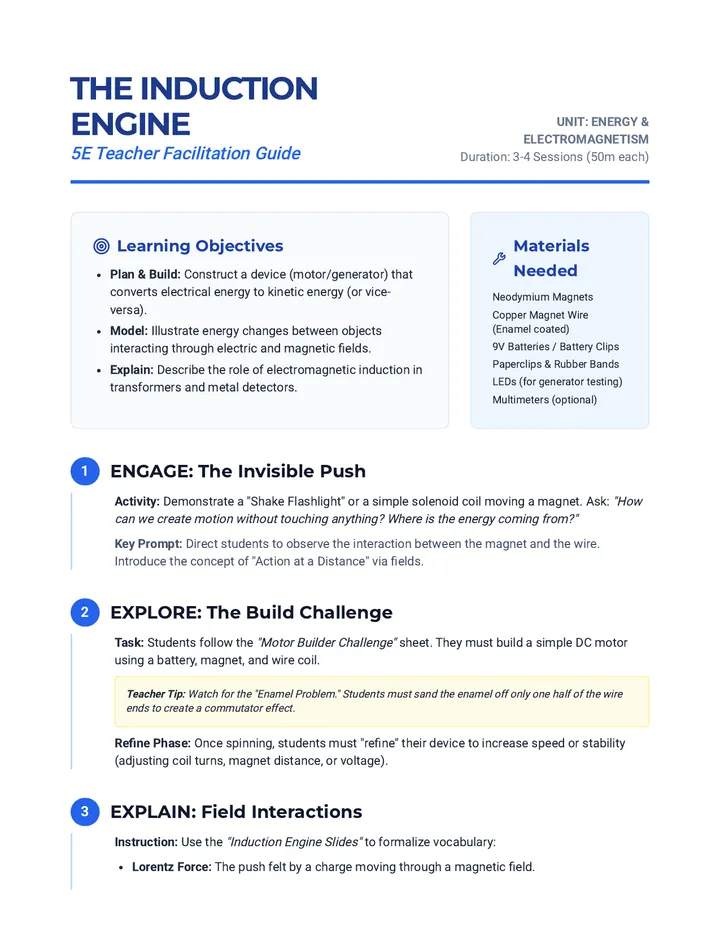
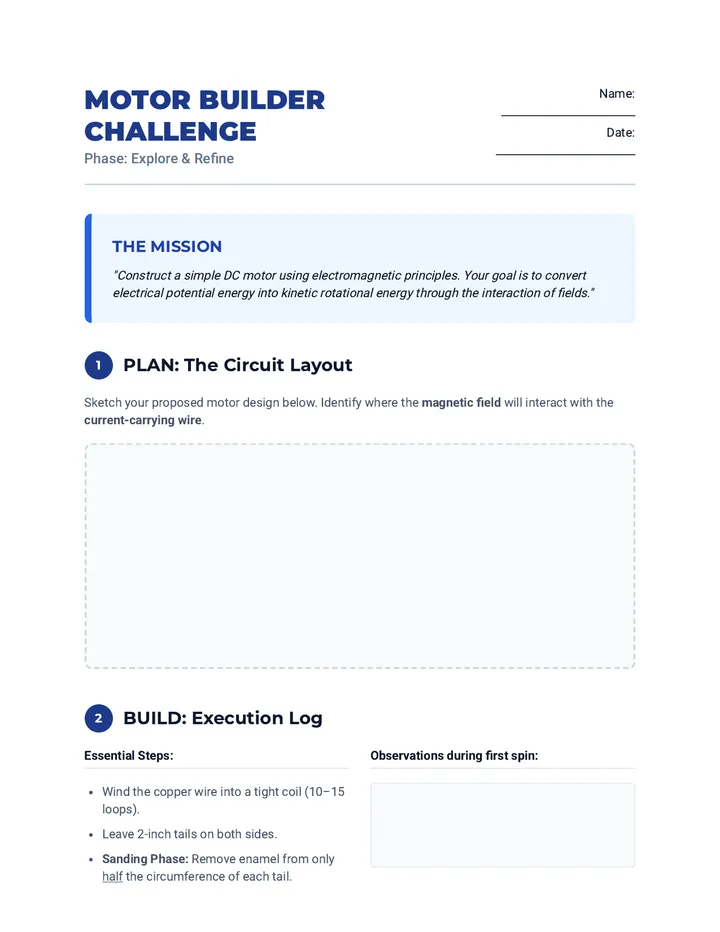
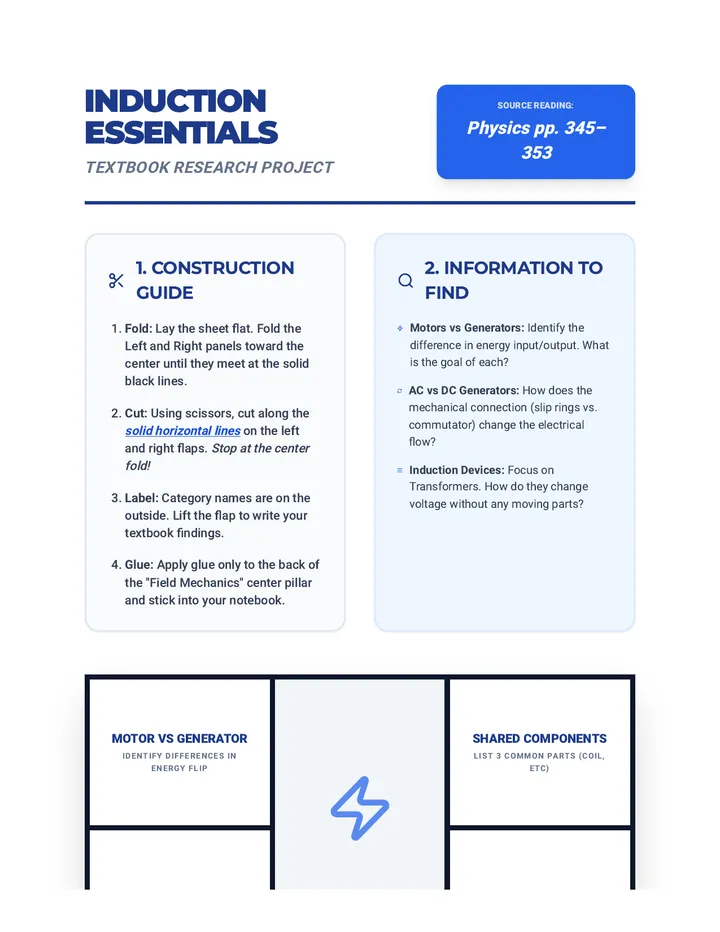
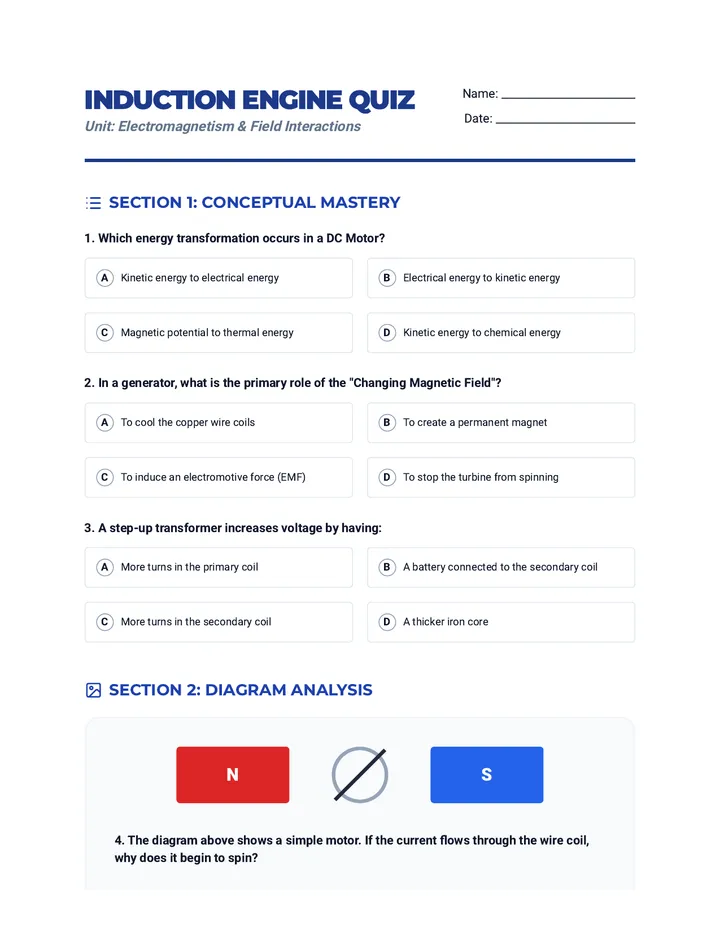
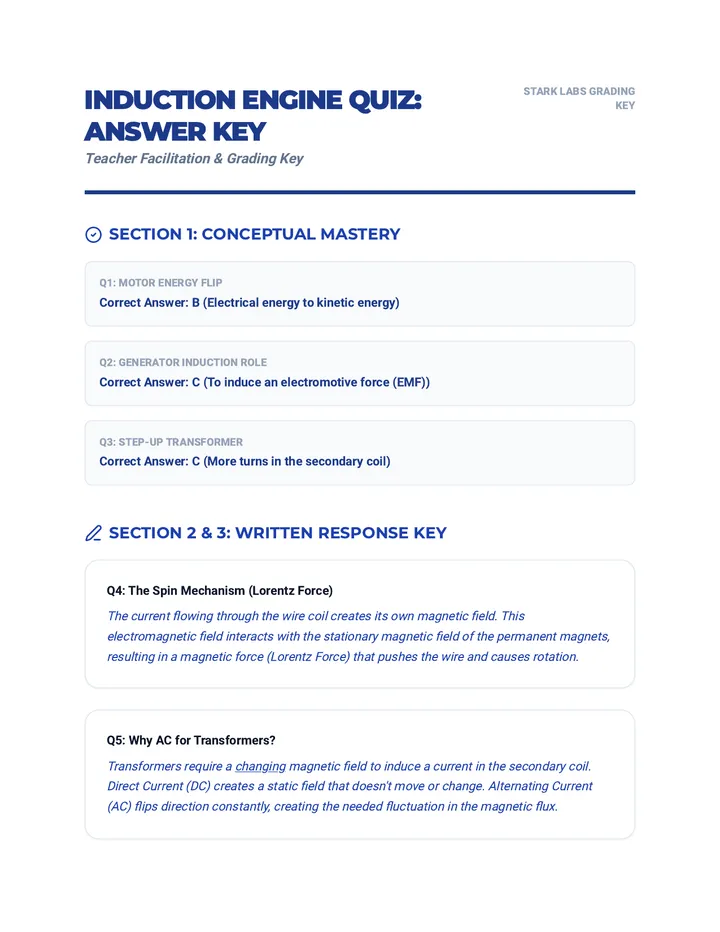
This advanced sequence explores the motor effect and electromagnetic induction, the principles driving modern power generation and mechanics. Students explore the Lorentz force to understand how motors spin, reverse the concept to understand generators, and culminate in building a DC motor.
A comprehensive 12th-grade physics unit exploring how mass distribution and geometry dictate rotational dynamics, from calculus-based derivations to experimental verification.
A project-based unit where 2nd-grade students act as biomechanical engineers to build mechanical models of human body systems, exploring bones, joints, muscles, the heart, and the nervous system.
A graduate-level sequence on advanced Laplace transform techniques, covering discontinuous functions, impulse responses, convolution, and linear systems. Students master the mathematical rigor of generalized functions and transfer function analysis.
A 12th-grade Physics project-based unit exploring momentum and impulse through the lens of impact safety engineering. Students design, test, and iterate on a safety containment unit, using the impulse-momentum theorem to protect a fragile payload.
This sequence bridges physics and chemistry to explore the geometric arrangements of atoms in solid matter. Students investigate crystal lattices, unit cells, and packing efficiency, understanding how microscopic geometry dictates macroscopic properties like density and conductivity.
This advanced theoretical sequence bridges the gap between classical Gestalt psychology and modern cognitive neuroscience. Students critically analyze historical foundations before examining contemporary research on the neural binding problem and visual cortex architecture.
This sequence introduces 11th-grade students to the physical and logical foundations of computer networks. Students explore bit transmission, analyze performance metrics like bandwidth and latency, compare physical media, and design local network topologies.
Students explore the invisible world of wireless communication, examining how data travels without physical cables. The sequence covers the electromagnetic spectrum basics, compares wireless standards, investigates IoT, and concludes with a future-focused design project.
A 1st-grade sequence exploring the difference between wired and wireless communication, using hands-on experiments with cords, remotes, radios, and obstacles to understand how data travels.
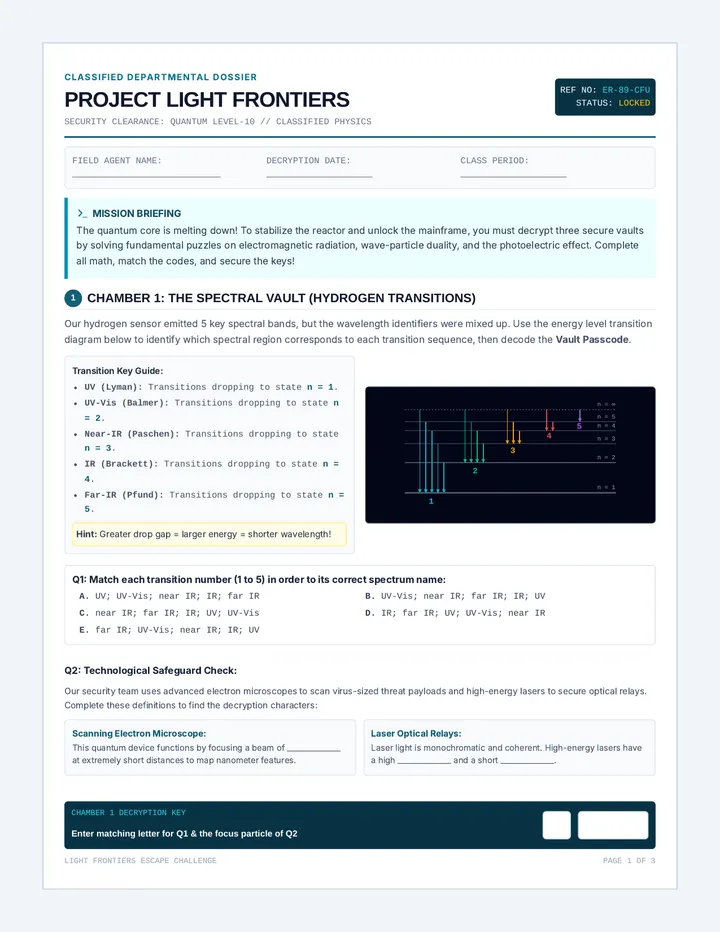
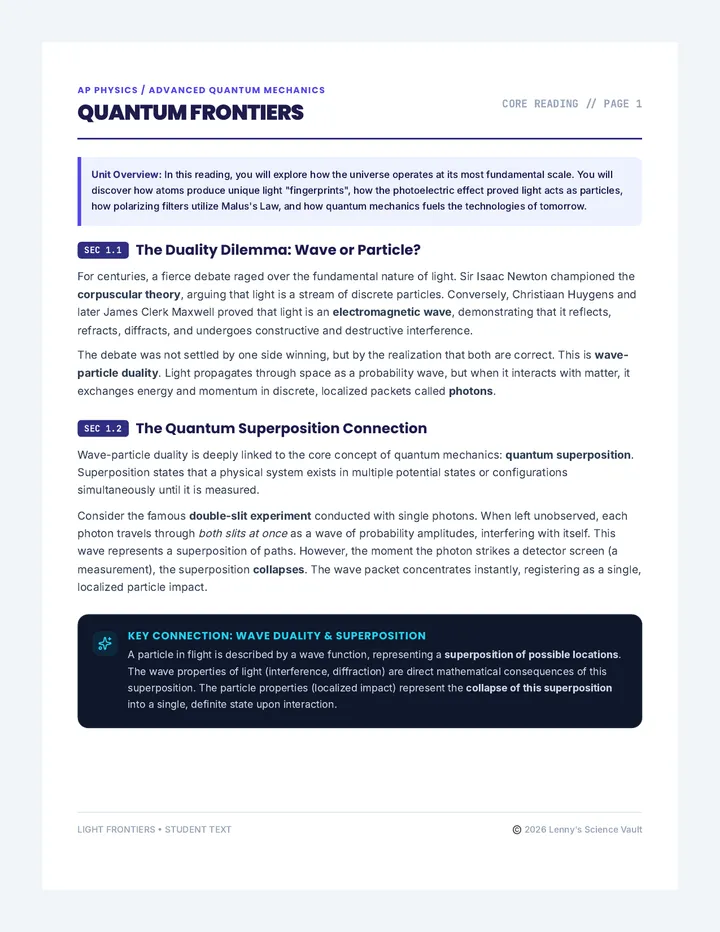
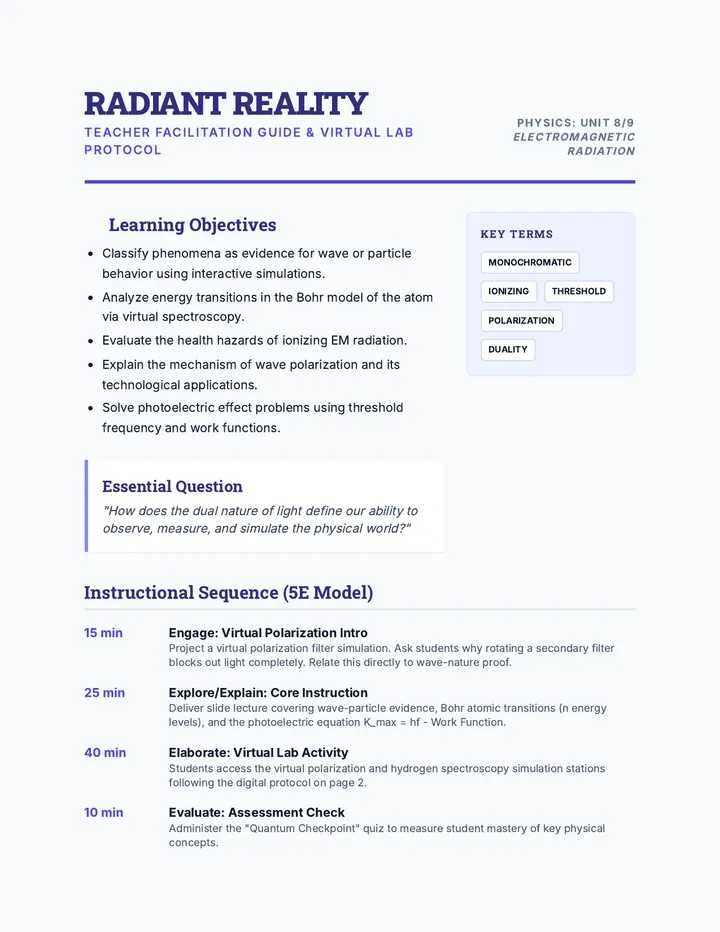
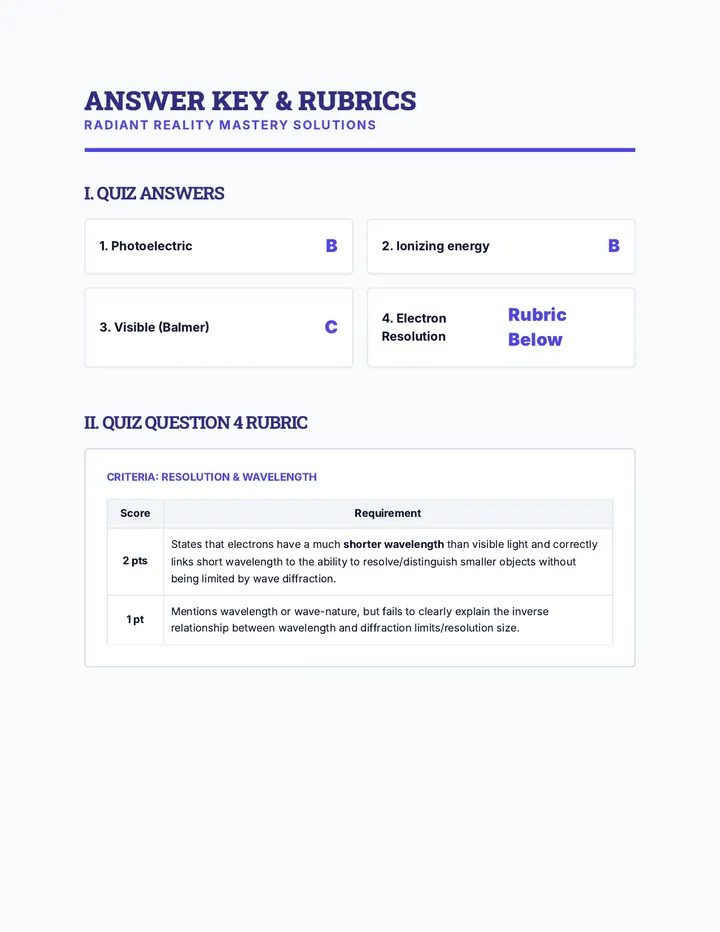
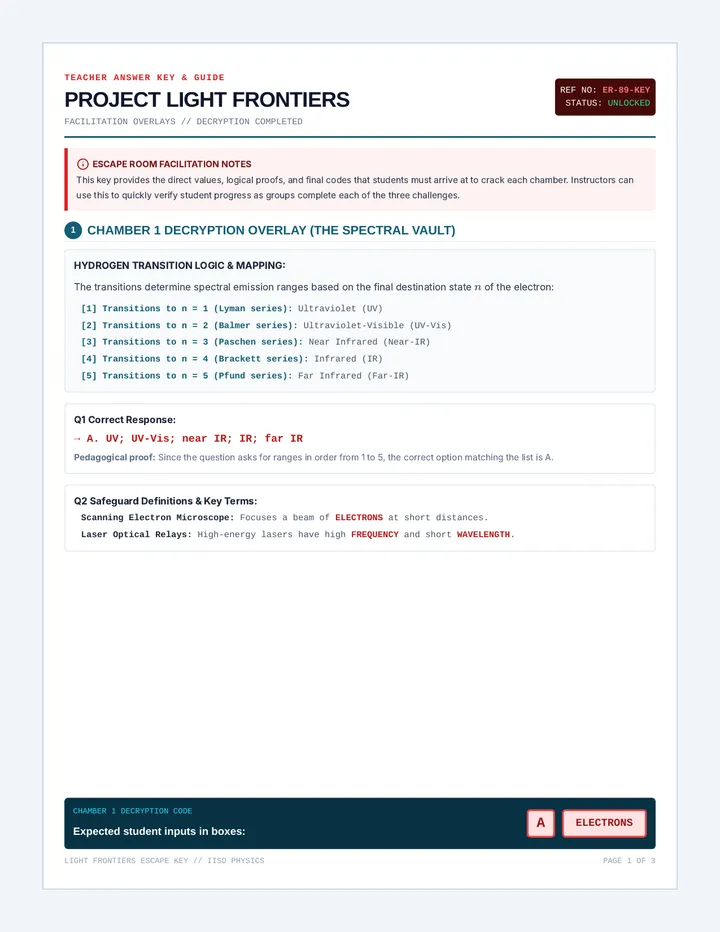
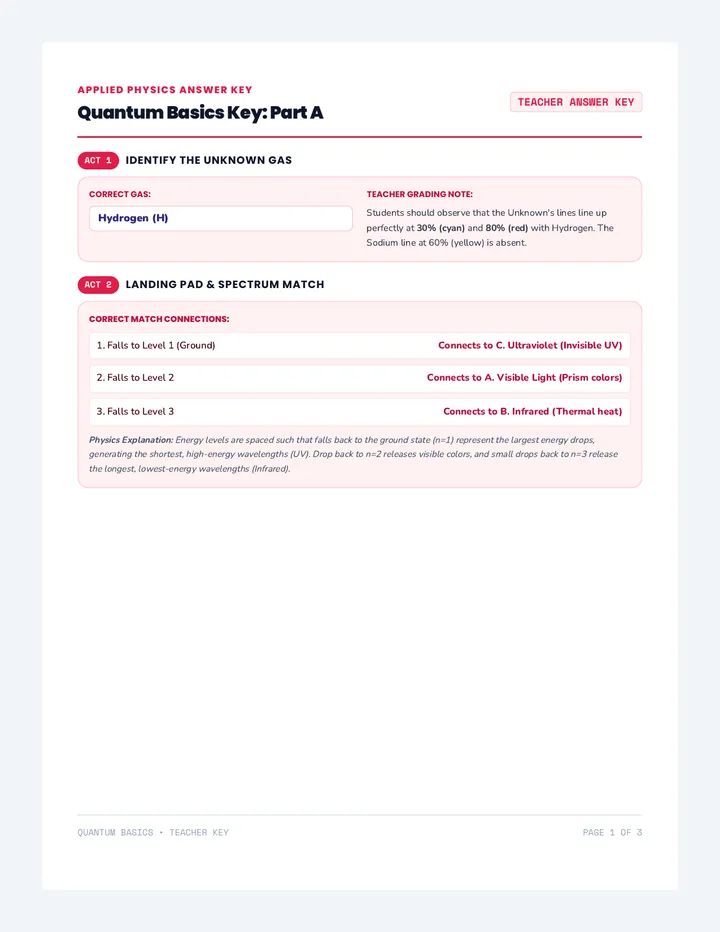
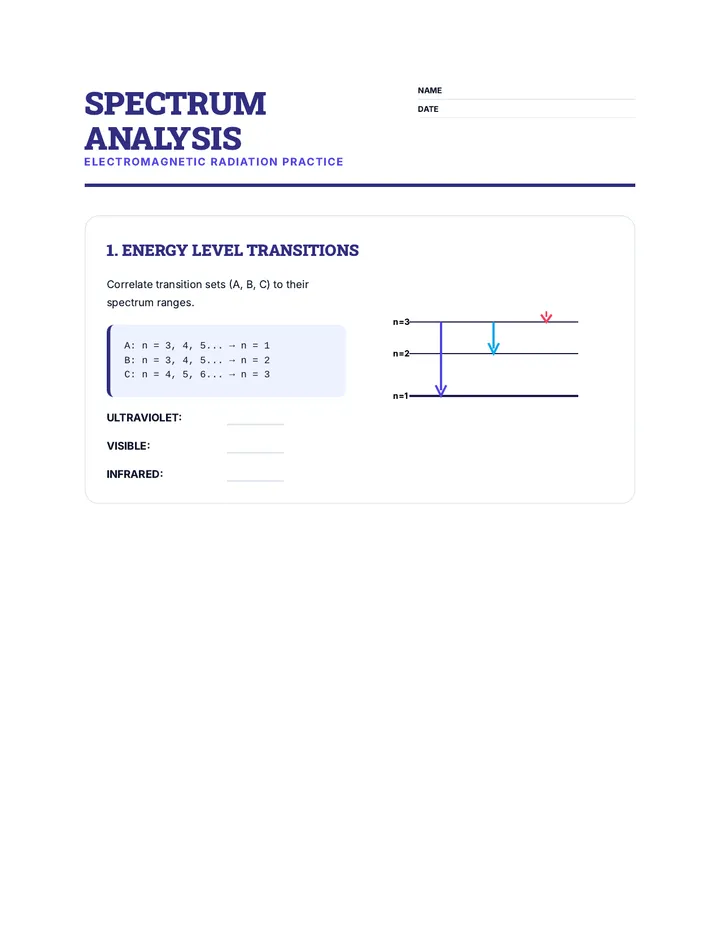
This sequence connects atomic structure to observable light phenomena. Students explore wave-particle duality, energy quantization, and spectral fingerprints to understand how spectroscopy reveals the internal architecture of elements and the composition of the universe.
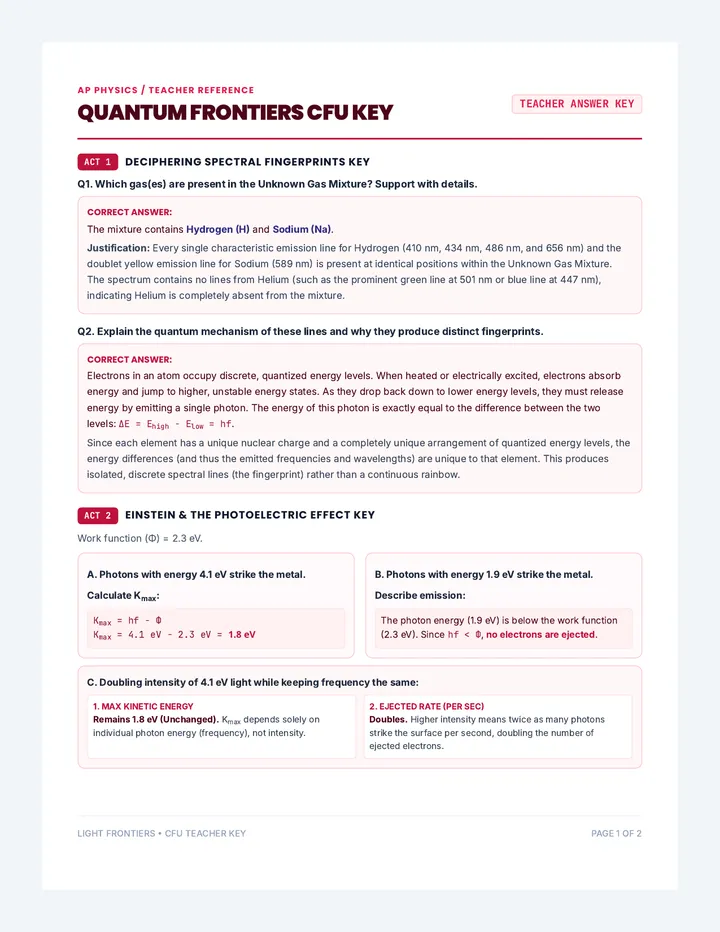
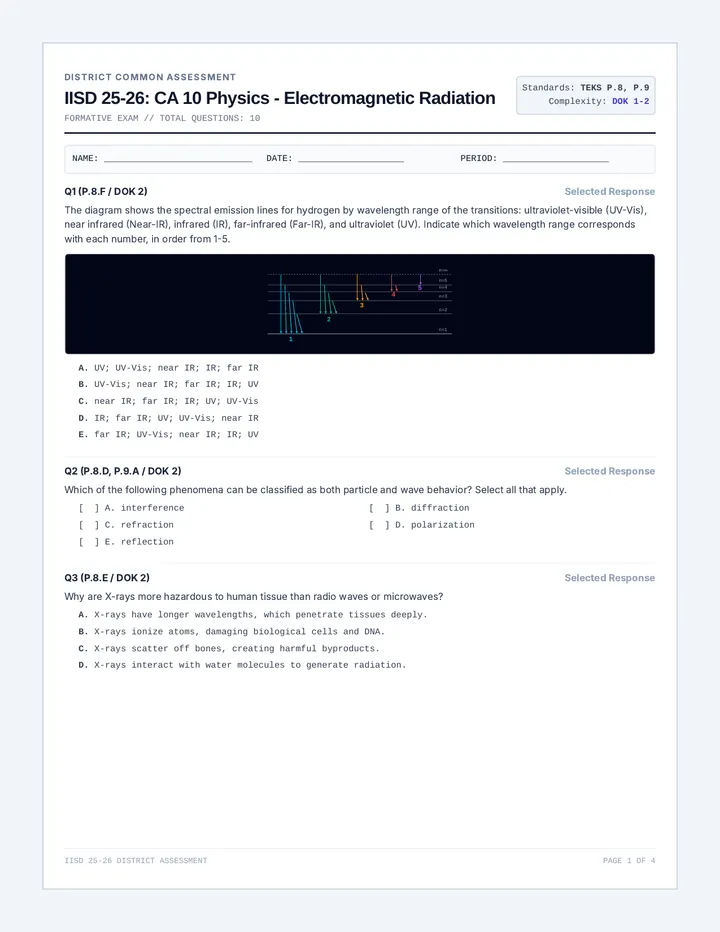
This sequence explores the physics of atomic spectroscopy, linking electron transitions to the emission and absorption of light. Students investigate how spectral lines serve as unique chemical fingerprints, allowing scientists to identify elements in laboratory samples and distant stars alike.
A graduate-level exploration of electromagnetic radiation, from the fundamental Liénard-Wiechert potentials to complex antenna array design and scattering theory. Students bridge the gap between theoretical electrodynamics and practical engineering applications.
A comprehensive graduate-level sequence exploring how microscopic atomic interactions determine the macroscopic propagation of electromagnetic waves through conductors, dielectrics, and plasmas. This series covers Maxwell's equations in matter, boundary conditions, dispersion models (Drude/Lorentz), Fresnel equations, and ionospheric plasma physics.
This graduate-level sequence provides a rigorous mathematical foundation in classical electrodynamics. It covers Maxwell's equations, conservation laws, potential formulations, gauge invariance, Green's functions for wave equations, and the properties of monochromatic plane waves including polarization states via Jones and Stokes calculus.
A 12th-grade physics sequence exploring ionizing radiation, its atomic interactions, and its critical applications in medical imaging and cancer treatment. Students transition from theoretical photon energy to practical dosimetry and hospital safety design.
This 12th-grade engineering sequence explores the physics of electromagnetic waves through the lens of wireless communication. Students learn how information is modulated onto carrier waves, how antenna geometry relates to wavelength, and how environmental factors like attenuation and interference affect signal integrity. The unit concludes with a design challenge requiring students to architect a communication link for a remote environment.
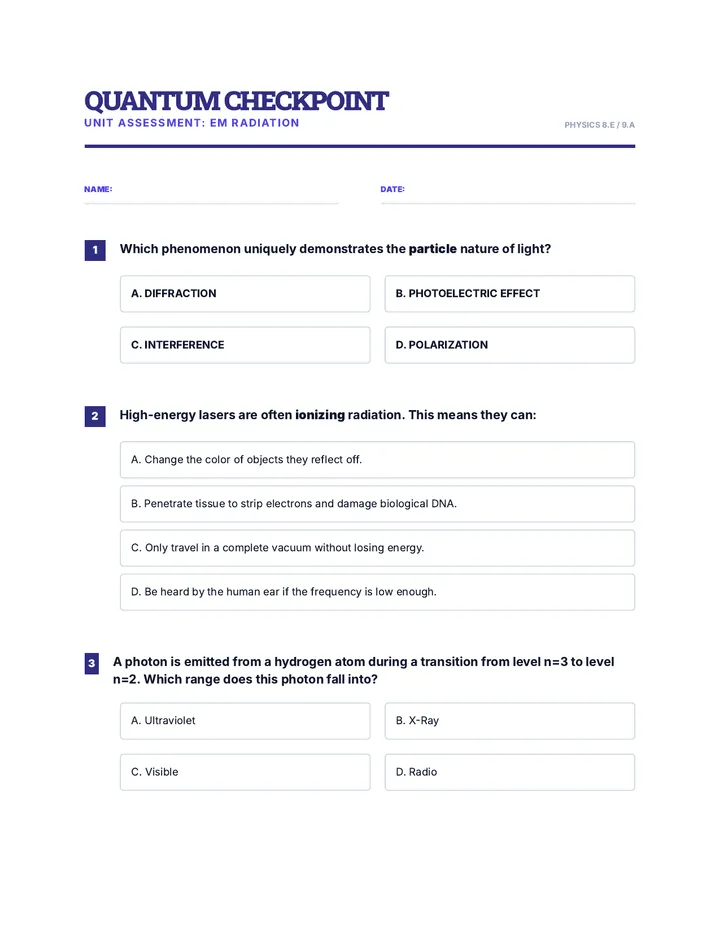
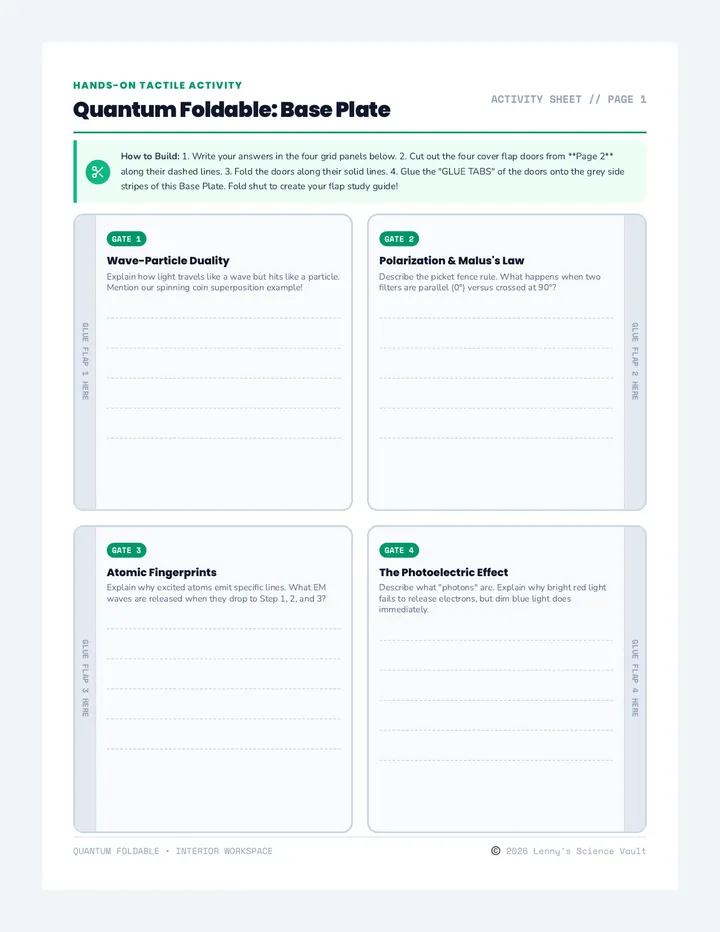
A comprehensive 12th-grade physics sequence exploring the transition from classical wave theory to quantum mechanics, focusing on the photoelectric effect, photon energy, and wave-particle duality.
A high-school physics sequence focused on the quantitative analysis of the electromagnetic spectrum. Students master the mathematics of wave relationships, explore spectroscopy and blackbody radiation, and research practical technological applications across different spectral bands.
A comprehensive 12th-grade physics unit exploring the genesis, propagation, and behavior of electromagnetic waves, from oscillating charges to Maxwell's synthesis and the inverse square law.
An 11th-grade physics unit exploring the evolution of electromagnetic theory, from Maxwell's unification of fields to the quantum mysteries of wave-particle duality and cosmic redshift. Students bridge classical wave mechanics with modern quantum phenomena to understand the fundamental nature of light and the universe.
A comprehensive sequence for 11th-grade physics students exploring the physics, biological impacts, and ethical considerations of ionizing radiation in medicine and industry. Students progress from fundamental EM wave properties to complex medical applications and safety standards.
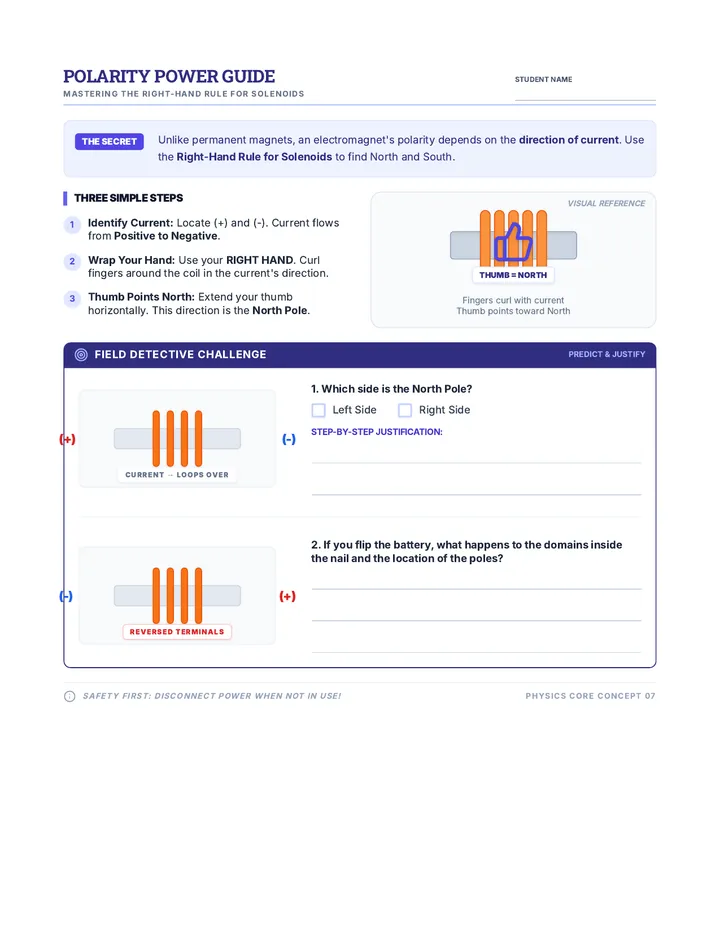
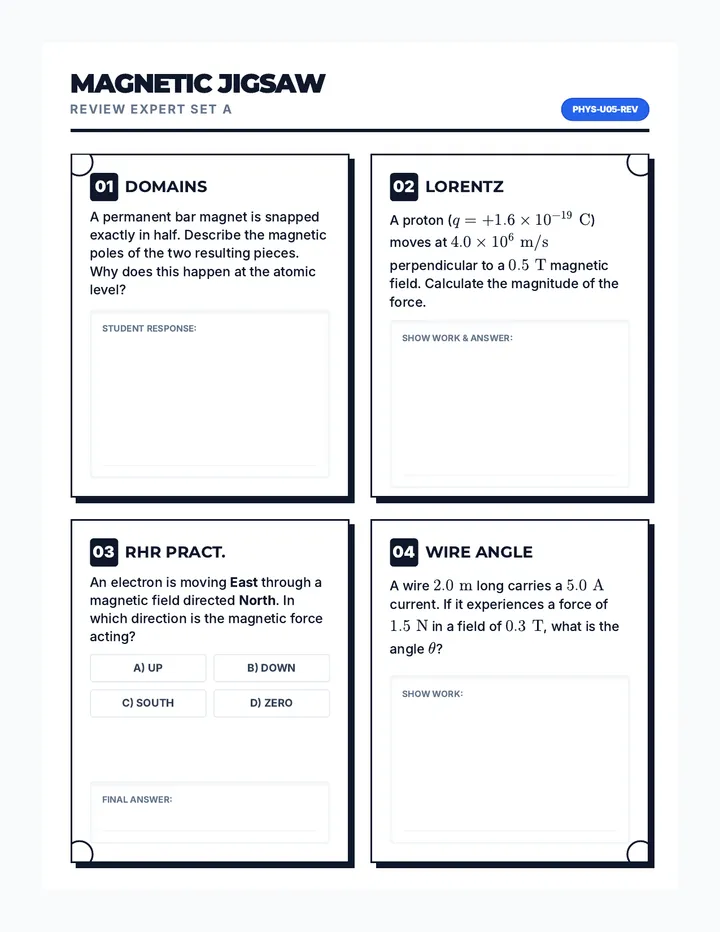
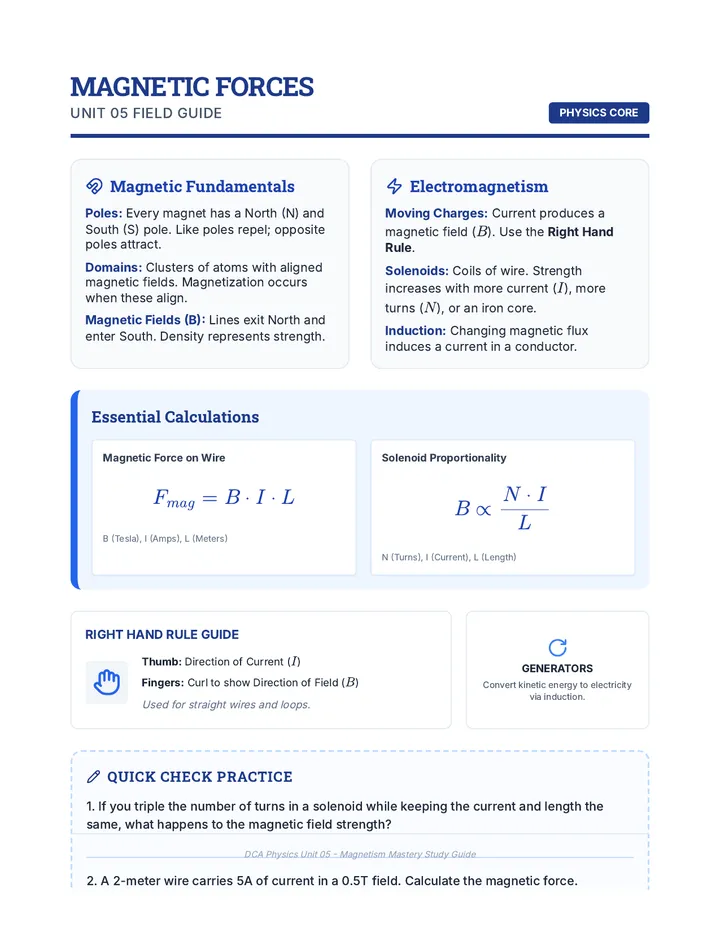
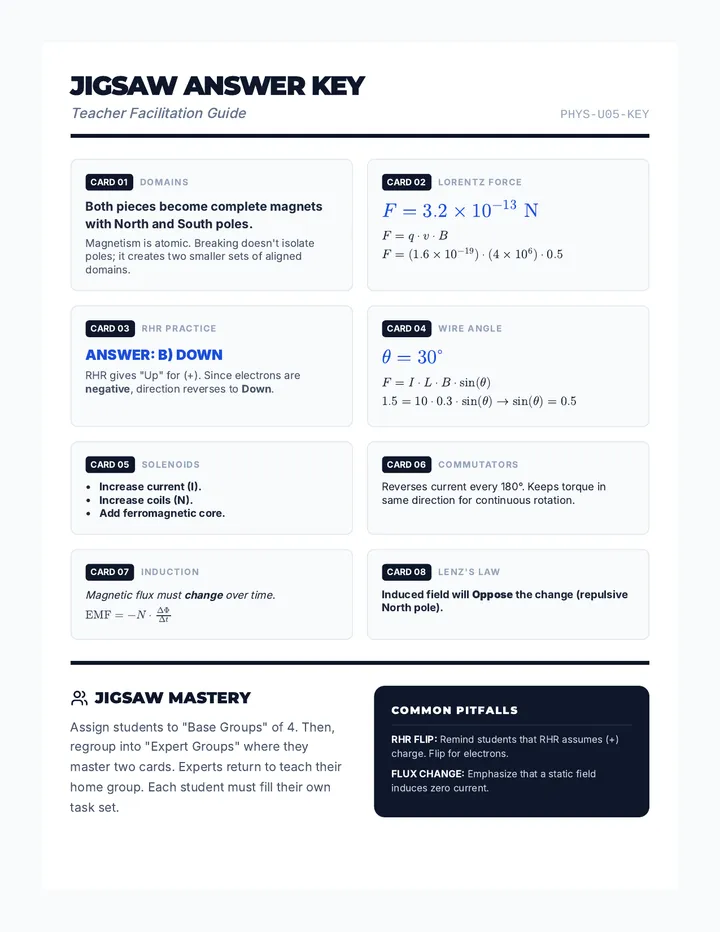
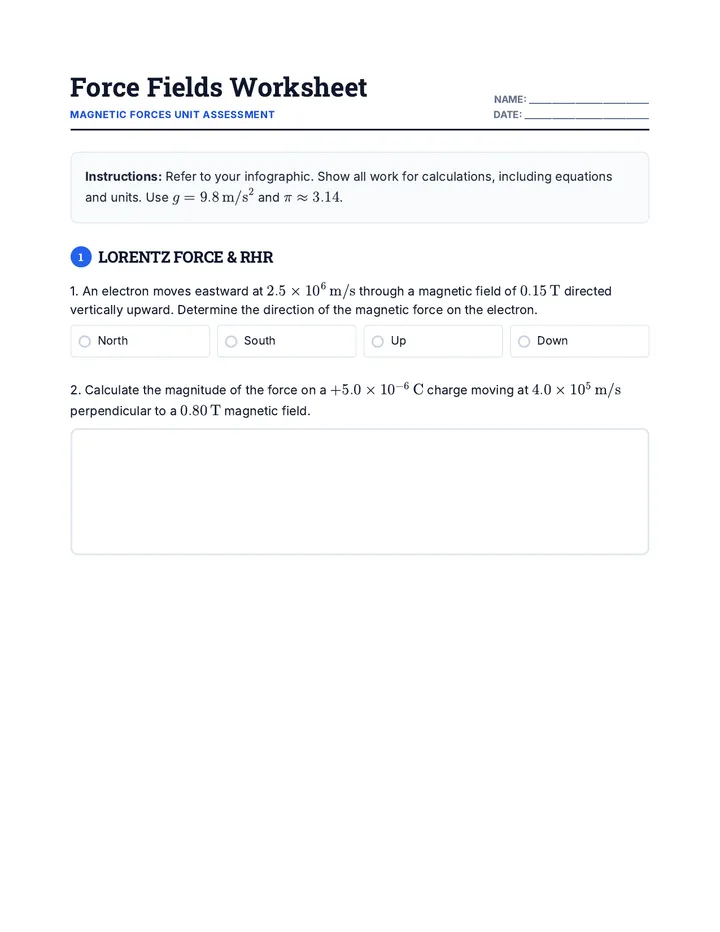
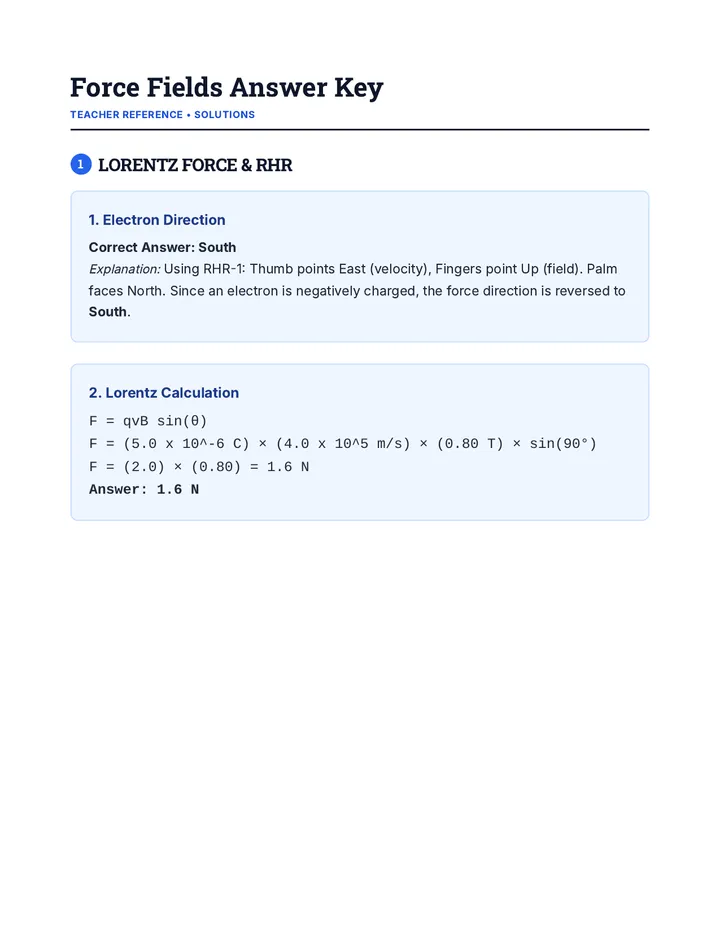
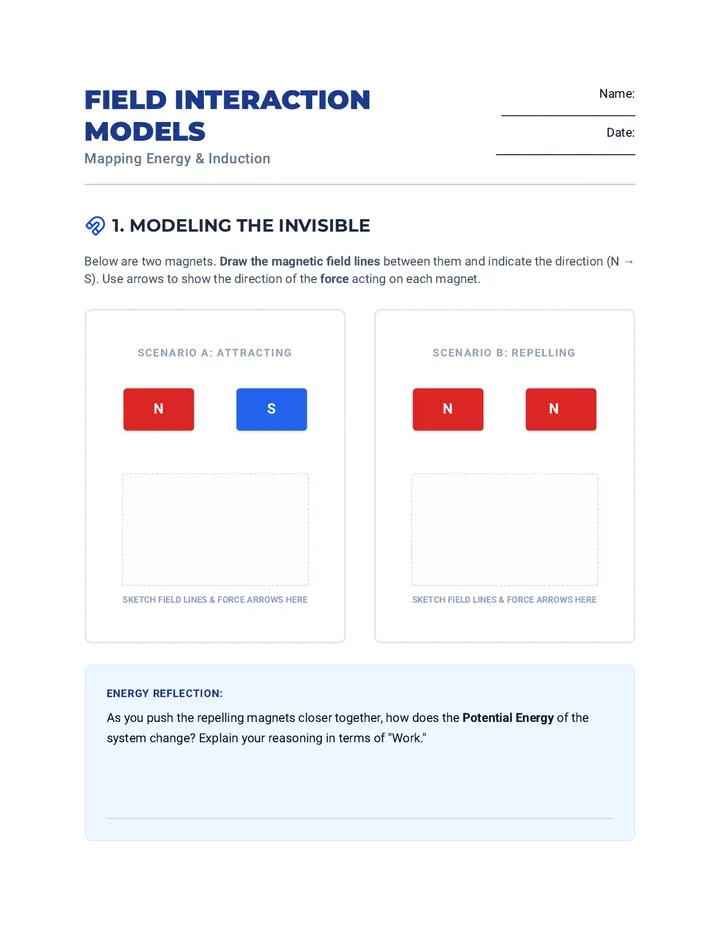
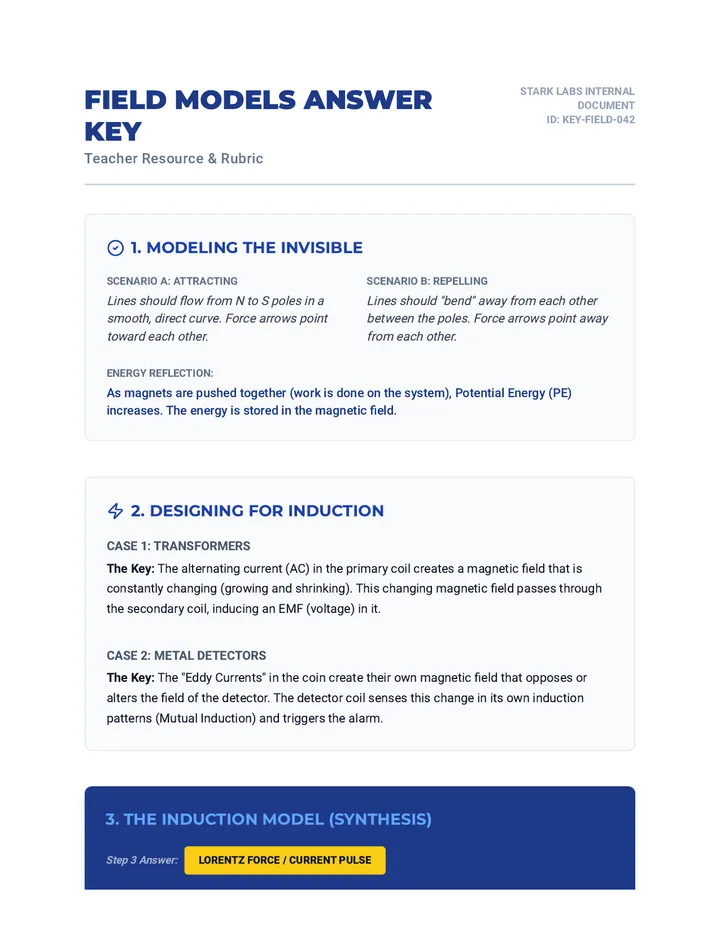
This sequence explores the relationship between electricity and magnetism, focusing on magnetic fields, the Lorentz force on moving charges, and practical applications in mass spectrometry. Students develop 3D spatial reasoning skills through the Right Hand Rule and apply kinematic principles to magnetic deflection.
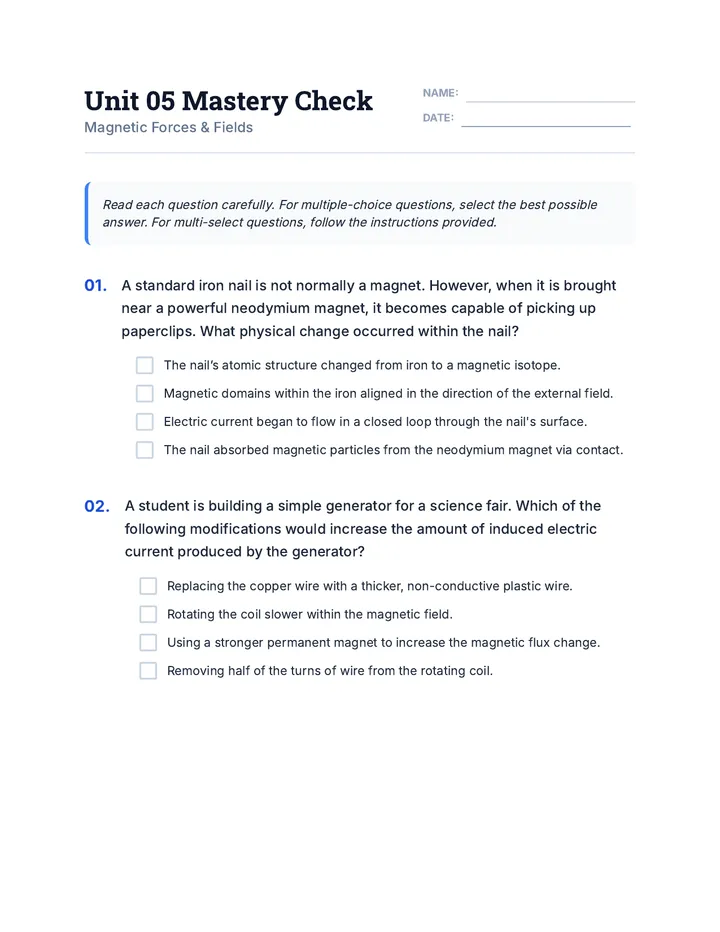
This sequence explores the fundamental relationship between electricity and magnetism. Students investigate magnetic fields around permanent magnets and current-carrying wires, build electromagnets, and calculate the forces exerted on moving charges and wires within magnetic fields.
This sequence explores the physical principles of robotics, focusing on kinematics, gear systems, and mechanical advantage. Students will progress from simple machines to designing and testing a motorized chassis for varied terrain.
This 8th-grade astronomy sequence explores the physics of orbital motion, focusing on the relationship between gravity and inertia. Students progress from basic gravitational laws to complex orbital mechanics and mission planning.
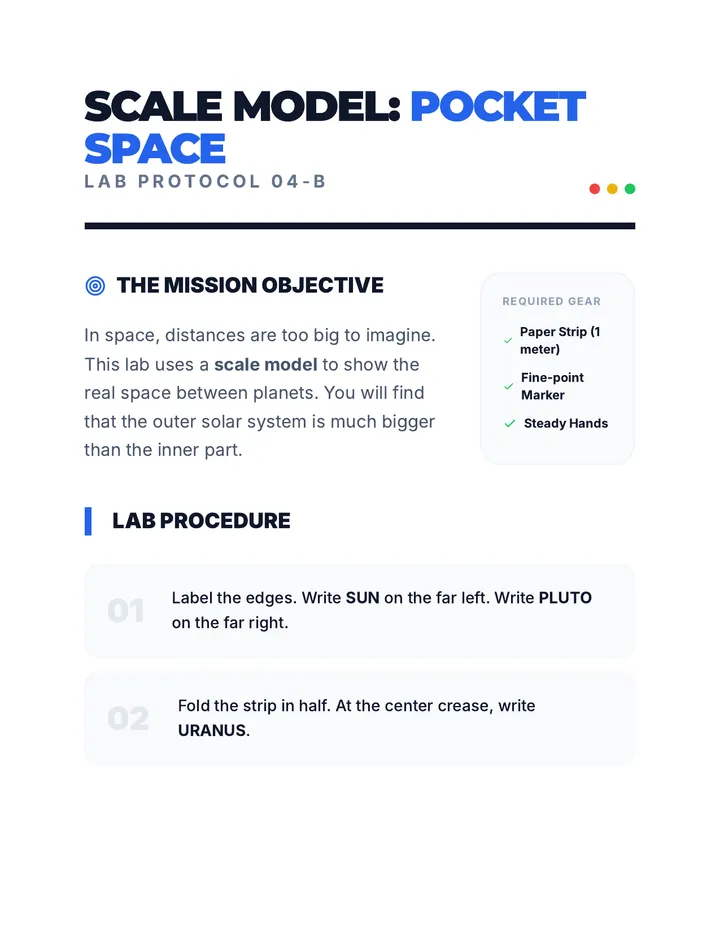
A project-based exploration of the solar system's formation, composition, and immense scale. Students use mathematical modeling and data analysis to understand the role of gravity and distance in shaping our cosmic neighborhood, culminating in the creation of a true-to-scale solar system model.
This 5th-grade astronomy sequence explores how Earth's rotation creates observable patterns like moving shadows, day and night, and apparent star movement. Students use hands-on tracking, physical modeling, and data analysis to transition from a geocentric observation to a heliocentric understanding of our planet's spin.
An undergraduate-level investigation into the large-scale structure of the universe, from galactic dynamics to cosmic expansion and the Big Bang. Students use real astrophysical data to model dark matter distributions, calibrate the cosmic distance ladder, and calculate the Hubble constant.
An 11th-grade physics sequence focused on separating heterogeneous mixtures through the engineering design of a multi-stage water filtration system. Students explore particle size, porosity, and flow rate to solve a real-world water crisis scenario.
A comprehensive undergraduate sequence on the physicochemical principles of chromatography, covering thermodynamic migration theory, kinetic efficiency (Van Deemter), phase optimization, instrumentation (GC/HPLC), and quantitative analytical methods.
A scientific inquiry sequence for 3rd graders that explores the conservation of mass through hands-on experiments with mixing substances in closed and open systems. Students learn that matter is neither created nor destroyed, providing an empirical foundation for understanding balanced chemical equations.
A sequence for 3rd grade students to explore the Law of Conservation of Mass using building blocks as models. Students move from counting parts to understanding that matter is neither created nor destroyed, even when rearranged.
This 5-lesson sequence introduces 1st-grade students to the concept of matter conservation. By observing dissolving solids, changing shapes, and chemical reactions in closed systems, students learn that matter persists even when its form or visibility changes.
This sequence connects the skill of balancing equations to real-world chemical phenomena, emphasizing that equations represent actual physical events. Students explore decoding word equations into formulas, investigate photosynthesis and combustion, and culminate in a creative storyboard project.
This sequence introduces 1st-grade students to the fundamentals of measurement, focusing on temperature and selecting appropriate tools for scientific data collection. Students will transition from subjective observations to using objective tools like thermometers, rulers, and scales through a field-scientist simulation.
This sequence introduces 3rd-grade students to temperature measurement and data organization. Students progress from reading thermometers and observing temperature changes to designing data tables and visualizing multi-unit measurement data through a 'Measurement Olympics' lab circuit.
A Kindergarten sequence introducing measurement concepts through attribute sorting, temperature exploration, tool selection, time perception, and hands-on station rotations. Students learn to use rulers, scales, thermometers, and timers to quantify the world around them.
A problem-based physics sequence for Pre-K students exploring how materials protect objects from damage, water, and temperature. Students test properties like softness, water resistance, and insulation to solve real-world protection challenges.
A project-based physics unit where students apply the impulse-momentum theorem to automotive safety design. Students investigate how increasing collision time reduces impact force, culminating in an engineering challenge to protect a fragile payload.
This project-based sequence for undergraduate engineering students explores the application of impulse and momentum principles to impact attenuation. Students analyze human physiological limits, investigate material properties, and design, prototype, and test structural systems meant to mitigate collision forces.
An advanced undergraduate physics sequence exploring the mechanics of variable mass systems, from the fundamental calculus of momentum flux to the engineering of multi-stage rockets and future propulsion technologies. Students will master the Tsiolkovsky Rocket Equation and solve complex problems involving continuous mass accumulation and depletion.
This calculus-based physics sequence explores the fundamental relationship between force, time, and momentum change. Students will derive the impulse-momentum theorem, use integration to analyze variable forces, and apply these concepts to biomechanical impact scenarios.
A comprehensive unit for 10th-grade physics students exploring the conservation of momentum through collisions and explosions. Students move from theoretical derivation of Newton's laws to practical mathematical modeling of elastic and inelastic interactions.
A calculus-based physics sequence for undergraduates focusing on the relationship between potential energy functions and physical forces, stability analysis, and mathematical modeling of physical systems from the atomic to the macroscopic scale.
A comprehensive 11th-grade physics sequence exploring work, energy, and power through inquiry and mathematical modeling. Students progress from basic vector work to complex energy conservation scenarios involving both conservative and non-conservative forces.
A graduate-level capstone sequence focused on the practical implementation of autonomous mobile robots using the ROS 2 middleware. Students progress from basic node communication to hardware driver integration, PID control, and the deployment of the full Nav2 stack.
A comprehensive introduction to the mechanical foundations of robotics, covering kinematics, gear systems, linkages, and structural design for 10th-grade engineering students.
This sequence explores robotic systems engineering through the lens of virtual simulation. Students learn to navigate simulators, analyze high-fidelity sensor data, and understand the critical 'Sim-to-Real' gap in engineering design.
A comprehensive introduction to mechanical engineering and data-driven design, taking students from basic kinematics and structural analysis to AI-integrated predictive maintenance and system optimization.
This undergraduate sequence introduces students to computational physics by using coding and spreadsheet modeling to simulate 1D motion. Students move from simple discretization (Euler's method) to complex scenarios like collisions and non-uniform acceleration, bridging the gap between analytical theory and modern engineering practice.
This sequence guides undergraduate students through the systematic derivation and application of the four kinematic equations for constant acceleration, moving from basic algebraic modeling to complex multi-stage and two-body intercept problems.
A comprehensive 5-lesson sequence applying kinematic principles to forensic accident reconstruction. Students explore reaction times, braking distances, intersection timing, and following gaps to analyze traffic safety and legal liability through the lens of one-dimensional motion.
This sequence introduces students to topology—the study of geometric properties preserved under continuous deformation—and its applications in modern physics. Students explore global geometric invariants like the Euler characteristic and genus, contrasting them with local geometry, and progress to physical manifestations like the Berry phase and topological insulators.
A comprehensive 8th-grade physics unit exploring the properties of visible light, focusing on reflection, refraction, absorption, and the biological mechanics of human sight. Students engage in inquiry-based workshops and optical labs to understand how we perceive the world.
This 9th-grade physics sequence explores the practical and emerging applications of electromagnetic waves. Students investigate infrared thermography, the principles of fiber optics via total internal reflection, satellite remote sensing for global monitoring, and future communication technologies like Li-Fi, culminating in a creative engineering proposal.
An inquiry-driven physics sequence exploring visible light, refraction, color theory, spectroscopy, and optics. Students investigate how light interacts with matter and how these interactions shape our perception of reality.
This sequence explores the behavior of electromagnetic waves at material interfaces. Students will derive boundary conditions from Maxwell's equations, apply the Fresnel equations to predict reflection and transmission, and investigate phenomena like Brewster's angle, total internal reflection, and fiber optic waveguides.
A comprehensive 6th-grade physics sequence exploring the nature of visible light, how it splits into the spectrum, interacts with surfaces through reflection and absorption, and behaves when passing through different mediums.
An advanced graduate-level exploration of optical physics, focusing on the statistical properties of light, Fourier analysis of optical systems, wavefront sensing, and quantum interference. Students move from classical coherence theory to cutting-edge adaptive optics and entangled photon experiments.
An advanced theoretical sequence exploring the mathematical foundations of wave propagation, from Maxwell's equations to complex scattering theory. Designed for graduate students in physics and electrical engineering.
An advanced undergraduate physics sequence exploring the principles of wave interference, optical interferometry (Michelson and Fabry-Perot), coherence theory, and modern applications like holography and gravitational wave detection (LIGO).
An undergraduate physics sequence exploring the wave nature of light through interference and diffraction. Students use phasor diagrams, calculus, and the Rayleigh criterion to analyze patterns from various aperture configurations and define the fundamental limits of optical resolution.
This sequence transitions undergraduate students from mechanical waves to electromagnetic theory, focusing on Maxwell's equations, energy flow via the Poynting vector, and the vector nature of light through polarization and boundary interactions.
A 5-lesson unit for 4th graders exploring refraction, prisms, and lenses. Students use a hands-on lab approach to investigate how light bends and splits into colors.
A comprehensive 4th-grade physics sequence exploring the properties of light, including straight-line travel, reflection, and material interaction through hands-on inquiry and engineering challenges.
A 12th-grade physics sequence exploring the properties of electromagnetic waves and their applications in modern communication and medicine, from radio waves to gamma rays.
A comprehensive 12th-grade physics sequence exploring the behavior of light. Students investigate reflection, refraction, Snell's Law, total internal reflection, and the mechanics of lenses and optical instruments through ray diagrams and mathematical analysis.
A comprehensive 11th-grade physics unit on geometric optics, covering the ray model of light, reflection, refraction, Snell's Law, total internal reflection, and lens image formation. Students engage in inquiry-based labs and quantitative analysis to understand how light is manipulated in modern technology and vision.
A 5-lesson sequence for 6th-grade students connecting the Periodic Table to engineering and material science. Students explore how atomic structure determines macroscopic properties, research elements in technology, investigate carbon's versatility, and apply their knowledge to solve engineering design challenges.
This sequence introduces 6th-grade students to atomic structure, focusing on subatomic particles, atomic number, isotopes, and electron shells. Students progress from identifying fundamental particles to constructing complex Bohr models for the first eighteen elements of the periodic table.
A comprehensive sequence for 8th-grade students exploring the internal structure of atoms. Students move from modeling subatomic particles to calculating atomic mass, constructing Bohr models, and investigating isotopes, culminating in the ability to decode periodic table tiles.
A project-based physics sequence exploring how periodic properties like conductivity and band gaps inform material science and engineering. Students learn about metals, semiconductors, alloys, and isotopes, culminating in a design challenge.
An inquiry-driven sequence for 11th-grade students to explore the physical forces behind periodic trends using data analysis and Coulombic principles. Students move from understanding atomic forces to predicting properties of unknown elements.
A comprehensive 11th-grade physics sequence exploring the quantum mechanical model of the atom, electron configurations, and the structural logic of the periodic table. Students progress from historical models to mastery of orbital filling rules and periodic blocks.
This sequence explores the practical application of the Periodic Table in modern technology, from smartphones to medical imaging. Students investigate the atomic properties of specific groups (Rare Earths, Metalloids, Isotopes) and analyze the geopolitical and ethical implications of our reliance on these materials.
A 10th-grade physics sequence that treats the Periodic Table as a logic puzzle. Students reconstruct the table's history, moving from atomic mass patterns to the modern atomic number organization through inquiry and prediction.
A 10th-grade physics sequence exploring the macroscopic chemical behaviors of the main group elements, connecting observable reactivity to electron configurations and group trends.
A comprehensive 10th-grade physics-based unit exploring periodic trends through the lens of Coulomb's Law and atomic data analysis. Students investigate atomic radius, ionization energy, and electronegativity to predict chemical behavior.
A comprehensive exploration of the quantum mechanical model, focusing on how electron configurations and orbital mechanics define the Periodic Table's structure. Students progress from basic atomic identity to predicting elemental properties based on quantum numbers.
This advanced physics sequence explores the f-block elements and the frontiers of the periodic table. Students investigate the lanthanide contraction, nuclear stability, and the profound impact of relativistic effects on chemical properties at high atomic numbers, culminating in an analysis of the theoretical limits of matter and the 'Island of Stability'.
This sequence grounds the structure of the Periodic Table in the fundamental principles of quantum mechanics. Students explore quantum numbers, orbital geometry, electron spin, shielding effects, and spectroscopic validation to understand why the elements are organized as they are.
An undergraduate-level physics sequence exploring periodic trends through data analysis, computational modeling, and thermodynamic principles to predict material behavior.
A comprehensive 9th-grade physics sequence exploring the internal structure of atoms. Students move from identifying subatomic particles to calculating atomic mass, understanding isotopes, drawing Bohr models, and analyzing ion formation.
A comprehensive 9th-grade physics unit on the organization, history, and predictive power of the Periodic Table. Students explore patterns, classify elements, and use periodic trends to solve logic puzzles and predict properties of unknown matter.
This sequence explores the physical limits of the periodic table, nuclear stability, and the synthesis of transuranium elements. Students analyze nuclear forces, decay mechanisms, and the theoretical 'Island of Stability' to understand the boundaries of matter.
This 12th-grade physics sequence explores how Coulomb's Law and electrostatic forces govern periodic trends. Students analyze Effective Nuclear Charge (Zeff), atomic radii, ionization energies, and electronegativity to understand the underlying physical principles of chemical behavior.
This sequence explores the transition from classical to quantum physics through the lens of atomic structure. Students will investigate the limitations of the Bohr model, the four quantum numbers, orbital geometry, and the principles governing electron configurations to understand the periodic table's organization.
This 8th-grade sequence explores the particle-level interactions within mixtures, focusing on modeling the differences between pure substances and mixtures. Students use physical manipulatives, digital simulations, and classification workshops to master the concepts of concentration, saturation, and the microscopic structure of heterogeneous and homogeneous matter.
A comprehensive 5-lesson sequence on stratigraphy and geochronology, moving from qualitative relative dating to quantitative radiometric analysis. Students act as geological detectives to reconstruct Earth's history using Steno's laws, index fossils, and radioactive decay.
A game-based chemistry sequence for 3rd graders focusing on the mathematical symmetry of balancing equations. Students use visual puzzles, pan balances, and 'glued' shape groups to understand equilibrium and the logic of coefficients.
A quantitative sequence for 11th-grade students focusing on the rigorous methods of geochronology. Students progress from qualitative relative dating principles to complex radiometric calculations, culminating in a multi-data stratigraphic correlation simulation.
This sequence explores the high-energy portion of the electromagnetic spectrum (UV, X-ray, and Gamma rays). Students analyze the biological impacts of ionizing radiation, evaluate medical benefits against safety risks, and investigate shielding properties through inquiry and case studies.
A 9th-grade physics sequence exploring the ionizing portion of the electromagnetic spectrum, covering UV, X-rays, and Gamma rays, focusing on biological impacts, medical applications, and safety protocols.
A 10th-grade physics sequence exploring the distinction between ionizing and non-ionizing radiation, their biological effects, and their applications in modern medicine. Students transition from theoretical energy calculations to practical safety and ethical debates.
This sequence explores the physics and safety of ionizing radiation, covering X-ray production, scattering mechanisms (Compton and Rayleigh), pair production, attenuation modeling for shielding, and biological dosimetry. It bridges fundamental quantum mechanics and relativistic physics with practical applications in medicine and nuclear engineering.
A high-level exploration of advanced computer architecture, parallel processing, and future computing paradigms for 12th-grade students. This sequence covers internal CPU optimizations, GPU parallelism, distributed systems, and emerging technologies like quantum computing.
This graduate-level sequence explores the intersection of nuclear physics and medical application, covering isotope production, diagnostic imaging (PET/SPECT), radiation therapy physics, radiobiology, and shielding design. Students apply advanced decay kinetics, interaction physics, and dosimetry principles to solve real-world clinical and industrial problems.
A graduate-level exploration of nuclear fusion processes, spanning from the quantum mechanics of stellar cores to the engineering challenges of terrestrial plasma confinement. Students analyze reaction rates, stellar cycles, and reactor designs.
A 2nd-grade engineering sequence where students explore heat transfer and insulation to design a device that prevents an ice pop from melting. Students test materials, create blueprints, and build prototypes for their 'Cold Keeper' invention.
A Kindergarten sequence focused on temperature vocabulary, sensing differences, using thermometers, and identifying heat sources safely. Students transition from sensory observation to scientific measurement.
A comprehensive 5th-grade unit on plate tectonics, guiding students from the evidence of continental drift to modeling plate boundaries and predicting future geological changes. Students use hands-on simulations, data mapping, and evidence-based reasoning to understand Earth's dynamic geosphere.
A 5-lesson unit for 7th-grade students exploring feedback loops in biological, social, and technological systems, culminating in a systems-design project.