Lenny LearningLenny
Create
Explore
Workspace
LoginSign up
MathEnglish Language ArtsScience & EngineeringSocial StudiesGlobal LanguagesHealth & Physical EducationSpecial EducationCounseling & Life SkillsArts & CreativityESL
Lenny LearningLenny
Lenny Learning
About
Training
Pricing
Support
Contact
© 2026 Lenny Learning Inc.

Physics

SequencesLessonsMaterialsVideos
  1. Science & Engineering

Physics

SequencesLessonsMaterialsVideos

Fundamental principles of force, motion, and energy across classical and modern contexts. Examines matter properties, wave behavior, thermodynamics, and electromagnetism through mechanics and atomic studies.

Science & EngineeringLife ScienceLiving ThingsAnimalsPlantsBody SystemsTraitsAdaptationsCellsEcosystemsHeredityGenes to TraitsCell DivisionPhysicsComparing MaterialsShapes and PropertiesMagnetsMagnetismLightSoundLight and SoundMatterStates of MatterChanges of StateMixturesPhysical and Chemical ChangeHeating and CoolingHeat and Thermal EnergyEnergyForce and MotionElectrical CircuitsAtoms and MoleculesPeriodic TableMotion in One DimensionMotion in Two DimensionsScalars and VectorsForces and Laws of MotionCircular Motion and GravityMomentum and ImpulseWork, Energy, and PowerWavesElectromagnetic WavesGeometric OpticsElectricity and MagnetismSimple Harmonic MotionThermodynamicsNuclear PhysicsEarth Science & AstronomyWeatherWater CycleRocks and MineralsFossilsEarth's FeaturesEarth's ResourcesEarth's StructureWeather and ClimateEarth EventsFossils and Geologic TimePlate TectonicsHuman ImpactsAstronomyChemistryUnits and MeasurementAtomic StructurePeriodic TrendsChemical BondingNomenclatureMolecular StructureIntermolecular ForcesThe MoleStoichiometryProperties of GasesSolutionsChemical ReactionsBalancing EquationsEnergy ChangesRates of ReactionsEquilibriumAcids and BasesQuantum ModelBiologyClassificationCell StructureThe Chemistry of LifeBiomoleculesCellular TransportCell EnergyCell Growth and DivisionDNAProtein SynthesisMeiosis and Sexual ReproductionPatterns of InheritanceMulticellular OrganismsEvolutionEcologyBiodiversityComputer ScienceAlgorithms and Computational ThinkingProgramming LanguagesComputing SystemsNetworks and InternetData AnalysisCybersecurityAI and Machine LearningSoftware Design and DevelopmentBlockchainEngineering & AIDesigning ExperimentsEngineering PracticesDesign ThinkingEngineering Design ProcessMechanical EngineeringElectrical EngineeringMaterials and StructuresCAD and 3D DesignRoboticsArtificial Intelligence BasicsVibe CodingMachine LearningAI Ethics and SocietySystems ThinkingEntrepreneurship & InnovationEntrepreneurial MindsetBusiness Idea DevelopmentBusiness Plan BasicsMarketing & Customer DiscoveryFinancial Management for Startups
Comparing MaterialsPhysical properties like hardness, flexibility, and transparency across various substances. Students evaluate material suitability for specific engineering or artistic purposes through systematic testing and classification.
Shapes and PropertiesGeometric identification of two-dimensional and three-dimensional figures using attributes like sides, vertices, and symmetry. Classifies polygons and solids while exploring spatial relationships and coordinate geometry basics.
MagnetsMagnetic poles, attraction, and repulsion principles alongside magnetic field mapping. Examines the relationship between electricity and magnetism through electromagnetic construction and real-world applications.
MagnetismProperties of magnetic fields, poles, and attraction-repulsion forces. Examines electromagnetism, magnetic materials, and practical applications in motors and electronic devices.
LightFundamental properties of the electromagnetic spectrum, including reflection, refraction, and diffraction. Analyzes the behavior of visible light through lenses, mirrors, and various media.
SoundPhysical properties of longitudinal waves, including frequency, amplitude, and pitch across various mediums. Examines the mechanics of hearing and how vibrations transform into auditory signals.
Light and SoundPhysical properties of waves including reflection, refraction, and transmission through various media. Connects frequency and amplitude to human perception of pitch, volume, and color.
MatterAtomic structure, molecular arrangements, and the four states of matter including solids, liquids, gases, and plasma. Examines physical and chemical properties alongside phase changes and the law of conservation of mass.
States of MatterPhysical properties of solids, liquids, and gases focusing on molecular motion and kinetic energy. Addresses phase transitions, including melting, freezing, and vaporization.
Changes of StateKinetic molecular theory and energy transfer during phase transitions between solids, liquids, and gases. Examines melting, freezing, boiling, and condensation through temperature and pressure variables.
MixturesDistinguishes between homogeneous and heterogeneous substances through physical properties and separation techniques. Examines methods like filtration, evaporation, and chromatography for isolating components based on particle size and solubility.
Physical and Chemical ChangeDistinguishes between reversible physical alterations and chemical reactions that form new molecular substances. Examines observable indicators of change, including gas production, temperature shifts, and color variations.
Heating and CoolingThermal energy transfer through conduction, convection, and radiation. Examines phase changes, temperature measurement, and the relationship between heat and particle motion.
Heat and Thermal EnergyKinetic molecular theory, temperature scales, and heat transfer via conduction, convection, and radiation. Addresses specific heat capacity, thermal equilibrium, and phase changes.
EnergyKinetic and potential energy transformations, thermodynamics, and the principle of conservation. Analyzes various power sources including solar, wind, and fossil fuels alongside mechanical and chemical systems.
Force and MotionNewton’s laws of motion, friction, and gravity applied to physical systems. Examines the relationship between mass, acceleration, and net force through quantitative calculations and practical observations.
Electrical CircuitsVoltage, current, and resistance relationships within series and parallel systems. Examines Ohm's Law, component functions, and circuit diagram analysis.
Atoms and MoleculesAtomic structure, subatomic particles, and the principles of chemical bonding. Examines how molecular configurations determine the physical and chemical properties of matter.
Periodic TableAtomic structure, electron configurations, and periodic trends like electronegativity and ionization energy. Examines group properties and the organization of elements by atomic number.
Motion in One DimensionDisplacement, velocity, and acceleration concepts for objects moving along a straight path. Applies kinematic equations to model uniform acceleration and free fall scenarios.
Motion in Two DimensionsVector analysis applied to projectile motion, uniform circular motion, and relative velocity. Examines the independence of horizontal and vertical components through kinematic equations and displacement calculations.
Scalars and VectorsDistinguishes between magnitude-only scalars and directional vectors like force and velocity. Covers vector addition, resolution into components, and coordinate system representation.
Forces and Laws of MotionNewton’s laws of motion, net forces, and the relationship between mass and acceleration. Examines friction, gravity, and inertia through practical applications in physical systems.
Circular Motion and GravityCentripetal acceleration, angular velocity, and uniform circular motion principles. Analyzes Newton’s law of universal gravitation and Kepler’s laws to describe planetary orbits and satellite motion.
Momentum and ImpulseLinear momentum, impulse-momentum theorem, and conservation principles during collisions. Examines force application over time and its effect on object velocity and system stability.
Work, Energy, and PowerKinetic and potential energy transformations, the work-energy theorem, and mathematical calculations of power. Examines conservation laws and mechanical efficiency in physical systems.
WavesMechanical and electromagnetic wave properties including frequency, wavelength, and amplitude. Examines wave behaviors such as reflection, refraction, and interference across sound and light spectrums.
Electromagnetic WavesProperties of the electromagnetic spectrum including frequency, wavelength, and photon energy. Connects Maxwell's equations to the behavior of light, radio waves, and ionizing radiation.
Geometric OpticsPrinciples of light propagation, reflection, and refraction through mirrors and lenses. Models image formation using ray tracing, Snell's law, and the thin lens equation.
Electricity and MagnetismElectric charges, fields, and circuit analysis using Ohm's and Kirchhoff's laws. Examines the relationship between current and magnetism, including electromagnetic induction and motor principles.
Simple Harmonic MotionPeriodic motion governed by a linear restoring force, focusing on displacement, velocity, and acceleration over time. Connects Hooke’s Law to pendulum dynamics and energy conservation within oscillating systems.
ThermodynamicsHeat transfer mechanisms, energy conservation laws, and the properties of matter under varying thermal conditions. Connects microscopic kinetic energy to macroscopic observations like temperature and pressure.
Nuclear PhysicsAtomic structure, radioactive decay processes, and the binding energy of nuclei. Examines nuclear fission, fusion, and their applications in energy production and medicine.
Video
How Engineers Build Strong Bridges

How Engineers Build Strong Bridges

In this engaging episode of SciShow Kids, host Jessi and her robot friend Squeaks explore the fascinating world of structural engineering to answer a viewer's question: "Why are bridges so strong?" The video breaks down complex engineering concepts into digestible lessons, using clear analogies, real-world examples, and physical demonstrations. It explains how engineers design structures to withstand heavy loads by utilizing specific shapes and materials. The video introduces three primary types of bridges: beam bridges, truss bridges, and suspension bridges. Through a failed experiment with a simple cardboard beam bridge, students learn about weight limits and structural failure. The narrative then pivots to solutions, highlighting how triangles are the secret weapon of strength in truss bridges and how the force of tension is harnessed in suspension bridges like the Golden Gate Bridge. This resource is highly valuable for elementary science and STEM classrooms. It provides a foundational understanding of physics concepts like force, tension, and compression without being overwhelming. Teachers can use this video to launch bridge-building challenges, geometry lessons about the strength of shapes, or social studies units on community infrastructure and the role of engineers.

SciShow KidsSciShow Kids

3mins 45s

Video
Building Tall Towers: The Power of Pyramids

Building Tall Towers: The Power of Pyramids

In this engaging engineering episode from SciShow Kids, host Jessi and her robot mouse friend Squeaks explore the physics of stability through a hands-on cup-stacking challenge. The video demonstrates the difference between unstable vertical stacks and stable pyramid structures, using clear visuals and simple analogies to explain why a wide base is crucial for building tall structures. The lesson moves from a failed attempt at a single column to a successful pyramid design, introducing the concept of weight distribution. Key themes include structural engineering, balance, geometry, and the scientific method of trial and error. The video explicitly connects abstract physics concepts to the students' own bodies (standing on one foot vs. two) and real-world architecture (skyscrapers). It breaks down the "why" behind structural failures in a way that is accessible to young learners. This video is an excellent resource for early elementary classrooms introducing STEM challenges or basic physics. It provides a perfect launchpad for low-cost, hands-on building activities using simple materials like plastic cups. Teachers can use it to introduce engineering vocabulary like "stable," "base," and "collapse," while encouraging students to predict outcomes and test their own designs.

SciShow KidsSciShow Kids

4mins 6s

Video
Investigating Matter: Observable and Measurable Properties

Investigating Matter: Observable and Measurable Properties

This educational video introduces students to the fundamental concepts of matter and its properties. Hosted by Sabrina Cruz from Crash Course Kids, the video uses a relatable analogy of playing with preschool blocks to explain complex scientific ideas. It defines "matter" as anything that has weight and takes up space, and "properties" as the characteristics used to describe that matter. The video distinguishes between qualitative properties (like color and shape) and quantitative properties (like length, width, height, volume, and weight) that can be measured using tools.

Crash Course KidsCrash Course Kids

4mins

Video
How We Use Senses to Describe Matter

How We Use Senses to Describe Matter

This educational video introduces young students to the fundamental scientific concept of matter and its properties. Through clear narration and relatable visual examples, it explains how we use our senses—specifically sight and touch—to observe and describe the world around us. The video breaks down abstract terms like "matter," "properties," and "texture" into child-friendly definitions, illustrating them with everyday objects like toys, animals, and household items. The content focuses on developing observational skills and building scientific vocabulary. Key themes include identifying physical attributes such as shape, size, color, hardness, and softness. The video specifically contrasts opposing textures (smooth vs. rough, hard vs. soft) to help students understand how to differentiate between materials based on tactile evidence. For educators, this video serves as an excellent hook for physical science units on matter or the five senses. It models scientific inquiry by encouraging viewers to look closely and touch objects to gather information. The clear examples provide a solid foundation for classroom activities involving sorting, classifying, and describing objects, making it a valuable tool for early elementary science curricula.

Next Generation ScienceNext Generation Science

1min 51s

Video
How Adding Coils Affects an Electromagnet's Strength

How Adding Coils Affects an Electromagnet's Strength

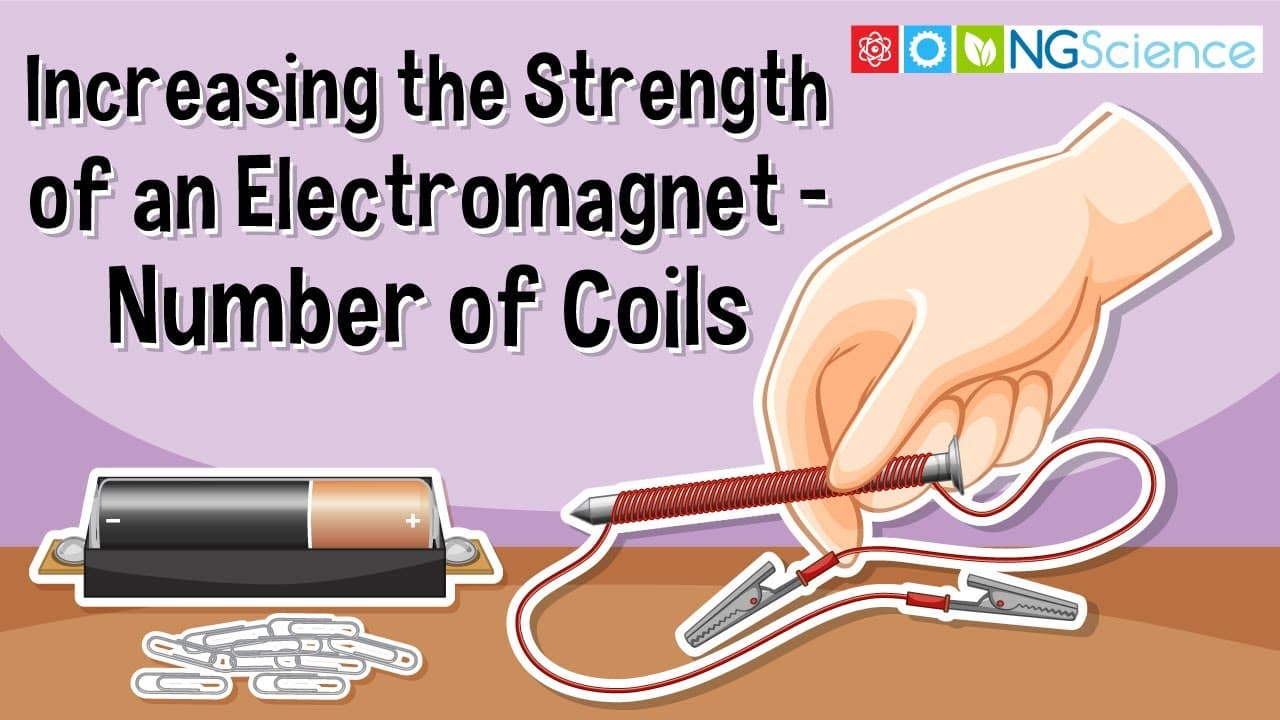
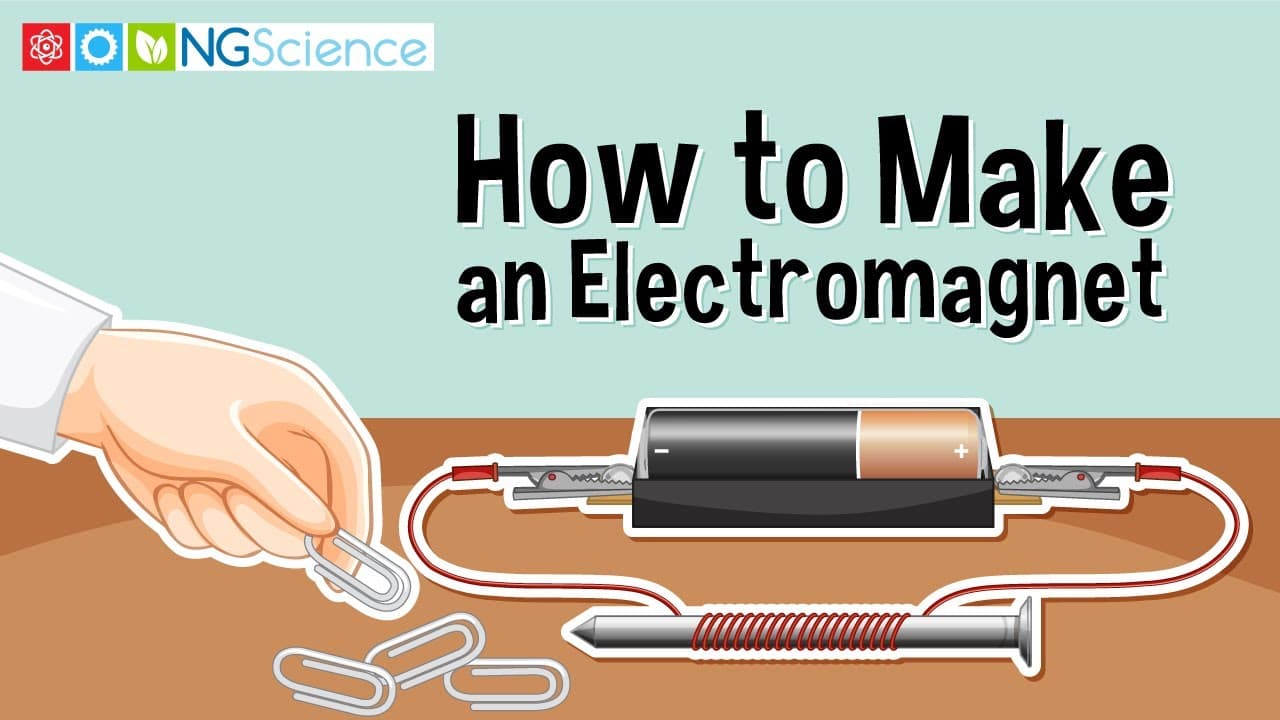
This educational video provides a clear, step-by-step demonstration on how to construct a simple electromagnet using basic materials: a battery, wire with alligator clips, and a metal nail. The video uses clean, distinct 2D animations to visualize the assembly process, showing exactly how to connect the circuit and coil the wire around the nail to create a magnetic field capable of picking up paperclips. The content moves beyond simple construction by introducing the scientific method and variable testing. It explicitly asks viewers to predict the effect of adding more coils of wire to the nail. It then demonstrates the result—that increasing the number of coils increases the magnetic force, allowing the magnet to pick up more paperclips—visually reinforcing the relationship between the number of turns in a solenoid and magnetic field strength. For educators, this video serves as an excellent introduction to electricity and magnetism units. It functions well as a pre-lab primer before students build their own electromagnets, or as a virtual demonstration for classrooms lacking materials. The built-in pause points for prediction make it an interactive tool for discussing independent variables (number of coils) and dependent variables (strength of magnet/number of clips held).

Next Generation ScienceNext Generation Science

1min 30s

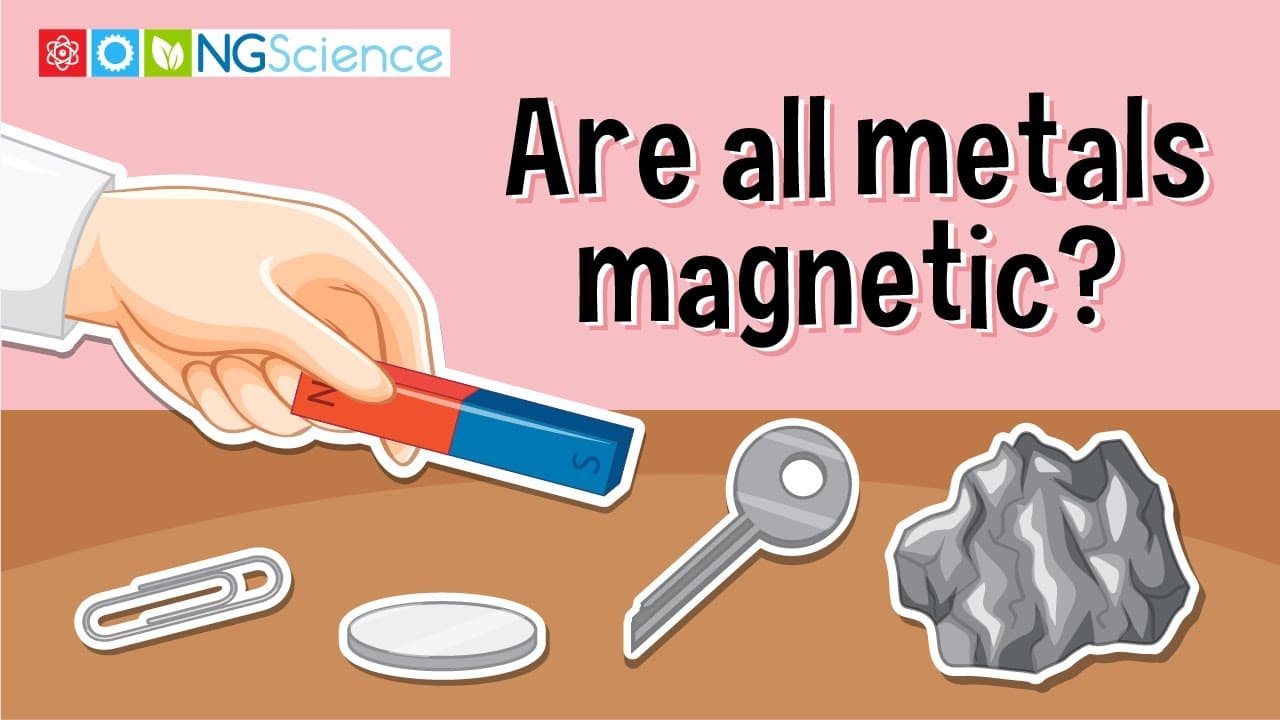
Video
Testing Which Metals Are Magnetic

Testing Which Metals Are Magnetic

This concise science demonstration investigates the relationship between magnets and various metal objects to determine which materials possess magnetic properties. Through a clear, step-by-step experiment, the narrator tests common household items—like keys, coins, and safety pins—against a U-shaped magnet. The video explicitly tests the hypothesis that "all metals are magnetic" by showing that while all the test objects are metallic, only some interact with the magnet. The core themes explore the physical properties of matter, specifically magnetism and material composition. It introduces the fundamental scientific concept that magnetism is a property specific to certain metals (ferromagnetic materials) rather than a general property of all metals. The video concludes by identifying specific elements—iron, nickel, and cobalt—that are magnetic, contrasting them with non-magnetic metals like aluminum, copper, and silver. For educators, this video serves as an excellent hook or demonstration for units on physical science and properties of matter. It directly addresses the common student misconception that magnets stick to all metals. The clear visual evidence of the key and coin failing to stick provides a memorable "discrepant event" that sparks inquiry. It lays the groundwork for understanding material composition and classification, making it valuable for early elementary science curriculums.

Next Generation ScienceNext Generation Science

1min 53s

Video
Earth's Magnetic Shield and the Right-Hand Rule

Earth's Magnetic Shield and the Right-Hand Rule

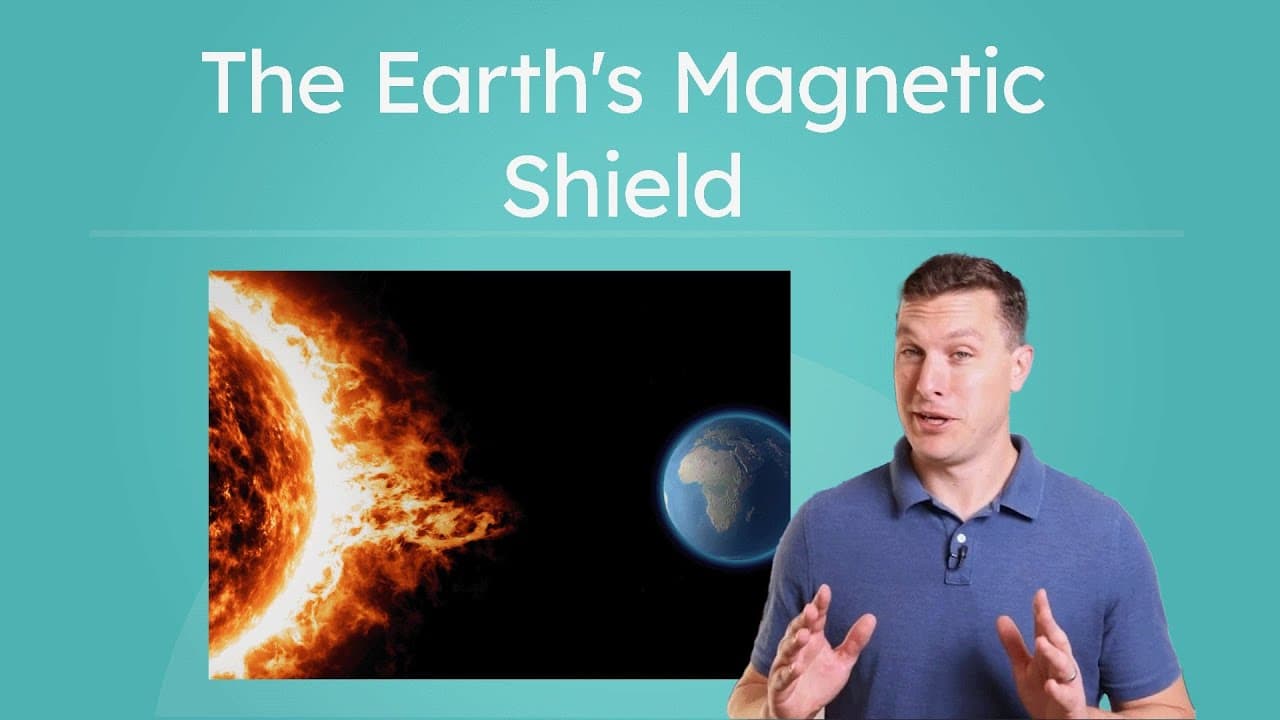
This educational video explores the critical role of Earth's magnetic field in protecting our planet from harmful solar radiation and introduces the physics concept of the Right-Hand Rule. The lesson begins by visualizing the sun as a massive nuclear reactor and explains how Earth's magnetic shield deflects solar wind, creating phenomena like the Aurora Borealis while preventing the radiation damage seen on barren worlds like the Moon and Mars. The second half of the video transitions into a practical physics tutorial on electromagnetism. It breaks down how magnetic fields exert force on moving charges and teaches students how to use the Right-Hand Rule to determine the direction of that force. The presenter uses clear, step-by-step examples with on-screen graphics to demonstrate how to position fingers to represent charge, field, and force vectors. For educators, this video serves as a bridge between Earth science and physics concepts. It provides a real-world application for abstract electromagnetic principles, making it an excellent resource for high school physics units on magnetism or earth science units on planetary habitability. The visual demonstrations of 3D spatial reasoning (using the hand) are particularly helpful for students who struggle with vector directions.

Miacademy & MiaPrep Learning ChannelMiacademy & MiaPrep Learning Channel

7mins 57s

Video
Exploring the Nature of Light and Electromagnetic Waves

Exploring the Nature of Light and Electromagnetic Waves

This educational video provides a comprehensive introduction to the physics of light, defining it as an oscillating electromagnetic wave. The instructor breaks down complex abstract concepts by first explaining electric and magnetic fields separately, using clear diagrams and real-world analogies like magnets and iron filings. The video then combines these concepts to visualize light as two perpendicular fields—electric and magnetic—oscillating together as they travel through space. The lesson delves into the specific wave properties of light, including wavelength, frequency, and amplitude. It effectively connects these mathematical and physical properties to human perception, explaining how wavelength and frequency determine the color we see, while amplitude determines the brightness. The video uses helpful animations, such as 3D graphs and water wave comparisons, to make these invisible phenomena easier to visualize. This resource is highly valuable for physical science and physics classrooms as it bridges the gap between static electricity/magnetism and wave theory. It is ideal for introducing the electromagnetic spectrum, teaching wave properties, or explaining the fundamental nature of light. The video includes a built-in review quiz and summary, making it a ready-to-use lesson component for checking student understanding of key physics vocabulary.

Miacademy & MiaPrep Learning ChannelMiacademy & MiaPrep Learning Channel

10mins

Video
How Magnets, Fields, and Generators Work

How Magnets, Fields, and Generators Work

This engaging physics lesson explores the fundamental principles of magnetism, moving from basic interactions to complex real-world applications. It begins with a relatable personal anecdote to introduce the strength of modern magnets before diving into core concepts like magnetic poles, attraction and repulsion, and the non-existence of magnetic monopoles. The video utilizes clear animations and diagrams to visualize invisible forces, making abstract concepts accessible to students.

Miacademy & MiaPrep Learning ChannelMiacademy & MiaPrep Learning Channel

8mins 9s

Video
Exploring Magnetic Poles: Attraction and Repulsion

Exploring Magnetic Poles: Attraction and Repulsion

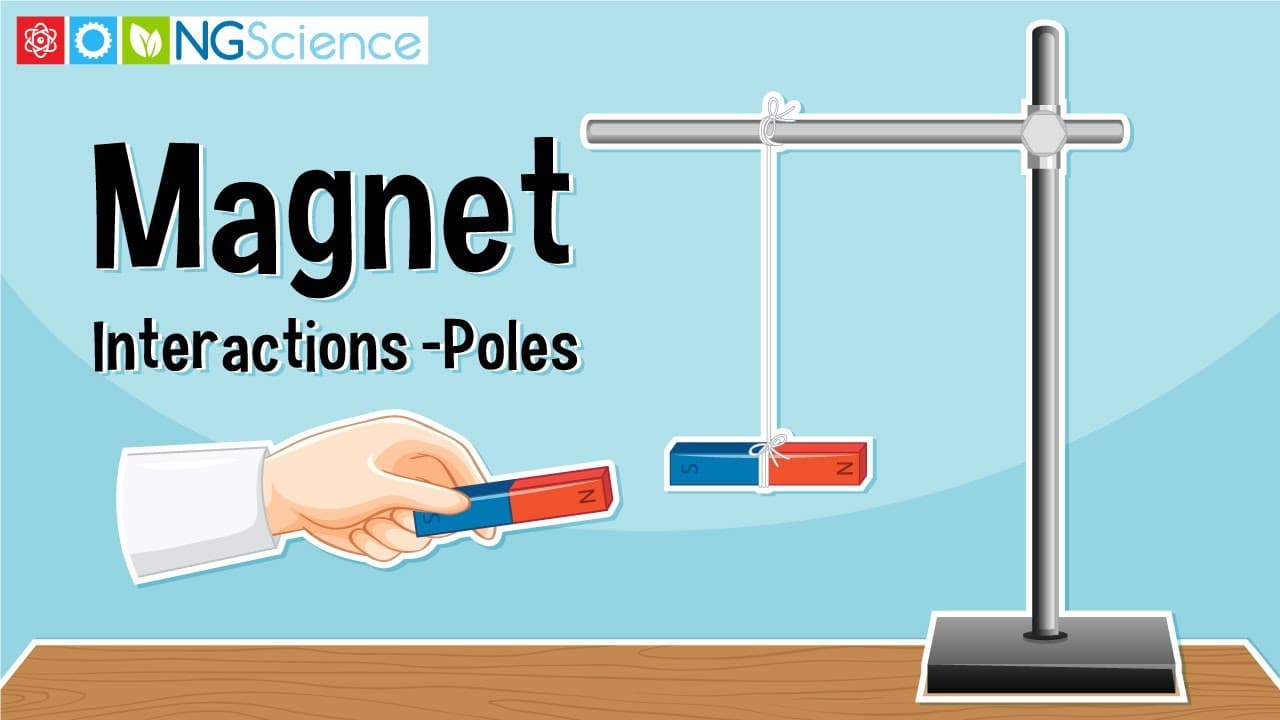
This educational video provides a clear, step-by-step demonstration of the fundamental principles of magnetism, specifically focusing on how magnetic poles interact. Through a virtual laboratory setup, viewers observe a controlled experiment using two bar magnets—one suspended freely from a retort stand and another held by hand. The video systematically tests every combination of pole interactions (North-North, South-North, South-South, and North-South) to visually prove the rules of magnetic force. The core themes explored are the concepts of magnetic poles (North and South), non-contact forces, and the defining laws of magnetism: attraction and repulsion. The video explicitly introduces and reinforces scientific vocabulary such as "interact," "attract," "repel," and "poles." By isolating the variables and showing the physical movement of the hanging magnet, it makes the invisible force of magnetism observable and concrete for young learners. For educators, this video serves as an excellent introduction to a unit on forces or magnetism. It models proper scientific inquiry by asking a question, setting up an experiment, observing results, and drawing a conclusion. It is particularly useful for demonstrating an experiment that students can then replicate in the classroom using their own magnets. The clear visual evidence of repulsion (pushing away) and attraction (pulling closer) provides a perfect anchor for discussions about invisible forces that act at a distance.

Next Generation ScienceNext Generation Science

2mins 10s

Video
Visualizing Invisible Magnetic Fields

Visualizing Invisible Magnetic Fields

This educational video provides a clear, visual demonstration of magnetic fields, transforming an abstract concept into a concrete observation. Through the use of bar magnets, paper, and iron filings, the narrator explains what a magnetic field is and demonstrates how to make these invisible forces visible. The video systematically tests different scenarios, showing the magnetic field of a single magnet, the repulsive force between like poles, and the attractive force between unlike poles. The key themes explored include the properties of magnets, magnetic poles (North and South), and the interaction between magnetic fields. The video specifically highlights how field lines are most concentrated at the poles and how the pattern of field lines changes depending on whether magnets are repelling or attracting one another. It introduces essential vocabulary such as "repel," "attract," "magnetic force," and "iron filings." For educators, this video is an invaluable tool for physics and general science units on forces. It serves as a perfect precursor to or substitute for a live lab activity, allowing students to see the expected results of a classic experiment. It can spark learning by prompting students to predict field patterns before they are revealed, helping them build mental models of invisible forces and understanding the fundamental rules of magnetism.

Next Generation ScienceNext Generation Science

3mins 18s

Video
How Sea Turtles Use Magnetism to Find Their Way

How Sea Turtles Use Magnetism to Find Their Way

This educational video follows Jessi and her robot rat friend Squeaks as they prepare for a hike in the woods. Squeaks is nervous about getting lost, which leads to a lesson on navigation tools. Jessi introduces the compass as a tool to find direction, explaining its reliance on magnetism. To deepen the understanding of navigation without landmarks, they video call Dr. Turtleman, a sea turtle expert, who explains how marine animals navigate the vast ocean. The video explores key scientific themes including magnetism, magnetic poles, and animal migration. It breaks down how magnets work, defining terms like 'North Pole,' 'South Pole,' and 'magnetic attraction.' It vividly illustrates Earth as a giant magnet and explains how compass needles align with Earth's magnetic field. Furthermore, it introduces the biological concept of 'magnetoreception,' revealing that sea turtles and other animals have magnetite in their brains that acts as an internal compass. For educators, this video is an excellent resource for bridging Earth science and biology. It simplifies complex concepts like the Earth's magnetic field and invisible forces, making them accessible to young learners. Teachers can use this video to launch units on magnets, animal adaptations, or geography skills. It encourages curiosity about the natural world and demonstrates how biological adaptations allow animals to solve problems—like navigation—in ways similar to human technology.

SciShow KidsSciShow Kids

4mins 2s

Video
How to Separate Mixtures Using Magnets

How to Separate Mixtures Using Magnets

This concise science demonstration visualizes the concept of separating mixtures based on physical properties, specifically magnetism. The video guides viewers through a clear experiment where a heterogeneous mixture is created using white sand and black iron filings, followed by the use of a magnetic wand to separate the two substances. It explicitly defines the scientific principles at play, noting that separation is possible because one component is magnetic while the other is not. Key themes include the properties of matter, the definition of mixtures, and techniques for separating substances. The video serves as a fundamental introduction to physical science concepts, demonstrating that mixtures can be physically separated without chemical reactions. It highlights the difference between magnetic materials (iron) and non-magnetic materials (sand) as the basis for the separation technique. For educators, this video provides an excellent "hook" or visual aid for units on matter, mixtures, and solutions. It is particularly useful for demonstrating a concept that might be messy or difficult to manage individually in a large classroom setting. Teachers can use this clip to model scientific observation, prompt predictions about physical properties, or introduce a hands-on lab activity where students replicate the experiment to learn about sorting materials in real-world contexts like recycling.

Next Generation ScienceNext Generation Science

1min 8s

Video
How to Build a Simple Electromagnet

How to Build a Simple Electromagnet

This concise animated video demonstrates the step-by-step process of creating a simple electromagnet using everyday materials. It introduces the necessary components—a battery, wire with alligator clips, and a metal nail—and guides viewers through the assembly process, clearly showing how electricity flowing through a coiled wire creates a magnetic field capable of picking up paperclips. The video explores key themes of electricity, magnetism, and circuitry, specifically illustrating the relationship between electric current and magnetic force. It highlights the unique property of electromagnets: they can be turned on and off by connecting or disconnecting the power source, unlike permanent magnets. For educators, this resource serves as an excellent introduction to a hands-on STEM activity or a review of circuit basics. The clean, labeled animations make abstract concepts concrete, and the video ends with an inquiry-based challenge asking how to make the magnet stronger, naturally leading students into experimental design and variable testing.

Next Generation ScienceNext Generation Science

1min 21s

Video
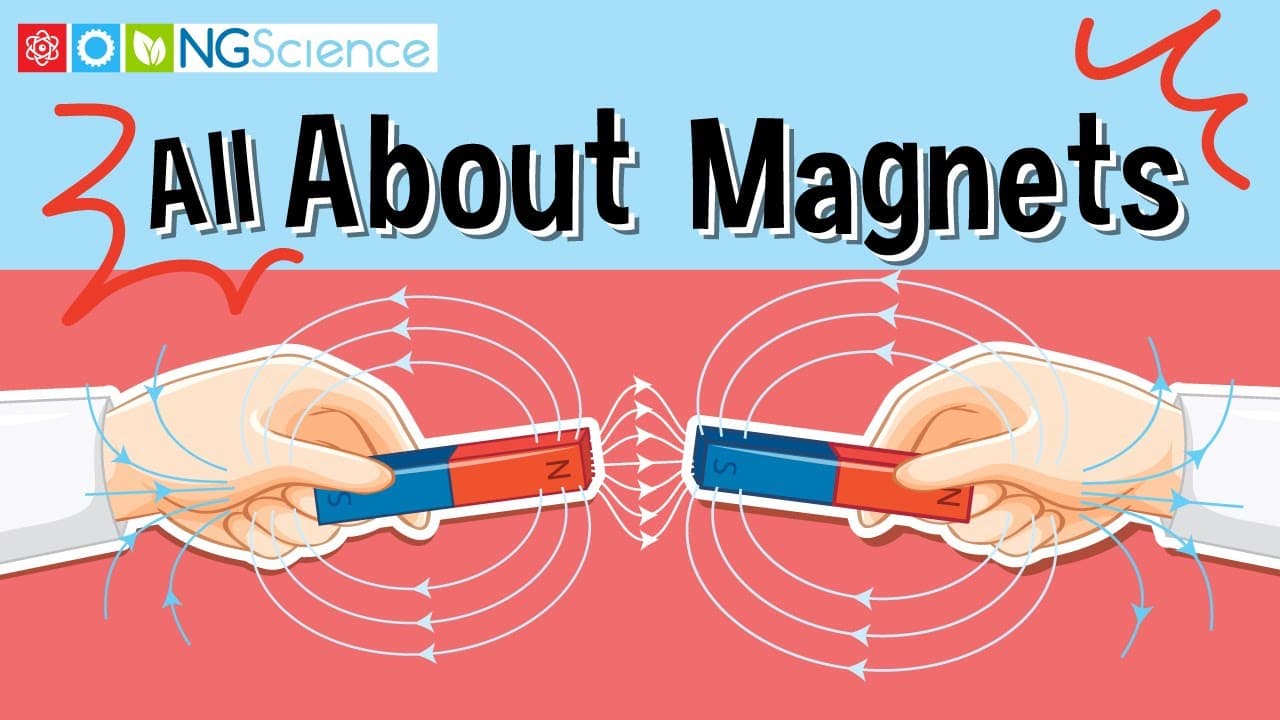
How Magnets Work and Why We Use Them

How Magnets Work and Why We Use Them

This educational video provides a comprehensive introduction to magnets, exploring their fundamental properties, different classifications, and wide-ranging applications in modern technology. The video begins by defining magnets through their ability to attract specific metals like iron and steel, visualizing the invisible magnetic fields that surround them. It breaks down the three primary types of magnets—permanent, temporary, and electromagnets—explaining how each functions differently, from the simple magnets on a refrigerator to the powerful electromagnets used in junkyards and roller coasters. The content delves into the physics of magnetic poles, illustrating the core rule that opposite poles attract while like poles repel. This segment uses clear visual demonstrations with bar magnets and iron filings to make abstract concepts concrete for young learners. The video also clarifies common misconceptions by distinguishing between magnetic and non-magnetic materials, showing tests on plastic, wood, and glass to reinforce understanding of material properties. Finally, the video connects these scientific concepts to the real world by highlighting how magnets are essential to everyday life and advanced engineering. Students learn about magnets in computers, earbuds, electric cars, and MRI machines, culminating in an exciting look at Maglev trains that float above tracks. This resource is excellent for elementary science units on forces and motion, offering clear definitions, engaging examples, and a built-in quiz to assess student comprehension.

Next Generation ScienceNext Generation Science

8mins 16s

Video
Exploring the Magic of Magnets: Attraction, Repulsion, and Levitation

Exploring the Magic of Magnets: Attraction, Repulsion, and Levitation

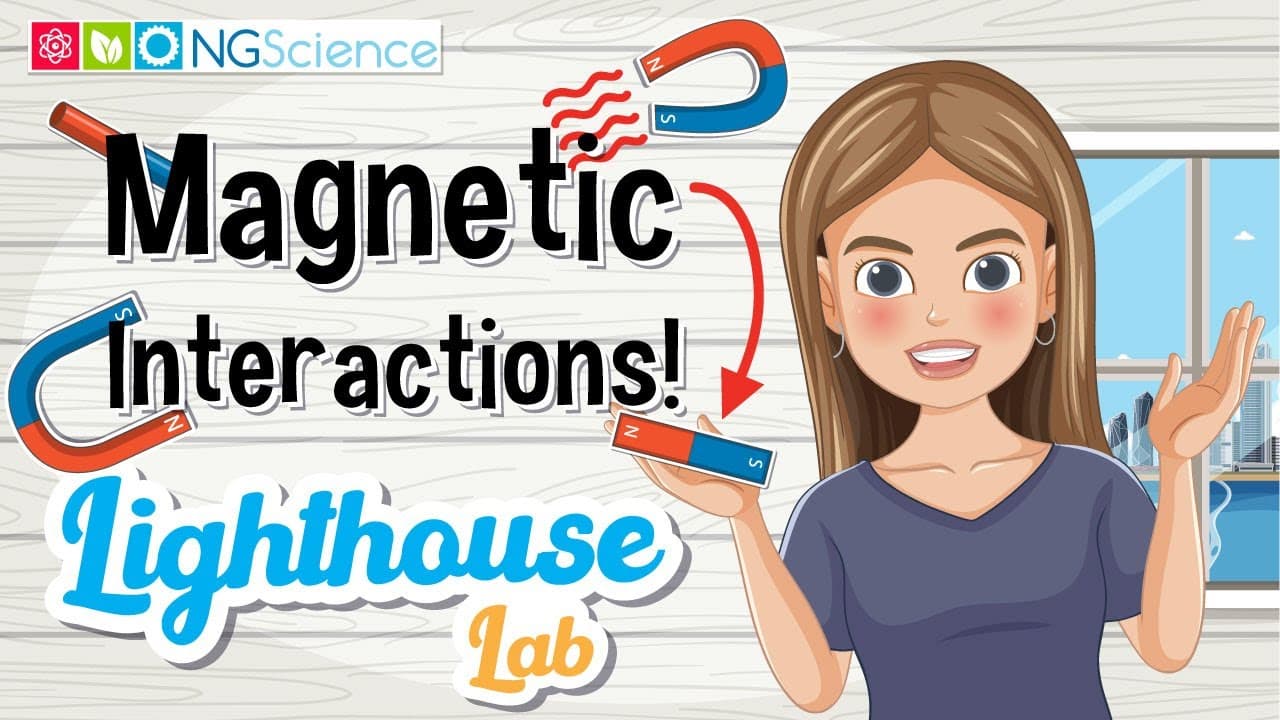
Join Chelsea in the Lighthouse Lab for an engaging exploration of magnetism designed for elementary students. The video introduces the fundamental properties of magnets, starting with the variety of shapes and sizes used in science, such as horseshoe, bar, and ring magnets. Viewers learn to distinguish between magnetic materials like iron and steel versus non-magnetic materials like plastic and wood through clear demonstrations. The core of the lesson focuses on magnetic poles and interactions. Through visual experiments using color-coded bar magnets, the video clearly demonstrates the laws of attraction and repulsion: how opposite poles pull together while like poles push apart. Concepts are explained using simple, age-appropriate language that demystifies the invisible forces at work. The video concludes with a "magic trick" that applies these scientific concepts. Using ring magnets and a wooden chopstick, the host demonstrates magnetic levitation, providing a concrete and exciting example of repulsion forces overcoming gravity. This video serves as an excellent foundational resource for physical science units on forces and properties of matter.

Next Generation ScienceNext Generation Science

5mins 51s

Video
Exploring Properties of Matter Through Lunchbox Science

Exploring Properties of Matter Through Lunchbox Science

This engaging science video explores the physical properties of matter using everyday lunch items as relatable examples. Hosted by Sabrina Cruz, the video introduces and defines four specific properties: hardness, malleability, conductivity, and magnetism. It explains each concept clearly with visual definitions and comparative examples, demonstrating how scientists use these properties to describe and classify different types of matter. The video breaks down complex vocabulary like "malleability" and "conductivity" into understandable segments. It uses side-by-side comparisons—such as a rock vs. slime for hardness, or a metal bottle vs. a plastic bottle for conductivity—to make abstract concepts concrete. The narrative emphasizes that properties are useful for comparing matter, showing that some materials possess certain traits strongly while others do not possess them at all. For educators, this resource serves as an excellent introduction or review of physical science concepts for upper elementary students. It models scientific investigation by asking questions and testing hypotheses (e.g., "Which is harder: bread or an apple?"). The video's structure, which moves from definitions to a "lunchtime investigation" application phase, provides a perfect model for classroom lab activities where students can test materials found in their own environment.

Crash Course KidsCrash Course Kids

3mins 37s

Video
Making Magnets Float: Understanding Attraction and Repulsion

Making Magnets Float: Understanding Attraction and Repulsion

In this engaging episode of SciShow Kids, host Jessi and her robot friend Squeaks introduce young learners to the fascinating world of magnetism through a "magic" levitation trick. The video uses a simple hands-on experiment involving ring magnets and a marker to demonstrate how magnets can float in mid-air, transitioning from this visual hook into a clear scientific explanation of magnetic forces. The content covers fundamental physics concepts appropriate for early elementary students, including what magnets are, how they exert non-contact forces (pushes and pulls), and the properties of magnetic poles. Through clear visual demonstrations and animations, Jessi explains the rules of attraction (opposites attract) and repulsion (like poles repel), using these principles to solve the mystery of the floating magnets. This video is an excellent classroom resource for introducing physical science units on forces and motion. It provides a ready-made experiment that teachers can replicate in class and offers vocabulary building for terms like "attract," "repel," "force," and "magnetic." The video concludes with several creative extension ideas, encouraging students to apply what they've learned to build forts, create art, or design engineering challenges using magnets.

SciShow KidsSciShow Kids

4mins 42s

Video
How Magnets Work: From Atoms to Maglev Trains

How Magnets Work: From Atoms to Maglev Trains

This engaging educational video explores the fundamental principles of magnetism, breaking down the invisible forces of attraction and repulsion that surround us. The presenter, donning a lab coat and using a humorous, approachable tone, guides viewers from the everyday example of refrigerator magnets to the subatomic level, explaining how the alignment of electrons creates magnetic fields. The video effectively demystifies complex physics concepts by visualizing atomic structures and demonstrating how magnetic poles interact.

Miacademy & MiaPrep Learning ChannelMiacademy & MiaPrep Learning Channel

9mins 4s

Video
How to Build a Compass and Find North

How to Build a Compass and Find North

In this engaging episode of SciShow Kids, host Anthony and his robot friend Squeaks explore the science of navigation and magnetism. After Squeaks arrives late due to taking a winding path along the river, Anthony suggests that a compass could help him find his way more efficiently. This leads to a hands-on demonstration of how to build a functioning compass using simple household items like a sewing needle, a magnet, and a bowl of water. The video breaks down complex physics concepts into age-appropriate explanations. It covers the fundamental properties of magnets, such as poles (North and South) and the laws of attraction and repulsion. It then scales these concepts up to planetary science, explaining how the Earth itself acts as a giant magnet with its own magnetic field that interacts with compass needles to guide travelers. Teachers can use this video to introduce units on forces and motion, magnetism, or geography. The clear, step-by-step experiment serves as a perfect classroom activity that requires minimal materials but yields immediate, observable results. Additionally, the video addresses the tricky scientific nuance of Earth's magnetic versus geographic poles, making it a valuable resource for deepening students' understanding of planetary physics.

SciShow KidsSciShow Kids

5mins 38s

Video
How to Identify Unknown Substances Using Properties

How to Identify Unknown Substances Using Properties

In this engaging episode of Crash Course Kids, host Sabrina Cruz explores how physical properties can be used to identify unknown substances. Starting with a relatable scenario about choosing candy from a gift bag without looking, the video introduces the scientific definition of 'properties' and explains how scientists use observable traits to categorize matter. It defines key terms like 'substance' and 'element' while reviewing properties of common groups like metals (shiny, conductive, magnetic) and gases (shapeless, transparent). The video transitions into a practical 'investigation' segment that demonstrates how to distinguish between similar-looking substances. It first tackles two white powders (sugar and sand) by testing their solubility in water, emphasizing the critical safety rule of 'No Tasting.' Then, using a blindfold challenge, it distinguishes between a metal nail and a gummy frog based on hardness, flexibility (malleability), and magnetism. This hands-on approach models scientific inquiry and deductive reasoning. Ideally suited for upper elementary science classrooms, this video provides a solid foundation for units on matter. It connects abstract definitions to concrete examples and simple experiments that can be replicated in class. Teachers can use this resource to introduce the concept of characteristic properties, teach laboratory safety, or kick off a mystery substance lab activity where students must identify materials using only physical tests.

Crash Course KidsCrash Course Kids

4mins 27s

Video
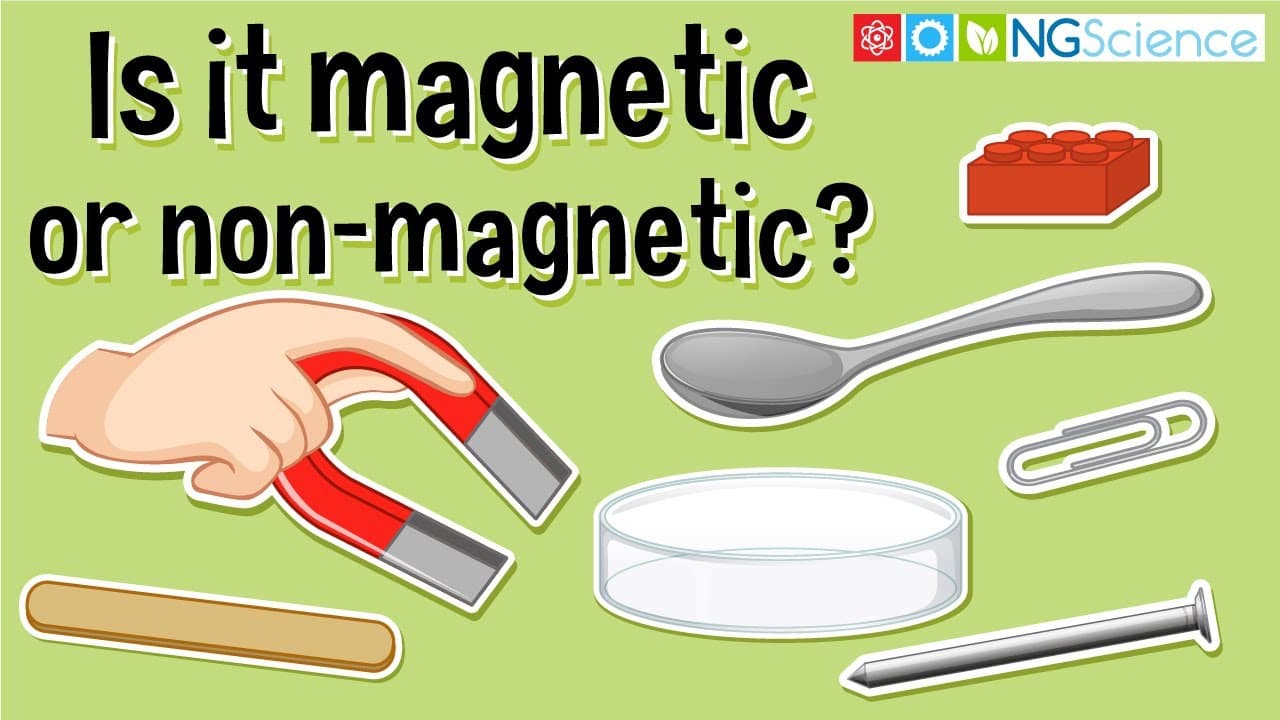
Exploring Magnetic and Non-Magnetic Objects

Exploring Magnetic and Non-Magnetic Objects

This straightforward science demonstration introduces students to the fundamental properties of magnetism by testing common everyday objects. Narrated with clear, paced instructions, the video defines magnetic and non-magnetic materials based on whether they are attracted to a magnet. It guides viewers through a scientific process: defining terms, showing clear examples, presenting a collection of varied items for prediction, and finally testing each item to sort them into categories.

Next Generation ScienceNext Generation Science

3mins 28s

Video
How Things Connect: Forces, Ecosystems, and Human Impact

How Things Connect: Forces, Ecosystems, and Human Impact

This educational video provides a comprehensive overview of the scientific concept of "interactions," demonstrating how different elements of our world affect one another. It begins by exploring physical forces, illustrating how pushes and pulls move objects like golf balls and ropes, and how friction provides the necessary grip for vehicles. The video then delves into non-contact forces, specifically magnetism, explaining attraction and repulsion through clear demonstrations and real-world applications like Maglev trains.

Next Generation ScienceNext Generation Science

4mins 29s

Video
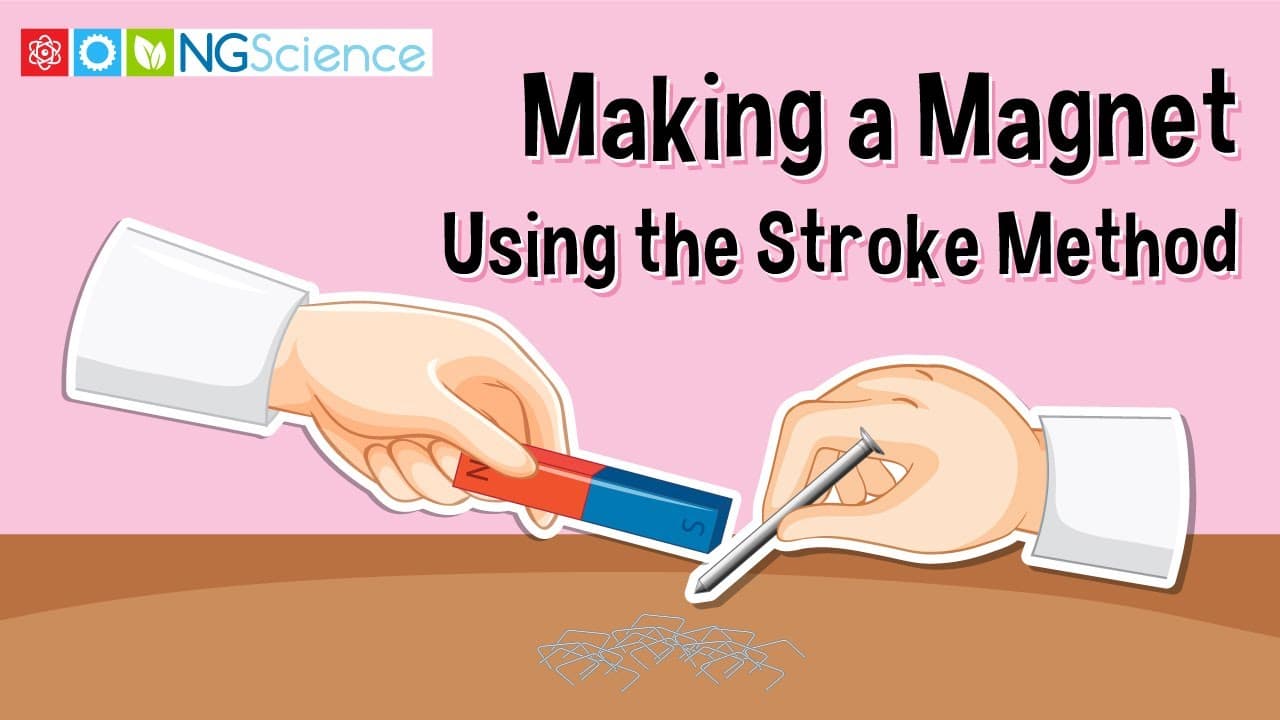
Creating a Temporary Magnet Using the Stroke Method

Creating a Temporary Magnet Using the Stroke Method

This video provides a clear, step-by-step demonstration of how to create a temporary magnet using the "stroke method." It begins by introducing the necessary materials—a permanent bar magnet, a metal nail, and metal staples—and establishes a control by showing that the nail is initially non-magnetic. The narrator then demonstrates the specific technique required to magnetize the nail: stroking it repeatedly in a single direction with one pole of the bar magnet. The video concludes by verifying the result as the nail successfully attracts the staples. Themes explored include magnetism, magnetic poles, magnetic forces, and scientific inquiry. Implicitly, the video touches upon the concept of magnetic domains, as the stroking motion aligns the atoms within the nail to create a magnetic field. It also introduces the scientific method by establishing a baseline observation before an intervention and concluding with an open-ended question that encourages further experimentation regarding magnetic strength. For educators, this video serves as an excellent hook or procedural guide for a hands-on physical science unit. It visually reinforces the importance of following specific experimental procedures—specifically, why rubbing back and forth would not work compared to the unidirectional stroke method. The open-ended question at the end ("What could you do to increase the strength?") provides a perfect transition into student-led investigations where they can test variables such as the number of strokes or the strength of the permanent magnet used.

Next Generation ScienceNext Generation Science

1min 28s

Video
Identifying Natural and Artificial Sources of Light

Identifying Natural and Artificial Sources of Light

This educational science video introduces primary school students to the concept of light sources, clearly distinguishing between objects that produce their own light and those that do not. Through a series of high-quality visuals ranging from sunny orchards to bioluminescent fireflies, the narrator explains the definition of a light source. The video categorizes these sources into natural examples like the Sun, lightning, and stars, and artificial examples used by humans such as light bulbs, car headlights, and televisions. A key scientific concept addressed is the distinction between emitting and reflecting light, specifically using the Moon as a case study. The video corrects the common misconception that the Moon is a source of light, explaining that it merely reflects the Sun's rays. This critical distinction helps students build a more accurate understanding of astronomical bodies and the physics of light. Teachers can use this video as an engaging hook for a unit on energy, physics, or day and night cycles. It provides clear visual examples that can anchor class discussions and sorting activities. The pacing is suitable for young learners, and the 'silent quiz' section near the end—showing fireworks, divers, and candles without narration—offers an excellent opportunity for teachers to pause and assess student understanding in real-time.

Next Generation ScienceNext Generation Science

1min 52s

Video
Why Is the Sky Blue? Understanding Light and Color

Why Is the Sky Blue? Understanding Light and Color

This engaging science video from SciShow Kids tackles one of the most common questions children ask: "Why is the sky blue?" Hosted by Jessi and her robot friend Squeaks, the video simplifies complex physics concepts like the visible light spectrum and atmospheric scattering into age-appropriate explanations. Using a mix of animation and real-world demonstrations, it explains that sunlight, while appearing white, actually contains all colors of the rainbow. The content covers key topics including the composition of white light, how prisms refract light to reveal the color spectrum, and the nature of Earth's atmosphere. It introduces the concept of air being made of tiny, invisible particles and demonstrates how these particles interact with sunlight. The core explanation focuses on Rayleigh scattering—simplified here as "scattering" or "bouncing"—showing how blue light waves scatter more easily than other colors when hitting air particles, painting the sky blue. For educators, this video serves as an excellent introduction to units on light, color, or Earth's atmosphere. It provides clear visual metaphors, such as comparing mixing paint to mixing light, and offers a tangible demonstration using a prism that can be replicated in the classroom. The video encourages observation and inquiry, making it a perfect launchpad for hands-on experiments about light refraction and atmospheric science.

SciShow KidsSciShow Kids

2mins 51s

Video
How Light Energy Travels and Interacts with Matter

How Light Energy Travels and Interacts with Matter

This engaging educational video introduces students to the fundamental concepts of light energy, explaining its nature, speed, and how it interacts with the material world. The lesson begins by defining light as a form of energy that travels in straight lines called rays, highlighting the Sun as our primary source and illustrating the immense speed at which light travels through space. Through clear visual examples and energetic narration, the host breaks down complex behaviors of light including reflection and refraction. The video dives deep into how we perceive our environment, demonstrating that sight is actually the result of light bouncing off objects and entering our eyes. It categorizes materials based on how they transmit light, defining key vocabulary such as transparent, translucent, and opaque with relatable real-world examples like windows, sunglasses, and walls. The concept of refraction is also explored, explaining optical illusions like a "broken" straw in water and how corrective lenses work. Teachers can utilize this video as a comprehensive introduction to optics and light energy for elementary and middle school science curriculums. The content effectively bridges the gap between abstract physical concepts and observable phenomena, making it an excellent launchpad for hands-on experiments involving mirrors, lenses, and shadow play. The clear definitions and "pause and think" moments provide natural breaks for classroom discussion and formative assessment.

Miacademy & MiaPrep Learning ChannelMiacademy & MiaPrep Learning Channel

8mins 8s

Video
Why We See the Moon During the Day

Why We See the Moon During the Day

This engaging video from SciShow Kids answers a common student inquiry: "Why can I see the moon during the day?" Through clear narration and helpful animations, the host breaks down the complex mechanics of the Earth-Sun-Moon system. The video explains foundational astronomical concepts, differentiating between Earth's daily rotation and the Moon's monthly orbit, while effectively demonstrating how the interaction of these movements allows the Moon to be visible in the daytime sky. Key themes include the rotation of Earth causing day and night, the concept of orbiting, and the physics of light reflection. A crucial distinction is made between the Sun as a source of light and the Moon as a reflector of that light. The video also introduces the concept of moon phases using kid-friendly analogies—comparing the changing shapes to a bitten cookie, a fingernail clipping, and a dinner plate—to explain that the Moon's shape doesn't actually change, only our view of its illuminated half does. For classroom application, this resource is invaluable for dispelling the misconception that the Moon acts solely as a "night light." It serves as a perfect launchpad for units on space systems, patterns in the sky, or the properties of light. Teachers can utilize the video's clear visual models to set up classroom demonstrations using globes and flashlights, or to initiate a long-term moon observation journal project where students track the moon's visibility during school hours.

SciShow KidsSciShow Kids

3mins 52s

Video
Why the Moon Turns Red: Understanding Lunar Eclipses

Why the Moon Turns Red: Understanding Lunar Eclipses

In this engaging episode of SciShow Kids, host Jessi takes young astronomers into the observatory to explore the phenomenon of a lunar eclipse. The video breaks down the celestial mechanics behind this event, explaining how the specific alignment of the Sun, Earth, and Moon creates a shadow that changes the Moon's appearance. It specifically addresses the "Blood Moon" phenomenon, answering the intriguing question of why the Moon turns red instead of going completely dark when it passes into Earth's shadow. The content covers key astronomical concepts including the definition of "lunar" and "eclipse," the orbital paths of the Earth and Moon, and the physics of light refraction through Earth's atmosphere. Through clear, colorful animations, students visualize the straight-line alignment required for an eclipse and learn why these events are visible only from certain parts of the world and at specific times. The video also importantly distinguishes between solar and lunar eclipses regarding eye safety. This resource is highly valuable for elementary science classrooms as it simplifies the complex 3D spatial relationships of celestial bodies into understandable 2D animations. It serves as an excellent introduction to units on space, light and shadows, or the solar system. Teachers can use this video to spark curiosity about the night sky, model orbital mechanics, or introduce basic optics concepts. While the video references specific dates from 2015, the scientific explanations remain evergreen and accurate.

SciShow KidsSciShow Kids

3mins 9s

Video
Exploring the Nature of Light and Electromagnetic Waves

Exploring the Nature of Light and Electromagnetic Waves

This educational video provides a comprehensive introduction to the physics of light, defining it as an oscillating electromagnetic wave. The instructor breaks down complex abstract concepts by first explaining electric and magnetic fields separately, using clear diagrams and real-world analogies like magnets and iron filings. The video then combines these concepts to visualize light as two perpendicular fields—electric and magnetic—oscillating together as they travel through space. The lesson delves into the specific wave properties of light, including wavelength, frequency, and amplitude. It effectively connects these mathematical and physical properties to human perception, explaining how wavelength and frequency determine the color we see, while amplitude determines the brightness. The video uses helpful animations, such as 3D graphs and water wave comparisons, to make these invisible phenomena easier to visualize. This resource is highly valuable for physical science and physics classrooms as it bridges the gap between static electricity/magnetism and wave theory. It is ideal for introducing the electromagnetic spectrum, teaching wave properties, or explaining the fundamental nature of light. The video includes a built-in review quiz and summary, making it a ready-to-use lesson component for checking student understanding of key physics vocabulary.

Miacademy & MiaPrep Learning ChannelMiacademy & MiaPrep Learning Channel

10mins

Video
How Land and Water Absorb the Sun's Heat

How Land and Water Absorb the Sun's Heat

This educational video from Crash Course Kids investigates the relationship between the sun's energy and the Earth's surface, specifically comparing how land and water absorb heat differently. Through the relatable example of a day at the beach, the host explains complex physical concepts like absorption and reflection in an accessible way. The video breaks down the path of solar energy from the sun's core to Earth, using clear visual aids like pie charts to show exactly how much energy reaches the surface versus what gets blocked or reflected by the atmosphere. The core scientific themes explored include heat energy transfer, the properties of matter (specifically color) in relation to light absorption, and the interaction between solar radiation and different terrestrial surfaces. A key focus is the concept that darker objects (like land/sand) absorb more heat than lighter objects (like water), which reflect more energy. This explains why sand feels hotter than the ocean on a sunny day despite receiving the same amount of sunlight. For educators, this video serves as an excellent anchor for units on Earth Science, weather patterns, or physical science regarding heat and light. It provides a visual and practical demonstration of differential heating, a foundational concept for understanding global weather systems, climate, and the water cycle. The use of clear definitions for terms like 'absorb' and 'reflect' makes it particularly useful for building scientific vocabulary in upper elementary grades.

Crash Course KidsCrash Course Kids

3mins 33s

Video
Exploring Light Energy and Its Sources

Exploring Light Energy and Its Sources

This educational video provides a comprehensive introduction to light energy for primary students, explaining what light is and why it is essential for life on Earth. Through clear narration and diverse visual examples, it defines light as a form of energy that allows us to see and distinguishes between darkness (the absence of light) and illumination. The video explores the sun as our primary light source while also introducing other natural sources like fire, lightning, and stars. The content breaks down the difference between natural and artificial light sources, offering relatable examples of human-made lights such as lamps, car headlights, and streetlights. It expands the concept of light beyond just vision by discussing how light is used for communication (traffic signals, lighthouses) and entertainment (television, computer screens). This helps students understand the multifaceted role light plays in modern society. Finally, the video connects light energy to biological processes, explaining how the sun's energy is captured by plants to create food, which is then passed on to animals and humans. This makes the video an excellent resource for science lessons covering energy forms, the senses, environmental science, and the basic food chain, helping students grasp the fundamental connection between the sun and all life on Earth.

Next Generation ScienceNext Generation Science

3mins 28s

Video
Understanding Time Dilation and Relativity

Understanding Time Dilation and Relativity

This educational video provides an engaging introduction to the complex physics concepts of time dilation and relativity. Using the popular film Interstellar as a hook, the narrator explains how time is not a fixed constant but changes based on velocity and gravity. The video breaks down Albert Einstein's theories into two main sections: Special Relativity, which deals with speed and the constant nature of light, and General Relativity, which connects acceleration and gravity to the warping of time.

Miacademy & MiaPrep Learning ChannelMiacademy & MiaPrep Learning Channel

10mins 54s

Video
How to Make a Rainbow and Why They Form

How to Make a Rainbow and Why They Form

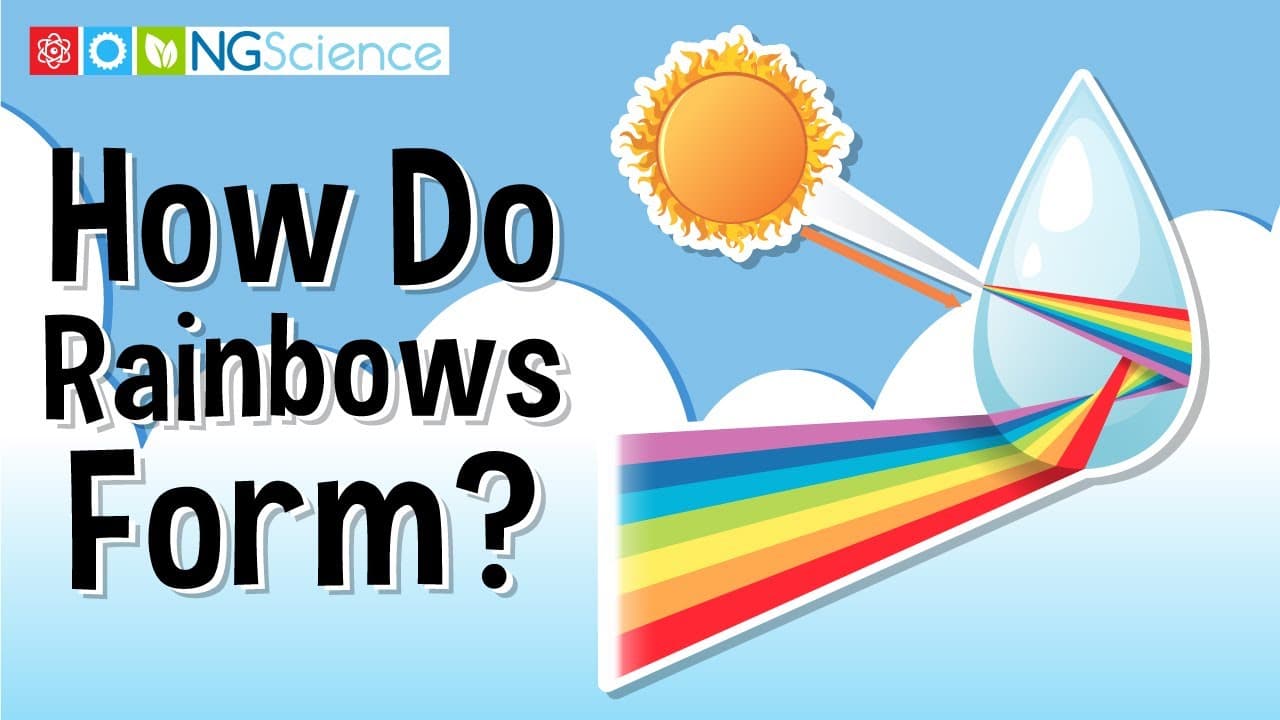
This engaging video from SciShow Kids guides young students through the science of rainbows, combining a hands-on experiment with clear conceptual explanations. Host Jessi demonstrates how to create a personal rainbow indoors using simple household items—a glass of water, paper, and sunlight—before diving into the physics behind the phenomenon. The video transitions from this concrete activity to abstract concepts, using animations to visualize how white light is composed of multiple colors that separate when passing through water.

SciShow KidsSciShow Kids

3mins 17s

Video
The Super Strength of the Mantis Shrimp

The Super Strength of the Mantis Shrimp

Hosted by Jessi and her robot rat friend Squeaks, this episode of SciShow Kids explores the fascinating world of the mantis shrimp. While many marine animals are commonly found in aquariums, the video explains why the mantis shrimp is a rare sight: its incredible strength allows it to punch hard enough to break standard glass. The video introduces viewers to this small but mighty crustacean, detailing its physical characteristics, habitats, and behavior.

SciShow KidsSciShow Kids

4mins 8s

Video
How We Explore Space: Telescopes, Satellites, and Rovers

How We Explore Space: Telescopes, Satellites, and Rovers

This educational video provides a comprehensive overview of the history, methods, and technologies humanity has developed to explore the cosmos. Starting with our innate curiosity about the stars, the narration guides viewers through the evolution of space exploration tools, from early optical telescopes to the advanced James Webb Space Telescope. It categorizes exploration into distinct methods: ground-based telescopes, orbiting satellites, deep-space probes, planetary rovers, and human space missions.

Next Generation ScienceNext Generation Science

12mins 4s

Video
Why Dark Colors Get Hotter in the Sun

Why Dark Colors Get Hotter in the Sun

In this engaging episode of SciShow Kids, host Jessi and her robot friend Squeaks face a common winter dilemma: how to keep a mini snowman from melting. After realizing it's too warm inside their fort, they venture outside to find a suitable cold spot. Since there is no shade available, they must choose between two sunny patches of ground: one covered in dark rocks and one covered in light rocks. This setup serves as the perfect hook for a scientific investigation into how color affects temperature.

SciShow KidsSciShow Kids

4mins 4s

Video
Introduction to Modern Physics: Quantum Mechanics and Relativity

Introduction to Modern Physics: Quantum Mechanics and Relativity

This video serves as an engaging introduction to the transition from Classical Physics to Modern Physics, covering the major scientific shifts that occurred in the early 20th century. It begins by contrasting pre-1900s physics (electricity and magnetism) with the revolutionary discoveries that followed, specifically addressing the limitations of classical theories in explaining phenomena like the nature of light. The instructor uses historical anecdotes, such as Max Planck's advisor advising him against studying physics, to highlight how drastically the scientific landscape changed. The content explores three pillars of Modern Physics: Quantum Mechanics, Special Relativity, and General Relativity. It breaks down complex concepts using accessible animations and analogies, explaining the Photoelectric Effect (wave-particle duality), the Michelson-Morley experiment (disproving the luminiferous aether), and the counter-intuitive nature of time dilation. The video also touches upon the Big Bang theory as an application of General Relativity to cosmology. For educators, this video is an excellent conceptual overview that bridges the gap between standard mechanics and advanced theoretical physics. It provides a narrative structure to physics history, making it ideal for introducing a unit on modern physics or light. The included true/false assessment at the end offers immediate checking for understanding, while the clear visualizations of electromagnetic waves and the twin paradox help demystify abstract ideas for high school students.

Miacademy & MiaPrep Learning ChannelMiacademy & MiaPrep Learning Channel

9mins 17s

Video
Why Water Bends Light: Exploring Refraction

Why Water Bends Light: Exploring Refraction

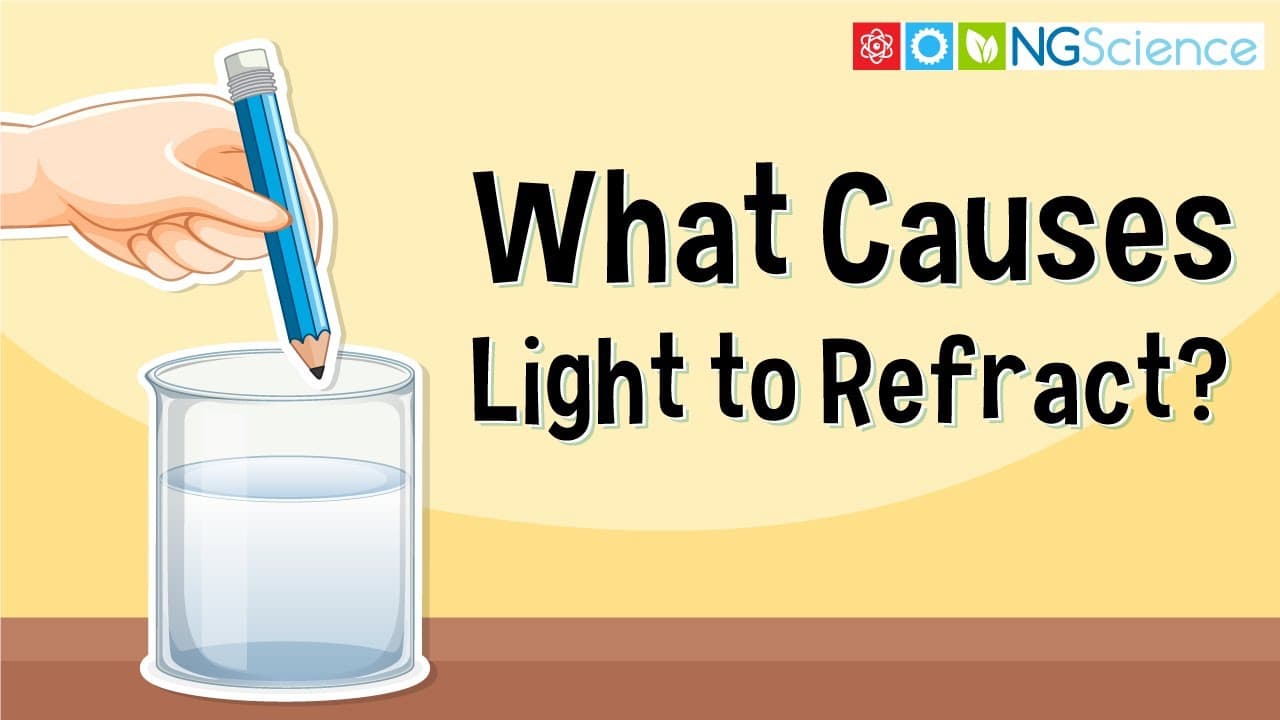
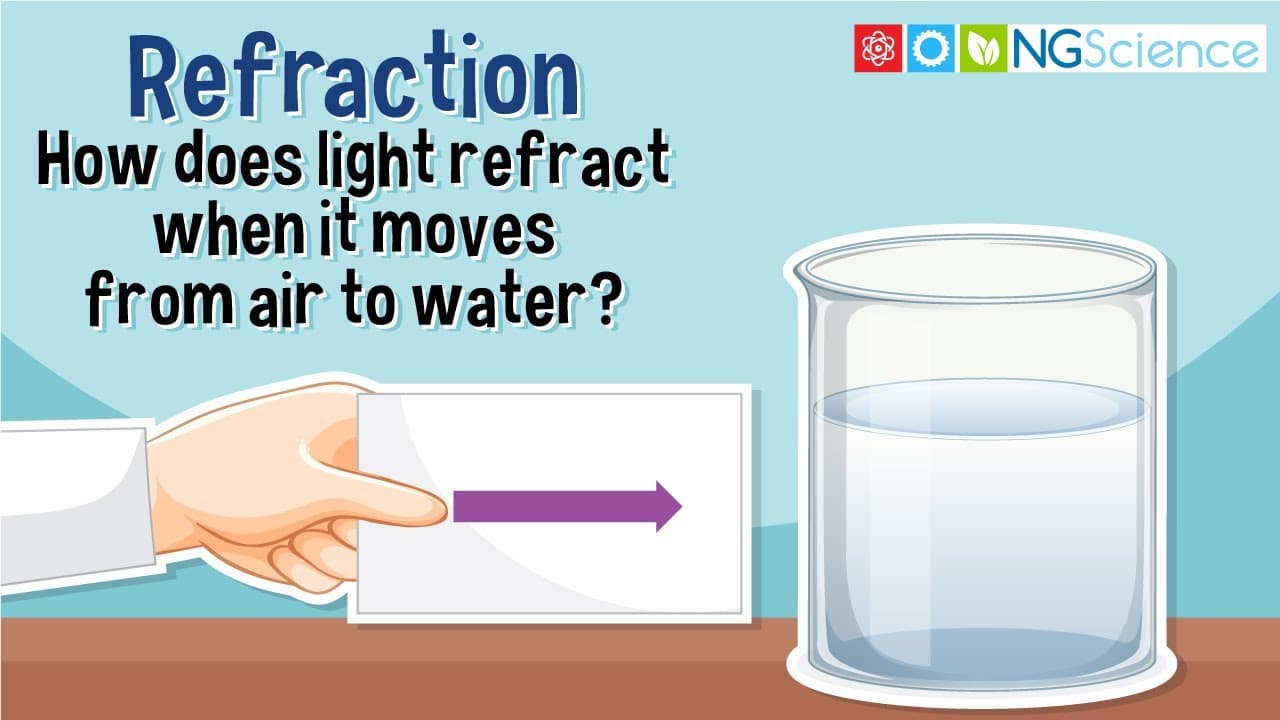
This engaging science video introduces students to the concept of light refraction through simple, high-impact experiments. Hosted in the 'Lighthouse Lab', the presenter demonstrates how light behaves differently when traveling through various materials, specifically focusing on the transition between air and water. The video uses clear visuals and real-world demonstrations to make abstract physics concepts concrete for young learners. The core themes explore the properties of light, specifically that light travels in straight lines but changes speed and direction when moving through different matter. The video defines 'refraction' and explains the optical illusions it creates, such as a pencil appearing bent in water or an arrow changing direction when viewed through a cylindrical jar. It also touches on how lenses, like magnifying glasses, utilize refraction to alter how we see objects. For educators, this video serves as an excellent hook for a unit on light and optics. The experiments demonstrated—the bent pencil and the reversing arrow—are easy to replicate in the classroom with minimal materials. The video includes a clear ray diagram animation that helps students visualize what is happening to light rays that they cannot see with the naked eye, bridging the gap between observation and theoretical understanding.

Next Generation ScienceNext Generation Science

3mins 13s

Video
From Nebula to White Dwarf: The Life Cycle of a Star

From Nebula to White Dwarf: The Life Cycle of a Star

This educational video takes students on a cosmic journey through the life cycle of an average-sized star, similar to our own Sun. It begins by explaining the birth of stars within stellar nebulas, detailing how gravity pulls gas and dust together to form protostars. The narrator simplifies complex astrophysical concepts, such as nuclear fusion, using clear animations to show how hydrogen atoms fuse into helium to release the immense energy that powers stars. Key themes include the transformation of matter and energy, the influence of gravity in space, and the stages of stellar evolution. The video explicitly differentiates between average-sized stars and massive stars, focusing on the specific path of average stars as they evolve from main sequence stars into expanding red giants. It concludes by describing the final stages of death for these stars: the shedding of outer layers to form planetary nebulas and the cooling of the core into a white dwarf. This resource is highly valuable for middle school science classrooms as it breaks down abstract space concepts into digestible stages. The clear definitions, visual diagrams of atomic fusion, and step-by-step lifecycle flowcharts make it an excellent tool for visual learners. Teachers can use this video to introduce units on astronomy, matter and energy, or the history of the universe, providing a solid foundation for understanding the life expectancy and eventual fate of our own solar system.

Miacademy & MiaPrep Learning ChannelMiacademy & MiaPrep Learning Channel

7mins 46s

Video
The Science of Electromagnetic Waves and Radiation

The Science of Electromagnetic Waves and Radiation

This engaging educational video provides a comprehensive introduction to electromagnetic waves, breaking down complex physics concepts into accessible segments using humor and relatable analogies. The lesson begins by demystifying how microwave ovens work, using this common appliance as a springboard to explain the fundamental nature of electromagnetic radiation. It details how vibrating electric and magnetic fields regenerate each other to allow energy to travel through a vacuum, distinguishing these waves from mechanical waves like sound.

Miacademy & MiaPrep Learning ChannelMiacademy & MiaPrep Learning Channel

8mins 34s

Video
How Light and Sound Work Together

How Light and Sound Work Together

This educational video provides a comprehensive review of the fundamental concepts of light and sound energy. Hosted by a teacher named Andrew and his animated friend Bally, the lesson breaks down abstract physics concepts into concrete examples. The video explains that sound is energy created by vibrations that travel through the air to our ears, using examples like stereo speakers and kitchen appliances. It then transitions to light, defining it as waves that travel from a source, bounce off objects, and enter our eyes to allow vision, while also explaining how shadows are formed when light is blocked. The video connects these two distinct forms of energy by illustrating how they work together in the real world to facilitate communication and safety. Specific examples include emergency vehicles using sirens (sound) and flashing lights (light) to warn traffic, and smartphones using ringtones and lighted screens to alert users of incoming calls. This synthesis helps students understand not just the definitions of energy forms, but their practical applications in daily life. Teachers can use this video as a perfect review tool after teaching units on physical science, specifically energy, waves, or the five senses. It effectively reinforces vocabulary like "vibration," "light source," and "communicate" through clear visuals and diagrams. The mix of live-action segments in a classroom setting and animated explanatory diagrams makes it highly engaging for early elementary students, bridging the gap between scientific theory and observable phenomena.

Kids AcademyKids Academy

2mins 12s

Video
Exploring the Electromagnetic Spectrum: From Radio Waves to Gamma Rays

Exploring the Electromagnetic Spectrum: From Radio Waves to Gamma Rays

This educational video provides a comprehensive overview of the electromagnetic spectrum, explaining the physics of light as a varying electromagnetic field. It systematically breaks down the spectrum into its constituent parts—radio waves, microwaves, infrared, visible light, ultraviolet, X-rays, and gamma rays—while categorizing them by both wavelength and energy levels. The narrator uses clear visual aids and mnemonics to help students understand the relationship between wave properties and their placement on the spectrum. The content explores real-world applications for each type of wave, connecting abstract physics concepts to tangible technologies students encounter daily. Examples range from cell phones and microwave ovens to medical imaging and radiation therapy. The video also addresses the interaction between light and matter, explaining phenomena like color perception (reflection vs. absorption) and the biological effects of high-energy radiation, such as DNA damage and cancer treatment. This resource is highly valuable for high school physics and physical science classrooms. It bridges the gap between theoretical wave mechanics and practical utility, making it an excellent tool for introducing the electromagnetic spectrum. Teachers can use the built-in quiz at the end to check for understanding, and the clear segmentation allows for pausing and discussing specific types of radiation in depth.

Miacademy & MiaPrep Learning ChannelMiacademy & MiaPrep Learning Channel

11mins 38s

Video
How Refraction Bends Light and Tricks Our Eyes

How Refraction Bends Light and Tricks Our Eyes

This engaging video from the Lighthouse Lab introduces students to the concept of refraction through simple, high-impact experiments. The host demonstrates how light behaves differently when traveling through various mediums, using everyday objects like a pencil, a beaker of water, and a magnifying glass to visualize these abstract concepts. The video effectively breaks down the physics of why objects appear bent or distorted in water, explaining the relationship between the speed of light and the density of matter. Key themes include the properties of light, the definition of refraction, and optical illusions. The video uses clear ray diagrams to illustrate how our brains interpret light traveling in straight lines, even when it has actually bent. It also touches upon how lenses work to magnify objects and how cylindrical containers of water can act as lenses to reverse images. For educators, this resource serves as an excellent hook for a unit on light and optics. It provides ready-to-replicate experiments that require minimal materials, making it perfect for classroom demonstrations or station-based activities. The inclusion of a 5-question review quiz at the end helps solidify student understanding and allows for immediate formative assessment.

Next Generation ScienceNext Generation Science

3mins 59s

Video
Classifying Living and Non-Living Things in Our World

Classifying Living and Non-Living Things in Our World

This educational video introduces students to the vast diversity of the world around them, focusing on the fundamental distinction between living and non-living things. Through high-quality footage of nature and human-made environments, viewers are taken on a visual journey that explores plants, animals, fungi, and microorganisms, contrasting them with non-living elements like rocks, water, and air. The narrative explains that while these categories differ, they are deeply interconnected, as living organisms rely on non-living elements to survive. The video covers key scientific themes including biological classification, the basic needs of living organisms (food, water, air, reproduction, growth), and the properties of non-living materials (wood, metal, plastic, etc.). It introduces the concept of classifying objects based on similarities and differences to make sense of the world's complexity. Additionally, it touches on material science by describing properties like strength, flexibility, and buoyancy. For educators, this video serves as an excellent anchor for units on biology, environmental science, or matter. It provides clear visual examples that help students practice observation and classification skills. The content naturally leads to lessons on sorting living vs. non-living items, investigating material properties, or discussing environmental stewardship, making it a versatile tool for early elementary science curriculums.

Next Generation ScienceNext Generation Science

4mins 20s

Video
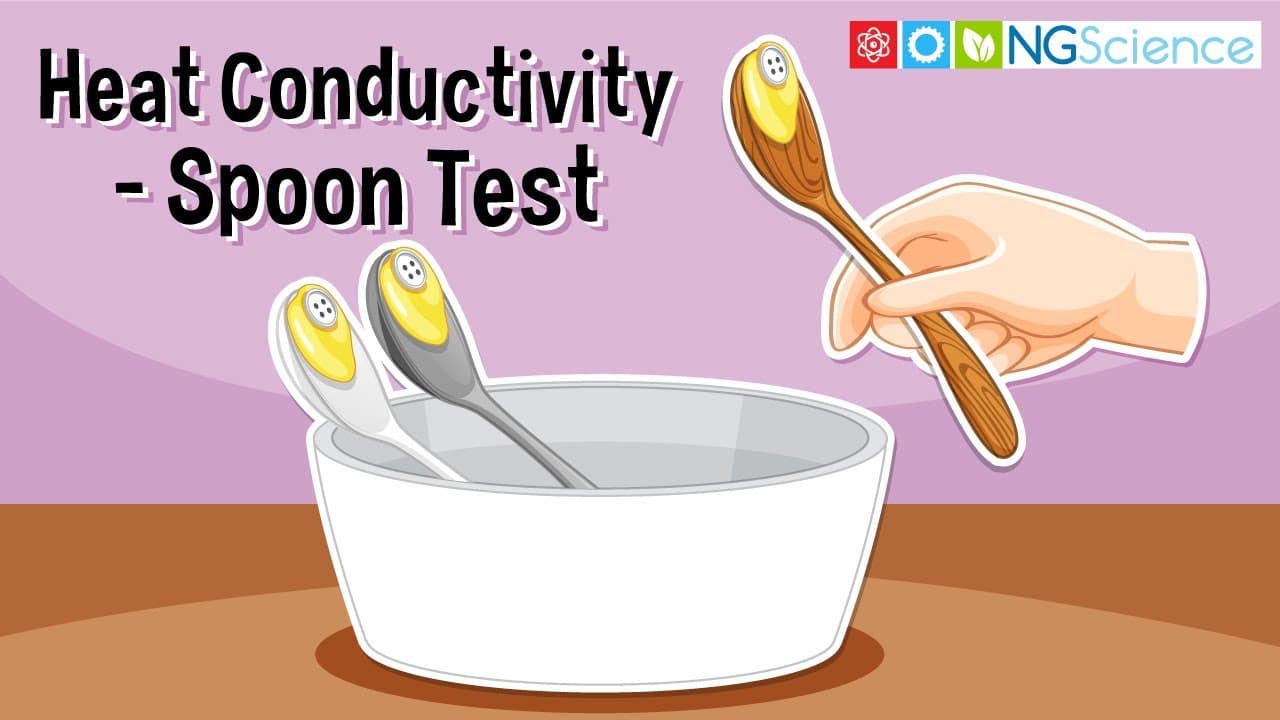
How Different Materials Conduct Heat

How Different Materials Conduct Heat

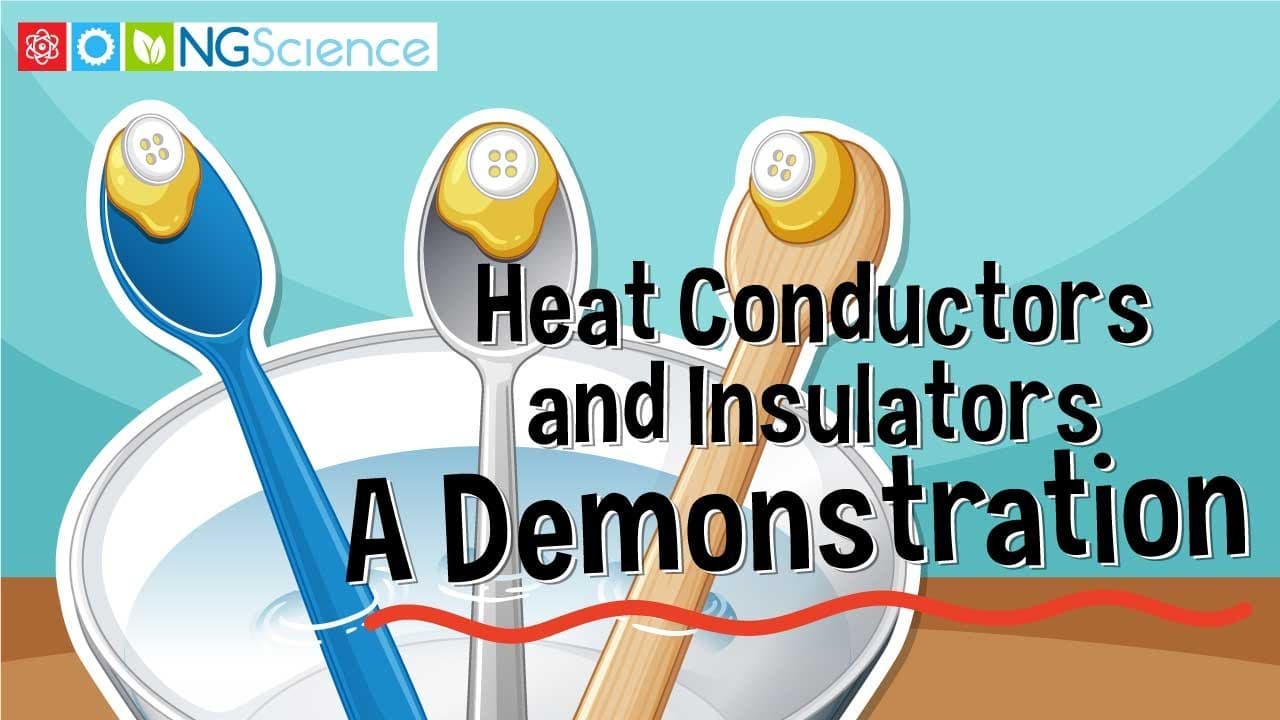
This educational video provides a clear, hands-on demonstration of heat conductivity using a simple comparative experiment. The video investigates how thermal energy travels differently through three distinct materials: metal, wood, and plastic. By placing spoons made of these materials into hot water, viewers observe which material conducts heat most effectively to melt a piece of margarine holding a button in place.

Next Generation ScienceNext Generation Science

2mins 37s

Video
Testing Which Metals Are Magnetic

Testing Which Metals Are Magnetic

This concise science demonstration investigates the relationship between magnets and various metal objects to determine which materials possess magnetic properties. Through a clear, step-by-step experiment, the narrator tests common household items—like keys, coins, and safety pins—against a U-shaped magnet. The video explicitly tests the hypothesis that "all metals are magnetic" by showing that while all the test objects are metallic, only some interact with the magnet. The core themes explore the physical properties of matter, specifically magnetism and material composition. It introduces the fundamental scientific concept that magnetism is a property specific to certain metals (ferromagnetic materials) rather than a general property of all metals. The video concludes by identifying specific elements—iron, nickel, and cobalt—that are magnetic, contrasting them with non-magnetic metals like aluminum, copper, and silver. For educators, this video serves as an excellent hook or demonstration for units on physical science and properties of matter. It directly addresses the common student misconception that magnets stick to all metals. The clear visual evidence of the key and coin failing to stick provides a memorable "discrepant event" that sparks inquiry. It lays the groundwork for understanding material composition and classification, making it valuable for early elementary science curriculums.

Next Generation ScienceNext Generation Science

1min 53s

Video
Sink or Float: Testing Common Objects

Sink or Float: Testing Common Objects

This engaging science video conducts a classic "Sink or Float" experiment, testing eleven common household objects to see how they interact with water. Using a clear tank and blue-tinted water for high visibility, the video systematically introduces an object, demonstrates dropping it into the water, and clearly labels the result as either "Sink" or "Float." The consistent pacing and clear visual cues make it an excellent resource for young learners to practice observation and prediction skills. The video explores key themes of buoyancy, density (at an introductory level), and material properties. It contrasts materials that typically sink, such as metal (lead ball, safety pin, paper clip) and dense rubber, with materials that float, like wood and certain plastics. It also implicitly addresses the concept that size does not determine buoyancy, as small heavy items sink while larger light items like the wooden block float. For educators, this video serves as a perfect digital demonstration to anchor a physical science unit on properties of matter. It allows teachers to pause before each drop to solicit student predictions, turning a passive viewing experience into an interactive game. It can be used to introduce the scientific method (predict, observe, record), prompt discussions about why certain materials float while others sink, or serve as a hook before a hands-on classroom water table activity.

Next Generation ScienceNext Generation Science

3mins 35s

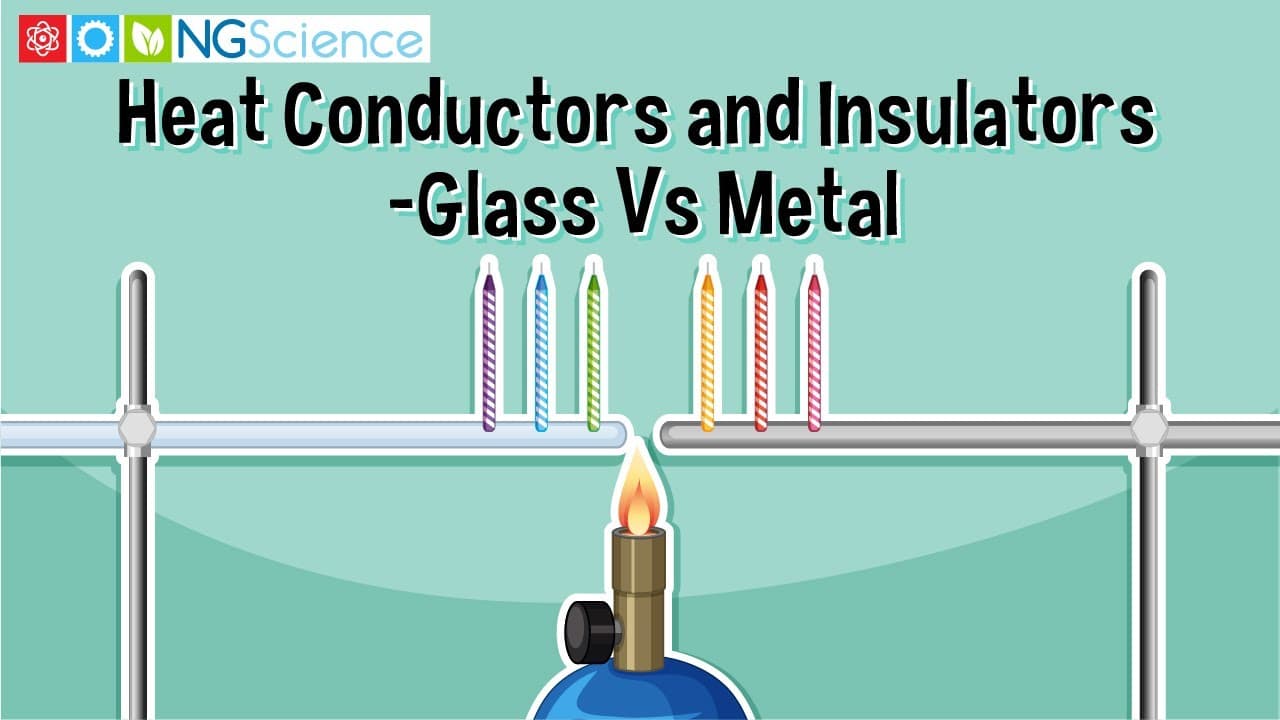
Video
Comparing Heat Conductivity: Metal vs. Glass Experiment

Comparing Heat Conductivity: Metal vs. Glass Experiment

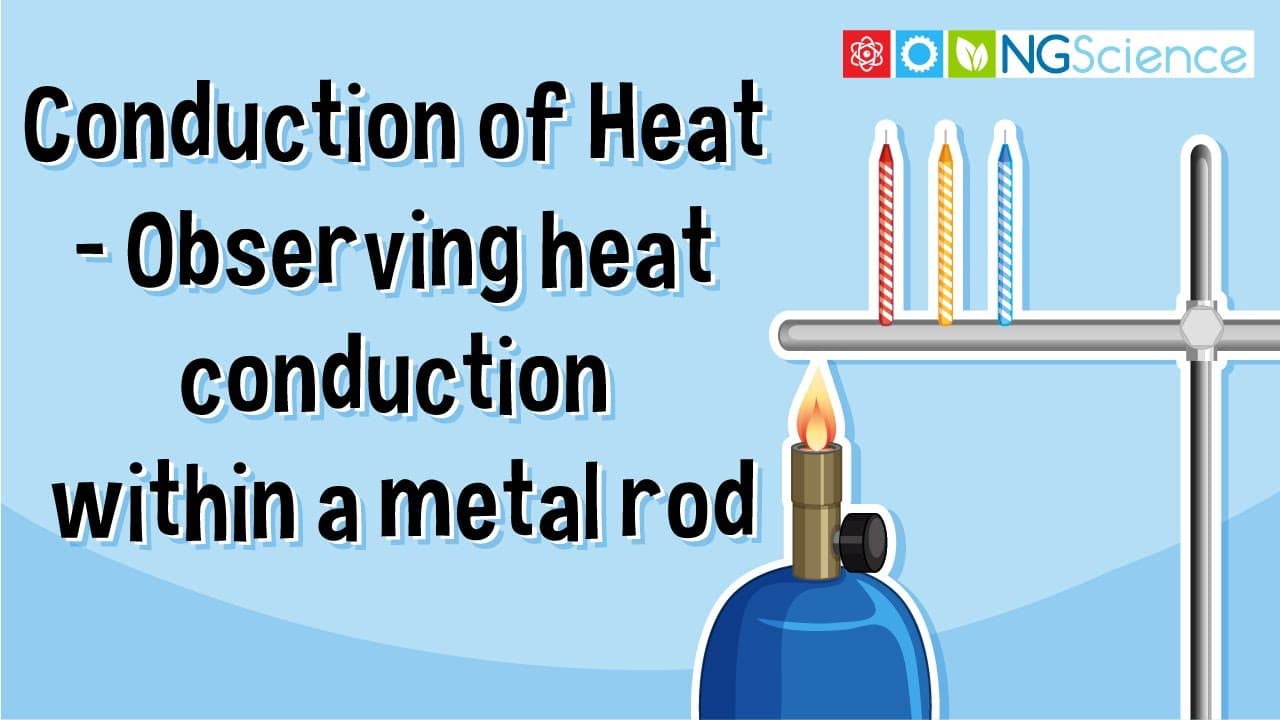
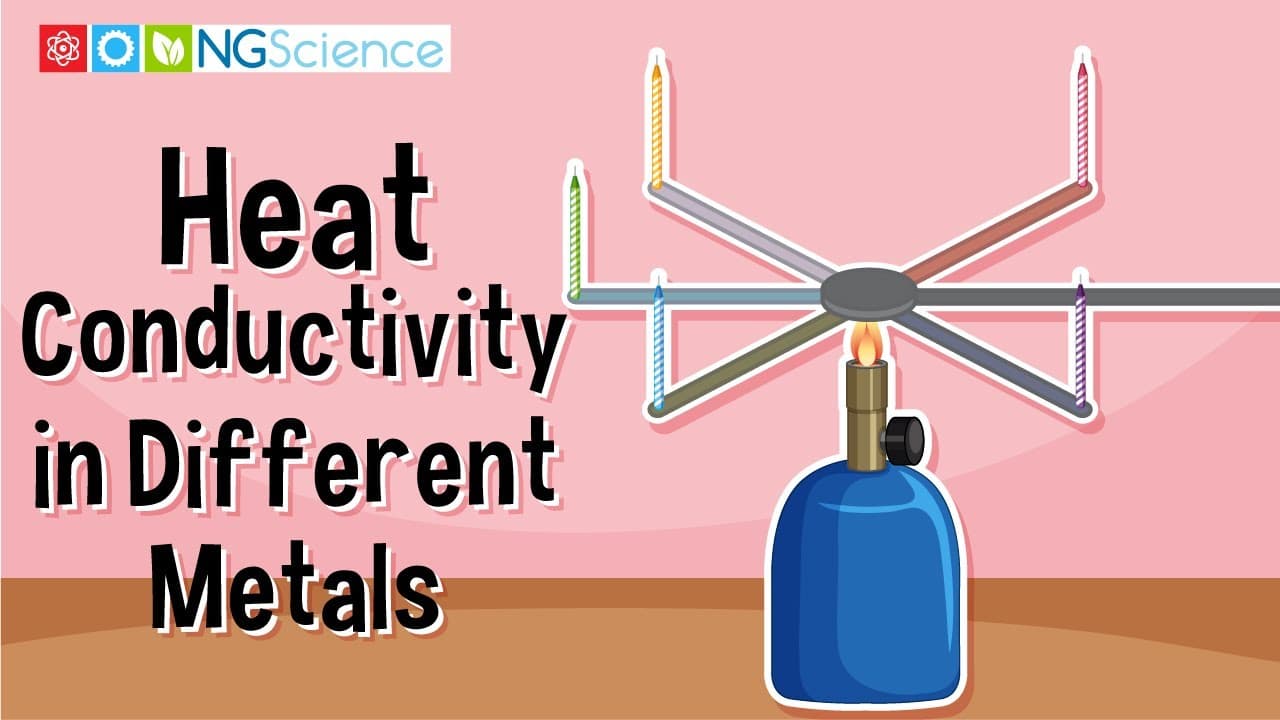
This concise science demonstration visualizes the concept of thermal conductivity by comparing how heat travels through metal versus glass. Set against a high-contrast background, the video features a clear experiment where candles are attached to metal and glass rods using wax. As a central heat source is applied, viewers can observe the progressive melting of the wax on the metal rod, demonstrating how heat energy transfers through conductive materials over time. The video introduces key physics vocabulary including thermal energy, conductors, insulators, and heat transfer. It explicitly addresses the direction of heat flow (from hot to cold) and provides a side-by-side comparison that makes the abstract concept of material properties concrete for young learners. The distinct visual result—candles falling off the metal rod while staying put on the glass rod—serves as immediate, observable evidence. Teachers can use this video to anchor lessons on energy transfer, material science, or the scientific method. It provides an excellent phenomenon for students to observe, predict, and explain. The clear setup allows for easy replication in a lab setting, or serves as a safe virtual alternative for classrooms without access to Bunsen burners. It naturally leads into discussions about why we use specific materials for cooking pans versus handles, or building insulation.

Next Generation ScienceNext Generation Science

2mins 15s

Video
How Light Energy Travels and Interacts with Matter

How Light Energy Travels and Interacts with Matter

This engaging educational video introduces students to the fundamental concepts of light energy, explaining its nature, speed, and how it interacts with the material world. The lesson begins by defining light as a form of energy that travels in straight lines called rays, highlighting the Sun as our primary source and illustrating the immense speed at which light travels through space. Through clear visual examples and energetic narration, the host breaks down complex behaviors of light including reflection and refraction. The video dives deep into how we perceive our environment, demonstrating that sight is actually the result of light bouncing off objects and entering our eyes. It categorizes materials based on how they transmit light, defining key vocabulary such as transparent, translucent, and opaque with relatable real-world examples like windows, sunglasses, and walls. The concept of refraction is also explored, explaining optical illusions like a "broken" straw in water and how corrective lenses work. Teachers can utilize this video as a comprehensive introduction to optics and light energy for elementary and middle school science curriculums. The content effectively bridges the gap between abstract physical concepts and observable phenomena, making it an excellent launchpad for hands-on experiments involving mirrors, lenses, and shadow play. The clear definitions and "pause and think" moments provide natural breaks for classroom discussion and formative assessment.

Miacademy & MiaPrep Learning ChannelMiacademy & MiaPrep Learning Channel

8mins 8s

Video
Exploring Material Hardness: The Scratch Test

Exploring Material Hardness: The Scratch Test

This video provides a clear, practical demonstration of how to test the physical property of hardness using a simple scratch test. Through a series of systematic trials, a narrator uses a metal nail to attempt to scratch various everyday objects, including a wax candle, plastic brick, glass beaker, and ceramic tile. The results are clearly stated and visually demonstrated, allowing viewers to see which materials resist abrasion and which do not. The content focuses on key scientific themes such as observing physical properties, conducting fair tests, and categorizing matter. It introduces the concept that materials have distinct characteristics that determine their suitability for different uses. The repetitive structure of prediction and observation reinforces the scientific method for young learners. For educators, this video is an excellent tool for introducing units on matter and materials. It models a safe and replicable experiment that can be adapted for the classroom. Teachers can use it to spark discussions about why certain objects are made of specific materials (e.g., why windows are made of glass but candles are made of wax) and to practice the skills of prediction and data recording.

Next Generation ScienceNext Generation Science

2mins 41s

Video
Choosing Materials Based on Their Properties

Choosing Materials Based on Their Properties

In this engaging science video, Jesse helps students understand the physical properties of matter by solving practical problems around his house. He explores the concept of 'properties'—observable and measurable qualities of materials—by comparing glass, plastic, and wood to determine the best material for new windows. He breaks down how we identify these properties using our five senses and various scientific tools like scales, rulers, and thermometers. The video illustrates the definition of properties such as transparency, durability, flexibility, weight, and texture. It demonstrates how these specific characteristics make certain materials suitable for specific jobs while others would fail. For example, the video contrasts transparent materials needed for windows against opaque materials, and waterproof materials needed for rain protection against absorbent ones. This resource is highly valuable for early elementary science classrooms introducing the properties of matter. It models the scientific process of observation and decision-making based on evidence. Teachers can use this video to launch lessons on material science, sensory observation, or engineering design challenges where students must select appropriate materials for a specific task based on their physical properties.

Miacademy & MiaPrep Learning ChannelMiacademy & MiaPrep Learning Channel

6mins 35s

Video
How to Identify Electrical Conductors and Insulators

How to Identify Electrical Conductors and Insulators

This educational video provides a clear and practical introduction to electrical conductors and insulators. It begins by defining the core property that distinguishes these two categories: the ability to allow electricity to flow through a material. Through a series of clear demonstrations using a simple electrical circuit, the video tests various common household items—including aluminum foil, a rubber band, a metal screw, a quarter, and a plastic block—to determine their conductivity.

Next Generation ScienceNext Generation Science

2mins 23s

Video
Making Oobleck: The Liquid That Acts Like a Solid

Making Oobleck: The Liquid That Acts Like a Solid

In this engaging episode of SciShow Kids, host Jessi introduces young scientists to the fascinating world of non-Newtonian fluids through a classic experiment: making Oobleck. The video begins by explaining the origin of the name "Oobleck" from a Dr. Seuss story before diving into the core scientific concepts. Jessi uses clear visuals and demonstrations to define the standard states of matter—solids and liquids—showing how solids keep their shape while liquids take the shape of their container. She then presents Oobleck as a special substance that breaks these rules by behaving as both a solid and a liquid depending on how force is applied. The video covers key scientific themes including states of matter, material properties, and basic chemistry. It provides a clear comparison between how normal objects (like a toy dinosaur or water) behave versus the unique properties of the cornstarch and water mixture. The narrative guides viewers through the scientific method of observation and experimentation, encouraging them to touch, squeeze, and release the substance to witness the physical changes firsthand. The video also emphasizes safety and responsibility, specifically instructing on the proper disposal of the mixture to avoid plumbing issues. For educators, this video serves as an excellent anchor for lessons on matter and physical science. It offers a low-cost, high-engagement hands-on activity that is accessible for early elementary students while demonstrating complex concepts in a tangible way. The clear step-by-step instructions make it easy to replicate in the classroom, and the connection to children's literature provides a cross-curricular opportunity to blend science with reading. The video's emphasis on observation skills makes it a valuable tool for introducing the basics of scientific inquiry.

SciShow KidsSciShow Kids

4mins 53s

Video
Comparing and Ordering Mass Using a Balance Scale

Comparing and Ordering Mass Using a Balance Scale

This educational science video demonstrates the concept of mass versus volume and how to use a pan balance scale to compare the mass of objects. Using three balls of similar size but different materials (a cricket ball, a tennis ball, and a rubber ball), the video guides viewers through a series of pairwise comparisons to determine their relative weights. It explicitly distinguishes between size (volume) and mass, helping students understand that objects of the same size can have different masses. The video employs a step-by-step scientific method, isolating variables by comparing two objects at a time. It visually depicts how a balance scale tips towards the object with greater mass and rises for the object with less mass. The narrative builds to a final conclusion where all three objects are arranged in order from least to greatest mass based on the evidence gathered from the experiments. For educators, this resource serves as an excellent introduction to measurement, data collection, and the physical properties of matter. It provides a clear visual model for using scientific tools and logic to solve a problem. It is particularly useful for introducing the concept of density (implicitly) and mass without needing complex formulas, making it accessible for early elementary students.

Next Generation ScienceNext Generation Science

1min 55s

Video
How Heat Moves Through Different Materials

How Heat Moves Through Different Materials

This educational science video provides a clear, practical introduction to thermal energy transfer by exploring the difference between heat conductors and insulators. Using familiar kitchen settings, it connects abstract scientific concepts to everyday life, explaining why cooking pots are made of metal while their handles are often made of plastic or wood. The narration simplifies complex ideas like thermal energy transfer into easy-to-understand definitions suited for upper elementary students. The video explores the specific properties of materials, distinguishing between "good conductors" that allow heat to pass through easily and "insulators" that block heat transfer. It culminates in a comparative science experiment using metal, wood, and plastic spoons placed in hot water. This demonstration visually proves the concepts discussed by showing how heat travels up the metal spoon to melt butter, while the insulating spoons remain cool enough to keep the butter solid. For educators, this resource serves as an excellent hook for units on energy, matter, or physical properties. It offers a replicable experiment that can be performed in the classroom to teach the scientific method (prediction, observation, conclusion). The real-world examples help students understand that material selection in engineering and design is purposeful and based on scientific properties.

Next Generation ScienceNext Generation Science

4mins 24s

Video
How Magnets Work and What They Attract

How Magnets Work and What They Attract

This engaging video from SciShow Kids introduces young learners to the fascinating world of magnets. Hosted by Jessi and her robot friend Squeaks, the lesson breaks down the fundamental concepts of magnetism, starting with the basic observation that magnets stick to certain objects without glue or tape. It explains scientific terms like "force" (push or pull) and introduces the concept of a "magnetic field"—the invisible area around a magnet where its force can be felt. The video explores the properties of magnets through clear demonstrations and an interactive guessing game. Viewers watch as Jessi tests different materials—wood, plastic, and various metals—to see which ones interact with a magnet. This experimental approach helps students understand that while magnets attract metals, they don't attract *all* metals. The video specifically identifies "iron" as the key magnetic metal found in common items like paperclips, tools, and refrigerator doors. Ideal for early elementary science curriculums, this resource transforms abstract physics concepts into tangible learning experiences. It demonstrates how to conduct simple experiments, encouraging students to make predictions (hypotheses) and test them. The content naturally leads to classroom activities involving sorting, classification, and hands-on exploration of magnetic forces, making it a perfect launchpad for STEM units on forces and motion or material properties.

SciShow KidsSciShow Kids

5mins 1s

Video
How to Observe and Sort Materials by Their Properties

How to Observe and Sort Materials by Their Properties

This educational video introduces young students to the fundamental scientific skill of observing and classifying matter based on physical properties. A friendly teacher guides viewers through hands-on demonstrations of sorting common classroom objects by observable characteristics such as size, color, and texture (hard vs. soft). The video emphasizes that organizing items into groups helps us better understand the world around us. The lesson progresses from simple sorting to critical thinking about material science, exploring the concept of "form follows function." Through a humorous animated sequence and real-world examples, students learn why specific materials are chosen for certain objects—for example, why floors must be hard while clothing should be soft. The video moves outdoors to demonstrate the properties of stone versus wood, specifically illustrating concepts of density and buoyancy through a sink-or-float experiment. Teachers can use this video to launch units on matter, sorting, and classification. It provides a clear model for hands-on classroom activities where students can practice grouping objects. The content effectively bridges basic observation skills with early engineering concepts, encouraging students to question why objects are made of specific materials and predicting how those materials will behave in different environments.

Kids AcademyKids Academy

5mins 43s

Video
Comparing Mass Using a Balance Scale

Comparing Mass Using a Balance Scale

This educational video provides a clear, visual demonstration of how to measure and compare mass using a simple two-pan balance scale. Through a step-by-step experiment using identical toy building blocks as standardized units of mass, the narrator explains the fundamental relationship between the amount of matter (number of blocks) and the resulting mass. The video progresses from showing equal mass, where the balance remains level, to unequal mass distributions, where the scale tips toward the heavier side. Key themes explored include the physical properties of matter, the concept of mass versus weight (implicitly), and the function of scientific tools like the balance scale. It visually reinforces mathematical concepts of equality, comparison (greater than/less than), and units of measurement. The content bridges the gap between abstract definitions of mass and concrete, observable phenomena that young learners can easily grasp. For educators, this video serves as an excellent hook or foundational lesson for early elementary science units on matter or math units on measurement. It models scientific observation and prediction, allowing teachers to pause before the scale tips to ask students for hypotheses. The use of familiar toy blocks makes the experiment easily reproducible in the classroom, encouraging hands-on learning where students can test their own predictions about mass using similar manipulatives.

Next Generation ScienceNext Generation Science

1min 50s

Video
Identifying and Sorting Objects by Their Materials

Identifying and Sorting Objects by Their Materials

This educational video introduces young learners to the scientific concepts of "objects" and "materials" by distinguishing between items themselves and the substances they are made from. Hosted by Jesse, the lesson begins with simple, informal language like "things" and "stuff" before transitioning to the correct scientific terminology. Through clear demonstrations with everyday items like a toy car, a bowl, and a pencil, viewers learn to identify an object (e.g., a bowl) and its corresponding material (e.g., glass). The video explores key themes of observation, classification, and physical science properties. It guides students through identifying common materials including wood, metal, plastic, glass, fabric, and rubber. The lesson progresses from simple identification to a sorting activity where a variety of new objects—such as spoons made of different materials—are categorized into groups based on what they are made of. It concludes with a more complex analysis of a pencil, demonstrating how a single object can be comprised of multiple materials. Ideally suited for early elementary science curriculums, this video provides excellent classroom application for teaching properties of matter. The host's pacing allows for natural pause-and-play opportunities where teachers can ask students to predict answers before they are revealed. The video models scientific thinking by rejecting arbitrary sorting methods (like size) in favor of sorting by material properties, and ends with an actionable prompt for a real-world scavenger hunt.

Miacademy & MiaPrep Learning ChannelMiacademy & MiaPrep Learning Channel

7mins 38s

Video
How to Identify Unknown Substances Using Properties

How to Identify Unknown Substances Using Properties

In this engaging episode of Crash Course Kids, host Sabrina Cruz explores how physical properties can be used to identify unknown substances. Starting with a relatable scenario about choosing candy from a gift bag without looking, the video introduces the scientific definition of 'properties' and explains how scientists use observable traits to categorize matter. It defines key terms like 'substance' and 'element' while reviewing properties of common groups like metals (shiny, conductive, magnetic) and gases (shapeless, transparent). The video transitions into a practical 'investigation' segment that demonstrates how to distinguish between similar-looking substances. It first tackles two white powders (sugar and sand) by testing their solubility in water, emphasizing the critical safety rule of 'No Tasting.' Then, using a blindfold challenge, it distinguishes between a metal nail and a gummy frog based on hardness, flexibility (malleability), and magnetism. This hands-on approach models scientific inquiry and deductive reasoning. Ideally suited for upper elementary science classrooms, this video provides a solid foundation for units on matter. It connects abstract definitions to concrete examples and simple experiments that can be replicated in class. Teachers can use this resource to introduce the concept of characteristic properties, teach laboratory safety, or kick off a mystery substance lab activity where students must identify materials using only physical tests.

Crash Course KidsCrash Course Kids

4mins 27s

Video
Learning About Objects and Materials

Learning About Objects and Materials

This educational video introduces young students to the fundamental scientific concepts of "objects" and "materials." The presenter, Jesse, guides viewers from using general language like "things and stuff" to precise scientific vocabulary. By examining everyday items like a toy car, a glass bowl, and a pencil, he clearly distinguishes between the object (what the item is) and the material (the substance it is made of, such as metal, glass, wood, or rubber). The video uses clear visual text overlays to reinforce these key vocabulary words. The central theme explores the properties of matter and classification. The video moves beyond simple identification to the skill of sorting and categorization. Jesse demonstrates different ways to sort a collection of items—by function or size—before showing that sorting by material is a useful scientific method. He groups items into plastic, metal, and wood categories, helping students visualize how different objects can share the same material composition. For the classroom, this video serves as an excellent hook for a unit on matter or physical properties. It models inquiry-based thinking and provides a structured approach to observation. Teachers can use the video to launch hands-on activities, such as classroom scavenger hunts where students identify objects made of specific materials, or sorting stations where they classify physical items. The content naturally encourages students to ask questions about the world around them and observing the physical makeup of their environment.

Miacademy & MiaPrep Learning ChannelMiacademy & MiaPrep Learning Channel

7mins 38s

Video
How Sand Turns Into Glass

How Sand Turns Into Glass

Join Jessi and Squeaks the Robot Mouse in this engaging science lesson that uncovers the surprising origins of glass. The video explains how common beach sand is transformed through extreme heat into the clear, solid material we use every day. By using analogies like melting ice and performing a kid-friendly experiment with sugar, the host demonstrates how granular solids can turn into liquids and cool back down into smooth solids. The content covers fundamental chemistry and physics concepts including states of matter (solids and liquids), phase changes (melting and cooling), and the process of recycling. It simplifies the industrial manufacturing process of glass by comparing it to volcanic heat, making complex engineering concepts accessible to young learners. This video is an excellent resource for elementary science units on materials, properties of matter, or natural resources. Teachers can use the featured "edible glass" experiment as a hands-on classroom activity or a demonstration to reinforce the concept of how heat changes the physical properties of materials without changing what they are made of.

SciShow KidsSciShow Kids

4mins 47s

Video
How Kites Fly and How to Build Your Own

How Kites Fly and How to Build Your Own

Hosted by Jessi and her robot rat friend Squeaks, this engaging video combines physics and engineering to explore the world of kites. The video begins by explaining the aerodynamic principles that allow kites to fly, breaking down complex concepts like lift, air pressure, and stability into kid-friendly terms. It uses clear animations to demonstrate how the angle of the kite's sail and the weight of the tail interact with wind to generate upward force. Following the science lesson, the video transitions into a practical DIY workshop. Jessi guides viewers through a step-by-step process to construct their own kite using common household materials like a plastic tablecloth, wooden dowels, and tape. The tutorial is detailed and easy to follow, covering everything from measuring and cutting the frame to attaching the bridle and tail. This resource is an excellent tool for STEM education, bridging the gap between theoretical science and hands-on application. Teachers can use it to introduce units on forces and motion, weather and wind, or procedural writing. The combination of visual learning and physical making encourages critical thinking, fine motor skills, and cooperative learning as students work together to build and fly their creations.

SciShow KidsSciShow Kids

4mins 30s

Video
Visualizing Invisible Magnetic Fields

Visualizing Invisible Magnetic Fields

This educational video provides a clear, visual demonstration of magnetic fields, transforming an abstract concept into a concrete observation. Through the use of bar magnets, paper, and iron filings, the narrator explains what a magnetic field is and demonstrates how to make these invisible forces visible. The video systematically tests different scenarios, showing the magnetic field of a single magnet, the repulsive force between like poles, and the attractive force between unlike poles. The key themes explored include the properties of magnets, magnetic poles (North and South), and the interaction between magnetic fields. The video specifically highlights how field lines are most concentrated at the poles and how the pattern of field lines changes depending on whether magnets are repelling or attracting one another. It introduces essential vocabulary such as "repel," "attract," "magnetic force," and "iron filings." For educators, this video is an invaluable tool for physics and general science units on forces. It serves as a perfect precursor to or substitute for a live lab activity, allowing students to see the expected results of a classic experiment. It can spark learning by prompting students to predict field patterns before they are revealed, helping them build mental models of invisible forces and understanding the fundamental rules of magnetism.

Next Generation ScienceNext Generation Science

3mins 18s

Video
Testing Which Metals Are Magnetic

Testing Which Metals Are Magnetic

This concise science demonstration investigates the relationship between magnets and various metal objects to determine which materials possess magnetic properties. Through a clear, step-by-step experiment, the narrator tests common household items—like keys, coins, and safety pins—against a U-shaped magnet. The video explicitly tests the hypothesis that "all metals are magnetic" by showing that while all the test objects are metallic, only some interact with the magnet. The core themes explore the physical properties of matter, specifically magnetism and material composition. It introduces the fundamental scientific concept that magnetism is a property specific to certain metals (ferromagnetic materials) rather than a general property of all metals. The video concludes by identifying specific elements—iron, nickel, and cobalt—that are magnetic, contrasting them with non-magnetic metals like aluminum, copper, and silver. For educators, this video serves as an excellent hook or demonstration for units on physical science and properties of matter. It directly addresses the common student misconception that magnets stick to all metals. The clear visual evidence of the key and coin failing to stick provides a memorable "discrepant event" that sparks inquiry. It lays the groundwork for understanding material composition and classification, making it valuable for early elementary science curriculums.

Next Generation ScienceNext Generation Science

1min 53s

Video
How Magnets, Fields, and Generators Work

How Magnets, Fields, and Generators Work

This engaging physics lesson explores the fundamental principles of magnetism, moving from basic interactions to complex real-world applications. It begins with a relatable personal anecdote to introduce the strength of modern magnets before diving into core concepts like magnetic poles, attraction and repulsion, and the non-existence of magnetic monopoles. The video utilizes clear animations and diagrams to visualize invisible forces, making abstract concepts accessible to students.

Miacademy & MiaPrep Learning ChannelMiacademy & MiaPrep Learning Channel

8mins 9s

Video
Earth's Magnetic Shield and the Right-Hand Rule

Earth's Magnetic Shield and the Right-Hand Rule

This educational video explores the critical role of Earth's magnetic field in protecting our planet from harmful solar radiation and introduces the physics concept of the Right-Hand Rule. The lesson begins by visualizing the sun as a massive nuclear reactor and explains how Earth's magnetic shield deflects solar wind, creating phenomena like the Aurora Borealis while preventing the radiation damage seen on barren worlds like the Moon and Mars. The second half of the video transitions into a practical physics tutorial on electromagnetism. It breaks down how magnetic fields exert force on moving charges and teaches students how to use the Right-Hand Rule to determine the direction of that force. The presenter uses clear, step-by-step examples with on-screen graphics to demonstrate how to position fingers to represent charge, field, and force vectors. For educators, this video serves as a bridge between Earth science and physics concepts. It provides a real-world application for abstract electromagnetic principles, making it an excellent resource for high school physics units on magnetism or earth science units on planetary habitability. The visual demonstrations of 3D spatial reasoning (using the hand) are particularly helpful for students who struggle with vector directions.

Miacademy & MiaPrep Learning ChannelMiacademy & MiaPrep Learning Channel

7mins 57s

Video
How Adding Coils Affects an Electromagnet's Strength

How Adding Coils Affects an Electromagnet's Strength

This educational video provides a clear, step-by-step demonstration on how to construct a simple electromagnet using basic materials: a battery, wire with alligator clips, and a metal nail. The video uses clean, distinct 2D animations to visualize the assembly process, showing exactly how to connect the circuit and coil the wire around the nail to create a magnetic field capable of picking up paperclips. The content moves beyond simple construction by introducing the scientific method and variable testing. It explicitly asks viewers to predict the effect of adding more coils of wire to the nail. It then demonstrates the result—that increasing the number of coils increases the magnetic force, allowing the magnet to pick up more paperclips—visually reinforcing the relationship between the number of turns in a solenoid and magnetic field strength. For educators, this video serves as an excellent introduction to electricity and magnetism units. It functions well as a pre-lab primer before students build their own electromagnets, or as a virtual demonstration for classrooms lacking materials. The built-in pause points for prediction make it an interactive tool for discussing independent variables (number of coils) and dependent variables (strength of magnet/number of clips held).

Next Generation ScienceNext Generation Science

1min 30s

Video
Exploring Magnetic Poles: Attraction and Repulsion

Exploring Magnetic Poles: Attraction and Repulsion

This educational video provides a clear, step-by-step demonstration of the fundamental principles of magnetism, specifically focusing on how magnetic poles interact. Through a virtual laboratory setup, viewers observe a controlled experiment using two bar magnets—one suspended freely from a retort stand and another held by hand. The video systematically tests every combination of pole interactions (North-North, South-North, South-South, and North-South) to visually prove the rules of magnetic force. The core themes explored are the concepts of magnetic poles (North and South), non-contact forces, and the defining laws of magnetism: attraction and repulsion. The video explicitly introduces and reinforces scientific vocabulary such as "interact," "attract," "repel," and "poles." By isolating the variables and showing the physical movement of the hanging magnet, it makes the invisible force of magnetism observable and concrete for young learners. For educators, this video serves as an excellent introduction to a unit on forces or magnetism. It models proper scientific inquiry by asking a question, setting up an experiment, observing results, and drawing a conclusion. It is particularly useful for demonstrating an experiment that students can then replicate in the classroom using their own magnets. The clear visual evidence of repulsion (pushing away) and attraction (pulling closer) provides a perfect anchor for discussions about invisible forces that act at a distance.

Next Generation ScienceNext Generation Science

2mins 10s

Video
Exploring the Magic of Magnets: Attraction, Repulsion, and Levitation

Exploring the Magic of Magnets: Attraction, Repulsion, and Levitation

Join Chelsea in the Lighthouse Lab for an engaging exploration of magnetism designed for elementary students. The video introduces the fundamental properties of magnets, starting with the variety of shapes and sizes used in science, such as horseshoe, bar, and ring magnets. Viewers learn to distinguish between magnetic materials like iron and steel versus non-magnetic materials like plastic and wood through clear demonstrations. The core of the lesson focuses on magnetic poles and interactions. Through visual experiments using color-coded bar magnets, the video clearly demonstrates the laws of attraction and repulsion: how opposite poles pull together while like poles push apart. Concepts are explained using simple, age-appropriate language that demystifies the invisible forces at work. The video concludes with a "magic trick" that applies these scientific concepts. Using ring magnets and a wooden chopstick, the host demonstrates magnetic levitation, providing a concrete and exciting example of repulsion forces overcoming gravity. This video serves as an excellent foundational resource for physical science units on forces and properties of matter.

Next Generation ScienceNext Generation Science

5mins 51s

Video
Creating a Temporary Magnet Using the Stroke Method

Creating a Temporary Magnet Using the Stroke Method

This video provides a clear, step-by-step demonstration of how to create a temporary magnet using the "stroke method." It begins by introducing the necessary materials—a permanent bar magnet, a metal nail, and metal staples—and establishes a control by showing that the nail is initially non-magnetic. The narrator then demonstrates the specific technique required to magnetize the nail: stroking it repeatedly in a single direction with one pole of the bar magnet. The video concludes by verifying the result as the nail successfully attracts the staples. Themes explored include magnetism, magnetic poles, magnetic forces, and scientific inquiry. Implicitly, the video touches upon the concept of magnetic domains, as the stroking motion aligns the atoms within the nail to create a magnetic field. It also introduces the scientific method by establishing a baseline observation before an intervention and concluding with an open-ended question that encourages further experimentation regarding magnetic strength. For educators, this video serves as an excellent hook or procedural guide for a hands-on physical science unit. It visually reinforces the importance of following specific experimental procedures—specifically, why rubbing back and forth would not work compared to the unidirectional stroke method. The open-ended question at the end ("What could you do to increase the strength?") provides a perfect transition into student-led investigations where they can test variables such as the number of strokes or the strength of the permanent magnet used.

Next Generation ScienceNext Generation Science

1min 28s

Video
How Magnets Work and What They Attract

How Magnets Work and What They Attract

This engaging video from SciShow Kids introduces young learners to the fascinating world of magnets. Hosted by Jessi and her robot friend Squeaks, the lesson breaks down the fundamental concepts of magnetism, starting with the basic observation that magnets stick to certain objects without glue or tape. It explains scientific terms like "force" (push or pull) and introduces the concept of a "magnetic field"—the invisible area around a magnet where its force can be felt. The video explores the properties of magnets through clear demonstrations and an interactive guessing game. Viewers watch as Jessi tests different materials—wood, plastic, and various metals—to see which ones interact with a magnet. This experimental approach helps students understand that while magnets attract metals, they don't attract *all* metals. The video specifically identifies "iron" as the key magnetic metal found in common items like paperclips, tools, and refrigerator doors. Ideal for early elementary science curriculums, this resource transforms abstract physics concepts into tangible learning experiences. It demonstrates how to conduct simple experiments, encouraging students to make predictions (hypotheses) and test them. The content naturally leads to classroom activities involving sorting, classification, and hands-on exploration of magnetic forces, making it a perfect launchpad for STEM units on forces and motion or material properties.

SciShow KidsSciShow Kids

5mins 1s

Video
Making Magnets Float: Understanding Attraction and Repulsion

Making Magnets Float: Understanding Attraction and Repulsion

In this engaging episode of SciShow Kids, host Jessi and her robot friend Squeaks introduce young learners to the fascinating world of magnetism through a "magic" levitation trick. The video uses a simple hands-on experiment involving ring magnets and a marker to demonstrate how magnets can float in mid-air, transitioning from this visual hook into a clear scientific explanation of magnetic forces. The content covers fundamental physics concepts appropriate for early elementary students, including what magnets are, how they exert non-contact forces (pushes and pulls), and the properties of magnetic poles. Through clear visual demonstrations and animations, Jessi explains the rules of attraction (opposites attract) and repulsion (like poles repel), using these principles to solve the mystery of the floating magnets. This video is an excellent classroom resource for introducing physical science units on forces and motion. It provides a ready-made experiment that teachers can replicate in class and offers vocabulary building for terms like "attract," "repel," "force," and "magnetic." The video concludes with several creative extension ideas, encouraging students to apply what they've learned to build forts, create art, or design engineering challenges using magnets.

SciShow KidsSciShow Kids

4mins 42s

Video
How to Separate Mixtures Using Magnets

How to Separate Mixtures Using Magnets

This concise science demonstration visualizes the concept of separating mixtures based on physical properties, specifically magnetism. The video guides viewers through a clear experiment where a heterogeneous mixture is created using white sand and black iron filings, followed by the use of a magnetic wand to separate the two substances. It explicitly defines the scientific principles at play, noting that separation is possible because one component is magnetic while the other is not. Key themes include the properties of matter, the definition of mixtures, and techniques for separating substances. The video serves as a fundamental introduction to physical science concepts, demonstrating that mixtures can be physically separated without chemical reactions. It highlights the difference between magnetic materials (iron) and non-magnetic materials (sand) as the basis for the separation technique. For educators, this video provides an excellent "hook" or visual aid for units on matter, mixtures, and solutions. It is particularly useful for demonstrating a concept that might be messy or difficult to manage individually in a large classroom setting. Teachers can use this clip to model scientific observation, prompt predictions about physical properties, or introduce a hands-on lab activity where students replicate the experiment to learn about sorting materials in real-world contexts like recycling.

Next Generation ScienceNext Generation Science

1min 8s

Video
Exploring Magnetic and Non-Magnetic Objects

Exploring Magnetic and Non-Magnetic Objects

This straightforward science demonstration introduces students to the fundamental properties of magnetism by testing common everyday objects. Narrated with clear, paced instructions, the video defines magnetic and non-magnetic materials based on whether they are attracted to a magnet. It guides viewers through a scientific process: defining terms, showing clear examples, presenting a collection of varied items for prediction, and finally testing each item to sort them into categories.

Next Generation ScienceNext Generation Science

3mins 28s

Video
How Sea Turtles Use Magnetism to Find Their Way

How Sea Turtles Use Magnetism to Find Their Way

This educational video follows Jessi and her robot rat friend Squeaks as they prepare for a hike in the woods. Squeaks is nervous about getting lost, which leads to a lesson on navigation tools. Jessi introduces the compass as a tool to find direction, explaining its reliance on magnetism. To deepen the understanding of navigation without landmarks, they video call Dr. Turtleman, a sea turtle expert, who explains how marine animals navigate the vast ocean. The video explores key scientific themes including magnetism, magnetic poles, and animal migration. It breaks down how magnets work, defining terms like 'North Pole,' 'South Pole,' and 'magnetic attraction.' It vividly illustrates Earth as a giant magnet and explains how compass needles align with Earth's magnetic field. Furthermore, it introduces the biological concept of 'magnetoreception,' revealing that sea turtles and other animals have magnetite in their brains that acts as an internal compass. For educators, this video is an excellent resource for bridging Earth science and biology. It simplifies complex concepts like the Earth's magnetic field and invisible forces, making them accessible to young learners. Teachers can use this video to launch units on magnets, animal adaptations, or geography skills. It encourages curiosity about the natural world and demonstrates how biological adaptations allow animals to solve problems—like navigation—in ways similar to human technology.

SciShow KidsSciShow Kids

4mins 2s

Video
How Magnets Work: From Atoms to Maglev Trains

How Magnets Work: From Atoms to Maglev Trains

This engaging educational video explores the fundamental principles of magnetism, breaking down the invisible forces of attraction and repulsion that surround us. The presenter, donning a lab coat and using a humorous, approachable tone, guides viewers from the everyday example of refrigerator magnets to the subatomic level, explaining how the alignment of electrons creates magnetic fields. The video effectively demystifies complex physics concepts by visualizing atomic structures and demonstrating how magnetic poles interact.

Miacademy & MiaPrep Learning ChannelMiacademy & MiaPrep Learning Channel

9mins 4s

Video
How to Build a Compass and Find North

How to Build a Compass and Find North

In this engaging episode of SciShow Kids, host Anthony and his robot friend Squeaks explore the science of navigation and magnetism. After Squeaks arrives late due to taking a winding path along the river, Anthony suggests that a compass could help him find his way more efficiently. This leads to a hands-on demonstration of how to build a functioning compass using simple household items like a sewing needle, a magnet, and a bowl of water. The video breaks down complex physics concepts into age-appropriate explanations. It covers the fundamental properties of magnets, such as poles (North and South) and the laws of attraction and repulsion. It then scales these concepts up to planetary science, explaining how the Earth itself acts as a giant magnet with its own magnetic field that interacts with compass needles to guide travelers. Teachers can use this video to introduce units on forces and motion, magnetism, or geography. The clear, step-by-step experiment serves as a perfect classroom activity that requires minimal materials but yields immediate, observable results. Additionally, the video addresses the tricky scientific nuance of Earth's magnetic versus geographic poles, making it a valuable resource for deepening students' understanding of planetary physics.

SciShow KidsSciShow Kids

5mins 38s

Video
How Things Connect: Forces, Ecosystems, and Human Impact

How Things Connect: Forces, Ecosystems, and Human Impact

This educational video provides a comprehensive overview of the scientific concept of "interactions," demonstrating how different elements of our world affect one another. It begins by exploring physical forces, illustrating how pushes and pulls move objects like golf balls and ropes, and how friction provides the necessary grip for vehicles. The video then delves into non-contact forces, specifically magnetism, explaining attraction and repulsion through clear demonstrations and real-world applications like Maglev trains.

Next Generation ScienceNext Generation Science

4mins 29s

Video
How Magnetic Poles Attract and Repel

How Magnetic Poles Attract and Repel

This concise and visually clear video provides a fundamental introduction to magnetic poles and how they interact. Set against a clean laboratory background, it uses standard bar magnets to demonstrate the core principles of magnetism: that every magnet has a North and South pole, and that the interaction between these poles results in specific forces. The narrator guides viewers through observing that opposite poles attract while like poles repel, establishing the foundational rules of magnetic behavior. The video explores key themes of forces and motion, specifically focusing on non-contact forces. It highlights the concept of 'action at a distance,' showing how magnets can affect one another without physically touching. The visual evidence of a magnet sliding away from another due to repulsion is a powerful demonstration of invisible forces at work, helping students visualize abstract physical science concepts. For educators, this video serves as an excellent hook or demonstration tool for physical science units on forces. It is particularly useful for introducing the scientific method, as it explicitly pauses to ask viewers to predict what will happen before showing the result. The clear, uncluttered visuals make it perfect for students to observe cause-and-effect relationships, vocabulary building around terms like 'attract' and 'repel,' and understanding the properties of magnets before handling them in real-life experiments.

Next Generation ScienceNext Generation Science

1min 28s

Video
How Magnets Push and Pull Objects

How Magnets Push and Pull Objects

This short science demonstration video visualizes the fundamental principles of magnetism through a simple "magnet race car" experiment. By using a toy car with magnetic wheels and a handheld bar magnet, the video clearly illustrates how magnetic forces can cause movement without physical contact. The demonstration isolates the variables of magnetic polarity to explain the concepts of attraction and repulsion. The video focuses on two key interactions: repulsion (pushing) and attraction (pulling). It explicitly labels the North and South poles on both the car's magnetic wheels and the handheld magnet. Through clear visual examples, students observe that bringing "like" poles together (South-South) causes the car to move away, while bringing "opposite" poles together (North-South) causes the car to be pulled toward the magnet. This resource is highly valuable for early elementary science classrooms as a hook or demonstration of invisible forces. It simplifies abstract concepts into concrete physical actions—pushing and pulling—that young students can easily understand. Teachers can use this video to introduce vocabulary like "attract," "repel," and "poles," or as a model for a hands-on engineering challenge where students build their own magnetic vehicles.

Next Generation ScienceNext Generation Science

1min 12s

Video
Introduction to Electromagnetism: Principles and Applications

Introduction to Electromagnetism: Principles and Applications

This engaging physics lesson provides a comprehensive introduction to electromagnetism, tracing the history from James Maxwell's unification of electricity and magnetism to modern-world applications. The video breaks down the four fundamental principles of electromagnetism: charge interactions, magnetic poles, the creation of magnetic fields by currents, and the generation of currents by changing magnetic fields. It uses clear diagrams and animations to visualize invisible forces like electric and magnetic fields.

Miacademy & MiaPrep Learning ChannelMiacademy & MiaPrep Learning Channel

8mins 57s

Video
Why Things Float, Sink, and Hover in Space

Why Things Float, Sink, and Hover in Space

This comprehensive science compilation explores the physics behind why things float, sink, or hover. Through a series of engaging segments featuring puppets and hands-on experiments, students learn about core physical science concepts including density, displacement, buoyancy, magnetism, and gravity. The video breaks down complex ideas into digestible examples, using analogies like marbles to explain particle density and practical demonstrations like building aluminum foil boats. The video covers five distinct but related topics: (1) Density and why objects sink or float in water; (2) Displacement and how heavy steel ships stay afloat; (3) How submarines use ballast tanks to control their depth; (4) Magnetic forces and how repulsion can make objects "float" in the air; and (5) Microgravity in space, featuring real footage from the International Space Station showing how water and fire behave differently when not pulled down by Earth's gravity. Teachers can use this video as a complete unit starter on forces and properties of matter, or break it into segments for specific lessons. It offers excellent opportunities for prediction-making, vocabulary building (density, displacement, attract, repel), and engineering challenges. The blend of animation, puppetry, experimentation, and real-world footage makes it highly engaging for early elementary students.

SciShow KidsSciShow Kids

24mins 26s

Video
Exploring Sound Energy and How It Travels

Exploring Sound Energy and How It Travels

This engaging science video explores the fundamental concepts of sound energy, defining it as mechanical energy created by vibrations. Hosted by a presenter who uses humor and clear demonstrations, the lesson breaks down complex physics concepts into accessible segments. It covers the creation of sound through vibration, the anatomy of the ear including the role of the eardrum, and how the brain interprets these signals as distinct noises.

Miacademy & MiaPrep Learning ChannelMiacademy & MiaPrep Learning Channel

8mins 58s

Video
How Bats Use Echolocation and Hang Upside Down

How Bats Use Echolocation and Hang Upside Down

This engaging educational video from SciShow Kids explores the fascinating world of bats, debunking common fears while highlighting their unique biological adaptations. Hosted by a lively presenter, the video breaks down three specific "superpowers" that make bats special: their ability to navigate using sound (echolocation), their physiological adaptation for hanging upside down without getting dizzy, and their strong maternal instincts and communal living habits in nurseries.

SciShow KidsSciShow Kids

3mins 48s

Video
How Sound Vibrations Travel to Our Ears

How Sound Vibrations Travel to Our Ears

Join Jessi and Squeaks the Robot in this engaging exploration of sound science. The video begins with a listening exercise to help viewers realize that sounds are constantly around them, differentiating between "noise" (unpleasant sounds like traffic) and "music" (organized notes). The core concept of vibration is introduced as the source of all sound, explaining that sound is simply rapid back-and-forth movement.

SciShow KidsSciShow Kids

3mins 58s

Video
The Doppler Effect Explained: From Cars to Calculations

The Doppler Effect Explained: From Cars to Calculations

This educational video provides a comprehensive overview of the Doppler effect, bridging conceptual understanding with mathematical application. It begins by introducing the phenomenon through familiar real-world examples, such as the changing pitch of a race car speeding by, and visually demonstrates how sound waves compress and expand due to motion relative to an observer. The narrator explains the relationship between frequency and pitch, establishing the core definition of the Doppler effect as a frequency shift caused by relative motion. The video explores practical applications of this physics principle in nature and technology. It highlights how bats use Doppler shifts in echolocation to determine the speed of their prey, not just location, and how medical professionals use Doppler ultrasound to measure the speed of blood flow in the heart. These examples help ground the abstract concept in tangible, useful realities. Finally, the lesson transitions into the mathematical calculation of the Doppler effect. It introduces the specific equation used to determine observed frequency, breaking down each variable ($f_o$, $f_s$, $v_w$, $v_s$). The narrator guides viewers through a specific rule for determining whether to add or subtract the source velocity based on direction of travel. Two step-by-step practice problems involving a train whistle allow students to apply the formula directly, reinforcing the link between the math and the physical auditory experience.

Miacademy & MiaPrep Learning ChannelMiacademy & MiaPrep Learning Channel

12mins 21s

Video
Exploring Longitudinal and Transverse Waves

Exploring Longitudinal and Transverse Waves

This educational video provides a clear and structured introduction to the physics of waves, specifically focusing on the differences between longitudinal and transverse waves. Using relatable analogies like car subwoofers and ocean surf, the narrator demystifies abstract concepts such as oscillation and wave propagation. The video breaks down complex definitions into manageable parts, ensuring students understand the fundamental mechanics behind how energy travels through different media.

Miacademy & MiaPrep Learning ChannelMiacademy & MiaPrep Learning Channel

8mins 35s

Video
How to Build a String Phone to See Sound Work

How to Build a String Phone to See Sound Work

This engaging episode of SciShow Kids explores the science of sound through the lens of a classic childhood experiment: the cup-and-string phone. Host Jessi explains that all sounds originate from vibrations, demonstrating this concept through relatable examples like vocal cords and guitar strings. The video breaks down the physics of how sound waves travel through air particles, explaining why voices get harder to hear as distance increases.

SciShow KidsSciShow Kids

4mins 38s

Video
How Your Ears Hear Sound

How Your Ears Hear Sound

In this engaging episode of Sci Kids!, host Jessi and her robot mouse friend Squeaks explore the fascinating science of hearing. The video breaks down the complex anatomy of the ear, explaining how sound waves travel through the air and are processed by the outer, middle, and inner ear to send signals to the brain. Through clear animations and demonstrations, students learn about specific structures like the auricle, ear canal, eardrum (tympanic membrane), ossicles, and the cochlea. The video also delves into the physics of sound, introducing concepts like vibration, pitch (frequency), and how sound travels through different states of matter. It addresses hearing loss and the technology used to assist hearing, such as hearing aids and cochlear implants. The lesson extends into the animal kingdom with guest puppet characters—Sam the Bat and Bill the Duck—who explain how different species utilize hearing, introducing the concept of echolocation. Ideally suited for elementary science curriculums, this resource transforms abstract biological and physical concepts into accessible knowledge. Teachers can use this video to support units on the five senses, the human body, or sound energy. The inclusion of diverse hearing abilities and animal adaptations offers excellent opportunities for discussions about inclusivity and comparative biology.

SciShow KidsSciShow Kids

8mins 22s

Video
How Cicadas Make Such Loud Noises

How Cicadas Make Such Loud Noises

This educational video from SciShow Kids explores the fascinating world of cicadas, focusing on their unique life cycles and the mechanics behind their incredibly loud songs. Hosted by Jessi and her robot rat friend Squeaks, the video explains that while cicadas are often heard buzzing loudly in the summer, they spend the vast majority of their lives—up to 17 years—living underground. The narrative covers their emergence, their need to find mates quickly, and how they use camouflage to survive during their short time above ground. The video dives deep into the biology of sound production, introducing specific insect anatomy like 'tymbals' and 'membranes.' It uses a clear, accessible analogy of a bendy straw to explain how cicadas produce clicking sounds that merge into a continuous buzz. Students learn about the physics of sound, how different species like the Walker's Cicada compare to man-made noises like motorcycles, and the biological imperative behind these loud calls. For educators, this video is an excellent resource for units on insects, life cycles, sound waves, or adaptation. It simplifies complex biological mechanisms into age-appropriate explanations and provides concrete examples and analogies. The content naturally bridges biology and physics, offering opportunities for cross-curricular lessons involving nature walks, sound experiments, and creative writing about the insect's long underground journey.

SciShow KidsSciShow Kids

4mins 18s

Video
How Light and Sound Work Together

How Light and Sound Work Together

This educational video provides a comprehensive review of the fundamental concepts of light and sound energy. Hosted by a teacher named Andrew and his animated friend Bally, the lesson breaks down abstract physics concepts into concrete examples. The video explains that sound is energy created by vibrations that travel through the air to our ears, using examples like stereo speakers and kitchen appliances. It then transitions to light, defining it as waves that travel from a source, bounce off objects, and enter our eyes to allow vision, while also explaining how shadows are formed when light is blocked. The video connects these two distinct forms of energy by illustrating how they work together in the real world to facilitate communication and safety. Specific examples include emergency vehicles using sirens (sound) and flashing lights (light) to warn traffic, and smartphones using ringtones and lighted screens to alert users of incoming calls. This synthesis helps students understand not just the definitions of energy forms, but their practical applications in daily life. Teachers can use this video as a perfect review tool after teaching units on physical science, specifically energy, waves, or the five senses. It effectively reinforces vocabulary like "vibration," "light source," and "communicate" through clear visuals and diagrams. The mix of live-action segments in a classroom setting and animated explanatory diagrams makes it highly engaging for early elementary students, bridging the gap between scientific theory and observable phenomena.

Kids AcademyKids Academy

2mins 12s

Video
Exploring Where Sounds Come From

Exploring Where Sounds Come From

Join host Andrew and his animated friend Bally in this engaging exploration of sound sources and energy. The video breaks down the fundamental concept that sound is a type of energy produced by sound sources. Through a mix of live-action demonstrations and colorful animations, viewers learn that sound sources are objects or things that create sound when they use energy, such as a fan spinning or a blender crushing fruit. The video covers key themes including the definition of a sound source, the relationship between energy and sound, and the variety of sounds found in everyday environments. It distinguishes between loud and quiet sounds using relatable examples like a library setting versus busy street traffic. A significant portion of the video features an interactive "Guess the Sound" game, challenging viewers to identify common household and neighborhood noises based on audio cues before revealing the visual source. For educators, this video serves as an excellent introduction to a physical science unit on sound and energy. The clear connection made between "doing work" (using energy) and making sound helps ground abstract concepts. The interactive guessing game segment provides a ready-made classroom activity that encourages active listening and critical thinking, while the outdoor examples inspire students to become more observant of their own acoustic environments.

Kids AcademyKids Academy

4mins 3s

Video
Nature's Tiny Acrobats: The Anatomy and Flight of Hummingbirds

Nature's Tiny Acrobats: The Anatomy and Flight of Hummingbirds

This engaging nature documentary short explores the fascinating biology and mechanics of hummingbirds, presenting them as "nature's miniature masterpieces." The video breaks down the specific anatomical features that make hummingbirds unique, from their needle-like beaks and extendable tongues designed for sipping nectar to their incredibly rapid wingbeats that create their signature humming sound. It combines high-quality footage of various hummingbird species in their natural habitats with clear, explanatory narration. Key scientific themes include animal adaptations, anatomy, and flight mechanics. The video specifically highlights the Bee Hummingbird to teach scale and measurement, comparing its weight to a paperclip. It also corrects the common misconception that hummingbirds only eat nectar by introducing their role as insect hunters. The segment on flight physics demonstrates their unique ability to hover, fly backward, and even upside down—capabilities unmatched by other bird species. For educators, this resource serves as an excellent anchor for lessons on structural adaptations and biological function. It provides clear visual evidence of how specific body parts (beaks, wings) are specialized for survival strategies (feeding, maneuvering). The clear comparisons to everyday objects (fingers, paperclips) make abstract measurements concrete for young learners, making it a valuable tool for cross-curricular math and science lessons.

Next Generation ScienceNext Generation Science

2mins 31s

Video
How Energy Powers Our World

How Energy Powers Our World

This educational video provides a comprehensive introduction to the concept of energy, explaining it as the fundamental force that powers all actions in our world. From the grand scale of launching rockets into space to the microscopic level of cellular function, the video illustrates how energy is ubiquitous and essential. It breaks down complex physical concepts into accessible categories, defining and visualizing various forms of energy including kinetic, potential, light, heat, sound, and electrical energy, making abstract scientific principles concrete for young learners. The narrative explores the critical theme of energy transformation, demonstrating how energy shifts from one form to another—such as electrical energy becoming kinetic energy in a fan, or chemical energy in food fueling human movement. It emphasizes the sun as the ultimate source of almost all energy on Earth, tracing the path from solar rays to photosynthesis, to the food chain, and even to fossil fuels and weather patterns. The video also addresses the vital distinction between renewable (solar, wind, hydro) and non-renewable (coal, oil, gas) resources, touching upon environmental stewardship. For educators, this video serves as an excellent anchor for units on physical science and environmental studies. It provides clear visual examples for identifying different types of energy and introduces the law of conservation of energy in simple terms. The content naturally leads into classroom experiments on energy transfer, discussions about sustainable living, and activities where students trace energy flows in their own daily lives.

Next Generation ScienceNext Generation Science

6mins 22s

Video
Observing the World Through Our Senses

Observing the World Through Our Senses

This engaging science video features an eccentric 'observational scientist' who introduces young students to the concept of making observations using their five senses. Through a series of humorous demonstrations and real-world examples, the video distinguishes between observing objects up close versus from a distance. The host explains that we don't always need to be right next to something to understand its properties, using a campfire as a central example to demonstrate how we use sight, smell, and hearing to gather information from afar. The video explores several key scientific themes, including the five senses (sight, touch, smell, hearing, taste), the properties of light, and the nature of sound. It introduces the concept that eyes require light to see and that light can travel over long distances, illustrated by a flashlight in the dark. Similarly, it explains how sound travels through the air as vibrations, allowing us to hear events like a birthday party before we even see them. For educators, this video serves as an excellent introduction to the scientific method and inquiry-based learning. It models how scientists ask questions and use evidence from their senses to draw conclusions. The content bridges physical science concepts (light and sound waves) with biological science (how sensory organs work), making it a versatile tool for early elementary science units. The playful tone and clear visual aids make abstract concepts like sound vibrations concrete and accessible for young learners.

Miacademy & MiaPrep Learning ChannelMiacademy & MiaPrep Learning Channel

5mins 34s

Video
Seeing Sound Vibrations with Dancing Rice

Seeing Sound Vibrations with Dancing Rice

This engaging science demonstration visualizes the abstract concept of sound waves using simple household items. The video investigates the question of whether sound energy can cause physical objects to move. A presenter conducts an experiment using a metal pot, a wooden spoon, and a bowl covered tightly with cling wrap topped with uncooked rice. By banging the pot near the bowl, the sound waves travel through the air and cause the plastic wrap to vibrate, making the rice grains "dance." The video explores key themes of physical science, specifically sound energy, vibrations, and the transmission of waves through a medium (air). It clearly explains the chain reaction of energy transfer: from the mechanical force on the pot to the sound waves in the air, and finally to the sympathetic vibrations of the plastic film. Concepts like cause and effect and energy transfer are central to the narrative. For educators, this video serves as an excellent hook or demonstration for units on sound and energy. It transforms the invisible nature of sound into a visible phenomenon, making it accessible for young learners. The experiment is safe, low-cost, and easy to replicate in the classroom, allowing students to not only watch but also perform the investigation themselves to verify the results.

Next Generation ScienceNext Generation Science

1min 38s

Video
How Vibrations Create Sound: Pitch, Volume, and Waves

How Vibrations Create Sound: Pitch, Volume, and Waves

This educational video provides a clear, age-appropriate introduction to the physics of sound, designed for elementary students. It begins by defining sound as a form of energy and distinguishing between its key characteristics: volume (loud vs. quiet) and pitch (high vs. low). Through engaging auditory and visual examples ranging from whispering children to roaring lions, the video helps students categorize different types of sounds they encounter in their daily lives. The core of the video explains the mechanism behind sound: vibrations. Utilizing slow-motion footage and animations, it demonstrates how vibrating objects—such as guitar strings, speakers, and vocal cords—create sound waves that travel through the air. It simplifies the biological process of hearing, explaining how these waves cause parts of the ear to vibrate, sending signals to the brain. This connection between mechanical vibration and biological perception is a key scientific concept. Finally, the video moves from explanation to demonstration with a replicable classroom experiment. By using a metal pot, a spoon, and rice on a plastic-covered bowl, the host visually proves that sound waves can move matter. This tangible evidence reinforces the concept that sound is physical energy. Teachers can use this video to introduce a unit on sound, clarify the difference between pitch and volume, or as a setup for hands-on experiments regarding vibrations.

Next Generation ScienceNext Generation Science

3mins 21s

Video
Why Seashells Sound Like the Ocean

Why Seashells Sound Like the Ocean

In this engaging episode of SciShow Kids, Jessi and her robot mouse friend Squeaks investigate the age-old question: Why do seashells sound like the ocean when held to your ear? The video debunks the myth that the sound is actually the ocean and introduces the scientific concept of sound as vibration. Through clear explanations and fun animations, students learn how sound waves travel through the air and interact with objects. The video breaks down complex physics concepts into age-appropriate terms, explaining how seashells act as resonators that amplify background noise from the surrounding environment. It demonstrates how vibrations from everyday sources—like cars, wind, or even our own bodies—bounce around inside the shell's cavity to create the familiar "roaring" sound that our brains interpret as crashing waves. Designed for early elementary students, this resource encourages scientific inquiry and hands-on experimentation. Jessi guides viewers through a simple DIY experiment using a plastic cup to replicate the seashell effect, empowering students to test the scientific principles for themselves. It serves as an excellent introduction to units on sound energy, the five senses, or the nature of waves.

SciShow KidsSciShow Kids

3mins 22s

Video
Five Amazing Facts About Dolphins

Five Amazing Facts About Dolphins

This engaging episode of SciShow Kids explores the fascinating world of dolphins, presenting five specific scientific reasons why these marine mammals are unique and intelligent. Host Jessi breaks down complex biological concepts—such as unihemispheric sleep and echolocation—into kid-friendly explanations supported by clear animations and analogies. The video covers dolphin anatomy, physical capabilities, social structures, and sensory systems. Key themes include animal adaptations, marine biology, physics (aerodynamics/hydrodynamics), and animal communication. The video specifically highlights how dolphins have adapted to life in the water as mammals who need to breathe air, examining their specialized sleeping habits and streamlined bodies. It also introduces the concept of pods and social cooperation among animals. For educators, this video serves as an excellent anchor for units on ocean life, animal adaptations, or sound waves. It provides concrete examples of biological structure and function (streamlined bodies for speed) and offers data points (jumping height, swimming speed) that can be used for cross-curricular math connections. The clear explanation of echolocation makes it particularly useful for science lessons regarding sound and sensing.

SciShow KidsSciShow Kids

3mins 57s

Video
How Vibrations Create Sound

How Vibrations Create Sound

This concise science video explores the fundamental relationship between vibration and sound production. Through the clear example of a ukulele being strummed, it demonstrates how physical movement generates sound waves that travel through the air to our ears. The video bridges the gap between visible action (strumming strings) and invisible physical phenomena (air particles vibrating). The primary themes cover the mechanics of sound, the definition of vibration as rapid back-and-forth movement, and the transmission of energy through sound waves. It specifically illustrates the complete journey of a sound: from the mechanical source, through the medium of air, to the biological receptor (the human ear). For educators, this resource serves as an excellent visual definition of 'vibration' for early elementary science. It provides a concrete, relatable example that demystifies abstract concepts like sound waves. Teachers can use this to introduce units on the five senses, energy, or physics, providing a clear visual anchor for vocabulary that is often difficult to explain with words alone.

Next Generation ScienceNext Generation Science

1min 7s

Video
How We Use Light and Sound to Communicate

How We Use Light and Sound to Communicate

This educational video introduces elementary students to the fundamental concepts of light and sound energy, focusing specifically on how humans use them to communicate and navigate the world. Hosted by a teacher and his animated friend "Bolly," the video combines live-action demonstrations, animated scientific diagrams, and real-world footage to explain abstract concepts. The narrative moves from defining light and sound as forms of energy to providing concrete examples of how we interpret these signals in our daily lives. Key themes include the physics of waves and vibrations, biological perception (how eyes and ears work), and safety signaling. The video provides a rich array of examples, including traffic lights, lighthouses, electronic device indicators, doorbells, school bells, and emergency vehicle sirens. It draws a clear distinction between light as electromagnetic waves and sound as mechanical vibrations, while unifying them under the umbrella of communication tools. For educators, this video serves as an excellent anchor for Next Generation Science Standards (NGSS) related to waves, light, and sound (specifically 1st Grade Physical Science). It bridges the gap between scientific definitions and everyday observations, allowing teachers to launch lessons on safety, coding/signaling, or the biology of the senses. The engaging mix of humor—such as the teacher stumbling in the dark—and clear diagrams makes it accessible for young learners.

Kids AcademyKids Academy

3mins 27s

Video
How Vibrations Create Sound Energy

How Vibrations Create Sound Energy

This engaging science video introduces elementary students to the physics of sound, defining it as a form of energy created by vibrations. Through a mix of animation and live-action demonstrations, the host explains how vibrations travel through the air to our ears and how different materials affect sound production. The video breaks down complex concepts like sound waves and auditory perception into bite-sized, visually accessible segments.

Kids AcademyKids Academy

4mins 38s

No videos found
There are no videos available for this topic yet.
Video
Understanding Harmonic Motion, Frequency, and Amplitude

Understanding Harmonic Motion, Frequency, and Amplitude

This engaging physics lesson introduces students to the fundamental concepts of harmonic motion through relatable storytelling and clear visual examples. The video begins with a humorous personal anecdote about the host's childhood attempt at bungee jumping using suspenders, which serves as a perfect hook to explain the concept of "restoring force." From there, the lesson transitions into a structured explanation of what constitutes harmonic motion—specifically, a repeated back-and-forth movement driven by a force pulling an object back to a central position. The content breaks down two critical properties of harmonic motion: frequency and amplitude. Through high-quality animations and real-world footage, students learn that frequency is the rate of repetition (measured in Hertz) and amplitude is the magnitude of the movement from the center point. The video uses diverse examples ranging from playground swings and grandfather clocks to trampolines and ocean swells to make these abstract physics concepts concrete and understandable. Ideally suited for middle school physical science or introductory high school physics, this video goes beyond definitions by including guided practice problems. The narrator walks students through the math of calculating frequency, including unit conversion and significant figures, and demonstrates how to visually estimate amplitude using a scale. This combination of conceptual understanding and quantitative application makes it a versatile tool for introducing periodic motion.

Miacademy & MiaPrep Learning ChannelMiacademy & MiaPrep Learning Channel

8mins 56s

Video
How to Jump Farther Using Physics

How to Jump Farther Using Physics

In this engaging episode of SciShow Kids, host Jessi helps her puppet friends, Bill and Webb, improve their game of competitive jumping using the principles of physics. The two ducks are trying to jump past each other's flags but hit a plateau. Jessi steps in to explain that they can use science—specifically concepts related to speed and trajectory—to launch themselves further without just trying harder.

SciShow KidsSciShow Kids

4mins 3s

Video
Mastering Vector Components: Displacement and Velocity

Mastering Vector Components: Displacement and Velocity

This educational video provides a clear and practical introduction to physics vectors, specifically focusing on decomposing displacement and velocity into horizontal and vertical components. Starting with a relatable analogy about shooting a basketball, the narrator explains how our brains naturally process vector mathematics and how to translate that intuition into formal calculations on paper. The video covers fundamental mathematical tools including the Pythagorean theorem and basic trigonometry (sine and cosine functions) to solve physics problems.

Miacademy & MiaPrep Learning ChannelMiacademy & MiaPrep Learning Channel

16mins 31s

Video
Solving Projectile Motion with Backyard Fireworks

Solving Projectile Motion with Backyard Fireworks

This physics lesson uses the engaging real-world context of fireworks to teach students how to solve complex projectile motion problems. The video begins with a humorous hook about backyard fireworks before transitioning into the serious mathematics required to ensure safety at professional shows. It breaks down the physics of a projectile launched at an angle, specifically focusing on decomposing velocity vectors into horizontal (x) and vertical (y) components using trigonometry.

Miacademy & MiaPrep Learning ChannelMiacademy & MiaPrep Learning Channel

13mins 33s

Video
Solving Projectile Motion Using the Quadratic Formula

Solving Projectile Motion Using the Quadratic Formula

This educational video bridges the gap between abstract mathematics and physical reality by demonstrating how parabolas and the quadratic equation are used to solve projectile motion problems in physics. The narrator begins by addressing the common student question, "When will I ever use this?" by explaining the historical context of parabolas, noting how Ancient Greek geometry was later applied by Galileo to describe the motion of objects moving through the air. The video visualizes how the trajectory of a projectile, like a cannonball, maps perfectly onto an inverted parabola. The core of the video is a step-by-step tutorial on applying the quadratic formula to a specific physics problem involving a rock ejected from a volcano. The video breaks down the problem-solving process: identifying known variables, decomposing velocity vectors using trigonometry, setting up the kinematic equation, and rearranging it into the standard quadratic form ($ax^2+bx+c=0$). It explicitly connects the mathematical coefficients $a$, $b$, and $c$ to physical quantities like gravity, initial velocity, and displacement. This resource is highly valuable for bridging Algebra II and High School Physics curricula. It provides a concrete application for the quadratic formula, moving beyond rote memorization to practical implementation. Teachers can use this video to introduce 2D kinematics, review the quadratic formula in a new context, or facilitate a cross-curricular lesson connecting math and science standards. The inclusion of a mnemonic song for the formula adds a memorable engagement element for students.

Miacademy & MiaPrep Learning ChannelMiacademy & MiaPrep Learning Channel

14mins 6s

Video
Hitting a Home Run: How to Solve Projectile Motion Problems

Hitting a Home Run: How to Solve Projectile Motion Problems

This educational video provides a comprehensive introduction to projectile motion in physics, using the engaging real-world example of hitting a home run in baseball. The lesson breaks down two-dimensional motion into a structured, five-step problem-solving process that makes complex kinematics accessible to high school students. It covers essential concepts such as splitting initial velocity into horizontal and vertical components using trigonometry, identifying the correct kinematic equations for each dimension, and understanding the role of gravity as the sole acting force. Key themes include the independence of horizontal and vertical motion, the use of time as the connecting variable between dimensions, and practical mathematical strategies like avoiding round-off errors. The video explicitly addresses the simplification of ignoring air resistance to focus on gravity's influence. Through the central problem—calculating whether a baseball hit at a specific angle and speed will clear a distant fence—students learn to apply abstract formulas to concrete scenarios. For educators, this video serves as an excellent instructional core for a unit on 2D kinematics. It models a clear, repeatable workflow for solving physics problems that students can adopt. The step-by-step derivation of the solution allows teachers to pause for guided practice, while the discussion on calculator settings (degree mode) and significant figures reinforces good scientific habits. The concluding true/false review provides a quick formative assessment tool.

Miacademy & MiaPrep Learning ChannelMiacademy & MiaPrep Learning Channel

13mins 20s

Video
Tracking Motion: An Introduction to Kinematics and Friction

Tracking Motion: An Introduction to Kinematics and Friction

This educational video serves as a comprehensive introduction to a high school physics unit on kinematics. The host begins by connecting physics to exciting real-world examples like fast cars, rockets, and sports to explain that kinematics is the study of motion using mathematical equations. The video outlines a clear progression of learning, starting with simple one-dimensional motion, advancing to two-dimensional projectile motion, and finally introducing the concept of friction, which is often initially neglected in basic kinematic models. The content explores several key physics themes, including the difference between distance and displacement, the decomposition of vectors into vertical and horizontal components, and the distinction between static and kinetic friction. It uses visual aids like triangles overlaid on basketball shots and skiers on slopes to demonstrate how complex motion can be broken down into manageable mathematical parts. The concept of an "inclined plane" is also introduced, showing how gravity affects objects on a slope. For educators, this video is an excellent "unit hook" or introductory overview for a physics class. It sets the stage for future lessons on calculating velocity, acceleration, and force. The clear definitions and visual examples of vector components make abstract trigonometric applications concrete for students. Teachers can use the built-in review quiz at the end of the video as a formative assessment to check for immediate understanding of the key vocabulary introduced.

Miacademy & MiaPrep Learning ChannelMiacademy & MiaPrep Learning Channel

7mins 58s

Video
How to Identify Elastic and Inelastic Collisions

How to Identify Elastic and Inelastic Collisions

This educational video provides a clear and engaging introduction to the physics of collisions, specifically distinguishing between elastic and inelastic types. Opening with a relatable personal anecdote about a flag football accident, the narrator simplifies complex physics concepts into a straightforward binary: collisions that "stick" (inelastic) and collisions that "bounce" (elastic). The video uses high-quality slow-motion footage and clear graphics to illustrate how kinetic energy behaves differently in each scenario.

Miacademy & MiaPrep Learning ChannelMiacademy & MiaPrep Learning Channel

8mins 34s

Video
Introduction to Collisions: Momentum, Impulse, and Impact Types

Introduction to Collisions: Momentum, Impulse, and Impact Types

This engaging physics video serves as an introduction to a unit on collisions, moving beyond single-object motion to the interaction between two objects. It systematically breaks down the core concepts necessary to understand these interactions: momentum, impulse, and the classification of collisions as either elastic or inelastic. The video utilizes clear real-world examples ranging from container ships and butterflies to sports like pool, golf, and kickboxing to illustrate abstract physical properties. Key themes include the mathematical definition of momentum ($p=mv$), the Law of Conservation of Momentum, the relationship between force and time in creating impulse ($Δp = FΔt$), and the distinction between objects bouncing (elastic) versus sticking together (inelastic). The content connects mathematical formulas directly to observable phenomena, such as why follow-through is important in sports. For educators, this video is an excellent hook and foundational overview for a high school physics unit on mechanics. It provides clear definitions, introduces essential formulas, and offers ready-made visual analogies that can be analyzed in class. It is particularly useful for visual learners who need to see the connection between equations and physical actions, such as a golf swing or a car crash.

Miacademy & MiaPrep Learning ChannelMiacademy & MiaPrep Learning Channel

5mins 57s

Video
Solving Inelastic Collision Problems in Physics

Solving Inelastic Collision Problems in Physics

A clear, step-by-step physics tutorial that explains inelastic collisions through real-world examples and mathematical problem-solving. The video begins with a relatable personal anecdote about a car accident to define inelastic collisions as events where objects stick together. It distinguishes these from elastic collisions by noting the loss of kinetic energy, permanent deformation, and the shared final velocity of the objects involved.

Miacademy & MiaPrep Learning ChannelMiacademy & MiaPrep Learning Channel

11mins 20s

Video
Understanding and Calculating Elastic Collisions

Understanding and Calculating Elastic Collisions

This educational video provides a comprehensive guide to understanding and calculating elastic collisions in physics. Starting with a relatable analogy of bumper cars, the instructor defines elastic collisions as interactions where objects bounce off one another and kinetic energy is conserved. The video carefully derives the mathematical formula for elastic collisions from the principle of conservation of momentum, showing students exactly where the equation comes from rather than just asking them to memorize it. The content covers key themes such as conservation of momentum, the distinction between initial and final states, the role of mass and velocity, and the importance of directional signs (vectors) in physics calculations. It specifically addresses common challenges, such as handling negative velocities when objects move in opposite directions and managing significant figures in final answers. Designed for high school physics classrooms, this video acts as both a conceptual introduction and a practical problem-solving tutorial. It models the step-by-step process of identifying variables, setting up equations, plugging in values, and performing algebraic manipulations to solve for unknowns. Teachers can use this video to introduce the topic, support students struggling with the math of momentum, or as a review tool before a unit test on mechanics.

Miacademy & MiaPrep Learning ChannelMiacademy & MiaPrep Learning Channel

17mins 53s

Video
Understanding Impulse: The Physics of Force and Time

Understanding Impulse: The Physics of Force and Time

This educational video provides a comprehensive introduction to the physics concept of impulse, defining it as the change in momentum of an object during a collision. The instructor begins with a relatable analogy about golf and the importance of "following through," using this to explain how maximizing the time of contact increases the momentum transferred to the ball. The video then transitions into a formal physics lesson, breaking down the variables that affect impulse: force and time.

Miacademy & MiaPrep Learning ChannelMiacademy & MiaPrep Learning Channel

11mins 26s

Video
How to Calculate Conservation of Momentum in Collisions and Rockets

How to Calculate Conservation of Momentum in Collisions and Rockets

This educational video provides a clear, mathematically rigorous introduction to the Conservation of Momentum, a fundamental principle in physics. Starting with an engaging hook about unrealistic "movie physics" where recoil is ignored, the instructor defines momentum as a conserved vector quantity. The video transitions into detailed problem-solving demonstrations, showing students how to set up and solve algebraic equations for both collision and propulsion scenarios. The content is divided into three main sections: a review of momentum properties, applications to collisions (using pool balls), and applications to propulsion (using rockets). The instructor carefully guides viewers through the math, emphasizing the importance of significant figures and directional signs (positive vs. negative velocity). Visual demonstrations, including a Newton's Cradle and a slow-motion water bottle rocket launch, help ground the abstract math in physical reality. This resource is highly valuable for high school physics classrooms as it bridges the gap between conceptual understanding and mathematical application. It effectively models problem-solving strategies, explicitly showing every step of the algebraic manipulation. Teachers can use this video to introduce the topic, reinforce lecture material, or as a flipped classroom resource where students learn the calculation methods at home before doing labs in class.

Miacademy & MiaPrep Learning ChannelMiacademy & MiaPrep Learning Channel

12mins 43s

Video
Understanding and Calculating Momentum

Understanding and Calculating Momentum

This educational video provides a comprehensive introduction to the physics concept of momentum. It begins with an engaging personal anecdote about crashing remote control cars to intuitively explain how both mass and speed contribute to the impact of a collision. The narrator then transitions to the formal definition of momentum as "the tendency of an object to stay in motion" and introduces the fundamental equation p = mv. The video covers several key themes including the relationship between mass, velocity, and momentum; the importance of standard units (kilograms and meters per second); and the mathematical process of calculating momentum. It also introduces two critical properties of momentum: that it is a vector quantity (having direction) and that it follows the law of conservation, illustrated through a pool table break shot. Ideally suited for physical science and introductory physics classrooms, this resource bridges conceptual understanding with mathematical application. It features clear, step-by-step walkthroughs of practice problems, including unit conversions from grams to kilograms, and provides a pause-and-practice opportunity for students to test their skills. The combination of visual examples (container ships, bullets, comets) and whiteboard-style calculations makes abstract physics concepts concrete and actionable.

Miacademy & MiaPrep Learning ChannelMiacademy & MiaPrep Learning Channel

8mins 18s

Video
Visualizing Energy Transformations in a Newton's Cradle

Visualizing Energy Transformations in a Newton's Cradle

This concise visualization demonstrates the physics principles behind Newton's Cradle, specifically focusing on energy transformations. Using high-definition footage overlaid with dynamic data graphics, the video illustrates exactly how energy shifts forms during the device's operation. It breaks down the continuous cycle between Gravitational Potential Energy (GPE) and Kinetic Energy, while also highlighting the momentary transfer to Elastic Energy during impact. The content explores fundamental physics concepts including the Law of Conservation of Energy, mechanical energy, and momentum. It visually defines three specific states of energy: maximum potential energy at the height of the swing, maximum kinetic energy at the bottom of the arc, and maximum elastic energy at the precise moment of collision. The accompanying bar graphs provide a clear, real-time representation of how one form of energy decreases as the other increases. For educators, this video serves as an excellent bridge between abstract definitions and observable phenomena. The animated bar charts allow students to "see" invisible energy values changing in real-time, making it an ideal tool for middle school physical science units. It effectively scaffolds the difficult concept of energy conservation by providing a concrete model that can be paused and analyzed at specific milliseconds to check for understanding.

Next Generation ScienceNext Generation Science

1min 13s

Video
Exploring Our Eight Planets: A Journey Through the Solar System

Exploring Our Eight Planets: A Journey Through the Solar System

This comprehensive educational video provides an in-depth tour of the solar system, exploring the Sun and each of the eight planets in detail. It breaks down the unique characteristics of every celestial body, from the blistering heat of Venus to the icy winds of Neptune, while also explaining fundamental concepts like gravity, orbits, and nuclear fusion. The video is structured into distinct sections for each planet, allowing for focused learning on specific topics. The narrative emphasizes the scientific data gathered by various space missions, such as Voyager, Cassini, and Curiosity, connecting historical exploration with current knowledge. Key themes include the classification of planets (terrestrial vs. gas/ice giants), atmospheric compositions, geological features, and the specific mechanics of planetary rotation and revolution. The video also highlights the unique position of Earth as the only known life-supporting planet. For educators, this video serves as a complete unit on the solar system. It is uniquely designed with built-in "Quick Quiz" assessment checkpoints after each section, making it an interactive tool for checking student understanding in real-time. Teachers can use this resource to introduce planetary science, support research projects, or as a visual anchor for lessons on astronomy and space exploration.

Next Generation ScienceNext Generation Science

33mins 51s

Video
4 Fun Indoor Science Experiments: Oobleck, Potions, Paint & Forts

4 Fun Indoor Science Experiments: Oobleck, Potions, Paint & Forts

In this engaging compilation of four hands-on science activities, Jessi and her robot rat friend Squeaks demonstrate how to turn a stuck-inside day into an exciting laboratory adventure. The video guides young viewers through creating Oobleck (a non-Newtonian fluid), mixing "potions" to understand solutions versus suspensions, creating homemade watercolor paints using a chemical reaction, and engineering blanket forts to learn about physics and tension. Each segment is practical, easy to follow, and uses common household items. The video explores fundamental scientific concepts across chemistry, physics, and engineering. Key topics include states of matter (solids, liquids, and things in between), the properties of mixtures (dissolving vs. separating), chemical reactions (acids and bases fizzing), color theory, and physical forces like tension that hold structures together. The content seamlessly blends fun activities with rigorous scientific vocabulary and explanation. For educators, this video is a treasure trove of ready-to-use classroom demonstrations or stations. It is ideal for introducing units on matter, mixtures, or simple machines/forces. The step-by-step instructions allow teachers to pause and have students predict outcomes or follow along in real-time. It transforms abstract concepts like "suspension" or "tension" into tangible, memorable experiences that students can touch, see, and build themselves.

SciShow KidsSciShow Kids

16mins 1s

Video
Does Matter Just Disappear? Investigating the Conservation of Mass

Does Matter Just Disappear? Investigating the Conservation of Mass

This educational video explores the fundamental scientific principle of the Conservation of Mass. Through engaging visuals and clear examples, the host investigates whether matter can ever truly disappear or be created from nothing. The video distinguishes between physical changes (like dissolving sugar in tea) and chemical changes (like baking a cake), explaining how matter behaves in each scenario. It specifically addresses the common misconception that when something dissolves or evaporates, it is gone forever. The content breaks down complex terminology into accessible concepts, defining key terms such as reactants, products, and physical versus chemical changes. It uses a concrete experiment—weighing sugar and water before and after mixing—to provide empirical evidence that mass remains constant even when visible properties change. The narrative connects everyday observations, like a glass of water evaporating or sugar dissolving, to the broader scientific law that mass is never made or lost. For educators, this video is an excellent tool for introducing the particle nature of matter and the law of conservation of mass. It provides a ready-made demonstration that can be replicated in the classroom and offers clear definitions of vocabulary essential for upper elementary and middle school science curricula. The visual proof provided by the digital scale reading serves as a powerful anchor for students grappling with abstract concepts of invisible matter.

Crash Course KidsCrash Course Kids

4mins 9s

Video
How Distillation Works: Separating Solutions Step-by-Step

How Distillation Works: Separating Solutions Step-by-Step

This educational animation provides a clear, step-by-step walkthrough of the scientific process of distillation, a method used to separate liquid solutions. The video breaks down the laboratory procedure into seven distinct steps, starting from the assembly of the necessary apparatus—including the burner, distillation flask, condenser, and receiving flask—to the final collection of the purified liquid. It utilizes detailed animated diagrams to visualize internal processes that are difficult to observe in a real-world setting, such as the flow of vapor and the cooling action of the condenser. Key themes explored include phase changes (vaporization and condensation), the importance of boiling points in separating mixtures, and the specific functions of laboratory equipment. The video explicitly differentiates between the 'distillate' (the purified liquid collected) and the 'residue' (the substance remaining in the original flask), helping students understand the conservation of matter during separation. It emphasizes the critical role of temperature control and the physical mechanics of the water-cooled condenser. For educators, this video serves as an excellent pre-lab visual aid or a substitute for live demonstrations when laboratory resources are limited. It connects abstract chemical concepts to tangible applications by concluding with real-world examples of distillation, such as water purification, perfume manufacturing, and essential oil production. The visual clarity makes it particularly useful for reinforcing vocabulary related to lab equipment and physical changes in matter.

Next Generation ScienceNext Generation Science

3mins 38s

Video
How to Separate Mixtures Using Sifting

How to Separate Mixtures Using Sifting

This animated science video provides a clear and accessible demonstration of how to separate mixtures based on particle size. It focuses specifically on separating a mixture of sand and gravel using a tool called a sieve. The video walks viewers through the entire scientific process: observing the individual properties of the materials, combining them to create a mixture, identifying a problem (how to separate them efficiently), and applying a solution using a specific tool.

Next Generation ScienceNext Generation Science

2mins 15s

Video
How to Separate Mixtures Using Magnets

How to Separate Mixtures Using Magnets

This concise science demonstration visualizes the concept of separating mixtures based on physical properties, specifically magnetism. The video guides viewers through a clear experiment where a heterogeneous mixture is created using white sand and black iron filings, followed by the use of a magnetic wand to separate the two substances. It explicitly defines the scientific principles at play, noting that separation is possible because one component is magnetic while the other is not. Key themes include the properties of matter, the definition of mixtures, and techniques for separating substances. The video serves as a fundamental introduction to physical science concepts, demonstrating that mixtures can be physically separated without chemical reactions. It highlights the difference between magnetic materials (iron) and non-magnetic materials (sand) as the basis for the separation technique. For educators, this video provides an excellent "hook" or visual aid for units on matter, mixtures, and solutions. It is particularly useful for demonstrating a concept that might be messy or difficult to manage individually in a large classroom setting. Teachers can use this clip to model scientific observation, prompt predictions about physical properties, or introduce a hands-on lab activity where students replicate the experiment to learn about sorting materials in real-world contexts like recycling.

Next Generation ScienceNext Generation Science

1min 8s

Video
The Science of Building the Perfect Sandcastle

The Science of Building the Perfect Sandcastle

This engaging video from SciShow Kids explores the science and engineering behind building the perfect sandcastle. Host Jessi breaks down the process into four actionable steps, transforming a simple beach activity into a lesson on physics and structural engineering. The video explains why dry sand crumbles and how water acts as a binding agent to hold grains together, providing a clear, age-appropriate explanation of surface tension without getting bogged down in complex jargon. The content covers key scientific concepts such as the composition of sand, the role of water in creating cohesive forces between grains, and the importance of drainage and compression. Through clear animations, the video illustrates how microscopic water bridges form between sand grains to act like glue. It also emphasizes the engineering principle of building a strong, wide base to support taller structures, drawing parallels to real-world architecture like skyscrapers. For educators, this video serves as an excellent launchpad for lessons on matter, mixtures, and introductory physics. It encourages hands-on inquiry and problem-solving, making it perfect for STEM challenges where students must determine the optimal sand-to-water ratio. The video effectively combines play with scientific principles, helping students understand that the physical world follows rules that, when understood, can help them build better and stronger structures.

SciShow KidsSciShow Kids

3mins 43s

Video
Making Oobleck to Understand Non-Newtonian Fluids

Making Oobleck to Understand Non-Newtonian Fluids

In this engaging episode of Crash Course Kids, host Sabrina Cruz explores the fascinating world of non-Newtonian fluids through the lens of "Oobleck," a mixture of cornstarch and water. The video begins by reviewing the three standard states of matter—solids, liquids, and gases—defining them by their ability to maintain size and shape. It then introduces the concept that some materials do not fit neatly into just one category, challenging students' understanding of how matter behaves.

Crash Course KidsCrash Course Kids

4mins 20s

Video
Earth's Magnetic Shield and the Right-Hand Rule

Earth's Magnetic Shield and the Right-Hand Rule

This educational video explores the critical role of Earth's magnetic field in protecting our planet from harmful solar radiation and introduces the physics concept of the Right-Hand Rule. The lesson begins by visualizing the sun as a massive nuclear reactor and explains how Earth's magnetic shield deflects solar wind, creating phenomena like the Aurora Borealis while preventing the radiation damage seen on barren worlds like the Moon and Mars. The second half of the video transitions into a practical physics tutorial on electromagnetism. It breaks down how magnetic fields exert force on moving charges and teaches students how to use the Right-Hand Rule to determine the direction of that force. The presenter uses clear, step-by-step examples with on-screen graphics to demonstrate how to position fingers to represent charge, field, and force vectors. For educators, this video serves as a bridge between Earth science and physics concepts. It provides a real-world application for abstract electromagnetic principles, making it an excellent resource for high school physics units on magnetism or earth science units on planetary habitability. The visual demonstrations of 3D spatial reasoning (using the hand) are particularly helpful for students who struggle with vector directions.

Miacademy & MiaPrep Learning ChannelMiacademy & MiaPrep Learning Channel

7mins 57s

Video
Understanding the Strange World of Quantum Mechanics

Understanding the Strange World of Quantum Mechanics

This engaging video introduces students to the fundamental and often counterintuitive principles of quantum mechanics. Through clear narration and helpful analogies, it breaks down complex topics such as wave-particle duality, the observer effect, the Heisenberg Uncertainty Principle, and energy quantization. The video uses visual demonstrations, like the double-slit experiment and car speedometer analogies, to make these abstract concepts accessible to high school students. Key themes include the strange behavior of subatomic particles, the difference between continuous and quantized energy, and how observation fundamentally alters quantum systems. The video also explores practical applications of these theories, explaining how quantum mechanics allows us to determine the composition of stars through spectroscopy, improves television displays with Quantum Dots (QLED), and powers the future of quantum computing. Ideally suited for high school physics and chemistry classrooms, this video bridges the gap between theoretical science and real-world technology. It provides a solid conceptual foundation for understanding atomic structure and modern technology, making it an excellent resource for introducing a unit on modern physics or electron configurations.

Miacademy & MiaPrep Learning ChannelMiacademy & MiaPrep Learning Channel

10mins 18s

Video
From Nebula to White Dwarf: The Life Cycle of a Star

From Nebula to White Dwarf: The Life Cycle of a Star

This educational video takes students on a cosmic journey through the life cycle of an average-sized star, similar to our own Sun. It begins by explaining the birth of stars within stellar nebulas, detailing how gravity pulls gas and dust together to form protostars. The narrator simplifies complex astrophysical concepts, such as nuclear fusion, using clear animations to show how hydrogen atoms fuse into helium to release the immense energy that powers stars. Key themes include the transformation of matter and energy, the influence of gravity in space, and the stages of stellar evolution. The video explicitly differentiates between average-sized stars and massive stars, focusing on the specific path of average stars as they evolve from main sequence stars into expanding red giants. It concludes by describing the final stages of death for these stars: the shedding of outer layers to form planetary nebulas and the cooling of the core into a white dwarf. This resource is highly valuable for middle school science classrooms as it breaks down abstract space concepts into digestible stages. The clear definitions, visual diagrams of atomic fusion, and step-by-step lifecycle flowcharts make it an excellent tool for visual learners. Teachers can use this video to introduce units on astronomy, matter and energy, or the history of the universe, providing a solid foundation for understanding the life expectancy and eventual fate of our own solar system.

Miacademy & MiaPrep Learning ChannelMiacademy & MiaPrep Learning Channel

7mins 46s

Video
Introduction to Modern Physics: Quantum Mechanics and Relativity

Introduction to Modern Physics: Quantum Mechanics and Relativity

This video serves as an engaging introduction to the transition from Classical Physics to Modern Physics, covering the major scientific shifts that occurred in the early 20th century. It begins by contrasting pre-1900s physics (electricity and magnetism) with the revolutionary discoveries that followed, specifically addressing the limitations of classical theories in explaining phenomena like the nature of light. The instructor uses historical anecdotes, such as Max Planck's advisor advising him against studying physics, to highlight how drastically the scientific landscape changed. The content explores three pillars of Modern Physics: Quantum Mechanics, Special Relativity, and General Relativity. It breaks down complex concepts using accessible animations and analogies, explaining the Photoelectric Effect (wave-particle duality), the Michelson-Morley experiment (disproving the luminiferous aether), and the counter-intuitive nature of time dilation. The video also touches upon the Big Bang theory as an application of General Relativity to cosmology. For educators, this video is an excellent conceptual overview that bridges the gap between standard mechanics and advanced theoretical physics. It provides a narrative structure to physics history, making it ideal for introducing a unit on modern physics or light. The included true/false assessment at the end offers immediate checking for understanding, while the clear visualizations of electromagnetic waves and the twin paradox help demystify abstract ideas for high school students.

Miacademy & MiaPrep Learning ChannelMiacademy & MiaPrep Learning Channel

9mins 17s

Video
The Building Blocks of Matter: Exploring Particle Physics

The Building Blocks of Matter: Exploring Particle Physics

This educational video provides a comprehensive introduction to particle physics, delving deeper than the standard model of protons, neutrons, and electrons to explore the fundamental building blocks of the universe. The narrator guides viewers through the "particle zoo," explaining how protons and neutrons are actually composite particles made of quarks, while electrons belong to a different family called leptons. The video clarifies the distinction between fermions (matter builders) and bosons (force carriers), offering clear analogies to explain how forces operate at the subatomic level. Key themes include the structure of the atom, the Standard Model of elementary particles, and the four fundamental forces of nature: electromagnetic, strong nuclear, weak nuclear, and gravitational. The video breaks down complex concepts like fractional charges in quarks, the pairing of leptons with neutrinos, and the role of particle accelerators in discovering new particles like the Higgs boson. It also addresses current gaps in scientific knowledge, such as the hypothetical nature of the graviton. For educators, this video serves as an excellent bridge between basic chemistry/physics concepts and advanced modern physics. It uses clear graphics and simple math (adding fractions for quark charges) to demystify abstract concepts. The content is valuable for high school physics and chemistry classrooms to deepen students' understanding of matter, introduce the concept of fundamental forces, and spark interest in contemporary scientific research.

Miacademy & MiaPrep Learning ChannelMiacademy & MiaPrep Learning Channel

12mins 40s

Video
How the Sun Powers Our Solar System

How the Sun Powers Our Solar System

This educational video takes students on a journey to the center of our solar system to explore the Sun. It breaks down complex astronomical concepts into digestible segments, starting with the Sun's identity as a star and its internal structure. The video explains the process of nuclear fusion within the core, describing how energy travels through the radiative and convective zones before reaching Earth as light and heat. It uses clear visuals and analogies, such as a pinball machine and a water balloon, to help students visualize abstract physical processes.

Miacademy & MiaPrep Learning ChannelMiacademy & MiaPrep Learning Channel

7mins 55s

Video
How Nuclear Physics Works: Fission, Fusion, and Energy

How Nuclear Physics Works: Fission, Fusion, and Energy

This educational video provides a clear and accessible introduction to the fundamentals of nuclear physics, explaining the mechanisms behind the sun's energy, nuclear power, and atomic weapons. The lesson begins by distinguishing nuclear reactions from chemical burning, debunking the misconception that the sun "burns" like a fire. It breaks down atomic structure to explain the opposing forces within a nucleus: the electromagnetic force pushing protons apart and the strong nuclear force holding them together.

Miacademy & MiaPrep Learning ChannelMiacademy & MiaPrep Learning Channel

7mins 27s

Video
The Explosive Life Cycle of Massive Stars

The Explosive Life Cycle of Massive Stars

This educational video takes students on a journey through the dramatic life cycle of massive stars, contrasting them with average-sized stars like our Sun. It explains the physical processes that drive stellar evolution, starting from the coalescence of gas and dust in nebulas to the ignition of nuclear fusion in protostars. The narrator details the specific stages massive stars undergo, including the transition to red supergiants and the cataclysmic supernova explosions that mark the end of their fusion cycles. The video explores complex astronomical concepts such as gravity's role in star formation, the mechanics of nuclear fusion (combining hydrogen into helium), and the relationship between mass and stellar density. Key topics include the formation of neutron stars—objects so dense a teaspoon would weigh a billion tons—and black holes, regions with gravity so intense that not even light can escape. The content also touches upon how astronomers study invisible objects like black holes by observing their effects on surrounding matter. For educators, this resource serves as an excellent visual aid for astronomy and physics units. It uses clear graphics, flowcharts, and real-world analogies (like comparing a neutron star's size to the city of Chicago) to make abstract concepts concrete. The video encourages critical thinking with discussion prompts about "star recycling" and provides a structured summary of stellar evolution, making it ideal for introducing or reviewing the life cycle of stars in middle and high school science classrooms.

Miacademy & MiaPrep Learning ChannelMiacademy & MiaPrep Learning Channel

8mins 57s

Video
Exploring Our Eight Planets: A Journey Through the Solar System

Exploring Our Eight Planets: A Journey Through the Solar System

This comprehensive educational video provides an in-depth tour of the solar system, exploring the Sun and each of the eight planets in detail. It breaks down the unique characteristics of every celestial body, from the blistering heat of Venus to the icy winds of Neptune, while also explaining fundamental concepts like gravity, orbits, and nuclear fusion. The video is structured into distinct sections for each planet, allowing for focused learning on specific topics. The narrative emphasizes the scientific data gathered by various space missions, such as Voyager, Cassini, and Curiosity, connecting historical exploration with current knowledge. Key themes include the classification of planets (terrestrial vs. gas/ice giants), atmospheric compositions, geological features, and the specific mechanics of planetary rotation and revolution. The video also highlights the unique position of Earth as the only known life-supporting planet. For educators, this video serves as a complete unit on the solar system. It is uniquely designed with built-in "Quick Quiz" assessment checkpoints after each section, making it an interactive tool for checking student understanding in real-time. Teachers can use this resource to introduce planetary science, support research projects, or as a visual anchor for lessons on astronomy and space exploration.

Next Generation ScienceNext Generation Science

33mins 51s

Video
Why Stars Glow and Shine Differently

Why Stars Glow and Shine Differently

This educational video from Crash Course Kids explores the fundamental science behind why stars glow and why their brightness varies from our perspective on Earth. Hosted by Sabrina Cruz, the video breaks down complex astronomical concepts into digestible segments, starting with the process of nuclear fusion in a star's core. It explains how hydrogen atoms fuse to form helium, releasing the massive amounts of energy that we perceive as heat and light. The video then distinguishes between two critical concepts: "true brightness" (luminosity) and "apparent brightness." Using accessible analogies like light bulbs of different wattages, it illustrates how a star's intrinsic power differs from how bright it appears to us. The narrative uses a compelling comparison between our Sun and the massive star Betelgeuse to demonstrate how distance plays a dominant role in apparent brightness—showing that a smaller, closer star can outshine a massive, distant supergiant. For educators, this resource addresses the NGSS performance expectation regarding the apparent brightness of the sun compared to other stars (5-ESS1-1). It effectively tackles common misconceptions, such as the idea that the Sun is the largest or brightest star in the universe. The clear visual aids, side-by-side comparisons, and real-world analogies make it an excellent tool for introducing stellar properties, scale in the universe, and the physics of light to upper elementary and middle school students.

Crash Course KidsCrash Course Kids

5mins 10s

Video
How GPS Works and Why We Need It

How GPS Works and Why We Need It

This educational video provides a clear and engaging explanation of the Global Positioning System (GPS), tracing its evolution from a military tool to an essential part of daily civilian life. The video begins by contrasting modern digital navigation with the traditional use of paper maps, highlighting the convenience technology has brought to travel. It then dives into the technical mechanics of GPS, explaining how a network of satellites orbiting Earth communicates with receivers in devices like smartphones to determine precise locations through signal timing.

Next Generation ScienceNext Generation Science

7mins 7s

Video
Exploring the Nature of Light and Electromagnetic Waves

Exploring the Nature of Light and Electromagnetic Waves

This educational video provides a comprehensive introduction to the physics of light, defining it as an oscillating electromagnetic wave. The instructor breaks down complex abstract concepts by first explaining electric and magnetic fields separately, using clear diagrams and real-world analogies like magnets and iron filings. The video then combines these concepts to visualize light as two perpendicular fields—electric and magnetic—oscillating together as they travel through space. The lesson delves into the specific wave properties of light, including wavelength, frequency, and amplitude. It effectively connects these mathematical and physical properties to human perception, explaining how wavelength and frequency determine the color we see, while amplitude determines the brightness. The video uses helpful animations, such as 3D graphs and water wave comparisons, to make these invisible phenomena easier to visualize. This resource is highly valuable for physical science and physics classrooms as it bridges the gap between static electricity/magnetism and wave theory. It is ideal for introducing the electromagnetic spectrum, teaching wave properties, or explaining the fundamental nature of light. The video includes a built-in review quiz and summary, making it a ready-to-use lesson component for checking student understanding of key physics vocabulary.

Miacademy & MiaPrep Learning ChannelMiacademy & MiaPrep Learning Channel

10mins

Video
Understanding Time Dilation and Relativity

Understanding Time Dilation and Relativity

This educational video provides an engaging introduction to the complex physics concepts of time dilation and relativity. Using the popular film Interstellar as a hook, the narrator explains how time is not a fixed constant but changes based on velocity and gravity. The video breaks down Albert Einstein's theories into two main sections: Special Relativity, which deals with speed and the constant nature of light, and General Relativity, which connects acceleration and gravity to the warping of time.

Miacademy & MiaPrep Learning ChannelMiacademy & MiaPrep Learning Channel

10mins 54s

Video
Introduction to Modern Physics: Quantum Mechanics and Relativity

Introduction to Modern Physics: Quantum Mechanics and Relativity

This video serves as an engaging introduction to the transition from Classical Physics to Modern Physics, covering the major scientific shifts that occurred in the early 20th century. It begins by contrasting pre-1900s physics (electricity and magnetism) with the revolutionary discoveries that followed, specifically addressing the limitations of classical theories in explaining phenomena like the nature of light. The instructor uses historical anecdotes, such as Max Planck's advisor advising him against studying physics, to highlight how drastically the scientific landscape changed. The content explores three pillars of Modern Physics: Quantum Mechanics, Special Relativity, and General Relativity. It breaks down complex concepts using accessible animations and analogies, explaining the Photoelectric Effect (wave-particle duality), the Michelson-Morley experiment (disproving the luminiferous aether), and the counter-intuitive nature of time dilation. The video also touches upon the Big Bang theory as an application of General Relativity to cosmology. For educators, this video is an excellent conceptual overview that bridges the gap between standard mechanics and advanced theoretical physics. It provides a narrative structure to physics history, making it ideal for introducing a unit on modern physics or light. The included true/false assessment at the end offers immediate checking for understanding, while the clear visualizations of electromagnetic waves and the twin paradox help demystify abstract ideas for high school students.

Miacademy & MiaPrep Learning ChannelMiacademy & MiaPrep Learning Channel

9mins 17s

Video
The Science of Electromagnetic Waves and Radiation

The Science of Electromagnetic Waves and Radiation

This engaging educational video provides a comprehensive introduction to electromagnetic waves, breaking down complex physics concepts into accessible segments using humor and relatable analogies. The lesson begins by demystifying how microwave ovens work, using this common appliance as a springboard to explain the fundamental nature of electromagnetic radiation. It details how vibrating electric and magnetic fields regenerate each other to allow energy to travel through a vacuum, distinguishing these waves from mechanical waves like sound.

Miacademy & MiaPrep Learning ChannelMiacademy & MiaPrep Learning Channel

8mins 34s

Video
How We Explore Space: Telescopes, Satellites, and Rovers

How We Explore Space: Telescopes, Satellites, and Rovers

This educational video provides a comprehensive overview of the history, methods, and technologies humanity has developed to explore the cosmos. Starting with our innate curiosity about the stars, the narration guides viewers through the evolution of space exploration tools, from early optical telescopes to the advanced James Webb Space Telescope. It categorizes exploration into distinct methods: ground-based telescopes, orbiting satellites, deep-space probes, planetary rovers, and human space missions.

Next Generation ScienceNext Generation Science

12mins 4s

Video
How Light and Water Create Rainbows

How Light and Water Create Rainbows

This engaging educational video demystifies the science behind one of nature's most beautiful phenomena: the rainbow. Starting with a relatable introduction about rainy days, the video transitions from common myths—like pots of gold—to the actual physics of light. It breaks down complex concepts such as the visible light spectrum, refraction, and reflection using clear animations and real-world footage, making the invisible behavior of light waves understandable for young students. The content explores several key scientific themes, primarily focusing on the properties of light. It explains how white light from the sun is actually a mixture of all colors and demonstrates how water droplets act as tiny prisms. The video provides a step-by-step visual diagram of how light enters a droplet, refracts (bends), reflects off the back, and refracts again upon exiting. It also introduces the concept of wavelengths to explain why colors separate, using a glass prism experiment to model the phenomenon in a controlled setting. For educators, this video serves as an excellent visual aid for physics and earth science units. It effectively bridges the gap between atmospheric weather events and physical science principles. The clear distinction between 'white light' and the 'color spectrum' provides a strong foundation for further experiments with prisms or mirrors. Additionally, the inclusion of diverse natural examples, such as waterfalls and whales, encourages students to look for scientific principles in the world around them.

Next Generation ScienceNext Generation Science

1min 55s

Video
How Hubble and James Webb Telescopes Explore the Universe

How Hubble and James Webb Telescopes Explore the Universe

This educational video provides a fascinating comparative overview of two of humanity's most important scientific instruments: the Hubble Space Telescope and the James Webb Space Telescope (JWST). It begins by exploring our historical fascination with the night sky before introducing the Hubble, detailing its 1990 launch, its low Earth orbit, and its role as a "giant camera" that has revolutionized our understanding of the universe. The video showcases iconic imagery captured by Hubble, including the Pillars of Creation, the Ultra Deep Field, and the Sombrero Galaxy, explaining the scientific significance of each.

Next Generation ScienceNext Generation Science

5mins 34s

Video
Exploring the Electromagnetic Spectrum: From Radio Waves to Gamma Rays

Exploring the Electromagnetic Spectrum: From Radio Waves to Gamma Rays

This educational video provides a comprehensive overview of the electromagnetic spectrum, explaining the physics of light as a varying electromagnetic field. It systematically breaks down the spectrum into its constituent parts—radio waves, microwaves, infrared, visible light, ultraviolet, X-rays, and gamma rays—while categorizing them by both wavelength and energy levels. The narrator uses clear visual aids and mnemonics to help students understand the relationship between wave properties and their placement on the spectrum. The content explores real-world applications for each type of wave, connecting abstract physics concepts to tangible technologies students encounter daily. Examples range from cell phones and microwave ovens to medical imaging and radiation therapy. The video also addresses the interaction between light and matter, explaining phenomena like color perception (reflection vs. absorption) and the biological effects of high-energy radiation, such as DNA damage and cancer treatment. This resource is highly valuable for high school physics and physical science classrooms. It bridges the gap between theoretical wave mechanics and practical utility, making it an excellent tool for introducing the electromagnetic spectrum. Teachers can use the built-in quiz at the end to check for understanding, and the clear segmentation allows for pausing and discussing specific types of radiation in depth.

Miacademy & MiaPrep Learning ChannelMiacademy & MiaPrep Learning Channel

11mins 38s

Video
How Light Helps Astronomers Study the Universe

How Light Helps Astronomers Study the Universe

This educational video explores how astronomers utilize the properties of light to study the vast and expanding universe. It breaks down complex astrophysical concepts into accessible explanations, focusing on how light behaves as a wave and how its movement affects observation. The narrator explains that by analyzing light, scientists can measure immense distances, track the movement of galaxies, and essentially look back in time. The content covers key topics such as the electromagnetic spectrum, the relationship between wavelength and color, and the Doppler effect. It specifically details how redshift and blueshift provide evidence for the expansion of the universe. Additionally, the video introduces the concept of a light-year, using examples within our solar system and beyond to demonstrate the finite speed of light and how looking at distant stars is akin to looking into the past. For educators, this video serves as an excellent resource for middle school Earth and Space Science units. It provides clear visual models for abstract concepts like the Doppler effect and the expansion of the universe. The video includes built-in pause points for student prediction and note-taking, making it a ready-to-use tool for introducing topics like cosmology, wave properties of light, and the scale of the universe.

Miacademy & MiaPrep Learning ChannelMiacademy & MiaPrep Learning Channel

8mins 36s

Video
The Speed of Light: Cosmic Limits and Calculations

The Speed of Light: Cosmic Limits and Calculations

This comprehensive physics lesson explores the speed of light ($c$), framing it as the "cosmic speed limit" of the universe. The video transitions from a conceptual understanding of light's immense speed to practical applications in astronomy, explaining how looking at distant galaxies like Andromeda is effectively looking back in time due to the travel time of light. It also covers the behavior of light in different media, introducing the index of refraction and explaining why light bends and splits into rainbows when passing through prisms. The video provides rigorous mathematical instruction on wave properties, teaching students the relationship between frequency, wavelength, and the speed of light using the equation $f = c/\lambda$. Detailed, step-by-step walkthroughs demonstrate how to handle scientific notation, unit conversions (nanometers to meters), and calculator inputs to solve physics problems. The content effectively bridges high-level concepts with the specific algebraic skills needed for high school physics. Ideal for high school physical science or physics classrooms, this video serves as both a conceptual introduction and a procedural tutorial. Teachers can use the astronomy segments to spark engagement about the scale of the universe, while the calculation segments provide a clear model for solving wave frequency problems. The explicit instruction on using parentheses in calculators addresses a common student error in scientific notation operations.

Miacademy & MiaPrep Learning ChannelMiacademy & MiaPrep Learning Channel

10mins

Video
Exploring Non-Visible Light and the Electromagnetic Spectrum

Exploring Non-Visible Light and the Electromagnetic Spectrum

This engaging educational video explores the fascinating world of the electromagnetic spectrum, specifically focusing on the types of light that human eyes cannot see. Hosted by a scientist character in a bowling alley, the lesson breaks down the spectrum into segments based on wavelength, explaining the properties, uses, and potential dangers of various non-visible light waves ranging from ultraviolet to radio waves. The content systematically covers the entire non-visible spectrum. It begins with shorter wavelengths like Ultraviolet (UV), X-rays, and Gamma rays, discussing their high energy, medical applications, and health implications like sunburns and Vitamin D production. It then transitions to longer wavelengths, exploring the discovery of Infrared light by William Herschel, and the practical applications of microwaves and radio waves in modern communication and technology. This video is an excellent resource for middle school science classrooms studying physics, waves, or energy. It helps students connect abstract scientific concepts (like wavelengths and nanometers) to concrete, real-world examples they encounter daily, such as TV remotes, microwave ovens, medical x-rays, and sunscreen. The video includes built-in pause points for note-taking and reflection, making it ready-to-use for structured classroom instruction.

Miacademy & MiaPrep Learning ChannelMiacademy & MiaPrep Learning Channel

8mins 56s

Video
Why We Need Space Telescopes to See the Universe

Why We Need Space Telescopes to See the Universe

Join host Anthony and his robot mouse friend Squeaks as they explore the fascinating engineering behind the James Webb Space Telescope. This video breaks down complex astronomical concepts into simple, relatable terms, explaining how telescopes function like high-powered magnifying glasses and why the Earth's atmosphere can make space observation difficult. Through a clear problem-and-solution narrative, students learn why engineers build observatories on mountain tops and eventually launch telescopes into space to capture clearer images of the universe. The video covers key themes of engineering design, optics, and the effects of the atmosphere on light. It illustrates the progression of technology from simple handheld telescopes to massive space instruments, using the planet Jupiter as a constant reference point to show the difference in image clarity. A bonus segment at the end answers a viewer question about biology, explaining the science behind how chameleons change color using special crystals in their skin called iridophores. For educators, this resource is an excellent tool for introducing the engineering design process and space science. It helps students understand that technology evolves to solve specific problems—in this case, the "blurriness" caused by air. The content bridges the gap between basic observation skills and advanced space technology, making it easy to discuss why we invest in scientific tools like the James Webb Space Telescope.

SciShow KidsSciShow Kids

7mins 36s

Video
Introduction to Electromagnetism: Principles and Applications

Introduction to Electromagnetism: Principles and Applications

This engaging physics lesson provides a comprehensive introduction to electromagnetism, tracing the history from James Maxwell's unification of electricity and magnetism to modern-world applications. The video breaks down the four fundamental principles of electromagnetism: charge interactions, magnetic poles, the creation of magnetic fields by currents, and the generation of currents by changing magnetic fields. It uses clear diagrams and animations to visualize invisible forces like electric and magnetic fields.

Miacademy & MiaPrep Learning ChannelMiacademy & MiaPrep Learning Channel

8mins 57s

Video
How Light Waves Create the Colors We See

How Light Waves Create the Colors We See

This engaging video explores the physics of visible light and color perception, bridging the gap between art and science. Set against the backdrop of an art museum, the host explains that what we perceive as color is actually specific wavelengths of light being reflected by objects. The video breaks down complex concepts like the electromagnetic spectrum, wave properties of light, and the mechanics of reflection and absorption using clear visuals and relatable examples like sunflowers and apples. Key themes include the wave nature of light energy, the definition and range of the visible spectrum (measured in nanometers), and the phenomenon of white light refraction through prisms. The video details the ROYGBIV color spectrum, explaining the relationship between color and wavelength size—from the long waves of red light to the short waves of violet light. It also clarifies the crucial concept that objects do not possess color themselves but rather absorb some light waves and reflect others to our eyes. For educators, this resource serves as an excellent introduction to optics and the properties of light for middle school science curriculums. It effectively visualizes abstract concepts like wavelengths and the electromagnetic spectrum, making them accessible to students. The explicit connection between physics and art offers a unique STEAM angle, allowing teachers to design interdisciplinary lessons that encourage students to look at the world around them with scientific curiosity.

Miacademy & MiaPrep Learning ChannelMiacademy & MiaPrep Learning Channel

8mins 8s

Video
How Eyes Work: Seeing Light and Color

How Eyes Work: Seeing Light and Color

Join host Jessi and her robot mouse friend Squeaks as they prepare for a trip and dive into the fascinating science of how eyes work. When Jessi realizes she can't join Squeaks on his adventure, she sends a "Tiny Jessi" paper doll instead, sparking a conversation about how we experience the world through our senses. The video breaks down the complex anatomy of the eye into kid-friendly concepts, explaining how light reflects off objects, enters the pupil, and travels to the brain to create the images we see.

SciShow KidsSciShow Kids

8mins 11s

Video
Decoding the Universe: How We Study the Electromagnetic Spectrum

Decoding the Universe: How We Study the Electromagnetic Spectrum

This video explores the fascinating world of astronomy through the lens of the electromagnetic spectrum. It begins by defining light not just as what we see, but as electromagnetic radiation composed of photons traveling in waves. The narrator breaks down complex physics concepts, such as wavelength and frequency, into accessible terms, explaining how the distance between wave peaks determines the type of radiation—from long radio waves to microscopic gamma rays. The lesson details the specific tools astronomers use to capture these different types of light. It distinguishes between reflecting and refracting telescopes used for visible light and introduces specialized instruments needed to detect invisible radiation like X-rays and radio waves. The video emphasizes that everything in the universe, including humans, stars, and black holes, emits some form of electromagnetic radiation, and studying these invisible waves reveals information that visible light cannot. Teachers can use this video to bridge the gap between physical science and astronomy. It offers a clear explanation of how technology extends human senses, allowing us to observe the universe beyond the limitations of our eyes. The content effectively addresses the challenges posed by Earth's atmosphere in blocking certain radiation, providing a logical explanation for why space telescopes are essential for a complete understanding of the cosmos.

Miacademy & MiaPrep Learning ChannelMiacademy & MiaPrep Learning Channel

8mins 15s

Video
How Earth's Atmosphere Protects Us and Balances Energy

How Earth's Atmosphere Protects Us and Balances Energy

This educational video from Crash Course Geography provides a comprehensive overview of Earth's atmosphere, exploring its composition, structure, and critical role in sustaining life. The host, Alizé Carrère, uses the analogy of a cell membrane to explain how the atmosphere acts as a protective barrier, regulating what enters and leaves the planet's system. The video breaks down the vertical layers of the atmosphere—troposphere, stratosphere, mesosphere, and thermosphere—explaining how temperature gradients define these distinct zones.

CrashCourseCrashCourse

10mins 42s

Video
How We Know the Universe Had a Beginning

How We Know the Universe Had a Beginning

This educational video provides a clear and engaging overview of cosmology, focusing on the scientific evidence that supports the Big Bang theory. It begins by exploring the historical debate between a static universe and one with a beginning, highlighting the contributions of George Lemaître and his interactions with Albert Einstein. The narrator explains how the initial concept of a singularity was controversial but eventually accepted due to overwhelming observational evidence. The video details two primary pillars of evidence for the Big Bang: Cosmic Background Radiation (CBR) and the redshift of distant galaxies. Using accessible analogies like glowing hot coals and the Doppler effect of a passing car, complex physics concepts are broken down for student understanding. The video visually demonstrates how light waves stretch as sources move away, connecting this phenomenon to the expansion of the universe. Finally, the lesson introduces the mysterious concept of dark energy. It explains that while the universe is expanding, it is doing so at an accelerating rate—a discovery that implies the existence of an unknown energy source. The video concludes with a review quiz to check understanding, making it an excellent resource for physics and astronomy classrooms to discuss the origins and future of our universe.

Miacademy & MiaPrep Learning ChannelMiacademy & MiaPrep Learning Channel

9mins 12s

Video
Why the Moon Turns Red: Understanding Lunar Eclipses

Why the Moon Turns Red: Understanding Lunar Eclipses

In this engaging episode of SciShow Kids, host Jessi takes young astronomers into the observatory to explore the phenomenon of a lunar eclipse. The video breaks down the celestial mechanics behind this event, explaining how the specific alignment of the Sun, Earth, and Moon creates a shadow that changes the Moon's appearance. It specifically addresses the "Blood Moon" phenomenon, answering the intriguing question of why the Moon turns red instead of going completely dark when it passes into Earth's shadow. The content covers key astronomical concepts including the definition of "lunar" and "eclipse," the orbital paths of the Earth and Moon, and the physics of light refraction through Earth's atmosphere. Through clear, colorful animations, students visualize the straight-line alignment required for an eclipse and learn why these events are visible only from certain parts of the world and at specific times. The video also importantly distinguishes between solar and lunar eclipses regarding eye safety. This resource is highly valuable for elementary science classrooms as it simplifies the complex 3D spatial relationships of celestial bodies into understandable 2D animations. It serves as an excellent introduction to units on space, light and shadows, or the solar system. Teachers can use this video to spark curiosity about the night sky, model orbital mechanics, or introduce basic optics concepts. While the video references specific dates from 2015, the scientific explanations remain evergreen and accurate.

SciShow KidsSciShow Kids

3mins 9s

Video
How Light Energy Travels and Interacts with Matter

How Light Energy Travels and Interacts with Matter

This engaging educational video introduces students to the fundamental concepts of light energy, explaining its nature, speed, and how it interacts with the material world. The lesson begins by defining light as a form of energy that travels in straight lines called rays, highlighting the Sun as our primary source and illustrating the immense speed at which light travels through space. Through clear visual examples and energetic narration, the host breaks down complex behaviors of light including reflection and refraction. The video dives deep into how we perceive our environment, demonstrating that sight is actually the result of light bouncing off objects and entering our eyes. It categorizes materials based on how they transmit light, defining key vocabulary such as transparent, translucent, and opaque with relatable real-world examples like windows, sunglasses, and walls. The concept of refraction is also explored, explaining optical illusions like a "broken" straw in water and how corrective lenses work. Teachers can utilize this video as a comprehensive introduction to optics and light energy for elementary and middle school science curriculums. The content effectively bridges the gap between abstract physical concepts and observable phenomena, making it an excellent launchpad for hands-on experiments involving mirrors, lenses, and shadow play. The clear definitions and "pause and think" moments provide natural breaks for classroom discussion and formative assessment.

Miacademy & MiaPrep Learning ChannelMiacademy & MiaPrep Learning Channel

8mins 8s

Video
Why Pencils Look Broken in Water: Understanding Refraction

Why Pencils Look Broken in Water: Understanding Refraction

This concise science video demonstrates the concept of light refraction through a classic and effective classroom experiment involving a pencil and a beaker of water. It visually answers the question "How does water refract light?" by showing how an object appears disjointed or "broken" when placed halfway into water, providing a concrete visual anchor for an abstract physics concept. The content explores the properties of light, specifically focusing on how the speed of light changes as it moves through different mediums (air vs. water). It introduces the term "refraction" and explains the relationship between the speed of light travel and the bending of light rays, helping students understand the mechanics behind optical illusions. For educators, this video serves as a perfect hook or explanation tool for units on energy, light, or optics. Its clear, uncluttered visuals make it ideal for pausing to allow students to sketch diagrams or make predictions. The video provides a replicable experiment that can easily be performed by students at their desks, making it a valuable resource for inquiry-based science lessons.

Next Generation ScienceNext Generation Science

59s

Video
The Speed of Light: Cosmic Limits and Calculations

The Speed of Light: Cosmic Limits and Calculations

This comprehensive physics lesson explores the speed of light ($c$), framing it as the "cosmic speed limit" of the universe. The video transitions from a conceptual understanding of light's immense speed to practical applications in astronomy, explaining how looking at distant galaxies like Andromeda is effectively looking back in time due to the travel time of light. It also covers the behavior of light in different media, introducing the index of refraction and explaining why light bends and splits into rainbows when passing through prisms. The video provides rigorous mathematical instruction on wave properties, teaching students the relationship between frequency, wavelength, and the speed of light using the equation $f = c/\lambda$. Detailed, step-by-step walkthroughs demonstrate how to handle scientific notation, unit conversions (nanometers to meters), and calculator inputs to solve physics problems. The content effectively bridges high-level concepts with the specific algebraic skills needed for high school physics. Ideal for high school physical science or physics classrooms, this video serves as both a conceptual introduction and a procedural tutorial. Teachers can use the astronomy segments to spark engagement about the scale of the universe, while the calculation segments provide a clear model for solving wave frequency problems. The explicit instruction on using parentheses in calculators addresses a common student error in scientific notation operations.

Miacademy & MiaPrep Learning ChannelMiacademy & MiaPrep Learning Channel

10mins

Video
How Refraction Bends Light and Tricks Our Eyes

How Refraction Bends Light and Tricks Our Eyes

This engaging video from the Lighthouse Lab introduces students to the concept of refraction through simple, high-impact experiments. The host demonstrates how light behaves differently when traveling through various mediums, using everyday objects like a pencil, a beaker of water, and a magnifying glass to visualize these abstract concepts. The video effectively breaks down the physics of why objects appear bent or distorted in water, explaining the relationship between the speed of light and the density of matter. Key themes include the properties of light, the definition of refraction, and optical illusions. The video uses clear ray diagrams to illustrate how our brains interpret light traveling in straight lines, even when it has actually bent. It also touches upon how lenses work to magnify objects and how cylindrical containers of water can act as lenses to reverse images. For educators, this resource serves as an excellent hook for a unit on light and optics. It provides ready-to-replicate experiments that require minimal materials, making it perfect for classroom demonstrations or station-based activities. The inclusion of a 5-question review quiz at the end helps solidify student understanding and allows for immediate formative assessment.

Next Generation ScienceNext Generation Science

3mins 59s

Video
Why Water Bends Light: Exploring Refraction

Why Water Bends Light: Exploring Refraction

This engaging science video introduces students to the concept of light refraction through simple, high-impact experiments. Hosted in the 'Lighthouse Lab', the presenter demonstrates how light behaves differently when traveling through various materials, specifically focusing on the transition between air and water. The video uses clear visuals and real-world demonstrations to make abstract physics concepts concrete for young learners. The core themes explore the properties of light, specifically that light travels in straight lines but changes speed and direction when moving through different matter. The video defines 'refraction' and explains the optical illusions it creates, such as a pencil appearing bent in water or an arrow changing direction when viewed through a cylindrical jar. It also touches on how lenses, like magnifying glasses, utilize refraction to alter how we see objects. For educators, this video serves as an excellent hook for a unit on light and optics. The experiments demonstrated—the bent pencil and the reversing arrow—are easy to replicate in the classroom with minimal materials. The video includes a clear ray diagram animation that helps students visualize what is happening to light rays that they cannot see with the naked eye, bridging the gap between observation and theoretical understanding.

Next Generation ScienceNext Generation Science

3mins 13s

Video
How Water Bends Light: The Reversing Arrow Experiment

How Water Bends Light: The Reversing Arrow Experiment

This concise video demonstrates the property of light refraction through a classic and visually striking experiment known as the "Reversing Arrow." Using simple materials—a glass beaker, water, and a drawing of an arrow—the video illustrates how light bends when passing from air into water, causing images to appear flipped. The visual demonstration is accompanied by a clear narration explaining the physics behind the phenomenon, specifically how the speed of light changes as it moves through different mediums. The content focuses on core physics concepts including light waves, refraction, and the behavior of light as it travels through materials of varying density. It explicitly connects the slowing down of light in water to the bending effect observed, comparing the cylindrical beaker of water to a lens. This provides a tangible example of abstract optical principles. For educators, this video serves as an excellent "hook" or discrepant event to introduce a unit on light and optics. It provides a replicable experiment that students can perform themselves with minimal equipment. The video helps visualize the concept of refraction, making it easier for students to understand why objects look distorted or shifted underwater, and lays the groundwork for understanding how lenses work in eyes, cameras, and glasses.

Next Generation ScienceNext Generation Science

1min 17s

Video
How Light and Water Create Rainbows

How Light and Water Create Rainbows

This engaging educational video demystifies the science behind one of nature's most beautiful phenomena: the rainbow. Starting with a relatable introduction about rainy days, the video transitions from common myths—like pots of gold—to the actual physics of light. It breaks down complex concepts such as the visible light spectrum, refraction, and reflection using clear animations and real-world footage, making the invisible behavior of light waves understandable for young students. The content explores several key scientific themes, primarily focusing on the properties of light. It explains how white light from the sun is actually a mixture of all colors and demonstrates how water droplets act as tiny prisms. The video provides a step-by-step visual diagram of how light enters a droplet, refracts (bends), reflects off the back, and refracts again upon exiting. It also introduces the concept of wavelengths to explain why colors separate, using a glass prism experiment to model the phenomenon in a controlled setting. For educators, this video serves as an excellent visual aid for physics and earth science units. It effectively bridges the gap between atmospheric weather events and physical science principles. The clear distinction between 'white light' and the 'color spectrum' provides a strong foundation for further experiments with prisms or mirrors. Additionally, the inclusion of diverse natural examples, such as waterfalls and whales, encourages students to look for scientific principles in the world around them.

Next Generation ScienceNext Generation Science

1min 55s

Video
How We Explore Space: Telescopes, Satellites, and Rovers

How We Explore Space: Telescopes, Satellites, and Rovers

This educational video provides a comprehensive overview of the history, methods, and technologies humanity has developed to explore the cosmos. Starting with our innate curiosity about the stars, the narration guides viewers through the evolution of space exploration tools, from early optical telescopes to the advanced James Webb Space Telescope. It categorizes exploration into distinct methods: ground-based telescopes, orbiting satellites, deep-space probes, planetary rovers, and human space missions.

Next Generation ScienceNext Generation Science

12mins 4s

Video
Why We Need Space Telescopes to See the Universe

Why We Need Space Telescopes to See the Universe

Join host Anthony and his robot mouse friend Squeaks as they explore the fascinating engineering behind the James Webb Space Telescope. This video breaks down complex astronomical concepts into simple, relatable terms, explaining how telescopes function like high-powered magnifying glasses and why the Earth's atmosphere can make space observation difficult. Through a clear problem-and-solution narrative, students learn why engineers build observatories on mountain tops and eventually launch telescopes into space to capture clearer images of the universe. The video covers key themes of engineering design, optics, and the effects of the atmosphere on light. It illustrates the progression of technology from simple handheld telescopes to massive space instruments, using the planet Jupiter as a constant reference point to show the difference in image clarity. A bonus segment at the end answers a viewer question about biology, explaining the science behind how chameleons change color using special crystals in their skin called iridophores. For educators, this resource is an excellent tool for introducing the engineering design process and space science. It helps students understand that technology evolves to solve specific problems—in this case, the "blurriness" caused by air. The content bridges the gap between basic observation skills and advanced space technology, making it easy to discuss why we invest in scientific tools like the James Webb Space Telescope.

SciShow KidsSciShow Kids

7mins 36s

Video
How Eyes Work: Seeing Light and Color

How Eyes Work: Seeing Light and Color

Join host Jessi and her robot mouse friend Squeaks as they prepare for a trip and dive into the fascinating science of how eyes work. When Jessi realizes she can't join Squeaks on his adventure, she sends a "Tiny Jessi" paper doll instead, sparking a conversation about how we experience the world through our senses. The video breaks down the complex anatomy of the eye into kid-friendly concepts, explaining how light reflects off objects, enters the pupil, and travels to the brain to create the images we see.

SciShow KidsSciShow Kids

8mins 11s

Video
How Glasses Help Us See Clearly

How Glasses Help Us See Clearly

In this engaging episode of SciShow Kids, host Jessi and her robot rat friend Squeaks explore the science behind vision and eye exams. The video demystifies the experience of visiting an eye doctor by explaining how vision tests work, specifically the "Tumbling E" chart, and normalizes the need for glasses or contact lenses. It uses clear, child-friendly language to explain complex biological concepts, making the abstract idea of "seeing" concrete and understandable for young learners. The content covers key themes of human body systems, specifically the anatomy of the eye including the lens and retina. It introduces the physics of light refraction, explaining how the eye's lens bends light to create a clear picture and how glasses act as corrective lenses to fix blurry vision. A hands-on demonstration using a flashlight and magnifying glass provides a visual analogy for how lenses focus light. For educators, this video is an excellent resource for health units, lessons on the five senses, or introductory physics regarding light and optics. It helps alleviate student anxiety about eye exams and fosters empathy and understanding for classmates who wear glasses. The interactive segment where viewers participate in a mock vision test makes it a participatory learning experience suitable for early elementary classrooms.

SciShow KidsSciShow Kids

4mins 36s

Video
How Light Travels, Reflects, and Bends

How Light Travels, Reflects, and Bends

This educational science video provides a clear, visual demonstration of the fundamental properties of light, specifically focusing on how light travels, reflects, and refracts. Using a high-visibility red laser and specialized optical blocks, the video makes abstract concepts like light rays and focal points concrete and observable. It moves systematically through four key concepts: linear propagation, reflection off mirrors, refraction through glass, and the specific effects of convex versus concave lenses.

Next Generation ScienceNext Generation Science

3mins 30s

Video
Building a Pinhole Projector to Safely Watch an Eclipse

Building a Pinhole Projector to Safely Watch an Eclipse

In this engaging instructional video from SciShow Kids, host Jessi and her robot mouse friend Squeaks explain how to safely view a solar eclipse. The video begins by addressing the excitement surrounding an eclipse but quickly pivots to the critical safety concerns involved with looking directly at the sun. It explains in child-friendly terms why the sun's light is dangerous to human eyes, even when partially covered by the moon, emphasizing that standard sunglasses or naked eyes are not sufficient protection.

SciShow KidsSciShow Kids

2mins 55s

Video
Decoding the Universe: How We Study the Electromagnetic Spectrum

Decoding the Universe: How We Study the Electromagnetic Spectrum

This video explores the fascinating world of astronomy through the lens of the electromagnetic spectrum. It begins by defining light not just as what we see, but as electromagnetic radiation composed of photons traveling in waves. The narrator breaks down complex physics concepts, such as wavelength and frequency, into accessible terms, explaining how the distance between wave peaks determines the type of radiation—from long radio waves to microscopic gamma rays. The lesson details the specific tools astronomers use to capture these different types of light. It distinguishes between reflecting and refracting telescopes used for visible light and introduces specialized instruments needed to detect invisible radiation like X-rays and radio waves. The video emphasizes that everything in the universe, including humans, stars, and black holes, emits some form of electromagnetic radiation, and studying these invisible waves reveals information that visible light cannot. Teachers can use this video to bridge the gap between physical science and astronomy. It offers a clear explanation of how technology extends human senses, allowing us to observe the universe beyond the limitations of our eyes. The content effectively addresses the challenges posed by Earth's atmosphere in blocking certain radiation, providing a logical explanation for why space telescopes are essential for a complete understanding of the cosmos.

Miacademy & MiaPrep Learning ChannelMiacademy & MiaPrep Learning Channel

8mins 15s

Video
How to Build a String Phone to See Sound Work

How to Build a String Phone to See Sound Work

This engaging episode of SciShow Kids explores the science of sound through the lens of a classic childhood experiment: the cup-and-string phone. Host Jessi explains that all sounds originate from vibrations, demonstrating this concept through relatable examples like vocal cords and guitar strings. The video breaks down the physics of how sound waves travel through air particles, explaining why voices get harder to hear as distance increases.

SciShow KidsSciShow Kids

4mins 38s

Video
How Waves Interact: Reflection, Refraction, and Interference

How Waves Interact: Reflection, Refraction, and Interference

This engaging physics video explores the fundamental behaviors of waves through the lens of everyday phenomena like rainbows and echoes. The narrator breaks down complex concepts into three primary categories of interaction: interference, reflection, and refraction. By comparing light waves and sound waves, the video demonstrates how the same physical principles apply to different types of energy moving through the world. The content dives deep into specific mechanics, using clear animations and real-world footage. It illustrates constructive and destructive interference using water ripples and sine wave diagrams. It explains reflection through echoes and mirrors, and demystifies refraction (bending light) using a clever analogy involving a kayak turning in water. The relationship between the speed of light, material density, and color is also explained to uncover the science behind rainbows. For educators, this resource serves as an excellent core lesson for Physical Science or Physics units on wave properties. It effectively bridges the gap between abstract wave theory and observable reality. The included review quiz and summary make it a complete learning package, ideal for introducing new concepts or reinforcing standard curriculum regarding how waves interact with matter.

Miacademy & MiaPrep Learning ChannelMiacademy & MiaPrep Learning Channel

8mins 25s

Video
How Cicadas Make Such Loud Noises

How Cicadas Make Such Loud Noises

This educational video from SciShow Kids explores the fascinating world of cicadas, focusing on their unique life cycles and the mechanics behind their incredibly loud songs. Hosted by Jessi and her robot rat friend Squeaks, the video explains that while cicadas are often heard buzzing loudly in the summer, they spend the vast majority of their lives—up to 17 years—living underground. The narrative covers their emergence, their need to find mates quickly, and how they use camouflage to survive during their short time above ground. The video dives deep into the biology of sound production, introducing specific insect anatomy like 'tymbals' and 'membranes.' It uses a clear, accessible analogy of a bendy straw to explain how cicadas produce clicking sounds that merge into a continuous buzz. Students learn about the physics of sound, how different species like the Walker's Cicada compare to man-made noises like motorcycles, and the biological imperative behind these loud calls. For educators, this video is an excellent resource for units on insects, life cycles, sound waves, or adaptation. It simplifies complex biological mechanisms into age-appropriate explanations and provides concrete examples and analogies. The content naturally bridges biology and physics, offering opportunities for cross-curricular lessons involving nature walks, sound experiments, and creative writing about the insect's long underground journey.

SciShow KidsSciShow Kids

4mins 18s

Video
The Doppler Effect Explained: From Cars to Calculations

The Doppler Effect Explained: From Cars to Calculations

This educational video provides a comprehensive overview of the Doppler effect, bridging conceptual understanding with mathematical application. It begins by introducing the phenomenon through familiar real-world examples, such as the changing pitch of a race car speeding by, and visually demonstrates how sound waves compress and expand due to motion relative to an observer. The narrator explains the relationship between frequency and pitch, establishing the core definition of the Doppler effect as a frequency shift caused by relative motion. The video explores practical applications of this physics principle in nature and technology. It highlights how bats use Doppler shifts in echolocation to determine the speed of their prey, not just location, and how medical professionals use Doppler ultrasound to measure the speed of blood flow in the heart. These examples help ground the abstract concept in tangible, useful realities. Finally, the lesson transitions into the mathematical calculation of the Doppler effect. It introduces the specific equation used to determine observed frequency, breaking down each variable ($f_o$, $f_s$, $v_w$, $v_s$). The narrator guides viewers through a specific rule for determining whether to add or subtract the source velocity based on direction of travel. Two step-by-step practice problems involving a train whistle allow students to apply the formula directly, reinforcing the link between the math and the physical auditory experience.

Miacademy & MiaPrep Learning ChannelMiacademy & MiaPrep Learning Channel

12mins 21s

Video
How Sound Vibrations Travel to Our Ears

How Sound Vibrations Travel to Our Ears

Join Jessi and Squeaks the Robot in this engaging exploration of sound science. The video begins with a listening exercise to help viewers realize that sounds are constantly around them, differentiating between "noise" (unpleasant sounds like traffic) and "music" (organized notes). The core concept of vibration is introduced as the source of all sound, explaining that sound is simply rapid back-and-forth movement.

SciShow KidsSciShow Kids

3mins 58s

Video
Why We See the Moon During the Day

Why We See the Moon During the Day

This engaging video from SciShow Kids answers a common student inquiry: "Why can I see the moon during the day?" Through clear narration and helpful animations, the host breaks down the complex mechanics of the Earth-Sun-Moon system. The video explains foundational astronomical concepts, differentiating between Earth's daily rotation and the Moon's monthly orbit, while effectively demonstrating how the interaction of these movements allows the Moon to be visible in the daytime sky. Key themes include the rotation of Earth causing day and night, the concept of orbiting, and the physics of light reflection. A crucial distinction is made between the Sun as a source of light and the Moon as a reflector of that light. The video also introduces the concept of moon phases using kid-friendly analogies—comparing the changing shapes to a bitten cookie, a fingernail clipping, and a dinner plate—to explain that the Moon's shape doesn't actually change, only our view of its illuminated half does. For classroom application, this resource is invaluable for dispelling the misconception that the Moon acts solely as a "night light." It serves as a perfect launchpad for units on space systems, patterns in the sky, or the properties of light. Teachers can utilize the video's clear visual models to set up classroom demonstrations using globes and flashlights, or to initiate a long-term moon observation journal project where students track the moon's visibility during school hours.

SciShow KidsSciShow Kids

3mins 52s

Video
How Bats Use Echolocation and Hang Upside Down

How Bats Use Echolocation and Hang Upside Down

This engaging educational video from SciShow Kids explores the fascinating world of bats, debunking common fears while highlighting their unique biological adaptations. Hosted by a lively presenter, the video breaks down three specific "superpowers" that make bats special: their ability to navigate using sound (echolocation), their physiological adaptation for hanging upside down without getting dizzy, and their strong maternal instincts and communal living habits in nurseries.

SciShow KidsSciShow Kids

3mins 48s

Video
Exploring Longitudinal and Transverse Waves

Exploring Longitudinal and Transverse Waves

This educational video provides a clear and structured introduction to the physics of waves, specifically focusing on the differences between longitudinal and transverse waves. Using relatable analogies like car subwoofers and ocean surf, the narrator demystifies abstract concepts such as oscillation and wave propagation. The video breaks down complex definitions into manageable parts, ensuring students understand the fundamental mechanics behind how energy travels through different media.

Miacademy & MiaPrep Learning ChannelMiacademy & MiaPrep Learning Channel

8mins 35s

Video
Identifying Natural and Artificial Sources of Light

Identifying Natural and Artificial Sources of Light

This educational science video introduces primary school students to the concept of light sources, clearly distinguishing between objects that produce their own light and those that do not. Through a series of high-quality visuals ranging from sunny orchards to bioluminescent fireflies, the narrator explains the definition of a light source. The video categorizes these sources into natural examples like the Sun, lightning, and stars, and artificial examples used by humans such as light bulbs, car headlights, and televisions. A key scientific concept addressed is the distinction between emitting and reflecting light, specifically using the Moon as a case study. The video corrects the common misconception that the Moon is a source of light, explaining that it merely reflects the Sun's rays. This critical distinction helps students build a more accurate understanding of astronomical bodies and the physics of light. Teachers can use this video as an engaging hook for a unit on energy, physics, or day and night cycles. It provides clear visual examples that can anchor class discussions and sorting activities. The pacing is suitable for young learners, and the 'silent quiz' section near the end—showing fireworks, divers, and candles without narration—offers an excellent opportunity for teachers to pause and assess student understanding in real-time.

Next Generation ScienceNext Generation Science

1min 52s

Video
How Light Energy Travels and Interacts with Matter

How Light Energy Travels and Interacts with Matter

This engaging educational video introduces students to the fundamental concepts of light energy, explaining its nature, speed, and how it interacts with the material world. The lesson begins by defining light as a form of energy that travels in straight lines called rays, highlighting the Sun as our primary source and illustrating the immense speed at which light travels through space. Through clear visual examples and energetic narration, the host breaks down complex behaviors of light including reflection and refraction. The video dives deep into how we perceive our environment, demonstrating that sight is actually the result of light bouncing off objects and entering our eyes. It categorizes materials based on how they transmit light, defining key vocabulary such as transparent, translucent, and opaque with relatable real-world examples like windows, sunglasses, and walls. The concept of refraction is also explored, explaining optical illusions like a "broken" straw in water and how corrective lenses work. Teachers can utilize this video as a comprehensive introduction to optics and light energy for elementary and middle school science curriculums. The content effectively bridges the gap between abstract physical concepts and observable phenomena, making it an excellent launchpad for hands-on experiments involving mirrors, lenses, and shadow play. The clear definitions and "pause and think" moments provide natural breaks for classroom discussion and formative assessment.

Miacademy & MiaPrep Learning ChannelMiacademy & MiaPrep Learning Channel

8mins 8s

Video
How Waves Work: Frequency, Amplitude, and Interference

How Waves Work: Frequency, Amplitude, and Interference

This engaging physics lesson provides a comprehensive introduction to waves, distinguishing their behavior from standard physical objects. The video begins with a relatable "stadium wave" analogy to demonstrate how a wave can travel through a crowd while individuals simply stand and sit in place. This foundational concept is used to define a wave as a "repeated disturbance in a medium," contrasted effectively with the trajectory of a baseball to highlight the difference between energy transport and particle transport.

Miacademy & MiaPrep Learning ChannelMiacademy & MiaPrep Learning Channel

8mins 21s

Video
Why Is the Sky Blue? Understanding Light and Color

Why Is the Sky Blue? Understanding Light and Color

This engaging science video from SciShow Kids tackles one of the most common questions children ask: "Why is the sky blue?" Hosted by Jessi and her robot friend Squeaks, the video simplifies complex physics concepts like the visible light spectrum and atmospheric scattering into age-appropriate explanations. Using a mix of animation and real-world demonstrations, it explains that sunlight, while appearing white, actually contains all colors of the rainbow. The content covers key topics including the composition of white light, how prisms refract light to reveal the color spectrum, and the nature of Earth's atmosphere. It introduces the concept of air being made of tiny, invisible particles and demonstrates how these particles interact with sunlight. The core explanation focuses on Rayleigh scattering—simplified here as "scattering" or "bouncing"—showing how blue light waves scatter more easily than other colors when hitting air particles, painting the sky blue. For educators, this video serves as an excellent introduction to units on light, color, or Earth's atmosphere. It provides clear visual metaphors, such as comparing mixing paint to mixing light, and offers a tangible demonstration using a prism that can be replicated in the classroom. The video encourages observation and inquiry, making it a perfect launchpad for hands-on experiments about light refraction and atmospheric science.

SciShow KidsSciShow Kids

2mins 51s

Video
How Your Ears Hear Sound

How Your Ears Hear Sound

In this engaging episode of Sci Kids!, host Jessi and her robot mouse friend Squeaks explore the fascinating science of hearing. The video breaks down the complex anatomy of the ear, explaining how sound waves travel through the air and are processed by the outer, middle, and inner ear to send signals to the brain. Through clear animations and demonstrations, students learn about specific structures like the auricle, ear canal, eardrum (tympanic membrane), ossicles, and the cochlea. The video also delves into the physics of sound, introducing concepts like vibration, pitch (frequency), and how sound travels through different states of matter. It addresses hearing loss and the technology used to assist hearing, such as hearing aids and cochlear implants. The lesson extends into the animal kingdom with guest puppet characters—Sam the Bat and Bill the Duck—who explain how different species utilize hearing, introducing the concept of echolocation. Ideally suited for elementary science curriculums, this resource transforms abstract biological and physical concepts into accessible knowledge. Teachers can use this video to support units on the five senses, the human body, or sound energy. The inclusion of diverse hearing abilities and animal adaptations offers excellent opportunities for discussions about inclusivity and comparative biology.

SciShow KidsSciShow Kids

8mins 22s

Video
How to Make a Rainbow and Why They Form

How to Make a Rainbow and Why They Form

This engaging video from SciShow Kids guides young students through the science of rainbows, combining a hands-on experiment with clear conceptual explanations. Host Jessi demonstrates how to create a personal rainbow indoors using simple household items—a glass of water, paper, and sunlight—before diving into the physics behind the phenomenon. The video transitions from this concrete activity to abstract concepts, using animations to visualize how white light is composed of multiple colors that separate when passing through water.

SciShow KidsSciShow Kids

3mins 17s

Video
Why Pencils Look Broken in Water: Understanding Refraction

Why Pencils Look Broken in Water: Understanding Refraction

This concise science video demonstrates the concept of light refraction through a classic and effective classroom experiment involving a pencil and a beaker of water. It visually answers the question "How does water refract light?" by showing how an object appears disjointed or "broken" when placed halfway into water, providing a concrete visual anchor for an abstract physics concept. The content explores the properties of light, specifically focusing on how the speed of light changes as it moves through different mediums (air vs. water). It introduces the term "refraction" and explains the relationship between the speed of light travel and the bending of light rays, helping students understand the mechanics behind optical illusions. For educators, this video serves as a perfect hook or explanation tool for units on energy, light, or optics. Its clear, uncluttered visuals make it ideal for pausing to allow students to sketch diagrams or make predictions. The video provides a replicable experiment that can easily be performed by students at their desks, making it a valuable resource for inquiry-based science lessons.

Next Generation ScienceNext Generation Science

59s

Video
Why Water Bends Light: Exploring Refraction

Why Water Bends Light: Exploring Refraction

This engaging science video introduces students to the concept of light refraction through simple, high-impact experiments. Hosted in the 'Lighthouse Lab', the presenter demonstrates how light behaves differently when traveling through various materials, specifically focusing on the transition between air and water. The video uses clear visuals and real-world demonstrations to make abstract physics concepts concrete for young learners. The core themes explore the properties of light, specifically that light travels in straight lines but changes speed and direction when moving through different matter. The video defines 'refraction' and explains the optical illusions it creates, such as a pencil appearing bent in water or an arrow changing direction when viewed through a cylindrical jar. It also touches on how lenses, like magnifying glasses, utilize refraction to alter how we see objects. For educators, this video serves as an excellent hook for a unit on light and optics. The experiments demonstrated—the bent pencil and the reversing arrow—are easy to replicate in the classroom with minimal materials. The video includes a clear ray diagram animation that helps students visualize what is happening to light rays that they cannot see with the naked eye, bridging the gap between observation and theoretical understanding.

Next Generation ScienceNext Generation Science

3mins 13s

Video
Exploring Where Sounds Come From

Exploring Where Sounds Come From

Join host Andrew and his animated friend Bally in this engaging exploration of sound sources and energy. The video breaks down the fundamental concept that sound is a type of energy produced by sound sources. Through a mix of live-action demonstrations and colorful animations, viewers learn that sound sources are objects or things that create sound when they use energy, such as a fan spinning or a blender crushing fruit. The video covers key themes including the definition of a sound source, the relationship between energy and sound, and the variety of sounds found in everyday environments. It distinguishes between loud and quiet sounds using relatable examples like a library setting versus busy street traffic. A significant portion of the video features an interactive "Guess the Sound" game, challenging viewers to identify common household and neighborhood noises based on audio cues before revealing the visual source. For educators, this video serves as an excellent introduction to a physical science unit on sound and energy. The clear connection made between "doing work" (using energy) and making sound helps ground abstract concepts. The interactive guessing game segment provides a ready-made classroom activity that encourages active listening and critical thinking, while the outdoor examples inspire students to become more observant of their own acoustic environments.

Kids AcademyKids Academy

4mins 3s

Video
How Water Bends Light: The Reversing Arrow Experiment

How Water Bends Light: The Reversing Arrow Experiment

This concise video demonstrates the property of light refraction through a classic and visually striking experiment known as the "Reversing Arrow." Using simple materials—a glass beaker, water, and a drawing of an arrow—the video illustrates how light bends when passing from air into water, causing images to appear flipped. The visual demonstration is accompanied by a clear narration explaining the physics behind the phenomenon, specifically how the speed of light changes as it moves through different mediums. The content focuses on core physics concepts including light waves, refraction, and the behavior of light as it travels through materials of varying density. It explicitly connects the slowing down of light in water to the bending effect observed, comparing the cylindrical beaker of water to a lens. This provides a tangible example of abstract optical principles. For educators, this video serves as an excellent "hook" or discrepant event to introduce a unit on light and optics. It provides a replicable experiment that students can perform themselves with minimal equipment. The video helps visualize the concept of refraction, making it easier for students to understand why objects look distorted or shifted underwater, and lays the groundwork for understanding how lenses work in eyes, cameras, and glasses.

Next Generation ScienceNext Generation Science

1min 17s

Video
The Physics of Sound Waves: Pitch, Amplitude, and Frequency

The Physics of Sound Waves: Pitch, Amplitude, and Frequency

This educational video provides a comprehensive introduction to the physics of sound waves, starting with an engaging demonstration of how helium changes a person's voice. The narrator breaks down the fundamental mechanics of sound, explaining how vibrating objects like strings and speakers create compressions and rarefactions in the air. Through clear animations, the video illustrates the difference between longitudinal and transverse waves and defines key wave properties including wavelength, amplitude, and frequency.

Miacademy & MiaPrep Learning ChannelMiacademy & MiaPrep Learning Channel

11mins 14s

Video
How Refraction Bends Light and Tricks Our Eyes

How Refraction Bends Light and Tricks Our Eyes

This engaging video from the Lighthouse Lab introduces students to the concept of refraction through simple, high-impact experiments. The host demonstrates how light behaves differently when traveling through various mediums, using everyday objects like a pencil, a beaker of water, and a magnifying glass to visualize these abstract concepts. The video effectively breaks down the physics of why objects appear bent or distorted in water, explaining the relationship between the speed of light and the density of matter. Key themes include the properties of light, the definition of refraction, and optical illusions. The video uses clear ray diagrams to illustrate how our brains interpret light traveling in straight lines, even when it has actually bent. It also touches upon how lenses work to magnify objects and how cylindrical containers of water can act as lenses to reverse images. For educators, this resource serves as an excellent hook for a unit on light and optics. It provides ready-to-replicate experiments that require minimal materials, making it perfect for classroom demonstrations or station-based activities. The inclusion of a 5-question review quiz at the end helps solidify student understanding and allows for immediate formative assessment.

Next Generation ScienceNext Generation Science

3mins 59s

Video
Earth's Magnetic Shield and the Right-Hand Rule

Earth's Magnetic Shield and the Right-Hand Rule

This educational video explores the critical role of Earth's magnetic field in protecting our planet from harmful solar radiation and introduces the physics concept of the Right-Hand Rule. The lesson begins by visualizing the sun as a massive nuclear reactor and explains how Earth's magnetic shield deflects solar wind, creating phenomena like the Aurora Borealis while preventing the radiation damage seen on barren worlds like the Moon and Mars. The second half of the video transitions into a practical physics tutorial on electromagnetism. It breaks down how magnetic fields exert force on moving charges and teaches students how to use the Right-Hand Rule to determine the direction of that force. The presenter uses clear, step-by-step examples with on-screen graphics to demonstrate how to position fingers to represent charge, field, and force vectors. For educators, this video serves as a bridge between Earth science and physics concepts. It provides a real-world application for abstract electromagnetic principles, making it an excellent resource for high school physics units on magnetism or earth science units on planetary habitability. The visual demonstrations of 3D spatial reasoning (using the hand) are particularly helpful for students who struggle with vector directions.

Miacademy & MiaPrep Learning ChannelMiacademy & MiaPrep Learning Channel

7mins 57s

Video
Mastering Newton's Second Law: Force, Mass, and Acceleration

Mastering Newton's Second Law: Force, Mass, and Acceleration

This educational video provides a comprehensive guide to understanding and applying Newton's Second Law of Motion ($F_{net} = ma$). The lesson begins with relatable real-world analogies, such as gas mileage in cars and moving heavy stones, to intuitively explain the relationships between force, mass, and acceleration. It clarifies the often-confusing distinction between mass (the amount of matter) and weight (the force of gravity), demonstrating why mass remains constant throughout the universe while weight changes. The core of the video focuses on the mathematical application of the law. It explores the concepts of direct and inverse proportionality using visual examples like jet engines and semi-trucks. The narrator then transitions into step-by-step problem-solving strategies, introducing Free Body Diagrams to visualize forces. Viewers are guided through two complex word problems: one calculating the engine force of a car including friction, and another determining the thrust of individual propellers on an airplane. For educators, this video serves as an excellent bridge between conceptual physics and algebraic application. It is highly valuable for teaching students how to set up "sum of forces" equations and perform calculations involving net force. The clear, handwritten-style problem-solving section allows teachers to pause and let students attempt calculations, making it an ideal tool for direct instruction or flipped classroom models in physical science and introductory physics courses.

Miacademy & MiaPrep Learning ChannelMiacademy & MiaPrep Learning Channel

15mins 4s

Video
Calculating the Force of Gravity with Newton's Law

Calculating the Force of Gravity with Newton's Law

This educational video provides a comprehensive introduction to Newton's Law of Universal Gravitation, bridging conceptual understanding with mathematical application. It begins by contextualizing the universality of physical laws, explaining how the same force that causes an apple to fall also governs the motion of planets. The narrator breaks down the gravitational formula step-by-step, identifying each variable and explaining the significance of the gravitational constant (G) determined by Henry Cavendish.

Miacademy & MiaPrep Learning ChannelMiacademy & MiaPrep Learning Channel

11mins 37s

Video
Mastering Acceleration: Definition, Units, and Calculations

Mastering Acceleration: Definition, Units, and Calculations

This educational video provides a comprehensive introduction to the physics concept of acceleration. It begins by grounding the abstract concept in physical sensation—explaining that acceleration is the motion you can actually feel, unlike constant velocity. The host guides viewers through the formal definition of acceleration as a vector quantity representing the rate of change in velocity, using clear visuals and real-world examples like motorcycles, top fuel dragsters, and space shuttles to illustrate these changes in speed and direction.

Miacademy & MiaPrep Learning ChannelMiacademy & MiaPrep Learning Channel

9mins 41s

Video
Calculating Speed vs. Velocity: Definitions and Practice

Calculating Speed vs. Velocity: Definitions and Practice

This educational video provides a clear and comprehensive introduction to the physics concepts of speed and velocity. It begins by engaging students with examples of fast-moving objects like race cars and rockets before settling into the mathematical definitions of motion. The narrator uses real-world analogies, such as a long car trip involving both highway driving and traffic jams, to distinguish between average speed and instantaneous speed. The video then introduces the crucial distinction between scalar quantities and vector quantities, explaining how distance relates to speed while displacement relates to velocity. The content covers key themes in kinematics, specifically focusing on the difference between distance (total ground covered) and displacement (straight-line distance from start to finish). It explicitly teaches the formulas for calculating average speed (Distance/Time) and average velocity (Displacement/Time). A significant portion of the video is dedicated to step-by-step worked examples where the narrator calculates both speed and velocity for the same trip, demonstrating how the results differ numerically and conceptually—most notably that velocity requires a direction. For educators, this video is an excellent resource for middle school physical science or introductory high school physics classrooms. It moves beyond simple definitions to application, providing guided practice problems that allow students to test their understanding immediately. The use of visual maps to illustrate the path of travel versus the vector of displacement helps concrete thinkers grasp abstract concepts. Teachers can use this video to introduce motion formulas, reinforce the concept of vectors, or as a flipped classroom assignment before a lab on measuring motion.

Miacademy & MiaPrep Learning ChannelMiacademy & MiaPrep Learning Channel

7mins 42s

Video
Distinguishing Between Vectors and Scalars in Physics

Distinguishing Between Vectors and Scalars in Physics

This educational video introduces the fundamental physics concepts of vectors and scalars, explaining the critical distinction between them. It begins by highlighting how physicists use language precisely, contrasting everyday synonyms like "speed" and "velocity" to illustrate that in science, these terms have distinct meanings. The video moves from a live-action introduction to clear, animated slides that define scalars as quantities with magnitude (size) and vectors as quantities with both magnitude and direction. The content is structured around defining terms, providing concrete examples, and offering interactive practice opportunities. Viewers learn that scalars, such as speed, height, and volume, are defined by a number and a unit. In contrast, vectors, such as velocity, acceleration, and magnetic fields, require a directional component. The video uses relatable visuals like car speedometers, measuring tapes, and crash test footage to ground these abstract concepts in reality. Ideally suited for middle and high school physical science classrooms, this video serves as an excellent primer or review for kinematics units. It features built-in "pause and think" moments where students are challenged to identify scalars on a dashboard or classify a list of measurements as vectors, scalars, or neither. Teachers can use this resource to clarify misconceptions about speed versus velocity and to practice identifying the components of scientific measurements.

Miacademy & MiaPrep Learning ChannelMiacademy & MiaPrep Learning Channel

6mins 47s

Video
How to Calculate Weight and Mass on Different Planets

How to Calculate Weight and Mass on Different Planets

This educational video clarifies the fundamental difference between mass and weight, concepts often confused in daily life but distinct in physics. Through clear explanations and practical examples involving astronauts and space travel, the video demonstrates that while mass (the amount of matter) remains constant regardless of location, weight (the force of gravity) changes depending on the gravitational pull of the planet or moon one is standing on. The content walks students through the mathematical relationship between these concepts using Newton's Second Law. It derives the formula w = mg from F = ma and guides viewers through step-by-step calculations. Students learn to calculate weight on Earth, in deep space, and on the Moon, emphasizing the importance of significant figures and unit conversions between Newtons and pounds. Teachers can use this video to introduce forces and gravity or to reinforce algebra skills within a science context. The step-by-step problem-solving sections are particularly valuable for modeling how to show work in physics problems, handle units properly, and apply mathematical concepts to real-world (and off-world) scenarios.

Miacademy & MiaPrep Learning ChannelMiacademy & MiaPrep Learning Channel

10mins 11s

Video
Understanding Distance, Displacement, and Reference Frames

Understanding Distance, Displacement, and Reference Frames

This engaging physics lesson breaks down the fundamental concepts of motion by exploring the critical difference between distance and displacement. Through relatable real-world analogies like a cruise ship vacation and a road trip, the video illustrates how two seemingly similar measurements can yield vastly different results depending on the path taken. The narrator uses clear visual maps to demonstrate that distance is the total length traveled, while displacement is the straight-line "net change" from start to finish—often described as "as the crow flies." The video introduces the essential concept of "reference frames"—the perspective from which motion is measured. By contrasting the Earth's surface with the interior of a moving car, students learn that motion is relative; an object can be moving thousands of miles or standing perfectly still depending on what is defined as the fixed point. This conceptual framework helps explain why a passenger on a cruise ship might be considered stationary relative to the ship but moving rapidly relative to the Earth. Ideal for middle and high school physical science classes, this video bridges the gap between conceptual understanding and mathematical application. It walks students through step-by-step calculation problems involving one-dimensional motion (East/West and North/South), teaching them how to compute distance by adding total path lengths and displacement by finding the difference between starting and ending positions. The clear, guided practice problems provide excellent models for classroom problem-solving.

Miacademy & MiaPrep Learning ChannelMiacademy & MiaPrep Learning Channel

8mins 26s

Video
How Friction Affects Motion and Newton's First Law

How Friction Affects Motion and Newton's First Law

This video provides a clear and practical application of Newton's First Law of Motion by examining the force of friction. It addresses the common student misconception that objects naturally stop moving, explaining that this observation is actually due to the invisible force of friction rather than a violation of Newton's laws. The video breaks down what friction is—a resistance to motion caused by matter in contact with an object, such as rough surfaces or air molecules—and contrasts earth-bound motion with the frictionless vacuum of space using the Voyager probe as an example. The content systematically explores the relationship between applied force and friction in three distinct scenarios: objects moving at a constant speed, objects speeding up, and objects slowing down. Through clear visuals like skateboarding, paragliding, and playing pool, the video introduces free-body diagrams and the concept of magnitude. It teaches students to recognize that constant velocity implies balanced forces (Applied Force = Friction), acceleration implies unbalanced forces in the direction of motion, and deceleration implies unbalanced resistive forces. Ideally suited for middle and high school physical science or physics classes, this video bridges the gap between conceptual understanding and mathematical application. It walks students through both qualitative problems (predicting motion based on forces) and quantitative problems (calculating specific force values in Newtons). The step-by-step problem-solving examples involving a wagon, a sliding box, and an airplane provide excellent models for students learning to construct free-body diagrams and perform net force calculations.

Miacademy & MiaPrep Learning ChannelMiacademy & MiaPrep Learning Channel

11mins 6s

Video
How Objects Accelerate by Slowing Down and Turning

How Objects Accelerate by Slowing Down and Turning

This physics video provides an in-depth exploration of acceleration, challenging the common misconception that it only refers to speeding up. The instructor explains that in physics, acceleration is a vector quantity defined as any rate of change in velocity. Through clear visual examples and animations, the video demonstrates the three distinct ways an object can accelerate: speeding up, slowing down (negative acceleration), and changing direction (turning). Special attention is given to the direction of acceleration vectors relative to velocity vectors in each scenario. The content moves from conceptual understanding to mathematical application. It guides students through a step-by-step problem-solving process to calculate negative acceleration using the formula for rate of change in velocity. The video uses a race car deploying a parachute as a practical example, showing how to determine variables, select the correct equation, and solve for the answer with appropriate units and significant figures. This resource is highly valuable for physical science and physics classrooms as it bridges the gap between intuitive understandings of motion and formal physics definitions. It specifically addresses the tricky concept of "slowing down" as acceleration in the negative direction and the often-overlooked fact that turning at a constant speed is also acceleration. The included practice scenarios at the end provide immediate formative assessment opportunities for teachers to check student comprehension.

Miacademy & MiaPrep Learning ChannelMiacademy & MiaPrep Learning Channel

11mins 39s

Video
Tracking Motion: An Introduction to Kinematics and Friction

Tracking Motion: An Introduction to Kinematics and Friction

This educational video serves as a comprehensive introduction to a high school physics unit on kinematics. The host begins by connecting physics to exciting real-world examples like fast cars, rockets, and sports to explain that kinematics is the study of motion using mathematical equations. The video outlines a clear progression of learning, starting with simple one-dimensional motion, advancing to two-dimensional projectile motion, and finally introducing the concept of friction, which is often initially neglected in basic kinematic models. The content explores several key physics themes, including the difference between distance and displacement, the decomposition of vectors into vertical and horizontal components, and the distinction between static and kinetic friction. It uses visual aids like triangles overlaid on basketball shots and skiers on slopes to demonstrate how complex motion can be broken down into manageable mathematical parts. The concept of an "inclined plane" is also introduced, showing how gravity affects objects on a slope. For educators, this video is an excellent "unit hook" or introductory overview for a physics class. It sets the stage for future lessons on calculating velocity, acceleration, and force. The clear definitions and visual examples of vector components make abstract trigonometric applications concrete for students. Teachers can use the built-in review quiz at the end of the video as a formative assessment to check for immediate understanding of the key vocabulary introduced.

Miacademy & MiaPrep Learning ChannelMiacademy & MiaPrep Learning Channel

7mins 58s

Video
Understanding and Calculating Elastic Collisions

Understanding and Calculating Elastic Collisions

This educational video provides a comprehensive guide to understanding and calculating elastic collisions in physics. Starting with a relatable analogy of bumper cars, the instructor defines elastic collisions as interactions where objects bounce off one another and kinetic energy is conserved. The video carefully derives the mathematical formula for elastic collisions from the principle of conservation of momentum, showing students exactly where the equation comes from rather than just asking them to memorize it. The content covers key themes such as conservation of momentum, the distinction between initial and final states, the role of mass and velocity, and the importance of directional signs (vectors) in physics calculations. It specifically addresses common challenges, such as handling negative velocities when objects move in opposite directions and managing significant figures in final answers. Designed for high school physics classrooms, this video acts as both a conceptual introduction and a practical problem-solving tutorial. It models the step-by-step process of identifying variables, setting up equations, plugging in values, and performing algebraic manipulations to solve for unknowns. Teachers can use this video to introduce the topic, support students struggling with the math of momentum, or as a review tool before a unit test on mechanics.

Miacademy & MiaPrep Learning ChannelMiacademy & MiaPrep Learning Channel

17mins 53s

Video
Mastering Vector Components: Displacement and Velocity

Mastering Vector Components: Displacement and Velocity

This educational video provides a clear and practical introduction to physics vectors, specifically focusing on decomposing displacement and velocity into horizontal and vertical components. Starting with a relatable analogy about shooting a basketball, the narrator explains how our brains naturally process vector mathematics and how to translate that intuition into formal calculations on paper. The video covers fundamental mathematical tools including the Pythagorean theorem and basic trigonometry (sine and cosine functions) to solve physics problems.

Miacademy & MiaPrep Learning ChannelMiacademy & MiaPrep Learning Channel

16mins 31s

Video
Understanding Impulse: The Physics of Force and Time

Understanding Impulse: The Physics of Force and Time

This educational video provides a comprehensive introduction to the physics concept of impulse, defining it as the change in momentum of an object during a collision. The instructor begins with a relatable analogy about golf and the importance of "following through," using this to explain how maximizing the time of contact increases the momentum transferred to the ball. The video then transitions into a formal physics lesson, breaking down the variables that affect impulse: force and time.

Miacademy & MiaPrep Learning ChannelMiacademy & MiaPrep Learning Channel

11mins 26s

Video
Solving Physics Problems with Kinematic Equations

Solving Physics Problems with Kinematic Equations

This video serves as a practical guide for high school physics students on how to apply kinematic equations to solve one-dimensional motion problems. Building on a previous lesson that introduced the equations, the narrator outlines a systematic five-step approach to problem-solving: sketching the scenario, identifying knowns and unknowns, selecting the appropriate equation, plugging in values to solve, and verifying that the answer makes sense. The video models this process through three distinct practice problems involving dragsters. The content focuses heavily on the procedural aspects of physics problems, including critical mathematical skills like algebraic rearrangement, unit conversions (miles to meters), and significant figures. It specifically addresses how to handle implicit information—such as recognizing that "from rest" means an initial velocity of zero—and how to select the correct equation based on the variables provided. The examples progress in difficulty, starting with calculating average velocity, moving to finding final velocity with unit conversions and square roots, and concluding with calculating acceleration. For educators, this resource provides a clear, modeled instruction on the "how-to" of physics calculations, moving beyond theory to application. It effectively demonstrates the cognitive steps experts take when approaching word problems, making it an excellent tool for scaffolding independent practice. The emphasis on checking units and significant figures reinforces good scientific habits, while the step-by-step walkthroughs allow teachers to pause and let students attempt calculations before seeing the solution.

Miacademy & MiaPrep Learning ChannelMiacademy & MiaPrep Learning Channel

13mins 51s

Video
How to Calculate Speed and Describe Motion

How to Calculate Speed and Describe Motion

This educational video provides a clear and comprehensive introduction to the concepts of motion and speed for elementary and middle school students. It begins by defining motion as a continuous change in position and explores different ways objects move, such as back-and-forth, circular, and linear motion. The core of the video focuses on defining speed as the rate at which an object covers distance, introducing the formula: Speed = Distance ÷ Time. The video breaks down speed calculation into two common units of measurement: meters per second (m/s) for short, fast bursts (like a sprinter or a drag car) and kilometers per hour (km/h) for longer journeys (like a train or boat). It uses high-quality, real-world footage to demonstrate these concepts, showing step-by-step mathematical calculations on screen for various scenarios, including a swimmer, a cyclist, and a train. For educators, this resource serves as an excellent dual-purpose tool for both Science and Math. It visually connects abstract physics concepts with practical division problems. The video concludes with a 10-question interactive "Speed Quiz" that challenges students to apply the formula they just learned, making it a ready-to-use lesson starter or review activity. The clear narration and visual text support diverse learners in grasping the relationship between distance, time, and speed.

Next Generation ScienceNext Generation Science

7mins 42s

Video
Understanding and Calculating Electric Fields

Understanding and Calculating Electric Fields

This educational video provides a comprehensive introduction to electric fields, bridging the gap between conceptual understanding and mathematical application in high school physics. It begins with an engaging hook about lightning strikes to illustrate the power of electric fields in nature before diving into the theoretical framework. The narrator explains how electric fields describe electric forces, using visual diagrams to demonstrate how field lines interact between positive and negative charges. The video distinguishes between attractive and repulsive forces and emphasizes that electric fields are vectors possessing both magnitude and direction. The core of the lesson focuses on the mathematical formula for calculating electric field strength ($E = k|q|/d^2$). The presenter breaks down each variable, including the Coulomb constant ($k$), charge ($q$), and distance ($d$), while highlighting critical details often missed by students, such as measuring distance from the center of a charged object rather than its surface. The relationship between electric field and electric force formulas is also analyzed, helping students see the connection between the two concepts. For classroom application, the video transitions into a guided problem-solving session. It walks through two specific practice problems involving real-world objects like a doorknob and a balloon. These segments demonstrate essential skills such as unit conversion (centimeters to meters, nano-Coulombs to Coulombs), scientific notation, and the correct order of operations. This video is an excellent resource for physics teachers introducing electrostatics, as it models the step-by-step thinking process required to solve complex physics problems.

Miacademy & MiaPrep Learning ChannelMiacademy & MiaPrep Learning Channel

9mins 31s

Video
Understanding Units of Speed: From Walking to Light Years

Understanding Units of Speed: From Walking to Light Years

This educational video provides a clear and comprehensive overview of the various units used to measure speed, explaining why different contexts require different measurements. It breaks down the concept of speed as a measure of how fast an object moves and introduces viewers to specific units ranging from everyday metrics like meters per second and kilometers per hour to specialized units like knots for aviation and maritime navigation. The video explores key scientific measurements including the Mach number for supersonic travel and the speed of light for astronomical distances. It effectively demonstrates the scale of these units, comparing the walking pace of a human to the immense velocity of light traveling around the Earth. Through high-quality visuals of traffic, aircraft, and celestial bodies, the content illustrates how each unit is tailored to the specific scale of movement being observed. For educators, this video serves as an excellent bridge between mathematics and physical science. It offers practical applications for unit conversion lessons and helps students understand the 'why' behind scientific conventions. It is particularly useful for introducing kinematics in physics or for exploring measurement systems in mathematics, providing concrete examples that make abstract numbers relatable and easier to visualize.

Next Generation ScienceNext Generation Science

4mins 33s

Video
Mastering the Five Kinematic Equations

Mastering the Five Kinematic Equations

This video serves as a comprehensive introduction to the five fundamental kinematic equations used in physics to describe motion under constant acceleration. It moves beyond simple concepts to formalize the mathematical relationships between displacement, velocity, acceleration, and time. Through a series of clear, step-by-step examples involving runners, cars, space shuttles, and rockets, the narrator demonstrates how to select the correct equation based on the known variables in a problem.

Miacademy & MiaPrep Learning ChannelMiacademy & MiaPrep Learning Channel

12mins 51s

Video
Understanding Newton's Laws of Motion and Forces

Understanding Newton's Laws of Motion and Forces

This educational video provides a comprehensive introduction to Sir Isaac Newton's three Laws of Motion, serving as a foundational lesson for a physics unit. The narrator begins by connecting abstract physics concepts to the thrilling experience of riding a roller coaster, explaining that safety and design rely on these fundamental laws. The video moves through history, introducing Newton and his 'Principia Mathematica', before breaking down each law individually with clear definitions and relatable examples ranging from drifting spacecraft to parked cars.

Miacademy & MiaPrep Learning ChannelMiacademy & MiaPrep Learning Channel

8mins 23s

Video
How Tornadoes Form and How We Measure Them

How Tornadoes Form and How We Measure Them

This educational video explores the science behind weather patterns, specifically focusing on extreme weather events and the formation of tornadoes. Hosted from the "Lighthouse Lab," the presenter guides students from observing daily weather changes to understanding complex meteorological phenomena. The video uses clear animations to break down the physics of how tornadoes form when cool, dry air meets warm, moist air, and explains the resulting atmospheric instability.

Next Generation ScienceNext Generation Science

5mins 59s

Video
How Salt Prevents Ice From Forming on Sidewalks

How Salt Prevents Ice From Forming on Sidewalks

In this engaging science demonstration, the host Anthony and his robot mouse companion Squeaks explore why we put salt on sidewalks during winter. Through a simple comparative experiment using two cups of water—one with salt and one without—placed in a freezer, the video visually demonstrates how salt affects the freezing process of water. The experiment clearly shows that while fresh water freezes into solid ice at standard temperatures, saltwater remains liquid. The video introduces key chemistry and physics concepts including states of matter (solids and liquids), freezing points, and freezing point depression. It explains that water normally freezes at 0°C (32°F), but adding salt lowers this temperature threshold, requiring much colder conditions for ice to form. This scientific principle is then directly applied to the real-world scenario of keeping sidewalks safe for walking. Finally, the video encourages critical thinking about the environmental impact of using salt, noting how runoff can harm local waterways. This leads to an open-ended inquiry prompt where students are encouraged to design their own experiments to test eco-friendly alternatives like sand, sugar, or rocks, making it an excellent springboard for classroom hands-on learning.

SciShow KidsSciShow Kids

4mins 34s

Video
Exploring Sources of Heat Energy

Exploring Sources of Heat Energy

This educational video introduces young learners to the fundamental concept of heat energy and its various sources. It begins by defining heat as a form of energy that makes things feel warm and defines a "source of heat" as anything that produces this energy. The narrative highlights the Sun as Earth's primary and most critical heat source, explaining its vital role in sustaining life and warming the planet's non-living elements like rocks, soil, and water. The video transitions from natural heat sources to human-managed ones, exploring how burning fuels like wood, gas, and oil generate both heat and light. It provides concrete examples of these chemical reactions in settings like campfires and cooking. This distinction helps students understand that heat can be naturally occurring or generated through specific actions. Finally, the content connects these concepts to students' daily lives by examining common household appliances. It lists familiar items such as ovens, kettles, toasters, clothes dryers, irons, and hair dryers as examples of technology that act as sources of heat. This practical application allows teachers to discuss energy transformation and safety in the home, making the abstract concept of "energy" tangible for primary students.

Next Generation ScienceNext Generation Science

1min 52s

Video
How Land and Water Absorb the Sun's Heat

How Land and Water Absorb the Sun's Heat

This educational video from Crash Course Kids investigates the relationship between the sun's energy and the Earth's surface, specifically comparing how land and water absorb heat differently. Through the relatable example of a day at the beach, the host explains complex physical concepts like absorption and reflection in an accessible way. The video breaks down the path of solar energy from the sun's core to Earth, using clear visual aids like pie charts to show exactly how much energy reaches the surface versus what gets blocked or reflected by the atmosphere. The core scientific themes explored include heat energy transfer, the properties of matter (specifically color) in relation to light absorption, and the interaction between solar radiation and different terrestrial surfaces. A key focus is the concept that darker objects (like land/sand) absorb more heat than lighter objects (like water), which reflect more energy. This explains why sand feels hotter than the ocean on a sunny day despite receiving the same amount of sunlight. For educators, this video serves as an excellent anchor for units on Earth Science, weather patterns, or physical science regarding heat and light. It provides a visual and practical demonstration of differential heating, a foundational concept for understanding global weather systems, climate, and the water cycle. The use of clear definitions for terms like 'absorb' and 'reflect' makes it particularly useful for building scientific vocabulary in upper elementary grades.

Crash Course KidsCrash Course Kids

3mins 33s

Video
The Science of Exploding Soap

The Science of Exploding Soap

In this engaging episode of SciShow Kids, host Jessi and her robot friend Squeaks demonstrate a classic and dramatic kitchen science experiment: the "exploding" soap trick. The video guides young viewers through the process of microwaving a specific type of soap to witness it expand into a massive, fluffy cloud. It explains the manufacturing process of Ivory soap, specifically how air is whipped into it, distinguishing it from other brands and making this specific reaction possible. The content explores key scientific concepts including states of matter, specifically the behavior of gases when heated. It introduces the term "water vapor" and uses clear animations to explain how heat energy causes gas molecules to move faster and expand. The narrative connects the microscopic behavior of air pockets and water trapped inside the soap to the macroscopic expansion seen in the microwave. This video is highly valuable for early elementary science classrooms as a safe, accessible introduction to thermal expansion and states of matter. It models the scientific method by encouraging predictions and observations. Teachers can use this video as a hook for lessons on heat energy, a demonstration of physical changes, or as a guide for a hands-on experiment that requires minimal materials but delivers maximum engagement.

SciShow KidsSciShow Kids

4mins 17s

Video
How Earth's Global Wind and Ocean Currents Work

How Earth's Global Wind and Ocean Currents Work

This engaging science video explores the complex systems of global wind and water currents that shape Earth's weather and climate. Hosted by Sabrina Cruz, the video breaks down how the uneven heating of the Earth by the Sun creates pressure zones, driving the movement of air and water on a massive scale. It moves from explaining local phenomena like sea breezes to global atmospheric circulation cells and jet streams. The content covers essential Earth science concepts including direct versus indirect sunlight, the relationship between temperature and pressure density, and the mechanics of the jet stream. It also draws parallels between atmospheric winds and ocean currents, introducing thermohaline circulation and explaining why these systems are crucial for regulating global temperatures and making the planet habitable. Ideal for upper elementary and middle school science classrooms, this video visualizes invisible forces like air pressure and wind patterns through clear animations. It provides a solid foundation for units on weather, climate, and Earth's systems, helping students understand the 'why' behind the weather patterns they experience and the global connectivity of Earth's environment.

Crash Course KidsCrash Course Kids

5mins 7s

Video
Comparing Heat Conductivity: Metal vs. Glass Experiment

Comparing Heat Conductivity: Metal vs. Glass Experiment

This concise science demonstration visualizes the concept of thermal conductivity by comparing how heat travels through metal versus glass. Set against a high-contrast background, the video features a clear experiment where candles are attached to metal and glass rods using wax. As a central heat source is applied, viewers can observe the progressive melting of the wax on the metal rod, demonstrating how heat energy transfers through conductive materials over time. The video introduces key physics vocabulary including thermal energy, conductors, insulators, and heat transfer. It explicitly addresses the direction of heat flow (from hot to cold) and provides a side-by-side comparison that makes the abstract concept of material properties concrete for young learners. The distinct visual result—candles falling off the metal rod while staying put on the glass rod—serves as immediate, observable evidence. Teachers can use this video to anchor lessons on energy transfer, material science, or the scientific method. It provides an excellent phenomenon for students to observe, predict, and explain. The clear setup allows for easy replication in a lab setting, or serves as a safe virtual alternative for classrooms without access to Bunsen burners. It naturally leads into discussions about why we use specific materials for cooking pans versus handles, or building insulation.

Next Generation ScienceNext Generation Science

2mins 15s

Video
How Heat Changes the States of Matter

How Heat Changes the States of Matter

This educational video explores the science behind how matter changes between solid, liquid, and gas states through the addition and removal of heat energy. Using the relatable example of melting ice cream, the instructor guides students through the molecular behavior of matter, explaining how atoms speed up and spread apart when heated (melting, evaporation) and slow down and condense when heat is removed (condensation, freezing). The video effectively uses particle animations to visualize these invisible processes, making abstract concepts concrete for young learners. Key themes include the relationship between heat energy and particle movement, the specific terms for phase changes (melting, freezing, evaporation, boiling, condensation), and the distinction between "cold" as an energy versus the absence of heat. The instructor also addresses the conservation of mass, demonstrating that while matter changes form, its amount remains constant. This resource is highly valuable for elementary science classrooms as it covers core physical science standards regarding states of matter. It provides clear definitions, addresses common misconceptions about "cold energy," and connects scientific concepts to everyday phenomena like drying towels, morning dew, and boiling water. The built-in pauses for note-taking and reflection make it an excellent interactive tool for direct instruction or independent study.

Miacademy & MiaPrep Learning ChannelMiacademy & MiaPrep Learning Channel

8mins 58s

Video
How Different Materials Conduct Heat

How Different Materials Conduct Heat

This educational video provides a clear, hands-on demonstration of heat conductivity using a simple comparative experiment. The video investigates how thermal energy travels differently through three distinct materials: metal, wood, and plastic. By placing spoons made of these materials into hot water, viewers observe which material conducts heat most effectively to melt a piece of margarine holding a button in place.

Next Generation ScienceNext Generation Science

2mins 37s

Video
How Blubber Keeps Animals Warm in Icy Water

How Blubber Keeps Animals Warm in Icy Water

This engaging science video from SciShow Kids explores how animals like whales, seals, and walruses stay warm in freezing Arctic and Antarctic waters. Host Jessi explains the concept of adaptations, specifically focusing on "blubber," a thick layer of fat that insulates animals against extreme cold. The video combines real-world animal footage, clear diagrams, and an energetic narrative to make complex biological concepts accessible to young learners. The core of the video features a hands-on scientific experiment that demonstrates the insulating power of fat. Using shortening (cooking fat) as a substitute for blubber, Jessi conducts a "Blubber Glove" experiment to show the difference in temperature sensation between a bare hand and a protected hand when submerged in ice water. This practical demonstration introduces students to the scientific method, including making predictions, testing variables, and observing results. For educators, this video is an excellent resource for units on animal adaptations, habitats, and states of matter. It effectively models scientific inquiry and provides a safe, replicable experiment that can be performed in the classroom. The content bridges biology and physics (insulation) in a way that is visual, memorable, and directly relevant to understanding how living things survive in diverse environments.

SciShow KidsSciShow Kids

3mins 56s

Video
How Hot Air Balloons Fly and Function

How Hot Air Balloons Fly and Function

In this engaging episode of Lighthouse Lab, host Halle takes students on a virtual journey to understand the science and engineering behind hot air balloons. The video combines live-action hosting with clear animations to break down the mechanics of flight, transitioning from a field setting to a laboratory environment to explain the core concepts before demonstrating a launch. It provides a accessible introduction to aerodynamics and states of matter. The content focuses on two main areas: the anatomy of a hot air balloon and the physics of lift. Viewers learn about the three essential components—the envelope, the burner, and the basket—and the specific materials used. Crucially, the video simplifies the complex concept of density, using particle animations to show how heating air causes it to expand and become less dense than the surrounding cooler air, generating lift. It also explains how pilots navigate vertically by controlling the temperature using the burner and top vents. This video is an excellent resource for elementary and middle school science classrooms introducing units on matter, energy, or forces. It provides a practical, real-world application for abstract concepts like density and thermal expansion. Teachers can use this video to anchor lessons on particle theory, to illustrate how heat changes matter, or as a case study in engineering design.

Next Generation ScienceNext Generation Science

3mins 55s

Video
Thermal Physics: Kinetic Energy, Heat Transfer, and Thermodynamics

Thermal Physics: Kinetic Energy, Heat Transfer, and Thermodynamics

This educational video provides a comprehensive introduction to thermal physics, bridging the gap between macroscopic observations and microscopic atomic behavior. It begins by defining thermal energy as a form of kinetic energy, using clear animations to show how particle motion increases with temperature. The lesson progresses through practical concepts including temperature scales, thermal equilibrium, and the three primary methods of heat transfer: conduction, convection, and radiation. The video also explores the states of matter, introducing plasma and explaining how phase changes occur as energy is added. A significant portion of the video is dedicated to explaining the three Laws of Thermodynamics in accessible terms, using real-world analogies like the decaying Colosseum to explain entropy. The content connects abstract physics concepts to tangible examples like molten iron, boiling water, and pottery kilns. This resource is highly valuable for middle and high school science classrooms as it visually demonstrates concepts that are often difficult for students to conceptualize, such as atomic vibration and entropy. Teachers can use this video to introduce a unit on thermodynamics, reinforce vocabulary around heat transfer, or visually demonstrate the relationship between kinetic energy and temperature.

Miacademy & MiaPrep Learning ChannelMiacademy & MiaPrep Learning Channel

10mins 56s

Video
Building a Solar Updraft Tower to Explore Heat Energy

Building a Solar Updraft Tower to Explore Heat Energy

In this engaging episode of SciShow Kids, host Jessi and her robot rat friend Squeaks introduce young learners to the power of solar energy through a hands-on engineering project. Starting with a simple observation about the warmth of the sun, the video explains the concept of solar power and how it can be converted into electricity or heat. The core of the video demonstrates how to build a "Solar Updraft Tower" using recycled tin cans, a pinwheel, and common household items, effectively turning sunlight into mechanical motion.

SciShow KidsSciShow Kids

4mins 31s

Video
How Hot Air Balloons Rise and Float

How Hot Air Balloons Rise and Float

This engaging educational video from SciShow Kids explains the science behind how hot air balloons fly. Hosted by Jessi, the video breaks down complex physics concepts into age-appropriate explanations, starting with the fundamental idea that air is matter made of molecules. It uses clear animations to demonstrate how heat affects the movement of these molecules, causing them to spread out and become less dense. The content explores several key scientific themes, including states of matter, the behavior of gases, thermal expansion, and density. By connecting the abstract concept of air density to the more familiar concept of objects sinking or floating in water, the video provides a concrete framework for students to understand buoyancy. It also draws real-world connections, such as explaining why the upstairs of a house is warmer than the downstairs. For educators, this video serves as an excellent tool for introducing properties of matter or weather concepts. It visualizes the invisible behavior of gas molecules, making it easier for students to grasp why hot air rises. The clear cause-and-effect narrative—from heating the air to the balloon rising—supports logical thinking and scientific inquiry, making it suitable for elementary science curriculums focused on physical science and engineering.

SciShow KidsSciShow Kids

3mins 50s

Video
How to Recycle Crayons and Save the Earth

How to Recycle Crayons and Save the Earth

In this engaging episode of SciShow Kids, host Jessi and her robot friend Squeaks explore the concept of recycling through a practical problem: Squeaks' crayons are worn down and difficult to use. Instead of throwing them away, Jessi proposes recycling them, using this as a jumping-off point to explain waste management. The video breaks down complex topics like landfills, decomposition rates of different materials (food vs. plastic vs. glass), and the environmental importance of reducing waste.

SciShow KidsSciShow Kids

6mins 1s

Video
How Thermal Energy Moves and Affects Temperature

How Thermal Energy Moves and Affects Temperature

This educational video from the Lighthouse Lab introduces students to the fundamental concepts of thermal energy, particle theory, and heat transfer. Hosted by Sophie Taylor-Pritchard, the lesson begins by defining matter as being made of tiny particles that are always in motion, explaining that the amount of this motion is what we call thermal energy. Through clear animations, students visualize how increased thermal energy leads to faster particle movement and higher temperatures. The video features two distinct demonstrations to reinforce these concepts. First, the host measures the temperature of three water cups (icy, warm, and hot) to illustrate the relationship between temperature readings and the amount of thermal energy present. Second, a classic conduction experiment is performed using a metal rod, a burner, and wax-attached candles to visually demonstrate the direction of heat flow. This experiment clearly shows that heat travels from a hot source to a cooler area, melting the wax holding the candles in a sequential order. For educators, this video serves as an excellent visual aid for physics and general science units on energy and matter. It effectively bridges the gap between the abstract concept of microscopic particle motion and observable macroscopic phenomena like temperature changes and melting. The included prediction opportunity during the conduction experiment allows for active student engagement and inquiry-based learning directly within the viewing experience.

Next Generation ScienceNext Generation Science

4mins 55s

Video
How Water Changes States

How Water Changes States

This educational animation explores the three states of water—solid, liquid, and gas—and the scientific processes that cause transitions between them. The video explains how temperature changes drive these transformations, providing specific data points in both Fahrenheit and Celsius for freezing and boiling points. Through clear visuals and narration, it breaks down complex concepts like evaporation, condensation, melting, and freezing into easily digestible segments suitable for young learners. Key themes include the physical properties of matter, the influence of thermal energy on state changes, and the cyclical nature of these transitions. The video introduces essential scientific vocabulary such as "water vapor," "condensation," and "evaporation," reinforcing these terms with a visual summary that maps the complete cycle of changes. It also touches upon Earth science concepts by noting how much of the planet is covered by water. For educators, this video serves as an excellent foundational tool for science units on matter or the water cycle. The clear visual representation of a thermometer alongside the phase changes helps students connect abstract temperature numbers to observable physical changes. The step-by-step breakdown allows teachers to pause and discuss each transition individually, making it easy to facilitate predictions and check for understanding regarding how heating and cooling affect matter.

Miacademy & MiaPrep Learning ChannelMiacademy & MiaPrep Learning Channel

3mins 11s

Video
Visualizing Heat Transfer: The Traveling Thermal Energy Experiment

Visualizing Heat Transfer: The Traveling Thermal Energy Experiment

This video provides a clear, high-quality demonstration of thermal energy transfer through conduction. Using a standard laboratory setup with a metal rod, retort stand, and wax-attached candles, the experiment visually proves that heat travels through solid objects from a heat source to cooler areas. As the metal rod is heated at one end, the heat travels down its length, melting the wax holding the candles in place one by one in a specific sequence. The video focuses on the core concept of heat moving from "hot to cold." By using three candles placed at different distances from the heat source, viewers can observe the rate of heat transfer in real-time. The visual evidence—candles dropping sequentially as the heat reaches them—makes the invisible concept of thermal conduction concrete and observable for students. For educators, this resource serves as an excellent "discrepant event" or demonstration to anchor lessons on energy, thermodynamics, or states of matter. It eliminates the safety risks of performing open-flame experiments in crowded classrooms while providing a perfect view for every student. It naturally leads into discussions about conductors, insulators, and particle theory.

Next Generation ScienceNext Generation Science

1min 51s

Video
Proving Energy Conservation: Joule's Paddle Wheel Experiment

Proving Energy Conservation: Joule's Paddle Wheel Experiment

This educational video tells the story of James Prescott Joule and his famous paddle wheel experiment which established the mechanical equivalent of heat. It begins with Joule's background working in his family's brewery, where he first observed the connection between mechanical work and heat generation. The narrative then details his meticulous experiment in 1845, using clear 3D animations to show how falling weights turned a paddle wheel in water, converting gravitational potential energy into heat via friction.

Miacademy & MiaPrep Learning ChannelMiacademy & MiaPrep Learning Channel

2mins 25s

Video
How Heat Moves Through Earth's Atmosphere

How Heat Moves Through Earth's Atmosphere

This educational video provides a clear and structured explanation of how heat energy moves through the Earth's atmosphere, connecting fundamental physics concepts to daily weather phenomena. The host breaks down the relationship between matter and energy, defining heat as the movement of atoms and molecules, and introduces the Law of Conservation of Energy to explain that Earth's heat source is the Sun. The video uses high-quality animations and real-world analogies—like boiling water and hot stoves—to make abstract concepts accessible. The core of the video is a detailed exploration of the three mechanisms of heat transfer: radiation, conduction, and convection. Each method is explained in the context of the atmosphere: radiation brings solar energy to Earth, conduction transfers that heat from the ground to the air, and convection circulates that warm air, creating wind. The video addresses the specific physics behind why the upper atmosphere remains cold despite high molecular temperatures, clarifying the difference between temperature and heat transfer efficiency. For educators, this resource is an excellent tool for middle school Earth Science or Physical Science units. It includes built-in pause points for student reflection and note-taking, making it ready-to-use for active learning. The content bridges the gap between molecular theory (kinetic energy) and macroscopic observations (wind and weather), helping students understand the 'why' behind the weather patterns they experience.

Miacademy & MiaPrep Learning ChannelMiacademy & MiaPrep Learning Channel

8mins 28s

Video
How Wind Energy Works: Experiments and Turbines

How Wind Energy Works: Experiments and Turbines

This engaging science video introduces elementary students to the concept of energy, specifically focusing on wind energy as an "invisible" force that can do work. Through a mix of colorful animation and live-action demonstrations, the video explains what energy is—defined as the ability to do work or make something happen—and categorizes different types including light, heat, electrical, water, and wind energy. The narrative is driven by a friendly egg character named Roly and a human science teacher who conducts experiments to make abstract concepts concrete. The core of the video takes place in a "Wind Lab Research Center," where the host uses a standard household fan to simulate wind. He conducts two primary experiments: first, testing how wind affects objects of different masses (a hammer, dollar bill, pen, water bottle, and plastic egg) to demonstrate force; and second, constructing a homemade wind turbine using plastic spoons to show how wind energy can be harnessed to lift a weight. The video concludes with an animated sequence explaining the real-world application of these concepts, showing how large wind turbines generate electricity that travels through power lines to our homes. For educators, this video is an excellent resource for STEM lessons regarding force, motion, and renewable energy. It provides a perfect template for classroom experiments that demonstrate the relationship between mass and force. The clear, step-by-step explanation of how wind turbines convert kinetic energy into electricity makes complex infrastructure relatable to young learners. The "spoon turbine" project serves as a practical engineering challenge that can be easily replicated in a classroom setting.

Kids AcademyKids Academy

7mins 1s

Video
How Series and Parallel Circuits Work

How Series and Parallel Circuits Work

This educational video provides a clear and practical comparison between series and parallel electrical circuits. Using the relatable analogy of holiday lights, the narrator explains the fundamental structural differences between the two circuit types, specifically focusing on how current flows through single versus multiple pathways. The video uses clear circuit diagrams and animations to demonstrate what happens when a component fails in each configuration, highlighting the reliability advantage of parallel circuits. The content dives into the mathematical application of circuit theory, providing step-by-step instructions on how to calculate total resistance for both circuit types. It introduces the formulas for summing resistance in series ($R_s = R_1 + R_2...$) versus the reciprocal formula for parallel circuits ($R_p = 1 / (1/R_1 + 1/R_2...)$). The video walks viewers through specific practice problems using 60-ohm and 25-ohm resistors to demonstrate how adding resistors increases total resistance in series but decreases it in parallel. This video is an excellent resource for physics and physical science classrooms introducing electricity. It directly addresses common student difficulties, such as the counter-intuitive concept that adding resistors in parallel reduces total resistance. Teachers can use this video to transition from conceptual understanding of electron flow to the quantitative skills required to solve resistance problems, supported by the video's guided practice questions and summary tables.

Miacademy & MiaPrep Learning ChannelMiacademy & MiaPrep Learning Channel

9mins 49s

Video
How to Build Simple Electrical Circuits

How to Build Simple Electrical Circuits

This educational video provides a clear, step-by-step demonstration of how to build simple electrical circuits. Hosted in the "Lighthouse Lab," the presenter guides viewers through the process of connecting basic components—batteries, wires, a light bulb, and a switch—to create a functional circuit. The video visualizes the concept of a complete path for electrical current, moving from a basic loop to more complex arrangements involving control mechanisms and increased power sources.

Next Generation ScienceNext Generation Science

4mins 48s

Video
How Simple Circuits Work and Why Bulbs Dim in Series

How Simple Circuits Work and Why Bulbs Dim in Series

This educational animation provides a clear, step-by-step introduction to electrical circuits, specifically focusing on components and series connections. It begins by identifying the fundamental parts of a simple circuit—batteries, wires, bulbs, and switches—and clearly defines the function of each within the system. The video uses clean, distinct illustrations to help students visualize how these components connect to form a loop that allows electricity to flow. The narrative advances from basic identification to demonstrating how a circuit functions when a switch is closed. It then introduces a key variable: adding a second bulb in a series arrangement. Through side-by-side comparison, the video visually demonstrates a critical concept in physics—voltage sharing. It explains that adding more load (bulbs) to a series circuit without increasing the power source causes the energy to be split, resulting in dimmer lights. For educators, this video serves as an excellent primer for electricity units. It simplifies abstract concepts like voltage and current flow into observable phenomena. The built-in prediction question about bulb brightness makes it an interactive tool for inquiry-based learning, allowing teachers to pause and assess student reasoning before the correct scientific explanation is revealed.

Next Generation ScienceNext Generation Science

1min 31s

Video
How Solar Panels Power Our Homes: From Sunlight to Electricity

How Solar Panels Power Our Homes: From Sunlight to Electricity

This educational video provides a clear and concise explanation of how solar energy is harvested, converted, and utilized in modern homes and businesses. It breaks down the technical process of photovoltaic generation, explaining the critical difference between Direct Current (DC) and Alternating Current (AC), and the role of inverters in making solar power compatible with the electrical grid. The video also introduces the concept of battery storage to manage energy demand during non-sunlight hours. Beyond the technical mechanics, the video explores the broader implications of adopting solar technology. It balances the discussion by highlighting key advantages—such as environmental sustainability, cost savings, and technological advancements—against significant challenges like weather dependence, high initial installation costs, and the environmental concerns surrounding panel disposal. For educators, this resource serves as an excellent primer for units on renewable energy, electricity, or environmental science. It simplifies complex electrical concepts like AC/DC conversion into digestible visuals, making it accessible for upper elementary and middle school students. The balanced presentation of pros and cons also makes it a valuable tool for critical thinking exercises regarding energy policy and sustainability.

Next Generation ScienceNext Generation Science

3mins 30s

Video
How to Identify Electrical Conductors and Insulators

How to Identify Electrical Conductors and Insulators

This educational video provides a clear and practical introduction to electrical conductors and insulators. It begins by defining the core property that distinguishes these two categories: the ability to allow electricity to flow through a material. Through a series of clear demonstrations using a simple electrical circuit, the video tests various common household items—including aluminum foil, a rubber band, a metal screw, a quarter, and a plastic block—to determine their conductivity.

Next Generation ScienceNext Generation Science

2mins 23s

Video
How Electric Circuits Work and How to Draw Them

How Electric Circuits Work and How to Draw Them

This video serves as an engaging introduction to the fundamental concepts of electricity, focusing on how electrons move through circuits and how scientists represent these systems using circuit diagrams. It begins by using an analogy of maps to introduce the concept of schematics, then dives into the microscopic world to visualize electrons roaming freely in metals versus being directed by a battery's voltage. The video explains the function of key components including batteries, light bulbs, switches, and resistors, providing real-world examples like toasters and space heaters to make the abstract concepts concrete. The content is split into two main sections: conceptual understanding and practical application. After establishing how circuits work physically, the narrator transitions to symbolic representation, teaching viewers how to draw standard symbols for voltage sources, lamps, switches, and resistors. The video includes guided practice sessions where the narrator demonstrates exactly how to draw a complex circuit diagram step-by-step, followed by an opportunity for students to practice on their own. This resource is highly valuable for middle and high school physical science or physics classrooms. It bridges the gap between the invisible movement of electrons and the abstract diagrams used in engineering. Teachers can use this video to introduce a unit on electricity, using the clear visual definitions to build vocabulary before moving to hands-on lab activities. The specific instructions on drawing diagrams (like counting the peaks on a resistor symbol) provide actionable skills that students can immediately apply.

Miacademy & MiaPrep Learning ChannelMiacademy & MiaPrep Learning Channel

9mins 48s

Video
How Adding Batteries Affects a Series Circuit

How Adding Batteries Affects a Series Circuit

This educational science video demonstrates the principles of simple series circuits and the relationship between voltage and output intensity. Through a clear side-by-side experiment, the video investigates what happens to a sound buzzer when the number of batteries in a circuit is doubled. It provides a visual and auditory demonstration of how electrical components behave differently when power is increased. The content focuses on key physics concepts including circuit components (batteries, wires, switch, buzzer), series connections, and voltage. It introduces the specific vocabulary of "series circuits" and explains the causal link between adding power sources and the resulting increase in electrical flow (voltage), manifested here as a louder sound. This resource is highly valuable for elementary and middle school science classrooms as a digital lab demonstration. It allows teachers to show a safe, clear example of electricity experiments that might otherwise require specific hardware for every student. It serves as an excellent anchor for lessons on energy, circuit design, variables in scientific experiments, and the basic properties of electricity.

Next Generation ScienceNext Generation Science

1min 13s

Video
How to Build a Simple Electromagnet

How to Build a Simple Electromagnet

This concise animated video demonstrates the step-by-step process of creating a simple electromagnet using everyday materials. It introduces the necessary components—a battery, wire with alligator clips, and a metal nail—and guides viewers through the assembly process, clearly showing how electricity flowing through a coiled wire creates a magnetic field capable of picking up paperclips. The video explores key themes of electricity, magnetism, and circuitry, specifically illustrating the relationship between electric current and magnetic force. It highlights the unique property of electromagnets: they can be turned on and off by connecting or disconnecting the power source, unlike permanent magnets. For educators, this resource serves as an excellent introduction to a hands-on STEM activity or a review of circuit basics. The clean, labeled animations make abstract concepts concrete, and the video ends with an inquiry-based challenge asking how to make the magnet stronger, naturally leading students into experimental design and variable testing.

Next Generation ScienceNext Generation Science

1min 21s

Video
How Adding Bulbs Affects a Series Circuit

How Adding Bulbs Affects a Series Circuit

This animated science video provides a clear, step-by-step demonstration of how series circuits function, specifically focusing on the relationship between the number of components and energy distribution. It begins by establishing a baseline with a simple single-bulb circuit, then progressively modifies the setup by adding additional bulbs in series. The narration explains the underlying physics concepts—specifically how voltage is shared across components in a single path—making the abstract concept of electrical potential difference visible through the changing brightness of the bulbs. The key themes explored include the definition of a series circuit, the concept of a single pathway for current, voltage division (sharing energy), and the resulting effect on component performance (brightness). The video visually proves that adding resistance (bulbs) in a series circuit without increasing the power source reduces the energy available to each individual component. It also touches upon the basic components of a circuit: power source (battery), load (bulbs), path (wires), and control (switch). For educators, this video serves as an excellent visual anchor for units on electricity and energy transformation. It is particularly useful for addressing the common student misconception that electricity is 'used up' or that components further down the line get less power (the video shows them dimming equally). It allows teachers to demonstrate circuit behavior without the immediate need for hardware, or as a prelude to a hands-on lab where students replicate the results. The included quiz at the end reinforces learning and introduces extension concepts like open circuits and increasing voltage.

Next Generation ScienceNext Generation Science

3mins 42s

Video
How to Build a Simple Electromagnet

How to Build a Simple Electromagnet

This educational video provides a clear, step-by-step demonstration of how to construct a simple electromagnet using everyday materials. Through clean 2D animation, viewers are introduced to the necessary components—a battery, wire with alligator clips, and a metal nail—and guided through the assembly process. The video illustrates the fundamental relationship between electricity and magnetism, showing how an electrical current flowing through a coiled wire creates a magnetic field capable of picking up metal objects like paper clips.

Next Generation ScienceNext Generation Science

1min 25s

Video
How Adding Batteries Affects a Fan's Speed

How Adding Batteries Affects a Fan's Speed

This concise science demonstration investigates the relationship between voltage and motor speed within a simple series circuit. The video follows a clear experimental structure, first establishing a baseline by showing how a fan operates when powered by two batteries connected in series. The narrator identifies the key components: batteries, wires, a switch, and a motor.

Next Generation ScienceNext Generation Science

1min 16s

Video
How Simple Electrical Circuits Work

How Simple Electrical Circuits Work

This educational video provides a clear and concise introduction to the fundamental components and mechanics of a simple electrical circuit. Through clear narration and illustrative animations, it breaks down the essential parts of a circuit—the energy source (battery), output device (light bulb), connectors (copper wires), and control mechanism (switch)—explaining the specific role each plays in the system.

Next Generation ScienceNext Generation Science

1min 26s

Video
Why Bulbs Get Dimmer in Series Circuits

Why Bulbs Get Dimmer in Series Circuits

In this engaging science demonstration from the Lighthouse Lab, the presenter explores the physics of electrical circuits, specifically focusing on how adding components impacts circuit performance. Building on previous knowledge about adding batteries, this video investigates the inverse effect: what happens when electrical loads (light bulbs) are added to a series circuit. The video provides a clear, step-by-step experiment that allows students to visually verify the relationship between load and brightness. The content covers key physics concepts including series circuits, voltage, and electrical load. Through a practical demonstration using standard classroom circuit kits (batteries, wires, clips, and bulbs), the video illustrates how energy is distributed in a closed loop. The central theme explains the concept of "voltage sharing," demonstrating that a fixed amount of voltage must be split between components, resulting in reduced energy available for each individual bulb. This video is an excellent resource for upper elementary and middle school science classrooms introducing electricity. It serves as a perfect anchor for prediction-based learning—allowing teachers to pause before the switch is thrown so students can hypothesize the outcome. The clear visual evidence helps dispel common misconceptions about electricity consumption (e.g., that the first bulb uses up the power before it reaches the second) by showing that both bulbs dim equally.

Next Generation ScienceNext Generation Science

3mins 27s

Video
Introduction to Electromagnetism: Principles and Applications

Introduction to Electromagnetism: Principles and Applications

This engaging physics lesson provides a comprehensive introduction to electromagnetism, tracing the history from James Maxwell's unification of electricity and magnetism to modern-world applications. The video breaks down the four fundamental principles of electromagnetism: charge interactions, magnetic poles, the creation of magnetic fields by currents, and the generation of currents by changing magnetic fields. It uses clear diagrams and animations to visualize invisible forces like electric and magnetic fields.

Miacademy & MiaPrep Learning ChannelMiacademy & MiaPrep Learning Channel

8mins 57s

Video
Demonstrating Broken Paths in Series Circuits

Demonstrating Broken Paths in Series Circuits

This educational science demonstration explores a fundamental characteristic and limitation of series circuits: the interdependence of components within a single loop. Hosted in the "Lighthouse Lab," the presenter uses a physical circuit kit containing batteries, light bulbs, a fan, and a switch to visually demonstrate how electricity flows through a single continuous path. The video systematically tests what happens to the entire system when individual components are removed or disconnected. Themes include the physics of electricity, circuit continuity, open versus closed loops, and the cause-and-effect relationship between component failure and circuit function. The video emphasizes scientific inquiry by asking viewers to predict outcomes before each variable is changed (removing a bulb, disconnecting a fan, removing a battery), reinforcing the concept that a break anywhere in a series circuit stops the flow of current to all parts. For educators, this video serves as an excellent visual anchor for units on electricity and energy. It provides a clear, high-contrast demonstration of circuit failure that is often difficult for all students to see during a live classroom demo. The presenter's deliberate pacing and "predict-observe-explain" structure make it a perfect tool for pausing to check student understanding, correcting misconceptions about current flow, and introducing the practical need for parallel circuits in modern wiring.

Next Generation ScienceNext Generation Science

3mins 19s

Video
Understanding Electric Current: AC, DC, and Electron Flow

Understanding Electric Current: AC, DC, and Electron Flow

This engaging physics video provides a clear and comprehensive introduction to electric current, tackling the often-confusing concepts of electron flow versus conventional current. The narrator breaks down complex ideas using relatable analogies, such as comparing electrical current to water flowing through pipes or ocean waves. Viewers learn the fundamental definition of current, the unit of measurement (Amperes), and the staggering number of electrons involved in powering everyday devices like smartphones.

Miacademy & MiaPrep Learning ChannelMiacademy & MiaPrep Learning Channel

9mins 10s

Video
How Electromagnetism Powers Our World: Motors, Generators, and Transformers

How Electromagnetism Powers Our World: Motors, Generators, and Transformers

This educational video explores the practical applications of electromagnetic forces, specifically focusing on how generators, motors, and transformers function. The lesson begins with a clear comparison between wind turbines and ceiling fans to illustrate the difference between generating electricity from motion and creating motion from electricity. Through a combination of live-action narration, animated diagrams, and real-world examples, the video breaks down complex physics concepts into accessible segments suitable for middle and high school students. Key themes include the principles of electromagnetism, energy conversion, and the infrastructure of power grids. The video provides detailed explanations of various power generation methods—including wind, hydroelectric, geothermal, nuclear, and coal—highlighting their shared reliance on turbines and generators. It also examines everyday devices like microphones, speakers, and household appliances to demonstrate these principles in action, explaining how microphones act as generators and speakers as motors. Finally, it covers the role of transformers in stepping voltage up and down for efficient electricity transmission. For educators, this video serves as an excellent core resource for units on electricity, magnetism, and energy resources. It simplifies abstract concepts like electromagnetic induction through clear visual aids, such as the wire loop animation and the transformer coil diagram. The video includes built-in assessment questions that challenge students to apply the four principles of electromagnetism to identify the underlying mechanisms of the devices discussed, making it a ready-to-use tool for introducing or reviewing these physical science topics.

Miacademy & MiaPrep Learning ChannelMiacademy & MiaPrep Learning Channel

9mins 35s

Video
How Electric Circuits and Switches Work

How Electric Circuits and Switches Work

In this engaging episode of SciShow Kids, host Jessi and her robot mouse friend Squeaks explore the fundamental concepts of electricity and circuits through the lens of a common household object: a flashlight. The video breaks down how electricity flows from a power source (battery) to a device (light bulb) and explains why a continuous path is necessary for the device to work. It uses clear visual analogies, such as comparing the word "circuit" to "circle" and likening electrical flow to a train on tracks, to make abstract physics concepts accessible to young learners. The video covers key topics including power sources, electrical paths, open and closed circuits, and the function of switches. A significant portion of the video features a live demonstration where Jessi builds a physical circuit using wires, a battery, a light bulb, and a button switch. This hands-on segment clearly illustrates how connecting components allows electricity to flow and how a switch functions by physically "breaking" that path to stop the flow. For educators, this video serves as an excellent introduction to physical science and engineering units on energy. It provides a visual and practical foundation for understanding how everyday electronics function. The content supports learning objectives related to cause and effect, systems thinking, and basic circuit building. It effectively demystifies the "magic" of electricity, empowering students to understand the mechanics behind the devices they use daily, from toys to refrigerators.

SciShow KidsSciShow Kids

4mins 42s

Video
Mastering Ohm's Law: Voltage, Current, and Resistance

Mastering Ohm's Law: Voltage, Current, and Resistance

This educational video provides a clear and practical introduction to Ohm's Law, a fundamental principle in physics that relates voltage, current, and resistance. Starting with a relatable comparison between old incandescent light bulbs and modern LED bulbs, the lesson explains why electrical resistance generates heat. It breaks down the definitions of key electrical concepts: voltage as an electromotive force, current as the flow of electrons, and resistance as the opposition to that flow.

Miacademy & MiaPrep Learning ChannelMiacademy & MiaPrep Learning Channel

9mins 40s

Video
How Salt Prevents Ice From Forming on Sidewalks

How Salt Prevents Ice From Forming on Sidewalks

In this engaging science demonstration, the host Anthony and his robot mouse companion Squeaks explore why we put salt on sidewalks during winter. Through a simple comparative experiment using two cups of water—one with salt and one without—placed in a freezer, the video visually demonstrates how salt affects the freezing process of water. The experiment clearly shows that while fresh water freezes into solid ice at standard temperatures, saltwater remains liquid. The video introduces key chemistry and physics concepts including states of matter (solids and liquids), freezing points, and freezing point depression. It explains that water normally freezes at 0°C (32°F), but adding salt lowers this temperature threshold, requiring much colder conditions for ice to form. This scientific principle is then directly applied to the real-world scenario of keeping sidewalks safe for walking. Finally, the video encourages critical thinking about the environmental impact of using salt, noting how runoff can harm local waterways. This leads to an open-ended inquiry prompt where students are encouraged to design their own experiments to test eco-friendly alternatives like sand, sugar, or rocks, making it an excellent springboard for classroom hands-on learning.

SciShow KidsSciShow Kids

4mins 34s

Video
How Hot Air Balloons Fly and Function

How Hot Air Balloons Fly and Function

In this engaging episode of Lighthouse Lab, host Halle takes students on a virtual journey to understand the science and engineering behind hot air balloons. The video combines live-action hosting with clear animations to break down the mechanics of flight, transitioning from a field setting to a laboratory environment to explain the core concepts before demonstrating a launch. It provides a accessible introduction to aerodynamics and states of matter. The content focuses on two main areas: the anatomy of a hot air balloon and the physics of lift. Viewers learn about the three essential components—the envelope, the burner, and the basket—and the specific materials used. Crucially, the video simplifies the complex concept of density, using particle animations to show how heating air causes it to expand and become less dense than the surrounding cooler air, generating lift. It also explains how pilots navigate vertically by controlling the temperature using the burner and top vents. This video is an excellent resource for elementary and middle school science classrooms introducing units on matter, energy, or forces. It provides a practical, real-world application for abstract concepts like density and thermal expansion. Teachers can use this video to anchor lessons on particle theory, to illustrate how heat changes matter, or as a case study in engineering design.

Next Generation ScienceNext Generation Science

3mins 55s

Video
How to Make Homemade Ice Cream Using Science

How to Make Homemade Ice Cream Using Science

In this engaging episode of SciShow Kids, host Jessi and her robot mouse friend Squeaks demonstrate how to make homemade ice cream using basic kitchen ingredients and the power of chemistry. The video guides viewers through a hands-on experiment that transforms liquid cream into solid ice cream without using a freezer, relying instead on a chemical reaction between ice and salt. The content focuses heavily on the scientific concepts of states of matter and freezing point depression. It explains in accessible terms why salt is added to ice (similar to salting icy roads in winter) and how this process lowers the freezing temperature of water. The video uses clear animations to visualize how melting ice draws heat away from the cream mixture, allowing it to freeze rapidly. This video is an excellent resource for elementary science classrooms as it combines a fun, edible reward with rigorous scientific inquiry. It provides a perfect practical application for lessons on phase changes, temperature, and following procedural texts. Teachers can use this video to introduce thermodynamics or simply as a guide for a beloved classroom activity that reinforces measuring skills and observation.

SciShow KidsSciShow Kids

4mins 10s

Video
How to Recycle Crayons and Save the Earth

How to Recycle Crayons and Save the Earth

In this engaging episode of SciShow Kids, host Jessi and her robot friend Squeaks explore the concept of recycling through a practical problem: Squeaks' crayons are worn down and difficult to use. Instead of throwing them away, Jessi proposes recycling them, using this as a jumping-off point to explain waste management. The video breaks down complex topics like landfills, decomposition rates of different materials (food vs. plastic vs. glass), and the environmental importance of reducing waste.

SciShow KidsSciShow Kids

6mins 1s

Video
The Wonders of Water: Rivers, Erosion, and the Water Cycle

The Wonders of Water: Rivers, Erosion, and the Water Cycle

In this comprehensive compilation from SciShow Kids, Jessi and her robot rat friend Squeaks take students on a journey to explore everything about Earth's water. The video is divided into three distinct segments: first, investigating where the water in our faucets comes from by exploring groundwater, rivers, oceans, and glaciers; second, a debate between puppet characters Bill and Webb about whether wind or water is a stronger force of nature, leading to a lesson on erosion and landforms; and third, a theatrical performance that dramatizes the stages of the water cycle. Key themes include the geography of water (rivers, lakes, oceans), the states of matter (liquid water, solid ice, water vapor), and the geological forces of erosion and weathering. The video covers specific landforms like the Grand Canyon, sand dunes, and stone arches, explaining how they were formed over millions of years. It also breaks down the water cycle into its four main components: evaporation, condensation, precipitation, and collection, using a play-within-a-video format to model these abstract concepts. This video is highly valuable for elementary science classrooms as it connects everyday experiences (turning on a tap, seeing rain) to global systems. It models scientific inquiry through Squeaks' hypothesis testing and uses engaging visual aids—including maps, real-world footage, and puppetry—to make complex topics like geological time and phase changes accessible. The variety of segments allows teachers to use the video as a whole or break it down to teach specific units on hydrology, geology, or weather.

SciShow KidsSciShow Kids

16mins 44s

Video
Sink or Float: Testing Common Objects

Sink or Float: Testing Common Objects

This engaging science video conducts a classic "Sink or Float" experiment, testing eleven common household objects to see how they interact with water. Using a clear tank and blue-tinted water for high visibility, the video systematically introduces an object, demonstrates dropping it into the water, and clearly labels the result as either "Sink" or "Float." The consistent pacing and clear visual cues make it an excellent resource for young learners to practice observation and prediction skills. The video explores key themes of buoyancy, density (at an introductory level), and material properties. It contrasts materials that typically sink, such as metal (lead ball, safety pin, paper clip) and dense rubber, with materials that float, like wood and certain plastics. It also implicitly addresses the concept that size does not determine buoyancy, as small heavy items sink while larger light items like the wooden block float. For educators, this video serves as a perfect digital demonstration to anchor a physical science unit on properties of matter. It allows teachers to pause before each drop to solicit student predictions, turning a passive viewing experience into an interactive game. It can be used to introduce the scientific method (predict, observe, record), prompt discussions about why certain materials float while others sink, or serve as a hook before a hands-on classroom water table activity.

Next Generation ScienceNext Generation Science

3mins 35s

Video
What Actually Happens When You Let Go of a Balloon?

What Actually Happens When You Let Go of a Balloon?

Have you ever accidentally let go of a helium balloon and watched it float away into the sky? In this episode of SciShow Kids, Jessi and her robot rat friend Squeaks explore the science behind that very moment. They explain exactly why helium balloons float while other objects don't, using a simple and effective analogy involving a spoon in a bowl of water to demonstrate the concept of density and buoyancy in a way young learners can grasp. The video takes students on a journey upwards through the atmosphere, investigating how conditions change as altitude increases. It covers key physical science concepts including air pressure (described as air spreading out), the properties of gases like helium, and atmospheric temperature changes. Viewers learn about the material science of rubber, seeing how it stretches when gas expands and becomes brittle when exposed to freezing temperatures at high altitudes. Beyond the physics, the video provides a crucial lesson in environmental stewardship. It explains the eventual fate of all balloons—popping or shattering and falling back to Earth—and the specific dangers this litter poses to wildlife who might mistake it for food. This combination of physics, earth science, and environmental responsibility makes it an excellent resource for discussing properties of matter, the atmosphere, and human impact on the environment.

SciShow KidsSciShow Kids

3mins 15s

Video
Thermal Physics: Kinetic Energy, Heat Transfer, and Thermodynamics

Thermal Physics: Kinetic Energy, Heat Transfer, and Thermodynamics

This educational video provides a comprehensive introduction to thermal physics, bridging the gap between macroscopic observations and microscopic atomic behavior. It begins by defining thermal energy as a form of kinetic energy, using clear animations to show how particle motion increases with temperature. The lesson progresses through practical concepts including temperature scales, thermal equilibrium, and the three primary methods of heat transfer: conduction, convection, and radiation. The video also explores the states of matter, introducing plasma and explaining how phase changes occur as energy is added. A significant portion of the video is dedicated to explaining the three Laws of Thermodynamics in accessible terms, using real-world analogies like the decaying Colosseum to explain entropy. The content connects abstract physics concepts to tangible examples like molten iron, boiling water, and pottery kilns. This resource is highly valuable for middle and high school science classrooms as it visually demonstrates concepts that are often difficult for students to conceptualize, such as atomic vibration and entropy. Teachers can use this video to introduce a unit on thermodynamics, reinforce vocabulary around heat transfer, or visually demonstrate the relationship between kinetic energy and temperature.

Miacademy & MiaPrep Learning ChannelMiacademy & MiaPrep Learning Channel

10mins 56s

Video
How Heat Changes the States of Matter

How Heat Changes the States of Matter

This educational video explores the science behind how matter changes between solid, liquid, and gas states through the addition and removal of heat energy. Using the relatable example of melting ice cream, the instructor guides students through the molecular behavior of matter, explaining how atoms speed up and spread apart when heated (melting, evaporation) and slow down and condense when heat is removed (condensation, freezing). The video effectively uses particle animations to visualize these invisible processes, making abstract concepts concrete for young learners. Key themes include the relationship between heat energy and particle movement, the specific terms for phase changes (melting, freezing, evaporation, boiling, condensation), and the distinction between "cold" as an energy versus the absence of heat. The instructor also addresses the conservation of mass, demonstrating that while matter changes form, its amount remains constant. This resource is highly valuable for elementary science classrooms as it covers core physical science standards regarding states of matter. It provides clear definitions, addresses common misconceptions about "cold energy," and connects scientific concepts to everyday phenomena like drying towels, morning dew, and boiling water. The built-in pauses for note-taking and reflection make it an excellent interactive tool for direct instruction or independent study.

Miacademy & MiaPrep Learning ChannelMiacademy & MiaPrep Learning Channel

8mins 58s

Video
The Science of Exploding Soap

The Science of Exploding Soap

In this engaging episode of SciShow Kids, host Jessi and her robot friend Squeaks demonstrate a classic and dramatic kitchen science experiment: the "exploding" soap trick. The video guides young viewers through the process of microwaving a specific type of soap to witness it expand into a massive, fluffy cloud. It explains the manufacturing process of Ivory soap, specifically how air is whipped into it, distinguishing it from other brands and making this specific reaction possible. The content explores key scientific concepts including states of matter, specifically the behavior of gases when heated. It introduces the term "water vapor" and uses clear animations to explain how heat energy causes gas molecules to move faster and expand. The narrative connects the microscopic behavior of air pockets and water trapped inside the soap to the macroscopic expansion seen in the microwave. This video is highly valuable for early elementary science classrooms as a safe, accessible introduction to thermal expansion and states of matter. It models the scientific method by encouraging predictions and observations. Teachers can use this video as a hook for lessons on heat energy, a demonstration of physical changes, or as a guide for a hands-on experiment that requires minimal materials but delivers maximum engagement.

SciShow KidsSciShow Kids

4mins 17s

Video
Exploring the Three States of Matter: Solids, Liquids, and Gases

Exploring the Three States of Matter: Solids, Liquids, and Gases

This engaging educational video introduces young learners to the fundamental concept of matter and its three primary states: solids, liquids, and gases. Through vibrant high-definition footage of nature, toys, and everyday objects, the video clearly defines matter as anything that takes up space and has weight. It breaks down complex scientific concepts into digestible examples, using rocks to explain solids, water to demonstrate liquids, and air to illustrate gases. The narrative guides students through the distinct properties of each state. It highlights how solids keep their shape, liquids flow and take the shape of their container, and gases spread out to fill space. The video effectively uses relatable items like teddy bears, apples, and puddles to make abstract definitions concrete. It also touches on the water cycle briefly by discussing clouds and addresses the invisibility of air. Ideal for early elementary science curriculums, this resource includes a built-in interactive quiz at the end to reinforce learning. Teachers can use this video to launch a unit on physical sciences, serving as a visual anchor for lessons about observation, categorization, and the physical world. It encourages curiosity by asking students to look at their own environment to identify different forms of matter.

Next Generation ScienceNext Generation Science

5mins 24s

Video
How Solid Sugar Becomes Fluffy Cotton Candy

How Solid Sugar Becomes Fluffy Cotton Candy

This engaging video from Sci Kids! takes young learners on a tasty trip to the carnival to uncover the science behind a favorite treat: cotton candy. Hosted by Anthony and his robot friend Squeaks, the episode demystifies how hard, crunchy sugar crystals are transformed into soft, fluffy clouds. Through clear explanations and helpful animations, the video breaks down the physical changes that occur when sugar is heated and spun.

SciShow KidsSciShow Kids

4mins 47s

Video
How Water Changes States

How Water Changes States

This educational animation explores the three states of water—solid, liquid, and gas—and the scientific processes that cause transitions between them. The video explains how temperature changes drive these transformations, providing specific data points in both Fahrenheit and Celsius for freezing and boiling points. Through clear visuals and narration, it breaks down complex concepts like evaporation, condensation, melting, and freezing into easily digestible segments suitable for young learners. Key themes include the physical properties of matter, the influence of thermal energy on state changes, and the cyclical nature of these transitions. The video introduces essential scientific vocabulary such as "water vapor," "condensation," and "evaporation," reinforcing these terms with a visual summary that maps the complete cycle of changes. It also touches upon Earth science concepts by noting how much of the planet is covered by water. For educators, this video serves as an excellent foundational tool for science units on matter or the water cycle. The clear visual representation of a thermometer alongside the phase changes helps students connect abstract temperature numbers to observable physical changes. The step-by-step breakdown allows teachers to pause and discuss each transition individually, making it easy to facilitate predictions and check for understanding regarding how heating and cooling affect matter.

Miacademy & MiaPrep Learning ChannelMiacademy & MiaPrep Learning Channel

3mins 11s

Video
4 Fun Indoor Science Experiments: Oobleck, Potions, Paint & Forts

4 Fun Indoor Science Experiments: Oobleck, Potions, Paint & Forts

In this engaging compilation of four hands-on science activities, Jessi and her robot rat friend Squeaks demonstrate how to turn a stuck-inside day into an exciting laboratory adventure. The video guides young viewers through creating Oobleck (a non-Newtonian fluid), mixing "potions" to understand solutions versus suspensions, creating homemade watercolor paints using a chemical reaction, and engineering blanket forts to learn about physics and tension. Each segment is practical, easy to follow, and uses common household items. The video explores fundamental scientific concepts across chemistry, physics, and engineering. Key topics include states of matter (solids, liquids, and things in between), the properties of mixtures (dissolving vs. separating), chemical reactions (acids and bases fizzing), color theory, and physical forces like tension that hold structures together. The content seamlessly blends fun activities with rigorous scientific vocabulary and explanation. For educators, this video is a treasure trove of ready-to-use classroom demonstrations or stations. It is ideal for introducing units on matter, mixtures, or simple machines/forces. The step-by-step instructions allow teachers to pause and have students predict outcomes or follow along in real-time. It transforms abstract concepts like "suspension" or "tension" into tangible, memorable experiences that students can touch, see, and build themselves.

SciShow KidsSciShow Kids

16mins 1s

Video
How Hot Air Balloons Rise and Float

How Hot Air Balloons Rise and Float

This engaging educational video from SciShow Kids explains the science behind how hot air balloons fly. Hosted by Jessi, the video breaks down complex physics concepts into age-appropriate explanations, starting with the fundamental idea that air is matter made of molecules. It uses clear animations to demonstrate how heat affects the movement of these molecules, causing them to spread out and become less dense. The content explores several key scientific themes, including states of matter, the behavior of gases, thermal expansion, and density. By connecting the abstract concept of air density to the more familiar concept of objects sinking or floating in water, the video provides a concrete framework for students to understand buoyancy. It also draws real-world connections, such as explaining why the upstairs of a house is warmer than the downstairs. For educators, this video serves as an excellent tool for introducing properties of matter or weather concepts. It visualizes the invisible behavior of gas molecules, making it easier for students to grasp why hot air rises. The clear cause-and-effect narrative—from heating the air to the balloon rising—supports logical thinking and scientific inquiry, making it suitable for elementary science curriculums focused on physical science and engineering.

SciShow KidsSciShow Kids

3mins 50s

Video
Visualizing Density: The Liquid Tower Experiment

Visualizing Density: The Liquid Tower Experiment

This educational video from the "Lighthouse Lab" series features host Chelsea demonstrating the scientific concept of density through a clear and engaging visual experiment. The video begins by defining density simply as "the amount of matter packed into a given volume" before constructing a density column using four common household liquids: honey, dish soap, vegetable oil, and isopropyl alcohol. Viewers watch as the liquids separate into distinct layers based on their densities. The second half of the video takes the experiment further by testing the density of four solid objects: a polystyrene ball, a marble, a plastic block, and a tea candle. Chelsea drops each object into the beaker, and students can observe exactly where each item settles within the liquid layers. This visual evidence allows viewers to compare the relative densities of the solids against the liquids and each other. This video is an excellent resource for upper elementary and middle school science classrooms. It provides a practical, easy-to-replicate demonstration of abstract concepts like mass, volume, and density. Teachers can use this video to introduce a unit on properties of matter, to model the scientific method through prediction and observation, or as a guide for a hands-on lab activity where students create their own density columns.

Next Generation ScienceNext Generation Science

3mins 41s

Video
The Science of Glass: From Sand to Fiber Optics

The Science of Glass: From Sand to Fiber Optics

This educational video provides a comprehensive overview of glass as a material, tracing its lifecycle from raw natural resources to sophisticated modern technology. It begins by situating glass within the broader context of materials science, before diving into the specific manufacturing process that transforms silica sand, soda ash, and limestone into the clear, hard substance we recognize. The narration explains the physical changes that occur during heating and cooling, providing a clear link between raw ingredients and finished products. The video explores key themes such as the physical properties of matter—specifically transparency, opacity, and translucency—and how these properties dictate function. It covers engineering concepts like tempering glass for safety in automobiles and showers, illustrating how altering a material's structure can change its behavior when broken. Additionally, the video bridges the gap between ancient uses of glass, such as stained glass art, and cutting-edge applications like fiber optic cables that power the internet. For educators, this resource serves as an excellent anchor for lessons on states of matter, material science, and engineering design. It visually demonstrates abstract concepts like "properties of materials" through concrete examples like lenses, windows, and cables. Teachers can use this video to spark discussions on why specific materials are chosen for specific objects, the relationship between structure and function, and the evolution of technology from purely structural uses to data transmission.

Next Generation ScienceNext Generation Science

3mins 22s

Video
Creating a Liquid Density Tower

Creating a Liquid Density Tower

This engaging science demonstration visualizes the abstract concept of density through the creation of a colorful four-layer liquid tower. By carefully pouring honey, washing detergent, cooking oil, and isopropyl alcohol into a beaker, the video clearly illustrates how liquids with different densities separate and stack rather than mix, with the densest liquids settling at the bottom and the least dense rising to the top. The demonstration extends beyond just liquids by introducing solid objects of varying densities—a polystyrene ball, a marble, a toy block, aluminum foil, and a piece of candy. Viewers watch as each object sinks to a specific level within the column, effectively floating on liquids denser than itself while sinking through those that are less dense. This provides a clear, observable way to compare the relative densities of different everyday materials. Ideally suited for elementary and middle school science classrooms, this video serves as an excellent hook for units on the properties of matter. It transforms the mathematical definition of density (mass divided by volume) into a concrete visual experience. Teachers can use this resource to introduce the concept of density, practice making scientific predictions (hypotheses) about buoyancy, and spark discussions about the physical properties of household materials.

Next Generation ScienceNext Generation Science

2mins 18s

Video
How Energy Powers Our World

How Energy Powers Our World

This educational video provides a comprehensive introduction to the concept of energy, explaining it as the fundamental force that powers all actions in our world. From the grand scale of launching rockets into space to the microscopic level of cellular function, the video illustrates how energy is ubiquitous and essential. It breaks down complex physical concepts into accessible categories, defining and visualizing various forms of energy including kinetic, potential, light, heat, sound, and electrical energy, making abstract scientific principles concrete for young learners. The narrative explores the critical theme of energy transformation, demonstrating how energy shifts from one form to another—such as electrical energy becoming kinetic energy in a fan, or chemical energy in food fueling human movement. It emphasizes the sun as the ultimate source of almost all energy on Earth, tracing the path from solar rays to photosynthesis, to the food chain, and even to fossil fuels and weather patterns. The video also addresses the vital distinction between renewable (solar, wind, hydro) and non-renewable (coal, oil, gas) resources, touching upon environmental stewardship. For educators, this video serves as an excellent anchor for units on physical science and environmental studies. It provides clear visual examples for identifying different types of energy and introduces the law of conservation of energy in simple terms. The content naturally leads into classroom experiments on energy transfer, discussions about sustainable living, and activities where students trace energy flows in their own daily lives.

Next Generation ScienceNext Generation Science

6mins 22s

Video
Comparing Liquid Volume in Different Containers

Comparing Liquid Volume in Different Containers

This video demonstrates a fundamental scientific experiment to explain the concept of volume and how to accurately compare liquids held in containers of different shapes. A narrator guides viewers through the problem of determining which of three different beakers contains the most liquid when visual estimation is unreliable due to their varying dimensions (tall and thin vs. short and wide). Key themes include the properties of matter, specifically volume as the amount of space matter occupies. It introduces the scientific need for controlled variables—in this case, using identical containers—to make accurate comparisons. The video visually illustrates that the height or width of a liquid in a container does not necessarily correspond to its total volume, addressing the common developmental misconception of conservation. Ideally suited for early elementary science classes, this resource serves as an excellent hook for units on measurement, matter, or the scientific method. Teachers can use it to challenge student misconceptions about size and shape before conducting hands-on water play or measurement activities in the classroom.

Next Generation ScienceNext Generation Science

2mins 5s

Video
How Heat Changes the States of Matter

How Heat Changes the States of Matter

This educational video explores the science behind how matter changes between solid, liquid, and gas states through the addition and removal of heat energy. Using the relatable example of melting ice cream, the instructor guides students through the molecular behavior of matter, explaining how atoms speed up and spread apart when heated (melting, evaporation) and slow down and condense when heat is removed (condensation, freezing). The video effectively uses particle animations to visualize these invisible processes, making abstract concepts concrete for young learners. Key themes include the relationship between heat energy and particle movement, the specific terms for phase changes (melting, freezing, evaporation, boiling, condensation), and the distinction between "cold" as an energy versus the absence of heat. The instructor also addresses the conservation of mass, demonstrating that while matter changes form, its amount remains constant. This resource is highly valuable for elementary science classrooms as it covers core physical science standards regarding states of matter. It provides clear definitions, addresses common misconceptions about "cold energy," and connects scientific concepts to everyday phenomena like drying towels, morning dew, and boiling water. The built-in pauses for note-taking and reflection make it an excellent interactive tool for direct instruction or independent study.

Miacademy & MiaPrep Learning ChannelMiacademy & MiaPrep Learning Channel

8mins 58s

Video
Exploring Sources of Heat Energy

Exploring Sources of Heat Energy

This educational video introduces young learners to the fundamental concept of heat energy and its various sources. It begins by defining heat as a form of energy that makes things feel warm and defines a "source of heat" as anything that produces this energy. The narrative highlights the Sun as Earth's primary and most critical heat source, explaining its vital role in sustaining life and warming the planet's non-living elements like rocks, soil, and water. The video transitions from natural heat sources to human-managed ones, exploring how burning fuels like wood, gas, and oil generate both heat and light. It provides concrete examples of these chemical reactions in settings like campfires and cooking. This distinction helps students understand that heat can be naturally occurring or generated through specific actions. Finally, the content connects these concepts to students' daily lives by examining common household appliances. It lists familiar items such as ovens, kettles, toasters, clothes dryers, irons, and hair dryers as examples of technology that act as sources of heat. This practical application allows teachers to discuss energy transformation and safety in the home, making the abstract concept of "energy" tangible for primary students.

Next Generation ScienceNext Generation Science

1min 52s

Video
How Heat and Work Change Energy

How Heat and Work Change Energy

This engaging video lesson provides a clear and practical introduction to the First Law of Thermodynamics, using real-world examples like the SR-71 Blackbird spy plane and hot air balloons to ground abstract physics concepts. The narrator explains the fundamental relationship between heat ($q$), work ($w$), and the change in internal energy ($ΔE$), demonstrating that energy is conserved and can only be transferred, not created or destroyed. The video breaks down the mathematical formula $ΔE = q + w$ and provides specific rules for determining positive and negative signs based on whether a system gains or loses energy. Key themes explored include the definitions of thermodynamic systems and surroundings, the conversion of heat into mechanical work, and the principle of conservation of energy. The video specifically focuses on the crucial skill of identifying sign conventions—understanding when heat and work values should be positive or negative in calculations. It walks students through multiple practice problems, moving from conceptual identification to calculating energy changes in kilojoules. For educators, this video is an excellent resource for high school chemistry or physics units on thermodynamics. It bridges the gap between conceptual understanding and mathematical application. The step-by-step problem-solving sections allow for natural pause points where students can attempt calculations before seeing the solution, making it ideal for direct instruction or flipped classroom models. The use of the SR-71 Blackbird as a hook effectively demonstrates how thermodynamic principles solve real engineering problems.

Miacademy & MiaPrep Learning ChannelMiacademy & MiaPrep Learning Channel

12mins 34s

Video
How Tornadoes Form and How We Measure Them

How Tornadoes Form and How We Measure Them

This educational video explores the science behind weather patterns, specifically focusing on extreme weather events and the formation of tornadoes. Hosted from the "Lighthouse Lab," the presenter guides students from observing daily weather changes to understanding complex meteorological phenomena. The video uses clear animations to break down the physics of how tornadoes form when cool, dry air meets warm, moist air, and explains the resulting atmospheric instability.

Next Generation ScienceNext Generation Science

5mins 59s

Video
How Salt Prevents Ice From Forming on Sidewalks

How Salt Prevents Ice From Forming on Sidewalks

In this engaging science demonstration, the host Anthony and his robot mouse companion Squeaks explore why we put salt on sidewalks during winter. Through a simple comparative experiment using two cups of water—one with salt and one without—placed in a freezer, the video visually demonstrates how salt affects the freezing process of water. The experiment clearly shows that while fresh water freezes into solid ice at standard temperatures, saltwater remains liquid. The video introduces key chemistry and physics concepts including states of matter (solids and liquids), freezing points, and freezing point depression. It explains that water normally freezes at 0°C (32°F), but adding salt lowers this temperature threshold, requiring much colder conditions for ice to form. This scientific principle is then directly applied to the real-world scenario of keeping sidewalks safe for walking. Finally, the video encourages critical thinking about the environmental impact of using salt, noting how runoff can harm local waterways. This leads to an open-ended inquiry prompt where students are encouraged to design their own experiments to test eco-friendly alternatives like sand, sugar, or rocks, making it an excellent springboard for classroom hands-on learning.

SciShow KidsSciShow Kids

4mins 34s

Video
How Hot Air Balloons Fly and Function

How Hot Air Balloons Fly and Function

In this engaging episode of Lighthouse Lab, host Halle takes students on a virtual journey to understand the science and engineering behind hot air balloons. The video combines live-action hosting with clear animations to break down the mechanics of flight, transitioning from a field setting to a laboratory environment to explain the core concepts before demonstrating a launch. It provides a accessible introduction to aerodynamics and states of matter. The content focuses on two main areas: the anatomy of a hot air balloon and the physics of lift. Viewers learn about the three essential components—the envelope, the burner, and the basket—and the specific materials used. Crucially, the video simplifies the complex concept of density, using particle animations to show how heating air causes it to expand and become less dense than the surrounding cooler air, generating lift. It also explains how pilots navigate vertically by controlling the temperature using the burner and top vents. This video is an excellent resource for elementary and middle school science classrooms introducing units on matter, energy, or forces. It provides a practical, real-world application for abstract concepts like density and thermal expansion. Teachers can use this video to anchor lessons on particle theory, to illustrate how heat changes matter, or as a case study in engineering design.

Next Generation ScienceNext Generation Science

3mins 55s

Video
How to Recycle Crayons and Save the Earth

How to Recycle Crayons and Save the Earth

In this engaging episode of SciShow Kids, host Jessi and her robot friend Squeaks explore the concept of recycling through a practical problem: Squeaks' crayons are worn down and difficult to use. Instead of throwing them away, Jessi proposes recycling them, using this as a jumping-off point to explain waste management. The video breaks down complex topics like landfills, decomposition rates of different materials (food vs. plastic vs. glass), and the environmental importance of reducing waste.

SciShow KidsSciShow Kids

6mins 1s

Video
The Wonders of Water: Rivers, Erosion, and the Water Cycle

The Wonders of Water: Rivers, Erosion, and the Water Cycle

In this comprehensive compilation from SciShow Kids, Jessi and her robot rat friend Squeaks take students on a journey to explore everything about Earth's water. The video is divided into three distinct segments: first, investigating where the water in our faucets comes from by exploring groundwater, rivers, oceans, and glaciers; second, a debate between puppet characters Bill and Webb about whether wind or water is a stronger force of nature, leading to a lesson on erosion and landforms; and third, a theatrical performance that dramatizes the stages of the water cycle. Key themes include the geography of water (rivers, lakes, oceans), the states of matter (liquid water, solid ice, water vapor), and the geological forces of erosion and weathering. The video covers specific landforms like the Grand Canyon, sand dunes, and stone arches, explaining how they were formed over millions of years. It also breaks down the water cycle into its four main components: evaporation, condensation, precipitation, and collection, using a play-within-a-video format to model these abstract concepts. This video is highly valuable for elementary science classrooms as it connects everyday experiences (turning on a tap, seeing rain) to global systems. It models scientific inquiry through Squeaks' hypothesis testing and uses engaging visual aids—including maps, real-world footage, and puppetry—to make complex topics like geological time and phase changes accessible. The variety of segments allows teachers to use the video as a whole or break it down to teach specific units on hydrology, geology, or weather.
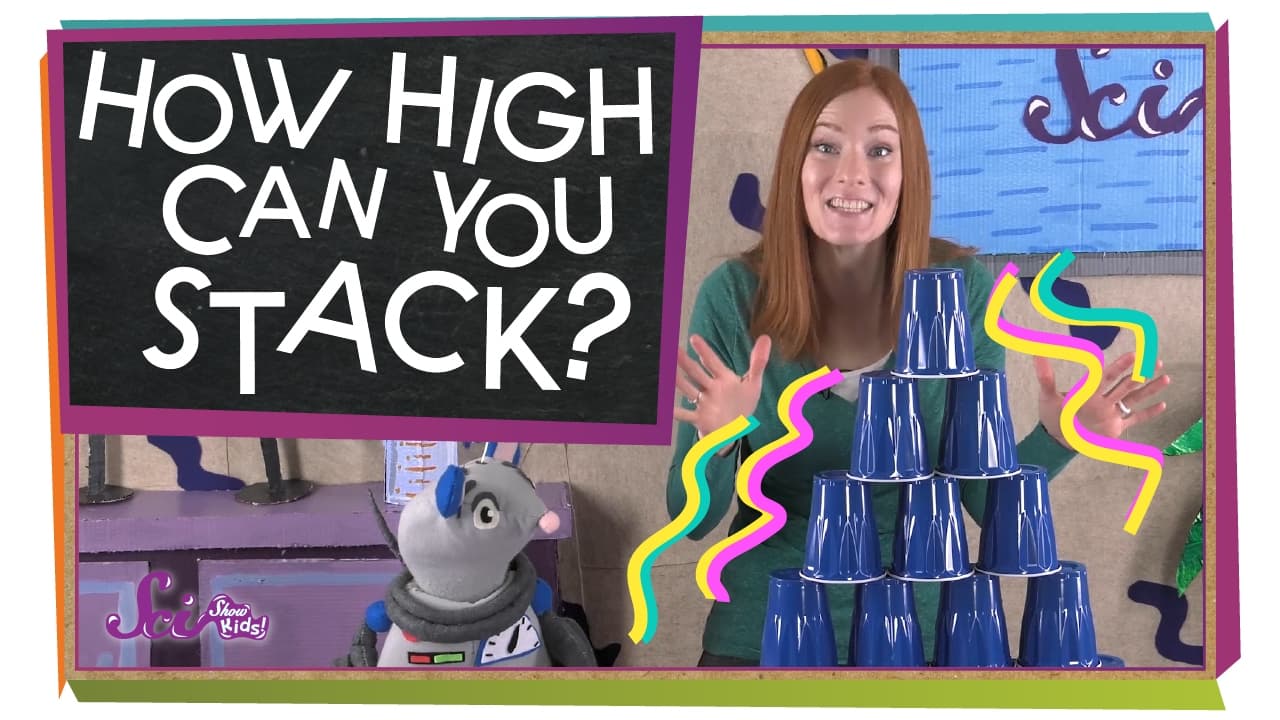
SciShow KidsSciShow Kids

16mins 44s

Video
What to Expect on Your First Airplane Ride

What to Expect on Your First Airplane Ride

In this engaging episode of Sci Kids, host Jessi helps her robot mouse friend, Squeaks, overcome his anxiety about taking his very first airplane flight. As they plan a trip to the Robot Hall of Fame in Pittsburgh, Jessi breaks down the entire travel experience into manageable, predictable steps to make the unknown less scary. The video combines live-action hosting with cute animations and real-world footage to illustrate every stage of air travel, from the busy airport terminal to landing on the runway. The video explores key themes of emotional regulation when facing new experiences, as well as fundamental scientific concepts related to flight. Jessi explains the physics of takeoff speed, the mechanics of air pressure and why ears "pop" at high altitudes, and the science behind turbulence, describing it simply as shifting air currents similar to wind on the ground. The content serves a dual purpose: soothing travel anxiety through knowledge and introducing basic aerodynamic and atmospheric science. For educators, this video is an excellent tool for both social-emotional learning and introductory physical science. It can be used to prepare students for field trips or vacations, helping them understand what to expect in new environments. Scientifically, it provides a clear, age-appropriate explanation of air pressure and how invisible forces affect our bodies and vehicles, making abstract concepts concrete through relatable examples like "popping" ears and bumpy car rides.

SciShow KidsSciShow Kids

4mins 54s

Video
How Fossil Fuels Generate Electricity

How Fossil Fuels Generate Electricity

This concise educational video explains the step-by-step process of generating electricity using fossil fuels. It begins by identifying the three primary fossil fuels—coal, natural gas, and petroleum—and visualizes their extraction and industrial use. The core of the video utilizes a clear, animated cross-section of a power plant to demonstrate the chain of energy transformations required to produce power: converting chemical energy in fuel to heat, heat to mechanical energy via steam and turbines, and finally into electrical energy through a generator. The video explores key themes of physical science and environmental science, specifically focusing on energy conversion and the environmental impact of human activity. It breaks down complex machinery like turbines and generators into understandable visual components. Furthermore, it honestly addresses the ecological cost of this process, highlighting how the combustion of these fuels releases harmful gases into the atmosphere, contributing to air pollution and climate change. For educators, this video serves as an excellent visual anchor for units on energy, natural resources, or environmental stewardship. The clear schematic animation helps students visualize the abstract concept of energy transfer, making it tangible. Teachers can use this resource to introduce the mechanics of electricity generation before diving into deeper discussions about renewable vs. non-renewable resources, the efficiency of energy transfer, or the engineering challenges of modern power grids.

Next Generation ScienceNext Generation Science

1min 47s

Video
Thermal Physics: Kinetic Energy, Heat Transfer, and Thermodynamics

Thermal Physics: Kinetic Energy, Heat Transfer, and Thermodynamics

This educational video provides a comprehensive introduction to thermal physics, bridging the gap between macroscopic observations and microscopic atomic behavior. It begins by defining thermal energy as a form of kinetic energy, using clear animations to show how particle motion increases with temperature. The lesson progresses through practical concepts including temperature scales, thermal equilibrium, and the three primary methods of heat transfer: conduction, convection, and radiation. The video also explores the states of matter, introducing plasma and explaining how phase changes occur as energy is added. A significant portion of the video is dedicated to explaining the three Laws of Thermodynamics in accessible terms, using real-world analogies like the decaying Colosseum to explain entropy. The content connects abstract physics concepts to tangible examples like molten iron, boiling water, and pottery kilns. This resource is highly valuable for middle and high school science classrooms as it visually demonstrates concepts that are often difficult for students to conceptualize, such as atomic vibration and entropy. Teachers can use this video to introduce a unit on thermodynamics, reinforce vocabulary around heat transfer, or visually demonstrate the relationship between kinetic energy and temperature.

Miacademy & MiaPrep Learning ChannelMiacademy & MiaPrep Learning Channel

10mins 56s

Video
How Solid Sugar Becomes Fluffy Cotton Candy

How Solid Sugar Becomes Fluffy Cotton Candy

This engaging video from Sci Kids! takes young learners on a tasty trip to the carnival to uncover the science behind a favorite treat: cotton candy. Hosted by Anthony and his robot friend Squeaks, the episode demystifies how hard, crunchy sugar crystals are transformed into soft, fluffy clouds. Through clear explanations and helpful animations, the video breaks down the physical changes that occur when sugar is heated and spun.

SciShow KidsSciShow Kids

4mins 47s

Video
The Science of Exploding Soap

The Science of Exploding Soap

In this engaging episode of SciShow Kids, host Jessi and her robot friend Squeaks demonstrate a classic and dramatic kitchen science experiment: the "exploding" soap trick. The video guides young viewers through the process of microwaving a specific type of soap to witness it expand into a massive, fluffy cloud. It explains the manufacturing process of Ivory soap, specifically how air is whipped into it, distinguishing it from other brands and making this specific reaction possible. The content explores key scientific concepts including states of matter, specifically the behavior of gases when heated. It introduces the term "water vapor" and uses clear animations to explain how heat energy causes gas molecules to move faster and expand. The narrative connects the microscopic behavior of air pockets and water trapped inside the soap to the macroscopic expansion seen in the microwave. This video is highly valuable for early elementary science classrooms as a safe, accessible introduction to thermal expansion and states of matter. It models the scientific method by encouraging predictions and observations. Teachers can use this video as a hook for lessons on heat energy, a demonstration of physical changes, or as a guide for a hands-on experiment that requires minimal materials but delivers maximum engagement.

SciShow KidsSciShow Kids

4mins 17s

Video
What Actually Happens When You Let Go of a Balloon?

What Actually Happens When You Let Go of a Balloon?

Have you ever accidentally let go of a helium balloon and watched it float away into the sky? In this episode of SciShow Kids, Jessi and her robot rat friend Squeaks explore the science behind that very moment. They explain exactly why helium balloons float while other objects don't, using a simple and effective analogy involving a spoon in a bowl of water to demonstrate the concept of density and buoyancy in a way young learners can grasp. The video takes students on a journey upwards through the atmosphere, investigating how conditions change as altitude increases. It covers key physical science concepts including air pressure (described as air spreading out), the properties of gases like helium, and atmospheric temperature changes. Viewers learn about the material science of rubber, seeing how it stretches when gas expands and becomes brittle when exposed to freezing temperatures at high altitudes. Beyond the physics, the video provides a crucial lesson in environmental stewardship. It explains the eventual fate of all balloons—popping or shattering and falling back to Earth—and the specific dangers this litter poses to wildlife who might mistake it for food. This combination of physics, earth science, and environmental responsibility makes it an excellent resource for discussing properties of matter, the atmosphere, and human impact on the environment.

SciShow KidsSciShow Kids

3mins 15s

Video
How Different Materials Conduct Heat

How Different Materials Conduct Heat

This educational video provides a clear, hands-on demonstration of heat conductivity using a simple comparative experiment. The video investigates how thermal energy travels differently through three distinct materials: metal, wood, and plastic. By placing spoons made of these materials into hot water, viewers observe which material conducts heat most effectively to melt a piece of margarine holding a button in place.

Next Generation ScienceNext Generation Science

2mins 37s

Video
How Earth's Global Wind and Ocean Currents Work

How Earth's Global Wind and Ocean Currents Work

This engaging science video explores the complex systems of global wind and water currents that shape Earth's weather and climate. Hosted by Sabrina Cruz, the video breaks down how the uneven heating of the Earth by the Sun creates pressure zones, driving the movement of air and water on a massive scale. It moves from explaining local phenomena like sea breezes to global atmospheric circulation cells and jet streams. The content covers essential Earth science concepts including direct versus indirect sunlight, the relationship between temperature and pressure density, and the mechanics of the jet stream. It also draws parallels between atmospheric winds and ocean currents, introducing thermohaline circulation and explaining why these systems are crucial for regulating global temperatures and making the planet habitable. Ideal for upper elementary and middle school science classrooms, this video visualizes invisible forces like air pressure and wind patterns through clear animations. It provides a solid foundation for units on weather, climate, and Earth's systems, helping students understand the 'why' behind the weather patterns they experience and the global connectivity of Earth's environment.

Crash Course KidsCrash Course Kids

5mins 7s

Video
Comparing Heat Conductivity: Metal vs. Glass Experiment

Comparing Heat Conductivity: Metal vs. Glass Experiment

This concise science demonstration visualizes the concept of thermal conductivity by comparing how heat travels through metal versus glass. Set against a high-contrast background, the video features a clear experiment where candles are attached to metal and glass rods using wax. As a central heat source is applied, viewers can observe the progressive melting of the wax on the metal rod, demonstrating how heat energy transfers through conductive materials over time. The video introduces key physics vocabulary including thermal energy, conductors, insulators, and heat transfer. It explicitly addresses the direction of heat flow (from hot to cold) and provides a side-by-side comparison that makes the abstract concept of material properties concrete for young learners. The distinct visual result—candles falling off the metal rod while staying put on the glass rod—serves as immediate, observable evidence. Teachers can use this video to anchor lessons on energy transfer, material science, or the scientific method. It provides an excellent phenomenon for students to observe, predict, and explain. The clear setup allows for easy replication in a lab setting, or serves as a safe virtual alternative for classrooms without access to Bunsen burners. It naturally leads into discussions about why we use specific materials for cooking pans versus handles, or building insulation.

Next Generation ScienceNext Generation Science

2mins 15s

Video
Building a Solar Updraft Tower to Explore Heat Energy

Building a Solar Updraft Tower to Explore Heat Energy

In this engaging episode of SciShow Kids, host Jessi and her robot rat friend Squeaks introduce young learners to the power of solar energy through a hands-on engineering project. Starting with a simple observation about the warmth of the sun, the video explains the concept of solar power and how it can be converted into electricity or heat. The core of the video demonstrates how to build a "Solar Updraft Tower" using recycled tin cans, a pinwheel, and common household items, effectively turning sunlight into mechanical motion.

SciShow KidsSciShow Kids

4mins 31s

Video
How Hot Air Balloons Rise and Float

How Hot Air Balloons Rise and Float

This engaging educational video from SciShow Kids explains the science behind how hot air balloons fly. Hosted by Jessi, the video breaks down complex physics concepts into age-appropriate explanations, starting with the fundamental idea that air is matter made of molecules. It uses clear animations to demonstrate how heat affects the movement of these molecules, causing them to spread out and become less dense. The content explores several key scientific themes, including states of matter, the behavior of gases, thermal expansion, and density. By connecting the abstract concept of air density to the more familiar concept of objects sinking or floating in water, the video provides a concrete framework for students to understand buoyancy. It also draws real-world connections, such as explaining why the upstairs of a house is warmer than the downstairs. For educators, this video serves as an excellent tool for introducing properties of matter or weather concepts. It visualizes the invisible behavior of gas molecules, making it easier for students to grasp why hot air rises. The clear cause-and-effect narrative—from heating the air to the balloon rising—supports logical thinking and scientific inquiry, making it suitable for elementary science curriculums focused on physical science and engineering.

SciShow KidsSciShow Kids

3mins 50s

Video
How Blubber Keeps Animals Warm in Icy Water

How Blubber Keeps Animals Warm in Icy Water

This engaging science video from SciShow Kids explores how animals like whales, seals, and walruses stay warm in freezing Arctic and Antarctic waters. Host Jessi explains the concept of adaptations, specifically focusing on "blubber," a thick layer of fat that insulates animals against extreme cold. The video combines real-world animal footage, clear diagrams, and an energetic narrative to make complex biological concepts accessible to young learners. The core of the video features a hands-on scientific experiment that demonstrates the insulating power of fat. Using shortening (cooking fat) as a substitute for blubber, Jessi conducts a "Blubber Glove" experiment to show the difference in temperature sensation between a bare hand and a protected hand when submerged in ice water. This practical demonstration introduces students to the scientific method, including making predictions, testing variables, and observing results. For educators, this video is an excellent resource for units on animal adaptations, habitats, and states of matter. It effectively models scientific inquiry and provides a safe, replicable experiment that can be performed in the classroom. The content bridges biology and physics (insulation) in a way that is visual, memorable, and directly relevant to understanding how living things survive in diverse environments.

SciShow KidsSciShow Kids

3mins 56s

Video
Graphing and Solving Quadratic Functions

Graphing and Solving Quadratic Functions

This educational video uses the real-world scenario of a diving competition to explain the properties and applications of quadratic functions. The video begins by modeling a diver's trajectory using a specific equation, challenging viewers to identify the correct graph that represents the dive based on concepts like x-intercepts and concavity. It effectively transitions from this concrete application to abstract algebraic problem-solving techniques. Key mathematical themes include analyzing parabolas, finding x-intercepts (also called roots or zeros), calculating the time interval between two intercepts, and utilizing the quadratic formula. The video provides a detailed explanation of the discriminant ($b^2 - 4ac$), demonstrating how it predicts the number and type of roots (real vs. imaginary) a function possesses. It also touches upon advanced concepts such as complex numbers and root multiplicity. This resource is highly valuable for algebra classrooms as it bridges the gap between theoretical math and physical motion. Teachers can use it to introduce quadratic modeling, reinforce the relationship between algebraic equations and their graphical representations, or as a comprehensive review of solving quadratics using factoring and the quadratic formula. The step-by-step walkthroughs of different problem types allow for paused learning and immediate practice.

Miacademy & MiaPrep Learning ChannelMiacademy & MiaPrep Learning Channel

15mins 35s

Video
Predicting How Objects Move Using Force and Speed

Predicting How Objects Move Using Force and Speed

This educational video explores the scientific principles behind predicting motion, demonstrating how observation and calculation allow us to anticipate how objects will move. It begins with simple, familiar examples like playground equipment to explain basic concepts of gravity and mechanics, before progressing to more complex scenarios involving friction, applied force, and variable conditions. The narration clearly links abstract physics concepts to tangible, everyday experiences, making the invisible forces of the world visible and understandable. Key themes include the relationship between force and distance, the effects of gravity and friction on moving objects, and the mathematical connection between speed, distance, and time. The video differentiates between simple predictions based on repetitive motion (like a swing) and complex calculations required for transportation systems like trains and airplanes, which must account for variables such as wind speed and weather conditions. For educators, this video serves as an excellent bridge between qualitative observation and quantitative analysis in science and math. It provides concrete examples for teaching Newton's laws of motion, data analysis, and critical thinking. The real-world applications—from scoring a goal in soccer to scheduling international flights—help students understand why mastering these concepts is essential for navigating and planning in their daily lives.

Next Generation ScienceNext Generation Science

5mins 30s

Video
Calculating Speed vs. Velocity: Definitions and Practice

Calculating Speed vs. Velocity: Definitions and Practice

This educational video provides a clear and comprehensive introduction to the physics concepts of speed and velocity. It begins by engaging students with examples of fast-moving objects like race cars and rockets before settling into the mathematical definitions of motion. The narrator uses real-world analogies, such as a long car trip involving both highway driving and traffic jams, to distinguish between average speed and instantaneous speed. The video then introduces the crucial distinction between scalar quantities and vector quantities, explaining how distance relates to speed while displacement relates to velocity. The content covers key themes in kinematics, specifically focusing on the difference between distance (total ground covered) and displacement (straight-line distance from start to finish). It explicitly teaches the formulas for calculating average speed (Distance/Time) and average velocity (Displacement/Time). A significant portion of the video is dedicated to step-by-step worked examples where the narrator calculates both speed and velocity for the same trip, demonstrating how the results differ numerically and conceptually—most notably that velocity requires a direction. For educators, this video is an excellent resource for middle school physical science or introductory high school physics classrooms. It moves beyond simple definitions to application, providing guided practice problems that allow students to test their understanding immediately. The use of visual maps to illustrate the path of travel versus the vector of displacement helps concrete thinkers grasp abstract concepts. Teachers can use this video to introduce motion formulas, reinforce the concept of vectors, or as a flipped classroom assignment before a lab on measuring motion.

Miacademy & MiaPrep Learning ChannelMiacademy & MiaPrep Learning Channel

7mins 42s

Video
Understanding Distance, Displacement, and Reference Frames

Understanding Distance, Displacement, and Reference Frames

This engaging physics lesson breaks down the fundamental concepts of motion by exploring the critical difference between distance and displacement. Through relatable real-world analogies like a cruise ship vacation and a road trip, the video illustrates how two seemingly similar measurements can yield vastly different results depending on the path taken. The narrator uses clear visual maps to demonstrate that distance is the total length traveled, while displacement is the straight-line "net change" from start to finish—often described as "as the crow flies." The video introduces the essential concept of "reference frames"—the perspective from which motion is measured. By contrasting the Earth's surface with the interior of a moving car, students learn that motion is relative; an object can be moving thousands of miles or standing perfectly still depending on what is defined as the fixed point. This conceptual framework helps explain why a passenger on a cruise ship might be considered stationary relative to the ship but moving rapidly relative to the Earth. Ideal for middle and high school physical science classes, this video bridges the gap between conceptual understanding and mathematical application. It walks students through step-by-step calculation problems involving one-dimensional motion (East/West and North/South), teaching them how to compute distance by adding total path lengths and displacement by finding the difference between starting and ending positions. The clear, guided practice problems provide excellent models for classroom problem-solving.

Miacademy & MiaPrep Learning ChannelMiacademy & MiaPrep Learning Channel

8mins 26s

Video
Mastering Acceleration: Definition, Units, and Calculations

Mastering Acceleration: Definition, Units, and Calculations

This educational video provides a comprehensive introduction to the physics concept of acceleration. It begins by grounding the abstract concept in physical sensation—explaining that acceleration is the motion you can actually feel, unlike constant velocity. The host guides viewers through the formal definition of acceleration as a vector quantity representing the rate of change in velocity, using clear visuals and real-world examples like motorcycles, top fuel dragsters, and space shuttles to illustrate these changes in speed and direction.

Miacademy & MiaPrep Learning ChannelMiacademy & MiaPrep Learning Channel

9mins 41s

Video
Investigating Gravity and Air Resistance

Investigating Gravity and Air Resistance

This educational science video from Crash Course Kids explores the fundamental concepts of gravity, mass, and air resistance. Host Sabrina Cruz investigates a common question: why do different objects seem to fall at different speeds on Earth? The video distinguishes between mass (the amount of matter in an object) and weight (the force of gravity pulling on that matter), correcting the misconception that heavier objects fall faster solely due to gravity.

Crash Course KidsCrash Course Kids

3mins 33s

Video
How Air Resistance Affects Falling Objects

How Air Resistance Affects Falling Objects

This engaging science video explores the physics behind falling objects, specifically tackling the interaction between gravity and air resistance. Hosted by Sabrina Cruz, the video investigates why objects of different masses, like a hammer and a feather, fall at the same speed on the Moon but different speeds on Earth. Through a mix of live-action explanation and animated simulations, it recreates Commander David Scott's famous Apollo 15 experiment to demonstrate that air resistance, not gravity alone, determines how fast objects fall in an atmosphere. The content focuses on core physics concepts including gravity, friction, air resistance, and the definition of a vacuum. It introduces the scientific method by isolating variables: first dropping a ball and a parachute on Earth, and then simulating the same drop in a vacuum (an airless environment). The video clearly defines 'air resistance' as friction between an object and the air, and 'vacuum' as a space void of matter, helping students visualize invisible forces. For educators, this video is an excellent tool for correcting the common misconception that heavier objects fall faster than lighter ones. It provides a visual proof that is often impossible to demonstrate in a standard classroom setting (the vacuum chamber experiment). Teachers can use this to introduce forces and motion, the history of space exploration, or the importance of controlling variables in scientific experiments.

Crash Course KidsCrash Course Kids

4mins 1s

Video
Tracking Motion: An Introduction to Kinematics and Friction

Tracking Motion: An Introduction to Kinematics and Friction

This educational video serves as a comprehensive introduction to a high school physics unit on kinematics. The host begins by connecting physics to exciting real-world examples like fast cars, rockets, and sports to explain that kinematics is the study of motion using mathematical equations. The video outlines a clear progression of learning, starting with simple one-dimensional motion, advancing to two-dimensional projectile motion, and finally introducing the concept of friction, which is often initially neglected in basic kinematic models. The content explores several key physics themes, including the difference between distance and displacement, the decomposition of vectors into vertical and horizontal components, and the distinction between static and kinetic friction. It uses visual aids like triangles overlaid on basketball shots and skiers on slopes to demonstrate how complex motion can be broken down into manageable mathematical parts. The concept of an "inclined plane" is also introduced, showing how gravity affects objects on a slope. For educators, this video is an excellent "unit hook" or introductory overview for a physics class. It sets the stage for future lessons on calculating velocity, acceleration, and force. The clear definitions and visual examples of vector components make abstract trigonometric applications concrete for students. Teachers can use the built-in review quiz at the end of the video as a formative assessment to check for immediate understanding of the key vocabulary introduced.

Miacademy & MiaPrep Learning ChannelMiacademy & MiaPrep Learning Channel

7mins 58s

Video
Mastering Position-Time Graphs and Calculating Velocity

Mastering Position-Time Graphs and Calculating Velocity

This educational video provides a clear and comprehensive introduction to position-time graphs, bridging the gap between algebraic concepts and physics applications. By analyzing real-world examples like Usain Bolt's world-record sprint and a daily walk to a mailbox, the narrator demonstrates how to translate motion into graphical data. The lesson systematically breaks down the components of a line graph, explains the physical significance of slope and y-intercept, and derives the fundamental physics equation for motion ($d_f = vt + d_0$) from the slope-intercept form ($y = mx + b$). The content explores key kinematics themes including constant velocity, changing velocity, and directionality. Viewers learn that the slope of a position-time graph represents velocity, with steeper slopes indicating faster speeds and horizontal lines indicating a stationary object. The video also addresses the concept of negative velocity, using a multi-segment graph to illustrate how moving back towards a starting point results in a negative slope. Through step-by-step calculations, students are guided on how to determine average velocity for different segments of a trip. This resource is highly valuable for middle and high school physical science or physics classrooms, particularly for students struggling to connect abstract math skills with concrete science concepts. It offers excellent classroom applications, such as analyzing motion graphs, calculating rates of change, and understanding the difference between speed and velocity. The clear visual aids and step-by-step derivation of formulas make it an ideal tool for introducing kinematics or reviewing graphing skills in a scientific context.

Miacademy & MiaPrep Learning ChannelMiacademy & MiaPrep Learning Channel

13mins 6s

Video
Mastering the Five Kinematic Equations

Mastering the Five Kinematic Equations

This video serves as a comprehensive introduction to the five fundamental kinematic equations used in physics to describe motion under constant acceleration. It moves beyond simple concepts to formalize the mathematical relationships between displacement, velocity, acceleration, and time. Through a series of clear, step-by-step examples involving runners, cars, space shuttles, and rockets, the narrator demonstrates how to select the correct equation based on the known variables in a problem.

Miacademy & MiaPrep Learning ChannelMiacademy & MiaPrep Learning Channel

12mins 51s

Video
Solving Physics Problems with Kinematic Equations

Solving Physics Problems with Kinematic Equations

This video serves as a practical guide for high school physics students on how to apply kinematic equations to solve one-dimensional motion problems. Building on a previous lesson that introduced the equations, the narrator outlines a systematic five-step approach to problem-solving: sketching the scenario, identifying knowns and unknowns, selecting the appropriate equation, plugging in values to solve, and verifying that the answer makes sense. The video models this process through three distinct practice problems involving dragsters. The content focuses heavily on the procedural aspects of physics problems, including critical mathematical skills like algebraic rearrangement, unit conversions (miles to meters), and significant figures. It specifically addresses how to handle implicit information—such as recognizing that "from rest" means an initial velocity of zero—and how to select the correct equation based on the variables provided. The examples progress in difficulty, starting with calculating average velocity, moving to finding final velocity with unit conversions and square roots, and concluding with calculating acceleration. For educators, this resource provides a clear, modeled instruction on the "how-to" of physics calculations, moving beyond theory to application. It effectively demonstrates the cognitive steps experts take when approaching word problems, making it an excellent tool for scaffolding independent practice. The emphasis on checking units and significant figures reinforces good scientific habits, while the step-by-step walkthroughs allow teachers to pause and let students attempt calculations before seeing the solution.

Miacademy & MiaPrep Learning ChannelMiacademy & MiaPrep Learning Channel

13mins 51s

Video
How to Calculate Speed and Describe Motion

How to Calculate Speed and Describe Motion

This educational video provides a clear and comprehensive introduction to the concepts of motion and speed for elementary and middle school students. It begins by defining motion as a continuous change in position and explores different ways objects move, such as back-and-forth, circular, and linear motion. The core of the video focuses on defining speed as the rate at which an object covers distance, introducing the formula: Speed = Distance ÷ Time. The video breaks down speed calculation into two common units of measurement: meters per second (m/s) for short, fast bursts (like a sprinter or a drag car) and kilometers per hour (km/h) for longer journeys (like a train or boat). It uses high-quality, real-world footage to demonstrate these concepts, showing step-by-step mathematical calculations on screen for various scenarios, including a swimmer, a cyclist, and a train. For educators, this resource serves as an excellent dual-purpose tool for both Science and Math. It visually connects abstract physics concepts with practical division problems. The video concludes with a 10-question interactive "Speed Quiz" that challenges students to apply the formula they just learned, making it a ready-to-use lesson starter or review activity. The clear narration and visual text support diverse learners in grasping the relationship between distance, time, and speed.

Next Generation ScienceNext Generation Science

7mins 42s

Video
How to Solve Physics Problems with Gravity

How to Solve Physics Problems with Gravity

This educational video provides a comprehensive guide to understanding and solving physics problems involving gravitational acceleration. Hosted by an engaging instructor, the lesson begins by establishing the fundamental concept that gravity causes objects to accelerate towards Earth at a rate of 9.8 meters per second squared, regardless of their mass. The video uses historical context, citing Galileo's famous Leaning Tower of Pisa experiment, to clarify common misconceptions about heavy and light objects falling at different rates.

Miacademy & MiaPrep Learning ChannelMiacademy & MiaPrep Learning Channel

15mins 45s

Video
Understanding Units of Speed: From Walking to Light Years

Understanding Units of Speed: From Walking to Light Years

This educational video provides a clear and comprehensive overview of the various units used to measure speed, explaining why different contexts require different measurements. It breaks down the concept of speed as a measure of how fast an object moves and introduces viewers to specific units ranging from everyday metrics like meters per second and kilometers per hour to specialized units like knots for aviation and maritime navigation. The video explores key scientific measurements including the Mach number for supersonic travel and the speed of light for astronomical distances. It effectively demonstrates the scale of these units, comparing the walking pace of a human to the immense velocity of light traveling around the Earth. Through high-quality visuals of traffic, aircraft, and celestial bodies, the content illustrates how each unit is tailored to the specific scale of movement being observed. For educators, this video serves as an excellent bridge between mathematics and physical science. It offers practical applications for unit conversion lessons and helps students understand the 'why' behind scientific conventions. It is particularly useful for introducing kinematics in physics or for exploring measurement systems in mathematics, providing concrete examples that make abstract numbers relatable and easier to visualize.

Next Generation ScienceNext Generation Science

4mins 33s

Video
How Acceleration Works: Speeding Up and Slowing Down

How Acceleration Works: Speeding Up and Slowing Down

This engaging video introduces students to the fundamental physics concept of acceleration, breaking it down into three clear categories: positive acceleration, negative acceleration, and constant speed. Through high-energy visuals ranging from Formula 1 cars and roller coasters to everyday examples like ceiling fans and traffic lights, the narration explains that acceleration is simply any change in speed over time. The video effectively distinguishes between "going fast" and the actual rate of changing speed, helping students separate velocity from acceleration. The content explores key themes of motion and forces, specifically focusing on how objects change their state of motion. It provides concrete examples of positive acceleration (speeding up) using race cars and skydivers, and negative acceleration (slowing down) using braking trains and crash test simulations. It also contrasts these dynamic states with constant speed, using visual anchors like a cruising airplane and a spinning fan to illustrate motion without acceleration. For educators, this video serves as an excellent visual primer for a unit on motion and stability. It simplifies abstract definitions into observable phenomena, making it ideal for introducing Newton's laws or kinematics. Teachers can use the distinct visual examples to have students practice identifying types of motion, analyzing speed-time graphs, or discussing the real-world implications of physics concepts, such as why vehicle safety features are designed to manage negative acceleration.

Next Generation ScienceNext Generation Science

3mins 43s

Video
How Skydiving Explains Terminal Velocity and Air Resistance

How Skydiving Explains Terminal Velocity and Air Resistance

This educational video uses the exciting context of skydiving to explain fundamental physics concepts including gravity, acceleration, air resistance (drag), and terminal velocity. Through a combination of high-quality live-action footage of skydivers and clear animated diagrams with force vectors, the video breaks down how falling objects interact with the air around them. It illustrates how gravity pulls objects down while air resistance pushes back, eventually leading to a balanced state known as terminal velocity.

Next Generation ScienceNext Generation Science

2mins 29s

Video
How Objects Accelerate by Slowing Down and Turning

How Objects Accelerate by Slowing Down and Turning

This physics video provides an in-depth exploration of acceleration, challenging the common misconception that it only refers to speeding up. The instructor explains that in physics, acceleration is a vector quantity defined as any rate of change in velocity. Through clear visual examples and animations, the video demonstrates the three distinct ways an object can accelerate: speeding up, slowing down (negative acceleration), and changing direction (turning). Special attention is given to the direction of acceleration vectors relative to velocity vectors in each scenario. The content moves from conceptual understanding to mathematical application. It guides students through a step-by-step problem-solving process to calculate negative acceleration using the formula for rate of change in velocity. The video uses a race car deploying a parachute as a practical example, showing how to determine variables, select the correct equation, and solve for the answer with appropriate units and significant figures. This resource is highly valuable for physical science and physics classrooms as it bridges the gap between intuitive understandings of motion and formal physics definitions. It specifically addresses the tricky concept of "slowing down" as acceleration in the negative direction and the often-overlooked fact that turning at a constant speed is also acceleration. The included practice scenarios at the end provide immediate formative assessment opportunities for teachers to check student comprehension.

Miacademy & MiaPrep Learning ChannelMiacademy & MiaPrep Learning Channel

11mins 39s

Video
How to Read Velocity-Time Graphs to Find Acceleration and Displacement

How to Read Velocity-Time Graphs to Find Acceleration and Displacement

This educational video provides a clear, step-by-step guide to understanding and analyzing velocity vs. time graphs in physics. It begins by contrasting position-time graphs with velocity-time graphs using the real-world example of a marathon runner to demonstrate constant velocity. The instructor establishes two fundamental rules of kinematic graphing: the slope of a velocity-time graph represents acceleration, and the area under the curve represents displacement. The video progresses from simple constant velocity scenarios to more complex motion using an elevator example that involves speeding up, constant speed, and slowing down. Through this narrative, viewers learn to calculate acceleration by finding the slope of line segments and calculate displacement by finding the area of geometric shapes (rectangles and triangles) formed by the graph line. Detailed practice problems are integrated directly into the lesson, allowing students to pause and test their understanding of instantaneous velocity, acceleration calculation, and displacement calculation. This resource is highly valuable for high school physics and physical science classrooms. It effectively bridges the gap between mathematical concepts (slope and area) and physical realities (acceleration and distance). Teachers can use this video to introduce kinematic graphs, reinforce the connection between math and science, or provide targeted practice for students struggling to interpret motion graphs.

Miacademy & MiaPrep Learning ChannelMiacademy & MiaPrep Learning Channel

12mins 12s

Video
How to Measure and Calculate Speed

How to Measure and Calculate Speed

This educational video provides a clear and engaging introduction to the concepts of motion and speed for elementary and middle school students. It begins by observing the various ways objects move in our world, such as in straight lines, turning, rolling, and bouncing, using diverse visual examples ranging from paper airplanes to roller coasters. This qualitative introduction helps ground the physics concepts in observable reality before moving to more abstract definitions. The video then transitions to the concept of speed, defining it simply as how fast or slow something moves. It uses comparative examples—like a cheetah versus a turtle, and a kayak versus a jet ski—to illustrate speed differences. Crucially, the video introduces the mathematical formula for calculating speed (Speed = Distance ÷ Time) and demonstrates this with two distinct examples: calculating a car's speed in kilometers per hour and a sprinter's speed in meters per second. For educators, this resource serves as an excellent bridge between observing motion and mathematically quantifying it. It provides visual anchors for vocabulary terms and step-by-step walkthroughs of calculations that can be paused for student participation. The content effectively links science concepts with math skills (division), making it suitable for interdisciplinary lessons in physical science and mathematics.

Next Generation ScienceNext Generation Science

2mins 16s

Video
Understanding Gravity: How Mass and Distance Create Attraction

Understanding Gravity: How Mass and Distance Create Attraction

This engaging video lesson explores the fundamental force of gravity, moving beyond the simple idea of "falling down" to a deeper scientific understanding of attraction between matter. Through the energetic hosting of Justin, students are guided from Sir Isaac Newton's apple to the orbits of planets, debunking common misconceptions along the way. The video clarifies the difference between a colloquial "theory" and a "scientific theory," providing students with essential vocabulary for scientific literacy. The content breaks down the two key factors that determine the strength of gravity: mass and distance. Using visual aids like penguins in Antarctica, a hypothetical "growth ray" turning a pencil into a planet-sized object, and the International Space Station, the video illustrates abstract physics concepts in concrete, humorous ways. It explains why we stick to the Earth, why planets orbit the Sun, and how astronauts experience gravity differently in space. Teachers can use this video to introduce a unit on forces and motion, astronomy, or the scientific method. Its clear explanations of mass and distance make it an excellent tool for helping students visualize invisible forces. The video includes built-in pause points for reflection and note-taking, making it ready-to-use for interactive classroom learning. It connects everyday experiences, like jumping on a trampoline, to cosmic phenomena, helping students realize that the same laws of physics apply everywhere in the universe.

Miacademy & MiaPrep Learning ChannelMiacademy & MiaPrep Learning Channel

9mins 40s

Video
How GPS Works and Why We Need It

How GPS Works and Why We Need It

This educational video provides a clear and engaging explanation of the Global Positioning System (GPS), tracing its evolution from a military tool to an essential part of daily civilian life. The video begins by contrasting modern digital navigation with the traditional use of paper maps, highlighting the convenience technology has brought to travel. It then dives into the technical mechanics of GPS, explaining how a network of satellites orbiting Earth communicates with receivers in devices like smartphones to determine precise locations through signal timing.

Next Generation ScienceNext Generation Science

7mins 7s

Video
How Gravity Shapes Orbits in Space

How Gravity Shapes Orbits in Space

This educational video from Crash Course Kids explores the mechanics of orbits in space, moving beyond simple planetary rotation to explain the gravitational forces that govern the universe. The host, Sabrina Cruz, breaks down why lighter objects orbit heavier ones, using the relationship between Earth and the Sun as a primary example. The video expands this concept to the galactic scale, explaining how the entire solar system orbits a supermassive black hole at the center of the Milky Way without getting swallowed up.

Crash Course KidsCrash Course Kids

4mins 31s

Video
How Gravity Causes Spring and Neap Tides

How Gravity Causes Spring and Neap Tides

This concise educational video explains the scientific phenomenon of ocean tides, breaking down the complex gravitational interactions between the Earth, Moon, and Sun. It begins by defining tides and showing a dramatic time-lapse of sea levels rising and falling in a coastal community, grounding the abstract concept in real-world observation. The video effectively bridges the gap between observable daily changes in the ocean and the celestial mechanics that drive them. The content focuses on distinguishing between two specific types of tidal patterns: Spring Tides (or King Tides) and Neap Tides. Through clear animated diagrams, it illustrates how the alignment of the Earth, Moon, and Sun during different lunar phases amplifies or cancels out gravitational forces. It explains that Spring Tides occur during full and new moons when gravity is aligned, while Neap Tides occur during quarter moons when gravitational forces pull at right angles. For educators, this resource serves as an excellent visual aid for Earth Science and Physics units. It simplifies the concept of gravitational force vectors without using complex math, making it accessible for upper elementary and middle school students. The combination of time-lapse footage and top-down solar system views helps students visualize why tides change intensity throughout the month, providing a solid foundation for lessons on the lunar cycle, gravity, and oceanography.

Next Generation ScienceNext Generation Science

1min 42s

Video
How Gravity Pulls Things Toward Earth

How Gravity Pulls Things Toward Earth

This engaging science video explores the concept of gravity, specifically addressing the common childhood question: "If the Earth is round, why don't people on the bottom fall off?" Hosted by Sabrina Cruz, the video uses humor, clear definitions, and a simple hands-on demonstration to explain how gravity functions as an attractive force. It redefines the concepts of "up" and "down" in the context of a spherical planet, helping students understand that "down" simply means towards the center of the Earth. The video covers key themes such as forces of attraction, matter, and the directional nature of gravitational pull. It clarifies that gravity is a relationship between objects with mass, explaining that because Earth is so massive compared to us, we are pulled towards it. The content specifically tackles the misconception that "down" is a universal direction, replacing it with the scientific understanding of gravitational attraction towards a planetary center. For educators, this resource provides an excellent visual and practical method for teaching abstract physics concepts to elementary students. The featured "tennis ball and rubber band" experiment is cheap, replicable, and highly effective for classroom use. The video is perfect for introducing a unit on forces, debunking misconceptions about space and gravity, or as a hook for Earth science lessons.

Crash Course KidsCrash Course Kids

2mins 59s

Video
Calculating the Force of Gravity with Newton's Law

Calculating the Force of Gravity with Newton's Law

This educational video provides a comprehensive introduction to Newton's Law of Universal Gravitation, bridging conceptual understanding with mathematical application. It begins by contextualizing the universality of physical laws, explaining how the same force that causes an apple to fall also governs the motion of planets. The narrator breaks down the gravitational formula step-by-step, identifying each variable and explaining the significance of the gravitational constant (G) determined by Henry Cavendish.

Miacademy & MiaPrep Learning ChannelMiacademy & MiaPrep Learning Channel

11mins 37s

Video
How Gravity Works: The Invisible Force That Pulls Us Down

How Gravity Works: The Invisible Force That Pulls Us Down

This engaging educational video introduces students to the fundamental concept of gravity, explaining it as an invisible force that pulls objects toward one another. Through clear demonstrations and real-world examples like falling leaves and skydiving, the host illustrates how gravity acts on everything on Earth. The video distinguishes between push and pull forces, using a simple ball toss experiment to show how gravity counters upward momentum. The content explores the history of gravitational theory, retelling the famous story of Isaac Newton and the falling apple. It expands the concept beyond Earth, explaining how the same force that drops an apple also keeps planets in orbit around the sun. The relationship between mass and gravity is introduced, clarifying that while all objects have gravity, it is the Earth's massive size that makes its pull the most observable force in our daily lives. Ideal for elementary science classrooms, this resource demystifies abstract physics concepts using accessible language and visuals. It concludes with a built-in multiple-choice quiz, making it a complete lesson package for teachers to check for understanding immediately after viewing. The video effectively bridges the gap between everyday observations—like dropping a ball—and larger astronomical concepts, providing a solid foundation for physical science units.

Next Generation ScienceNext Generation Science

4mins 59s

Video
How Gravity Works: From Falling Apples to Orbits

How Gravity Works: From Falling Apples to Orbits

This educational video introduces students to the fundamental concept of gravity, defined as an invisible force that pulls objects toward the center of the Earth. Hosted in the "Lighthouse Lab," the presenter uses clear demonstrations, such as throwing a ball into the air, to illustrate the difference between push forces and the pull of gravity. The video seamlessly transitions from everyday examples—like falling leaves and waterfalls—to the historical discovery of gravity by Isaac Newton in the 1600s. The content explores the scientific definition of gravity as a force existing between all objects with mass, distinguishing it from magnetic force. It explains the relationship between mass and gravitational pull, clarifying why the Earth pulls objects down rather than objects pulling the Earth up noticeably. The narrative extends this concept to the solar system, explaining how the same force that drops an apple also keeps planets in orbit around the Sun and the Moon around the Earth. For educators, this video serves as an excellent anchor for units on forces and motion, the history of science, or astronomy. It addresses common misconceptions about why things fall and connects terrestrial physics (falling apples) with celestial mechanics (orbits) in an age-appropriate way. The mix of live-action demonstration and animated storytelling makes abstract physics concepts concrete and accessible for elementary and middle school students.

Next Generation ScienceNext Generation Science

4mins 3s

Video
Gravity Explained: From Earth to the Moon

Gravity Explained: From Earth to the Moon

This educational video from Crash Course Kids explores the fundamental principles of gravity and how they apply to space travel, specifically a journey from the Earth to the Moon. Hosted by Sabrina, the video breaks down complex physics concepts like escape velocity, mass, and gravitational force into accessible, age-appropriate explanations using engaging animations and clear analogies.

Crash Course KidsCrash Course Kids

3mins 55s

Video
Exploring Our Eight Planets: A Journey Through the Solar System

Exploring Our Eight Planets: A Journey Through the Solar System

This comprehensive educational video provides an in-depth tour of the solar system, exploring the Sun and each of the eight planets in detail. It breaks down the unique characteristics of every celestial body, from the blistering heat of Venus to the icy winds of Neptune, while also explaining fundamental concepts like gravity, orbits, and nuclear fusion. The video is structured into distinct sections for each planet, allowing for focused learning on specific topics. The narrative emphasizes the scientific data gathered by various space missions, such as Voyager, Cassini, and Curiosity, connecting historical exploration with current knowledge. Key themes include the classification of planets (terrestrial vs. gas/ice giants), atmospheric compositions, geological features, and the specific mechanics of planetary rotation and revolution. The video also highlights the unique position of Earth as the only known life-supporting planet. For educators, this video serves as a complete unit on the solar system. It is uniquely designed with built-in "Quick Quiz" assessment checkpoints after each section, making it an interactive tool for checking student understanding in real-time. Teachers can use this resource to introduce planetary science, support research projects, or as a visual anchor for lessons on astronomy and space exploration.

Next Generation ScienceNext Generation Science

33mins 51s

Video
How Gravity Works: Isaac Newton and the Apple Story

How Gravity Works: Isaac Newton and the Apple Story

This engaging video from SciShow Kids explores the life and discoveries of Sir Isaac Newton, specifically focusing on his famous theory of gravity. Hosted by Jessi and her robot mouse friend Squeaks, the video uses the legendary story of the falling apple to explain complex physical concepts in an accessible way for young learners. It breaks down what gravity is—a force that pulls objects toward one another—and explains how this same force keeps the Moon in orbit around the Earth and the Earth in orbit around the Sun. The video covers key scientific themes including forces (pushes and pulls), mass, attraction, and orbital mechanics. It effectively simplifies the relationship between an object's size/weight and its gravitational pull. Additionally, the video touches upon historical analysis by investigating the truth behind the "apple hitting the head" myth, introducing students to the idea of primary sources through William Stukeley's account. For educators, this resource is an excellent tool for introducing units on forces and motion or the solar system. It provides clear visual metaphors for gravity and orbits that are often difficult to visualize. The segment on the historical accuracy of the apple story also offers a unique opportunity to teach critical thinking and the difference between historical fact and legend. The video is upbeat, visually stimulating, and uses humor to keep students engaged while delivering foundational physics concepts.

SciShow KidsSciShow Kids

4mins 57s

Video
Resolving the Gravity Paradox: Why Heavy Objects Don't Fall Faster

Resolving the Gravity Paradox: Why Heavy Objects Don't Fall Faster

This physics video addresses a common student paradox regarding gravity: if the force of gravity depends on an object's mass, why do all objects fall with the same acceleration regardless of their weight? The video begins by defining a paradox and setting up the conflict between the observation that acceleration is constant (9.8 m/s²) and the Law of Universal Gravitation which includes mass as a variable. The content moves from a conceptual discussion to a mathematical proof using Newton's Second Law and the Law of Universal Gravitation. Through step-by-step algebraic derivation, the narrator demonstrates how the mass of the falling object cancels out of the equation, leaving acceleration dependent only on the mass and radius of the planet. The video also applies this logic to calculate the gravitational acceleration on the Moon. This resource is highly valuable for high school physics classrooms as it bridges the gap between conceptual understanding and mathematical application. It directly addresses a specific cognitive conflict that many students face when learning Newton's laws. Teachers can use this video to model problem-solving strategies, reinforce algebraic substitution in physics, and visually demonstrate why "heavy" objects do not fall faster than "light" ones in a vacuum.

Miacademy & MiaPrep Learning ChannelMiacademy & MiaPrep Learning Channel

8mins 40s

Video
Exploring Ocean Waves and Tides

Exploring Ocean Waves and Tides

In this engaging episode of SciShow Kids, the host and his robot friend Squeaks explore the science behind the ocean's movements. Starting with a simple seashell found on the beach, they investigate how waves are formed by wind energy and explain the physics of water particle motion. The video then transitions to a broader look at planetary forces, illustrating how the moon's gravity creates high and low tides that change the landscape of the beach throughout the day. Key scientific themes include forces and motion, energy transfer from wind to water, and the gravitational relationship between the Earth and the Moon. The video introduces specific vocabulary such as 'crest,' 'trough,' 'gravity,' and 'orbit,' while also distinguishing between typical wind-driven waves and extreme events like tsunamis caused by earthquakes and volcanoes. For educators, this video is an excellent visual aid for Earth Science units focusing on oceans or weather. It uses clear animations to demonstrate concepts that are difficult to observe directly, such as the circular motion of water particles within a wave and the global pull of the moon. The segment on gravity offers an interactive moment for students to physically engage with the concept, making it suitable for active classroom learning.

SciShow KidsSciShow Kids

5mins 17s

Video
Exploring Life on the International Space Station

Exploring Life on the International Space Station

This engaging video introduces students to the International Space Station (ISS), the largest man-made object in space. It begins by contrasting the billions of people living on Earth with the select few who live and work in orbit. The video breaks down complex statistics into understandable comparisons, such as equating the station's size to a football field and illustrating its incredible speed of 27,000 kilometers per hour. Key themes include orbital physics, microgravity, and the vital role of international cooperation in scientific advancement. Viewers are taken inside the modules to see astronauts conducting experiments and managing daily life in a weightless environment. The content highlights how the ISS serves as a unique orbiting laboratory where nations share data to solve problems and prepare for future exploration. Ideally suited for science and social studies curriculums, this video helps educators teach concepts regarding gravity, orbit, and global citizenship. The clear visuals of floating objects and Earth from above provide excellent hooks for discussions about forces and motion, while the narrative emphasis on teamwork reinforces social-emotional learning goals regarding collaboration.

Next Generation ScienceNext Generation Science

2mins 50s

Video
What Would Happen If the Moon Disappeared?

What Would Happen If the Moon Disappeared?

This educational video investigates the hypothetical scenario of the moon suddenly disappearing to teach students about the moon's critical roles in Earth's systems. By asking "What if?", the video guides viewers through the specific ways the moon influences our planet, including creating tides, stabilizing Earth's axial tilt, and maintaining the regularity of our seasons. It serves as an engaging hook to learn about astronomy and gravitational physics. The video covers several key astronomical concepts: the moon's physical characteristics and formation theory, the mechanics of synchronous rotation (why we only see one side), the gravitational pull that causes ocean tides, and the stabilizing effect the moon has on Earth's wobble. It also addresses common misconceptions, such as the nature of the "dark side" of the moon. This resource is highly valuable for Earth Science and Astronomy units. It uses clear analogies—like comparing Earth and the Moon to a basketball and tennis ball, or using a spinning top to explain axial tilt—that make abstract concepts concrete. The video includes built-in pause points for reflection and note-taking, making it ready-made for interactive classroom viewing. Teachers can use it to spark discussions about gravity, ecosystems, and the delicate balance of our solar system.

Miacademy & MiaPrep Learning ChannelMiacademy & MiaPrep Learning Channel

9mins 35s

Video
How Satellites and the Moon Stay in Orbit

How Satellites and the Moon Stay in Orbit

In this engaging episode of Crash Course Kids, host Sabrina Cruz explores the science behind orbits, focusing specifically on why objects like the Moon and artificial satellites don't crash into the Earth despite gravity's pull. The video breaks down complex physics concepts into accessible segments, explaining the delicate balance between gravitational pull and velocity that keeps objects in stable orbit. It uses clear analogies, such as "falling toward Earth but missing," to help students visualize orbital mechanics. The video covers key astronomical concepts including the definition of an orbit, the distinction between natural satellites (like the Moon) and artificial satellites (like the International Space Station), and the formation history of the Moon. It also highlights the practical applications of satellites in our daily lives, from weather forecasting to telecommunications, making the abstract science relevant to students' experiences. For educators, this resource serves as an excellent anchor for units on space systems, forces, and motion. It provides clear definitions of scientific vocabulary like gravity, orbit, and velocity, supported by visual text and animations. The content naturally lends itself to classroom demonstrations of centripetal force and discussions about the engineering challenges involved in space exploration.

Crash Course KidsCrash Course Kids

4mins 26s

Video
How Objects Accelerate by Slowing Down and Turning

How Objects Accelerate by Slowing Down and Turning

This physics video provides an in-depth exploration of acceleration, challenging the common misconception that it only refers to speeding up. The instructor explains that in physics, acceleration is a vector quantity defined as any rate of change in velocity. Through clear visual examples and animations, the video demonstrates the three distinct ways an object can accelerate: speeding up, slowing down (negative acceleration), and changing direction (turning). Special attention is given to the direction of acceleration vectors relative to velocity vectors in each scenario. The content moves from conceptual understanding to mathematical application. It guides students through a step-by-step problem-solving process to calculate negative acceleration using the formula for rate of change in velocity. The video uses a race car deploying a parachute as a practical example, showing how to determine variables, select the correct equation, and solve for the answer with appropriate units and significant figures. This resource is highly valuable for physical science and physics classrooms as it bridges the gap between intuitive understandings of motion and formal physics definitions. It specifically addresses the tricky concept of "slowing down" as acceleration in the negative direction and the often-overlooked fact that turning at a constant speed is also acceleration. The included practice scenarios at the end provide immediate formative assessment opportunities for teachers to check student comprehension.

Miacademy & MiaPrep Learning ChannelMiacademy & MiaPrep Learning Channel

11mins 39s

Video
Understanding Kepler's First Law and Elliptical Orbits

Understanding Kepler's First Law and Elliptical Orbits

This educational video explores Kepler's First Law of Planetary Motion, explaining that planets orbit the sun in elliptical paths rather than perfect circles. It begins by defining the etymology of the word "planet" and contrasting ancient observations of stars versus planets. The narrator creates a clear distinction between the circular orbits proposed by Copernicus and the elliptical reality discovered by Johannes Kepler, using visual aids to demonstrate the geometry of an ellipse, including its two foci.

Miacademy & MiaPrep Learning ChannelMiacademy & MiaPrep Learning Channel

12mins 30s

Video
How the Earth Moves: Rotation, Revolution, and Seasons

How the Earth Moves: Rotation, Revolution, and Seasons

This installment of Crash Course Geography explores the fundamental movements of our planet—rotation and revolution—and how they shape life on Earth. Host Alizé Carrère begins with a personal anecdote about growing up in a treehouse to illustrate adapting to nature, before zooming out to the cosmic origins of our solar system. The video explains the physics behind Earth's formation from a solar nebula, detailing why the planet spins and orbits the way it does.

CrashCourseCrashCourse

10mins 33s

Video
Understanding Gravity: The Force That Pulls Us Down

Understanding Gravity: The Force That Pulls Us Down

This concise educational video provides a clear introduction to gravity as a non-contact force. Through a combination of live-action footage and 3D animations, it explains the fundamental definition of gravity as an attractive pull between objects with mass. The video specifically breaks down the two main factors that influence gravitational strength: the mass of the objects involved and the distance between them. The content visualizes abstract concepts by using relatable examples, such as a girl jumping on a trampoline, planets orbiting the sun, and a basketball player shooting hoops. It visually demonstrates how larger objects (like Earth) have stronger gravitational pulls than smaller ones (like the Moon), and how this force weakens as objects move further apart. The video concludes by connecting these concepts to our daily experience on Earth and the structure of our solar system. For educators, this video serves as an excellent hook or review tool for physical science units on forces and motion. It directly addresses Next Generation Science Standards regarding non-contact forces and the relationship between mass and gravitational force. The visual metaphors provide immediate access points for students to understand why we stay on the ground and how the solar system maintains its structure.

Next Generation ScienceNext Generation Science

1min 17s

Video
How Series and Parallel Circuits Work

How Series and Parallel Circuits Work

This educational video provides a clear and practical comparison between series and parallel electrical circuits. Using the relatable analogy of holiday lights, the narrator explains the fundamental structural differences between the two circuit types, specifically focusing on how current flows through single versus multiple pathways. The video uses clear circuit diagrams and animations to demonstrate what happens when a component fails in each configuration, highlighting the reliability advantage of parallel circuits. The content dives into the mathematical application of circuit theory, providing step-by-step instructions on how to calculate total resistance for both circuit types. It introduces the formulas for summing resistance in series ($R_s = R_1 + R_2...$) versus the reciprocal formula for parallel circuits ($R_p = 1 / (1/R_1 + 1/R_2...)$). The video walks viewers through specific practice problems using 60-ohm and 25-ohm resistors to demonstrate how adding resistors increases total resistance in series but decreases it in parallel. This video is an excellent resource for physics and physical science classrooms introducing electricity. It directly addresses common student difficulties, such as the counter-intuitive concept that adding resistors in parallel reduces total resistance. Teachers can use this video to transition from conceptual understanding of electron flow to the quantitative skills required to solve resistance problems, supported by the video's guided practice questions and summary tables.

Miacademy & MiaPrep Learning ChannelMiacademy & MiaPrep Learning Channel

9mins 49s

Video
How to Identify Electrical Conductors and Insulators

How to Identify Electrical Conductors and Insulators

This educational video provides a clear and practical introduction to electrical conductors and insulators. It begins by defining the core property that distinguishes these two categories: the ability to allow electricity to flow through a material. Through a series of clear demonstrations using a simple electrical circuit, the video tests various common household items—including aluminum foil, a rubber band, a metal screw, a quarter, and a plastic block—to determine their conductivity.

Next Generation ScienceNext Generation Science

2mins 23s

Video
Earth's Magnetic Shield and the Right-Hand Rule

Earth's Magnetic Shield and the Right-Hand Rule

This educational video explores the critical role of Earth's magnetic field in protecting our planet from harmful solar radiation and introduces the physics concept of the Right-Hand Rule. The lesson begins by visualizing the sun as a massive nuclear reactor and explains how Earth's magnetic shield deflects solar wind, creating phenomena like the Aurora Borealis while preventing the radiation damage seen on barren worlds like the Moon and Mars. The second half of the video transitions into a practical physics tutorial on electromagnetism. It breaks down how magnetic fields exert force on moving charges and teaches students how to use the Right-Hand Rule to determine the direction of that force. The presenter uses clear, step-by-step examples with on-screen graphics to demonstrate how to position fingers to represent charge, field, and force vectors. For educators, this video serves as a bridge between Earth science and physics concepts. It provides a real-world application for abstract electromagnetic principles, making it an excellent resource for high school physics units on magnetism or earth science units on planetary habitability. The visual demonstrations of 3D spatial reasoning (using the hand) are particularly helpful for students who struggle with vector directions.

Miacademy & MiaPrep Learning ChannelMiacademy & MiaPrep Learning Channel

7mins 57s

Video
How Wind Turbines Generate Clean Energy

How Wind Turbines Generate Clean Energy

This educational video provides a clear and concise overview of wind energy, explaining how wind turbines function to generate electricity. It begins by establishing the importance of electricity in modern life before diving into the mechanics of energy conversion—specifically how kinetic energy from wind is transformed into electrical power through generators. The video utilizes clear diagrams to illustrate the internal components of a wind turbine, making complex engineering concepts accessible to students. Beyond just the mechanics, the video explores the broader implications of wind energy. It introduces the concept of "wind farms" and how they can power entire cities. Crucially, it discusses the environmental benefits of wind power as a clean, renewable resource that doesn't produce emissions. This sets the stage for discussions about sustainable living and alternative energy sources. The video concludes by presenting a balanced view, addressing the disadvantages of wind turbines, including their potential impact on wildlife like birds and bats, noise pollution, and high maintenance costs. This balanced perspective is excellent for critical thinking exercises, allowing students to weigh the pros and cons of renewable energy technologies and understand that engineering solutions often involve trade-offs.

Next Generation ScienceNext Generation Science

1min 45s

Video
Demonstrating Static Electricity with a Balloon

Demonstrating Static Electricity with a Balloon

This concise educational video provides a clear, practical demonstration of static electricity and electric charge using everyday materials. It opens by posing a central inquiry question about the interaction between charged and neutral objects, setting the stage for a scientific observation. The video then visually demonstrates the answer through an experiment where a balloon is rubbed against a cloth to create a charge imbalance, subsequently attracting small pieces of polystyrene foam. The content focuses on key physical science concepts including electric charge, friction, charge imbalance, and non-contact forces. It explicitly models the scientific method by stating a question, performing a procedure (creating friction), and observing the result (attraction). The slow-motion replay allows students to observe the exact moment the electrostatic force overcomes gravity. For educators, this video serves as an excellent 'hook' or anchor for units on electricity, matter, or forces. It transforms an abstract concept—invisible electric charges—into a tangible phenomenon. Teachers can use it to spark discussions about why the attraction occurs, introduce atomic structure (electrons transferring), or as a precursor to a hands-on lab where students replicate the experiment with different variables.

Next Generation ScienceNext Generation Science

52s

Video
How Magnets, Fields, and Generators Work

How Magnets, Fields, and Generators Work

This engaging physics lesson explores the fundamental principles of magnetism, moving from basic interactions to complex real-world applications. It begins with a relatable personal anecdote to introduce the strength of modern magnets before diving into core concepts like magnetic poles, attraction and repulsion, and the non-existence of magnetic monopoles. The video utilizes clear animations and diagrams to visualize invisible forces, making abstract concepts accessible to students.

Miacademy & MiaPrep Learning ChannelMiacademy & MiaPrep Learning Channel

8mins 9s

Video
How Solar Panels Power Our Homes: From Sunlight to Electricity

How Solar Panels Power Our Homes: From Sunlight to Electricity

This educational video provides a clear and concise explanation of how solar energy is harvested, converted, and utilized in modern homes and businesses. It breaks down the technical process of photovoltaic generation, explaining the critical difference between Direct Current (DC) and Alternating Current (AC), and the role of inverters in making solar power compatible with the electrical grid. The video also introduces the concept of battery storage to manage energy demand during non-sunlight hours. Beyond the technical mechanics, the video explores the broader implications of adopting solar technology. It balances the discussion by highlighting key advantages—such as environmental sustainability, cost savings, and technological advancements—against significant challenges like weather dependence, high initial installation costs, and the environmental concerns surrounding panel disposal. For educators, this resource serves as an excellent primer for units on renewable energy, electricity, or environmental science. It simplifies complex electrical concepts like AC/DC conversion into digestible visuals, making it accessible for upper elementary and middle school students. The balanced presentation of pros and cons also makes it a valuable tool for critical thinking exercises regarding energy policy and sustainability.

Next Generation ScienceNext Generation Science

3mins 30s

Video
How Adding Coils Affects an Electromagnet's Strength

How Adding Coils Affects an Electromagnet's Strength

This educational video provides a clear, step-by-step demonstration on how to construct a simple electromagnet using basic materials: a battery, wire with alligator clips, and a metal nail. The video uses clean, distinct 2D animations to visualize the assembly process, showing exactly how to connect the circuit and coil the wire around the nail to create a magnetic field capable of picking up paperclips. The content moves beyond simple construction by introducing the scientific method and variable testing. It explicitly asks viewers to predict the effect of adding more coils of wire to the nail. It then demonstrates the result—that increasing the number of coils increases the magnetic force, allowing the magnet to pick up more paperclips—visually reinforcing the relationship between the number of turns in a solenoid and magnetic field strength. For educators, this video serves as an excellent introduction to electricity and magnetism units. It functions well as a pre-lab primer before students build their own electromagnets, or as a virtual demonstration for classrooms lacking materials. The built-in pause points for prediction make it an interactive tool for discussing independent variables (number of coils) and dependent variables (strength of magnet/number of clips held).

Next Generation ScienceNext Generation Science

1min 30s

Video
How Static Electricity Makes Balloons Stick

How Static Electricity Makes Balloons Stick

This engaging science video introduces young learners to the concept of static electricity through a classic and accessible experiment: sticking a balloon to a wall. Hosted by Jessi from SciShow Kids, the video demystifies what looks like a magic trick by explaining the underlying scientific principles. It breaks down complex ideas about matter and atomic structure into simple, age-appropriate terms, using the concepts of "positive" and "negative" opposites to explain attraction. The video explores key themes including forces, the properties of matter, and the behavior of charged particles. It uses clear analogies, such as comparing static attraction to magnets, and provides visual representations of invisible particles to help students grasp abstract concepts. The narrative moves from a demonstration to an explanation of particle transfer caused by friction, defining static electricity as an imbalance of positive and negative charges. For educators, this video serves as an excellent hook for units on forces, matter, or weather (lightning). It provides a safe, replicable classroom experiment that requires minimal materials. The clear visual models of positive and negative charges offer a concrete way to discuss atomic theory at an elementary level without getting bogged down in complex terminology like protons and electrons, making it highly effective for early elementary science instruction.

SciShow KidsSciShow Kids

3mins 12s

Video
How to Build Simple Electrical Circuits

How to Build Simple Electrical Circuits

This educational video provides a clear, step-by-step demonstration of how to build simple electrical circuits. Hosted in the "Lighthouse Lab," the presenter guides viewers through the process of connecting basic components—batteries, wires, a light bulb, and a switch—to create a functional circuit. The video visualizes the concept of a complete path for electrical current, moving from a basic loop to more complex arrangements involving control mechanisms and increased power sources.

Next Generation ScienceNext Generation Science

4mins 48s

Video
How Simple Circuits Work and Why Bulbs Dim in Series

How Simple Circuits Work and Why Bulbs Dim in Series

This educational animation provides a clear, step-by-step introduction to electrical circuits, specifically focusing on components and series connections. It begins by identifying the fundamental parts of a simple circuit—batteries, wires, bulbs, and switches—and clearly defines the function of each within the system. The video uses clean, distinct illustrations to help students visualize how these components connect to form a loop that allows electricity to flow. The narrative advances from basic identification to demonstrating how a circuit functions when a switch is closed. It then introduces a key variable: adding a second bulb in a series arrangement. Through side-by-side comparison, the video visually demonstrates a critical concept in physics—voltage sharing. It explains that adding more load (bulbs) to a series circuit without increasing the power source causes the energy to be split, resulting in dimmer lights. For educators, this video serves as an excellent primer for electricity units. It simplifies abstract concepts like voltage and current flow into observable phenomena. The built-in prediction question about bulb brightness makes it an interactive tool for inquiry-based learning, allowing teachers to pause and assess student reasoning before the correct scientific explanation is revealed.

Next Generation ScienceNext Generation Science

1min 31s

Video
Why Bulbs Get Dimmer in Series Circuits

Why Bulbs Get Dimmer in Series Circuits

In this engaging science demonstration from the Lighthouse Lab, the presenter explores the physics of electrical circuits, specifically focusing on how adding components impacts circuit performance. Building on previous knowledge about adding batteries, this video investigates the inverse effect: what happens when electrical loads (light bulbs) are added to a series circuit. The video provides a clear, step-by-step experiment that allows students to visually verify the relationship between load and brightness. The content covers key physics concepts including series circuits, voltage, and electrical load. Through a practical demonstration using standard classroom circuit kits (batteries, wires, clips, and bulbs), the video illustrates how energy is distributed in a closed loop. The central theme explains the concept of "voltage sharing," demonstrating that a fixed amount of voltage must be split between components, resulting in reduced energy available for each individual bulb. This video is an excellent resource for upper elementary and middle school science classrooms introducing electricity. It serves as a perfect anchor for prediction-based learning—allowing teachers to pause before the switch is thrown so students can hypothesize the outcome. The clear visual evidence helps dispel common misconceptions about electricity consumption (e.g., that the first bulb uses up the power before it reaches the second) by showing that both bulbs dim equally.

Next Generation ScienceNext Generation Science

3mins 27s

Video
Exploring Electrical Energy and Static Electricity

Exploring Electrical Energy and Static Electricity

This engaging educational video introduces students to the fundamental concepts of electrical energy, beginning with the atomic structure of matter. Through a mix of live-action humor and clear animated diagrams, the host explains how the movement of subatomic particles—specifically electrons—creates the electricity that powers our daily lives. The video breaks down complex physics concepts into digestible segments, covering the differences between protons, neutrons, and electrons, and how their charges interact to create energy.

Miacademy & MiaPrep Learning ChannelMiacademy & MiaPrep Learning Channel

10mins 47s

Video
How Adding Batteries Affects a Fan's Speed

How Adding Batteries Affects a Fan's Speed

This concise science demonstration investigates the relationship between voltage and motor speed within a simple series circuit. The video follows a clear experimental structure, first establishing a baseline by showing how a fan operates when powered by two batteries connected in series. The narrator identifies the key components: batteries, wires, a switch, and a motor.

Next Generation ScienceNext Generation Science

1min 16s

Video
How Adding Batteries Affects a Series Circuit

How Adding Batteries Affects a Series Circuit

This educational science video demonstrates the principles of simple series circuits and the relationship between voltage and output intensity. Through a clear side-by-side experiment, the video investigates what happens to a sound buzzer when the number of batteries in a circuit is doubled. It provides a visual and auditory demonstration of how electrical components behave differently when power is increased. The content focuses on key physics concepts including circuit components (batteries, wires, switch, buzzer), series connections, and voltage. It introduces the specific vocabulary of "series circuits" and explains the causal link between adding power sources and the resulting increase in electrical flow (voltage), manifested here as a louder sound. This resource is highly valuable for elementary and middle school science classrooms as a digital lab demonstration. It allows teachers to show a safe, clear example of electricity experiments that might otherwise require specific hardware for every student. It serves as an excellent anchor for lessons on energy, circuit design, variables in scientific experiments, and the basic properties of electricity.

Next Generation ScienceNext Generation Science

1min 13s

Video
How Electric Circuits Work and How to Draw Them

How Electric Circuits Work and How to Draw Them

This video serves as an engaging introduction to the fundamental concepts of electricity, focusing on how electrons move through circuits and how scientists represent these systems using circuit diagrams. It begins by using an analogy of maps to introduce the concept of schematics, then dives into the microscopic world to visualize electrons roaming freely in metals versus being directed by a battery's voltage. The video explains the function of key components including batteries, light bulbs, switches, and resistors, providing real-world examples like toasters and space heaters to make the abstract concepts concrete. The content is split into two main sections: conceptual understanding and practical application. After establishing how circuits work physically, the narrator transitions to symbolic representation, teaching viewers how to draw standard symbols for voltage sources, lamps, switches, and resistors. The video includes guided practice sessions where the narrator demonstrates exactly how to draw a complex circuit diagram step-by-step, followed by an opportunity for students to practice on their own. This resource is highly valuable for middle and high school physical science or physics classrooms. It bridges the gap between the invisible movement of electrons and the abstract diagrams used in engineering. Teachers can use this video to introduce a unit on electricity, using the clear visual definitions to build vocabulary before moving to hands-on lab activities. The specific instructions on drawing diagrams (like counting the peaks on a resistor symbol) provide actionable skills that students can immediately apply.

Miacademy & MiaPrep Learning ChannelMiacademy & MiaPrep Learning Channel

9mins 48s

Video
How Magnets Work: From Atoms to Maglev Trains

How Magnets Work: From Atoms to Maglev Trains

This engaging educational video explores the fundamental principles of magnetism, breaking down the invisible forces of attraction and repulsion that surround us. The presenter, donning a lab coat and using a humorous, approachable tone, guides viewers from the everyday example of refrigerator magnets to the subatomic level, explaining how the alignment of electrons creates magnetic fields. The video effectively demystifies complex physics concepts by visualizing atomic structures and demonstrating how magnetic poles interact.

Miacademy & MiaPrep Learning ChannelMiacademy & MiaPrep Learning Channel

9mins 4s

Video
How Adding Bulbs Affects a Series Circuit

How Adding Bulbs Affects a Series Circuit

This animated science video provides a clear, step-by-step demonstration of how series circuits function, specifically focusing on the relationship between the number of components and energy distribution. It begins by establishing a baseline with a simple single-bulb circuit, then progressively modifies the setup by adding additional bulbs in series. The narration explains the underlying physics concepts—specifically how voltage is shared across components in a single path—making the abstract concept of electrical potential difference visible through the changing brightness of the bulbs. The key themes explored include the definition of a series circuit, the concept of a single pathway for current, voltage division (sharing energy), and the resulting effect on component performance (brightness). The video visually proves that adding resistance (bulbs) in a series circuit without increasing the power source reduces the energy available to each individual component. It also touches upon the basic components of a circuit: power source (battery), load (bulbs), path (wires), and control (switch). For educators, this video serves as an excellent visual anchor for units on electricity and energy transformation. It is particularly useful for addressing the common student misconception that electricity is 'used up' or that components further down the line get less power (the video shows them dimming equally). It allows teachers to demonstrate circuit behavior without the immediate need for hardware, or as a prelude to a hands-on lab where students replicate the results. The included quiz at the end reinforces learning and introduces extension concepts like open circuits and increasing voltage.

Next Generation ScienceNext Generation Science

3mins 42s

Video
How Electricity Powers Our Daily Lives

How Electricity Powers Our Daily Lives

This engaging educational video introduces young learners to the fundamental role electricity plays in modern daily life. Narrated with a friendly and accessible tone, it guides viewers through common household applications of electricity, from kitchen appliances like blenders and toasters to the technology used to watch the video itself. The content bridges the gap between abstract energy concepts and tangible experiences, helping students recognize the invisible force powering their world. The video explores two primary sources of electricity: mains electricity generated at power stations and portable energy stored in batteries. It visually demonstrates how power travels through wires to homes and introduces various battery types used in toys, flashlights, and mobile devices. A significant portion is dedicated to electric vehicles, highlighting how battery technology has scaled up to power cars, connecting the concept of small batteries to large-scale transportation engineering. Ideal for early elementary science curriculums, this resource serves as an excellent hook for units on energy, technology, or community infrastructure. It provides clear visual examples that teachers can use to facilitate discussions about energy conservation, the difference between mains and battery power, and the evolution of technology. The relatable scenarios allow students to immediately connect the lesson to their own homes and habits.

Next Generation ScienceNext Generation Science

2mins 4s

Video
How Electric Circuits and Switches Work

How Electric Circuits and Switches Work

In this engaging episode of SciShow Kids, host Jessi and her robot mouse friend Squeaks explore the fundamental concepts of electricity and circuits through the lens of a common household object: a flashlight. The video breaks down how electricity flows from a power source (battery) to a device (light bulb) and explains why a continuous path is necessary for the device to work. It uses clear visual analogies, such as comparing the word "circuit" to "circle" and likening electrical flow to a train on tracks, to make abstract physics concepts accessible to young learners. The video covers key topics including power sources, electrical paths, open and closed circuits, and the function of switches. A significant portion of the video features a live demonstration where Jessi builds a physical circuit using wires, a battery, a light bulb, and a button switch. This hands-on segment clearly illustrates how connecting components allows electricity to flow and how a switch functions by physically "breaking" that path to stop the flow. For educators, this video serves as an excellent introduction to physical science and engineering units on energy. It provides a visual and practical foundation for understanding how everyday electronics function. The content supports learning objectives related to cause and effect, systems thinking, and basic circuit building. It effectively demystifies the "magic" of electricity, empowering students to understand the mechanics behind the devices they use daily, from toys to refrigerators.

SciShow KidsSciShow Kids

4mins 42s

Video
How Your Ears Hear Sound

How Your Ears Hear Sound

In this engaging episode of Sci Kids!, host Jessi and her robot mouse friend Squeaks explore the fascinating science of hearing. The video breaks down the complex anatomy of the ear, explaining how sound waves travel through the air and are processed by the outer, middle, and inner ear to send signals to the brain. Through clear animations and demonstrations, students learn about specific structures like the auricle, ear canal, eardrum (tympanic membrane), ossicles, and the cochlea. The video also delves into the physics of sound, introducing concepts like vibration, pitch (frequency), and how sound travels through different states of matter. It addresses hearing loss and the technology used to assist hearing, such as hearing aids and cochlear implants. The lesson extends into the animal kingdom with guest puppet characters—Sam the Bat and Bill the Duck—who explain how different species utilize hearing, introducing the concept of echolocation. Ideally suited for elementary science curriculums, this resource transforms abstract biological and physical concepts into accessible knowledge. Teachers can use this video to support units on the five senses, the human body, or sound energy. The inclusion of diverse hearing abilities and animal adaptations offers excellent opportunities for discussions about inclusivity and comparative biology.

SciShow KidsSciShow Kids

8mins 22s

Video
How Waves Interact: Reflection, Refraction, and Interference

How Waves Interact: Reflection, Refraction, and Interference

This engaging physics video explores the fundamental behaviors of waves through the lens of everyday phenomena like rainbows and echoes. The narrator breaks down complex concepts into three primary categories of interaction: interference, reflection, and refraction. By comparing light waves and sound waves, the video demonstrates how the same physical principles apply to different types of energy moving through the world. The content dives deep into specific mechanics, using clear animations and real-world footage. It illustrates constructive and destructive interference using water ripples and sine wave diagrams. It explains reflection through echoes and mirrors, and demystifies refraction (bending light) using a clever analogy involving a kayak turning in water. The relationship between the speed of light, material density, and color is also explained to uncover the science behind rainbows. For educators, this resource serves as an excellent core lesson for Physical Science or Physics units on wave properties. It effectively bridges the gap between abstract wave theory and observable reality. The included review quiz and summary make it a complete learning package, ideal for introducing new concepts or reinforcing standard curriculum regarding how waves interact with matter.

Miacademy & MiaPrep Learning ChannelMiacademy & MiaPrep Learning Channel

8mins 25s

Video
How Sound Vibrations Travel to Our Ears

How Sound Vibrations Travel to Our Ears

Join Jessi and Squeaks the Robot in this engaging exploration of sound science. The video begins with a listening exercise to help viewers realize that sounds are constantly around them, differentiating between "noise" (unpleasant sounds like traffic) and "music" (organized notes). The core concept of vibration is introduced as the source of all sound, explaining that sound is simply rapid back-and-forth movement.

SciShow KidsSciShow Kids

3mins 58s

Video
Exploring Sound Energy and How It Travels

Exploring Sound Energy and How It Travels

This engaging science video explores the fundamental concepts of sound energy, defining it as mechanical energy created by vibrations. Hosted by a presenter who uses humor and clear demonstrations, the lesson breaks down complex physics concepts into accessible segments. It covers the creation of sound through vibration, the anatomy of the ear including the role of the eardrum, and how the brain interprets these signals as distinct noises.

Miacademy & MiaPrep Learning ChannelMiacademy & MiaPrep Learning Channel

8mins 58s

Video
Understanding Harmonic Motion, Frequency, and Amplitude

Understanding Harmonic Motion, Frequency, and Amplitude

This engaging physics lesson introduces students to the fundamental concepts of harmonic motion through relatable storytelling and clear visual examples. The video begins with a humorous personal anecdote about the host's childhood attempt at bungee jumping using suspenders, which serves as a perfect hook to explain the concept of "restoring force." From there, the lesson transitions into a structured explanation of what constitutes harmonic motion—specifically, a repeated back-and-forth movement driven by a force pulling an object back to a central position. The content breaks down two critical properties of harmonic motion: frequency and amplitude. Through high-quality animations and real-world footage, students learn that frequency is the rate of repetition (measured in Hertz) and amplitude is the magnitude of the movement from the center point. The video uses diverse examples ranging from playground swings and grandfather clocks to trampolines and ocean swells to make these abstract physics concepts concrete and understandable. Ideally suited for middle school physical science or introductory high school physics, this video goes beyond definitions by including guided practice problems. The narrator walks students through the math of calculating frequency, including unit conversion and significant figures, and demonstrates how to visually estimate amplitude using a scale. This combination of conceptual understanding and quantitative application makes it a versatile tool for introducing periodic motion.

Miacademy & MiaPrep Learning ChannelMiacademy & MiaPrep Learning Channel

8mins 56s

Video
Exploring the Nature of Light and Electromagnetic Waves

Exploring the Nature of Light and Electromagnetic Waves

This educational video provides a comprehensive introduction to the physics of light, defining it as an oscillating electromagnetic wave. The instructor breaks down complex abstract concepts by first explaining electric and magnetic fields separately, using clear diagrams and real-world analogies like magnets and iron filings. The video then combines these concepts to visualize light as two perpendicular fields—electric and magnetic—oscillating together as they travel through space. The lesson delves into the specific wave properties of light, including wavelength, frequency, and amplitude. It effectively connects these mathematical and physical properties to human perception, explaining how wavelength and frequency determine the color we see, while amplitude determines the brightness. The video uses helpful animations, such as 3D graphs and water wave comparisons, to make these invisible phenomena easier to visualize. This resource is highly valuable for physical science and physics classrooms as it bridges the gap between static electricity/magnetism and wave theory. It is ideal for introducing the electromagnetic spectrum, teaching wave properties, or explaining the fundamental nature of light. The video includes a built-in review quiz and summary, making it a ready-to-use lesson component for checking student understanding of key physics vocabulary.

Miacademy & MiaPrep Learning ChannelMiacademy & MiaPrep Learning Channel

10mins

Video
Why the Moon Turns Red: Understanding Lunar Eclipses

Why the Moon Turns Red: Understanding Lunar Eclipses

In this engaging episode of SciShow Kids, host Jessi takes young astronomers into the observatory to explore the phenomenon of a lunar eclipse. The video breaks down the celestial mechanics behind this event, explaining how the specific alignment of the Sun, Earth, and Moon creates a shadow that changes the Moon's appearance. It specifically addresses the "Blood Moon" phenomenon, answering the intriguing question of why the Moon turns red instead of going completely dark when it passes into Earth's shadow. The content covers key astronomical concepts including the definition of "lunar" and "eclipse," the orbital paths of the Earth and Moon, and the physics of light refraction through Earth's atmosphere. Through clear, colorful animations, students visualize the straight-line alignment required for an eclipse and learn why these events are visible only from certain parts of the world and at specific times. The video also importantly distinguishes between solar and lunar eclipses regarding eye safety. This resource is highly valuable for elementary science classrooms as it simplifies the complex 3D spatial relationships of celestial bodies into understandable 2D animations. It serves as an excellent introduction to units on space, light and shadows, or the solar system. Teachers can use this video to spark curiosity about the night sky, model orbital mechanics, or introduce basic optics concepts. While the video references specific dates from 2015, the scientific explanations remain evergreen and accurate.

SciShow KidsSciShow Kids

3mins 9s

Video
The Doppler Effect Explained: From Cars to Calculations

The Doppler Effect Explained: From Cars to Calculations

This educational video provides a comprehensive overview of the Doppler effect, bridging conceptual understanding with mathematical application. It begins by introducing the phenomenon through familiar real-world examples, such as the changing pitch of a race car speeding by, and visually demonstrates how sound waves compress and expand due to motion relative to an observer. The narrator explains the relationship between frequency and pitch, establishing the core definition of the Doppler effect as a frequency shift caused by relative motion. The video explores practical applications of this physics principle in nature and technology. It highlights how bats use Doppler shifts in echolocation to determine the speed of their prey, not just location, and how medical professionals use Doppler ultrasound to measure the speed of blood flow in the heart. These examples help ground the abstract concept in tangible, useful realities. Finally, the lesson transitions into the mathematical calculation of the Doppler effect. It introduces the specific equation used to determine observed frequency, breaking down each variable ($f_o$, $f_s$, $v_w$, $v_s$). The narrator guides viewers through a specific rule for determining whether to add or subtract the source velocity based on direction of travel. Two step-by-step practice problems involving a train whistle allow students to apply the formula directly, reinforcing the link between the math and the physical auditory experience.

Miacademy & MiaPrep Learning ChannelMiacademy & MiaPrep Learning Channel

12mins 21s

Video
How to Build a String Phone to See Sound Work

How to Build a String Phone to See Sound Work

This engaging episode of SciShow Kids explores the science of sound through the lens of a classic childhood experiment: the cup-and-string phone. Host Jessi explains that all sounds originate from vibrations, demonstrating this concept through relatable examples like vocal cords and guitar strings. The video breaks down the physics of how sound waves travel through air particles, explaining why voices get harder to hear as distance increases.

SciShow KidsSciShow Kids

4mins 38s

Video
Exploring Longitudinal and Transverse Waves

Exploring Longitudinal and Transverse Waves

This educational video provides a clear and structured introduction to the physics of waves, specifically focusing on the differences between longitudinal and transverse waves. Using relatable analogies like car subwoofers and ocean surf, the narrator demystifies abstract concepts such as oscillation and wave propagation. The video breaks down complex definitions into manageable parts, ensuring students understand the fundamental mechanics behind how energy travels through different media.

Miacademy & MiaPrep Learning ChannelMiacademy & MiaPrep Learning Channel

8mins 35s

Video
Why Is the Sky Blue? Understanding Light and Color

Why Is the Sky Blue? Understanding Light and Color

This engaging science video from SciShow Kids tackles one of the most common questions children ask: "Why is the sky blue?" Hosted by Jessi and her robot friend Squeaks, the video simplifies complex physics concepts like the visible light spectrum and atmospheric scattering into age-appropriate explanations. Using a mix of animation and real-world demonstrations, it explains that sunlight, while appearing white, actually contains all colors of the rainbow. The content covers key topics including the composition of white light, how prisms refract light to reveal the color spectrum, and the nature of Earth's atmosphere. It introduces the concept of air being made of tiny, invisible particles and demonstrates how these particles interact with sunlight. The core explanation focuses on Rayleigh scattering—simplified here as "scattering" or "bouncing"—showing how blue light waves scatter more easily than other colors when hitting air particles, painting the sky blue. For educators, this video serves as an excellent introduction to units on light, color, or Earth's atmosphere. It provides clear visual metaphors, such as comparing mixing paint to mixing light, and offers a tangible demonstration using a prism that can be replicated in the classroom. The video encourages observation and inquiry, making it a perfect launchpad for hands-on experiments about light refraction and atmospheric science.

SciShow KidsSciShow Kids

2mins 51s

Video
How Waves Work: Frequency, Amplitude, and Interference

How Waves Work: Frequency, Amplitude, and Interference

This engaging physics lesson provides a comprehensive introduction to waves, distinguishing their behavior from standard physical objects. The video begins with a relatable "stadium wave" analogy to demonstrate how a wave can travel through a crowd while individuals simply stand and sit in place. This foundational concept is used to define a wave as a "repeated disturbance in a medium," contrasted effectively with the trajectory of a baseball to highlight the difference between energy transport and particle transport.

Miacademy & MiaPrep Learning ChannelMiacademy & MiaPrep Learning Channel

8mins 21s

Video
How Light Energy Travels and Interacts with Matter

How Light Energy Travels and Interacts with Matter

This engaging educational video introduces students to the fundamental concepts of light energy, explaining its nature, speed, and how it interacts with the material world. The lesson begins by defining light as a form of energy that travels in straight lines called rays, highlighting the Sun as our primary source and illustrating the immense speed at which light travels through space. Through clear visual examples and energetic narration, the host breaks down complex behaviors of light including reflection and refraction. The video dives deep into how we perceive our environment, demonstrating that sight is actually the result of light bouncing off objects and entering our eyes. It categorizes materials based on how they transmit light, defining key vocabulary such as transparent, translucent, and opaque with relatable real-world examples like windows, sunglasses, and walls. The concept of refraction is also explored, explaining optical illusions like a "broken" straw in water and how corrective lenses work. Teachers can utilize this video as a comprehensive introduction to optics and light energy for elementary and middle school science curriculums. The content effectively bridges the gap between abstract physical concepts and observable phenomena, making it an excellent launchpad for hands-on experiments involving mirrors, lenses, and shadow play. The clear definitions and "pause and think" moments provide natural breaks for classroom discussion and formative assessment.

Miacademy & MiaPrep Learning ChannelMiacademy & MiaPrep Learning Channel

8mins 8s

Video
How to Make a Rainbow and Why They Form

How to Make a Rainbow and Why They Form

This engaging video from SciShow Kids guides young students through the science of rainbows, combining a hands-on experiment with clear conceptual explanations. Host Jessi demonstrates how to create a personal rainbow indoors using simple household items—a glass of water, paper, and sunlight—before diving into the physics behind the phenomenon. The video transitions from this concrete activity to abstract concepts, using animations to visualize how white light is composed of multiple colors that separate when passing through water.

SciShow KidsSciShow Kids

3mins 17s

Video
Exploring Ocean Waves and Tides

Exploring Ocean Waves and Tides

In this engaging episode of SciShow Kids, the host and his robot friend Squeaks explore the science behind the ocean's movements. Starting with a simple seashell found on the beach, they investigate how waves are formed by wind energy and explain the physics of water particle motion. The video then transitions to a broader look at planetary forces, illustrating how the moon's gravity creates high and low tides that change the landscape of the beach throughout the day. Key scientific themes include forces and motion, energy transfer from wind to water, and the gravitational relationship between the Earth and the Moon. The video introduces specific vocabulary such as 'crest,' 'trough,' 'gravity,' and 'orbit,' while also distinguishing between typical wind-driven waves and extreme events like tsunamis caused by earthquakes and volcanoes. For educators, this video is an excellent visual aid for Earth Science units focusing on oceans or weather. It uses clear animations to demonstrate concepts that are difficult to observe directly, such as the circular motion of water particles within a wave and the global pull of the moon. The segment on gravity offers an interactive moment for students to physically engage with the concept, making it suitable for active classroom learning.

SciShow KidsSciShow Kids

5mins 17s

Video
The Physics of Sound Waves: Pitch, Amplitude, and Frequency

The Physics of Sound Waves: Pitch, Amplitude, and Frequency

This educational video provides a comprehensive introduction to the physics of sound waves, starting with an engaging demonstration of how helium changes a person's voice. The narrator breaks down the fundamental mechanics of sound, explaining how vibrating objects like strings and speakers create compressions and rarefactions in the air. Through clear animations, the video illustrates the difference between longitudinal and transverse waves and defines key wave properties including wavelength, amplitude, and frequency.

Miacademy & MiaPrep Learning ChannelMiacademy & MiaPrep Learning Channel

11mins 14s

Video
How Earth's Atmosphere Protects Us and Balances Energy

How Earth's Atmosphere Protects Us and Balances Energy

This educational video from Crash Course Geography provides a comprehensive overview of Earth's atmosphere, exploring its composition, structure, and critical role in sustaining life. The host, Alizé Carrère, uses the analogy of a cell membrane to explain how the atmosphere acts as a protective barrier, regulating what enters and leaves the planet's system. The video breaks down the vertical layers of the atmosphere—troposphere, stratosphere, mesosphere, and thermosphere—explaining how temperature gradients define these distinct zones.

CrashCourseCrashCourse

10mins 42s

Video
Solving Human Problems with Nature's Secrets: A Guide to Biomimicry

Solving Human Problems with Nature's Secrets: A Guide to Biomimicry

This video introduces the fascinating concept of biomimicry, exploring how scientists and engineers act as "nature's detectives" to solve complex human problems. It defines biomimicry as the process of taking inspiration from nature's time-tested strategies—perfected over millions of years—to innovate new technologies. The narrative connects the biological features of plants and animals directly to modern engineering marvels, demonstrating that the best ideas often come from the wild. The video covers several distinct examples of bio-inspired innovation. It explains how bird flight inspired early aviation and the principles of aerodynamics, how the bumps on humpback whale fins led to more efficient wind turbines, and how the kingfisher's beak helped solve noise pollution issues for Japanese bullet trains. Other examples include drones modeled after bees, antimicrobial surfaces inspired by shark skin, self-cleaning materials based on lotus leaves, and the invention of Velcro (hook-and-loop fasteners) derived from burrs. For educators, this video is an excellent resource for bridging the gap between biology and engineering (STEM). It encourages students to observe the natural world critically and ask questions about structure and function. The content supports lessons on adaptation, physics (aerodynamics), and the engineering design process, showing students that science is often interdisciplinary and that nature acts as a vast library of solutions waiting to be discovered.

Next Generation ScienceNext Generation Science

6mins 32s

Video
How Energy Powers Our World

How Energy Powers Our World

This educational video provides a comprehensive introduction to the concept of energy, explaining it as the fundamental force that powers all actions in our world. From the grand scale of launching rockets into space to the microscopic level of cellular function, the video illustrates how energy is ubiquitous and essential. It breaks down complex physical concepts into accessible categories, defining and visualizing various forms of energy including kinetic, potential, light, heat, sound, and electrical energy, making abstract scientific principles concrete for young learners. The narrative explores the critical theme of energy transformation, demonstrating how energy shifts from one form to another—such as electrical energy becoming kinetic energy in a fan, or chemical energy in food fueling human movement. It emphasizes the sun as the ultimate source of almost all energy on Earth, tracing the path from solar rays to photosynthesis, to the food chain, and even to fossil fuels and weather patterns. The video also addresses the vital distinction between renewable (solar, wind, hydro) and non-renewable (coal, oil, gas) resources, touching upon environmental stewardship. For educators, this video serves as an excellent anchor for units on physical science and environmental studies. It provides clear visual examples for identifying different types of energy and introduces the law of conservation of energy in simple terms. The content naturally leads into classroom experiments on energy transfer, discussions about sustainable living, and activities where students trace energy flows in their own daily lives.

Next Generation ScienceNext Generation Science

6mins 22s

Video
Observing the World Through Our Senses

Observing the World Through Our Senses

This engaging science video features an eccentric 'observational scientist' who introduces young students to the concept of making observations using their five senses. Through a series of humorous demonstrations and real-world examples, the video distinguishes between observing objects up close versus from a distance. The host explains that we don't always need to be right next to something to understand its properties, using a campfire as a central example to demonstrate how we use sight, smell, and hearing to gather information from afar. The video explores several key scientific themes, including the five senses (sight, touch, smell, hearing, taste), the properties of light, and the nature of sound. It introduces the concept that eyes require light to see and that light can travel over long distances, illustrated by a flashlight in the dark. Similarly, it explains how sound travels through the air as vibrations, allowing us to hear events like a birthday party before we even see them. For educators, this video serves as an excellent introduction to the scientific method and inquiry-based learning. It models how scientists ask questions and use evidence from their senses to draw conclusions. The content bridges physical science concepts (light and sound waves) with biological science (how sensory organs work), making it a versatile tool for early elementary science units. The playful tone and clear visual aids make abstract concepts like sound vibrations concrete and accessible for young learners.

Miacademy & MiaPrep Learning ChannelMiacademy & MiaPrep Learning Channel

5mins 34s

Video
How Simple Machines Make Work Easier: The Lever

How Simple Machines Make Work Easier: The Lever

This educational video introduces students to the concept of simple machines through the lens of physics and history. Using the Great Pyramids of Giza as a hook, the narrator explores how ancient civilizations accomplished massive engineering feats without modern technology. The video specifically defines "work" in a scientific context—applying force to move an object over a distance—and explains how machines reduce the effort required to perform this work. The content primarily focuses on the first of six simple machines: the lever. Through clear diagrams and relatable examples like seesaws and wheelbarrows, the video breaks down the anatomy of a lever (beam, fulcrum, load, and effort). It illustrates how levers function by changing the direction or magnitude of force, making heavy lifting manageable. This resource is highly valuable for elementary and middle school science classrooms introducing force, motion, and engineering. It bridges historical inquiry with physical science, providing a compelling narrative for why simple machines matter. Teachers can use this video to anchor lessons on mechanical advantage, initiate hands-on experiments with levers, or clarify the scientific definition of "work" versus everyday chores.

Miacademy & MiaPrep Learning ChannelMiacademy & MiaPrep Learning Channel

7mins 27s

Video
How Heat and Work Change Energy

How Heat and Work Change Energy

This engaging video lesson provides a clear and practical introduction to the First Law of Thermodynamics, using real-world examples like the SR-71 Blackbird spy plane and hot air balloons to ground abstract physics concepts. The narrator explains the fundamental relationship between heat ($q$), work ($w$), and the change in internal energy ($ΔE$), demonstrating that energy is conserved and can only be transferred, not created or destroyed. The video breaks down the mathematical formula $ΔE = q + w$ and provides specific rules for determining positive and negative signs based on whether a system gains or loses energy. Key themes explored include the definitions of thermodynamic systems and surroundings, the conversion of heat into mechanical work, and the principle of conservation of energy. The video specifically focuses on the crucial skill of identifying sign conventions—understanding when heat and work values should be positive or negative in calculations. It walks students through multiple practice problems, moving from conceptual identification to calculating energy changes in kilojoules. For educators, this video is an excellent resource for high school chemistry or physics units on thermodynamics. It bridges the gap between conceptual understanding and mathematical application. The step-by-step problem-solving sections allow for natural pause points where students can attempt calculations before seeing the solution, making it ideal for direct instruction or flipped classroom models. The use of the SR-71 Blackbird as a hook effectively demonstrates how thermodynamic principles solve real engineering problems.

Miacademy & MiaPrep Learning ChannelMiacademy & MiaPrep Learning Channel

12mins 34s

Video
How Energy Changes Form and Powers Our World

How Energy Changes Form and Powers Our World

This educational video provides a comprehensive introduction to the concept of energy, exploring its various forms and the fundamental principle of energy conversion. It begins by defining energy as the capacity to do work and illustrates its ubiquity in daily life, from powering household appliances to fueling transportation and biological processes. The narration clearly distinguishes between key types of energy, such as kinetic, potential, thermal, light, chemical, and electrical, using relatable real-world examples like riding a bicycle, boiling water, and eating food.

Next Generation ScienceNext Generation Science

9mins 51s

Video
How Wind Turbines Generate Clean Energy

How Wind Turbines Generate Clean Energy

This educational video provides a clear and concise overview of wind energy, explaining how wind turbines function to generate electricity. It begins by establishing the importance of electricity in modern life before diving into the mechanics of energy conversion—specifically how kinetic energy from wind is transformed into electrical power through generators. The video utilizes clear diagrams to illustrate the internal components of a wind turbine, making complex engineering concepts accessible to students. Beyond just the mechanics, the video explores the broader implications of wind energy. It introduces the concept of "wind farms" and how they can power entire cities. Crucially, it discusses the environmental benefits of wind power as a clean, renewable resource that doesn't produce emissions. This sets the stage for discussions about sustainable living and alternative energy sources. The video concludes by presenting a balanced view, addressing the disadvantages of wind turbines, including their potential impact on wildlife like birds and bats, noise pollution, and high maintenance costs. This balanced perspective is excellent for critical thinking exercises, allowing students to weigh the pros and cons of renewable energy technologies and understand that engineering solutions often involve trade-offs.

Next Generation ScienceNext Generation Science

1min 45s

Video
Exploring Energy Transformations in Everyday Life

Exploring Energy Transformations in Everyday Life

This educational video provides a clear and visually engaging introduction to the concept of energy transformations. It defines energy as a pervasive force that shifts forms and systematically explores various types of conversions, such as chemical to thermal, thermal to chemical, light to chemical, and the interplay between kinetic and potential energy (elastic and gravitational). Through high-quality demonstrations involving everyday items like candles, cooking eggs, glow sticks, and toys, the video makes abstract physics concepts concrete and observable. Key themes include the law of conservation of energy (demonstrated through transformation), the specific mechanics of potential versus kinetic energy, and the role of energy in biological processes like photosynthesis. The video breaks down complex interactions—such as how the mechanical action of snapping a glow stick initiates a chemical reaction—into easy-to-understand segments labeled with clear text overlays. It covers a wide spectrum of energy types including thermal, chemical, light, elastic, kinetic, and gravitational potential energy. For educators, this resource serves as an excellent visual anchor for units on physics and matter. It is particularly useful for bridging the gap between textbook definitions and real-world phenomena. Teachers can use the segmented examples to introduce specific energy types or as a review tool to check student understanding of how energy changes form. The varied examples, from archery to cooking, ensure that the content appeals to diverse student interests and provides multiple entry points for discussion.

Next Generation ScienceNext Generation Science

5mins 1s

Video
How Fossil Fuels Generate Electricity

How Fossil Fuels Generate Electricity

This concise educational video explains the step-by-step process of generating electricity using fossil fuels. It begins by identifying the three primary fossil fuels—coal, natural gas, and petroleum—and visualizes their extraction and industrial use. The core of the video utilizes a clear, animated cross-section of a power plant to demonstrate the chain of energy transformations required to produce power: converting chemical energy in fuel to heat, heat to mechanical energy via steam and turbines, and finally into electrical energy through a generator. The video explores key themes of physical science and environmental science, specifically focusing on energy conversion and the environmental impact of human activity. It breaks down complex machinery like turbines and generators into understandable visual components. Furthermore, it honestly addresses the ecological cost of this process, highlighting how the combustion of these fuels releases harmful gases into the atmosphere, contributing to air pollution and climate change. For educators, this video serves as an excellent visual anchor for units on energy, natural resources, or environmental stewardship. The clear schematic animation helps students visualize the abstract concept of energy transfer, making it tangible. Teachers can use this resource to introduce the mechanics of electricity generation before diving into deeper discussions about renewable vs. non-renewable resources, the efficiency of energy transfer, or the engineering challenges of modern power grids.

Next Generation ScienceNext Generation Science

1min 47s

Video
How Wind Energy Works: Experiments and Turbines

How Wind Energy Works: Experiments and Turbines

This engaging science video introduces elementary students to the concept of energy, specifically focusing on wind energy as an "invisible" force that can do work. Through a mix of colorful animation and live-action demonstrations, the video explains what energy is—defined as the ability to do work or make something happen—and categorizes different types including light, heat, electrical, water, and wind energy. The narrative is driven by a friendly egg character named Roly and a human science teacher who conducts experiments to make abstract concepts concrete. The core of the video takes place in a "Wind Lab Research Center," where the host uses a standard household fan to simulate wind. He conducts two primary experiments: first, testing how wind affects objects of different masses (a hammer, dollar bill, pen, water bottle, and plastic egg) to demonstrate force; and second, constructing a homemade wind turbine using plastic spoons to show how wind energy can be harnessed to lift a weight. The video concludes with an animated sequence explaining the real-world application of these concepts, showing how large wind turbines generate electricity that travels through power lines to our homes. For educators, this video is an excellent resource for STEM lessons regarding force, motion, and renewable energy. It provides a perfect template for classroom experiments that demonstrate the relationship between mass and force. The clear, step-by-step explanation of how wind turbines convert kinetic energy into electricity makes complex infrastructure relatable to young learners. The "spoon turbine" project serves as a practical engineering challenge that can be easily replicated in a classroom setting.

Kids AcademyKids Academy

7mins 1s

Video
How Ramps Make Work Easier: Simple Machines Explained

How Ramps Make Work Easier: Simple Machines Explained

Join Jessi and her robot rat friend Squeaks in this engaging introduction to simple machines, focusing specifically on the inclined plane or ramp. When the duo returns from a library book sale with heavy boxes that are too difficult to carry up the stairs, they encounter a common physical problem: moving heavy loads against gravity. Through problem-solving, they discover how using a ramp can transform an impossible lifting task into a manageable pushing task. The video explores key physics concepts appropriate for young learners, including the definition of a machine as anything that helps us do work, the concept of slope (steepness), and the fundamental trade-off in mechanics: trading distance for effort. By experimenting with two different ramps—a short, steep one and a long, gentle one—Jessi visually demonstrates that while a longer ramp requires traveling a greater distance, it significantly reduces the force needed to move an object. This resource is an excellent tool for early elementary science classrooms introducing forces, motion, and engineering. It takes abstract physics concepts and grounds them in a relatable scenario with clear visual demonstrations. Teachers can use this video to kickstart units on simple machines, inspire hands-on engineering challenges, or explain accessibility features like wheelchair ramps in the real world.

SciShow KidsSciShow Kids

4mins 9s

Video
How Simple Machines Create Mechanical Advantage

How Simple Machines Create Mechanical Advantage

This video provides an engaging and clear introduction to the physics of simple and compound machines, focusing on the concept of mechanical advantage. The lesson begins by contrasting a human jump with the height achievable on a swing, using this analogy to explain how simple machines allow us to "smear out" effort over a longer distance to achieve a greater result with less immediate force. The narrator systematically breaks down the six classic simple machines: the inclined plane, pulley, wheel and axle, lever, wedge, and screw.

Miacademy & MiaPrep Learning ChannelMiacademy & MiaPrep Learning Channel

8mins 45s

Video
How Inclined Planes and Screws Make Work Easier

How Inclined Planes and Screws Make Work Easier

This educational video provides a clear and concise introduction to the inclined plane, one of the six classic simple machines. Using a blend of clear animations and real-world footage, it defines an inclined plane as a flat surface tilted at an angle, commonly known as a ramp. The narration explains the fundamental mechanical advantage of using an inclined plane: it reduces the effort required to lift a load by increasing the distance the load must travel.

Next Generation ScienceNext Generation Science

1min 31s

Video
How Energy Changes Form: The Law of Conservation Explained

How Energy Changes Form: The Law of Conservation Explained

This video provides a clear and visually engaging introduction to the concept of energy, specifically focusing on the Law of Conservation of Energy. It begins by establishing that energy is ubiquitous—powering everything from human movement and industrial machines to biological growth and technology. The narration explains that while energy acts as an invisible force, its presence is observable through the work it performs, such as creating motion, heat, light, and sound.

Next Generation ScienceNext Generation Science

4mins 35s

Video
How Energy Transforms During a Bungee Jump

How Energy Transforms During a Bungee Jump

This engaging video utilizes the thrilling extreme sport of bungee jumping to illustrate the fundamental physics principles of energy conservation and transformation. Set against the scenic backdrop of Queenstown, New Zealand, the video follows a jumper leaping from a bridge 100 meters above a river. Through this real-world example, the narration breaks down the invisible forces at play, specifically focusing on how energy changes forms throughout the different stages of the jump. Key scientific concepts explored include Gravitational Potential Energy (energy stored due to height), Kinetic Energy (energy of motion), and Elastic Potential Energy (energy stored in the stretching cord). The video meticulously traces the conversion cycle: starting with high potential energy at the top, transforming into kinetic energy during the freefall, shifting into elastic potential energy as the cord stretches, and then cycling back as the jumper rebounds. For educators, this resource is invaluable because it visualizes abstract physics concepts. The second half of the video features a powerful split-screen replay with a dynamic bar graph overlay. This animation allows students to see the simultaneous rise and fall of different energy levels in real-time, making the Law of Conservation of Energy concrete and easier to understand. It is an excellent anchor for lessons on forces, motion, and energy systems.

Next Generation ScienceNext Generation Science

3mins 13s

Video
Exploring Potential Energy and Its Forms

Exploring Potential Energy and Its Forms

This educational video provides a clear and engaging introduction to the scientific concept of energy, with a specific focus on potential energy. Hosted in a virtual laboratory setting, the presenter breaks down complex physics concepts into digestible segments, starting with the basic definition of energy as the ability to do work. The video distinguishes between energy associated with motion and energy stored within objects, using a mix of real-world stock footage and hands-on demonstrations to illustrate these abstract ideas. The content explores three primary forms of potential energy: Chemical, Gravitational, and Elastic. Through practical demonstrations—lighting a sparkler, running a toy car down a track, and drawing a bow and arrow—the host visually demonstrates how stored potential energy is transformed into other forms like light, heat, sound, and kinetic energy. The narrative carefully explains the variables that affect the amount of potential energy, such as height for gravitational energy and the degree of stretch for elastic energy. For educators, this video serves as an excellent anchor for physical science units on energy. It moves beyond simple definitions to show cause-and-effect relationships in energy transformation. The clear segmentation allows teachers to pause after each type of energy is introduced to conduct classroom discussions or replicate the simple experiments shown. It effectively bridges the gap between everyday experiences (eating food, using batteries) and scientific principles.

Next Generation ScienceNext Generation Science

5mins

Video
Understanding Kinetic and Elastic Potential Energy

Understanding Kinetic and Elastic Potential Energy

This engaging educational video provides a clear and visually rich introduction to the concepts of energy, specifically focusing on the relationship between kinetic energy, potential energy, and elastic potential energy. Through high-quality footage of everyday activities—like playing soccer, riding bikes, and shooting arrows—the narration explains how energy is the power behind all movement and change. The video breaks down complex physics concepts into digestible segments, defining kinetic energy as the energy of motion and potential energy as stored energy waiting to be released. The content places special emphasis on "elastic potential energy," explaining it as the energy stored when objects are stretched, squashed, or bent. It uses concrete examples such as rubber bands, wind-up toys, trampolines, and archery bows to demonstrate how this stored energy transforms into kinetic energy upon release. The visual demonstrations help students visualize the invisible concept of stored energy turning into motion. For educators, this video serves as an excellent anchor for lessons on forces, motion, and energy conservation. It provides clear definitions and relatable real-world examples that can easily be replicated in classroom experiments. The distinct sections allow teachers to pause and discuss specific types of energy, making it a versatile tool for introducing new units or reviewing concepts in physical science curriculums.

Next Generation ScienceNext Generation Science

4mins 41s

Video
Exploring Energy: Kinetic and Potential Forms Explained

Exploring Energy: Kinetic and Potential Forms Explained

This educational video provides a clear and comprehensive introduction to the concept of energy, defining it as the ability to do work or cause change. It explains that while energy itself is invisible, its effects are observable in the world around us, from powering machines and lighting cities to fueling the biological processes of living organisms. The video breaks down the fundamental distinction between the two main categories of energy: kinetic (energy of motion) and potential (stored energy). The narration guides students through various sub-forms of energy with real-world visual examples. Kinetic energy is illustrated through mechanical movement, sound, light, heat, and electricity. Potential energy is explored through chemical energy (fuels like gasoline and wood), gravitational potential energy (objects positioned above ground), and elastic potential energy (a drawn bowstring). Ideal for upper elementary and middle school science curricula, this video serves as an excellent foundational resource for units on physical science. It clearly demonstrates the transformation of energy from one form to another—such as a rock rolling down a hill converting gravitational potential to kinetic energy, or a fire converting chemical energy into heat and light—helping students visualize abstract physics concepts through concrete examples.

Next Generation ScienceNext Generation Science

3mins 9s

Video
How Chemical Potential Energy Powers Our World

How Chemical Potential Energy Powers Our World

This educational video provides a clear and comprehensive introduction to chemical potential energy, defining it as the energy stored within the bonds of atoms and molecules. It distinguishes this form of energy from elastic potential energy, explaining that energy is released when chemical bonds are broken during reactions. The video uses high-quality visuals to illustrate abstract concepts, making the physics and chemistry accessible to students.

Next Generation ScienceNext Generation Science

4mins 30s

Video
How Potential Energy Becomes Kinetic Energy

How Potential Energy Becomes Kinetic Energy

This educational video provides a clear and engaging introduction to the fundamental concepts of energy, specifically focusing on the definitions of potential and kinetic energy and how they convert from one form to another. It begins by defining energy as the ability to do work or cause change, providing relatable real-world examples like wind turbines, running, and electric heaters. The narration simplifies complex ideas by describing energy conversion as the process where energy changes forms, such as electrical energy becoming heat and light.

Next Generation ScienceNext Generation Science

2mins 25s

Video
How Energy Powers Our World

How Energy Powers Our World

This educational video provides a comprehensive introduction to the concept of energy, explaining it as the fundamental force that powers all actions in our world. From the grand scale of launching rockets into space to the microscopic level of cellular function, the video illustrates how energy is ubiquitous and essential. It breaks down complex physical concepts into accessible categories, defining and visualizing various forms of energy including kinetic, potential, light, heat, sound, and electrical energy, making abstract scientific principles concrete for young learners. The narrative explores the critical theme of energy transformation, demonstrating how energy shifts from one form to another—such as electrical energy becoming kinetic energy in a fan, or chemical energy in food fueling human movement. It emphasizes the sun as the ultimate source of almost all energy on Earth, tracing the path from solar rays to photosynthesis, to the food chain, and even to fossil fuels and weather patterns. The video also addresses the vital distinction between renewable (solar, wind, hydro) and non-renewable (coal, oil, gas) resources, touching upon environmental stewardship. For educators, this video serves as an excellent anchor for units on physical science and environmental studies. It provides clear visual examples for identifying different types of energy and introduces the law of conservation of energy in simple terms. The content naturally leads into classroom experiments on energy transfer, discussions about sustainable living, and activities where students trace energy flows in their own daily lives.

Next Generation ScienceNext Generation Science

6mins 22s

Video
What Is Physics? Exploring Matter, Energy, and Forces

What Is Physics? Exploring Matter, Energy, and Forces

This engaging introduction to physics serves as the opening lesson for a broader course, defining the subject as the study of matter, energy, and their interactions. Dr. Morris, the instructor, breaks down these abstract concepts into simple, observable questions: Does it take up space? (Matter), Can it do work? (Energy), and Does it push or pull? (Forces). The video uses clear, everyday examples like toasters, forklifts, and donuts to explain complex ideas like kinetic and potential energy.

Miacademy & MiaPrep Learning ChannelMiacademy & MiaPrep Learning Channel

8mins 6s

Video
How Levers Work: The Three Classes Explained

How Levers Work: The Three Classes Explained

This educational video provides a comprehensive introduction to levers, one of the fundamental simple machines. It clearly defines the core components of a lever system—the bar, fulcrum, effort, and load—and explains the physical principles of how they function to make work easier. The narration breaks down the relationship between force and distance, illustrating the trade-off that occurs: reducing the effort required to lift a load necessitates increasing the distance the effort must move. The video systematically explores the three distinct classes of levers (first, second, and third class) based on the relative positions of the fulcrum, load, and effort. Clear animated diagrams are paired with high-quality real-world footage of everyday objects to reinforce these concepts. Viewers see how scissors, pliers, and crowbars function as first-class levers; how wheelbarrows and nutcrackers operate as second-class levers; and how fishing rods and brooms act as third-class levers. For educators, this resource serves as an excellent visual aid for physics and general science units on simple machines, force, and motion. It moves beyond simple definitions to explain the mechanical advantage of different lever configurations. The real-life examples help students bridge the gap between abstract diagrams and the tools they encounter in daily life, making it a valuable asset for sparking discussions about engineering and mechanics.

Next Generation ScienceNext Generation Science

3mins 24s

Video
How Heat Changes the States of Matter

How Heat Changes the States of Matter

This educational video explores the science behind how matter changes between solid, liquid, and gas states through the addition and removal of heat energy. Using the relatable example of melting ice cream, the instructor guides students through the molecular behavior of matter, explaining how atoms speed up and spread apart when heated (melting, evaporation) and slow down and condense when heat is removed (condensation, freezing). The video effectively uses particle animations to visualize these invisible processes, making abstract concepts concrete for young learners. Key themes include the relationship between heat energy and particle movement, the specific terms for phase changes (melting, freezing, evaporation, boiling, condensation), and the distinction between "cold" as an energy versus the absence of heat. The instructor also addresses the conservation of mass, demonstrating that while matter changes form, its amount remains constant. This resource is highly valuable for elementary science classrooms as it covers core physical science standards regarding states of matter. It provides clear definitions, addresses common misconceptions about "cold energy," and connects scientific concepts to everyday phenomena like drying towels, morning dew, and boiling water. The built-in pauses for note-taking and reflection make it an excellent interactive tool for direct instruction or independent study.

Miacademy & MiaPrep Learning ChannelMiacademy & MiaPrep Learning Channel

8mins 58s

Video
Thermal Physics: Kinetic Energy, Heat Transfer, and Thermodynamics

Thermal Physics: Kinetic Energy, Heat Transfer, and Thermodynamics

This educational video provides a comprehensive introduction to thermal physics, bridging the gap between macroscopic observations and microscopic atomic behavior. It begins by defining thermal energy as a form of kinetic energy, using clear animations to show how particle motion increases with temperature. The lesson progresses through practical concepts including temperature scales, thermal equilibrium, and the three primary methods of heat transfer: conduction, convection, and radiation. The video also explores the states of matter, introducing plasma and explaining how phase changes occur as energy is added. A significant portion of the video is dedicated to explaining the three Laws of Thermodynamics in accessible terms, using real-world analogies like the decaying Colosseum to explain entropy. The content connects abstract physics concepts to tangible examples like molten iron, boiling water, and pottery kilns. This resource is highly valuable for middle and high school science classrooms as it visually demonstrates concepts that are often difficult for students to conceptualize, such as atomic vibration and entropy. Teachers can use this video to introduce a unit on thermodynamics, reinforce vocabulary around heat transfer, or visually demonstrate the relationship between kinetic energy and temperature.

Miacademy & MiaPrep Learning ChannelMiacademy & MiaPrep Learning Channel

10mins 56s

Video
How Earth's Global Wind and Ocean Currents Work

How Earth's Global Wind and Ocean Currents Work

This engaging science video explores the complex systems of global wind and water currents that shape Earth's weather and climate. Hosted by Sabrina Cruz, the video breaks down how the uneven heating of the Earth by the Sun creates pressure zones, driving the movement of air and water on a massive scale. It moves from explaining local phenomena like sea breezes to global atmospheric circulation cells and jet streams. The content covers essential Earth science concepts including direct versus indirect sunlight, the relationship between temperature and pressure density, and the mechanics of the jet stream. It also draws parallels between atmospheric winds and ocean currents, introducing thermohaline circulation and explaining why these systems are crucial for regulating global temperatures and making the planet habitable. Ideal for upper elementary and middle school science classrooms, this video visualizes invisible forces like air pressure and wind patterns through clear animations. It provides a solid foundation for units on weather, climate, and Earth's systems, helping students understand the 'why' behind the weather patterns they experience and the global connectivity of Earth's environment.

Crash Course KidsCrash Course Kids

5mins 7s

Video
Comparing Heat Conductivity: Metal vs. Glass Experiment

Comparing Heat Conductivity: Metal vs. Glass Experiment

This concise science demonstration visualizes the concept of thermal conductivity by comparing how heat travels through metal versus glass. Set against a high-contrast background, the video features a clear experiment where candles are attached to metal and glass rods using wax. As a central heat source is applied, viewers can observe the progressive melting of the wax on the metal rod, demonstrating how heat energy transfers through conductive materials over time. The video introduces key physics vocabulary including thermal energy, conductors, insulators, and heat transfer. It explicitly addresses the direction of heat flow (from hot to cold) and provides a side-by-side comparison that makes the abstract concept of material properties concrete for young learners. The distinct visual result—candles falling off the metal rod while staying put on the glass rod—serves as immediate, observable evidence. Teachers can use this video to anchor lessons on energy transfer, material science, or the scientific method. It provides an excellent phenomenon for students to observe, predict, and explain. The clear setup allows for easy replication in a lab setting, or serves as a safe virtual alternative for classrooms without access to Bunsen burners. It naturally leads into discussions about why we use specific materials for cooking pans versus handles, or building insulation.

Next Generation ScienceNext Generation Science

2mins 15s

Video
How Tornadoes Form and How We Measure Them

How Tornadoes Form and How We Measure Them

This educational video explores the science behind weather patterns, specifically focusing on extreme weather events and the formation of tornadoes. Hosted from the "Lighthouse Lab," the presenter guides students from observing daily weather changes to understanding complex meteorological phenomena. The video uses clear animations to break down the physics of how tornadoes form when cool, dry air meets warm, moist air, and explains the resulting atmospheric instability.

Next Generation ScienceNext Generation Science

5mins 59s

Video
How to Make Homemade Ice Cream Using Science

How to Make Homemade Ice Cream Using Science

In this engaging episode of SciShow Kids, host Jessi and her robot mouse friend Squeaks demonstrate how to make homemade ice cream using basic kitchen ingredients and the power of chemistry. The video guides viewers through a hands-on experiment that transforms liquid cream into solid ice cream without using a freezer, relying instead on a chemical reaction between ice and salt. The content focuses heavily on the scientific concepts of states of matter and freezing point depression. It explains in accessible terms why salt is added to ice (similar to salting icy roads in winter) and how this process lowers the freezing temperature of water. The video uses clear animations to visualize how melting ice draws heat away from the cream mixture, allowing it to freeze rapidly. This video is an excellent resource for elementary science classrooms as it combines a fun, edible reward with rigorous scientific inquiry. It provides a perfect practical application for lessons on phase changes, temperature, and following procedural texts. Teachers can use this video to introduce thermodynamics or simply as a guide for a beloved classroom activity that reinforces measuring skills and observation.

SciShow KidsSciShow Kids

4mins 10s

Video
How Hot Air Balloons Rise and Float

How Hot Air Balloons Rise and Float

This engaging educational video from SciShow Kids explains the science behind how hot air balloons fly. Hosted by Jessi, the video breaks down complex physics concepts into age-appropriate explanations, starting with the fundamental idea that air is matter made of molecules. It uses clear animations to demonstrate how heat affects the movement of these molecules, causing them to spread out and become less dense. The content explores several key scientific themes, including states of matter, the behavior of gases, thermal expansion, and density. By connecting the abstract concept of air density to the more familiar concept of objects sinking or floating in water, the video provides a concrete framework for students to understand buoyancy. It also draws real-world connections, such as explaining why the upstairs of a house is warmer than the downstairs. For educators, this video serves as an excellent tool for introducing properties of matter or weather concepts. It visualizes the invisible behavior of gas molecules, making it easier for students to grasp why hot air rises. The clear cause-and-effect narrative—from heating the air to the balloon rising—supports logical thinking and scientific inquiry, making it suitable for elementary science curriculums focused on physical science and engineering.

SciShow KidsSciShow Kids

3mins 50s

Video
The Science of Flying: Planes, Birds, and Wind

The Science of Flying: Planes, Birds, and Wind

This comprehensive educational video demystifies the science of flight to help alleviate anxiety about flying. Through three distinct segments, hosts Jessi and Anthony explain the physics of how airplanes stay aloft, compare the different wing structures of animals found in nature, and explore how wind patterns affect flight and the Earth itself. The narrative is anchored by Squeaks the robot mouse, who is nervous about his first airplane trip, providing a relatable emotional hook for young viewers. The video covers a wide range of scientific topics including aerodynamics (thrust and lift), biology (comparative anatomy of bird, insect, and penguin wings), meteorology (global and local wind patterns), and paleontology (the extinct Quetzalcoatlus). It uses clear animations and real-world analogies to explain complex concepts like air pressure, the jet stream, and erosion. A key theme throughout is how understanding how things work can help overcome fear. Teachers can use this video to support lessons in physics, life sciences, and earth systems. It offers excellent opportunities to discuss the relationship between form and function in animal adaptations, the physical forces of flight, and the powerful effects of wind. Additionally, the video serves as a strong social-emotional learning tool for discussing travel anxiety and strategies for managing nervousness through knowledge.

SciShow KidsSciShow Kids

22mins 26s

Video
How Thermal Energy Moves and Affects Temperature

How Thermal Energy Moves and Affects Temperature

This educational video from the Lighthouse Lab introduces students to the fundamental concepts of thermal energy, particle theory, and heat transfer. Hosted by Sophie Taylor-Pritchard, the lesson begins by defining matter as being made of tiny particles that are always in motion, explaining that the amount of this motion is what we call thermal energy. Through clear animations, students visualize how increased thermal energy leads to faster particle movement and higher temperatures. The video features two distinct demonstrations to reinforce these concepts. First, the host measures the temperature of three water cups (icy, warm, and hot) to illustrate the relationship between temperature readings and the amount of thermal energy present. Second, a classic conduction experiment is performed using a metal rod, a burner, and wax-attached candles to visually demonstrate the direction of heat flow. This experiment clearly shows that heat travels from a hot source to a cooler area, melting the wax holding the candles in a sequential order. For educators, this video serves as an excellent visual aid for physics and general science units on energy and matter. It effectively bridges the gap between the abstract concept of microscopic particle motion and observable macroscopic phenomena like temperature changes and melting. The included prediction opportunity during the conduction experiment allows for active student engagement and inquiry-based learning directly within the viewing experience.

Next Generation ScienceNext Generation Science

4mins 55s

Video
How Heat and Work Change Energy

How Heat and Work Change Energy

This engaging video lesson provides a clear and practical introduction to the First Law of Thermodynamics, using real-world examples like the SR-71 Blackbird spy plane and hot air balloons to ground abstract physics concepts. The narrator explains the fundamental relationship between heat ($q$), work ($w$), and the change in internal energy ($ΔE$), demonstrating that energy is conserved and can only be transferred, not created or destroyed. The video breaks down the mathematical formula $ΔE = q + w$ and provides specific rules for determining positive and negative signs based on whether a system gains or loses energy. Key themes explored include the definitions of thermodynamic systems and surroundings, the conversion of heat into mechanical work, and the principle of conservation of energy. The video specifically focuses on the crucial skill of identifying sign conventions—understanding when heat and work values should be positive or negative in calculations. It walks students through multiple practice problems, moving from conceptual identification to calculating energy changes in kilojoules. For educators, this video is an excellent resource for high school chemistry or physics units on thermodynamics. It bridges the gap between conceptual understanding and mathematical application. The step-by-step problem-solving sections allow for natural pause points where students can attempt calculations before seeing the solution, making it ideal for direct instruction or flipped classroom models. The use of the SR-71 Blackbird as a hook effectively demonstrates how thermodynamic principles solve real engineering problems.

Miacademy & MiaPrep Learning ChannelMiacademy & MiaPrep Learning Channel

12mins 34s

Video
Visualizing Heat Transfer: The Traveling Thermal Energy Experiment

Visualizing Heat Transfer: The Traveling Thermal Energy Experiment

This video provides a clear, high-quality demonstration of thermal energy transfer through conduction. Using a standard laboratory setup with a metal rod, retort stand, and wax-attached candles, the experiment visually proves that heat travels through solid objects from a heat source to cooler areas. As the metal rod is heated at one end, the heat travels down its length, melting the wax holding the candles in place one by one in a specific sequence. The video focuses on the core concept of heat moving from "hot to cold." By using three candles placed at different distances from the heat source, viewers can observe the rate of heat transfer in real-time. The visual evidence—candles dropping sequentially as the heat reaches them—makes the invisible concept of thermal conduction concrete and observable for students. For educators, this resource serves as an excellent "discrepant event" or demonstration to anchor lessons on energy, thermodynamics, or states of matter. It eliminates the safety risks of performing open-flame experiments in crowded classrooms while providing a perfect view for every student. It naturally leads into discussions about conductors, insulators, and particle theory.

Next Generation ScienceNext Generation Science

1min 51s

Video
How Extreme Environments Change the Properties of Water

How Extreme Environments Change the Properties of Water

This educational video from Crash Course Kids explores how environmental factors like pressure and temperature affect the properties of matter. Using water as a central example, host Sabrina Cruz demonstrates how a standard material behaves differently in extreme environments, specifically comparing conditions at sea level to those on Mount Everest and in the vacuum of space. The video uses animation and clear analogies to explain complex concepts regarding phase changes and atmospheric pressure. The content covers key chemistry and physics topics including states of matter (solid, liquid, gas), physical properties, boiling points, and the relationship between altitude, atmospheric pressure, and molecular behavior. It introduces the particle model of matter by explaining how pressure acts as a force keeping molecules bound together in a liquid state, and what happens when that pressure is removed. For educators, this video serves as an excellent bridge between units on states of matter and units on weather/atmosphere or space science. It provides concrete examples of abstract concepts, making it easier for students to understand why boiling points aren't fixed numbers but are dependent on environmental conditions. The engaging animation style and humorous examples (like astronaut waste in space) make high-level science accessible for upper elementary and middle school students.

Crash Course KidsCrash Course Kids

4mins 46s

Video
Which Metal is the Best Heat Conductor?

Which Metal is the Best Heat Conductor?

This educational science video demonstrates a clear, comparative experiment to investigate the thermal conductivity of five different metals: steel, brass, nickel, aluminum, and copper. Using a specialized star-shaped apparatus with metal rods of equal length and thickness, the video visualizes heat transfer by observing how quickly heat travels from a central flame to the tips of the rods, melting the wax holding birthday candles in place. The experimental setup introduces key scientific concepts such as controlled variables (same thickness and length of rods) and dependent variables (time taken for the candle to fall). It visually ranks the metals based on their ability to conduct heat, showing students that while all the materials are metals, their physical properties regarding heat transfer vary significantly. For educators, this video serves as an excellent "virtual lab" or demonstration for units on thermodynamics, properties of matter, or energy transfer. It allows students to observe a process that is often invisible (heat conduction) and provides a concrete, memorable example of conduction rates. The clear, paced nature of the experiment makes it perfect for practicing prediction, observation, and data recording skills in the classroom.

Next Generation ScienceNext Generation Science

2mins 25s

Video
Understanding Heat Transfer and Thermal Equilibrium

Understanding Heat Transfer and Thermal Equilibrium

This engaging video lesson provides a comprehensive introduction to the physics of heat transfer, using relatable real-world scenarios to explain complex concepts. It begins with a personal anecdote about walking barefoot on hot pavement to naturally introduce the source of heat (the sun) and how it travels to Earth and then to our bodies. The lesson formally defines and illustrates the three primary modes of heat transfer: conduction (direct contact), radiation (light), and convection (fluid currents), using clear visuals like melting ice, glowing stoves, and campfires. The content delves deeper into the microscopic behavior of matter to explain *why* heat moves. Using animated particle models and a creative pool table analogy, it demonstrates that heat transfer is actually the transfer of kinetic energy from fast-moving (hot) molecules to slow-moving (cold) molecules upon collision. This section clarifies the fundamental rule that heat always flows from hot objects to cold objects, never the reverse. Finally, the concept of thermal equilibrium is introduced as the end state of heat transfer, where objects in contact reach the same temperature. The video concludes with an interactive matching quiz that challenges viewers to apply their new vocabulary to specific scenarios, reinforcing the distinctions between conduction, convection, radiation, and equilibrium. This resource is ideal for middle school physical science curricula looking to bridge macroscopic observations with microscopic explanations.

Miacademy & MiaPrep Learning ChannelMiacademy & MiaPrep Learning Channel

7mins 37s

Video
Proving Energy Conservation: Joule's Paddle Wheel Experiment

Proving Energy Conservation: Joule's Paddle Wheel Experiment

This educational video tells the story of James Prescott Joule and his famous paddle wheel experiment which established the mechanical equivalent of heat. It begins with Joule's background working in his family's brewery, where he first observed the connection between mechanical work and heat generation. The narrative then details his meticulous experiment in 1845, using clear 3D animations to show how falling weights turned a paddle wheel in water, converting gravitational potential energy into heat via friction.

Miacademy & MiaPrep Learning ChannelMiacademy & MiaPrep Learning Channel

2mins 25s

Video
How to Build a Solar Oven from a Pizza Box

How to Build a Solar Oven from a Pizza Box

In this engaging episode of SciShow Kids, host Anthony and his robot friend Squeaks explore how to harness the power of the sun to cook food by building a solar oven. The video guides viewers through the engineering design process, identifying problems and finding solutions using common household materials like a pizza box, aluminum foil, and plastic wrap. It simplifies complex physics concepts by demonstrating how different materials interact with heat and light to create a functional oven. The video covers key scientific themes including solar energy, insulation, reflection, and absorption. Anthony explains how tin foil acts as an insulator to trap heat and a reflector to bounce sunlight, while plastic wrap serves as a window to let light in without letting heat escape. The lesson also touches on thermodynamics by demonstrating why dark colors are better for cooking than light colors, providing a comprehensive look at heat transfer suitable for young learners. This resource is highly valuable for STEM instruction as it combines physical science concepts with a practical, hands-on engineering project. Teachers can use this video to introduce renewable energy, the properties of light and heat, or the engineering design cycle. It serves as a perfect launchpad for a class project where students build their own ovens, test different variables, and enjoy the 'fruits' of their labor—like solar-cooked s'mores or pizza bagels.

SciShow KidsSciShow Kids

5mins 11s

Video
Understanding the Three Types of Heat Transfer

Understanding the Three Types of Heat Transfer

This concise animated video provides a clear, visual explanation of the three primary methods of heat transfer: conduction, convection, and radiation. Using a simple setup involving an electric hot plate and a pot of water, the narration guides viewers through each concept sequentially. The video demonstrates how heat moves through direct contact (conduction), through fluid currents (convection), and through electromagnetic waves across a distance (radiation). Key themes include thermal energy, the movement of particles, and the physical properties of matter. The video explicitly distinguishes between heat transfer requiring a medium (conduction and convection) and heat transfer that can occur without direct contact (radiation). It uses color-coded visual aids, such as red arrows for rising heat and blue arrows for sinking cool liquid, to make invisible thermal currents visible to students. For educators, this resource acts as a perfect primer or review tool for physical science units on energy. Its brevity makes it an excellent hook to start a lesson or a quick reference for students to revisit. The clear animation allows teachers to pause at specific moments to discuss the molecular behavior happening on screen, making abstract physics concepts concrete and observable for elementary and middle school learners.

Next Generation ScienceNext Generation Science

1min

Video
Visualizing Thermal Energy: The Food Coloring Experiment

Visualizing Thermal Energy: The Food Coloring Experiment

This educational video provides a clear, visual demonstration of thermal energy and the kinetic theory of matter using a simple water and food coloring experiment. It begins by using animations to visualize how water molecules behave at different temperatures, introducing the concept that thermal energy is essentially the movement of molecules. The video explains that higher temperatures correspond to faster molecular motion and more energetic collisions.

Next Generation ScienceNext Generation Science

3mins 16s

Video
How Heat Moves: Conduction, Convection, and Radiation Explained

How Heat Moves: Conduction, Convection, and Radiation Explained

This educational video provides a clear and structured explanation of thermal energy transfer, breaking it down into three primary mechanisms: conduction, convection, and radiation. Through a mix of real-world footage—such as campfires, cooking, and hot air balloons—and clear animated diagrams, the video illustrates how heat moves through solids, liquids, gases, and empty space. It simplifies complex physics concepts into relatable examples, helping students visualize abstract processes like how a metal handle gets hot or why air conditioners cool a room. The content explores the specific characteristics of each heat transfer method. It defines conduction as heat movement through direct contact in solids, exemplified by a kettle on a stove and melting butter. Convection is explained as the circulation of heat in fluids (liquids and gases), demonstrated by the rising currents in a hot air balloon. Finally, radiation is introduced to explain how heat travels through the vacuum of space via electromagnetic waves, using the sun and radiant heaters as key examples. For educators, this video serves as an excellent foundational resource for physical science units on energy. It effectively scaffolds learning by introducing terms individually before synthesizing them in a final, comprehensive example of a boiling kettle that demonstrates all three types of heat transfer simultaneously. This structure allows teachers to pause and check for understanding after each section, making it a versatile tool for introduction, review, or visual reinforcement of textbook concepts.

Next Generation ScienceNext Generation Science

3mins 15s

Video
How Heat and Pressure Turn Corn Into Popcorn

How Heat and Pressure Turn Corn Into Popcorn

This engaging video breaks down the science behind one of the world's most popular snacks: popcorn. Hosted by a young presenter in a "Lighthouse Lab" setting, the video takes students on a journey from the farm to the bowl, explaining specifically how hard corn kernels transform into fluffy white clouds. It introduces the specific type of corn required for popping (Zea mays everta) and dissects the anatomy of a kernel to reveal the critical components: the hull, the starch, and the tiny droplet of water trapped inside. The core of the video focuses on the physical changes that occur during heating. Through clear animations, students visualize how heat turns the internal water into steam, creating immense pressure against the strong hull until it eventually explodes. This demonstration of phase changes (liquid to gas) and pressure offers a perfect real-world example of chemistry and physics concepts in action. The video concludes with a practical demonstration using an air popper and a five-question interactive quiz to reinforce learning. For educators, this resource serves as an excellent hook for lessons on states of matter, heat energy, or plant biology. It provides a relatable entry point for discussing how temperature affects matter and introduces scientific vocabulary like "starch," "hull," and "pressure" in a context students already enjoy. The combination of live-action demonstration and diagrammatic animation helps varied learners grasp the invisible forces at work inside the kernel.

Next Generation ScienceNext Generation Science

4mins 52s

Video
How Salt Prevents Ice From Forming on Sidewalks

How Salt Prevents Ice From Forming on Sidewalks

In this engaging science demonstration, the host Anthony and his robot mouse companion Squeaks explore why we put salt on sidewalks during winter. Through a simple comparative experiment using two cups of water—one with salt and one without—placed in a freezer, the video visually demonstrates how salt affects the freezing process of water. The experiment clearly shows that while fresh water freezes into solid ice at standard temperatures, saltwater remains liquid. The video introduces key chemistry and physics concepts including states of matter (solids and liquids), freezing points, and freezing point depression. It explains that water normally freezes at 0°C (32°F), but adding salt lowers this temperature threshold, requiring much colder conditions for ice to form. This scientific principle is then directly applied to the real-world scenario of keeping sidewalks safe for walking. Finally, the video encourages critical thinking about the environmental impact of using salt, noting how runoff can harm local waterways. This leads to an open-ended inquiry prompt where students are encouraged to design their own experiments to test eco-friendly alternatives like sand, sugar, or rocks, making it an excellent springboard for classroom hands-on learning.

SciShow KidsSciShow Kids

4mins 34s

Video
How to Make Homemade Ice Cream Using Science

How to Make Homemade Ice Cream Using Science

In this engaging episode of SciShow Kids, host Jessi and her robot mouse friend Squeaks demonstrate how to make homemade ice cream using basic kitchen ingredients and the power of chemistry. The video guides viewers through a hands-on experiment that transforms liquid cream into solid ice cream without using a freezer, relying instead on a chemical reaction between ice and salt. The content focuses heavily on the scientific concepts of states of matter and freezing point depression. It explains in accessible terms why salt is added to ice (similar to salting icy roads in winter) and how this process lowers the freezing temperature of water. The video uses clear animations to visualize how melting ice draws heat away from the cream mixture, allowing it to freeze rapidly. This video is an excellent resource for elementary science classrooms as it combines a fun, edible reward with rigorous scientific inquiry. It provides a perfect practical application for lessons on phase changes, temperature, and following procedural texts. Teachers can use this video to introduce thermodynamics or simply as a guide for a beloved classroom activity that reinforces measuring skills and observation.

SciShow KidsSciShow Kids

4mins 10s

Video
How Heat Changes the States of Matter

How Heat Changes the States of Matter

This educational video explores the science behind how matter changes between solid, liquid, and gas states through the addition and removal of heat energy. Using the relatable example of melting ice cream, the instructor guides students through the molecular behavior of matter, explaining how atoms speed up and spread apart when heated (melting, evaporation) and slow down and condense when heat is removed (condensation, freezing). The video effectively uses particle animations to visualize these invisible processes, making abstract concepts concrete for young learners. Key themes include the relationship between heat energy and particle movement, the specific terms for phase changes (melting, freezing, evaporation, boiling, condensation), and the distinction between "cold" as an energy versus the absence of heat. The instructor also addresses the conservation of mass, demonstrating that while matter changes form, its amount remains constant. This resource is highly valuable for elementary science classrooms as it covers core physical science standards regarding states of matter. It provides clear definitions, addresses common misconceptions about "cold energy," and connects scientific concepts to everyday phenomena like drying towels, morning dew, and boiling water. The built-in pauses for note-taking and reflection make it an excellent interactive tool for direct instruction or independent study.

Miacademy & MiaPrep Learning ChannelMiacademy & MiaPrep Learning Channel

8mins 58s

Video
How to Recycle Crayons and Save the Earth

How to Recycle Crayons and Save the Earth

In this engaging episode of SciShow Kids, host Jessi and her robot friend Squeaks explore the concept of recycling through a practical problem: Squeaks' crayons are worn down and difficult to use. Instead of throwing them away, Jessi proposes recycling them, using this as a jumping-off point to explain waste management. The video breaks down complex topics like landfills, decomposition rates of different materials (food vs. plastic vs. glass), and the environmental importance of reducing waste.

SciShow KidsSciShow Kids

6mins 1s

Video
Thermal Physics: Kinetic Energy, Heat Transfer, and Thermodynamics

Thermal Physics: Kinetic Energy, Heat Transfer, and Thermodynamics

This educational video provides a comprehensive introduction to thermal physics, bridging the gap between macroscopic observations and microscopic atomic behavior. It begins by defining thermal energy as a form of kinetic energy, using clear animations to show how particle motion increases with temperature. The lesson progresses through practical concepts including temperature scales, thermal equilibrium, and the three primary methods of heat transfer: conduction, convection, and radiation. The video also explores the states of matter, introducing plasma and explaining how phase changes occur as energy is added. A significant portion of the video is dedicated to explaining the three Laws of Thermodynamics in accessible terms, using real-world analogies like the decaying Colosseum to explain entropy. The content connects abstract physics concepts to tangible examples like molten iron, boiling water, and pottery kilns. This resource is highly valuable for middle and high school science classrooms as it visually demonstrates concepts that are often difficult for students to conceptualize, such as atomic vibration and entropy. Teachers can use this video to introduce a unit on thermodynamics, reinforce vocabulary around heat transfer, or visually demonstrate the relationship between kinetic energy and temperature.

Miacademy & MiaPrep Learning ChannelMiacademy & MiaPrep Learning Channel

10mins 56s

Video
The Wonders of Water: Rivers, Erosion, and the Water Cycle

The Wonders of Water: Rivers, Erosion, and the Water Cycle

In this comprehensive compilation from SciShow Kids, Jessi and her robot rat friend Squeaks take students on a journey to explore everything about Earth's water. The video is divided into three distinct segments: first, investigating where the water in our faucets comes from by exploring groundwater, rivers, oceans, and glaciers; second, a debate between puppet characters Bill and Webb about whether wind or water is a stronger force of nature, leading to a lesson on erosion and landforms; and third, a theatrical performance that dramatizes the stages of the water cycle. Key themes include the geography of water (rivers, lakes, oceans), the states of matter (liquid water, solid ice, water vapor), and the geological forces of erosion and weathering. The video covers specific landforms like the Grand Canyon, sand dunes, and stone arches, explaining how they were formed over millions of years. It also breaks down the water cycle into its four main components: evaporation, condensation, precipitation, and collection, using a play-within-a-video format to model these abstract concepts. This video is highly valuable for elementary science classrooms as it connects everyday experiences (turning on a tap, seeing rain) to global systems. It models scientific inquiry through Squeaks' hypothesis testing and uses engaging visual aids—including maps, real-world footage, and puppetry—to make complex topics like geological time and phase changes accessible. The variety of segments allows teachers to use the video as a whole or break it down to teach specific units on hydrology, geology, or weather.
SciShow KidsSciShow Kids

16mins 44s

Video
What Actually Happens When You Let Go of a Balloon?

What Actually Happens When You Let Go of a Balloon?

Have you ever accidentally let go of a helium balloon and watched it float away into the sky? In this episode of SciShow Kids, Jessi and her robot rat friend Squeaks explore the science behind that very moment. They explain exactly why helium balloons float while other objects don't, using a simple and effective analogy involving a spoon in a bowl of water to demonstrate the concept of density and buoyancy in a way young learners can grasp. The video takes students on a journey upwards through the atmosphere, investigating how conditions change as altitude increases. It covers key physical science concepts including air pressure (described as air spreading out), the properties of gases like helium, and atmospheric temperature changes. Viewers learn about the material science of rubber, seeing how it stretches when gas expands and becomes brittle when exposed to freezing temperatures at high altitudes. Beyond the physics, the video provides a crucial lesson in environmental stewardship. It explains the eventual fate of all balloons—popping or shattering and falling back to Earth—and the specific dangers this litter poses to wildlife who might mistake it for food. This combination of physics, earth science, and environmental responsibility makes it an excellent resource for discussing properties of matter, the atmosphere, and human impact on the environment.

SciShow KidsSciShow Kids

3mins 15s

Video
How Solid Sugar Becomes Fluffy Cotton Candy

How Solid Sugar Becomes Fluffy Cotton Candy

This engaging video from Sci Kids! takes young learners on a tasty trip to the carnival to uncover the science behind a favorite treat: cotton candy. Hosted by Anthony and his robot friend Squeaks, the episode demystifies how hard, crunchy sugar crystals are transformed into soft, fluffy clouds. Through clear explanations and helpful animations, the video breaks down the physical changes that occur when sugar is heated and spun.

SciShow KidsSciShow Kids

4mins 47s

Video
How Water Changes States

How Water Changes States

This educational animation explores the three states of water—solid, liquid, and gas—and the scientific processes that cause transitions between them. The video explains how temperature changes drive these transformations, providing specific data points in both Fahrenheit and Celsius for freezing and boiling points. Through clear visuals and narration, it breaks down complex concepts like evaporation, condensation, melting, and freezing into easily digestible segments suitable for young learners. Key themes include the physical properties of matter, the influence of thermal energy on state changes, and the cyclical nature of these transitions. The video introduces essential scientific vocabulary such as "water vapor," "condensation," and "evaporation," reinforcing these terms with a visual summary that maps the complete cycle of changes. It also touches upon Earth science concepts by noting how much of the planet is covered by water. For educators, this video serves as an excellent foundational tool for science units on matter or the water cycle. The clear visual representation of a thermometer alongside the phase changes helps students connect abstract temperature numbers to observable physical changes. The step-by-step breakdown allows teachers to pause and discuss each transition individually, making it easy to facilitate predictions and check for understanding regarding how heating and cooling affect matter.

Miacademy & MiaPrep Learning ChannelMiacademy & MiaPrep Learning Channel

3mins 11s

Video
How Sand Turns Into Glass

How Sand Turns Into Glass

Join Jessi and Squeaks the Robot Mouse in this engaging science lesson that uncovers the surprising origins of glass. The video explains how common beach sand is transformed through extreme heat into the clear, solid material we use every day. By using analogies like melting ice and performing a kid-friendly experiment with sugar, the host demonstrates how granular solids can turn into liquids and cool back down into smooth solids. The content covers fundamental chemistry and physics concepts including states of matter (solids and liquids), phase changes (melting and cooling), and the process of recycling. It simplifies the industrial manufacturing process of glass by comparing it to volcanic heat, making complex engineering concepts accessible to young learners. This video is an excellent resource for elementary science units on materials, properties of matter, or natural resources. Teachers can use the featured "edible glass" experiment as a hands-on classroom activity or a demonstration to reinforce the concept of how heat changes the physical properties of materials without changing what they are made of.

SciShow KidsSciShow Kids

4mins 47s

Video
Why Do Jets Leave White Trails in the Sky?

Why Do Jets Leave White Trails in the Sky?

In this engaging episode of SciShow Kids, host Jessi and her robot friend Squeaks explore the science behind the white trails that jet planes leave in the sky. Starting with a relatable activity of cloud gazing, the video transitions into identifying these man-made clouds, known as contrails or condensation trails. Jessi uses clear, age-appropriate analogies—like breathing on a cold window or seeing your breath on a winter day—to explain complex concepts involving temperature, condensation, and states of matter. The video breaks down the mechanics of jet engines, explaining that they produce exhaust containing heat and invisible water vapor. It connects this to the atmospheric conditions at high altitudes, where the air is extremely cold. The core scientific principle demonstrated is condensation: how hot water vapor turns into visible water droplets or ice crystals when it meets cold air, creating the "cloud" we see behind the plane. This resource is highly valuable for early elementary science classrooms as it introduces foundational concepts of physics and meteorology through everyday observations. It encourages student curiosity about the sky and provides a concrete understanding of abstract concepts like water vapor and exhaust. Teachers can use this video to launch units on the water cycle, states of matter (gas to liquid/solid), or weather, making science feel accessible and relevant to students' daily lives.

SciShow KidsSciShow Kids

4mins

Video
How Water Changes States of Matter

How Water Changes States of Matter

This animated video takes students inside a 'Virtual Science Lab' to demonstrate the four primary changes in states of matter using water as the subject. Through a clear, step-by-step experiment, the narrator guides viewers through the processes of melting, evaporation, condensation, and freezing. The video uses simple laboratory equipment—a beaker, burner, and cooling plate—to visually represent how adding or removing heat energy transforms matter from solid to liquid to gas and back again.

Next Generation ScienceNext Generation Science

1min 52s

Video
Heating Matter: From Ice to Steam Explained

Heating Matter: From Ice to Steam Explained

This educational video provides a clear, visual demonstration of the three states of matter—solid, liquid, and gas—using water as the primary example. Through a live laboratory demonstration, a presenter heats ice in a beaker to show the transformation from solid ice to liquid water, and finally to water vapor. The video explicitly connects the addition of heat energy to these phase changes, known as melting and evaporating. Key themes explored include the physical properties of matter, such as how solids maintain their shape while liquids take the shape of their container but maintain their volume. Crucially, the video introduces the particle theory of matter using animated diagrams overlaid on the footage. These animations visualize how particles are tightly packed in solids, slide past one another in liquids, and move freely in gases. This resource is highly valuable for elementary science classrooms as it bridges the gap between observable phenomena (ice melting) and abstract concepts (molecular arrangement). Teachers can use this video to introduce the water cycle, thermodynamics, or the basic definitions of matter. It provides a "virtual lab" experience that allows students to see the process of boiling and evaporation safely and clearly, serving as a perfect anchor for lessons on physical changes.

Next Generation ScienceNext Generation Science

2mins 40s

Video
Is Mars Ready for Humans? Exploring the Red Planet

Is Mars Ready for Humans? Exploring the Red Planet

This educational video provides a comprehensive exploration of Mars, evaluating its potential as a destination for a future human crewed mission. Hosted by an instructor named Caroline, the lesson investigates the physical characteristics of the "Red Planet," comparing them to Earth and other terrestrial planets. The narrative is structured around a central inquiry: "Which planet offers the best conditions for a successful crewed mission?" Through this lens, students learn about Mars's atmosphere, temperature fluctuations, seasonal cycles, and surface conditions. The video covers key astronomical and earth science concepts including the definition of terrestrial planets, the mechanics of the "Goldilocks" or habitable zone, and the relationship between atmospheric density and temperature regulation. It delves into the states of water on Mars, discussing past evidence of liquid water versus current frozen reserves. Additionally, the lesson explains gravitational differences based on planetary mass and size, and reviews the history of robotic exploration that has provided our current data. For educators, this video serves as an excellent anchor for units on the solar system, space exploration, or comparative planetology. It naturally bridges science and engineering by asking students to consider the practical challenges of sustaining life on another world. The content encourages critical thinking by prompting students to make predictions about temperature and gravity based on prior knowledge, making it a valuable tool for developing scientific reasoning skills in upper elementary and middle school classrooms.

Miacademy & MiaPrep Learning ChannelMiacademy & MiaPrep Learning Channel

8mins 19s

Video
Why the Universe Becomes Disordered: Entropy Explained

Why the Universe Becomes Disordered: Entropy Explained

This educational video provides a clear and accessible introduction to the Second Law of Thermodynamics and the concept of entropy. Using relatable analogies like a messy bedroom and a sandcastle, the narrator explains why the universe naturally tends toward disorder. The video breaks down complex physics concepts into digestible parts, defining entropy as a measure of disorder based on the statistical probability of particle arrangements. It transitions from macroscopic examples to the molecular level, illustrating how phases of matter (solids, liquids, gases, plasmas) and temperature influence entropy. Key themes explored include the relationship between order and disorder, the definition of systems versus surroundings, and the mathematical representation of entropy change. The video specifically addresses the common confusion regarding local decreases in entropy (like cleaning a room or water freezing) by explaining that these must be offset by a greater increase in entropy in the surroundings. Visual aids include particle diagrams, text overlays of definitions, and step-by-step practice problems. For educators, this video serves as an excellent foundational resource for high school chemistry and physics units on thermodynamics. It effectively bridges the gap between conceptual understanding and application, providing specific practice scenarios (like a balloon heating up or water condensing) that allow students to test their grasp of sign conventions for entropy change. The content encourages critical thinking about energy transfer and the inevitable march toward thermodynamic equilibrium.

Miacademy & MiaPrep Learning ChannelMiacademy & MiaPrep Learning Channel

12mins 11s

Video
Exploring Matter: States, Properties, and Changes

Exploring Matter: States, Properties, and Changes

This energetic animated music video provides a comprehensive introduction to the concept of matter, setting fundamental physical science concepts to a catchy, rhythmic beat. Through a cast of colorful animated characters and clear visual diagrams, the song defines matter as anything that has mass and takes up space, distinguishing it from forms of energy like light and sound. The video breaks down the composition of matter into atoms and molecules, visualizing protons, neutrons, and electrons in a way that makes abstract atomic theory accessible to young learners. The content covers several critical curriculum standards, including the three primary states of matter (solid, liquid, gas) and the phase changes between them (melting, freezing, evaporation, condensation). It progresses to more advanced topics by distinguishing between physical changes—where the substance remains the same, like tearing paper—and chemical changes—where new substances are formed, illustrated by rusting locks, burning wood, and cooking food. The lyrics also introduce key properties used to describe matter, such as mass, volume, density, and texture. For educators, this video serves as an excellent engagement hook or review tool for units on physical science. The repetitive nature of the chorus helps reinforce the definition of matter, while the specific visual examples provide concrete anchors for difficult vocabulary. It successfully bridges the gap between simple observation (what things look like) and scientific explanation (molecular structure and chemical reactions), making it a versatile resource for upper elementary and middle school science classrooms.

Have Fun TeachingHave Fun Teaching

4mins 29s

Video
How Frost Forms and Why It Sparkles

How Frost Forms and Why It Sparkles

In this engaging episode of SciShow Kids, host Jessi and her robot friend Squeaks explore the science behind frost—that sparkling, frozen layer we often see on grass and windows during colder months. The video breaks down the complex atmospheric process of how water changes states, explaining how invisible water vapor in the air transforms into liquid dew (condensation) and eventually freezes into solid ice crystals when temperatures drop below freezing.

SciShow KidsSciShow Kids

4mins 24s

Video
The Mystery of Hair Ice: How Water Cohesion Creates Strange Shapes

The Mystery of Hair Ice: How Water Cohesion Creates Strange Shapes

In this episode of SciShow Kids, Jessi and Squeaks explore a strange winter phenomenon called "Hair Ice"—ice that looks exactly like fluffy white hair growing on dead wood. After discovering a sample on a nature walk, they investigate why the ice forms in such a unique shape and why it melted so quickly when brought indoors. The video uses this mystery to introduce fundamental physics and chemistry concepts in an accessible way.

SciShow KidsSciShow Kids

5mins 8s

Video
Investigating Properties of Matter: States, Light, and Temperature

Investigating Properties of Matter: States, Light, and Temperature

This educational video introduces students to the physical properties of matter, drawing an analogy between human character traits and scientific properties. Hosted by Sabrina from Crash Course Kids, the video breaks down how scientists describe and classify matter beyond just its state (solid, liquid, gas). It specifically explores how temperature affects matter through freezing, melting, and boiling points, and how matter interacts with light through reflectivity and transparency. The content is structured around a central "Big Question" and uses a comparative investigation between water and wood to make abstract concepts concrete. Students learn specific scientific vocabulary including reflectivity, transparency, and phase change points. The video demonstrates how different materials react differently to the same conditions (room temperature, sunlight), teaching the core scientific skill of observation and comparison. Ideally suited for upper elementary classrooms, this video serves as an excellent anchor for units on physical science and matter. It provides clear, visual definitions of complex terms and models a scientific investigation that can be easily replicated in the classroom. Teachers can use this resource to help students transition from using everyday language to describe objects (e.g., "shiny", "clear") to using precise scientific terminology (e.g., "high reflectivity", "transparent").

Crash Course KidsCrash Course Kids

3mins 55s

Video
How Clouds Form and How to Name Them

How Clouds Form and How to Name Them

This engaging episode of SciShow Kids introduces young learners to the science of clouds, moving beyond simple shape-spotting to the meteorology behind them. Host Jessi explains that clouds are composed of water droplets and connects this to the three states of matter—solid, liquid, and gas. Using relatable analogies like a boiling pot of water, the video breaks down the complex process of evaporation and condensation, explaining how water vapor rises, cools, and clings to dust particles to form the clouds we see in the sky. The video then transitions into cloud identification, teaching students how to distinguish between the three main cloud types: Cumulus, Cirrus, and Stratus. It provides clear visual cues for each type—describing Cumulus as puffy "cotton candy," Cirrus as thin "whispy lines," and Stratus as a "blanket." The content also links these visual characteristics to specific weather patterns, helping students understand that clouds can function as weather predictors. Ideal for early elementary science curriculums, this video serves as a perfect launchpad for units on weather, the water cycle, or states of matter. Teachers can use it to ground abstract concepts like evaporation in real-world observations. The clear distinctions between cloud types provide an excellent opportunity for outdoor observation activities, encouraging students to apply their new scientific vocabulary to the world around them.

SciShow KidsSciShow Kids

3mins 37s

Video
How to Calculate Weight and Mass on Different Planets

How to Calculate Weight and Mass on Different Planets

This educational video clarifies the fundamental difference between mass and weight, concepts often confused in daily life but distinct in physics. Through clear explanations and practical examples involving astronauts and space travel, the video demonstrates that while mass (the amount of matter) remains constant regardless of location, weight (the force of gravity) changes depending on the gravitational pull of the planet or moon one is standing on. The content walks students through the mathematical relationship between these concepts using Newton's Second Law. It derives the formula w = mg from F = ma and guides viewers through step-by-step calculations. Students learn to calculate weight on Earth, in deep space, and on the Moon, emphasizing the importance of significant figures and unit conversions between Newtons and pounds. Teachers can use this video to introduce forces and gravity or to reinforce algebra skills within a science context. The step-by-step problem-solving sections are particularly valuable for modeling how to show work in physics problems, handle units properly, and apply mathematical concepts to real-world (and off-world) scenarios.

Miacademy & MiaPrep Learning ChannelMiacademy & MiaPrep Learning Channel

10mins 11s

Video
How Gravity Shapes Orbits in Space

How Gravity Shapes Orbits in Space

This educational video from Crash Course Kids explores the mechanics of orbits in space, moving beyond simple planetary rotation to explain the gravitational forces that govern the universe. The host, Sabrina Cruz, breaks down why lighter objects orbit heavier ones, using the relationship between Earth and the Sun as a primary example. The video expands this concept to the galactic scale, explaining how the entire solar system orbits a supermassive black hole at the center of the Milky Way without getting swallowed up.

Crash Course KidsCrash Course Kids

4mins 31s

Video
How Gravity Works: The Invisible Force That Pulls Us Down

How Gravity Works: The Invisible Force That Pulls Us Down

This engaging educational video introduces students to the fundamental concept of gravity, explaining it as an invisible force that pulls objects toward one another. Through clear demonstrations and real-world examples like falling leaves and skydiving, the host illustrates how gravity acts on everything on Earth. The video distinguishes between push and pull forces, using a simple ball toss experiment to show how gravity counters upward momentum. The content explores the history of gravitational theory, retelling the famous story of Isaac Newton and the falling apple. It expands the concept beyond Earth, explaining how the same force that drops an apple also keeps planets in orbit around the sun. The relationship between mass and gravity is introduced, clarifying that while all objects have gravity, it is the Earth's massive size that makes its pull the most observable force in our daily lives. Ideal for elementary science classrooms, this resource demystifies abstract physics concepts using accessible language and visuals. It concludes with a built-in multiple-choice quiz, making it a complete lesson package for teachers to check for understanding immediately after viewing. The video effectively bridges the gap between everyday observations—like dropping a ball—and larger astronomical concepts, providing a solid foundation for physical science units.

Next Generation ScienceNext Generation Science

4mins 59s

Video
How Ramps Make Work Easier: Simple Machines Explained

How Ramps Make Work Easier: Simple Machines Explained

Join Jessi and her robot rat friend Squeaks in this engaging introduction to simple machines, focusing specifically on the inclined plane or ramp. When the duo returns from a library book sale with heavy boxes that are too difficult to carry up the stairs, they encounter a common physical problem: moving heavy loads against gravity. Through problem-solving, they discover how using a ramp can transform an impossible lifting task into a manageable pushing task. The video explores key physics concepts appropriate for young learners, including the definition of a machine as anything that helps us do work, the concept of slope (steepness), and the fundamental trade-off in mechanics: trading distance for effort. By experimenting with two different ramps—a short, steep one and a long, gentle one—Jessi visually demonstrates that while a longer ramp requires traveling a greater distance, it significantly reduces the force needed to move an object. This resource is an excellent tool for early elementary science classrooms introducing forces, motion, and engineering. It takes abstract physics concepts and grounds them in a relatable scenario with clear visual demonstrations. Teachers can use this video to kickstart units on simple machines, inspire hands-on engineering challenges, or explain accessibility features like wheelchair ramps in the real world.

SciShow KidsSciShow Kids

4mins 9s

Video
Building Paper Airplanes and Learning How They Fly

Building Paper Airplanes and Learning How They Fly

This educational video from SciShow Kids guides students through the hands-on process of building a paper airplane while simultaneously introducing the fundamental physics concepts that allow planes to fly. Hosted by Jessi and her robot companion Squeaks, the video combines a practical maker activity with clear, age-appropriate scientific explanations of aerodynamic forces. The content focuses on two primary forces: thrust and lift. It explains how thrust provides forward movement (created by engines in real planes and by a throwing arm for paper planes) and how lift acts against gravity to keep the plane in the air. The video uses clear animations to demonstrate how air moving over wings creates lift, simplifying complex fluid dynamics into an accessible concept for young learners. For the classroom, this video serves as an excellent dual-purpose resource. It functions as a step-by-step instructional guide for a fine motor activity while also serving as a science lesson on forces and motion. Teachers can use it to introduce a STEM unit on flight, anchoring the theoretical concepts of physics in a tangible, fun activity that encourages experimentation and engineering design.

SciShow KidsSciShow Kids

4mins 18s

Video
How Simple Machines Create Mechanical Advantage

How Simple Machines Create Mechanical Advantage

This video provides an engaging and clear introduction to the physics of simple and compound machines, focusing on the concept of mechanical advantage. The lesson begins by contrasting a human jump with the height achievable on a swing, using this analogy to explain how simple machines allow us to "smear out" effort over a longer distance to achieve a greater result with less immediate force. The narrator systematically breaks down the six classic simple machines: the inclined plane, pulley, wheel and axle, lever, wedge, and screw.

Miacademy & MiaPrep Learning ChannelMiacademy & MiaPrep Learning Channel

8mins 45s

Video
Understanding Gravity: How Mass and Distance Create Attraction

Understanding Gravity: How Mass and Distance Create Attraction

This engaging video lesson explores the fundamental force of gravity, moving beyond the simple idea of "falling down" to a deeper scientific understanding of attraction between matter. Through the energetic hosting of Justin, students are guided from Sir Isaac Newton's apple to the orbits of planets, debunking common misconceptions along the way. The video clarifies the difference between a colloquial "theory" and a "scientific theory," providing students with essential vocabulary for scientific literacy. The content breaks down the two key factors that determine the strength of gravity: mass and distance. Using visual aids like penguins in Antarctica, a hypothetical "growth ray" turning a pencil into a planet-sized object, and the International Space Station, the video illustrates abstract physics concepts in concrete, humorous ways. It explains why we stick to the Earth, why planets orbit the Sun, and how astronauts experience gravity differently in space. Teachers can use this video to introduce a unit on forces and motion, astronomy, or the scientific method. Its clear explanations of mass and distance make it an excellent tool for helping students visualize invisible forces. The video includes built-in pause points for reflection and note-taking, making it ready-to-use for interactive classroom learning. It connects everyday experiences, like jumping on a trampoline, to cosmic phenomena, helping students realize that the same laws of physics apply everywhere in the universe.

Miacademy & MiaPrep Learning ChannelMiacademy & MiaPrep Learning Channel

9mins 40s

Video
Discovering Pushes and Pulls in Nature

Discovering Pushes and Pulls in Nature

This engaging science video introduces young learners to the concept of forces within the natural world, specifically focusing on how wind and water act as agents of motion. Building upon the foundational understanding that pushes and pulls make objects move, the narration guides students to observe these forces in action outside of human intervention. It illustrates how invisible forces like wind can have visible effects, such as moving sailboats or turning wind turbines, and how moving water exerts force on objects like kayaks and surfboards. The video explores key themes of physics and earth science, bridging the gap between abstract concepts (force, motion) and tangible reality. It highlights the dual nature of forces—distinguishing between 'pushes' (wind pushing a sail) and 'pulls' (a kite pulling a surfer). The imagery transitions from gentle examples, like dandelion seeds floating, to high-energy examples like extreme sports, effectively demonstrating that natural forces vary in strength. For educators, this resource serves as an excellent hook for units on Forces and Motion (NGSS K-PS2-1) or Weather. It provides clear, real-world examples that allow teachers to move beyond classroom demonstrations (like pushing a chair) to observing the environment. The video's clear narration and question-based ending make it an ideal tool for sparking inquiry-based learning, prompting students to identify other natural forces in their own surroundings.

Next Generation ScienceNext Generation Science

1min 24s

Video
How Simple Machines Make Work Easier: The Lever

How Simple Machines Make Work Easier: The Lever

This educational video introduces students to the concept of simple machines through the lens of physics and history. Using the Great Pyramids of Giza as a hook, the narrator explores how ancient civilizations accomplished massive engineering feats without modern technology. The video specifically defines "work" in a scientific context—applying force to move an object over a distance—and explains how machines reduce the effort required to perform this work. The content primarily focuses on the first of six simple machines: the lever. Through clear diagrams and relatable examples like seesaws and wheelbarrows, the video breaks down the anatomy of a lever (beam, fulcrum, load, and effort). It illustrates how levers function by changing the direction or magnitude of force, making heavy lifting manageable. This resource is highly valuable for elementary and middle school science classrooms introducing force, motion, and engineering. It bridges historical inquiry with physical science, providing a compelling narrative for why simple machines matter. Teachers can use this video to anchor lessons on mechanical advantage, initiate hands-on experiments with levers, or clarify the scientific definition of "work" versus everyday chores.

Miacademy & MiaPrep Learning ChannelMiacademy & MiaPrep Learning Channel

7mins 27s

Video
How Newton's First Law Explains Rest and Motion

How Newton's First Law Explains Rest and Motion

This engaging educational video provides a comprehensive introduction to Newton's First Law of Motion, demystifying physics concepts through relatable examples and clear visual aids. The narrator breaks down the law into two main components: objects at rest and objects in motion, explaining that both states require a net force of zero to maintain their status. The video uses humor and casual language—referring to objects "chilling"—to make the abstract concept of inertia accessible to students. Key themes include the definition of net force as the sum of all forces acting on an object, the relationship between force and acceleration, and the importance of free-body diagrams. The content clarifies the distinction between constant velocity and acceleration, emphasizing that a change in direction (like a boat turning) counts as acceleration and thus requires a net force. It also introduces the mathematical notation for net force (Fnet = 0). Ideally suited for middle and high school physical science classrooms, this video serves as excellent instructional material for introducing forces and motion. Teachers can use the built-in practice questions and free-body diagram exercises to check for understanding in real-time. The clear visual representations of forces (gravity, normal force, friction, tension) provide a strong foundation for students learning to analyze physical systems.

Miacademy & MiaPrep Learning ChannelMiacademy & MiaPrep Learning Channel

9mins 11s

Video
How Things Move: Pushes and Pulls

How Things Move: Pushes and Pulls

This engaging educational video introduces young learners to the fundamental concepts of motion and forces through relatable, real-world examples. It begins by observing everyday movement—from children playing on a playground to a Ferris wheel spinning—and establishes the core scientific principle that objects cannot move on their own without the application of a force. The content is paced perfectly for early elementary students, using clear narration and distinct visual cues to explain complex ideas simply. The video breaks down the definition of a force into two primary categories: pushes and pulls. It illustrates "push" forces through actions like throwing a basketball, bowling, and kicking a soccer ball, defining them as pressing something away. Conversely, "pull" forces are demonstrated through tug-of-war, dragging a sled, and opening a can, defined as bringing objects closer. The video also touches on how these forces can work together in activities like fishing. Teachers can use this video as a perfect anchor for a physical science unit on motion and stability. The final segment, which poses questions about specific actions (sweeping, hammering, opening a door), serves as an built-in formative assessment, allowing educators to pause and check for student understanding. It provides a solid foundation for understanding cause and effect in the physical world, making it an essential resource for K-2 science curriculums.

Next Generation ScienceNext Generation Science

2mins 14s

Video
Understanding and Calculating Kinetic Friction

Understanding and Calculating Kinetic Friction

This educational video provides a comprehensive introduction to kinetic friction, a fundamental concept in physics. The lesson begins with a relatable hook about air resistance and the Hyperloop to illustrate the concept of friction as a force that resists motion. It then transitions into a formal definition of kinetic friction, distinguishing it from static friction, and introduces the mathematical formula used to calculate it ($F_k = \mu_k N$). The video explores key themes such as the relationship between normal force and weight, the coefficient of friction, and how surface materials affect friction levels. A comparative table highlights the difference between static and kinetic coefficients, emphasizing that it takes more force to start an object moving than to keep it moving. The narrator uses clear visual aids, including free-body diagrams, to explain how forces interact on objects like a sled being pulled through snow. Ideally suited for middle and high school physical science or physics curriculums, this resource is highly valuable for teaching students how to solve physics problems step-by-step. The video walks viewers through two complete calculation examples—one guided and one for independent practice—reinforcing algebraic skills and the application of scientific formulas. Teachers can use this video to introduce friction, model problem-solving strategies, or as a flipped classroom resource for students to master force calculations.

Miacademy & MiaPrep Learning ChannelMiacademy & MiaPrep Learning Channel

6mins 6s

Video
Exploring Air Resistance: How Drag Works

Exploring Air Resistance: How Drag Works

This engaging science video introduces elementary students to the concepts of air resistance and drag through the familiar example of parachutes. Hosted by Jessi from SciShow Kids, the video breaks down the invisible forces that surround us, explaining that air is actually made of "matter" or "stuff" that takes up space. Through clear animations and relatable analogies like holding a hand out of a car window, students visualize how moving through air pushes air particles out of the way, creating a resistive force.

SciShow KidsSciShow Kids

3mins 37s

Video
Building Blanket Forts with the Science of Tension

Building Blanket Forts with the Science of Tension

In this engaging episode of SciShow Kids, host Jessi and her robot friend Squeaks explore the physics behind a favorite childhood pastime: building blanket forts. The video transforms a fun rainy-day activity into an introductory engineering lesson by explaining how structures stay standing. Jessi demonstrates two specific methods for constructing forts—the basic draped sheet and the 'tent' style using a string—while explaining the scientific principles that make them work. The content focuses heavily on physical science concepts, specifically the idea of 'forces' (pushes and pulls) and 'tension' (a pulling force). The video draws a clear parallel between the mechanics of a blanket fort and the engineering of massive suspension bridges, showing students that the same physical laws apply to both. It introduces key vocabulary like 'tension,' 'anchors,' and 'engineers' in a highly accessible context. For educators, this video serves as an excellent hook for STEM challenges and physical science units. It provides a concrete, low-stakes environment for students to experiment with forces. Teachers can use this video to launch a classroom engineering design challenge where students must plan, build, and test structures, applying the concept of tension to create stability. It validates play as a form of scientific experimentation.

SciShow KidsSciShow Kids

3mins 16s

Video
Predicting How Objects Move Using Force and Speed

Predicting How Objects Move Using Force and Speed

This educational video explores the scientific principles behind predicting motion, demonstrating how observation and calculation allow us to anticipate how objects will move. It begins with simple, familiar examples like playground equipment to explain basic concepts of gravity and mechanics, before progressing to more complex scenarios involving friction, applied force, and variable conditions. The narration clearly links abstract physics concepts to tangible, everyday experiences, making the invisible forces of the world visible and understandable. Key themes include the relationship between force and distance, the effects of gravity and friction on moving objects, and the mathematical connection between speed, distance, and time. The video differentiates between simple predictions based on repetitive motion (like a swing) and complex calculations required for transportation systems like trains and airplanes, which must account for variables such as wind speed and weather conditions. For educators, this video serves as an excellent bridge between qualitative observation and quantitative analysis in science and math. It provides concrete examples for teaching Newton's laws of motion, data analysis, and critical thinking. The real-world applications—from scoring a goal in soccer to scheduling international flights—help students understand why mastering these concepts is essential for navigating and planning in their daily lives.

Next Generation ScienceNext Generation Science

5mins 30s

Video
How to Build a Rube Goldberg Machine

How to Build a Rube Goldberg Machine

In this engaging episode of SciShow Kids, host Jessi and her robot rat friend Squeaks introduce young learners to the whimsical world of Rube Goldberg machines. The video begins with a practical demonstration of a "cheese serving machine" that the duo has invented, which utilizes a complex chain reaction to perform the simple task of putting cheese on a table. Through this fun example, the video breaks down the mechanics behind the machine, specifically highlighting simple machines like levers and pulleys, and explains how energy is transferred from one object to another in a chain reaction. The video seamlessly transitions from physical science to engineering history by introducing Rube Goldberg, the real-life cartoonist and engineer famous for drawing overly complicated machines for simple tasks. Key themes explored include the physics of simple machines (levers, fulcrums, pulleys), the concept of a chain reaction, and the Engineering Design Process (Idea, Design, Gather, Build). It also touches on an important Social-Emotional Learning (SEL) concept for young engineers: persistence, emphasizing that inventions often require multiple attempts before they work correctly. For educators, this video serves as an excellent launchpad for STEM units on motion, force, and engineering design. It demystifies technical concepts by showing them in action and provides a clear, four-step framework for students to create their own inventions. The content encourages creativity and critical thinking, challenging students to look at everyday objects as potential components of a larger machine. It is particularly useful for introducing the "Design" phase of engineering, showing actual blueprints and planning before building.

SciShow KidsSciShow Kids

5mins 56s

Video
Comparing Mass: Heavy, Light, and Size Misconceptions

Comparing Mass: Heavy, Light, and Size Misconceptions

This educational video introduces young students to the concept of mass by comparing everyday objects. It begins with an intuitive comparison between a feather and a brick, using relatable questions about moving the objects to establish the concepts of "heavy" and "light." The video explicitly defines mass in simple terms, explaining that heavy objects have more mass while light objects have less mass. The video progresses to a more complex comparison between a large beach ball and a smaller bowling ball. This segment is particularly valuable as it addresses the common misconception that size always equals weight. By showing that the larger object (beach ball) is actually lighter than the smaller object (bowling ball), it helps students distinguish between volume (size) and mass. For educators, this resource serves as an excellent hook for units on measurement, matter, or adjectives. The clear visual layout, where comparative phrases like "is heavier than" appear between the objects, supports early literacy alongside scientific understanding. It provides a perfect springboard for hands-on classroom activities where students predict and test the weight of various classroom items.

MatholiaChannelMatholiaChannel

1min 54s

Video
How Levers Work and Their Three Classes

How Levers Work and Their Three Classes

This educational video provides a clear and structured explanation of levers as simple machines. It begins by defining the basic components of a lever—the rigid bar and the fulcrum—and explains the trade-off between the effort force applied and the distance traveled. The narration simplifies the physics of mechanical advantage, showing how moving the fulcrum or the point of effort changes the force required to move a load.

Next Generation ScienceNext Generation Science

1min 57s

Video
How Friction Affects Your Sled Ride

How Friction Affects Your Sled Ride

Join Jessi and Squeaks the Robot Mouse in this engaging winter science lesson that explains the physics of friction through a relatable sledding adventure. After a disappointing first run down a snowy hill where their sled barely moves, Jessi uses the scientific method to analyze what went wrong. The video breaks down key physics concepts including force, weight, and surface texture to explain why the sled got stuck. The core of the video focuses on the concept of friction—the force that resists motion when two surfaces slide against each other. Through clear animations and a relatable analogy involving wearing socks on carpet versus wood floors, students learn that rough surfaces create more friction than smooth ones. The video demonstrates how fresh, powdery snow acts as a rough surface that slows the sled down, while packed snow creates a smoother surface for faster sliding. This resource is an excellent tool for introducing elementary students to forces and motion. It models scientific inquiry by identifying a problem, analyzing variables (push strength, weight, surface texture), devising a solution (packing the snow), and testing the result. Teachers can use this to spark classroom experiments about friction using toy cars on different surfaces or to discuss problem-solving strategies in science.

SciShow KidsSciShow Kids

4mins 3s

Video
How to Build a Mars Helicopter Model

How to Build a Mars Helicopter Model

Join Anthony and his robot pal Squeaks to explore the fascinating engineering behind NASA's Ingenuity helicopter, the first machine designed to fly on Mars. This engaging video breaks down the science of flight, comparing how helicopters work on Earth versus the unique challenges posed by the thin Martian atmosphere. Viewers learn how scientists solved these problems using specific design features like lightweight materials and extra-long, fast-spinning blades. The video transitions from theory to practice by guiding students through a hands-on STEM activity: building their own paper helicopter models. It demonstrates the importance of scientific modeling and introduces the engineering design process, encouraging viewers to test, observe, and iterate on their designs—just like real NASA engineers. This resource is an excellent tool for introducing elementary students to concepts of aerodynamics, planetary science, and engineering. It seamlessly connects complex space exploration topics with a simple, accessible classroom craft, making it perfect for lessons on the scientific method, variables, and the perseverance required in problem-solving.

SciShow KidsSciShow Kids

6mins 41s

Video
How Static Electricity Makes Balloons Stick

How Static Electricity Makes Balloons Stick

This engaging science video introduces young learners to the concept of static electricity through a classic and accessible experiment: sticking a balloon to a wall. Hosted by Jessi from SciShow Kids, the video demystifies what looks like a magic trick by explaining the underlying scientific principles. It breaks down complex ideas about matter and atomic structure into simple, age-appropriate terms, using the concepts of "positive" and "negative" opposites to explain attraction. The video explores key themes including forces, the properties of matter, and the behavior of charged particles. It uses clear analogies, such as comparing static attraction to magnets, and provides visual representations of invisible particles to help students grasp abstract concepts. The narrative moves from a demonstration to an explanation of particle transfer caused by friction, defining static electricity as an imbalance of positive and negative charges. For educators, this video serves as an excellent hook for units on forces, matter, or weather (lightning). It provides a safe, replicable classroom experiment that requires minimal materials. The clear visual models of positive and negative charges offer a concrete way to discuss atomic theory at an elementary level without getting bogged down in complex terminology like protons and electrons, making it highly effective for early elementary science instruction.

SciShow KidsSciShow Kids

3mins 12s

Video
How Hot Air Balloons Rise and Float

How Hot Air Balloons Rise and Float

This engaging educational video from SciShow Kids explains the science behind how hot air balloons fly. Hosted by Jessi, the video breaks down complex physics concepts into age-appropriate explanations, starting with the fundamental idea that air is matter made of molecules. It uses clear animations to demonstrate how heat affects the movement of these molecules, causing them to spread out and become less dense. The content explores several key scientific themes, including states of matter, the behavior of gases, thermal expansion, and density. By connecting the abstract concept of air density to the more familiar concept of objects sinking or floating in water, the video provides a concrete framework for students to understand buoyancy. It also draws real-world connections, such as explaining why the upstairs of a house is warmer than the downstairs. For educators, this video serves as an excellent tool for introducing properties of matter or weather concepts. It visualizes the invisible behavior of gas molecules, making it easier for students to grasp why hot air rises. The clear cause-and-effect narrative—from heating the air to the balloon rising—supports logical thinking and scientific inquiry, making it suitable for elementary science curriculums focused on physical science and engineering.

SciShow KidsSciShow Kids

3mins 50s

Video
Understanding Matter: Mass, Volume, and Atoms

Understanding Matter: Mass, Volume, and Atoms

In this engaging general science lesson, host Justin breaks down the fundamental concept of matter, explaining that almost everything in the universe—from squirrels to water bottles—is made of it. The video simplifies abstract physical science concepts by defining matter through two main criteria: having mass and taking up space (volume). Through clear visual examples and animations, students learn to distinguish between objects with different masses and volumes, understanding that size doesn't always equal mass. The lesson explores key themes including the definitions of mass versus volume, the distinction between matter and non-matter (like ideas and light), and the physical properties of gases. A significant portion of the video demonstrates that air is indeed matter through a practical balloon experiment, addressing a common student misconception. It concludes by zooming in to the microscopic level, introducing atoms as the basic building blocks of all matter. This video is an excellent resource for elementary and middle school science classrooms introducing physical science. It includes built-in pause points for student reflection and note-taking, making it ready-to-use for direct instruction. Teachers can use the comparative examples (like the bowling ball vs. beach ball) to spark classroom debates about density and mass, while the segment on atoms provides a perfect segue into more advanced chemistry topics.

Miacademy & MiaPrep Learning ChannelMiacademy & MiaPrep Learning Channel

9mins 40s

Video
From Nebula to White Dwarf: The Life Cycle of a Star

From Nebula to White Dwarf: The Life Cycle of a Star

This educational video takes students on a cosmic journey through the life cycle of an average-sized star, similar to our own Sun. It begins by explaining the birth of stars within stellar nebulas, detailing how gravity pulls gas and dust together to form protostars. The narrator simplifies complex astrophysical concepts, such as nuclear fusion, using clear animations to show how hydrogen atoms fuse into helium to release the immense energy that powers stars. Key themes include the transformation of matter and energy, the influence of gravity in space, and the stages of stellar evolution. The video explicitly differentiates between average-sized stars and massive stars, focusing on the specific path of average stars as they evolve from main sequence stars into expanding red giants. It concludes by describing the final stages of death for these stars: the shedding of outer layers to form planetary nebulas and the cooling of the core into a white dwarf. This resource is highly valuable for middle school science classrooms as it breaks down abstract space concepts into digestible stages. The clear definitions, visual diagrams of atomic fusion, and step-by-step lifecycle flowcharts make it an excellent tool for visual learners. Teachers can use this video to introduce units on astronomy, matter and energy, or the history of the universe, providing a solid foundation for understanding the life expectancy and eventual fate of our own solar system.

Miacademy & MiaPrep Learning ChannelMiacademy & MiaPrep Learning Channel

7mins 46s

Video
Why Bubbles Are Always Round

Why Bubbles Are Always Round

Join Jessi and Squeaks the Robot Mouse in this engaging exploration of the science behind soap bubbles. The video breaks down the physical properties of bubbles, explaining that a bubble is essentially a "sandwich" of water trapped between two layers of soap. Through clear animations and demonstrations, Jessi illustrates how water particles are naturally attracted to one another, creating a force that pulls water together into droplets—a phenomenon known as surface tension (though explained here through particle attraction). The video delves into specific scientific concepts regarding molecular attraction and geometry. It explains that while water alone pulls together too tightly to form bubbles, adding soap reduces this attraction just enough to allow the water to stretch into a thin film. A key segment of the video features an experiment with a diamond-shaped wand to investigate whether the shape of the wand dictates the shape of the bubble, introducing students to the geometric principle that bubbles always form spheres because the surface tension pulls inward equally in all directions. This resource is an excellent tool for early elementary science classrooms. It seamlessly connects abstract concepts like particle physics and molecular attraction to a familiar, fun activity. Teachers can use this video to introduce the scientific method (specifically making predictions), explore states of matter, demonstrate surface tension, or launch a hands-on unit about liquids and gases. The clear distinction between the wand's shape and the resulting bubble's shape provides a perfect anchor for discussions about forces and geometry.

SciShow KidsSciShow Kids

4mins 20s

Video
Heating Matter: From Ice to Steam Explained

Heating Matter: From Ice to Steam Explained

This educational video provides a clear, visual demonstration of the three states of matter—solid, liquid, and gas—using water as the primary example. Through a live laboratory demonstration, a presenter heats ice in a beaker to show the transformation from solid ice to liquid water, and finally to water vapor. The video explicitly connects the addition of heat energy to these phase changes, known as melting and evaporating. Key themes explored include the physical properties of matter, such as how solids maintain their shape while liquids take the shape of their container but maintain their volume. Crucially, the video introduces the particle theory of matter using animated diagrams overlaid on the footage. These animations visualize how particles are tightly packed in solids, slide past one another in liquids, and move freely in gases. This resource is highly valuable for elementary science classrooms as it bridges the gap between observable phenomena (ice melting) and abstract concepts (molecular arrangement). Teachers can use this video to introduce the water cycle, thermodynamics, or the basic definitions of matter. It provides a "virtual lab" experience that allows students to see the process of boiling and evaporation safely and clearly, serving as a perfect anchor for lessons on physical changes.

Next Generation ScienceNext Generation Science

2mins 40s

Video
Exploring Electrical Energy and Static Electricity

Exploring Electrical Energy and Static Electricity

This engaging educational video introduces students to the fundamental concepts of electrical energy, beginning with the atomic structure of matter. Through a mix of live-action humor and clear animated diagrams, the host explains how the movement of subatomic particles—specifically electrons—creates the electricity that powers our daily lives. The video breaks down complex physics concepts into digestible segments, covering the differences between protons, neutrons, and electrons, and how their charges interact to create energy.

Miacademy & MiaPrep Learning ChannelMiacademy & MiaPrep Learning Channel

10mins 47s

Video
The Mystery of Hair Ice: How Water Cohesion Creates Strange Shapes

The Mystery of Hair Ice: How Water Cohesion Creates Strange Shapes

In this episode of SciShow Kids, Jessi and Squeaks explore a strange winter phenomenon called "Hair Ice"—ice that looks exactly like fluffy white hair growing on dead wood. After discovering a sample on a nature walk, they investigate why the ice forms in such a unique shape and why it melted so quickly when brought indoors. The video uses this mystery to introduce fundamental physics and chemistry concepts in an accessible way.

SciShow KidsSciShow Kids

5mins 8s

Video
Exploring Matter: States, Properties, and Changes

Exploring Matter: States, Properties, and Changes

This energetic animated music video provides a comprehensive introduction to the concept of matter, setting fundamental physical science concepts to a catchy, rhythmic beat. Through a cast of colorful animated characters and clear visual diagrams, the song defines matter as anything that has mass and takes up space, distinguishing it from forms of energy like light and sound. The video breaks down the composition of matter into atoms and molecules, visualizing protons, neutrons, and electrons in a way that makes abstract atomic theory accessible to young learners. The content covers several critical curriculum standards, including the three primary states of matter (solid, liquid, gas) and the phase changes between them (melting, freezing, evaporation, condensation). It progresses to more advanced topics by distinguishing between physical changes—where the substance remains the same, like tearing paper—and chemical changes—where new substances are formed, illustrated by rusting locks, burning wood, and cooking food. The lyrics also introduce key properties used to describe matter, such as mass, volume, density, and texture. For educators, this video serves as an excellent engagement hook or review tool for units on physical science. The repetitive nature of the chorus helps reinforce the definition of matter, while the specific visual examples provide concrete anchors for difficult vocabulary. It successfully bridges the gap between simple observation (what things look like) and scientific explanation (molecular structure and chemical reactions), making it a versatile resource for upper elementary and middle school science classrooms.

Have Fun TeachingHave Fun Teaching

4mins 29s

Video
What Is Matter? A Musical Science Lesson

What Is Matter? A Musical Science Lesson

This high-energy animated music video serves as an engaging introduction to the fundamental concepts of matter for elementary students. Through a catchy pop-rock song performed by a diverse band of cartoon characters, the video defines matter as anything that has mass and takes up space. It moves beyond simple definitions to introduce the microscopic structure of matter, explaining that it is composed of molecules, atoms, and subatomic particles like protons, neutrons, and electrons. The content effectively differentiates between matter and non-matter, specifically addressing forms of energy that students often confuse with physical objects. By visually and lyrically contrasting matter with light, sound, heat, and wind, it helps clarify abstract distinctions in physical science. The video utilizes clear, colorful graphics—such as atomic models and diagrams of molecules—to visualize these invisible concepts alongside everyday objects like cheese and ice cubes. Teachers can use this video as a hook to start a unit on physical science or as a review tool to reinforce vocabulary. Its musical format aids in memorization, making definitions of 'mass', 'volume', and 'atoms' stickier for young learners. The video naturally bridges the gap between observing the world (everything you see and touch) and understanding the underlying scientific structure (atoms and elements), providing a springboard for lessons on density, states of matter, or atomic theory.

Have Fun TeachingHave Fun Teaching

1min

Video
How Particles Make Up All Matter and Change States

How Particles Make Up All Matter and Change States

This engaging science video introduces students to the fundamental concept that all matter is made of tiny building blocks called particles. Hosted by Sabrina Cruz, the video uses clear analogies and animation to explain that while we see large objects like people, devices, or dogs, they are actually composed of microscopic particles that determine how the object looks and behaves. The video breaks down the three primary states of matter—solids, liquids, and gases—by visualizing how the arrangement and movement of particles differ in each state.

Crash Course KidsCrash Course Kids

3mins 50s

Video
How Magnets Work: From Atoms to Maglev Trains

How Magnets Work: From Atoms to Maglev Trains

This engaging educational video explores the fundamental principles of magnetism, breaking down the invisible forces of attraction and repulsion that surround us. The presenter, donning a lab coat and using a humorous, approachable tone, guides viewers from the everyday example of refrigerator magnets to the subatomic level, explaining how the alignment of electrons creates magnetic fields. The video effectively demystifies complex physics concepts by visualizing atomic structures and demonstrating how magnetic poles interact.

Miacademy & MiaPrep Learning ChannelMiacademy & MiaPrep Learning Channel

9mins 4s

Video
How to Make Slime and Understand States of Matter

How to Make Slime and Understand States of Matter

This engaging episode of SciShow Kids guides young learners through the popular hands-on experiment of making slime, transforming simple household ingredients into a fun scientific investigation. Hosted by Jessi and her robot friend Squeaks, the video provides a clear, step-by-step tutorial on combining school glue, baking soda, and contact solution to create the stretchy substance. Beyond just a recipe, the video emphasizes safety and the importance of specific chemical components like boric acid in the activation process. The content delves into introductory chemistry and physics concepts, specifically focusing on states of matter and molecular structures. Through clear animations, the video illustrates how glue molecules act like long chains that slide past one another in liquid form, but become "tangled" when the activating ingredients are added. This visual analogy helps students grasp the complex concept of polymerization and cross-linking in an age-appropriate way. For educators, this video serves as an excellent anchor for lessons on matter, chemical reactions, and procedural writing. It connects abstract ideas about molecules to a tangible product students can touch and manipulate. The video encourages scientific inquiry by asking students to predict changes, observe physical properties (viscosity, stickiness), and compare the slime's behavior to both solids and liquids, making it a perfect launchpad for a STEM lab activity.

SciShow KidsSciShow Kids

4mins 32s

Video
How Chemical Potential Energy Powers Our World

How Chemical Potential Energy Powers Our World

This educational video provides a clear and comprehensive introduction to chemical potential energy, defining it as the energy stored within the bonds of atoms and molecules. It distinguishes this form of energy from elastic potential energy, explaining that energy is released when chemical bonds are broken during reactions. The video uses high-quality visuals to illustrate abstract concepts, making the physics and chemistry accessible to students.

Next Generation ScienceNext Generation Science

4mins 30s

Video
Why Do Some Things Sink and Others Float?

Why Do Some Things Sink and Others Float?

In this engaging episode of SciShow Kids, host Jessi and her puppet friends, Webb and Bill the ducks, explore the scientific concepts of sinking and floating. Through a hands-on experiment using common household objects like a stick, a penny, and different types of spoons, the team utilizes the scientific method to make predictions, record observations, and analyze results. The video transforms a simple water play activity into a structured investigation of material properties. The video introduces fundamental physics concepts including material composition (wood, metal, plastic) and density. It breaks down the complex idea of density using a clear, age-appropriate visual analogy involving marbles to represent particles. The narrative moves from simple observation—some things sink, some float—to explaining *why* this happens based on how tightly packed the particles are within an object compared to the water it is placed in. This resource is highly valuable for early elementary science classrooms as it models the inquiry process perfect for young learners. It demonstrates how to use a data chart to track predictions versus results and addresses the common misconception that heavy things always sink and light things always float. Teachers can use this video to launch a "sink or float" water table station or to introduce the abstract concept of density in a concrete, visual way.

SciShow KidsSciShow Kids

5mins 51s

Video
The Building Blocks of Matter: Exploring Particle Physics

The Building Blocks of Matter: Exploring Particle Physics

This educational video provides a comprehensive introduction to particle physics, delving deeper than the standard model of protons, neutrons, and electrons to explore the fundamental building blocks of the universe. The narrator guides viewers through the "particle zoo," explaining how protons and neutrons are actually composite particles made of quarks, while electrons belong to a different family called leptons. The video clarifies the distinction between fermions (matter builders) and bosons (force carriers), offering clear analogies to explain how forces operate at the subatomic level. Key themes include the structure of the atom, the Standard Model of elementary particles, and the four fundamental forces of nature: electromagnetic, strong nuclear, weak nuclear, and gravitational. The video breaks down complex concepts like fractional charges in quarks, the pairing of leptons with neutrinos, and the role of particle accelerators in discovering new particles like the Higgs boson. It also addresses current gaps in scientific knowledge, such as the hypothetical nature of the graviton. For educators, this video serves as an excellent bridge between basic chemistry/physics concepts and advanced modern physics. It uses clear graphics and simple math (adding fractions for quark charges) to demystify abstract concepts. The content is valuable for high school physics and chemistry classrooms to deepen students' understanding of matter, introduce the concept of fundamental forces, and spark interest in contemporary scientific research.

Miacademy & MiaPrep Learning ChannelMiacademy & MiaPrep Learning Channel

12mins 40s

Video
The Matter Song: Properties, States, and Changes

The Matter Song: Properties, States, and Changes

A high-energy, pop-rock educational song that provides a comprehensive overview of the scientific concept of matter. The video features a static visual while the lyrics deliver a dense stream of scientific definitions, examples, and distinctions, covering everything from atomic structure to phase changes. The song breaks down complex chemistry topics into rhyming verses that are easy for students to memorize and recall. The content moves systematically through key topics: defining matter (mass and volume), atomic composition (protons, neutrons, electrons), states of matter (solid, liquid, gas), phase changes (melting, freezing, evaporation, condensation), and the difference between physical and chemical changes. It explicitly addresses misconceptions by listing things that are not matter, such as energy forms like light and sound. This resource is an excellent tool for auditory learners and can serve as an engaging hook to start a unit or a mnemonic device for review. Teachers can use the lyrics as a text for close reading to unpack vocabulary like "oxidation," "density," and "substance," or use the song's structure to organize a series of lessons on the properties and changes of matter.

Have Fun TeachingHave Fun Teaching

4mins 33s

Video
What Is Matter? Properties and States Explained

What Is Matter? Properties and States Explained

A high-energy, animated musical video that defines matter and explores its fundamental properties through a catchy rock song. The video utilizes colorful characters and clear diagrams to explain abstract physical science concepts like mass, volume, and atomic structure in an accessible way for elementary students. The content covers the definition of matter (anything that has mass and takes up space), its composition (atoms, molecules, protons, neutrons, electrons), and the distinction between matter and energy forms like light and sound. It concludes by introducing the three primary states of matter: solids, liquids, and gases. Teachers can use this video as an engaging hook to start a unit on matter, a mnemonic device to help students memorize definitions, or a review tool. The clear visuals distinguish between tangible matter and intangible energy, addressing a common conceptual hurdle for young science students.

Have Fun TeachingHave Fun Teaching

1min

Video
Explaining the 4 Phases of Matter: From Ice to Plasma

Explaining the 4 Phases of Matter: From Ice to Plasma

This educational video provides a comprehensive overview of the four primary phases of matter: solids, liquids, gases, and plasmas. Using a combination of real-world examples (like diamond, water, and hot air balloons) and particle-level animations, the narrator explains the unique properties of each phase concerning density, shape, volume, and atomic structure. The video specifically highlights how atomic neighbors behave in each state and introduces the concept of plasma as a "soup" of separated nuclei and electrons. Beyond just defining the states, the video details the phase changes that occur between them, introducing terminology such as melting, freezing, evaporation, condensation, ionization, and deionization. It establishes the relationship between temperature and phase changes, providing specific data points for water and plasma. The narrator also addresses density trends across the phases and notes important exceptions, such as water ice being less dense than liquid water. This resource is highly valuable for middle and high school science classrooms as it connects abstract particle theory with observable phenomena. The clear visuals of molecular arrangements help students conceptualize the difference between the states of matter. The video includes built-in retrieval practice, asking students to pause and recall information, which supports long-term retention of these fundamental physics and chemistry concepts.

Miacademy & MiaPrep Learning ChannelMiacademy & MiaPrep Learning Channel

8mins 19s

Video
How Electric Charges Interact and Coulomb's Law

How Electric Charges Interact and Coulomb's Law

This educational video provides a comprehensive introduction to electric charge and the electric force, specifically tailored for high school physics students. It begins with a relatable hook—asking why we don't fall through the chairs we sit on—to explain electron repulsion at the atomic level. The video then transitions into the fundamental principles of electrostatics, defining protons and electrons, and establishing the rules of attraction and repulsion between like and opposite charges.

Miacademy & MiaPrep Learning ChannelMiacademy & MiaPrep Learning Channel

10mins 41s

Video
Does Changing Shape Change Mass?

Does Changing Shape Change Mass?

This concise science demonstration investigates the relationship between an object's physical shape and its mass. Using a digital scale and a ball of purple modeling clay, the video guides viewers through a systematic experiment. The narrator first weighs the clay as a ball, then manipulates it into a flat pancake and a cylinder, measuring the mass after each transformation to verify if it changes. The video explores key concepts related to the properties of matter, specifically focusing on mass and the conservation of matter during physical changes. It clearly demonstrates that physical alterations, such as squishing or rolling an object, do not affect the amount of matter present. The use of a digital scale provides clear, numerical evidence (85.0 grams) that reinforces the scientific observation. For educators, this video serves as an excellent hook or direct instruction tool for units on matter. It models the scientific method by posing a question, testing a hypothesis, and drawing a conclusion based on data. It is particularly useful for addressing the common student misconception that an object's weight or mass changes when its appearance or surface area changes (e.g., thinking a flat pancake weighs less than a dense ball).

Next Generation ScienceNext Generation Science

1min 41s

Video
How Solid Sugar Becomes Fluffy Cotton Candy

How Solid Sugar Becomes Fluffy Cotton Candy

This engaging video from Sci Kids! takes young learners on a tasty trip to the carnival to uncover the science behind a favorite treat: cotton candy. Hosted by Anthony and his robot friend Squeaks, the episode demystifies how hard, crunchy sugar crystals are transformed into soft, fluffy clouds. Through clear explanations and helpful animations, the video breaks down the physical changes that occur when sugar is heated and spun.

SciShow KidsSciShow Kids

4mins 47s

Video
The Wonders of Water: Rivers, Erosion, and the Water Cycle

The Wonders of Water: Rivers, Erosion, and the Water Cycle

In this comprehensive compilation from SciShow Kids, Jessi and her robot rat friend Squeaks take students on a journey to explore everything about Earth's water. The video is divided into three distinct segments: first, investigating where the water in our faucets comes from by exploring groundwater, rivers, oceans, and glaciers; second, a debate between puppet characters Bill and Webb about whether wind or water is a stronger force of nature, leading to a lesson on erosion and landforms; and third, a theatrical performance that dramatizes the stages of the water cycle. Key themes include the geography of water (rivers, lakes, oceans), the states of matter (liquid water, solid ice, water vapor), and the geological forces of erosion and weathering. The video covers specific landforms like the Grand Canyon, sand dunes, and stone arches, explaining how they were formed over millions of years. It also breaks down the water cycle into its four main components: evaporation, condensation, precipitation, and collection, using a play-within-a-video format to model these abstract concepts. This video is highly valuable for elementary science classrooms as it connects everyday experiences (turning on a tap, seeing rain) to global systems. It models scientific inquiry through Squeaks' hypothesis testing and uses engaging visual aids—including maps, real-world footage, and puppetry—to make complex topics like geological time and phase changes accessible. The variety of segments allows teachers to use the video as a whole or break it down to teach specific units on hydrology, geology, or weather.

SciShow KidsSciShow Kids

16mins 44s

Video
Does Matter Just Disappear? Investigating the Conservation of Mass

Does Matter Just Disappear? Investigating the Conservation of Mass

This educational video explores the fundamental scientific principle of the Conservation of Mass. Through engaging visuals and clear examples, the host investigates whether matter can ever truly disappear or be created from nothing. The video distinguishes between physical changes (like dissolving sugar in tea) and chemical changes (like baking a cake), explaining how matter behaves in each scenario. It specifically addresses the common misconception that when something dissolves or evaporates, it is gone forever. The content breaks down complex terminology into accessible concepts, defining key terms such as reactants, products, and physical versus chemical changes. It uses a concrete experiment—weighing sugar and water before and after mixing—to provide empirical evidence that mass remains constant even when visible properties change. The narrative connects everyday observations, like a glass of water evaporating or sugar dissolving, to the broader scientific law that mass is never made or lost. For educators, this video is an excellent tool for introducing the particle nature of matter and the law of conservation of mass. It provides a ready-made demonstration that can be replicated in the classroom and offers clear definitions of vocabulary essential for upper elementary and middle school science curricula. The visual proof provided by the digital scale reading serves as a powerful anchor for students grappling with abstract concepts of invisible matter.

Crash Course KidsCrash Course Kids

4mins 9s

Video
Why Is Fire Hot? The Science of Energy and Combustion

Why Is Fire Hot? The Science of Energy and Combustion

This engaging episode of SciShow Kids tackles a common childhood question: "Why is fire hot?" Host Jessi and her robot mouse companion, Squeaks, break down the complex physics of heat and energy into kid-friendly concepts. The video explains that heat is a form of energy and uses the relatable analogy of how our bodies get warm when we exercise to explain how fire releases energy. It introduces the scientific concept of "combustion" and clearly delineates the three essential ingredients needed for a fire: fuel, oxygen, and heat. The video explores key themes of energy transformation and chemical changes. It visually demonstrates how wood (fuel) changes physically into charcoal and ash as it releases stored energy in the form of heat. The narrative connects abstract scientific principles to concrete examples, such as eating food for energy or using a match to start a birthday candle. It also reinforces critical fire safety rules, reminding young viewers never to play with matches or get too close to fires. For educators, this video serves as an excellent introduction to physical science concepts like energy, heat, and chemical reactions. It provides a natural bridge between basic observations (fire is hot) and scientific explanations (combustion). Teachers can use this resource to launch lessons on the "Fire Triangle," discuss the difference between physical and chemical changes, or reinforce health and safety curriculums regarding fire prevention. The clear visual aids and simple analogies make it highly accessible for early elementary students.

SciShow KidsSciShow Kids

3mins 41s

Video
How to Recycle Crayons and Save the Earth

How to Recycle Crayons and Save the Earth

In this engaging episode of SciShow Kids, host Jessi and her robot friend Squeaks explore the concept of recycling through a practical problem: Squeaks' crayons are worn down and difficult to use. Instead of throwing them away, Jessi proposes recycling them, using this as a jumping-off point to explain waste management. The video breaks down complex topics like landfills, decomposition rates of different materials (food vs. plastic vs. glass), and the environmental importance of reducing waste.

SciShow KidsSciShow Kids

6mins 1s

Video
The Science of Exploding Soap

The Science of Exploding Soap

In this engaging episode of SciShow Kids, host Jessi and her robot friend Squeaks demonstrate a classic and dramatic kitchen science experiment: the "exploding" soap trick. The video guides young viewers through the process of microwaving a specific type of soap to witness it expand into a massive, fluffy cloud. It explains the manufacturing process of Ivory soap, specifically how air is whipped into it, distinguishing it from other brands and making this specific reaction possible. The content explores key scientific concepts including states of matter, specifically the behavior of gases when heated. It introduces the term "water vapor" and uses clear animations to explain how heat energy causes gas molecules to move faster and expand. The narrative connects the microscopic behavior of air pockets and water trapped inside the soap to the macroscopic expansion seen in the microwave. This video is highly valuable for early elementary science classrooms as a safe, accessible introduction to thermal expansion and states of matter. It models the scientific method by encouraging predictions and observations. Teachers can use this video as a hook for lessons on heat energy, a demonstration of physical changes, or as a guide for a hands-on experiment that requires minimal materials but delivers maximum engagement.

SciShow KidsSciShow Kids

4mins 17s

Video
4 Fun Indoor Science Experiments: Oobleck, Potions, Paint & Forts

4 Fun Indoor Science Experiments: Oobleck, Potions, Paint & Forts

In this engaging compilation of four hands-on science activities, Jessi and her robot rat friend Squeaks demonstrate how to turn a stuck-inside day into an exciting laboratory adventure. The video guides young viewers through creating Oobleck (a non-Newtonian fluid), mixing "potions" to understand solutions versus suspensions, creating homemade watercolor paints using a chemical reaction, and engineering blanket forts to learn about physics and tension. Each segment is practical, easy to follow, and uses common household items. The video explores fundamental scientific concepts across chemistry, physics, and engineering. Key topics include states of matter (solids, liquids, and things in between), the properties of mixtures (dissolving vs. separating), chemical reactions (acids and bases fizzing), color theory, and physical forces like tension that hold structures together. The content seamlessly blends fun activities with rigorous scientific vocabulary and explanation. For educators, this video is a treasure trove of ready-to-use classroom demonstrations or stations. It is ideal for introducing units on matter, mixtures, or simple machines/forces. The step-by-step instructions allow teachers to pause and have students predict outcomes or follow along in real-time. It transforms abstract concepts like "suspension" or "tension" into tangible, memorable experiences that students can touch, see, and build themselves.

SciShow KidsSciShow Kids

16mins 1s

Video
Identifying Physical Changes: Breaking a Popsicle Stick

Identifying Physical Changes: Breaking a Popsicle Stick

This short, focused educational video presents a clear demonstration to help students distinguish between physical and chemical changes. Using a simple prop—a colorful popsicle stick—the video asks viewers to categorize the act of breaking the stick. It then demonstrates the action, breaking both a yellow and a blue stick in half, while narration explains that this action only alters the object's shape and form, providing the key evidence needed to classify it as a physical change. The content focuses on the core concepts of matter and its properties, specifically identifying physical changes where the substance's chemical identity remains intact. It highlights that change in appearance (shape/form) does not necessarily equate to a change in substance, a foundational concept in elementary physical science. For teachers, this video serves as an excellent "bell ringer" or discussion starter. It effectively models scientific observation and reasoning. Because it is short and visually clear, it works well as part of a larger station rotation, a quick formative assessment, or an introduction to a hands-on activity where students test various materials for physical versus chemical volatility.

Next Generation ScienceNext Generation Science

58s

Video
The Science of Glass: From Sand to Fiber Optics

The Science of Glass: From Sand to Fiber Optics

This educational video provides a comprehensive overview of glass as a material, tracing its lifecycle from raw natural resources to sophisticated modern technology. It begins by situating glass within the broader context of materials science, before diving into the specific manufacturing process that transforms silica sand, soda ash, and limestone into the clear, hard substance we recognize. The narration explains the physical changes that occur during heating and cooling, providing a clear link between raw ingredients and finished products. The video explores key themes such as the physical properties of matter—specifically transparency, opacity, and translucency—and how these properties dictate function. It covers engineering concepts like tempering glass for safety in automobiles and showers, illustrating how altering a material's structure can change its behavior when broken. Additionally, the video bridges the gap between ancient uses of glass, such as stained glass art, and cutting-edge applications like fiber optic cables that power the internet. For educators, this resource serves as an excellent anchor for lessons on states of matter, material science, and engineering design. It visually demonstrates abstract concepts like "properties of materials" through concrete examples like lenses, windows, and cables. Teachers can use this video to spark discussions on why specific materials are chosen for specific objects, the relationship between structure and function, and the evolution of technology from purely structural uses to data transmission.

Next Generation ScienceNext Generation Science

3mins 22s

Video
How Distillation Works: Separating Solutions Step-by-Step

How Distillation Works: Separating Solutions Step-by-Step

This educational animation provides a clear, step-by-step walkthrough of the scientific process of distillation, a method used to separate liquid solutions. The video breaks down the laboratory procedure into seven distinct steps, starting from the assembly of the necessary apparatus—including the burner, distillation flask, condenser, and receiving flask—to the final collection of the purified liquid. It utilizes detailed animated diagrams to visualize internal processes that are difficult to observe in a real-world setting, such as the flow of vapor and the cooling action of the condenser. Key themes explored include phase changes (vaporization and condensation), the importance of boiling points in separating mixtures, and the specific functions of laboratory equipment. The video explicitly differentiates between the 'distillate' (the purified liquid collected) and the 'residue' (the substance remaining in the original flask), helping students understand the conservation of matter during separation. It emphasizes the critical role of temperature control and the physical mechanics of the water-cooled condenser. For educators, this video serves as an excellent pre-lab visual aid or a substitute for live demonstrations when laboratory resources are limited. It connects abstract chemical concepts to tangible applications by concluding with real-world examples of distillation, such as water purification, perfume manufacturing, and essential oil production. The visual clarity makes it particularly useful for reinforcing vocabulary related to lab equipment and physical changes in matter.

Next Generation ScienceNext Generation Science

3mins 38s

Video
Exploring Matter: States, Properties, and Changes

Exploring Matter: States, Properties, and Changes

This energetic animated music video provides a comprehensive introduction to the concept of matter, setting fundamental physical science concepts to a catchy, rhythmic beat. Through a cast of colorful animated characters and clear visual diagrams, the song defines matter as anything that has mass and takes up space, distinguishing it from forms of energy like light and sound. The video breaks down the composition of matter into atoms and molecules, visualizing protons, neutrons, and electrons in a way that makes abstract atomic theory accessible to young learners. The content covers several critical curriculum standards, including the three primary states of matter (solid, liquid, gas) and the phase changes between them (melting, freezing, evaporation, condensation). It progresses to more advanced topics by distinguishing between physical changes—where the substance remains the same, like tearing paper—and chemical changes—where new substances are formed, illustrated by rusting locks, burning wood, and cooking food. The lyrics also introduce key properties used to describe matter, such as mass, volume, density, and texture. For educators, this video serves as an excellent engagement hook or review tool for units on physical science. The repetitive nature of the chorus helps reinforce the definition of matter, while the specific visual examples provide concrete anchors for difficult vocabulary. It successfully bridges the gap between simple observation (what things look like) and scientific explanation (molecular structure and chemical reactions), making it a versatile resource for upper elementary and middle school science classrooms.

Have Fun TeachingHave Fun Teaching

4mins 29s

Video
The Science of How Popcorn Pops

The Science of How Popcorn Pops

In this engaging episode of the Sci Kids! Show, the host and his robot friend, Squeaks, investigate the science behind a favorite movie night snack: popcorn. The video takes students on a journey from the cornfield to the popcorn bowl, explaining the biological structure of a corn kernel and the physical changes that occur when it is heated. Through clear narration and helpful animations, viewers learn how a hard, tiny seed transforms into a large, fluffy treat.

SciShow KidsSciShow Kids

5mins 40s

Video
How Water Changes Forms and Why You Can't Un-Cook an Egg

How Water Changes Forms and Why You Can't Un-Cook an Egg

This educational video introduces young students to the three states of matter—solid, liquid, and gas—using water as the primary example. Through a conversation between a host named Andrew and an animated character named Bally, the video explains how temperature changes affect water, transforming it from liquid to steam (gas) or ice (solid). It connects these concepts to real-world weather phenomena like rain, snow, and hail, and uses simple kitchen experiments to demonstrate evaporation and freezing. The video explores key themes of phase changes, the water cycle, and the distinction between reversible and irreversible changes. It visually demonstrates how heat energy causes water to boil into steam and how cooling causes it to freeze into ice. It then expands on these concepts by introducing irreversible chemical changes, demonstrating that while melting ice can turn back into water, cooking an egg or burning paper creates permanent changes that cannot be reversed. For educators, this video serves as an excellent introduction to physical science and chemistry concepts for elementary students. It provides clear, replicable experiments that can be done in a classroom or at home, such as freezing different liquids or observing steam condensation. The distinction between physical changes (states of matter) and chemical changes (cooking/burning) is simplified effectively, making abstract concepts concrete and understandable through familiar daily objects.

Kids AcademyKids Academy

7mins 32s

Video
Making Art with the Sun: The Science of Cyanotypes

Making Art with the Sun: The Science of Cyanotypes

In this engaging episode of SciShow Kids, Mister Brown and Squeaks introduce young learners to the intersection of art and science through cyanotypes, also known as sun prints. After returning from a nature walk, Mister Brown reveals a unique piece of art created using special paper, water, and sunlight, rather than traditional paint or ink. The video serves as both a practical tutorial and a scientific explanation, making the concept of light-sensitive chemical reactions accessible to elementary students. The content explores several key themes, including the history of photography, the physics of light and shadows, and basic chemistry. It highlights historical figures like Sir John Herschel, who invented the process, and Anna Atkins, a botanist considered the first person to publish a book illustrated with photographic images. The video also breaks down the scientific mechanism behind the art, explaining how specific ingredients on the paper undergo a chemical change when exposed to ultraviolet light, turning into a waterproof dye called Prussian Blue. For educators, this video is an excellent resource for STEAM (Science, Technology, Engineering, Art, and Math) lessons. It provides a perfect launchpad for hands-on activities involving light energy and nature exploration. Teachers can use it to explain how opacity and transparency work, introduce the concept of chemical reactions (ingredients changing to make something new), or discuss the history of scientific documentation. The clear, step-by-step demonstration allows students to visualize a process that they can easily replicate in the classroom or at home.

SciShow KidsSciShow Kids

4mins 5s

Video
How Matter Changes State: Melting, Freezing, and Evaporation

How Matter Changes State: Melting, Freezing, and Evaporation

This educational video provides a clear and visually engaging explanation of how matter changes states through heating and cooling. It begins by distinguishing between physical changes that alter shape—such as cutting celery or squishing clay—and phase changes that alter the state of matter itself. The core of the lesson demonstrates the water cycle on a micro scale, showing how ice melts into water and water evaporates into vapor when heated, introducing the concept of conservation of matter by explaining that the "disappearing" water has simply turned into a gas.

Next Generation ScienceNext Generation Science

6mins 16s

Video
The Matter Song: Properties, States, and Changes

The Matter Song: Properties, States, and Changes

A high-energy, pop-rock educational song that provides a comprehensive overview of the scientific concept of matter. The video features a static visual while the lyrics deliver a dense stream of scientific definitions, examples, and distinctions, covering everything from atomic structure to phase changes. The song breaks down complex chemistry topics into rhyming verses that are easy for students to memorize and recall. The content moves systematically through key topics: defining matter (mass and volume), atomic composition (protons, neutrons, electrons), states of matter (solid, liquid, gas), phase changes (melting, freezing, evaporation, condensation), and the difference between physical and chemical changes. It explicitly addresses misconceptions by listing things that are not matter, such as energy forms like light and sound. This resource is an excellent tool for auditory learners and can serve as an engaging hook to start a unit or a mnemonic device for review. Teachers can use the lyrics as a text for close reading to unpack vocabulary like "oxidation," "density," and "substance," or use the song's structure to organize a series of lessons on the properties and changes of matter.

Have Fun TeachingHave Fun Teaching

4mins 33s

Video
How Clay Becomes Ceramic: Properties and Uses

How Clay Becomes Ceramic: Properties and Uses

This educational video provides a comprehensive introduction to ceramics as a material, tracing their journey from natural geological origins to advanced technological applications. It begins by situating ceramics among other common materials like wood and metal, defining them as substances made from natural sources like clay. The video explains the geological process of how igneous rock breaks down over millions of years to form clay, and how this malleable substance is transformed through high heat in a kiln to become hard, durable ceramic.

Next Generation ScienceNext Generation Science

3mins 2s

Video
How to Make Slime and Understand States of Matter

How to Make Slime and Understand States of Matter

This engaging episode of SciShow Kids guides young learners through the popular hands-on experiment of making slime, transforming simple household ingredients into a fun scientific investigation. Hosted by Jessi and her robot friend Squeaks, the video provides a clear, step-by-step tutorial on combining school glue, baking soda, and contact solution to create the stretchy substance. Beyond just a recipe, the video emphasizes safety and the importance of specific chemical components like boric acid in the activation process. The content delves into introductory chemistry and physics concepts, specifically focusing on states of matter and molecular structures. Through clear animations, the video illustrates how glue molecules act like long chains that slide past one another in liquid form, but become "tangled" when the activating ingredients are added. This visual analogy helps students grasp the complex concept of polymerization and cross-linking in an age-appropriate way. For educators, this video serves as an excellent anchor for lessons on matter, chemical reactions, and procedural writing. It connects abstract ideas about molecules to a tangible product students can touch and manipulate. The video encourages scientific inquiry by asking students to predict changes, observe physical properties (viscosity, stickiness), and compare the slime's behavior to both solids and liquids, making it a perfect launchpad for a STEM lab activity.

SciShow KidsSciShow Kids

4mins 32s

Video
Physical Change Explained: Folding a Paper Plane

Physical Change Explained: Folding a Paper Plane

This concise educational video utilizes a simple, relatable demonstration to explain the concept of physical change within the context of basic chemistry and physics. The video features a clear, step-by-step visual of a student folding a piece of paper into a paper airplane. This familiar activity serves as the anchor for a scientific inquiry question posed at the beginning: "Is folding a paper plane an example of physical or chemical change?" The core theme explores the properties of matter and how to distinguish between physical and chemical changes. Specifically, it highlights that while the *shape* and *form* of an object may be altered during a process, if the underlying substance remains the same and "no new matter is produced," it is classified as a physical change. The video provides a clear definition and criteria for identification that students can apply to other scenarios. For educators, this video is an excellent hook or reinforcing tool for a unit on Matter and Its Interactions. Its brevity makes it perfect for a "bell ringer" activity where students hypothesize the answer before the explanation is revealed. It effectively models scientific observation and provides a low-barrier-to-entry experiment that can be immediately replicated in the classroom with nothing more than a sheet of paper, allowing students to physically experience the concept being taught.

Next Generation ScienceNext Generation Science

1min 12s

Video
How Heat and Work Change Energy

How Heat and Work Change Energy

This engaging video lesson provides a clear and practical introduction to the First Law of Thermodynamics, using real-world examples like the SR-71 Blackbird spy plane and hot air balloons to ground abstract physics concepts. The narrator explains the fundamental relationship between heat ($q$), work ($w$), and the change in internal energy ($ΔE$), demonstrating that energy is conserved and can only be transferred, not created or destroyed. The video breaks down the mathematical formula $ΔE = q + w$ and provides specific rules for determining positive and negative signs based on whether a system gains or loses energy. Key themes explored include the definitions of thermodynamic systems and surroundings, the conversion of heat into mechanical work, and the principle of conservation of energy. The video specifically focuses on the crucial skill of identifying sign conventions—understanding when heat and work values should be positive or negative in calculations. It walks students through multiple practice problems, moving from conceptual identification to calculating energy changes in kilojoules. For educators, this video is an excellent resource for high school chemistry or physics units on thermodynamics. It bridges the gap between conceptual understanding and mathematical application. The step-by-step problem-solving sections allow for natural pause points where students can attempt calculations before seeing the solution, making it ideal for direct instruction or flipped classroom models. The use of the SR-71 Blackbird as a hook effectively demonstrates how thermodynamic principles solve real engineering problems.

Miacademy & MiaPrep Learning ChannelMiacademy & MiaPrep Learning Channel

12mins 34s

Video
How Land and Water Absorb the Sun's Heat

How Land and Water Absorb the Sun's Heat

This educational video from Crash Course Kids investigates the relationship between the sun's energy and the Earth's surface, specifically comparing how land and water absorb heat differently. Through the relatable example of a day at the beach, the host explains complex physical concepts like absorption and reflection in an accessible way. The video breaks down the path of solar energy from the sun's core to Earth, using clear visual aids like pie charts to show exactly how much energy reaches the surface versus what gets blocked or reflected by the atmosphere. The core scientific themes explored include heat energy transfer, the properties of matter (specifically color) in relation to light absorption, and the interaction between solar radiation and different terrestrial surfaces. A key focus is the concept that darker objects (like land/sand) absorb more heat than lighter objects (like water), which reflect more energy. This explains why sand feels hotter than the ocean on a sunny day despite receiving the same amount of sunlight. For educators, this video serves as an excellent anchor for units on Earth Science, weather patterns, or physical science regarding heat and light. It provides a visual and practical demonstration of differential heating, a foundational concept for understanding global weather systems, climate, and the water cycle. The use of clear definitions for terms like 'absorb' and 'reflect' makes it particularly useful for building scientific vocabulary in upper elementary grades.

Crash Course KidsCrash Course Kids

3mins 33s

Video
How to Build a Rube Goldberg Machine

How to Build a Rube Goldberg Machine

In this engaging episode of SciShow Kids, host Jessi and her robot rat friend Squeaks introduce young learners to the whimsical world of Rube Goldberg machines. The video begins with a practical demonstration of a "cheese serving machine" that the duo has invented, which utilizes a complex chain reaction to perform the simple task of putting cheese on a table. Through this fun example, the video breaks down the mechanics behind the machine, specifically highlighting simple machines like levers and pulleys, and explains how energy is transferred from one object to another in a chain reaction. The video seamlessly transitions from physical science to engineering history by introducing Rube Goldberg, the real-life cartoonist and engineer famous for drawing overly complicated machines for simple tasks. Key themes explored include the physics of simple machines (levers, fulcrums, pulleys), the concept of a chain reaction, and the Engineering Design Process (Idea, Design, Gather, Build). It also touches on an important Social-Emotional Learning (SEL) concept for young engineers: persistence, emphasizing that inventions often require multiple attempts before they work correctly. For educators, this video serves as an excellent launchpad for STEM units on motion, force, and engineering design. It demystifies technical concepts by showing them in action and provides a clear, four-step framework for students to create their own inventions. The content encourages creativity and critical thinking, challenging students to look at everyday objects as potential components of a larger machine. It is particularly useful for introducing the "Design" phase of engineering, showing actual blueprints and planning before building.

SciShow KidsSciShow Kids

5mins 56s

Video
Exploring Sound Energy and How It Travels

Exploring Sound Energy and How It Travels

This engaging science video explores the fundamental concepts of sound energy, defining it as mechanical energy created by vibrations. Hosted by a presenter who uses humor and clear demonstrations, the lesson breaks down complex physics concepts into accessible segments. It covers the creation of sound through vibration, the anatomy of the ear including the role of the eardrum, and how the brain interprets these signals as distinct noises.

Miacademy & MiaPrep Learning ChannelMiacademy & MiaPrep Learning Channel

8mins 58s

Video
Comparing Heat Conductivity: Metal vs. Glass Experiment

Comparing Heat Conductivity: Metal vs. Glass Experiment

This concise science demonstration visualizes the concept of thermal conductivity by comparing how heat travels through metal versus glass. Set against a high-contrast background, the video features a clear experiment where candles are attached to metal and glass rods using wax. As a central heat source is applied, viewers can observe the progressive melting of the wax on the metal rod, demonstrating how heat energy transfers through conductive materials over time. The video introduces key physics vocabulary including thermal energy, conductors, insulators, and heat transfer. It explicitly addresses the direction of heat flow (from hot to cold) and provides a side-by-side comparison that makes the abstract concept of material properties concrete for young learners. The distinct visual result—candles falling off the metal rod while staying put on the glass rod—serves as immediate, observable evidence. Teachers can use this video to anchor lessons on energy transfer, material science, or the scientific method. It provides an excellent phenomenon for students to observe, predict, and explain. The clear setup allows for easy replication in a lab setting, or serves as a safe virtual alternative for classrooms without access to Bunsen burners. It naturally leads into discussions about why we use specific materials for cooking pans versus handles, or building insulation.

Next Generation ScienceNext Generation Science

2mins 15s

Video
Thermal Physics: Kinetic Energy, Heat Transfer, and Thermodynamics

Thermal Physics: Kinetic Energy, Heat Transfer, and Thermodynamics

This educational video provides a comprehensive introduction to thermal physics, bridging the gap between macroscopic observations and microscopic atomic behavior. It begins by defining thermal energy as a form of kinetic energy, using clear animations to show how particle motion increases with temperature. The lesson progresses through practical concepts including temperature scales, thermal equilibrium, and the three primary methods of heat transfer: conduction, convection, and radiation. The video also explores the states of matter, introducing plasma and explaining how phase changes occur as energy is added. A significant portion of the video is dedicated to explaining the three Laws of Thermodynamics in accessible terms, using real-world analogies like the decaying Colosseum to explain entropy. The content connects abstract physics concepts to tangible examples like molten iron, boiling water, and pottery kilns. This resource is highly valuable for middle and high school science classrooms as it visually demonstrates concepts that are often difficult for students to conceptualize, such as atomic vibration and entropy. Teachers can use this video to introduce a unit on thermodynamics, reinforce vocabulary around heat transfer, or visually demonstrate the relationship between kinetic energy and temperature.

Miacademy & MiaPrep Learning ChannelMiacademy & MiaPrep Learning Channel

10mins 56s

Video
How Solar Panels Power Our Homes: From Sunlight to Electricity

How Solar Panels Power Our Homes: From Sunlight to Electricity

This educational video provides a clear and concise explanation of how solar energy is harvested, converted, and utilized in modern homes and businesses. It breaks down the technical process of photovoltaic generation, explaining the critical difference between Direct Current (DC) and Alternating Current (AC), and the role of inverters in making solar power compatible with the electrical grid. The video also introduces the concept of battery storage to manage energy demand during non-sunlight hours. Beyond the technical mechanics, the video explores the broader implications of adopting solar technology. It balances the discussion by highlighting key advantages—such as environmental sustainability, cost savings, and technological advancements—against significant challenges like weather dependence, high initial installation costs, and the environmental concerns surrounding panel disposal. For educators, this resource serves as an excellent primer for units on renewable energy, electricity, or environmental science. It simplifies complex electrical concepts like AC/DC conversion into digestible visuals, making it accessible for upper elementary and middle school students. The balanced presentation of pros and cons also makes it a valuable tool for critical thinking exercises regarding energy policy and sustainability.

Next Generation ScienceNext Generation Science

3mins 30s

Video
How Energy Changes Form: The Law of Conservation Explained

How Energy Changes Form: The Law of Conservation Explained

This video provides a clear and visually engaging introduction to the concept of energy, specifically focusing on the Law of Conservation of Energy. It begins by establishing that energy is ubiquitous—powering everything from human movement and industrial machines to biological growth and technology. The narration explains that while energy acts as an invisible force, its presence is observable through the work it performs, such as creating motion, heat, light, and sound.

Next Generation ScienceNext Generation Science

4mins 35s

Video
Why Is Fire Hot? The Science of Energy and Combustion

Why Is Fire Hot? The Science of Energy and Combustion

This engaging episode of SciShow Kids tackles a common childhood question: "Why is fire hot?" Host Jessi and her robot mouse companion, Squeaks, break down the complex physics of heat and energy into kid-friendly concepts. The video explains that heat is a form of energy and uses the relatable analogy of how our bodies get warm when we exercise to explain how fire releases energy. It introduces the scientific concept of "combustion" and clearly delineates the three essential ingredients needed for a fire: fuel, oxygen, and heat. The video explores key themes of energy transformation and chemical changes. It visually demonstrates how wood (fuel) changes physically into charcoal and ash as it releases stored energy in the form of heat. The narrative connects abstract scientific principles to concrete examples, such as eating food for energy or using a match to start a birthday candle. It also reinforces critical fire safety rules, reminding young viewers never to play with matches or get too close to fires. For educators, this video serves as an excellent introduction to physical science concepts like energy, heat, and chemical reactions. It provides a natural bridge between basic observations (fire is hot) and scientific explanations (combustion). Teachers can use this resource to launch lessons on the "Fire Triangle," discuss the difference between physical and chemical changes, or reinforce health and safety curriculums regarding fire prevention. The clear visual aids and simple analogies make it highly accessible for early elementary students.

SciShow KidsSciShow Kids

3mins 41s

Video
How Fossil Fuels Generate Electricity

How Fossil Fuels Generate Electricity

This concise educational video explains the step-by-step process of generating electricity using fossil fuels. It begins by identifying the three primary fossil fuels—coal, natural gas, and petroleum—and visualizes their extraction and industrial use. The core of the video utilizes a clear, animated cross-section of a power plant to demonstrate the chain of energy transformations required to produce power: converting chemical energy in fuel to heat, heat to mechanical energy via steam and turbines, and finally into electrical energy through a generator. The video explores key themes of physical science and environmental science, specifically focusing on energy conversion and the environmental impact of human activity. It breaks down complex machinery like turbines and generators into understandable visual components. Furthermore, it honestly addresses the ecological cost of this process, highlighting how the combustion of these fuels releases harmful gases into the atmosphere, contributing to air pollution and climate change. For educators, this video serves as an excellent visual anchor for units on energy, natural resources, or environmental stewardship. The clear schematic animation helps students visualize the abstract concept of energy transfer, making it tangible. Teachers can use this resource to introduce the mechanics of electricity generation before diving into deeper discussions about renewable vs. non-renewable resources, the efficiency of energy transfer, or the engineering challenges of modern power grids.

Next Generation ScienceNext Generation Science

1min 47s

Video
How Simple Machines Create Mechanical Advantage

How Simple Machines Create Mechanical Advantage

This video provides an engaging and clear introduction to the physics of simple and compound machines, focusing on the concept of mechanical advantage. The lesson begins by contrasting a human jump with the height achievable on a swing, using this analogy to explain how simple machines allow us to "smear out" effort over a longer distance to achieve a greater result with less immediate force. The narrator systematically breaks down the six classic simple machines: the inclined plane, pulley, wheel and axle, lever, wedge, and screw.

Miacademy & MiaPrep Learning ChannelMiacademy & MiaPrep Learning Channel

8mins 45s

Video
Building a Solar Updraft Tower to Explore Heat Energy

Building a Solar Updraft Tower to Explore Heat Energy

In this engaging episode of SciShow Kids, host Jessi and her robot rat friend Squeaks introduce young learners to the power of solar energy through a hands-on engineering project. Starting with a simple observation about the warmth of the sun, the video explains the concept of solar power and how it can be converted into electricity or heat. The core of the video demonstrates how to build a "Solar Updraft Tower" using recycled tin cans, a pinwheel, and common household items, effectively turning sunlight into mechanical motion.

SciShow KidsSciShow Kids

4mins 31s

Video
Smart Strategies for Energy Conservation

Smart Strategies for Energy Conservation

This educational video introduces students to the concept of energy conservation and provides practical strategies for implementing it in daily life. It begins by highlighting the massive amount of resources required to power modern homes, using a tangible comparison to pounds of coal. The narrator defines energy conservation as finding innovative ways to use less energy, explaining how this practice protects natural resources, preserves ecosystems, and offers significant economic benefits to both households and businesses.

Miacademy & MiaPrep Learning ChannelMiacademy & MiaPrep Learning Channel

8mins 38s

Video
How to Identify Elastic and Inelastic Collisions

How to Identify Elastic and Inelastic Collisions

This educational video provides a clear and engaging introduction to the physics of collisions, specifically distinguishing between elastic and inelastic types. Opening with a relatable personal anecdote about a flag football accident, the narrator simplifies complex physics concepts into a straightforward binary: collisions that "stick" (inelastic) and collisions that "bounce" (elastic). The video uses high-quality slow-motion footage and clear graphics to illustrate how kinetic energy behaves differently in each scenario.

Miacademy & MiaPrep Learning ChannelMiacademy & MiaPrep Learning Channel

8mins 34s

Video
How Wind Energy Works: Experiments and Turbines

How Wind Energy Works: Experiments and Turbines

This engaging science video introduces elementary students to the concept of energy, specifically focusing on wind energy as an "invisible" force that can do work. Through a mix of colorful animation and live-action demonstrations, the video explains what energy is—defined as the ability to do work or make something happen—and categorizes different types including light, heat, electrical, water, and wind energy. The narrative is driven by a friendly egg character named Roly and a human science teacher who conducts experiments to make abstract concepts concrete. The core of the video takes place in a "Wind Lab Research Center," where the host uses a standard household fan to simulate wind. He conducts two primary experiments: first, testing how wind affects objects of different masses (a hammer, dollar bill, pen, water bottle, and plastic egg) to demonstrate force; and second, constructing a homemade wind turbine using plastic spoons to show how wind energy can be harnessed to lift a weight. The video concludes with an animated sequence explaining the real-world application of these concepts, showing how large wind turbines generate electricity that travels through power lines to our homes. For educators, this video is an excellent resource for STEM lessons regarding force, motion, and renewable energy. It provides a perfect template for classroom experiments that demonstrate the relationship between mass and force. The clear, step-by-step explanation of how wind turbines convert kinetic energy into electricity makes complex infrastructure relatable to young learners. The "spoon turbine" project serves as a practical engineering challenge that can be easily replicated in a classroom setting.

Kids AcademyKids Academy

7mins 1s

Video
How Earth's Global Wind and Ocean Currents Work

How Earth's Global Wind and Ocean Currents Work

This engaging science video explores the complex systems of global wind and water currents that shape Earth's weather and climate. Hosted by Sabrina Cruz, the video breaks down how the uneven heating of the Earth by the Sun creates pressure zones, driving the movement of air and water on a massive scale. It moves from explaining local phenomena like sea breezes to global atmospheric circulation cells and jet streams. The content covers essential Earth science concepts including direct versus indirect sunlight, the relationship between temperature and pressure density, and the mechanics of the jet stream. It also draws parallels between atmospheric winds and ocean currents, introducing thermohaline circulation and explaining why these systems are crucial for regulating global temperatures and making the planet habitable. Ideal for upper elementary and middle school science classrooms, this video visualizes invisible forces like air pressure and wind patterns through clear animations. It provides a solid foundation for units on weather, climate, and Earth's systems, helping students understand the 'why' behind the weather patterns they experience and the global connectivity of Earth's environment.

Crash Course KidsCrash Course Kids

5mins 7s

Video
Exploring Energy Transformations in Everyday Life

Exploring Energy Transformations in Everyday Life

This educational video provides a clear and visually engaging introduction to the concept of energy transformations. It defines energy as a pervasive force that shifts forms and systematically explores various types of conversions, such as chemical to thermal, thermal to chemical, light to chemical, and the interplay between kinetic and potential energy (elastic and gravitational). Through high-quality demonstrations involving everyday items like candles, cooking eggs, glow sticks, and toys, the video makes abstract physics concepts concrete and observable. Key themes include the law of conservation of energy (demonstrated through transformation), the specific mechanics of potential versus kinetic energy, and the role of energy in biological processes like photosynthesis. The video breaks down complex interactions—such as how the mechanical action of snapping a glow stick initiates a chemical reaction—into easy-to-understand segments labeled with clear text overlays. It covers a wide spectrum of energy types including thermal, chemical, light, elastic, kinetic, and gravitational potential energy. For educators, this resource serves as an excellent visual anchor for units on physics and matter. It is particularly useful for bridging the gap between textbook definitions and real-world phenomena. Teachers can use the segmented examples to introduce specific energy types or as a review tool to check student understanding of how energy changes form. The varied examples, from archery to cooking, ensure that the content appeals to diverse student interests and provides multiple entry points for discussion.

Next Generation ScienceNext Generation Science

5mins 1s

Video
The Wonders of Water: Rivers, Erosion, and the Water Cycle

The Wonders of Water: Rivers, Erosion, and the Water Cycle

In this comprehensive compilation from SciShow Kids, Jessi and her robot rat friend Squeaks take students on a journey to explore everything about Earth's water. The video is divided into three distinct segments: first, investigating where the water in our faucets comes from by exploring groundwater, rivers, oceans, and glaciers; second, a debate between puppet characters Bill and Webb about whether wind or water is a stronger force of nature, leading to a lesson on erosion and landforms; and third, a theatrical performance that dramatizes the stages of the water cycle. Key themes include the geography of water (rivers, lakes, oceans), the states of matter (liquid water, solid ice, water vapor), and the geological forces of erosion and weathering. The video covers specific landforms like the Grand Canyon, sand dunes, and stone arches, explaining how they were formed over millions of years. It also breaks down the water cycle into its four main components: evaporation, condensation, precipitation, and collection, using a play-within-a-video format to model these abstract concepts. This video is highly valuable for elementary science classrooms as it connects everyday experiences (turning on a tap, seeing rain) to global systems. It models scientific inquiry through Squeaks' hypothesis testing and uses engaging visual aids—including maps, real-world footage, and puppetry—to make complex topics like geological time and phase changes accessible. The variety of segments allows teachers to use the video as a whole or break it down to teach specific units on hydrology, geology, or weather.
SciShow KidsSciShow Kids

16mins 44s

Video
How Energy Changes Form and Powers Our World

How Energy Changes Form and Powers Our World

This educational video provides a comprehensive introduction to the concept of energy, exploring its various forms and the fundamental principle of energy conversion. It begins by defining energy as the capacity to do work and illustrates its ubiquity in daily life, from powering household appliances to fueling transportation and biological processes. The narration clearly distinguishes between key types of energy, such as kinetic, potential, thermal, light, chemical, and electrical, using relatable real-world examples like riding a bicycle, boiling water, and eating food.

Next Generation ScienceNext Generation Science

9mins 51s

Video
Exploring Sources of Heat Energy

Exploring Sources of Heat Energy

This educational video introduces young learners to the fundamental concept of heat energy and its various sources. It begins by defining heat as a form of energy that makes things feel warm and defines a "source of heat" as anything that produces this energy. The narrative highlights the Sun as Earth's primary and most critical heat source, explaining its vital role in sustaining life and warming the planet's non-living elements like rocks, soil, and water. The video transitions from natural heat sources to human-managed ones, exploring how burning fuels like wood, gas, and oil generate both heat and light. It provides concrete examples of these chemical reactions in settings like campfires and cooking. This distinction helps students understand that heat can be naturally occurring or generated through specific actions. Finally, the content connects these concepts to students' daily lives by examining common household appliances. It lists familiar items such as ovens, kettles, toasters, clothes dryers, irons, and hair dryers as examples of technology that act as sources of heat. This practical application allows teachers to discuss energy transformation and safety in the home, making the abstract concept of "energy" tangible for primary students.

Next Generation ScienceNext Generation Science

1min 52s

Video
How Newton's First Law Explains Rest and Motion

How Newton's First Law Explains Rest and Motion

This engaging educational video provides a comprehensive introduction to Newton's First Law of Motion, demystifying physics concepts through relatable examples and clear visual aids. The narrator breaks down the law into two main components: objects at rest and objects in motion, explaining that both states require a net force of zero to maintain their status. The video uses humor and casual language—referring to objects "chilling"—to make the abstract concept of inertia accessible to students. Key themes include the definition of net force as the sum of all forces acting on an object, the relationship between force and acceleration, and the importance of free-body diagrams. The content clarifies the distinction between constant velocity and acceleration, emphasizing that a change in direction (like a boat turning) counts as acceleration and thus requires a net force. It also introduces the mathematical notation for net force (Fnet = 0). Ideally suited for middle and high school physical science classrooms, this video serves as excellent instructional material for introducing forces and motion. Teachers can use the built-in practice questions and free-body diagram exercises to check for understanding in real-time. The clear visual representations of forces (gravity, normal force, friction, tension) provide a strong foundation for students learning to analyze physical systems.

Miacademy & MiaPrep Learning ChannelMiacademy & MiaPrep Learning Channel

9mins 11s

Video
How Things Move: Pushes and Pulls

How Things Move: Pushes and Pulls

This engaging educational video introduces young learners to the fundamental concepts of motion and forces through relatable, real-world examples. It begins by observing everyday movement—from children playing on a playground to a Ferris wheel spinning—and establishes the core scientific principle that objects cannot move on their own without the application of a force. The content is paced perfectly for early elementary students, using clear narration and distinct visual cues to explain complex ideas simply. The video breaks down the definition of a force into two primary categories: pushes and pulls. It illustrates "push" forces through actions like throwing a basketball, bowling, and kicking a soccer ball, defining them as pressing something away. Conversely, "pull" forces are demonstrated through tug-of-war, dragging a sled, and opening a can, defined as bringing objects closer. The video also touches on how these forces can work together in activities like fishing. Teachers can use this video as a perfect anchor for a physical science unit on motion and stability. The final segment, which poses questions about specific actions (sweeping, hammering, opening a door), serves as an built-in formative assessment, allowing educators to pause and check for student understanding. It provides a solid foundation for understanding cause and effect in the physical world, making it an essential resource for K-2 science curriculums.

Next Generation ScienceNext Generation Science

2mins 14s

Video
Calculating Speed vs. Velocity: Definitions and Practice

Calculating Speed vs. Velocity: Definitions and Practice

This educational video provides a clear and comprehensive introduction to the physics concepts of speed and velocity. It begins by engaging students with examples of fast-moving objects like race cars and rockets before settling into the mathematical definitions of motion. The narrator uses real-world analogies, such as a long car trip involving both highway driving and traffic jams, to distinguish between average speed and instantaneous speed. The video then introduces the crucial distinction between scalar quantities and vector quantities, explaining how distance relates to speed while displacement relates to velocity. The content covers key themes in kinematics, specifically focusing on the difference between distance (total ground covered) and displacement (straight-line distance from start to finish). It explicitly teaches the formulas for calculating average speed (Distance/Time) and average velocity (Displacement/Time). A significant portion of the video is dedicated to step-by-step worked examples where the narrator calculates both speed and velocity for the same trip, demonstrating how the results differ numerically and conceptually—most notably that velocity requires a direction. For educators, this video is an excellent resource for middle school physical science or introductory high school physics classrooms. It moves beyond simple definitions to application, providing guided practice problems that allow students to test their understanding immediately. The use of visual maps to illustrate the path of travel versus the vector of displacement helps concrete thinkers grasp abstract concepts. Teachers can use this video to introduce motion formulas, reinforce the concept of vectors, or as a flipped classroom assignment before a lab on measuring motion.

Miacademy & MiaPrep Learning ChannelMiacademy & MiaPrep Learning Channel

7mins 42s

Video
Building Blanket Forts with the Science of Tension

Building Blanket Forts with the Science of Tension

In this engaging episode of SciShow Kids, host Jessi and her robot friend Squeaks explore the physics behind a favorite childhood pastime: building blanket forts. The video transforms a fun rainy-day activity into an introductory engineering lesson by explaining how structures stay standing. Jessi demonstrates two specific methods for constructing forts—the basic draped sheet and the 'tent' style using a string—while explaining the scientific principles that make them work. The content focuses heavily on physical science concepts, specifically the idea of 'forces' (pushes and pulls) and 'tension' (a pulling force). The video draws a clear parallel between the mechanics of a blanket fort and the engineering of massive suspension bridges, showing students that the same physical laws apply to both. It introduces key vocabulary like 'tension,' 'anchors,' and 'engineers' in a highly accessible context. For educators, this video serves as an excellent hook for STEM challenges and physical science units. It provides a concrete, low-stakes environment for students to experiment with forces. Teachers can use this video to launch a classroom engineering design challenge where students must plan, build, and test structures, applying the concept of tension to create stability. It validates play as a form of scientific experimentation.

SciShow KidsSciShow Kids

3mins 16s

Video
How Gears Work: Direction, Force, and Speed

How Gears Work: Direction, Force, and Speed

This concise educational video provides a clear, foundational overview of gears as simple machines. It defines what gears are—wheels with interlocking teeth—and visually demonstrates their three primary functions: changing the direction of force, multiplying applied force (mechanical advantage), and multiplying speed. The narration is supported by high-quality close-ups of various gear mechanisms in action, ranging from simple plastic models to heavy industrial machinery. The video explores key mechanical concepts including the relationship between gear size and speed/force. It explains how turning a smaller gear to drive a larger one creates more force but less speed, while the reverse increases speed. The content concludes by connecting these abstract physical principles to concrete, everyday objects like bicycles, fishing reels, watches, and can openers, helping students recognize engineering in their daily lives. For educators, this resource serves as an excellent introduction or review for a unit on simple machines, physics, or engineering. Its short runtime makes it a perfect "hook" to start a lesson or a visual anchor to reinforce textbook definitions. The clear visual evidence of counter-rotation and speed differences allows teachers to pause and ask predictive questions, making it a valuable tool for developing observational skills in STEM subjects.

Next Generation ScienceNext Generation Science

1min 8s

Video
Understanding and Calculating Kinetic Friction

Understanding and Calculating Kinetic Friction

This educational video provides a comprehensive introduction to kinetic friction, a fundamental concept in physics. The lesson begins with a relatable hook about air resistance and the Hyperloop to illustrate the concept of friction as a force that resists motion. It then transitions into a formal definition of kinetic friction, distinguishing it from static friction, and introduces the mathematical formula used to calculate it ($F_k = \mu_k N$). The video explores key themes such as the relationship between normal force and weight, the coefficient of friction, and how surface materials affect friction levels. A comparative table highlights the difference between static and kinetic coefficients, emphasizing that it takes more force to start an object moving than to keep it moving. The narrator uses clear visual aids, including free-body diagrams, to explain how forces interact on objects like a sled being pulled through snow. Ideally suited for middle and high school physical science or physics curriculums, this resource is highly valuable for teaching students how to solve physics problems step-by-step. The video walks viewers through two complete calculation examples—one guided and one for independent practice—reinforcing algebraic skills and the application of scientific formulas. Teachers can use this video to introduce friction, model problem-solving strategies, or as a flipped classroom resource for students to master force calculations.

Miacademy & MiaPrep Learning ChannelMiacademy & MiaPrep Learning Channel

6mins 6s

Video
Why the Blobfish Looks So Squishy

Why the Blobfish Looks So Squishy

This engaging episode of SciShow Kids explores the fascinating life of the blobfish, famously voted the "world's ugliest animal." Hosted by Jessi and her robot rat friend Squeaks, the video dives deep into the ocean to explain why this unique creature looks the way it does. Instead of just mocking its appearance, the video uses the blobfish as a perfect case study to teach students about deep-sea environments and biological adaptations. Viewers travel to the coast of Australia and descend nearly to the sea floor to discover a dark, freezing, and high-pressure habitat. The video covers several key scientific concepts, primarily focusing on water pressure and buoyancy. It uses clear analogies, such as a "tight bear hug," to explain how deep-sea pressure works and why animals need specific bodies to survive it. The narration explains how the blobfish's gelatinous body, lack of muscle, and minimal skeleton allow it to survive extreme pressure while staying buoyant without expending energy. A critical turning point in the video addresses the misconception that the blobfish is naturally "blobby," revealing that it actually looks like a normal fish in its natural habitat and only deforms when brought to the surface. For educators, this video is an excellent tool for connecting biology and physics. It transforms a viral internet meme (the ugly blobfish) into a rigorous science lesson about how environment shapes evolution. It offers natural entry points for discussing states of matter, density, ocean zones, and the importance of context in scientific observation. The content promotes critical thinking by challenging students' initial perceptions and teaching them that what might look "weird" to us is actually a perfect design for a different environment.

SciShow KidsSciShow Kids

3mins 6s

Video
Mastering Newton's Second Law: Force, Mass, and Acceleration

Mastering Newton's Second Law: Force, Mass, and Acceleration

This educational video provides a comprehensive guide to understanding and applying Newton's Second Law of Motion ($F_{net} = ma$). The lesson begins with relatable real-world analogies, such as gas mileage in cars and moving heavy stones, to intuitively explain the relationships between force, mass, and acceleration. It clarifies the often-confusing distinction between mass (the amount of matter) and weight (the force of gravity), demonstrating why mass remains constant throughout the universe while weight changes. The core of the video focuses on the mathematical application of the law. It explores the concepts of direct and inverse proportionality using visual examples like jet engines and semi-trucks. The narrator then transitions into step-by-step problem-solving strategies, introducing Free Body Diagrams to visualize forces. Viewers are guided through two complex word problems: one calculating the engine force of a car including friction, and another determining the thrust of individual propellers on an airplane. For educators, this video serves as an excellent bridge between conceptual physics and algebraic application. It is highly valuable for teaching students how to set up "sum of forces" equations and perform calculations involving net force. The clear, handwritten-style problem-solving section allows teachers to pause and let students attempt calculations, making it an ideal tool for direct instruction or flipped classroom models in physical science and introductory physics courses.

Miacademy & MiaPrep Learning ChannelMiacademy & MiaPrep Learning Channel

15mins 4s

Video
How Ramps Make Work Easier: Simple Machines Explained

How Ramps Make Work Easier: Simple Machines Explained

Join Jessi and her robot rat friend Squeaks in this engaging introduction to simple machines, focusing specifically on the inclined plane or ramp. When the duo returns from a library book sale with heavy boxes that are too difficult to carry up the stairs, they encounter a common physical problem: moving heavy loads against gravity. Through problem-solving, they discover how using a ramp can transform an impossible lifting task into a manageable pushing task. The video explores key physics concepts appropriate for young learners, including the definition of a machine as anything that helps us do work, the concept of slope (steepness), and the fundamental trade-off in mechanics: trading distance for effort. By experimenting with two different ramps—a short, steep one and a long, gentle one—Jessi visually demonstrates that while a longer ramp requires traveling a greater distance, it significantly reduces the force needed to move an object. This resource is an excellent tool for early elementary science classrooms introducing forces, motion, and engineering. It takes abstract physics concepts and grounds them in a relatable scenario with clear visual demonstrations. Teachers can use this video to kickstart units on simple machines, inspire hands-on engineering challenges, or explain accessibility features like wheelchair ramps in the real world.

SciShow KidsSciShow Kids

4mins 9s

Video
How Gravity Pulls Things Toward Earth

How Gravity Pulls Things Toward Earth

This engaging science video explores the concept of gravity, specifically addressing the common childhood question: "If the Earth is round, why don't people on the bottom fall off?" Hosted by Sabrina Cruz, the video uses humor, clear definitions, and a simple hands-on demonstration to explain how gravity functions as an attractive force. It redefines the concepts of "up" and "down" in the context of a spherical planet, helping students understand that "down" simply means towards the center of the Earth. The video covers key themes such as forces of attraction, matter, and the directional nature of gravitational pull. It clarifies that gravity is a relationship between objects with mass, explaining that because Earth is so massive compared to us, we are pulled towards it. The content specifically tackles the misconception that "down" is a universal direction, replacing it with the scientific understanding of gravitational attraction towards a planetary center. For educators, this resource provides an excellent visual and practical method for teaching abstract physics concepts to elementary students. The featured "tennis ball and rubber band" experiment is cheap, replicable, and highly effective for classroom use. The video is perfect for introducing a unit on forces, debunking misconceptions about space and gravity, or as a hook for Earth science lessons.

Crash Course KidsCrash Course Kids

2mins 59s

Video
How Things Move: Fast, Slow, and All Around

How Things Move: Fast, Slow, and All Around

This engaging educational video introduces young learners to the fundamental concepts of motion and physics through clear, real-world examples. It categorizes movement into descriptive terms such as fast and slow, up and down, round and round, spinning, sliding, bouncing, swinging, and rolling. High-quality footage of animals, vehicles, and people helps students visualize and distinguish between these different types of motion. The video is structured to build vocabulary and observational skills. It begins by defining motion simply as "how things move" and proceeds to demonstrate contrasting concepts (fast vs. slow) and specific movement patterns. The content supports Next Generation Science Standards (NGSS) related to forces and interactions, specifically looking at how objects move in different ways. Following the instructional segment, the video features an interactive 8-question quiz. This formative assessment reinforces learning by showing new video clips and asking students to identify the type of motion being demonstrated. This format makes it an excellent tool for introducing a physics unit, reviewing vocabulary, or assessing student understanding of basic motion concepts.

Next Generation ScienceNext Generation Science

5mins 28s

Video
How Simple Machines Create Mechanical Advantage

How Simple Machines Create Mechanical Advantage

This video provides an engaging and clear introduction to the physics of simple and compound machines, focusing on the concept of mechanical advantage. The lesson begins by contrasting a human jump with the height achievable on a swing, using this analogy to explain how simple machines allow us to "smear out" effort over a longer distance to achieve a greater result with less immediate force. The narrator systematically breaks down the six classic simple machines: the inclined plane, pulley, wheel and axle, lever, wedge, and screw.

Miacademy & MiaPrep Learning ChannelMiacademy & MiaPrep Learning Channel

8mins 45s

Video
Discovering Pushes and Pulls in Nature

Discovering Pushes and Pulls in Nature

This engaging science video introduces young learners to the concept of forces within the natural world, specifically focusing on how wind and water act as agents of motion. Building upon the foundational understanding that pushes and pulls make objects move, the narration guides students to observe these forces in action outside of human intervention. It illustrates how invisible forces like wind can have visible effects, such as moving sailboats or turning wind turbines, and how moving water exerts force on objects like kayaks and surfboards. The video explores key themes of physics and earth science, bridging the gap between abstract concepts (force, motion) and tangible reality. It highlights the dual nature of forces—distinguishing between 'pushes' (wind pushing a sail) and 'pulls' (a kite pulling a surfer). The imagery transitions from gentle examples, like dandelion seeds floating, to high-energy examples like extreme sports, effectively demonstrating that natural forces vary in strength. For educators, this resource serves as an excellent hook for units on Forces and Motion (NGSS K-PS2-1) or Weather. It provides clear, real-world examples that allow teachers to move beyond classroom demonstrations (like pushing a chair) to observing the environment. The video's clear narration and question-based ending make it an ideal tool for sparking inquiry-based learning, prompting students to identify other natural forces in their own surroundings.

Next Generation ScienceNext Generation Science

1min 24s

Video
How Simple Machines Make Work Easier: The Lever

How Simple Machines Make Work Easier: The Lever

This educational video introduces students to the concept of simple machines through the lens of physics and history. Using the Great Pyramids of Giza as a hook, the narrator explores how ancient civilizations accomplished massive engineering feats without modern technology. The video specifically defines "work" in a scientific context—applying force to move an object over a distance—and explains how machines reduce the effort required to perform this work. The content primarily focuses on the first of six simple machines: the lever. Through clear diagrams and relatable examples like seesaws and wheelbarrows, the video breaks down the anatomy of a lever (beam, fulcrum, load, and effort). It illustrates how levers function by changing the direction or magnitude of force, making heavy lifting manageable. This resource is highly valuable for elementary and middle school science classrooms introducing force, motion, and engineering. It bridges historical inquiry with physical science, providing a compelling narrative for why simple machines matter. Teachers can use this video to anchor lessons on mechanical advantage, initiate hands-on experiments with levers, or clarify the scientific definition of "work" versus everyday chores.

Miacademy & MiaPrep Learning ChannelMiacademy & MiaPrep Learning Channel

7mins 27s

Video
How Friction Affects Your Sled Ride

How Friction Affects Your Sled Ride

Join Jessi and Squeaks the Robot Mouse in this engaging winter science lesson that explains the physics of friction through a relatable sledding adventure. After a disappointing first run down a snowy hill where their sled barely moves, Jessi uses the scientific method to analyze what went wrong. The video breaks down key physics concepts including force, weight, and surface texture to explain why the sled got stuck. The core of the video focuses on the concept of friction—the force that resists motion when two surfaces slide against each other. Through clear animations and a relatable analogy involving wearing socks on carpet versus wood floors, students learn that rough surfaces create more friction than smooth ones. The video demonstrates how fresh, powdery snow acts as a rough surface that slows the sled down, while packed snow creates a smoother surface for faster sliding. This resource is an excellent tool for introducing elementary students to forces and motion. It models scientific inquiry by identifying a problem, analyzing variables (push strength, weight, surface texture), devising a solution (packing the snow), and testing the result. Teachers can use this to spark classroom experiments about friction using toy cars on different surfaces or to discuss problem-solving strategies in science.

SciShow KidsSciShow Kids

4mins 3s

Video
Predicting How Objects Move Using Force and Speed

Predicting How Objects Move Using Force and Speed

This educational video explores the scientific principles behind predicting motion, demonstrating how observation and calculation allow us to anticipate how objects will move. It begins with simple, familiar examples like playground equipment to explain basic concepts of gravity and mechanics, before progressing to more complex scenarios involving friction, applied force, and variable conditions. The narration clearly links abstract physics concepts to tangible, everyday experiences, making the invisible forces of the world visible and understandable. Key themes include the relationship between force and distance, the effects of gravity and friction on moving objects, and the mathematical connection between speed, distance, and time. The video differentiates between simple predictions based on repetitive motion (like a swing) and complex calculations required for transportation systems like trains and airplanes, which must account for variables such as wind speed and weather conditions. For educators, this video serves as an excellent bridge between qualitative observation and quantitative analysis in science and math. It provides concrete examples for teaching Newton's laws of motion, data analysis, and critical thinking. The real-world applications—from scoring a goal in soccer to scheduling international flights—help students understand why mastering these concepts is essential for navigating and planning in their daily lives.

Next Generation ScienceNext Generation Science

5mins 30s

Video
How to Build a Mars Helicopter Model

How to Build a Mars Helicopter Model

Join Anthony and his robot pal Squeaks to explore the fascinating engineering behind NASA's Ingenuity helicopter, the first machine designed to fly on Mars. This engaging video breaks down the science of flight, comparing how helicopters work on Earth versus the unique challenges posed by the thin Martian atmosphere. Viewers learn how scientists solved these problems using specific design features like lightweight materials and extra-long, fast-spinning blades. The video transitions from theory to practice by guiding students through a hands-on STEM activity: building their own paper helicopter models. It demonstrates the importance of scientific modeling and introduces the engineering design process, encouraging viewers to test, observe, and iterate on their designs—just like real NASA engineers. This resource is an excellent tool for introducing elementary students to concepts of aerodynamics, planetary science, and engineering. It seamlessly connects complex space exploration topics with a simple, accessible classroom craft, making it perfect for lessons on the scientific method, variables, and the perseverance required in problem-solving.

SciShow KidsSciShow Kids

6mins 41s

Video
Why Engineers Change One Variable at a Time

Why Engineers Change One Variable at a Time

In this engaging episode of Crash Course Kids, host Sabrina Cruz uses the analogy of a mobile video game to explain the fundamental engineering concepts of variables and outcomes. The video breaks down the scientific method of testing solutions, specifically focusing on why it is critical to isolate variables during an experiment to understand cause and effect. Through a "Catbot" slingshot game, viewers see a practical demonstration of how changing launch angle versus pull strength affects the result.

Crash Course KidsCrash Course Kids

3mins 18s

Video
Comparing Mass: Heavy, Light, and Size Misconceptions

Comparing Mass: Heavy, Light, and Size Misconceptions

This educational video introduces young students to the concept of mass by comparing everyday objects. It begins with an intuitive comparison between a feather and a brick, using relatable questions about moving the objects to establish the concepts of "heavy" and "light." The video explicitly defines mass in simple terms, explaining that heavy objects have more mass while light objects have less mass. The video progresses to a more complex comparison between a large beach ball and a smaller bowling ball. This segment is particularly valuable as it addresses the common misconception that size always equals weight. By showing that the larger object (beach ball) is actually lighter than the smaller object (bowling ball), it helps students distinguish between volume (size) and mass. For educators, this resource serves as an excellent hook for units on measurement, matter, or adjectives. The clear visual layout, where comparative phrases like "is heavier than" appear between the objects, supports early literacy alongside scientific understanding. It provides a perfect springboard for hands-on classroom activities where students predict and test the weight of various classroom items.

MatholiaChannelMatholiaChannel

1min 54s

Video
Exploring Air Resistance: How Drag Works

Exploring Air Resistance: How Drag Works

This engaging science video introduces elementary students to the concepts of air resistance and drag through the familiar example of parachutes. Hosted by Jessi from SciShow Kids, the video breaks down the invisible forces that surround us, explaining that air is actually made of "matter" or "stuff" that takes up space. Through clear animations and relatable analogies like holding a hand out of a car window, students visualize how moving through air pushes air particles out of the way, creating a resistive force.

SciShow KidsSciShow Kids

3mins 37s

Video
Understanding the Metric System and Scientific Measurements

Understanding the Metric System and Scientific Measurements

This video provides a comprehensive introduction to scientific data collection and measurement using the metric system. It begins with a humorous scenario involving a baking mishap caused by confusing unit conversions, effectively illustrating the need for a standardized system of measurement. The host then clearly defines data and distinguishes between the two primary types: qualitative (descriptive qualities like color or texture) and quantitative (numerical values like height or count), providing vivid examples from nature for each. The core of the video breaks down the metric system, explaining the three base units—grams for mass, meters for length, and liters for volume—and how prefixes like kilo-, centi-, and milli- are used to scale these units based on powers of ten. The video details specific tools and techniques for measurement, including using digital balances for mass, rulers for length, and graduated cylinders for volume. It places special emphasis on proper laboratory techniques, such as reading the meniscus at eye level when measuring liquids. Finally, the video covers the concepts of accuracy and estimation in scientific measurement. It demonstrates how to interpret measurements that fall between the markings on a tool and stresses the importance of selecting the appropriate instrument for the task. This resource is an excellent primer for upper elementary and middle school students preparing for laboratory work, as it establishes the vocabulary and practical skills necessary for conducting precise scientific investigations.

Miacademy & MiaPrep Learning ChannelMiacademy & MiaPrep Learning Channel

9mins 51s

Video
Testing Which Metals Are Magnetic

Testing Which Metals Are Magnetic

This concise science demonstration investigates the relationship between magnets and various metal objects to determine which materials possess magnetic properties. Through a clear, step-by-step experiment, the narrator tests common household items—like keys, coins, and safety pins—against a U-shaped magnet. The video explicitly tests the hypothesis that "all metals are magnetic" by showing that while all the test objects are metallic, only some interact with the magnet. The core themes explore the physical properties of matter, specifically magnetism and material composition. It introduces the fundamental scientific concept that magnetism is a property specific to certain metals (ferromagnetic materials) rather than a general property of all metals. The video concludes by identifying specific elements—iron, nickel, and cobalt—that are magnetic, contrasting them with non-magnetic metals like aluminum, copper, and silver. For educators, this video serves as an excellent hook or demonstration for units on physical science and properties of matter. It directly addresses the common student misconception that magnets stick to all metals. The clear visual evidence of the key and coin failing to stick provides a memorable "discrepant event" that sparks inquiry. It lays the groundwork for understanding material composition and classification, making it valuable for early elementary science curriculums.

Next Generation ScienceNext Generation Science

1min 53s

Video
Why the Blobfish Looks So Squishy

Why the Blobfish Looks So Squishy

This engaging episode of SciShow Kids explores the fascinating life of the blobfish, famously voted the "world's ugliest animal." Hosted by Jessi and her robot rat friend Squeaks, the video dives deep into the ocean to explain why this unique creature looks the way it does. Instead of just mocking its appearance, the video uses the blobfish as a perfect case study to teach students about deep-sea environments and biological adaptations. Viewers travel to the coast of Australia and descend nearly to the sea floor to discover a dark, freezing, and high-pressure habitat. The video covers several key scientific concepts, primarily focusing on water pressure and buoyancy. It uses clear analogies, such as a "tight bear hug," to explain how deep-sea pressure works and why animals need specific bodies to survive it. The narration explains how the blobfish's gelatinous body, lack of muscle, and minimal skeleton allow it to survive extreme pressure while staying buoyant without expending energy. A critical turning point in the video addresses the misconception that the blobfish is naturally "blobby," revealing that it actually looks like a normal fish in its natural habitat and only deforms when brought to the surface. For educators, this video is an excellent tool for connecting biology and physics. It transforms a viral internet meme (the ugly blobfish) into a rigorous science lesson about how environment shapes evolution. It offers natural entry points for discussing states of matter, density, ocean zones, and the importance of context in scientific observation. The content promotes critical thinking by challenging students' initial perceptions and teaching them that what might look "weird" to us is actually a perfect design for a different environment.

SciShow KidsSciShow Kids

3mins 6s

Video
How Hot Air Balloons Fly and Function

How Hot Air Balloons Fly and Function

In this engaging episode of Lighthouse Lab, host Halle takes students on a virtual journey to understand the science and engineering behind hot air balloons. The video combines live-action hosting with clear animations to break down the mechanics of flight, transitioning from a field setting to a laboratory environment to explain the core concepts before demonstrating a launch. It provides a accessible introduction to aerodynamics and states of matter. The content focuses on two main areas: the anatomy of a hot air balloon and the physics of lift. Viewers learn about the three essential components—the envelope, the burner, and the basket—and the specific materials used. Crucially, the video simplifies the complex concept of density, using particle animations to show how heating air causes it to expand and become less dense than the surrounding cooler air, generating lift. It also explains how pilots navigate vertically by controlling the temperature using the burner and top vents. This video is an excellent resource for elementary and middle school science classrooms introducing units on matter, energy, or forces. It provides a practical, real-world application for abstract concepts like density and thermal expansion. Teachers can use this video to anchor lessons on particle theory, to illustrate how heat changes matter, or as a case study in engineering design.

Next Generation ScienceNext Generation Science

3mins 55s

Video
How Heat Changes the States of Matter

How Heat Changes the States of Matter

This educational video explores the science behind how matter changes between solid, liquid, and gas states through the addition and removal of heat energy. Using the relatable example of melting ice cream, the instructor guides students through the molecular behavior of matter, explaining how atoms speed up and spread apart when heated (melting, evaporation) and slow down and condense when heat is removed (condensation, freezing). The video effectively uses particle animations to visualize these invisible processes, making abstract concepts concrete for young learners. Key themes include the relationship between heat energy and particle movement, the specific terms for phase changes (melting, freezing, evaporation, boiling, condensation), and the distinction between "cold" as an energy versus the absence of heat. The instructor also addresses the conservation of mass, demonstrating that while matter changes form, its amount remains constant. This resource is highly valuable for elementary science classrooms as it covers core physical science standards regarding states of matter. It provides clear definitions, addresses common misconceptions about "cold energy," and connects scientific concepts to everyday phenomena like drying towels, morning dew, and boiling water. The built-in pauses for note-taking and reflection make it an excellent interactive tool for direct instruction or independent study.

Miacademy & MiaPrep Learning ChannelMiacademy & MiaPrep Learning Channel

8mins 58s

Video
The Wonders of Water: Rivers, Erosion, and the Water Cycle

The Wonders of Water: Rivers, Erosion, and the Water Cycle

In this comprehensive compilation from SciShow Kids, Jessi and her robot rat friend Squeaks take students on a journey to explore everything about Earth's water. The video is divided into three distinct segments: first, investigating where the water in our faucets comes from by exploring groundwater, rivers, oceans, and glaciers; second, a debate between puppet characters Bill and Webb about whether wind or water is a stronger force of nature, leading to a lesson on erosion and landforms; and third, a theatrical performance that dramatizes the stages of the water cycle. Key themes include the geography of water (rivers, lakes, oceans), the states of matter (liquid water, solid ice, water vapor), and the geological forces of erosion and weathering. The video covers specific landforms like the Grand Canyon, sand dunes, and stone arches, explaining how they were formed over millions of years. It also breaks down the water cycle into its four main components: evaporation, condensation, precipitation, and collection, using a play-within-a-video format to model these abstract concepts. This video is highly valuable for elementary science classrooms as it connects everyday experiences (turning on a tap, seeing rain) to global systems. It models scientific inquiry through Squeaks' hypothesis testing and uses engaging visual aids—including maps, real-world footage, and puppetry—to make complex topics like geological time and phase changes accessible. The variety of segments allows teachers to use the video as a whole or break it down to teach specific units on hydrology, geology, or weather.

SciShow KidsSciShow Kids

16mins 44s

Video
Understanding Matter: Mass, Volume, and Atoms

Understanding Matter: Mass, Volume, and Atoms

In this engaging general science lesson, host Justin breaks down the fundamental concept of matter, explaining that almost everything in the universe—from squirrels to water bottles—is made of it. The video simplifies abstract physical science concepts by defining matter through two main criteria: having mass and taking up space (volume). Through clear visual examples and animations, students learn to distinguish between objects with different masses and volumes, understanding that size doesn't always equal mass. The lesson explores key themes including the definitions of mass versus volume, the distinction between matter and non-matter (like ideas and light), and the physical properties of gases. A significant portion of the video demonstrates that air is indeed matter through a practical balloon experiment, addressing a common student misconception. It concludes by zooming in to the microscopic level, introducing atoms as the basic building blocks of all matter. This video is an excellent resource for elementary and middle school science classrooms introducing physical science. It includes built-in pause points for student reflection and note-taking, making it ready-to-use for direct instruction. Teachers can use the comparative examples (like the bowling ball vs. beach ball) to spark classroom debates about density and mass, while the segment on atoms provides a perfect segue into more advanced chemistry topics.

Miacademy & MiaPrep Learning ChannelMiacademy & MiaPrep Learning Channel

9mins 40s

Video
Comparing Mass: Heavy, Light, and Size Misconceptions

Comparing Mass: Heavy, Light, and Size Misconceptions

This educational video introduces young students to the concept of mass by comparing everyday objects. It begins with an intuitive comparison between a feather and a brick, using relatable questions about moving the objects to establish the concepts of "heavy" and "light." The video explicitly defines mass in simple terms, explaining that heavy objects have more mass while light objects have less mass. The video progresses to a more complex comparison between a large beach ball and a smaller bowling ball. This segment is particularly valuable as it addresses the common misconception that size always equals weight. By showing that the larger object (beach ball) is actually lighter than the smaller object (bowling ball), it helps students distinguish between volume (size) and mass. For educators, this resource serves as an excellent hook for units on measurement, matter, or adjectives. The clear visual layout, where comparative phrases like "is heavier than" appear between the objects, supports early literacy alongside scientific understanding. It provides a perfect springboard for hands-on classroom activities where students predict and test the weight of various classroom items.

MatholiaChannelMatholiaChannel

1min 54s

Video
How Static Electricity Makes Balloons Stick

How Static Electricity Makes Balloons Stick

This engaging science video introduces young learners to the concept of static electricity through a classic and accessible experiment: sticking a balloon to a wall. Hosted by Jessi from SciShow Kids, the video demystifies what looks like a magic trick by explaining the underlying scientific principles. It breaks down complex ideas about matter and atomic structure into simple, age-appropriate terms, using the concepts of "positive" and "negative" opposites to explain attraction. The video explores key themes including forces, the properties of matter, and the behavior of charged particles. It uses clear analogies, such as comparing static attraction to magnets, and provides visual representations of invisible particles to help students grasp abstract concepts. The narrative moves from a demonstration to an explanation of particle transfer caused by friction, defining static electricity as an imbalance of positive and negative charges. For educators, this video serves as an excellent hook for units on forces, matter, or weather (lightning). It provides a safe, replicable classroom experiment that requires minimal materials. The clear visual models of positive and negative charges offer a concrete way to discuss atomic theory at an elementary level without getting bogged down in complex terminology like protons and electrons, making it highly effective for early elementary science instruction.

SciShow KidsSciShow Kids

3mins 12s

Video
Why Is Fire Hot? The Science of Energy and Combustion

Why Is Fire Hot? The Science of Energy and Combustion

This engaging episode of SciShow Kids tackles a common childhood question: "Why is fire hot?" Host Jessi and her robot mouse companion, Squeaks, break down the complex physics of heat and energy into kid-friendly concepts. The video explains that heat is a form of energy and uses the relatable analogy of how our bodies get warm when we exercise to explain how fire releases energy. It introduces the scientific concept of "combustion" and clearly delineates the three essential ingredients needed for a fire: fuel, oxygen, and heat. The video explores key themes of energy transformation and chemical changes. It visually demonstrates how wood (fuel) changes physically into charcoal and ash as it releases stored energy in the form of heat. The narrative connects abstract scientific principles to concrete examples, such as eating food for energy or using a match to start a birthday candle. It also reinforces critical fire safety rules, reminding young viewers never to play with matches or get too close to fires. For educators, this video serves as an excellent introduction to physical science concepts like energy, heat, and chemical reactions. It provides a natural bridge between basic observations (fire is hot) and scientific explanations (combustion). Teachers can use this resource to launch lessons on the "Fire Triangle," discuss the difference between physical and chemical changes, or reinforce health and safety curriculums regarding fire prevention. The clear visual aids and simple analogies make it highly accessible for early elementary students.

SciShow KidsSciShow Kids

3mins 41s

Video
Exploring Air Resistance: How Drag Works

Exploring Air Resistance: How Drag Works

This engaging science video introduces elementary students to the concepts of air resistance and drag through the familiar example of parachutes. Hosted by Jessi from SciShow Kids, the video breaks down the invisible forces that surround us, explaining that air is actually made of "matter" or "stuff" that takes up space. Through clear animations and relatable analogies like holding a hand out of a car window, students visualize how moving through air pushes air particles out of the way, creating a resistive force.

SciShow KidsSciShow Kids

3mins 37s

Video
What Actually Happens When You Let Go of a Balloon?

What Actually Happens When You Let Go of a Balloon?

Have you ever accidentally let go of a helium balloon and watched it float away into the sky? In this episode of SciShow Kids, Jessi and her robot rat friend Squeaks explore the science behind that very moment. They explain exactly why helium balloons float while other objects don't, using a simple and effective analogy involving a spoon in a bowl of water to demonstrate the concept of density and buoyancy in a way young learners can grasp. The video takes students on a journey upwards through the atmosphere, investigating how conditions change as altitude increases. It covers key physical science concepts including air pressure (described as air spreading out), the properties of gases like helium, and atmospheric temperature changes. Viewers learn about the material science of rubber, seeing how it stretches when gas expands and becomes brittle when exposed to freezing temperatures at high altitudes. Beyond the physics, the video provides a crucial lesson in environmental stewardship. It explains the eventual fate of all balloons—popping or shattering and falling back to Earth—and the specific dangers this litter poses to wildlife who might mistake it for food. This combination of physics, earth science, and environmental responsibility makes it an excellent resource for discussing properties of matter, the atmosphere, and human impact on the environment.

SciShow KidsSciShow Kids

3mins 15s

Video
Does Changing Shape Change Mass?

Does Changing Shape Change Mass?

This concise science demonstration investigates the relationship between an object's physical shape and its mass. Using a digital scale and a ball of purple modeling clay, the video guides viewers through a systematic experiment. The narrator first weighs the clay as a ball, then manipulates it into a flat pancake and a cylinder, measuring the mass after each transformation to verify if it changes. The video explores key concepts related to the properties of matter, specifically focusing on mass and the conservation of matter during physical changes. It clearly demonstrates that physical alterations, such as squishing or rolling an object, do not affect the amount of matter present. The use of a digital scale provides clear, numerical evidence (85.0 grams) that reinforces the scientific observation. For educators, this video serves as an excellent hook or direct instruction tool for units on matter. It models the scientific method by posing a question, testing a hypothesis, and drawing a conclusion based on data. It is particularly useful for addressing the common student misconception that an object's weight or mass changes when its appearance or surface area changes (e.g., thinking a flat pancake weighs less than a dense ball).

Next Generation ScienceNext Generation Science

1min 41s

Video
Sink or Float: Testing Common Objects

Sink or Float: Testing Common Objects

This engaging science video conducts a classic "Sink or Float" experiment, testing eleven common household objects to see how they interact with water. Using a clear tank and blue-tinted water for high visibility, the video systematically introduces an object, demonstrates dropping it into the water, and clearly labels the result as either "Sink" or "Float." The consistent pacing and clear visual cues make it an excellent resource for young learners to practice observation and prediction skills. The video explores key themes of buoyancy, density (at an introductory level), and material properties. It contrasts materials that typically sink, such as metal (lead ball, safety pin, paper clip) and dense rubber, with materials that float, like wood and certain plastics. It also implicitly addresses the concept that size does not determine buoyancy, as small heavy items sink while larger light items like the wooden block float. For educators, this video serves as a perfect digital demonstration to anchor a physical science unit on properties of matter. It allows teachers to pause before each drop to solicit student predictions, turning a passive viewing experience into an interactive game. It can be used to introduce the scientific method (predict, observe, record), prompt discussions about why certain materials float while others sink, or serve as a hook before a hands-on classroom water table activity.

Next Generation ScienceNext Generation Science

3mins 35s

Video
Does Matter Just Disappear? Investigating the Conservation of Mass

Does Matter Just Disappear? Investigating the Conservation of Mass

This educational video explores the fundamental scientific principle of the Conservation of Mass. Through engaging visuals and clear examples, the host investigates whether matter can ever truly disappear or be created from nothing. The video distinguishes between physical changes (like dissolving sugar in tea) and chemical changes (like baking a cake), explaining how matter behaves in each scenario. It specifically addresses the common misconception that when something dissolves or evaporates, it is gone forever. The content breaks down complex terminology into accessible concepts, defining key terms such as reactants, products, and physical versus chemical changes. It uses a concrete experiment—weighing sugar and water before and after mixing—to provide empirical evidence that mass remains constant even when visible properties change. The narrative connects everyday observations, like a glass of water evaporating or sugar dissolving, to the broader scientific law that mass is never made or lost. For educators, this video is an excellent tool for introducing the particle nature of matter and the law of conservation of mass. It provides a ready-made demonstration that can be replicated in the classroom and offers clear definitions of vocabulary essential for upper elementary and middle school science curricula. The visual proof provided by the digital scale reading serves as a powerful anchor for students grappling with abstract concepts of invisible matter.

Crash Course KidsCrash Course Kids

4mins 9s

Video
Solving Mysteries with the Metric System

Solving Mysteries with the Metric System

This engaging episode of Crash Course Kids, hosted by Sabrina Cruz, introduces students to the scientific method of identifying matter through observation and measurement. Using a relatable narrative about tripping over an unknown object in the dark, the video guides viewers through an investigation to solve a "Measurement Mystery." It transitions from qualitative observations to quantitative data collection, emphasizing the importance of standard units. The video explores key themes such as the properties of matter (specifically length, width, height, and mass) and the International System of Units (Metric System). It explains why standard units like meters, centimeters, and grams are necessary for accurate scientific communication, contrasting them with non-standard units like "jellybeans." The distinction between simply observing an object and measuring it to gather specific data is a central focus. For educators, this video serves as an excellent hook for units on the physical properties of matter, measurement, or the metric system. It models scientific inquiry by asking a question ("What is this thing?"), gathering evidence through measurement, and using that evidence to draw a conclusion. The video is particularly useful for transitioning students from using non-standard measurement to using rulers and scales with precision.

Crash Course KidsCrash Course Kids

3mins 45s

Video
How Do Submarines Dive and Surface?

How Do Submarines Dive and Surface?

In this engaging episode of SciShow Kids, host Jessi and her robot friend Squeaks explore the science behind how submarines function. Starting with a viewer question, the video breaks down complex physics concepts like density and buoyancy into age-appropriate explanations, using clear analogies and demonstrations to show how an object can change from floating to sinking and back again. The video covers key scientific themes including density (described as how heavy something is for its size), the mechanics of ballast tanks, and the requirements for human survival underwater, such as air supply. It also touches upon marine biology by illustrating the types of sea creatures scientists might observe while exploring the ocean depths. For educators, this resource provides a perfect bridge between physical science and engineering. It offers replicable classroom experiments—like the jar demonstration—that make abstract concepts concrete. The video encourages inquiry-based learning and helps students understand that scientific principles can be applied to build machines that explore the world around us.

SciShow KidsSciShow Kids

4mins 29s

Video
How Hot Air Balloons Rise and Float

How Hot Air Balloons Rise and Float

This engaging educational video from SciShow Kids explains the science behind how hot air balloons fly. Hosted by Jessi, the video breaks down complex physics concepts into age-appropriate explanations, starting with the fundamental idea that air is matter made of molecules. It uses clear animations to demonstrate how heat affects the movement of these molecules, causing them to spread out and become less dense. The content explores several key scientific themes, including states of matter, the behavior of gases, thermal expansion, and density. By connecting the abstract concept of air density to the more familiar concept of objects sinking or floating in water, the video provides a concrete framework for students to understand buoyancy. It also draws real-world connections, such as explaining why the upstairs of a house is warmer than the downstairs. For educators, this video serves as an excellent tool for introducing properties of matter or weather concepts. It visualizes the invisible behavior of gas molecules, making it easier for students to grasp why hot air rises. The clear cause-and-effect narrative—from heating the air to the balloon rising—supports logical thinking and scientific inquiry, making it suitable for elementary science curriculums focused on physical science and engineering.

SciShow KidsSciShow Kids

3mins 50s

Video
Exploring the Three States of Matter: Solids, Liquids, and Gases

Exploring the Three States of Matter: Solids, Liquids, and Gases

This engaging educational video introduces young learners to the fundamental concept of matter and its three primary states: solids, liquids, and gases. Through vibrant high-definition footage of nature, toys, and everyday objects, the video clearly defines matter as anything that takes up space and has weight. It breaks down complex scientific concepts into digestible examples, using rocks to explain solids, water to demonstrate liquids, and air to illustrate gases. The narrative guides students through the distinct properties of each state. It highlights how solids keep their shape, liquids flow and take the shape of their container, and gases spread out to fill space. The video effectively uses relatable items like teddy bears, apples, and puddles to make abstract definitions concrete. It also touches on the water cycle briefly by discussing clouds and addresses the invisibility of air. Ideal for early elementary science curriculums, this resource includes a built-in interactive quiz at the end to reinforce learning. Teachers can use this video to launch a unit on physical sciences, serving as a visual anchor for lessons about observation, categorization, and the physical world. It encourages curiosity by asking students to look at their own environment to identify different forms of matter.

Next Generation ScienceNext Generation Science

5mins 24s

Video
4 Fun Indoor Science Experiments: Oobleck, Potions, Paint & Forts

4 Fun Indoor Science Experiments: Oobleck, Potions, Paint & Forts

In this engaging compilation of four hands-on science activities, Jessi and her robot rat friend Squeaks demonstrate how to turn a stuck-inside day into an exciting laboratory adventure. The video guides young viewers through creating Oobleck (a non-Newtonian fluid), mixing "potions" to understand solutions versus suspensions, creating homemade watercolor paints using a chemical reaction, and engineering blanket forts to learn about physics and tension. Each segment is practical, easy to follow, and uses common household items. The video explores fundamental scientific concepts across chemistry, physics, and engineering. Key topics include states of matter (solids, liquids, and things in between), the properties of mixtures (dissolving vs. separating), chemical reactions (acids and bases fizzing), color theory, and physical forces like tension that hold structures together. The content seamlessly blends fun activities with rigorous scientific vocabulary and explanation. For educators, this video is a treasure trove of ready-to-use classroom demonstrations or stations. It is ideal for introducing units on matter, mixtures, or simple machines/forces. The step-by-step instructions allow teachers to pause and have students predict outcomes or follow along in real-time. It transforms abstract concepts like "suspension" or "tension" into tangible, memorable experiences that students can touch, see, and build themselves.
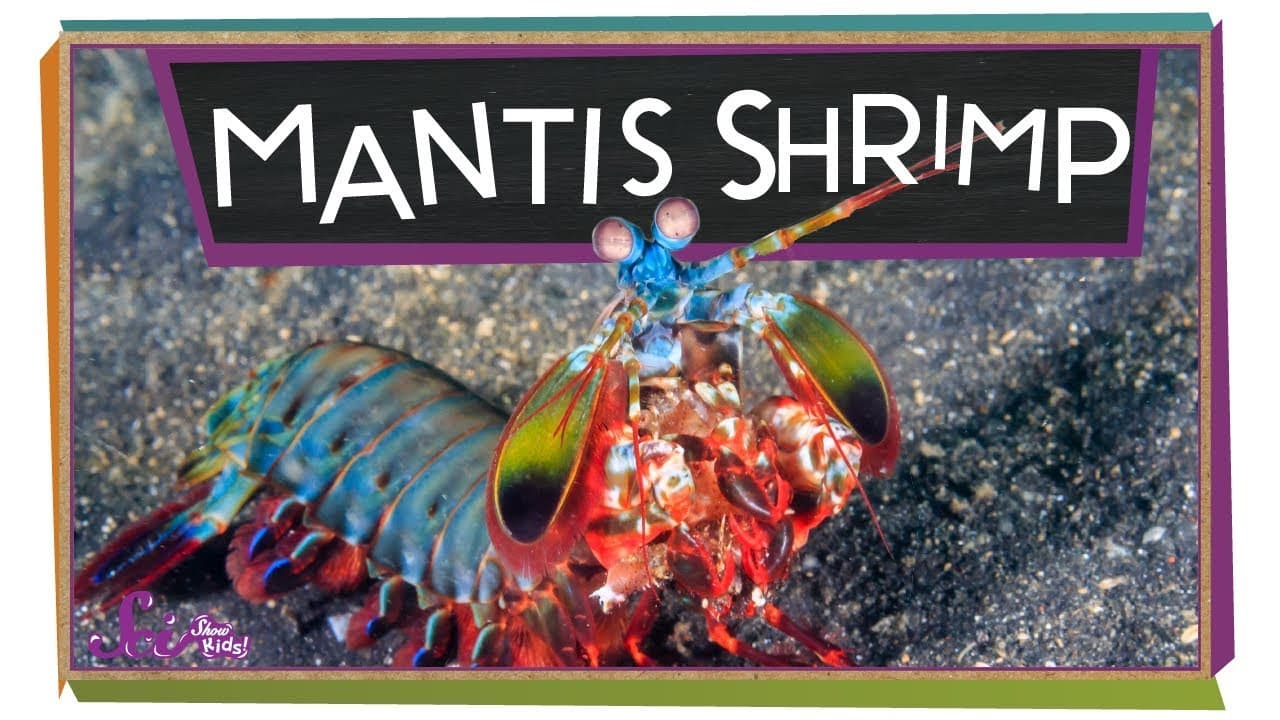
SciShow KidsSciShow Kids

16mins 1s