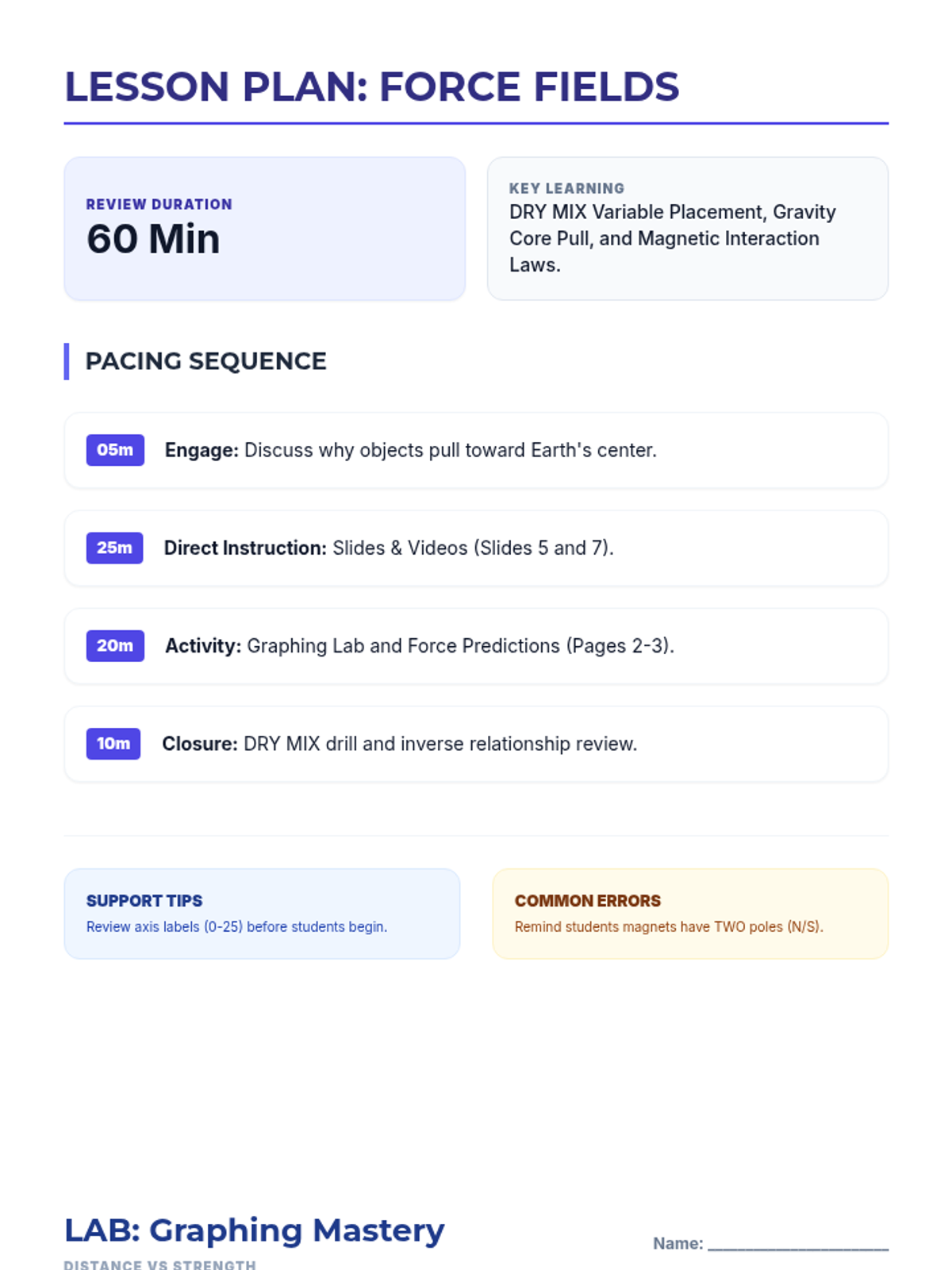
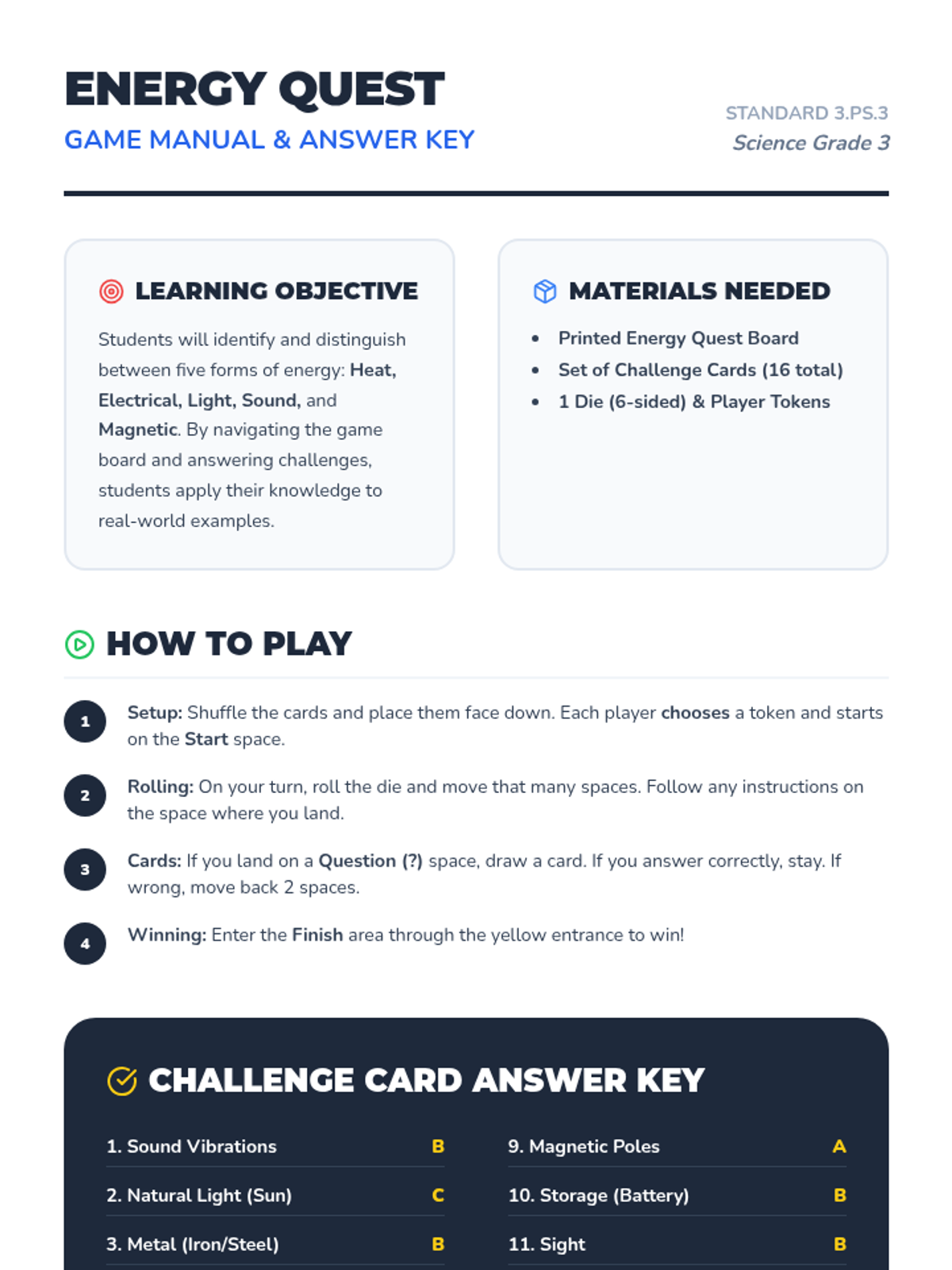
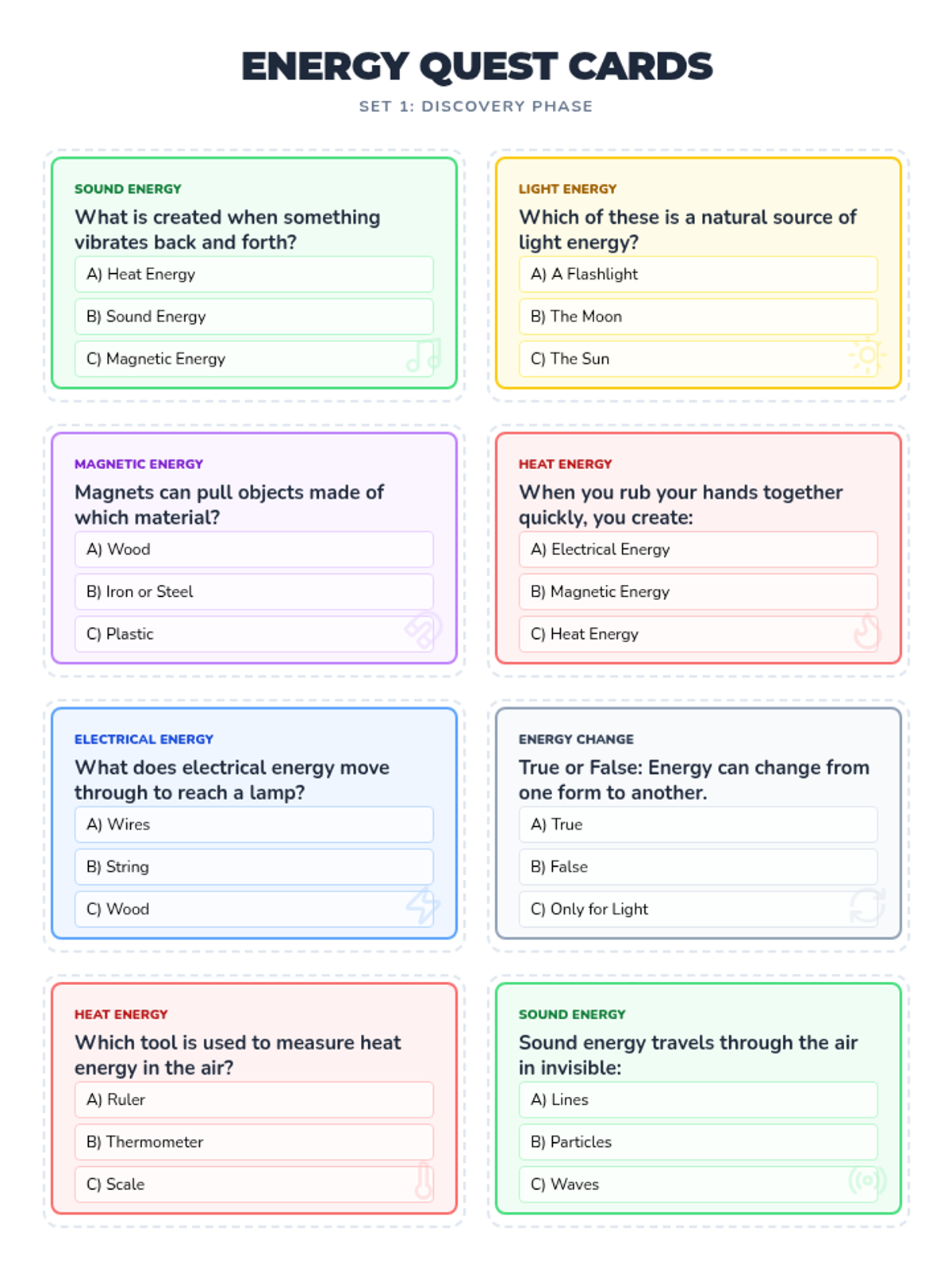
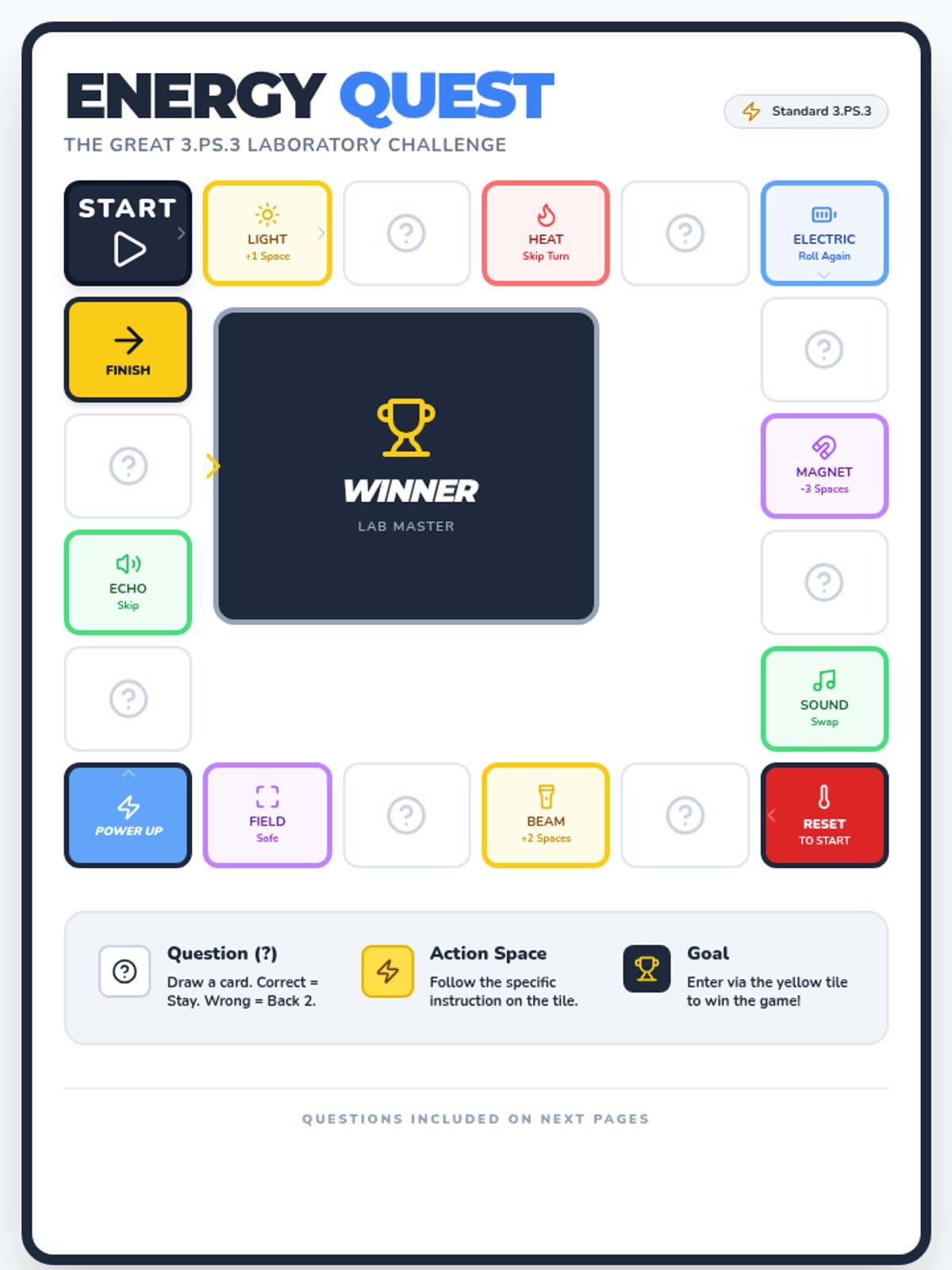
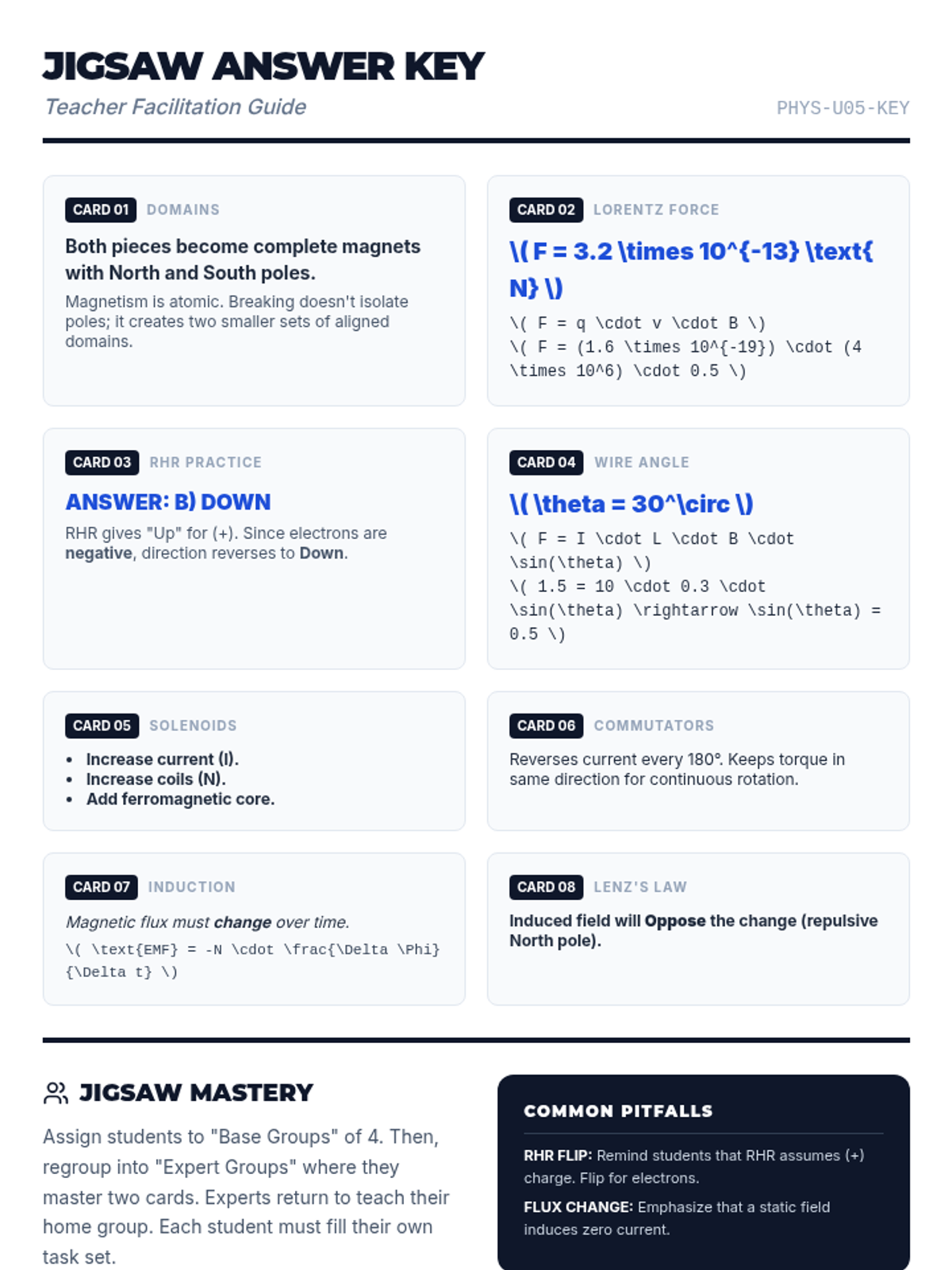
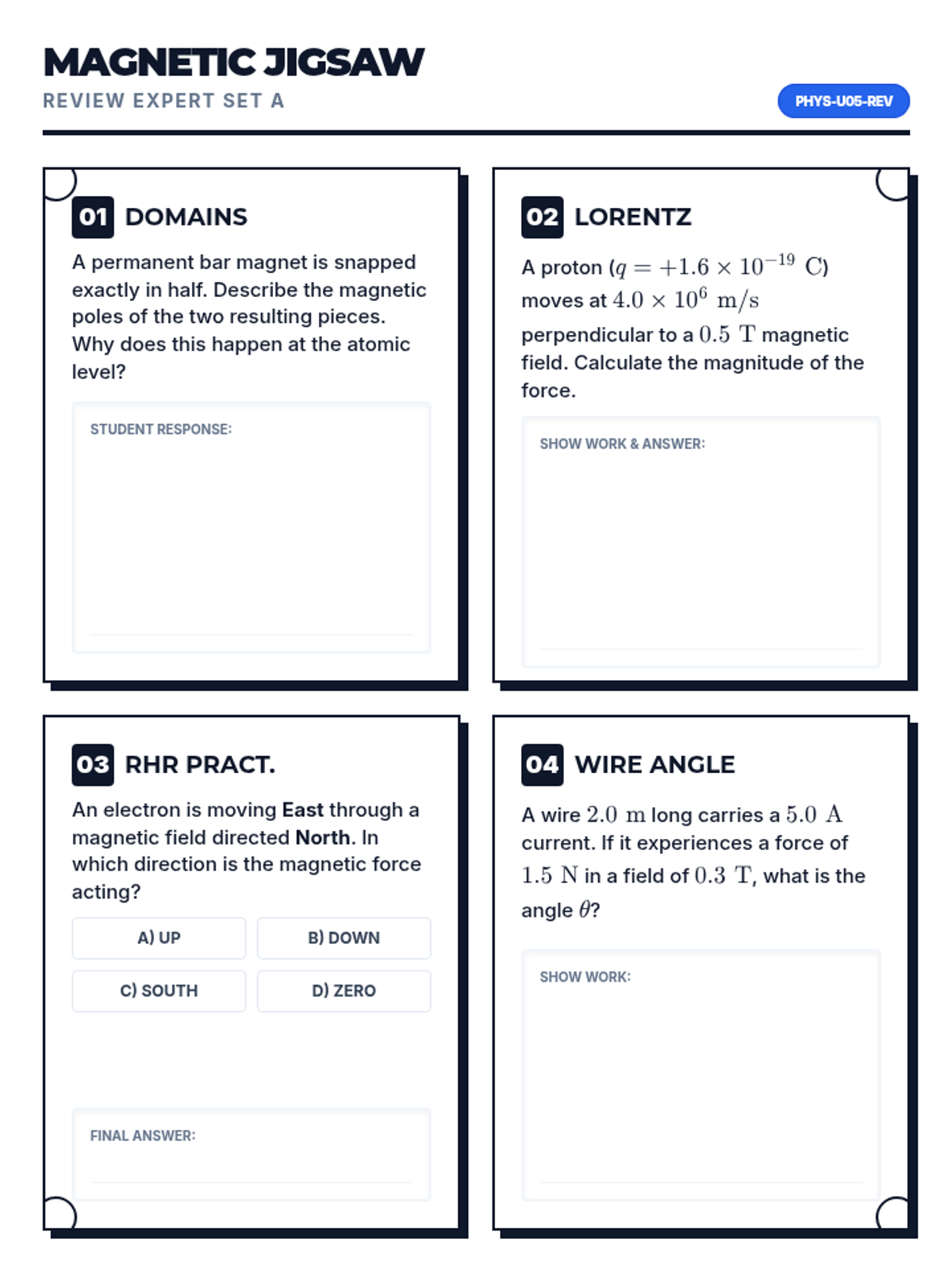
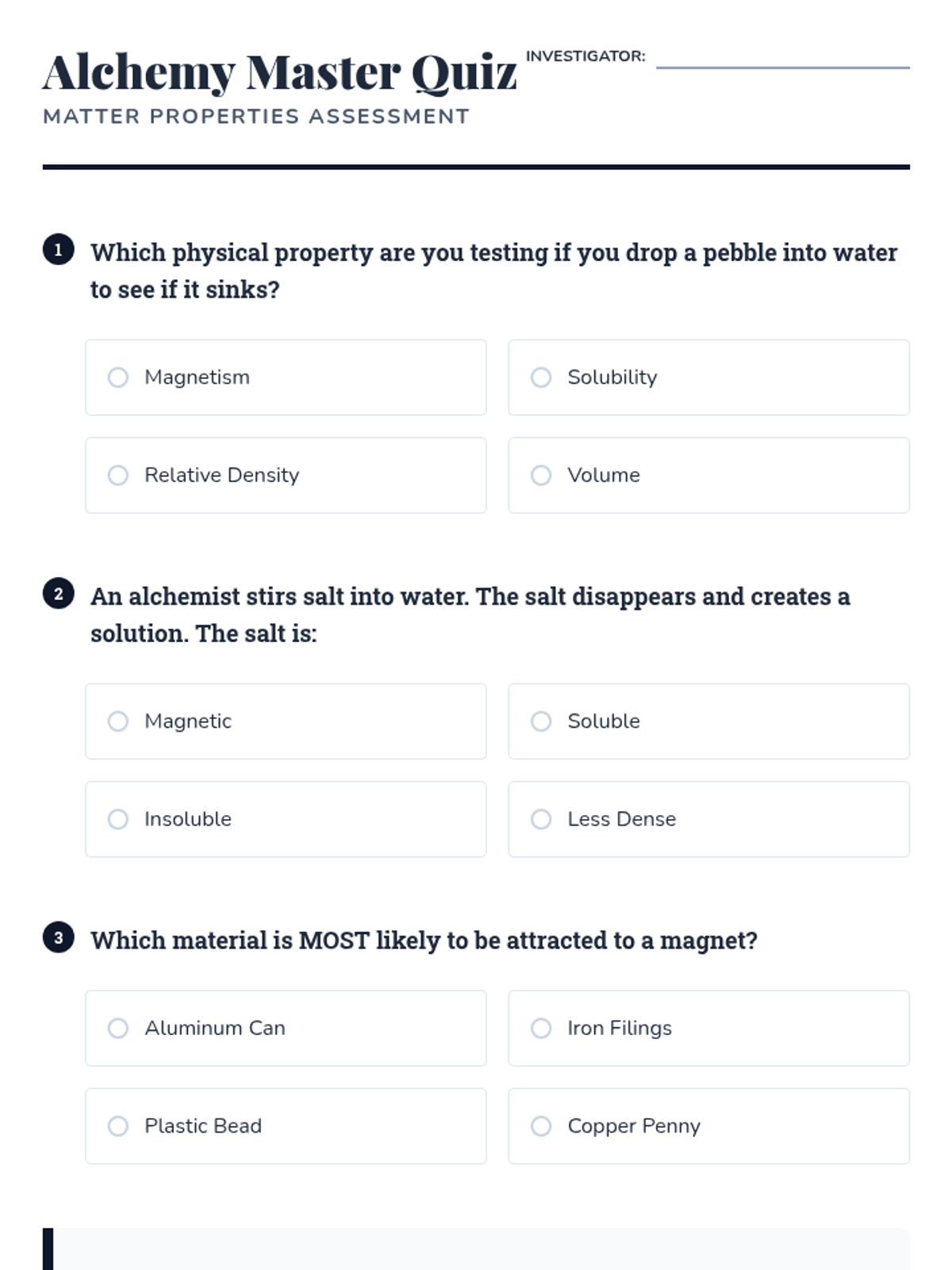
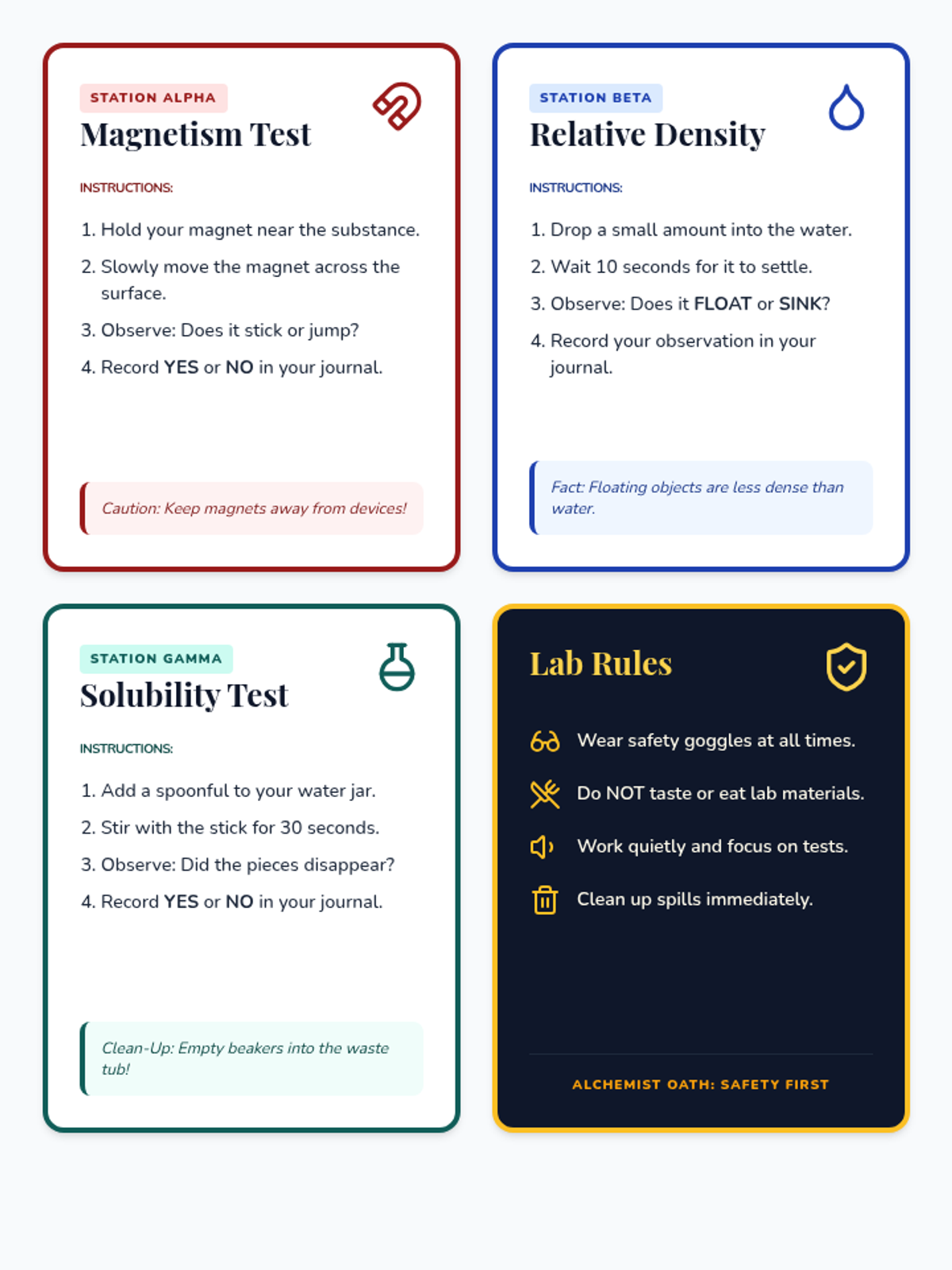
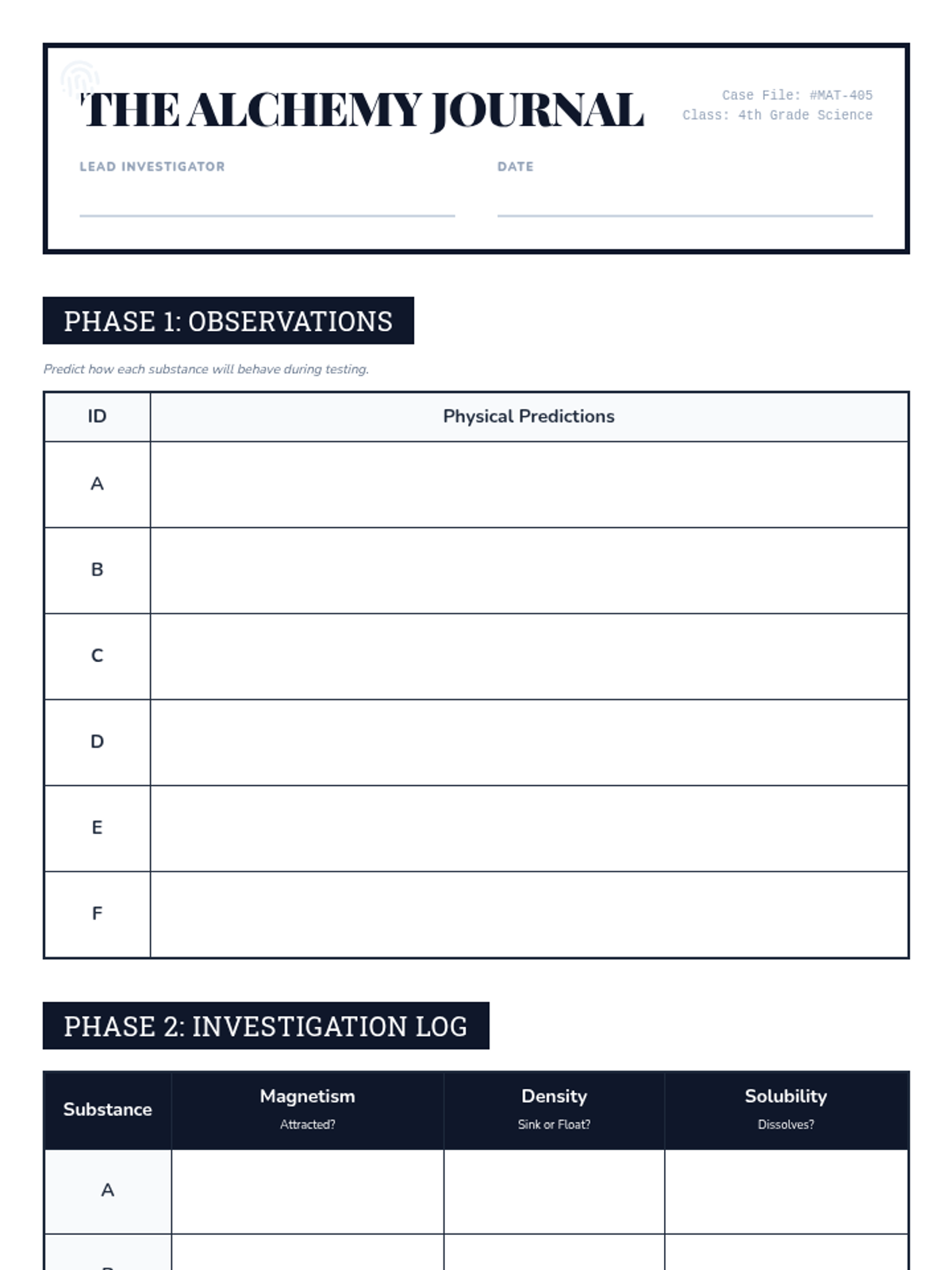
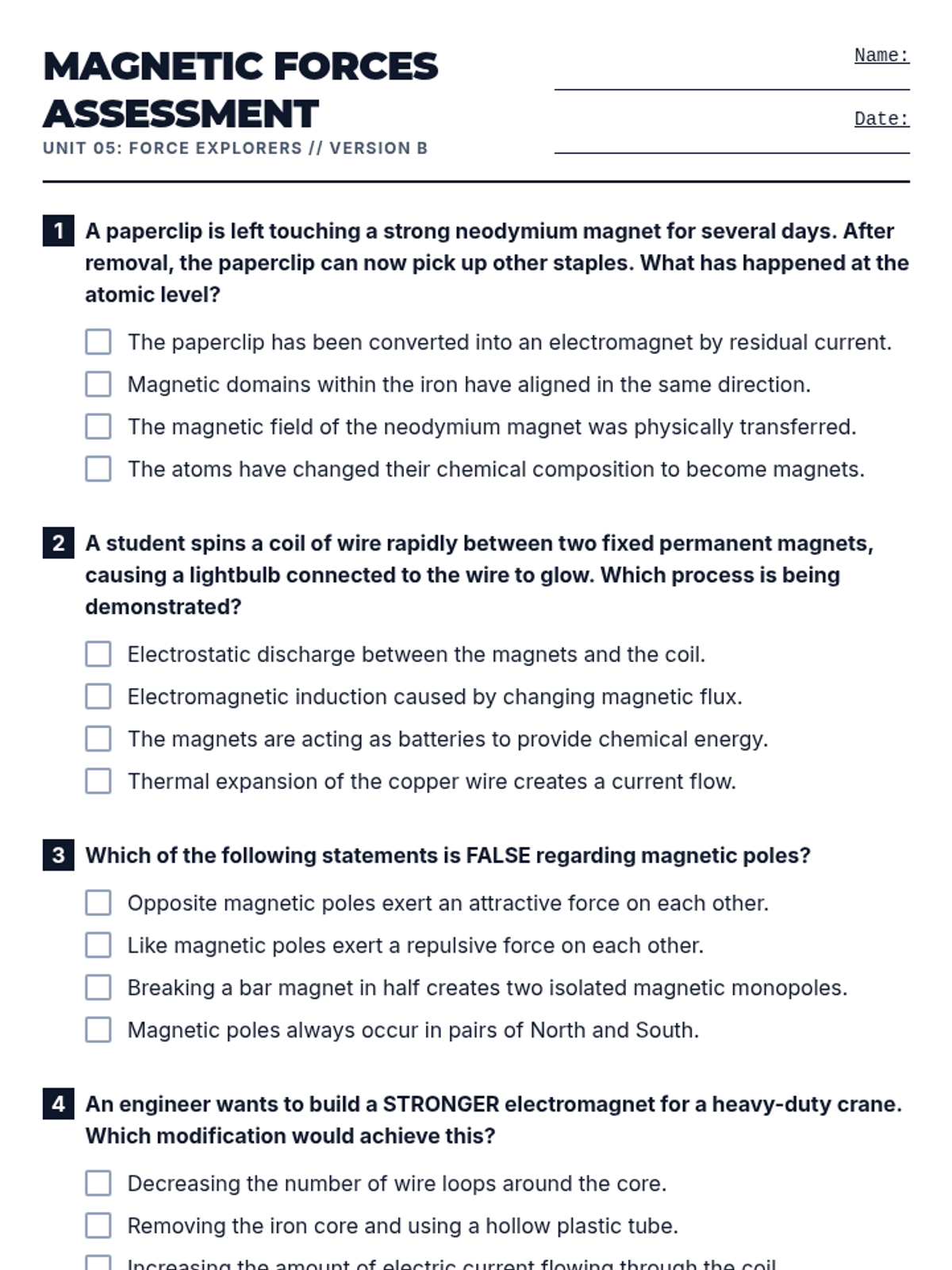
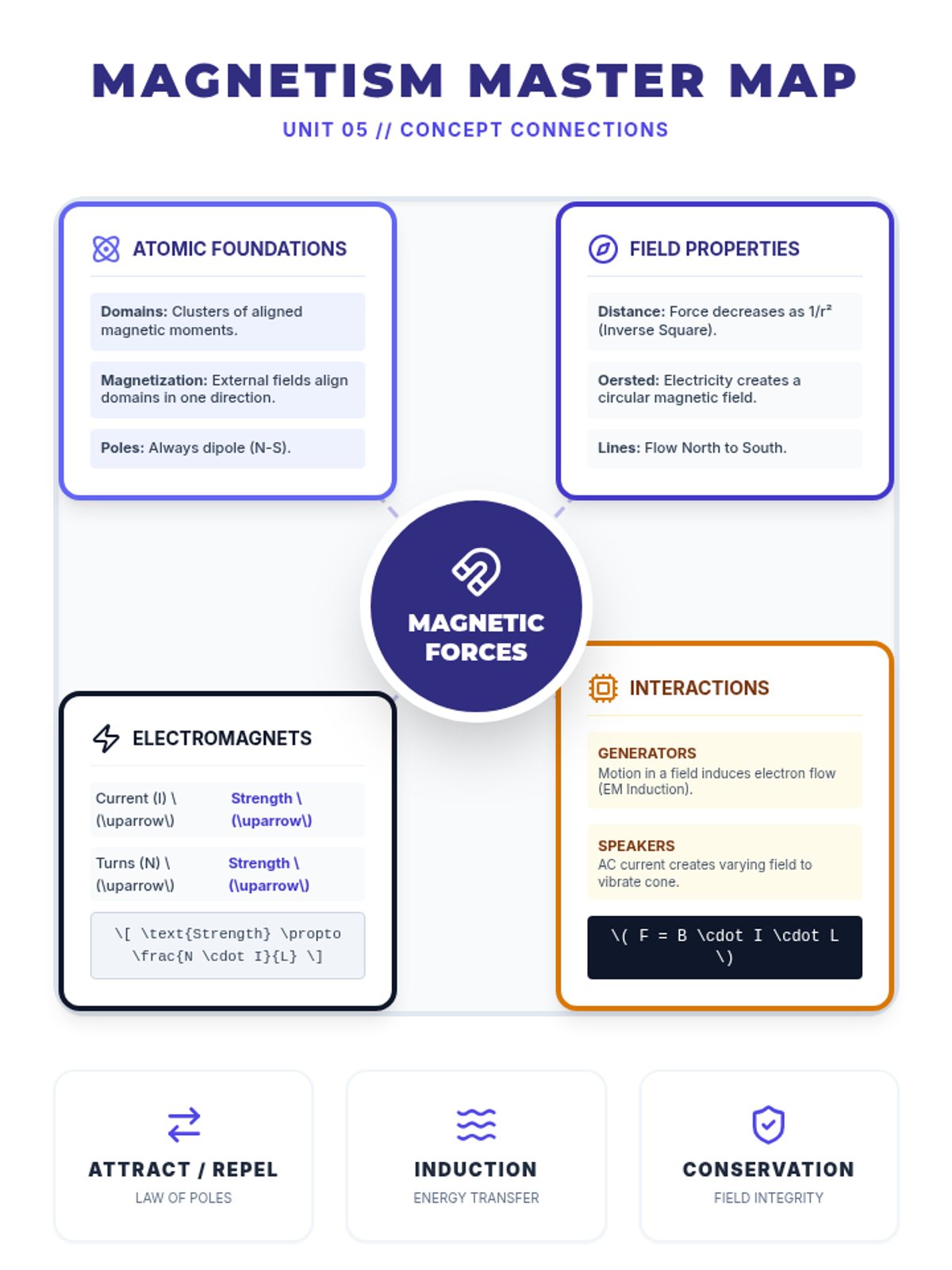
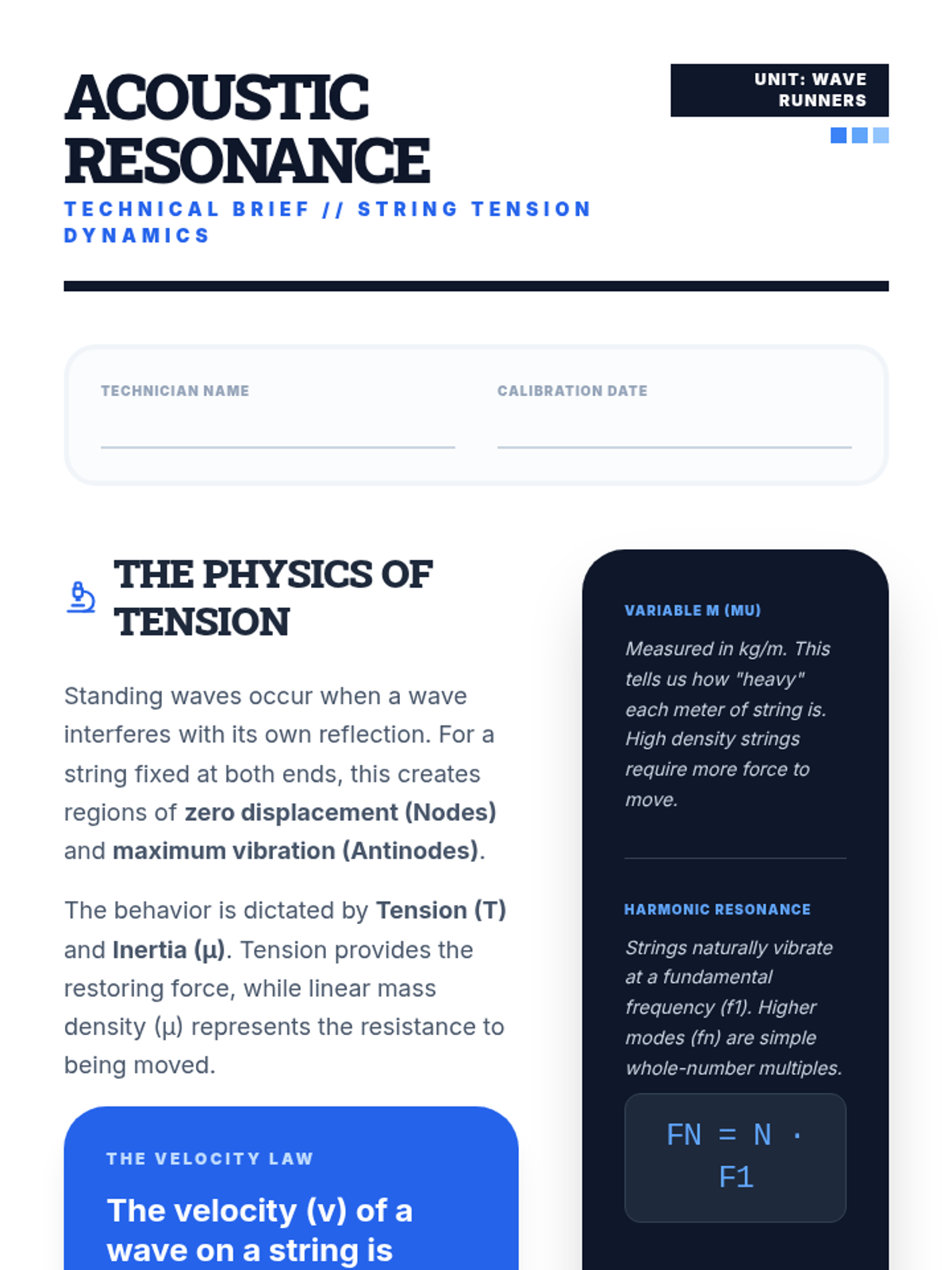
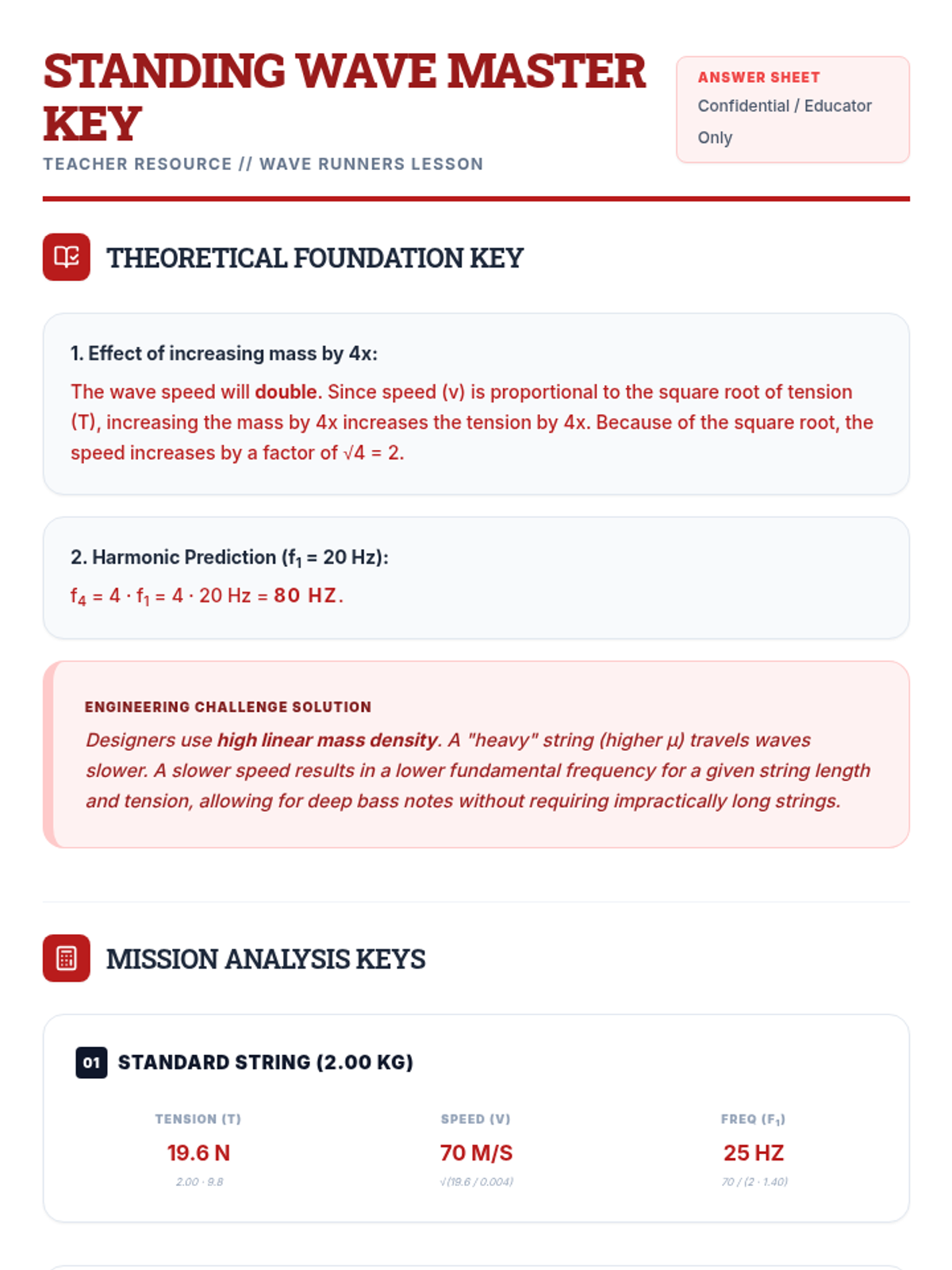
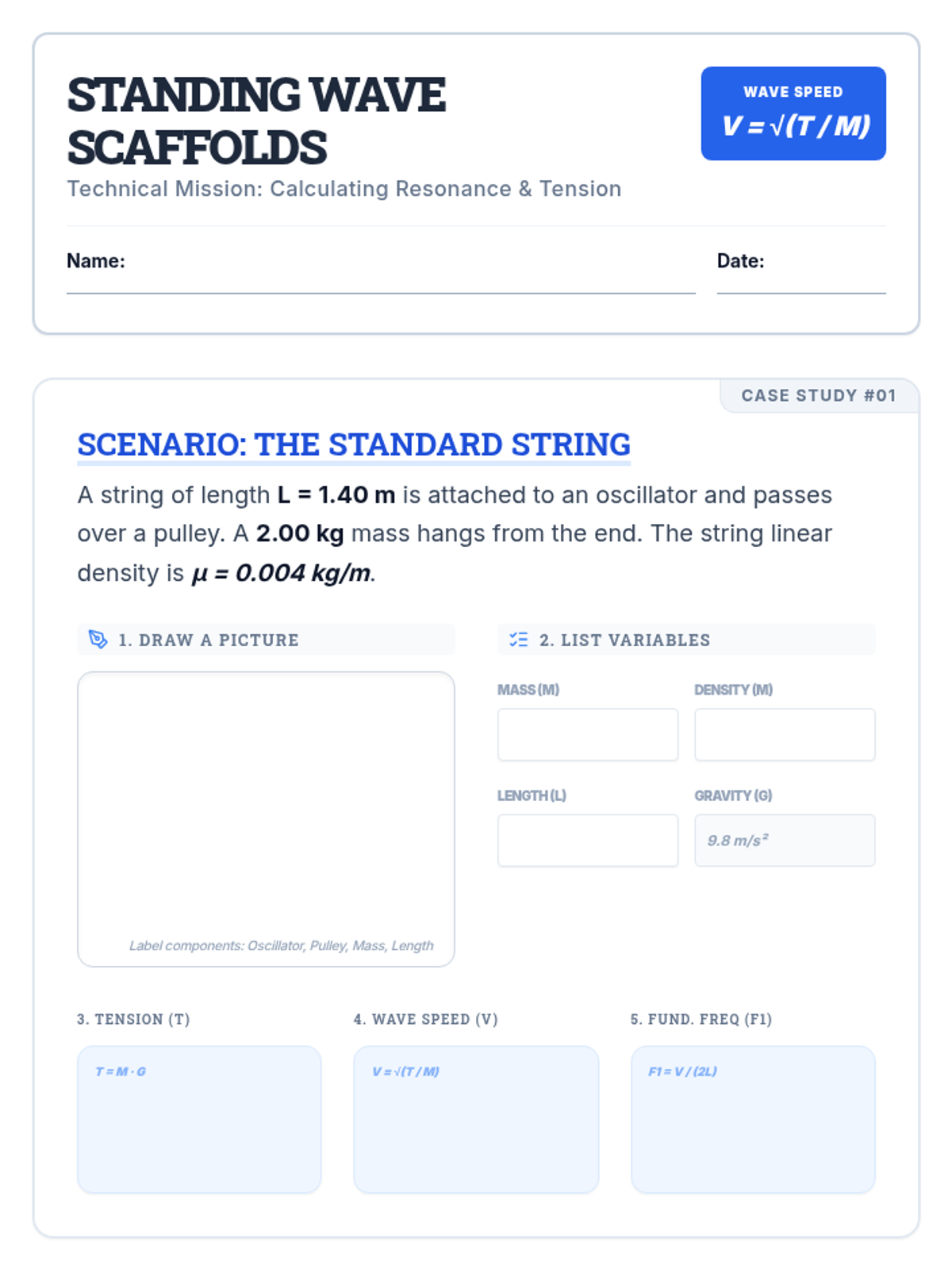
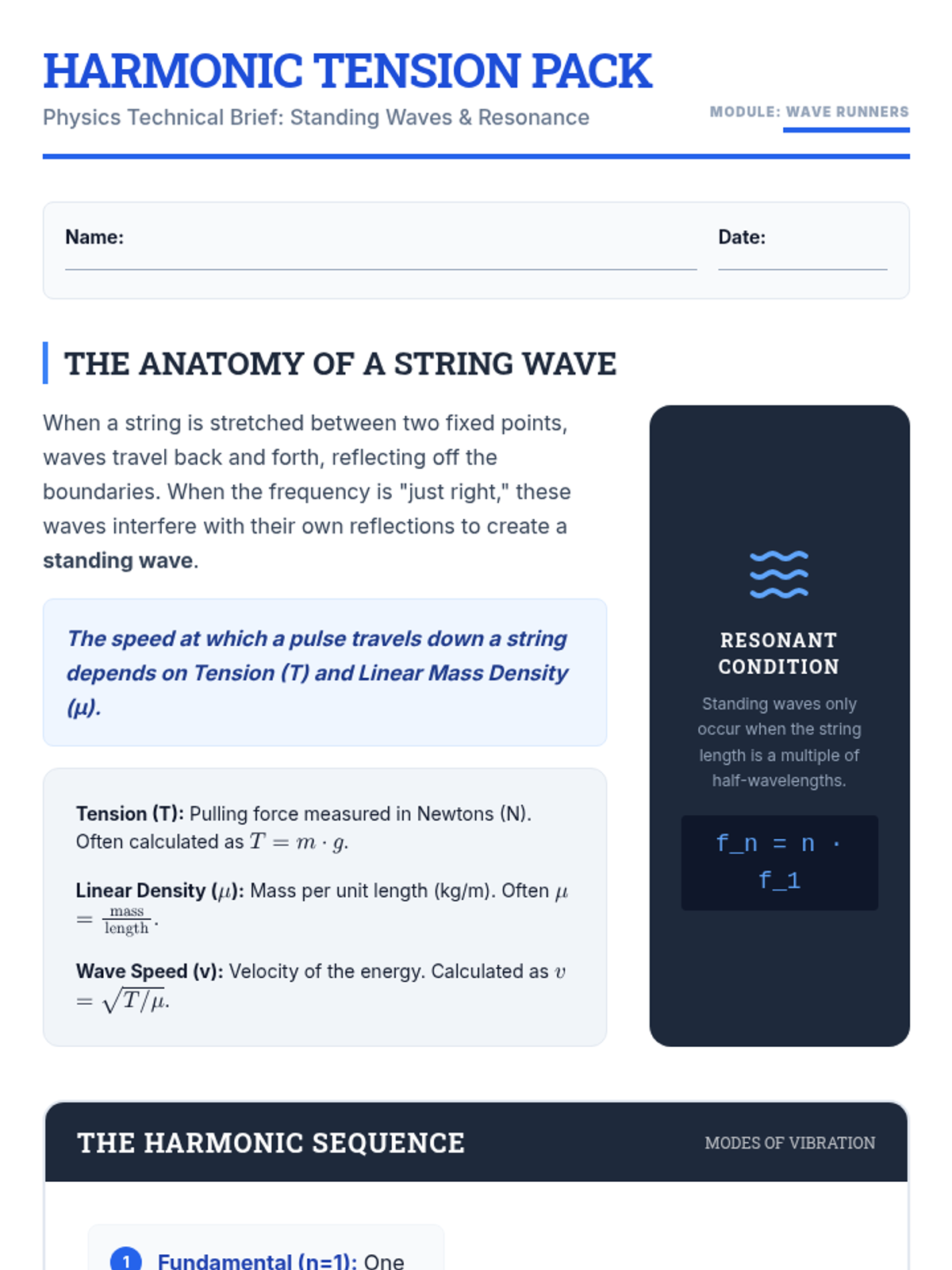
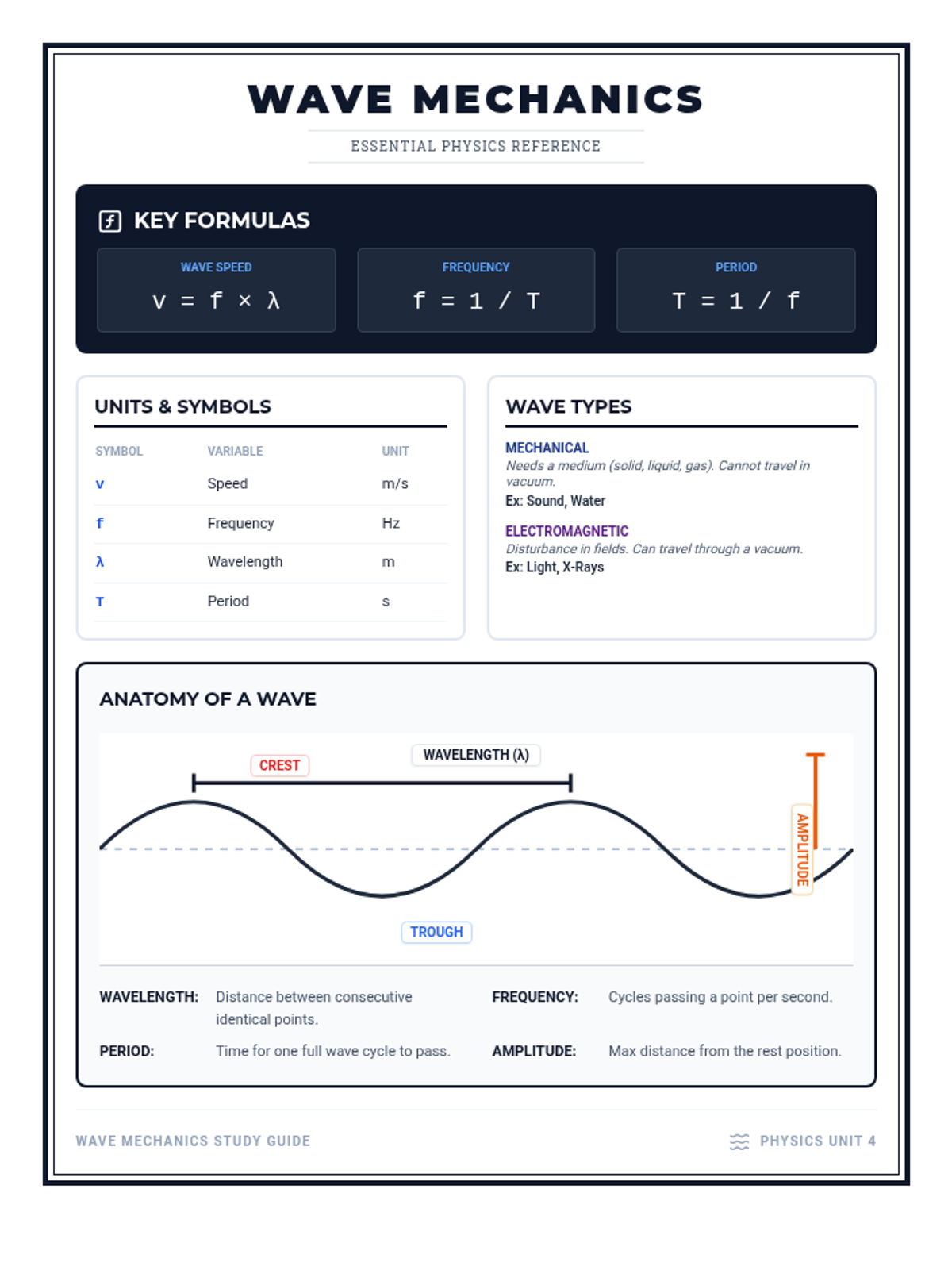
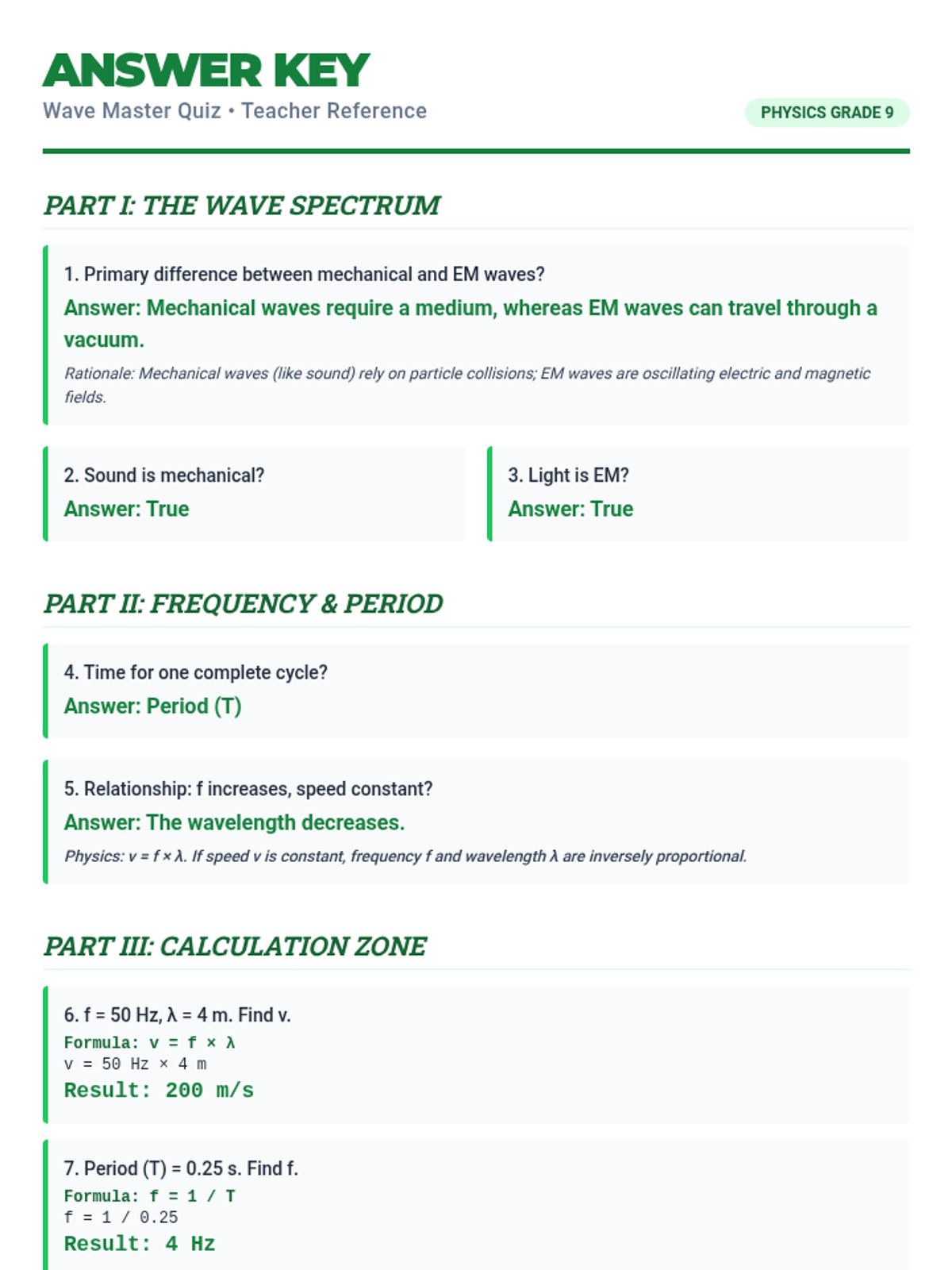
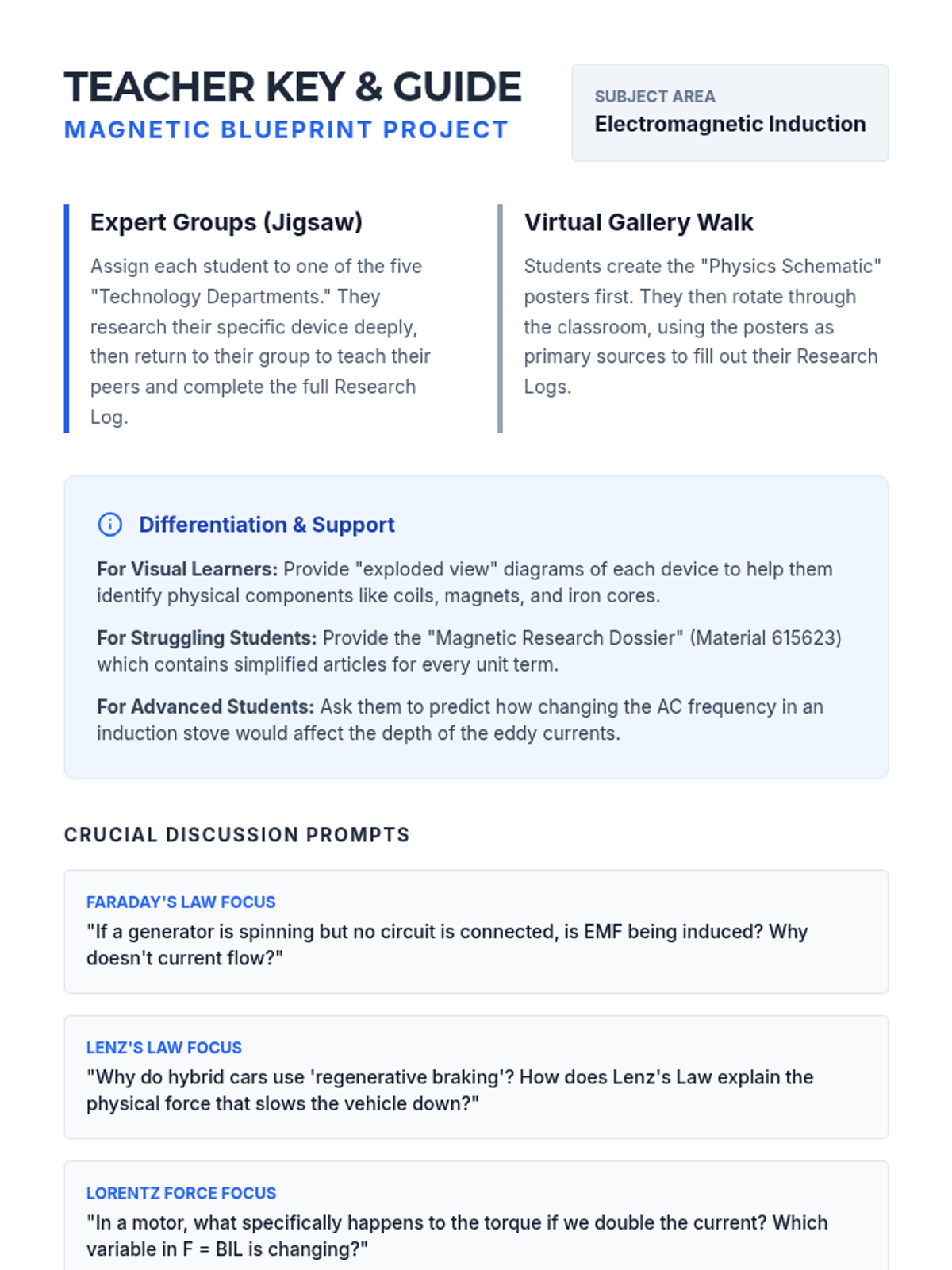
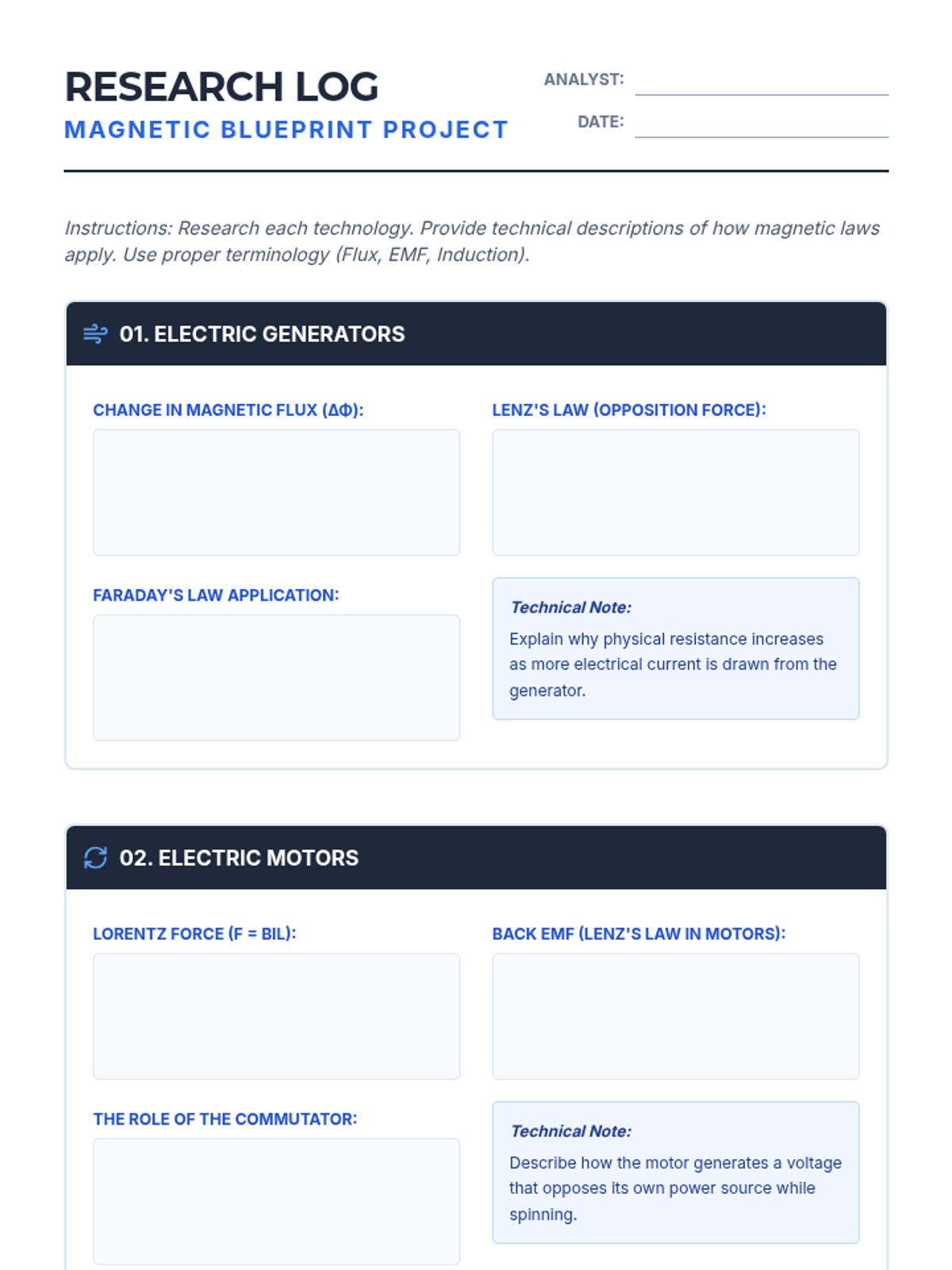
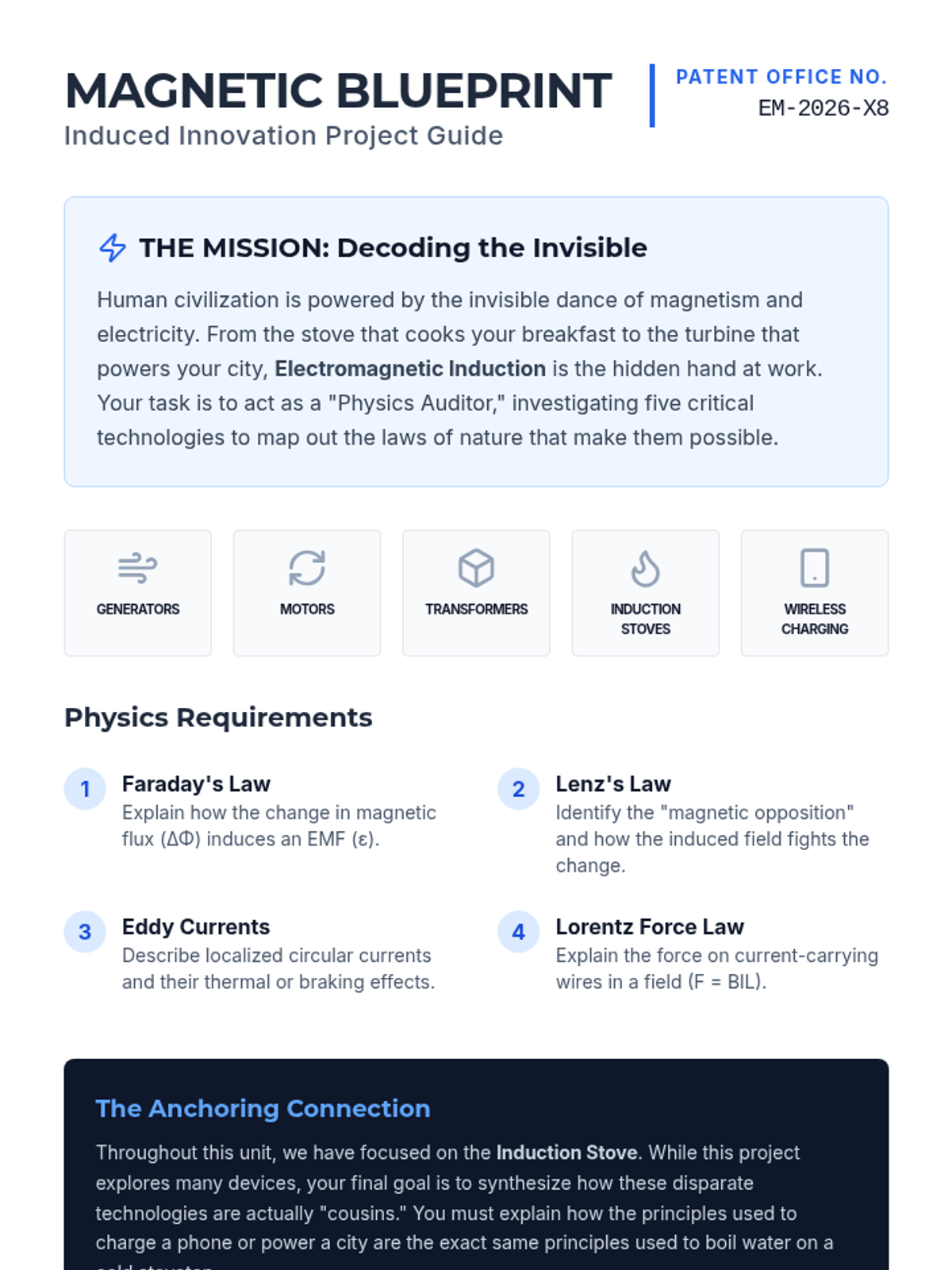
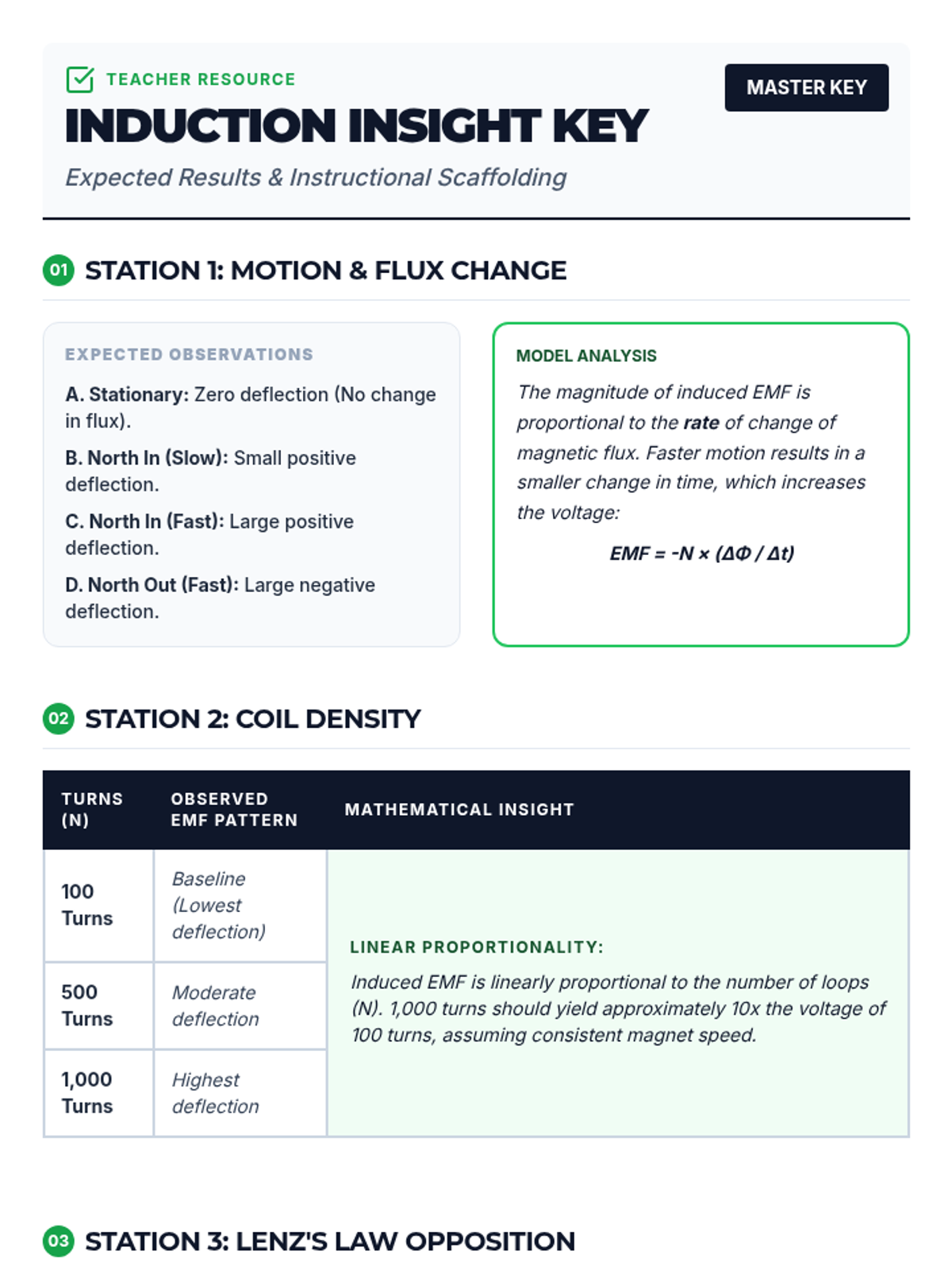
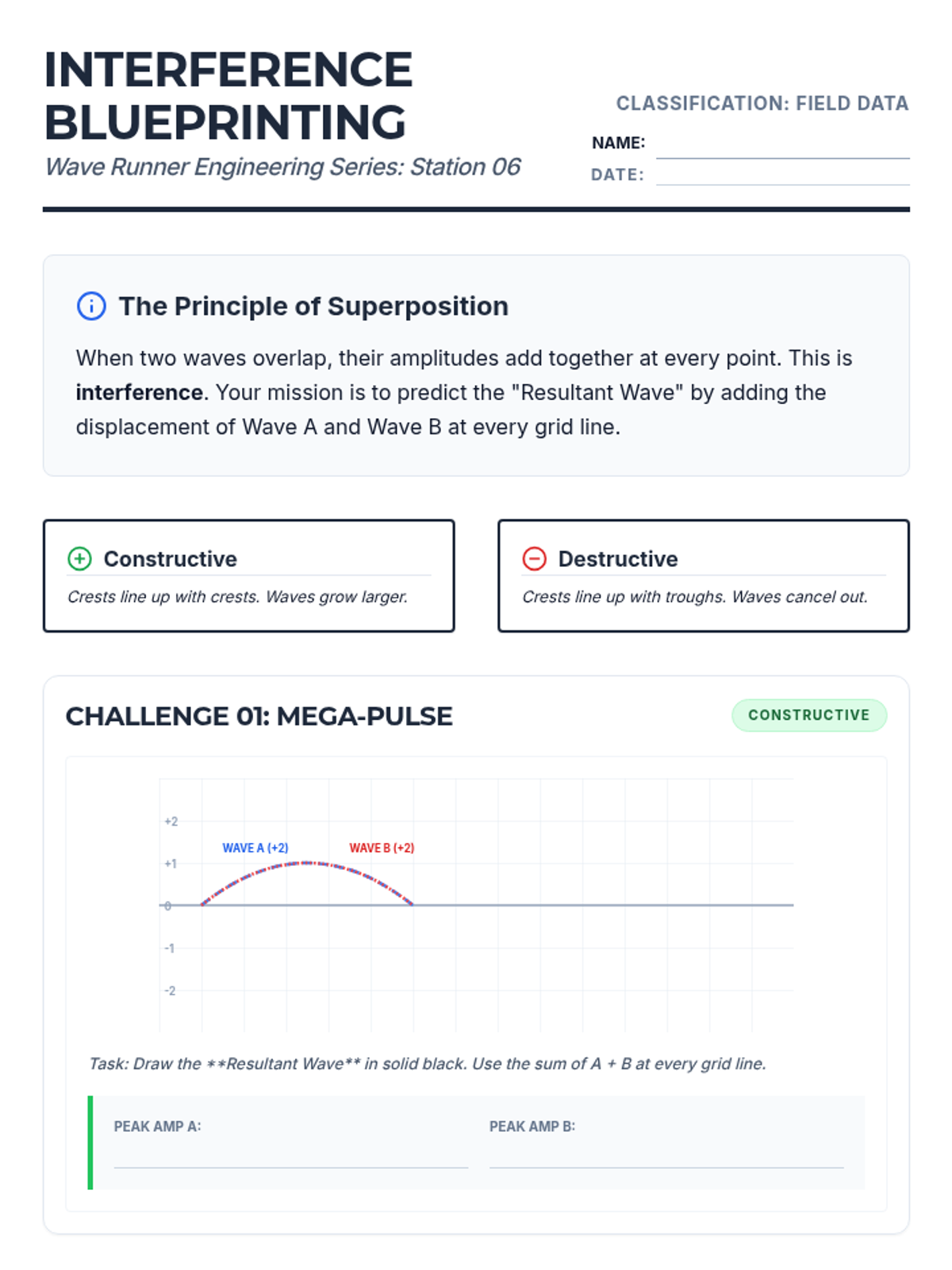
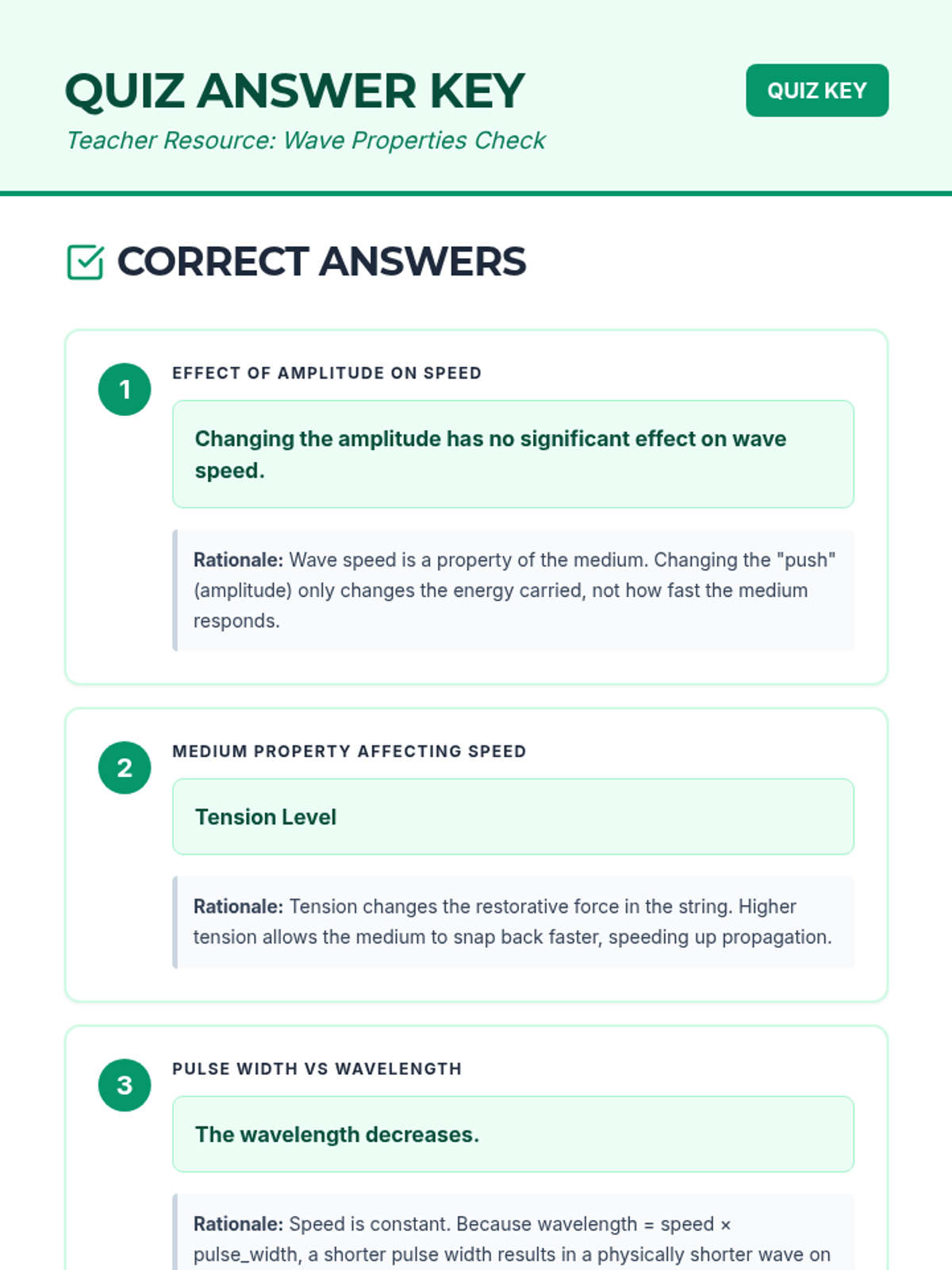
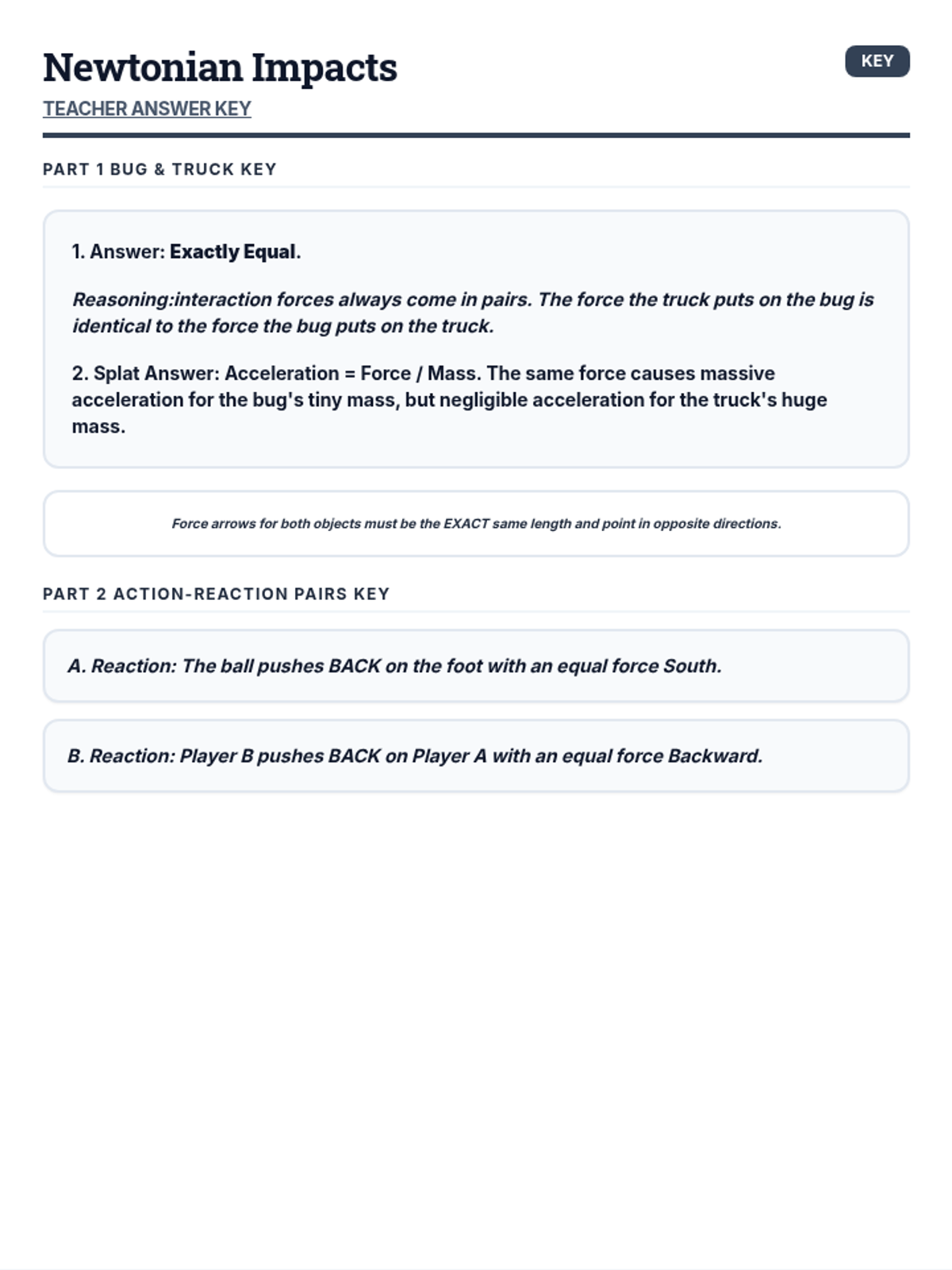
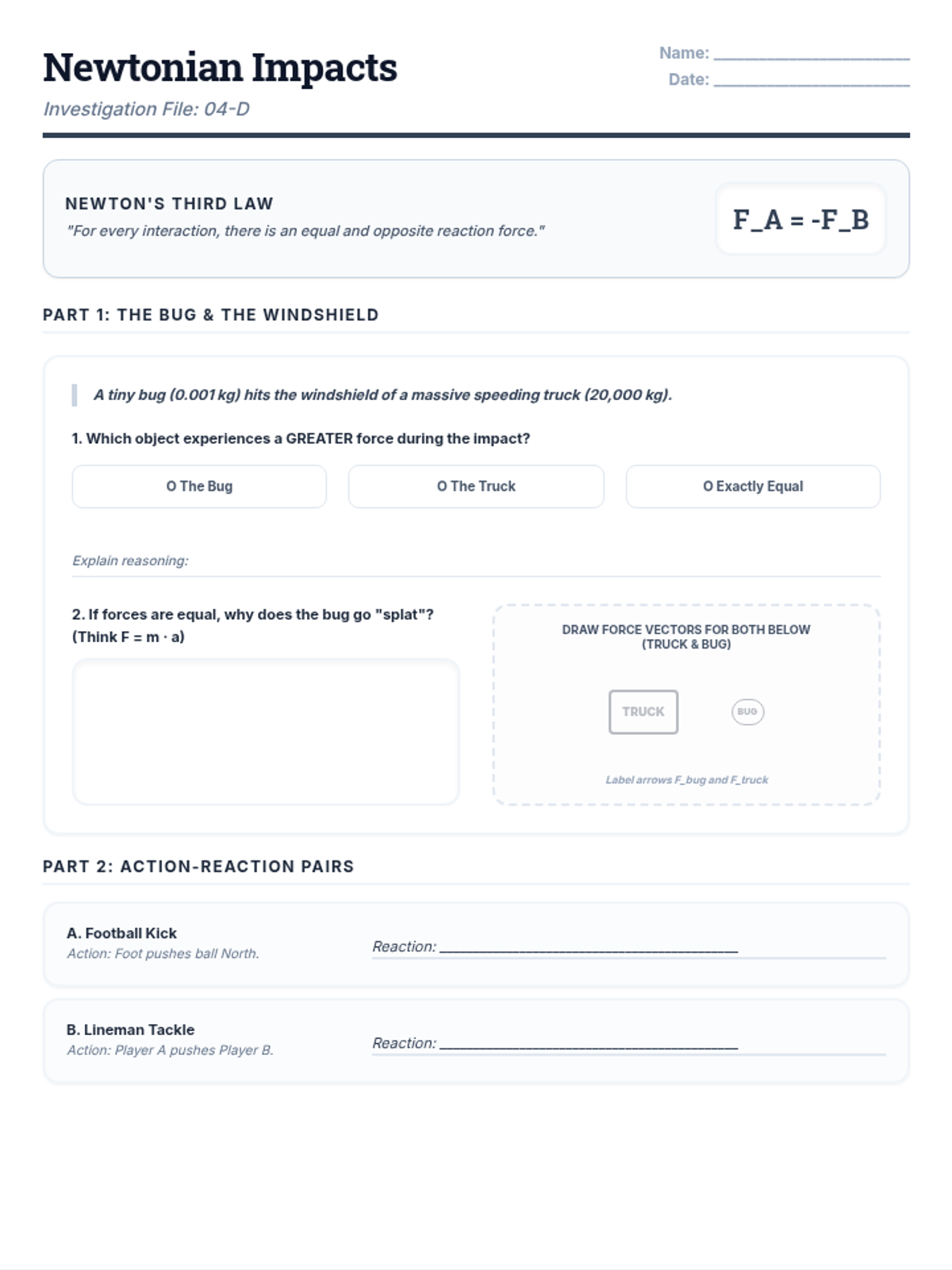
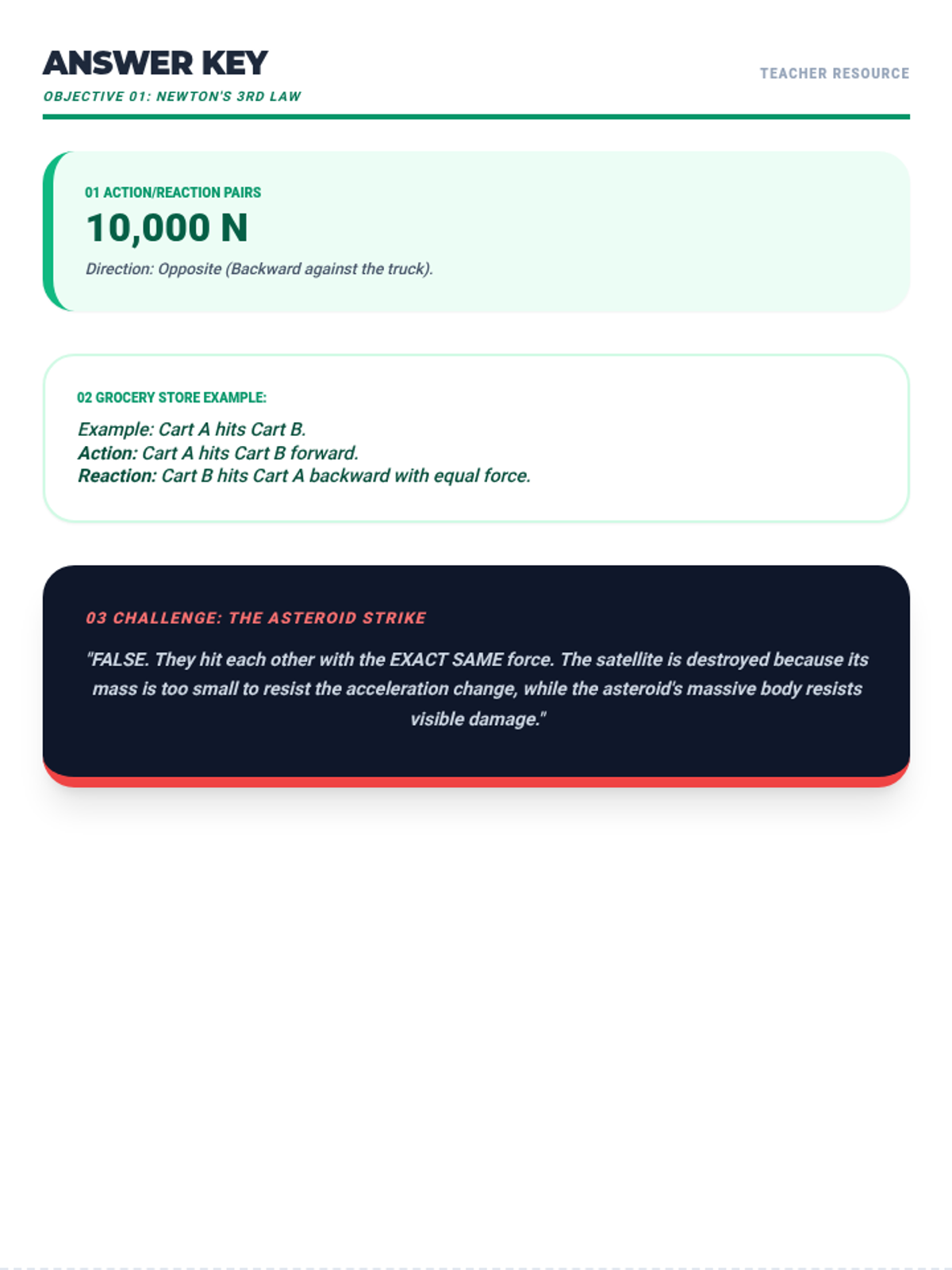
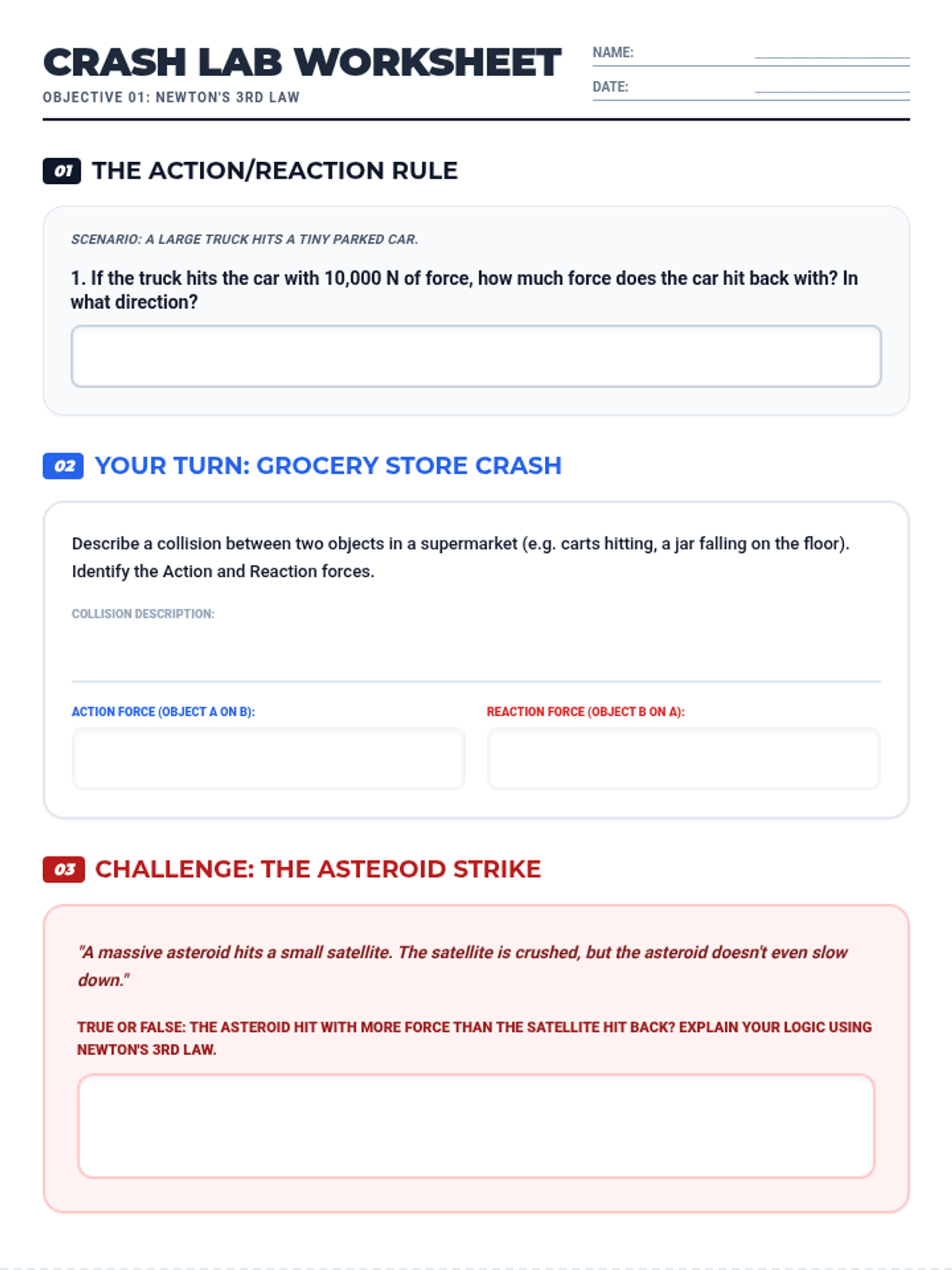
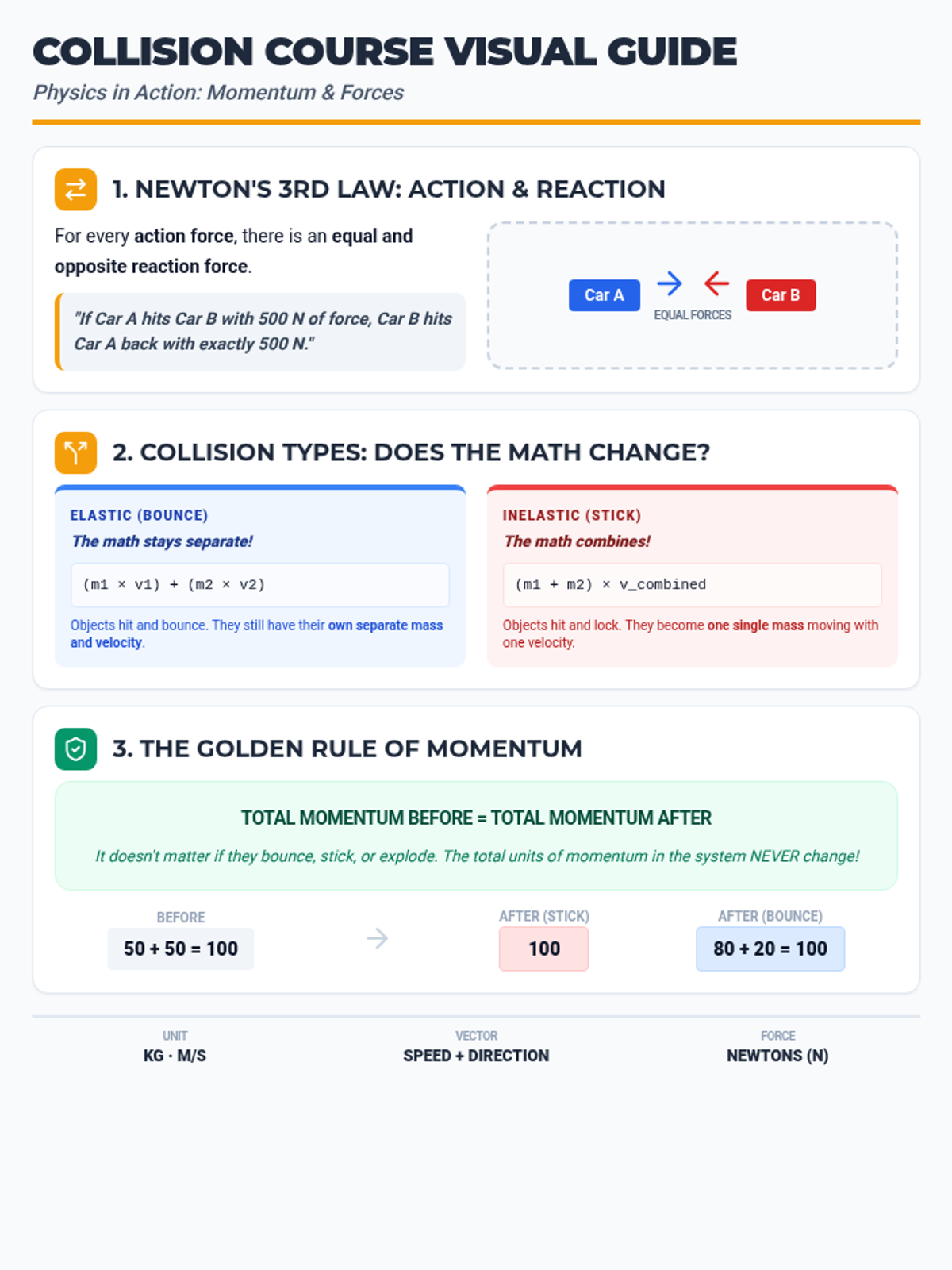
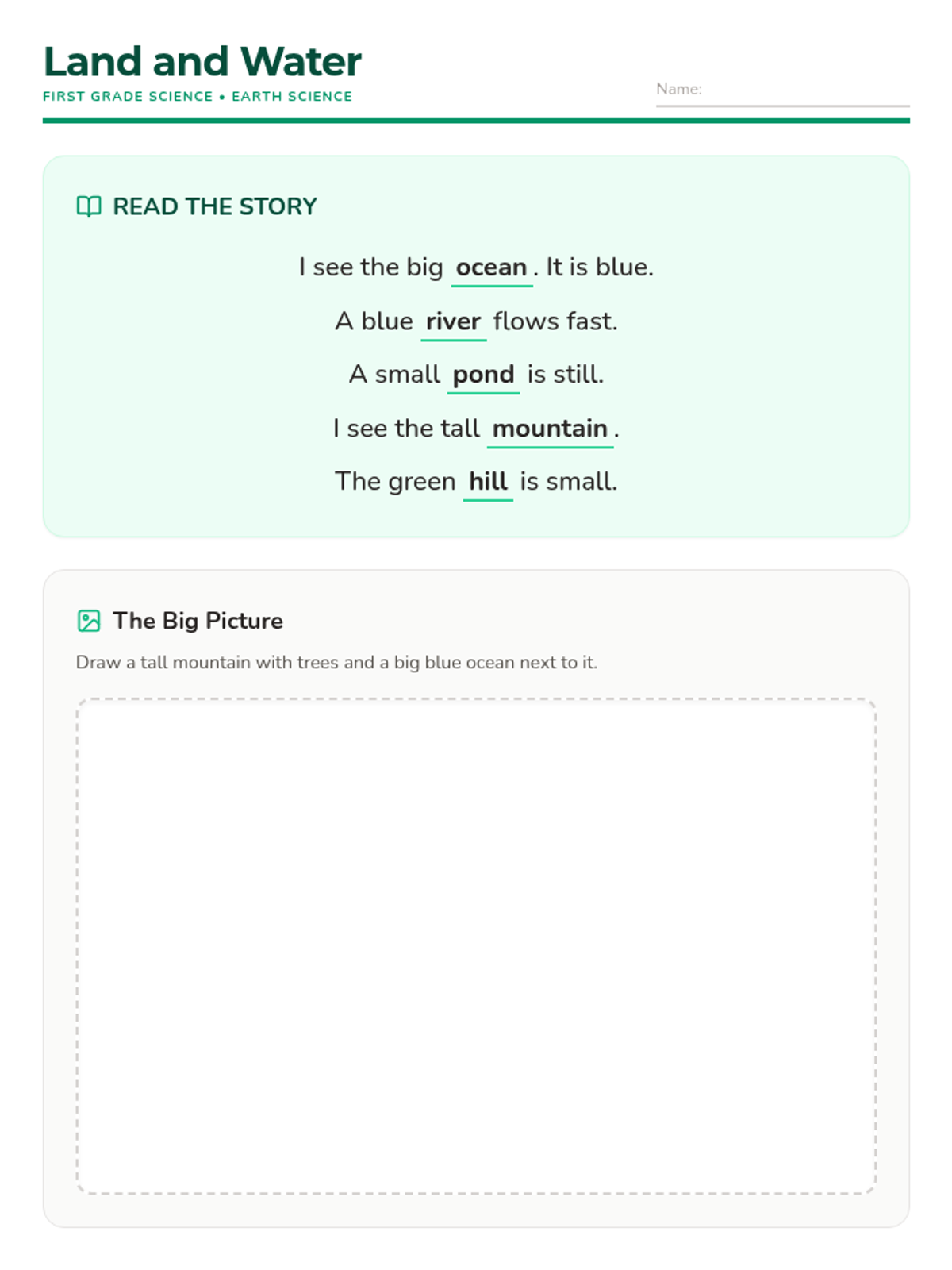
Fundamental principles of force, motion, and energy across classical and modern contexts. Examines matter properties, wave behavior, thermodynamics, and electromagnetism through mechanics and atomic studies.
A student lab sheet for drawing circuit diagrams, testing series and parallel circuits, and identifying conductors and insulators.
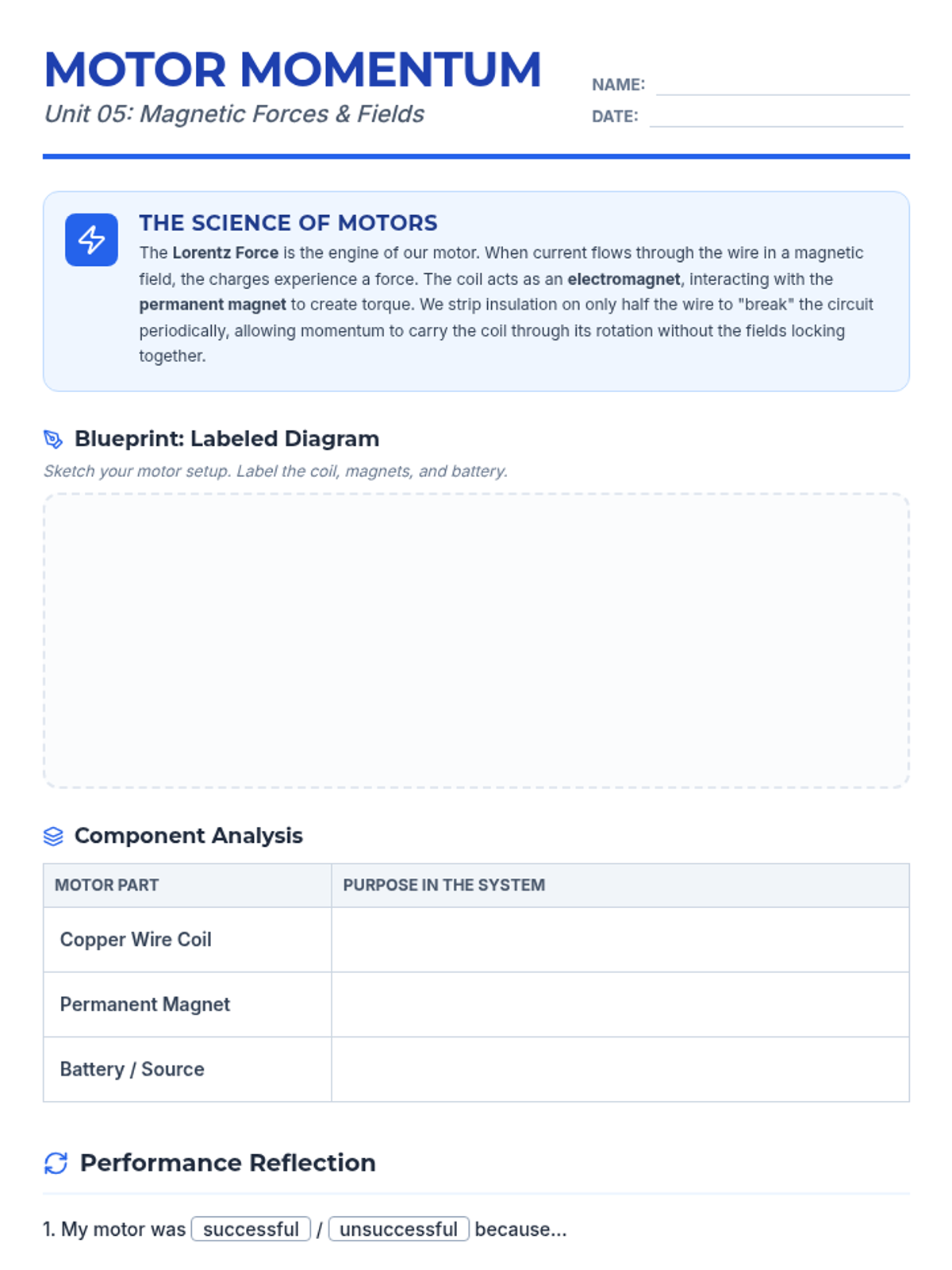
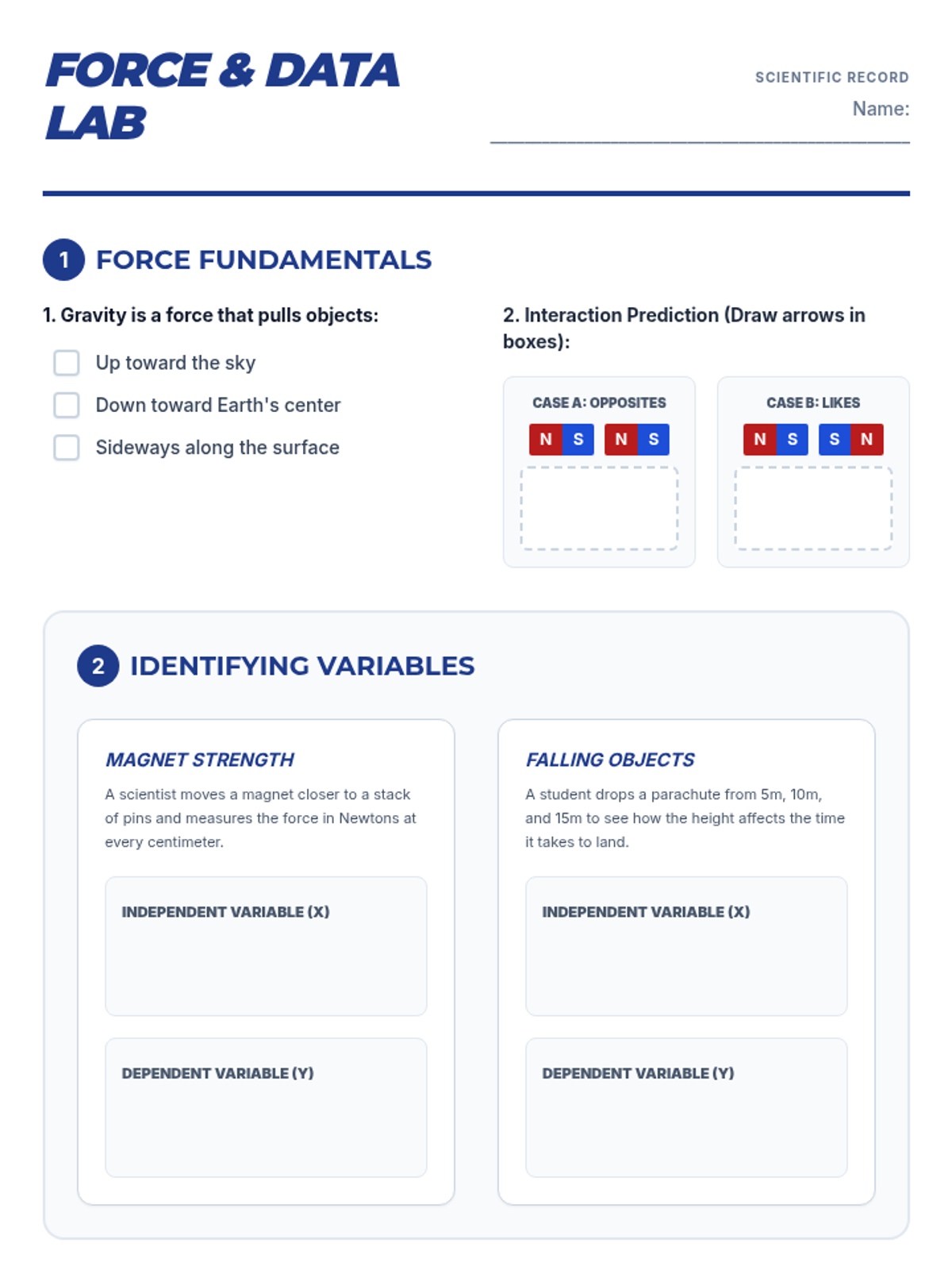
A student activity sheet for predicting magnetic forces, conducting a magnetism hunt, and sketching magnetic field lines.
A visual-heavy slide deck exploring series and parallel circuits, conductors, insulators, and circuit components.
A visual-heavy slide deck exploring magnetic poles, attraction and repulsion, magnetic fields, and real-world applications of magnetism.
A student worksheet for identifying potential and kinetic electrical energy and tracking energy transformations in everyday objects.
A visual-heavy slide deck introducing the concept of electrical energy, potential vs. kinetic energy, and energy transformations.
A quick warm-up slip ("Mission Launch Slip") designed to activate student knowledge on net force, gravity, and friction before starting the stations.
A visual presentation for the Force Frenzy stations, including instructional slides, rotation protocols, a station timer, and debrief questions.
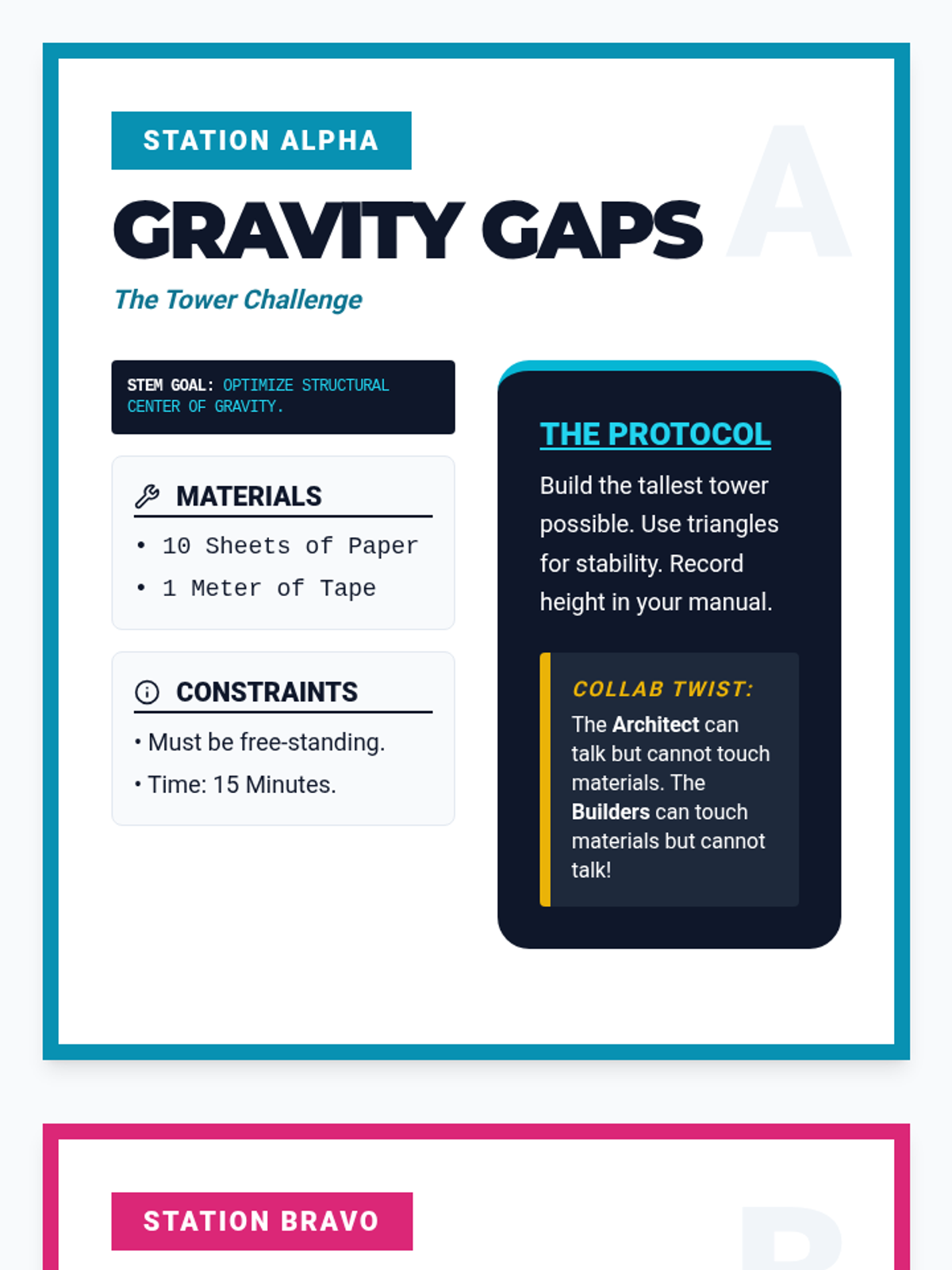
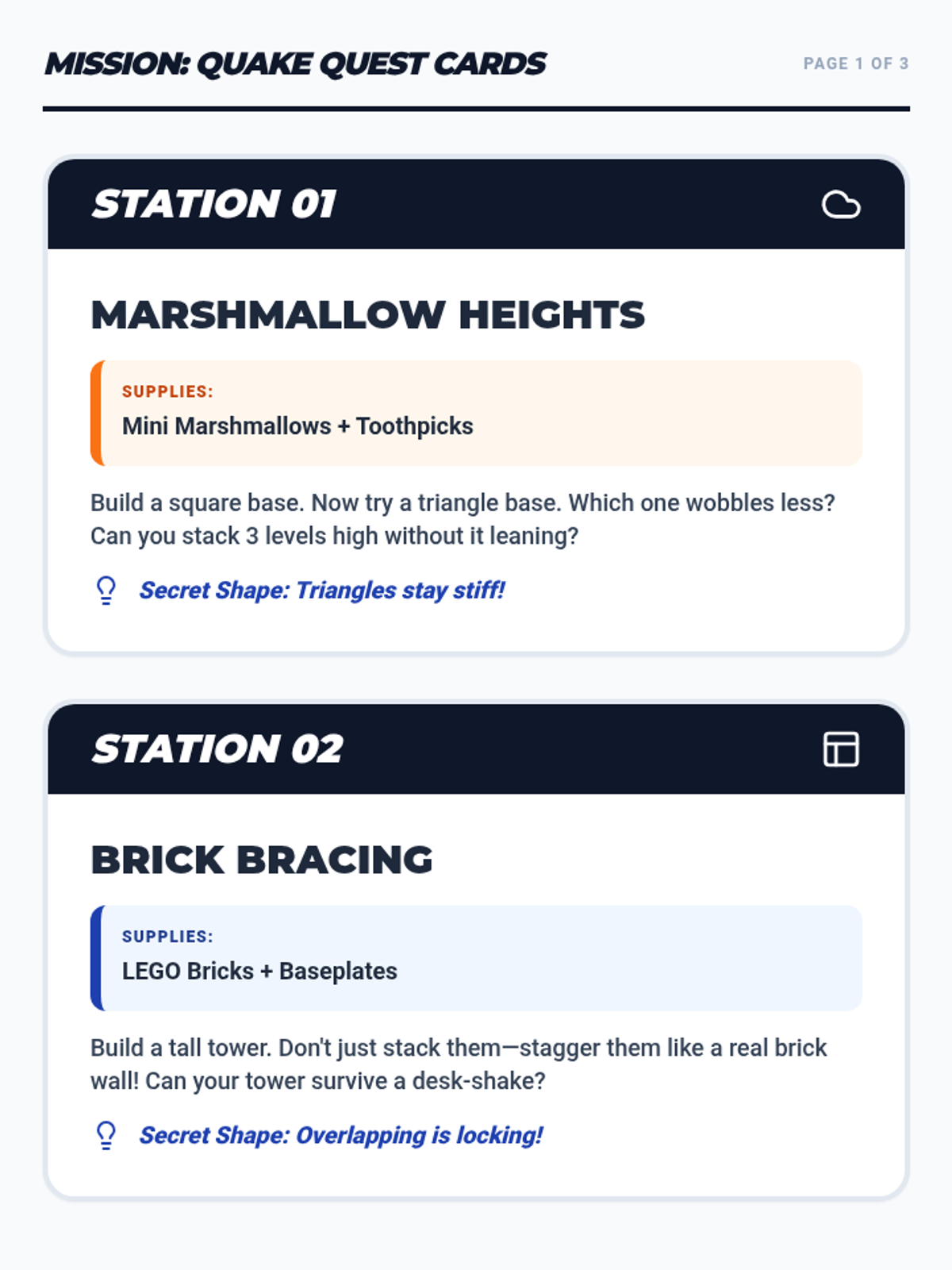
Large-format instructional cards for each of the five stations, featuring clear objectives, procedures, and prompting questions.
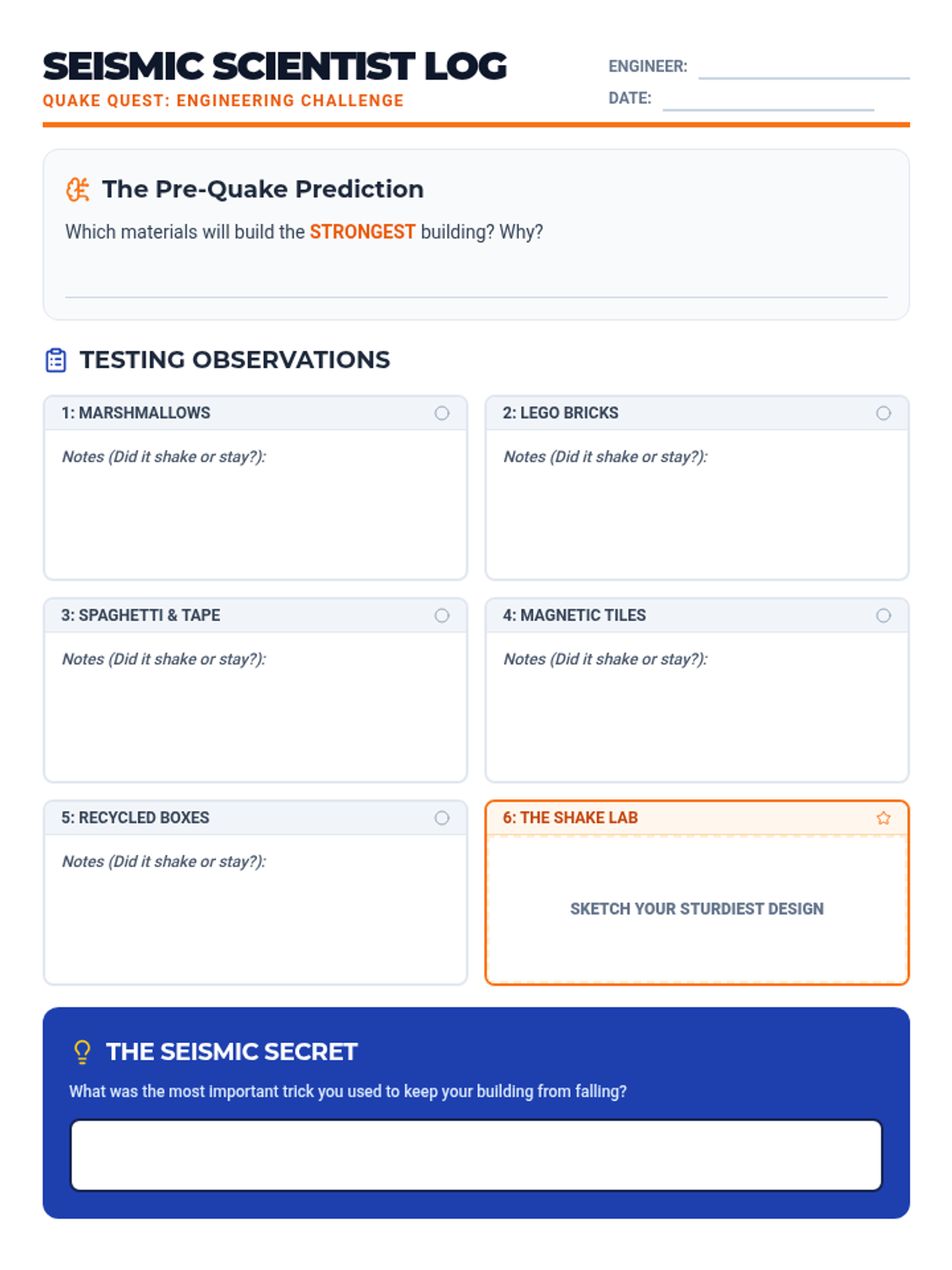
The student recording sheet for the Force Frenzy stations, featuring space for drawings, data tables, and reflection questions.
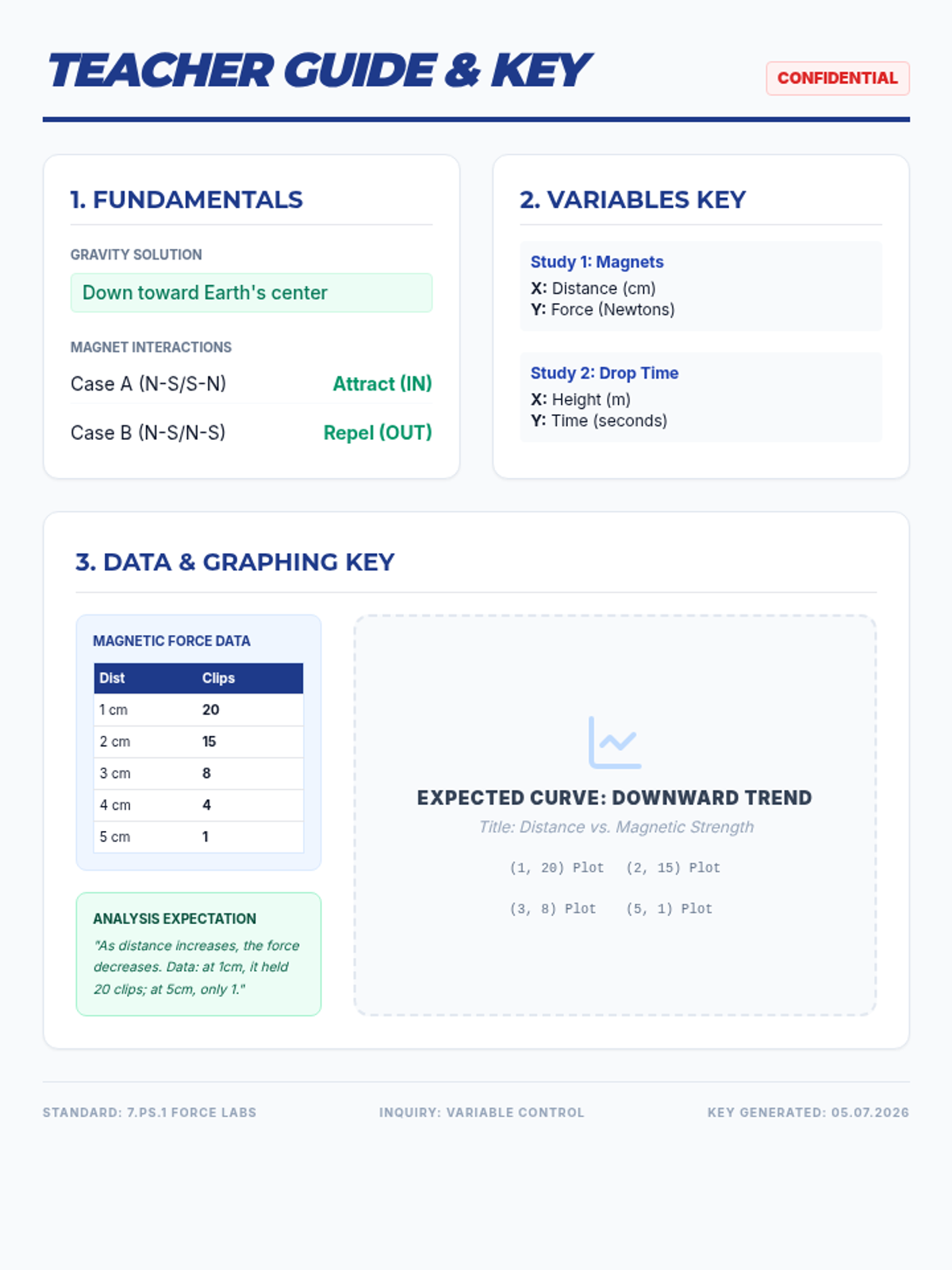
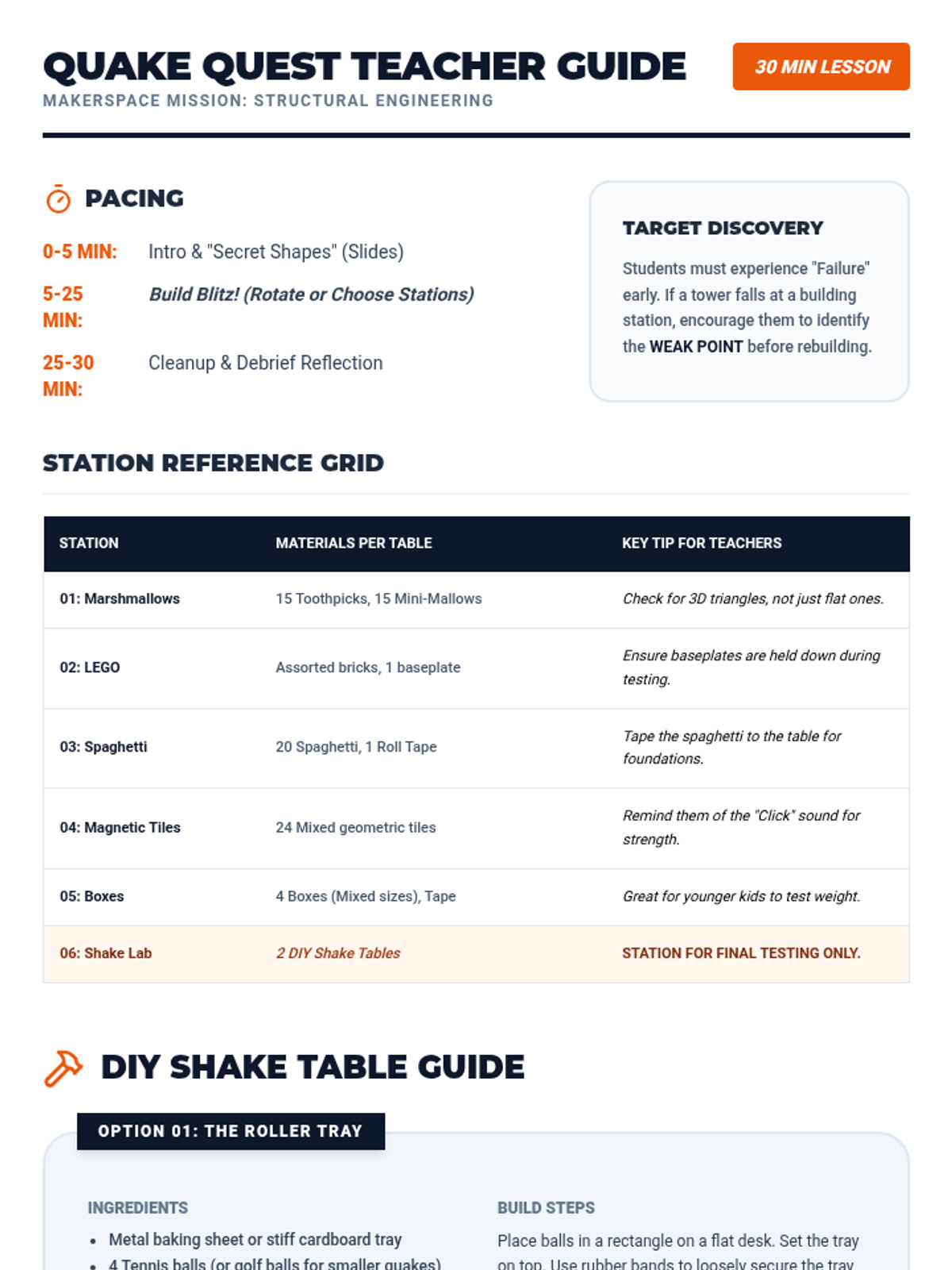
A comprehensive teacher guide for the Force Frenzy stations, including setup instructions, materials lists, pacing advice, and an answer key.
A set of 10 printable vocabulary cards with definitions and icons for magnetism, magnetic fields, and the trio of magnetic metals.
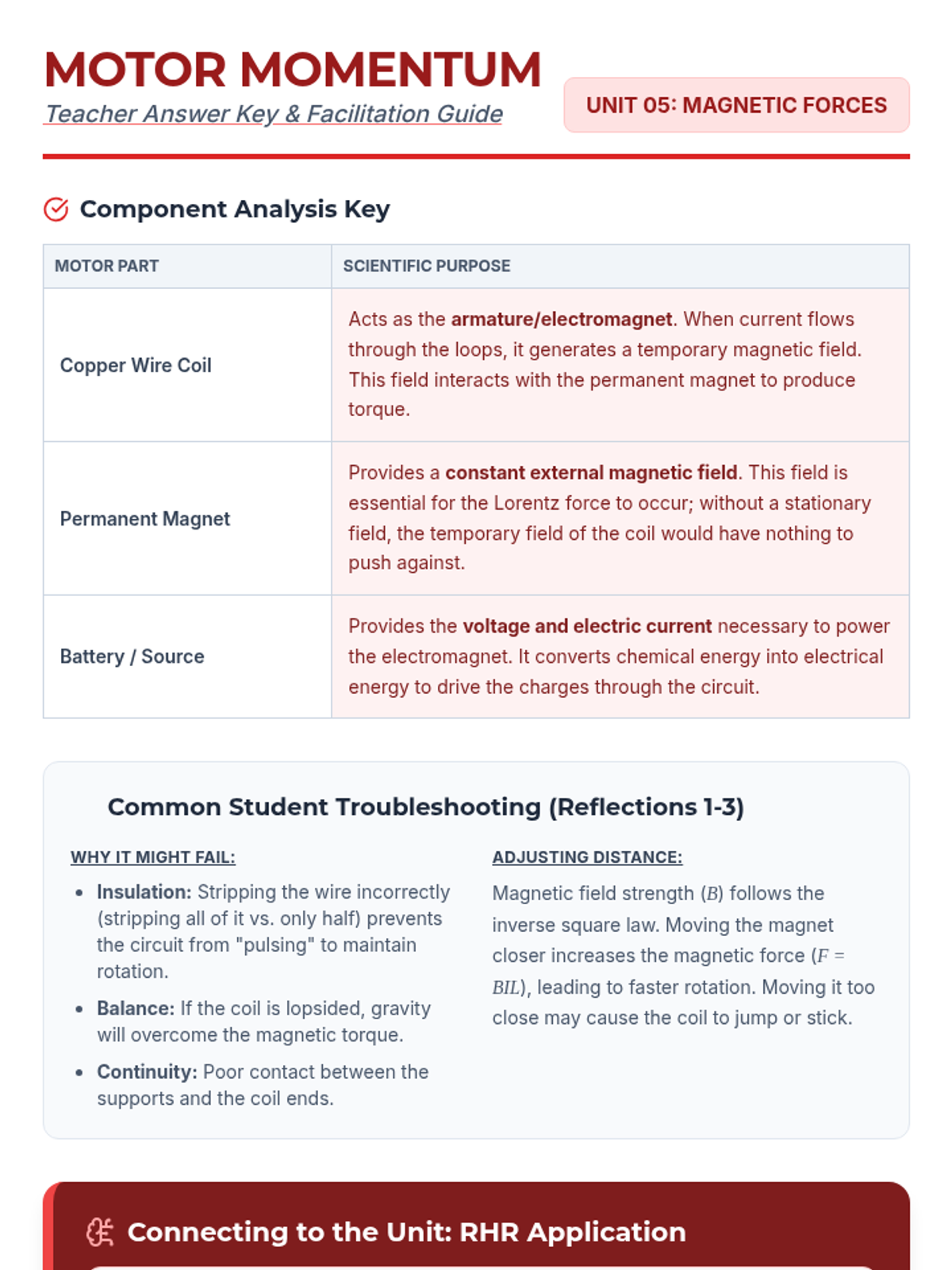
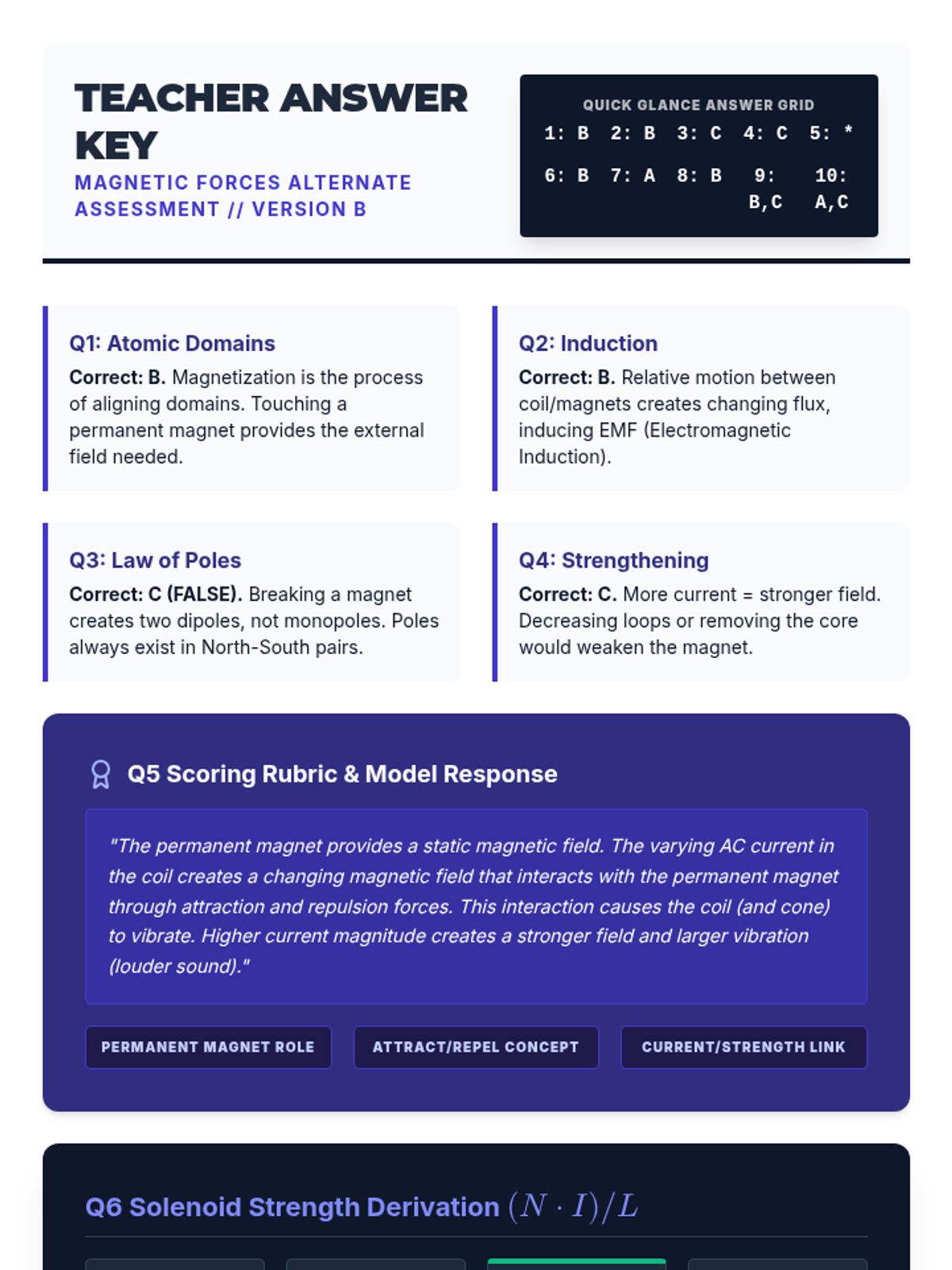
A comprehensive teacher answer key for the warm-up, lab sheet, and exit ticket in the Magnetic Movers lesson.
A quick warm-up activity for students to activate prior knowledge about contact and non-contact forces and predict how magnets affect object motion.
A quick assessment for the end of the lesson to check student understanding of the three magnetic metals, non-contact forces, and how magnets affect object motion.
A student lab sheet for the Magnetic Movers lesson, featuring three hands-on investigation stations for exploring magnetic fields and motion.
A presentation deck for a 7th-grade science lesson on magnetism, featuring vocabulary, the three magnetic metals, and the relationship between magnetic force and object motion.
A detailed lesson plan for a 60-minute session on magnetism and motion, including instructional steps, materials, and learning objectives.
A comprehensive teacher's resource containing lesson pacing, prep checklists, detailed answer keys for the lab calculations, and background information for high school science instruction.
A 2-page lab activity where students use magnetic stripe maps to calculate and compare seafloor spreading rates between the Atlantic and Pacific oceans. Includes data collection tables, measurement areas, and analysis questions.
A comprehensive teacher guide for the 'Bridge Builders' lesson. Includes preparation instructions for the straw models, video discussion prompts, a walking tour guide, and extension activity details.
A visually engaging slide deck for 1st grade students to learn about the strength of triangles. Includes a 'Squish Test' warm-up, an embedded SciShow Kids video on bridges, and visual aids for the 'Shape Detective' mission.
A student-facing worksheet for 1st graders to identify triangles in real-world structures and draw their own triangular design. Features clear diagrams of a playground, bridge, house, and crane for circling practice.
A comprehensive teacher guide for the Strong Shapes Safari lesson. Includes pacing, discussion prompts, "Squish Test" instructions, and differentiation strategies for K-2 educators.
A student recording sheet for the Shape Detective scavenger hunt and the pipe cleaner stability experiment. Includes drawing areas and a guided reflection section.
A vibrant presentation for K-2 students focusing on stable shapes in engineering. Includes mystery buildings, an embedded video, vocabulary, and interactive practice slides.
Printable 'Safety Inspector' badges for students to receive once they have successfully presented their symmetrical ride models and proven their 'safety' through geometry.
A comprehensive teacher guide for the Symmetry Land lesson, including instructional pacing, specific video pause points for deeper discussion, and differentiation strategies for varied learners.
A two-page student design log where young engineers can brainstorm, list materials, and draw an official blueprint of their symmetrical ride, including a designated space for showing lines of symmetry.
Visual slide deck for the Symmetry Land Engineering lesson, including the 'Symmetry Song for Kids' video, discussion prompts about real-world symmetry, and the 'Build a Ride' design challenge overview.
Final assessment for the sequence, requiring students to apply point group classification and selection rules to predict spectroscopic transitions in ammonia. Tests ability to use character tables, calculate direct products, and interpret physical outcomes.
Compact character table reference sheet for common point groups (C2v, C3v) and direct product rules. Essential tool for students applying selection rules in spectroscopy.
Answer key for the Scaling Failure Case Study, providing structural engineering analysis and space elevator design justifications.
Answer key for the Terminal Velocity Workshop, featuring terminal velocity scaling calculations and parachute design derivations.
Answer key for the Thermal Efficiency Lab, including SA:V ratio calculations and biological application explanations for Bergmann's and Allen's Rules.
Final slide deck for Lesson 5 on Selection Rules. Connects group theory character tables to quantum mechanical transition integrals, teaching students how to predict allowed and forbidden spectroscopic transitions based on molecular symmetry.
Answer key for the Monster Proportions Lab, featuring calculations for gorilla scaling and allometric bone radius requirements.
A student worksheet for Lesson 5 focusing on calculating interplanar spacing from XRD data, applying selection rules for crystal structure identification, and analyzing geometric constraints of diffraction.
Answer key for the Scaling Growth Worksheet, providing completed tables and worked-out biological scaling problems.
Teacher setup and facilitation guide for Lesson 5, including expected race results, setup tips for accuracy, and discussion prompts.
Teacher answer key for the Lesson 5 Rainbow Rebels worksheet, including the color spectrum and prism concepts.
Teacher answer key for the Lesson 4 Shadow Play worksheet, including material classification and shadow formation.
Teacher answer key for the Lesson 3 Bend It worksheet, including vocabulary and lab observation keys.
Teacher answer key for the Lesson 2 Bounce Back worksheet, including reflection classification and sample responses.
Teacher answer key for the Lesson 1 Straight Shooters worksheet, including vocabulary definitions and sample responses.
A student worksheet for Lesson 5: Rainbow Rebels, covering the visible light spectrum (ROY G. BIV) and how prisms split light.
Introductory slide deck for Lesson 5: Rainbow Rebels, exploring the visible light spectrum and prisms.
A student worksheet for Lesson 4: Shadow Play, focusing on classifying materials and understanding shadow formation.
Introductory slide deck for Lesson 4: Shadow Play, classifying materials as transparent, translucent, or opaque.
A student worksheet for Lesson 3: Bend It, focusing on refraction vocabulary, laboratory observations, and the concept of light speed changing in different mediums.
Introductory slide deck for Lesson 3: Bend It, exploring the principles of light refraction, speed changes, and lenses.
A student worksheet for Lesson 2: Bounce Back, focusing on reflection, smooth vs. rough surfaces, and predicting reflection angles.
Introductory slide deck for Lesson 2: Bounce Back, exploring the principles of light reflection and smooth vs. rough surfaces.
A student worksheet for Lesson 1: Straight Shooters, featuring vocabulary matching, path drawing, and an exit ticket.
Introductory slide deck for Lesson 1: Straight Shooters, covering light energy basics and its linear travel.
Large, color-coded labels for sorting bins used in the Light Lab activity, featuring clear definitions and icons for 2nd-grade students.
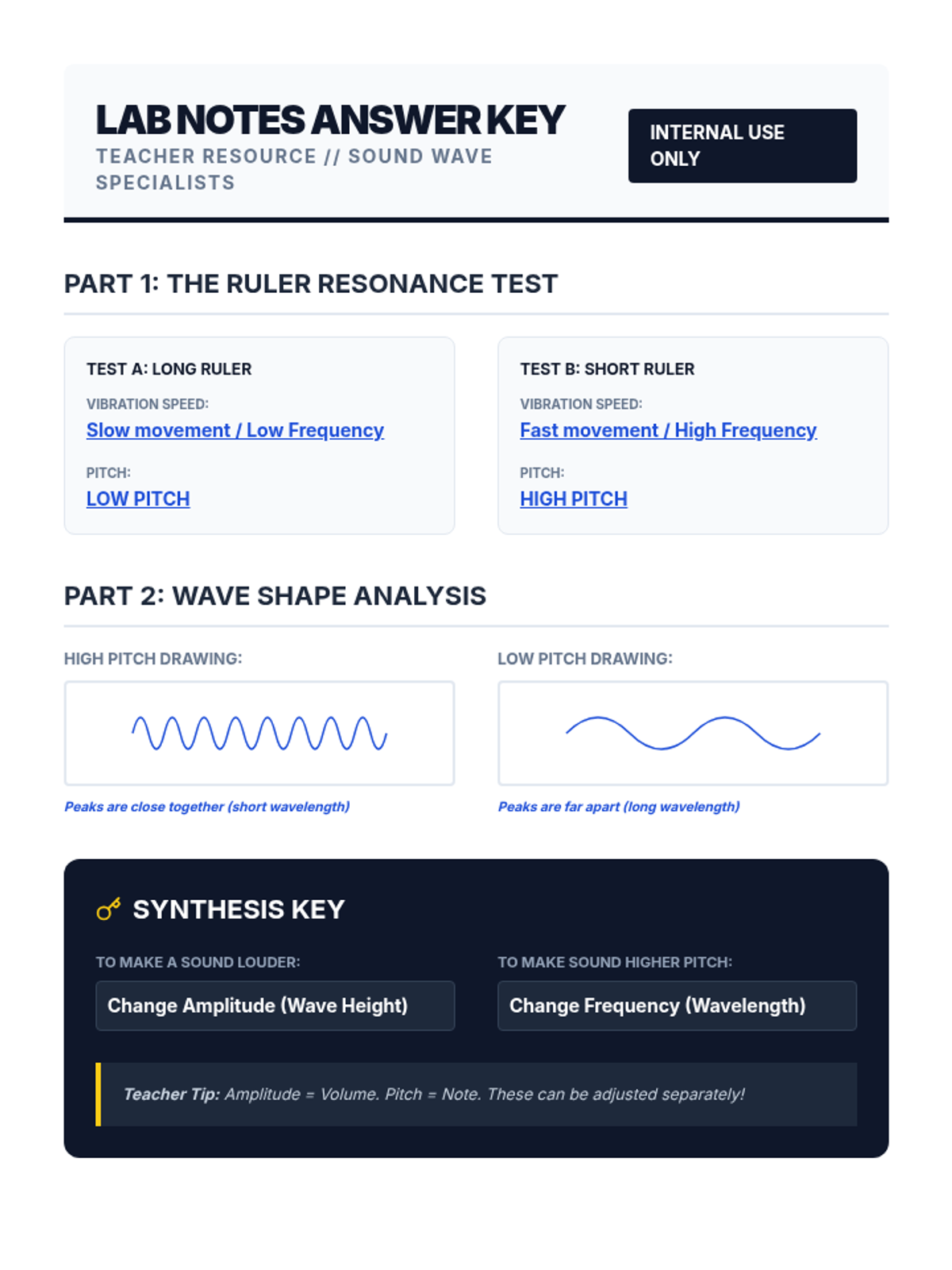
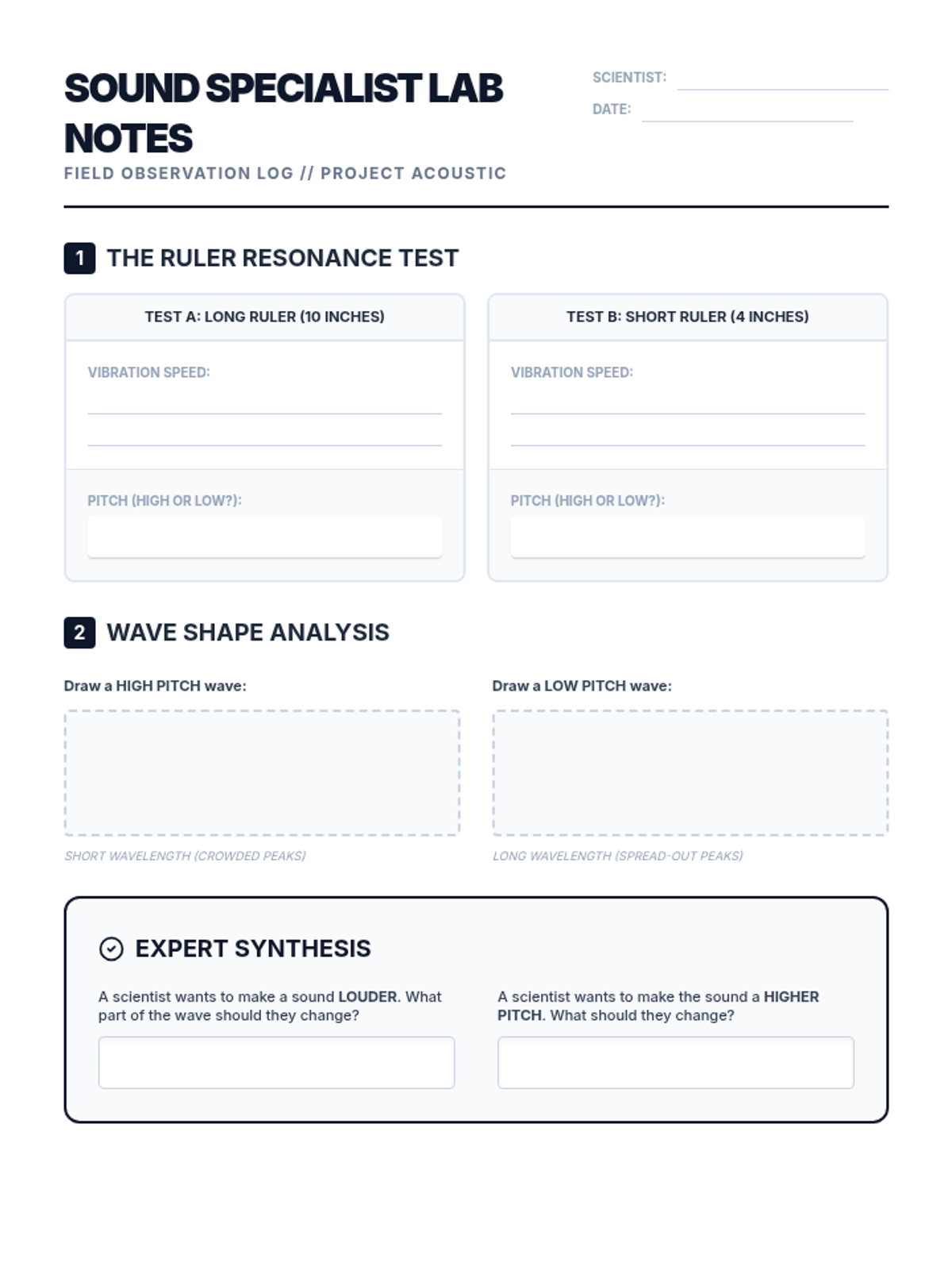
An answer key and grading guide for the Vibe Check lab notes and exit ticket, including visual examples for wave drawings.
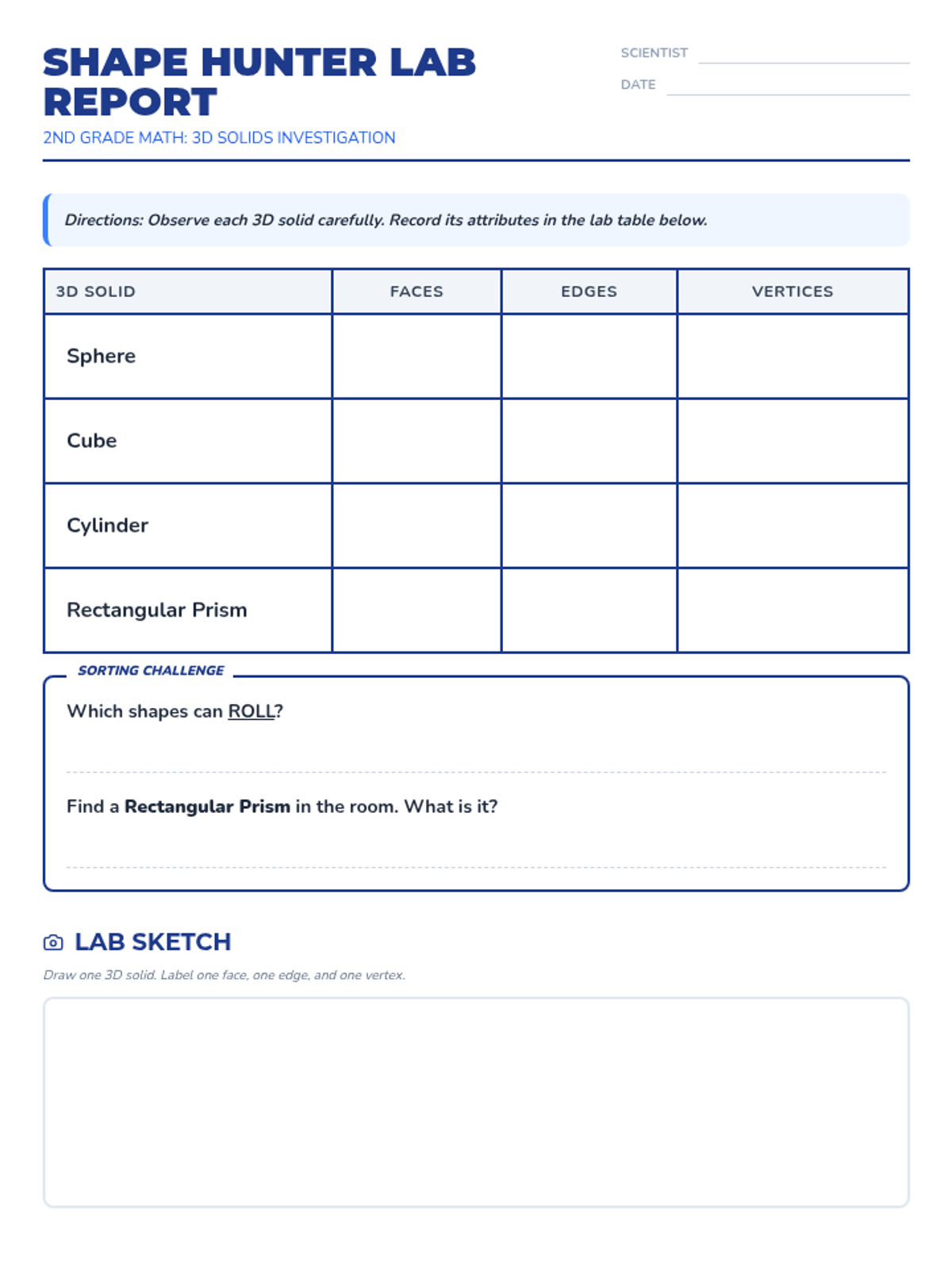
A quick drawing-based exit ticket for 2nd graders to demonstrate their understanding of transparent, translucent, and opaque materials. Includes two tickets per page for easy printing.
A student-facing worksheet featuring numbered sheet music for two songs, a visual guide to bottle tuning, and reflective scientific questions about pitch and vibration.
An exit ticket for assessing student understanding of the relationship between vibration speed (fast/slow) and pitch (high/low).
A comprehensive teacher facilitation guide for the Mystery Box Protocol lesson. Includes materials lists, setup instructions for four specific mystery box types, pacing guides, discussion prompts, and an answer key for the video notes.
A student worksheet for recording video notes on the scientific method and documenting findings from the mystery box investigation. Includes structured sections for each of the 6 steps of the protocol for four different case files.
A technical graphic organizer for mapping watershed features, including ridges, tributaries, estuaries, and the Chesapeake Bay. Designed for student labeling and identifying Virginia-specific systems.
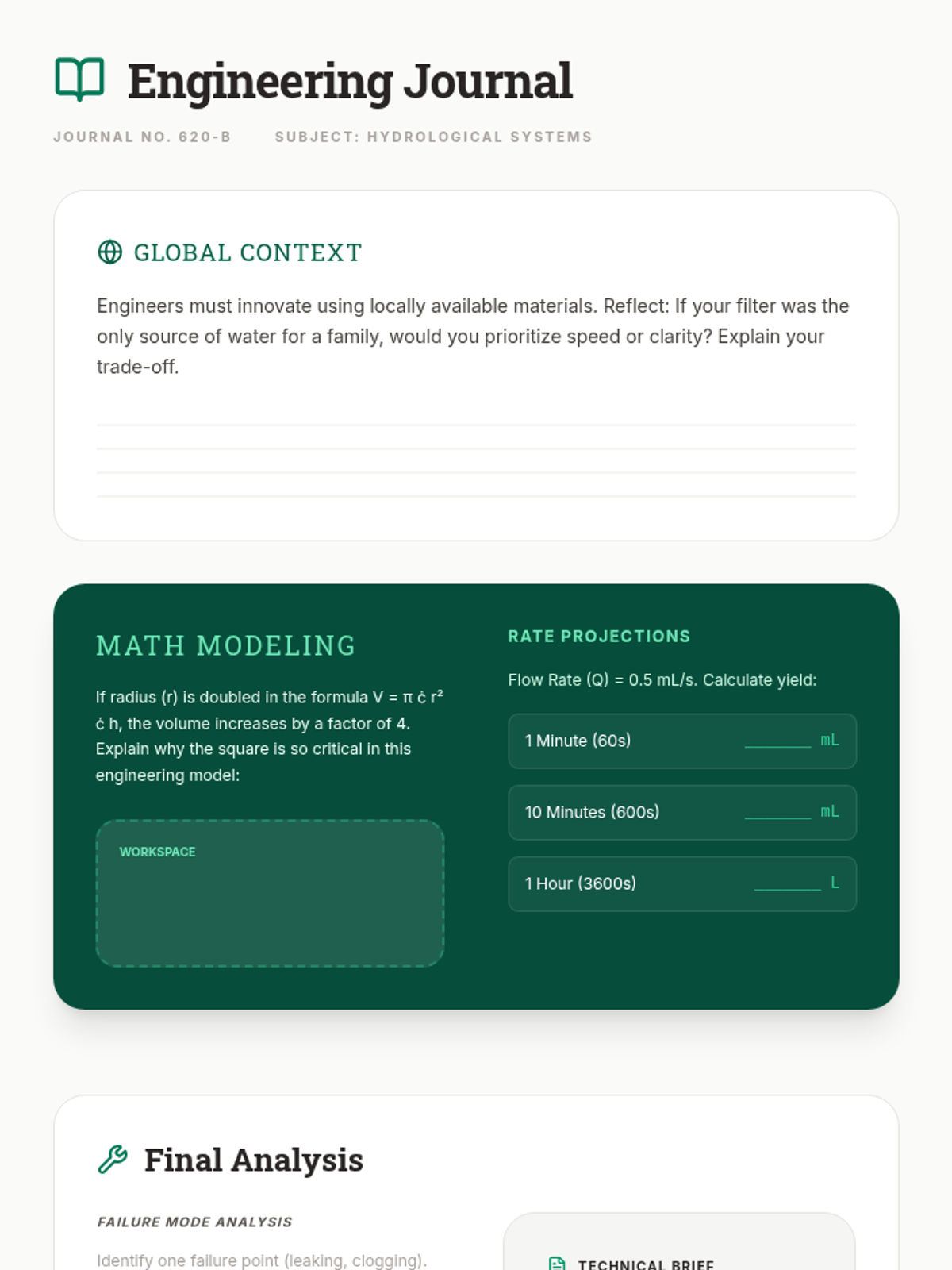
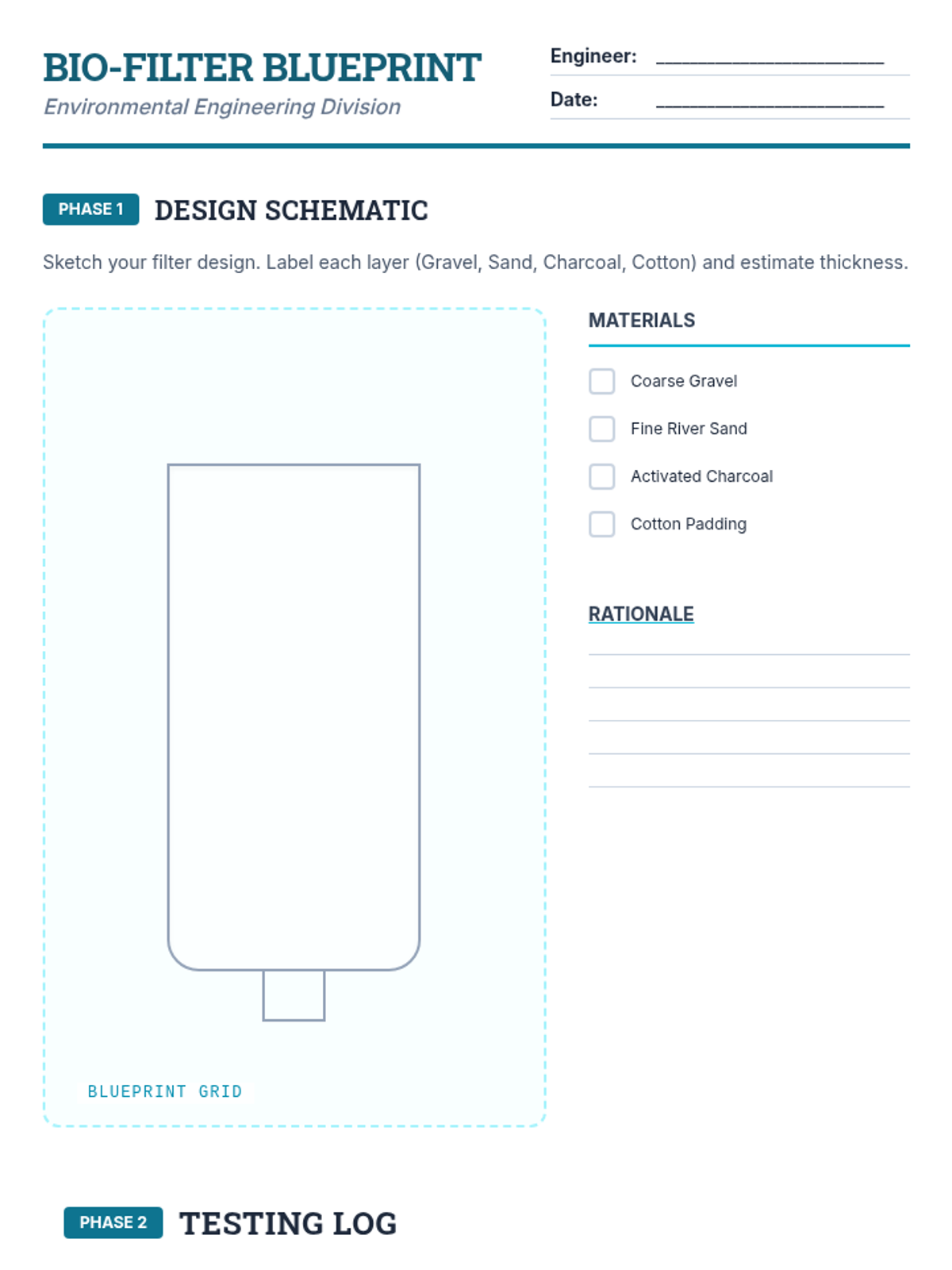
A 3-page student logbook containing the engineering filter lab sheet, core reading passages on water properties (SOL 6.6) and watersheds (SOL 6.8), and critical thinking reflection prompts.
A visual presentation deck for 6th-grade students covering the physical properties of water (universal solvent, cohesion, adhesion, thermal energy) and the complexity of Virginia's watershed systems. Designed with high-contrast, large text for readability.
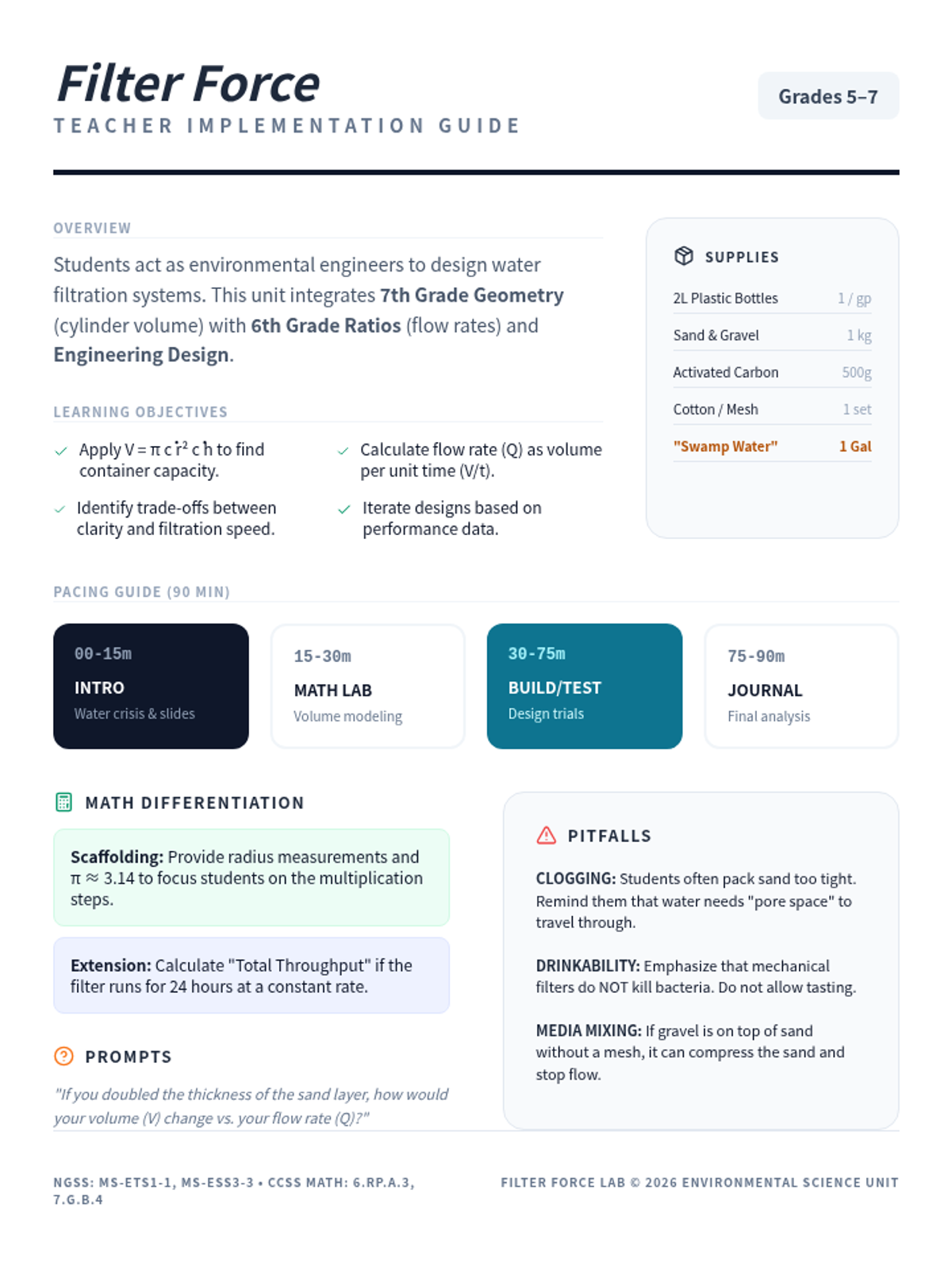
A comprehensive 10-session teacher guide for a 5-week unit on water properties and watersheds. Includes pacing schedules, daily session objectives, teacher tips, questioning frameworks, and differentiation strategies.
Teacher answer key for the Gelatin Lab Worksheet, featuring categorized answers for the Venn Diagram and suggested responses for the reflection question.
An anchor chart template for teachers to draw on chart paper, contrasting reversible physical changes (ice) with permanent mixtures (gelatin).
A student worksheet for the Wiggle Science lesson featuring a large Venn Diagram to compare properties of ice and gelatin, including a word bank and reflection question.
A student worksheet for the Wiggly Webs lesson, including a "Lab Key" to translate model parts to scientific concepts, a large sketching area for their edible model, and a guided reflection section to explain colloid behavior.
Visual slide deck for the Wiggle Science lesson, featuring concepts of dissolving, colloids, and reversible vs. permanent changes with 2nd-grade appropriate graphics and an embedded video.
A visual presentation for the Wiggly Webs lesson featuring the SciShow Kids video, microscopic analogies for colloids, and step-by-step instructions for the pretzel-and-marshmallow modeling activity.
A teacher guide for the Wiggly Webs lesson, including a timeline, material list, step-by-step instructions for the edible colloid model activity, and strategies for addressing common student misconceptions.
A teacher facilitation guide for the Wiggle Science lesson, including objectives, materials, and a detailed lesson flow for 2nd-grade students.
A printable template for creating a classroom anchor chart, featuring large T-chart headers and illustrated item cards for sorting during the lesson discussion.
A simple exit ticket assessment for the Mixture Mystery lesson, designed with two tickets per page to save paper. Asks students to identify physical properties and apply their learning to a new scenario.
Detailed answer key for the Magnetic Mixtures Lab Worksheet. Includes expected definitions, sample data values for mass measurements, common student errors in measurement, and answers for the scientific analysis and extension questions.
A student activity sheet for recording predictions and results during the magnetic scavenger hunt, including a space for reflection drawings.
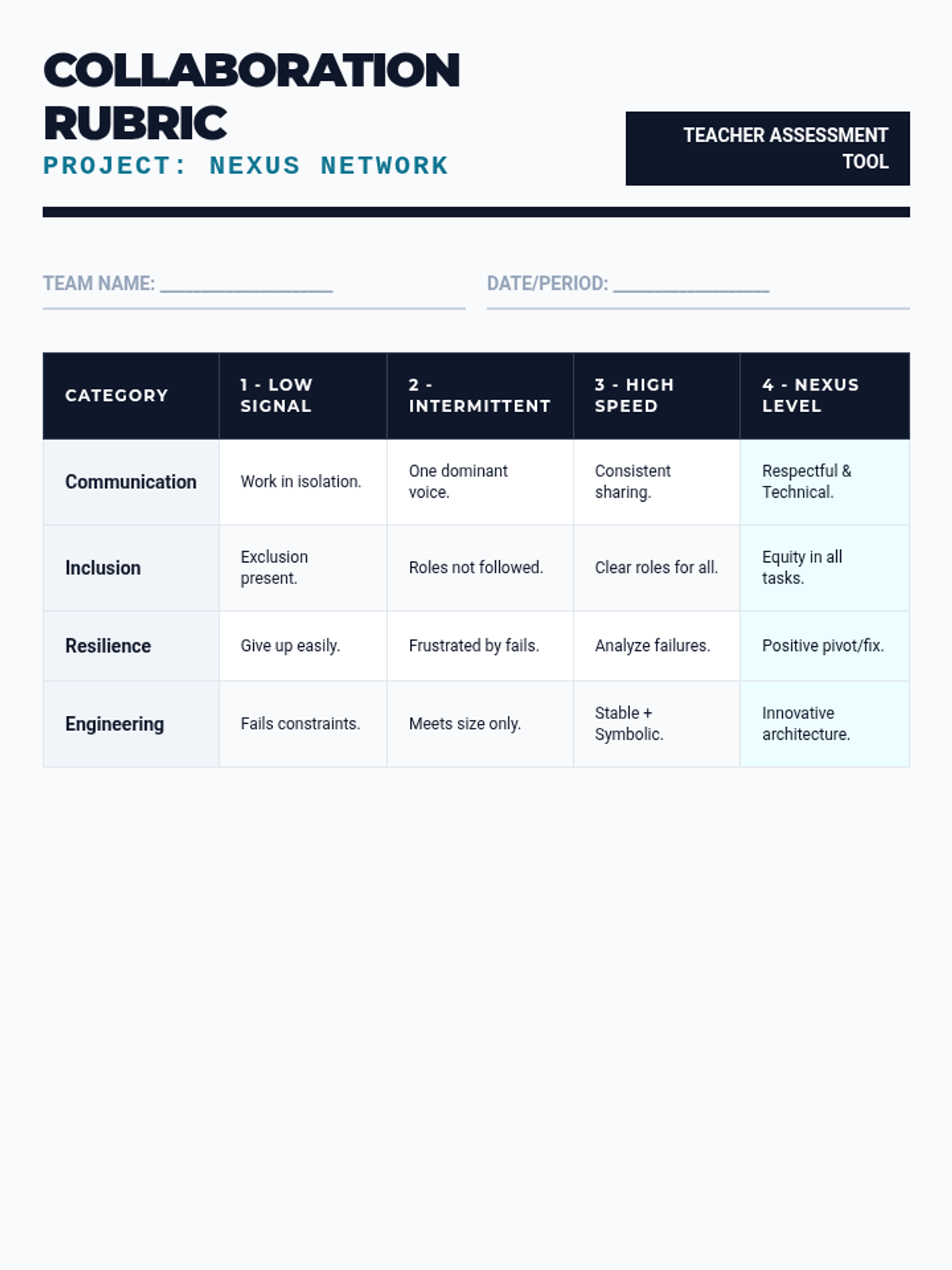
A grading rubric for 'The Great Sort' recycling design challenge, evaluating students on property application, engineering strategy, diagram clarity, and scientific reasoning.
A structured laboratory worksheet for 3rd-grade students to record their predictions, observations, and conclusions during the Mixture Mystery activity, focusing on physical properties and separation tools.
Teacher facilitation guide for the Magnetic Mixtures lesson. Includes a detailed material list, pacing suggestions, specific video pause points with discussion questions, common misconceptions, and safety advice regarding the handling of iron filings.
Engaging classroom slides for the Magnetic Mystery lesson, including the embedded experiment video, visual explanations of magnetic fields, and structured prompts for students.
A comprehensive teacher guide for instructing Class A and Class B fire alarm circuits. Includes learning objectives, a timed lesson sequence, instructional strategies, and tips for addressing common student misconceptions.
A visual presentation deck for 11th-grade students introducing Class A and Class B fire alarm circuits. It features clear diagrams of radial vs. loop topologies, pro/con comparisons, and real-world engineering challenges.
A technical comparison worksheet for 11th-grade students detailing the differences between Class A and Class B fire alarm circuits. It includes wiring diagrams, a feature comparison table, and scenario-based analysis questions.
A comprehensive project evaluation tool containing a student self-assessment checklist, reflection prompts, and a formal teacher rubric.
A student-facing technical reference sheet that explains how to connect hardware and code narrative patterns.
A student brainstorming worksheet to help plan the narrative beats, physical interfaces, and programming logic for their circuit story.
A visually engaging slide deck that introduces the concept of circuit stories, explains conductivity and microcontroller logic, and outlines the project phases for students.
A comprehensive teacher guide for the Circuit Stories lesson, including duration, materials, instructional flow, and differentiation strategies.
An exit ticket assessment for students to apply their knowledge of material properties to objects in their immediate environment, requiring the use of scientific vocabulary.
Printable 'What If?' scenario cards to facilitate group discussion about material properties by imagining the consequences of using inappropriate materials for everyday objects.
A Cause and Effect graphic organizer for students to complete while watching the 'Properties of Materials' video, identifying how material properties dictate their practical uses.
A visual presentation deck for the Material Mastery lesson, featuring a warm-up activity, vocabulary introduction, embedded video, and discussion prompts.
A comprehensive teacher facilitation guide for the Material Mastery lesson, including learning objectives, a timed lesson flow, vocabulary definitions, and answer keys for the student activities.
A professional instructional guide for teachers to facilitate the Circuit Blueprints lesson, featuring specific video timestamps, whiteboard modeling tips, and common student misconception notes.
Student task cards for the Earthquake Proof activity, outlining goals, material options, engineering tips, and testing procedures.
A reflective journal for students to record their thoughts on structural stability, ancient material choices, and future engineering challenges.
An engineering lab sheet for the Shake Test activity, where students sketch their designs, record observations during the earthquake simulation, and analyze their results.
Visual presentation for the Epic Foundations lesson, featuring the Wonders of the World video, engineering concepts, and the Shake Test challenge.
A comprehensive teacher facilitation guide for the Epic Foundations lesson, featuring pacing, video timestamps, and detailed activity instructions for the earthquake simulation.
Teacher facilitation guide for the Voyager Engineering lesson, including learning objectives, a detailed materials list, a timed lesson flow, and teaching tips for the boat-building activity.
Student lab sheet for the 'Float Your Boat' engineering challenge, including prediction space, a data table for penny counts, and analysis questions regarding boat stability.
Visual slide deck for the Voyager Engineering lesson, covering the Polynesian Triangle, migration concepts, and the 'Float Your Boat' activity instructions. Includes an embedded video and discussion prompts.
Teacher answer key for the Molecular Map Worksheet, featuring visual examples of low vs. high density molecular drawings and the correct ranking of the 8 substances from the lesson.
Printable exit tickets for the 'Better Bridge Engineering' lesson, asking students to reflect on the specific iteration they made to improve their bridge design.
Évaluation sommative finale pour la séquence sur le principe d'inertie, incluant restitution de cours, analyse de scénarios et schématisation vectorielle.
Feuille d'exercices de synthèse appliquant le principe d'inertie à des cas complexes comme les sondes spatiales, l'analyse de chronophotographies et le sport (curling).
Mini-quiz d'évaluation formative de 10 minutes pour vérifier la compréhension immédiate de l'énoncé du principe d'inertie et de sa contraposée.
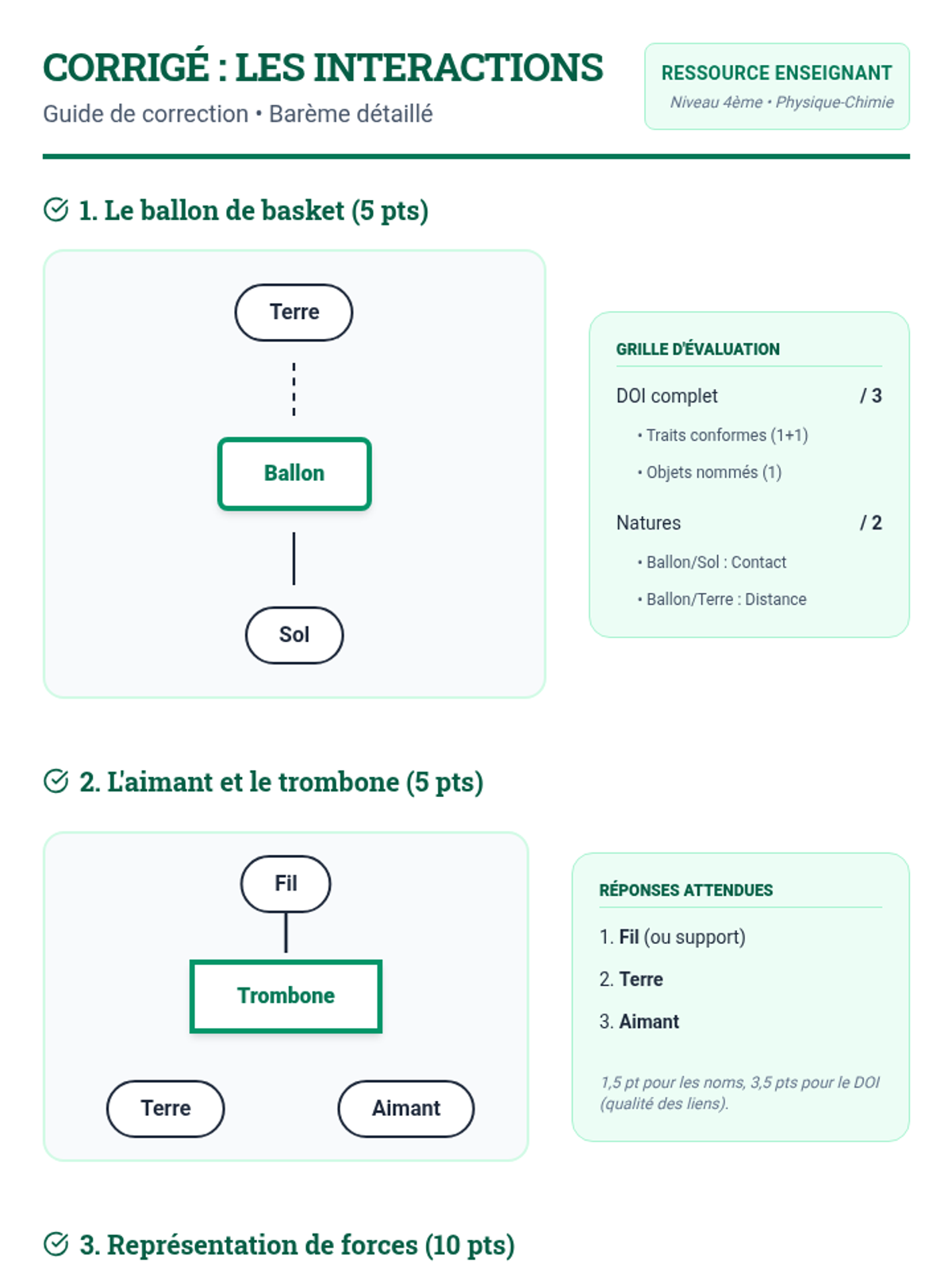
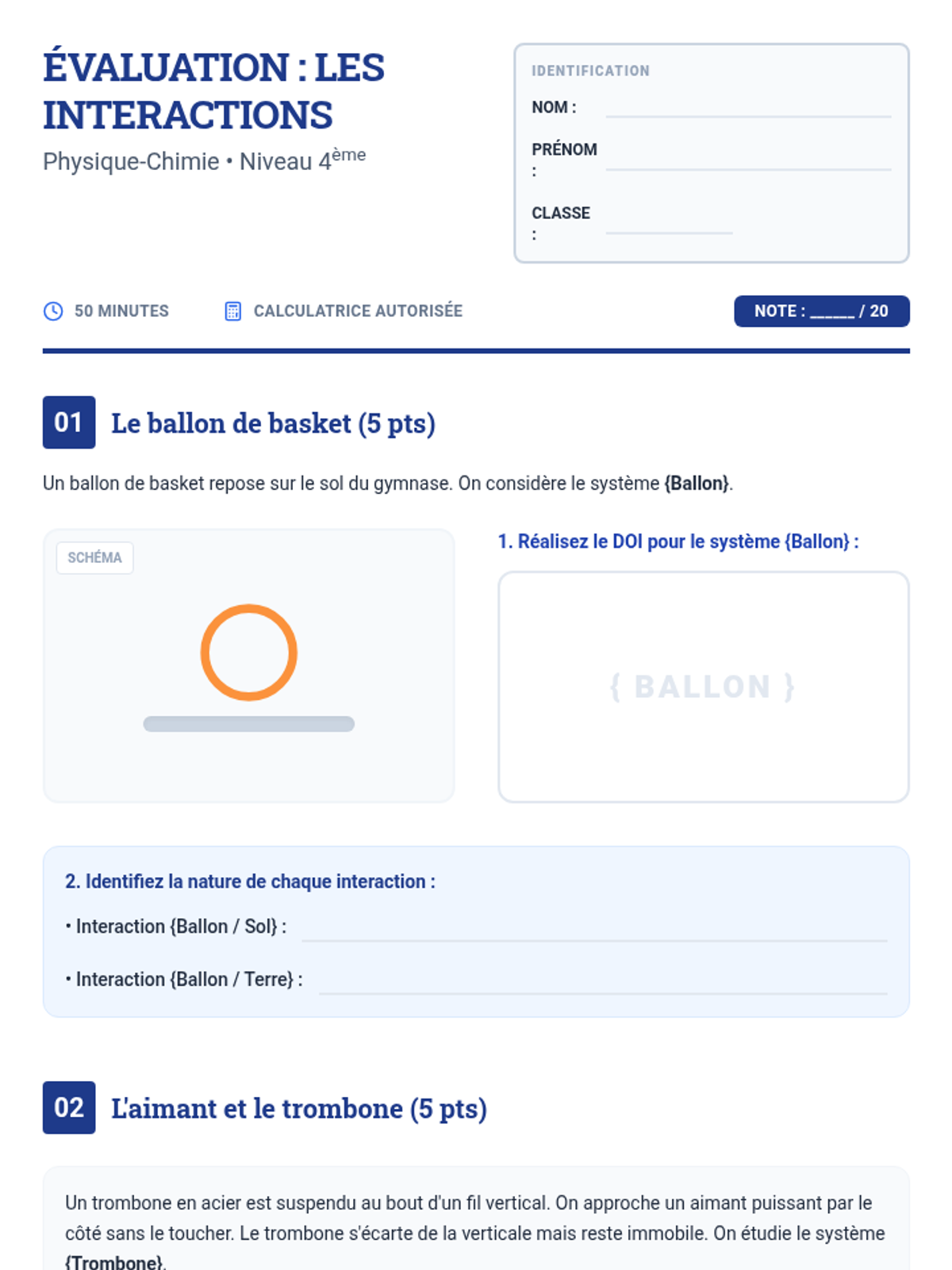
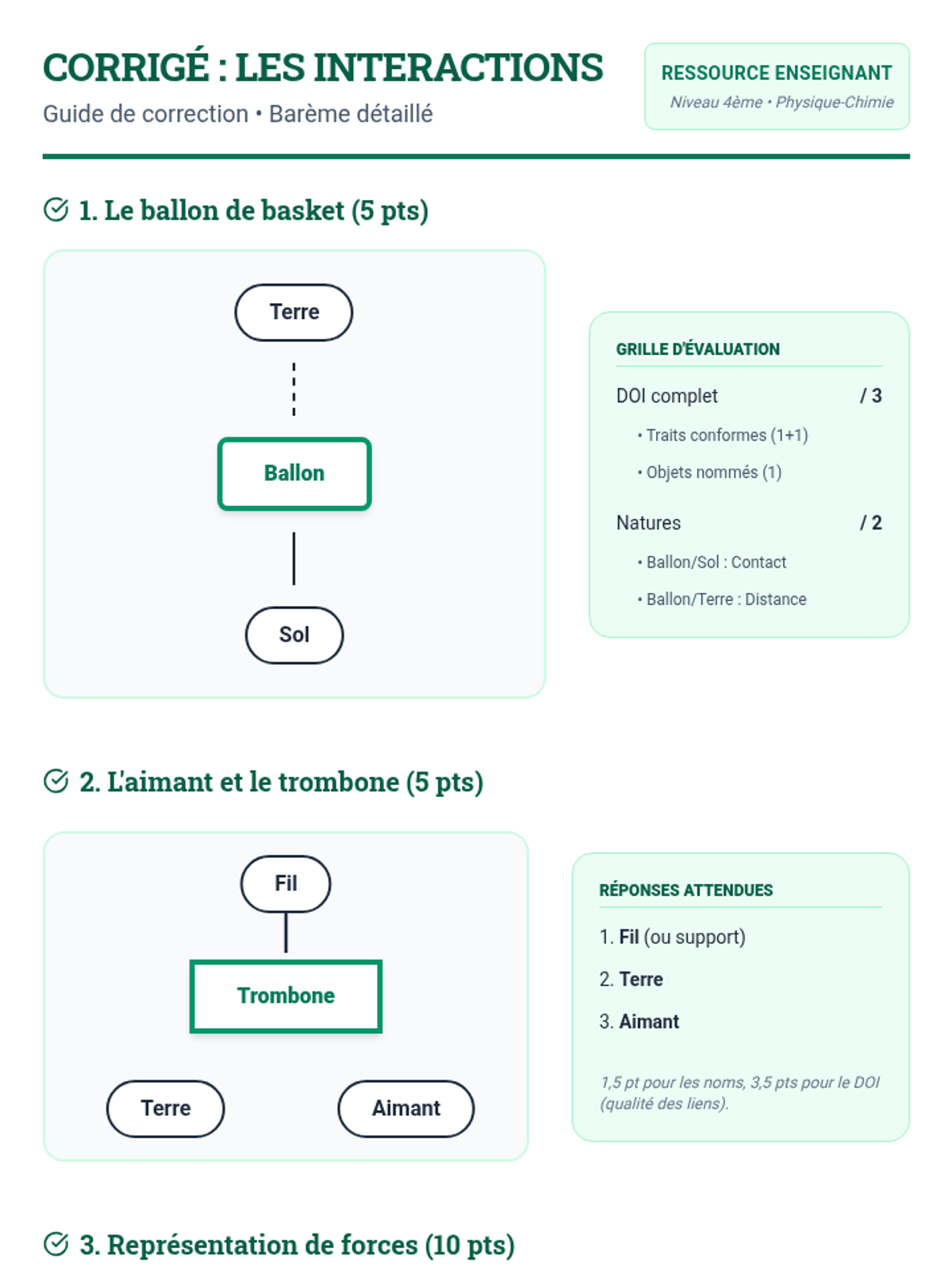
Feuille d'exercices focalisée sur l'application du principe d'inertie à travers des bilans de forces vectorielles et des situations concrètes (parachutiste, hockey).
Guide d'activité numérique utilisant un simulateur PhET pour manipuler les forces et observer leur impact sur le mouvement, permettant de redécouvrir le principe d'inertie de manière expérimentale.
Activité documentaire comparant les textes historiques d'Aristote et de Galilée pour introduire le changement de paradigme vers le principe d'inertie.
Support de présentation pour la première séance, introduisant le contexte historique et l'énoncé moderne du principe d'inertie avec une esthétique soignée.
A comprehensive teacher's guide for the "Speed of Signals" lesson, featuring pacing, prep notes, and an answer key.
A set of two exit tickets per page for closing the lesson, focusing on the future of communication and reflection on past speeds.
A student worksheet for calculating communication speeds (mph) and preparing for a physical timeline activity.
A sleek, high-energy slide deck for guiding the lesson, including the warm-up, video embed, and activity instructions.
A visually striking anchor chart comparing the speeds of physical transport (horse, boat, train) versus electronic signals (speed of light).
A standard metric grid paper template for students to use for additional graphing or sketching during the Kinetic Records lesson.
An answer key for the Kinetic Records lesson, providing the correct speed calculations from the video and expectations for the graphing activities.
A graphing activity sheet where students create a bar chart comparing speeds and a line graph showing the cyclist's distance-time relationship.
A handy printable reference card (4 per page) for students, featuring the speed formula triangle, derived formulas, and common metric units.
Answer key for the Speed Unit Sort activity and the Speed Check exit ticket, provided as a reference for teachers.
A data collection worksheet for students to record distances and times from the video and calculate the final speeds for various subjects.
An answer key for the Speed Sprint lesson, covering the Lab Sheet calculations, video examples, and the interactive speed quiz.
Brief end-of-lesson assessment asking students to calculate a speed problem and identify the correct unit of measurement for a given scenario.
Answer key for the Straight Shot worksheet and exit ticket, providing step-by-step calculations and conceptual explanations.
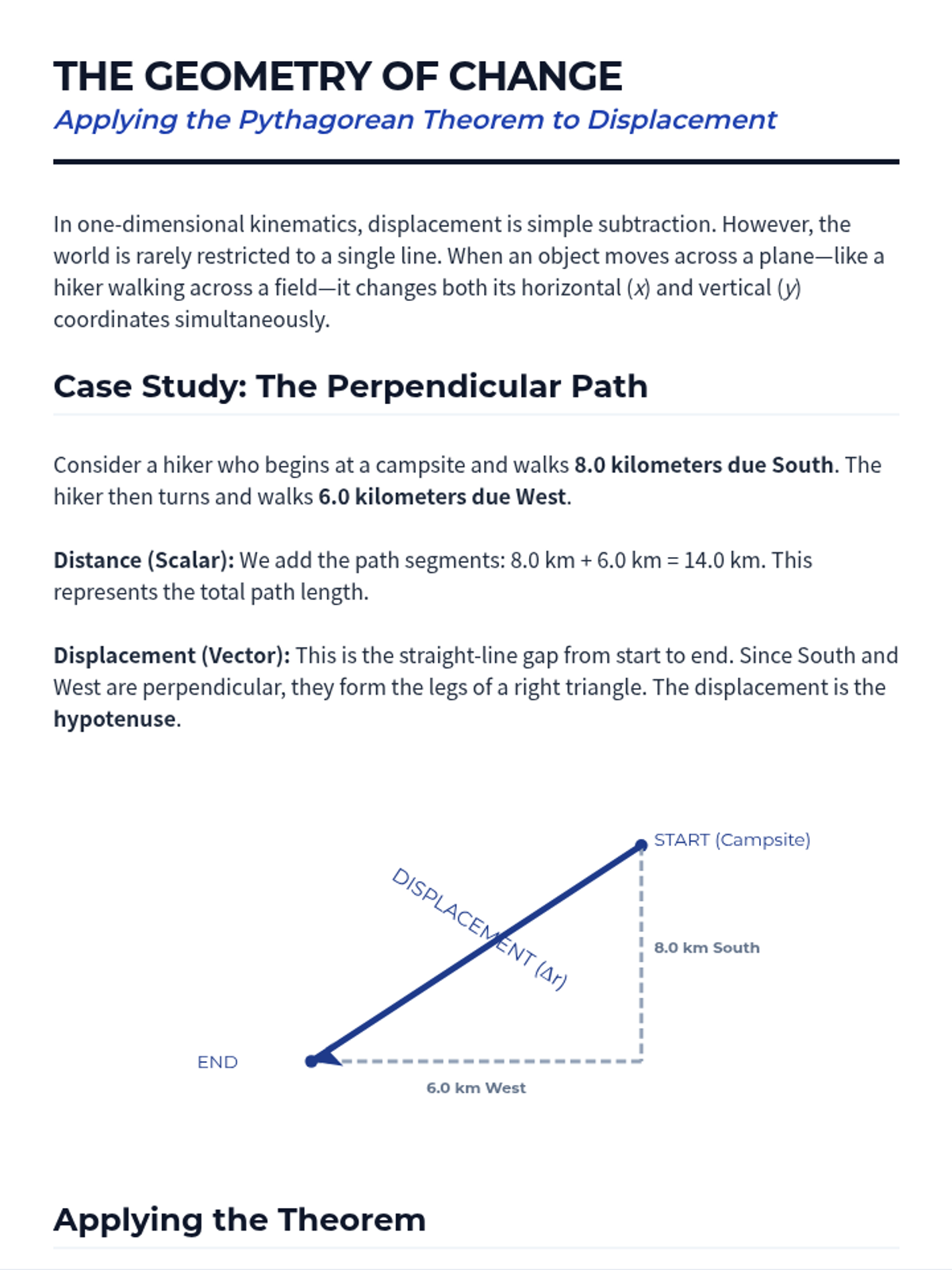
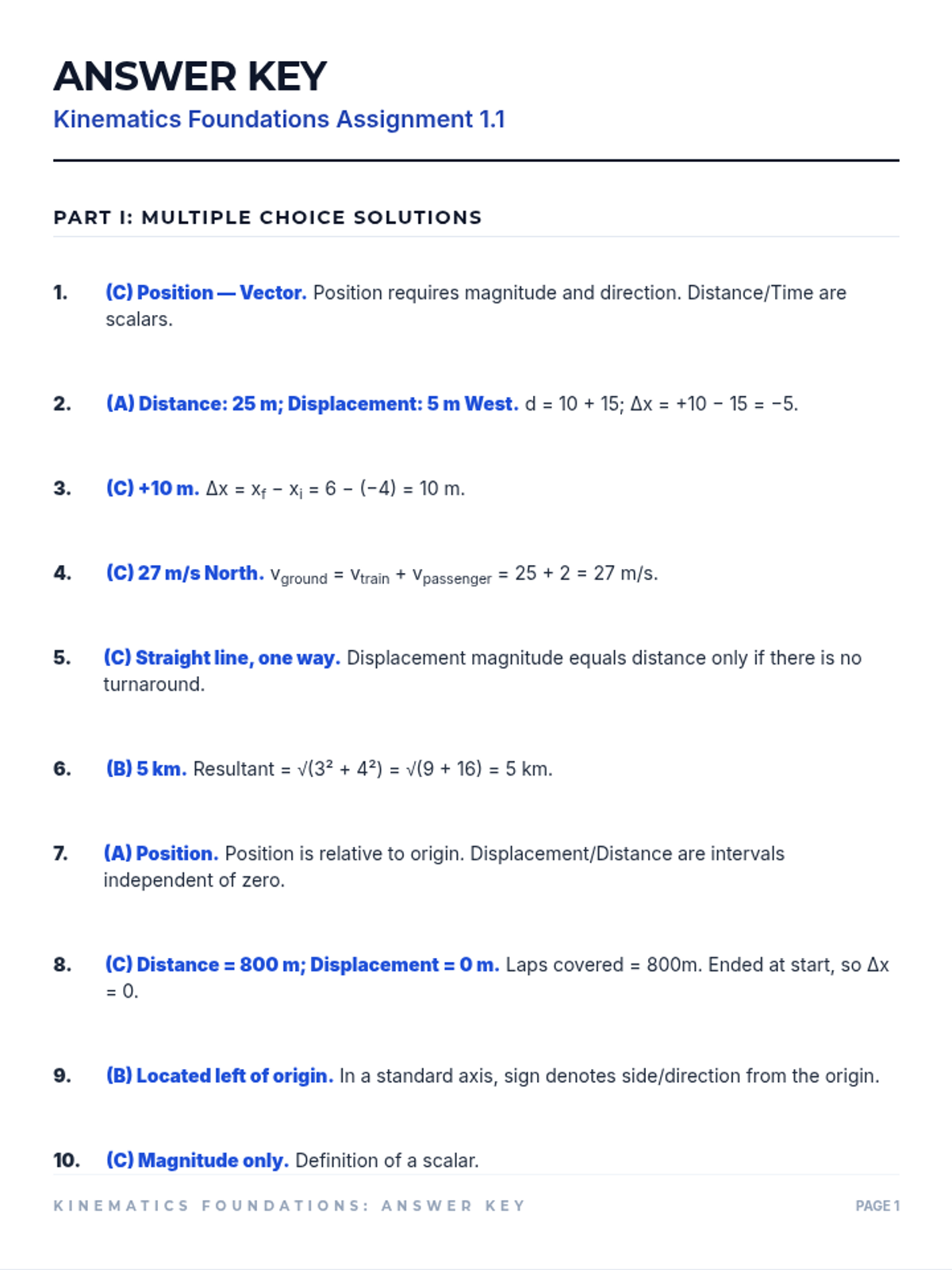
Teacher answer key and instruction guide for the Calculator Pro Lab. Includes solutions for the warm-up, error analysis worksheet, and video practice problems, along with instructional tips for identifying student errors.
A quick assessment tool for the end of the lesson, featuring a golf-themed displacement problem and a conceptual reflection question. Duplicated for easy printing.
A student worksheet for AP Physics focusing on resolving velocity components for a golf ball projectile and extending the calculation to find time of flight and range.
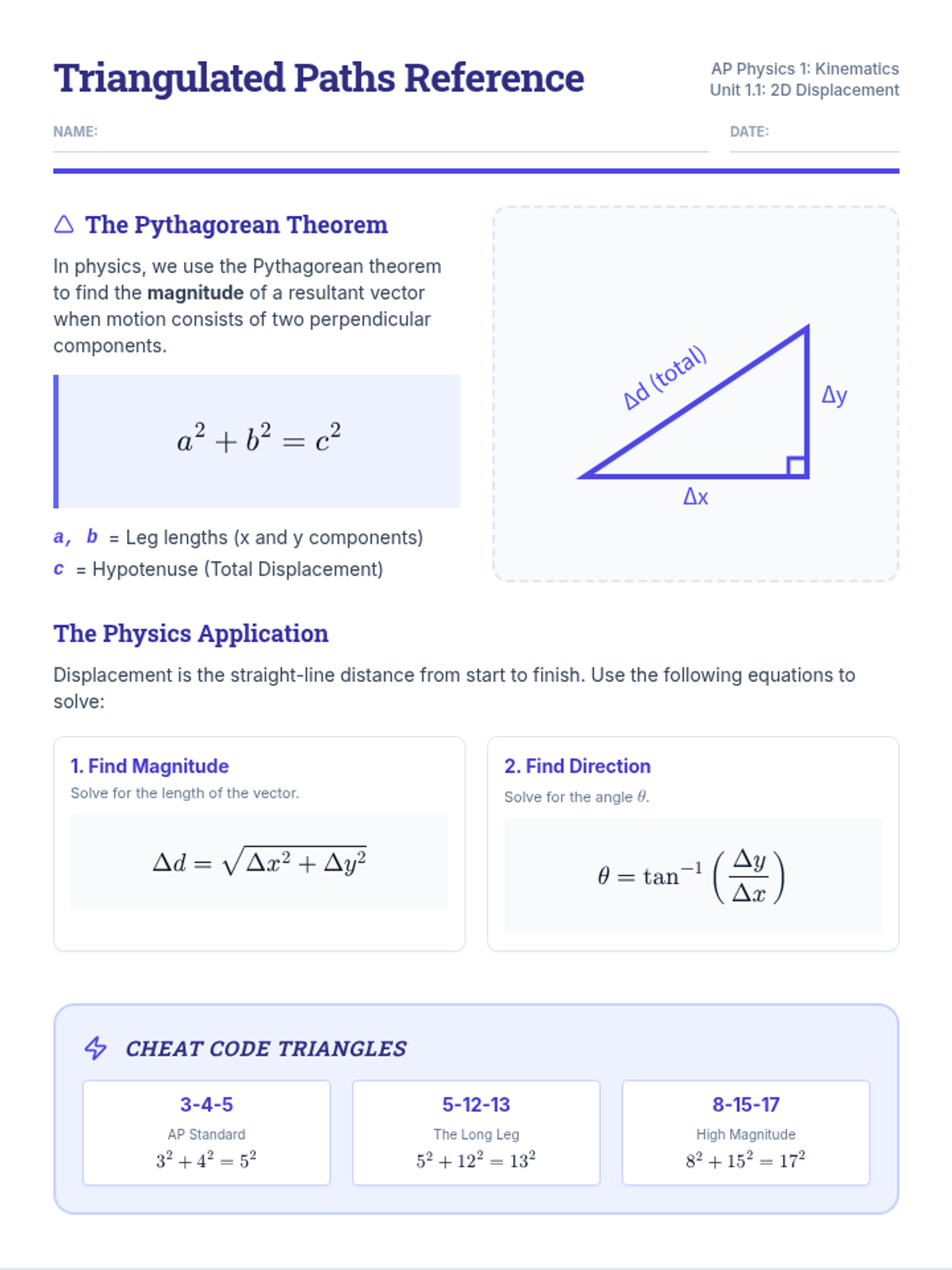
A comprehensive 'Physics Calculator Cheat Sheet' for students. Features visual trig components, calculator mode check instructions, formulas for vector components, and simplified significant figure rules.
Student worksheet for the Driveway Hoop activity, featuring real-world sports displacement problems and measurement logs. Expanded work areas for drawing and calculations.
A visual presentation for AP Physics introducing projectile motion and the independence of vertical/horizontal components. Includes a YouTube video embed, warm-up prompt, and activity guidance.
An error analysis worksheet where students identify and fix common calculator-related mistakes in physics problems, such as radian vs. degree mode, incorrect trig function choice, and significant figure rounding.
Visual presentation slides for the Straight Shot physics lesson, including video embed, definitions, and activity instructions.
Interactive slide deck designed for high school remedial physics students. Includes a calculator mode warm-up, embedded video lesson with clear pause points for calculation checks, and step-by-step guidance on vector components.
A comprehensive teacher guide for AP Physics projectile motion, including pacing, whiteboard prompts, learning objectives, and a detailed answer key for flight time and range calculations.
A comprehensive teacher guide for the Straight Shot physics lesson, including objectives, materials, pacing, and discussion prompts.
A comprehensive teacher guide for the Vector Velocity lesson, outlining the timeline, materials, pedagogical strategies for calculator use, and deep-dive discussion questions for high school physics.
An instructor's answer key for the Basketball Shot Worksheet, showing step-by-step calculations for horizontal and vertical components and detailed analysis responses.
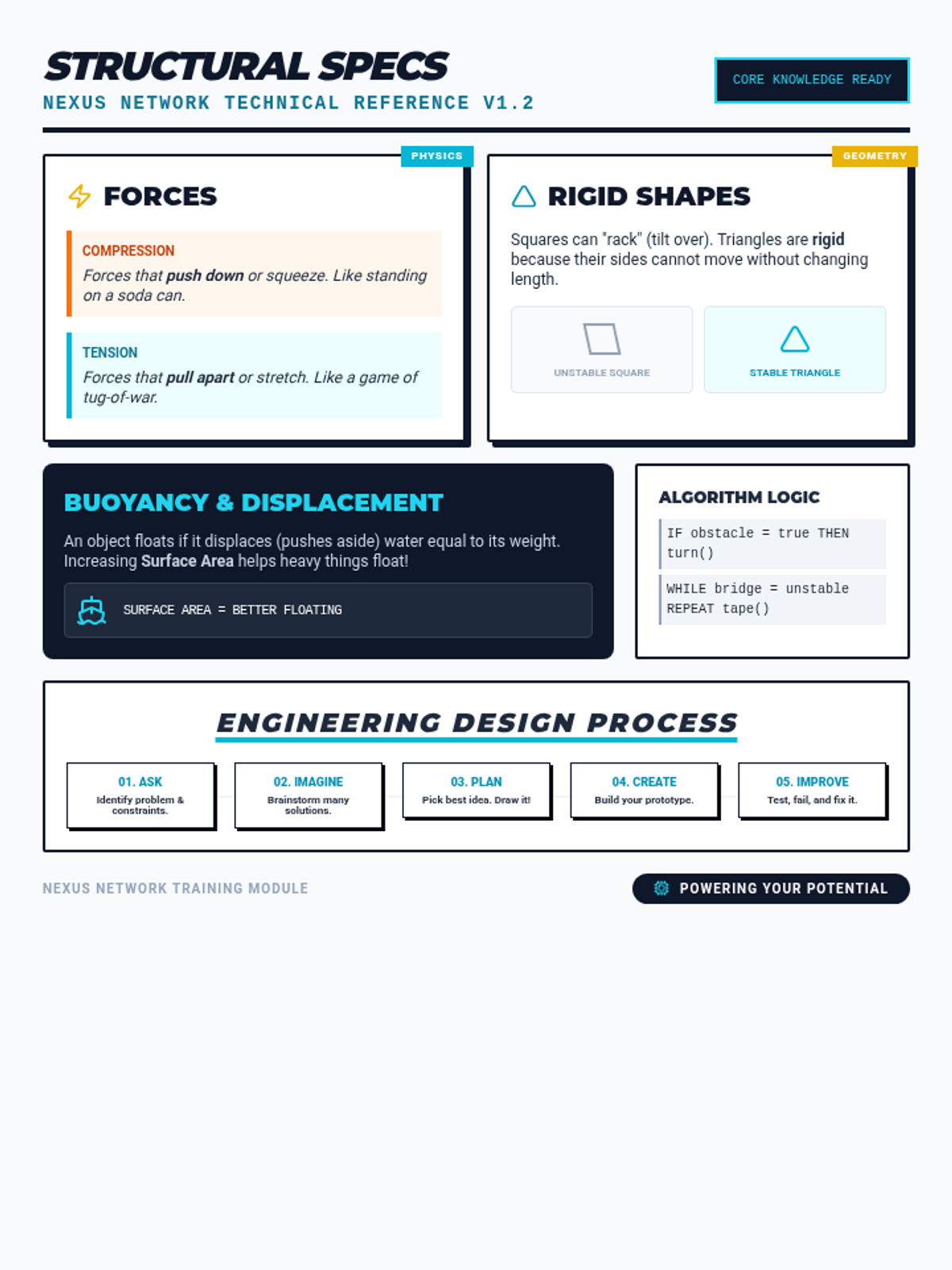
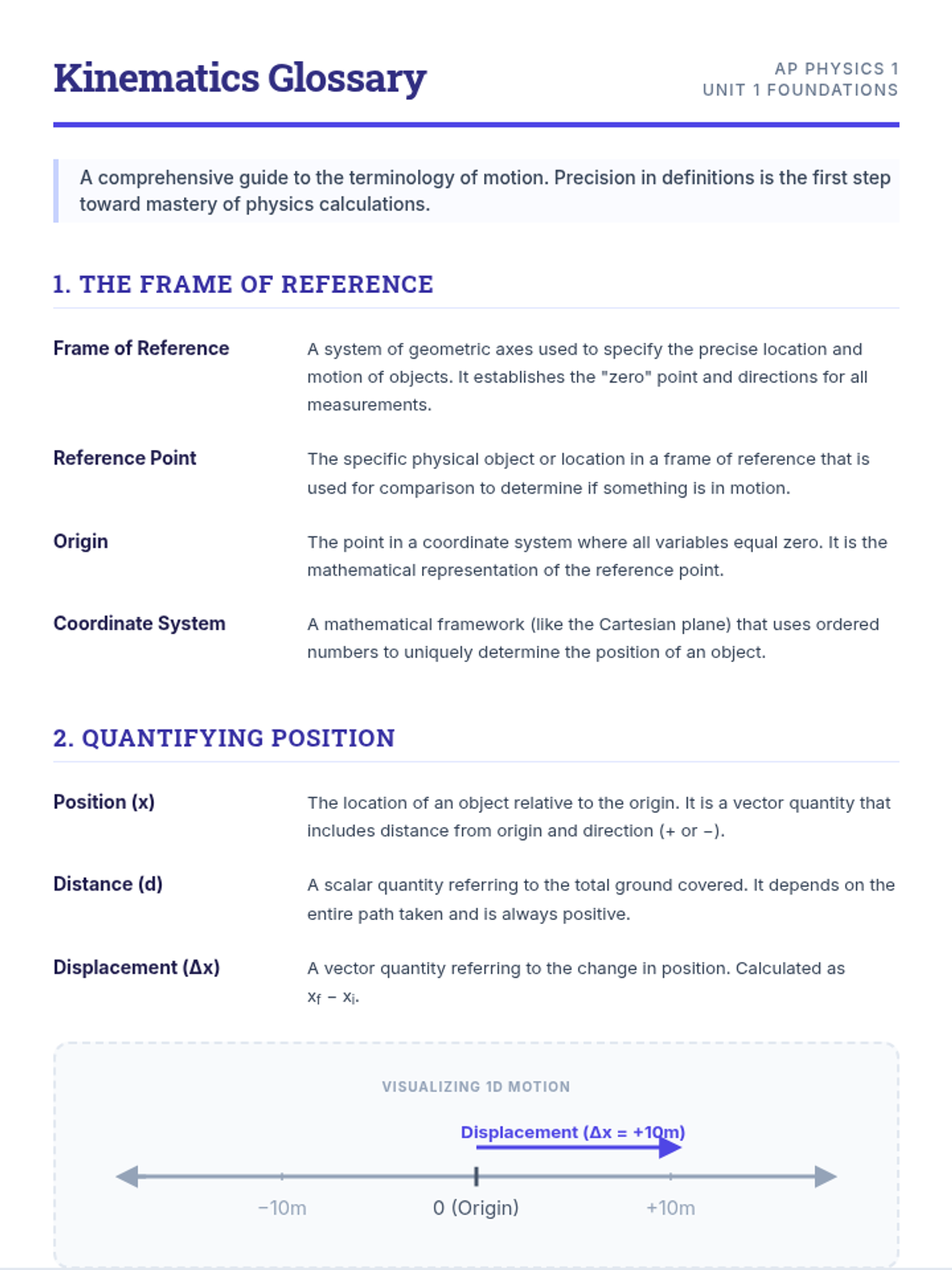
A classroom anchor chart (whiteboard visual) summarizing kinematics definitions, the distinction between 1D and 2D motion, types of friction, and the concept of an inclined plane. Designed for high visibility and reference during lessons.
Teacher answer key for the Kinematic Connections Worksheet, providing correct matching answers, sample conceptual responses, and scenario labels.
A practice worksheet for calculating horizontal and vertical velocity components based on basketball launch scenarios with varying angles and velocities.
A teacher guide for setting up and facilitating the 'Component Walk' activity. Includes a materials list, step-by-step setup instructions for floor markings, and pedagogical tips for connecting the activity to core kinematics concepts.
A student worksheet focused on kinematic vocabulary, conceptual understanding of friction, and scenario-based application of 1D and 2D motion. Includes a matching section, short response questions, and scenario labeling.
Visual presentation for the Vector Velocity lesson, including a warm-up, embedded YouTube video, conceptual breakdowns of horizontal and vertical velocity, and a concluding review quiz. Revised for optimal slide font sizes.
A 10-slide presentation for the Mystery Box Protocol lesson. Includes warm-up video embed, essential questions, a breakdown of the 6 steps of the scientific method, historical context, and activity instructions.
A visual presentation for the 'Mapping the Invisible Ocean' lesson, featuring the warm-up prompt, embedded video segment, sonar physics explanation, and activity instructions.
A technical bathymetric plotting sheet for students to convert sonar travel times into depth and graph a seafloor profile, featuring a raw data table and a structured coordinate plane.
A student worksheet for the 'Mapping the Invisible Ocean' lesson, featuring a warm-up brainstorming area, video-based comprehension questions, and a sonar depth calculation tutorial.
A teacher guide including the lesson plan, instructional sequence, answer keys for the sonar calculations, and discussion prompts for the 'Mapping the Invisible Ocean' lesson.
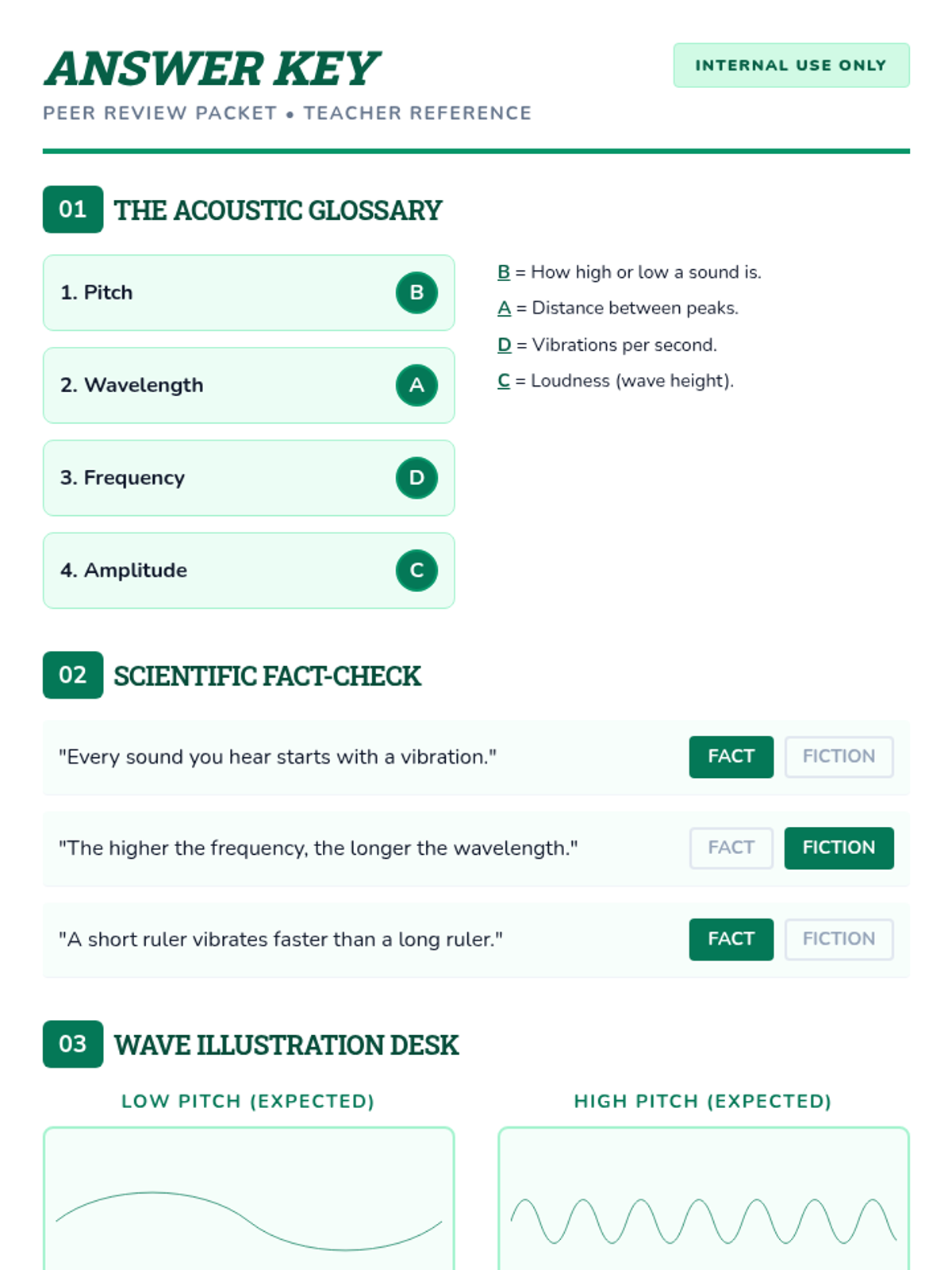
An answer key for the Pitch Paradox lesson, providing the expected observations and scientific explanations for the Tapping vs. Blowing experiments.
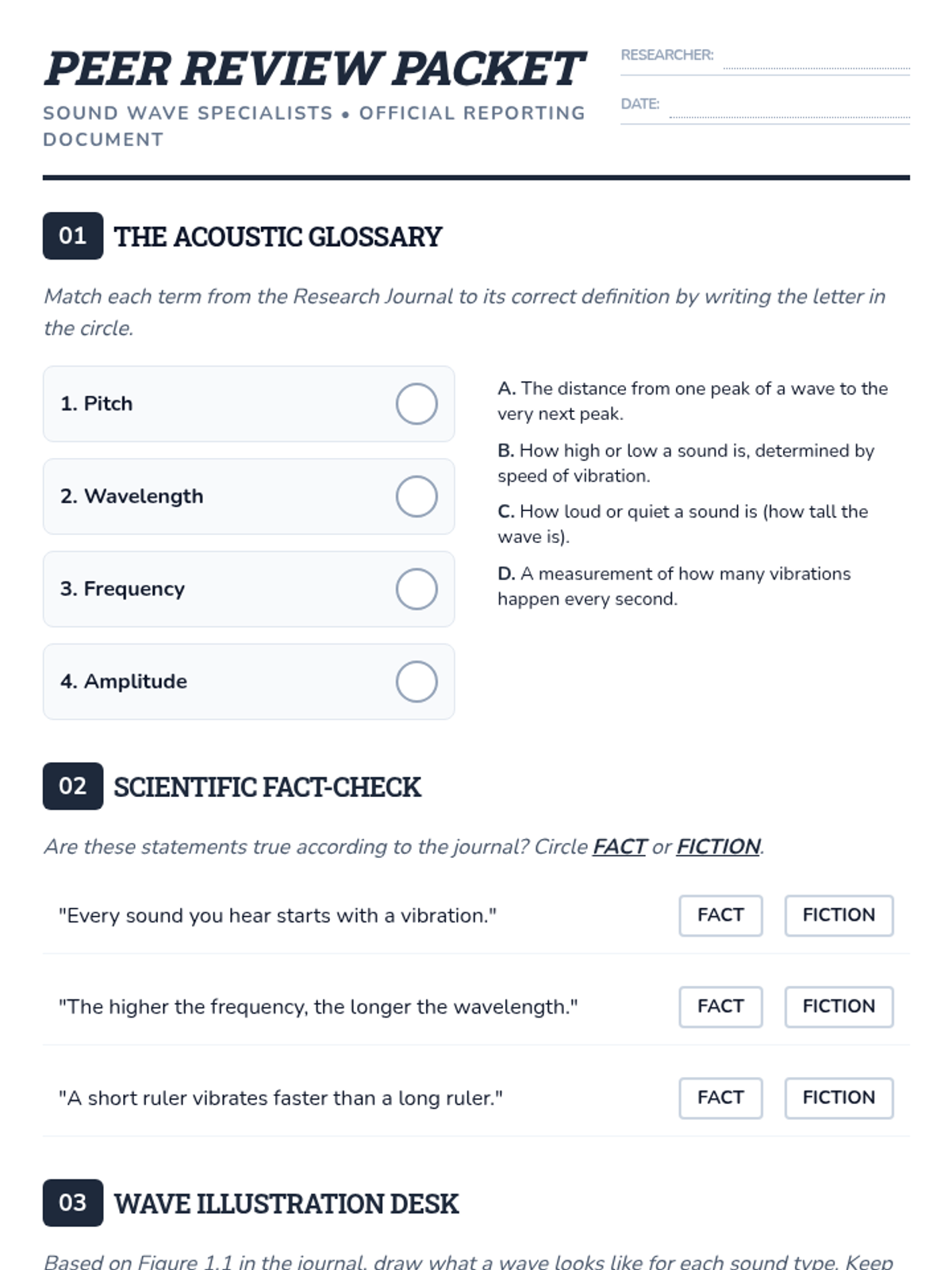
A Venn Diagram worksheet for students to compare and contrast the physics of tapping (percussion) versus blowing (wind) on water bottles.
A simple, visual observation worksheet for Kindergarteners to draw and record their findings during the tuning fork water and ping pong ball experiments.
A set of hands-on challenge cards for the domino warm-up activity, designed to help students visualize energy transfer and chain reactions before applying the concept to sound.
A student-facing worksheet for the Rubber Band Lab, providing designated space for students to draw their observations of silent versus vibrating rubber bands and identify sound sources in the room.
An activity worksheet for the Wind Instrument Challenge, allowing students to record and compare pitch observations for tapping and blowing.
A student note-taking worksheet for recording rubber band observations, video insights, and sketching sound waves to represent different pitches.
A teacher facilitation guide for the Sound Wave Dash lesson, including pacing, timestamped discussion prompts for the video, activity management tips, and common science misconceptions.
Engaging classroom slides for the Vibration Station lesson, featuring the "How Do We Hear Sounds?" video, interactive hum-along activities, and step-by-step lab instructions for 1st grade students.
Teacher's guide for the Bottle Band lesson, including pacing, facilitation tips for the video, materials checklist, and answer keys.
Évaluation finale de 15 minutes portant sur l'ensemble de la séquence "Observatoire Climat". Comprend des questions à choix multiples et une question de synthèse sur les boucles de rétroaction.
Guide pédagogique pour l'enseignant pour la séance 3. Inclut le corrigé des activités sur les rétroactions, la montée des eaux et les stratégies d'action.
Fiche d'activité finale sur les conséquences du réchauffement climatique et les solutions. Inclut un exercice sur les boucles de rétroaction, la montée des eaux et la distinction entre atténuation et adaptation.
Support de présentation pour la troisième séance du module "Observatoire Climat". Cette séance aborde les conséquences du réchauffement climatique (boucles de rétroaction, montée des eaux) et les leviers d'action pour l'atténuation et l'adaptation.
Guide pédagogique pour l'enseignant pour la séance 2. Contient les points clés sur la courbe de Keeling, le cycle du carbone et les réponses détaillées aux activités élèves.
Fiche d'activité élève pour la séance 2. Propose une analyse des courbes historiques de CO2/Température, un schéma du cycle du carbone à compléter et un exercice sur le forçage radiatif.
Support de présentation pour la deuxième séance du module "Observatoire Climat". Cette séance analyse les données de la courbe de Keeling, le forçage radiatif, le cycle du carbone et les archives glaciaires.
Guide pédagogique pour l'enseignant pour la séance 1. Contient les objectifs, le minutage détaillé de la séance de 2 heures et le corrigé des activités élèves.
Fiche d'activité pour les élèves sur le bilan radiatif et l'effet de serre. Comprend des questions de compréhension, un exercice de calcul du bilan énergétique et un tableau comparatif sur les gaz à effet de serre.
Support de présentation pour la première séance du module "Observatoire Climat". Ces diapositives détaillent les concepts physiques de l'effet de serre, le rôle des différents gaz (CO2, CH4, H2O) et le principe du bilan radiatif terrestre.
Teacher answer key and scoring resource for the 9th-grade extension labs. Includes chemical benchmarks for filtration, specific heat formula applications, and a GIS delineation checklist.
Advanced 3-page student lab manual for 9th graders. Includes quantitative filtration analysis (TDS/pH), specific heat lab data graphing, and GIS-based watershed delineation tasks.
Advanced slide deck for 9th-grade Earth Science, including chemical solubility metrics (TDS/pH), karst topography, specific heat calculations, GIS watershed delineation, and eutrophication science.
An expanded teacher guide for 9th graders, moving from 2 sessions to 3 sessions per week (15 total). Includes advanced deep-dive activities, quantitative lab analysis, and GIS mapping extensions.
A concise exit ticket for the Thermal Energy Detectives lesson, specifically designed to assess if students can prove warmer liquid has more movement. Includes a multiple-choice question, a drawing area for molecular motion, and a space for a scientific explanation.
A visual presentation for 3rd-grade 'Thermal Detectives' featuring high-contrast slides that introduce the scientist role, explain the butter case study, review safety, and reveal the secret of molecular motion. Designed for engagement with large text and clear visuals.
A teacher's answer key for the Thermal Energy Detectives lesson. It provides expected student responses for the butter comparison, experiment observations, and final scientific conclusions, along with pedagogical tips for delivery.
Vocabulary flashcards for 3rd-grade students covering key terms like temperature, molecule, thermal energy, and motion. Designed with cut-lines and clear visual icons to support diverse learners.
A comprehensive laboratory notebook for 3rd-grade students including experiment instructions, observation logs, and a graphic organizer comparing thermal properties. The design uses a 'Thermal Scientist' theme with clear visual steps and adequate writing space.
A visual, student-facing worksheet for autistic students to practice identifying states of matter and predicting changes caused by heat, featuring matching activities and drawing areas.
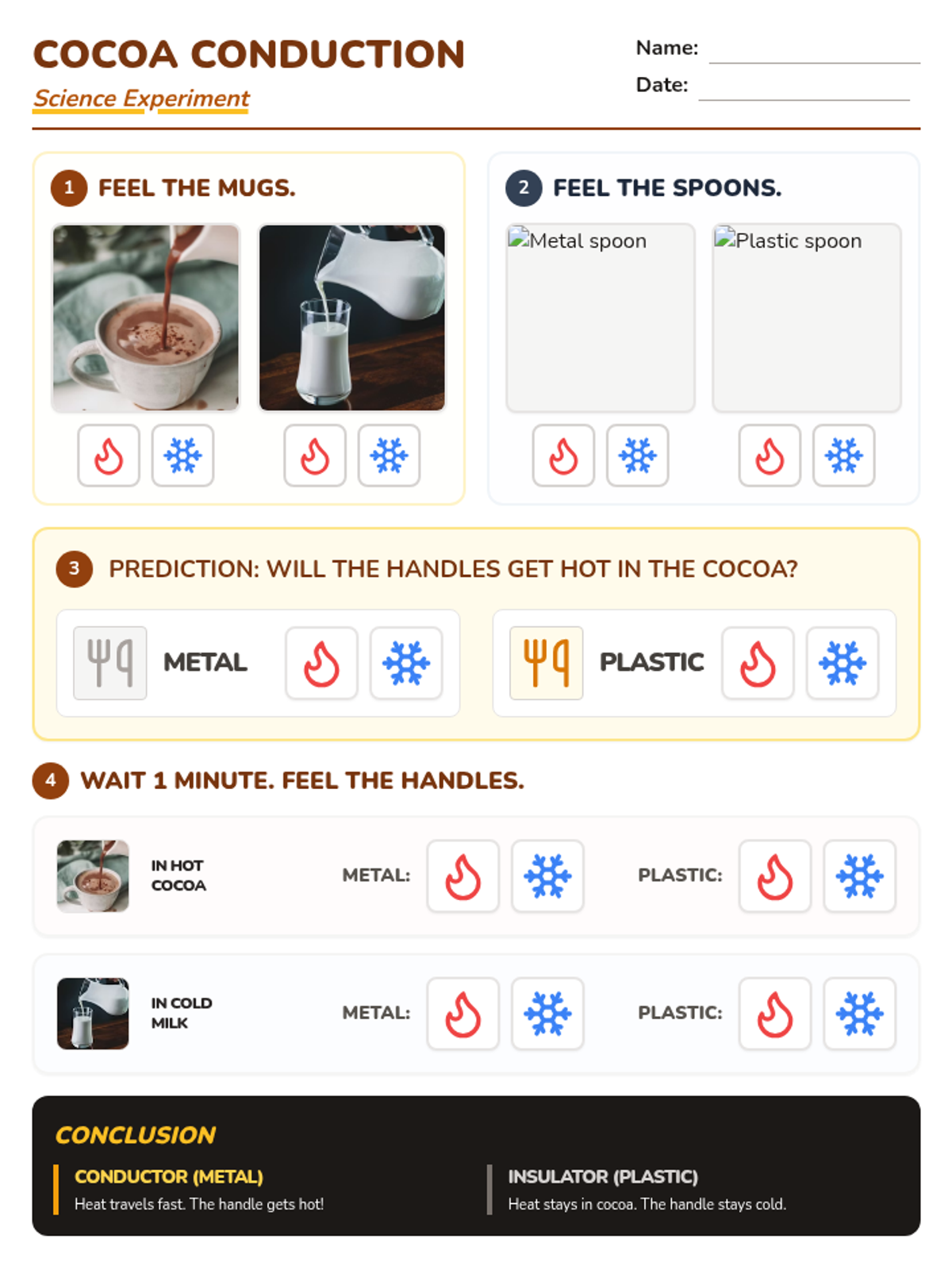
A step-by-step experiment guide for ASD students to observe a "melting snowman" (ice) and its transition between the three states of matter using clear visuals and sensory cues.
A visual-heavy presentation designed for autistic students, explaining the states of matter using Mel the Snowman as a relatable narrative example.
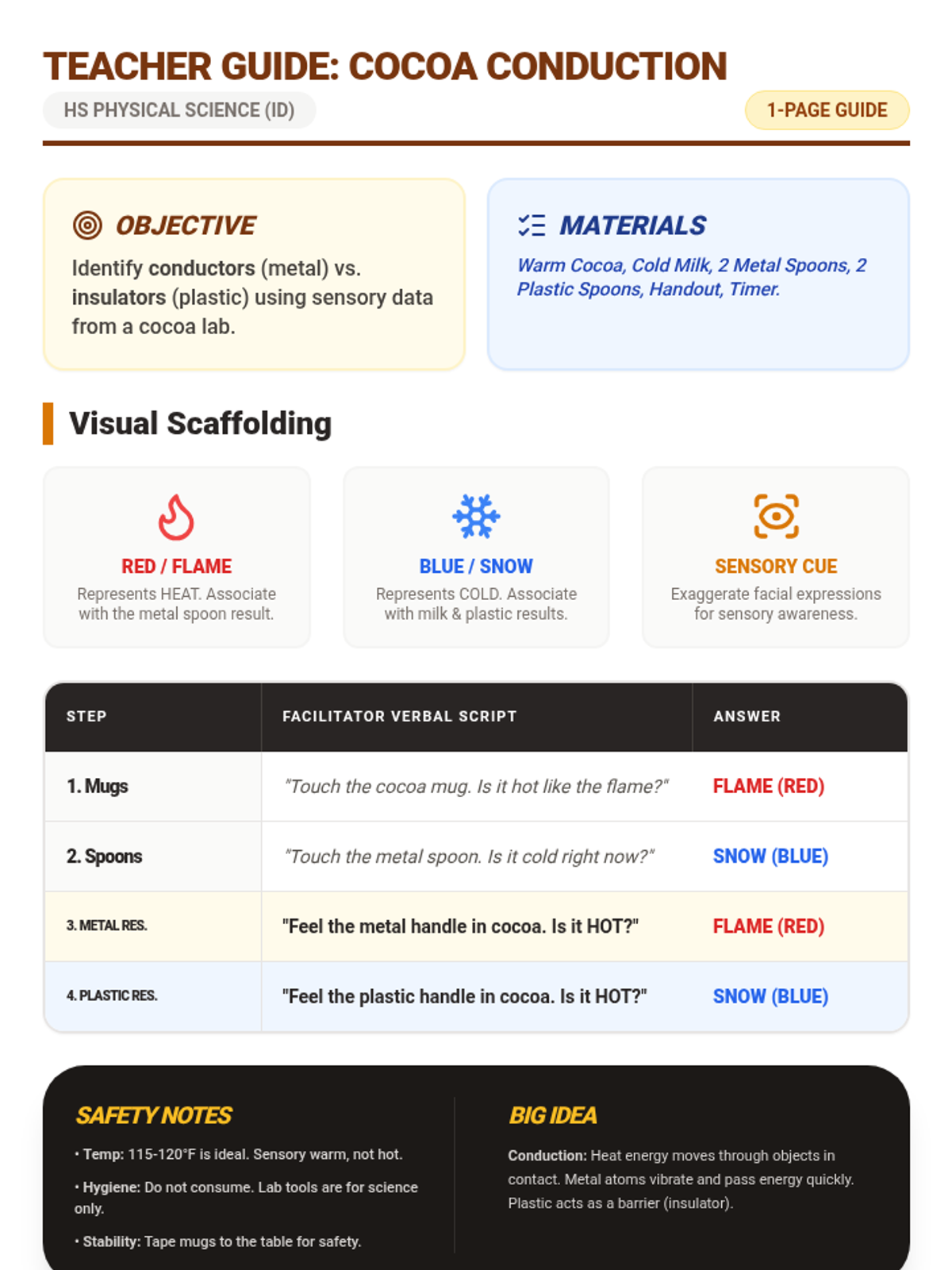
A comprehensive teacher lesson guide for a snowman-themed science lesson on states of matter, featuring visual schedules, differentiation strategies for ASD students, and instructional scripts.
A teacher guide containing the lesson objective, materials list, pacing guide, and an answer key for the comic strip activity.
Instructional slides for the lesson, featuring a flashlight hook, the Crash Course Geography video, sphere recap, and comic strip directions.
A 6-panel comic strip template where students trace a unit of solar energy through various Earth spheres and cycles.
A professional answer key for the Vibrations and Phase quiz, featuring clear multiple-choice solutions and detailed explanations for the computational problems. Includes a clean, laboratory-inspired layout suitable for teacher reference.
Full answer key for the foundational vibrations quiz, including solutions for SHM units, energy principles, and frequency/period calculations.
A complete 11-question foundational physics quiz on vibrations and waves, including concepts of SHM, frequency calculations, and pendulum variables.
The complete answer key for the foundational vibrations and waves quiz, providing detailed explanations for period, frequency, and phase questions.
A foundational physics quiz on harmonic motion and waves, featuring questions on period calculation, frequency, and phase relationships.
The answer key for the 'Vibrational Mechanics' quiz, including effective gravity calculations, spring algebra, and differential proofs.
The complete answer key for the Harmonic Motion Quiz, including step-by-step mathematical derivations, multiple-choice explanations, and grading rubrics for graphing and proofs.
A classic advanced physics quiz on harmonic motion covering non-inertial frames, spring combinations, energy conservation, and damping.
An expanded, high-difficulty advanced quiz on vibrations and harmonic motion. Includes 6 fill-in-the-blank items, 22 MCQs, and 5 calculation problems. Wave B amplitude is consistently fixed at 10 cm with all peaks aligned, and the analysis graph features 1-second intervals. Spacing between problems 29-31 has been reduced to fit on one page. Does not include mass-spring systems.
The complete answer key for the revised Advanced Mastery Quiz, featuring detailed solutions for the phase analysis and timing problems. All numbering matches the updated grouped MCQ format including the newly added computational problems. Wave B amplitude is fixed at 10 cm in the solutions.
An expanded, high-difficulty advanced quiz on vibrations and harmonic motion. Includes 6 fill-in-the-blank items, 22 MCQs, and 5 calculation problems. Wave B amplitude is consistently fixed at 10 cm with all peaks aligned, and the analysis graph features 1-second intervals. Does not include mass-spring systems.
The complete answer key for the revised Advanced Mastery Quiz, featuring detailed solutions for the phase analysis and timing problems. All numbering matches the updated grouped MCQ format including the newly added computational problems.
The complete answer key for the revised Advanced Mastery Quiz, featuring detailed solutions for the phase analysis and timing problems. All numbering matches the updated grouped MCQ format.
An expanded, high-difficulty advanced quiz on vibrations and harmonic motion. Includes 6 fill-in-the-blank items, 22 MCQs, and multiple calculation problems, with a heavy focus on phase relationships and graphical analysis. Wave B amplitude is fixed at 10 cm and clearly visible. All MCQs are grouped together through Question 28.
The complete answer key for the revised Advanced Mastery Quiz, featuring detailed solutions for the phase analysis and timing problems. Includes the updated Question 30 MCQ.
An expanded, high-difficulty advanced quiz on vibrations and harmonic motion. Includes 6 fill-in-the-blank items, 21 MCQs, and multiple calculation problems, with a heavy focus on phase relationships and graphical analysis. Wave B amplitude is fixed at 10 cm and clearly visible.
The complete answer key for the Advanced Mastery Quiz, featuring detailed solutions for the multi-step phase and frequency problems. Includes the new energy transformation and equilibrium velocity questions.
A teacher guide containing instructional tips, common misconceptions, and a detailed answer key for the eclipse DOK assessment.
A comprehensive 30-minute exit ticket assessing student understanding of solar and lunar eclipses through four levels of Depth of Knowledge (DOK) questioning.
A classroom anchor chart explaining the four Depth of Knowledge (DOK) levels using specific eclipse-themed examples to help teachers and students understand cognitive rigor.
A comprehensive worksheet for High School Environmental Science students to follow along with the lesson on Albedo and feedback loops. It includes warm-up reflections, video notes, a diagramming activity, and a 3-2-1 closure.
A visually engaging anchor chart explaining the Albedo effect and the Ice-Albedo positive feedback loop, specifically tailored for High School Environmental Science.
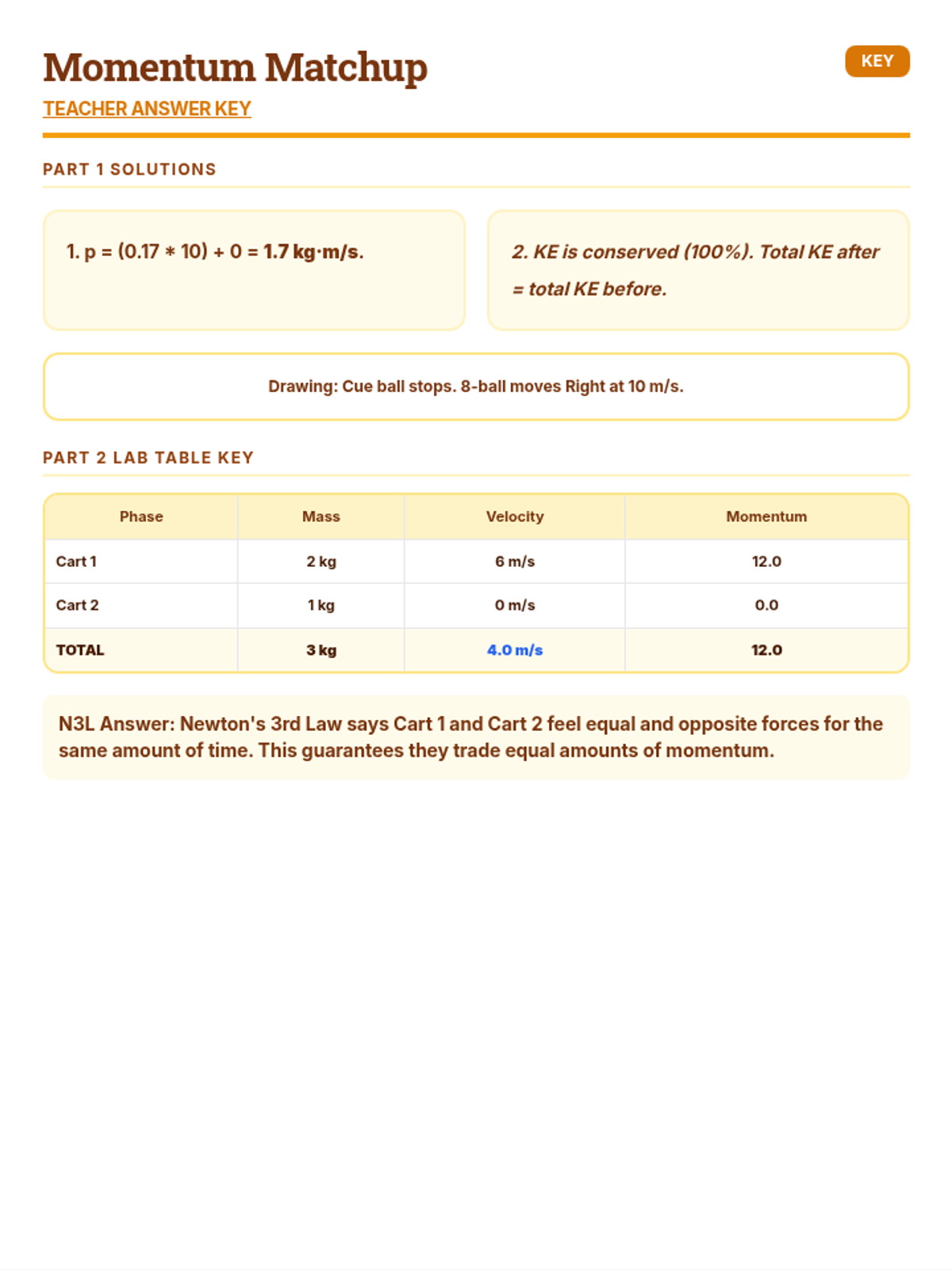
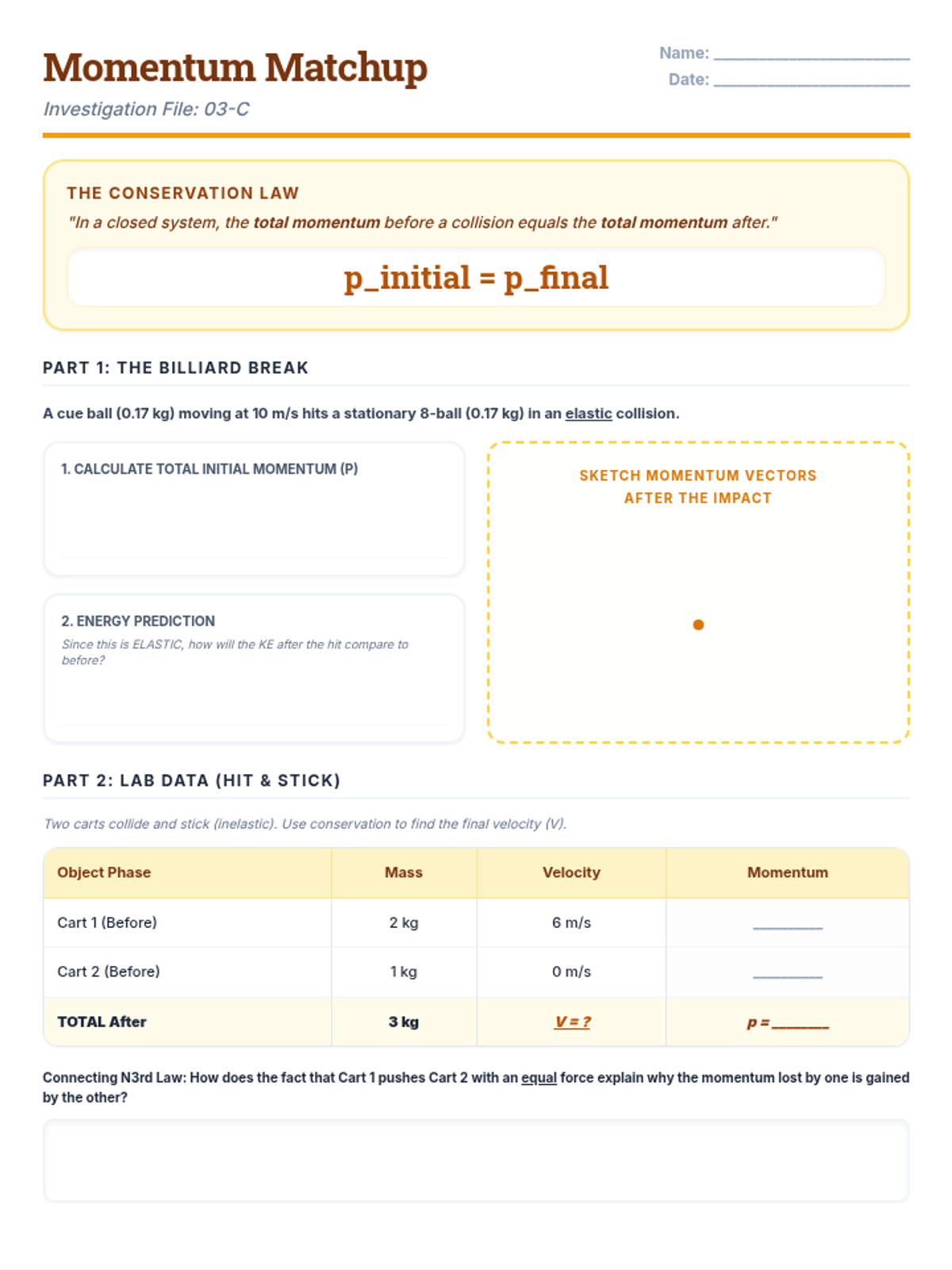
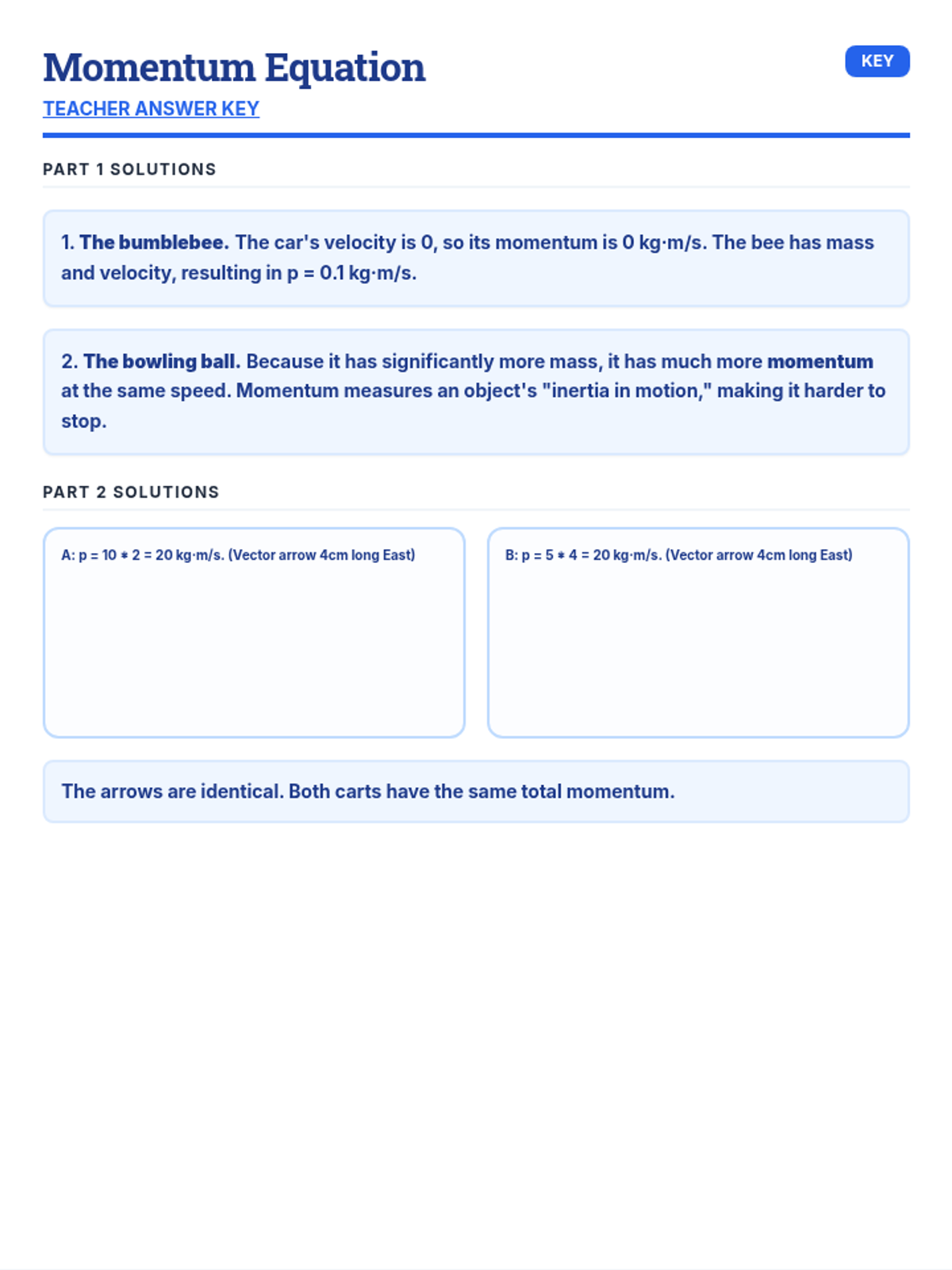
A student worksheet for recording simulation data, performing momentum calculations, and analyzing the safety implications of collision duration. Revised for better legibility and includes the simulation link.
A slide deck introducing the Momentum-Impulse Theorem lab, covering objectives, simulation parameters, and data analysis methods. Updated with simulation link.
Updated answer key featuring full solutions for the 12 multiple choice questions, 10 calculations, and 4 conceptual challenges.
Updated comprehensive practice worksheet now featuring 12 multiple choice questions, 10 calculation problems, and 4 conceptual thought challenges for deep understanding.
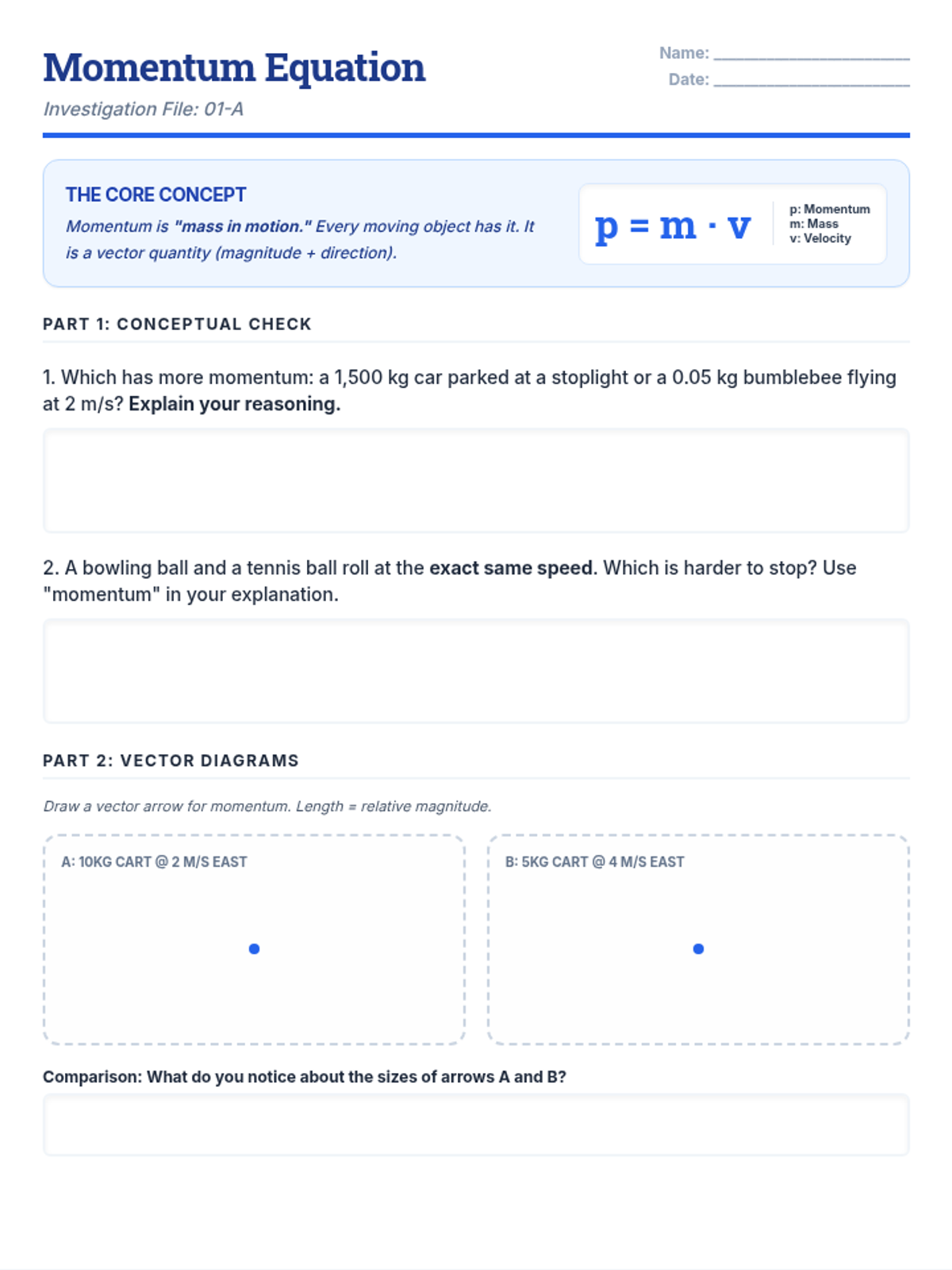
Detailed two-page reading guide organized topic-by-topic with specific descriptions, diagrams, properties, and examples for momentum, impulse, and the Impulse-Momentum Theorem, now featuring a summary table.
Introductory presentation slides covering the definitions of momentum and impulse, the Impulse-Momentum Theorem, and an expanded gallery of real-world examples (egg drop, bungee jumping, rockets, and crumple zones).
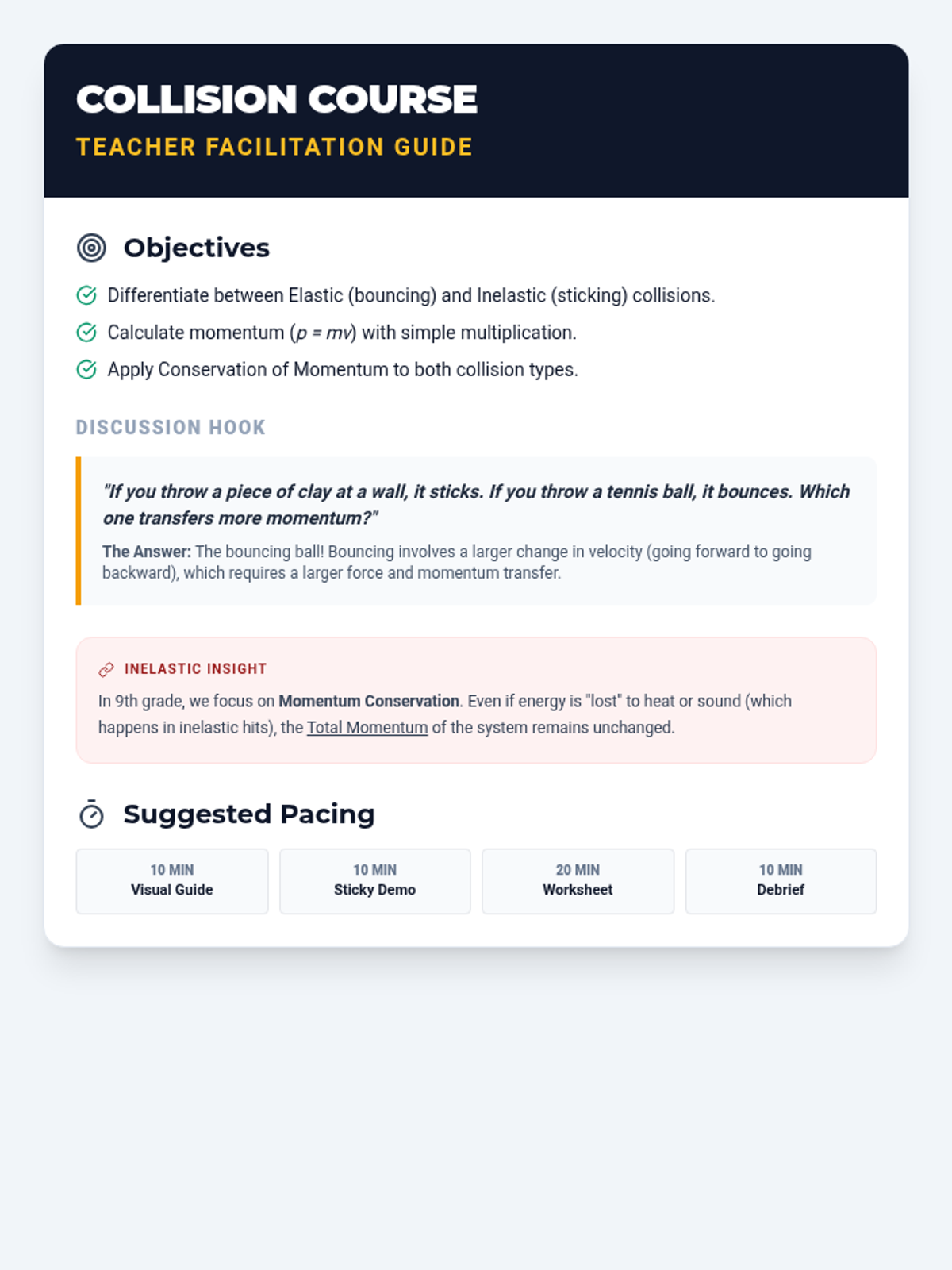
A detailed teacher's answer key for the Collision Course Worksheet, including step-by-step vector calculations and conceptual reminders.
A practice worksheet featuring AP-style problems on impulse graphs, symbolic inelastic collisions, 2D momentum vectors, and recoil.
An AP-level reading passage covering linear momentum, the impulse-momentum theorem, and conservation laws with calculus connections.
A teacher facilitation guide containing pacing suggestions, instructional tips on torque and central forces, and a complete answer key for the "Deriving the Law" worksheet.
A slide deck designed for the "Orbital Momentum" lesson. It includes an embedded video review of Kepler's Second Law, a conceptual warm-up on angular momentum formulas, and visual comparisons of planetary motion at perihelion and aphelion.
A student derivation worksheet that guides learners through the geometric proof connecting Kepler's Second Law to the conservation of angular momentum using triangle approximations.
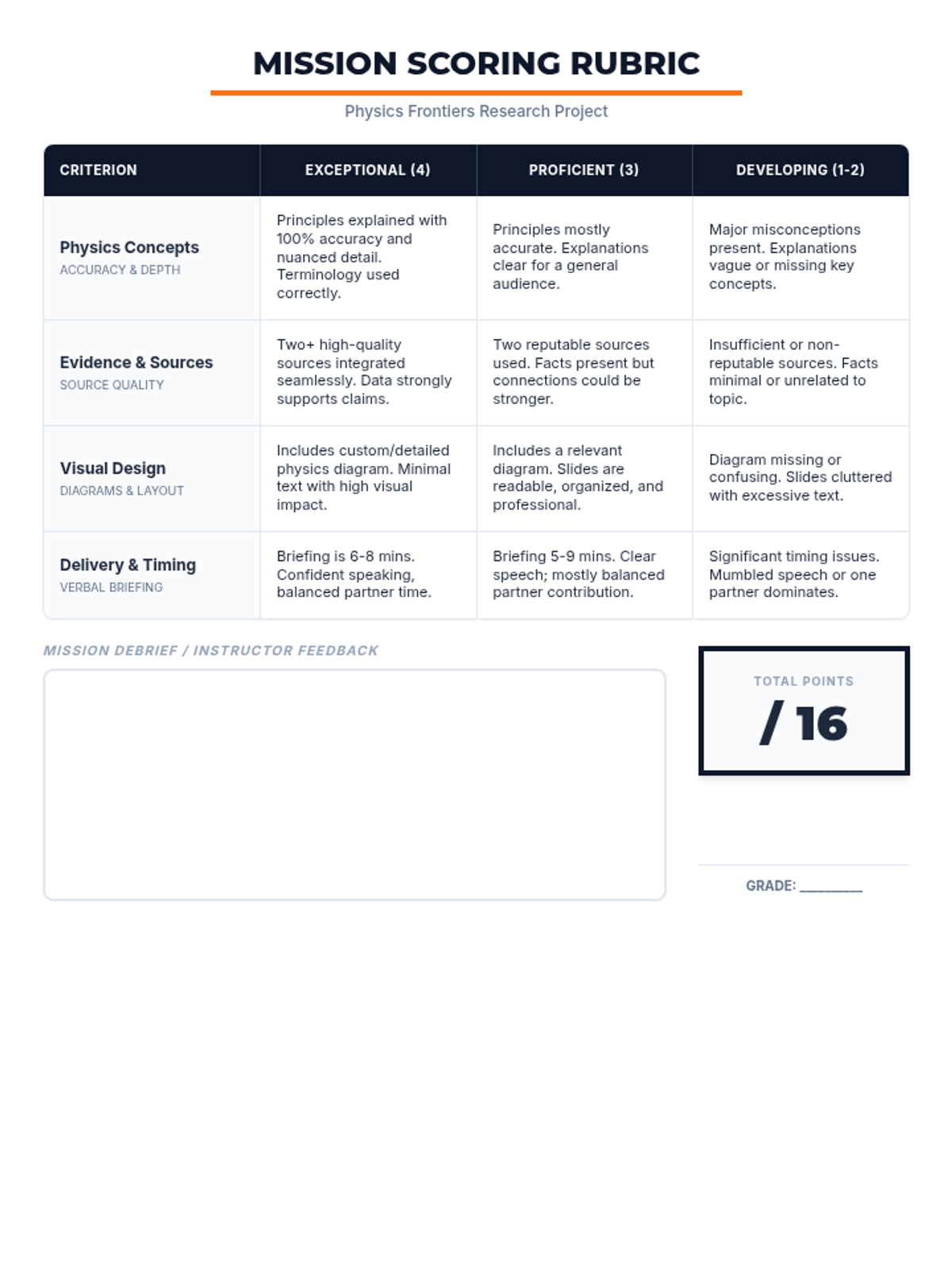
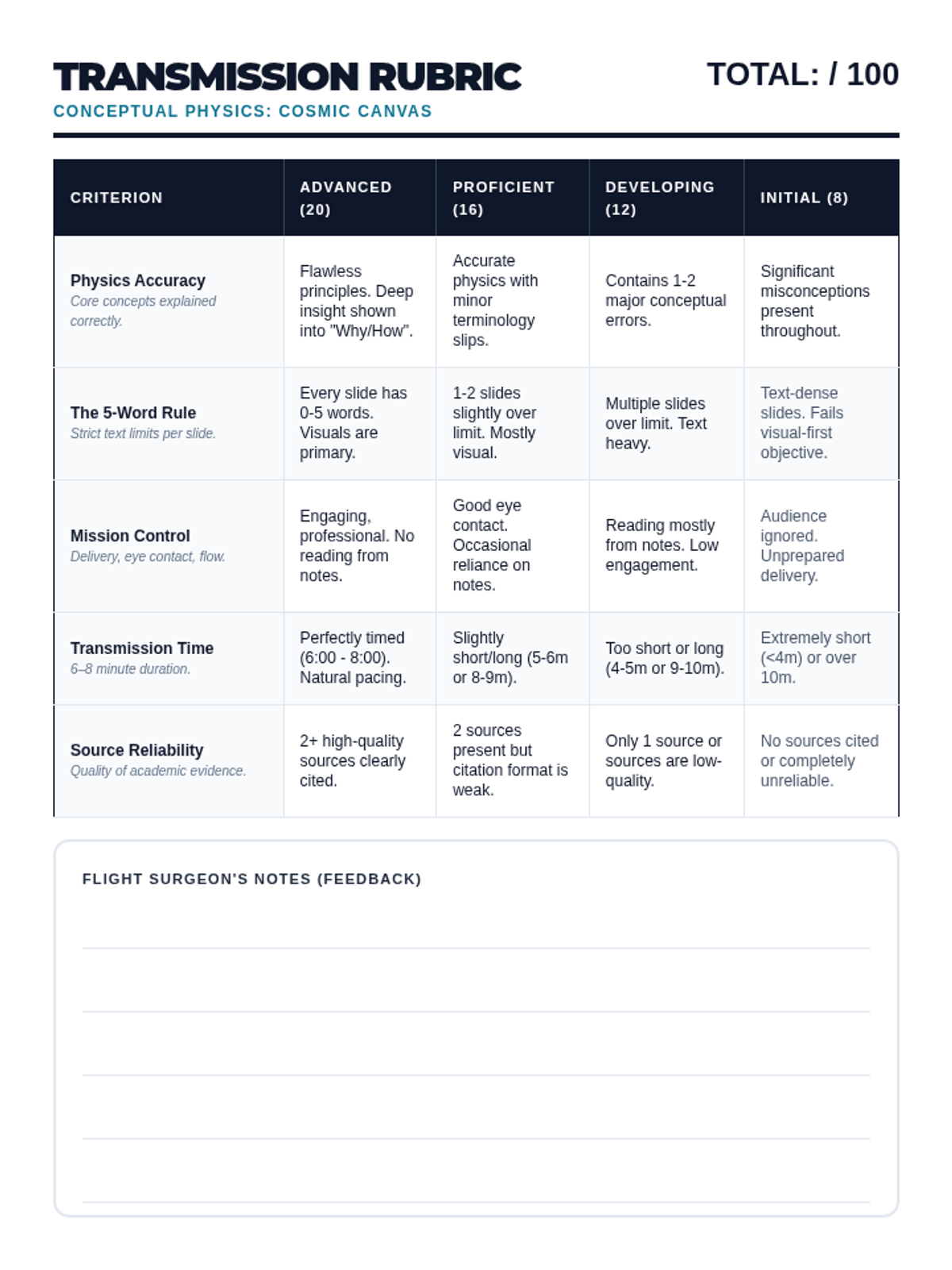
A professional rubric for assessing student comic strips, focusing on scientific accuracy, vocabulary, visual storytelling, and peer collaboration.
A student worksheet for creating a 4-panel comic strip about the Giant Impact Hypothesis, featuring space for drawings, captions, and a peer review check.
Engaging slides for the Lunar Launch lesson, featuring a warm-up prompt, embedded Crash Course Kids video, Giant Impact Hypothesis breakdown, and activity instructions.
A comprehensive teacher guide for the Lunar Launch lesson, including timelines, facilitation notes, key vocabulary, and comic strip exemplar details.
A teacher's answer key and reference guide for the Egg Lander Challenge. It includes expected worksheet responses, discussion points connecting the activity to the Mars rover video, and a simple rubric for 2nd-grade engineering skills.
A student lab report worksheet for the Egg Lander Challenge. It guides students through identifying the problem, sketching a blueprint, observing peer solutions, recording test results, and reflecting on design improvements.
A visual presentation for the Egg Lander Challenge, including vocabulary definitions, embedded Mars Rover video, mission steps, and reflection prompts. All text is 24px minimum for visibility.
A comprehensive teacher facilitation guide for the Egg Lander Challenge, including vocabulary, timing, discussion prompts for the Mars Rovers video, and a step-by-step instructional sequence.
A comprehensive reference sheet for students, featuring facts about common chemical elements and a science-themed rhyming dictionary to support lyric writing.
A student worksheet designed as a 'Lyric Lab' journal. Includes space for vocabulary analysis, a sample rhyme scheme reference, and a structured area for students to write their original 4-line science verse with a self-check rubric.
Visual presentation slides to guide students through the 'Matter Song' lesson. Includes an embedded YouTube video, a breakdown of rhyme schemes (AABB vs. ABAB), and clear instructions for the creative writing task.
A comprehensive teacher guide for the Matter Song lesson, including learning objectives, a minute-by-minute timeline, discussion anchors with video timestamps, and differentiation strategies.
Final teacher guide for Lesson 5, providing background on synthetic elements, helium geology, and guiding questions for the ethical debates.
Discussion and reflection worksheet for Lesson 5 focusing on the ethics of resource management, including the helium crisis and conflict minerals.
Final slides for Lesson 5 exploring synthetic elements, the helium scarcity crisis, and the ethical/future considerations of material science.
Slide deck for the final project gallery walk, including peer review instructions and synthesis discussion prompts.
Assessment rubric for the Atomic Zoo project, focusing on nucleus integrity, electron layout, technical specs, and craftsmanship.
A culminating project-based lesson where students build models of the first eighteen elements and participate in a gallery walk to demonstrate mastery of atomic theory.
Assessment rubric for Lesson 4, providing clear criteria for evaluating student material selection and justification, along with sample expert element choices for both scenarios.
Teacher answer key for the Heavy Atoms Worksheet, including full table data and explanation for the weighted average concept.
Design document for the Lesson 4 engineering challenge where students select elements and justify their use in a material design project.
Worksheet for students to compare isotopes of Hydrogen and Carbon, including a sketching area for nucleus models.
Slides for Lesson 4 setting up the Material Selection Challenge with engineering scenarios like a Venus lander and a racing bike.
Slide deck defining isotopes as variations of elements with different neutron counts and explaining average atomic mass.
Teacher guide for Lesson 3 explaining the chemistry of carbon bonding, biological roles of CHNOPS, and the engineering of polymers.
Activity guide for a physical "Stadium" game where students model electron configurations to learn the 2-8-8 rule.
Worksheet for Lesson 3 focusing on Carbon's valence electrons, the biological roles of CHNOPS elements, and the concept of polymers.
Slides for Lesson 3 focusing on the unique bonding capabilities of Carbon, the CHNOPS elements of life, and the creation of polymers and plastics.
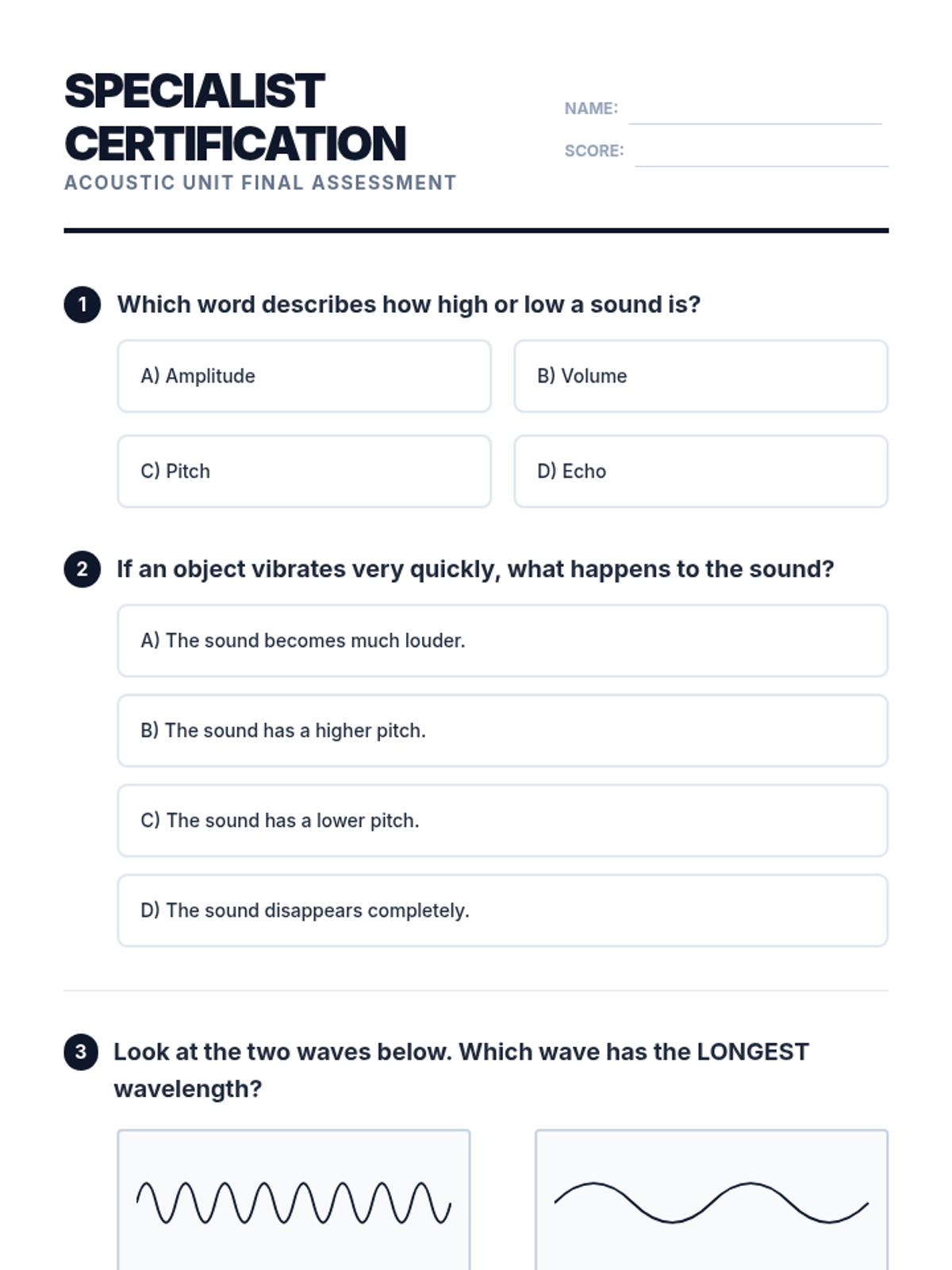
An expanded, high-difficulty advanced quiz on vibrations and harmonic motion. Includes 6 fill-in-the-blank items, 21 MCQs (6 medium, 15 hard), and 12 calculation/conceptual problems, with a heavy focus on phase relationships and energy transformations. Does not include mass-spring systems.
A classroom anchor chart visualizing the nuclear fission chain reaction and comparing the gun-type and implosion-type bomb designs used in the Manhattan Project.
A set of instructional data cards for the 'Atomic Archive' activity, providing technical details on bomb designs, isotopes, and the environmental evidence of the Trinity test.
A student infographic template for the Manhattan Project, featuring sections for fission diagrams, bomb design comparisons, and the analysis of the Trinity test's environmental impact.
A visual presentation for the 'Atomic Archive' lesson, featuring video integration, fission diagrams, and activity instructions for high school students.
A teacher guide for the 'Atomic Archive' lesson, including objectives, a detailed timeline, materials checklist, and discussion prompts connecting physics to WWII history.
A comprehensive teacher's instructional guide for the Atomic Crossroads lesson. Includes pacing, discussion prompts, an answer key for the video segment, and a 'Key Concepts' cheat sheet to address student misconceptions and deep-dive into the environmental science content.
Instructional slides for the 'Solar Supercharge' lesson, featuring the 'Energy Detective' warm-up, an embedded Crash Course video, activity instructions, and a closing discussion on non-solar energy sources.
A comprehensive grading rubric for the nuclear energy town hall debate. Evaluates students on Content Knowledge, Role Authenticity, Persuasion & Logic, and Listening & Response across a 4-point scale. Includes a clean aesthetic and teacher feedback section.
A student role-play guide for the Stonemill Town Hall debate. Includes a detailed scenario, four distinct character profiles with evidence-based talking points, and organized sections for student brainstorming and reflection.
Instructions for the 'Sun Chain' group activity where students trace specific fuel sources (wood, coal, gas, horse-power) back to the sun through historical and biological processes.
A comprehensive 7-slide presentation for the 'Atomic Crossroads' lesson, including warm-up, video context with timestamp (4:24-5:51), pro/con analysis, and role-play instructions. Features a clean, high-contrast scientific aesthetic.
A visual reference poster for the classroom illustrating the transfer of energy from the sun to biological muscle power and industrial fossil fuels, including the non-solar exceptions.
A student worksheet for identifying energy-using items, recording video notes, and sketching energy flowcharts tracing fuel sources back to the sun.
An assessment rubric for the IAEA Policy Briefing, evaluating technical accuracy, policy feasibility, enforcement logic, and ethical justification.
A structured worksheet for students to draft an IAEA policy brief, featuring sections for safeguards, monitoring plans, and ethical justifications.
A visual presentation for the Atomic Tightrope lesson, including a warm-up activity, embedded video, and clear framing of the dual-use technological dilemma.
A comprehensive teacher's lesson plan for teaching the ethics of nuclear dual-use technology, featuring timing, procedure, and differentiation strategies.
A student reflection journal for the Cosmic Recycling lesson, including guided prompts for the video pause point, a central writing task on heavy element generation, and an extension activity for researching the Crab Nebula.
A teacher guide for the Fusion Frenzy lesson, providing pacing, activity facilitation tips, the 'SUV vs. Sedan' analogy for stellar mass, and answer key highlights for the student worksheet.
Collaborative discussion cards for small group activities, prompting students to think deeply about the chemical and physical implications of supernovas and stellar generation.
A comprehensive teacher resource for the circular motion lesson, including answer keys for the practice set, a list of common misconceptions, and AP Physics 1 specific teaching strategies for symbolic derivation and proportional reasoning.
A rigorous practice problem set for AP Physics 1 covering circular motion. Includes multiple-choice conceptual questions and a free-response derivation task focusing on static friction and mass-independence in circular paths.
A guided inquiry worksheet for AP Physics 1 students to practice vector sketching, force identification, and qualitative reasoning for circular motion. Includes sections on Newton's First Law application and symbolic ratio derivations.
A set of instructional slides covering uniform circular motion, centripetal acceleration, and force applications for AP Physics 1. Includes visual diagrams of vectors, vertical circles, and common misconceptions.
A hands-on laboratory activity for investigating the relationship between centripetal force and velocity using a rubber stopper apparatus, featuring data tables, graphing space, and error analysis.
Updated teacher guide for the Centripetal Circuit lesson, now including setup tips for the Spin Cycle Lab, common error analysis for the lab, and a 2-day pacing guide.
A multi-page practice worksheet for AP Physics 1 covering circular motion, featuring conceptual questions, real-world highway scenarios, vertical loop derivations, and a conical pendulum challenge.
A visual slide deck covering the kinematics and dynamics of uniform circular motion for AP Physics 1, featuring diagrams of acceleration vectors, force analysis for vertical loops, and a step-by-step problem-solving strategy.
A reference guide identifying the four Galilean moons (Io, Europa, Ganymede, and Callisto). Includes visual representations, physical characteristics, and historical context for each moon.
A student worksheet designed as an observation log for Galileo's discoveries. Includes sketching areas for four nights of celestial observations and reflection questions on the impact of technology on scientific proof.
A comprehensive slide deck for the lesson 'Starry Messenger', featuring a warm-up discussion, an embedded video on the Scientific Revolution, and a 4-night simulation of Galileo's observations of Jupiter's moons.
A student lab sheet for investigating orbital mechanics and solar system formation. It guides students through video analysis, data collection using PhET simulations, and synthesis questions about Earth's elliptical orbit and the plane of the ecliptic.
A structured reflection journal page featuring prompts that encourage students to think deeply about the impact of human water use on Earth's rotation.
A visual presentation deck for the Celestial Spin lesson, featuring interactive prompts, physics equations for angular momentum, an embedded Crash Course video segment, and lab instructions for the PhET orbital simulation.
A set of printable discussion cards for a Socratic seminar focused on the ethical and physical implications of human impact on Earth's rotation.
A presentation deck for a lesson on human-driven changes to Earth's rotation, featuring video integration, objectives, and Socratic discussion prompts.
A comprehensive teacher guide for the Celestial Spin lesson, including a minute-by-minute timeline, learning objectives, answer keys for the lab activity, and discussion prompts to address common student misconceptions about solar system formation.
An answer key for the Arc Master Worksheet, providing the correct terminology, equipment functions, safety protocols, and technique essentials.
A teacher facilitation guide for the SMAW Fundamentals lesson, including pacing, discussion prompts, a lab safety checklist, and troubleshooting common student errors.
A comprehensive student worksheet to accompany the Arc Master Slides, covering SMAW terminology, equipment, electrode identification, safety, and technique.
A comprehensive 20-slide presentation covering the fundamentals of SMAW (Stick Welding), including equipment, safety procedures, electrode selection, and core techniques. Minimum font size 24px for all text.
A visual presentation for the lesson including a video embed, key concept slides for Al-Khwarizmi and Ibn al-Haytham, and instructions for group activities. All text is at least 24px for classroom visibility.
A simple and focused exit ticket for students to reflect on the lasting impact of Islamic scientific contributions. Includes a specific prompt and space for a written response.
Instructions for two 'Scholar Stations' focusing on Al-Khwarizmi (Algebra) and Ibn al-Haytham (Optics). Includes historical context, specific missions for students, and thought-provoking prompts.
A student worksheet for the lesson, featuring a warm-up brainstorming section, a video notes organizer for Islamic contributions, and an observation area for station activities.
A comprehensive teacher guide for the lesson, including timing, material setup for stations, discussion prompts, and an answer key for the student worksheet.
A comprehensive instructional script for the Thermal Energy Detectives lesson. It includes slide-by-slide dialogue, guiding questions, and key pedagogical notes to help teachers deliver the lesson with a focus on molecular motion and investigation.
A teacher's answer key for the Matter Master Sort activity. Provides the correct categorization for all 24 emoji-based cards and includes guided discussion questions for classroom use. Layout fixed to exactly one page.
Large-format sorting mats for the States of Matter game. Each state (Solid, Liquid, Gas) has its own dedicated full-page mat. Layout strictly constrained to exactly 960px height per section to ensure perfect page alignment for printing.
Answer key for the Matter Morphers Worksheet, providing example student observations and correct classifications for each station.
A visual anchor chart or poster illustrating the processes of phase changes (melting, freezing, evaporation, condensation) and the key distinction between physical and state changes.
A comprehensive teacher's facilitation guide for the Matter Morphers lesson, including setup instructions, a timed lesson plan, safety warnings, and key discussion prompts.
A student worksheet for the 'Change Station Rotation' where they record observations for four different matter changes and identify each as either a physical or state change.
Engaging slide presentation for the Matter Morphers lesson, featuring a warm-up activity, embedded YouTube video, and clear visual distinctions between physical and state changes.
A comprehensive teacher guide for the Volcano Power lesson, including prep lists, pacing, discussion prompts, and instructional tips for facilitating the chemical energy experiment.
Visual presentation for the 'Volcano Power' lesson, featuring a hook image, embedded experiment video, key definitions of chemical energy, and step-by-step activity instructions.
A reflective journal page for students to explain the concept of 'work' in the context of the vinegar experiment, with spacious writing lines and a drawing prompt.
A hands-on lab report for 2nd graders to document their 'Classroom Volcano' observations, featuring 'Before' and 'After' drawing sections and specific prompts to identify chemical energy in action.
A short exit ticket for students to reflect on irreversible changes in food, designed as four-to-a-page for efficient printing.
A set of printable sorting cards for the Change Detectives activity, featuring icons and descriptions of various physical and chemical changes.
A creative art project template for students to create a 'Popcorn Explosion' collage using real kernels and popped corn to represent physical change.
An advanced physics assessment on harmonic motion, featuring fill-in-the-blank vocabulary, complex multiple-choice questions on phase and frequency, and detailed graphical analysis problems. This quiz excludes mass-spring systems and focuses on pendulums and general oscillators.
A comprehensive answer key and grading guide for the Harmonic Mastery Quiz, including step-by-step calculations and grading notes.
An engaging slide presentation on vibrations and harmonic motion, featuring large-scale mathematical formulas, visual wave diagrams, and real-world examples.
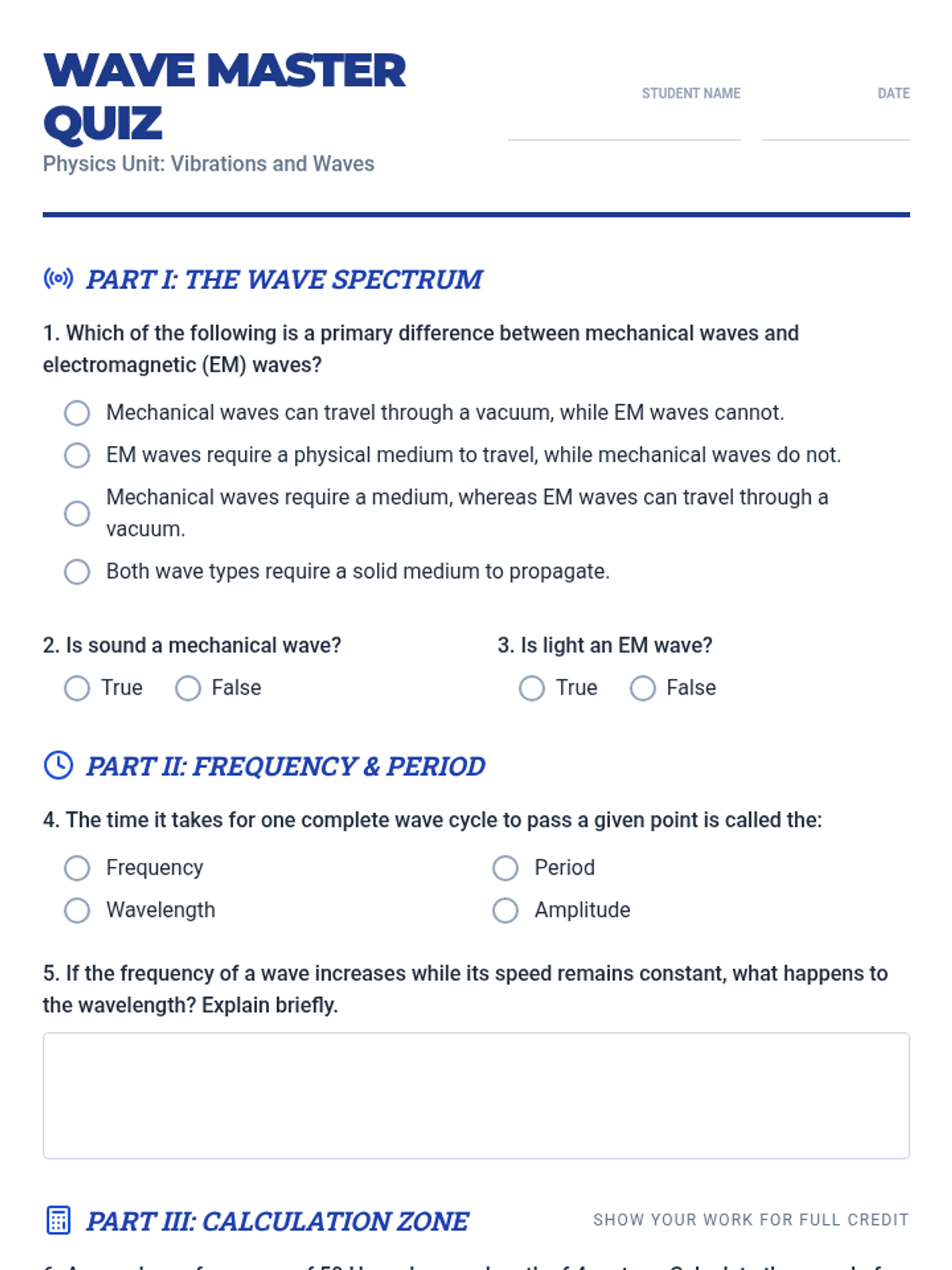
A professional physics quiz focused on vibrations, frequency, and amplitude, featuring a technical blueprint aesthetic and visual analysis problems.
An elaborate, two-page reading guide on Gauss's Law and Electric Flux. It includes conceptual visualizations, the mathematical foundations of flux, a detailed explanation of Gauss's Law, and a strategic guide for applying symmetry to solve for electric fields. Fixed icons and optimized layout.
An answer key for the Flux Field Lab Worksheet, providing detailed solutions and step-by-step derivations for teacher reference.
A practice worksheet for students to apply Gauss's Law, calculate electric flux, and practice derivations using symmetry.
A comprehensive slide deck for presenting the core concepts of electric flux, Gauss's Law, and the power of symmetry in calculating electric fields.
An introductory reading handout on Gauss's Law, covering electric flux, the fundamental equation, symmetry applications, and conceptual checkpoints. Revised with better spacing and added instructional depth.
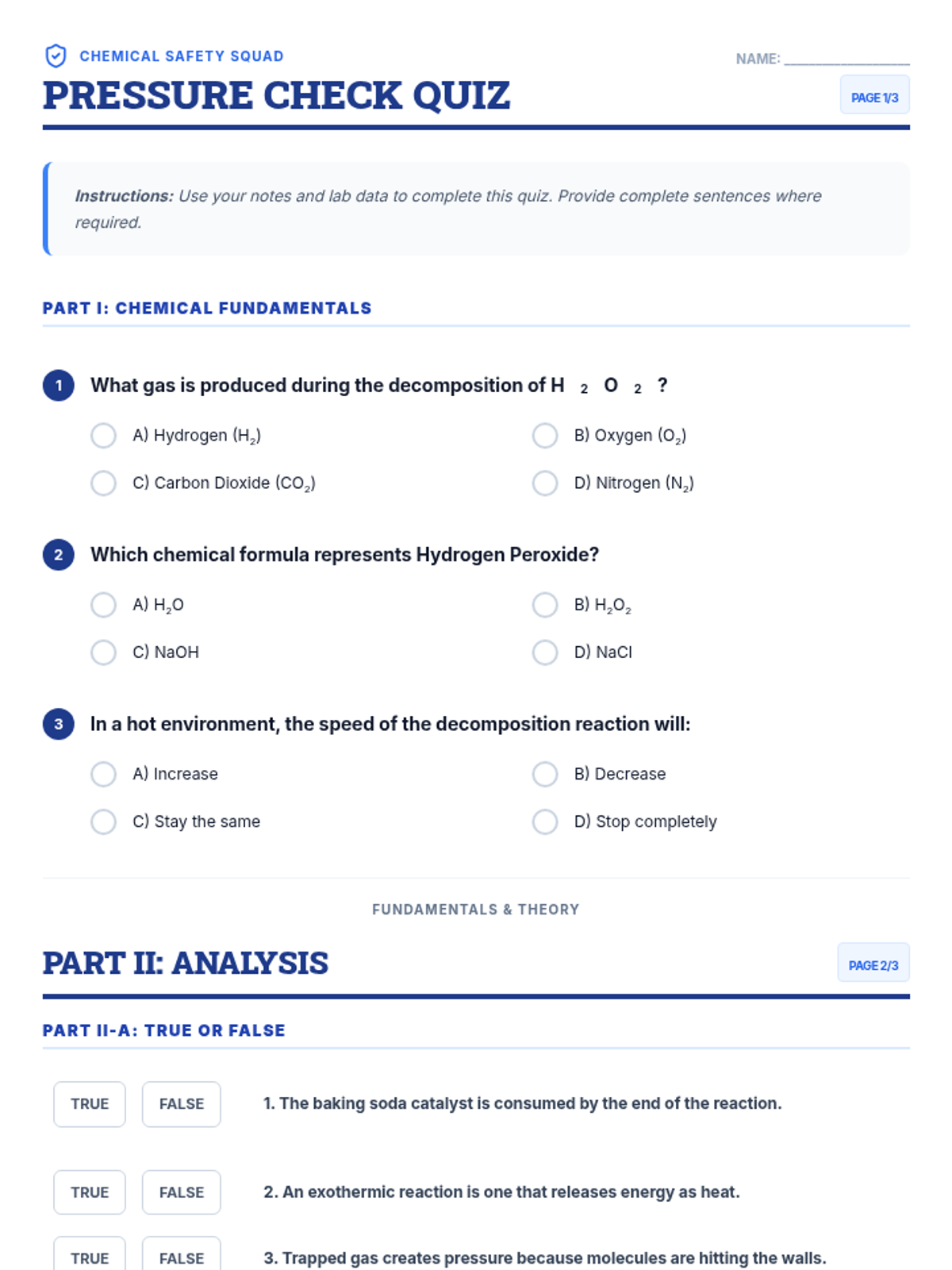
Formative assessment exit ticket for the Pressure Pushers lesson, covering Boyle's Law, the definition of elements, and the significance of the scientific method.
A step-by-step group activity guide for the "Budget Balancing Act" poker chip simulation, providing clear instructions for students to subtract energy units for absorption, scattering, and reflection.
A student worksheet for the Earth's Energy Budget lesson, featuring a visual flowchart to track energy units and a guided space for the CO2 prediction writing extension.
A visual presentation for the Earth's Energy Budget lesson, including the bank account analogy, a Crash Course Geography video embed, and guided prompts for the poker chip activity.
A comprehensive teacher resource for the Earth's Energy Budget lesson, including a "Bank Account" script, activity instructions for the poker chip simulation, and a full answer key for the student worksheets.
Large-format vocabulary cards for Kindergarten and 1st Grade students, including visual icons and simple definitions for Sunburn, Rays, Sunscreen, Sponge, and Mirror.
A student-facing activity sheet for the Sunscreen Painting experiment, featuring spaces for drawing designs, checking off observations, and completing a simple conclusion sentence.
Engaging presentation slides for the Sun Shield lesson featuring high-contrast visuals, the SciShow Kids video embed, and clear explanations of the sponge vs. mirror analogy.
A comprehensive teacher facilitation guide for the Sun Shield Science lesson, including objectives, materials list, pacing, and detailed instructional steps with video pause points.
A formal engineering challenge prompt for students, providing the technical specifications (bulb power and safety brightness requirements) and instructions for creating their solution poster.
A comprehensive teacher guide for the Inverse Square Discovery lesson, including prep steps, a detailed timeline, discussion prompts based on the video, and an answer key for the lab activity.
Individual role cards for the Jigsaw activity, assigning students the roles of Power Expert, Brightness Expert, and Radius Expert with specific responsibilities and formula insights.
A visual presentation featuring embedded video segments, the geometry of light spheres, the inverse square equation, and guided lab instructions for the Phone Physics activity.
A comprehensive slide deck for the Bright Streets lesson, featuring instructional visuals for the inverse square law, an embedded YouTube tutorial, and the municipal engineering challenge prompt.
A structured lab worksheet for students to record Lux measurements at varying distances, graph their findings, and analyze the results against the inverse square law formula.
A teacher facilitation guide for the Bright Streets lesson, including learning objectives, pacing, expert role definitions, an answer key for the municipal lighting challenge, and common student misconceptions.