Large-format sorting mats for the States of Matter game. Each state (Solid, Liquid, Gas) has its own dedicated full-page mat. Layout strictly constrained to exactly 960px height per section to ensure perfect page alignment for printing.

An answer key for the Bone Blueprint labeling worksheet, providing the correct identifying labels for teachers on an anatomically improved skeletal blueprint.
A labeling activity for 3rd graders to identify the skull, rib cage, spine, and femur on a highly detailed, accurate skeletal blueprint.
A museum-themed presentation introducing the skull, rib cage, spine, and femur with fun facts and anatomically accurate custom CSS visuals.
An answer key for the Bone Zone worksheet, providing correct matches, labels, and acceptable reflection answers. Updated to match the latest worksheet structure.
A student worksheet for identifying skeletal functions, labeling major bones, and reflecting on bone health. Updated with elongated limbs and precisely placed indicators for better instructional clarity.
An engaging slide deck for the Bone Zone lesson, featuring bright visuals, key vocabulary, and interactive prompts to teach skeletal functions and major bones.
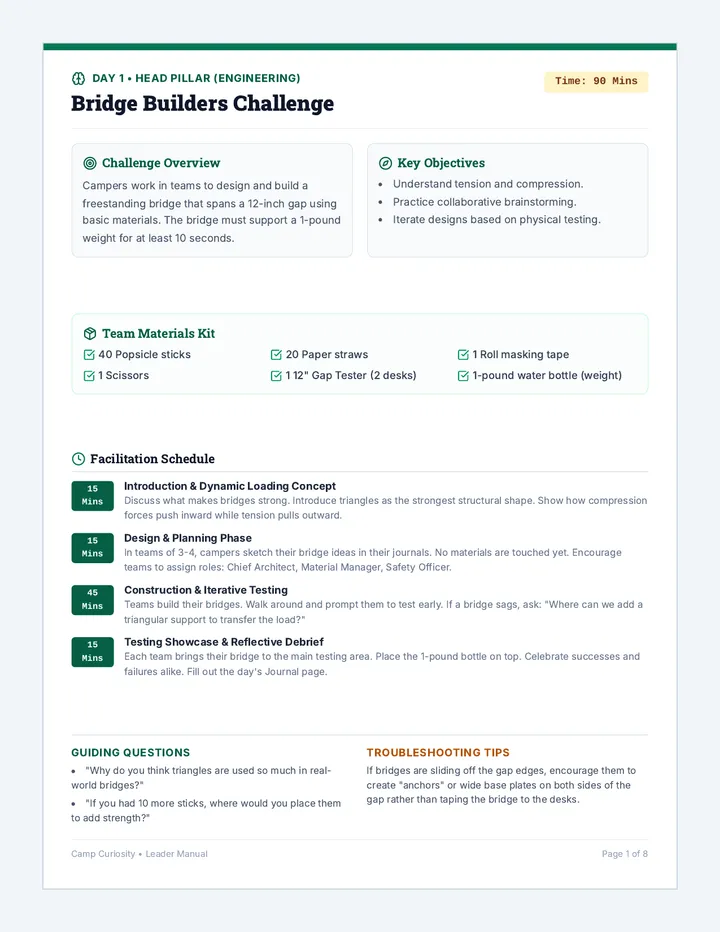
A concise teacher facilitation guide for the 30-minute Bone Zone lesson, including a detailed timeline, materials list, and helpful teaching tips.
A comprehensive teacher guide for the 'Seed to Sprout' lesson, including learning objectives, vocabulary, step-by-step instructional procedures, and differentiation tips for Kindergarten students.
A fun and simple sequencing worksheet for Kindergarteners to practice identifying the four main stages of the plant life cycle. Students color, cut, and paste images of a seed, sprout, seedling, and flower in the correct order.
A bright and engaging slide deck designed for Kindergarten students to learn about the plant life cycle and the four essential things plants need to survive. Features large text, friendly icons, and a clear visual progression of plant growth, including an embedded time-lapse video.
Teacher answer key for the Tree Tenant Worksheet, including expected animal names, habitat descriptions, and sample reflection responses.
A visual presentation introducing 8 tree-dwelling animals, their specific habitats (nests, hollows, branches), and why trees are essential for their survival.
A student worksheet for identifying 8 tree-dwelling animals and describing their specific habitats within the tree.
A detailed two-page field guide featuring "notebook-style" observations of 12 subterranean animals, focusing on their scientific observations and underground nesting habits.
A coloring sheet featuring the 12 subterranean animals in a grid format with large labels for coloring and literacy practice.
Updated page of 12 animal cards for cutting out, now including larger den-dwelling and nesting animals like foxes, badgers, and rabbits.
Updated landscape worksheet with 12 spots for animals that live in tunnels, dens, or nests beneath the soil.
An educator's guide for the Sabertooth Secrets lesson, including a full answer key and instructional notes on Smilodon fatalis.
A student worksheet designed to be used alongside the Sabertooth Secrets presentation, updated to include Smilodon genus and extinction questions.
A visual slide deck about Sabertooth cats, featuring instructional text on biological classification, prehistoric facts, and Smilodon genus specifics with comprehension questions.
A facilitation guide for teachers to deliver the 30-minute pollinator lesson, including objectives, pacing, and differentiation strategies.
A writing activity for 2nd graders to imagine themselves as pollinators, featuring a word bank, creative writing lines, and a drawing space.
A visual presentation for 2nd graders explaining what pollinators are, how they move pollen, and why they are important for our food system.
Engaging slides to introduce 2nd grade students to pollinators, pollen, and why they are important for our food.
An answer key for the Garden Helpers Worksheet including grading criteria for the drawing activity and teaching notes.
A short reading passage about pollinators with comprehension questions and a drawing activity designed for 2nd grade students. Updated with more writing space and a cleaner drawing area.
A hands-on sorting activity for 1st-grade MLLs, featuring visual habitat mats and animal cards designed for oral language practice and habitat matching.
A vibrant, high-contrast visual presentation for 1st-grade MLLs introducing three habitats (Forest, Ocean, Desert) with emphasis on visual cues, vocabulary, and initial sounds.
A comprehensive teacher guide for a 1st-grade MLL lesson on animals and habitats, featuring TPR strategies, visual prompts, and a structured instructional sequence focused on oral language.
A quick formative assessment for the end of the lesson, featuring two identical tickets per page for easy printing. It tests students on layer sequencing, fossil relative dating, and the formation process.
A comprehensive lesson plan for teachers, outlining objectives, materials, and a step-by-step instructional procedure for teaching sedimentary rock formation and fossil sequencing.
A teacher's answer key for the Rock Record Worksheet, providing correct sequencing, explanations for layer relative dating, and evidence for ancient plant life.
A student worksheet for practicing the sequencing of sedimentary rock formation and analyzing fossil layers. It includes a step-by-step ordering task and short-answer questions.
A comprehensive visual presentation covering the definition of sedimentary rocks, the four-step formation sequence, and the concept of relative dating using rock layers and fossils.
An educational anchor chart illustrating the four-step sequence of sedimentary rock formation and the concept of fossil age layers. It features a field-journal aesthetic with clear visual diagrams of rock stratification.
A kindergarten-level adaptation of the periodical cicada homework article. It simplifies the language while retaining essential vocabulary (cicada, periodical, reproduce, predators, species, offspring) and mirrors the original document's visual design, including the header, callout box, and student notes sidebar.
A 2-page homework article about periodical cicadas, adapted for a kindergarten reading level. This version removes the dashed borders and page numbers while maintaining the original layout and 6th-grade vocabulary, designed to be printed front and back on standard paper.
A simplified reading passage about periodical cicadas adapted for 3rd-grade readers, maintaining key science vocabulary and homework formatting while removing the original questions.
A 3rd-grade adapted homework worksheet about periodical cicadas, reformatted to match the visual style of the original 6th-grade PDF. Includes all specific vocabulary words and two pages of content with adapted reading level. No "3rd grade" label included as requested.
A 3rd-grade adapted homework worksheet about periodical cicadas, reformatted to match the visual style of the original 6th-grade PDF. Includes all specific vocabulary words and two pages of content with adapted reading level.
An answer key for the Cicada Invasion Homework, providing correct responses and exemplar explanations for teachers based on the 3rd-grade adapted content.
A quick exit ticket for the Grumble Guts lab to assess student understanding of mechanical vs chemical digestion and organ roles.
A digestive system mapping activity where students label and color the organs, including a simplified version for students who need more visual support.
A comprehensive teacher guide for the Grumble Guts lab, featuring a detailed 60-minute pacing guide, materials list, answer keys, and sensory-focused teaching tips for diverse learners.
A pictorial lab observation sheet for students with significant intellectual disabilities, focusing on visual steps and simple 'small vs big' recognition.
A guided lab worksheet for the Grumble Guts experiment, featuring organ matching (including intestines, liver, and gallbladder), a step-by-step procedure, and observation areas for modified learners.
A visual presentation for the Grumble Guts lab, introducing the concepts of mechanical and chemical digestion, helper organs (liver/gallbladder), and guiding students through the cracker-and-bag simulation.
A teacher resource for the Ecosystem Explorers lesson, including instructional pacing, differentiation strategies, and a full answer key for the Detective Worksheet. Designed with a clean, professional layout for easy reference.
A field-journal styled worksheet for students to apply their knowledge of ecosystems. Includes identification matching, component categorization, a habitat sketching area, and a reflective writing prompt on biodiversity.