Lenny LearningLenny
Create
Explore
Workspace
LoginSign up
MathEnglish Language ArtsScience & EngineeringSocial StudiesGlobal LanguagesHealth & Physical EducationSpecial EducationCounseling & Life SkillsArts & CreativityESL
Lenny LearningLenny
Lenny Learning
About
Training
Pricing
Support
Contact
© 2026 Lenny Learning Inc.
Science & EngineeringLife ScienceLiving ThingsAnimalsPlantsBody SystemsTraitsAdaptationsCellsEcosystemsHeredityGenes to TraitsCell DivisionPhysicsComparing MaterialsShapes and PropertiesMagnetsMagnetismLightSoundLight and SoundMatterStates of MatterChanges of StateMixturesPhysical and Chemical ChangeHeating and CoolingHeat and Thermal EnergyEnergyForce and MotionElectrical CircuitsAtoms and MoleculesPeriodic TableMotion in One DimensionMotion in Two DimensionsScalars and VectorsForces and Laws of MotionCircular Motion and GravityMomentum and ImpulseWork, Energy, and PowerWavesElectromagnetic WavesGeometric OpticsElectricity and MagnetismSimple Harmonic MotionThermodynamicsNuclear PhysicsEarth Science & AstronomyWeatherWater CycleRocks and MineralsFossilsEarth's FeaturesEarth's ResourcesEarth's StructureWeather and ClimateEarth EventsFossils and Geologic TimePlate TectonicsHuman ImpactsAstronomyChemistryUnits and MeasurementAtomic StructurePeriodic TrendsChemical BondingNomenclatureMolecular StructureIntermolecular ForcesThe MoleStoichiometryProperties of GasesSolutionsChemical ReactionsBalancing EquationsEnergy ChangesRates of ReactionsEquilibriumAcids and BasesQuantum ModelBiologyClassificationCell StructureThe Chemistry of LifeBiomoleculesCellular TransportCell EnergyCell Growth and DivisionDNAProtein SynthesisMeiosis and Sexual ReproductionPatterns of InheritanceMulticellular OrganismsEvolutionEcologyBiodiversityComputer ScienceAlgorithms and Computational ThinkingProgramming LanguagesComputing SystemsNetworks and InternetData AnalysisCybersecurityAI and Machine LearningSoftware Design and DevelopmentBlockchainEngineering & AIDesigning ExperimentsEngineering PracticesDesign ThinkingEngineering Design ProcessMechanical EngineeringElectrical EngineeringMaterials and StructuresCAD and 3D DesignRoboticsArtificial Intelligence BasicsVibe CodingMachine LearningAI Ethics and SocietySystems ThinkingEntrepreneurship & InnovationEntrepreneurial MindsetBusiness Idea DevelopmentBusiness Plan BasicsMarketing & Customer DiscoveryFinancial Management for Startups

Chemistry

SequencesLessonsMaterialsVideos
  1. Science & Engineering

Chemistry

SequencesLessonsMaterialsVideos

Atomic structure, quantum models, and periodic trends establish the fundamental nature of matter. Stoichiometry, gas properties, and equilibrium constants facilitate quantitative analysis of chemical reactions and molecular interactions.

Units and MeasurementStandardized SI and customary units, conversion techniques, and precision in data collection. Equips students with dimensional analysis skills and the ability to use measurement tools accurately.
Atomic StructureFundamental particles including protons, neutrons, and electrons within the nucleus and orbital shells. Examines atomic numbers, isotopes, and electron configurations to explain elemental properties and chemical behavior.
Periodic TrendsAtomic radius, ionization energy, and electronegativity patterns across periods and groups. Examines how effective nuclear charge and electron shielding dictate elemental properties and reactivity.
Chemical BondingExamines the formation of ionic, covalent, and metallic bonds through valence electron interactions. Connects electronegativity and molecular geometry to predict substance properties and reactivity.
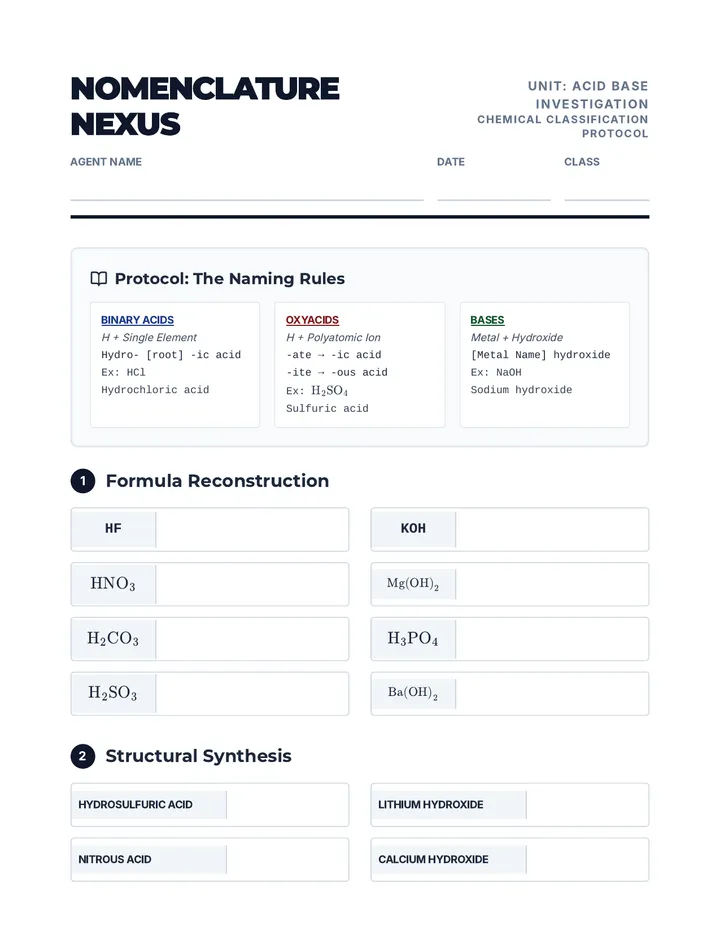
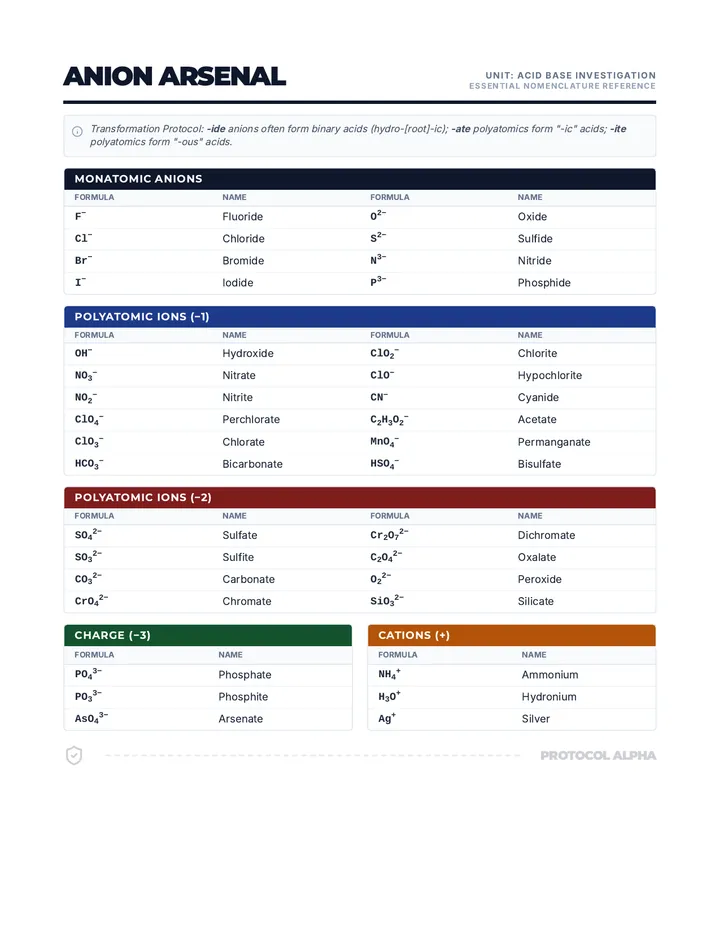
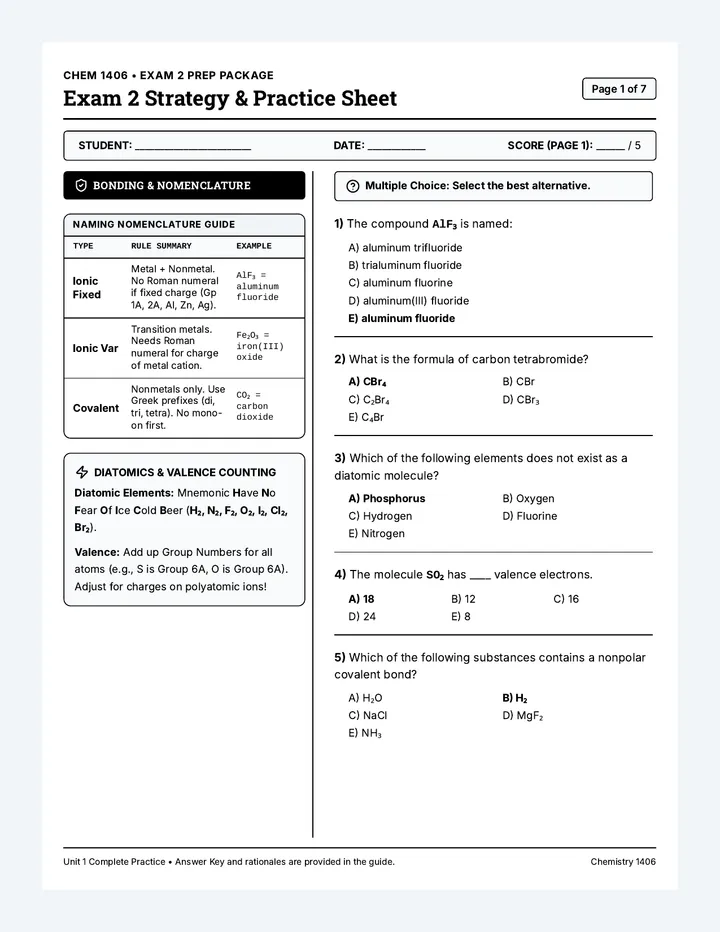
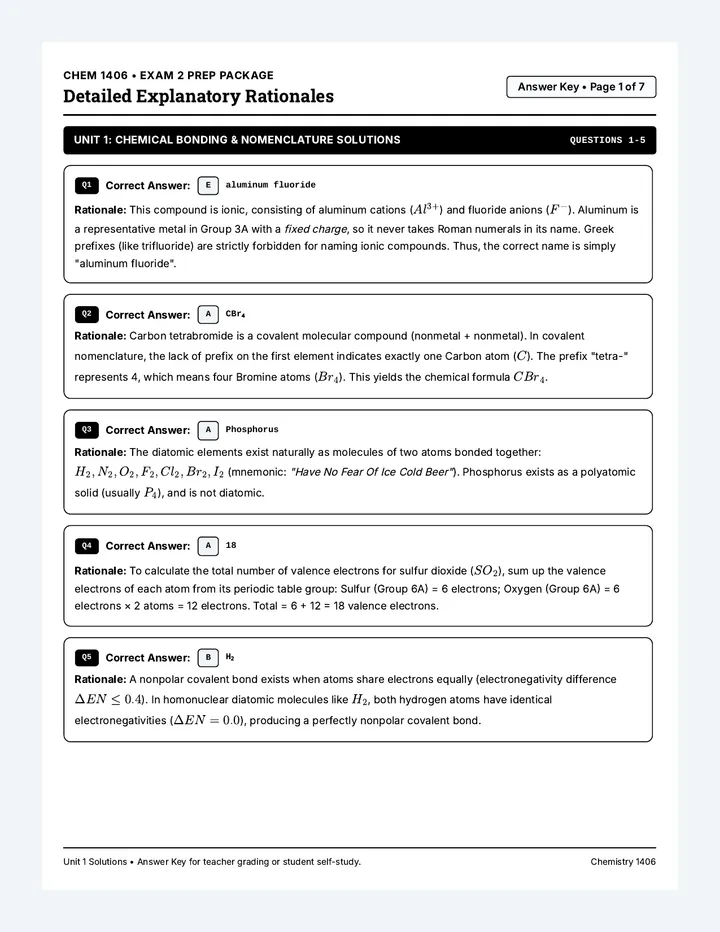
NomenclatureSystematic rules for naming chemical compounds and biological organisms. Establishes standardized identification protocols to ensure consistent communication across scientific disciplines.
Molecular StructureLewis structures, VSEPR theory, and molecular geometry. Connects bonding patterns to chemical properties and physical behavior.
Intermolecular ForcesExamines hydrogen bonding, dipole-dipole interactions, and London dispersion forces. Connects molecular polarity to physical properties like boiling points, solubility, and phase changes.
The MoleFundamental units for measuring substance amounts using Avogadro’s constant. Equips students with conversion skills between mass, particles, and molar volume for stoichiometric calculations.
StoichiometryQuantitative relationships between reactants and products using balanced chemical equations. Develops skills in mole-to-mass conversions, limiting reactant analysis, and theoretical yield calculations.
Properties of GasesKinetic molecular theory and the physical relationships between pressure, volume, and temperature. Applies gas laws to predict molecular behavior and calculate changes in state across varying conditions.
SolutionsChemical properties of solutes and solvents, including concentration measures like molarity and mass percent. Examines factors affecting solubility and the behavior of colligative properties.
Chemical ReactionsPrinciples of stoichiometry, reaction types, and thermodynamic properties of molecular interactions. Identifies patterns in chemical changes and predicts products using balanced equations.
Balancing EquationsFundamental techniques for applying the law of conservation of mass to chemical reactions. Strengthens ability to adjust coefficients while identifying reactants and products in stoichiometric calculations.
Energy ChangesExothermic and endothermic reactions, enthalpy changes, and the law of conservation of energy. Examines bond energies and calorimetry to quantify heat transfer in chemical processes.
Rates of ReactionsCollision theory and activation energy principles used to explain chemical kinetics. Examines how temperature, concentration, surface area, and catalysts influence the speed of chemical reactions.
EquilibriumReversible reactions and the balance between forward and reverse reaction rates. Addresses Le Chatelier's principle, equilibrium constants, and the impact of temperature, pressure, and concentration changes.
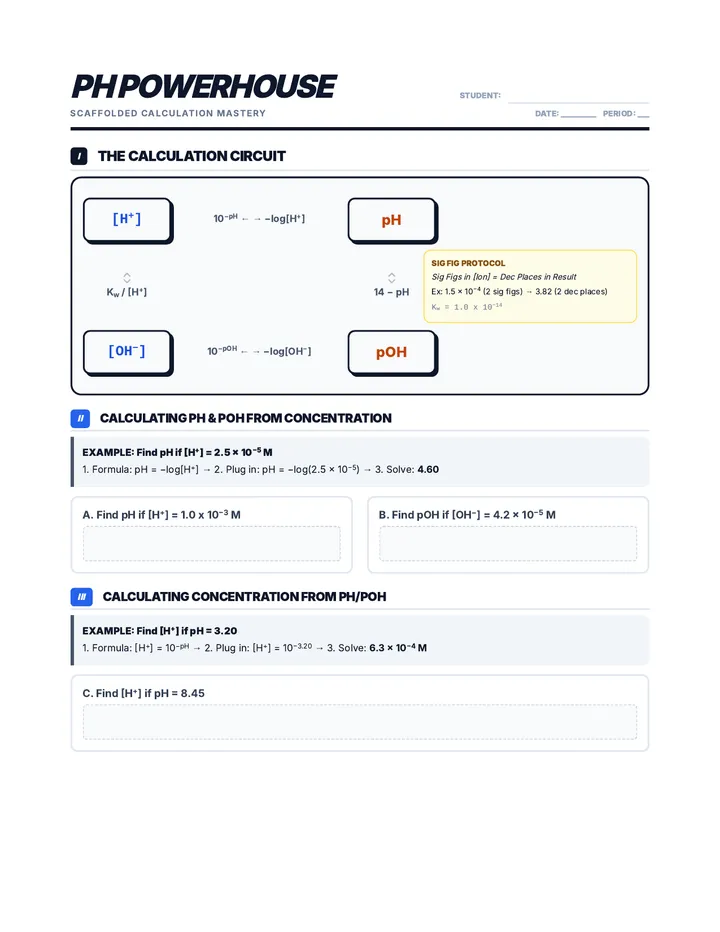
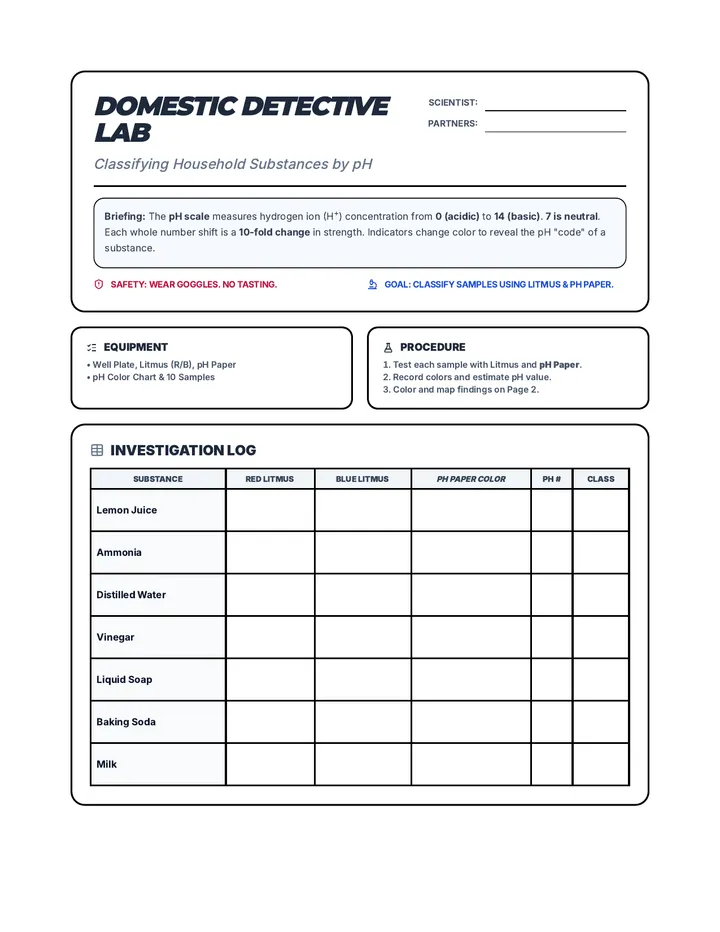
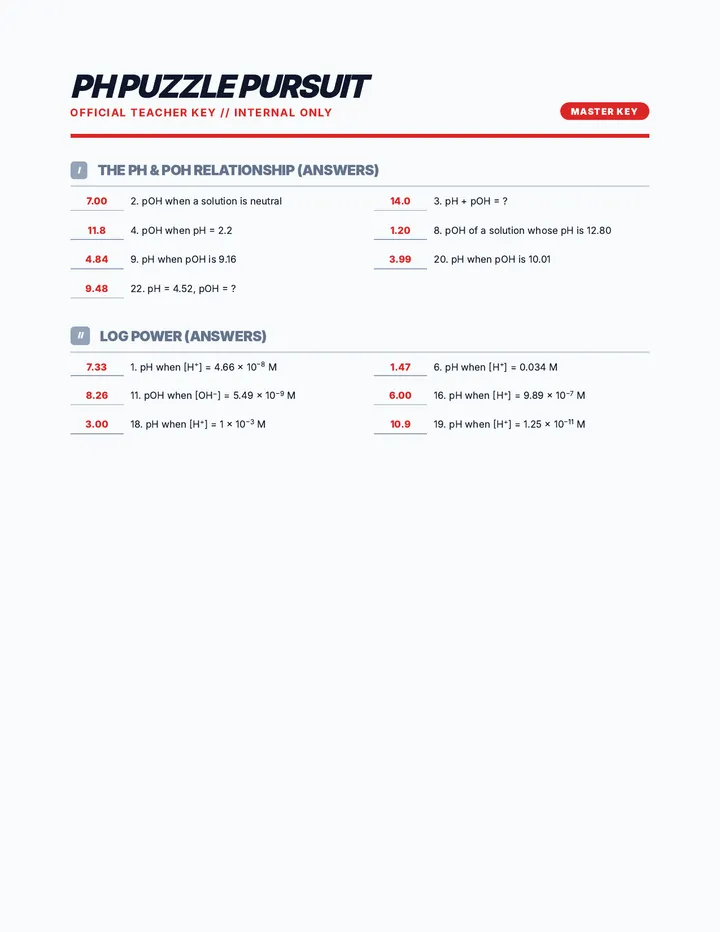
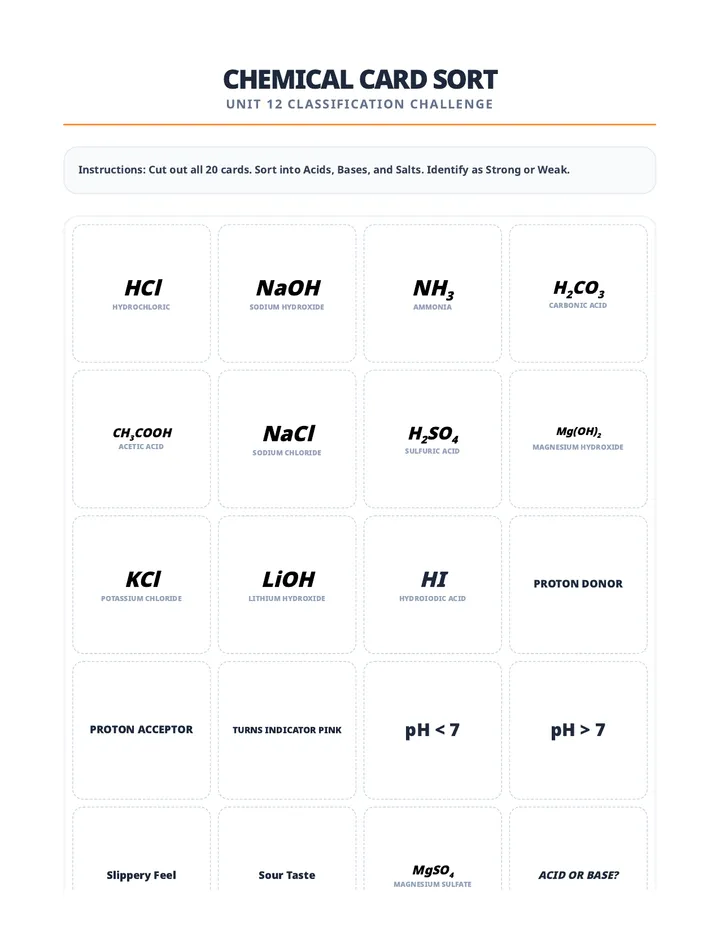
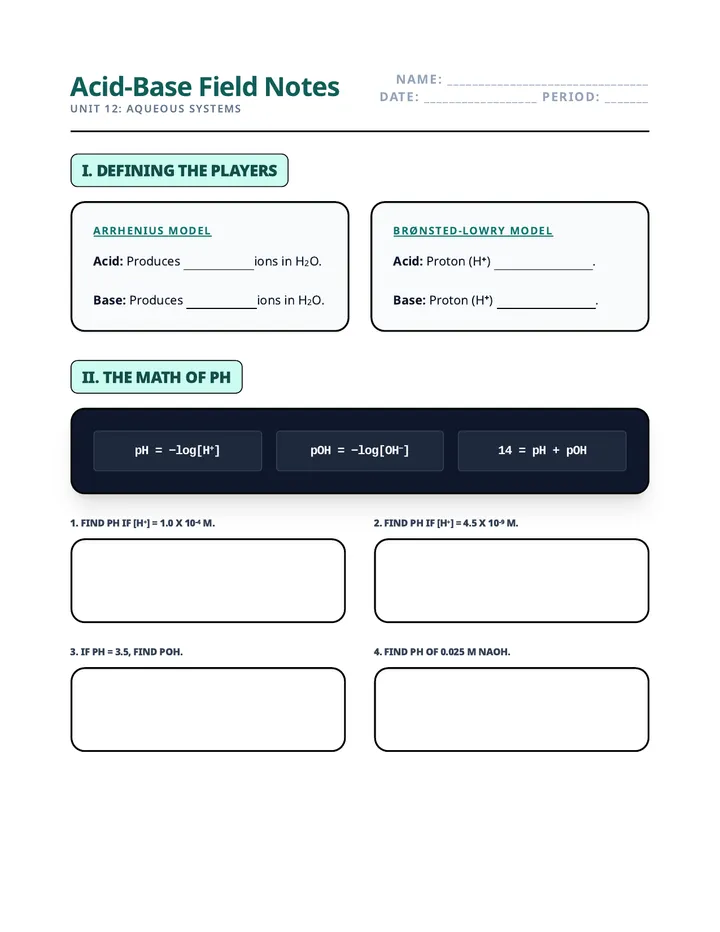
Acids and BasesProperties of pH levels, hydrogen ion concentrations, and neutralization reactions. Examines chemical indicators, titration methods, and Bronsted-Lowry theory.
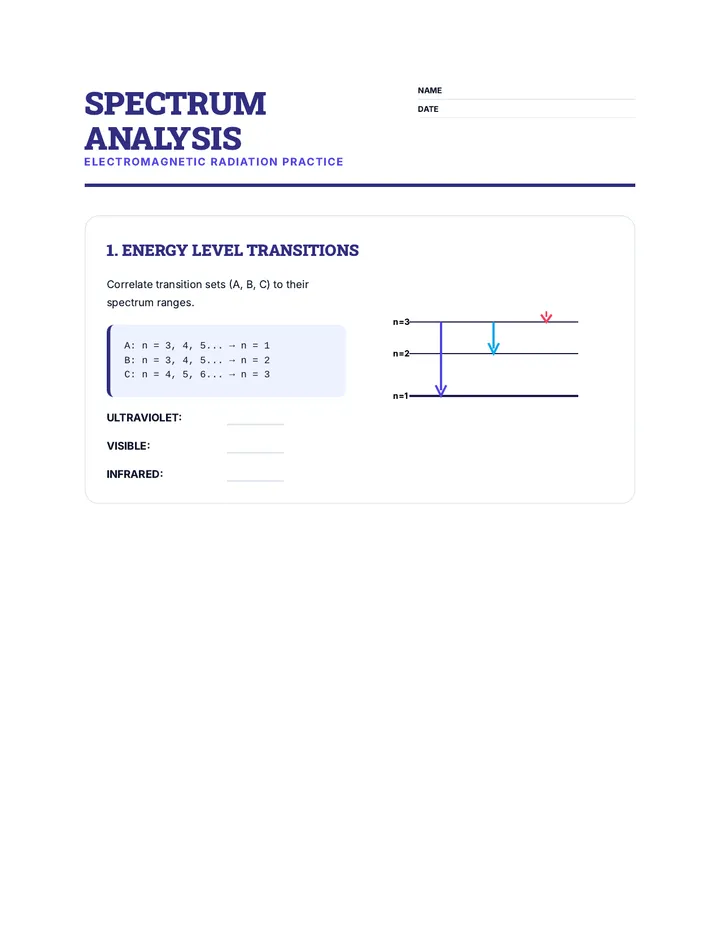
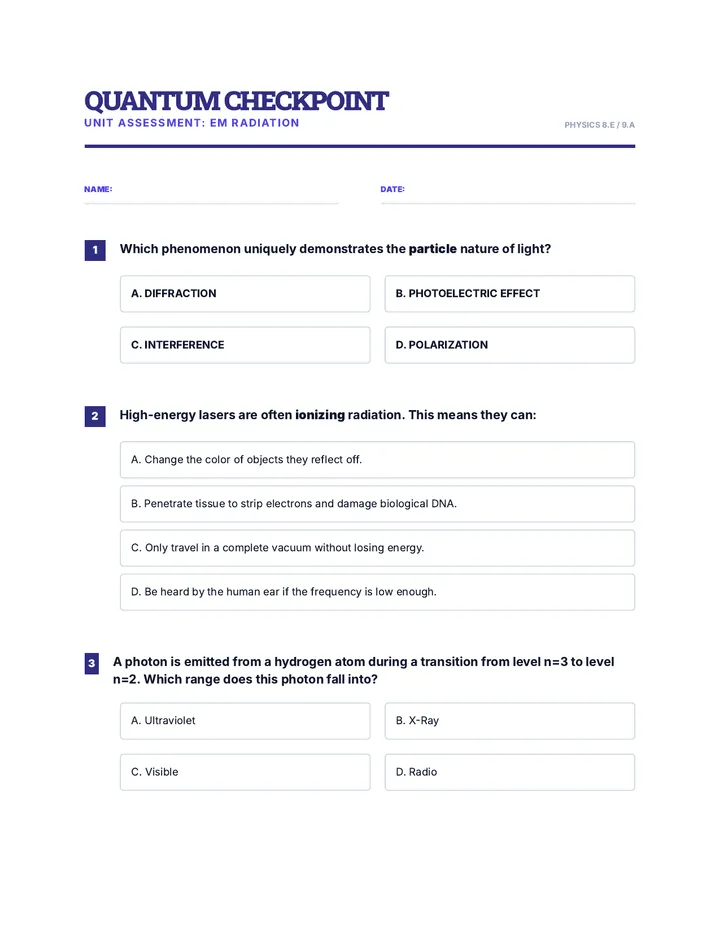
Quantum ModelMaps electron probability distributions through atomic orbitals and wave-particle duality principles. Defines quantum numbers and energy quantization to explain atomic structure beyond the Bohr model.
Sequence
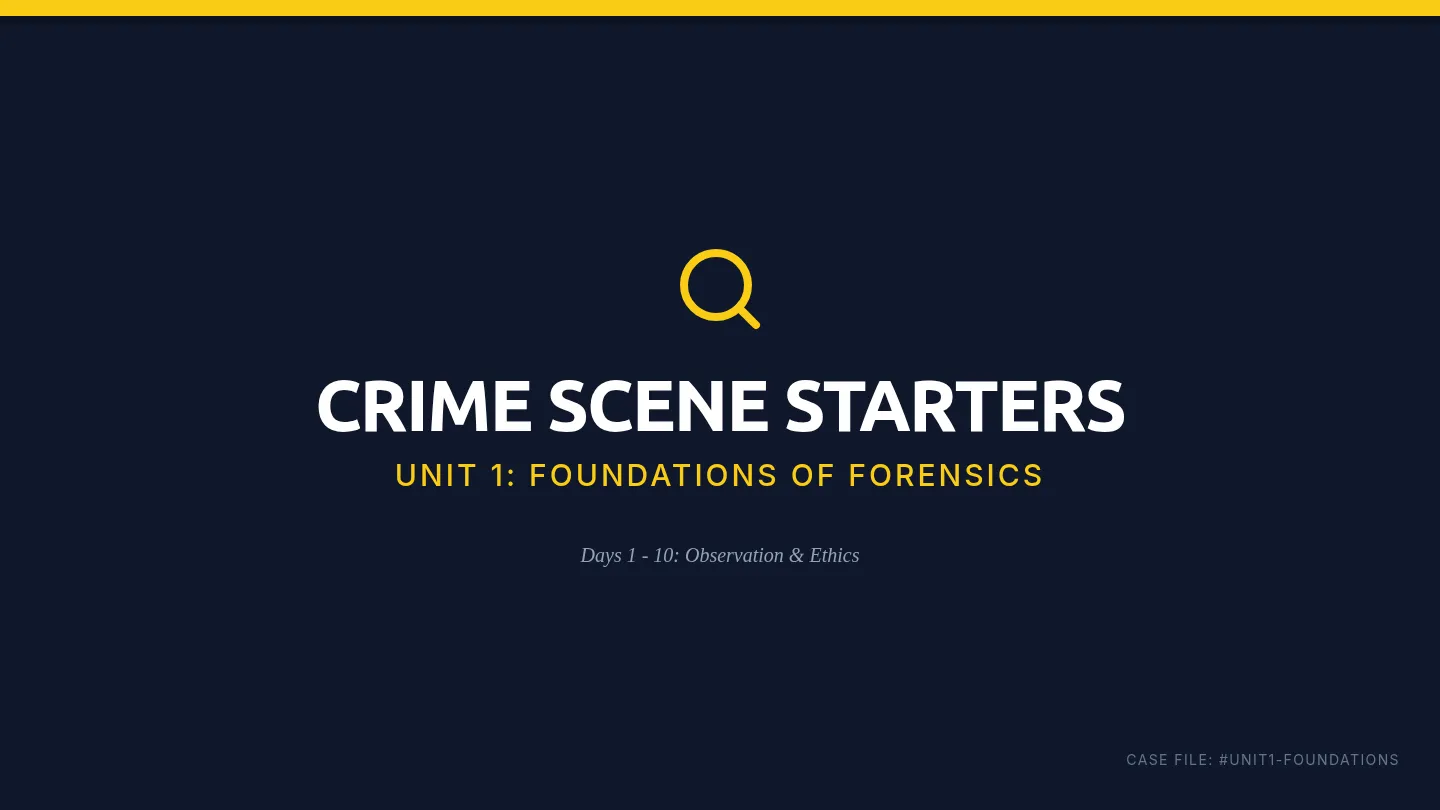
Detective Vocab Slides
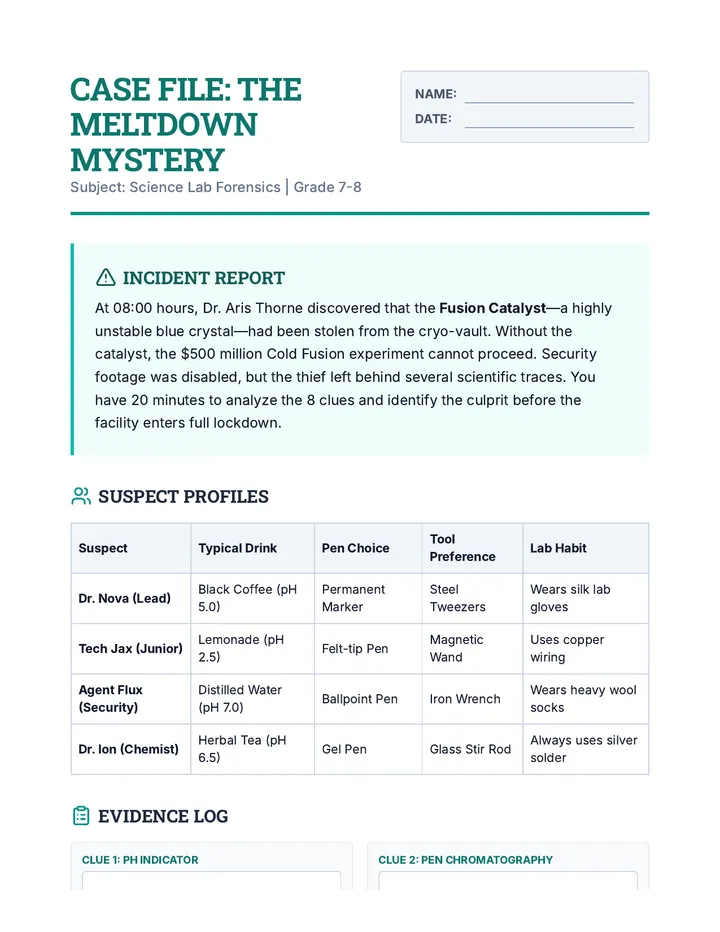
Detective Vocab Worksheet
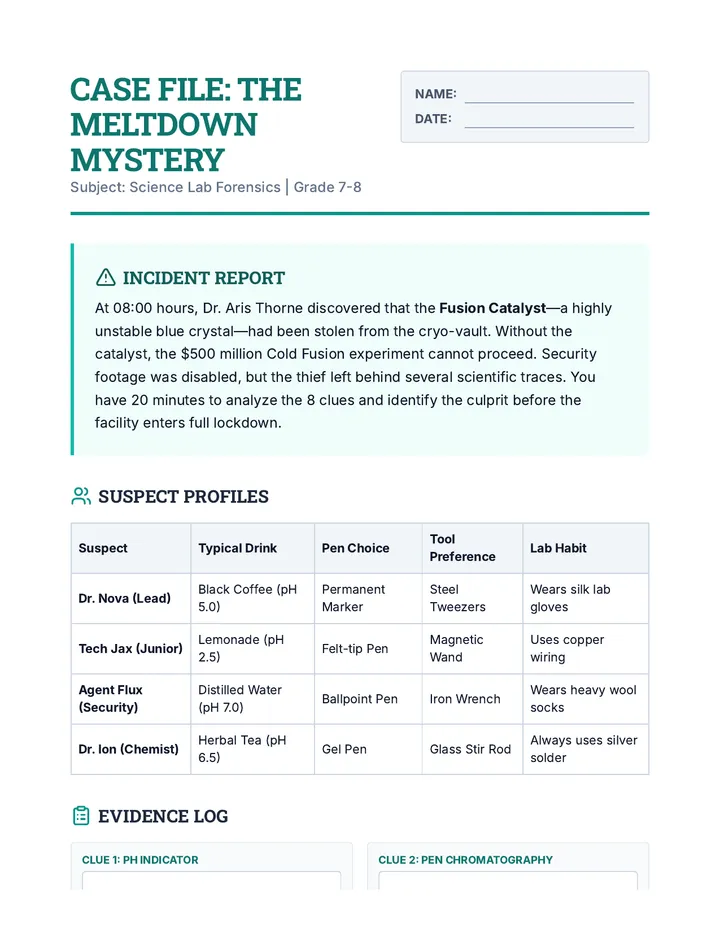
Crime Scene Sketch Activity

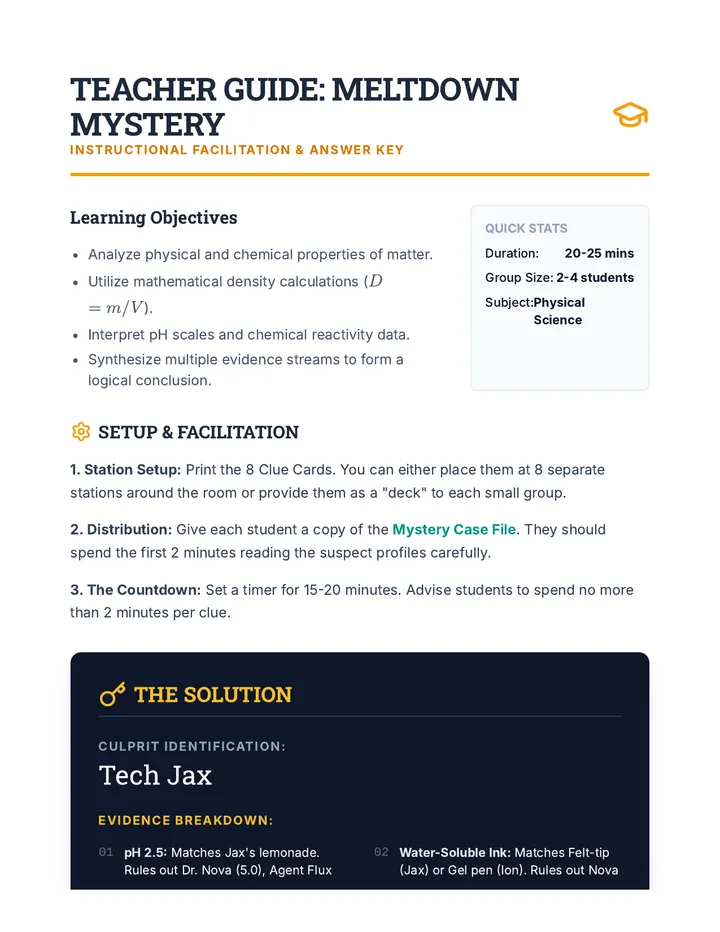
Crime Scene Chronicles

A comprehensive unit on the fundamentals of forensic science and criminal investigation, culminating in a hands-on murder mystery simulation. Students learn about evidence collection, witness psychology, and deductive reasoning.

A(

Anaïs (A)

English Language Arts Teacher
2/4
Sequence
Liquid Legacy Teacher Guide
Flow Force Lab Sheets
Watershed Weaver Graphic Organizer
Flow Force Slides

Flow Force

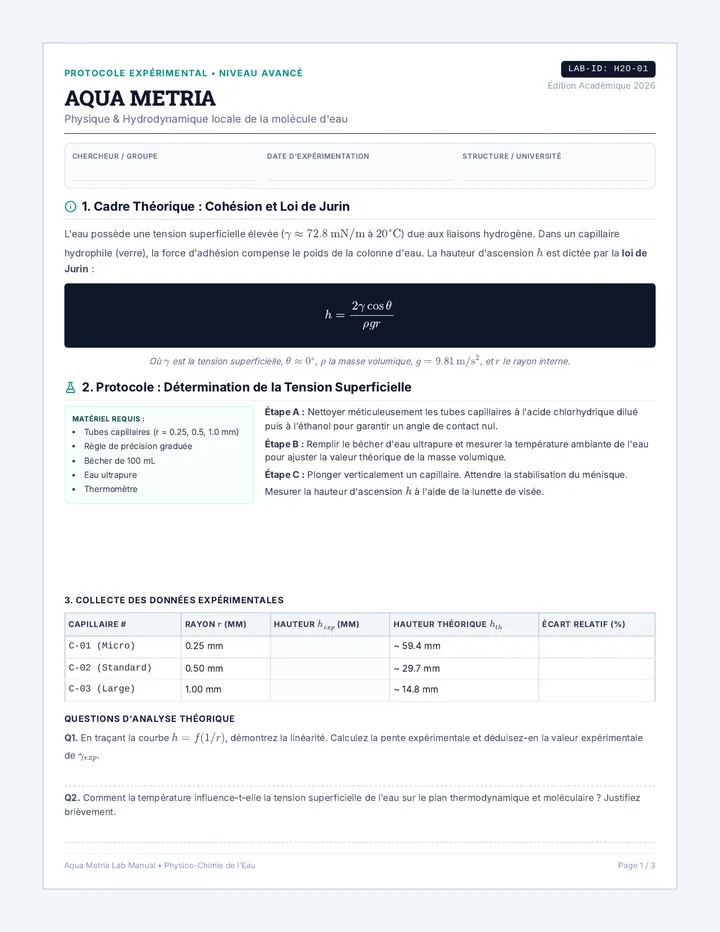
A comprehensive 5-week sequence exploring the physical properties of water, the engineering of water filtration, and the complex systems of Virginia's watersheds. Students move from hands-on engineering to chemical properties and finally to large-scale environmental systems.

TM

Teri Minami

Science Teacher
2/3
Sequence
Liquid Legacy Teacher Guide
Flow Force Slides
Hydro Quest Student Workbook
Watershed Weaver Graphic Organizer
Liquid Legacy Teacher Guide 9th Grade Extension
Flow Force 9th Grade Extension Slides
Hydro Quest 9th Grade Lab Manual
Watershed Data Analysis Answer Key

Flow Force

A comprehensive 5-week sequence exploring the physical properties of water, the engineering of water filtration, and the complex systems of Virginia's watersheds. Students move from hands-on engineering to chemical properties and finally to large-scale environmental systems.

TM

Teri Minami

Science Teacher
2/2
Sequence
Flux de Photons Diapositives
TP Pigments Photosynthétiques
Circuit Électronique de la Feuille
Photosynthèse Guide Enseignant

Le Pouvoir Solaire

Une séquence approfondie sur les phases claires de la photosynthèse, destinée aux étudiants de première année de licence. Elle couvre la capture de l'énergie lumineuse, les pigments photosynthétiques et la chaîne de transfert d'électrons.

D

dimitri0681

Science Teacher
2/1
Sequence
Matter Mystery Teacher Guide
Matter Mystery Slides
The Weigh In Lab Sheet
Matter Reflection Journal
The Weigh In Answer Key

Matter Lab Investigations

A lesson sequence exploring the conservation of matter through reversible and irreversible changes, including hands-on weighing activities and video analysis.

Lenny Avatar
Lenny
1/19
Sequence
Industrial Hygiene Slides
Toxicology and Exposure Teacher Guide
PEL Analysis Worksheet

Strategic Hazard Assessment and Risk Control

A graduate-level sequence focused on systematic hazard identification and risk control. Students master Industrial Hygiene, Job Hazard Analysis (JHA), Hierarchy of Controls, and Hazard Communication (GHS) to develop predictive safety strategies in high-risk environments.

Lenny Avatar
Lenny
1/18
Sequence
Green Stage Slides
Production Audit Worksheet

Sustainable Scenography and Material Science

A graduate-level exploration of sustainable set design, focusing on ecoscenography, material science, modular engineering, and digital fabrication to move the theater industry toward a circular economy.

Lenny Avatar
Lenny
1/18
Sequence
Phase Separation Slides
Chromatography Modeling Worksheet

Chromatography and Solubility Analysis

A comprehensive sequence on the physics and chemistry of chromatography, covering stationary and mobile phases, Rf value calculations, polarity, and forensic applications. Students progress from basic paper chromatography to thin-layer chromatography (TLC) in a series of inquiry-based labs.

Lenny Avatar
Lenny
1/18
Sequence
Ink Mystery Worksheet
Ink Trace Introduction Slides
Ransom Note Teacher Guide

Ink Evidence Files

A 9th-grade physics sequence where students act as forensic technicians, using chromatography to separate mixtures, calculate Retention Factor (Rf) values, and solve a forensic mystery. Students explore solubility, polarity, and real-world applications of chemical separation techniques.

Lenny Avatar
Lenny
1/18
Sequence
Pollution Patrol Slides
Water Quality Report Worksheet
Pollution Setup Teacher Guide

Water Filtration Engineering

A 5-lesson engineering sequence where 7th-grade students analyze contaminated water, investigate filtration materials, and design, build, and test multi-stage filtration systems to explore separation science.

Lenny Avatar
Lenny
1/18
Sequence
Contamination Brief Handout
Characterization Lab Sheet
PureStream Intro Slides

Purification Protocols

A project-based sequence where 12th-grade students act as environmental engineers to design, test, and optimize a multi-stage separation protocol for a complex hazardous waste mixture. Students apply physical principles of density, solubility, and boiling points to isolate pure substances.

Lenny Avatar
Lenny
1/18
Sequence
Scale of Small Worksheet
Liquid Secrets Slides
Mixture Mapping Teacher Guide

Colloid Physics and Heterogeneous Systems

This sequence explores the physics of colloids, suspensions, and heterogeneous systems. Students investigate particle size scales, light scattering (Tyndall effect), fluid dynamics (Stokes' Law), and surface tension to understand how complex mixtures behave and how to engineer stable consumer products.

Lenny Avatar
Lenny
1/18
Sequence
Sum of Parts Slides
Mixing Lab Report
Mass Tracker Teacher Guide

Mass Mystery Solvers

A quantitative exploration of mixtures and solutions where students use measurement to prove that mass is conserved even when substances dissolve or change state. Students progress from simple mixtures of solids to complex solutions and recovery through evaporation.

Lenny Avatar
Lenny
1/18
Sequence
Water Watch Slides
Mystery Mix Case Study Worksheet
Analyzing Contamination Teacher Guide

Designing Water Filtration Systems

A project-based sequence where 5th-grade students act as environmental engineers to design, build, and test water filtration systems, applying concepts of mixtures and particle size to solve a real-world problem.

Lenny Avatar
Lenny
1/18
Sequence
Water Audit Sheet
Mixture Mechanics Slides

Engineering Filtration Systems

An engineering-focused unit where 8th-grade students design, build, and test water filtration systems, applying concepts of heterogeneous and homogeneous mixtures to solve real-world water purification challenges.

Lenny Avatar
Lenny
1/18
Sequence
Property Handles Worksheet
Sorting Challenge Guide
Property Handles Slides

Industrial Separation Systems

An industrial engineering-focused sequence for 11th-grade physics investigating how physical properties (density, magnetism, conductivity) dictate large-scale separation methods in recycling, mining, and environmental cleanup. Students analyze the physics of centrifuges, eddy currents, and the economic trade-offs of engineering design.

Lenny Avatar
Lenny
1/18
Sequence
Solubility Rulebook Lab Worksheet
Vanishing Act Slides
Solubility Facilitation Guide

Molecular Separation Lab

This inquiry-driven sequence moves 11th-grade physics students from visible mixtures to the molecular level of solutions. Using paper and column chromatography as primary tools, students explore solubility, molecular affinity, and quantitative analysis (Rf values) within a forensic context.

Lenny Avatar
Lenny
1/18
Sequence
Pollutant Primer Slides
Contaminant Detective Worksheet
Filtration Kickoff Teacher Guide

Engineering Water Filtration Systems

A project-based unit where 6th-grade students design, test, and evaluate water filtration systems, applying concepts of mixtures and separation techniques.

Lenny Avatar
Lenny
1/18
Sequence
Solubility Secrets Slides
Solubility Speed Lab Worksheet
Solubility Teacher Guide

Investigating Solutions and Chromatography

A 5-lesson unit exploring homogeneous mixtures, solubility, and separation techniques like evaporation and chromatography, culminating in a forensic ink analysis case study.

Lenny Avatar
Lenny
1/18
Sequence
Mechanical Sort Slides
Sifting and Shifting Worksheet
Size and Snap Teacher Guide

Separation Masters

A comprehensive workshop-style sequence for 6th-grade students to master the physical separation of heterogeneous mixtures. Students progress through sifting, magnetism, filtration, and decantation, culminating in a complex multi-step separation challenge.

Lenny Avatar
Lenny
1/18
Sequence
Atomic Blueprint Slides
Macro Micro Worksheet
Property Pro Teacher Guide

Elemental Engineering

A 5-lesson sequence for 6th-grade students connecting the Periodic Table to engineering and material science. Students explore how atomic structure determines macroscopic properties, research elements in technology, investigate carbon's versatility, and apply their knowledge to solve engineering design challenges.

Lenny Avatar
Lenny
1/18
Sequence
Valence Venture Slides
Valence Map Worksheet
Valence Guide Teacher Notes

Elemental Personalities

A 5-lesson sequence for 6th-grade students focused on chemical reactivity and element families. Students explore valence electrons, alkali metals, halogens, and noble gases to understand why elements behave the way they do based on their atomic structure.

Lenny Avatar
Lenny
1/18
Sequence
Matter Mystery Slides
Element Property Cards
Sorting Strategy Log

Matter Mapmakers

This sequence explores the Periodic Table as a logical map of the universe, moving from basic classification of matter to using the table as a predictive tool for scientific discovery. Students act as 'Elemental Cartographers' to uncover the patterns that govern the building blocks of matter.

Lenny Avatar
Lenny
1/18
Sequence
Inside Your Tech Slides
Element Profile Blueprint

Elemental Engineering

A project-based unit where 7th-grade students act as materials engineers, exploring how the unique properties of elements on the Periodic Table are harnessed to create modern technology and solve future design challenges.

Lenny Avatar
Lenny
1/18
Sequence
Elemental Archetypes Slides
Property Archetypes Worksheet
Staircase Scaffolding Teacher Guide

Periodic Personality

This 5-lesson sequence explores the 'personalities' of elements based on their group properties. Students move from basic classification of metals and nonmetals to predicting the reactivity and stability of specific chemical families using valence electron concepts.

Lenny Avatar
Lenny
1/18
Sequence
Bohr Blueprints Slides
Shell Shaper Worksheet
Bohr Architect Teacher Guide

Atomic Architects Modeling Electrons and Trends

This sequence guides 7th-grade students through the visualization of electron arrangements. From drawing Bohr models for the first 18 elements to mastering Lewis dot structures, students learn how an atom's 'address' on the periodic table reflects its electron configuration and influences its chemical properties and trends.

Lenny Avatar
Lenny
1/18
Sequence
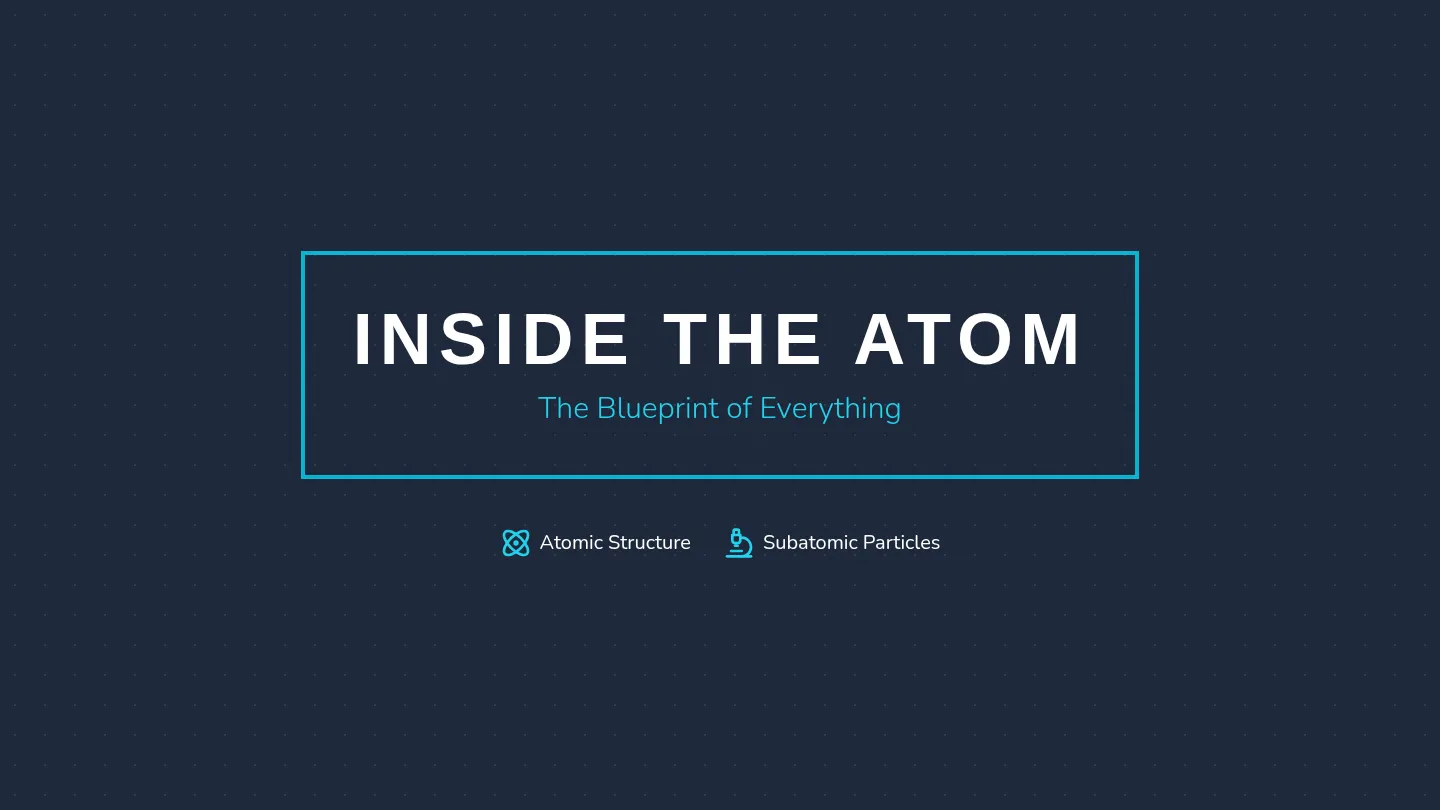
Inside the Atom Slides
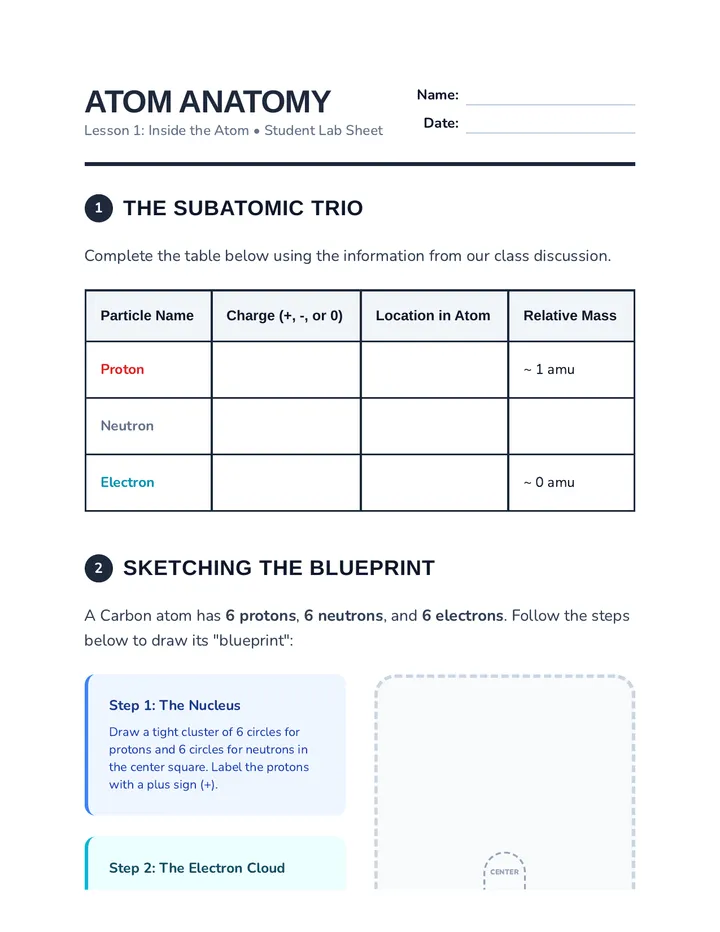
Atom Anatomy Worksheet

Atomic Blueprint Sequence

This sequence introduces students to the fundamental building blocks of matter and the logical organization of the Periodic Table. Students progress from subatomic particles to the predictive power of element classification.

Lenny Avatar
Lenny
1/18
Sequence
Valence Voyagers Slides
Shell Shocker Worksheet

Periodic Trends and Reactivity

This inquiry-based sequence explores periodic trends, chemical reactivity, and the organization of the Periodic Table. Students investigate valence electrons, element classification, families, and trends to predict the behavior of matter.

Lenny Avatar
Lenny
1/18
Sequence
Subatomic Blueprint Slides
Subatomic Blueprint Log Worksheet
Particle Lab Teacher Guide

Atomic Structure and Element Classification

A comprehensive sequence for 8th-grade students exploring the internal structure of atoms. Students move from modeling subatomic particles to calculating atomic mass, constructing Bohr models, and investigating isotopes, culminating in the ability to decode periodic table tiles.

Lenny Avatar
Lenny
1/18
Sequence
Element Classified Slides
Sorting the Stairs Teacher Guide
Material Map Worksheet

Designing Materials Using Periodic Properties

A project-based physics sequence exploring how periodic properties like conductivity and band gaps inform material science and engineering. Students learn about metals, semiconductors, alloys, and isotopes, culminating in a design challenge.

Lenny Avatar
Lenny
1/17
Sequence
Alkali Reactivity Log
Alkali Metals Slides

Elemental Families Field Guide

A comprehensive 11th-grade chemistry sequence exploring the periodic table through element families. Students investigate reactivity, physical states, and electron configurations across five key groups, from the violent alkali metals to the critical rare earth elements.

Lenny Avatar
Lenny
1/17
Sequence
Nuclear Grip Slides
Nuclear Grip Worksheet

Periodic Blueprint

An inquiry-driven sequence for 11th-grade students to explore the physical forces behind periodic trends using data analysis and Coulombic principles. Students move from understanding atomic forces to predicting properties of unknown elements.

Lenny Avatar
Lenny
1/17
Sequence
Atomic Evolution Slides
Atomic Evolution Worksheet
Atomic Evolution Teacher Guide

Quantum Architect Sequence

A comprehensive 11th-grade physics sequence exploring the quantum mechanical model of the atom, electron configurations, and the structural logic of the periodic table. Students progress from historical models to mastery of orbital filling rules and periodic blocks.

Lenny Avatar
Lenny
1/17
Sequence
Pocket Tech Slides
Smartphone Dissection Worksheet
Smartphone Elements Guide

Elemental Tech Insights

This sequence explores the practical application of the Periodic Table in modern technology, from smartphones to medical imaging. Students investigate the atomic properties of specific groups (Rare Earths, Metalloids, Isotopes) and analyze the geopolitical and ethical implications of our reliance on these materials.

Lenny Avatar
Lenny
1/17
Sequence
Shuffle Puzzle Teacher Guide
Early Classification Slides
Patterns Past Worksheet

Periodic Table Logic Puzzle

A 10th-grade physics sequence that treats the Periodic Table as a logic puzzle. Students reconstruct the table's history, moving from atomic mass patterns to the modern atomic number organization through inquiry and prediction.

Lenny Avatar
Lenny
1/17
Sequence
Element Mapmakers Slides
Element Investigation Log Worksheet

Elemental Identities Sequence

A 10th-grade physics sequence exploring the macroscopic chemical behaviors of the main group elements, connecting observable reactivity to electron configurations and group trends.

Lenny Avatar
Lenny
1/17
Sequence
Atomic Forces Worksheet
Atomic Forces Slides
Atomic Forces Teacher Guide

Investigating Periodic Trends

A comprehensive 10th-grade physics-based unit exploring periodic trends through the lens of Coulomb's Law and atomic data analysis. Students investigate atomic radius, ionization energy, and electronegativity to predict chemical behavior.

Lenny Avatar
Lenny
1/17
Sequence
Isotope Investigation Worksheet
Atomic Foundations Slides
Atomic Essentials Teacher Guide

Electron Energy

A comprehensive exploration of the quantum mechanical model, focusing on how electron configurations and orbital mechanics define the Periodic Table's structure. Students progress from basic atomic identity to predicting elemental properties based on quantum numbers.

Lenny Avatar
Lenny
1/17
Sequence
Family Profiles Slides
Family Profile Dossier
Elemental Architects Teacher Guide

Elemental Architects

A project-based unit exploring chemical families, transition metals, halogens, and noble gases through the lens of material science and engineering. Students investigate how atomic structure dictates real-world utility and conclude by designing elemental solutions for engineering challenges.

Lenny Avatar
Lenny
1/17
Sequence
Atomic Radius Slides
Radius Radar Worksheet
Size Paradox Teacher Guide

Periodic Patterns and Trends

This sequence explores recurring patterns in the periodic table, including atomic radius, ionization energy, and electronegativity. Students will analyze data, use analogies, and visualize how atomic structure influences chemical properties and reactivity.

Lenny Avatar
Lenny
1/17
Sequence
Detective Vocab Slides
Detective Vocab Worksheet
Crime Scene Sketch Activity

Crime Scene Chronicles

A comprehensive unit on the fundamentals of forensic science and criminal investigation, culminating in a hands-on murder mystery simulation. Students learn about evidence collection, witness psychology, and deductive reasoning.

A(

Anaïs (A)

English Language Arts Teacher
2/4
Sequence
Flux de Photons Diapositives
TP Pigments Photosynthétiques
Circuit Électronique de la Feuille
Photosynthèse Guide Enseignant

Le Pouvoir Solaire

Une séquence approfondie sur les phases claires de la photosynthèse, destinée aux étudiants de première année de licence. Elle couvre la capture de l'énergie lumineuse, les pigments photosynthétiques et la chaîne de transfert d'électrons.

D

dimitri0681

Science Teacher
2/1
Sequence
Matter Blueprint Slides
Atomic Assembly Worksheet

Molecular Blueprints Sequence

An inquiry-based exploration of matter classification, focusing on the physical properties of homogeneous and heterogeneous mixtures. Students use particle modeling, the Tyndall effect, and solubility analysis to distinguish between solutions, colloids, and suspensions.

Lenny Avatar
Lenny
1/18
Sequence
Pure Particle Slides
Particle Builder Worksheet
Modeling Prep Guide

Particle Models and Mixtures

A conceptual 5-lesson sequence for 7th-grade science focusing on particle modeling to differentiate between pure substances and mixtures. Students use visualization and modeling to understand chemical vs. physical changes and the conservation of mass.

Lenny Avatar
Lenny
1/18
Sequence
Matter Building Blocks Slides
Particle Construction Lab Worksheet
Builder Facilitation Guide Teacher Resource

Matter Under the Microscope

This 8th-grade sequence explores the particle-level interactions within mixtures, focusing on modeling the differences between pure substances and mixtures. Students use physical manipulatives, digital simulations, and classification workshops to master the concepts of concentration, saturation, and the microscopic structure of heterogeneous and homogeneous matter.

Lenny Avatar
Lenny
1/18
Sequence
Pure or Mixed Slides
Matter Detective Log
Pure or Mixed Teacher Guide

Matter Mixers

A comprehensive 6th-grade unit exploring the differences between pure substances and mixtures through inquiry, particle modeling, and laboratory investigations. Students progress from macroscopic observations to microscopic explanations of homogeneous and heterogeneous matter.

Lenny Avatar
Lenny
1/18
Sequence
Particle Grouping Activity Handout
Particle Intro Slides

Particle Power Play

A hands-on chemistry sequence for 2nd graders using colored beads to model particle rearrangement and the fundamentals of balancing chemical equations. Students move from basic grouping to solving complex 'particle puzzles' that simulate conservation of mass.

Lenny Avatar
Lenny
1/18
Sequence
Lattice Logic Slides
Symmetry Hunt Worksheet

Crystallography and Lattice Geometry

An undergraduate-level exploration of solid-state crystallography, moving from real-space lattice geometry and packing efficiency to the mathematical abstraction of reciprocal space and X-ray diffraction analysis. Students master the geometric principles that govern material properties at the atomic scale.

Lenny Avatar
Lenny
1/18
Sequence
Lattice Logic Slides
Unit Cell Blueprint Worksheet

Atomic Geometry and Crystal Structures

This sequence bridges physics and chemistry to explore the geometric arrangements of atoms in solid matter. Students investigate crystal lattices, unit cells, and packing efficiency, understanding how microscopic geometry dictates macroscopic properties like density and conductivity.

Lenny Avatar
Lenny
1/18
Sequence
Mineral Identity Lab Sheet
Mineral Identity Slides
Mineral Identity Key

Earth Material Archives

This rigorous 10th-grade Earth Science sequence explores the chemical and physical foundations of geology. Students move from identifying mineral properties based on atomic structure to analyzing the processes of the rock cycle (igneous, sedimentary, and metamorphic) as snapshots of dynamic planetary systems.

Lenny Avatar
Lenny
1/18
Sequence
Vanishing Act Slides
Baggie Reaction Lab Worksheet
Conservation Lab Teacher Guide

Matter Makers

A hands-on chemistry unit for 6th grade focused on the Law of Conservation of Mass. Students use physical manipulatives to model molecules and simulate chemical reactions to understand why equations must be balanced.

Lenny Avatar
Lenny
1/18
Sequence
Tiny Blocks Slides
Matter Maker Teacher Guide
Micro Scope Sketcher Worksheet

Particle Party

A 3rd-grade physics sequence where students use kinesthetic simulations and game-based learning to model how particle movement changes during phase transitions. Students 'become' the particles to understand how heat energy leads to transitions between solids, liquids, and gases.

Lenny Avatar
Lenny
1/18
Sequence
Atomic Blueprint Slides
Macro Micro Worksheet
Property Pro Teacher Guide

Elemental Engineering

A 5-lesson sequence for 6th-grade students connecting the Periodic Table to engineering and material science. Students explore how atomic structure determines macroscopic properties, research elements in technology, investigate carbon's versatility, and apply their knowledge to solve engineering design challenges.

Lenny Avatar
Lenny
1/18
Sequence
Valence Venture Slides
Valence Map Worksheet
Valence Guide Teacher Notes

Elemental Personalities

A 5-lesson sequence for 6th-grade students focused on chemical reactivity and element families. Students explore valence electrons, alkali metals, halogens, and noble gases to understand why elements behave the way they do based on their atomic structure.

Lenny Avatar
Lenny
1/18
Sequence
Matter Mystery Slides
Element Property Cards
Sorting Strategy Log

Matter Mapmakers

This sequence explores the Periodic Table as a logical map of the universe, moving from basic classification of matter to using the table as a predictive tool for scientific discovery. Students act as 'Elemental Cartographers' to uncover the patterns that govern the building blocks of matter.

Lenny Avatar
Lenny
1/18
Sequence
Particle Lab Slides
Subatomic Specs Worksheet
Particle Facilitator Guide

Atomic Architect Expedition

This sequence introduces 6th-grade students to atomic structure, focusing on subatomic particles, atomic number, isotopes, and electron shells. Students progress from identifying fundamental particles to constructing complex Bohr models for the first eighteen elements of the periodic table.

Lenny Avatar
Lenny
1/18
Sequence
Inside Your Tech Slides
Element Profile Blueprint

Elemental Engineering

A project-based unit where 7th-grade students act as materials engineers, exploring how the unique properties of elements on the Periodic Table are harnessed to create modern technology and solve future design challenges.

Lenny Avatar
Lenny
1/18
Sequence
Elemental Archetypes Slides
Property Archetypes Worksheet
Staircase Scaffolding Teacher Guide

Periodic Personality

This 5-lesson sequence explores the 'personalities' of elements based on their group properties. Students move from basic classification of metals and nonmetals to predicting the reactivity and stability of specific chemical families using valence electron concepts.

Lenny Avatar
Lenny
1/18
Sequence
Bohr Blueprints Slides
Shell Shaper Worksheet
Bohr Architect Teacher Guide

Atomic Architects Modeling Electrons and Trends

This sequence guides 7th-grade students through the visualization of electron arrangements. From drawing Bohr models for the first 18 elements to mastering Lewis dot structures, students learn how an atom's 'address' on the periodic table reflects its electron configuration and influences its chemical properties and trends.

Lenny Avatar
Lenny
1/18
Sequence
Inside the Atom Slides
Atom Anatomy Worksheet

Atomic Blueprint Sequence

This sequence introduces students to the fundamental building blocks of matter and the logical organization of the Periodic Table. Students progress from subatomic particles to the predictive power of element classification.

Lenny Avatar
Lenny
1/18
Sequence
Bouclier Thermique Slides Deck
Bouclier Thermique Activité Fiche
Bouclier Thermique Teacher Guide

Observatoire Climat

Cette séquence pédagogique de 6 heures explore les mécanismes scientifiques de l'effet de serre, l'impact des activités humaines sur le climat et les enjeux futurs liés au réchauffement climatique. Elle est conçue pour les élèves de Première et Terminale dans le cadre de l'Enseignement Scientifique.

MT

Marina Trarbach

Science Teacher
2/3
Sequence
Liquid Legacy Teacher Guide
Flow Force Lab Sheets
Watershed Weaver Graphic Organizer
Flow Force Slides

Flow Force

A comprehensive 5-week sequence exploring the physical properties of water, the engineering of water filtration, and the complex systems of Virginia's watersheds. Students move from hands-on engineering to chemical properties and finally to large-scale environmental systems.

TM

Teri Minami

Science Teacher
2/3
Sequence
Liquid Legacy Teacher Guide
Flow Force Slides
Hydro Quest Student Workbook
Watershed Weaver Graphic Organizer
Liquid Legacy Teacher Guide 9th Grade Extension
Flow Force 9th Grade Extension Slides
Hydro Quest 9th Grade Lab Manual
Watershed Data Analysis Answer Key

Flow Force

A comprehensive 5-week sequence exploring the physical properties of water, the engineering of water filtration, and the complex systems of Virginia's watersheds. Students move from hands-on engineering to chemical properties and finally to large-scale environmental systems.

TM

Teri Minami

Science Teacher
2/2
Sequence
Flux de Photons Diapositives
TP Pigments Photosynthétiques
Circuit Électronique de la Feuille
Photosynthèse Guide Enseignant

Le Pouvoir Solaire

Une séquence approfondie sur les phases claires de la photosynthèse, destinée aux étudiants de première année de licence. Elle couvre la capture de l'énergie lumineuse, les pigments photosynthétiques et la chaîne de transfert d'électrons.

D

dimitri0681

Science Teacher
2/1
Sequence
Extreme Membranes Worksheet
Extreme Membranes Presentation
Lipid Blueprint Reference
Extremophile Facilitator Guide

Molecular Survival Strategies

A specialized high school chemistry/biology integrated lesson exploring the biochemical differences between Archaea and Bacteria. Students analyze how ether bonds and lipid monolayers provide structural stability for survival in extreme thermal environments through modeling and chemical analysis.

Lenny Avatar
Lenny
1/19
Sequence
The Chaos Connection Slides
Gibbs Connection Worksheet
Thermo Tool Reference Guide

Entropy and Energy Flow

A high-school level exploration of thermodynamics, focusing on the connection between entropy, enthalpy, and Gibbs Free Energy to predict chemical spontaneity.

Lenny Avatar
Lenny
1/19
Sequence
Burger Burn Slides
Footprint Facts Data Sheet
Beef Impact Worksheet
Beef Teacher Guide

Climate Connections

A series of lessons focused on human-induced climate change, exploring the causes, effects, and potential solutions through data analysis and scientific inquiry.

Lenny Avatar
Lenny
1/19
Sequence
Matter Mystery Teacher Guide
Matter Mystery Slides
The Weigh In Lab Sheet
Matter Reflection Journal
The Weigh In Answer Key

Matter Lab Investigations

A lesson sequence exploring the conservation of matter through reversible and irreversible changes, including hands-on weighing activities and video analysis.

Lenny Avatar
Lenny
1/19
Sequence
Phase Change Mechanics Slides
Salt Recovery Worksheet
Phase Change Mechanics Teacher Guide

Distillation and Thermal Separation

A comprehensive workshop-based sequence exploring thermal separation techniques, from basic evaporation to industrial fractional distillation. Students master the physics of phase changes and boiling points to separate liquid mixtures.

Lenny Avatar
Lenny
1/18
Sequence
Solubility Secrets Slides
Saturation Investigation Worksheet
Solubility Secrets Teacher Guide

Thermal Separation Quest

This sequence explores how thermal energy is used to separate homogeneous mixtures. Students progress from understanding solubility and saturation to performing evaporation and distillation labs, ultimately connecting these laboratory skills to industrial applications like oil refining.

Lenny Avatar
Lenny
1/18
Sequence
Contamination Brief Handout
Characterization Lab Sheet
PureStream Intro Slides

Purification Protocols

A project-based sequence where 12th-grade students act as environmental engineers to design, test, and optimize a multi-stage separation protocol for a complex hazardous waste mixture. Students apply physical principles of density, solubility, and boiling points to isolate pure substances.

Lenny Avatar
Lenny
1/18
Sequence
Molecular Bonds Slides
Solvation Physics Worksheet
Solvation Physics Answer Key

Thermodynamics of Distillation and Evaporation

This sequence explores the thermodynamic principles governing the separation of mixtures through phase changes. Students analyze intermolecular forces, vapor pressure (Raoult's Law), fractional distillation, crystallization kinetics, and membrane-based desalination, bridging the gap between molecular physics and industrial applications.

Lenny Avatar
Lenny
1/18
Sequence
Sum of Parts Slides
Mixing Lab Report
Mass Tracker Teacher Guide

Mass Mystery Solvers

A quantitative exploration of mixtures and solutions where students use measurement to prove that mass is conserved even when substances dissolve or change state. Students progress from simple mixtures of solids to complex solutions and recovery through evaporation.

Lenny Avatar
Lenny
1/18
Sequence
Unbake Slides
Unbake Facilitation Guide
Unbake Worksheet

Salt Scout Chronicles

A 2nd-grade science sequence exploring physical changes, solubility, and evaporation. Students investigate if dissolved solids can be recovered through evaporation, connecting classroom experiments to real-world salt harvesting.

Lenny Avatar
Lenny
1/18
Sequence
Evaporation Basics Slides
Salt Recovery Worksheet
Evaporation Lab Teacher Guide

Thermal Separation Techniques

This skill-building sequence focuses on the thermal properties of mixtures, specifically how boiling points and phase changes allow for separation via evaporation and distillation. Students explore the physics of vapor pressure and energy transfer required to separate a solvent from a solute.

Lenny Avatar
Lenny
1/18
Sequence
Mixing Thermodynamics Slides
Mixing Thermodynamics Teacher Guide
Molecular Miscibility Worksheet

Thermodynamics of Phase Separation

An undergraduate-level sequence exploring the thermodynamic and physical principles of mixtures, covering entropy, enthalpy, phase equilibria, and practical separation techniques like distillation and recrystallization.

Lenny Avatar
Lenny
1/18
Sequence
Filter of Time Worksheet
Bias of Buried Slides

Taphonomy and Preservation

This sequence explores taphonomy, the study of how organic remains transition from the biosphere to the lithosphere. Students investigate the chemical and physical biases that determine what gets preserved, moving beyond simple burial to explore mineralization, replacement, and carbonization, culminating in a forensic analysis of fossil assemblages.

Lenny Avatar
Lenny
1/18
Sequence
Particle Party Slides
Acting Out Matter Guide
Particle Motion Map Worksheet

Particle Detectives Phase Changes

An inquiry-driven exploration of particle theory and phase changes for 4th-grade students. Learners investigate how heat energy influences particle movement across solids, liquids, and gases through hands-on simulations and data-driven experiments.

Lenny Avatar
Lenny
1/18
Sequence
Tiny Blocks Slides
Matter Maker Teacher Guide
Micro Scope Sketcher Worksheet

Particle Party

A 3rd-grade physics sequence where students use kinesthetic simulations and game-based learning to model how particle movement changes during phase transitions. Students 'become' the particles to understand how heat energy leads to transitions between solids, liquids, and gases.

Lenny Avatar
Lenny
1/18
Sequence
Matter Mastermind Worksheet
Matter Mastermind Slides
Phase Transition Teacher Guide

Phase Transition Lab

This inquiry-based sequence guides third-grade students through the observable processes of phase changes using water as a primary model. Students investigate solids, liquids, and gases, discovering how adding or removing heat energy causes reversible changes of state.

Lenny Avatar
Lenny
1/18
Sequence
Detective Vocab Slides
Detective Vocab Worksheet
Crime Scene Sketch Activity

Crime Scene Chronicles

A comprehensive unit on the fundamentals of forensic science and criminal investigation, culminating in a hands-on murder mystery simulation. Students learn about evidence collection, witness psychology, and deductive reasoning.

A(

Anaïs (A)

English Language Arts Teacher
2/4
Sequence
Bouclier Thermique Slides Deck
Bouclier Thermique Activité Fiche
Bouclier Thermique Teacher Guide

Observatoire Climat

Cette séquence pédagogique de 6 heures explore les mécanismes scientifiques de l'effet de serre, l'impact des activités humaines sur le climat et les enjeux futurs liés au réchauffement climatique. Elle est conçue pour les élèves de Première et Terminale dans le cadre de l'Enseignement Scientifique.

MT

Marina Trarbach

Science Teacher
2/3
Sequence
Liquid Legacy Teacher Guide
Flow Force Lab Sheets
Watershed Weaver Graphic Organizer
Flow Force Slides

Flow Force

A comprehensive 5-week sequence exploring the physical properties of water, the engineering of water filtration, and the complex systems of Virginia's watersheds. Students move from hands-on engineering to chemical properties and finally to large-scale environmental systems.

TM

Teri Minami

Science Teacher
2/3
Sequence
Flux de Photons Diapositives
TP Pigments Photosynthétiques
Circuit Électronique de la Feuille
Photosynthèse Guide Enseignant

Le Pouvoir Solaire

Une séquence approfondie sur les phases claires de la photosynthèse, destinée aux étudiants de première année de licence. Elle couvre la capture de l'énergie lumineuse, les pigments photosynthétiques et la chaîne de transfert d'électrons.

D

dimitri0681

Science Teacher
2/1
Sequence
Syllable Snap Cards Sync
Syllable Match Log
Syllable Match Teacher Key

Classroom Hands On Tools

A collection of science and phonics resources designed for hands-on classroom activities.

CD

Cari Doherty

Elementary Teacher
1/20
Sequence
Extreme Membranes Worksheet
Extreme Membranes Presentation
Lipid Blueprint Reference
Extremophile Facilitator Guide

Molecular Survival Strategies

A specialized high school chemistry/biology integrated lesson exploring the biochemical differences between Archaea and Bacteria. Students analyze how ether bonds and lipid monolayers provide structural stability for survival in extreme thermal environments through modeling and chemical analysis.

Lenny Avatar
Lenny
1/19
Sequence
The Chaos Connection Slides
Gibbs Connection Worksheet
Thermo Tool Reference Guide

Entropy and Energy Flow

A high-school level exploration of thermodynamics, focusing on the connection between entropy, enthalpy, and Gibbs Free Energy to predict chemical spontaneity.

Lenny Avatar
Lenny
1/19
Sequence
Burger Burn Slides
Footprint Facts Data Sheet
Beef Impact Worksheet
Beef Teacher Guide

Climate Connections

A series of lessons focused on human-induced climate change, exploring the causes, effects, and potential solutions through data analysis and scientific inquiry.

Lenny Avatar
Lenny
1/19
Sequence
Matter Mystery Teacher Guide
Matter Mystery Slides
The Weigh In Lab Sheet
Matter Reflection Journal
The Weigh In Answer Key

Matter Lab Investigations

A lesson sequence exploring the conservation of matter through reversible and irreversible changes, including hands-on weighing activities and video analysis.

Lenny Avatar
Lenny
1/19
Sequence
Tiny Chemists Teacher Guide
Tiny Chemists Slides
Junior Lab Notebook Document
Safety First Guide Document
Home Lab Parent Letter Document

Kitchen Science

A beginner science sequence where students explore the world of chemistry through everyday household items, focusing on observations, reactions, and the scientific method.

Lenny Avatar
Lenny
1/19
Sequence
Matter Master Teacher Guide
Matter Morph Presentation Slides
Mission Station Cards
Change Detective Log Worksheet
Pancake Proof Exit Ticket

Matter Mysteries

A unit exploring the properties of matter, focusing on how substances change state and form new materials through chemical reactions.

Lenny Avatar
Lenny
1/19
Sequence
Phase Change Mechanics Slides
Salt Recovery Worksheet
Phase Change Mechanics Teacher Guide

Distillation and Thermal Separation

A comprehensive workshop-based sequence exploring thermal separation techniques, from basic evaporation to industrial fractional distillation. Students master the physics of phase changes and boiling points to separate liquid mixtures.

Lenny Avatar
Lenny
1/18
Sequence
Matter Blueprint Slides
Atomic Assembly Worksheet

Molecular Blueprints Sequence

An inquiry-based exploration of matter classification, focusing on the physical properties of homogeneous and heterogeneous mixtures. Students use particle modeling, the Tyndall effect, and solubility analysis to distinguish between solutions, colloids, and suspensions.

Lenny Avatar
Lenny
1/18
Sequence
Solubility Secrets Slides
Saturation Investigation Worksheet
Solubility Secrets Teacher Guide

Thermal Separation Quest

This sequence explores how thermal energy is used to separate homogeneous mixtures. Students progress from understanding solubility and saturation to performing evaporation and distillation labs, ultimately connecting these laboratory skills to industrial applications like oil refining.

Lenny Avatar
Lenny
1/18
Sequence
Particle Scale Slides
Mixture Matrix Worksheet

Mixtures Mystery Mastered

A 9th-grade physics sequence exploring the distinct properties of solutions, colloids, and suspensions based on particle size, stability, and light interaction.

Lenny Avatar
Lenny
1/18
Sequence
Macroscopic Mystery Slides
Macroscopic Mystery Log
Macroscopic Mystery Teacher Guide

Matter Under the Microscope

This 9th-grade physics and chemistry sequence explores the classification of matter through physical properties. Students progress from macroscopic observations to microscopic particle diagrams, conducting labs to distinguish between pure substances, homogeneous mixtures, and heterogeneous mixtures using evidence-based reasoning.

Lenny Avatar
Lenny
1/18
Sequence
Pure Particle Slides
Particle Builder Worksheet
Modeling Prep Guide

Particle Models and Mixtures

A conceptual 5-lesson sequence for 7th-grade science focusing on particle modeling to differentiate between pure substances and mixtures. Students use visualization and modeling to understand chemical vs. physical changes and the conservation of mass.

Lenny Avatar
Lenny
1/18
Sequence
Waste Wizard Slides
Sorting Stream Lab Sheet
Recycling Manager Guide

Industrial Separation Techniques

A 5-lesson unit for 7th-grade science exploring industrial separation techniques through simulations, engineering challenges, and systems thinking. Students act as process engineers to solve real-world problems like recycling, oil spills, mining, and water scarcity.

Lenny Avatar
Lenny
1/18
Sequence
Solutes and Solvents Slides
Dissolving Dynamics Lab Report
Solutes and Solvents Teacher Guide

Analyzing Solutions and Mixtures

A forensic-themed 7th-grade science sequence exploring homogeneous mixtures, solubility, chromatography, and evaporation to separate dissolved components.

Lenny Avatar
Lenny
1/18
Sequence
Pollution Patrol Slides
Water Quality Report Worksheet
Pollution Setup Teacher Guide

Water Filtration Engineering

A 5-lesson engineering sequence where 7th-grade students analyze contaminated water, investigate filtration materials, and design, build, and test multi-stage filtration systems to explore separation science.

Lenny Avatar
Lenny
1/18
Sequence
Bouclier Thermique Slides Deck
Bouclier Thermique Activité Fiche
Bouclier Thermique Teacher Guide

Observatoire Climat

Cette séquence pédagogique de 6 heures explore les mécanismes scientifiques de l'effet de serre, l'impact des activités humaines sur le climat et les enjeux futurs liés au réchauffement climatique. Elle est conçue pour les élèves de Première et Terminale dans le cadre de l'Enseignement Scientifique.

MT

Marina Trarbach

Science Teacher
2/3
Sequence
Syllable Snap Cards Sync
Syllable Match Log
Syllable Match Teacher Key

Classroom Hands On Tools

A collection of science and phonics resources designed for hands-on classroom activities.

CD

Cari Doherty

Elementary Teacher
1/20
Sequence
Tiny Chemists Teacher Guide
Tiny Chemists Slides
Junior Lab Notebook Document
Safety First Guide Document
Home Lab Parent Letter Document

Kitchen Science

A beginner science sequence where students explore the world of chemistry through everyday household items, focusing on observations, reactions, and the scientific method.

Lenny Avatar
Lenny
1/19
Sequence
Matter Building Blocks Slides
Particle Construction Lab Worksheet
Builder Facilitation Guide Teacher Resource

Matter Under the Microscope

This 8th-grade sequence explores the particle-level interactions within mixtures, focusing on modeling the differences between pure substances and mixtures. Students use physical manipulatives, digital simulations, and classification workshops to master the concepts of concentration, saturation, and the microscopic structure of heterogeneous and homogeneous matter.

Lenny Avatar
Lenny
1/18
Sequence
Evaporation Basics Slides
Salt Recovery Worksheet
Evaporation Lab Teacher Guide

Thermal Separation Techniques

This skill-building sequence focuses on the thermal properties of mixtures, specifically how boiling points and phase changes allow for separation via evaporation and distillation. Students explore the physics of vapor pressure and energy transfer required to separate a solvent from a solute.

Lenny Avatar
Lenny
1/18
Sequence
Salt Mystery Slides
Salt Mystery Worksheet

Matter Magic

This 5-lesson sequence introduces 1st-grade students to the concept of matter conservation. By observing dissolving solids, changing shapes, and chemical reactions in closed systems, students learn that matter persists even when its form or visibility changes.

Lenny Avatar
Lenny
1/18
Sequence
Tiny Blocks Slides
Matter Maker Teacher Guide
Micro Scope Sketcher Worksheet

Particle Party

A 3rd-grade physics sequence where students use kinesthetic simulations and game-based learning to model how particle movement changes during phase transitions. Students 'become' the particles to understand how heat energy leads to transitions between solids, liquids, and gases.

Lenny Avatar
Lenny
1/18
Sequence
Matter Matchers Slides
Matter Scavenger Hunt Worksheet
Mystery Bag Teacher Guide

Phase Change Investigation

An inquiry-based exploration of the three states of matter and how temperature changes cause materials to transition between solid, liquid, and gas. students will engage in hands-on labs involving melting, freezing, evaporation, and condensation to understand physical changes.

Lenny Avatar
Lenny
1/18
Sequence
Reversible Journeys Slides
Back and Forth Tracker Worksheet
Reversibility Facilitation Guide

Matter Mysteries

A 4th-grade science sequence exploring physical and chemical changes through the lens of reversibility and the conservation of matter. Students investigate how matter changes state, reacts chemically, and maintains its weight throughout these processes.

Lenny Avatar
Lenny
1/18
Sequence
Gas Law Refresher Slides
Pressure Points Worksheet
Gas Law Mastery Key

Gas Phase Stoichiometry and Thermodynamics

A comprehensive sequence for undergraduate chemistry students exploring the intersection of the Ideal Gas Law and stoichiometry, featuring real-world applications like airbag engineering and atmospheric science.

Lenny Avatar
Lenny
1/17
Sequence
Airbag Engineering Slides
Airbag Crash Worksheet
Airbag Analysis Teacher Key

Stoichiometry in Industry

This project-based stoichiometry sequence explores industrial applications in automotive safety, pharmaceutical manufacturing, and environmental sustainability. Students apply chemical calculations to real-world engineering challenges, focusing on precision, safety, and economic efficiency.

Lenny Avatar
Lenny
1/17
Sequence
Airbag Chemistry Slides
Reaction Balancing Schematic
Airbag Chemistry Teacher Guide

Engineering Safety Systems with Stoichiometry

A 12th-grade chemistry sequence where students act as safety engineers, using stoichiometry and gas laws to design and justify the chemical systems within automobile airbags.

Lenny Avatar
Lenny
1/17
Sequence
Mole Ratios Teacher Guide
Mole Ratios Slides
Equation Architect Worksheet
Equation Architect Answer Key

Stoichiometry Roadmap

A comprehensive 11th-grade chemistry sequence focusing on the mathematical framework of chemical reactions. Students progress from balancing equations and mole ratios to complex mass-mass, gas, and solution stoichiometry using dimensional analysis and a 'stoichiometric roadmap'.

Lenny Avatar
Lenny
1/17
Sequence
Ratio Roadmap Slides
Mole Ratio Workshop Worksheet

Stoichiometry Fundamentals

This sequence establishes the mathematical foundation of chemistry by mastering dimensional analysis and mole-mass relationships. Students begin by reinforcing their understanding of balanced equations as the basis for mole ratios before progressing to complex multi-step conversions. The arc moves from ideal stoichiometric calculations to the introduction of limiting reactants, emphasizing the logic behind the algorithms.

Lenny Avatar
Lenny
1/17
Sequence
Life-Saving Reactions Slides
Propellant Analysis Worksheet
Life-Saving Reactions Teacher Guide

Stoichiometry in Safety Engineering

A high-stakes chemistry sequence for 10th-grade students that applies stoichiometric principles to automotive safety engineering. Students analyze the chemical reactions in airbags, calculate gas production at STP, and perform safety audits on engineering specifications.

Lenny Avatar
Lenny
1/17
Sequence
Ratio Blueprint Workshop Student Document
Ratio Blueprint Presentation Slides
Ratio Master Teacher Guide Lesson 1

Molecular Logistics

A foundational sequence for 10th-grade chemistry that guides students through the mathematical logic of stoichiometry. Students progress from balancing equations and writing mole ratios to performing complex mass, volume, and particle conversions using dimensional analysis.

Lenny Avatar
Lenny
1/17
Sequence
Radiant Volumes Slides
RTE Mastery Worksheet
RTE Solutions Guide

Heat Transfer and Nanoscale Physics

A graduate-level exploration of advanced heat transfer, focusing on radiative transfer in participating media and nanoscale thermal physics. Students move from volumetric radiation to phonon transport and interfacial resistance, culminating in microscale thermal management simulations.

Lenny Avatar
Lenny
1/17
Sequence
Mapping State Shifts Slides
Phase Mapping Worksheet
Phase Mapping Answer Key

Phase Transitions and Real Matter

This sequence explores the thermodynamics of real matter, focusing on phase transitions, equations of state beyond the ideal gas law, and the physical properties of real gases and liquids. Students will transition from conceptual understanding of phase diagrams to rigorous mathematical modeling of non-ideal systems.

Lenny Avatar
Lenny
1/17
Sequence
Energy Partition Slides
Specific Heat Predictions Worksheet

Micro to Macro Thermodynamics

A comprehensive undergraduate-level sequence bridging the gap between microscopic particle dynamics and macroscopic thermodynamic properties. Students derive the Ideal Gas Law, explore the Maxwell-Boltzmann distribution, apply the Equipartition Theorem, and conclude with a statistical interpretation of entropy.

Lenny Avatar
Lenny
1/17
Sequence
The Chaos Connection Slides
Gibbs Connection Worksheet
Thermo Tool Reference Guide

Entropy and Energy Flow

A high-school level exploration of thermodynamics, focusing on the connection between entropy, enthalpy, and Gibbs Free Energy to predict chemical spontaneity.

Lenny Avatar
Lenny
1/19
Sequence
Phase Change Mechanics Slides
Salt Recovery Worksheet
Phase Change Mechanics Teacher Guide

Distillation and Thermal Separation

A comprehensive workshop-based sequence exploring thermal separation techniques, from basic evaporation to industrial fractional distillation. Students master the physics of phase changes and boiling points to separate liquid mixtures.

Lenny Avatar
Lenny
1/18
Sequence
Molecular Bonds Slides
Solvation Physics Worksheet
Solvation Physics Answer Key

Thermodynamics of Distillation and Evaporation

This sequence explores the thermodynamic principles governing the separation of mixtures through phase changes. Students analyze intermolecular forces, vapor pressure (Raoult's Law), fractional distillation, crystallization kinetics, and membrane-based desalination, bridging the gap between molecular physics and industrial applications.

Lenny Avatar
Lenny
1/18
Sequence
Mystery Powder Slides
Vanishing Act Worksheet
Disappearing Powder Teacher Guide

Investigating Solubility and Dissolving

A 2nd-grade science sequence investigating how solids dissolve in liquids to form solutions, moving from basic observations to the concept of saturation.

Lenny Avatar
Lenny
1/18
Sequence
Migration Theory Slides
Migration Math Worksheet
Migration Math Key
Migration Theory Teacher Guide

Chromatographic Theory and Analytical Isolation

A comprehensive undergraduate sequence on the physicochemical principles of chromatography, covering thermodynamic migration theory, kinetic efficiency (Van Deemter), phase optimization, instrumentation (GC/HPLC), and quantitative analytical methods.

Lenny Avatar
Lenny
1/18
Sequence
Mixing Thermodynamics Slides
Mixing Thermodynamics Teacher Guide
Molecular Miscibility Worksheet

Thermodynamics of Phase Separation

An undergraduate-level sequence exploring the thermodynamic and physical principles of mixtures, covering entropy, enthalpy, phase equilibria, and practical separation techniques like distillation and recrystallization.

Lenny Avatar
Lenny
1/18
Sequence
Reward Circuitry Slides
Synaptic Transmission Worksheet
Neurochemistry Educator Guide

Stimulant Science and Society

A comprehensive undergraduate-level sequence exploring the pharmacology, neurobiology, and public health implications of stimulant drugs, from molecular mechanisms to community intervention.

Lenny Avatar
Lenny
1/18
Sequence
Decay Kinetics Worksheet
Decay Kinetics Slides
Decay Kinetics Teacher Key

Decay Dynamics Sequence

This sequence explores the quantum mechanical mechanisms and mathematical kinetics of radioactive decay. Students will master decay laws, solve multi-step decay chains, and investigate the physics of alpha, beta, and gamma transitions, culminating in an analysis of natural decay series and secular equilibrium.

Lenny Avatar
Lenny
1/17
Sequence
Metropolis Slides Presentation
Metropolis Blueprint Worksheet
Metropolis Implementation Guide Teacher Resource

Computational Molecular Thermodynamics

A graduate-level series on simulating thermodynamic systems using Monte Carlo and Molecular Dynamics. Students progress from basic Metropolis sampling to advanced free energy calculations and phase equilibrium simulations, culminating in a full Lennard-Jones fluid project.

Lenny Avatar
Lenny
1/17
Sequence
Entropy Ledger Slides
Flux and Force Workshop Worksheet
Entropy Production Notes Teacher Guide

Transport Phenomena and Non-Equilibrium Systems

A graduate-level physics sequence exploring the thermodynamics of irreversible processes, including entropy production, Onsager relations, linear response theory, and modern fluctuation theorems. Students will learn to model systems far from equilibrium and apply stochastic thermodynamics to microscopic and biological systems.

Lenny Avatar
Lenny
1/17
Sequence
Mapping State Shifts Slides
Phase Mapping Worksheet
Phase Mapping Answer Key

Phase Transitions and Real Matter

This sequence explores the thermodynamics of real matter, focusing on phase transitions, equations of state beyond the ideal gas law, and the physical properties of real gases and liquids. Students will transition from conceptual understanding of phase diagrams to rigorous mathematical modeling of non-ideal systems.

Lenny Avatar
Lenny
1/17
Sequence
Particle Dance Slides
Particle Dance Teacher Guide
Particle Dance Worksheet

Particle Motion and Thermal Energy

A comprehensive 7th-grade physics sequence exploring the kinetic theory of matter. Students investigate how particle motion relates to temperature, thermal energy, phase changes, and thermal equilibrium through hands-on labs and modeling.

Lenny Avatar
Lenny
1/17
Sequence
Kinetic Landscape Slides
Kinetic Landscape Teacher Guide
Kinetic Landscape Worksheet

Advanced Experimental Kinetics

A comprehensive survey of advanced instrumentation used to measure reaction rates across vast timescales, from milliseconds to femtoseconds. Students explore the physical principles, experimental design, and data analysis techniques required to resolve fast chemical events.

Lenny Avatar
Lenny
1/17
Sequence
Complex Order Slides
Rate Law Workshop Worksheet
Rate Law Solution Key

Kinetic Architecture

A graduate-level module focused on the mathematical derivation and validation of complex reaction mechanisms using advanced kinetic approximations and modeling.

Lenny Avatar
Lenny
1/17
Sequence
Adsorption Dynamics Slides
Isotherm Derivation Workshop
Adsorption Facilitation Guide

Catalytic Kinetics Mastery

This graduate-level sequence explores the kinetic modeling of reactions on surfaces and within enzyme active sites. Students master adsorption isotherms, derive rate laws for heterogeneous mechanisms, analyze complex enzyme inhibition patterns, and apply the Sabatier principle to catalyst design.

Lenny Avatar
Lenny
1/17
Sequence
Catalytic Action Slides
Energy Barrier Worksheet
Teacher Roadmap Guide

Catalytic Crossroads

This application-oriented sequence explores the critical role of catalysis in chemistry, biology, and industry. Students examine how catalysts alter reaction pathways to lower activation energy without being consumed, contrasting homogeneous and heterogeneous systems and diving into enzyme kinetics and industrial applications.

Lenny Avatar
Lenny
1/17
Sequence
Step Logic Slides
Molecularity Mastery Worksheet
Mechanism Basics Teacher Guide

Mechanism Architect

An undergraduate chemistry sequence exploring the step-by-step pathways of chemical reactions, from elementary steps and molecularity to advanced kinetic approximations like the Steady-State Approximation. Students learn to deduce and validate reaction mechanisms using experimental rate laws and potential energy profiles.

Lenny Avatar
Lenny
1/17
Sequence
Technique Selection Worksheet
Kinetics Toolkit Slides
Analytical Techniques Lesson Guide

Experimental Methods for Measuring Reaction Rates

An undergraduate-level chemistry sequence focusing on the experimental design, analytical techniques, and data processing required to measure chemical reaction rates across various timescales.

Lenny Avatar
Lenny
1/17
Sequence
Interaction Geometry Task Worksheet
Interaction Geometry Slides
Supramolecular Answer Key Teacher Resource

Supramolecular Assembly and Non-Covalent Dynamics

This advanced chemistry sequence explores the principles of supramolecular assembly, focusing on the engineering of non-covalent interactions to create robust macroscopic structures. Students analyze interaction geometries, host-guest thermodynamics, self-assembly kinetics, crystal engineering, and dynamic combinatorial chemistry.

Lenny Avatar
Lenny
1/17
Sequence
Haber Speed Slides
Haber Analysis Worksheet
Haber Facilitation Guide

Applied Kinetics in Industry

A project-based chemistry unit where students act as chemical engineers to explore reaction rates through the lens of industrial production, safety engineering, and food preservation. Students balance kinetic speed with safety and economic efficiency, culminating in a reactor design challenge.

Lenny Avatar
Lenny
1/17
Sequence
Sandwich Rule Worksheet
Sandwich Formula Slides
Sandwich Formula Teacher Guide

Recipe Reactions

This sequence introduces chemical equations through the analogy of sandwiches and snacks. Students learn about reactants, products, coefficients, and limiting reagents by following and writing 'recipe codes' to fill customer orders.

Lenny Avatar
Lenny
1/18
Sequence
Taking Inventory Slides
System Dissection Worksheet
Taking Inventory Teacher Guide

Systematic Analysis of Inputs and Outputs

A 3rd-grade introductory chemistry sequence that uses mechanical systems (toy cars, pens) to teach the conservation of matter. Students explore 'inputs' and 'outputs' through disassembly, diagramming, and factory simulations to understand that matter is rearranged, not created or destroyed.

Lenny Avatar
Lenny
1/18
Sequence
Equilibrium Engineering Slides
Balance Lab Log Worksheet

Visualizing Equality and Balance

A game-based chemistry sequence for 3rd graders focusing on the mathematical symmetry of balancing equations. Students use visual puzzles, pan balances, and 'glued' shape groups to understand equilibrium and the logic of coefficients.

Lenny Avatar
Lenny
1/18
Sequence
Kitchen Chemist Slides
Perfect Sandwich Worksheet
Sandwich Master Teacher Guide

Kitchen Chemistry Recipes

A chemistry unit for 3rd graders that uses a cooking analogy to teach the basics of reactants, products, and balancing chemical equations. Students progress from simple sandwich formulas to scaling recipes and identifying limiting ingredients.

Lenny Avatar
Lenny
1/18
Sequence
Counting Parts Slides
Block Inventory Sheet
Counting Parts Teacher Guide

Modeling Conservation of Matter

A sequence for 3rd grade students to explore the Law of Conservation of Mass using building blocks as models. Students move from counting parts to understanding that matter is neither created nor destroyed, even when rearranged.

Lenny Avatar
Lenny
1/18
Sequence
Inventory Prep Guide
Block Inventory Worksheet

Conservation of Parts

A 1st-grade chemistry sequence that uses construction blocks to introduce the Law of Conservation of Mass. Students learn that matter is neither created nor destroyed, only rearranged, through hands-on building, deconstructing, and inventorying.

Lenny Avatar
Lenny
1/18
Sequence
Sandwich Science Slides
Sandwich Recipe Worksheet
Kitchen Chemistry Answer Key

Kitchen Chemistry Recipes

A 1st-grade chemistry unit that uses the metaphor of sandwich-making and snack recipes to introduce chemical formulas, coefficients, and limiting reactants through simple math and visual patterns.

Lenny Avatar
Lenny
1/18
Sequence
Equation Anatomy Slides
Equation Anatomy Cheat Sheet

Atomic Architect Balancing Equations

A comprehensive 5-lesson unit for 7th-grade science focusing on the mechanics and logic of balancing chemical equations. Students progress from identifying parts of an equation to mastering systematic balancing strategies and error analysis through a blueprint-themed instructional arc.

Lenny Avatar
Lenny
1/18
Sequence
Vanishing Act Slides
Baggie Reaction Lab Worksheet
Conservation Lab Teacher Guide

Matter Makers

A hands-on chemistry unit for 6th grade focused on the Law of Conservation of Mass. Students use physical manipulatives to model molecules and simulate chemical reactions to understand why equations must be balanced.

Lenny Avatar
Lenny
1/18
Sequence
Identity Rule Slides
Identity Rule Teacher Guide
Identity Rule Worksheet

Chemical Balance Masters

A comprehensive unit for 6th-grade students on balancing chemical equations, moving from basic notation to advanced strategies using the T-chart method. Students develop a strong mathematical foundation in the Law of Conservation of Mass through structured practice and gamified challenges.

Lenny Avatar
Lenny
1/18
Sequence
Photosynthesis Equation Slides
Molecule Mapper Worksheet
Photosynthesis Teacher Guide

Real World Reactions

This 6th-grade chemistry sequence explores the law of conservation of mass through the lens of real-world biological and environmental reactions, including photosynthesis, respiration, and corrosion. Students learn to balance chemical equations by treating them as case studies of how matter cycles through the world.

Lenny Avatar
Lenny
1/18
Sequence
Gas Law Refresher Slides
Pressure Points Worksheet
Gas Law Mastery Key

Gas Phase Stoichiometry and Thermodynamics

A comprehensive sequence for undergraduate chemistry students exploring the intersection of the Ideal Gas Law and stoichiometry, featuring real-world applications like airbag engineering and atmospheric science.

Lenny Avatar
Lenny
1/17
Sequence
Beaker to Vat Worksheet
Beaker to Vat Slides

Industrial Stoichiometry and Green Chemistry

A comprehensive undergraduate chemistry sequence focusing on the intersection of stoichiometric principles, industrial scaling, economic optimization, and green chemistry metrics. Students move from laboratory calculations to large-scale process design, evaluating efficiency through atom economy and E-factor analysis.

Lenny Avatar
Lenny
1/17
Sequence
Pure Precision Slides
Concentration Checkpoint Worksheet
Solution Architect Teacher Guide

Solution Stoichiometry and Volumetric Analysis

This sequence guides undergraduate students through the quantification of chemical reactions in aqueous solutions. From foundational molarity concepts to complex multi-step titration and precipitation analysis, students develop the analytical skills required for laboratory chemistry.

Lenny Avatar
Lenny
1/17
Sequence
Limiting Reactant Concepts Slides
Particle Patterns Worksheet
Limiting Reactant Teacher Guide

Stoichiometry and Reaction Efficiency

A comprehensive unit on limiting reactants, theoretical yield, excess reagents, and percent yield, connecting particle-level concepts to industrial applications. Students progress from conceptual analogies to complex mathematical modeling and process optimization.

Lenny Avatar
Lenny
1/17
Sequence
Mole Ratio Slides
Mole Ratio Workshop Worksheet
Mole Ratio Key Teacher Resource

Stoichiometry Fundamentals

A comprehensive undergraduate sequence on reaction stoichiometry, focusing on the mathematical frameworks of chemical quantitation. Students master mole ratios, dimensional analysis, mass-to-mass conversions, and liquid stoichiometry using a 'Roadmap' approach.

Lenny Avatar
Lenny
1/17
Sequence
Gravimetric Prep Worksheet
Gravimetric Analysis Slides
Gravimetric Prep Teacher Guide

Stoichiometry Lab Chronicles

Focuses on high-precision quantitative analysis and experimental design. Students prepare for labs via pre-lab calculations, execute complex precipitation reactions, and use gravimetric analysis to determine composition, emphasizing the relationship between data and theory.

Lenny Avatar
Lenny
1/17
Sequence
Airbag Engineering Slides
Airbag Crash Worksheet
Airbag Analysis Teacher Key

Stoichiometry in Industry

This project-based stoichiometry sequence explores industrial applications in automotive safety, pharmaceutical manufacturing, and environmental sustainability. Students apply chemical calculations to real-world engineering challenges, focusing on precision, safety, and economic efficiency.

Lenny Avatar
Lenny
1/17
Sequence
Ingredient Interruption Slides
Recipe Realities Worksheet
Limiting Logic Teacher Guide

Molecular Logistics

A comprehensive 5-lesson unit on limiting reactants, theoretical yield, and percent yield analysis in chemistry. Students move from conceptual sandwich analogies to rigorous stoichiometry and inquiry-based laboratory experiments.

Lenny Avatar
Lenny
1/17
Sequence
Airbag Chemistry Slides
Reaction Balancing Schematic
Airbag Chemistry Teacher Guide

Engineering Safety Systems with Stoichiometry

A 12th-grade chemistry sequence where students act as safety engineers, using stoichiometry and gas laws to design and justify the chemical systems within automobile airbags.

Lenny Avatar
Lenny
1/17
Sequence
Water Audit Sheet
Mixture Mechanics Slides

Engineering Filtration Systems

An engineering-focused unit where 8th-grade students design, build, and test water filtration systems, applying concepts of heterogeneous and homogeneous mixtures to solve real-world water purification challenges.

Lenny Avatar
Lenny
1/18
Sequence
Particle Grouping Activity Handout
Particle Intro Slides

Particle Power Play

A hands-on chemistry sequence for 2nd graders using colored beads to model particle rearrangement and the fundamentals of balancing chemical equations. Students move from basic grouping to solving complex 'particle puzzles' that simulate conservation of mass.

Lenny Avatar
Lenny
1/18
Sequence
Sandwich Rule Worksheet
Sandwich Formula Slides
Sandwich Formula Teacher Guide

Recipe Reactions

This sequence introduces chemical equations through the analogy of sandwiches and snacks. Students learn about reactants, products, coefficients, and limiting reagents by following and writing 'recipe codes' to fill customer orders.

Lenny Avatar
Lenny
1/18
Sequence
Salt Mystery Slides
Salt Solution Tracker
Invisible Salt Teacher Guide

Matter Detectives Conservation Mystery

A scientific inquiry sequence for 3rd graders that explores the conservation of mass through hands-on experiments with mixing substances in closed and open systems. Students learn that matter is neither created nor destroyed, providing an empirical foundation for understanding balanced chemical equations.

Lenny Avatar
Lenny
1/18
Sequence
Taking Inventory Slides
System Dissection Worksheet
Taking Inventory Teacher Guide

Systematic Analysis of Inputs and Outputs

A 3rd-grade introductory chemistry sequence that uses mechanical systems (toy cars, pens) to teach the conservation of matter. Students explore 'inputs' and 'outputs' through disassembly, diagramming, and factory simulations to understand that matter is rearranged, not created or destroyed.

Lenny Avatar
Lenny
1/18
Sequence
Equilibrium Engineering Slides
Balance Lab Log Worksheet

Visualizing Equality and Balance

A game-based chemistry sequence for 3rd graders focusing on the mathematical symmetry of balancing equations. Students use visual puzzles, pan balances, and 'glued' shape groups to understand equilibrium and the logic of coefficients.

Lenny Avatar
Lenny
1/18
Sequence
Kitchen Chemist Slides
Perfect Sandwich Worksheet
Sandwich Master Teacher Guide

Kitchen Chemistry Recipes

A chemistry unit for 3rd graders that uses a cooking analogy to teach the basics of reactants, products, and balancing chemical equations. Students progress from simple sandwich formulas to scaling recipes and identifying limiting ingredients.

Lenny Avatar
Lenny
1/18
Sequence
Counting Parts Slides
Block Inventory Sheet
Counting Parts Teacher Guide

Modeling Conservation of Matter

A sequence for 3rd grade students to explore the Law of Conservation of Mass using building blocks as models. Students move from counting parts to understanding that matter is neither created nor destroyed, even when rearranged.

Lenny Avatar
Lenny
1/18
Sequence
Salt Mystery Slides
Salt Mystery Worksheet

Matter Magic

This 5-lesson sequence introduces 1st-grade students to the concept of matter conservation. By observing dissolving solids, changing shapes, and chemical reactions in closed systems, students learn that matter persists even when its form or visibility changes.

Lenny Avatar
Lenny
1/18
Sequence
Inventory Prep Guide
Block Inventory Worksheet

Conservation of Parts

A 1st-grade chemistry sequence that uses construction blocks to introduce the Law of Conservation of Mass. Students learn that matter is neither created nor destroyed, only rearranged, through hands-on building, deconstructing, and inventorying.

Lenny Avatar
Lenny
1/18
Sequence
Sandwich Science Slides
Sandwich Recipe Worksheet
Kitchen Chemistry Answer Key

Kitchen Chemistry Recipes

A 1st-grade chemistry unit that uses the metaphor of sandwich-making and snack recipes to introduce chemical formulas, coefficients, and limiting reactants through simple math and visual patterns.

Lenny Avatar
Lenny
1/18
Sequence
Equation Code Breakers Slides
Sentence Scrambler Worksheet
Decoding Sentences Teacher Guide

Conservation of Mass in Action

This sequence connects the skill of balancing equations to real-world chemical phenomena, emphasizing that equations represent actual physical events. Students explore decoding word equations into formulas, investigate photosynthesis and combustion, and culminate in a creative storyboard project.

Lenny Avatar
Lenny
1/18
Sequence
Mass Guardians Slides
Mass Guardians Lab Report

Atomic Blueprints

A 7th-grade chemistry unit that uses physical modeling to bridge the gap between tangible mass conservation and abstract chemical equation balancing. Students progress from weighing reactions to building molecular structures and finally mastering scientific notation.

Lenny Avatar
Lenny
1/18
Sequence
Equation Anatomy Slides
Equation Anatomy Cheat Sheet

Atomic Architect Balancing Equations

A comprehensive 5-lesson unit for 7th-grade science focusing on the mechanics and logic of balancing chemical equations. Students progress from identifying parts of an equation to mastering systematic balancing strategies and error analysis through a blueprint-themed instructional arc.

Lenny Avatar
Lenny
1/18
Sequence
Vanishing Act Slides
Baggie Reaction Lab Worksheet
Conservation Lab Teacher Guide

Matter Makers

A hands-on chemistry unit for 6th grade focused on the Law of Conservation of Mass. Students use physical manipulatives to model molecules and simulate chemical reactions to understand why equations must be balanced.

Lenny Avatar
Lenny
1/18
Sequence
Identity Rule Slides
Identity Rule Teacher Guide
Identity Rule Worksheet

Chemical Balance Masters

A comprehensive unit for 6th-grade students on balancing chemical equations, moving from basic notation to advanced strategies using the T-chart method. Students develop a strong mathematical foundation in the Law of Conservation of Mass through structured practice and gamified challenges.

Lenny Avatar
Lenny
1/18
Sequence
Photosynthesis Equation Slides
Molecule Mapper Worksheet
Photosynthesis Teacher Guide

Real World Reactions

This 6th-grade chemistry sequence explores the law of conservation of mass through the lens of real-world biological and environmental reactions, including photosynthesis, respiration, and corrosion. Students learn to balance chemical equations by treating them as case studies of how matter cycles through the world.

Lenny Avatar
Lenny
1/18
Sequence
Shuffle Puzzle Teacher Guide
Early Classification Slides
Patterns Past Worksheet

Periodic Table Logic Puzzle

A 10th-grade physics sequence that treats the Periodic Table as a logic puzzle. Students reconstruct the table's history, moving from atomic mass patterns to the modern atomic number organization through inquiry and prediction.

Lenny Avatar
Lenny
1/17
Sequence
Element Mapmakers Slides
Element Investigation Log Worksheet

Elemental Identities Sequence

A 10th-grade physics sequence exploring the macroscopic chemical behaviors of the main group elements, connecting observable reactivity to electron configurations and group trends.

Lenny Avatar
Lenny
1/17
Sequence
Liquid Legacy Teacher Guide
Flow Force Lab Sheets
Watershed Weaver Graphic Organizer
Flow Force Slides

Flow Force

A comprehensive 5-week sequence exploring the physical properties of water, the engineering of water filtration, and the complex systems of Virginia's watersheds. Students move from hands-on engineering to chemical properties and finally to large-scale environmental systems.

TM

Teri Minami

Science Teacher
2/3
Sequence
Liquid Legacy Teacher Guide
Flow Force Slides
Hydro Quest Student Workbook
Watershed Weaver Graphic Organizer
Liquid Legacy Teacher Guide 9th Grade Extension
Flow Force 9th Grade Extension Slides
Hydro Quest 9th Grade Lab Manual
Watershed Data Analysis Answer Key

Flow Force

A comprehensive 5-week sequence exploring the physical properties of water, the engineering of water filtration, and the complex systems of Virginia's watersheds. Students move from hands-on engineering to chemical properties and finally to large-scale environmental systems.

TM

Teri Minami

Science Teacher
2/2
Sequence
Picnic Particles Slides
Picnic Particles Teacher Guide
Picnic Vocab Hunt Worksheet
Picnic Menu Template
Picnic Particles Answer Key

Picnic Particles Chemistry

A chemistry unit for upper elementary students focused on the science of mixtures and solutions through the relatable lens of a backyard picnic. Students explore vocabulary like solute, solvent, and saturation using video analysis and creative menu design.

Lenny Avatar
Lenny
1/19
Sequence
Matter Master Teacher Guide
Matter Morph Presentation Slides
Mission Station Cards
Change Detective Log Worksheet
Pancake Proof Exit Ticket

Matter Mysteries

A unit exploring the properties of matter, focusing on how substances change state and form new materials through chemical reactions.

Lenny Avatar
Lenny
1/19
Sequence
Phase Separation Slides
Chromatography Modeling Worksheet

Chromatography and Solubility Analysis

A comprehensive sequence on the physics and chemistry of chromatography, covering stationary and mobile phases, Rf value calculations, polarity, and forensic applications. Students progress from basic paper chromatography to thin-layer chromatography (TLC) in a series of inquiry-based labs.

Lenny Avatar
Lenny
1/18
Sequence
Spin Cycle Slides
Centrifuge Lab Report

Industrial Mixture Separation

This high school physics sequence explores the industrial scale-up of mixture separation techniques, focusing on the physics of centrifugation, magnetism, oil-water interactions, and reverse osmosis. Students evaluate trade-offs between efficiency, cost, and environmental impact through simulations and case studies.

Lenny Avatar
Lenny
1/18
Sequence
Matter Blueprint Slides
Atomic Assembly Worksheet

Molecular Blueprints Sequence

An inquiry-based exploration of matter classification, focusing on the physical properties of homogeneous and heterogeneous mixtures. Students use particle modeling, the Tyndall effect, and solubility analysis to distinguish between solutions, colloids, and suspensions.

Lenny Avatar
Lenny
1/18
Sequence
Solubility Secrets Slides
Saturation Investigation Worksheet
Solubility Secrets Teacher Guide

Thermal Separation Quest

This sequence explores how thermal energy is used to separate homogeneous mixtures. Students progress from understanding solubility and saturation to performing evaporation and distillation labs, ultimately connecting these laboratory skills to industrial applications like oil refining.

Lenny Avatar
Lenny
1/18
Sequence
Particle Scale Slides
Mixture Matrix Worksheet

Mixtures Mystery Mastered

A 9th-grade physics sequence exploring the distinct properties of solutions, colloids, and suspensions based on particle size, stability, and light interaction.

Lenny Avatar
Lenny
1/18
Sequence
Ink Mystery Worksheet
Ink Trace Introduction Slides
Ransom Note Teacher Guide

Ink Evidence Files

A 9th-grade physics sequence where students act as forensic technicians, using chromatography to separate mixtures, calculate Retention Factor (Rf) values, and solve a forensic mystery. Students explore solubility, polarity, and real-world applications of chemical separation techniques.

Lenny Avatar
Lenny
1/18
Sequence
Macroscopic Mystery Slides
Macroscopic Mystery Log
Macroscopic Mystery Teacher Guide

Matter Under the Microscope

This 9th-grade physics and chemistry sequence explores the classification of matter through physical properties. Students progress from macroscopic observations to microscopic particle diagrams, conducting labs to distinguish between pure substances, homogeneous mixtures, and heterogeneous mixtures using evidence-based reasoning.

Lenny Avatar
Lenny
1/18
Sequence
Pure Particle Slides
Particle Builder Worksheet
Modeling Prep Guide

Particle Models and Mixtures

A conceptual 5-lesson sequence for 7th-grade science focusing on particle modeling to differentiate between pure substances and mixtures. Students use visualization and modeling to understand chemical vs. physical changes and the conservation of mass.

Lenny Avatar
Lenny
1/18
Sequence
Solutes and Solvents Slides
Dissolving Dynamics Lab Report
Solutes and Solvents Teacher Guide

Analyzing Solutions and Mixtures

A forensic-themed 7th-grade science sequence exploring homogeneous mixtures, solubility, chromatography, and evaporation to separate dissolved components.

Lenny Avatar
Lenny
1/18
Sequence
Pollution Patrol Slides
Water Quality Report Worksheet
Pollution Setup Teacher Guide

Water Filtration Engineering

A 5-lesson engineering sequence where 7th-grade students analyze contaminated water, investigate filtration materials, and design, build, and test multi-stage filtration systems to explore separation science.

Lenny Avatar
Lenny
1/18
Sequence
Matter Identity Slides
Matter Sorter Worksheet
Matter Identity Teacher Guide

Mixture Masterminds

An inquiry-based exploration of the classification of matter and the physical separation of mixtures, designed for 7th-grade students. This sequence progresses from conceptual classification to hands-on mechanical separation techniques.

Lenny Avatar
Lenny
1/18
Sequence
Contamination Brief Handout
Characterization Lab Sheet
PureStream Intro Slides

Purification Protocols

A project-based sequence where 12th-grade students act as environmental engineers to design, test, and optimize a multi-stage separation protocol for a complex hazardous waste mixture. Students apply physical principles of density, solubility, and boiling points to isolate pure substances.

Lenny Avatar
Lenny
1/18
Sequence
Scale of Small Worksheet
Liquid Secrets Slides
Mixture Mapping Teacher Guide

Colloid Physics and Heterogeneous Systems

This sequence explores the physics of colloids, suspensions, and heterogeneous systems. Students investigate particle size scales, light scattering (Tyndall effect), fluid dynamics (Stokes' Law), and surface tension to understand how complex mixtures behave and how to engineer stable consumer products.

Lenny Avatar
Lenny
1/18
Sequence
Molecular Bonds Slides
Solvation Physics Worksheet
Solvation Physics Answer Key

Thermodynamics of Distillation and Evaporation

This sequence explores the thermodynamic principles governing the separation of mixtures through phase changes. Students analyze intermolecular forces, vapor pressure (Raoult's Law), fractional distillation, crystallization kinetics, and membrane-based desalination, bridging the gap between molecular physics and industrial applications.

Lenny Avatar
Lenny
1/18
Sequence
Sum of Parts Slides
Mixing Lab Report
Mass Tracker Teacher Guide

Mass Mystery Solvers

A quantitative exploration of mixtures and solutions where students use measurement to prove that mass is conserved even when substances dissolve or change state. Students progress from simple mixtures of solids to complex solutions and recovery through evaporation.

Lenny Avatar
Lenny
1/18
Sequence
Mystery Note Slides
Ink Inquiry Worksheet
Case Briefing Guide

Solubility Sleuths

A forensic-themed science unit where 5th-grade students explore mixtures and solubility. Through the technique of chromatography, they solve a mystery by separating pigments and analyzing how different solvents interact with matter.

Lenny Avatar
Lenny
1/18
Sequence
Bouclier Thermique Slides Deck
Bouclier Thermique Activité Fiche
Bouclier Thermique Teacher Guide

Observatoire Climat

Cette séquence pédagogique de 6 heures explore les mécanismes scientifiques de l'effet de serre, l'impact des activités humaines sur le climat et les enjeux futurs liés au réchauffement climatique. Elle est conçue pour les élèves de Première et Terminale dans le cadre de l'Enseignement Scientifique.

MT

Marina Trarbach

Science Teacher
2/3
Sequence
Liquid Legacy Teacher Guide
Flow Force Lab Sheets
Watershed Weaver Graphic Organizer
Flow Force Slides

Flow Force

A comprehensive 5-week sequence exploring the physical properties of water, the engineering of water filtration, and the complex systems of Virginia's watersheds. Students move from hands-on engineering to chemical properties and finally to large-scale environmental systems.

TM

Teri Minami

Science Teacher
2/3
Sequence
Liquid Legacy Teacher Guide
Flow Force Slides
Hydro Quest Student Workbook
Watershed Weaver Graphic Organizer
Liquid Legacy Teacher Guide 9th Grade Extension
Flow Force 9th Grade Extension Slides
Hydro Quest 9th Grade Lab Manual
Watershed Data Analysis Answer Key

Flow Force

A comprehensive 5-week sequence exploring the physical properties of water, the engineering of water filtration, and the complex systems of Virginia's watersheds. Students move from hands-on engineering to chemical properties and finally to large-scale environmental systems.

TM

Teri Minami

Science Teacher
2/2
Sequence
Flux de Photons Diapositives
TP Pigments Photosynthétiques
Circuit Électronique de la Feuille
Photosynthèse Guide Enseignant

Le Pouvoir Solaire

Une séquence approfondie sur les phases claires de la photosynthèse, destinée aux étudiants de première année de licence. Elle couvre la capture de l'énergie lumineuse, les pigments photosynthétiques et la chaîne de transfert d'électrons.

D

dimitri0681

Science Teacher
2/1
Sequence
Extreme Membranes Worksheet
Extreme Membranes Presentation
Lipid Blueprint Reference
Extremophile Facilitator Guide

Molecular Survival Strategies

A specialized high school chemistry/biology integrated lesson exploring the biochemical differences between Archaea and Bacteria. Students analyze how ether bonds and lipid monolayers provide structural stability for survival in extreme thermal environments through modeling and chemical analysis.

Lenny Avatar
Lenny
1/19
Sequence
Phase Separation Slides
Chromatography Modeling Worksheet

Chromatography and Solubility Analysis

A comprehensive sequence on the physics and chemistry of chromatography, covering stationary and mobile phases, Rf value calculations, polarity, and forensic applications. Students progress from basic paper chromatography to thin-layer chromatography (TLC) in a series of inquiry-based labs.

Lenny Avatar
Lenny
1/18
Sequence
Ink Mystery Worksheet
Ink Trace Introduction Slides
Ransom Note Teacher Guide

Ink Evidence Files

A 9th-grade physics sequence where students act as forensic technicians, using chromatography to separate mixtures, calculate Retention Factor (Rf) values, and solve a forensic mystery. Students explore solubility, polarity, and real-world applications of chemical separation techniques.

Lenny Avatar
Lenny
1/18
Sequence
Pure Particle Slides
Particle Builder Worksheet
Modeling Prep Guide

Particle Models and Mixtures

A conceptual 5-lesson sequence for 7th-grade science focusing on particle modeling to differentiate between pure substances and mixtures. Students use visualization and modeling to understand chemical vs. physical changes and the conservation of mass.

Lenny Avatar
Lenny
1/18
Sequence
Molecular Bonds Slides
Solvation Physics Worksheet
Solvation Physics Answer Key

Thermodynamics of Distillation and Evaporation

This sequence explores the thermodynamic principles governing the separation of mixtures through phase changes. Students analyze intermolecular forces, vapor pressure (Raoult's Law), fractional distillation, crystallization kinetics, and membrane-based desalination, bridging the gap between molecular physics and industrial applications.

Lenny Avatar
Lenny
1/18
Sequence
Matter Building Blocks Slides
Particle Construction Lab Worksheet
Builder Facilitation Guide Teacher Resource

Matter Under the Microscope

This 8th-grade sequence explores the particle-level interactions within mixtures, focusing on modeling the differences between pure substances and mixtures. Students use physical manipulatives, digital simulations, and classification workshops to master the concepts of concentration, saturation, and the microscopic structure of heterogeneous and homogeneous matter.

Lenny Avatar
Lenny
1/18
Sequence
Solubility Rulebook Lab Worksheet
Vanishing Act Slides
Solubility Facilitation Guide

Molecular Separation Lab

This inquiry-driven sequence moves 11th-grade physics students from visible mixtures to the molecular level of solutions. Using paper and column chromatography as primary tools, students explore solubility, molecular affinity, and quantitative analysis (Rf values) within a forensic context.

Lenny Avatar
Lenny
1/18
Sequence
Counting Parts Slides
Block Inventory Sheet
Counting Parts Teacher Guide

Modeling Conservation of Matter

A sequence for 3rd grade students to explore the Law of Conservation of Mass using building blocks as models. Students move from counting parts to understanding that matter is neither created nor destroyed, even when rearranged.

Lenny Avatar
Lenny
1/18
Sequence
Lattice Logic Slides
Symmetry Hunt Worksheet

Crystallography and Lattice Geometry

An undergraduate-level exploration of solid-state crystallography, moving from real-space lattice geometry and packing efficiency to the mathematical abstraction of reciprocal space and X-ray diffraction analysis. Students master the geometric principles that govern material properties at the atomic scale.

Lenny Avatar
Lenny
1/18
Sequence
Lattice Logic Slides
Unit Cell Blueprint Worksheet

Atomic Geometry and Crystal Structures

This sequence bridges physics and chemistry to explore the geometric arrangements of atoms in solid matter. Students investigate crystal lattices, unit cells, and packing efficiency, understanding how microscopic geometry dictates macroscopic properties like density and conductivity.

Lenny Avatar
Lenny
1/18
Sequence
Mineral Identity Lab Sheet
Mineral Identity Slides
Mineral Identity Key

Earth Material Archives

This rigorous 10th-grade Earth Science sequence explores the chemical and physical foundations of geology. Students move from identifying mineral properties based on atomic structure to analyzing the processes of the rock cycle (igneous, sedimentary, and metamorphic) as snapshots of dynamic planetary systems.

Lenny Avatar
Lenny
1/18
Sequence
Matter Morph Slides
Matter Morph Log Worksheet

Matter Morphers

This sequence guides students through the scientific process of distinguishing between physical changes, where matter changes form but not identity, and chemical changes that create new substances. The unit emphasizes the concept of reversibility versus permanent alteration, culminating in a hands-on lab performance task.

Lenny Avatar
Lenny
1/18
Sequence
Atomic Blueprint Slides
Macro Micro Worksheet
Property Pro Teacher Guide

Elemental Engineering

A 5-lesson sequence for 6th-grade students connecting the Periodic Table to engineering and material science. Students explore how atomic structure determines macroscopic properties, research elements in technology, investigate carbon's versatility, and apply their knowledge to solve engineering design challenges.

Lenny Avatar
Lenny
1/18
Sequence
Valence Venture Slides
Valence Map Worksheet
Valence Guide Teacher Notes

Elemental Personalities

A 5-lesson sequence for 6th-grade students focused on chemical reactivity and element families. Students explore valence electrons, alkali metals, halogens, and noble gases to understand why elements behave the way they do based on their atomic structure.

Lenny Avatar
Lenny
1/18
Sequence
Elemental Archetypes Slides
Property Archetypes Worksheet
Staircase Scaffolding Teacher Guide

Periodic Personality

This 5-lesson sequence explores the 'personalities' of elements based on their group properties. Students move from basic classification of metals and nonmetals to predicting the reactivity and stability of specific chemical families using valence electron concepts.

Lenny Avatar
Lenny
1/18
Sequence
Helix Heat Slides
Stacking vs Stripping Workshop
Helix Stability Teacher Guide

Advanced DNA Biophysics

An advanced exploration of DNA biophysics, thermodynamics, and structural topology for graduate-level students, focusing on the dynamic physical properties of nucleic acids beyond the genetic code.

Lenny Avatar
Lenny
1/17
Sequence
Atomic Evolution Slides
Atomic Timeline Teacher Guide
Model Metamorphosis Worksheet

Atomic Blueprint Sequence

This sequence introduces 8th-grade students to atomic structure through historical models, subatomic particle properties, and isotope calculations. Students will use a blueprint-inspired approach to build, calculate, and analyze the fundamental building blocks of matter.

Lenny Avatar
Lenny
1/17
Sequence
Gas Law Refresher Slides
Pressure Points Worksheet
Gas Law Mastery Key

Gas Phase Stoichiometry and Thermodynamics

A comprehensive sequence for undergraduate chemistry students exploring the intersection of the Ideal Gas Law and stoichiometry, featuring real-world applications like airbag engineering and atmospheric science.

Lenny Avatar
Lenny
1/17
Sequence
Beaker to Vat Worksheet
Beaker to Vat Slides

Industrial Stoichiometry and Green Chemistry

A comprehensive undergraduate chemistry sequence focusing on the intersection of stoichiometric principles, industrial scaling, economic optimization, and green chemistry metrics. Students move from laboratory calculations to large-scale process design, evaluating efficiency through atom economy and E-factor analysis.

Lenny Avatar
Lenny
1/17
Sequence
Pure Precision Slides
Concentration Checkpoint Worksheet
Solution Architect Teacher Guide

Solution Stoichiometry and Volumetric Analysis

This sequence guides undergraduate students through the quantification of chemical reactions in aqueous solutions. From foundational molarity concepts to complex multi-step titration and precipitation analysis, students develop the analytical skills required for laboratory chemistry.

Lenny Avatar
Lenny
1/17
Sequence
Limiting Reactant Concepts Slides
Particle Patterns Worksheet
Limiting Reactant Teacher Guide

Stoichiometry and Reaction Efficiency

A comprehensive unit on limiting reactants, theoretical yield, excess reagents, and percent yield, connecting particle-level concepts to industrial applications. Students progress from conceptual analogies to complex mathematical modeling and process optimization.

Lenny Avatar
Lenny
1/17
Sequence
Mole Ratio Slides
Mole Ratio Workshop Worksheet
Mole Ratio Key Teacher Resource

Stoichiometry Fundamentals

A comprehensive undergraduate sequence on reaction stoichiometry, focusing on the mathematical frameworks of chemical quantitation. Students master mole ratios, dimensional analysis, mass-to-mass conversions, and liquid stoichiometry using a 'Roadmap' approach.

Lenny Avatar
Lenny
1/17
Sequence
Gravimetric Prep Worksheet
Gravimetric Analysis Slides
Gravimetric Prep Teacher Guide

Stoichiometry Lab Chronicles

Focuses on high-precision quantitative analysis and experimental design. Students prepare for labs via pre-lab calculations, execute complex precipitation reactions, and use gravimetric analysis to determine composition, emphasizing the relationship between data and theory.

Lenny Avatar
Lenny
1/17
Sequence
Airbag Engineering Slides
Airbag Crash Worksheet
Airbag Analysis Teacher Key

Stoichiometry in Industry

This project-based stoichiometry sequence explores industrial applications in automotive safety, pharmaceutical manufacturing, and environmental sustainability. Students apply chemical calculations to real-world engineering challenges, focusing on precision, safety, and economic efficiency.

Lenny Avatar
Lenny
1/17
Sequence
Ingredient Interruption Slides
Recipe Realities Worksheet
Limiting Logic Teacher Guide

Molecular Logistics

A comprehensive 5-lesson unit on limiting reactants, theoretical yield, and percent yield analysis in chemistry. Students move from conceptual sandwich analogies to rigorous stoichiometry and inquiry-based laboratory experiments.

Lenny Avatar
Lenny
1/17
Sequence
Mole Ratios Teacher Guide
Mole Ratios Slides
Equation Architect Worksheet
Equation Architect Answer Key

Stoichiometry Roadmap

A comprehensive 11th-grade chemistry sequence focusing on the mathematical framework of chemical reactions. Students progress from balancing equations and mole ratios to complex mass-mass, gas, and solution stoichiometry using dimensional analysis and a 'stoichiometric roadmap'.

Lenny Avatar
Lenny
1/17
Sequence
Target Yield Challenge Worksheet
Target Yield Challenge Slides
Yield Challenge Guide

Yield and Error Analysis

A lab-intensive sequence for 12th-grade chemistry focusing on the discrepancy between theoretical and actual yield. Students design a precipitation reaction, execute it with precision, and perform a rigorous error analysis to understand why real-world chemistry rarely matches mathematical predictions.

Lenny Avatar
Lenny
1/17
Sequence
Ratio Roadmap Slides
Mole Ratio Workshop Worksheet

Stoichiometry Fundamentals

This sequence establishes the mathematical foundation of chemistry by mastering dimensional analysis and mole-mass relationships. Students begin by reinforcing their understanding of balanced equations as the basis for mole ratios before progressing to complex multi-step conversions. The arc moves from ideal stoichiometric calculations to the introduction of limiting reactants, emphasizing the logic behind the algorithms.

Lenny Avatar
Lenny
1/17
Sequence
Life-Saving Reactions Slides
Propellant Analysis Worksheet
Life-Saving Reactions Teacher Guide

Stoichiometry in Safety Engineering

A high-stakes chemistry sequence for 10th-grade students that applies stoichiometric principles to automotive safety engineering. Students analyze the chemical reactions in airbags, calculate gas production at STP, and perform safety audits on engineering specifications.

Lenny Avatar
Lenny
1/17
Sequence
Yield Concepts Teacher Guide
Yield Master Worksheet

Yield Reality Check

A 10th-grade chemistry unit investigating the discrepancies between theoretical calculations and experimental outcomes. Students explore yield types, conduct precipitation labs, and perform deep error analysis to understand why chemical reactions rarely produce 100% yield.

Lenny Avatar
Lenny
1/17
Sequence
Assembly Line Challenge Worksheet
Yield Master Slides

Industrial Efficiency Sequence

A 10th-grade chemistry sequence exploring limiting reactants through the lens of industrial efficiency. Students move from conceptual modeling with manipulatives to complex stoichiometric calculations and strategic resource management in a simulated chemical plant.

Lenny Avatar
Lenny
1/17
Sequence
Ratio Blueprint Workshop Student Document
Ratio Blueprint Presentation Slides
Ratio Master Teacher Guide Lesson 1

Molecular Logistics

A foundational sequence for 10th-grade chemistry that guides students through the mathematical logic of stoichiometry. Students progress from balancing equations and writing mole ratios to performing complex mass, volume, and particle conversions using dimensional analysis.

Lenny Avatar
Lenny
1/17
Sequence
Acid Origins Slides
Reaction Tracer Worksheet
Acid Source Teacher Guide

Acidification Solutions

A 5-lesson 11th-grade chemistry sequence exploring the chemical mechanisms of ocean acidification and acid rain, from source tracing to engineering remediation solutions.

Lenny Avatar
Lenny
1/17
Sequence
Gas Constant Quest Slides
Constant Calibration Worksheet
Constant Calibration Answer Key

Gas Pressure Moles Power

This sequence introduces the Ideal Gas Law (PV=nRT) by bridging gas mechanics with the concept of the mole. Students progress from Avogadro's Law to complex applications involving gas density, molar mass, and non-standard stoichiometry through engineering-themed challenges.

Lenny Avatar
Lenny
1/17
Sequence
Pressure Mechanics Worksheet
Atmospheric Crush Slides

Ideal Gas Foundations

A comprehensive undergraduate chemistry sequence exploring the empirical and theoretical foundations of gas behavior, from basic pressure relationships to complex stoichiometric applications and Dalton's Law.

Lenny Avatar
Lenny
1/17
Sequence
Atmospheric Mix Slides
Vapor Pressure Corrections Worksheet
Partial Pressure Teacher Guide

Advanced Gas Dynamics and Atmospheric Science

An advanced 12th-grade chemistry sequence exploring non-ideal gas behavior, partial pressures, and atmospheric applications through case studies like scuba diving and the greenhouse effect.

Lenny Avatar
Lenny
1/17
Sequence
Detective Vocab Slides
Detective Vocab Worksheet
Crime Scene Sketch Activity

Crime Scene Chronicles

A comprehensive unit on the fundamentals of forensic science and criminal investigation, culminating in a hands-on murder mystery simulation. Students learn about evidence collection, witness psychology, and deductive reasoning.

A(

Anaïs (A)

English Language Arts Teacher
2/4
Sequence
Pollutant Primer Slides
Contaminant Detective Worksheet
Filtration Kickoff Teacher Guide

Engineering Water Filtration Systems

A project-based unit where 6th-grade students design, test, and evaluate water filtration systems, applying concepts of mixtures and separation techniques.

Lenny Avatar
Lenny
1/18
Sequence
Mixing Thermodynamics Slides
Mixing Thermodynamics Teacher Guide
Molecular Miscibility Worksheet

Thermodynamics of Phase Separation

An undergraduate-level sequence exploring the thermodynamic and physical principles of mixtures, covering entropy, enthalpy, phase equilibria, and practical separation techniques like distillation and recrystallization.

Lenny Avatar
Lenny
1/18
Sequence
Taphonomic Filters Slides
Missing Millions Worksheet

Preservation Chemistry

This sequence examines the complex geochemical and physical processes that transform organic remains into rock. Students explore preservation modes like permineralization and carbonization, analyze Lagerstätten sites, and simulate diagenetic environments to understand the fossil record's biases.

Lenny Avatar
Lenny
1/18
Sequence
Heat Hunt Slides
Heat Hunt Log Worksheet
Heat Hunt Teacher Guide

Reaction Detectives

A 5-lesson sequence for 4th graders exploring observable indicators of chemical changes (temperature, color, gas, and precipitate) through a hands-on 'detective' framework. Students act as science investigators to identify how new substances are formed.

Lenny Avatar
Lenny
1/18
Sequence
Nucleotide Anatomy Slides
Nucleotide Blueprint Worksheet

DNA Structure and Chemical Bonding

An undergraduate-level sequence exploring the physicochemical properties of DNA, covering nucleotide chemistry, thermodynamic stability, alternative helical conformations, topological constraints, and hierarchical packaging in chromatin.

Lenny Avatar
Lenny
1/17
Sequence
Nicotine Insecticide Slides
Nicotine Toxicity Teacher Guide
Insecticide Investigation Worksheet

Toxic Truths Tobacco Awareness

A 5-lesson unit for 7th-grade students exploring the chemical composition of tobacco and e-cigarettes, focusing on toxicity, nicotine's origins as an insecticide, and environmental impacts.

Lenny Avatar
Lenny
1/17
Sequence
Pure Precision Slides
Concentration Checkpoint Worksheet
Solution Architect Teacher Guide

Solution Stoichiometry and Volumetric Analysis

This sequence guides undergraduate students through the quantification of chemical reactions in aqueous solutions. From foundational molarity concepts to complex multi-step titration and precipitation analysis, students develop the analytical skills required for laboratory chemistry.

Lenny Avatar
Lenny
1/17
Sequence
Molecular Gatekeepers Slides
pH Partitioning Workshop Worksheet
Molecular Gatekeepers Answer Key

Pharmacology and Drug Delivery Systems

An undergraduate-level module exploring the application of cellular transport principles to pharmacology, pharmacokinetics, and the design of novel drug delivery systems. Students analyze chemical properties, membrane barriers, and engineering solutions for therapeutic delivery.

Lenny Avatar
Lenny
1/17
Sequence
Structure Paradox Worksheet
Resonance Reality Slides
Resonance Mystery Teacher Guide

Molecular Blueprint Resonance

This advanced 12th-grade chemistry sequence explores the limits of static Lewis structures, introducing resonance and formal charge as tools to describe electron delocalization and molecular stability. Students will transition from simple bonding models to nuanced structural evaluations, ultimately applying these concepts to organic chemistry and acidity.

Lenny Avatar
Lenny
1/17
Sequence
Smell Geometry Slides
Molecular Mirror Worksheet

Shape of Life

A 5-lesson unit exploring the critical role of three-dimensional molecular geometry in biological systems, smell, enzymes, medicine, and protein folding. Students investigate how shape dictates function through case studies, simulations, and a design challenge.

Lenny Avatar
Lenny
1/17
Sequence
Binary Audit Slides
Binary Systems Worksheet
Binary Audit Teacher Guide

Advanced Inorganic Nomenclature Mastery

An advanced chemistry sequence focused on mastering inorganic nomenclature through gamified, pattern-based learning. Students progress from binary systems to polyatomic ions, acids, and hydrates, culminating in a synthesis escape room challenge.

Lenny Avatar
Lenny
1/17
Sequence
Binary Ionic Slides
Binary Ionic Worksheet
Binary Ionic Answer Key

Foundations of Inorganic Compound Naming

A comprehensive sequence for undergraduate chemistry students to master IUPAC inorganic nomenclature, progressing from binary compounds to polyatomic systems, acids, and hydrates.

Lenny Avatar
Lenny
1/17
Sequence
Acid Basics Slides
Acid ID Worksheet

Acid Nomenclature and Chemical Safety

A comprehensive 9th-grade chemistry sequence on naming acids, classifying binary and oxyacids, and applying this knowledge to laboratory safety and Safety Data Sheets (SDS). Students progress from pattern recognition to practical safety applications.

Lenny Avatar
Lenny
1/17
Sequence
Nomenclature Introduction Teacher Guide
The Nomenclature Decoder Worksheet
The Power of Names Slides

Analyzing Household Chemical Labels and Composition

A project-based unit connecting chemistry nomenclature to real-world household products. Students decode chemical names, analyze safety data, and debunk marketing myths to create a comprehensive Consumer Chemical Guide.

Lenny Avatar
Lenny
1/17
Sequence
Prefix Code Slides
Covalent Code Worksheet

Chemical Cipher Nomenclature

A comprehensive unit for 10th-grade chemistry focusing on the nomenclature of covalent compounds and acids. Students learn to distinguish between different bonding types and apply the specific naming conventions for molecular substances, binary acids, and oxyacids, concluding with a real-world application of household chemical analysis.

Lenny Avatar
Lenny
1/17
Sequence
Acid Identity Slides
Acid Sort Worksheet
Acid Intro Teacher Guide

Names and Bonds Acids and Hydrates

This sequence guides 11th-grade chemistry students through the systematic nomenclature of acids (binary and oxyacids) and hydrates. Students connect naming conventions to chemical structure and physical properties through inquiry, mnemonic games, and laboratory observations.

Lenny Avatar
Lenny
1/17
Sequence
Amino Acid Slides
Peptide pI Worksheet
Peptide pI Key

Molecular Blueprint

An undergraduate-level dive into protein structural biology and enzymology. Students move from the fundamental chemistry of amino acids to the complex thermodynamics of protein folding and the mathematical modeling of enzyme kinetics.

Lenny Avatar
Lenny
1/17
Sequence
Protein Assembly Worksheet
Molecular Alphabet Slides
Building Blocks Teacher Guide

Shape of Life

A comprehensive 5-lesson unit exploring the relationship between protein structure and function, from amino acid chains to enzymatic catalysis and denaturation.

Lenny Avatar
Lenny
1/17
Sequence
Acid Origins Slides
Reaction Tracer Worksheet
Acid Source Teacher Guide

Acidification Solutions

A 5-lesson 11th-grade chemistry sequence exploring the chemical mechanisms of ocean acidification and acid rain, from source tracing to engineering remediation solutions.

Lenny Avatar
Lenny
1/17
Sequence
Flux de Photons Diapositives
TP Pigments Photosynthétiques
Circuit Électronique de la Feuille
Photosynthèse Guide Enseignant

Le Pouvoir Solaire

Une séquence approfondie sur les phases claires de la photosynthèse, destinée aux étudiants de première année de licence. Elle couvre la capture de l'énergie lumineuse, les pigments photosynthétiques et la chaîne de transfert d'électrons.

D

dimitri0681

Science Teacher
2/1
Sequence
Extreme Membranes Worksheet
Extreme Membranes Presentation
Lipid Blueprint Reference
Extremophile Facilitator Guide

Molecular Survival Strategies

A specialized high school chemistry/biology integrated lesson exploring the biochemical differences between Archaea and Bacteria. Students analyze how ether bonds and lipid monolayers provide structural stability for survival in extreme thermal environments through modeling and chemical analysis.

Lenny Avatar
Lenny
1/19
Sequence
Phase Change Mechanics Slides
Salt Recovery Worksheet
Phase Change Mechanics Teacher Guide

Distillation and Thermal Separation

A comprehensive workshop-based sequence exploring thermal separation techniques, from basic evaporation to industrial fractional distillation. Students master the physics of phase changes and boiling points to separate liquid mixtures.

Lenny Avatar
Lenny
1/18
Sequence
Macroscopic Mystery Slides
Macroscopic Mystery Log
Macroscopic Mystery Teacher Guide

Matter Under the Microscope

This 9th-grade physics and chemistry sequence explores the classification of matter through physical properties. Students progress from macroscopic observations to microscopic particle diagrams, conducting labs to distinguish between pure substances, homogeneous mixtures, and heterogeneous mixtures using evidence-based reasoning.

Lenny Avatar
Lenny
1/18
Sequence
Pure Particle Slides
Particle Builder Worksheet
Modeling Prep Guide

Particle Models and Mixtures

A conceptual 5-lesson sequence for 7th-grade science focusing on particle modeling to differentiate between pure substances and mixtures. Students use visualization and modeling to understand chemical vs. physical changes and the conservation of mass.

Lenny Avatar
Lenny
1/18
Sequence
Solubility Rulebook Lab Worksheet
Vanishing Act Slides
Solubility Facilitation Guide

Molecular Separation Lab

This inquiry-driven sequence moves 11th-grade physics students from visible mixtures to the molecular level of solutions. Using paper and column chromatography as primary tools, students explore solubility, molecular affinity, and quantitative analysis (Rf values) within a forensic context.

Lenny Avatar
Lenny
1/18
Sequence
Pure or Mixed Slides
Matter Detective Log
Pure or Mixed Teacher Guide

Matter Mixers

A comprehensive 6th-grade unit exploring the differences between pure substances and mixtures through inquiry, particle modeling, and laboratory investigations. Students progress from macroscopic observations to microscopic explanations of homogeneous and heterogeneous matter.

Lenny Avatar
Lenny
1/18
Sequence
Counting Parts Slides
Block Inventory Sheet
Counting Parts Teacher Guide

Modeling Conservation of Matter

A sequence for 3rd grade students to explore the Law of Conservation of Mass using building blocks as models. Students move from counting parts to understanding that matter is neither created nor destroyed, even when rearranged.

Lenny Avatar
Lenny
1/18
Sequence
Taphonomic Filters Slides
Missing Millions Worksheet

Preservation Chemistry

This sequence examines the complex geochemical and physical processes that transform organic remains into rock. Students explore preservation modes like permineralization and carbonization, analyze Lagerstätten sites, and simulate diagenetic environments to understand the fossil record's biases.

Lenny Avatar
Lenny
1/18
Sequence
Lattice Logic Slides
Symmetry Hunt Worksheet

Crystallography and Lattice Geometry

An undergraduate-level exploration of solid-state crystallography, moving from real-space lattice geometry and packing efficiency to the mathematical abstraction of reciprocal space and X-ray diffraction analysis. Students master the geometric principles that govern material properties at the atomic scale.

Lenny Avatar
Lenny
1/18
Sequence
Symmetry Ops Slides
Polyhedron Analysis Worksheet
Symmetry Fundamentals Teacher Guide

Symmetry and Conservation Law

This sequence bridges the gap between abstract geometry and physical law by introducing group theory as a tool for analyzing physical systems. Students classify shapes, translate operations into matrix algebra, derive conservation laws via Noether's Theorem, and apply symmetry to quantum selection rules.

Lenny Avatar
Lenny
1/18
Sequence
Lattice Logic Slides
Unit Cell Blueprint Worksheet

Atomic Geometry and Crystal Structures

This sequence bridges physics and chemistry to explore the geometric arrangements of atoms in solid matter. Students investigate crystal lattices, unit cells, and packing efficiency, understanding how microscopic geometry dictates macroscopic properties like density and conductivity.

Lenny Avatar
Lenny
1/18
Sequence
Mineral Identity Lab Sheet
Mineral Identity Slides
Mineral Identity Key

Earth Material Archives

This rigorous 10th-grade Earth Science sequence explores the chemical and physical foundations of geology. Students move from identifying mineral properties based on atomic structure to analyzing the processes of the rock cycle (igneous, sedimentary, and metamorphic) as snapshots of dynamic planetary systems.

Lenny Avatar
Lenny
1/18
Sequence
Mass Guardians Slides
Mass Guardians Lab Report

Atomic Blueprints

A 7th-grade chemistry unit that uses physical modeling to bridge the gap between tangible mass conservation and abstract chemical equation balancing. Students progress from weighing reactions to building molecular structures and finally mastering scientific notation.

Lenny Avatar
Lenny
1/18
Sequence
Vanishing Act Slides
Baggie Reaction Lab Worksheet
Conservation Lab Teacher Guide

Matter Makers

A hands-on chemistry unit for 6th grade focused on the Law of Conservation of Mass. Students use physical manipulatives to model molecules and simulate chemical reactions to understand why equations must be balanced.

Lenny Avatar
Lenny
1/18
Sequence
Atomic Blueprint Slides
Macro Micro Worksheet
Property Pro Teacher Guide

Elemental Engineering

A 5-lesson sequence for 6th-grade students connecting the Periodic Table to engineering and material science. Students explore how atomic structure determines macroscopic properties, research elements in technology, investigate carbon's versatility, and apply their knowledge to solve engineering design challenges.

Lenny Avatar
Lenny
1/18
Sequence
Valence Venture Slides
Valence Map Worksheet
Valence Guide Teacher Notes

Elemental Personalities

A 5-lesson sequence for 6th-grade students focused on chemical reactivity and element families. Students explore valence electrons, alkali metals, halogens, and noble gases to understand why elements behave the way they do based on their atomic structure.

Lenny Avatar
Lenny
1/18
Sequence
Particle Lab Slides
Subatomic Specs Worksheet
Particle Facilitator Guide

Atomic Architect Expedition

This sequence introduces 6th-grade students to atomic structure, focusing on subatomic particles, atomic number, isotopes, and electron shells. Students progress from identifying fundamental particles to constructing complex Bohr models for the first eighteen elements of the periodic table.

Lenny Avatar
Lenny
1/18
Sequence
Bohr Blueprints Slides
Shell Shaper Worksheet
Bohr Architect Teacher Guide

Atomic Architects Modeling Electrons and Trends

This sequence guides 7th-grade students through the visualization of electron arrangements. From drawing Bohr models for the first 18 elements to mastering Lewis dot structures, students learn how an atom's 'address' on the periodic table reflects its electron configuration and influences its chemical properties and trends.

Lenny Avatar
Lenny
1/18
Sequence
Neural Hijack Slides
Synaptic Sabotage Worksheet
Pathway Pilot Teacher Guide

Analyzing Physiological Impacts of Stimulants

A comprehensive 12th-grade inquiry into the biological and neurological mechanisms of stimulant drugs, focusing on neurotransmitter disruption, cardiovascular stress, and long-term brain remodeling.

Lenny Avatar
Lenny
1/17
Sequence
Flux de Photons Diapositives
TP Pigments Photosynthétiques
Circuit Électronique de la Feuille
Photosynthèse Guide Enseignant

Le Pouvoir Solaire

Une séquence approfondie sur les phases claires de la photosynthèse, destinée aux étudiants de première année de licence. Elle couvre la capture de l'énergie lumineuse, les pigments photosynthétiques et la chaîne de transfert d'électrons.

D

dimitri0681

Science Teacher
2/1
Sequence
Alkali Reactivity Log
Alkali Metals Slides

Elemental Families Field Guide

A comprehensive 11th-grade chemistry sequence exploring the periodic table through element families. Students investigate reactivity, physical states, and electron configurations across five key groups, from the violent alkali metals to the critical rare earth elements.

Lenny Avatar
Lenny
1/17
Sequence
Photon Physics Worksheet
Photon Power Slides
Wave Master Teacher Guide

Spectroscopy and the Quantized Atom

This sequence connects atomic structure to observable light phenomena. Students explore wave-particle duality, energy quantization, and spectral fingerprints to understand how spectroscopy reveals the internal architecture of elements and the composition of the universe.

Lenny Avatar
Lenny
1/17
Sequence
Atomic Evolution Slides
Atomic Evolution Worksheet
Atomic Evolution Teacher Guide

Quantum Architect Sequence

A comprehensive 11th-grade physics sequence exploring the quantum mechanical model of the atom, electron configurations, and the structural logic of the periodic table. Students progress from historical models to mastery of orbital filling rules and periodic blocks.

Lenny Avatar
Lenny
1/17
Sequence
Pocket Tech Slides
Smartphone Dissection Worksheet
Smartphone Elements Guide

Elemental Tech Insights

This sequence explores the practical application of the Periodic Table in modern technology, from smartphones to medical imaging. Students investigate the atomic properties of specific groups (Rare Earths, Metalloids, Isotopes) and analyze the geopolitical and ethical implications of our reliance on these materials.

Lenny Avatar
Lenny
1/17
Sequence
Isotope Investigation Worksheet
Atomic Foundations Slides
Atomic Essentials Teacher Guide

Electron Energy

A comprehensive exploration of the quantum mechanical model, focusing on how electron configurations and orbital mechanics define the Periodic Table's structure. Students progress from basic atomic identity to predicting elemental properties based on quantum numbers.

Lenny Avatar
Lenny
1/17
Sequence
Atomic Evolution Slides
Atomic Timeline Teacher Guide
Model Metamorphosis Worksheet

Atomic Blueprint Sequence

This sequence introduces 8th-grade students to atomic structure through historical models, subatomic particle properties, and isotope calculations. Students will use a blueprint-inspired approach to build, calculate, and analyze the fundamental building blocks of matter.

Lenny Avatar
Lenny
1/17
Sequence
F-Block Frontiers Slides
Shielding Secrets Worksheet
Lanthanide Logic Teacher Guide

Heavy Elements and Relativistic Effects

This advanced physics sequence explores the f-block elements and the frontiers of the periodic table. Students investigate the lanthanide contraction, nuclear stability, and the profound impact of relativistic effects on chemical properties at high atomic numbers, culminating in an analysis of the theoretical limits of matter and the 'Island of Stability'.

Lenny Avatar
Lenny
1/17
Sequence
Second Period Anomalies Slides
Gas vs Glass Case Study

Anomalous Main Group Chemistry

This advanced sequence explores why main group elements often deviate from expected periodic trends. Students will investigate the uniqueness of the second period, diagonal relationships, the inert pair effect, electron-deficient bonding, and the modern debate surrounding hypervalency.

Lenny Avatar
Lenny
1/17
Sequence
Configuration Quest Worksheet
Configuration Quest Answer Key
Electron Odyssey Slides

Transition Metal Chemistry and Crystal Field Theory

This undergraduate-level chemistry sequence explores the unique properties of d-block elements, focusing on coordination chemistry, Crystal Field Theory, and the origins of magnetism and color in transition metal complexes. Students move from electronic foundations to industrial applications in catalysis.

Lenny Avatar
Lenny
1/17
Sequence
Orbital Geometry Slides
Wave Function Worksheet
Orbital Derivation Teacher Guide

Quantum Foundations of the Periodic Table

This sequence grounds the structure of the Periodic Table in the fundamental principles of quantum mechanics. Students explore quantum numbers, orbital geometry, electron spin, shielding effects, and spectroscopic validation to understand why the elements are organized as they are.

Lenny Avatar
Lenny
1/17
Sequence
Radii Trends Slides
Radius Analysis Worksheet
Radius Analysis Answer Key

Periodic Trends Analysis

An undergraduate-level physics sequence exploring periodic trends through data analysis, computational modeling, and thermodynamic principles to predict material behavior.

Lenny Avatar
Lenny
1/17
Sequence
Nucleus Under Pressure Slides
Band of Stability Worksheet
Nuclear Forces Teacher Guide

Nuclear Limits and Synthetic Elements

This sequence explores the physical limits of the periodic table, nuclear stability, and the synthesis of transuranium elements. Students analyze nuclear forces, decay mechanisms, and the theoretical 'Island of Stability' to understand the boundaries of matter.

Lenny Avatar
Lenny
1/17
Sequence
Quantum Leap Slides
Photon Power Worksheet
Photon Power Answer Key

Atomic Spectroscopy and Spectral Analysis

This sequence explores the physics of atomic spectroscopy, linking electron transitions to the emission and absorption of light. Students investigate how spectral lines serve as unique chemical fingerprints, allowing scientists to identify elements in laboratory samples and distant stars alike.

Lenny Avatar
Lenny
1/17
Sequence
Atomic Bonds Slides
Band Theory Teacher Guide
Classifying Solids Worksheet

Elemental Architects

An advanced physics sequence exploring the engineering applications of periodic properties. Students investigate band theory, semiconductor doping, magnetic domains, and alloy formation to solve material science challenges.

Lenny Avatar
Lenny
1/17
Sequence
Coulomb and Charge Slides
Zeff Force Analysis Worksheet
Zeff Teacher Guide Key

Analyzing Periodic Trends and Electrostatic Forces

This 12th-grade physics sequence explores how Coulomb's Law and electrostatic forces govern periodic trends. Students analyze Effective Nuclear Charge (Zeff), atomic radii, ionization energies, and electronegativity to understand the underlying physical principles of chemical behavior.

Lenny Avatar
Lenny
1/17
Sequence
Beyond the Bohr Teacher Guide
Beyond the Bohr Slides
Duality Dilemma Worksheet

Quantum Mechanics and Electronic Structure

This sequence explores the transition from classical to quantum physics through the lens of atomic structure. Students will investigate the limitations of the Bohr model, the four quantum numbers, orbital geometry, and the principles governing electron configurations to understand the periodic table's organization.

Lenny Avatar
Lenny
1/17
Sequence
Layered Logic Teacher Guide
Atomic Architecture Slides
Energy Shell Explorer Worksheet

Atomic Architecture Sequence

A 5-lesson sequence for 7th-grade students exploring the relationship between atomic structure and the periodic table. Students will master electron configurations, Bohr models, Lewis dot structures, and the octet rule to understand chemical reactivity and bonding.

Lenny Avatar
Lenny
1/17
Sequence
Atomic Evolution Slides
Atomic Timeline Tracker
Atomic Evolution Teacher Guide

Atomic Blueprint

This sequence explores the subatomic level of matter, from historical models to the calculations of mass and charge. Students will master the relationship between protons, neutrons, and electrons and how they define an element's identity.

Lenny Avatar
Lenny
1/17
Sequence
Prism Power Lab Worksheet
Light Benders Slides

Visible Light and Optics

An inquiry-driven physics sequence exploring visible light, refraction, color theory, spectroscopy, and optics. Students investigate how light interacts with matter and how these interactions shape our perception of reality.

Lenny Avatar
Lenny
1/17
Sequence
Sum of Parts Slides
Mixing Lab Report
Mass Tracker Teacher Guide

Mass Mystery Solvers

A quantitative exploration of mixtures and solutions where students use measurement to prove that mass is conserved even when substances dissolve or change state. Students progress from simple mixtures of solids to complex solutions and recovery through evaporation.

Lenny Avatar
Lenny
1/18
Sequence
Solution Anatomy Slides
Solute Solvent Worksheet
Solubility Lab Guide

Analyzing Solutions Through Forensic Chromatography

An 8th-grade science sequence exploring homogeneous mixtures through the lens of forensic science, covering solubility, chromatography, and quantitative Rf analysis.

Lenny Avatar
Lenny
1/18
Sequence
Kitchen Lab Notes Worksheet
Salad vs Lemonade Slides
Mixtures Teacher Guide

Kitchen Chemistry Academy

A 4th-grade Project-Based Learning sequence exploring physical and chemical changes through the lens of food science and 'Kitchen Chemistry'. Students investigate mixtures, gas production in baking, heat-induced reactions, and food preservation to understand the science behind cooking.

Lenny Avatar
Lenny
1/18
Sequence
Alpha Tunneling Slides
Tunneling Probability Worksheet
Alpha Decay Teacher Guide

Radioactive Decay Kinetics and Interactions

A graduate-level sequence exploring the quantum mechanics and statistical kinetics of radioactive decay, from theoretical derivations of transition rates to the practical physics of radiation-matter interaction and detection.

Lenny Avatar
Lenny
1/17
Sequence
Decay Modes Slides
Nuclear Balancing Worksheet
Atomic Breakdowns Teacher Guide

Half Life Hunters

An advanced physics sequence for 12th-grade students focusing on the mathematical modeling of radioactive decay, from atomic mechanisms to radiometric dating. Students explore alpha, beta, and gamma decay, simulate randomness, derive exponential laws, and apply these concepts to determine the age of geological samples.

Lenny Avatar
Lenny
1/17
Sequence
Particle Party Slides
Matter Map Worksheet
Human Model Guide

Analyzing Particle Motion and Temperature

A 5th-grade inquiry-based sequence exploring the relationship between thermal energy and particle motion. Students move from modeling physical states to explaining thermal expansion and kinetic energy.

Lenny Avatar
Lenny
1/17
Sequence
Carrier Kinetics Slides
Transport Kinetics Workshop Worksheet
Carrier Kinetics Teacher Guide

Protein Mediated Transport Kinetics and Structure

A comprehensive undergraduate-level sequence exploring the structural biology and kinetics of membrane transport proteins, ranging from simple facilitated diffusion to complex active transport mechanisms and their roles in human disease.

Lenny Avatar
Lenny
1/17
Sequence
Mapping PES Slides
Surface Analysis Worksheet
Optimization Troubleshooting Guide

Digital Kinetics Modeling

A graduate-level sequence exploring computational tools for predicting reaction kinetics, including Potential Energy Surfaces, RRKM theory, microkinetic modeling, and Kinetic Monte Carlo methods.

Lenny Avatar
Lenny
1/17
Sequence
Kinetic Landscape Slides
Kinetic Landscape Teacher Guide
Kinetic Landscape Worksheet

Advanced Experimental Kinetics

A comprehensive survey of advanced instrumentation used to measure reaction rates across vast timescales, from milliseconds to femtoseconds. Students explore the physical principles, experimental design, and data analysis techniques required to resolve fast chemical events.

Lenny Avatar
Lenny
1/17
Sequence
Complex Order Slides
Rate Law Workshop Worksheet
Rate Law Solution Key

Kinetic Architecture

A graduate-level module focused on the mathematical derivation and validation of complex reaction mechanisms using advanced kinetic approximations and modeling.

Lenny Avatar
Lenny
1/17
Sequence
Adsorption Dynamics Slides
Isotherm Derivation Workshop
Adsorption Facilitation Guide

Catalytic Kinetics Mastery

This graduate-level sequence explores the kinetic modeling of reactions on surfaces and within enzyme active sites. Students master adsorption isotherms, derive rate laws for heterogeneous mechanisms, analyze complex enzyme inhibition patterns, and apply the Sabatier principle to catalyst design.

Lenny Avatar
Lenny
1/17
Sequence
Statistical Formulations Slides
Statistical Formulations Worksheet
Statistical Formulations Teacher Guide

Theoretical Foundations of Chemical Dynamics

An advanced graduate-level module bridging classical kinetics with statistical mechanics. Students derive Transition State Theory, explore potential energy surfaces, and analyze complex effects like solvent dynamics, kinetic isotope effects, and quantum tunneling.

Lenny Avatar
Lenny
1/17
Sequence
Catalytic Action Slides
Energy Barrier Worksheet
Teacher Roadmap Guide

Catalytic Crossroads

This application-oriented sequence explores the critical role of catalysis in chemistry, biology, and industry. Students examine how catalysts alter reaction pathways to lower activation energy without being consumed, contrasting homogeneous and heterogeneous systems and diving into enzyme kinetics and industrial applications.

Lenny Avatar
Lenny
1/17
Sequence
Step Logic Slides
Molecularity Mastery Worksheet
Mechanism Basics Teacher Guide

Mechanism Architect

An undergraduate chemistry sequence exploring the step-by-step pathways of chemical reactions, from elementary steps and molecularity to advanced kinetic approximations like the Steady-State Approximation. Students learn to deduce and validate reaction mechanisms using experimental rate laws and potential energy profiles.

Lenny Avatar
Lenny
1/17
Sequence
Technique Selection Worksheet
Kinetics Toolkit Slides
Analytical Techniques Lesson Guide

Experimental Methods for Measuring Reaction Rates

An undergraduate-level chemistry sequence focusing on the experimental design, analytical techniques, and data processing required to measure chemical reaction rates across various timescales.

Lenny Avatar
Lenny
1/17
Sequence
Collision Logic Slides
Molecular Matchup Worksheet

Microscopic Principles of Reaction Dynamics

A comprehensive undergraduate chemistry sequence exploring the microscopic mechanisms of reaction rates. Students transition from basic collision theory to advanced Arrhenius analysis and transition state theory, understanding the energetic and geometric requirements of chemical change.

Lenny Avatar
Lenny
1/17
Sequence
Rate Basics Slides
Rate Relations Worksheet

Quantitative Kinetics and Integrated Rate Laws

A rigorous undergraduate sequence on chemical kinetics, covering reaction rates, differential and integrated rate laws, half-lives, and pseudo-order approximations through mathematical derivation and data analysis.

Lenny Avatar
Lenny
1/17
Sequence
Energy Hills Slides
Profile Plotting Worksheet
Profile Plotting Answer Key

Reaction Kinetics Data

This sequence explores chemical kinetics through the lens of graphical analysis. Students will master Potential Energy diagrams, visualize the impact of catalysts, and perform quantitative rate calculations using average and instantaneous methods.

Lenny Avatar
Lenny
1/17
Sequence
Process Engineer Intro Slides
Project Design Journal
Challenge Facilitation Guide

Reaction Rate Engineering

A project-based chemistry sequence where students act as process engineers to optimize chemical reaction rates. They balance collision theory variables with economic and safety constraints to design the most efficient industrial process.

Lenny Avatar
Lenny
1/17
Sequence
Activation Energy Slides
Reaction Pathway Worksheet
Elephant Toothpaste Teacher Guide

Molecular Speed Controllers

This sequence explores the special role of catalysts and inhibitors in both industrial chemistry and biological systems. Students move beyond simple kinetics to understand how alternative reaction pathways lower activation energy without being consumed. The learning arc bridges the gap between inorganic catalysts and organic enzymes, concluding with a case study analysis of how these agents are critical for life and modern manufacturing.

Lenny Avatar
Lenny
1/17
Sequence
Detective Vocab Slides
Detective Vocab Worksheet
Crime Scene Sketch Activity

Crime Scene Chronicles

A comprehensive unit on the fundamentals of forensic science and criminal investigation, culminating in a hands-on murder mystery simulation. Students learn about evidence collection, witness psychology, and deductive reasoning.

A(

Anaïs (A)

English Language Arts Teacher
2/4
Sequence
Syllable Snap Cards Sync
Syllable Match Log
Syllable Match Teacher Key

Classroom Hands On Tools

A collection of science and phonics resources designed for hands-on classroom activities.

CD

Cari Doherty

Elementary Teacher
1/20
Sequence
Burger Burn Slides
Footprint Facts Data Sheet
Beef Impact Worksheet
Beef Teacher Guide

Climate Connections

A series of lessons focused on human-induced climate change, exploring the causes, effects, and potential solutions through data analysis and scientific inquiry.

Lenny Avatar
Lenny
1/19
Sequence
Industrial Hygiene Slides
Toxicology and Exposure Teacher Guide
PEL Analysis Worksheet

Strategic Hazard Assessment and Risk Control

A graduate-level sequence focused on systematic hazard identification and risk control. Students master Industrial Hygiene, Job Hazard Analysis (JHA), Hierarchy of Controls, and Hazard Communication (GHS) to develop predictive safety strategies in high-risk environments.

Lenny Avatar
Lenny
1/18
Sequence
Sandwich Rule Worksheet
Sandwich Formula Slides
Sandwich Formula Teacher Guide

Recipe Reactions

This sequence introduces chemical equations through the analogy of sandwiches and snacks. Students learn about reactants, products, coefficients, and limiting reagents by following and writing 'recipe codes' to fill customer orders.

Lenny Avatar
Lenny
1/18
Sequence
Lattice Logic Slides
Symmetry Hunt Worksheet

Crystallography and Lattice Geometry

An undergraduate-level exploration of solid-state crystallography, moving from real-space lattice geometry and packing efficiency to the mathematical abstraction of reciprocal space and X-ray diffraction analysis. Students master the geometric principles that govern material properties at the atomic scale.

Lenny Avatar
Lenny
1/18
Sequence
Mineral Identity Lab Sheet
Mineral Identity Slides
Mineral Identity Key

Earth Material Archives

This rigorous 10th-grade Earth Science sequence explores the chemical and physical foundations of geology. Students move from identifying mineral properties based on atomic structure to analyzing the processes of the rock cycle (igneous, sedimentary, and metamorphic) as snapshots of dynamic planetary systems.

Lenny Avatar
Lenny
1/18
Sequence
Equation Code Breakers Slides
Sentence Scrambler Worksheet
Decoding Sentences Teacher Guide

Conservation of Mass in Action

This sequence connects the skill of balancing equations to real-world chemical phenomena, emphasizing that equations represent actual physical events. Students explore decoding word equations into formulas, investigate photosynthesis and combustion, and culminate in a creative storyboard project.

Lenny Avatar
Lenny
1/18
Sequence
Death to Discovery Slides
Decay Bias Worksheet
Taphonomic Pathways Reference Sheet

Advanced Taphonomy and Paleoenvironmental Reconstruction

An advanced undergraduate sequence exploring the transition of organic material into the fossil record. Students analyze taphonomic filters, geochemical preservation mechanisms, and biostratigraphic principles to reconstruct ancient environments.

Lenny Avatar
Lenny
1/18
Sequence
Inside Your Tech Slides
Element Profile Blueprint

Elemental Engineering

A project-based unit where 7th-grade students act as materials engineers, exploring how the unique properties of elements on the Periodic Table are harnessed to create modern technology and solve future design challenges.

Lenny Avatar
Lenny
1/18
Sequence
Neural Hijack Slides
Synaptic Sabotage Worksheet
Pathway Pilot Teacher Guide

Analyzing Physiological Impacts of Stimulants

A comprehensive 12th-grade inquiry into the biological and neurological mechanisms of stimulant drugs, focusing on neurotransmitter disruption, cardiovascular stress, and long-term brain remodeling.

Lenny Avatar
Lenny
1/17
Sequence
Nucleotide Anatomy Slides
Nucleotide Blueprint Worksheet

DNA Structure and Chemical Bonding

An undergraduate-level sequence exploring the physicochemical properties of DNA, covering nucleotide chemistry, thermodynamic stability, alternative helical conformations, topological constraints, and hierarchical packaging in chromatin.

Lenny Avatar
Lenny
1/17
Sequence
Shuffle Puzzle Teacher Guide
Early Classification Slides
Patterns Past Worksheet

Periodic Table Logic Puzzle

A 10th-grade physics sequence that treats the Periodic Table as a logic puzzle. Students reconstruct the table's history, moving from atomic mass patterns to the modern atomic number organization through inquiry and prediction.

Lenny Avatar
Lenny
1/17
Sequence
Element Mapmakers Slides
Element Investigation Log Worksheet

Elemental Identities Sequence

A 10th-grade physics sequence exploring the macroscopic chemical behaviors of the main group elements, connecting observable reactivity to electron configurations and group trends.

Lenny Avatar
Lenny
1/17
Sequence
Mendeleev Puzzle Slides
Element Sorting Activity
Mendeleev Facilitation Guide

Periodic Table Blueprint

An inquiry-driven 7th-grade sequence where students reconstruct the logic of the Periodic Table through sorting activities, pattern recognition, and predictive reasoning. Students explore groups, periods, element classifications, and decoding chemical symbols.

Lenny Avatar
Lenny
1/17
Sequence
Nicotine Insecticide Slides
Nicotine Toxicity Teacher Guide
Insecticide Investigation Worksheet

Toxic Truths Tobacco Awareness

A 5-lesson unit for 7th-grade students exploring the chemical composition of tobacco and e-cigarettes, focusing on toxicity, nicotine's origins as an insecticide, and environmental impacts.

Lenny Avatar
Lenny
1/17
Sequence
Metropolis Slides Presentation
Metropolis Blueprint Worksheet
Metropolis Implementation Guide Teacher Resource

Computational Molecular Thermodynamics

A graduate-level series on simulating thermodynamic systems using Monte Carlo and Molecular Dynamics. Students progress from basic Metropolis sampling to advanced free energy calculations and phase equilibrium simulations, culminating in a full Lennard-Jones fluid project.

Lenny Avatar
Lenny
1/17
Sequence
Molecular Gatekeepers Slides
pH Partitioning Workshop Worksheet
Molecular Gatekeepers Answer Key

Pharmacology and Drug Delivery Systems

An undergraduate-level module exploring the application of cellular transport principles to pharmacology, pharmacokinetics, and the design of novel drug delivery systems. Students analyze chemical properties, membrane barriers, and engineering solutions for therapeutic delivery.

Lenny Avatar
Lenny
1/17
Sequence
Lipid Logic Slides
Split Personality Worksheet
Bilayer Briefing Teacher Guide

Membrane Models

A comprehensive biology sequence for 9th-grade students focusing on the chemistry of phospholipids, the structure of the fluid mosaic model, and the mechanics of facilitated diffusion and specific transport proteins. Students progress from chemical fundamentals to complex system modeling and critical analysis of biological representations.

Lenny Avatar
Lenny
1/17
Sequence
Vibrational Symmetry Slides
Vibrational Mode Workshop Handout
Vibrational Symmetry Facilitation Guide Teacher Guide

Structural Elucidation Spectroscopy

This graduate-level sequence focuses on the application of symmetry selection rules, 2D NMR techniques (NOE), and fragmentation mechanisms to determine the 3D structure and stereochemistry of complex molecules. Students move beyond basic spectral interpretation to synthesize data from multiple spectroscopic platforms to defend molecular geometry.

Lenny Avatar
Lenny
1/17
Sequence
Extreme Membranes Worksheet
Extreme Membranes Presentation
Lipid Blueprint Reference
Extremophile Facilitator Guide

Molecular Survival Strategies

A specialized high school chemistry/biology integrated lesson exploring the biochemical differences between Archaea and Bacteria. Students analyze how ether bonds and lipid monolayers provide structural stability for survival in extreme thermal environments through modeling and chemical analysis.

Lenny Avatar
Lenny
1/19
Sequence
Phase Separation Slides
Chromatography Modeling Worksheet

Chromatography and Solubility Analysis

A comprehensive sequence on the physics and chemistry of chromatography, covering stationary and mobile phases, Rf value calculations, polarity, and forensic applications. Students progress from basic paper chromatography to thin-layer chromatography (TLC) in a series of inquiry-based labs.

Lenny Avatar
Lenny
1/18
Sequence
Spin Cycle Slides
Centrifuge Lab Report

Industrial Mixture Separation

This high school physics sequence explores the industrial scale-up of mixture separation techniques, focusing on the physics of centrifugation, magnetism, oil-water interactions, and reverse osmosis. Students evaluate trade-offs between efficiency, cost, and environmental impact through simulations and case studies.

Lenny Avatar
Lenny
1/18
Sequence
Phase Change Mechanics Slides
Salt Recovery Worksheet
Phase Change Mechanics Teacher Guide

Distillation and Thermal Separation

A comprehensive workshop-based sequence exploring thermal separation techniques, from basic evaporation to industrial fractional distillation. Students master the physics of phase changes and boiling points to separate liquid mixtures.

Lenny Avatar
Lenny
1/18
Sequence
Ink Mystery Worksheet
Ink Trace Introduction Slides
Ransom Note Teacher Guide

Ink Evidence Files

A 9th-grade physics sequence where students act as forensic technicians, using chromatography to separate mixtures, calculate Retention Factor (Rf) values, and solve a forensic mystery. Students explore solubility, polarity, and real-world applications of chemical separation techniques.

Lenny Avatar
Lenny
1/18
Sequence
Contamination Brief Handout
Characterization Lab Sheet
PureStream Intro Slides

Purification Protocols

A project-based sequence where 12th-grade students act as environmental engineers to design, test, and optimize a multi-stage separation protocol for a complex hazardous waste mixture. Students apply physical principles of density, solubility, and boiling points to isolate pure substances.

Lenny Avatar
Lenny
1/18
Sequence
Molecular Bonds Slides
Solvation Physics Worksheet
Solvation Physics Answer Key

Thermodynamics of Distillation and Evaporation

This sequence explores the thermodynamic principles governing the separation of mixtures through phase changes. Students analyze intermolecular forces, vapor pressure (Raoult's Law), fractional distillation, crystallization kinetics, and membrane-based desalination, bridging the gap between molecular physics and industrial applications.

Lenny Avatar
Lenny
1/18
Sequence
Molecular Flow Slides
Capillary Climb Lab Worksheet
Molecular Flow Teacher Guide

Molecular Separation Sequence

A deep dive into chromatography as a method for separating complex homogeneous mixtures based on differential affinity. Students explore the physics of adsorption and capillary action, moving from paper chromatography to interpreting data from Gas Chromatography (GC) and High-Performance Liquid Chromatography (HPLC).

Lenny Avatar
Lenny
1/18
Sequence
Evaporation Basics Slides
Salt Recovery Worksheet
Evaporation Lab Teacher Guide

Thermal Separation Techniques

This skill-building sequence focuses on the thermal properties of mixtures, specifically how boiling points and phase changes allow for separation via evaporation and distillation. Students explore the physics of vapor pressure and energy transfer required to separate a solvent from a solute.

Lenny Avatar
Lenny
1/18
Sequence
Solubility Rulebook Lab Worksheet
Vanishing Act Slides
Solubility Facilitation Guide

Molecular Separation Lab

This inquiry-driven sequence moves 11th-grade physics students from visible mixtures to the molecular level of solutions. Using paper and column chromatography as primary tools, students explore solubility, molecular affinity, and quantitative analysis (Rf values) within a forensic context.

Lenny Avatar
Lenny
1/18
Sequence
Migration Theory Slides
Migration Math Worksheet
Migration Math Key
Migration Theory Teacher Guide

Chromatographic Theory and Analytical Isolation

A comprehensive undergraduate sequence on the physicochemical principles of chromatography, covering thermodynamic migration theory, kinetic efficiency (Van Deemter), phase optimization, instrumentation (GC/HPLC), and quantitative analytical methods.

Lenny Avatar
Lenny
1/18
Sequence
Mixing Thermodynamics Slides
Mixing Thermodynamics Teacher Guide
Molecular Miscibility Worksheet

Thermodynamics of Phase Separation

An undergraduate-level sequence exploring the thermodynamic and physical principles of mixtures, covering entropy, enthalpy, phase equilibria, and practical separation techniques like distillation and recrystallization.

Lenny Avatar
Lenny
1/18
Sequence
Helix Heat Slides
Stacking vs Stripping Workshop
Helix Stability Teacher Guide

Advanced DNA Biophysics

An advanced exploration of DNA biophysics, thermodynamics, and structural topology for graduate-level students, focusing on the dynamic physical properties of nucleic acids beyond the genetic code.

Lenny Avatar
Lenny
1/17
Sequence
Nucleotide Anatomy Slides
Nucleotide Blueprint Worksheet

DNA Structure and Chemical Bonding

An undergraduate-level sequence exploring the physicochemical properties of DNA, covering nucleotide chemistry, thermodynamic stability, alternative helical conformations, topological constraints, and hierarchical packaging in chromatin.

Lenny Avatar
Lenny
1/17
Sequence
Chargaff Mystery Slides
Chargaff Code Tracker Worksheet
Chargaff Teacher Guide

Modeling the Molecular Structure of DNA

Students reconstruct the discovery of DNA's structure by analyzing historical data and scientific contributions, from Chargaff's ratios to 3D modeling.

Lenny Avatar
Lenny
1/17
Sequence
Molecular Vault Slides
Break In Blueprint Worksheet
Barrier Breakdown Guide

Molecular Detective DNA Extraction

A hands-on, lab-focused sequence where students extract tangible DNA from biological material. Students learn the chemistry behind cell lysis, protein removal, and DNA precipitation, culminating in a wet-lab extraction and analysis of results.

Lenny Avatar
Lenny
1/17
Sequence
Element Classified Slides
Sorting the Stairs Teacher Guide
Material Map Worksheet

Designing Materials Using Periodic Properties

A project-based physics sequence exploring how periodic properties like conductivity and band gaps inform material science and engineering. Students learn about metals, semiconductors, alloys, and isotopes, culminating in a design challenge.

Lenny Avatar
Lenny
1/17
Sequence
Alkali Reactivity Log
Alkali Metals Slides

Elemental Families Field Guide

A comprehensive 11th-grade chemistry sequence exploring the periodic table through element families. Students investigate reactivity, physical states, and electron configurations across five key groups, from the violent alkali metals to the critical rare earth elements.

Lenny Avatar
Lenny
1/17
Sequence
Gas Law Refresher Slides
Pressure Points Worksheet
Gas Law Mastery Key

Gas Phase Stoichiometry and Thermodynamics

A comprehensive sequence for undergraduate chemistry students exploring the intersection of the Ideal Gas Law and stoichiometry, featuring real-world applications like airbag engineering and atmospheric science.

Lenny Avatar
Lenny
1/17
Sequence
Mapping State Shifts Slides
Phase Mapping Worksheet
Phase Mapping Answer Key

Phase Transitions and Real Matter

This sequence explores the thermodynamics of real matter, focusing on phase transitions, equations of state beyond the ideal gas law, and the physical properties of real gases and liquids. Students will transition from conceptual understanding of phase diagrams to rigorous mathematical modeling of non-ideal systems.

Lenny Avatar
Lenny
1/17