A teacher guide containing instructional tips, common misconceptions, and a detailed answer key for the eclipse DOK assessment.
An anchor chart explaining the interactions between plant transport, reproduction, and response systems, specifically focusing on how hormones and vascular structures facilitate these processes.
An anchor chart detailing the reproductive structures of a flower, including male and female parts and the stages of the plant life cycle.
An anchor chart focused on transpiration and the function of stomata and guard cells in plant systems.
An anchor chart for photosynthesis, explaining the inputs and outputs of the process, the role of chloroplasts, and the chemical equation.
An anchor chart detailing the differences between xylem and phloem, highlighting their roles in transporting water and nutrients throughout a plant.
A structured field log for 6th grade students to record their findings during the Earth Structures Scavenger Hunt. Includes a reflection section on sphere interactions.
A set of 12 scavenger hunt task cards focused on Earth's structures, spheres, and the rock cycle. Each card creates a self-correcting path for 6th grade students to follow around the room.
A comprehensive teacher facilitation guide for the Earth Structures Scavenger Hunt, featuring setup instructions, a master answer key for the self-correcting loop, and pedagogical tips.
A structured recording sheet for students to use during the Body Systems Scavenger Hunt. It includes space for tracking 12 stations and a final reflection question on system interactions.
A set of 12 scavenger hunt task cards formatted as 'Medical Case Files'. Each card contains a question and an answer to a different card, creating a self-correcting loop for students to follow around the classroom.
A comprehensive teacher facilitation guide for the Body Systems Scavenger Hunt, featuring setup instructions, a master answer key for the self-correcting loop, and tips for classroom engagement.
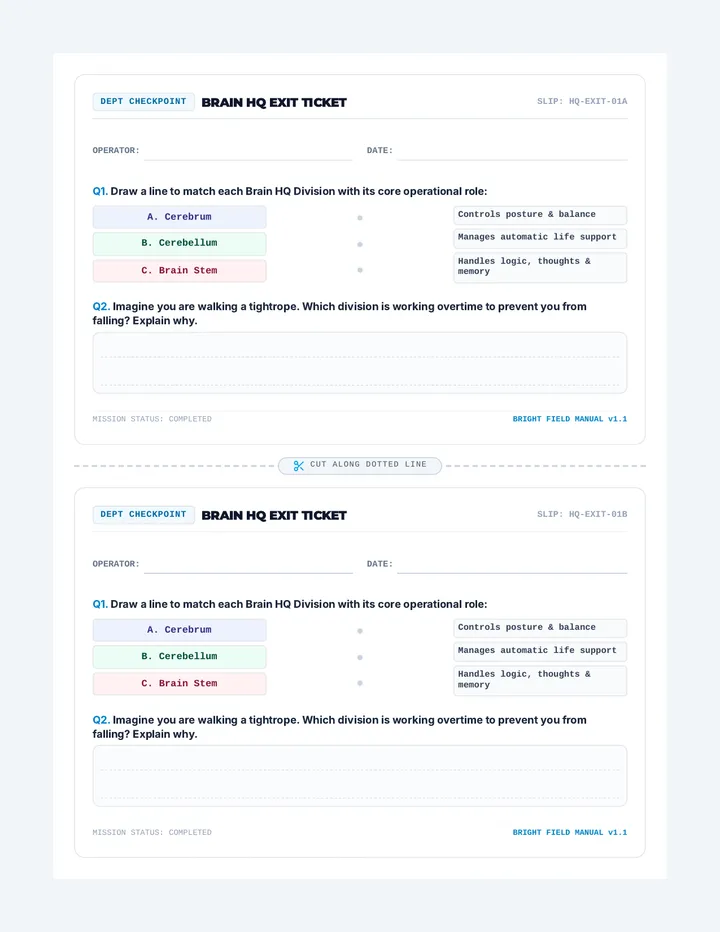
A quick assessment tool for students to complete at the end of the lesson, asking them to identify a healthy food choice and explain the gut-brain connection. Two tickets per page.
A creative worksheet where students design a visual metaphor for the gut microbiome, including space for brainstorming inputs and outputs and a large drawing area.
A comprehensive teacher facilitation guide providing pacing information, discussion prompts, and an answer key for the graphing and comparison activities in 'The Speed of Addiction' lesson.
Visual presentation slides to guide the lesson, featuring a warm-up game, an embedded video about nutrition and the brain, activity instructions for the microbiome metaphor, and discussion prompts.
Visual presentation slides to guide students through the 'Speed of Delivery' concept, including the hook poll, embedded educational video, and case studies comparing different substances.
A comprehensive teacher facilitation guide for the "Second Brain" lesson, including a timed sequence, discussion prompts, key vocabulary definitions, and lesson objectives.
A comprehensive graphing and analysis worksheet for students to record predictions, plot dopamine spike curves, and compare various substance delivery modes based on the biological 'Speed of Delivery' concept.
A comprehensive teacher's guide for the Mind and Molecules lesson, including pacing, neurotransmitter keys, pharmacological mechanisms of action, and discussion prompts for AP Biology.
An answer key and facilitation guide for the Diagnostic Detectives case studies, providing detailed rationales for each patient diagnosis based on DSM-5 criteria.
A case study analysis handout for nursing and pre-med students to practice diagnosing three distinct patient profiles based on symptom chronology and DSM-5 criteria.
A clinical-themed research log for AP Biology students to record brainstormed functions, video notes, pharmacological research, and synaptic diagrams.
A clinical diagnostic reference sheet for nursing and pre-med students, detailing DSM-5 criteria for schizoaffective disorder and the "2-week rule" for differential diagnosis.
A comprehensive slide deck for teaching the neurobiology of mental illness, featuring an embedded Khan Academy video, guided research prompts, and discussion anchors for AP Biology students.
A clinical slide deck for undergraduate nursing and pre-med students, featuring visual aids for diagnostic criteria, embedded Khan Academy video, and group case study prompts.
A student reflection journal for the Neuron Game lesson, updated with pure white writing areas for maximum handwriting legibility.
A comprehensive teacher facilitation guide for the neuroplasticity lesson, including pacing guides, specific video pause points, discussion anchors, and research tips for student case studies.
A group activity guide for the 'Yarn Web' simulation, featuring step-by-step instructions for building, strengthening, and dissolving neural pathways with yarn. Updated for better handwriting legibility.
A student worksheet for the neuroplasticity lesson, including a video analysis section, a structured case study research table for documenting brain injury recovery, and a final reflection on brain resilience.
A visual presentation for the Neuron Game lesson, featuring the embedded video, timed discussion prompts, and a transition to the physical yarn activity.
A comprehensive slide deck for teaching neuroplasticity, featuring the 'How Your Brain is Shaped' video, visual metaphors for neural networks, and research prompts for brain injury recovery case studies.
A comprehensive teacher facilitation guide for the Neuron Game lesson, featuring a 45-minute pacing guide, learning objectives, prep checklists, and specific discussion anchors for the accompanying video.
A facilitation guide for teachers featuring lesson pacing, specific video pause prompts with suggested answers, and a physiological cheat sheet to support students during their treatment research activity.
A visual presentation for teaching the five major anxiety disorders, featuring embedded video content, discussion prompts for key teaching moments, and instructions for the physiological deep dive activity.
A comprehensive research journal for 11th-12th grade psychology students to record video notes on anxiety disorders and conduct a physiological deep dive into how specific medications interact with the brain and body to treat symptoms.
A professional academic rubric for grading the undergraduate lab simulation proposals, focusing on methodology critique, experimental design, neuroanatomical knowledge, and ethical analysis.
A visual presentation for undergraduate neuroscience students covering the anatomy of the frontal lobes, the results of Tali Sharot's fMRI/TMS studies on optimism bias, and instructions for a lab meeting simulation activity. Includes embedded YouTube video and viewing prompts.
Biographical reference sheet and reflection activity featuring famous scientists and innovators on the autism spectrum, such as Temple Grandin and Greta Thunberg.
A lab simulation guide for undergraduate neuroscience students to design a follow-up experiment to Tali Sharot's TMS study on the optimism bias, including sections for methodology critique, experimental design, and ethical analysis.
Research graphic organizer for small groups to investigate the biological link between the brain and co-occurring conditions like ADHD, Anxiety, Sleep, and GI issues.
A teacher guide and answer key for the "Stressed Synapse" activity, providing detailed explanations of glutamate excitotoxicity, the HPA feedback loop, and the role of BDNF.
Sorting cards for the 'Fact or Myth' warm-up activity, featuring 9 common statements about autism and neurodevelopment for students to discuss and categorize.
Visual slide deck for the Neuro Blueprint lesson, including an embedded YouTube video, key discussion points on the spectrum and biology, and instructions for the group research mission.
Teacher facilitation guide for the Neuro Blueprint lesson, including instructional sequence, key pausing points for the video, answer keys for myth-busting, and research scaffolding for co-occurring conditions.