Pocket Protector Final Exam
Pocket Protector
Health Insurance Unit Final Exam
Name:
Date:
Part 1: Multiple Choice (20 Questions)
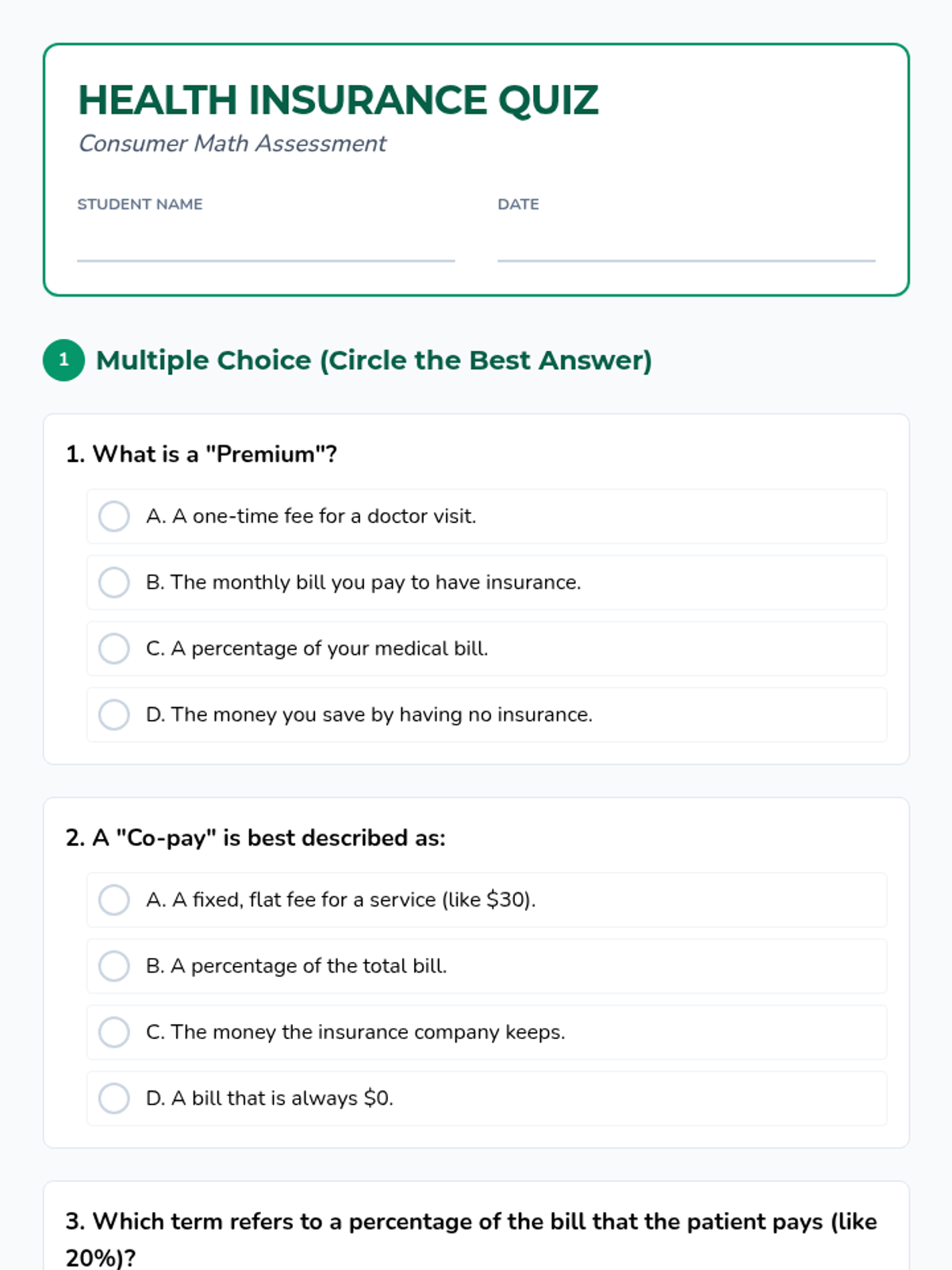
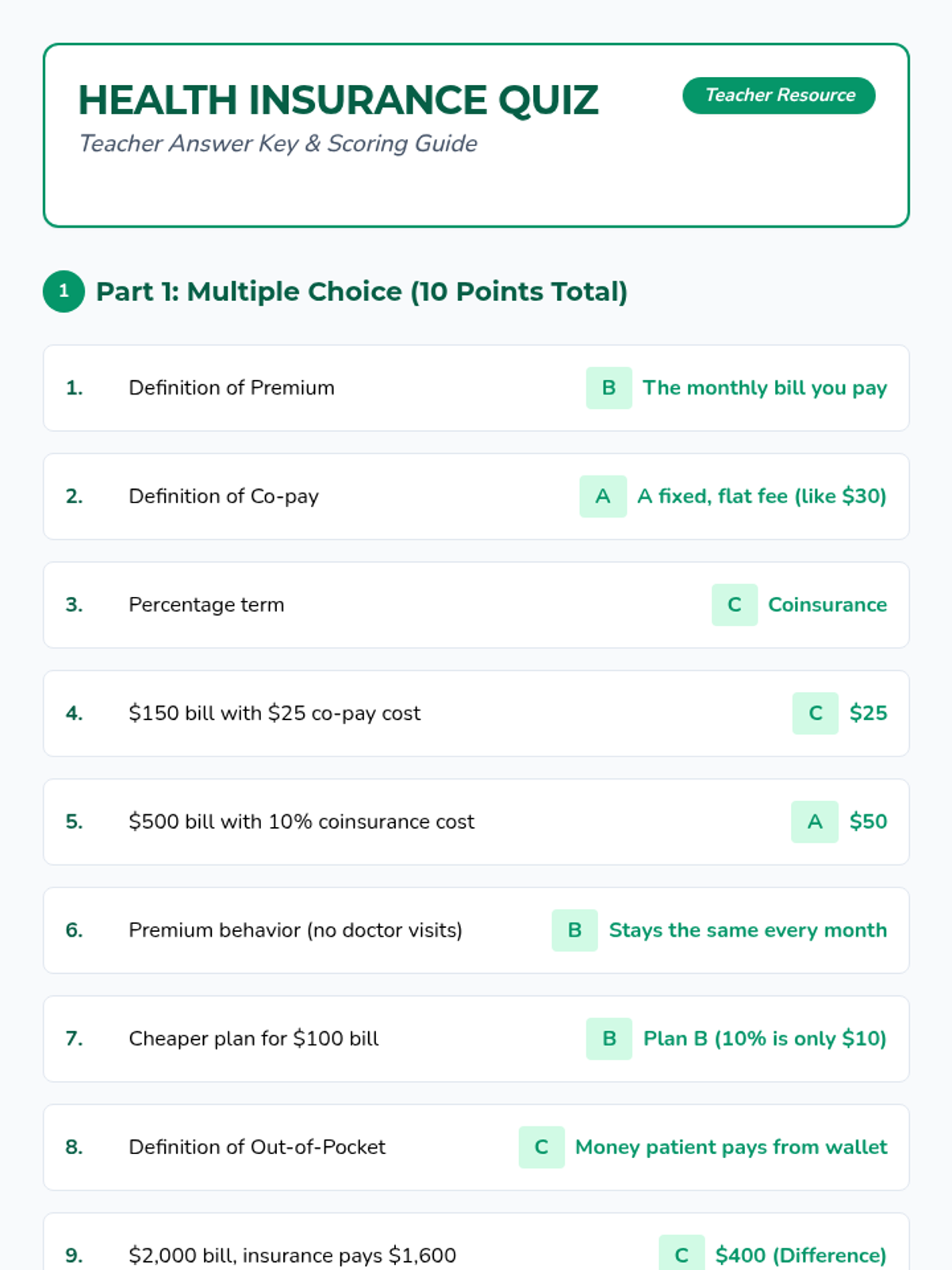
1 What is the best definition of Premium?
A. A percentage of the total bill
B. The monthly bill you pay for insurance
C. A fixed, flat fee for a visit
D. The amount you pay before insurance starts
2 What is the best definition of Co-pay?
A. A fixed, flat fee (like $30) for a visit
B. A percentage of the medical bill
C. The monthly cost of your plan
D. The total money the doctor earns
3 Which insurance term describes a percentage of the bill paid by the patient?
A. Premium
B. Co-pay
C. Coinsurance
D. Deductible
4 If you have a $150 bill and your plan has a $25 co-pay for that service, how much do you pay?
A. $150
B. $125
C. $25
D. $0
5 If you have a $500 bill and your plan has 10% coinsurance, how much is your share of the cost?
A. $50
B. $450
C. $500
D. $10
6 If you do not visit the doctor at all this month, what happens to your monthly premium?
A. It is waived (free) for that month
B. It stays the same every month
C. It goes up because you are healthy
D. It is cut in half
7 Which plan is cheaper for a $100 doctor's visit?
A. Plan A: $25 Co-pay
B. Plan B: 10% Coinsurance
C. They both cost the same
D. Insurance pays for everything
8 What is the best definition of Out-of-Pocket cost?
A. The money the insurance company pays
B. The total earnings of the medical clinic
C. The money the patient pays from their wallet
D. The monthly cost of your health policy
9 If you have a $2,000 bill and your insurance pays $1,600, how much is your share?
A. $2,000
B. $1,600
C. $400
D. $0
10 Why do many patients prefer a co-pay (like $150) for an expensive hospital bill?
A. Co-pays "cap" the cost at a set amount
B. Coinsurance is always $0
C. Co-pays apply toward the monthly premium
D. It is illegal to use coinsurance for hospitals
Section: Advanced Consumer Math & Deductibles
11 What is the best definition of a Deductible?
A. A monthly fee for your health coverage
B. The amount you pay before insurance helps
C. The total discount given by the hospital
D. The maximum insurance will ever pay
12 If a patient has a $500 deductible and they receive their first bill of the year for $1,000, how much of that bill do they pay before coinsurance is calculated?
A. $1,000
B. $0
C. $500
D. $100
13 Alicia has a $500 deductible and a $35 co-pay. She gets a $1,400 bill (first bill of the year). What is her total out-of-pocket cost?
A. $500
B. $535
C. $35
D. $1,400
14 Brandon has a $750 deductible and 20% coinsurance. He receives a hospital bill for $2,250. How much does he pay total?
A. $1,050
B. $750
C. $300
D. $450
15 Which is generally true about the relationship between Deductibles and Premiums?
A. Higher deductible = Lower monthly premium
B. Lower deductible = Lower monthly premium
C. They must always be the same price
D. There is no relationship between them
16 If your bill is $200 and your deductible is $1,000 (and you've paid $0 so far), how much of that bill do you pay?
A. $20 (10% Coinsurance)
B. $0 (Insurance pays everything)
C. $200 (You pay full cost)
D. $1,000 (The full deductible)
17 Jordan pays a $275 monthly premium. This month they also paid a $40 co-pay for a check-up. What is Jordan's total cost for the month?
A. $275
B. $315
C. $235
D. $40
18 Why is the "Deductible Bucket" a useful visual for insurance?
A. It shows how much money is in the bank
B. It shows that insurance only helps after the bucket is full
C. It shows that insurance pays for everything first
D. It shows how much water the clinic uses
19 You need surgery that costs $4,200. Plan A is a $1,200 deductible. How much is the remainder of the bill after you pay the deductible?
A. $4,200
B. $1,200
C. $3,000
D. $5,400
20 If a plan has 20% coinsurance and the remainder of a bill is $3,000, how much is the patient's share of that remainder?
A. $20
B. $600
C. $2,400
D. $3,000
Part 2: Open Ended Analysis (3 Questions)
Question 21: Critical Thinking
5 POINTS
Imagine you have a GIANT hospital bill for $10,000. Plan A has a $150 co-pay. Plan B has 10% coinsurance. Explain why a patient would feel much safer with Plan A for this huge bill. Show your math or explain your reasoning.
Question 22: Major Procedure Analysis
10 POINTS
You recently learned you will need a hospital treatment that costs $4,200. You have not spent any money on healthcare yet this year.
Plan A
$1,200 Deductible
$90 Co-pay
Plan B
$800 Deductible
20% Coinsurance
Calculate the total out-of-pocket cost for both plans. Then, state which plan you would choose and why.


Plan A Work Area
Plan B Work Area
Final Decision & Reasoning:
Question 23: Annual Cost Calculation
10 POINTS
Jamal goes to physical therapy twice per month (24 visits total per year). Each visit costs $110.
Plan A
$600 Deductible
$35 Co-pay per visit
Plan B
$900 Deductible
15% Coinsurance per visit
Calculate the total annual out-of-pocket cost for Jamal under both plans.
Plan A Calculation
Plan B Calculation
Most Affordable Plan: