A student-facing project guide for Day 2 of the Stress Signals week. It provides clear instructions, a brainstorming area, and an artistic key for creating a personal 'Stress Map' poster.
A comprehensive facilitator guide for educators teaching digital access to students in transition. Includes pedagogical tips, solutions for common administrative barriers (like library cards), and classroom activity ideas.
A visual guide for students on finding and using public computer resources. Includes high-contrast visuals of login screens, WiFi menus, and desktop navigation, along with critical digital survival tips for users with limited tech access.
A 2-page interactive worksheet designed to teach students how to find free computer access, navigate login screens, connect to public WiFi, and understand basic desktop navigation. Includes scenario-based questions and matching activities.
A high-contrast, visual infographic poster designed for neurodivergent youth experiencing homelessness. It provides clear, direct guidance on public Wi-Fi safety, social media privacy, identifying predatory red flags, and safe protocols for meeting online friends in person.
A set of printable practice cards with common testing-season scenarios for students to practice identifying cognitive distortions and applying the Perspective Pivot technique.
A student worksheet for identifying cognitive distortions and practicing the Perspective Pivot reframing technique, including space for evidence collection and belief scaling.
A personal reflection worksheet where students identify a specific stress thought and apply the P.I.V.O.T. technique to reframe it into a resilient, balanced perspective.
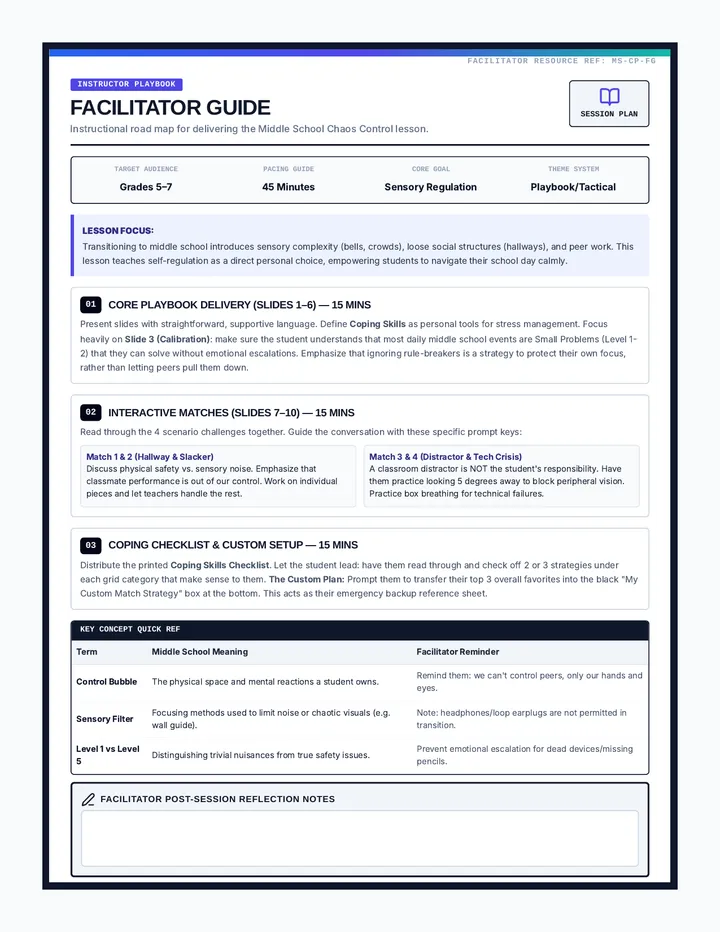
A detailed teacher facilitation guide for the Perspective Pivot intervention, including learning objectives, a step-by-step instructional sequence, and differentiation strategies.