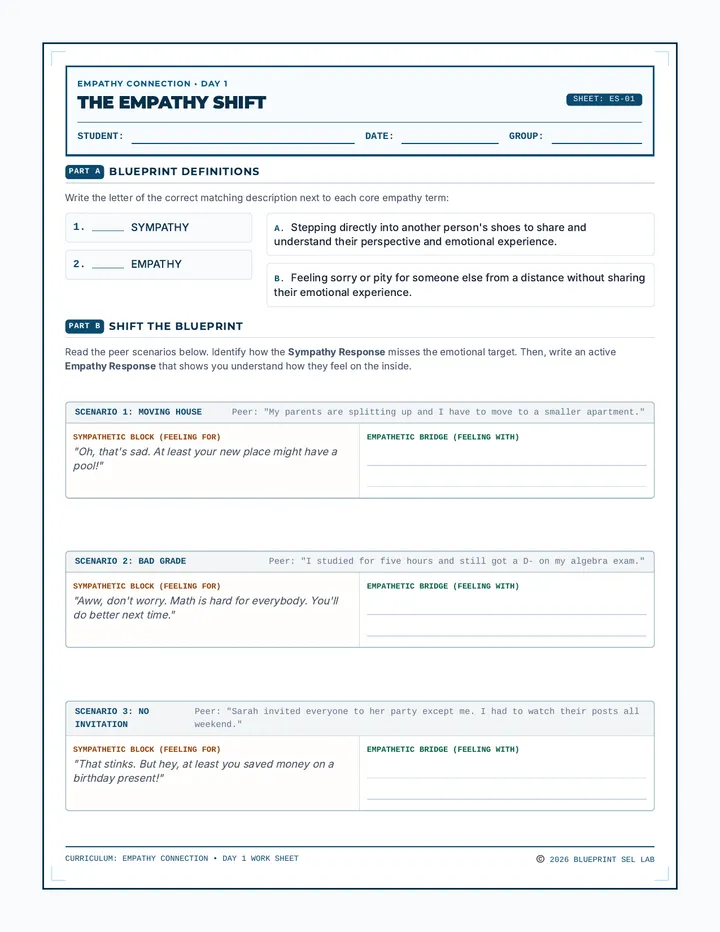
A simulation practice packet containing tricky questions designed to test students' ability to follow complex directions, use the process of elimination, and manage their time under pressure.
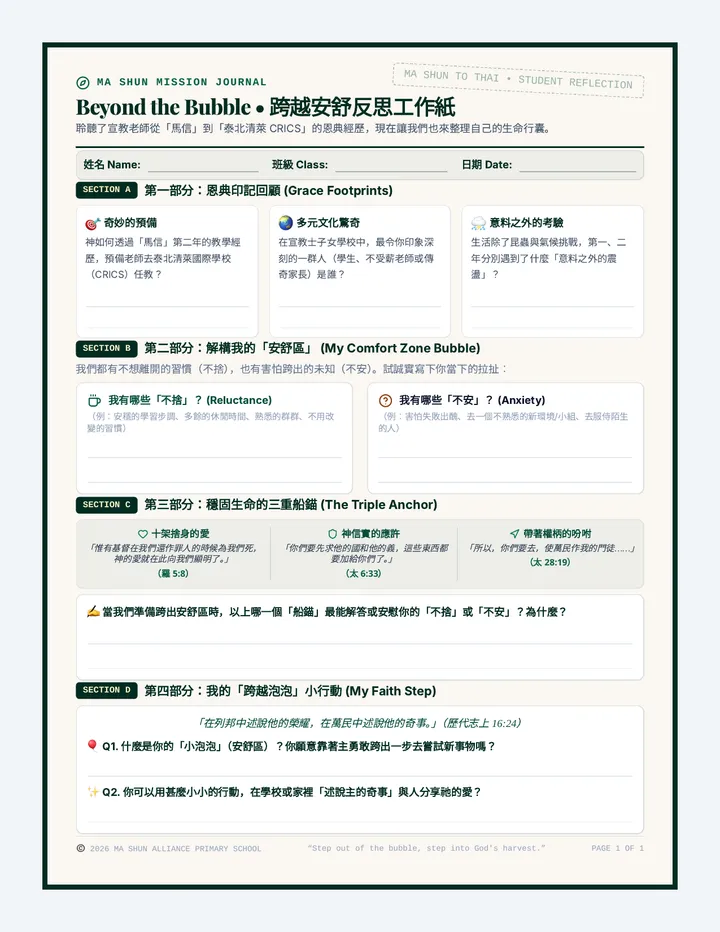
A comprehensive teacher's guide for Lesson 6, providing pacing, discussion prompts, and technical tips for facilitating the formal business proposal setup.
A student-facing formatting checklist and architecture guide for setting up a formal business proposal, featuring technical requirements for alignment, typography, and spacing.
A professional, visually striking slide deck for teaching document architecture and formal business proposal formatting, featuring blueprint design elements and technical software skill guides.
A student synthesis worksheet for Lesson 5, guiding students through the process of writing a summary paragraph based on their market research and deciding whether to pivot their product idea.
A joint teacher's guide for Lessons 4 and 5, covering interviewing techniques, the concept of the pivot, and facilitating a market research sprint with digital citizenship reminders.
A high-energy slide deck for Lesson 5, focusing on market research, transcribing customer feedback, and the concept of 'pivoting' based on data synthesis.
A student worksheet designed to help scaffold the creation of an interview script with open-ended questions, featuring a table layout and a digital skills checklist.
A high-impact slide deck for teaching customer interviewing techniques, focusing on open-ended questions vs. leading questions and introducing the technical skill of creating tables.
A comprehensive facilitator guide for Lesson 3, covering target market segmentation, customer empathy, and user journey mapping with facilitation tips.
A detailed template for students to create a "User Persona" profile, identifying customer demographics, frustrations, and a "Day in the Life" journey for their product ideas.
A visually engaging slide deck teaching the concepts of target markets and customer empathy, featuring gift-giving analogies, demographic breakdowns, and instructions for creating a User Persona.
A comprehensive teacher's guide providing pacing instructions, discussion prompts, common misconceptions, and differentiation strategies for facilitating the "Scarcity & Opportunity Cost" lesson.
A visually compelling slide deck using a blueprint-inspired design to teach the concepts of scarcity and opportunity cost, featuring a 'Feature Fight' activity where students must budget resource points for their product ideas.
A comprehensive teacher's guide providing pacing instructions, discussion prompts, common misconceptions, and differentiation strategies for facilitating the "Spotting the Pain" lesson.
A structured worksheet designed for the "Annoyance Scavenger Hunt" activity, allowing students to document personal pain points and conceptualize their "Magic Wand" solutions with a dedicated exit ticket section.
A high-energy, visually engaging slide deck that introduces students to the entrepreneurial mindset of seeing problems as business opportunities, featuring blueprint-inspired design and interactive activity instructions.
A large-format classroom anchor chart (poster) that visually reinforces the 'Comedy Compass' system. It uses high-contrast icons, bold color-coded zones for Green (Go) and Red (Stop) times, and prominently features the core self-regulation question for students to reference at a glance.
A compact, visually high-contrast reference card for students. It features the Green and Red zones of humor, teacher social cues to watch for, and the core 'Check-In' question to help students self-regulate their classroom jokes.
A teacher guide for the Comedy Compass lesson. It includes objectives, pacing, discussion questions, common misconceptions about humor timing, and differentiation tips for varied learners.
A student worksheet for auditing classroom humor timing. It features signal identification exercises and reflective prompts on how humor impacts classroom dynamics and following teacher cues.
A comprehensive 8-slide presentation designed to help students understand the social nuances of humor in the classroom. It uses a 'Comedy Compass' theme to categorize situations into 'Green Zones' (appropriate times) and 'Red Zones' (focused learning times), emphasizing the importance of following teacher directions and reading social cues.
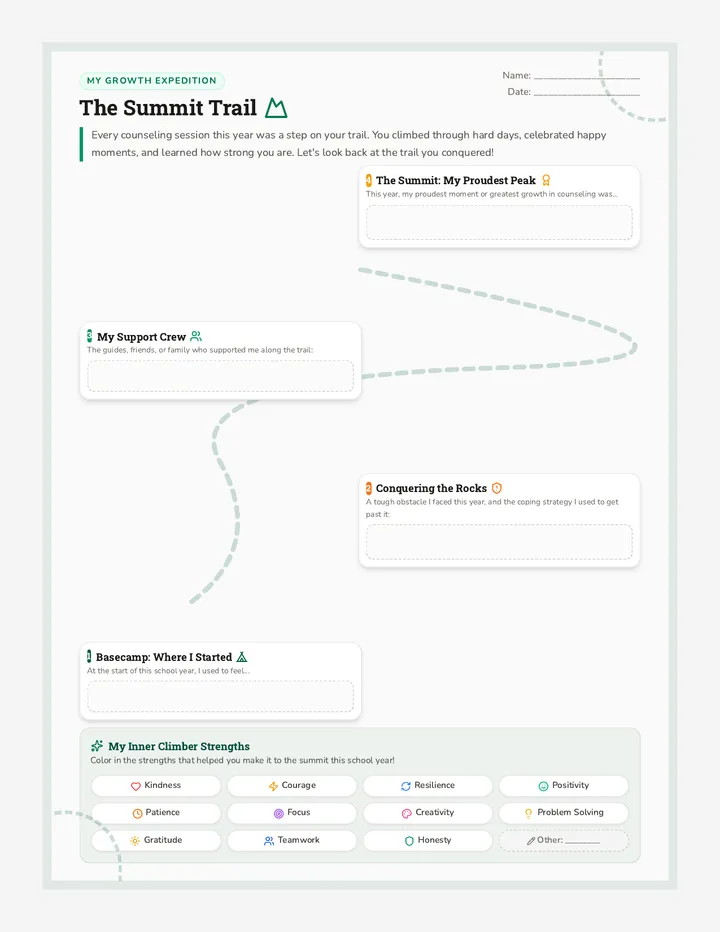
A reflection worksheet for students to complete during their final counseling session to document growth, identify coping tools, and plan for future independence.
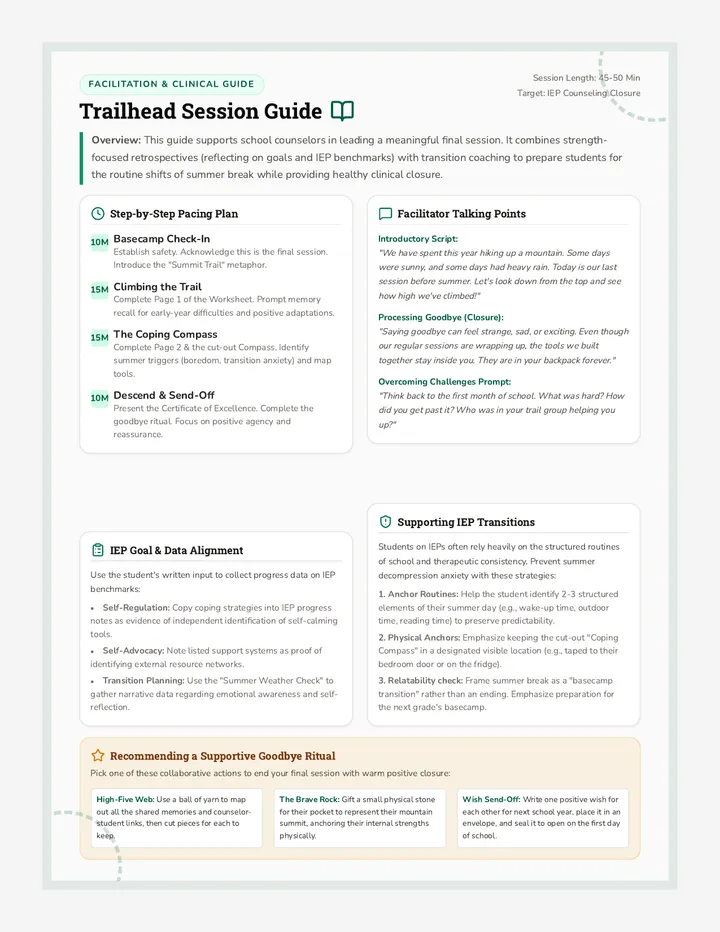
A professional guide for counselors or educators to facilitate effective termination discussions, including prompts, scenarios, and clinical considerations.
A visual presentation for school counselors to use with students (or for counselor training) to explain the termination process, normalize emotions, and plan for closure.
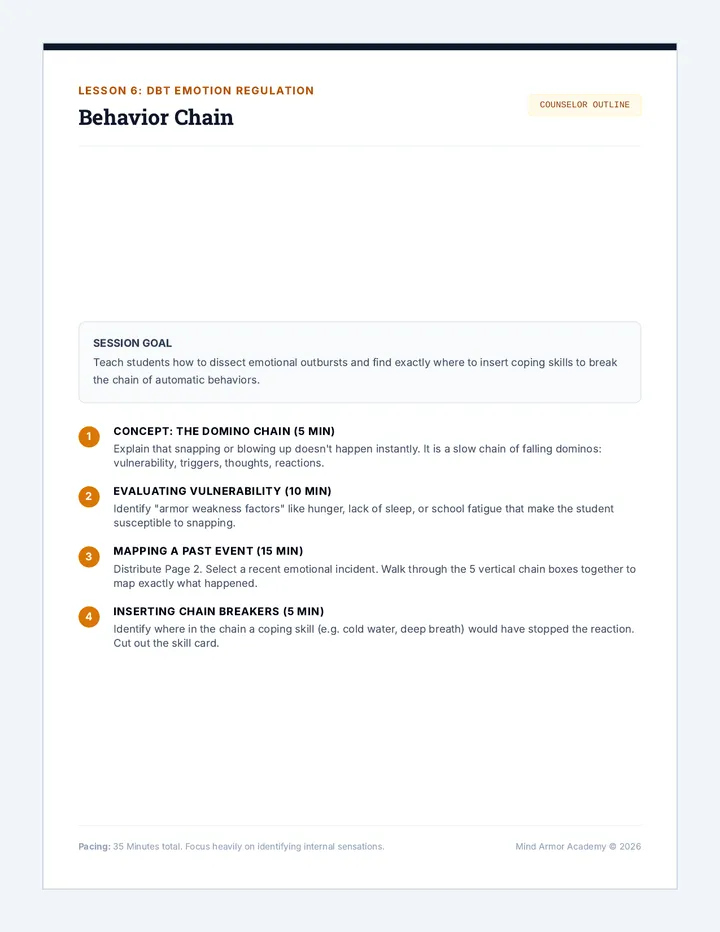
A refined facilitator guide for the Emotion Connection session, providing clinical strategies and pacing for a 60-minute nature-themed slide presentation.
A calm, nature-themed slide deck for teens focused on the normative and adaptive nature of emotions, featuring interactive discussion prompts, 4 detailed social stories, and an emotion tracking log.
A single-page vertical 'Self-Control Strategy Menu' with 10 grounding and self-control strategies, including 'Pump the Brakes', 5-4-3-2-1, and Muscle Melt. Features the THINK acronym (Thoughtful, Honest, Important, Necessary, Kind/Appropriate) in the footer. Revised for user specific word choices.
Student worksheet for practicing the T.H.I.N.K. filter and 'Pump the Brakes' technique. Includes scenarios for transitions, blurting, and disagreements, plus a cut-out desk strip. Revised to include specific words for the THINK acronym: Thoughtful, Honest, Important, Necessary, Kind/Appropriate. Includes larger legible text for acronym labels.
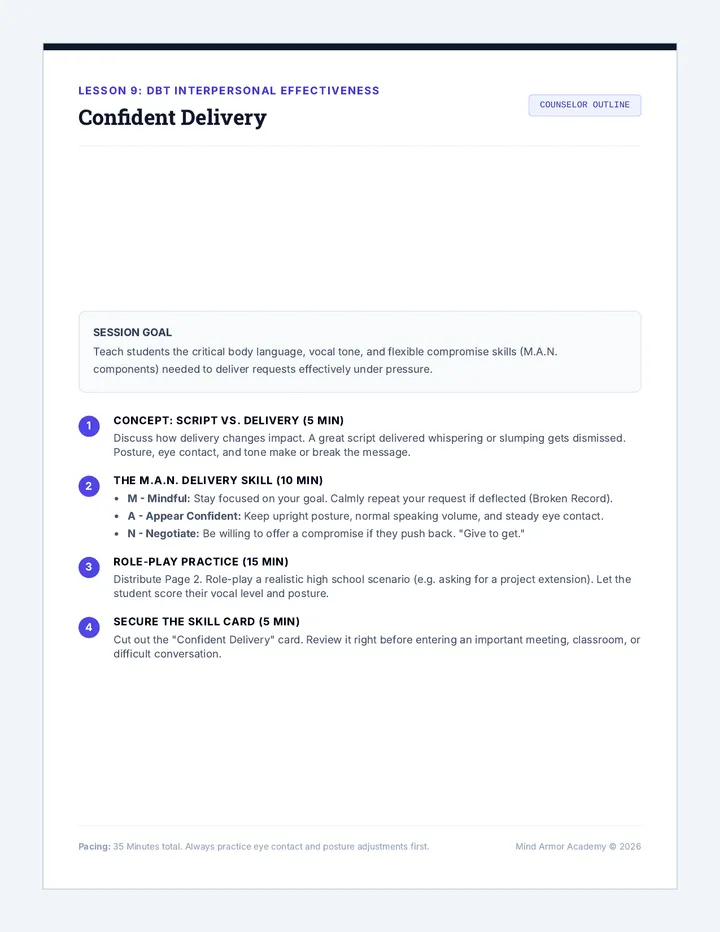
Teacher facilitation guide updated with the 'Pump the Brakes' car metaphor and the T.H.I.N.K. filter (Thoughtful, Honest, Important, Necessary, Kind/Appropriate). Includes scripts and an observation log.
Printable desk strips for an ADHD student. Features the T.H.I.N.K. filter (Thoughtful, Honest, Important, Necessary, Kind/Appropriate) and the 'Pump the Brakes' car metaphor.
Instructional slides for a 5th grade student focusing on impulse control through the 'Inner Remote' and 'Pump the Brakes' metaphors. Includes specific scenarios for transitions and the T.H.I.N.K. filter (Thoughtful, Honest, Important, Necessary, Kind/Appropriate).
A reflection worksheet for 6th-grade boys to identify physiological signs of anger, personal triggers, and de-escalation strategies in a professional, direct format. Revised for improved student work area spacing and printability.
A facilitator guide for a 30-minute group counseling session for 6th-grade boys, focusing on identifying personal triggers and developing de-escalation strategies without thematic metaphors. Revised for improved layout and guaranteed single-page fit.
A reference card containing word banks for values and strengths to help students who may struggle to brainstorm ideas during the identity session.
A professional facilitation guide for counselors to lead a 30-minute pair session on identity, including timing, scripts, and therapeutic prompts.
An identity-focused worksheet for students to map out their core values, strengths, challenges, and future goals, designed to facilitate partner discussion.
A creative, technical-themed worksheet for two students to independently reflect on their identity and then engage in a guided peer discussion about their values, strengths, and future goals.
A facilitator's guide for a 30-minute counseling session for two students, providing a structured timeline, prompts, and tips for exploring self-identity through the "Identity Blueprint" metaphor.
A set of printable drawing paths for the String Sync activity, ranging from easy (circular) to extreme (the Vortex spiral). Each path includes start/end markers and decreasing path widths to increase the teamwork challenge.
A comprehensive facilitator guide for the String Sync teamwork activity, including setup instructions, step-by-step procedures, and guided debrief questions focusing on communication and problem-solving.
A refined student worksheet for reflecting on daily experiences using two distinct buckets for 'good' and 'hard' events, now completely anonymous without name fields.
A teacher resource providing correct answers for the scenario sorting activity, a model translation for the email exercise, and a guidance key for assessing student reflection responses.
A hands-on worksheet where students practice sorting communication scenarios into Professional or Social categories, translate informal slang into formal requests, and reflect on the real-world impact of their communication choices.
A vibrant and engaging slide deck designed for middle school students to learn the crucial differences between professional and social communication styles. Includes visual examples, a 'communication ladder' framework, and actionable tips for 'leveling up' their professional presence.
A visual presentation to launch the children's book project, featuring the 20 approved values menu, project requirements, and success criteria. Updated for individual work.
Simplified instructional slides for the Peace Protocol lesson, redesigned with accessible language and clear visuals for IDD clients. Features 3 interactive, paperless games and explicit reminders that conflict is not always a fight.
A structured planning worksheet for student groups to brainstorm characters, setting, conflict, and a storyboard arc for their children's book project. Updated for individual work.
A comprehensive project guide for creating a children's book, including an 'Approved Values Menu' of 20 core topics and the project's grading rubric. Updated for individual work.
A detailed teacher guide for the Peace Protocol lesson, featuring learning objectives, a materials checklist, and a step-by-step pacing guide for middle school educators.