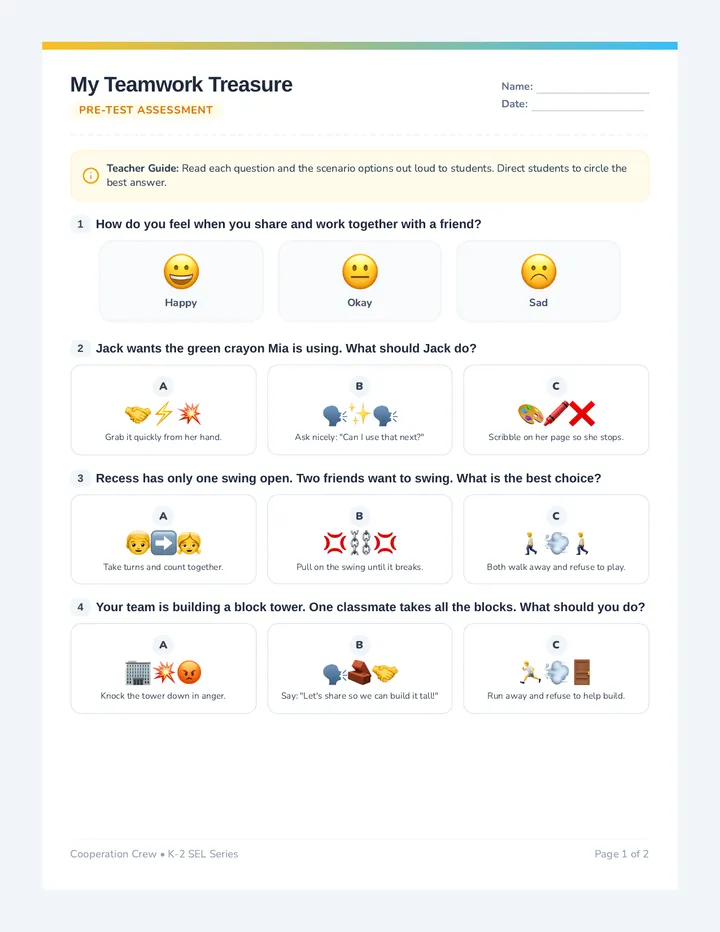
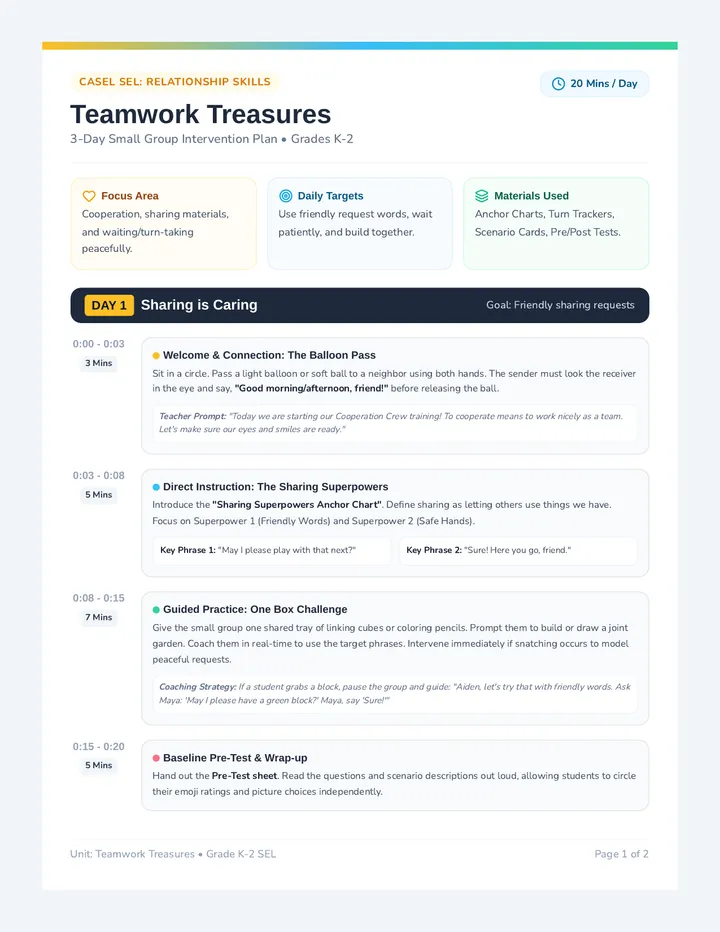
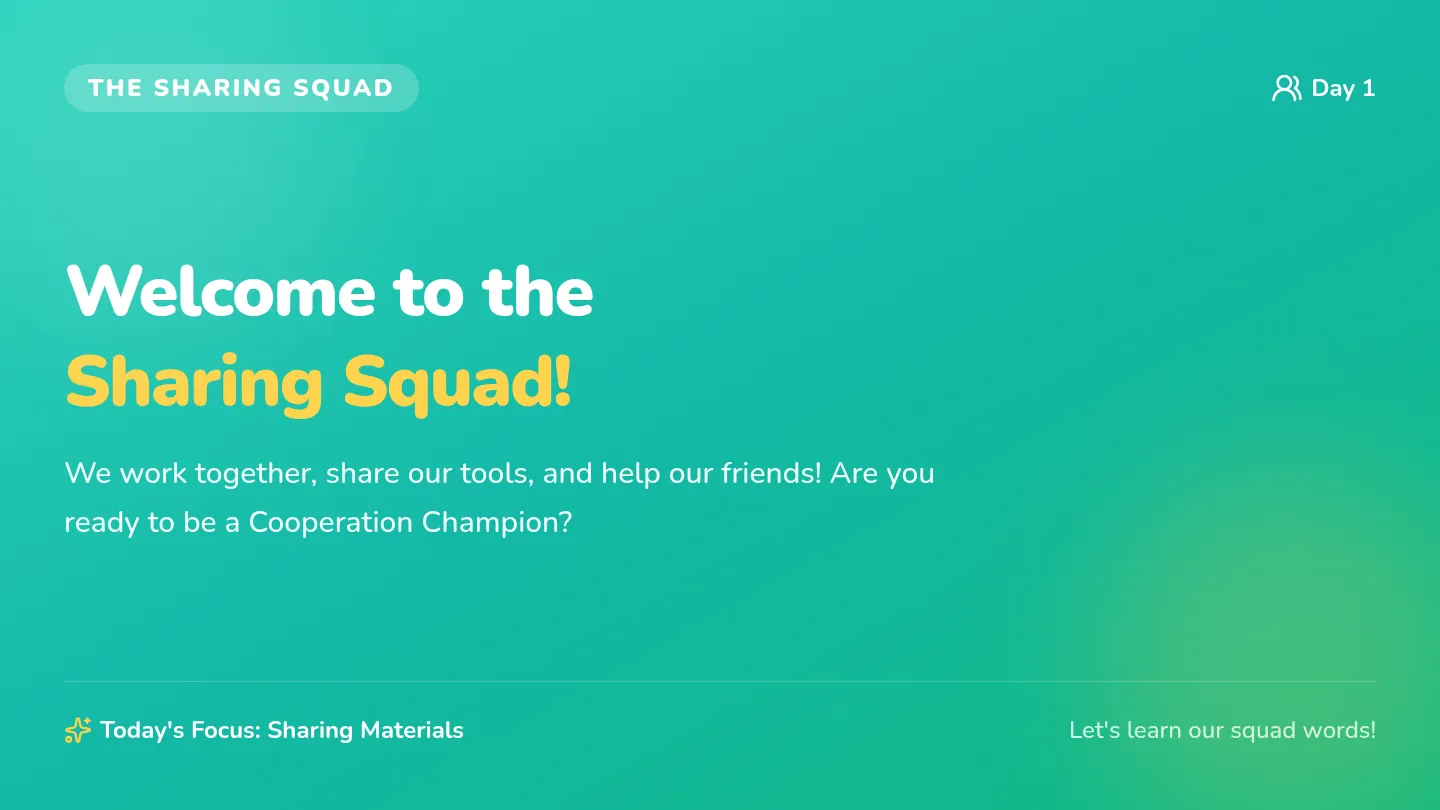
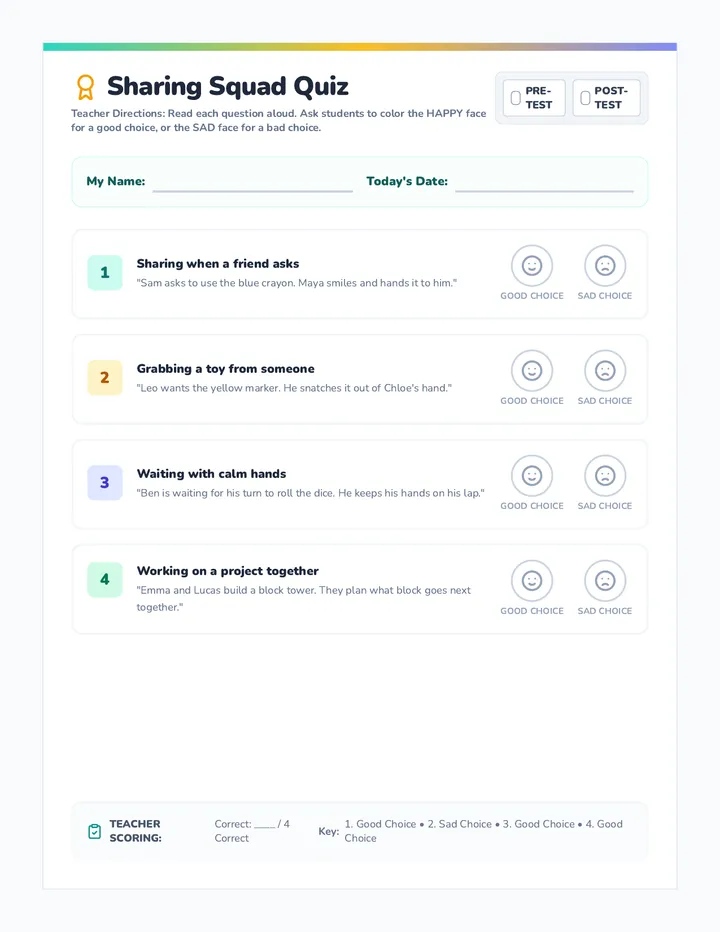
A colorful, engaging slide presentation for kindergarteners using a garden metaphor to teach the basics of making and keeping friends. Includes simple scenarios for class discussion.
A professional guide for teachers to facilitate the Social Sleuths lesson. Includes slide-by-slide discussion prompts, vocabulary definitions, and instructions for selecting appropriate video evidence.
A detective-themed worksheet for students to record their observations of expected and unexpected behaviors during the slideshow. Includes sections for case file analysis and video observation.
A detective-themed slide deck for elementary students that introduces the concepts of 'expected' and 'unexpected' behaviors. Includes visual prompts, discussion questions, and a video analysis template.
A refined worksheet for kindergarteners with a radial flower design to identify friendship skills and a central space for a drawing of themselves with a friend.
A comprehensive teacher guide for the Super Listener Lab lesson, including learning objectives, a step-by-step procedure, differentiation tips, and an answer key visual.
A hands-on cut-and-paste worksheet for Kindergarteners to match listening behaviors (brain, heart, eyes, etc.) to a human blueprint.
A vibrant, highly visual slide deck designed for Kindergarteners to introduce the concept of Whole Body Listening, using simple icons and large text.
A quick formative assessment tool for Lesson 1 to gauge student understanding of neurodiversity and the lesson's key concepts.
A creative student worksheet for K-4 that encourages students to identify their own unique strengths and acknowledge challenges, fostering a positive view of neurodiversity.
A comprehensive teacher facilitation guide for Lesson 1, including a script, discussion prompts, and key talking points to introduce neurodiversity and autism.
A colorful and engaging slide deck for K-4 students introducing the concept of neurodiversity and autism, focusing on how different brains have unique strengths and ways of seeing the world.
Comprehensive teacher script for Lesson 8: Pause Power Pro. Includes rules, timer instruction, and connection to Character Strong's Responsibility trait.
Instructional slide deck for Lesson 8: Pause Power Pro. Covers the rules of the self-regulation space, setting a 2-minute visual timer, and choosing from the "Reset Menu" tools.
Comprehensive teacher script for Lesson 7: Practice Run. Covers the rules of the self-regulation space, setting a 2-minute visual timer, and choosing from the "Reset Menu" tools.
Instructional slide deck for Lesson 7: Practice Run. Covers the rules of the self-regulation space, setting a 2-minute visual timer, and choosing from the "Reset Menu" tools.
Comprehensive teacher script for Lesson 6: The Power Chart. Covers the rules of the self-regulation space, setting a 2-minute visual timer, and choosing from the "Reset Menu" tools.
Instructional slide deck for Lesson 6: The Power Chart. Covers the rules of the self-regulation space, setting a 2-minute visual timer, and choosing from the "Reset Menu" tools.
Comprehensive teacher script for Lesson 5: The Launch Pad. Covers the rules of the self-regulation space, setting a 2-minute visual timer, and choosing from the "Reset Menu" tools.
Instructional slide deck for Lesson 5: The Launch Pad. Covers the rules of the self-regulation space, setting a 2-minute visual timer, and choosing from the "Reset Menu" tools.
Comprehensive teacher script for Lesson 4: The Reset Room. Includes rules, timer instruction, and connection to Character Strong's Responsibility trait.
Instructional slide deck for Lesson 4: The Reset Room. Covers the rules of the self-regulation space, setting a 2-minute visual timer, and choosing from the "Reset Menu" tools.
Comprehensive teacher script for Lesson 3: The Signal. Includes role-play prompts, signal choices, and alignment to Character Strong's Courage trait.
Instructional slide deck for Lesson 3: The Signal. Covers choosing a respectful way to request a break (Card, Hand, or Whisper) and the concept of waiting for teacher approval.
Comprehensive teacher script for Lesson 2: The Pause Button. Includes specific dialogue prompts, the Pit Stop analogy, and alignment to Character Strong's Responsibility trait.
Instructional slide deck for Lesson 2: The Pause Button. Differentiates between self-regulation (Pause) and leisure (Play) using a video game and race car pit stop analogy for preschool students.
Comprehensive teacher script for Lesson 1: Body Clues. Includes specific dialogue prompts, instructional steps, and alignment to learning targets and success criteria for a preschool audience.
Instructional slide deck for Lesson 1: Detecting the Drift. Designed for 4-5 year olds with high-contrast visuals, emojis, and clear learning targets focused on identifying physical "body clues" for self-regulation.
Final celebration slides for Lesson 8, reviewing all mastery skills and celebrating the students' transition to independent self-regulation.
Role-play practice slides for Lesson 7, presenting specific scenarios for students to model the Pause Power routine using puppets.
Incentive-focused slides for Lesson 6, explaining the reward system and reinforcing the specific behaviors that earn sticker stars.
Visual presentation for Lesson 5, guiding students through the three clear steps for returning to classroom activities after a break.
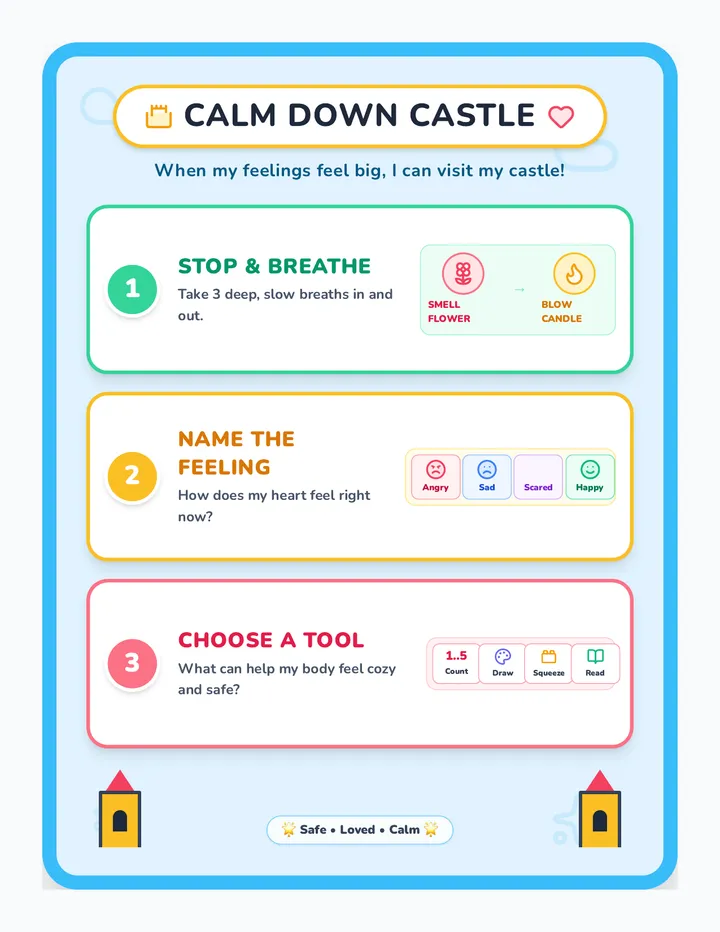
Visual guide for Lesson 4, introducing the 'Cozy Corner' options and setting classroom expectations for using the self-regulation space.
Visual guide for Lesson 3, teaching students how to communicate their need for a break using a non-verbal hand signal and a quiet verbal request.
Slide deck for Lesson 2 focusing on the 'Stop Sign' tool, teaching students to identify the visual cue and pair it with a calming breath.
Engaging visual presentation for Lesson 1, introducing preschoolers to the concept of 'wiggles' and practicing the transition from fast to calm.