A highly visual and engaging slide deck designed for 3rd graders. It uses a detective agency theme to teach the difference between private and personal information, how to spot 'Red Flags' online, and who to turn to for help.
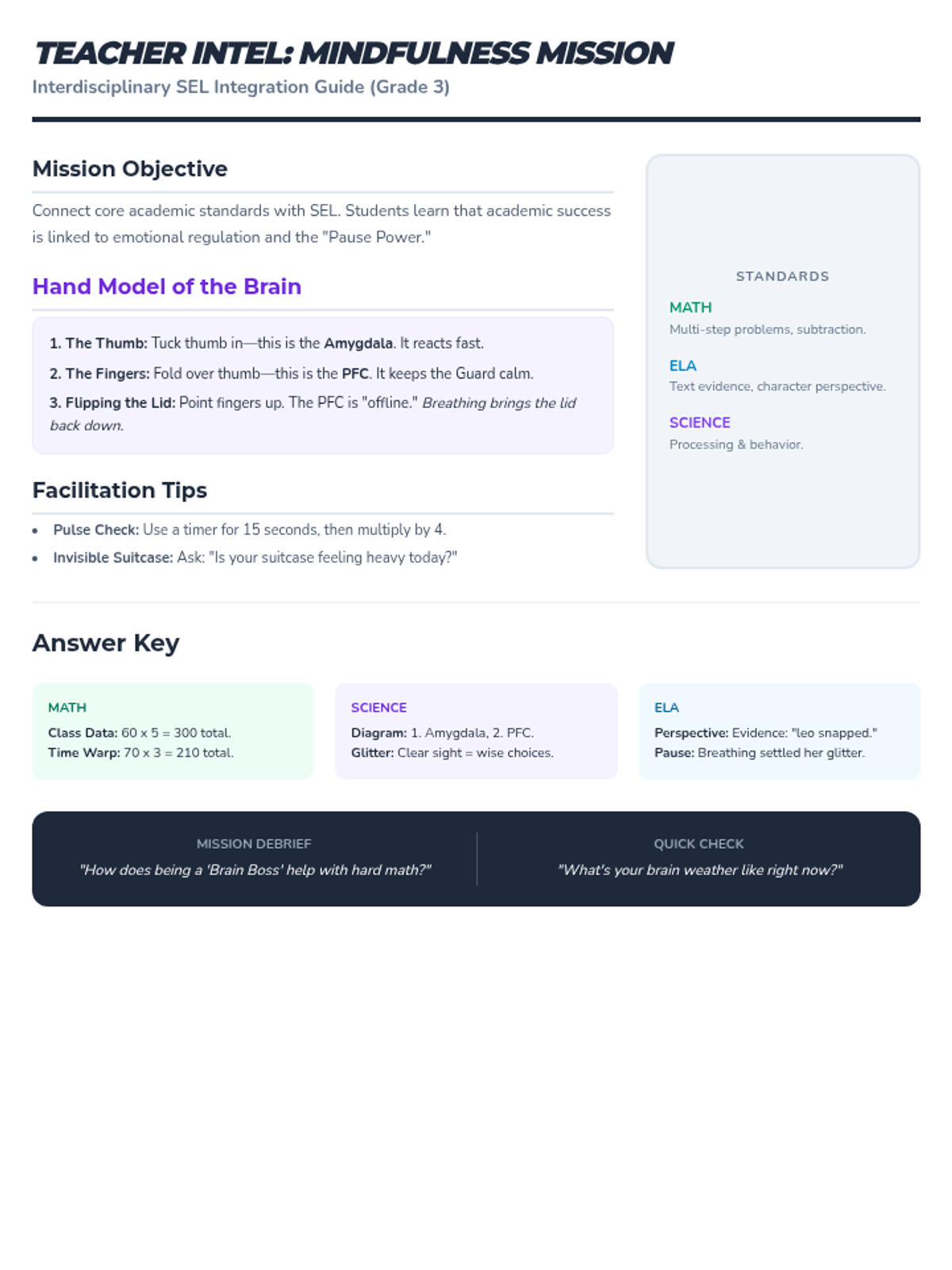
A teacher guide for the Mindfulness Mission set. Revised to keep all content on a single page, improve contrast, and use plain text for math.
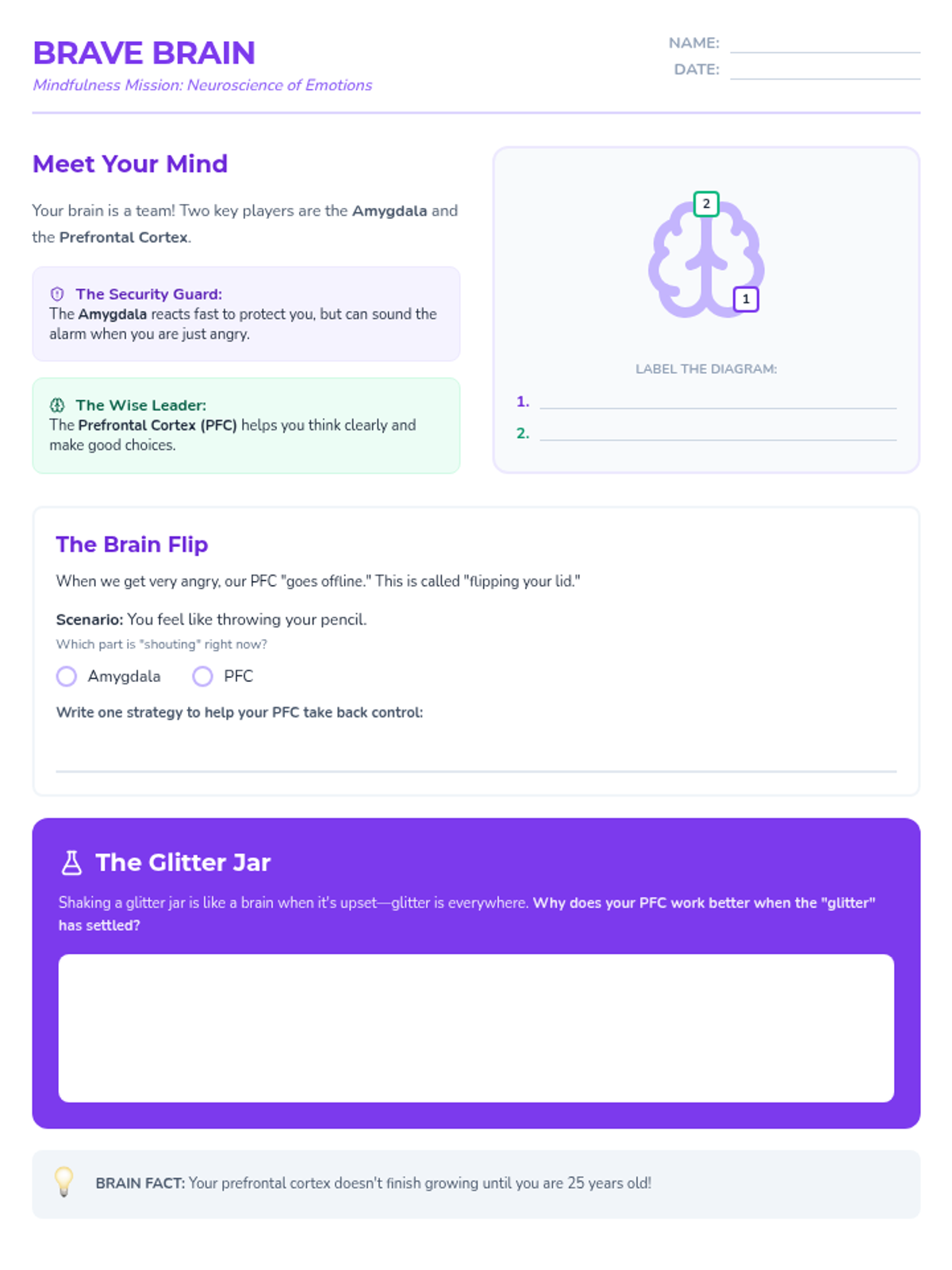
A 3rd-grade science worksheet about the biology of emotions. Revised to keep the experiment section together and improve the diagram labeling task.
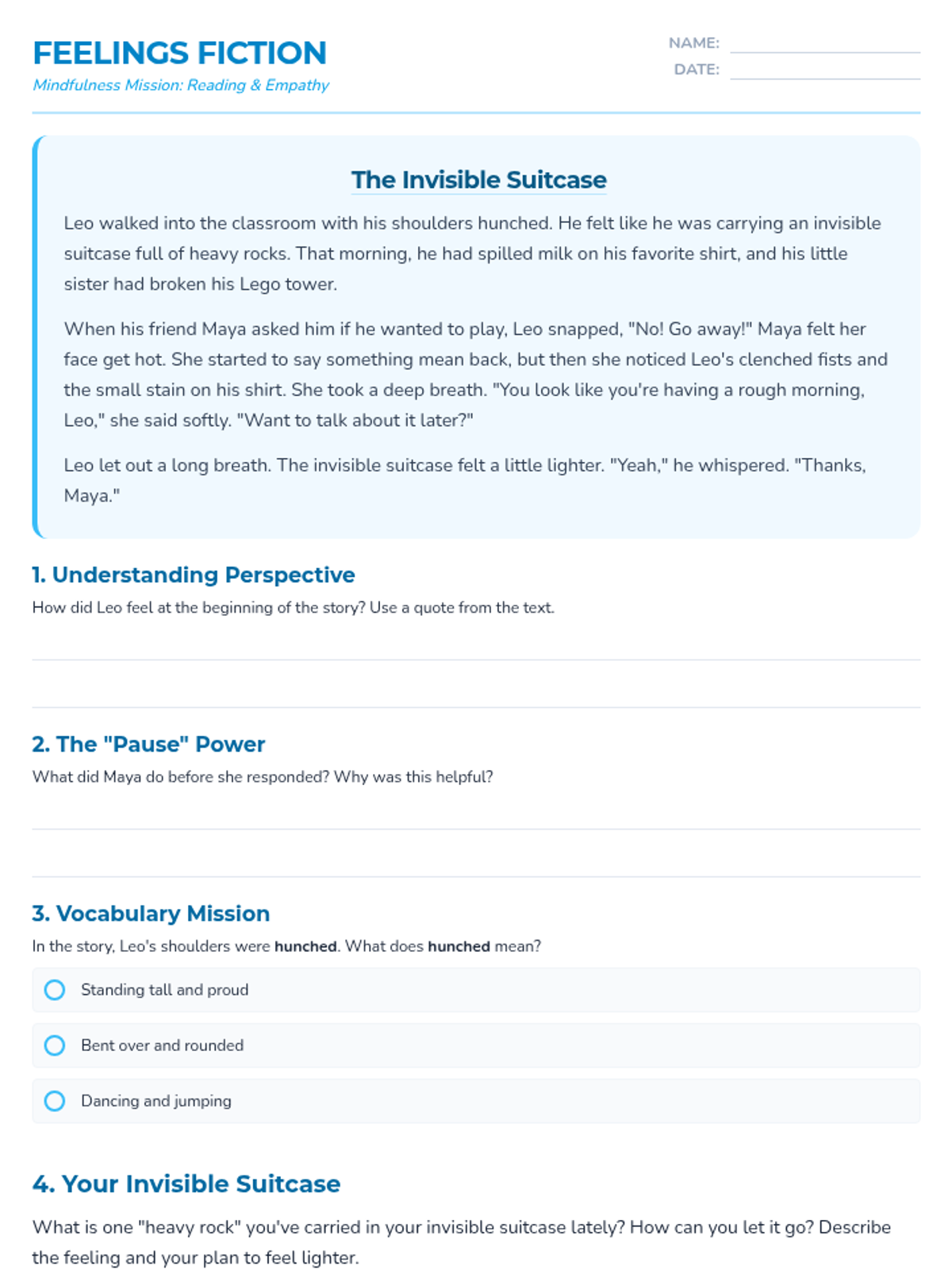
A 3rd-grade ELA worksheet focusing on reading comprehension and empathy. Revised to provide a full-page reflection area for the final prompt.
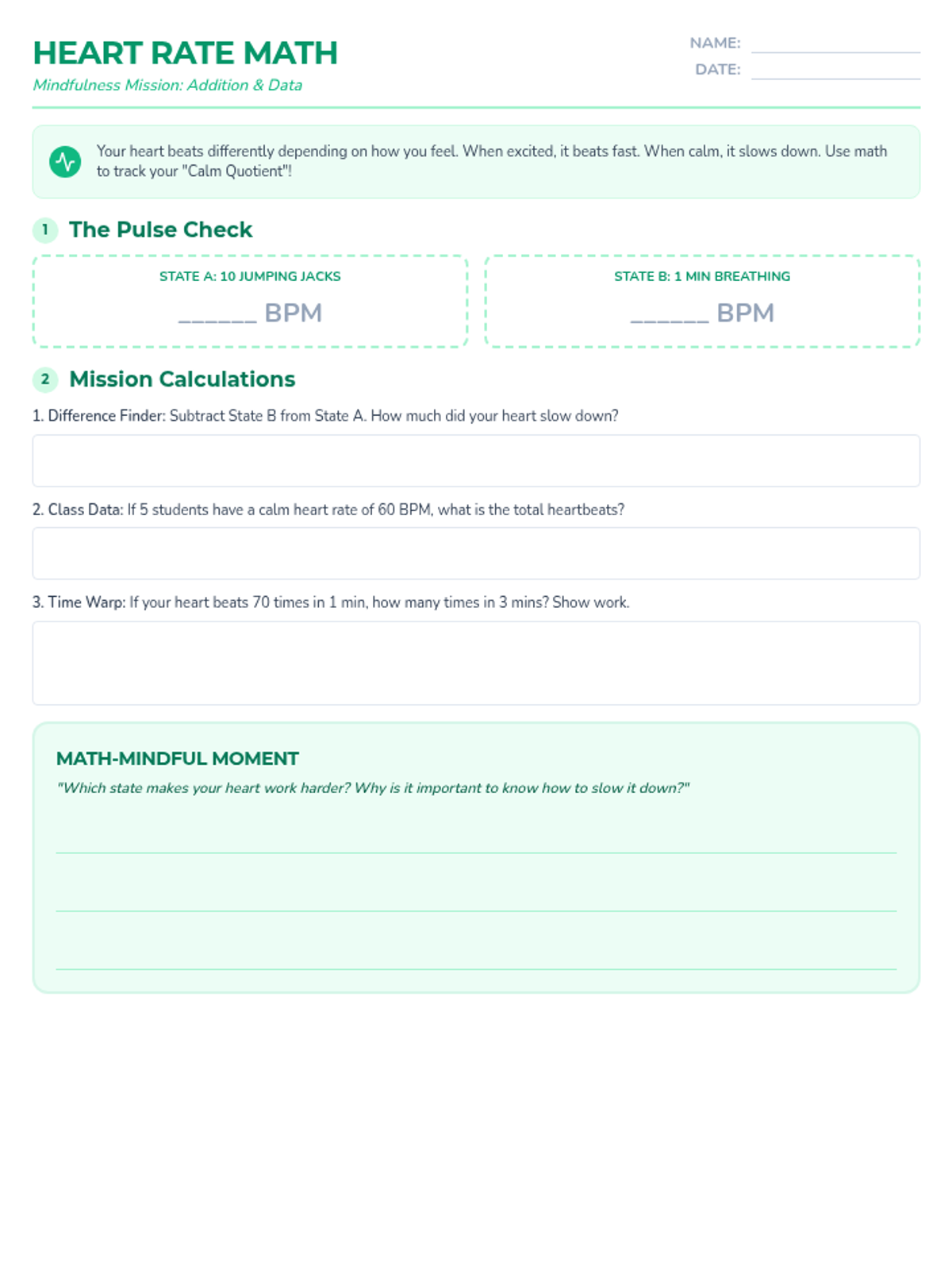
A 3rd-grade math worksheet that integrates SEL by having students track their heart rate during different emotional/physical states. It covers subtraction, multiplication (repeated addition), and data interpretation. Revised to fit on one page with a legible reflection area.
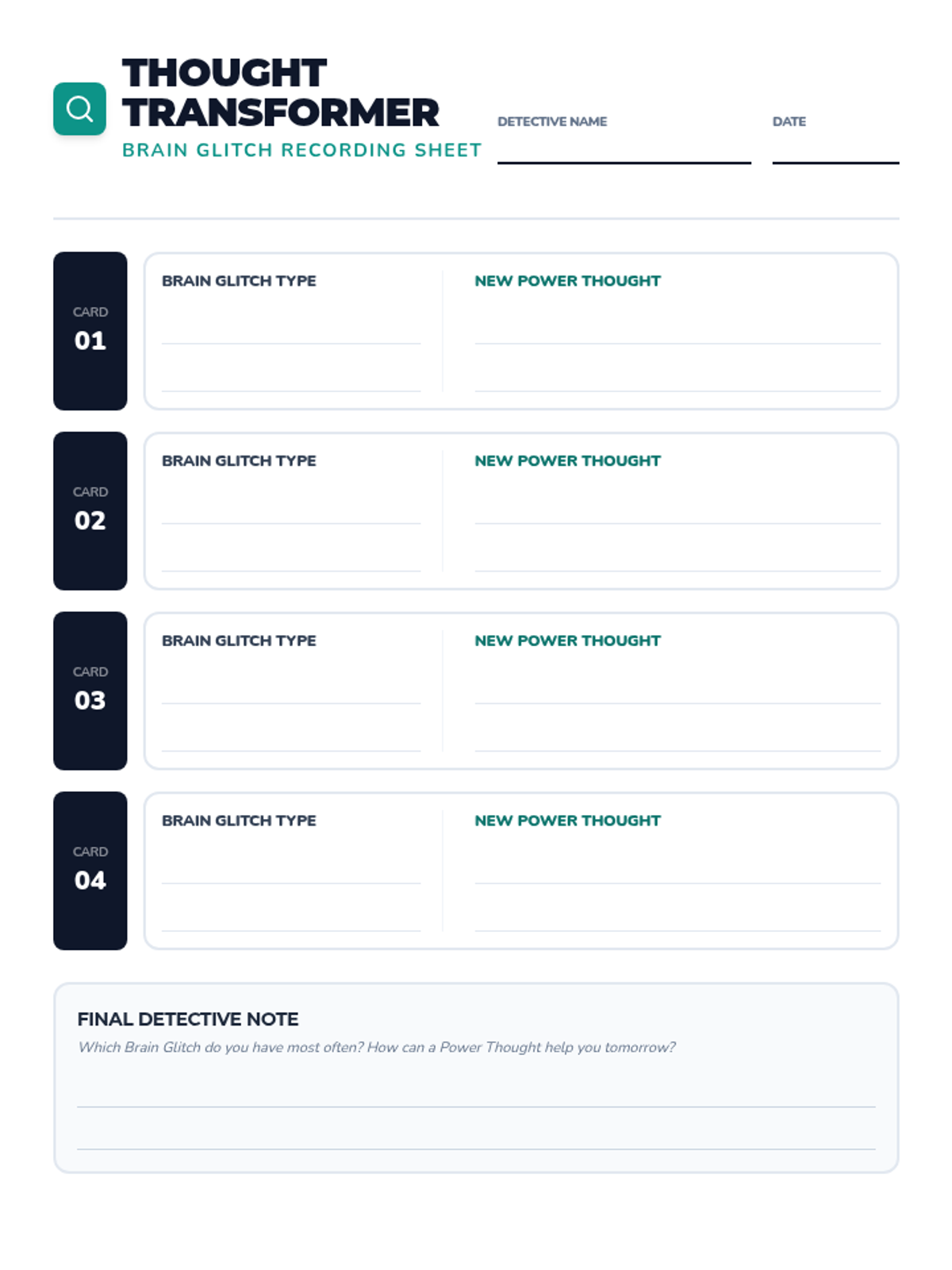
A student recording sheet for the task card activity, providing space for students to identify glitches and record their reframed 'Power Thoughts' for each scenario.
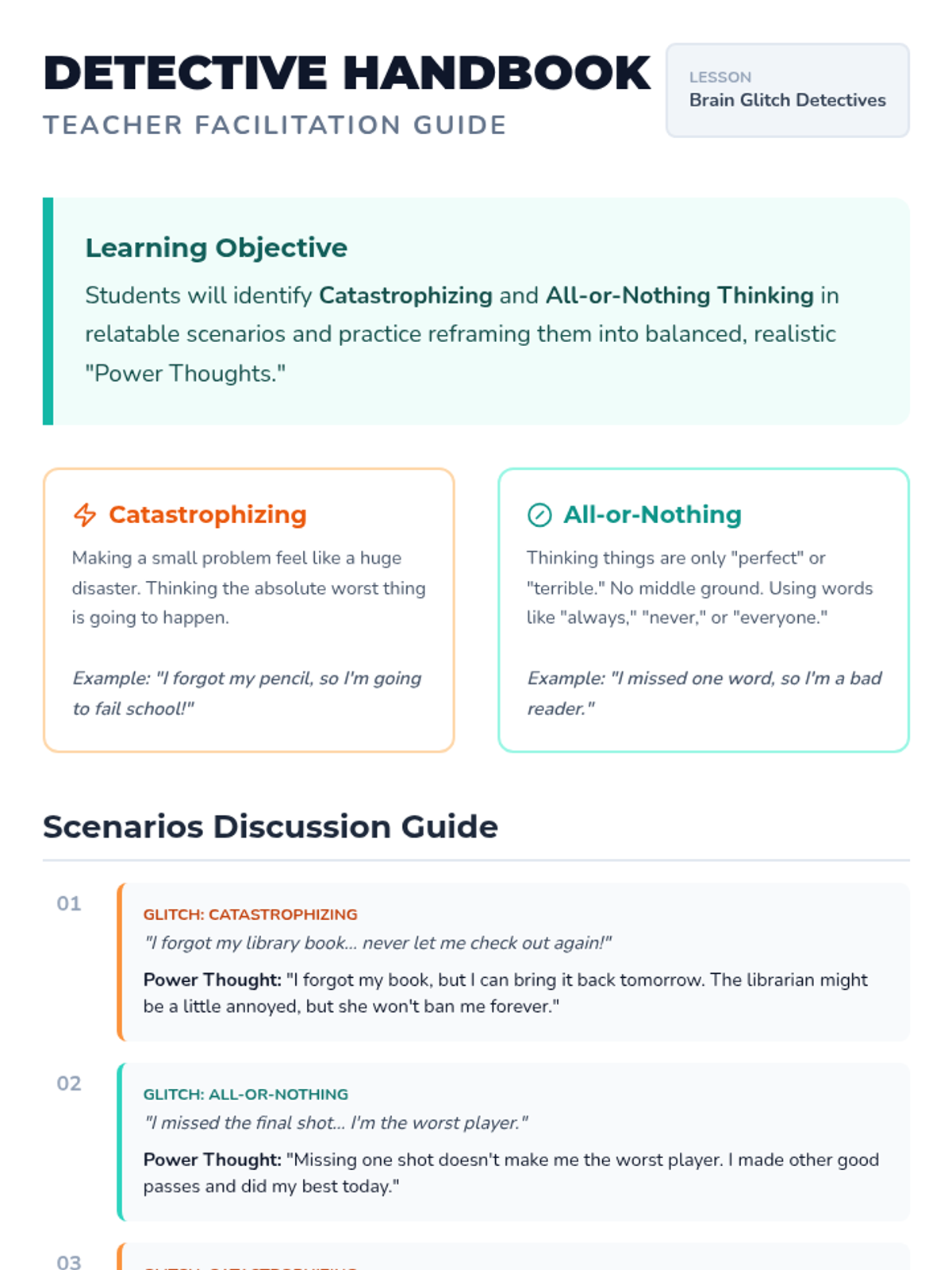
A teacher facilitation guide for the Brain Glitch lesson, including definitions of cognitive distortions, answer keys for the task cards, and group discussion prompts.
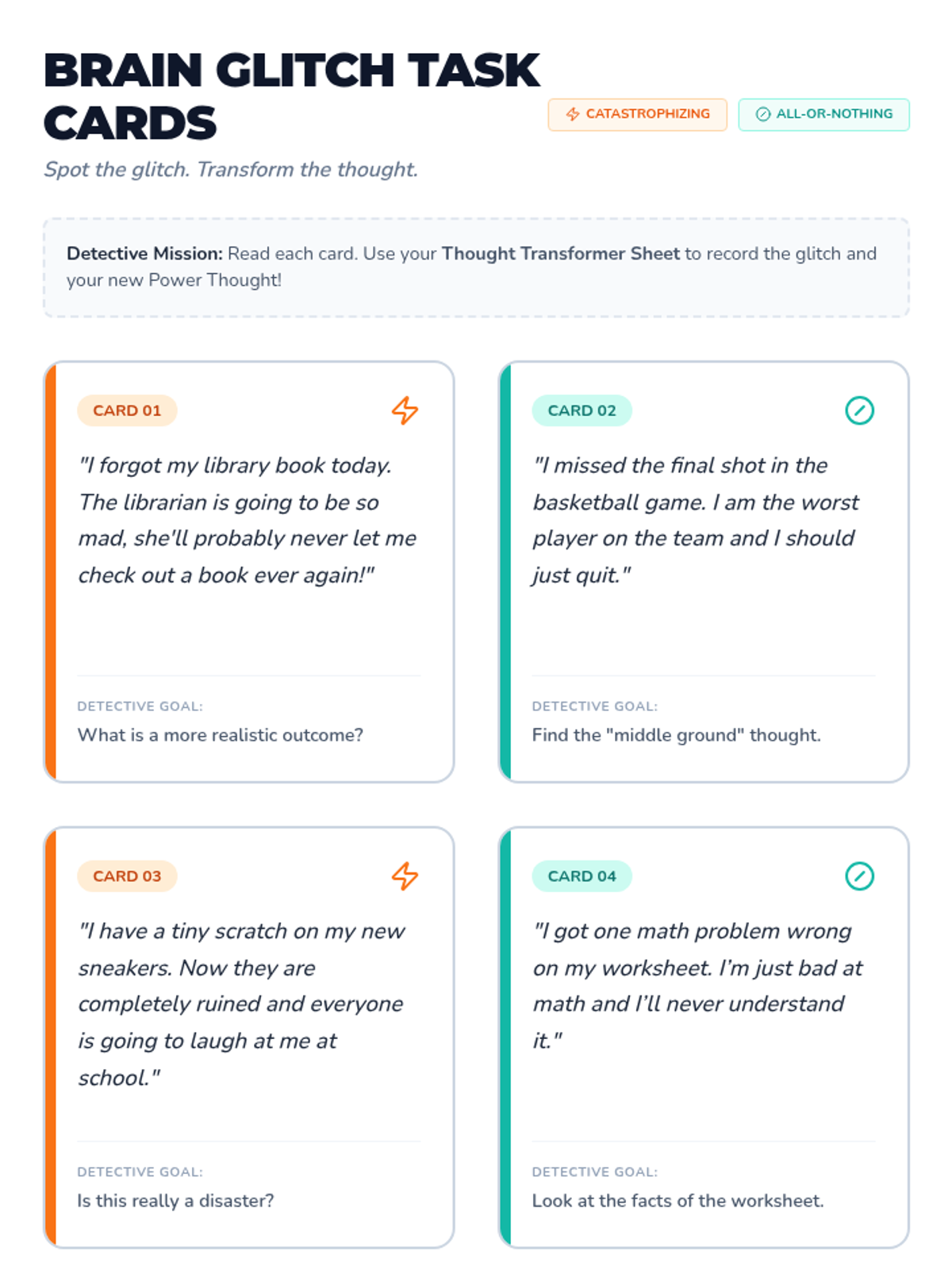
A set of 8 illustrated task cards featuring scenarios of catastrophizing and all-or-nothing thinking for students to identify and reframe.
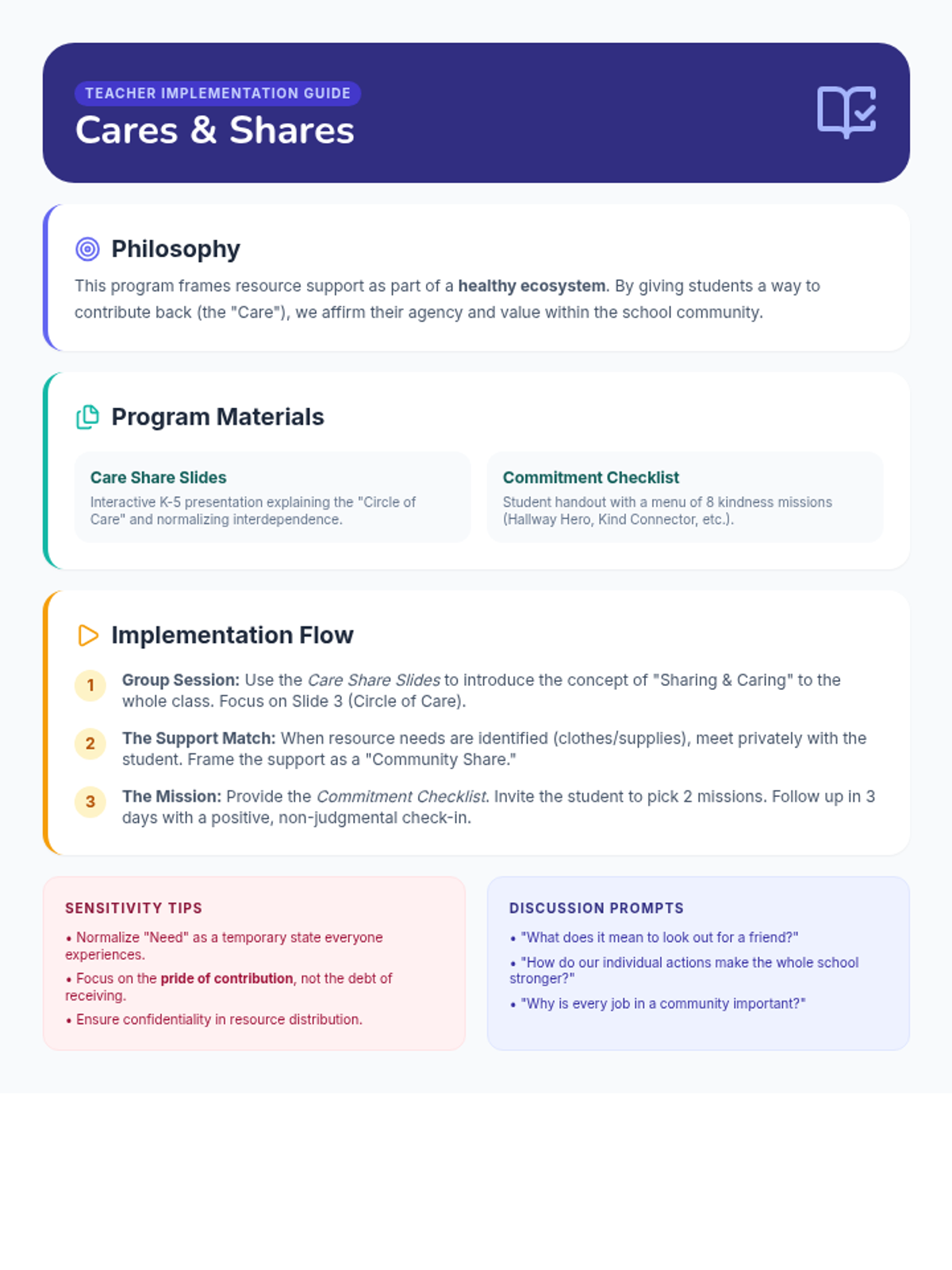
A teacher's guide for implementing the "Cares & Shares" program, providing pedagogical philosophy, sensitive delivery tips, and lesson facilitation strategies to build a dignity-centered community.
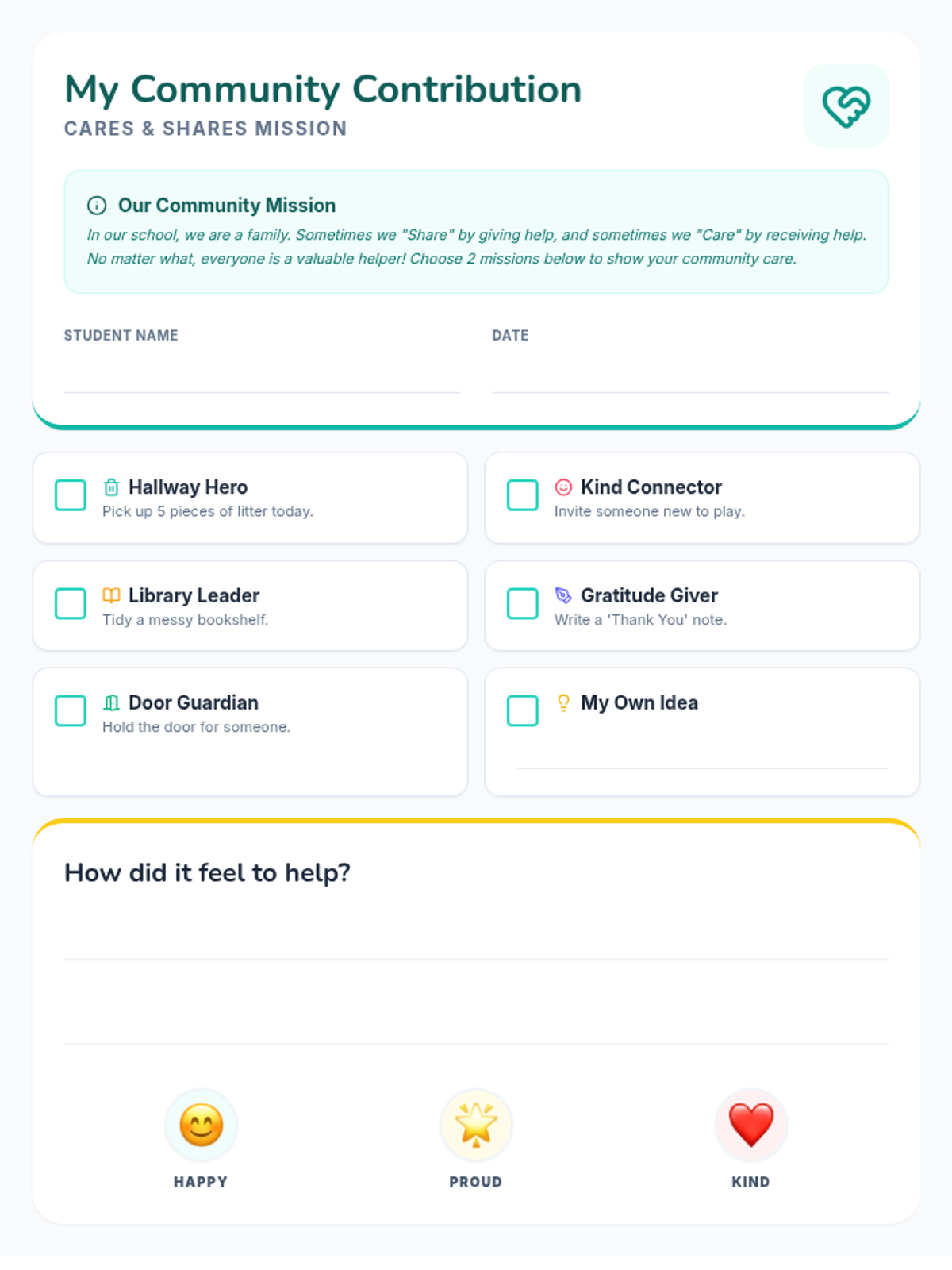
A student-facing checklist for the "Cares & Shares" program, providing concrete and age-appropriate ways for students to contribute to their school community after receiving support.
A vibrant and welcoming slide presentation designed for elementary students to explain the "Cares & Shares" program, focusing on community interdependence and the value of contributing back to the school.
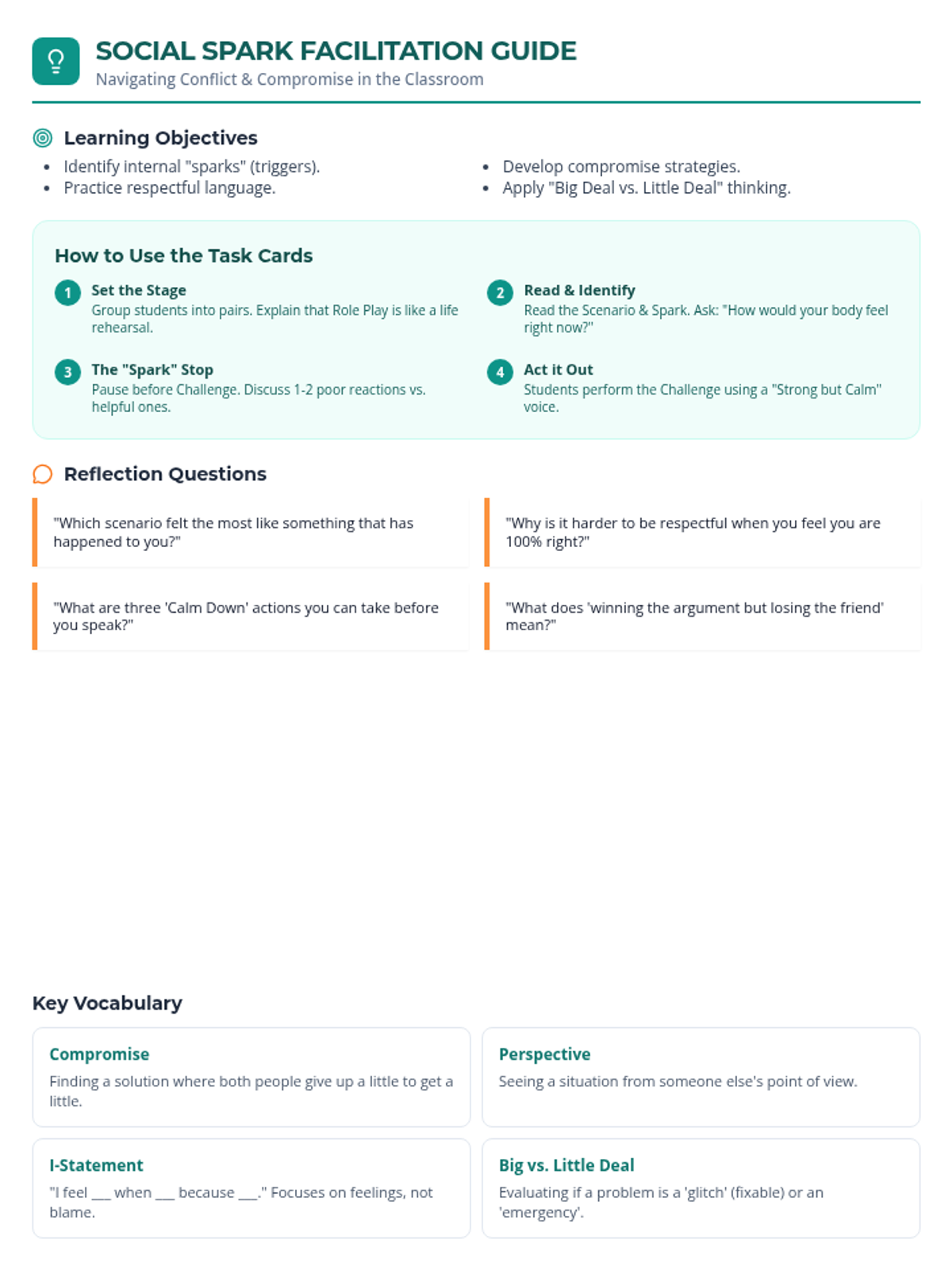
A facilitation guide for teachers to lead the Social Spark role-play activities. It includes learning objectives, a 4-step role-play framework, reflection questions, and key social-emotional vocabulary definitions. Revised to fit on a single page.
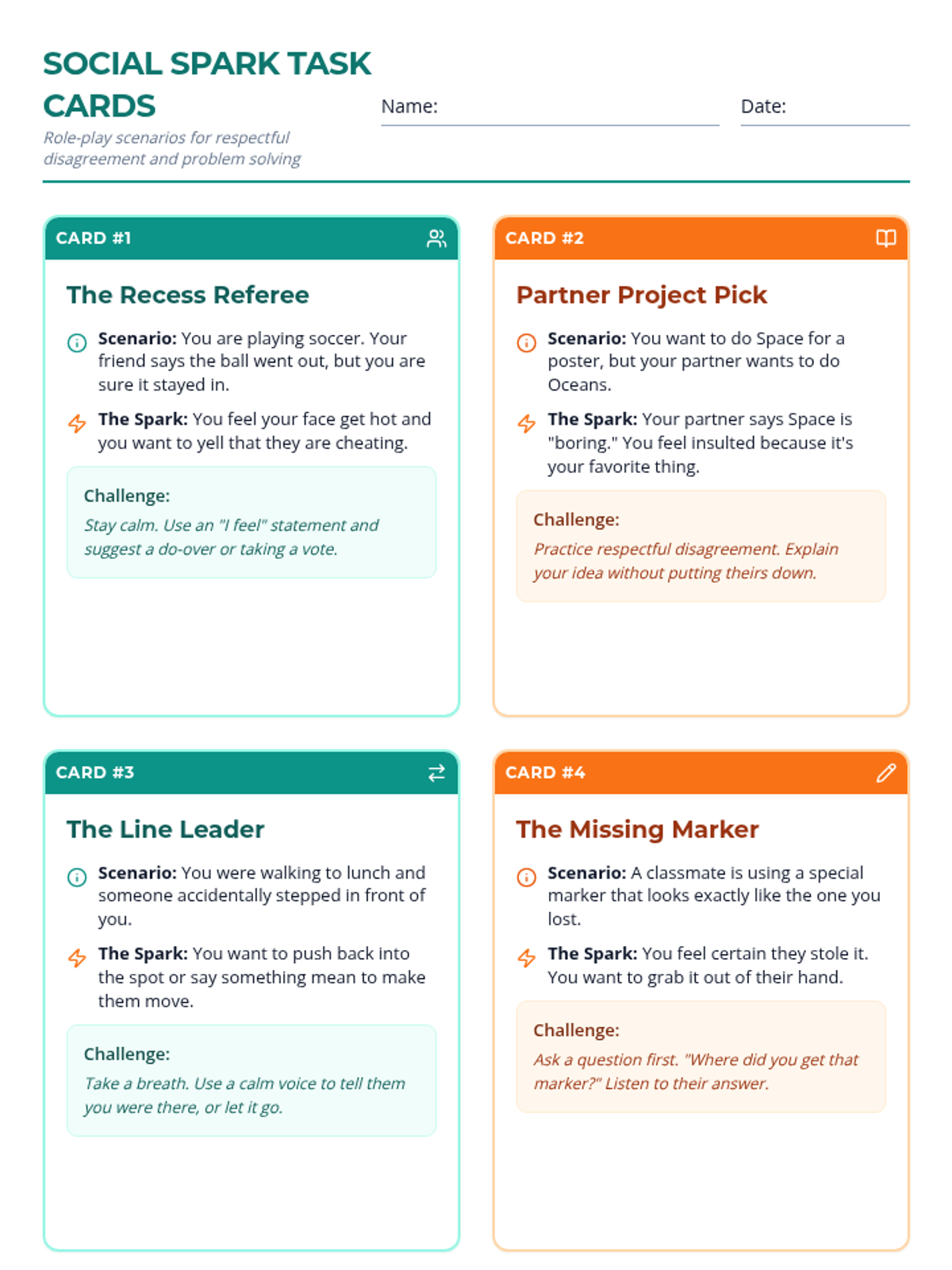
A set of 8 illustrated task cards featuring common school-based social scenarios. Each card includes a scenario, a conflict point (the 'spark'), and a challenge for students to role-play respectful disagreement and problem-solving. Revised for better page layout.
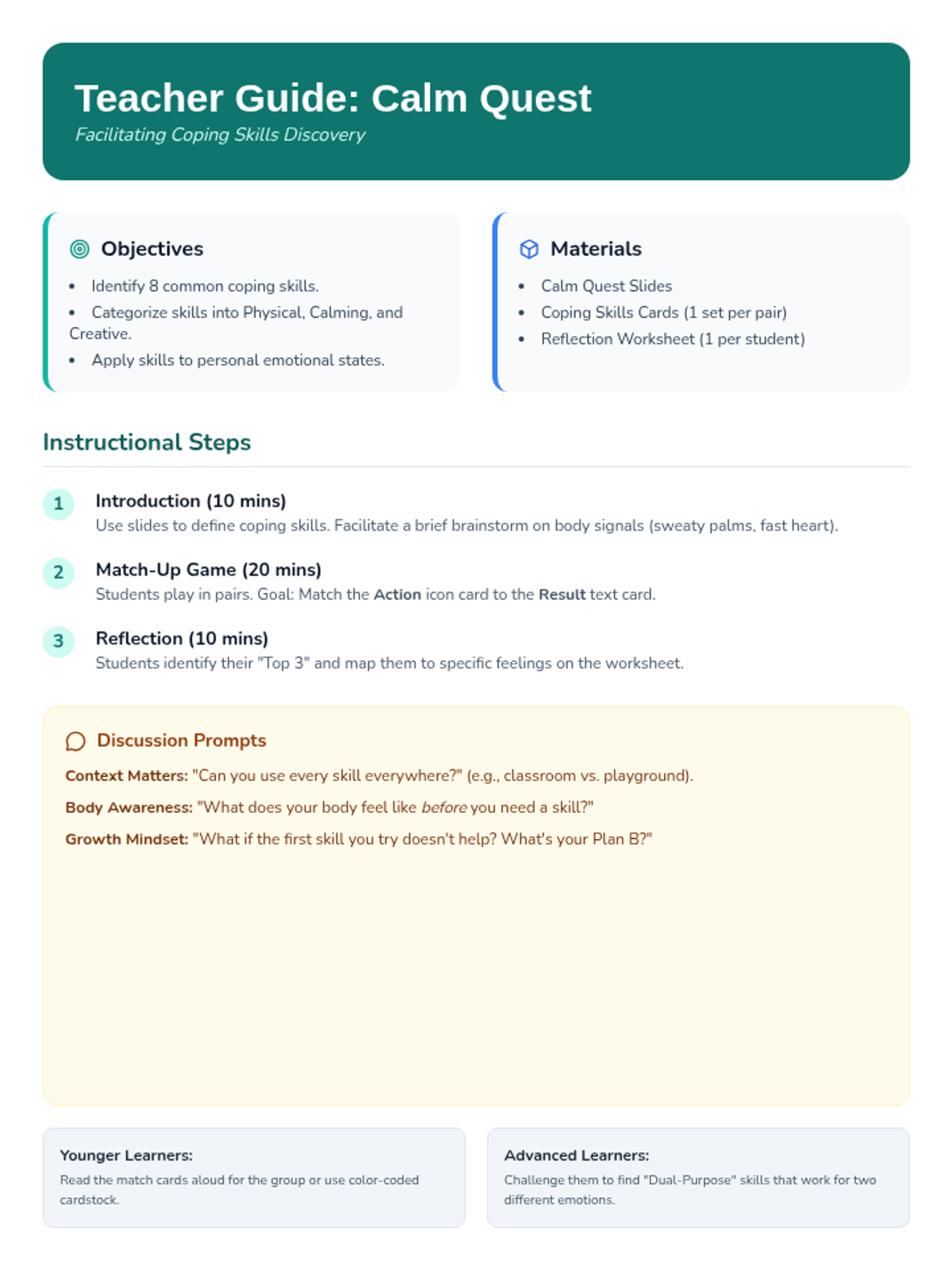
A teacher's facilitation guide for the Calm Quest lesson, including learning objectives, a step-by-step instructional plan, discussion prompts, and differentiation strategies. Optimized for a clean single-page layout.
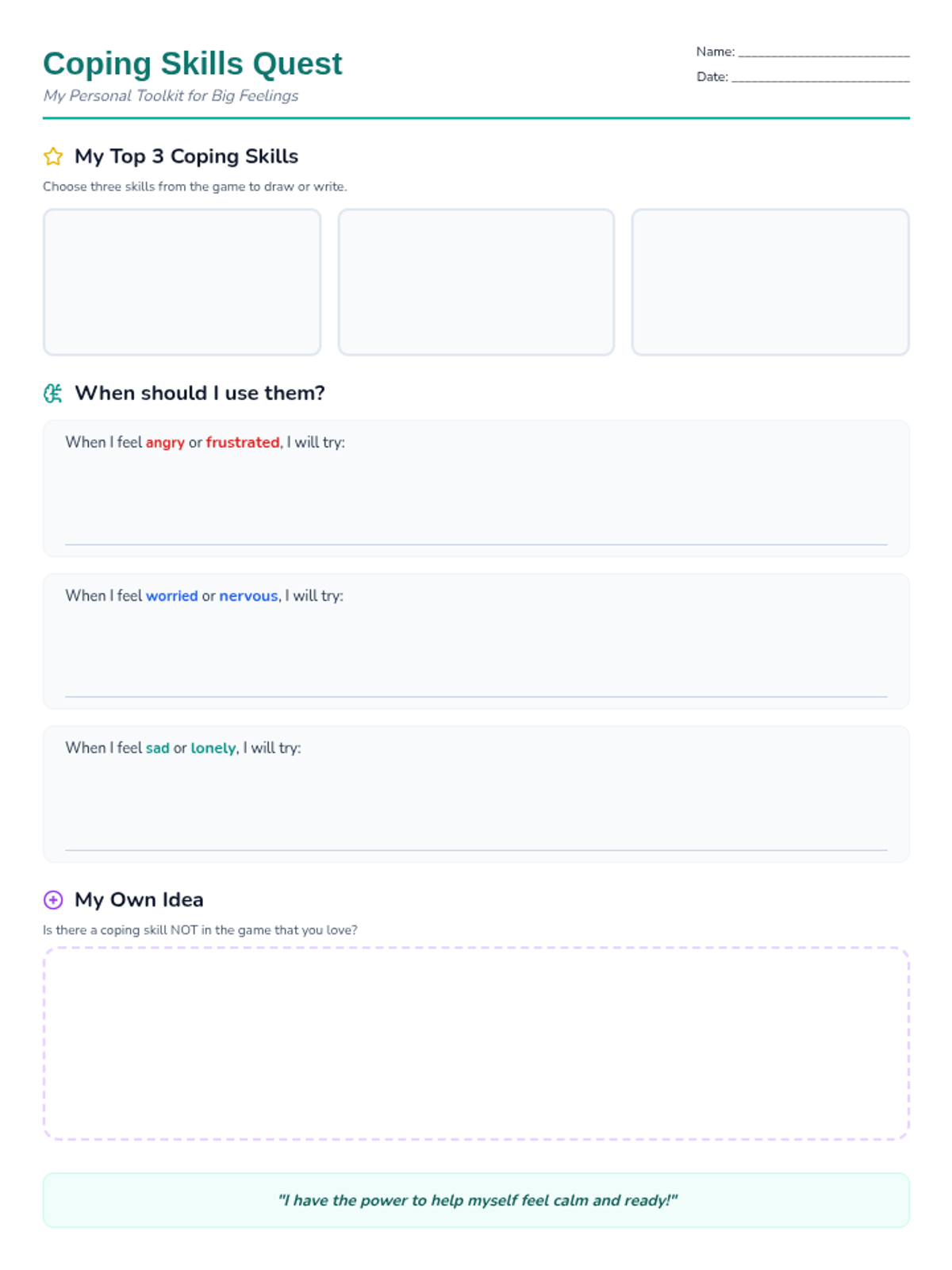
A reflection worksheet for students to identify their favorite coping skills, plan when to use them for specific emotions, and contribute their own unique ideas to their toolkit. Optimized for single-page printing.
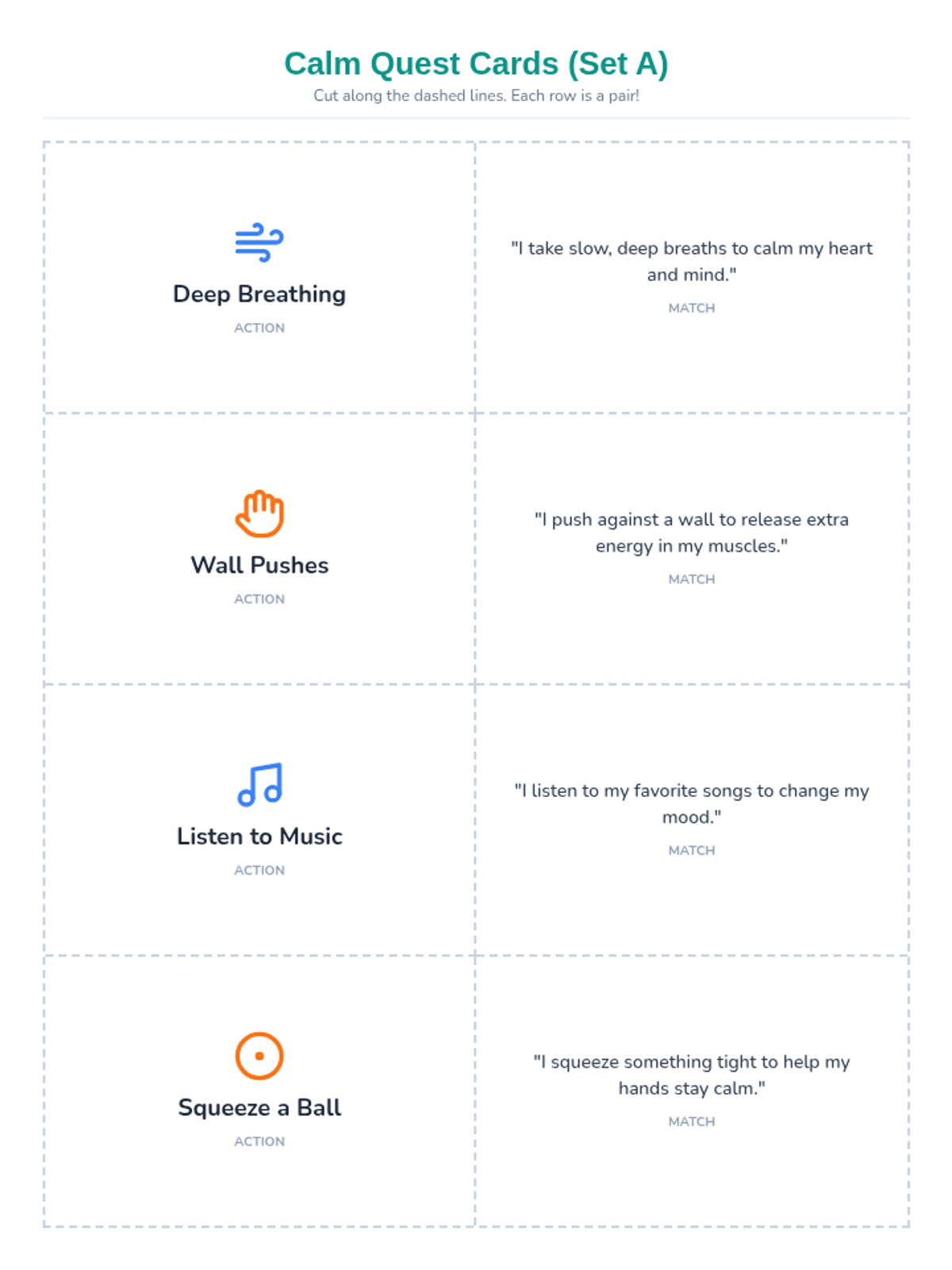
A set of printable matching cards featuring 8 different coping skills across four categories. Each pair consists of an 'Action Card' with an icon and title, and a 'Match Card' explaining the purpose of the skill. Uniform backgrounds prevent visual telegraphing.
Educational slides designed to introduce students to the concept of coping skills, categorizing them into Physical, Calming, Creative, and Distraction, and explaining how to play the Calm Quest matching game.
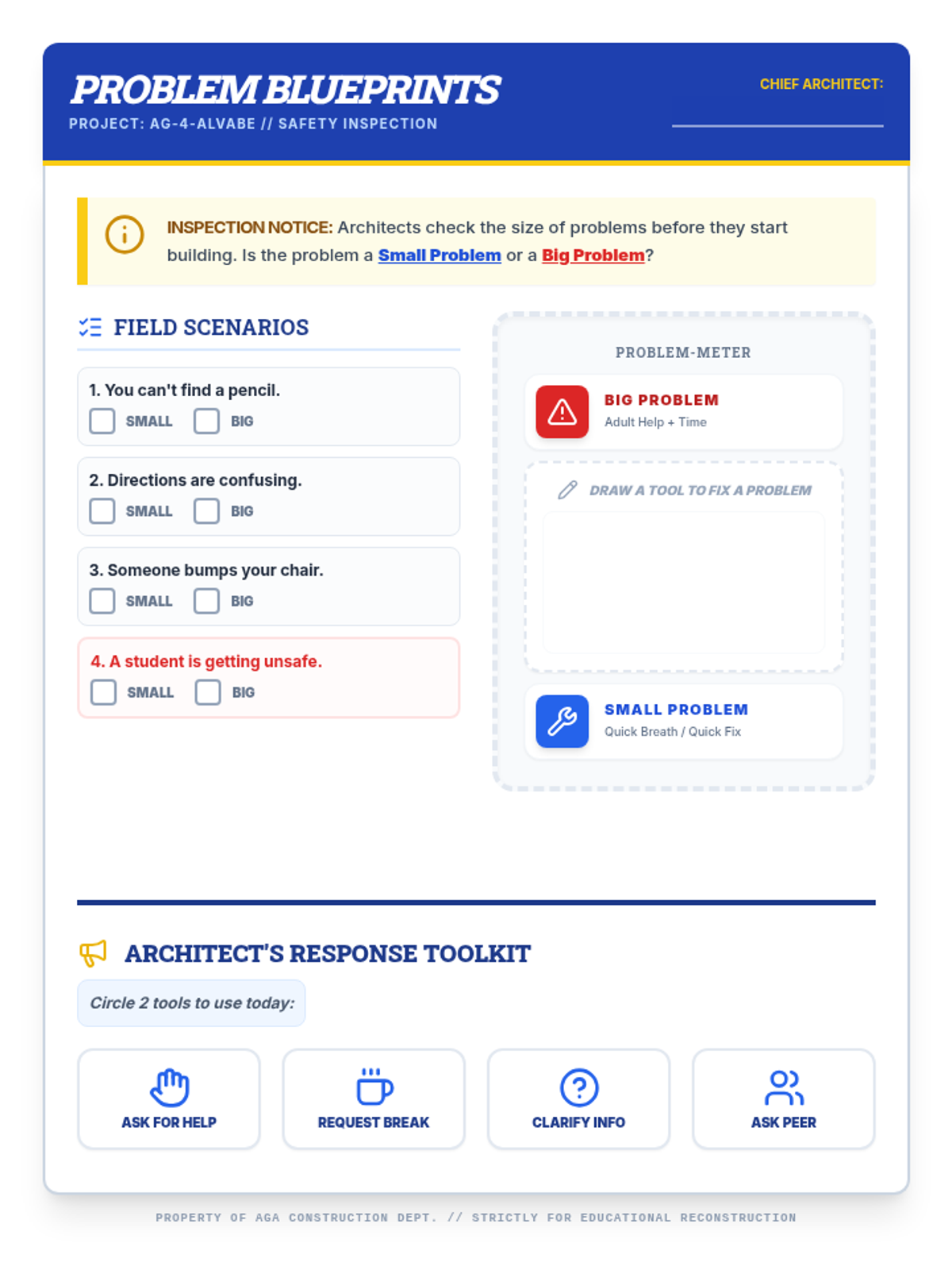
A two-page student resource featuring a construction-themed problem scaling worksheet and a printable page of 'desk strips' for staff to use as visual cues for self-advocacy. Background set to white for ink efficiency.
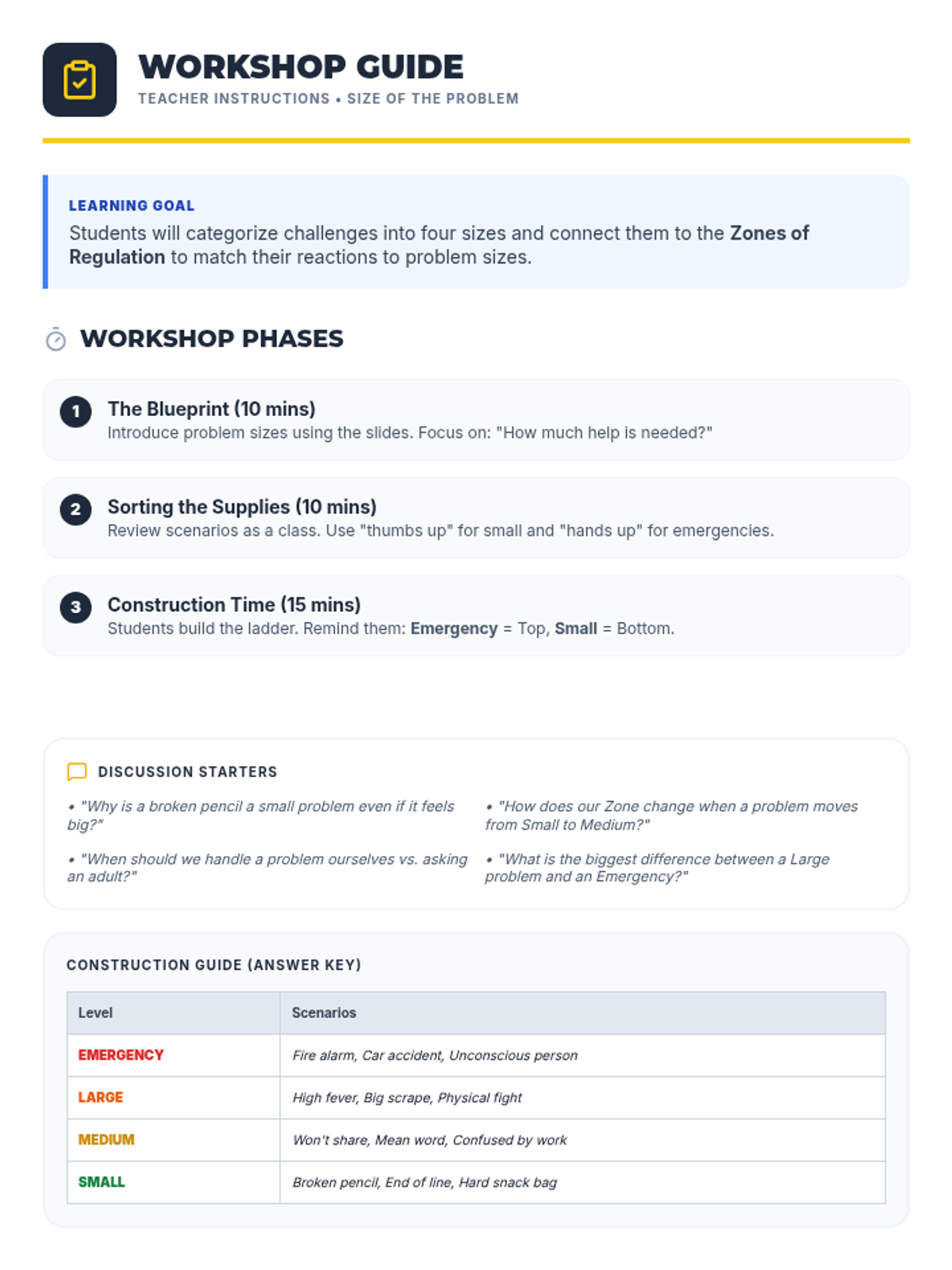
Detailed teacher facilitation guide for the Problem Solvers Workshop, featuring lesson pacing, discussion prompts, and a scenario sorting answer key for the ladder craft.
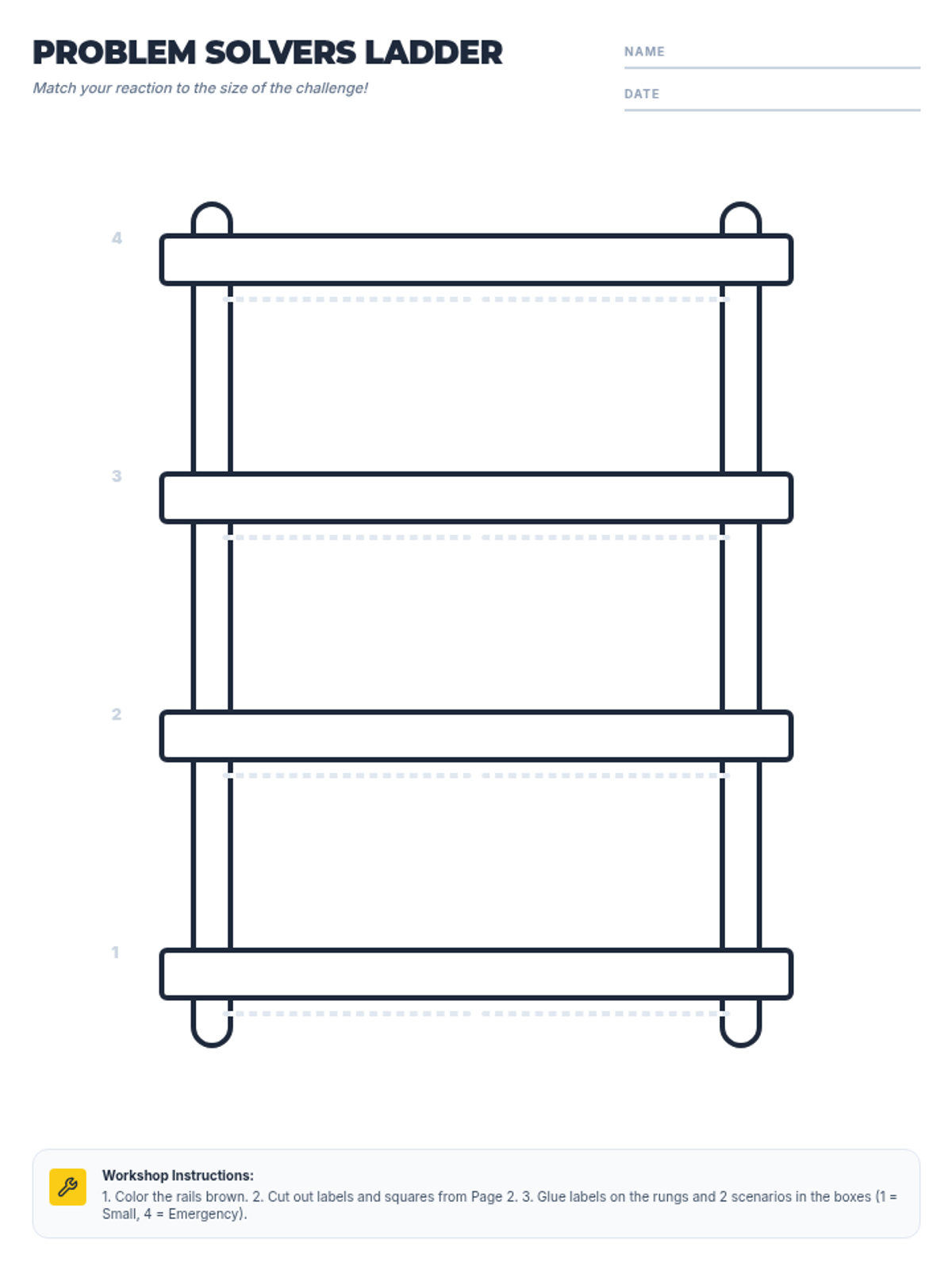
A two-page printable craft activity where students build a 'Problem Ladder'. They cut and sort problem scenarios and labels into Small, Medium, Large, and Emergency categories, reinforced with Zones of Regulation color coding.
Engaging visual presentation introducing the "Problem Solvers Workshop" concept, defining problem sizes (Small, Medium, Large, Emergency) and their relationship to the Zones of Regulation.
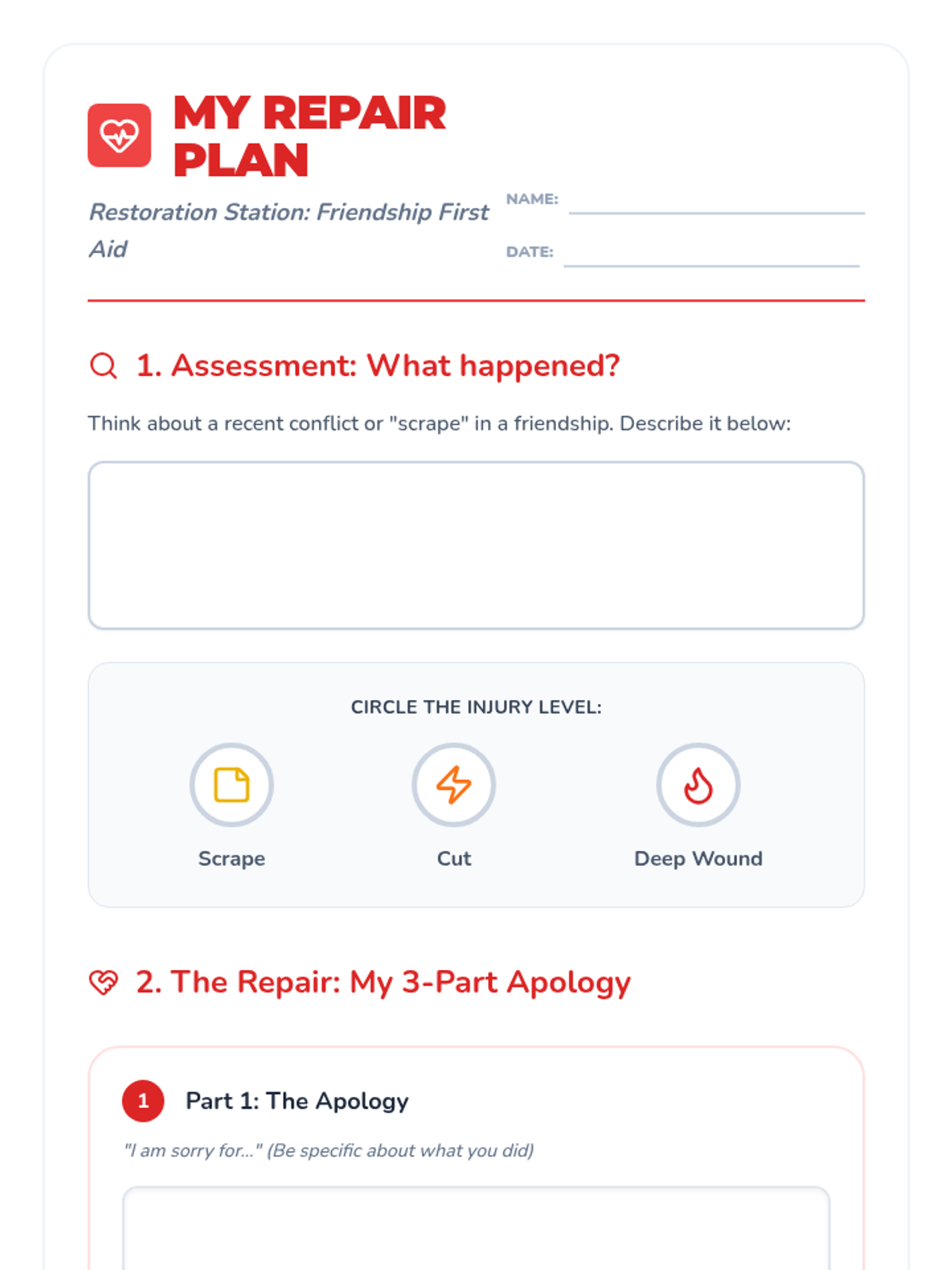
A reflective student worksheet for 'The Restoration Station' that guides students through assessing a friendship conflict and drafting a meaningful three-part repair apology.
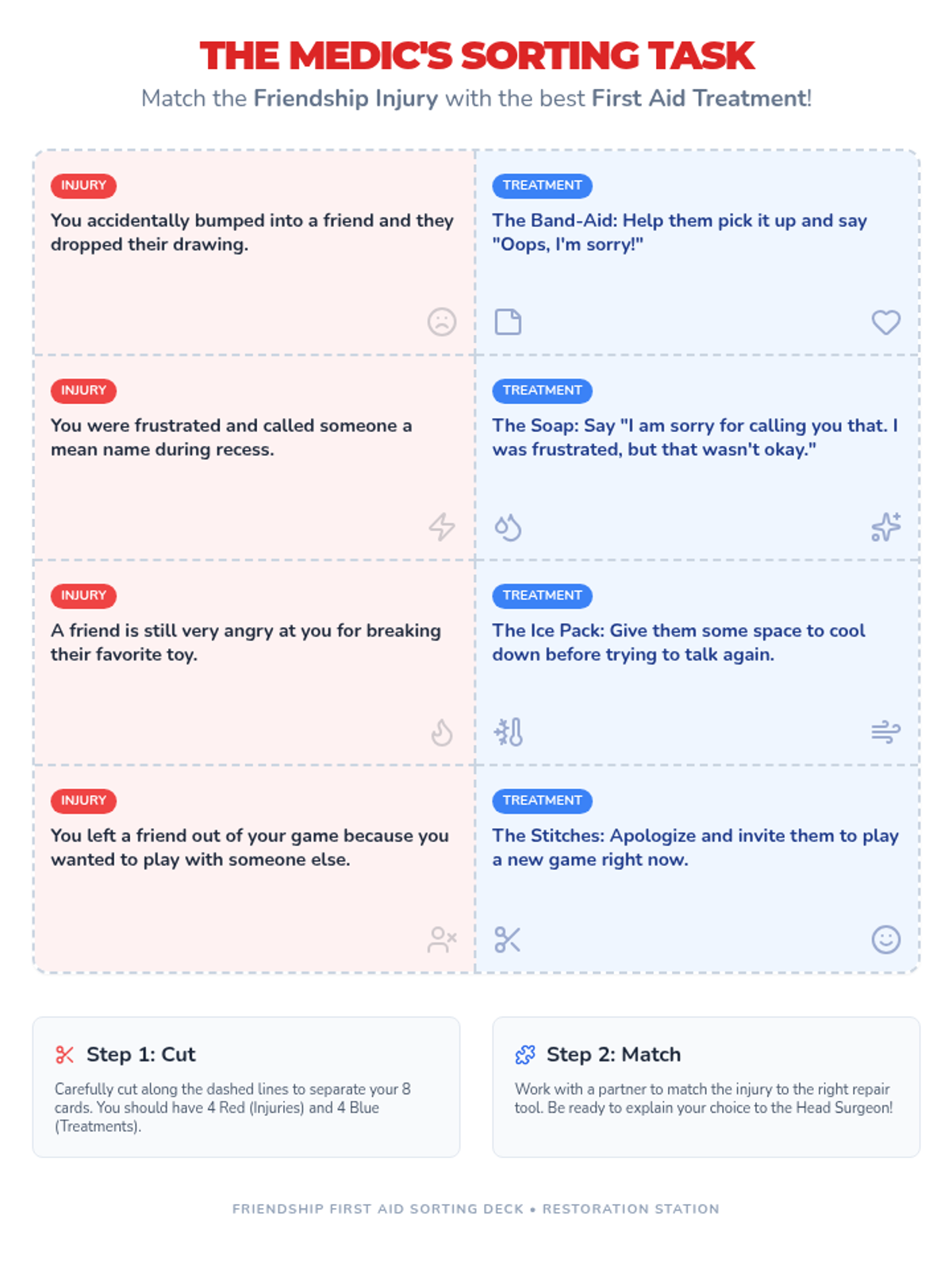
A sorting activity where students match social conflict 'injuries' with appropriate restorative 'treatments', reinforcing the lesson's first-aid metaphor.
An engaging slide deck for 'The Restoration Station' that introduces the friendship first-aid metaphor, defines different levels of conflict, and teaches the three-part repair apology.
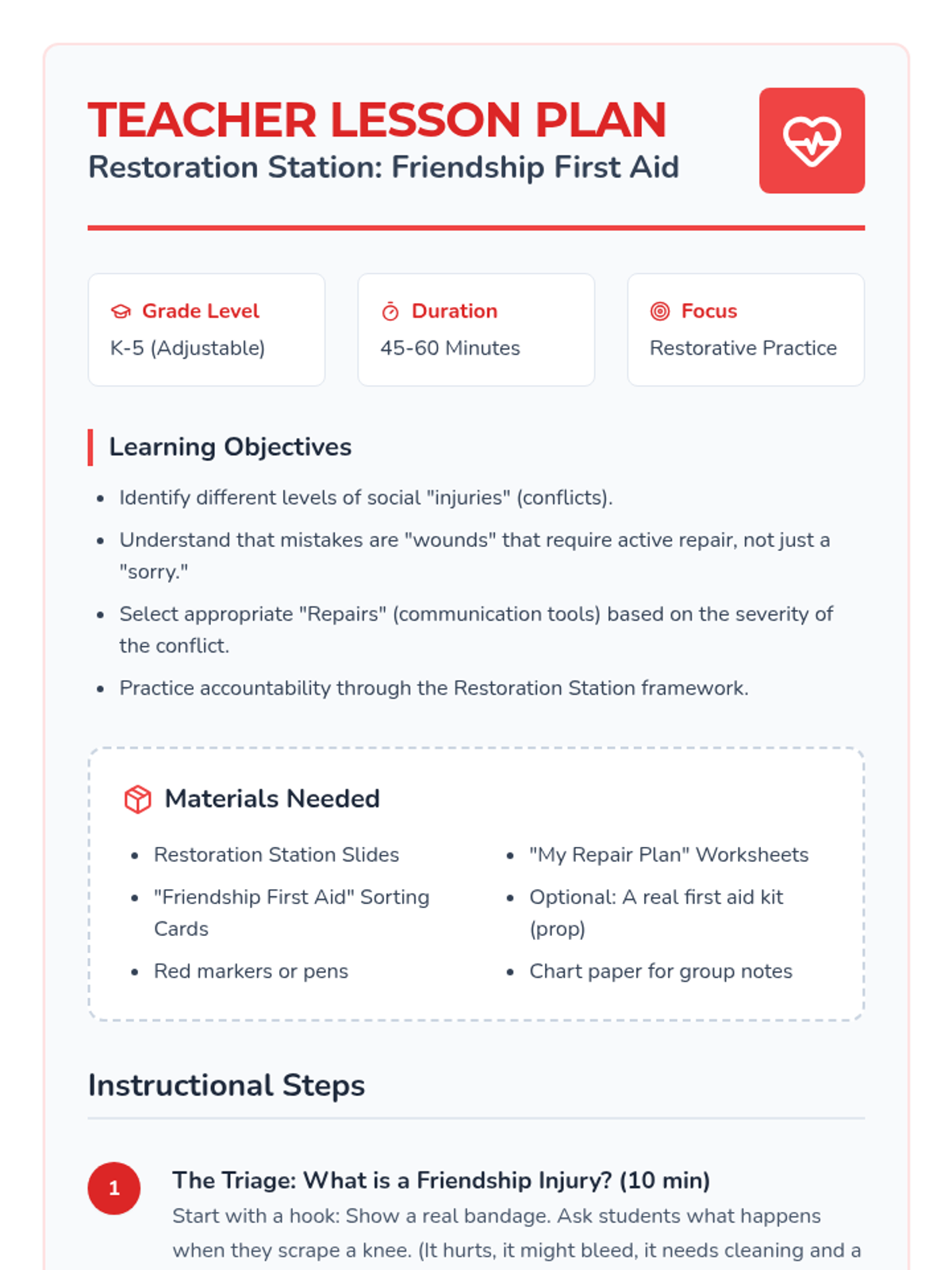
A comprehensive teacher lesson plan for 'The Restoration Station', detailing instructional steps, materials, and restorative practice strategies for K-5 students using a friendship first-aid metaphor.
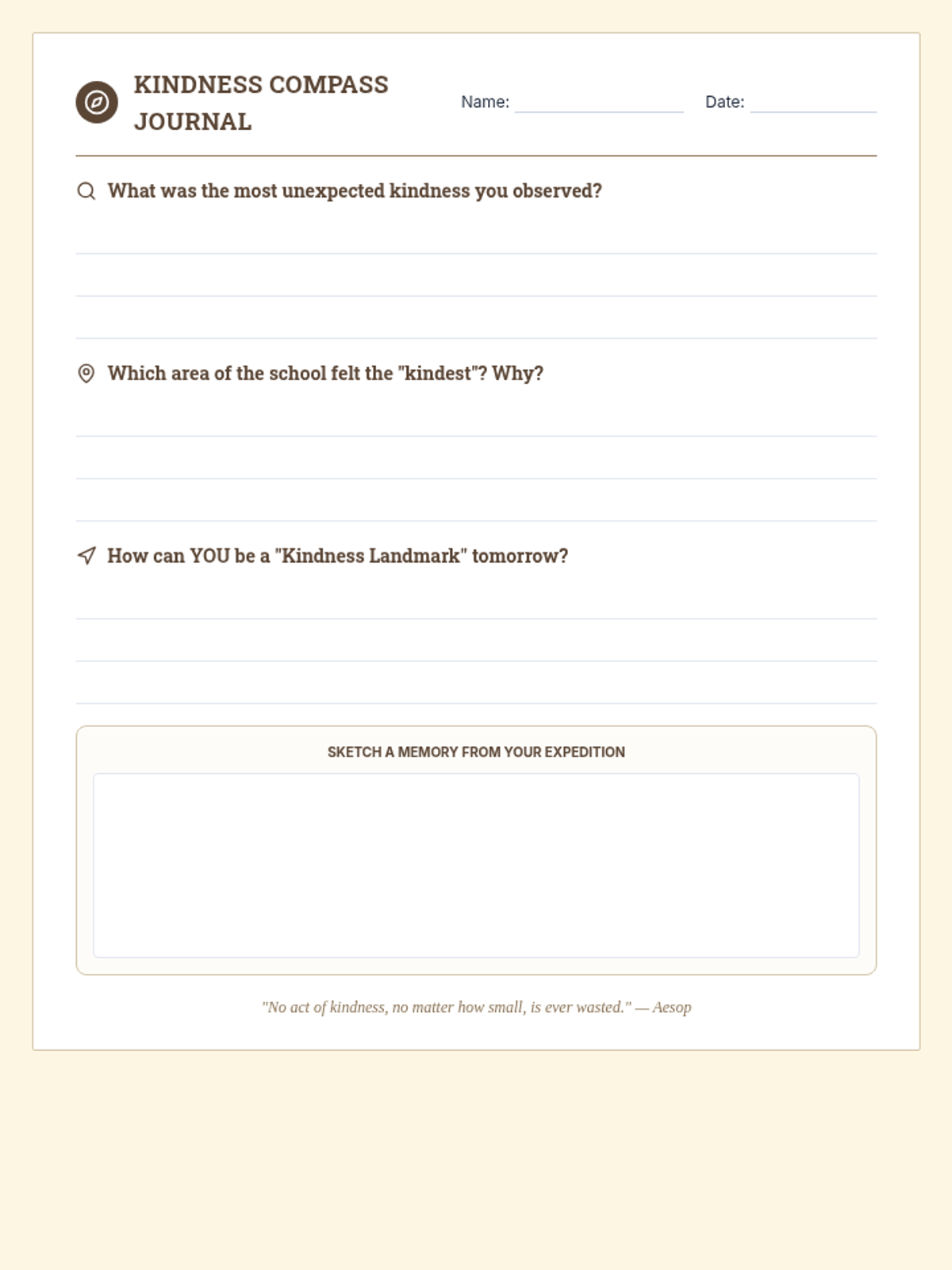
A reflection journal for students to process their observations from the kindness expedition, focusing on specific acts seen and their personal impact.
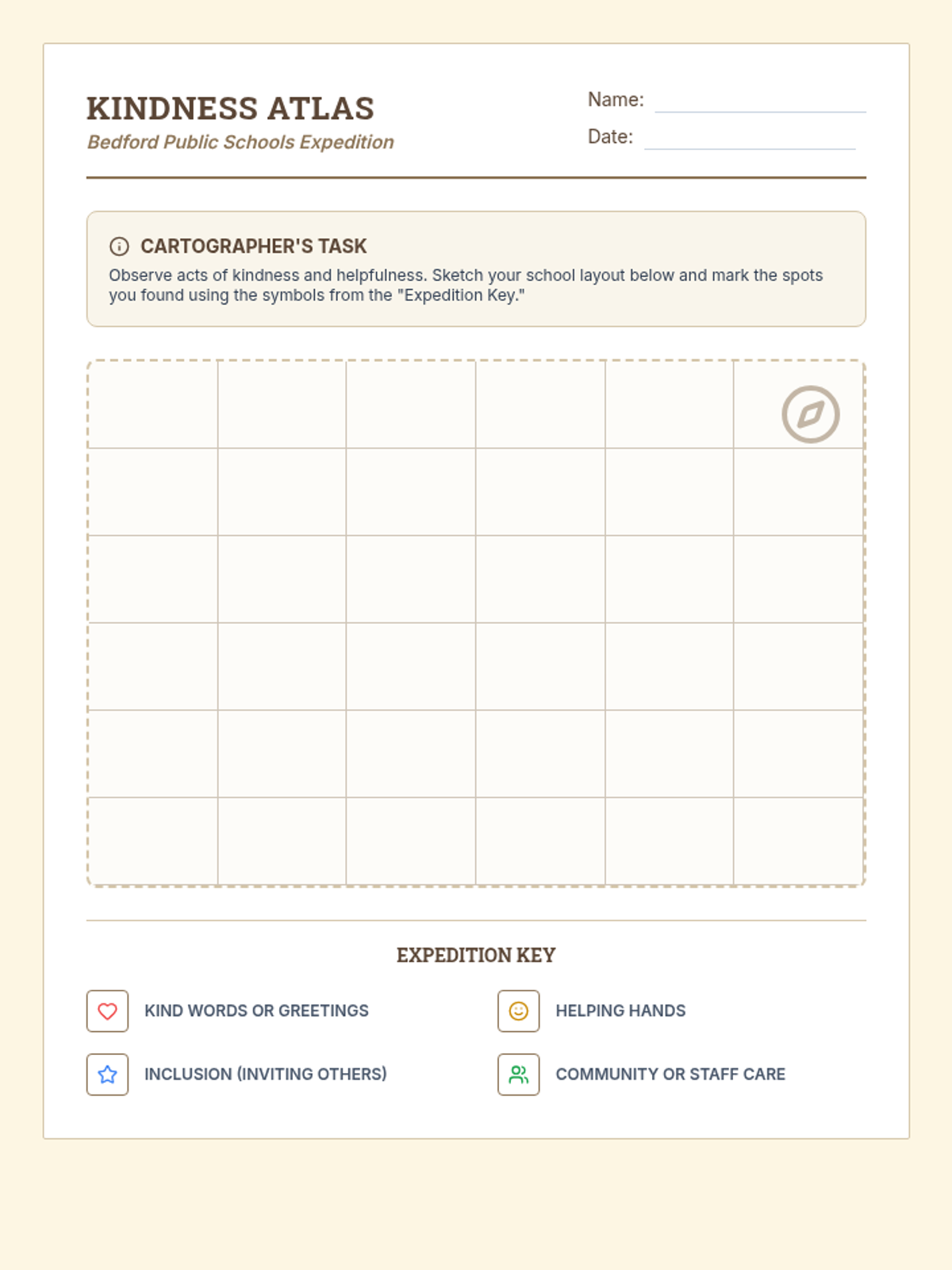
A mapping activity where students draw a map of their school and mark landmarks where acts of kindness were observed using a visual key.
A slide deck that introduces the concept of social cartography and guides students through the 'Kindness Cartographers' expedition at Bedford Public Schools.
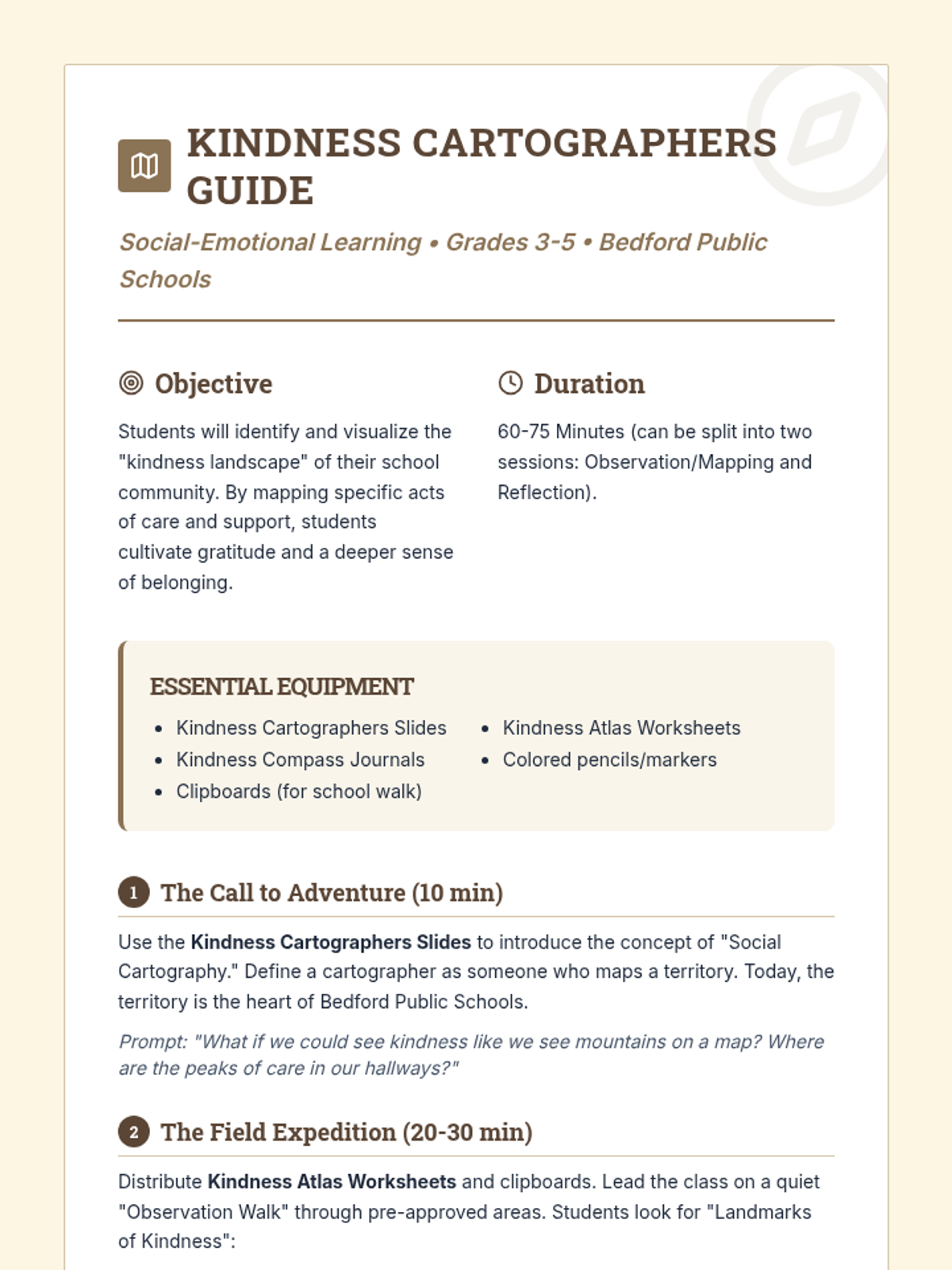
A comprehensive teacher's guide for the Kindness Cartographers lesson, detailing objectives, materials, and a step-by-step procedure for students to map kindness in their school community.
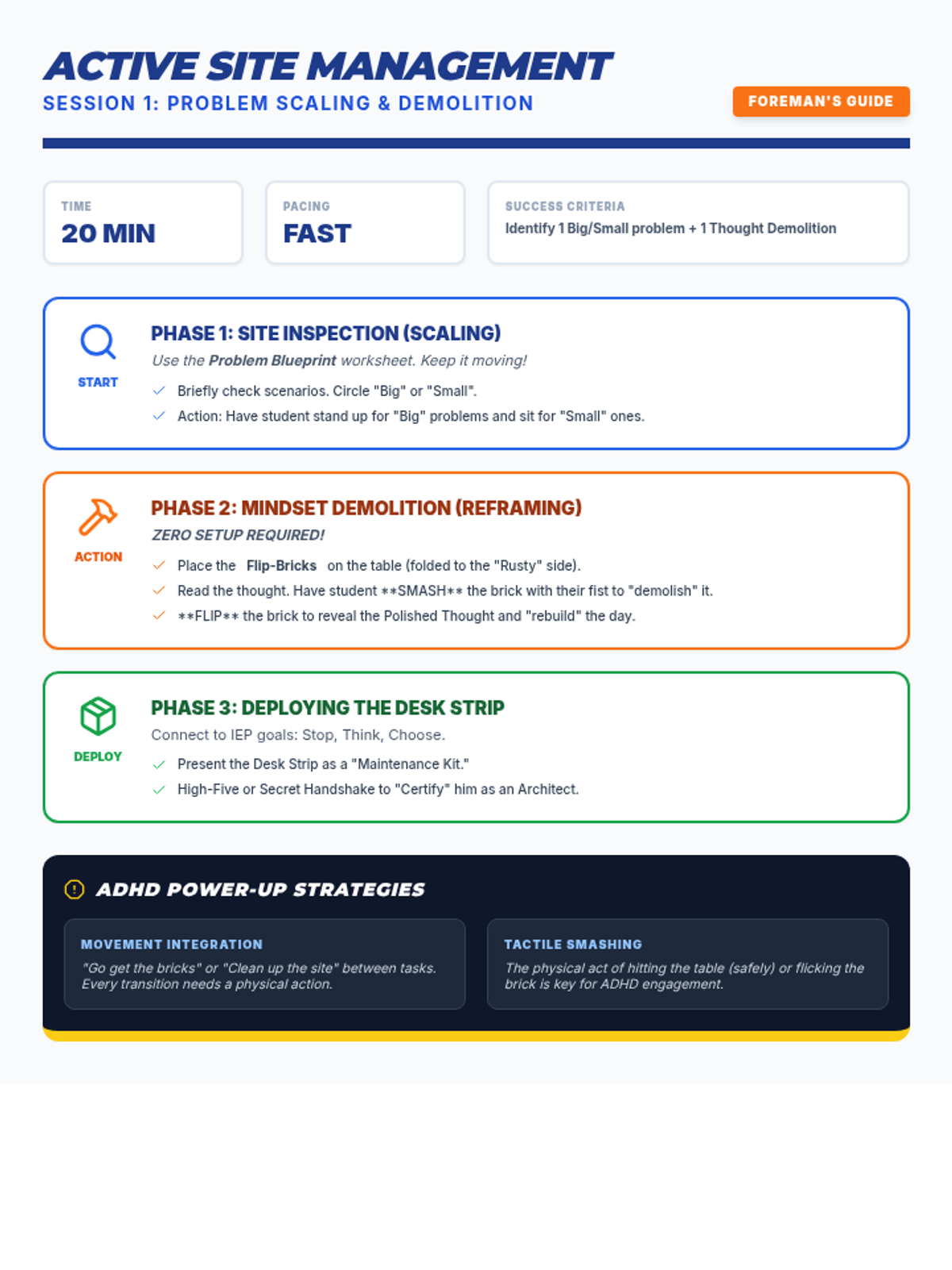
A facilitator guide for a 20-minute counseling session centered on problem-scaling and cognitive reframing using a construction theme, now using simplified 'Big' and 'Small' terminology. Background set to white for ink efficiency.
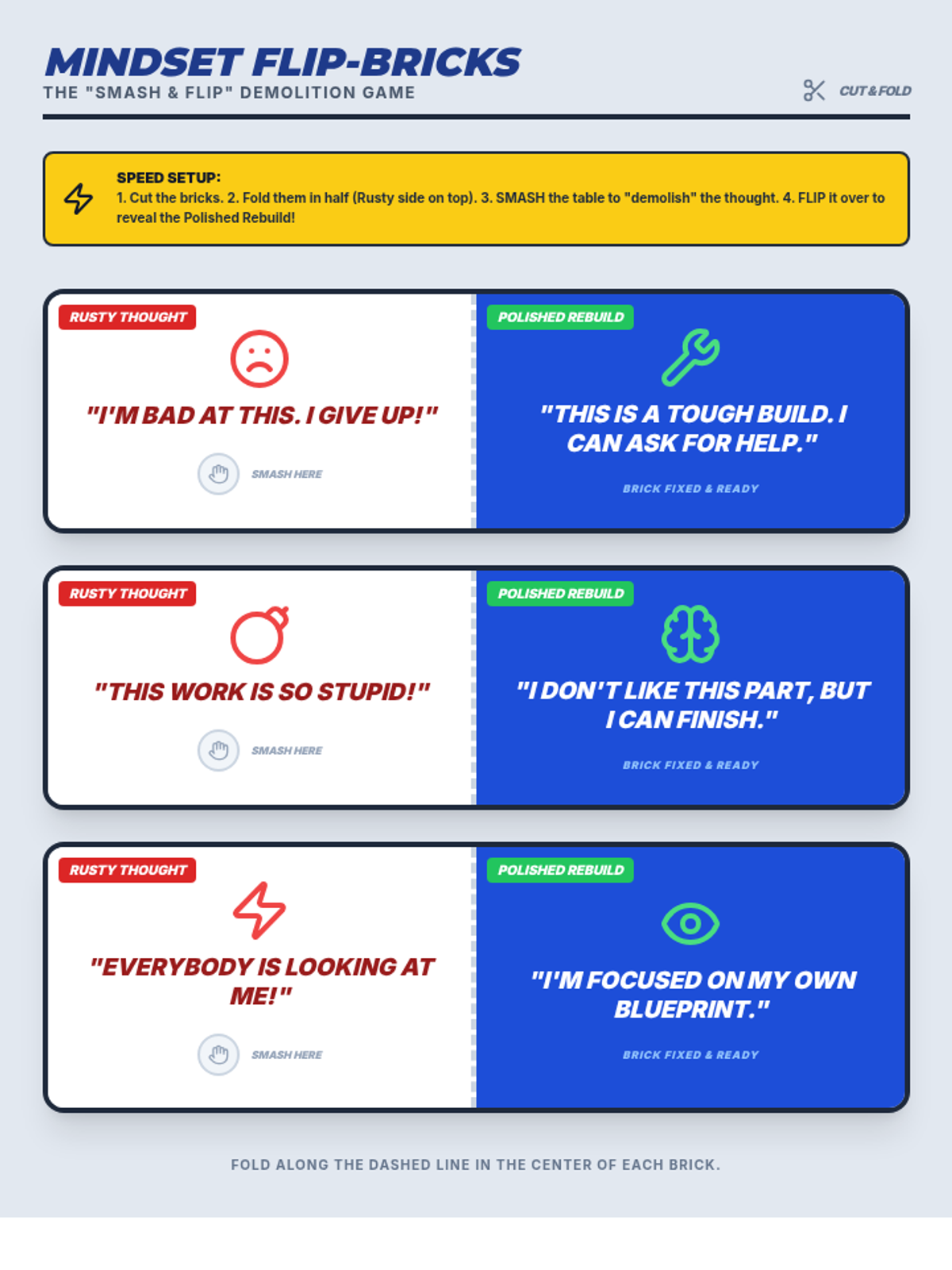
A two-page, high-energy cognitive reframing game featuring six 'Flip-Bricks'. Students smash the 'Rusty Thought' side and flip it to reveal a concrete, everyday 'Fix' for common school challenges. Background set to white for ink efficiency.
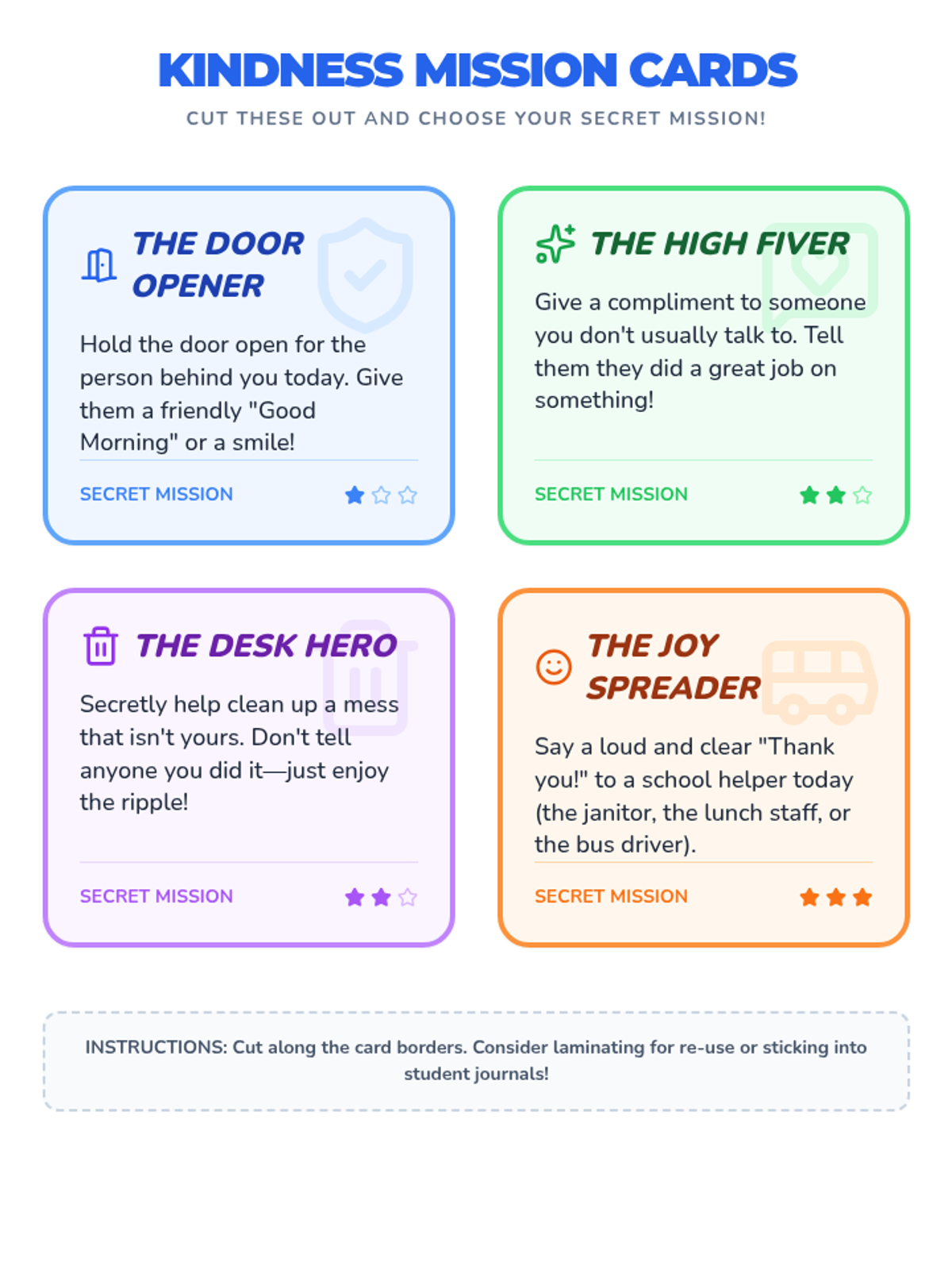
A set of four printable 'Secret Mission' cards for students, each containing a specific kind act to perform at school, along with a difficulty rating and thematic icons.
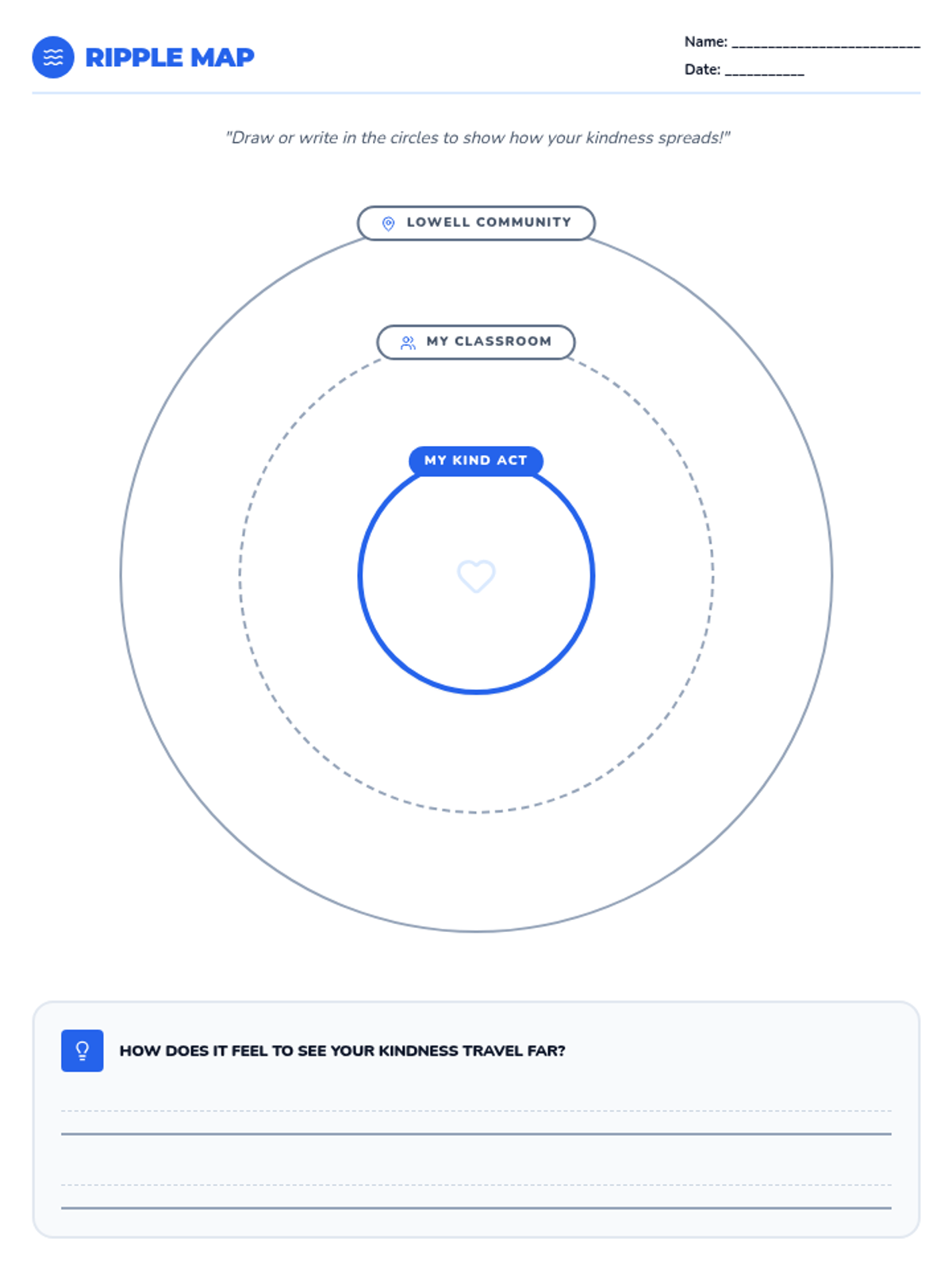
A student-facing worksheet featuring a concentric circle map. Students document a single kind act and trace its impact from an individual person to their classroom and finally to the Lowell community.
Visual slides for the 'Kindness Ripples Project' featuring high-contrast text, engaging icons, and a clear visualization of how small acts impact the person, the class, and the Lowell community.
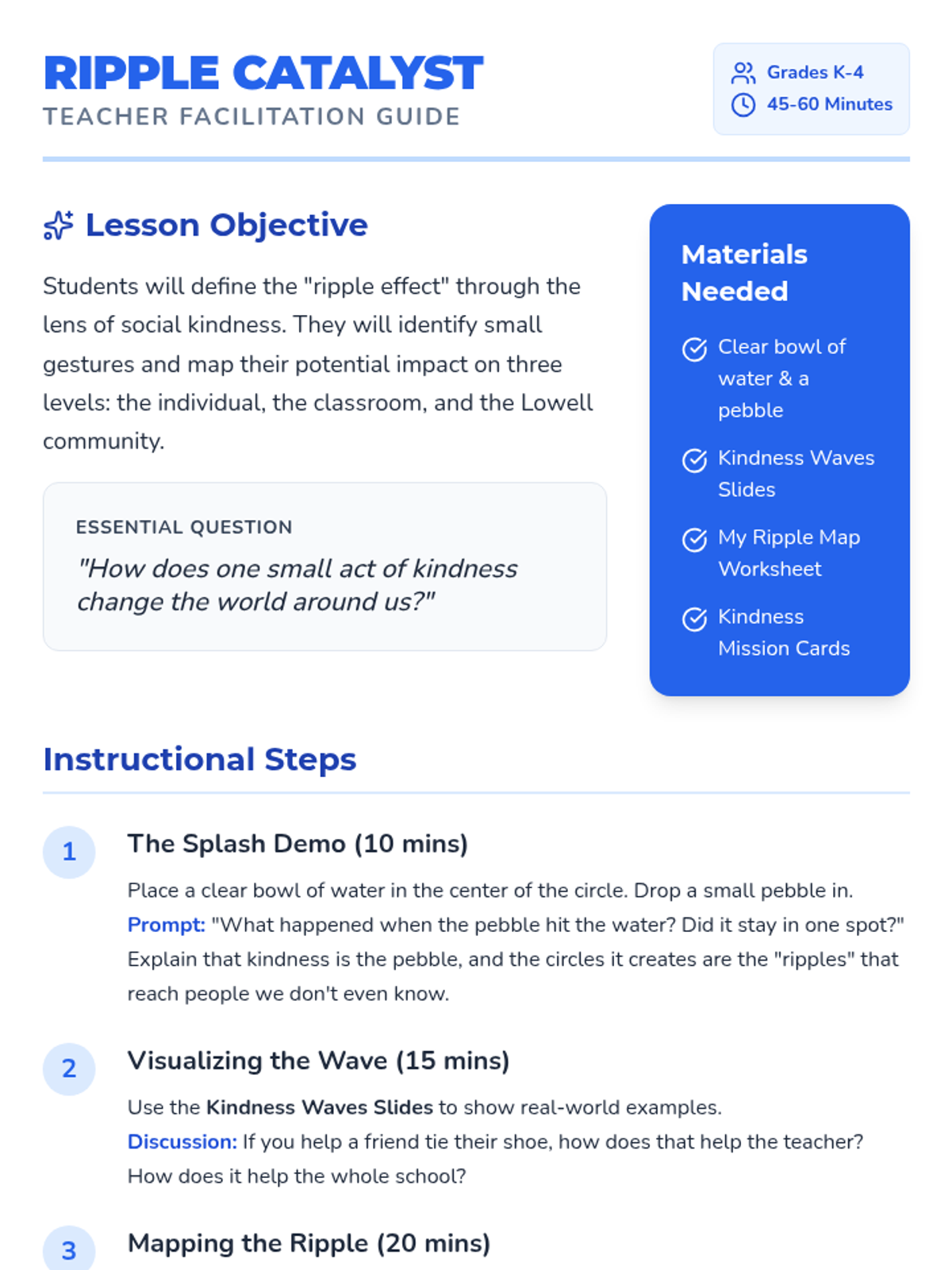
A comprehensive teacher's guide for 'The Kindness Ripples Project,' featuring lesson objectives, a step-by-step procedure including a hands-on water demonstration, and differentiation strategies for K-4th grade.
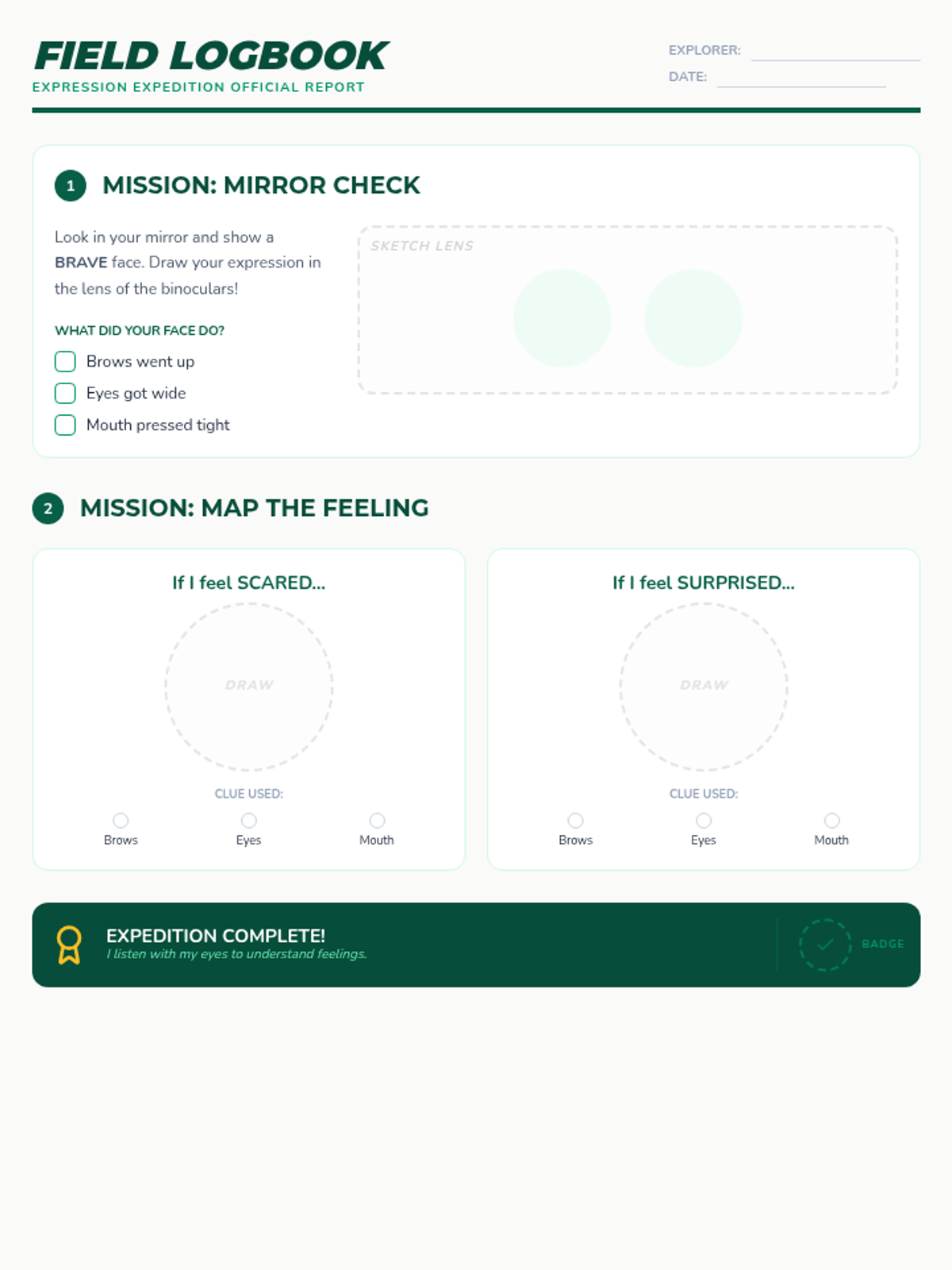
A student worksheet designed as a 'Field Logbook' for sketching facial expressions and identifying specific emotional cues like eyebrows, eyes, and mouth movements.
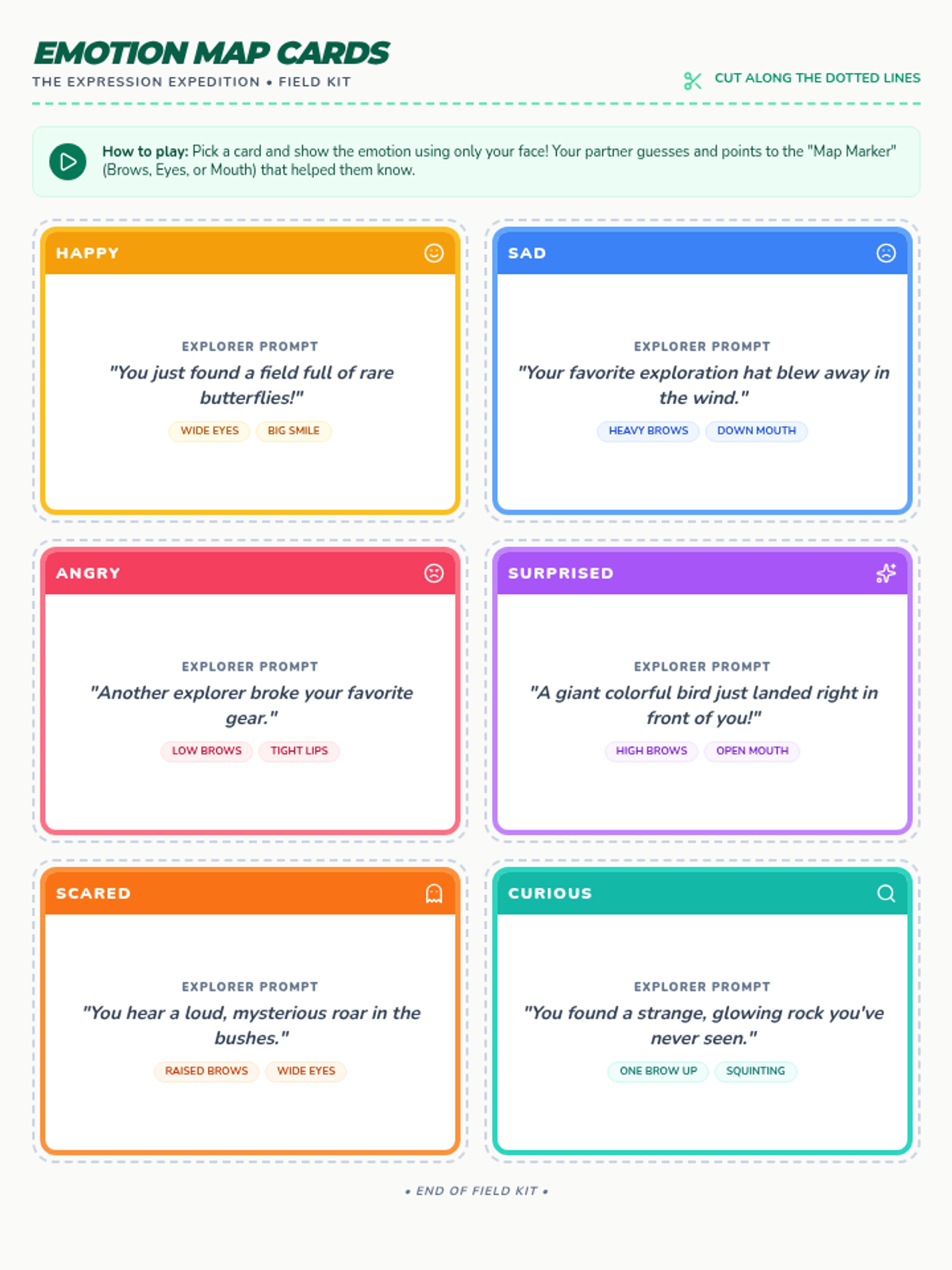
A set of interactive emotion cards for a classroom roleplay activity. Each card features an explorer-themed prompt and visual cues to help students practice non-verbal communication.
A highly visual slide deck for the Expression Expedition lesson, featuring key facial features to watch for, interactive mirror prompts, and large emoji-based visual aids.
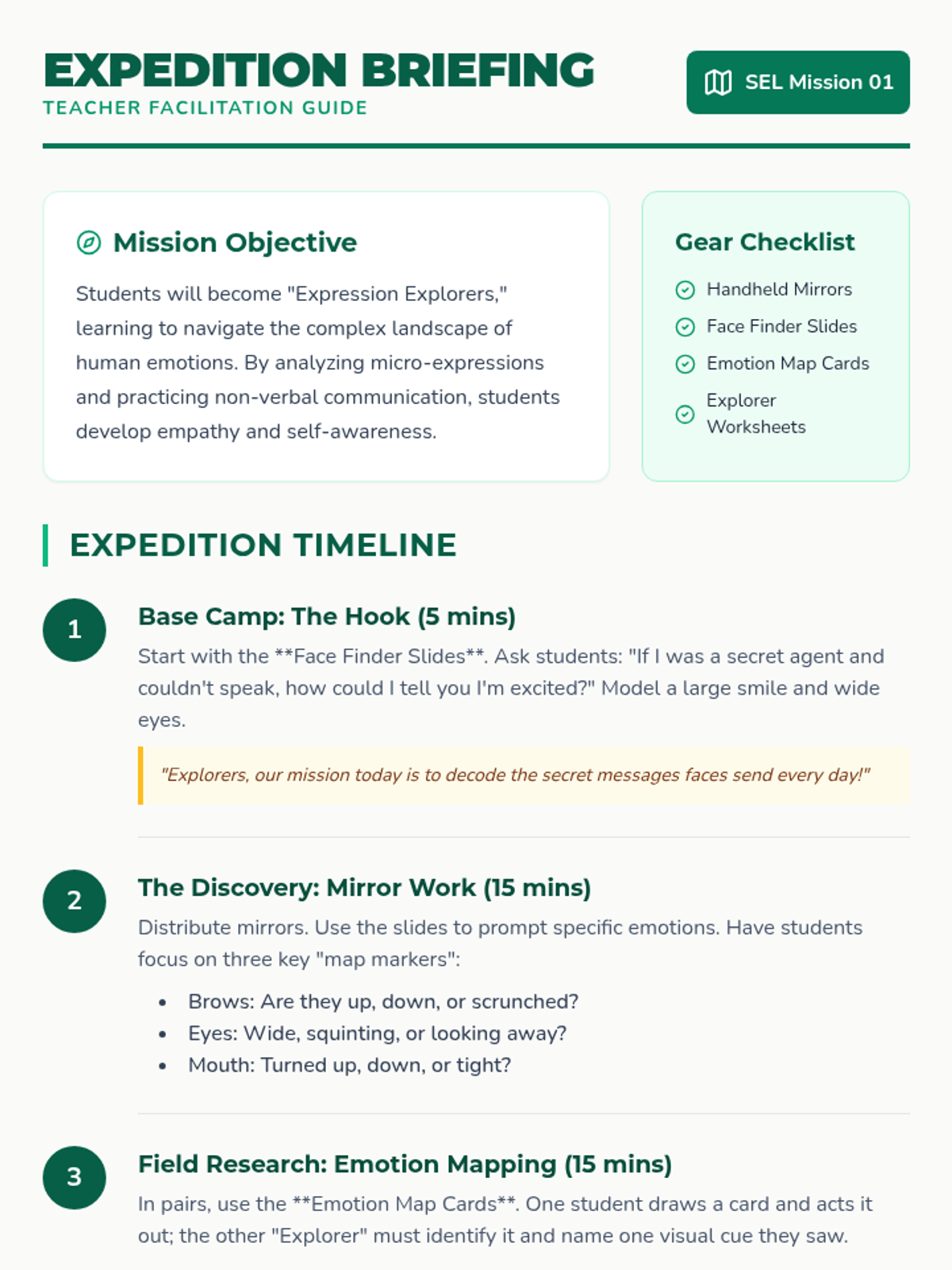
A comprehensive teacher's guide for the Expression Expedition lesson, detailing instructional steps, differentiation strategies, and material management for an SEL focus on non-verbal communication.
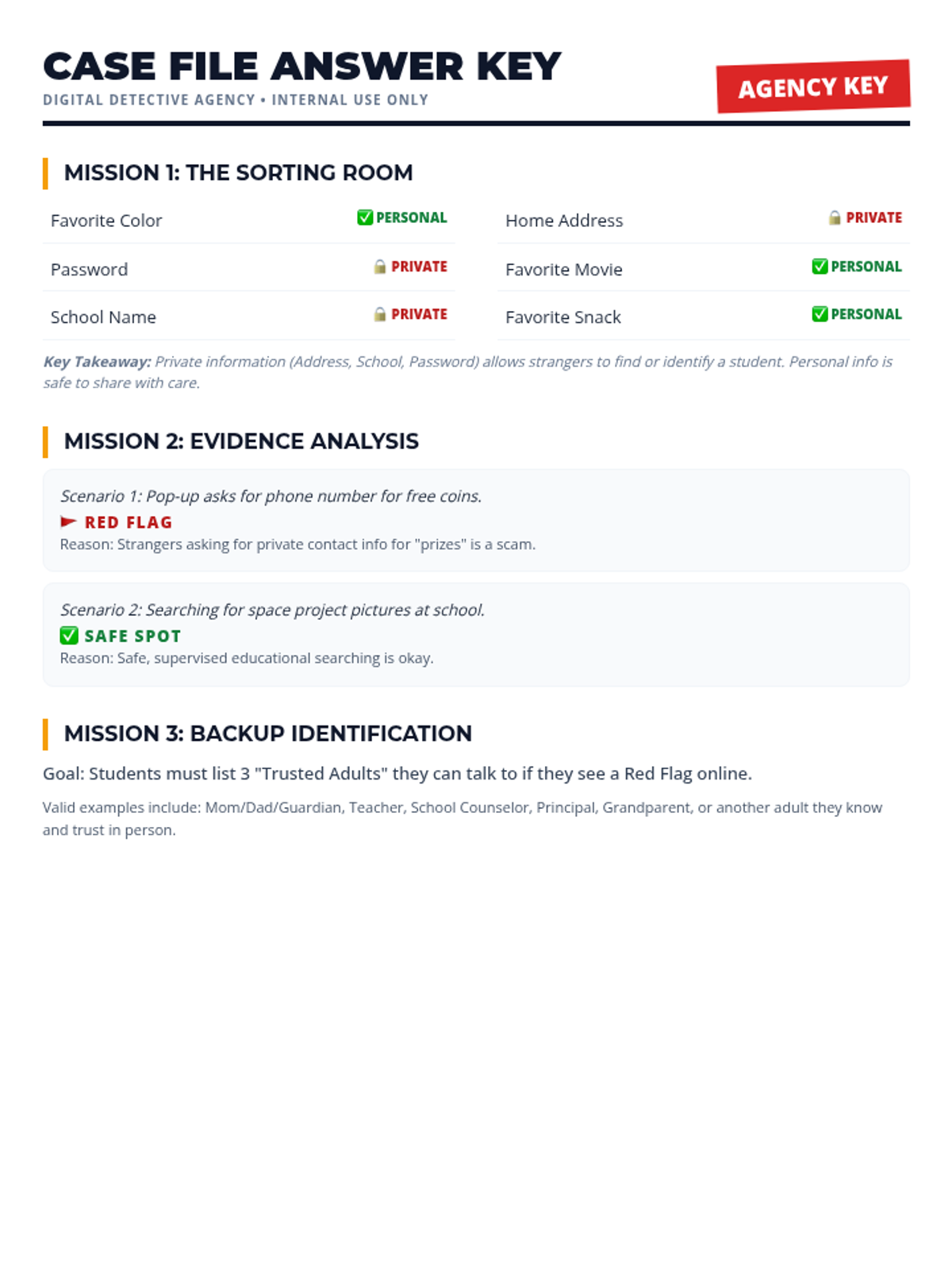
Teacher answer key for the Privacy Case File worksheet, including explanations for why certain information is considered private.
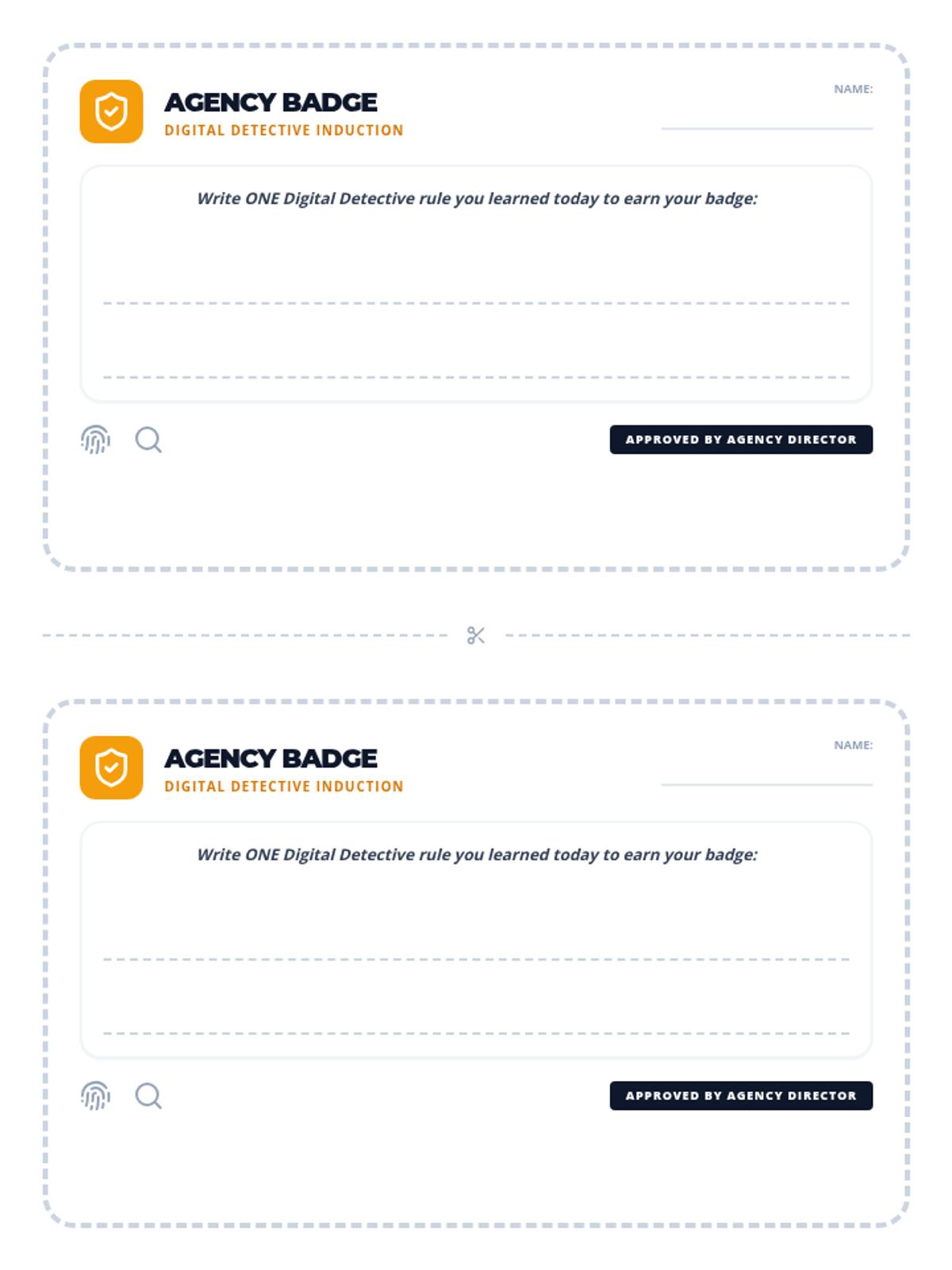
A simple exit ticket for students to demonstrate what they learned in the lesson. Two tickets per page to save on printing.
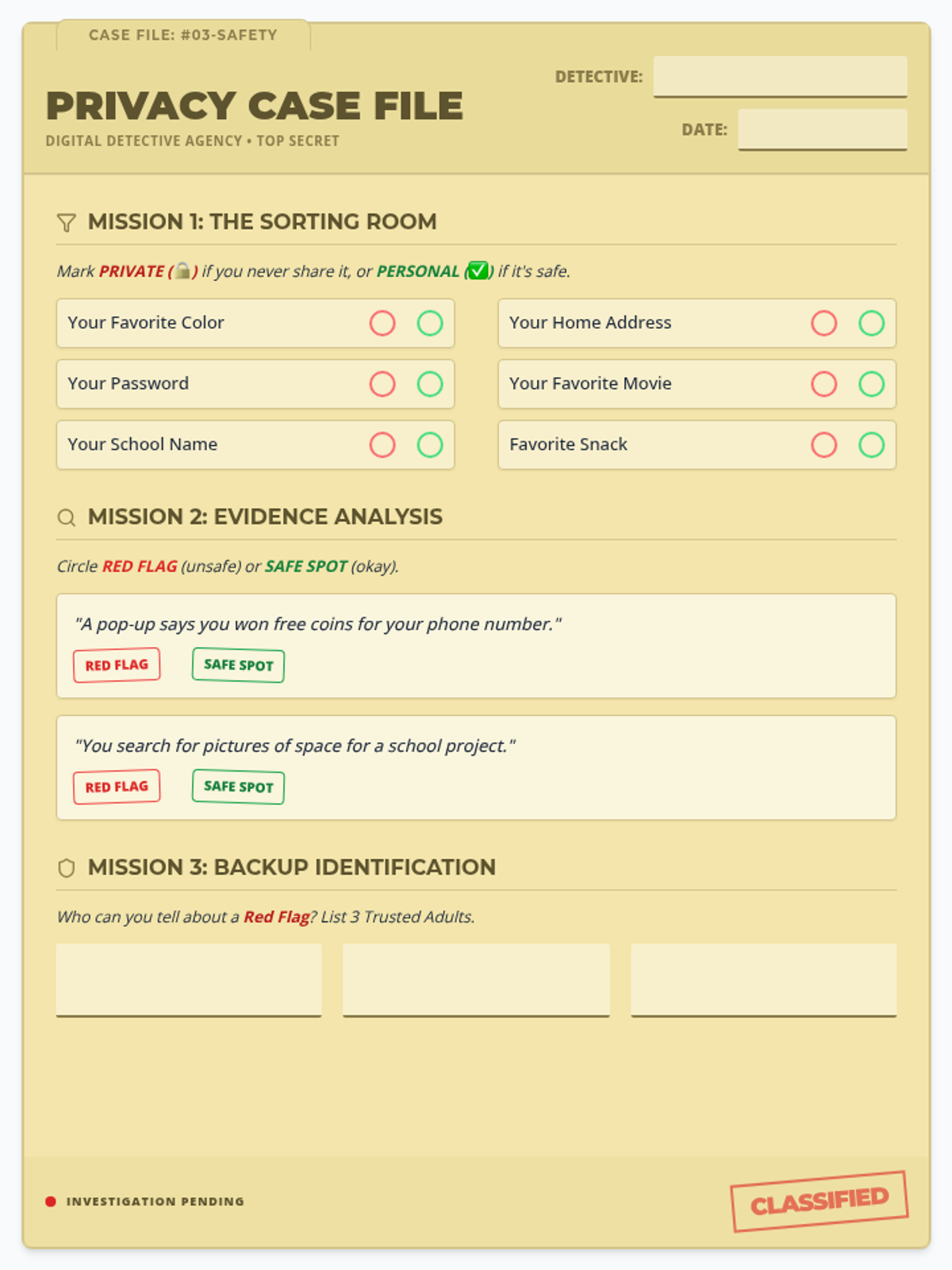
A detective-themed worksheet where students sort private vs. personal information and analyze online safety scenarios. Designed to look like a manila case file folder.
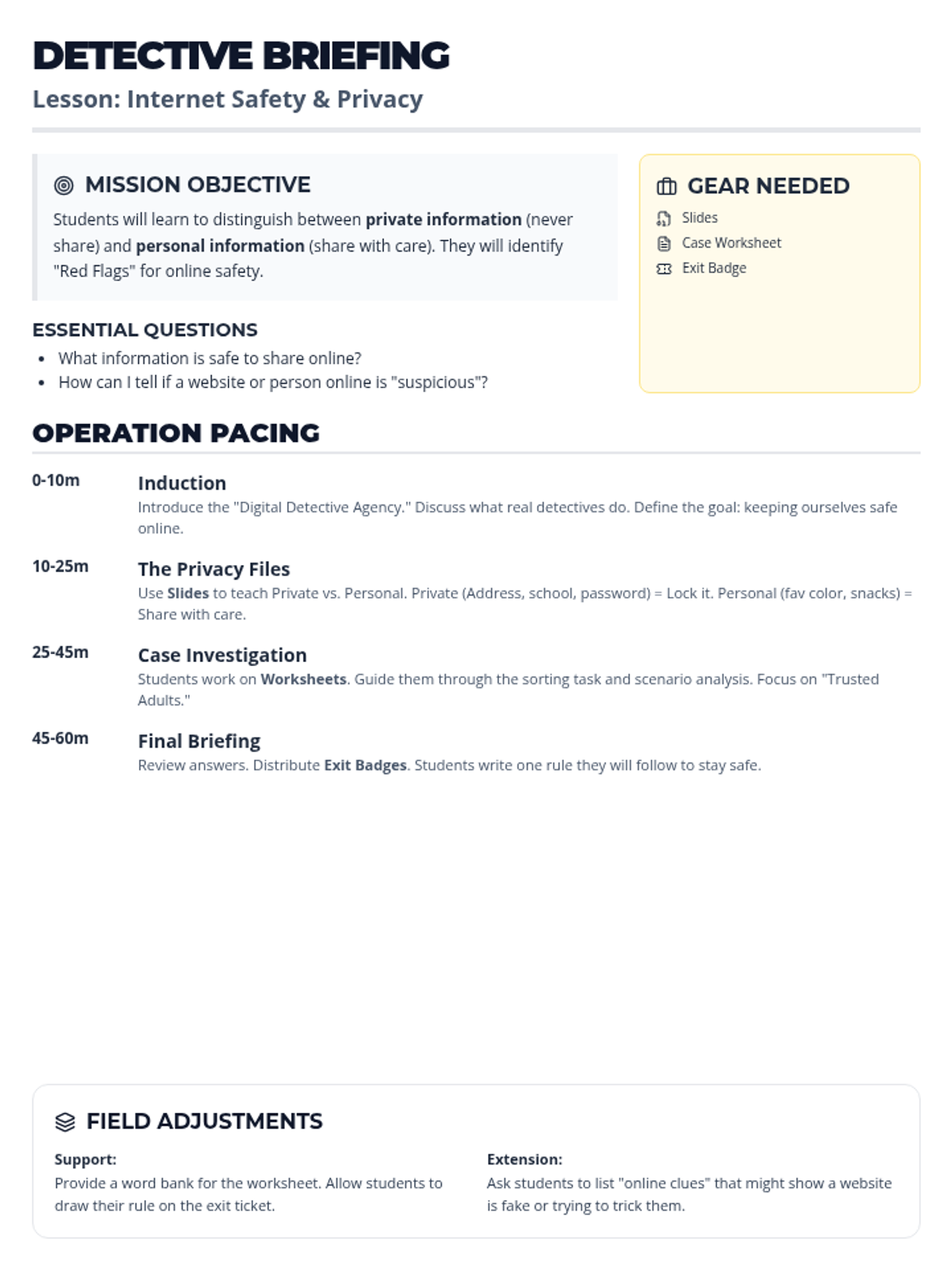
A detailed instructional guide for teachers to lead a 3rd-grade lesson on internet safety. Includes timing, objectives, essential questions, and differentiation strategies with a detective agency theme.