A structured reflection worksheet for students to record their observations and personal growth goals regarding nonverbal communication skills.
A comprehensive teacher's guide for delivering the Thought Transformers lesson. It includes talking points, instructional strategies, and tips for helping students master the concept of reframing.
A student worksheet for practicing the 'Thought Flip' technique. It provides clear, large areas for students to draw or write a negative 'Red' thought and its positive 'Green' reframe.
A visual-heavy slide presentation for elementary students about positive self-talk. It introduces the concept of 'Red' vs 'Green' thoughts and provides scenarios for reframing negative thinking.
An answer key and teacher exemplar guide for the Mindset Magic worksheet, providing sample reframed thoughts, affirmation examples, and guidance on assessing student reflections.
A student-facing worksheet for practicing reframing negative thoughts and writing personal positive affirmations. Uses the 'Brain Garden' theme with clear sections for practice and reflection.
An engaging slide presentation for 3rd-5th graders that uses the 'Brain Garden' metaphor to explain positive thinking, reframing negative thoughts, and the power of affirmations. Features visual examples and interactive prompts.
A teacher-facing facilitator guide for the Mindset Magic lesson. It includes learning objectives, materials lists, a step-by-step instructional sequence with time allocations, and differentiation strategies for 3rd-5th grade students.
A single-page vertical 'Strategy Snack Menu' with 10 grounding and self-control strategies, including 'Pump the Brakes', 5-4-3-2-1, and Muscle Melt. Designed with readable font sizes for student use on a single page. Revised to ensure high text contrast and clear page formatting.
Student worksheet for practicing the T.K.N.A. filter and 'Pump the Brakes' technique. Includes scenarios for transitions, blurting, and disagreements, plus a cut-out desk strip. Revised to fit all content on a single printable page.
Teacher facilitation guide updated with the 'Pump the Brakes' car metaphor and the T.H.I.N.K. filter. Includes scripts and an observation log for tracking behavior.
Printable desk strips for an ADHD student. Features the T.H.I.N.K. filter and the 'Pump the Brakes' car metaphor in high-contrast, gamer-themed designs.
Instructional slides for a 5th grade student focusing on impulse control through the 'Inner Remote' and 'Pump the Brakes' metaphors. Includes specific scenarios for transitions and the T.H.I.N.K. filter.
A set of printable drawing paths for the String Sync activity, ranging from easy (circular) to extreme (the Vortex spiral). Each path includes start/end markers and decreasing path widths to increase the teamwork challenge.
A comprehensive facilitator guide for the String Sync teamwork activity, including setup instructions, step-by-step procedures, and guided debrief questions focusing on communication and problem-solving.
A refined student worksheet for reflecting on daily experiences using two distinct buckets for 'good' and 'hard' events, now completely anonymous without name fields.
A detailed facilitator guide for the 'Conflict Repair Shop' lesson. Includes a 10-minute pacing guide, instructional scripts for each slide, specific role-play prompts, and tips for facilitating a writing-free SEL experience.
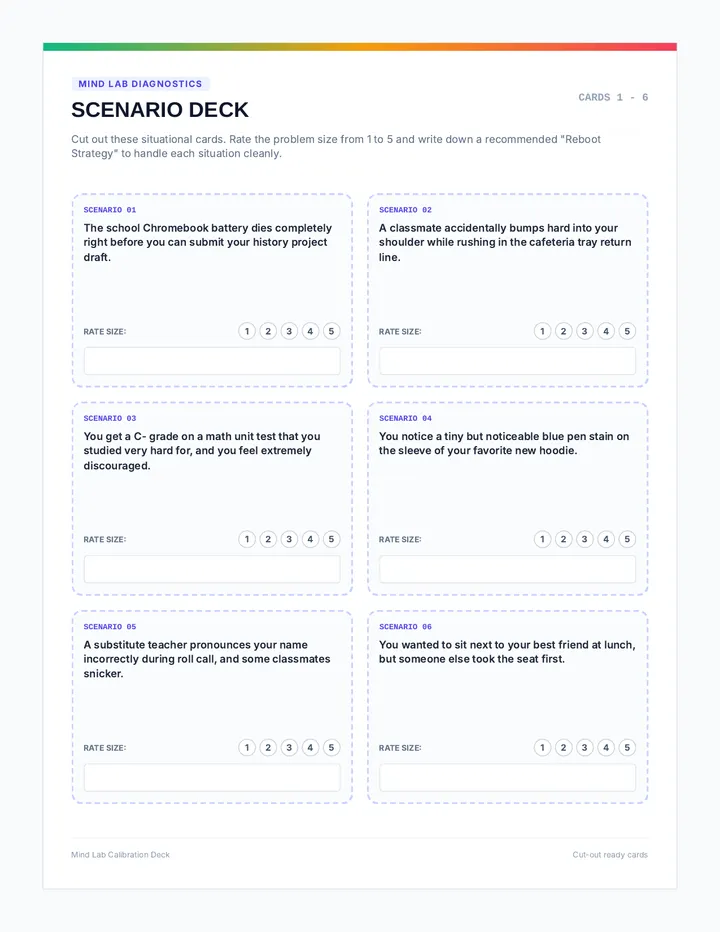
A 6-slide visual presentation for a 10-minute SEL lesson on conflict resolution. Uses a 'Repair Shop' theme with the 'Size of the Problem' scale, role-play instructions, and emotional check-ins, all designed with large text (24px+) and high-contrast visuals.
A visual presentation to launch the children's book project, featuring the 20 approved values menu, project requirements, and success criteria. Updated for individual work.
A discussion guide titled "Power Talk Leader Guide," featuring 10 questions focused on self-regulation and resilience, with specific prompts for a peer mentor to lead and advise.
A coping skills worksheet titled "Cool Head Game Plan," guiding students through identifying physical signs of anger and creating a personalized three-step reset strategy.
A structured planning worksheet for student groups to brainstorm characters, setting, conflict, and a storyboard arc for their children's book project. Updated for individual work.
A social story and role-play slide deck titled "Mastering the Pivot," teaching coping strategies for disappointment through relatable scenarios and peer-to-peer coaching.
A comprehensive project guide for creating a children's book, including an 'Approved Values Menu' of 20 core topics and the project's grading rubric. Updated for individual work.
A single display slide featuring a 6-step checklist of the performance lab procedures, including a reminders for classroom conduct and group participation. Fixed layout to prevent overlap.
Instructions for the Mystery Performance Lab, guiding students through solo reading, role assignment with tie-breakers, plot analysis, fluency practice, and final presentation.
A comprehensive 2-page follow-up worksheet for students to complete after performing or watching mystery plays. Focuses on fluency self-reflection, high-rigor character analysis, comprehension of plot devices like red herrings, and social-emotional debriefing. Optimized for print with writing lines instead of boxes. Updated terminology to "Character Change".
Six lengthened mystery/problem-solving plays featuring 4-5 characters each. Each play includes increased plot complexity, red herrings, and higher rigor dialogue focused on social-emotional conflicts. Includes a reusable analysis log template. Themes are strictly school-based with no space or weapon-related content. Every script and the analysis log are formatted to fit on a single page. Optimized with writing lines and no heavy boxes.
A student worksheet for analyzing the plot structure of a play, including sections for setting, characters, beginning, middle, end, problem, and solution. Optimized with writing lines and no heavy boxes. fits on one page.
A short model play script titled "The Missing Lunchbox" used to demonstrate play structure, characters, and dialogue. Features a friendship-based problem and solution. Dinosaur theme used for the lunchbox.
Instructional slides teaching the components of a play script (dialogue, stage directions), plot elements (beginning, middle, end, problem, solution), and fluency skills.