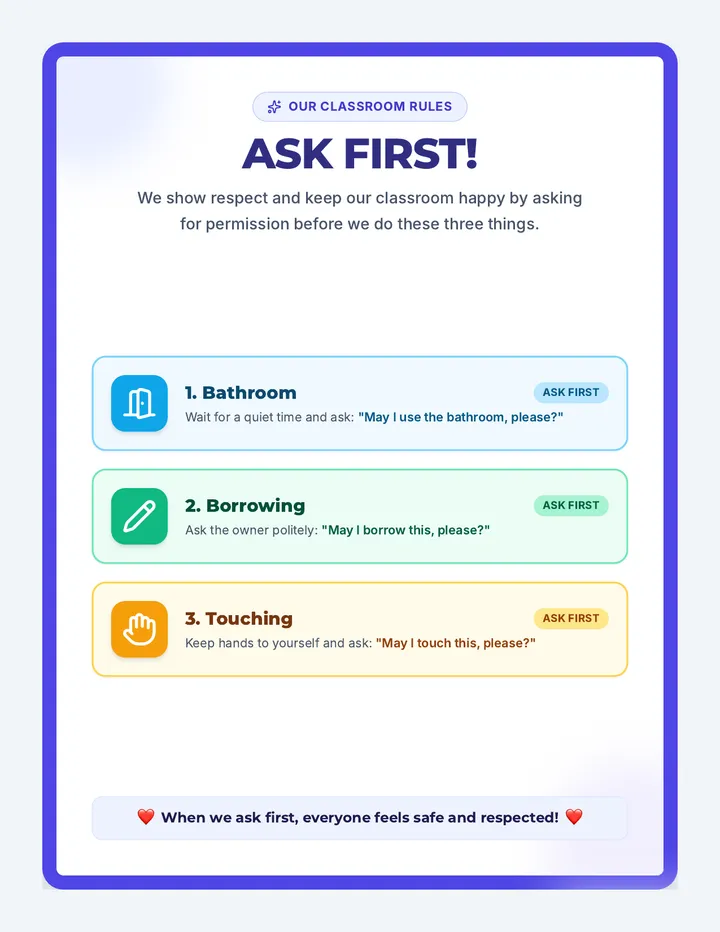
A quick exit ticket for students to demonstrate their understanding of nonverbal communication cues before ending the lesson. Features two tickets per page for easy printing.
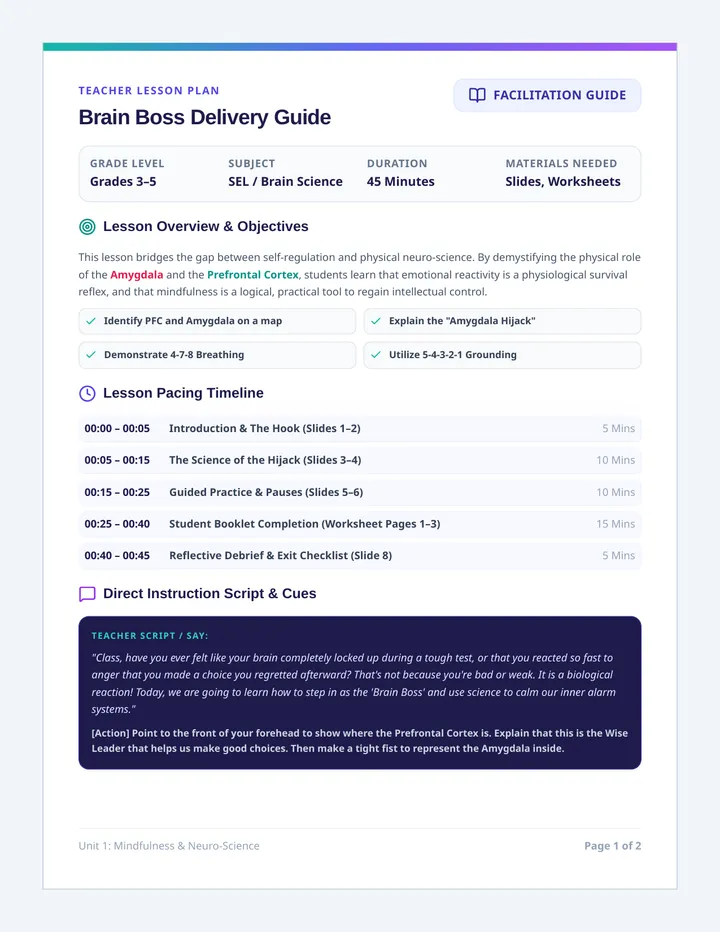
A teacher facilitation guide for the Emotional Intelligence Navigator lesson, including learning objectives, lesson flow, and differentiation strategies.
A visual presentation to introduce the four core emotions (angry, sad, worried, calm) using a weather/navigation metaphor and teaching basic self-regulation tools.
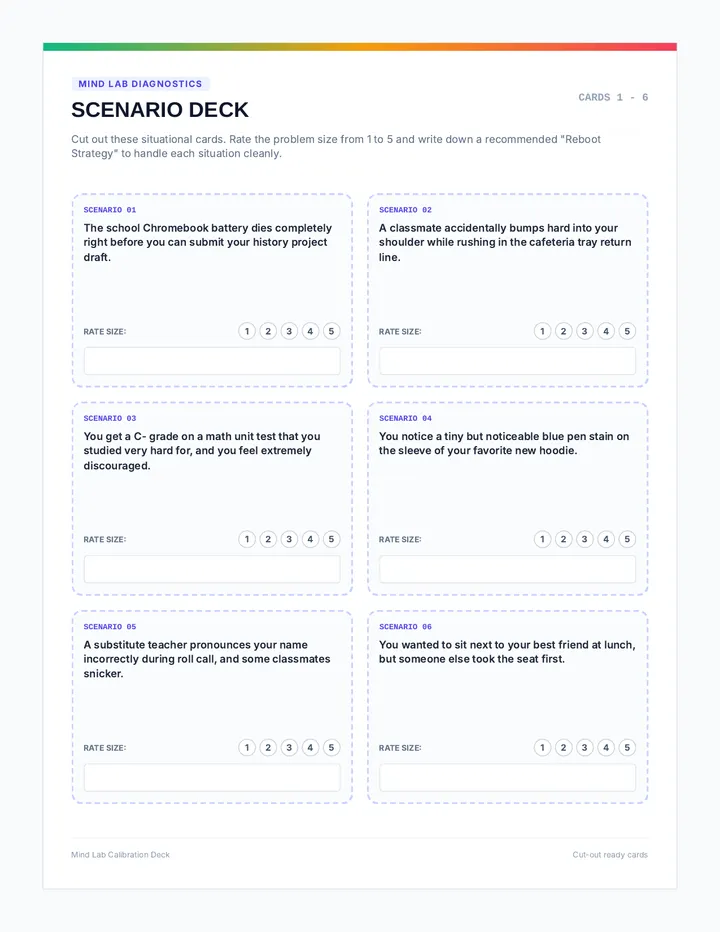
A set of printable scenario cards for calm, sad, worried, and angry emotions, designed to help students practice social-emotional regulation and perspective-taking.
A 8-slide presentation deck to accompany the Brain Pilot Academy lesson. Features high-impact visuals, the Stop-Breathe-Choose strategy, positive framing examples, and student participation prompts. Designed for teacher-led instruction. Revised with better contrast, student guidance, and an integrated printable coloring slide.
A two-page set of coloring sheets for elementary students. Features Pilot Parker in a cockpit and the "Stop, Breathe, Choose" strategy with bold outlines for creative coloring and reinforcement of lesson concepts. Revised for better character personality and print visibility. Fixed cloud overlap and page break.
A student activity sheet for practicing social-emotional skills. Revised with optimized page breaks, larger writing areas (h-14), and a more comprehensive personal "Flight Plan" on the second page. Removed bracketed placeholders.
A two-page narrative-style social story featuring "Pilot Parker." Page 1 contains the high-impact illustrated story, and Page 2 provides a "Post-Flight Debrief" with generous handwriting space for reflection questions. Revised for better page flow and larger writing areas. Backgrounds for work areas updated to white for better visibility. Fixed page breaks and drop-cap alignment.
Two bold, visual anchor charts designed for classroom display. The first chart, "Mission Control," outlines the Stop-Breathe-Choose strategy for impulse control. The second chart, "Brain Upgrades," provides specific examples of replacing negative self-talk with positive framing. Revised with high-impact text sizes and optimized layout for wall display.
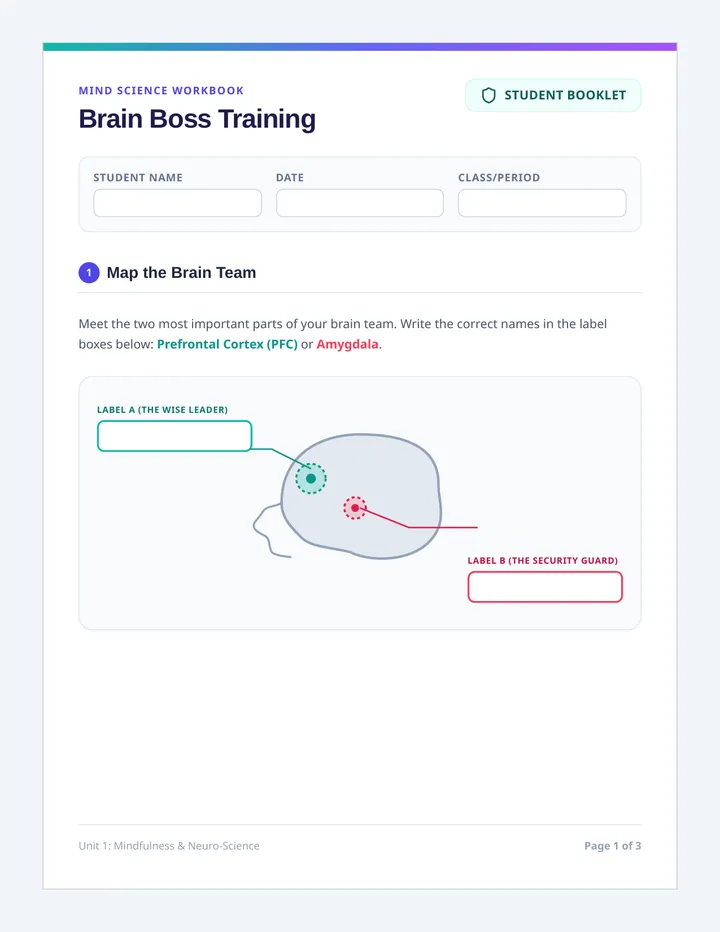
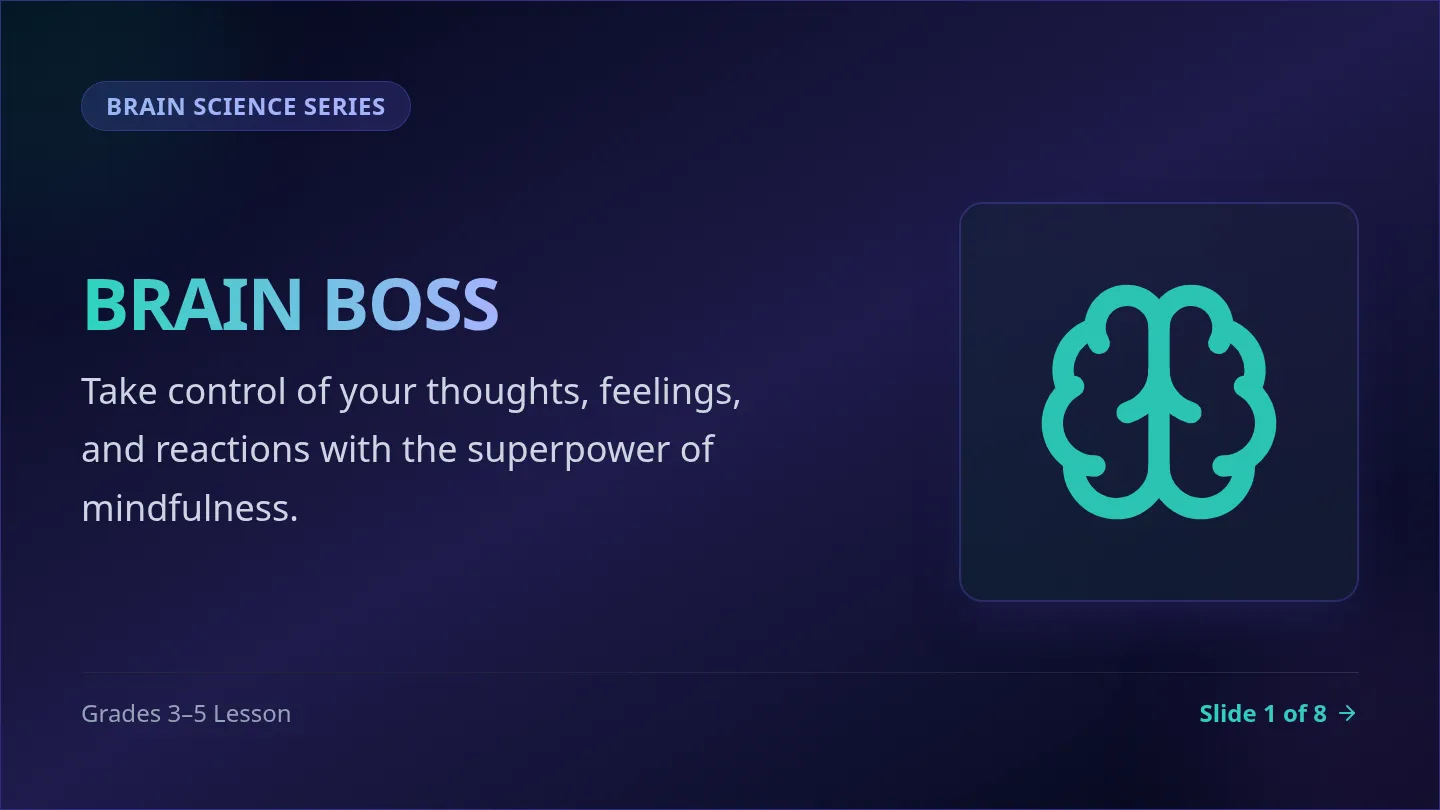
A comprehensive 45-minute lesson plan for teachers, outlining a "Brain Pilot" themed approach to teaching impulse control, deep breathing, and positive framing. Includes learning targets, a detailed instructional sequence, and differentiation tips.
A large-format classroom anchor chart (poster) that visually reinforces the 'Comedy Compass' system. It uses high-contrast icons, bold color-coded zones for Green (Go) and Red (Stop) times, and prominently features the core self-regulation question for students to reference at a glance.
A compact, visually high-contrast reference card for students. It features the Green and Red zones of humor, teacher social cues to watch for, and the core 'Check-In' question to help students self-regulate their classroom jokes.
A teacher guide for the Comedy Compass lesson. It includes objectives, pacing, discussion questions, common misconceptions about humor timing, and differentiation tips for varied learners.
A student worksheet for auditing classroom humor timing. It features signal identification exercises and reflective prompts on how humor impacts classroom dynamics and following teacher cues.
A comprehensive 8-slide presentation designed to help students understand the social nuances of humor in the classroom. It uses a 'Comedy Compass' theme to categorize situations into 'Green Zones' (appropriate times) and 'Red Zones' (focused learning times), emphasizing the importance of following teacher directions and reading social cues.
A comprehensive teacher's guide for delivering the Thought Transformers lesson. It includes talking points, instructional strategies, and tips for helping students master the concept of reframing.
A student worksheet for practicing the 'Thought Flip' technique. It provides clear, large areas for students to draw or write a negative 'Red' thought and its positive 'Green' reframe.
A visual-heavy slide presentation for elementary students about positive self-talk. It introduces the concept of 'Red' vs 'Green' thoughts and provides scenarios for reframing negative thinking.
An answer key and teacher exemplar guide for the Mindset Magic worksheet, providing sample reframed thoughts, affirmation examples, and guidance on assessing student reflections.
A student-facing worksheet for practicing reframing negative thoughts and writing personal positive affirmations. Uses the 'Brain Garden' theme with clear sections for practice and reflection.
An engaging slide presentation for 3rd-5th graders that uses the 'Brain Garden' metaphor to explain positive thinking, reframing negative thoughts, and the power of affirmations. Features visual examples and interactive prompts.
A teacher-facing facilitator guide for the Mindset Magic lesson. It includes learning objectives, materials lists, a step-by-step instructional sequence with time allocations, and differentiation strategies for 3rd-5th grade students.
A single-page vertical 'Self-Control Strategy Menu' with 10 grounding and self-control strategies, including 'Pump the Brakes', 5-4-3-2-1, and Muscle Melt. Features the THINK acronym (Thoughtful, Honest, Important, Necessary, Kind/Appropriate) in the footer. Revised for user specific word choices.
Student worksheet for practicing the T.H.I.N.K. filter and 'Pump the Brakes' technique. Includes scenarios for transitions, blurting, and disagreements, plus a cut-out desk strip. Revised to include specific words for the THINK acronym: Thoughtful, Honest, Important, Necessary, Kind/Appropriate. Includes larger legible text for acronym labels.
Teacher facilitation guide updated with the 'Pump the Brakes' car metaphor and the T.H.I.N.K. filter (Thoughtful, Honest, Important, Necessary, Kind/Appropriate). Includes scripts and an observation log.
Printable desk strips for an ADHD student. Features the T.H.I.N.K. filter (Thoughtful, Honest, Important, Necessary, Kind/Appropriate) and the 'Pump the Brakes' car metaphor.
Instructional slides for a 5th grade student focusing on impulse control through the 'Inner Remote' and 'Pump the Brakes' metaphors. Includes specific scenarios for transitions and the T.H.I.N.K. filter (Thoughtful, Honest, Important, Necessary, Kind/Appropriate).
A set of printable drawing paths for the String Sync activity, ranging from easy (circular) to extreme (the Vortex spiral). Each path includes start/end markers and decreasing path widths to increase the teamwork challenge.
A comprehensive facilitator guide for the String Sync teamwork activity, including setup instructions, step-by-step procedures, and guided debrief questions focusing on communication and problem-solving.
A refined student worksheet for reflecting on daily experiences using two distinct buckets for 'good' and 'hard' events, now completely anonymous without name fields.
A detailed facilitator guide for the 'Conflict Repair Shop' lesson. Includes a 10-minute pacing guide, instructional scripts for each slide, specific role-play prompts, and tips for facilitating a writing-free SEL experience.
A 6-slide visual presentation for a 10-minute SEL lesson on conflict resolution. Uses a 'Repair Shop' theme with the 'Size of the Problem' scale, role-play instructions, and emotional check-ins, all designed with large text (24px+) and high-contrast visuals.