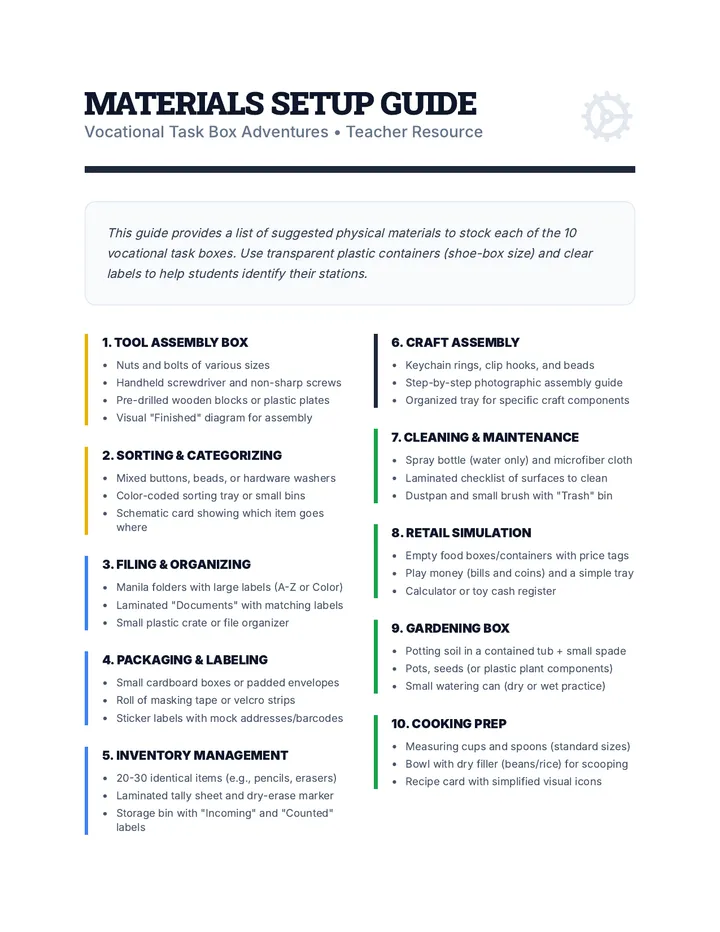
Post-secondary education pathways, independent living requirements, and vocational training strategies for students with diverse needs. Targets career goal setting and the development of essential daily life skills for adult independence.
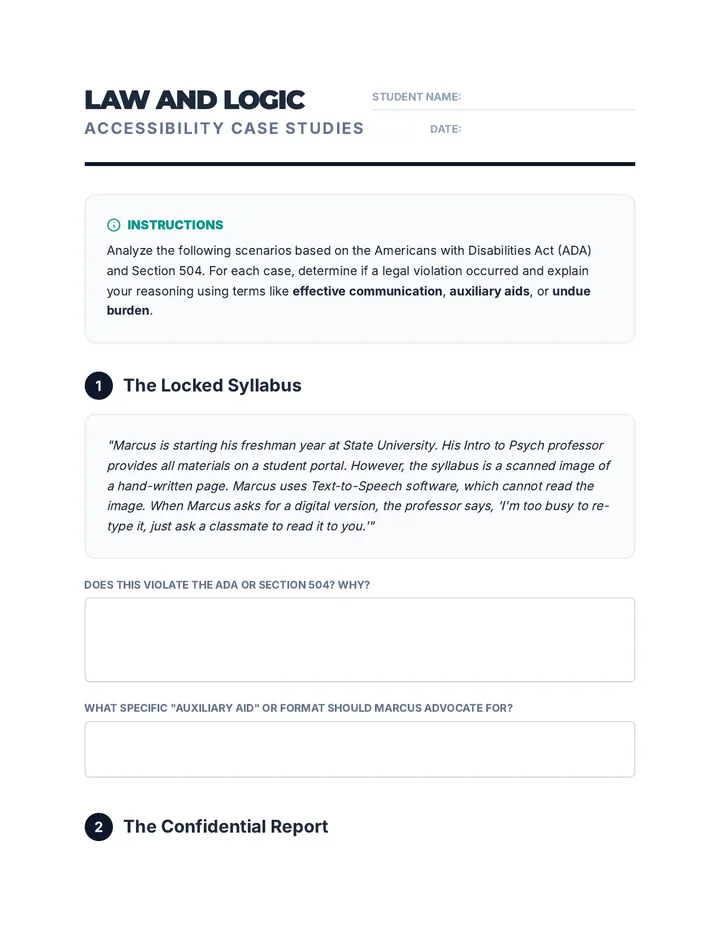
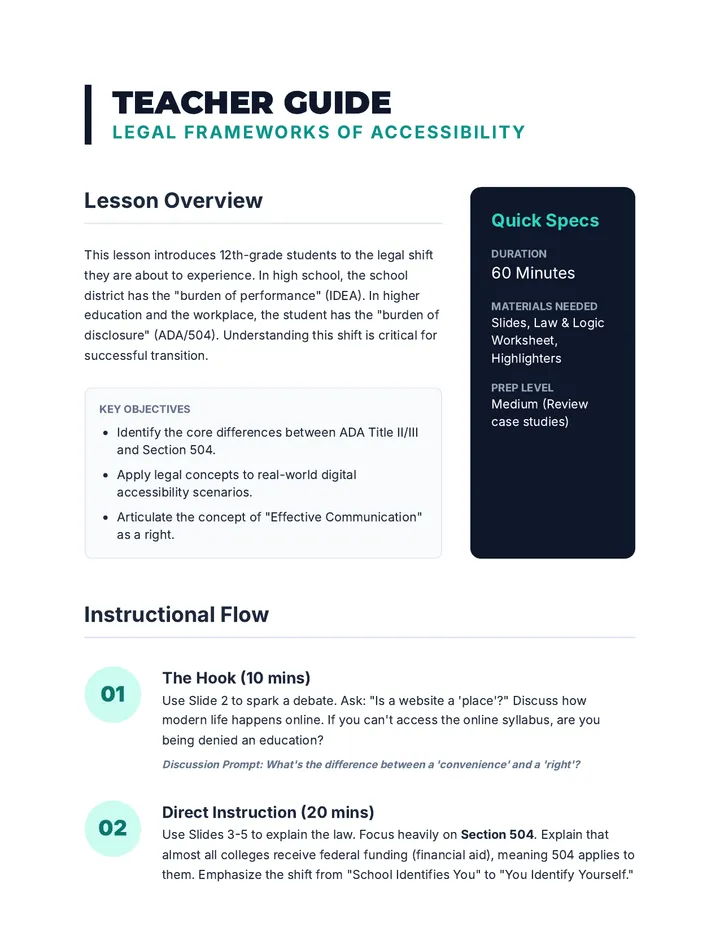
A comprehensive transition sequence for 12th-grade students focusing on the legal, professional, and practical aspects of using Text-to-Speech (TTS) and other assistive technologies in higher education and the workplace. Students learn to advocate for their rights under the ADA and Section 504 through role-play, professional writing, and portfolio building.
An inquiry-based exploration for 12th-grade students into the sustainability of the special education profession. Students investigate the causes of teacher burnout and develop strategic organization, delegation, and boundary-setting habits to ensure long-term career success and mental well-being.
A self-advocacy sequence for 11th-grade students to manage working memory challenges by requesting single-step directions and professional modifications in fast-paced environments.
A vocational training sequence for 11th-grade students focusing on working memory through single-step directions in workplace safety contexts. Students practice interpreting signs, filtering auditory distractions, and following strict protocols in high-stakes simulations.
A vocational and life skills sequence focusing on procedural assembly for 12th-grade students with working memory needs. Students practice strict single-step adherence through inventory, fastening, partner systems, and spatial orientation tasks to ensure structural success.
This sequence focuses on teaching 12th-grade students with working memory needs how to isolate, rehearse, and verify single-step verbal and visual instructions in a vocational setting. Through simulations and skill-building activities, students learn to filter extraneous information and prioritize safety and accuracy over speed.
This sequence focuses on vocational and life skills, applying single-step direction following to physical assembly and procedural tasks. Students learn to navigate technical diagrams and standard operating procedures by isolating one action at a time to support working memory.
A comprehensive graduate-level sequence for future Assistive Technology specialists, focusing on the pedagogical strategies required to teach keyboard navigation and shortcuts to individuals with disabilities. The course covers assessment, scaffolding, gamification, and emotional resilience in AT training.
A specialized training program for graduate students in Special Education to master high-efficiency assistive technology navigation. Students learn to use keyboard shortcuts to perform professional-level document editing, spreadsheet management, and presentation design, with a focus on vocational rehabilitation.
A 10th-grade Special Education sequence focusing on mastering keyboard shortcuts within vocational contexts like email, scheduling, and troubleshooting to build professional independence.
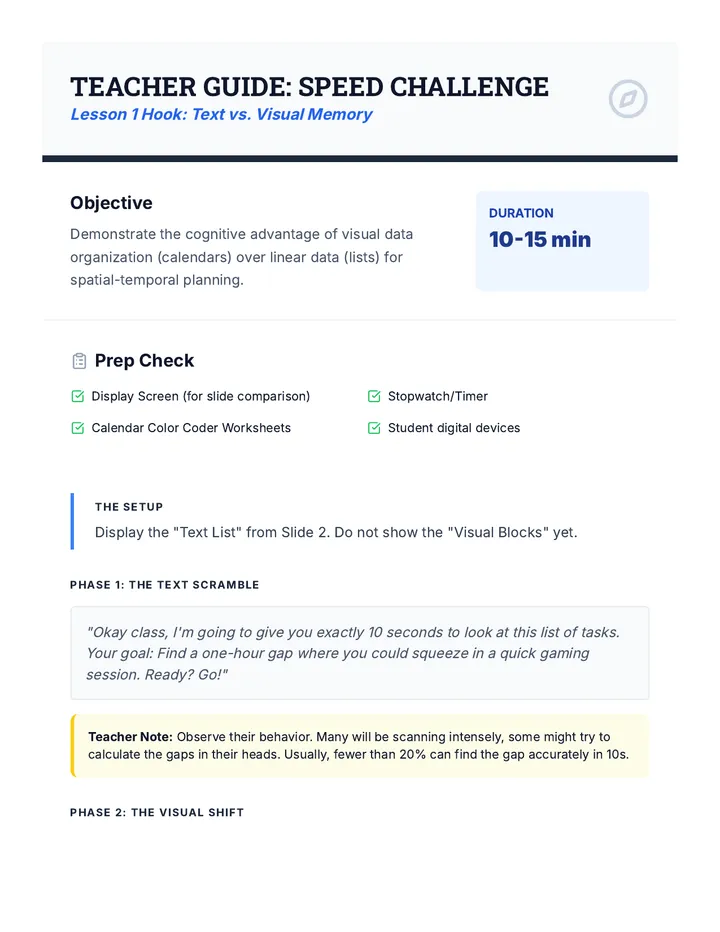
A vocational-readiness sequence for 9th-grade students focusing on mastering assistive technology through keyboard shortcuts in professional communication tools (email and calendar). Students develop digital independence by learning to manage high-volume communication without mouse interaction, preparing them for workplace efficiency and accessibility.
A comprehensive sequence for 12th-grade students on mastering web browser navigation using keyboard shortcuts. This unit covers address bar manipulation, tab management, link navigation, form interaction, and integrated research workflows to build independence and efficiency in digital environments.
A sequence for 10th-grade students focusing on the strategic implementation and self-advocacy of speech recognition technology. Students learn to analyze writing barriers, audit environmental noise, advocate for their needs, troubleshoot technical failures, and create a formal technology implementation plan for future transition to college or career.
A 5-lesson sequence for 9th-grade students to build and maintain a physical 'Advocacy Portfolio' of their Special Education documentation. This unit teaches document literacy, physical organization, and the importance of record-keeping for self-advocacy.
An advanced sequence for graduate students exploring the legal and theoretical underpinnings of self-advocacy in special education. Students analyze the shift from paternalism to self-determination, the legal nuances of 'appropriate' education, and the ethical implications of disability disclosure.
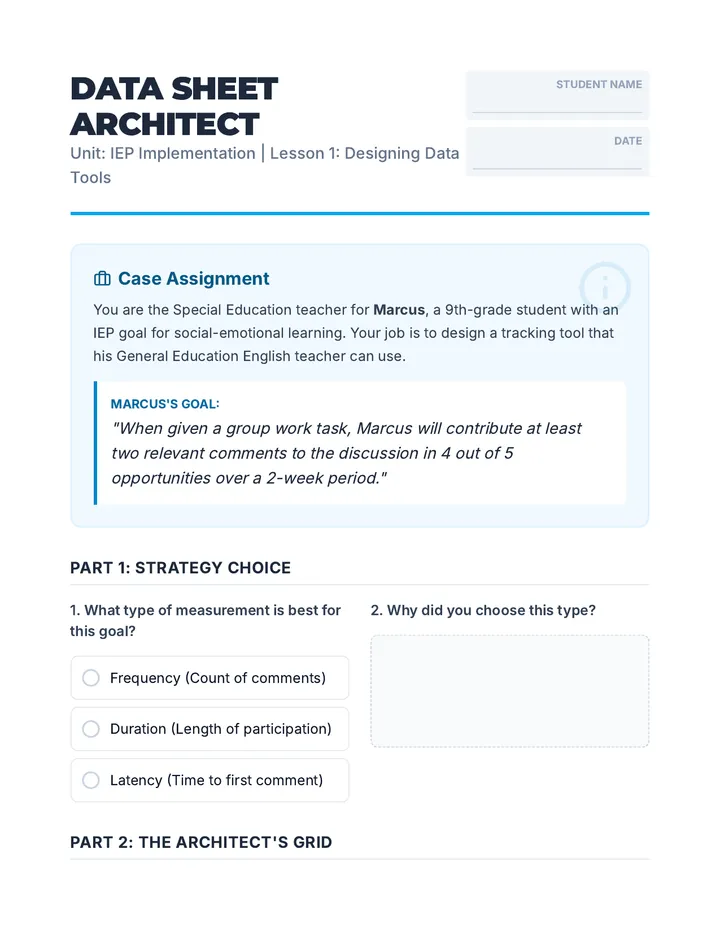
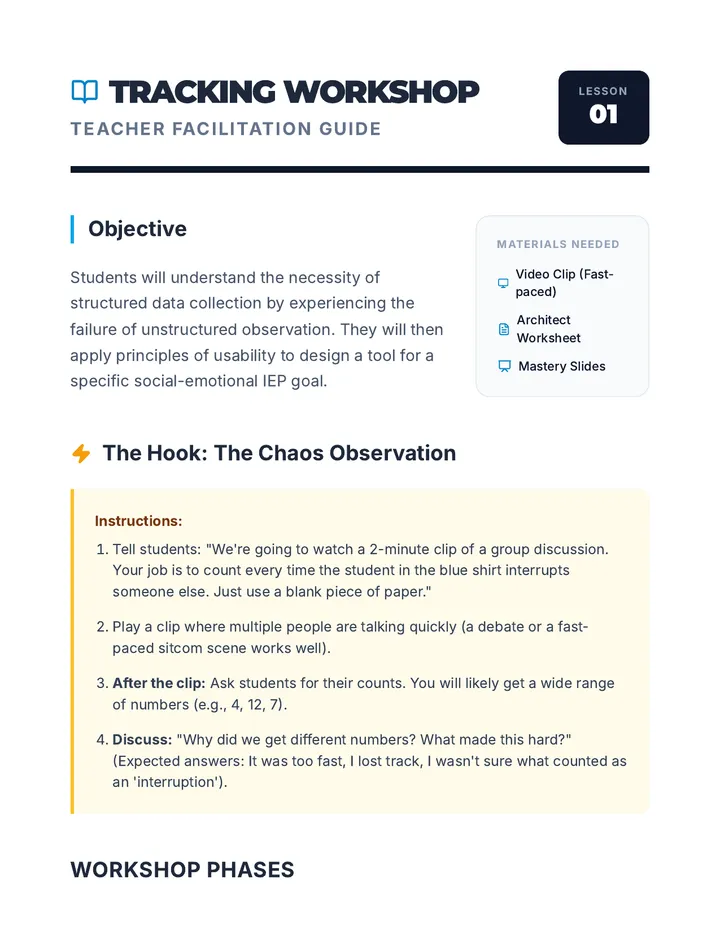
This sequence introduces students to Universal Design principles and data tracking through physical organization. Students will learn to design, implement, and stress-test labeling and storage systems that are accessible to diverse users, building vocational skills in logistics and systems design.
A project-based sequence for 4th graders to prepare for their own IEP or 504 meetings. Students build self-awareness and self-advocacy skills by creating a 'Student Input' presentation to share their strengths, needs, and goals with adult stakeholders.
A specialized sequence for 9th-grade students focusing on working memory strategies within vocational contexts. Students learn to deconstruct complex protocols, use checklists, chunk tasks, and utilize professional communication to manage multi-step directions effectively in the workplace.
A 5-lesson sequence for 11th-grade students focused on using technology to compensate for working memory challenges. Students learn to use voice capture, AI task breakdown, and location-based alerts to create a robust 'external brain' for managing multi-step directions.
A metacognitive sequence for 12th-grade students to understand their working memory profiles and build a personalized 'external brain' toolkit for following multi-step directions. Students move from self-diagnosis to strategy mastery and finally to self-advocacy for transition to college or the workforce.
A graduate-level sequence focused on the clinical transition from contrived token systems to natural reinforcement, covering social praise conditioning, schedule thinning, level systems, self-monitoring, and long-term exit strategies.
A professional, project-based sequence where students act as behavioral consultants to design, budget, and pitch a comprehensive token economy intervention. Students analyze complex cases, manage resources, and develop staff training protocols to ensure sustainable behavioral change.
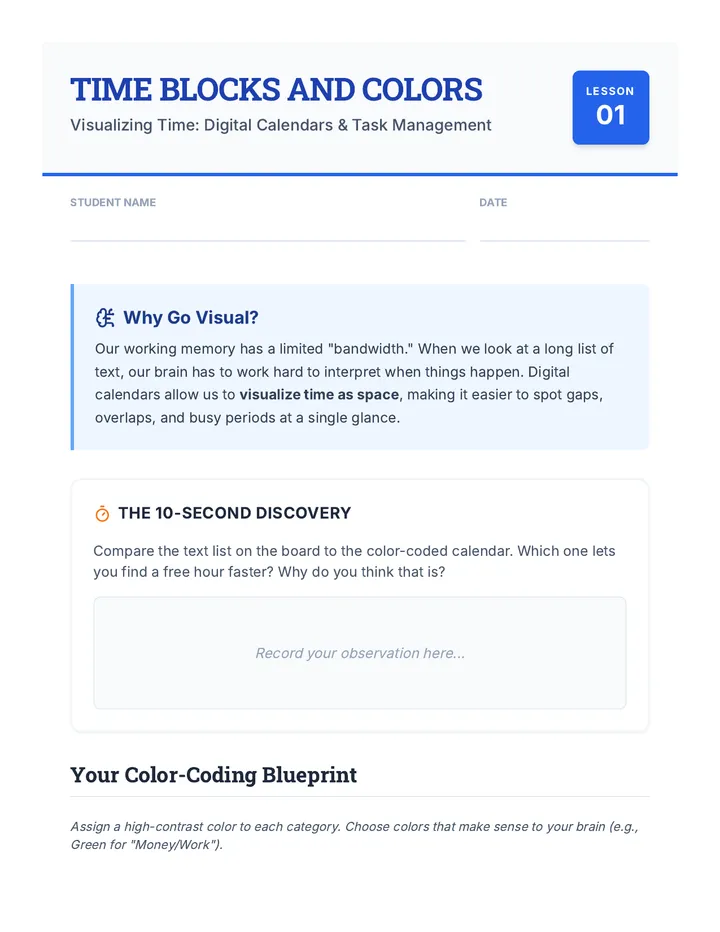
This sequence teaches 11th-grade students how to use digital visual systems (calendars, Kanban boards, and widgets) to support working memory and executive function. Students transition from reactive list-making to proactive visual time and task management, preparing them for the demands of college and career environments.
A 5-lesson sequence for 12th-grade students with working memory challenges, focusing on using assistive technology to break down complex tasks into manageable single-step directions. Students explore checklists, voice assistants, photo-based instructions, and QR codes to build independence through digital literacy.
A specialized instructional unit for 12th-grade students focusing on overcoming working memory challenges through single-step task execution. This sequence teaches students to use 'masking', task deconstruction, and binary decision-making to master complex home maintenance and independent living tasks.
A comprehensive sequence for 11th-grade students to master the organization, maintenance, and management of sensory tools and classroom resources. Students transition from identifying tools to designing professional-grade inventory and hygiene systems.
This sequence empowers 12th-grade students to identify and leverage digital accessibility tools for independent study. Students move from exploring assistive technology to curating a personalized digital study ecosystem, culminating in a self-advocacy portfolio for post-secondary success.
This sequence prepares 12th-grade students with working memory challenges for post-secondary life by teaching them how to deconstruct complex projects, externalize their executive functions, and monitor their own cognitive fatigue. Students progress from task analysis to a full independent workflow simulation, building a toolkit of strategies for sustained attention.
This graduate-level sequence explores the psychological and ethical complexities of reinforcement. It contrasts traditional behavioral perspectives with Self-Determination Theory, examines the overjustification effect, and addresses cultural responsiveness and ethical codes in behavioral support.
A comprehensive graduate-level sequence on designing, implementing, and monitoring systemic reinforcement interventions. Students move from the theoretical foundations of positive reinforcement to the practical design of token economies, group contingencies, and behavioral contracts, concluding with data-based decision-making and generalization strategies.
A comprehensive sequence for undergraduate students exploring the ethical transition from external reinforcement to natural contingencies. Students analyze ethics codes, debate motivation theories, and master technical strategies for fading support and ensuring long-term behavior maintenance.
A 5-lesson sequence for 9th-grade Special Education students focused on building independence by replacing verbal prompts with visual systems. Students learn to use checklists and visual anchors to initiate tasks without teacher intervention.

A metacognitive, project-based sequence where students investigate personal task initiation barriers and engineer custom 'Start Systems' to foster independence and reduce reliance on external prompting.
A comprehensive sequence for 12th-grade students to transition from adult-led prompts to independent task initiation using visual anchors, timers, and self-monitoring.
A sequence of five lessons designed for 12th-grade students in special education, focusing on using visual models like bar diagrams, area models, and double number lines to demystify financial math. Students transition from abstract calculations to concrete visual representations of wages, budgeting, savings, and loan comparisons.
This sequence teaches 12th-grade students with working memory needs how to manage adult personal logistics (finances, scheduling, security) using information chunking and categorization strategies.
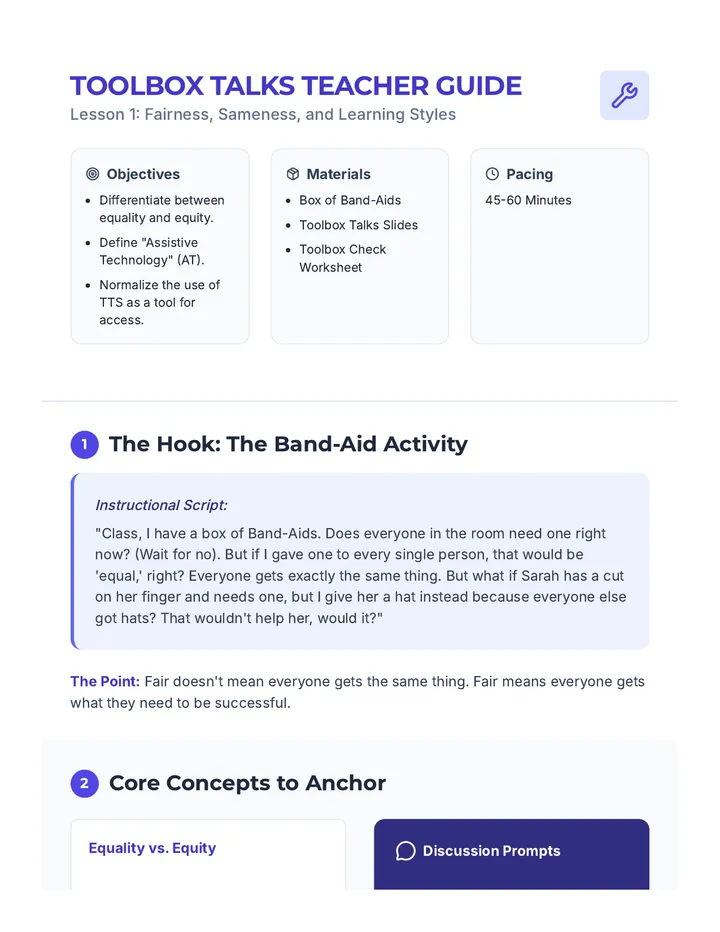
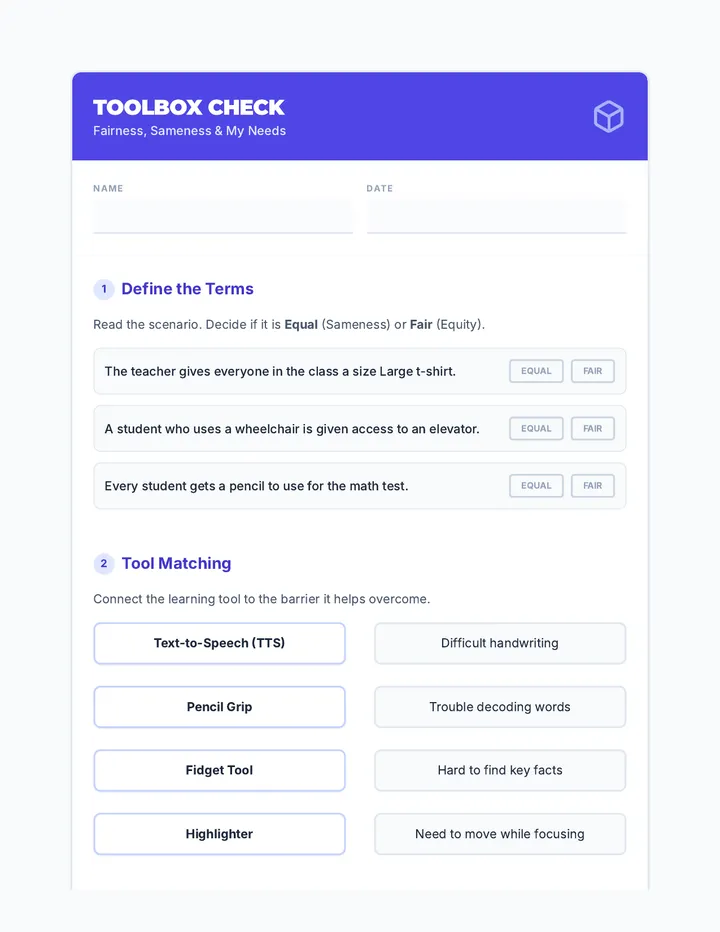
This sequence empowers 5th-grade students to understand, use, and advocate for Text-to-Speech (TTS) as a vital learning tool. It focuses on the distinction between fairness and sameness, identifying specific tasks where TTS is most effective, and building the social-emotional confidence to communicate needs to teachers and peers.
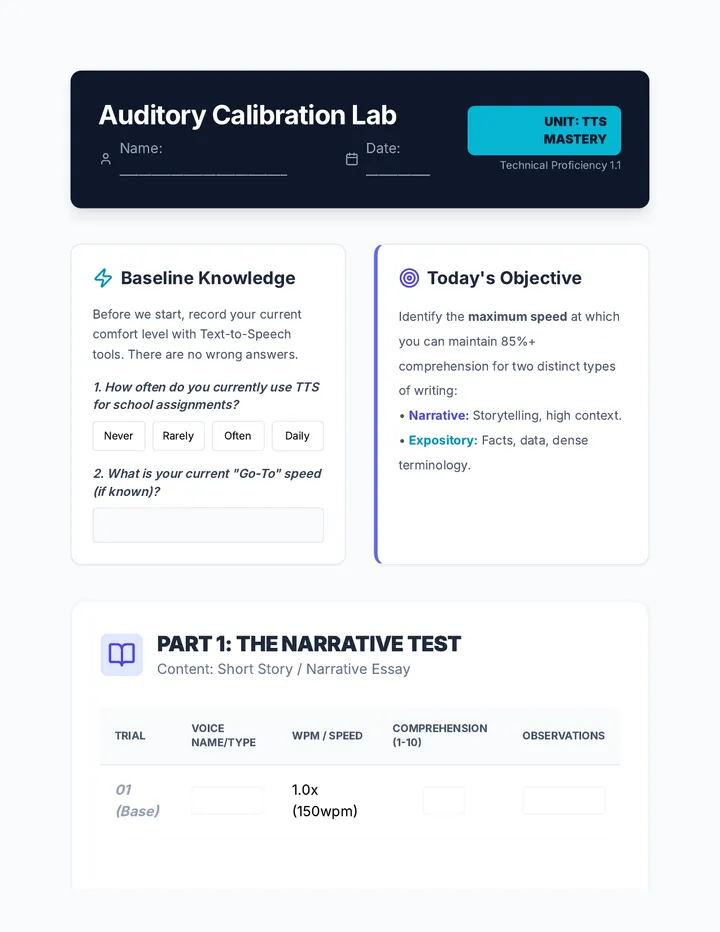
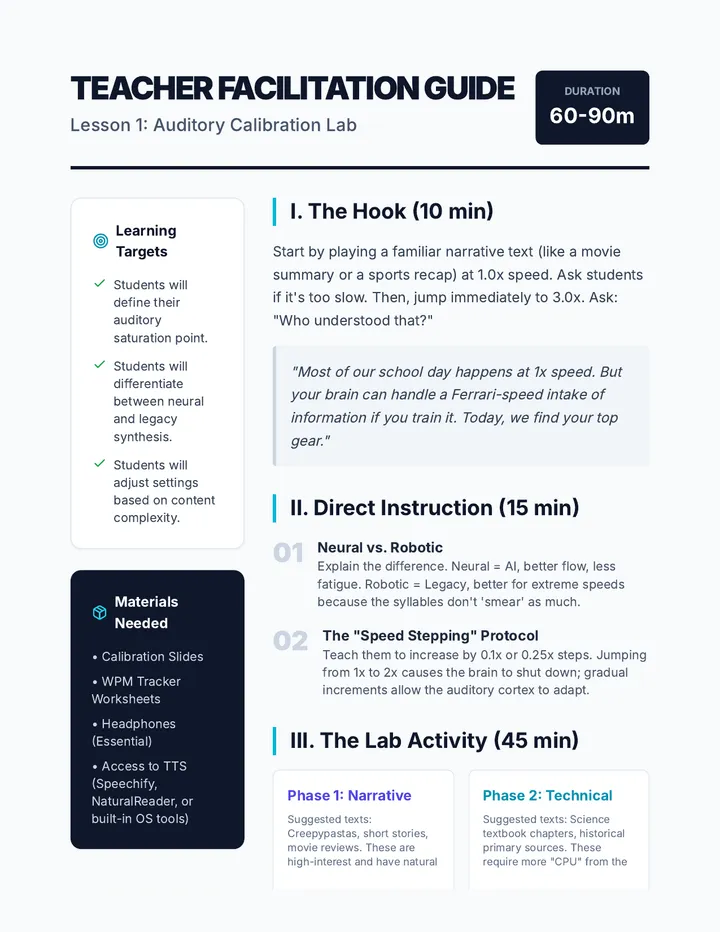
This sequence equips 12th-grade students with advanced technical skills in Text-to-Speech (TTS) technology. It moves beyond basic tool usage to professional-grade workflows, including auditory calibration, OCR conversion, immersion reading, mobile synchronization, and technical troubleshooting, preparing students for the heavy reading demands of post-secondary environments.
A technical sequence designed for high school students to master text-to-speech (TTS) tools. It covers tool selection, voice optimization, navigation shortcuts, troubleshooting inaccessible formats like PDFs, and ends with students creating a personal accessibility profile for independent academic success.
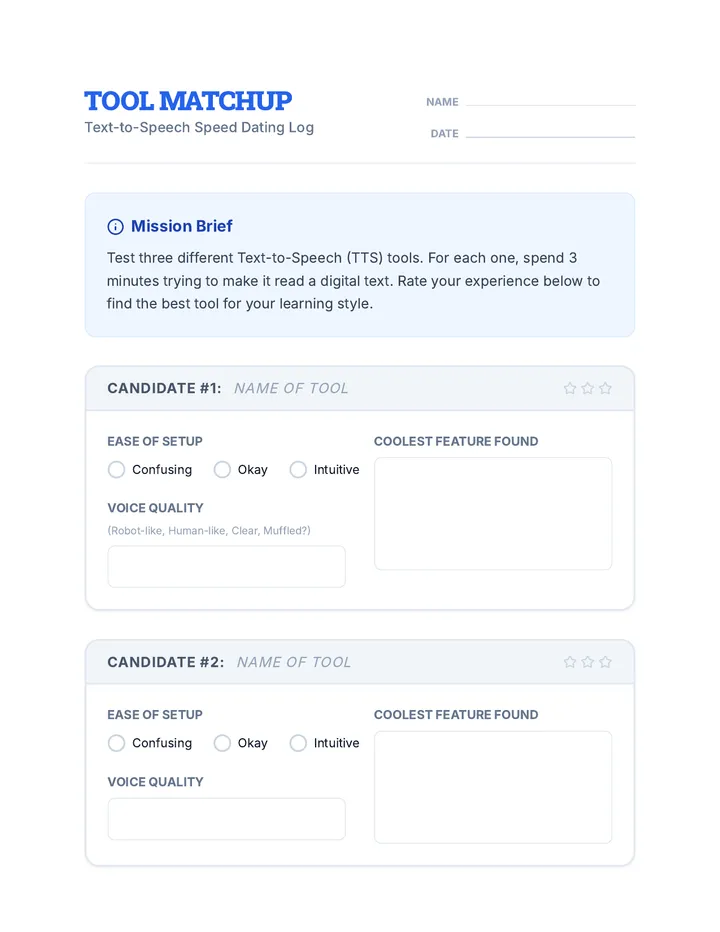
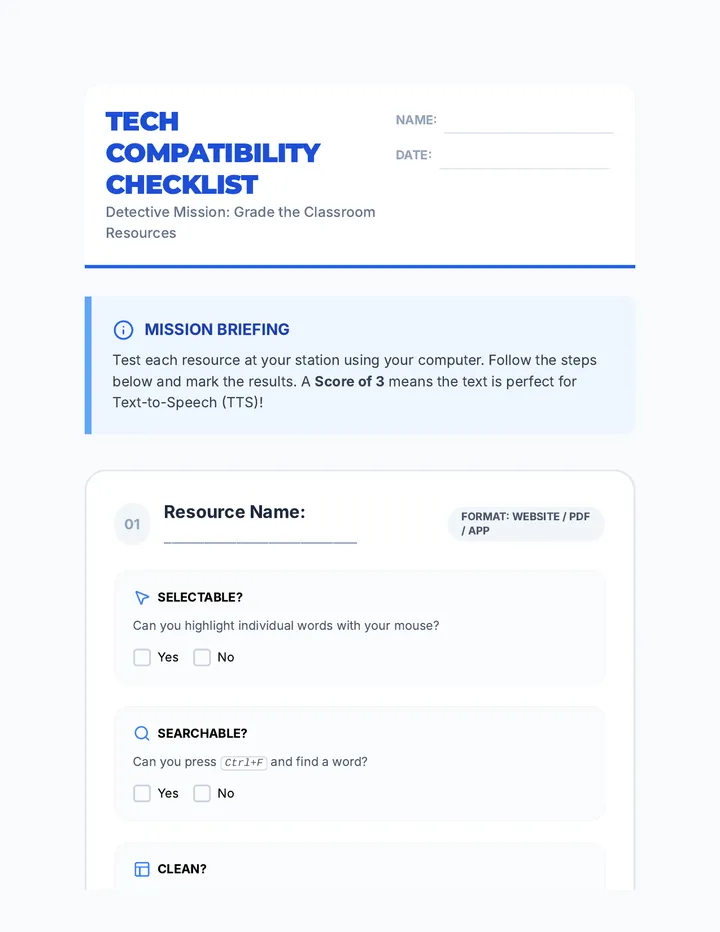
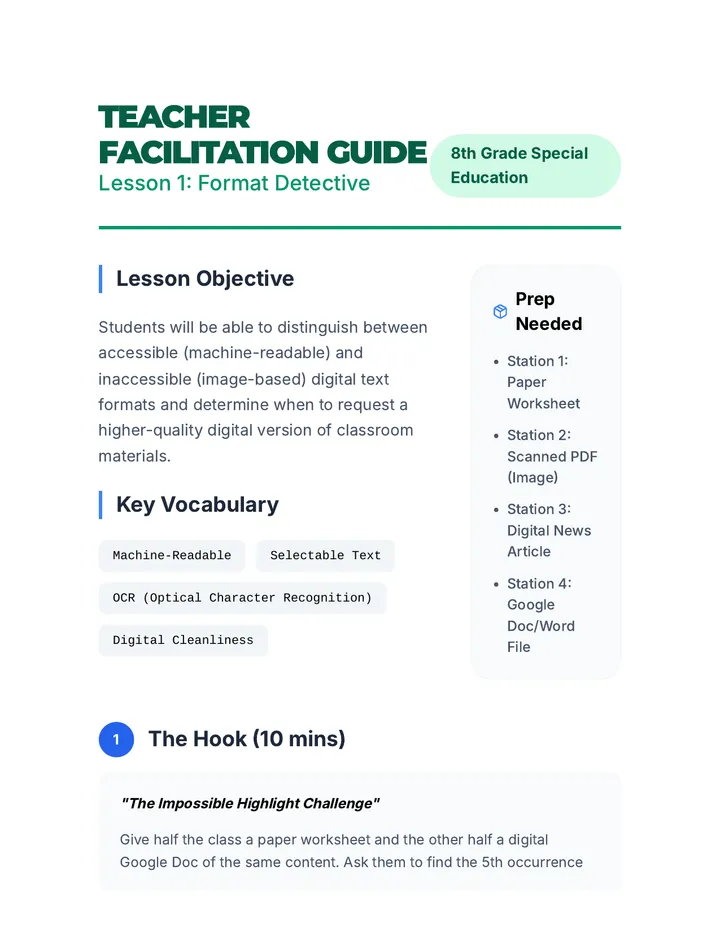
A 5-lesson sequence for 8th-grade students to master Text-to-Speech (TTS) tools, develop self-advocacy skills for accessible materials, and create a personalized digital accessibility plan for high school. Students transition from identifying accessible content to independently managing their accommodations across various academic environments.
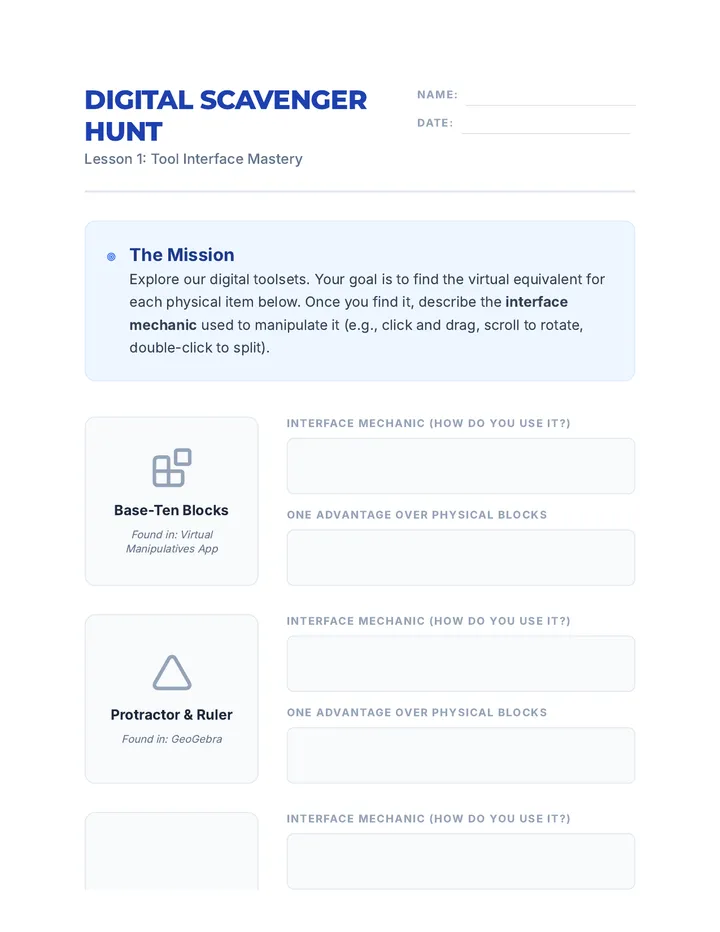
A 5-lesson sequence for 11th-grade students transitioning from physical math manipulatives to virtual tools. The curriculum emphasizes digital literacy, strategic tool selection, and self-advocacy to prepare students for post-secondary academic environments.
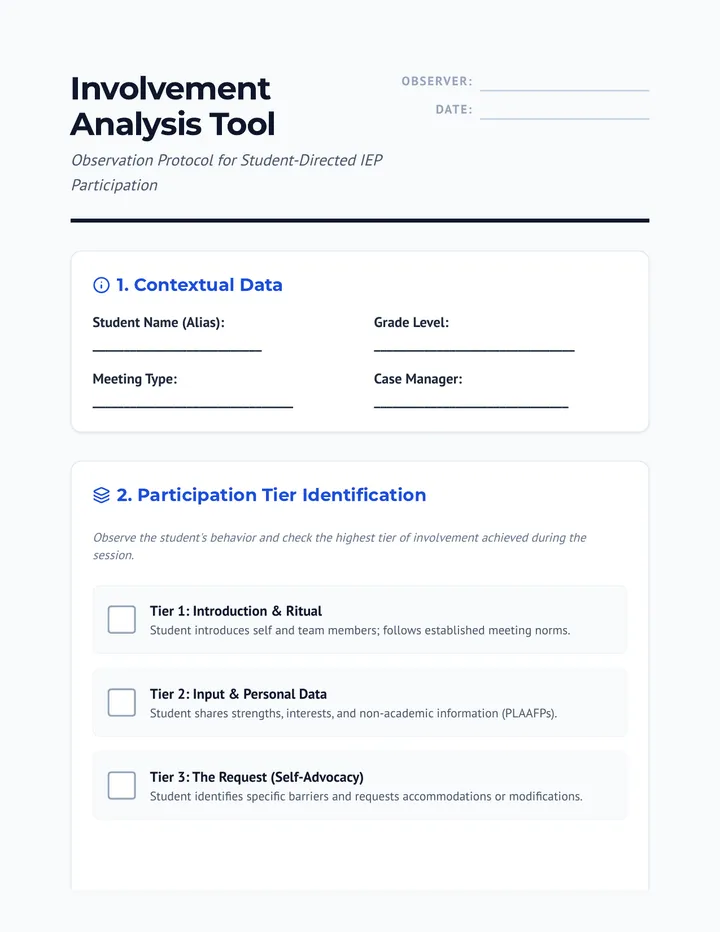
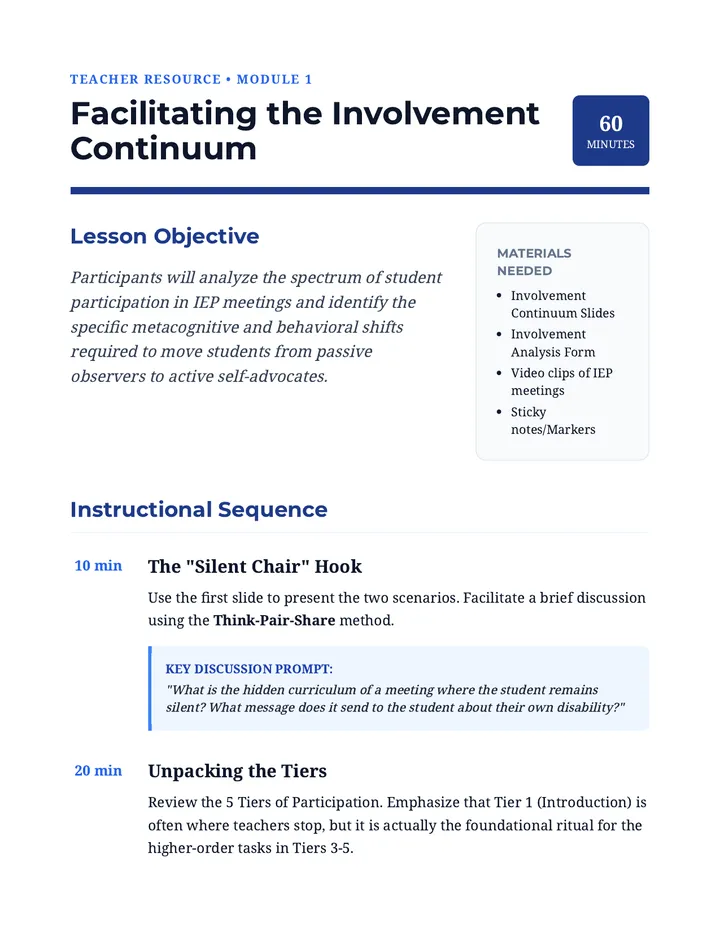
A comprehensive sequence for graduate students to master the implementation of Student-Led IEPs (SLIEPs). This sequence explores the continuum of student involvement, preparation protocols, visual advocacy aids, meeting facilitation techniques, and post-meeting reflection to empower students as self-advocates for their own accommodations.
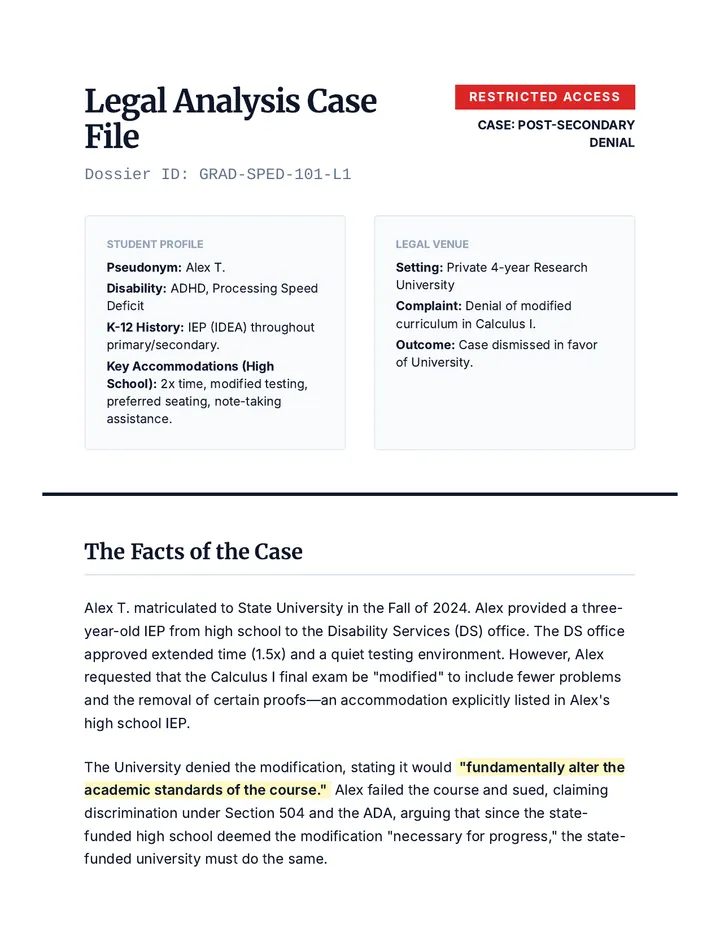
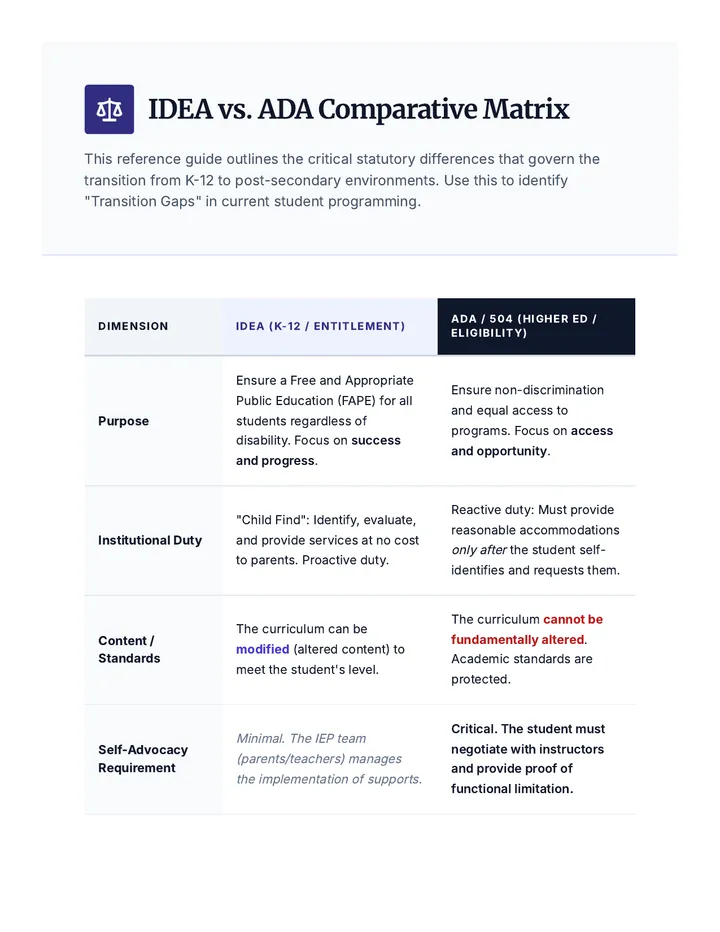
This sequence for graduate students explores the legal and psychological shift from IDEA to ADA in the context of self-advocacy and accommodation requests. It moves from legal analysis to curriculum design, preparing future special education leaders to build robust transition programs.
A graduate-level professional development sequence focused on training special educators to coach students in self-advocacy, negotiation, and student-led IEP leadership. The sequence emphasizes pedagogical scaffolding, transition of power, and clinical simulation.
A project-based sequence where 10th-grade students learn to organize their physical IEP documentation and assistive tools into a professional Advocacy Portfolio. Through document deconstruction and data tracking, students prepare to lead their own transition meetings with evidence-based self-advocacy.
A 5-lesson sequence designed for 4th-grade students to explore their unique learning profiles, identify strengths and challenges, and understand the logic behind using specific academic supports. Students move from general brain science to creating a personalized 'User Manual' for their own learning.