Repair Manual Teacher Guide Repair Manual
Teacher Instruction Guide v1.0
Project: Social Restoration
Workshop Overview
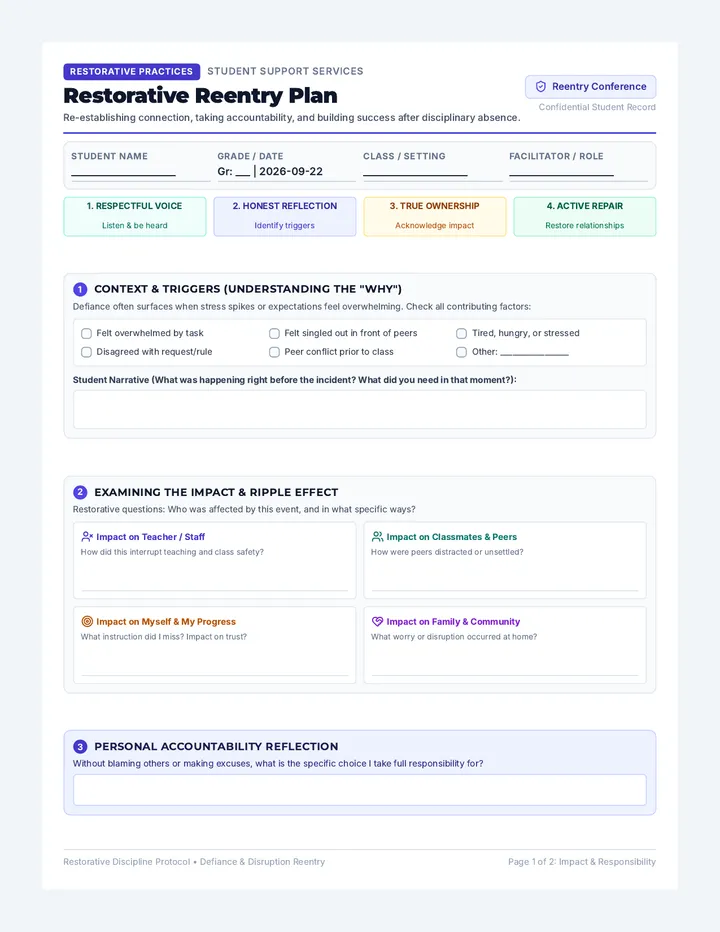
At the end of the school year, social friction often peaks. This workshop moves students beyond the performative "I'm sorry" to a restorative framework where they analyze the impact of their actions and offer concrete repairs .
Time
60 Minutes
Grade Level
6 - 12
Materials
Slides, Worksheet, Roleplay Cards
The Four-Part Fix
1
The Statement (No "Ifs" or "Buts")
"I did X." vs "I'm sorry if you felt bad."
2
The Impact Acknowledgement
"I see that this made you feel unheard/embarrassed."
3
The Repair Proposal (The Fix)
"To make it right, I will..."
4
The Prevention Plan
"Next time, I will do this differently so it doesn't happen again."
Pacing & Facilitation
Part 1: The Diagnosis
10 Minutes
Use the slides to define "Social Friction." Ask students: Why is a simple 'sorry' sometimes more annoying than no apology at all? Discuss the "Non-Apology" (e.g., "Sorry you're so sensitive").
Part 2: The Blueprint
15 Minutes
Introduce the Four-Part Fix. Focus heavily on Impact Acknowledgement . Explain that we don't get to decide how our actions affect others; they do.
Part 3: Conflict Mechanics Lab
25 Minutes
Hand out the Roleplay Cards . Students work in pairs to "diagnose" a scenario and draft a Four-Part Fix on their Fix-It Form Worksheet . Practice the dialogue out loud.
Part 4: Quality Check
10 Minutes
Debrief. Ask: Which part of the repair is hardest to say? (Usually Part 4, as it requires genuine commitment). Close with the "End-of-Year Clean Slate" challenge.
Pro-Tip for Facilitators
Middle and high schoolers are often hyper-aware of "authenticity." If they feel forced to apologize, the activity will backfire. Frame this as "Mechanics"—it's about learning a skill to get what they want (smoother friendships and less drama), rather than a moral lecture.
Workshop Blueprint Slides THE REPAIR
WORKSHOP
Restorative Mechanics for Social Friction
Level: Restoration
The Diagnosis
Why do simple "sorries" often fail to fix the problem?
They feel automatic or fake
They don't address the damage
They minimize the other person's feelings
Case Study: The "Non-Apology"
"I'm sorry you took it that way."
This isn't an apology; it's a blame shift . You're apologizing for their reaction, not your action.
The 4-Part Fix
01
Ownership
State what you did clearly. No "ifs" or "buts."
02
Impact
Acknowledge how it hurt or affected the other person.
03
Repair
The "Fix." What can you do now to make it better?
04
Prevention
The plan. How will you ensure it doesn't happen again?
Real World Repair
The Scenario
You gossiped about a friend's relationship and they found out. They are hurt and embarrassed.
"I shared your private business with others."
"I see that I broke your trust and made things awkward for you."
"I'm going to talk to those people and tell them I was wrong."
"Next time I hear rumors, I'm shutting them down."
Conflict Mechanics Roleplay Cards Conflict Mechanics
Activity: Roleplay Scenarios
PART_NUM: 4022-A
The 4-Part Fix
Ownership 2. Impact 3. Repair 4. Prevention
Instructions: Use the 4-Part Fix framework to practice restoring trust in the scenarios below.
Scenario 01
The Group Project Lag
You forgot the final slides. Your partner stayed up until 2:00 AM to finish them so you wouldn't both fail the course.
Impact: Stress & Exhaustion
Scenario 02
The Borrowed Gear
You spilled juice on a friend's favorite hoodie and tried to hide the stain. They just noticed it and are very upset.
Impact: Broken Trust & Damage
Scenario 03
The Social Snub
You made a joke at a friend's expense to impress a cool new group. Your friend left the table immediately.
Impact: Public Embarrassment
Scenario 04
The Ghosting Incident
A friend messaged you for support while having a hard time. You read them but didn't reply because you were gaming.
Impact: Isolation & Loneliness
Scenario 05
The Screen Squeeze
You posted a video of your friend without asking. It was meant to be funny, but they've asked you repeatedly to delete it.
Impact: Privacy Violation
Scenario 06
The Forgotten Promise
You promised to attend a friend's performance but went out with others instead. They saw your social media post.
Impact: Devalued Friendship
Every conflict is an opportunity for a better rebuild. Use your tools wisely.
The Fix-It Form Worksheet The Fix-It Form
Social Restoration Log // Maintenance Dept
Mechanic:
Date:
01. Diagnosis
Describe what broke.
02. Impact
Acknowledge the damage.
03. The Repair Proposal
Part A: Ownership (The "I did..." statement)
Part B: Impact (The acknowledgment)
Part C: The Fix (The specific action)
Part D: Prevention (The growth plan)
Pre-Apology Quality Check
No "ifs" or "buts"?
Helpful fix?
Ready if they aren't?
Tone genuine?
SPEC: RESTORATIVE-JS-2026
FORM: 001-A