Blueprint Briefing Teacher Guide Blueprint Briefing
Facilitator Guide
Topic: School Operations
Target: K-12 Administrators
Duration: 180 Minutes
Mission Objective
To equip school leaders with the analytical tools necessary to audit current operational workflows, identify systemic bottlenecks, and design high-efficiency systems that maximize human and fiscal resources.
Learning Outcomes
Apply the "Process Mapping" technique to visualize school-wide workflows.
Utilize the 4-D Efficiency Framework (Ditch, Delegate, Defer, Do) to audit tasks.
Develop a 90-day "Efficiency Roadmap" for a selected school operation.
Loadout (Materials)
Operational Blueprint Slides
Bottleneck Breakthrough Cards
Process Audit Worksheet
Efficiency Roadmap Project
Large Post-it Notes & Markers
Pacing Guide
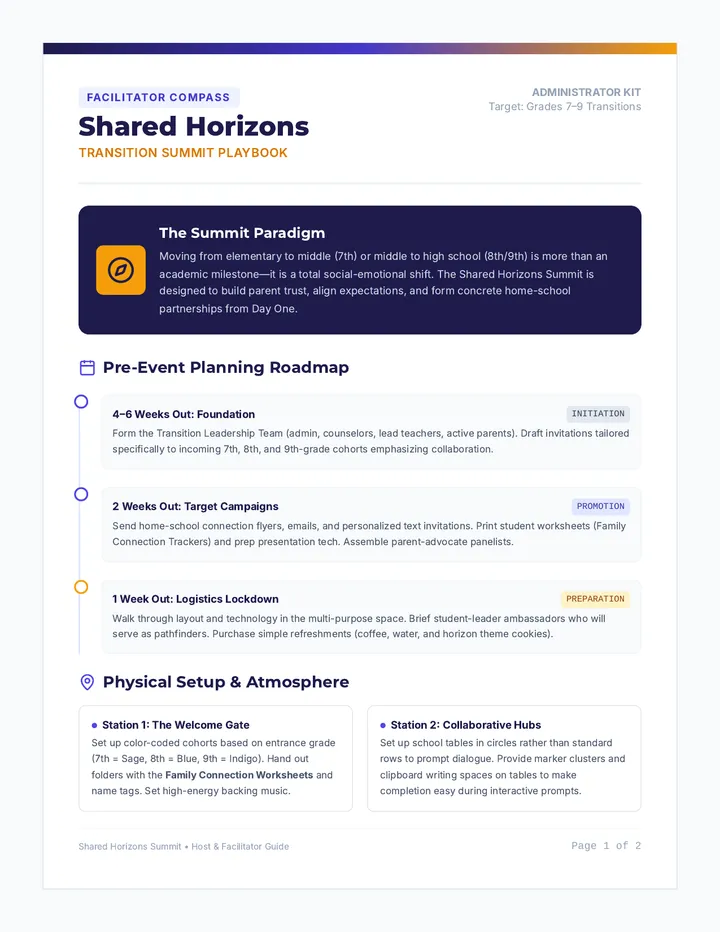
Time Phase Key Activities 15 min Structural Scan Welcome, efficiency mindset shift, and "The Cost of Friction" hook. 45 min Flow Mapping Process Mapping workshop using the Audit Worksheet. Focus on high-friction areas. 40 min Tactical Audit Applying the 4-D Framework to personal and team task lists. 30 min Breakthrough Collaborative problem-solving using the Breakthrough Cards. 50 min The Blueprint Individual work on the Efficiency Roadmap Project. Peer review session.
Facilitation Notes
01 The Hook: The Cost of Friction (15 min)
Open by asking: "If you could recover 3 hours of your week, what would you do for your students?" Shift the focus from "working harder" to "reducing system drag." Introduce the concept that every inefficient process is a tax on educational leadership.
02 Flow Mapping Workshop (45 min)
Participants use the Process Audit Worksheet . They must choose ONE recurring process (e.g., morning arrival, IEP scheduling, substitute booking).
Key Insight: Challenge them to map the "as-is" state, not the "should-be" state. Where does the paper go? Who waits for whom? Identify the "waiting" nodes—these are your bottlenecks.
03 The 4-D Framework (40 min)
Display Slide 3. Have participants audit their last 5 working days using these categories:
Ditch: Low-value tasks that don't serve the mission.Delegate: Tasks that someone else could (and should) be doing.Defer: Non-urgent tasks that clutter today's priority list.Do: High-impact leadership work that requires your specific expertise.
04 Collaborative Troubleshooting (30 min)
Distribute Breakthrough Cards . In small groups, they must solve the scenario on the card in 5 minutes using the "Efficiency First" mindset. Rotate cards twice.
Pro-Tip for Facilitators
School leaders are often "fixers" by nature. Remind them that solving a one-time crisis is heroic, but building a system that prevents the crisis is leadership. Keep the focus on structural fixes, not personal effort.
Operational Blueprint Slides Operational
Blueprint
Efficiency in Action
Professional Development Series
The Efficiency Gap
"System drag is the invisible tax on school leadership."
Every hour spent on an inefficient process is an hour lost to instructional leadership.
Friction
Wait times, redundancies, and manual data entry.
Flow
Streamlined, automated, and mission-aligned.
The Tactical Audit: 4-D Framework
Ditch
Is this task adding value? If not, stop doing it immediately.
Eliminate Waste
Delegate
Does this require your expertise? If no, train others to lead.
Empower Others
Defer
Urgent or just noisy? Schedule non-priority tasks for later.
Strategic Timing
Do
High-impact, mission-critical work. Focus your energy here.
Mission Focused
Identifying the Bottlenecks
The Single Point of Failure: One person who must approve everything.Manual Repetition: Re-typing the same data across multiple sheets.The Communication Loop: Endless emails to clarify one simple request.
!
"A system is only as fast as its slowest component. Fix the node, fix the flow."
Building Your Roadmap
Efficiency isn't a one-time event; it's a structural commitment. Transition from "Management" to "Architecture."
30
Audit & Map
Pick one core process and map every step and friction point.
60
Redesign & Test
Simplify the steps. Pilot the new workflow with a small team.
90
Standardize & Automate
Document the protocol and use tools to automate manual work.
Bottleneck Breakthrough Cards Bottleneck Breakthrough
System Diagnostic Cards / Group Activity
Ref: OPS-DIAG-001
Scenario: The Paper Trail CRITICAL
Field trip permission forms are currently printed, sent home, returned to teachers, manually alphabetized by the front office, and then scanned into a digital folder before being filed in physical cabinets.
The Mission:
Apply the "Ditch & Automate" principle. How do you reduce the touch-points by 50%?
LOC: Front Office ID: B-01
Scenario: The Approval Jam MODERATE
The Principal must sign off on every purchase request over $50. This creates a 48-hour backlog on her desk, delaying classroom supplies and causing teachers to use personal funds.
The Mission:
Apply the "Delegate" principle. How do you shift authority while maintaining fiscal oversight?
LOC: Administration ID: B-02
Scenario: The Sub Shuffle HIGH FRICTION
Teachers call the Assistant Principal at 6:00 AM to report absences. The AP then calls from a list of substitutes manually. This consumes the first 90 minutes of the AP's day every morning.
The Mission:
Apply the "System Flow" principle. Design a decentralized system for coverage.
LOC: Human Resources ID: B-03
Scenario: Meeting Bloat TIME DRAIN
The weekly Leadership Team meeting lasts 90 minutes. 60 minutes are spent on "announcements" that were already sent in the weekly email. Leadership only has 30 minutes for strategic planning.
The Mission:
Apply the "Ditch & Defer" principles. How do you flip the meeting agenda?
LOC: Strategic Planning ID: B-04
Facilitator Instructions
Cut along the borders to create individual scenario cards. Distribute to groups for 5-minute "Sprint" problem-solving sessions.
Process Audit Worksheet Process Audit
Operational Efficiency Series
Officer:
Date:
Phase 01: Identification
Select ONE recurring school process that feels "heavy" or creates friction (e.g., student check-in, field trip approval, supply ordering).
Target Process Name:
Phase 02: Flow Mapping
Map the current "As-Is" state. Use boxes for actions and diamonds for decision points. Identify every "touch" and every "wait."
Action
Decision
Wait/Delay
Phase 03: The Friction Scan
Single Point of Failure:
Who is the bottleneck? Where does it stop?
Redundant Steps:
What data is being re-entered multiple times?
Wait Time:
What is the average 'idle' time between steps?
The 4-D Strategy
Which parts of this process can be optimized?
Ditch
Delegate
Defer
Do
"Simplification is the ultimate sophistication."
Efficiency Roadmap Project Efficiency Roadmap
Implementation Blueprint v1.0
Project Status:
Drafting Phase
01
Project Scope & Core Objective
Focus Area (Process):
The "North Star" (Goal State):
Success Metrics
Reduce time by _______ %
Eliminate _______ steps.
Automate _______ tasks.
02
90-Day Tactical Deployment
30 Days
Analysis
Key Milestones:
60 Days
Testing
Key Milestones:
90 Days
Rollout
Key Milestones:
03
Personnel & Tools
The Efficiency Team
Project Lead:
Data Manager:
Comms Lead:
Technical Requirements Breakthrough Key Teacher Guide Breakthrough Key
Facilitator Answer Guide
Material: Breakthrough Cards
Session: Operational Blueprint
This guide provides potential high-efficiency solutions for the Bottleneck Breakthrough scenarios. Use these to prompt group discussion and challenge participants to move beyond "quick fixes" toward systemic redesign.
Scenario B-01
The Paper Trail
Systemic Solutions
Digital-First Entry: Implement a digital form (Google Forms/Microsoft Forms) that feeds directly into a master spreadsheet. Elimination of paper forms and scanning entirely.Automated Sorting: Use spreadsheet filters or scripts to automatically sort student data by grade/teacher, removing the manual alphabetization step for office staff.
Scenario B-02
The Approval Jam
Systemic Solutions
Tiered Authority: Establish clear budget thresholds. Department heads or Team Leads sign off on items under $250; Principal only reviews high-cost or novel items.Pre-Approved Vendor List: Create an annual "standard supply list." Purchases from these vendors using pre-allocated budgets bypass the Principal's individual signature.
Scenario B-03
The Sub Shuffle
Systemic Solutions
Automated Absence Management: Invest in a software solution (e.g., Frontline) where teachers log absences and subs claim jobs directly via app, removing the middleman.Internal Priority List: Establish a rotating duty roster for internal coverage that is managed by a secretary or automatically triggered when no sub is found.
Scenario B-04
Meeting Bloat
Systemic Solutions
The "Read-Only" Memo: Mandate that all updates and announcements be submitted to a shared digital dock 24 hours prior. Meeting time is strictly for discussion/decisions.Strategic Standing Agenda: Flip the agenda so "Strategic Growth" is the first 60 minutes. If time runs out, the announcements (already in text) are the part that gets cut.