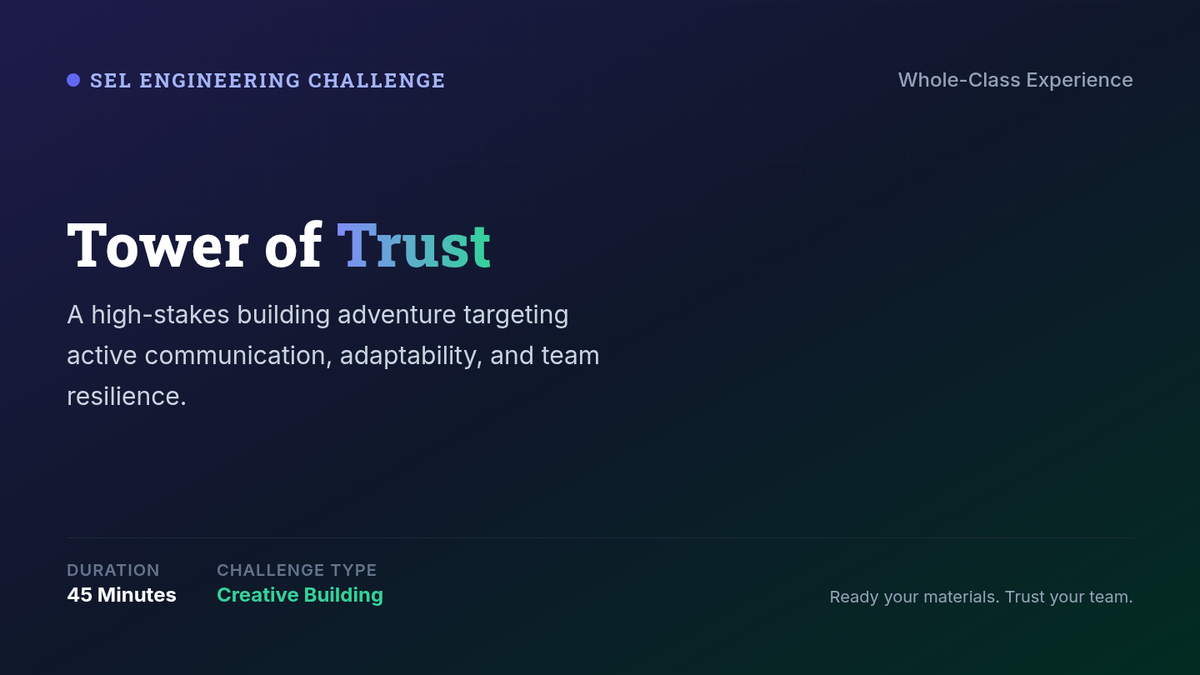
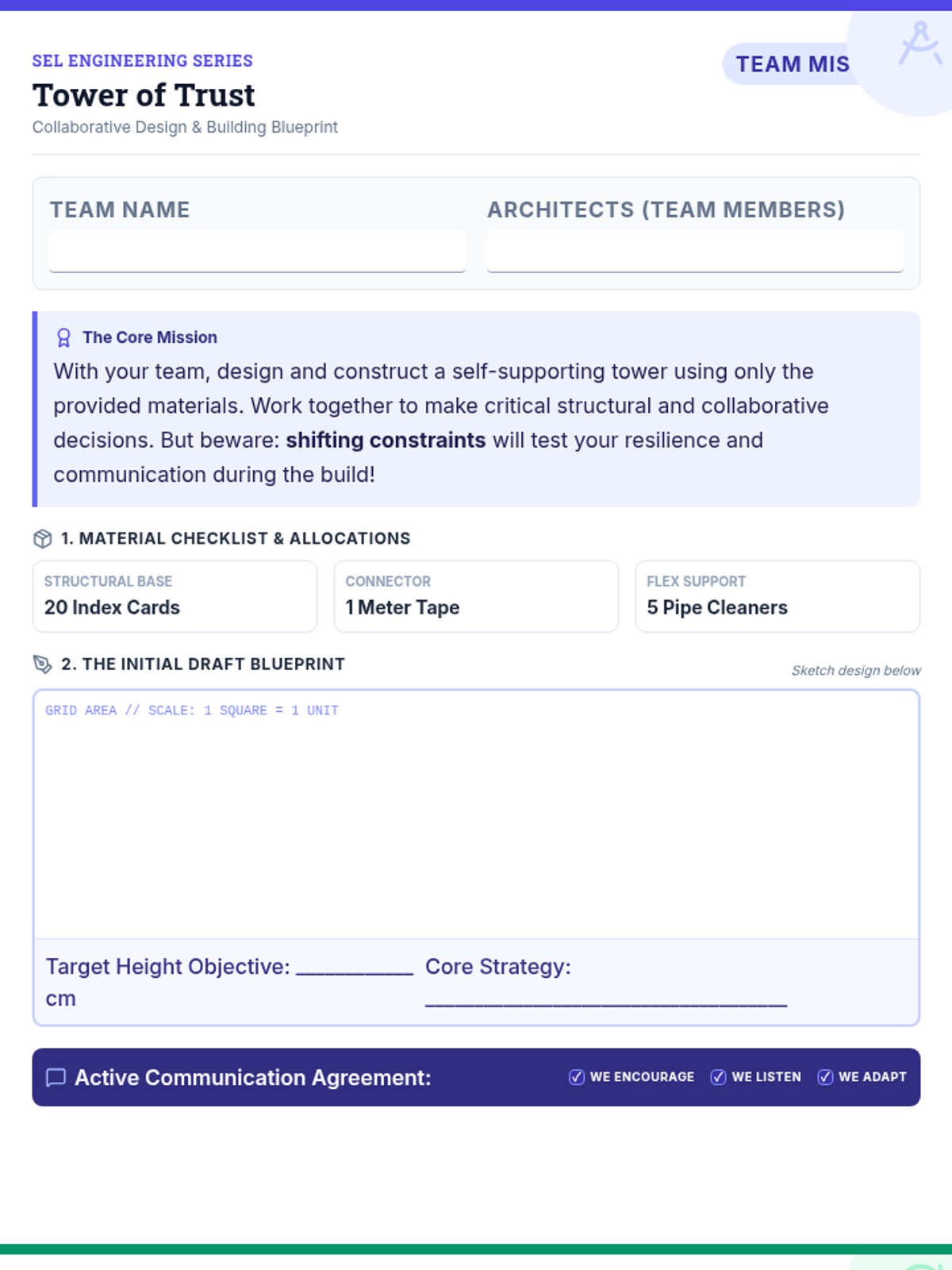
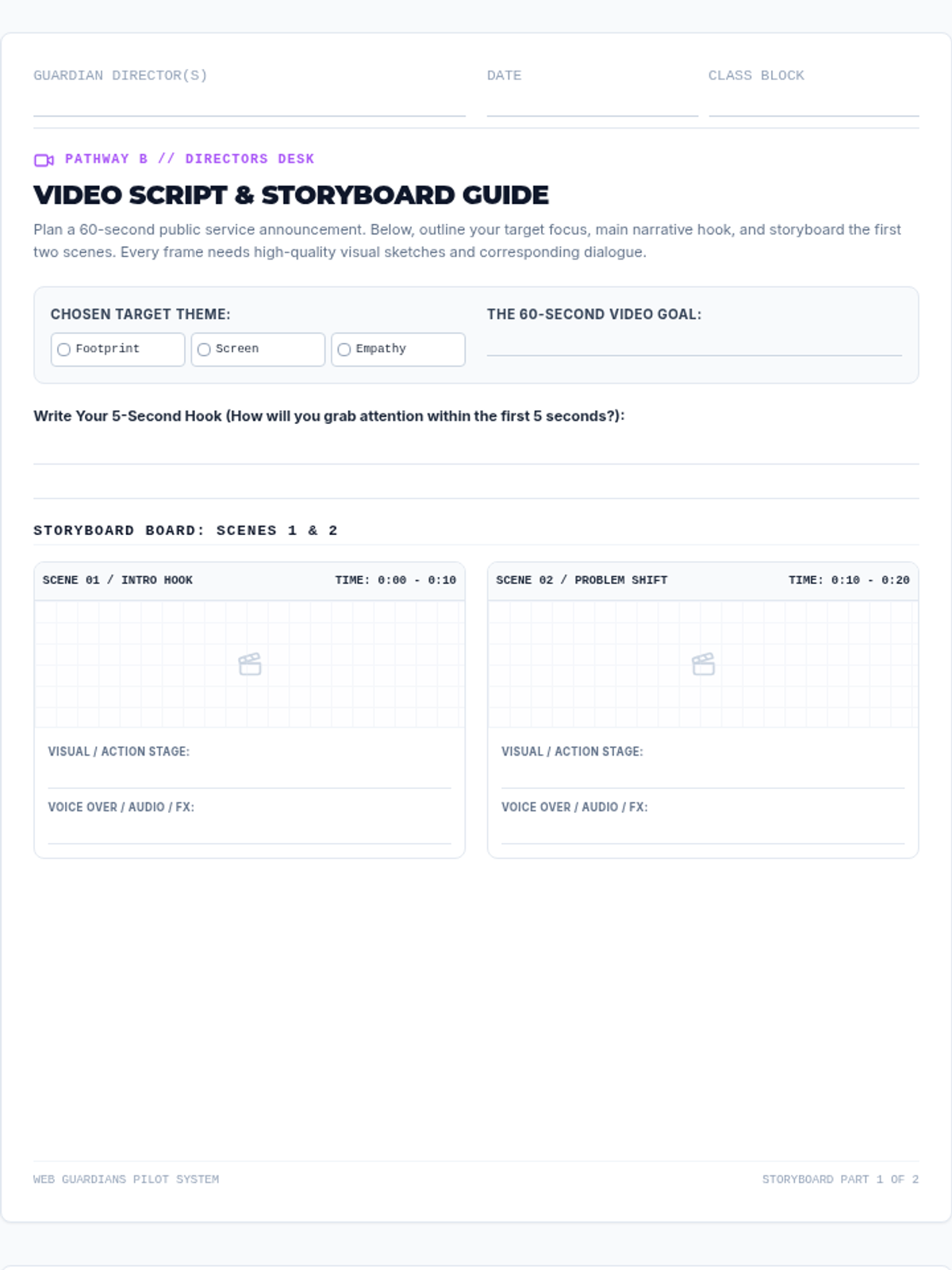
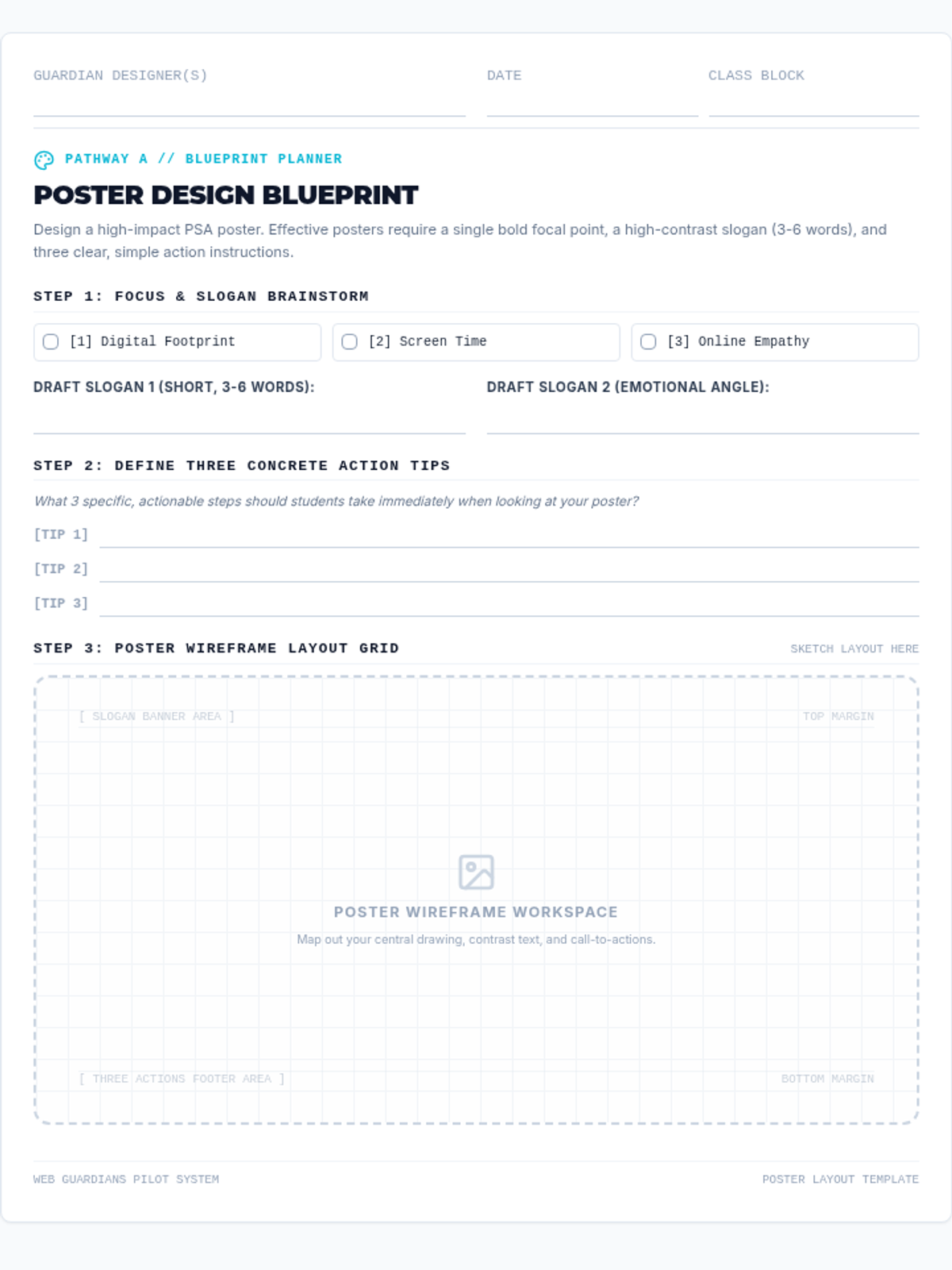
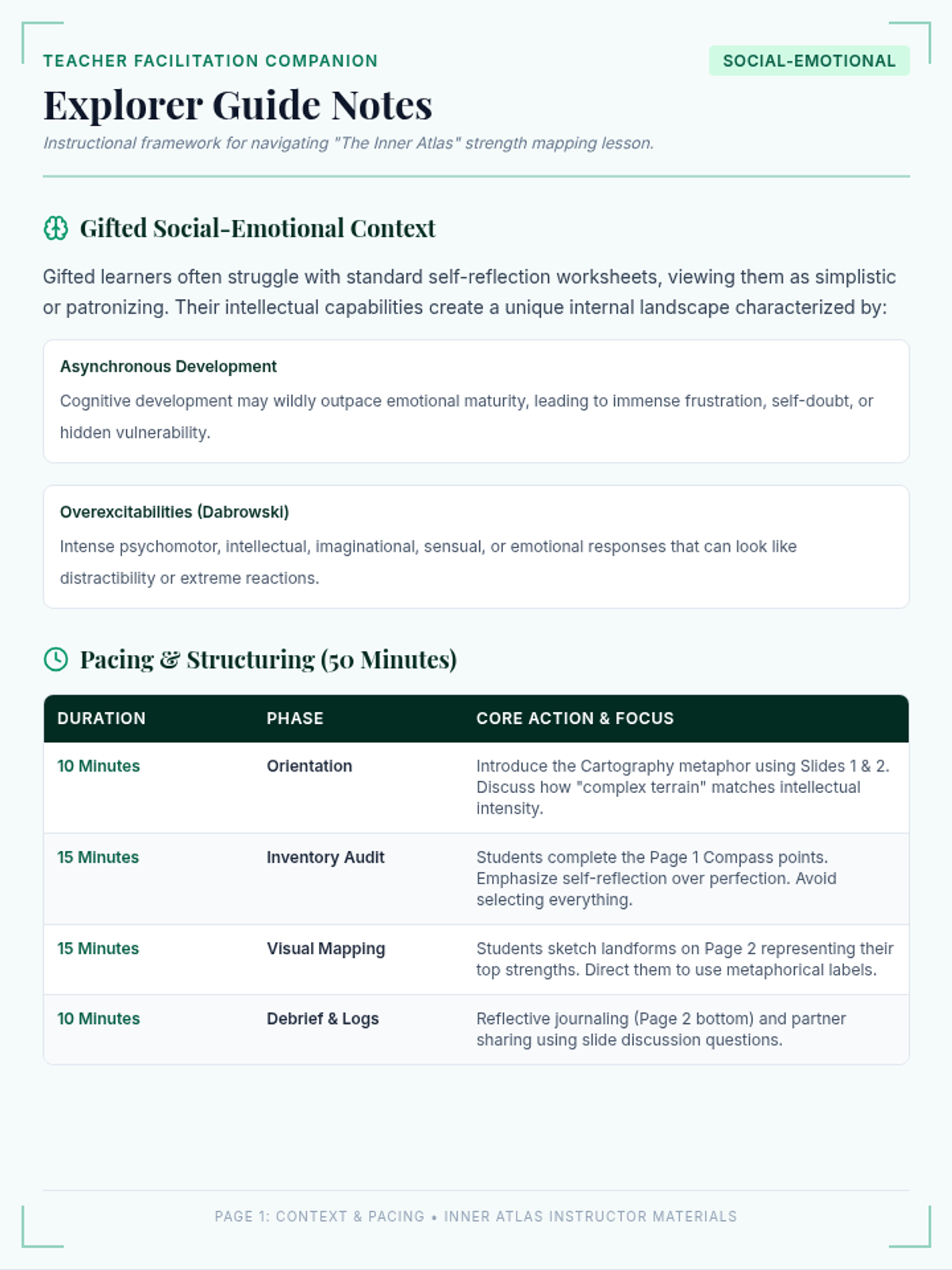
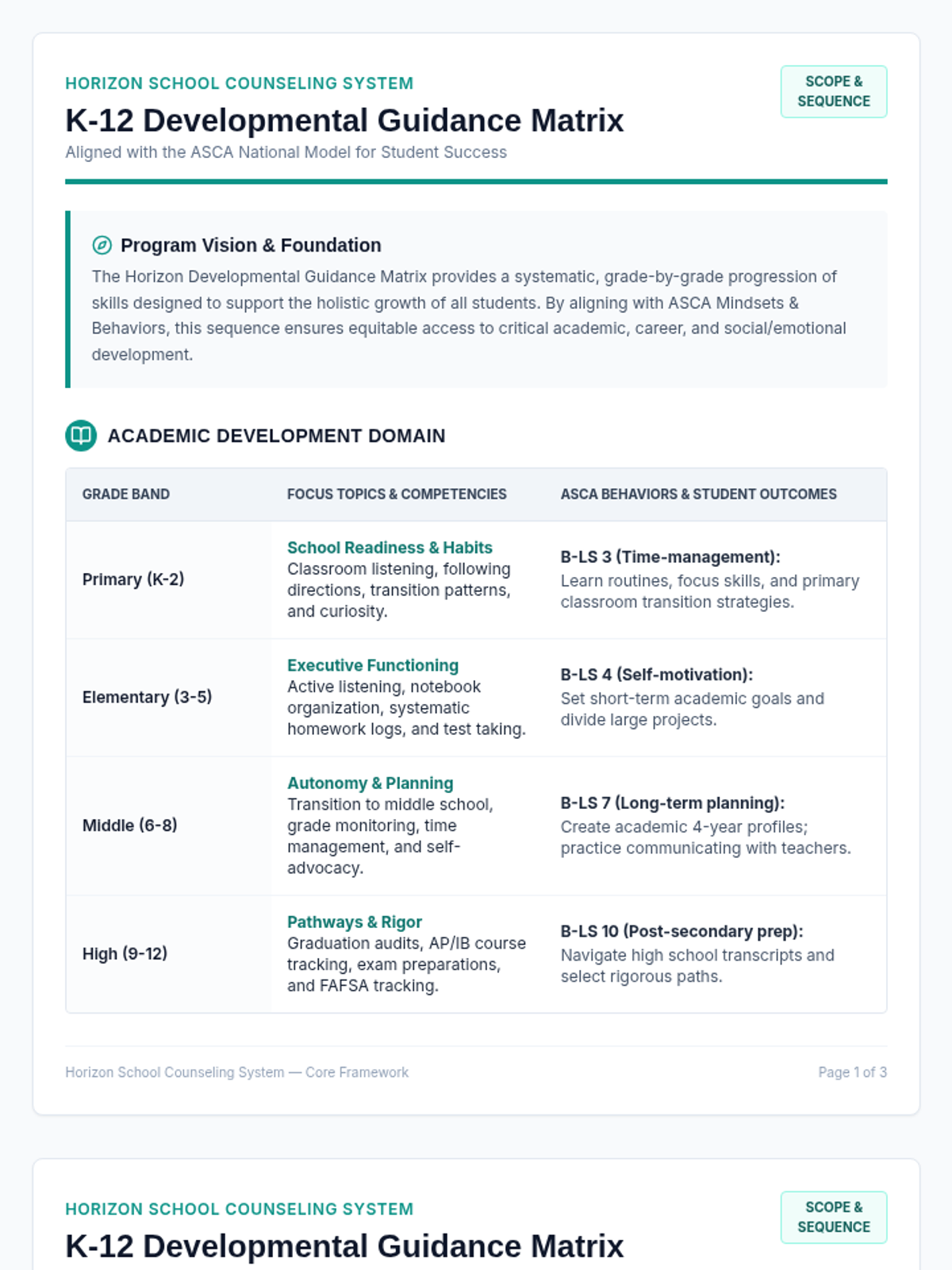
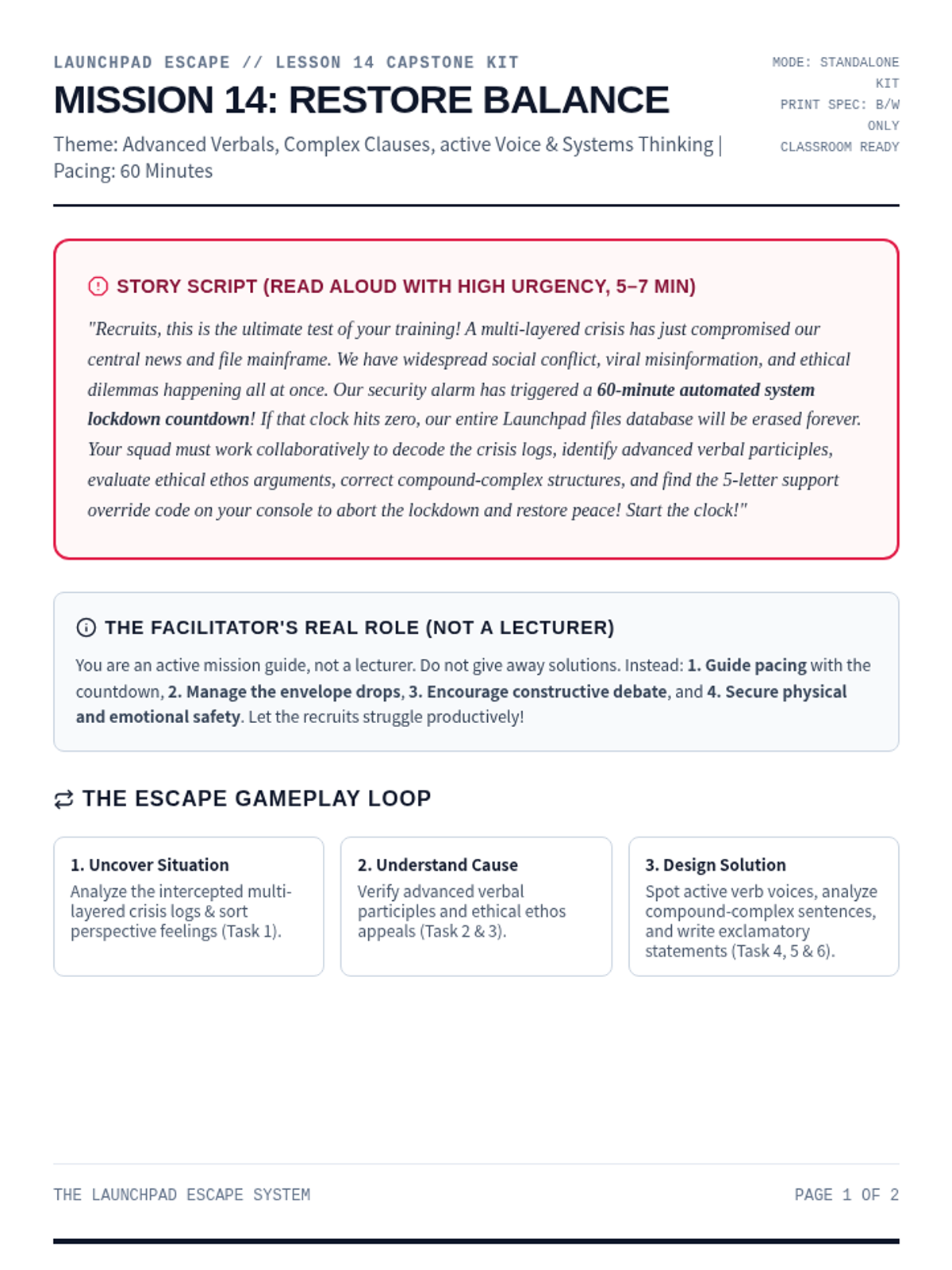
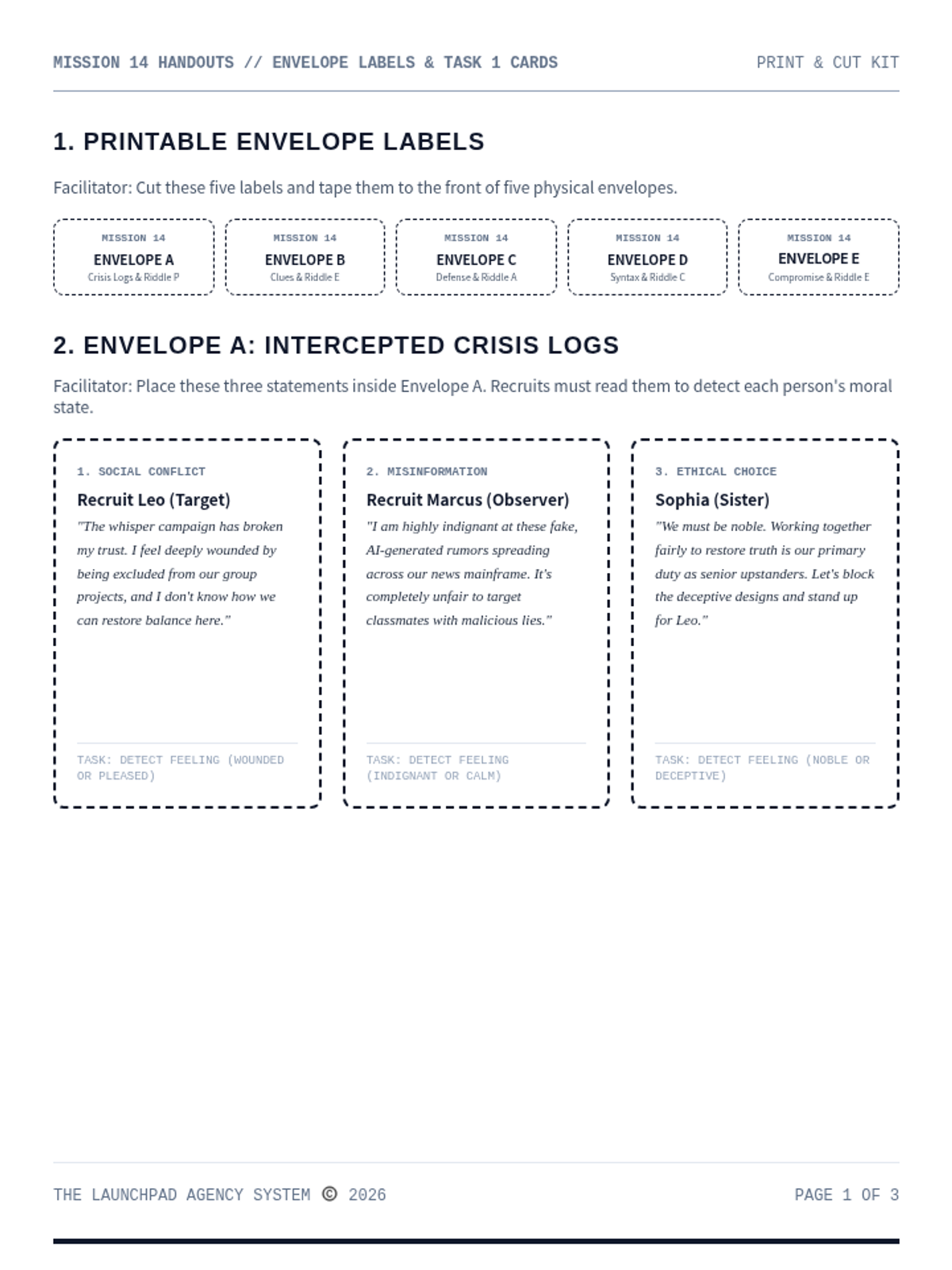
The culmination project for Lesson 5: a personalized, professional pre-interview technical checklist that students complete and use for a peer "Mission Control" dry run.
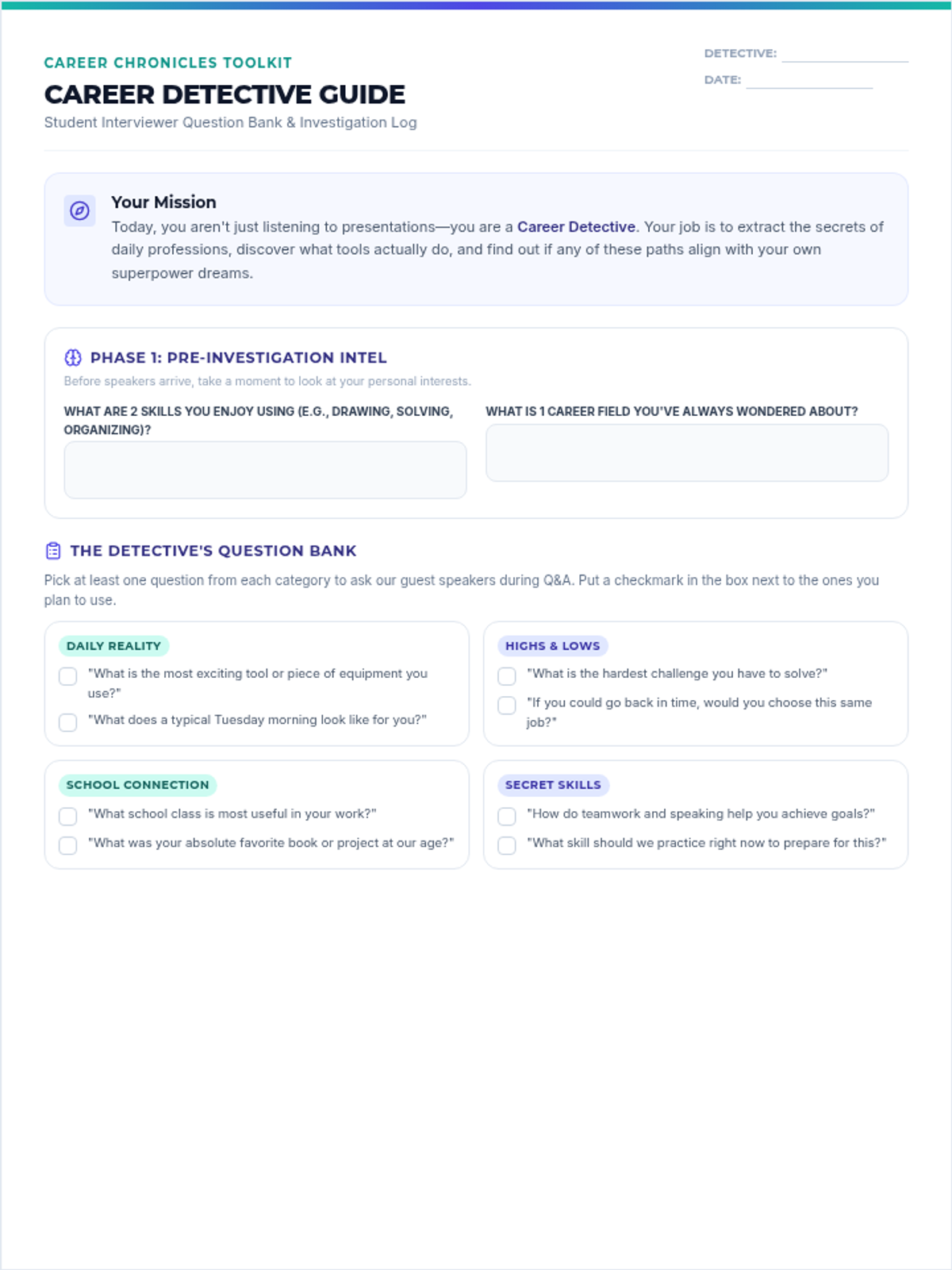
A one-page reference checklist for students featuring 'circuit breaker' coping skills to use when feeling emotionally overwhelmed or 'sucked into' a friend's mood.
A comprehensive facilitator's guide for teachers or counselors, providing a roadmap for individual and dyad sessions, key talking points, observation checklists, and troubleshooting tips for addressing trauma bonding.
A two-page individual 'self-repair' guide for students featuring grounding exercises, strength identification, the 'Yet' reframing technique, and daily journaling prompts to build personal resilience.
A one-page 'pocket guide' for students featuring conversation scripts, a friendship agreement, and a menu of emotional regulation tools to maintain healthy boundaries.
A two-page student activity featuring 'The Backpack Exercise' for identifying emotional ownership and three 'Upgrade the Moment' scenarios for practicing healthy boundaries and responses.
A two-page student-facing fact sheet and reflection guide that explains the concept of 'emotional mirroring' (trauma bonding) and introduces the 'both can be true' mindset for healthy friendship boundaries.
A comprehensive one-page master checklist of all coping skills, organized by tactical 'Sectors' (Hardware, Software, Base Camp, Toolkits, Advanced Ops) with rating and field note sections.
A refined one-page master checklist of coping skills for middle school students, featuring a tactical 'Master Inventory' aesthetic with space for ratings and observations.
A handout for middle schoolers focusing on journaling, mental games, art-based expression, and visualization as creative 'Mental Toolkits' for anxiety.
Updated master list and tracking worksheet that includes all four phases of coping skills (Hardware, Software, Base Camp, and Toolkits) for student rating and pattern recognition.
A handout for middle schoolers explaining the biological importance of sleep, exercise, and emotional labeling as foundational 'Base Camp' maintenance for managing anxiety.
A tactical handout focused on Cognitive Behavioral Therapy (CBT) and Acceptance and Commitment Therapy (ACT) techniques, explained as 'software overrides' for the brain.
Updated technical handout for middle schoolers explaining breathing, PMR, and grounding skills through the lens of nervous system biology.
A visually striking slide deck titled 'Iron Character' designed for a large-group SEL lesson, featuring interactive prompts, discussion frameworks, and structured activity instructions.
A reflective student handout titled 'Character Compass' that guides students through identifying their core values, reflecting on ethical challenges, and planning personal growth.
A comprehensive facilitator guide for a large-group SEL lesson on character, featuring session objectives, a minute-by-minute breakdown, and management tips for large groups.
An advanced version of the Calm Cards matching game specifically tailored for middle schoolers. Features 12 pairs of sophisticated coping strategies like cognitive reframing, digital boundaries, and assertive communication, with a mature journal-style design.
Engaging slides for a middle school counseling lesson on reading social signals, understanding perspectives, and choosing responses with natural consequences. This version separates the definition of natural consequences from the escalation/de-escalation outcomes and inquiry questions into three distinct slides.
A printer-optimized set of 24 matching cards (12 pairs) with tightened layout and fixed height grids to ensure zero content cutoff during printing. Includes clear cutting guides and compact instructional header.
Engaging slides for a middle school counseling lesson on reading social signals, understanding perspectives, and choosing responses with natural consequences. updated to include examples, non-examples, inquiry questions, and the original escalation/de-escalation concept.
An assessment rubric for evaluating student understanding of academic integrity, focusing on four key criteria: understanding pressure, impact analysis, ethical strategy, and self-reflection.
An interactive student activity featuring three realistic scenarios (Case Files) where students must analyze the pressures to cheat and develop ethical 'Blueprint Actions.' Includes a personal reflection section.
A visual presentation for the 'Honesty Blueprint' lesson, covering the definition of integrity, the 'Pressure Cooker' of why students cheat, and the long-term impact of dishonesty on trust and character.
A comprehensive teacher facilitation guide for the 'Honesty Blueprint' lesson, featuring learning objectives, a minute-by-minute instructional sequence, and pedagogical insights into why students cheat.
A professional guide for teachers on how to facilitate classroom discussions and debriefs following a school incident, focusing on de-escalation and restoring a sense of safety.
A visual presentation for students and staff outlining the Peace Protocol, emphasizing roles during an incident and the restorative process afterward.
A student-facing reflection sheet to be completed after witnessing or being involved in a conflict, designed to process emotions and gather factual accounts.
A comprehensive flowchart outlining the necessary steps for students and staff to take during and after a school conflict, featuring multilingual support and clear visual cues.
Discussion handout featuring three middle school-focused conflict scenarios (simulations). Each includes a mission-style briefing, heat level analysis, and tactical objectives for staying engaged.
A handy printable reference sheet containing four pocket-sized 'Navigation Cards' for students. Each card outlines the 'Pause, Plot, Pilot' framework for quick decision-making in real-world situations.
A student reflection worksheet for the 'Helm of Choices' lesson. Uses the 'Pause, Plot, Pilot' framework to analyze a social media / bullying scenario.
A comprehensive teacher facilitation guide for the 'Helm of Choices' lesson, including scripts, discussion prompts, troubleshooting tips, and extension activities using the nautical theme.
A nautical-themed slide deck for middle-grade students focused on decision-making using the 'Pause, Plot, Pilot' framework. Features bold visuals, scenarios, and a witty, Arctic exploration aesthetic.
A facilitator's guide for the Distress Signal materials. Includes scenario answers, scripts for responding to avoidance (Ghost Signals), and discussion points for reinforcing self-advocacy (Captain's Calls).
A student worksheet for distinguishing between using mental health as an excuse (Ghost Signal) and legitimate self-advocacy (Captain's Call). Includes scenario sorting and a reflection on 'cheap prizes' vs. long-term costs.
A witty, high-impact slide deck for therapeutic sessions. It teaches students to distinguish between 'The Ghost Signal' (using mental health as a cop-out for work avoidance) and 'The Captain's Call' (legitimately asking for tools and support to stay engaged).
A student-facing worksheet for self-reflection on avoidance triggers (icebergs), coping strategies (buckets), and communication plans (radio check).
A facilitation guide for counselors to use the loopable slide deck effectively, focusing on the witty tone, community impact, and communication strategies.
A witty and sassy loopable slide deck featuring a winter nautical theme. Designed for students in a therapeutic program to address work avoidance and community impact with real-talk strategies.
An ultra-compact, print-optimized, black-and-white version of the game-inspired goal-setting worksheet. This version has been strictly vertically limited to 760px total height and uses a flex layout to ensure it fits safely on a single 8.5x11 inch page. Writing space for the Battle Zone has been significantly expanded, and the Quest Allies section has been shifted to the very bottom.
A print-friendly, black-and-white version of the game-inspired goal-setting worksheet. Features an avatar drawing area, superpowers (strengths), battle zones (challenges), and loot boxes (goals). Uses high-contrast black borders and grayscale elements for excellent legibility on standard paper. Instructional prompts have been darkened and slightly enlarged for better readability on office printers.
A final evaluation tool for students to complete at the end of the 6-week curriculum, allowing them to reflect on their growth, identify new study strategies, and measure progress against their initial baseline assessment.
A baseline assessment tool for students to complete at the start of the 6-week curriculum, measuring their current self-perceptions of organizational skills, study habits, and familiarity with key academic strategies.
A formal group description and authorization form for parents and students to sign, detailing the group mission, schedule, and expectations for participation and confidentiality.