A comprehensive project guide for students to apply the PATH problem-solving framework to a real-world school or community challenge, including phases for exploration, design, and a final presentation.
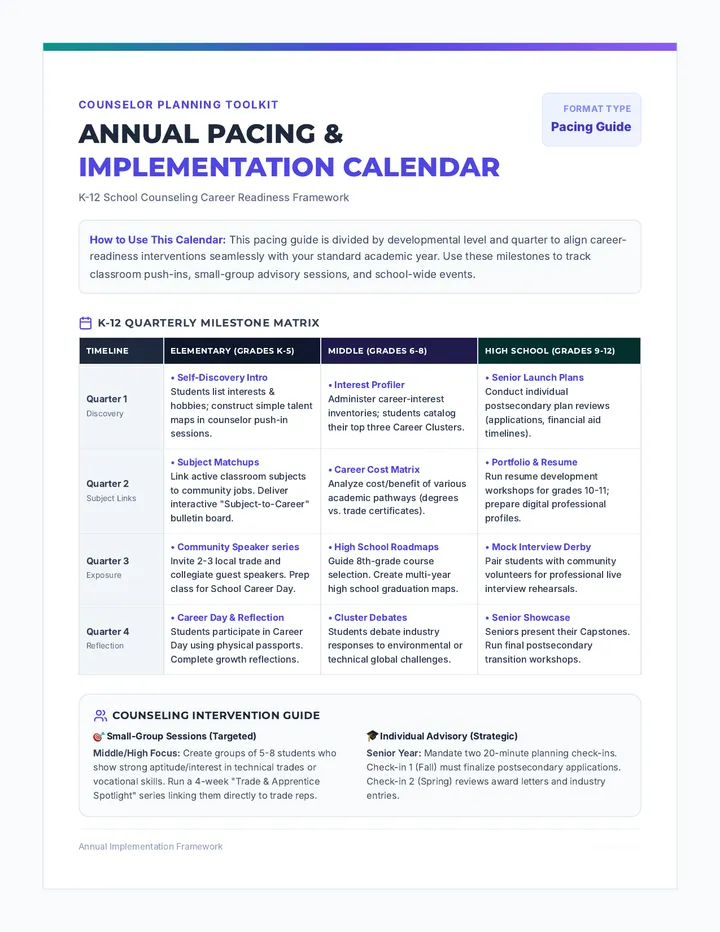
Instructional guide for teachers with timing, teaching points, and tips for delivering the first lesson on career clusters.
Revised self-audit worksheet for Lesson 3, now with a clean single-page layout and improved student work area.
Presentation for Lesson 3, defining hard vs. soft skills and highlighting the top skills employers look for in candidates.
Revised student worksheet for Lesson 1, now featuring all 16 clusters in the bank and improved single-page layout.
Revised introductory presentation for Lesson 1, now including all 16 career clusters with visual icons and descriptions.
A high-impact informational handout that explains the critical link between parental support and a child's long-term success, featuring reflective prompts for parents.
A facilitator's guide featuring three impactful opening questions for the Parenting Journey presentation, along with tips for engaging parents and creating a supportive atmosphere.
A professional feedback form for parents to evaluate the Parenting Journey presentation, including rating scales and reflection questions.
A professional and welcoming presentation slide for Burlington Public Schools' Parenting Journey program, highlighting key benefits for parents at all stages.
A comprehensive answer key and exemplar response guide for the Brain Lab workbook, covering scientific terminology, mindset flips, and personal reflection prompts.
A robust 10-page facilitation guide for educators to implement the Brain Lab workbook, featuring learning objectives, pacing tables, instructional strategies, differentiation tips, and an assessment rubric.
A comprehensive 10-page student workbook exploring the science of neuroplasticity, brain anatomy, and growth mindset. It features a "Brain Lab" theme with engaging visuals and dedicated student reflection areas.
A professional facilitator's key providing the psychological rationale for the lesson's prompts, tips for handling common teen responses in rehab, and suggested reframing language.
A structured student workbook using architectural metaphors to guide teens in recovery through journaling exercises focused on identifying core values and reconstructing their identity.
A visually striking slide deck for a teen journaling session, using architectural blueprints as a metaphor for self-discovery and recovery. Includes discussion prompts and structured journaling exercises.
A comprehensive facilitator's guide for a journaling session in a recovery setting, utilizing an architectural blueprint metaphor to help teens explore identity and self-discovery.
A vocabulary reference sheet for teenagers, defining core values in accessible language. Organized by categories like Strength, Connection, Growth, and Spirit to aid in self-reflection and art brainstorming.
A student worksheet for planning and reflecting on an art therapy project focused on values. It provides structured space for selecting values, brainstorming visual symbols, and reflecting on the creative process.
A comprehensive facilitator guide for an art therapy lesson on values, specifically tailored for teenagers in rehabilitation. Includes therapeutic goals, materials, a step-by-step lesson plan, and discussion prompts.
A portable reference card for students to keep in their notebook or wallet. It provides quick cognitive reframing statements and three 'Golden Rules' for overcoming the perfectionism-procrastination loop during moments of high stress.
Visual presentation slides for the counseling session, explaining core neurodivergent concepts like Time Blindness, the 'Wall of Awful', and the 'Strategic B-Minus' approach. Designed with a dark, high-contrast aesthetic to maintain focus and reduce visual overwhelm.
A student-facing worksheet designed to help neurodivergent high schoolers break the cycle of perfectionism and procrastination. It features sections for 'shrinking' tasks, battling time blindness through estimation, and conceptualizing 'Strategic B-Minus' work to foster momentum.