A structured roadmap for middle school counselors to facilitate safe and successful student re-entry following a mental health crisis or hospitalization.
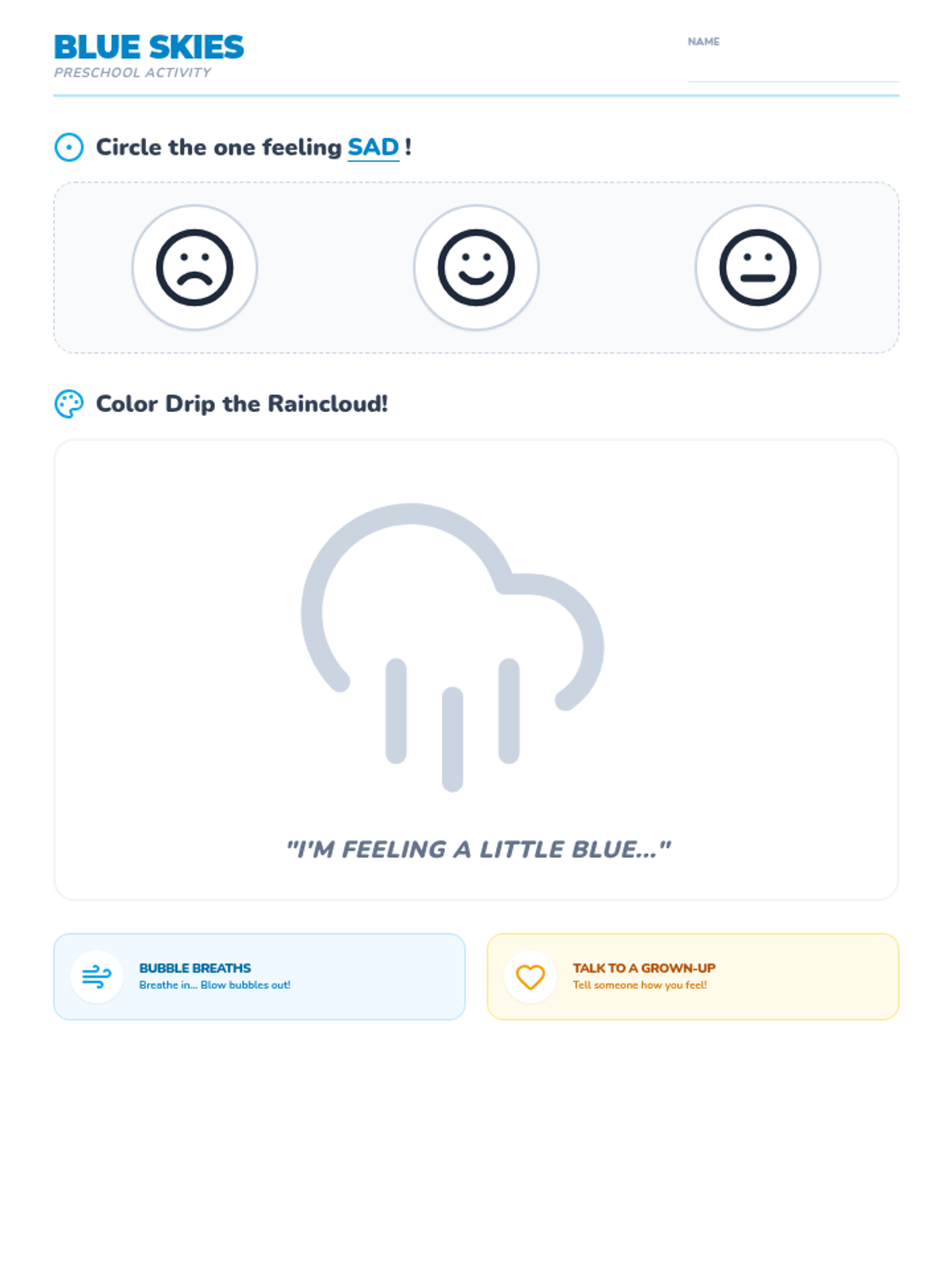
A student-facing activity sheet for preschoolers featuring character coloring, emotion identification, and visual reminders of coping strategies.
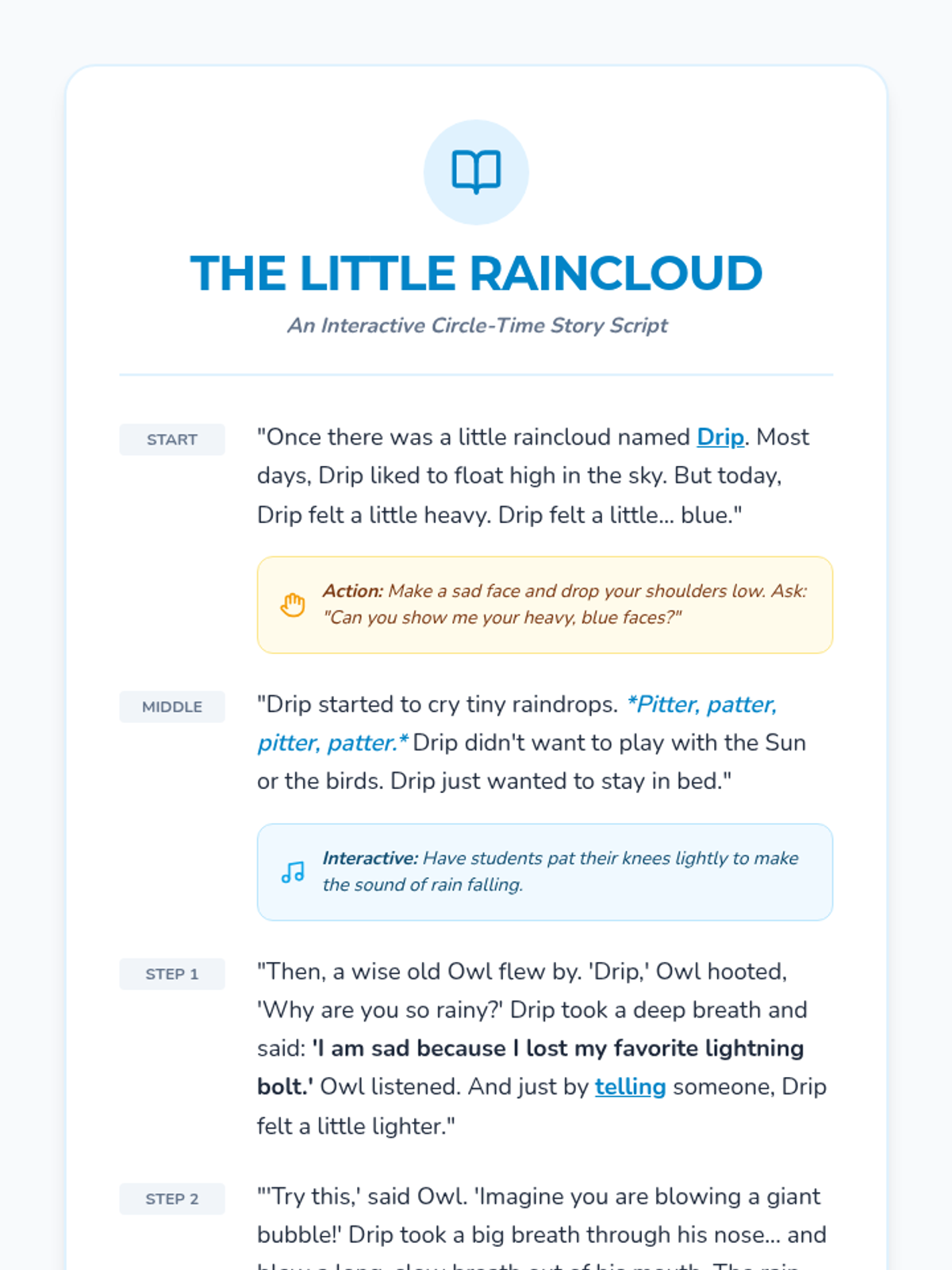
A teacher-facing interactive script featuring a character named Drip the Raincloud, used to teach preschoolers how to articulate sadness and practice breathing.
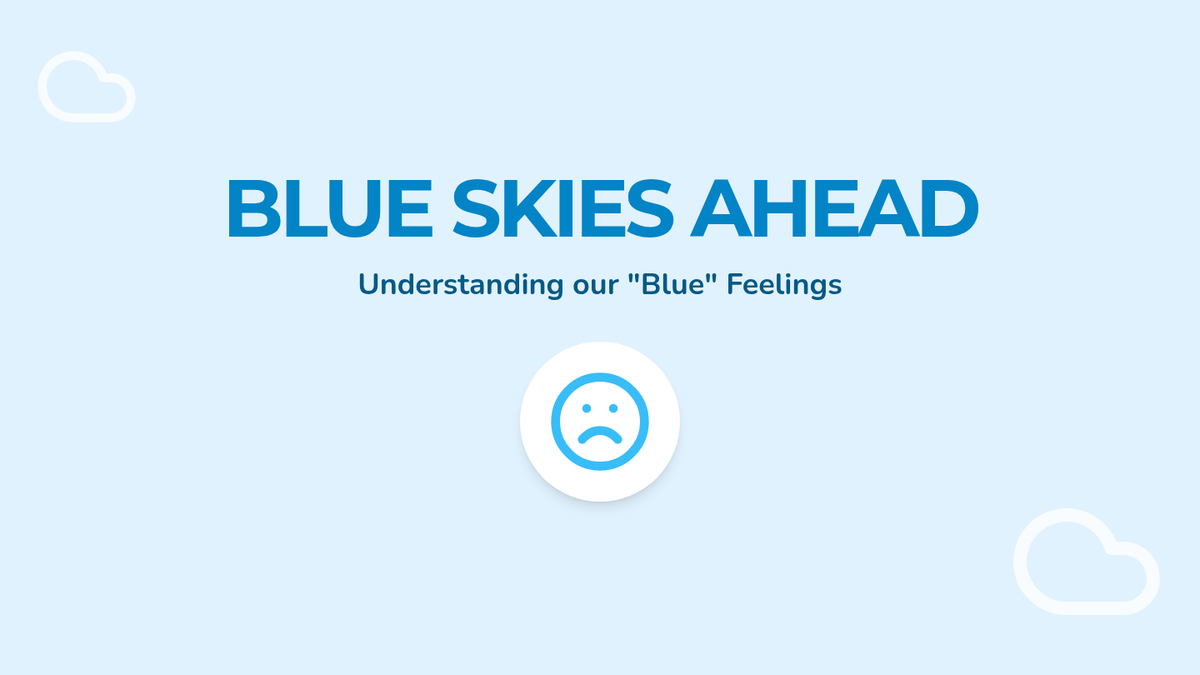
Engaging visual slides for a circle-time lesson, teaching preschoolers how to recognize sadness and use Bubble Breaths and communication to cope.
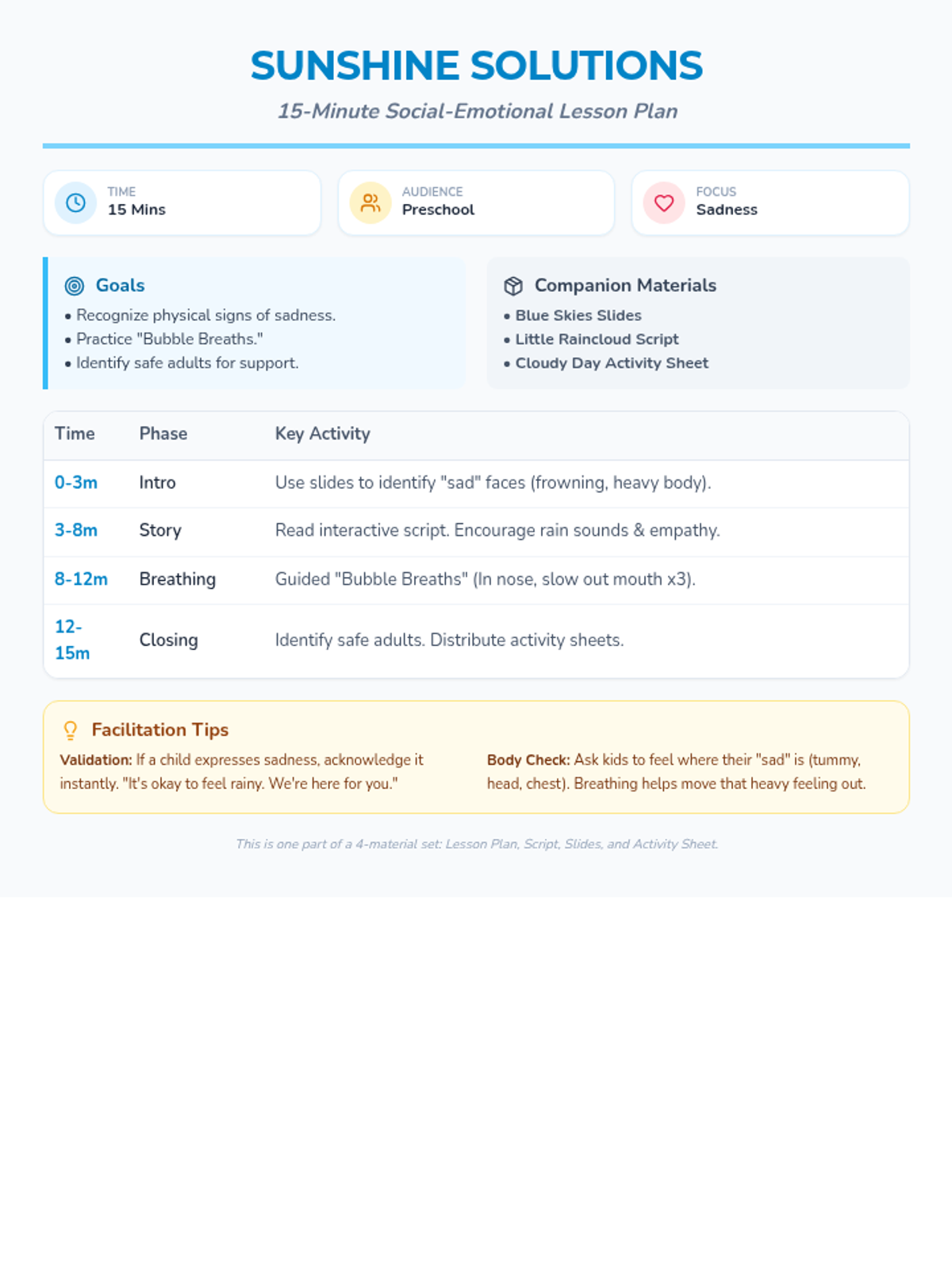
A comprehensive 15-minute lesson plan for preschool teachers focusing on identifying sadness and practicing coping strategies like Bubble Breaths and seeking support.
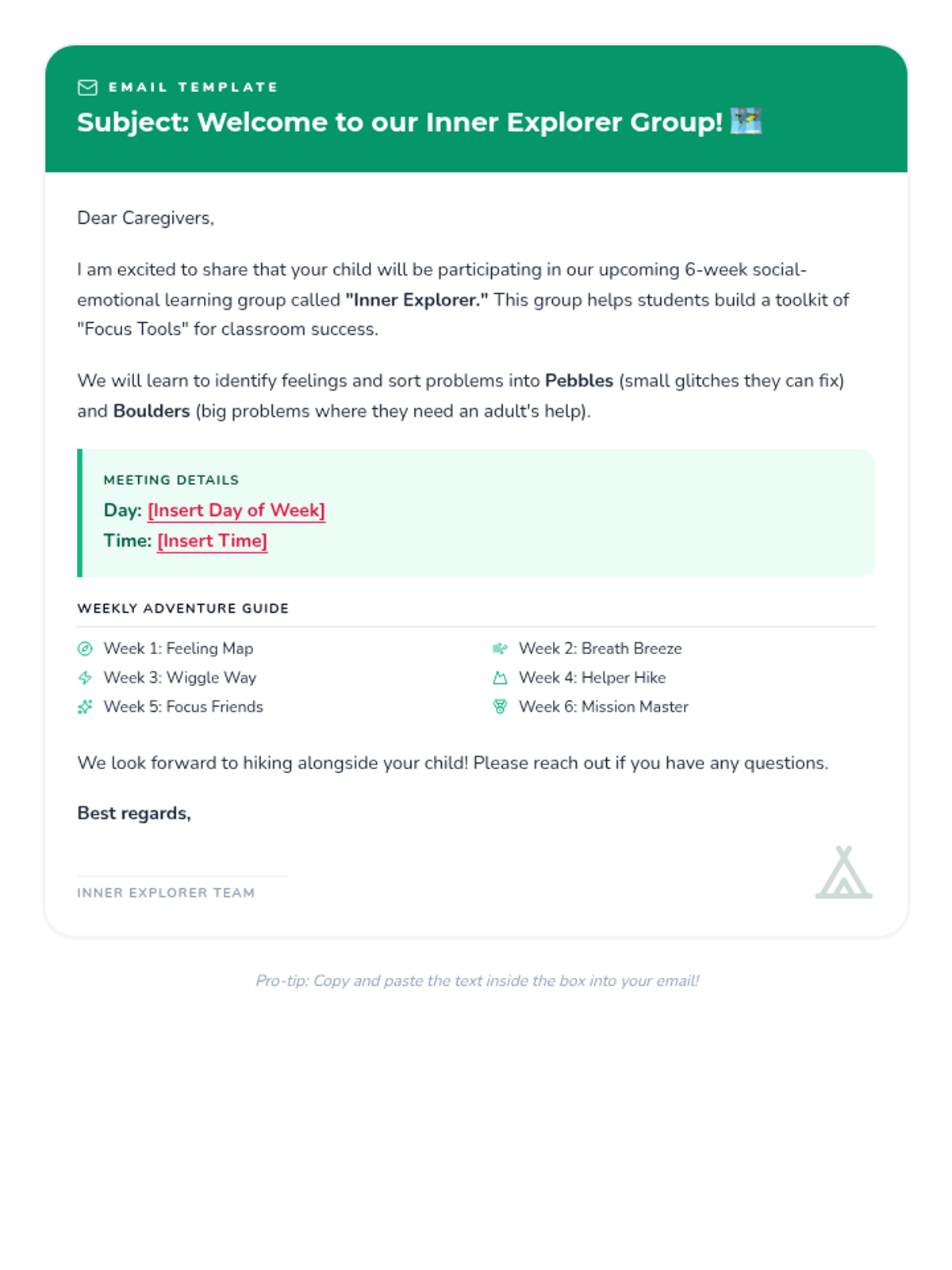
A simplified email template for caregivers introducing the 'Inner Explorer' group. Includes placeholders for group day and time, a summary of the 6-week curriculum, and an explanation of key concepts like 'Pebbles vs. Boulders'. Designed for quick copying into an email or school newsletter.
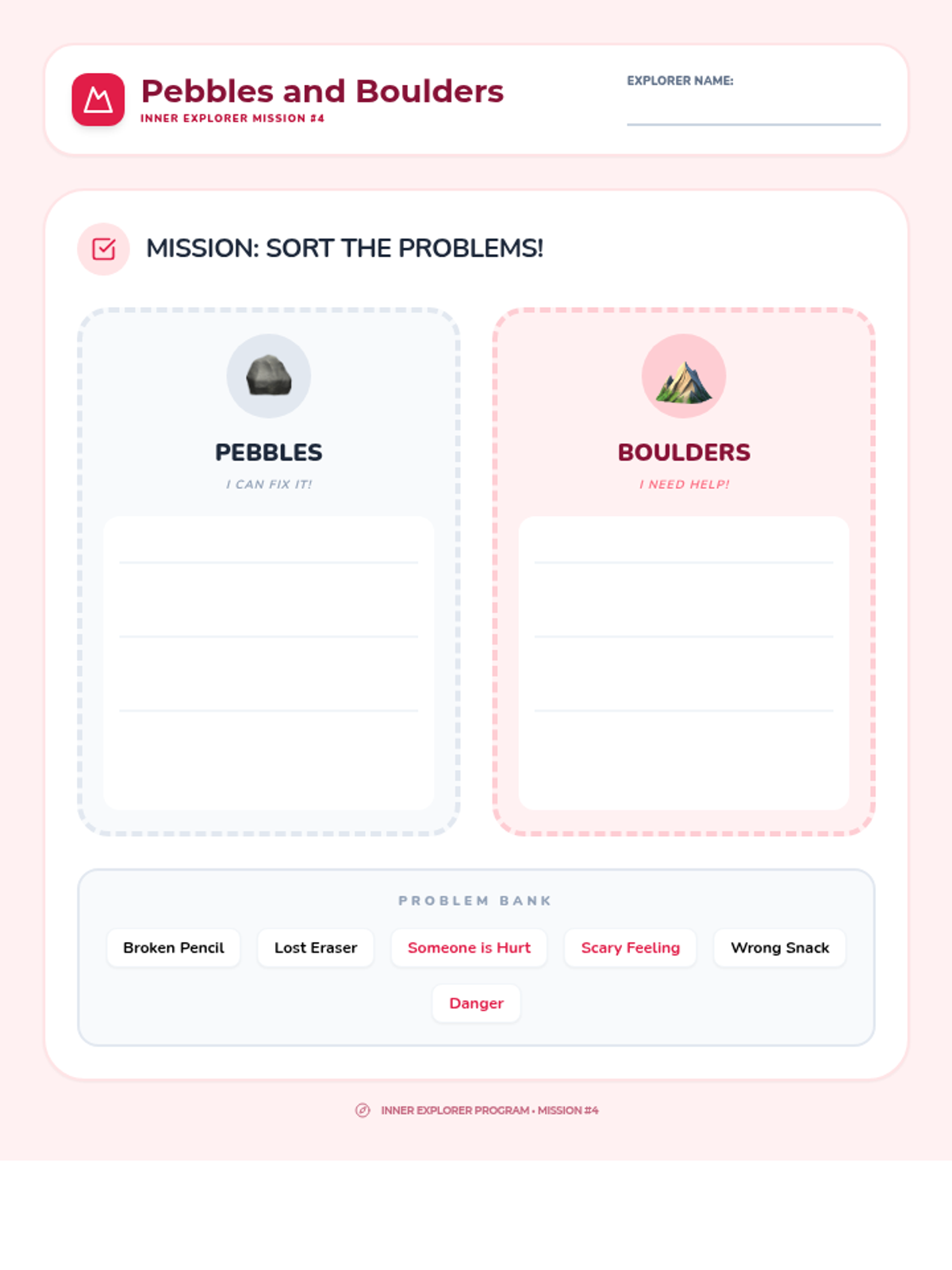
A sorting activity worksheet for first graders to practice identifying the difference between 'Pebbles' (small problems) and 'Boulders' (big problems). Includes a word bank of relatable scenarios and clear sorting areas to reinforce when to seek adult support.
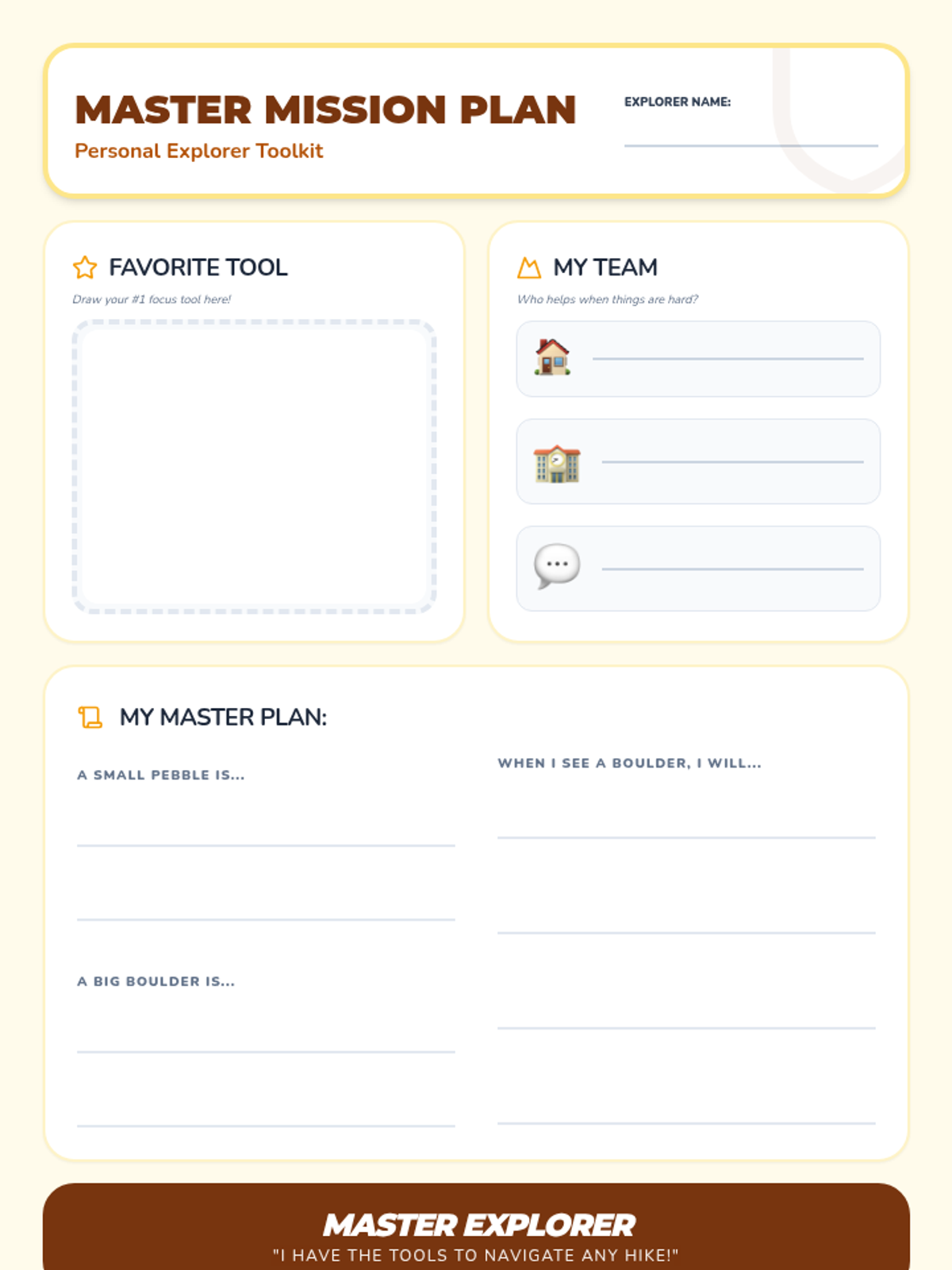
The culminating student worksheet for the Inner Explorer program, updated to include 'Pebbles vs. Boulders' problem sizing. Students document their favorite tool, their support team, and specific plans for handling different problem sizes.
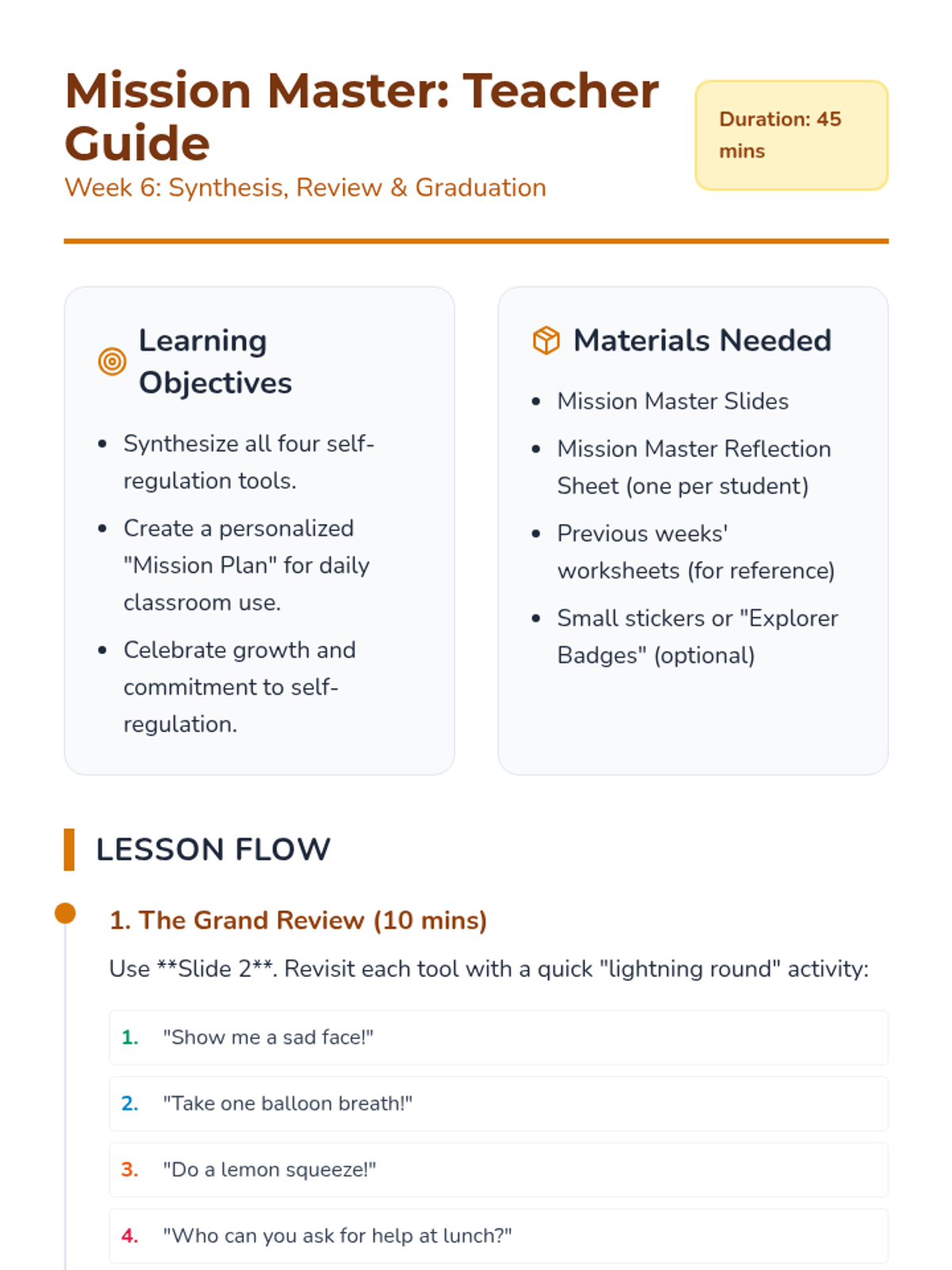
The final teacher's guide for the Inner Explorer program. Focuses on synthesizing the six weeks of learning, guiding students through the creation of their personalized mission plans, and conducting a celebration ceremony to recognize student achievement in self-regulation.
A celebratory and comprehensive review slide deck for the final week of the Inner Explorer program. Summarizes the four key tools learned (Feelings, Breath, Movement, Team), guides students in creating a personalized toolkit, and celebrates their growth as self-regulated learners.
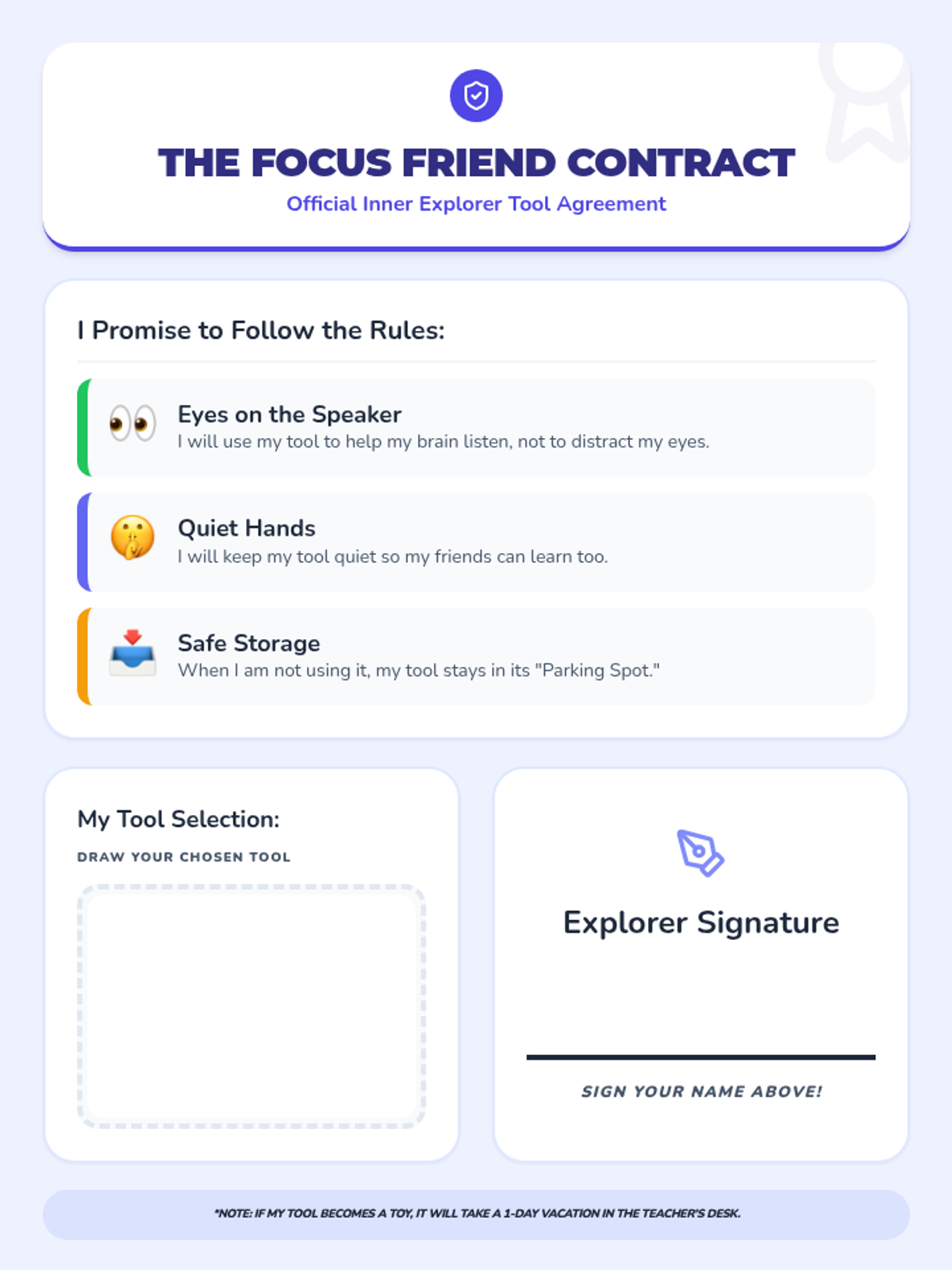
A formal behavioral contract for students using sensory tools (fidgets). Outlines three key rules (Eyes on Speaker, Quiet Hands, Safe Storage), includes a space for students to draw their selected tool, and provides a signature line to foster a sense of responsibility and ownership.
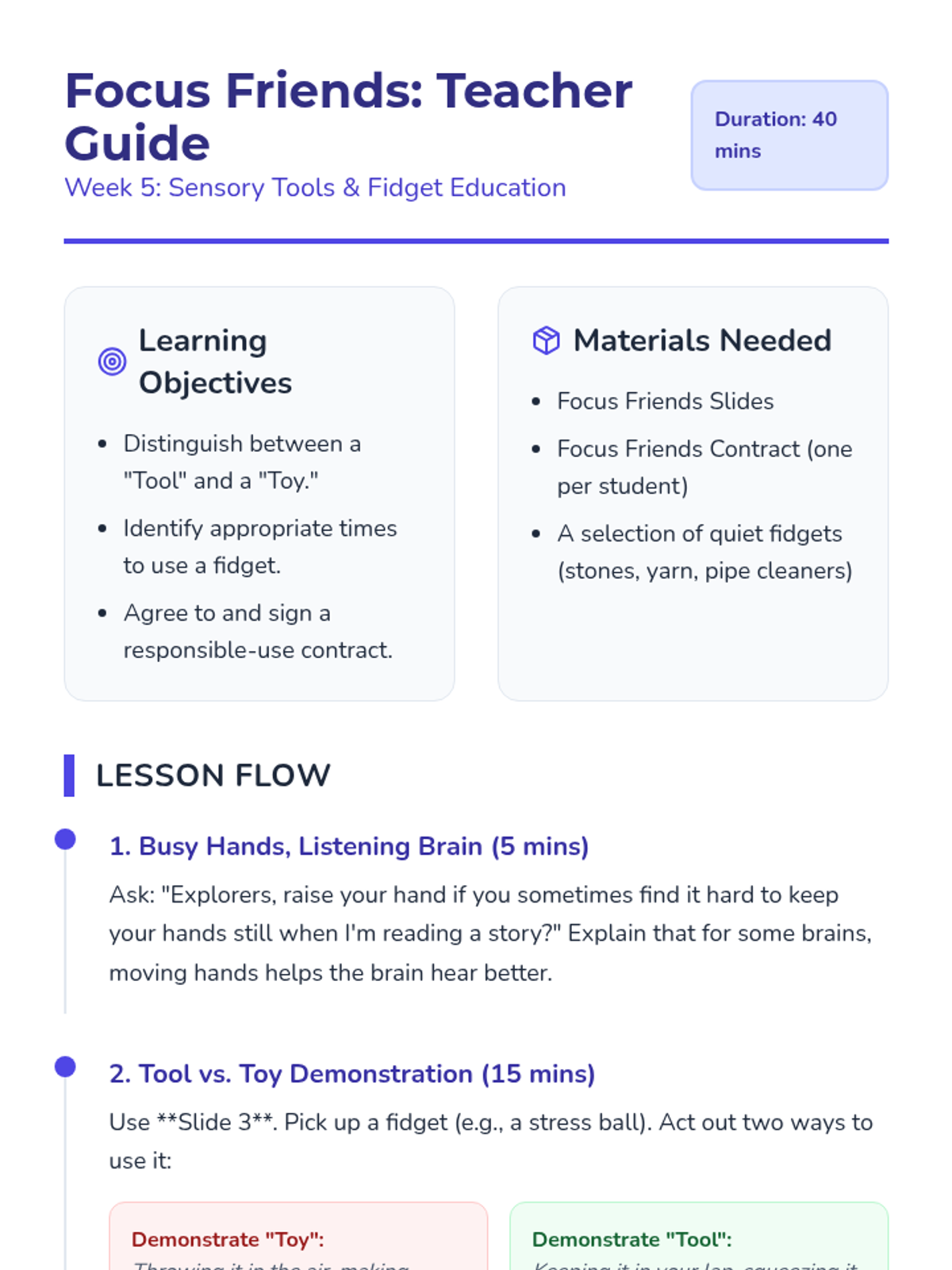
A teacher's guide for introducing fidget tools in the first-grade classroom. Includes a clear 'Tool vs. Toy' demonstration script, behavioral expectations for fidget use, and a classroom management strategy for storing and retrieving sensory tools.
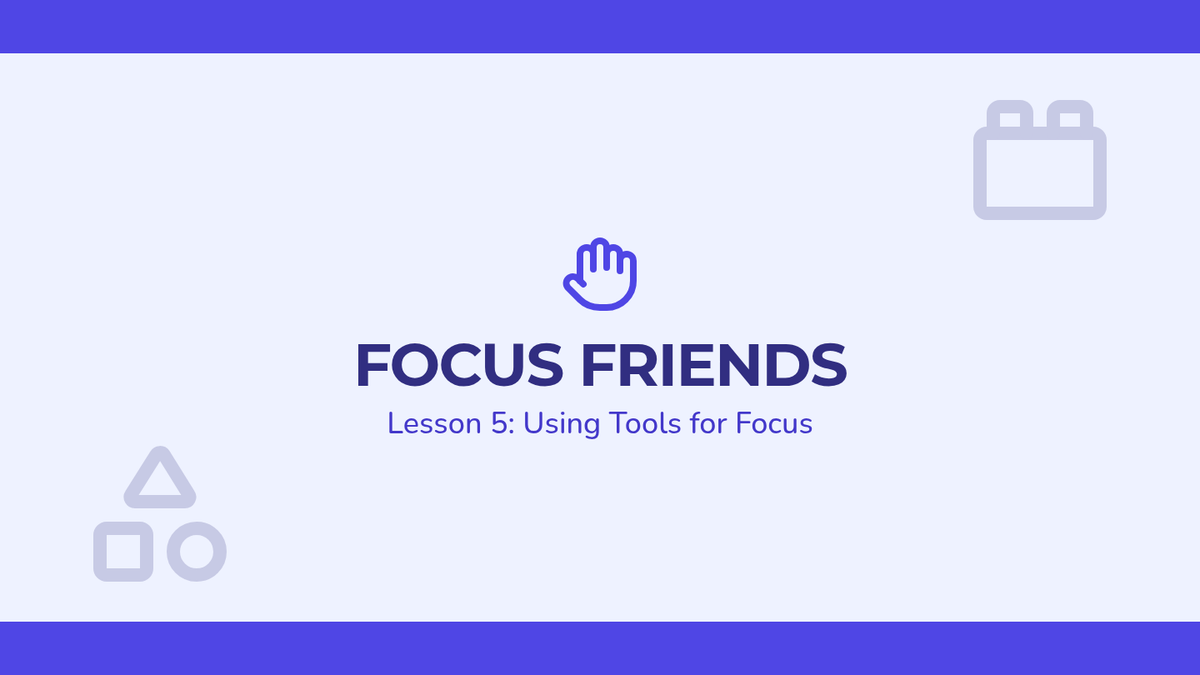
A slide deck for teaching first graders how to use fidgets (Focus Friends) responsibly. Explains the difference between a tool and a toy, provides clear rules for engagement (Eyes Up, Keep it Quiet, Desk Home), and builds anticipation for signing a focus contract.
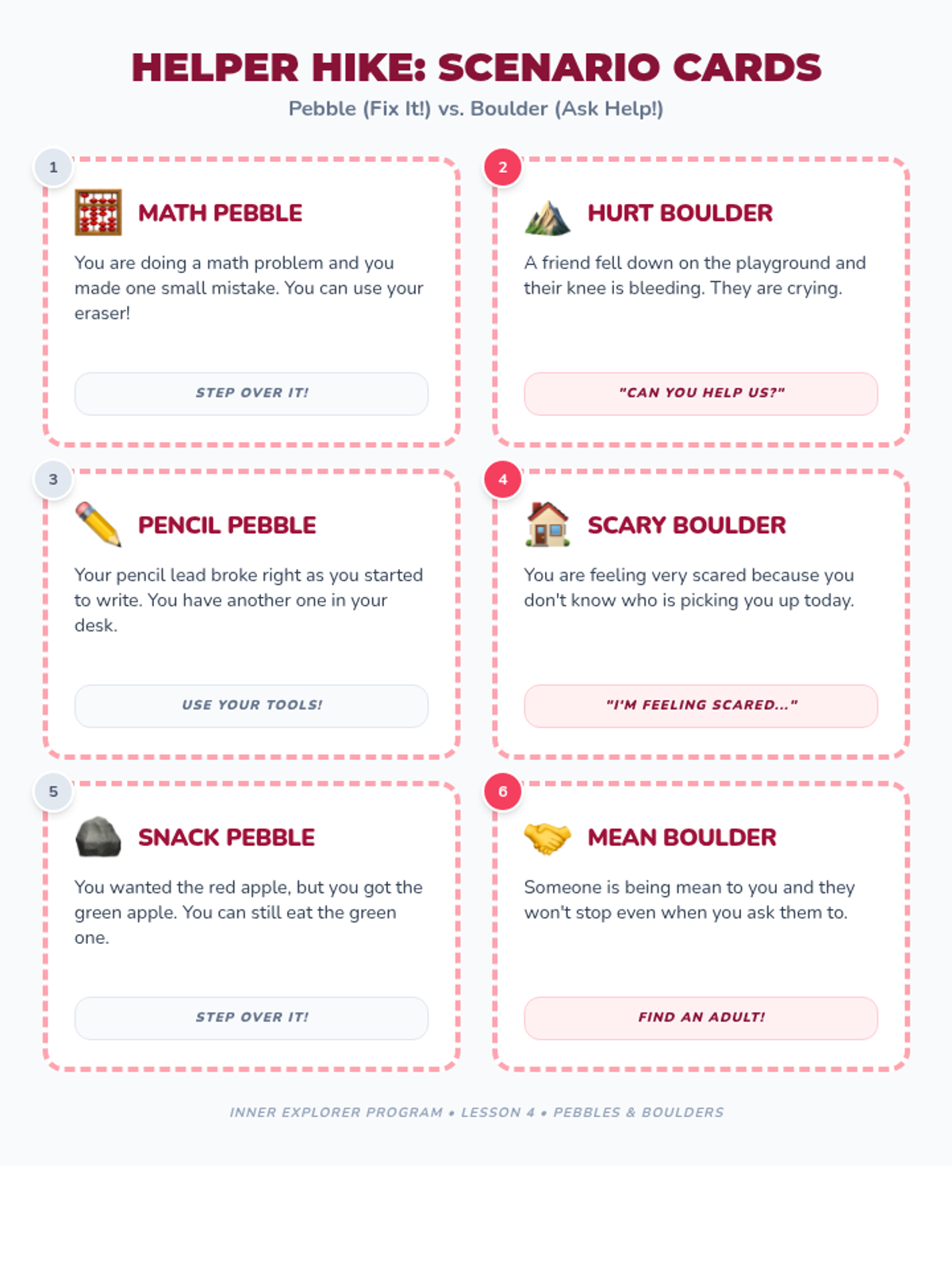
A set of six printable scenario cards for first-grade role-playing, updated to include the 'Pebbles vs. Boulders' concept. Each card presents a situation and helps students practice deciding whether to solve it independently or seek adult assistance.
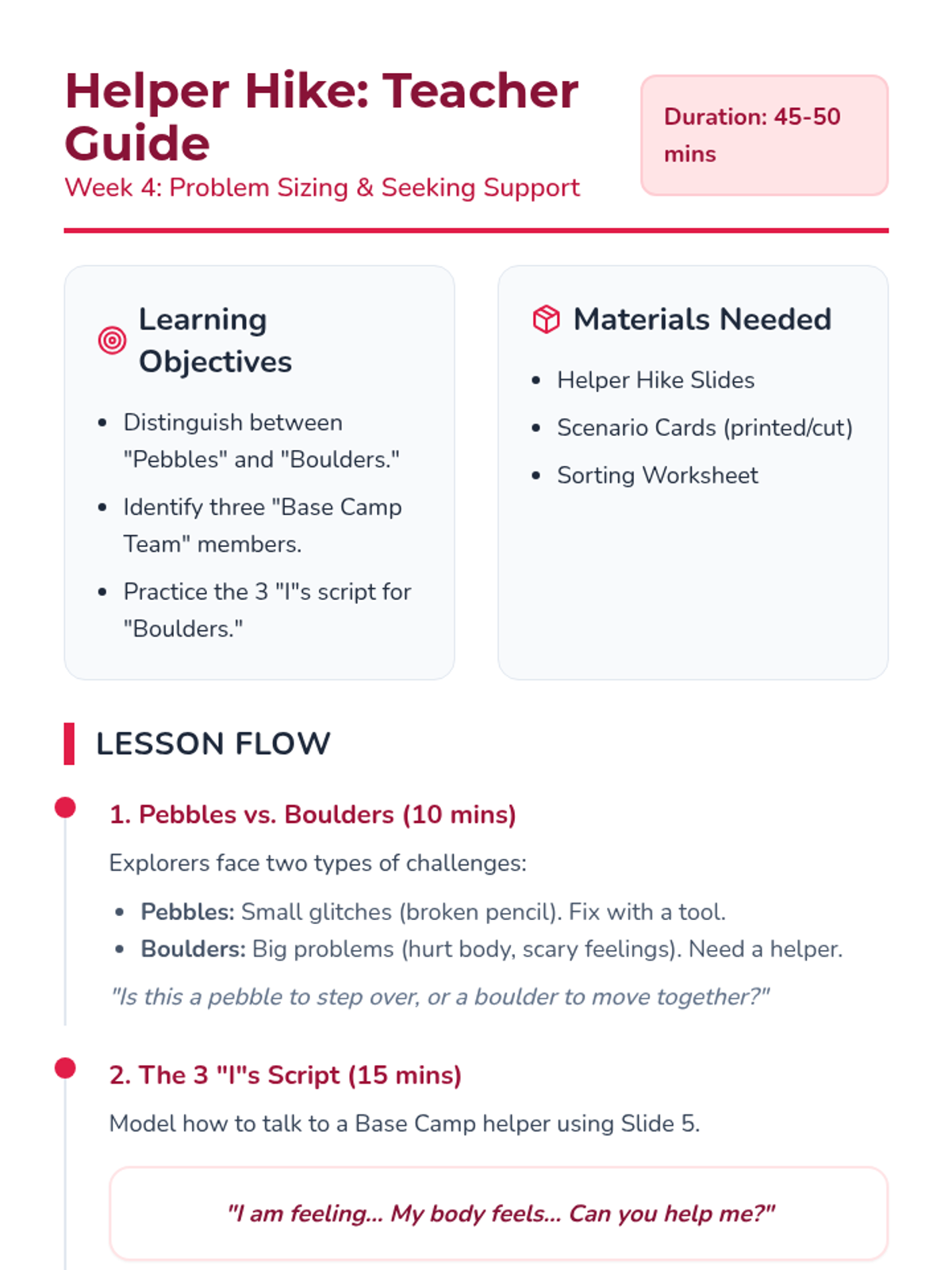
A professional teacher's guide for Lesson 4, focused on problem sizing (Pebbles vs. Boulders) and help-seeking behaviors. It outlines how to frame asking for help as a strength and provides a structured script for communicating needs to adults.
A social-emotional slide deck for first graders about the importance of asking for help. Introduces the 'Pebbles vs. Boulders' metaphor for problem sizing and teaches a three-step process for communicating needs to the 'Base Camp Team'.
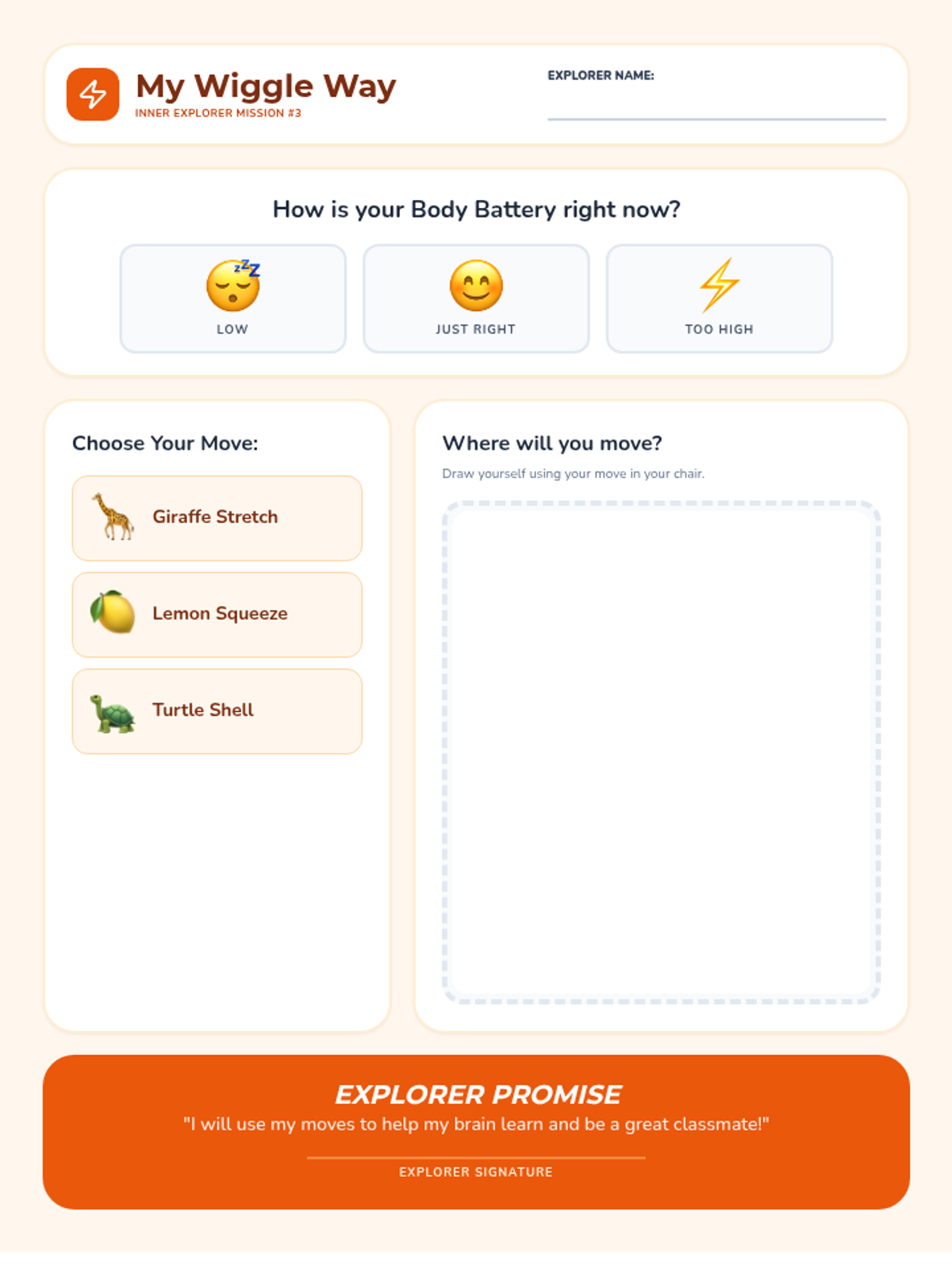
A student activity sheet for the 'Wiggle Way' movement lesson. Includes a 'Body Battery' check-in, a selection menu of three classroom-friendly movements, a drawing space for personalized application, and an 'Explorer Promise' to reinforce responsible use of movement tools.
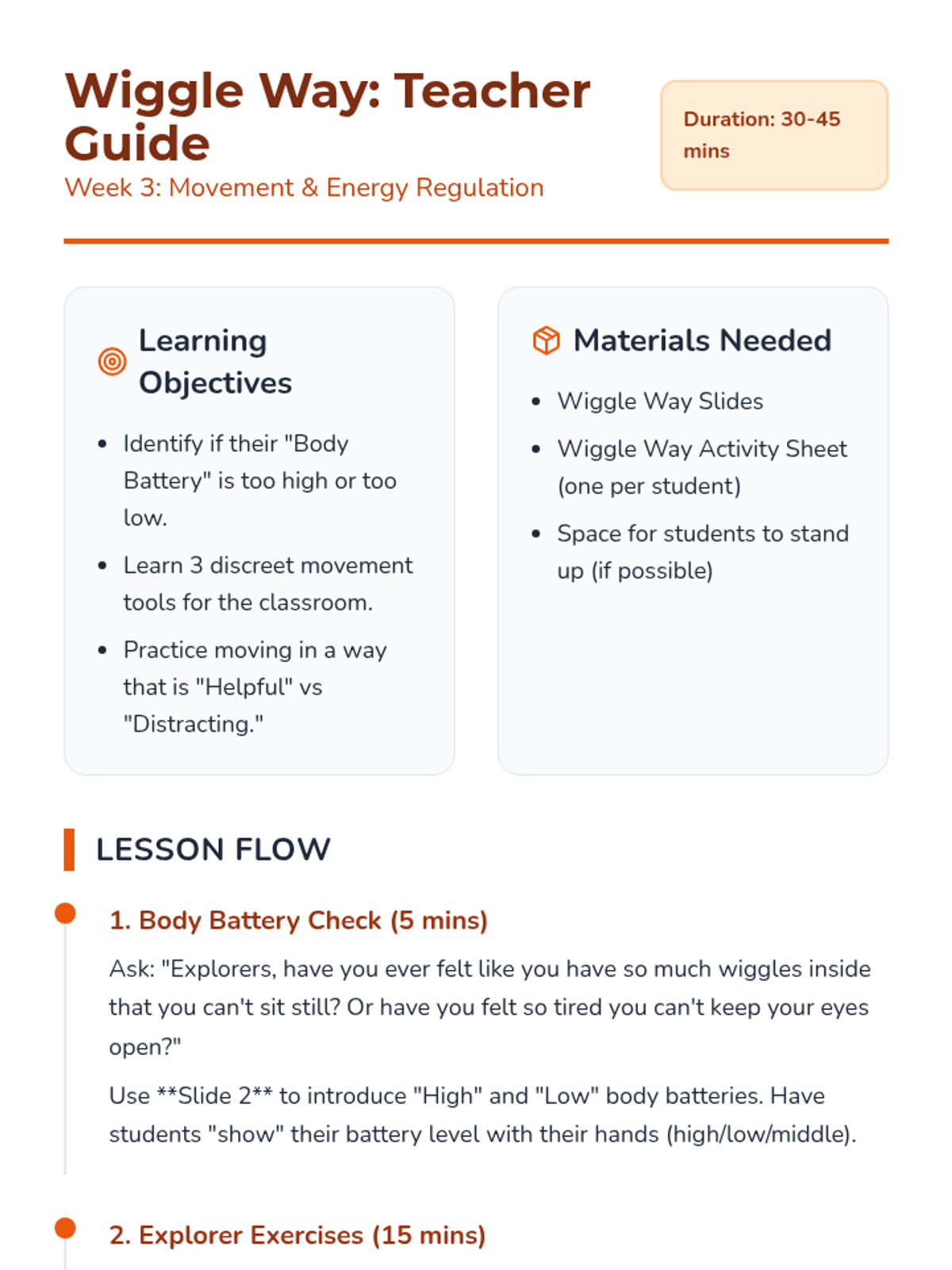
A teacher guide for the 'Wiggle Way' movement lesson. Includes a 'Body Battery' conceptual framework, instructions for teaching three specific classroom-appropriate movements, and a discussion guide for distinguishing between helpful movement and distraction.
An energetic slide deck for first graders about using movement as a focus tool. Introduces the concept of 'Body Battery', teaches three specific desk-friendly stretches ('Giraffe Stretch', 'Lemon Squeeze', 'Turtle Shell'), and establishes rules for using movement effectively in the classroom.
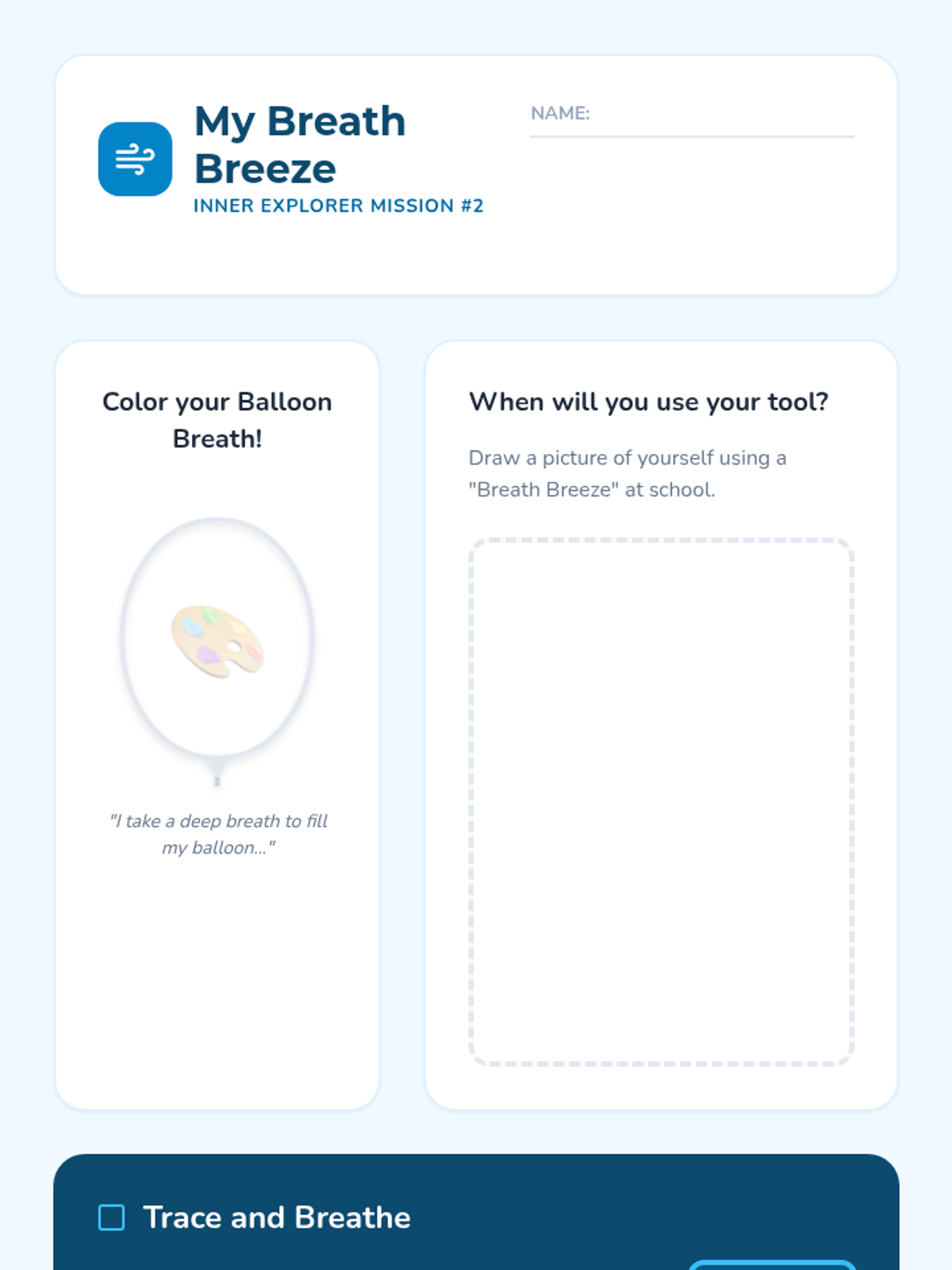
A student activity sheet for practicing breathing techniques. Features a large balloon outline for coloring (representing Balloon Breathing), a creative drawing space for situational application, and a tactile 'Trace and Breathe' square for practicing Square Breathing.
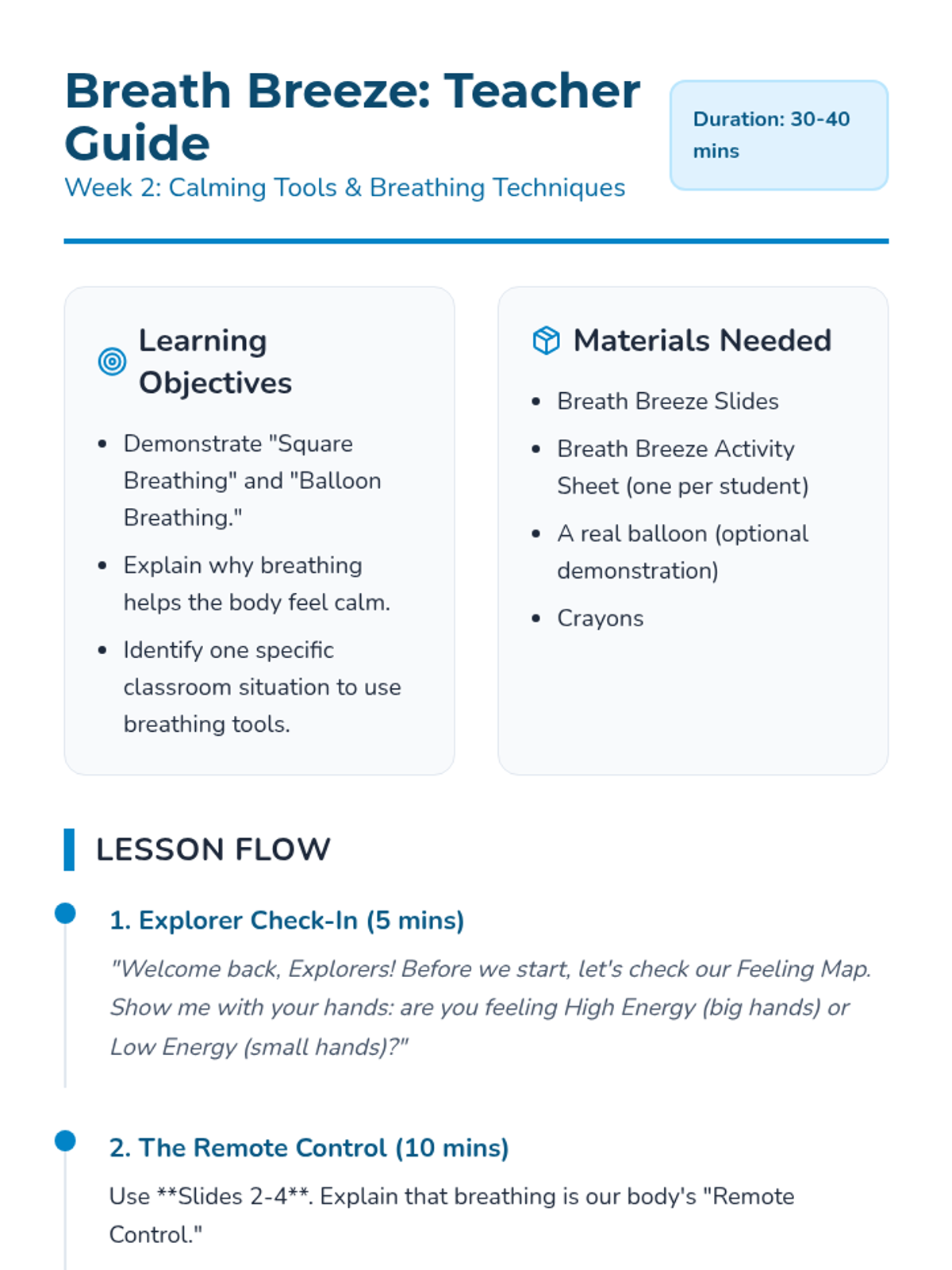
A lesson plan for teachers to lead the 'Breath Breeze' session. Provides structured activities for teaching 'Balloon' and 'Square' breathing, includes discussion prompts about the physiological benefits of breathing, and offers tips for classroom implementation.
An instructional slide deck for first graders focusing on breathing techniques as a self-regulation tool. Teaches 'Square Breathing' and 'Balloon Breathing' with simple visuals and identifies specific classroom moments when these tools are most effective.
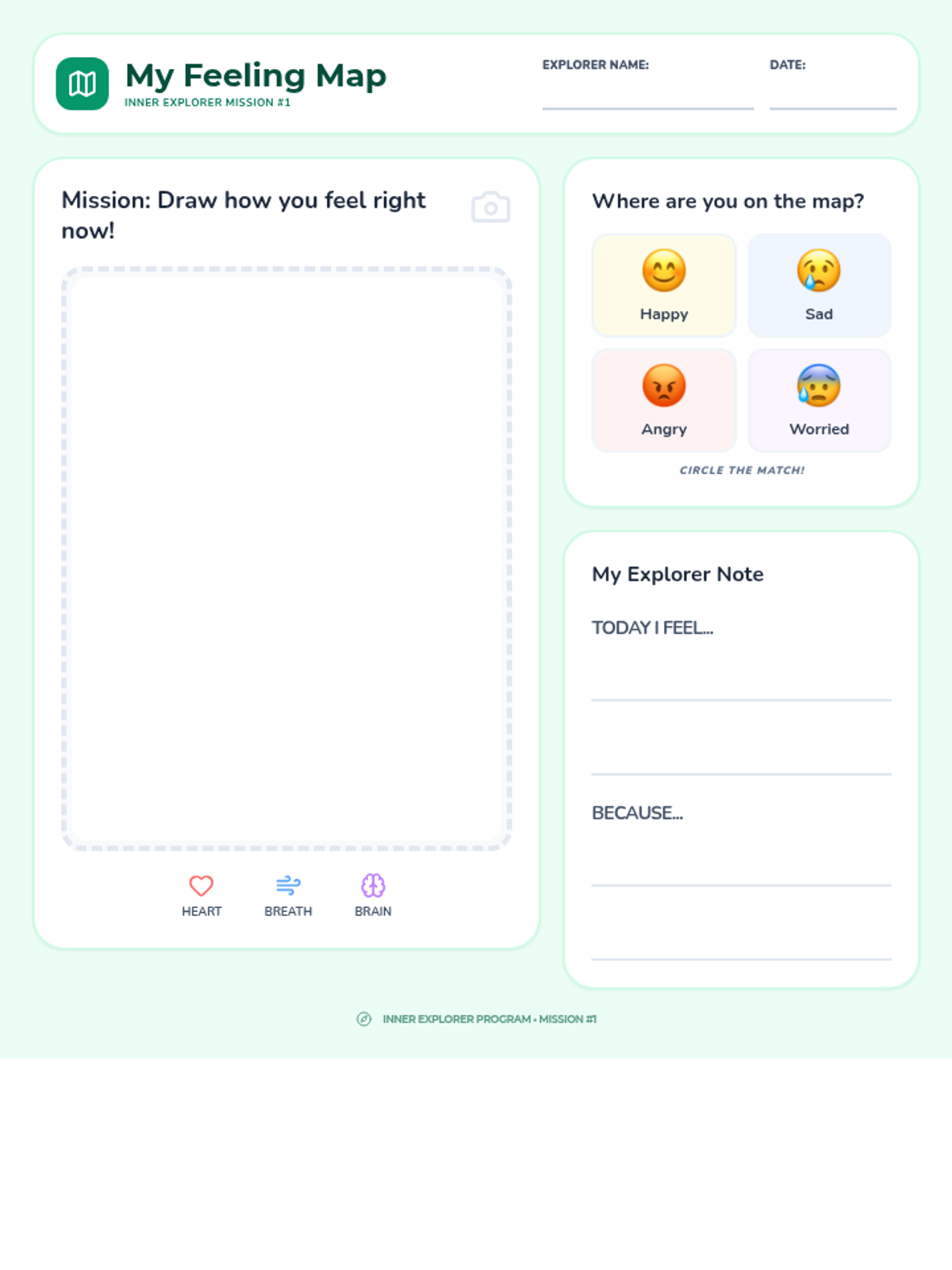
An interactive worksheet for first graders to draw and identify their current emotions. Includes a creative drawing area, emoji-based emotion selection, and a simple sentence-starter section to help students articulate why they feel a certain way.
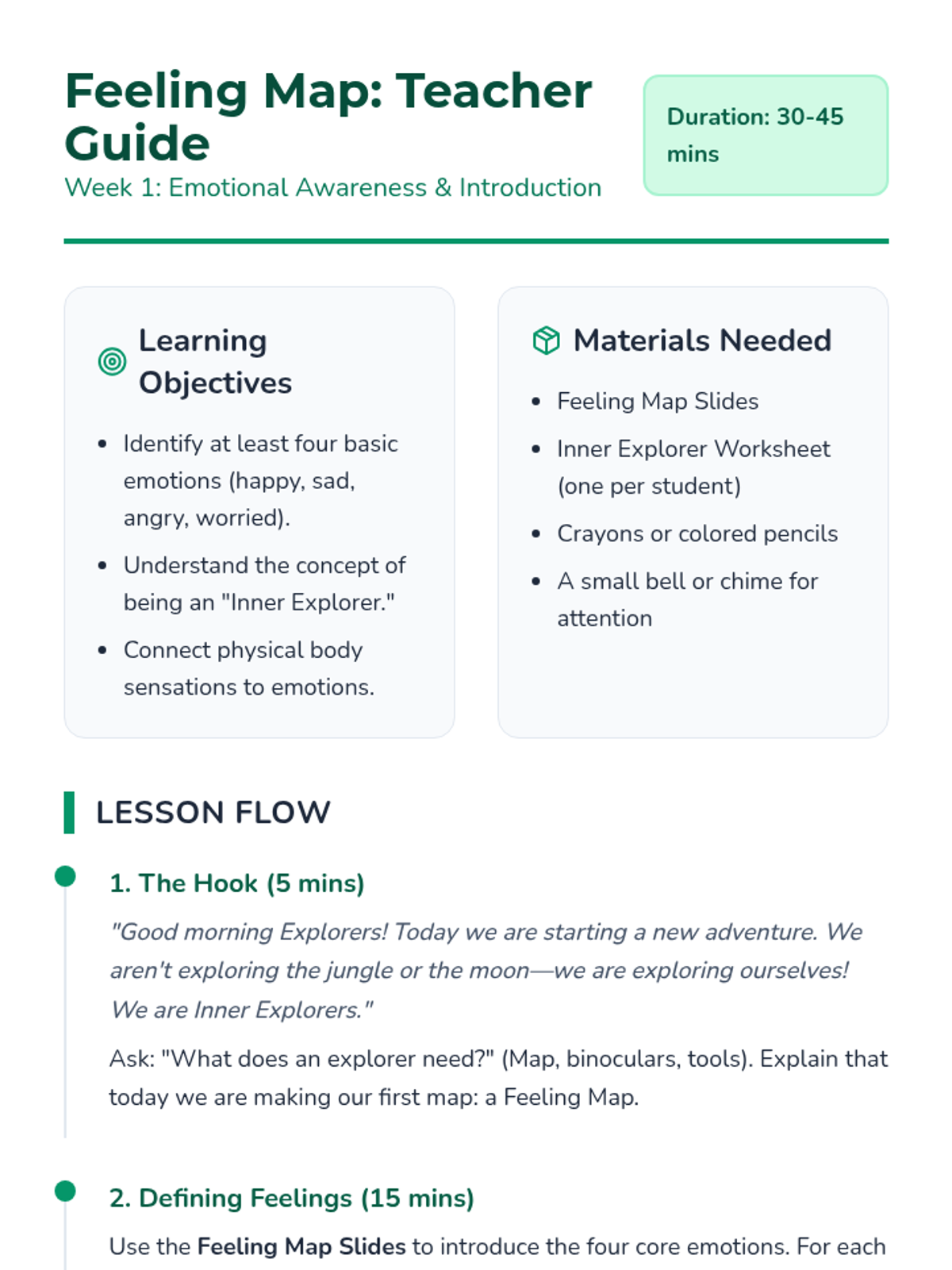
A comprehensive teacher's guide for the first week of the Inner Explorer program. Includes learning objectives, a step-by-step instructional script, materials list, and differentiation strategies to support all learners in identifying basic emotions.
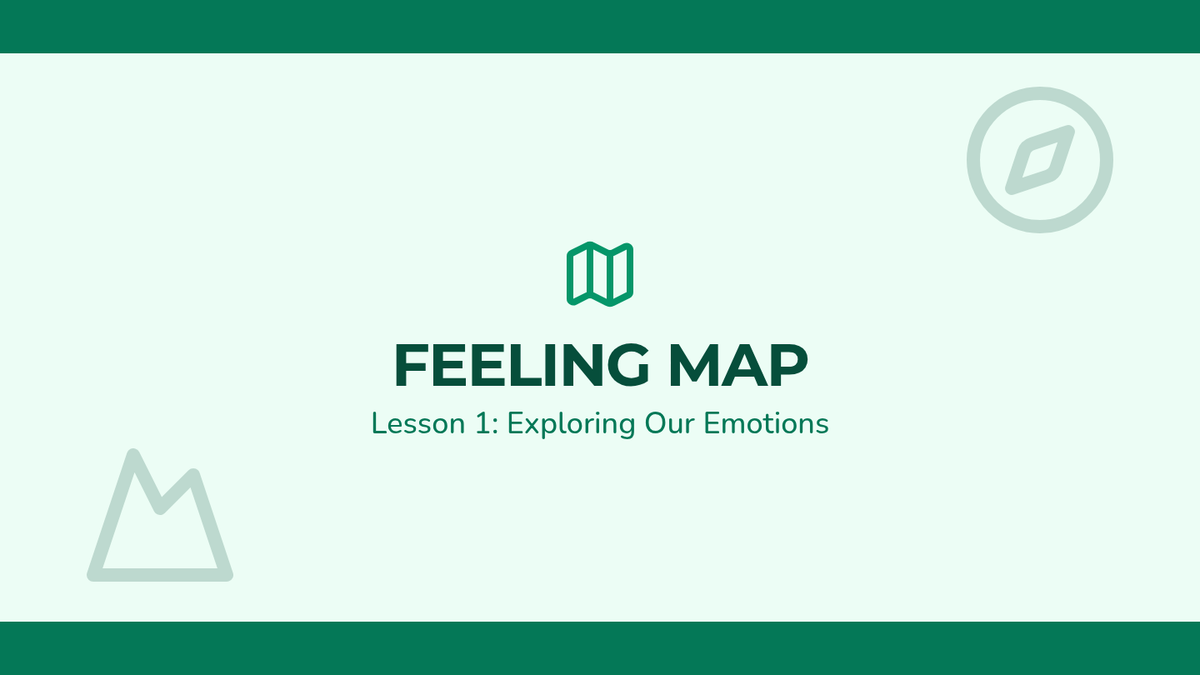
A vibrant and engaging slide deck introducing the 'Inner Explorer' concept and helping first graders identify common emotions using a 'Feeling Map' metaphor. Includes visual cues for happy, sad, angry, and worried emotions, plus a guided check-in activity.
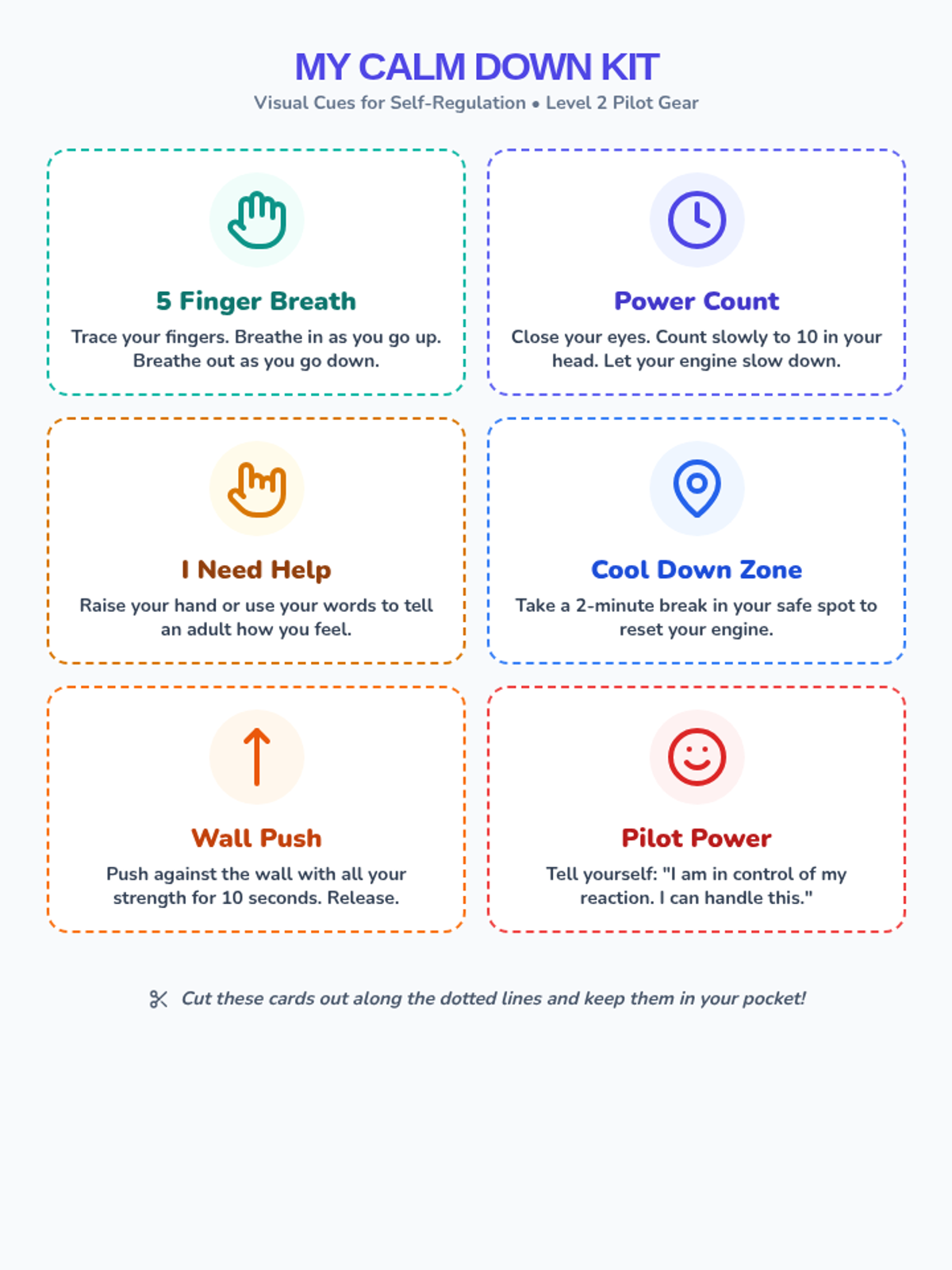
A set of six printable visual cue cards for self-regulation techniques, designed to be used by students as a portable 'Calm Down Kit'. Revision: Increased text size, updated icons, and improved footer contrast.
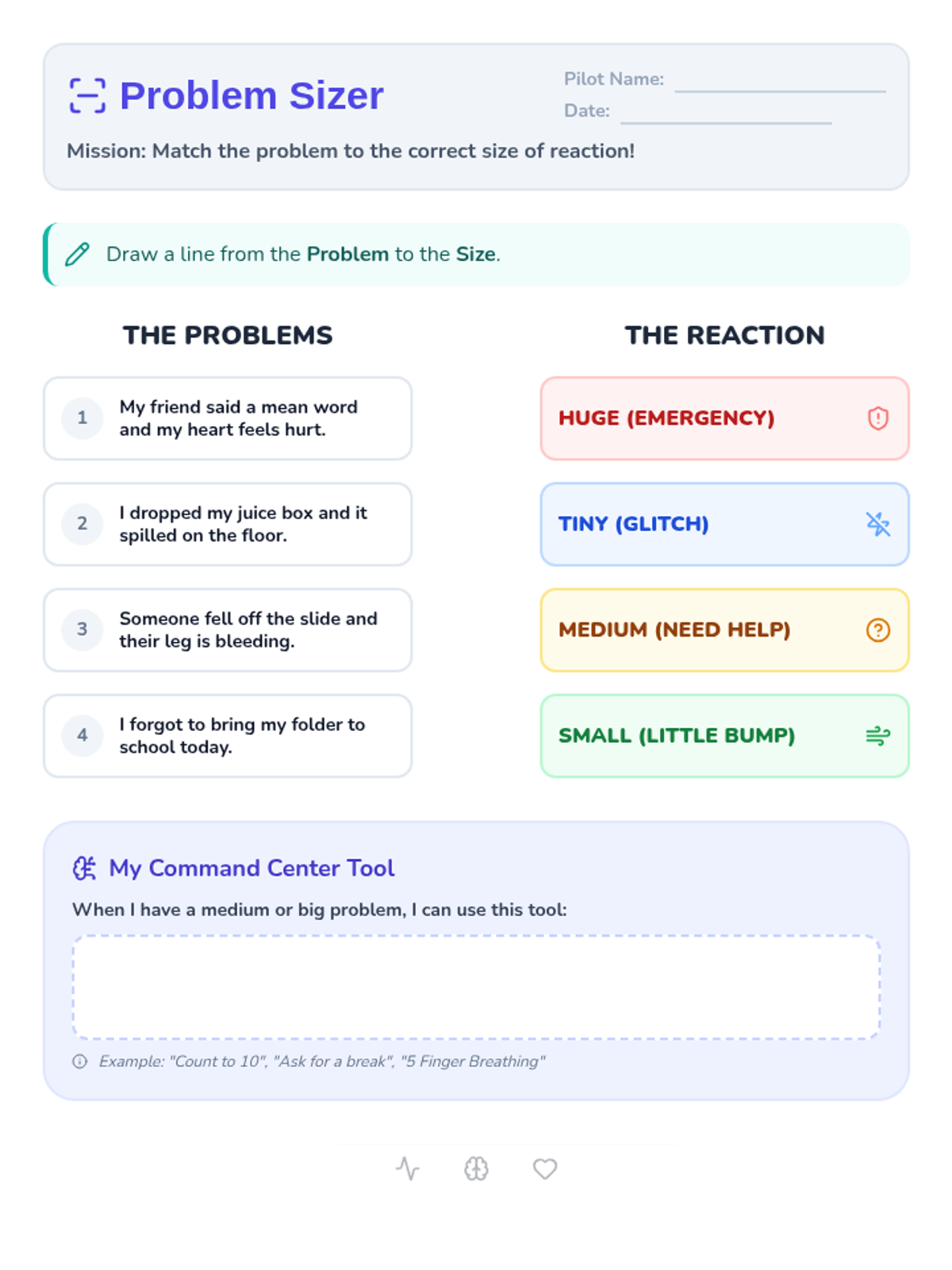
A matching worksheet for students to identify the size of problems (Tiny to Huge) and their appropriate reactions. Revision: Increased horizontal gap and updated icons for clarity.
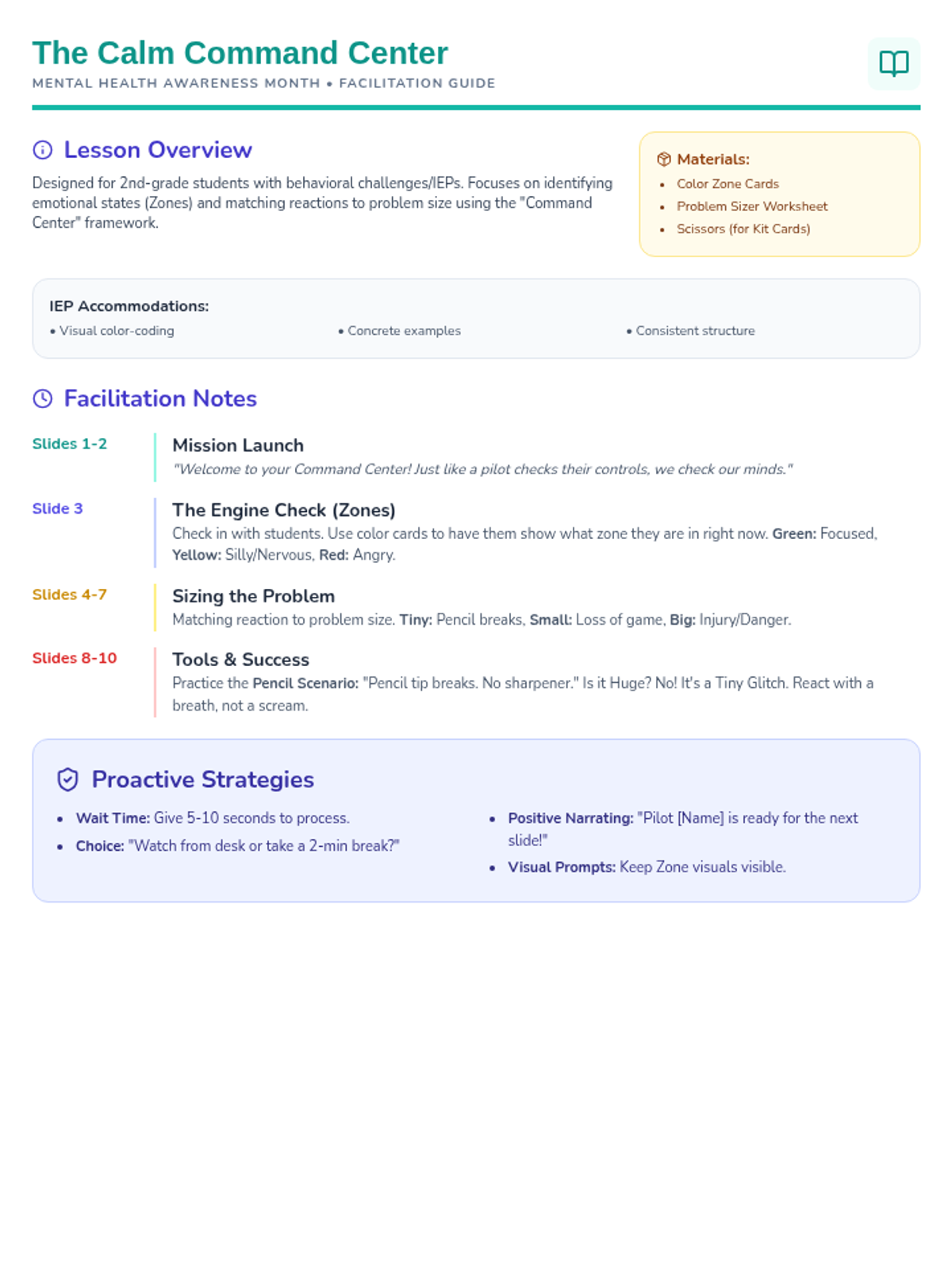
A teacher guide for the Calm Command Center lesson, providing scripting, pacing, and behavior support strategies tailored for 2nd-grade students with IEPs. Revision: Added materials list and specific scenario details.
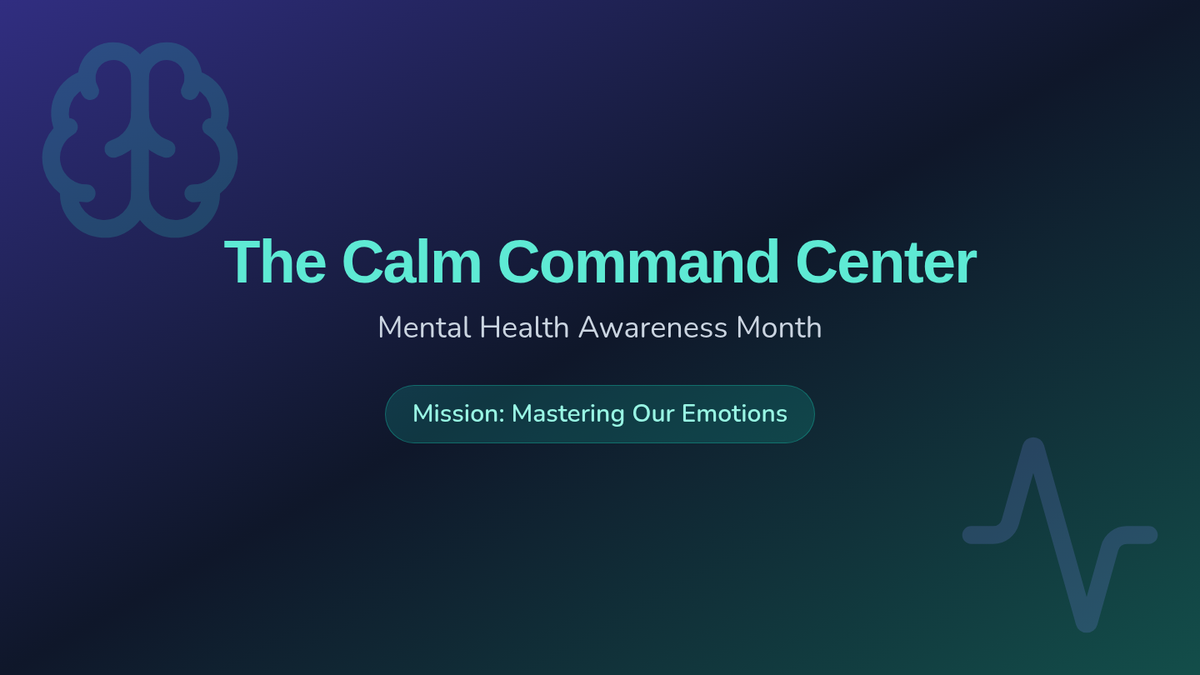
A structured slide deck designed for primary students with behavioral challenges. It introduces the 'Size of the Problem' concept and self-regulation 'Engine Check' zones using a futuristic Command Center theme. Revision: Improved contrast on the final slide.
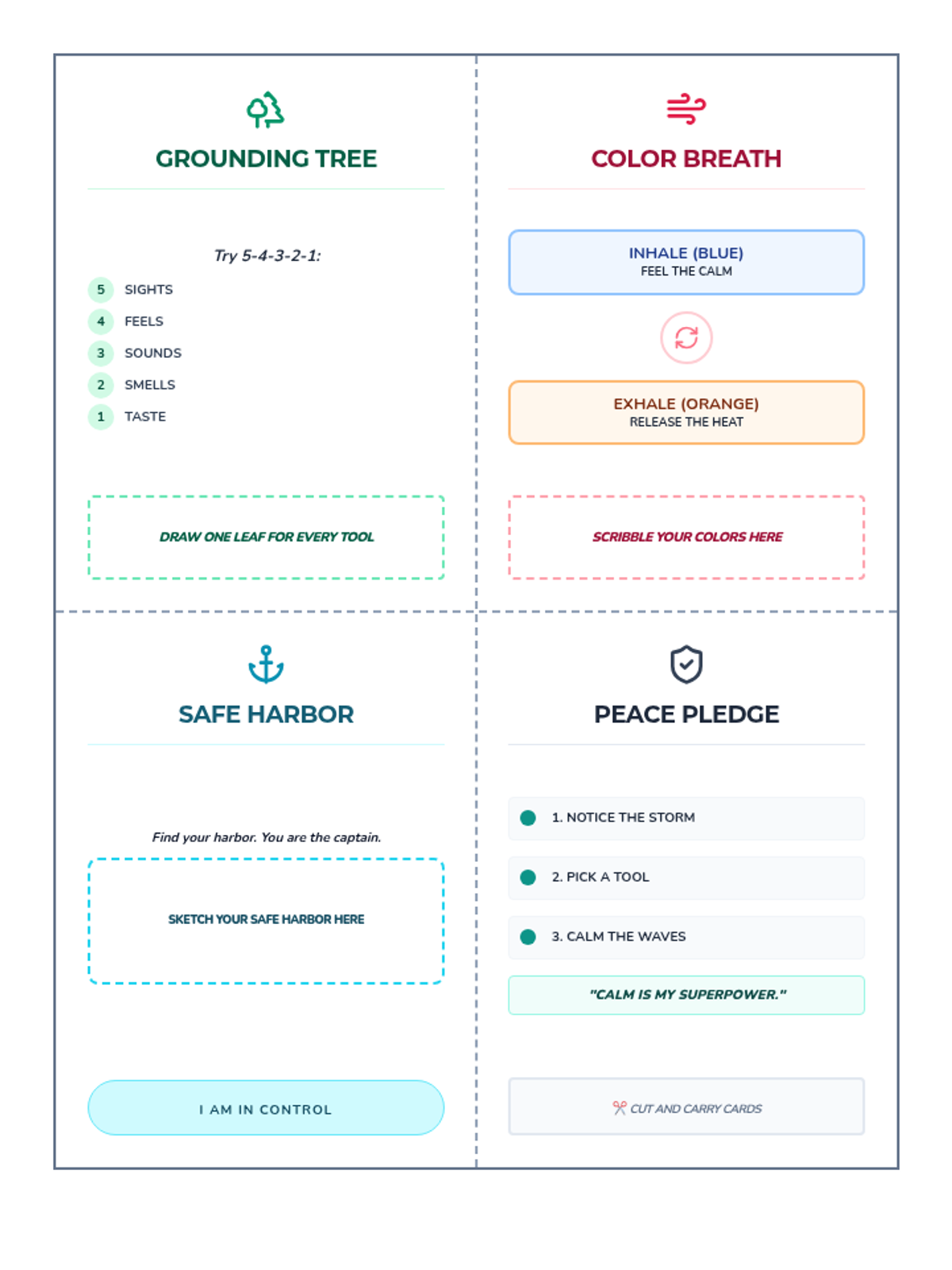
Four pocket-sized 'Pocket Peace Cards' that students can color, cut out, and carry to remind them of grounding, breathing, and visualization techniques for independent regulation.
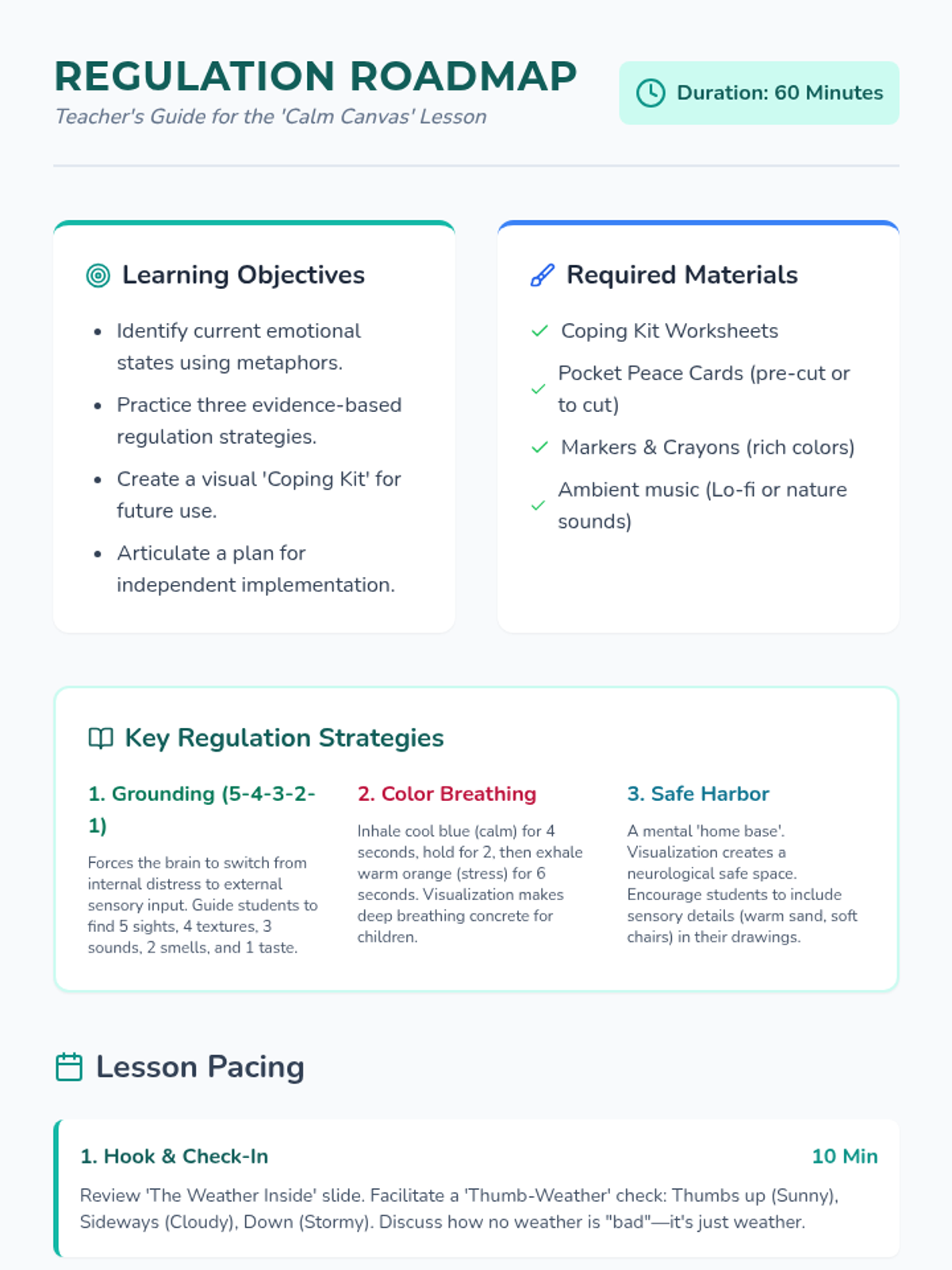
A teacher-facing lesson plan providing pacing, instructional strategies, and differentiation tips for implementing the Calm Canvas art and regulation lesson.
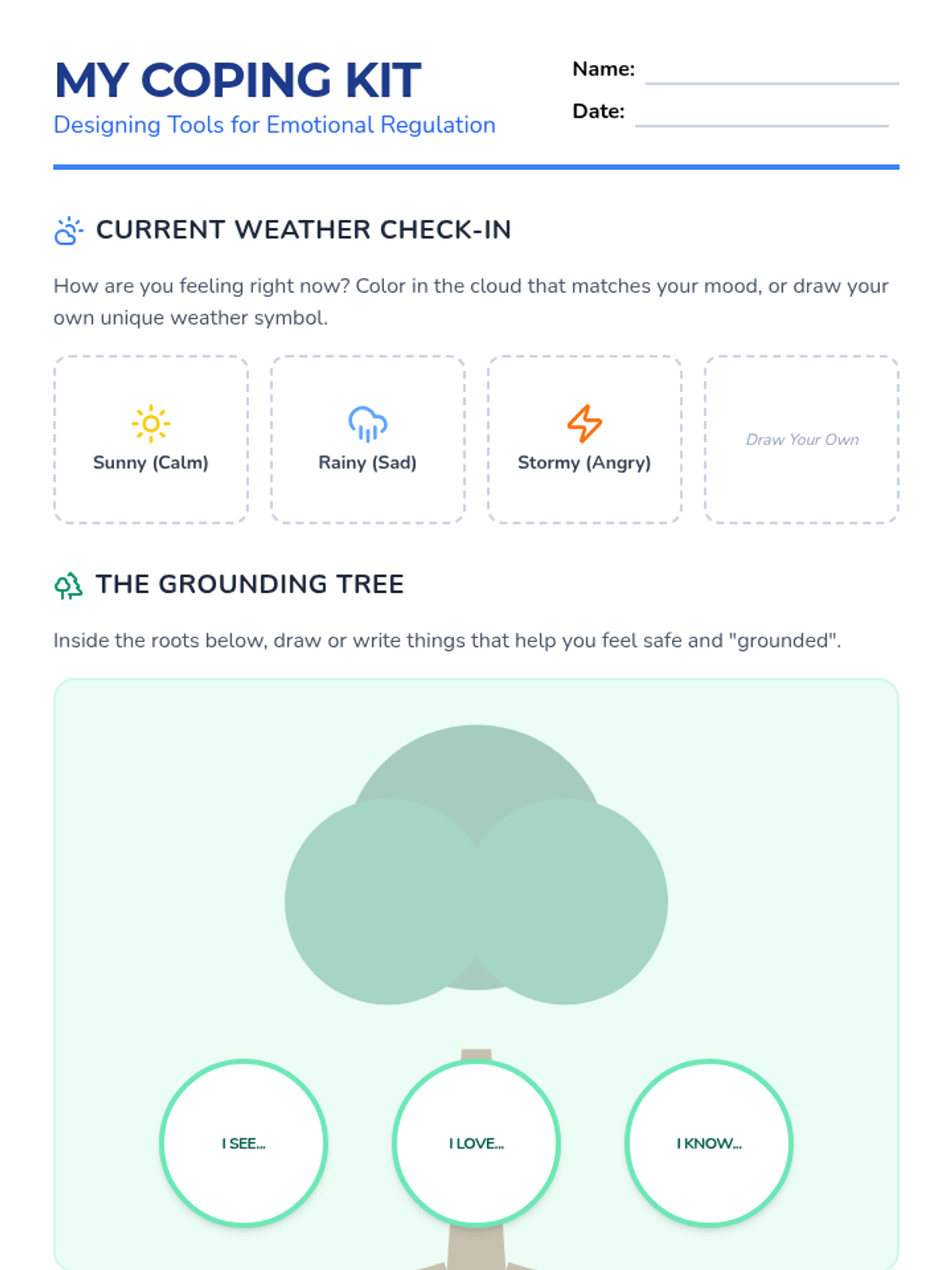
A two-page student worksheet that guides students through identifying their emotions and creatively drawing their own 'Coping Kit', featuring a 'Grounding Tree' and a 'Safe Harbor' visualization space.
A visual slide deck that introduces emotional regulation concepts through the metaphor of weather and 'The Safe Harbor', teaching three specific art-linked coping strategies.
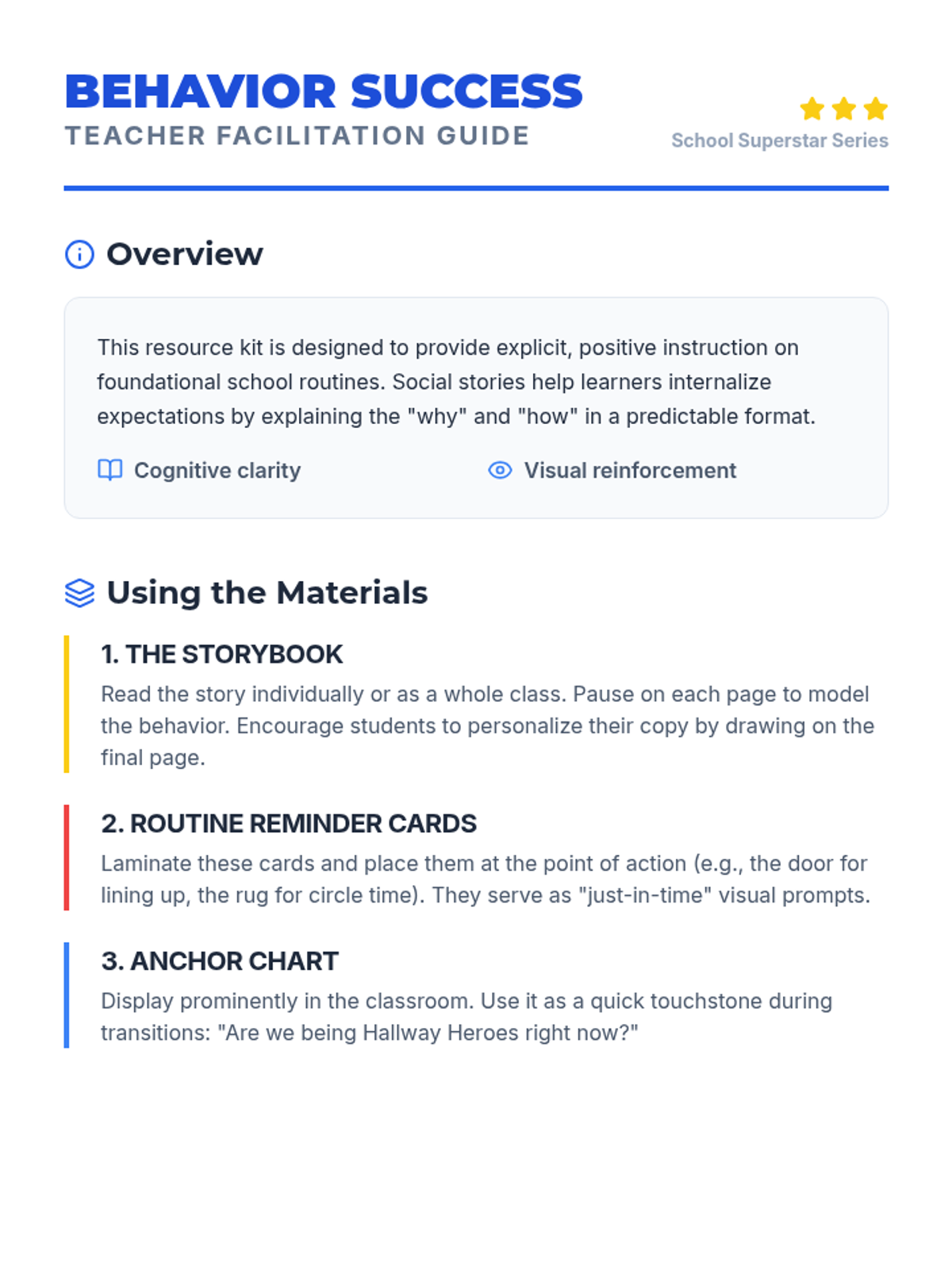
A teacher-facing facilitation guide providing instructional strategies, pacing suggestions, and practical tips for implementing the School Superstar social story and visual aids in the classroom.
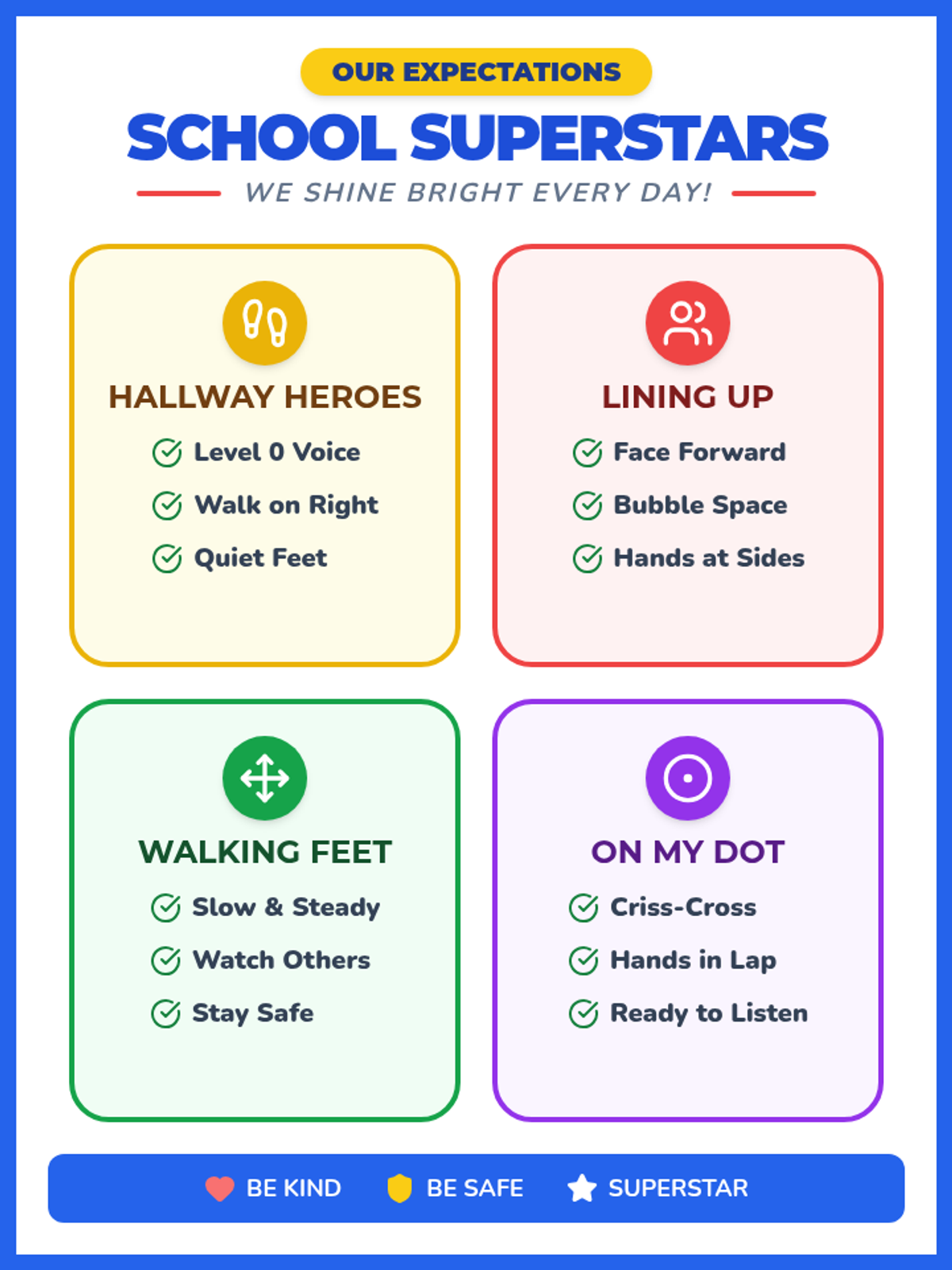
A high-impact, single-page anchor chart summarizing the four key behavioral expectations: Hallway Hero, Lining Up, Walking Feet, and Circle Time Dot. Uses clear icons, vibrant colors, and simplified bullet points for classroom display.
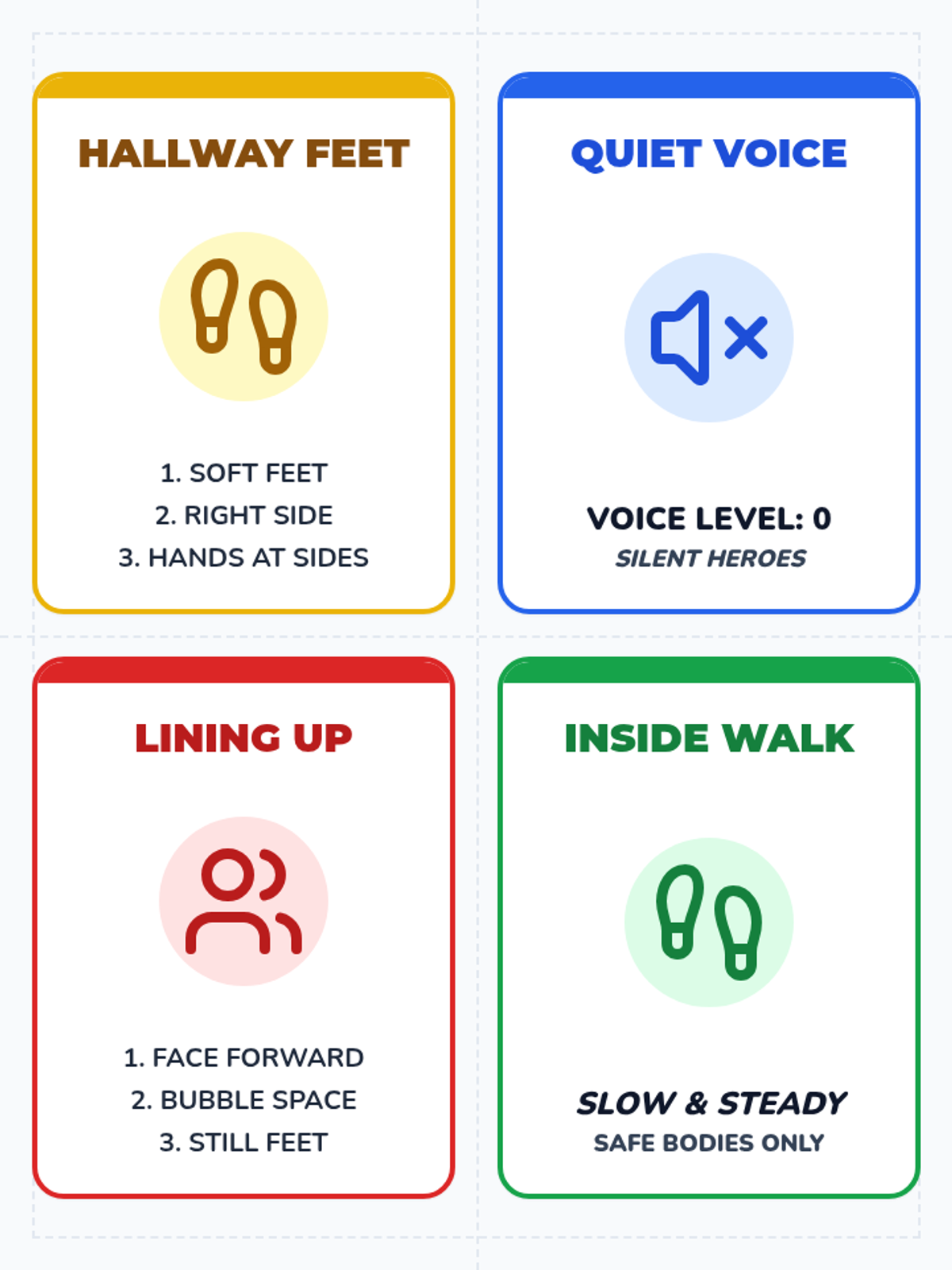
A 2-page set of printable visual sequence cards (8 cards total) that provide quick-reference reminders for hallway behavior, voice levels, lining up, walking feet, circle time posture, and self-reflection. Designed to be cut out and laminated for classroom use.
A 7-page social story document designed to teach young students the expected behaviors for hallway walking, lining up, classroom safety, and circle time participation. It features engaging illustrations (emojis/icons), clear step-by-step instructions, and a personalized cover and drawing page.
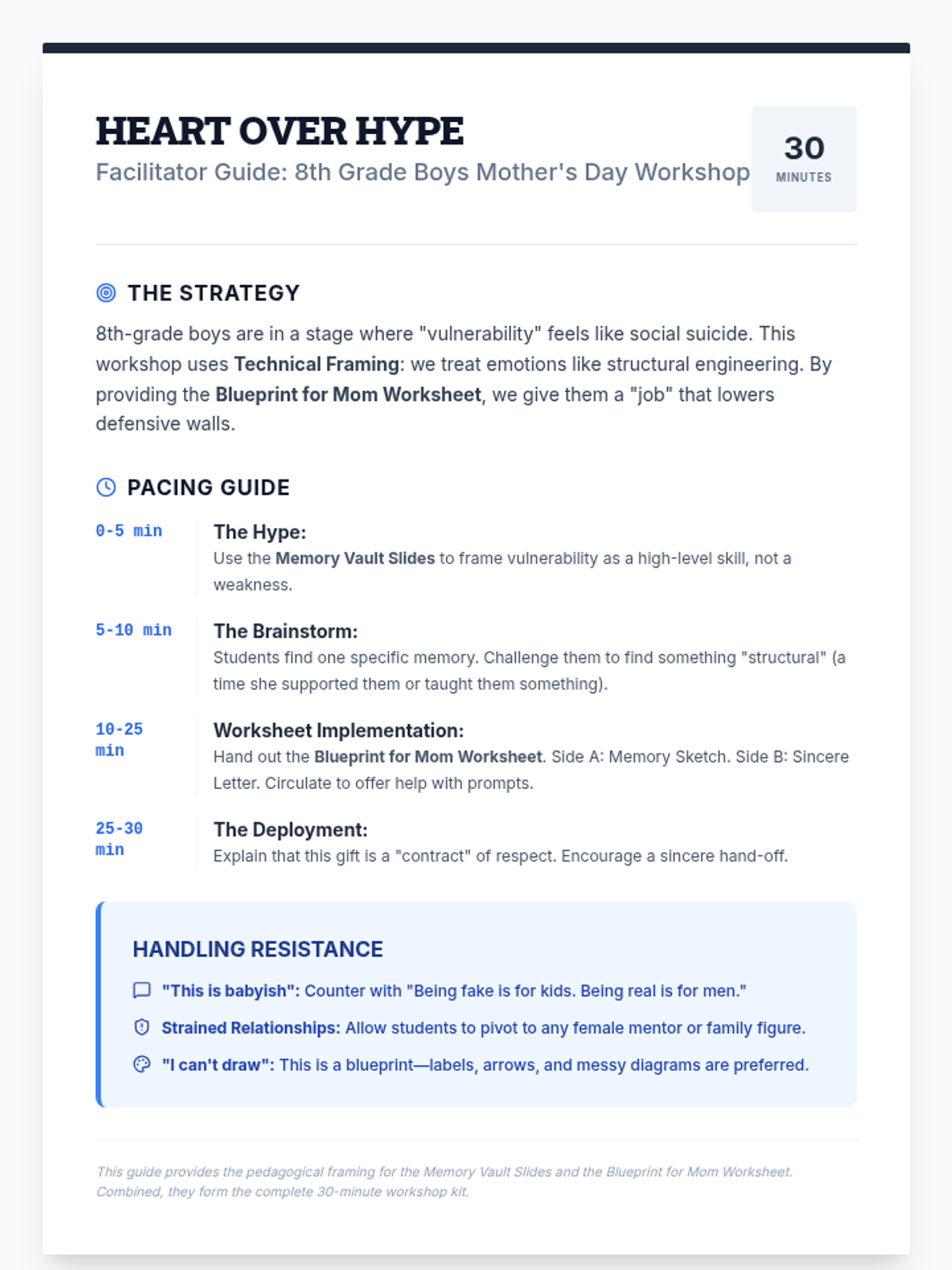
A facilitator guide for teachers leading a Mother's Day workshop for 8th-grade boys. It provides a 30-minute pacing guide, instructional strategies for overcoming emotional resistance, and a core philosophy of 'Technical Framing' to encourage vulnerability.
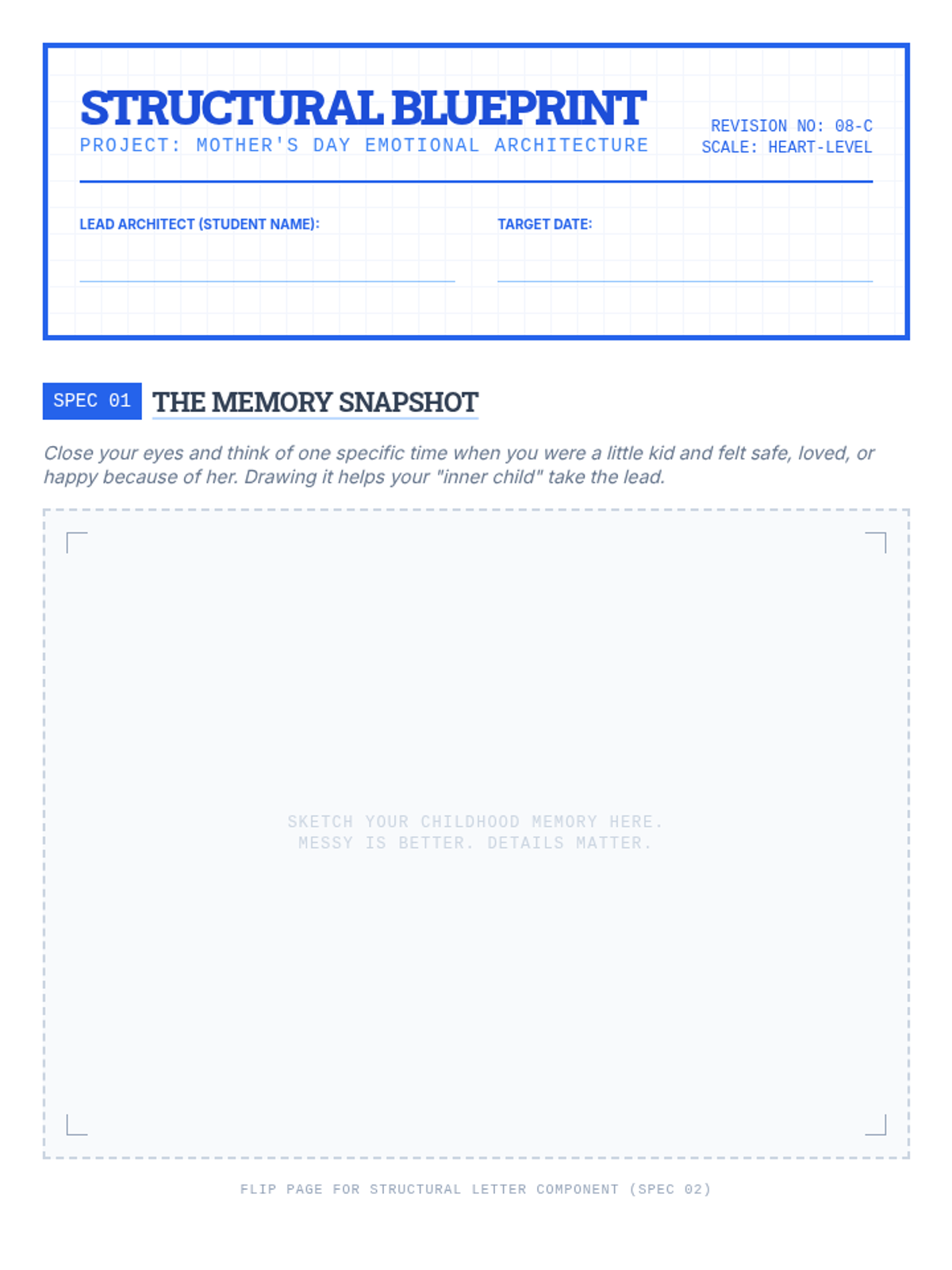
A double-sided student worksheet designed as a 'Structural Blueprint'. It guides students through sketching a childhood memory and writing a heartfelt, vulnerable letter to their mother, using technical prompts to frame emotional expression as a high-value skill.
A visual presentation for 8th-grade boys that frames Mother's Day as a 'Mission' requiring emotional bravery. It uses a technical blueprint aesthetic to make vulnerability feel like a skill to be mastered rather than a weakness.
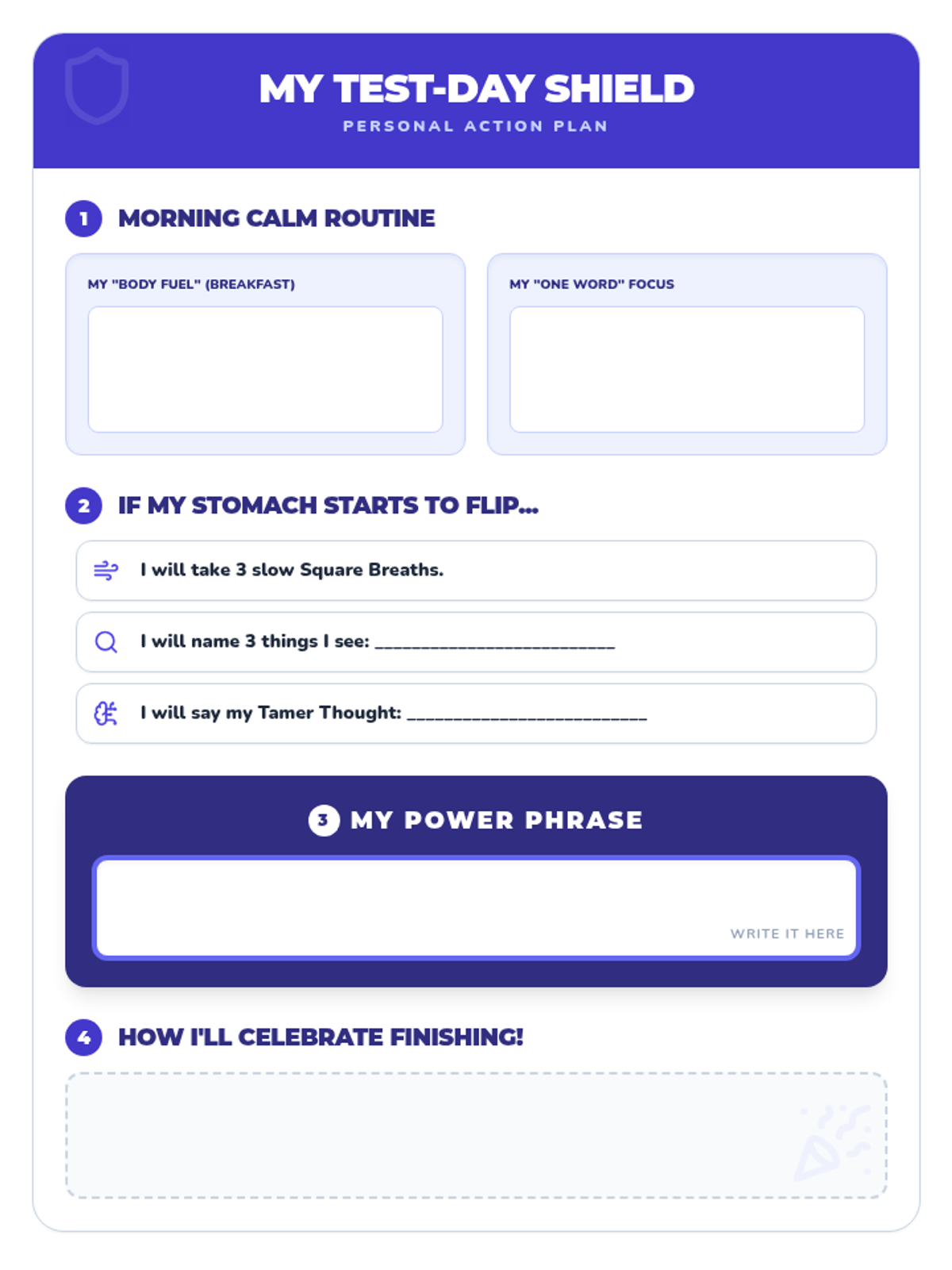
A summary action plan for students to keep in their folders or on their desks, outlining their specific routine and coping strategies for test days.
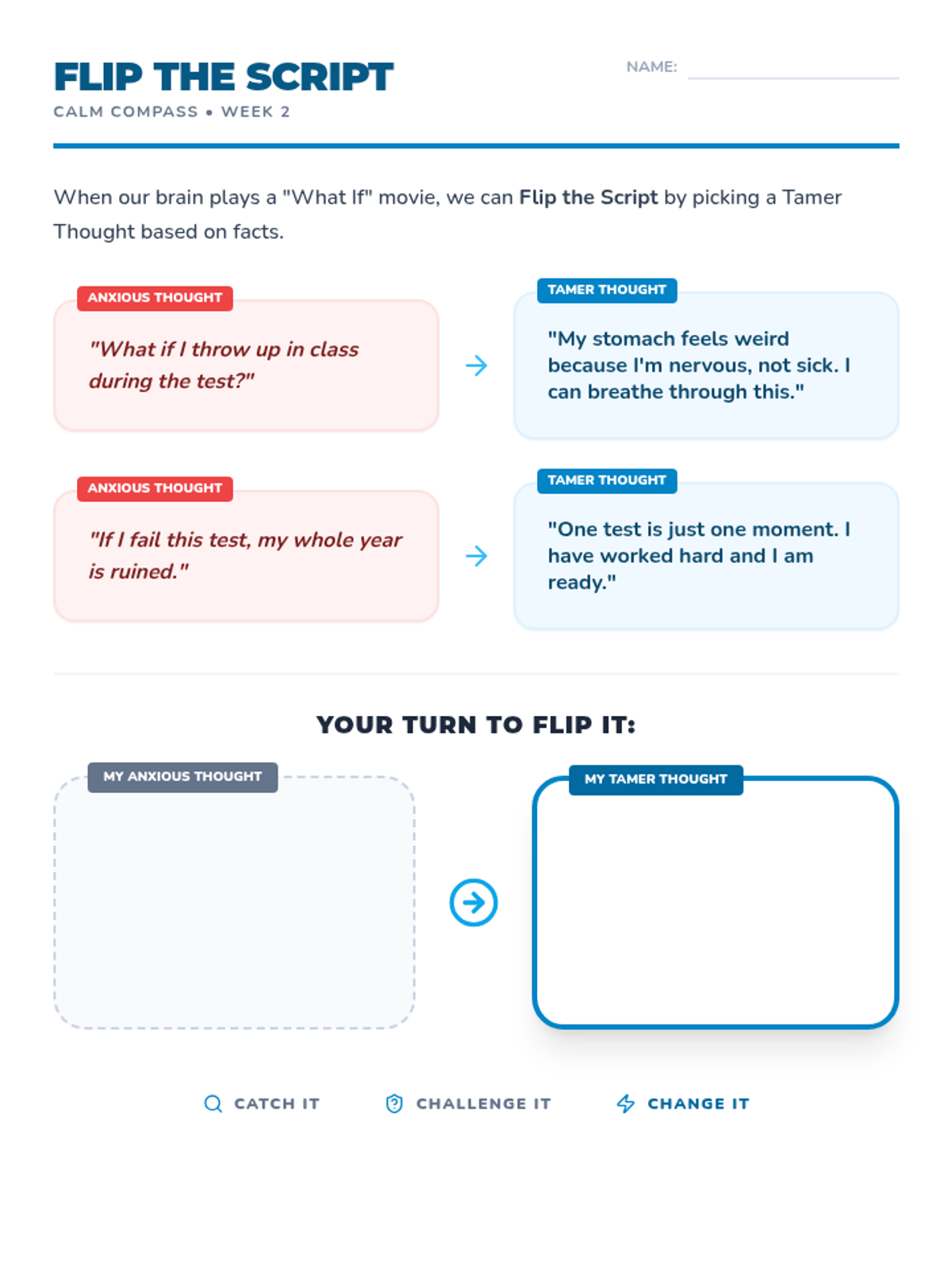
An activity sheet for cognitive reframing, helping students identify anxious 'what if' thoughts and replace them with helpful, evidence-based thoughts.
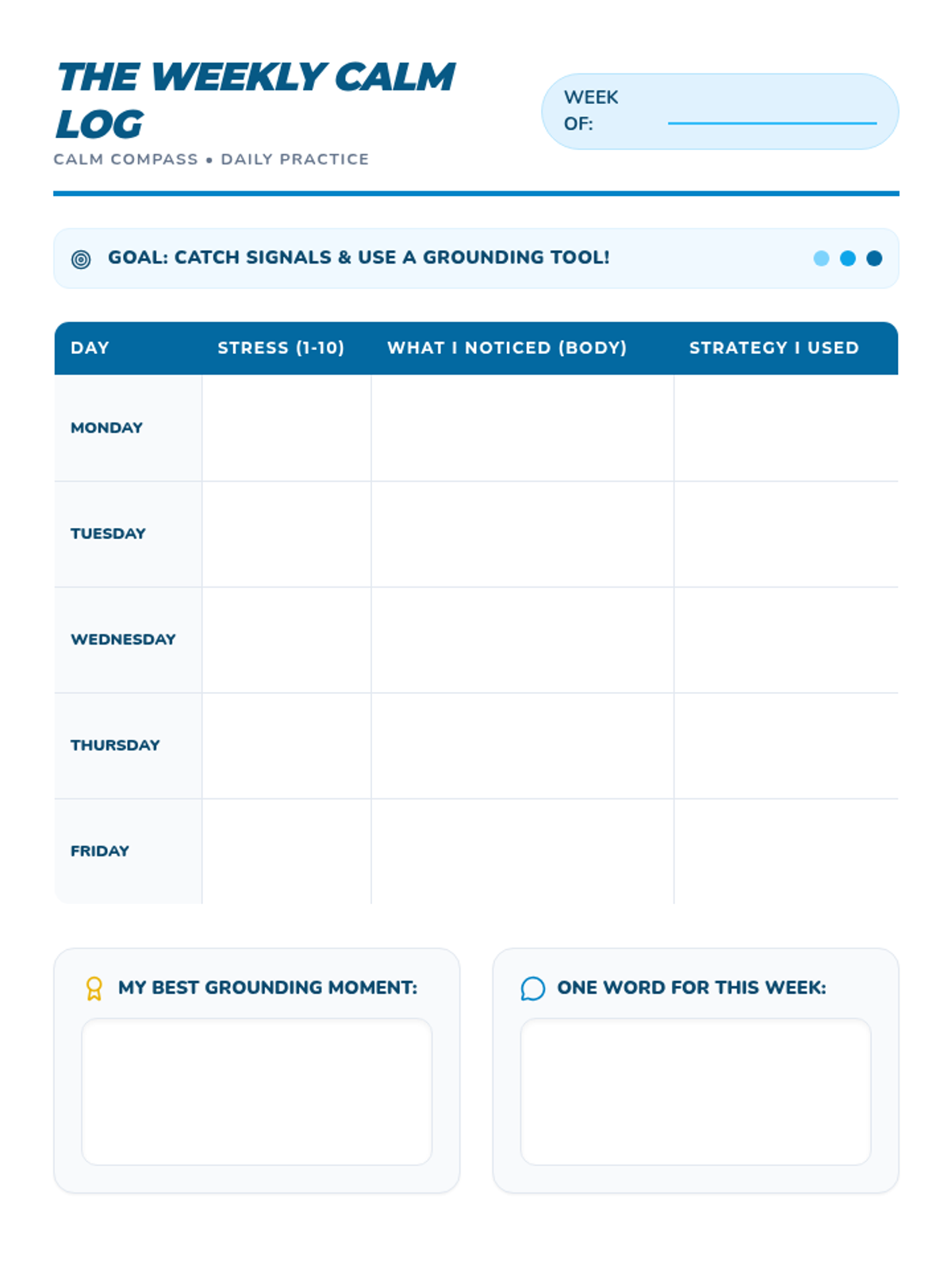
A weekly check-in log for students to track their anxiety levels, physical symptoms, and the coping strategies they utilized throughout the week.
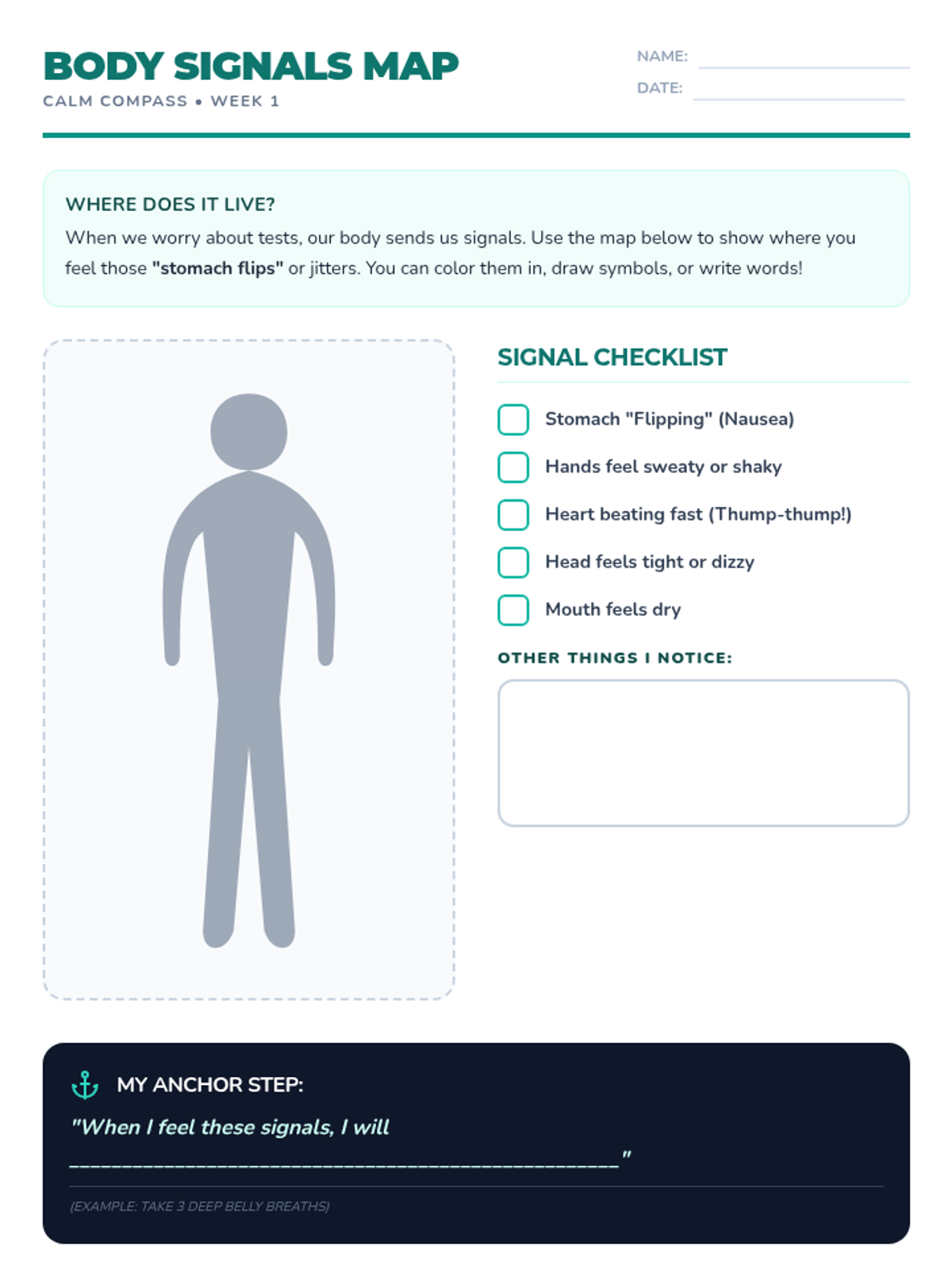
A printable worksheet featuring a body map for students to identify and visualize where they feel physical symptoms of anxiety.
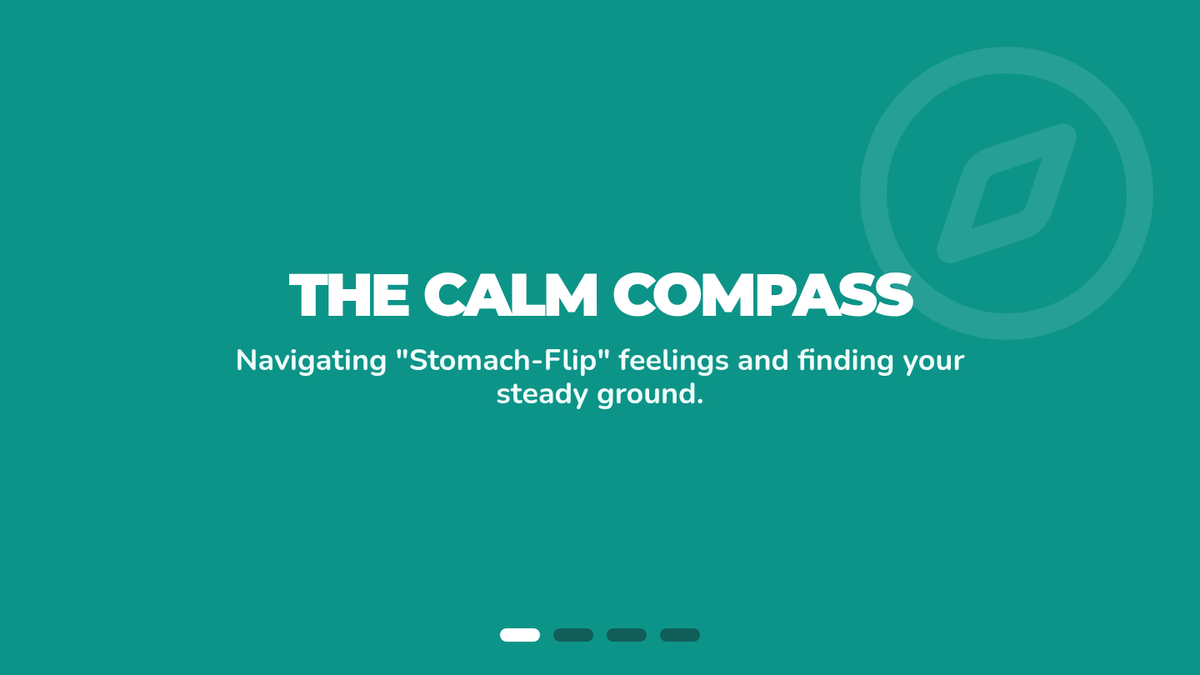
A visual presentation to help students understand the physical mechanics of anxiety (the 'fire alarm' response) and learn the 5-4-3-2-1 grounding technique.
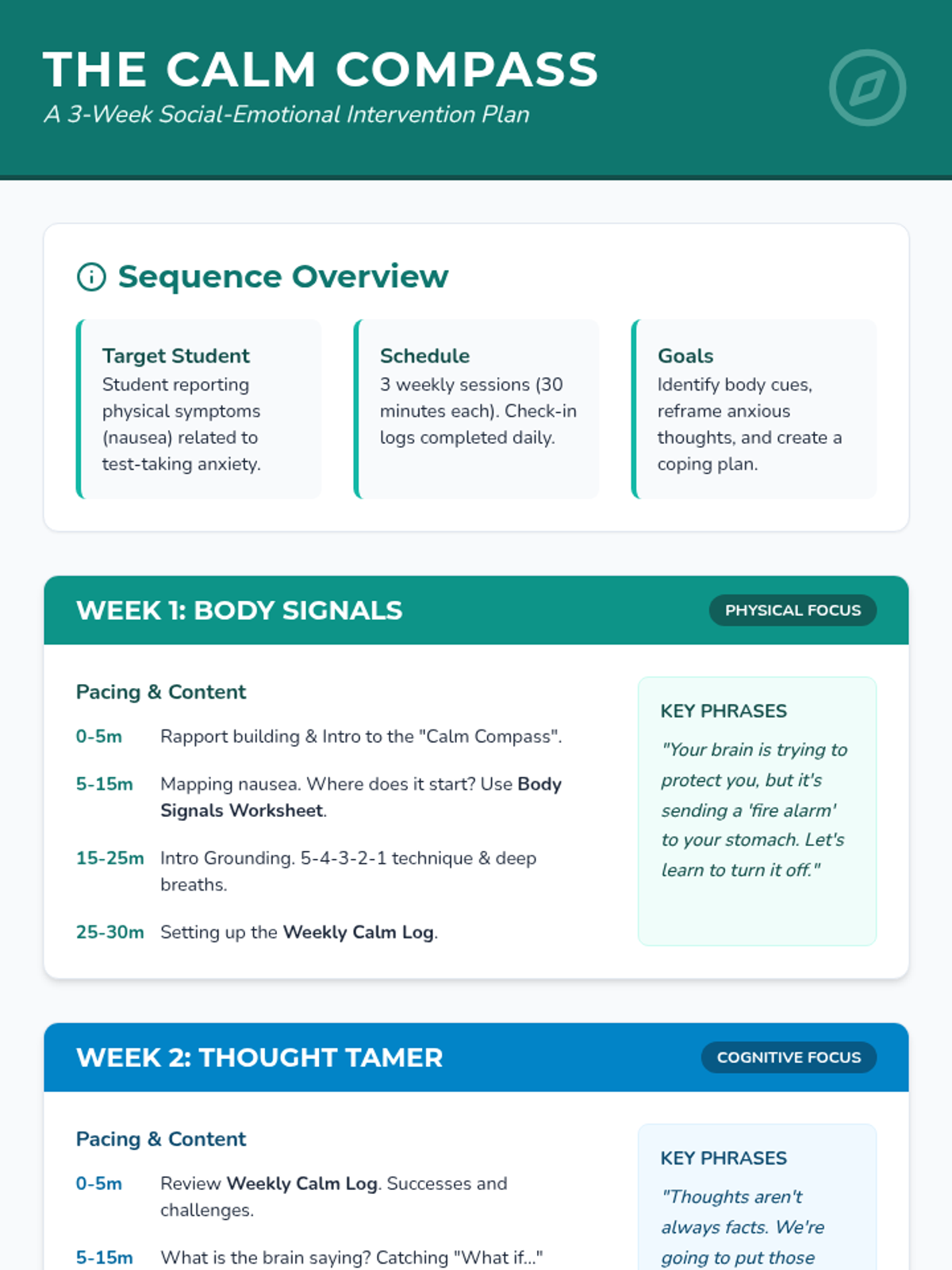
A detailed 3-week facilitator guide for a school social worker to implement a test anxiety intervention sequence. It includes session pacing, key talking points, and a materials checklist.
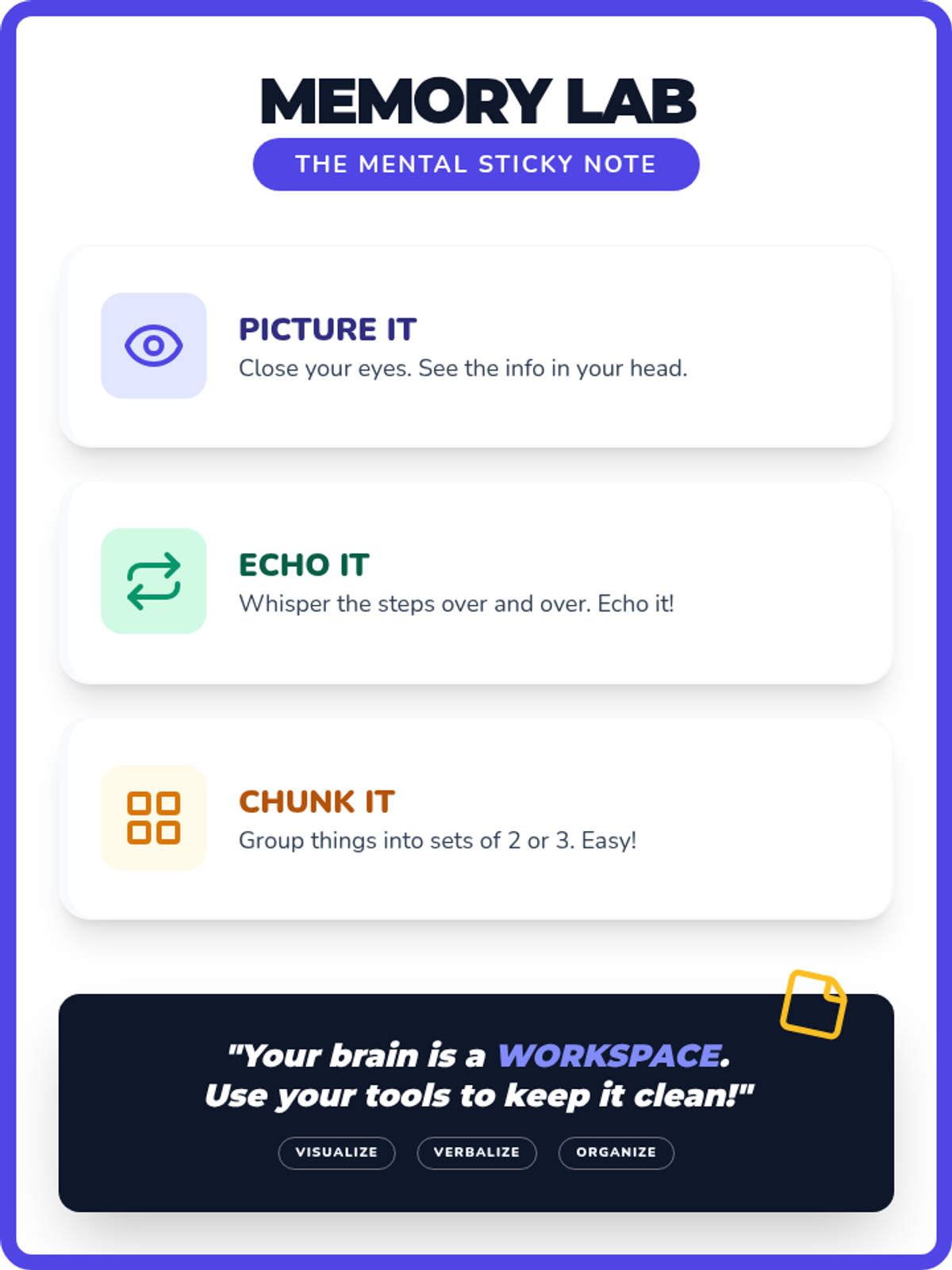
A bold, instructional anchor chart for working memory. It uses large icons and simple slogans to reinforce 'Picture It', 'Echo It', and 'Chunk It' as foundational cognitive strategies.
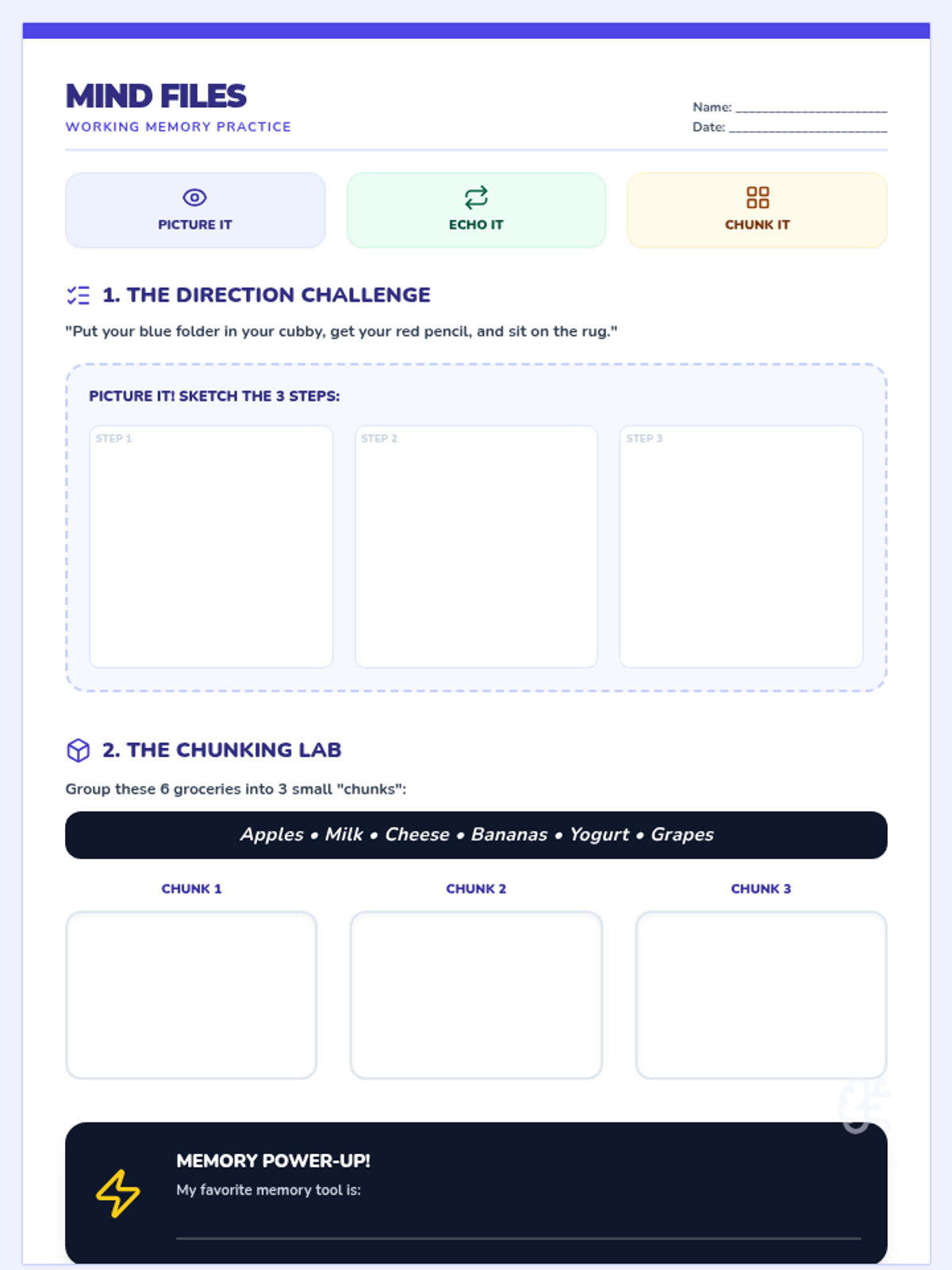
A worksheet for working memory skills. It features two hands-on activities: 'The Direction Challenge' for visualization and 'The Chunking Lab' for grouping information, helping students apply cognitive strategies to real-world tasks.
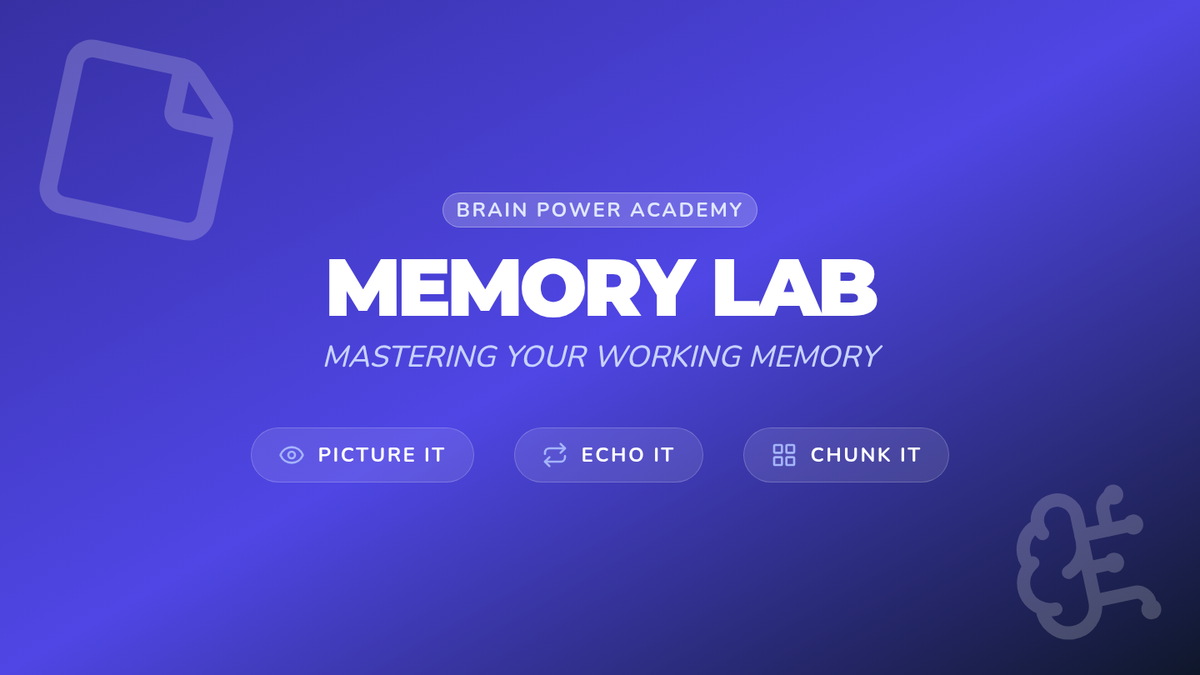
An instructional slide deck for working memory. It defines working memory using the 'Mental Sticky Note' metaphor and teaches three core strategies (Picture It, Echo It, Chunk It) through a series of engaging memory challenges.
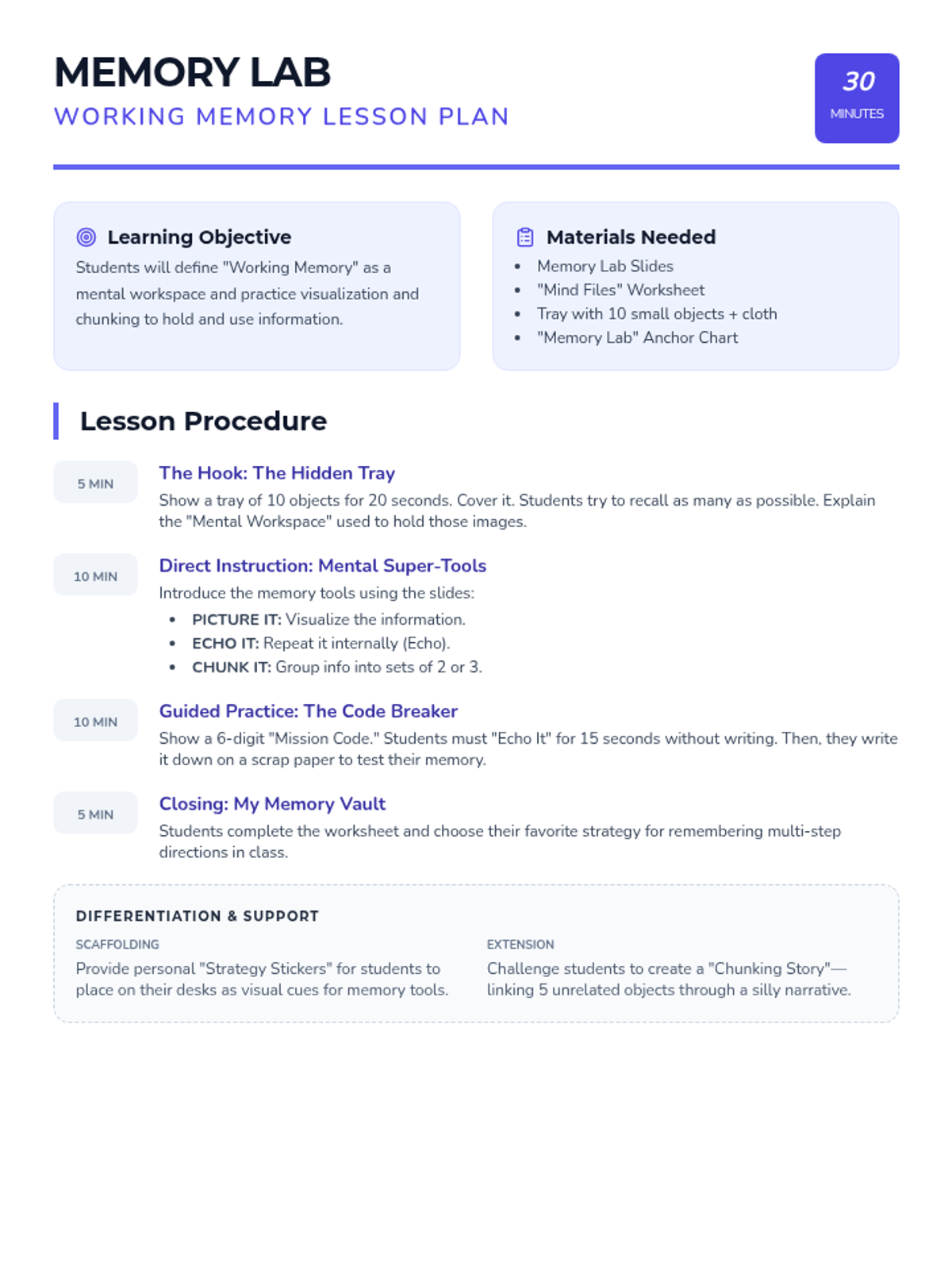
A 30-minute lesson plan for teachers on working memory. It introduces students to the 'Mental Workspace' and teaches strategies like visualization, echoing, and chunking to improve information retention.
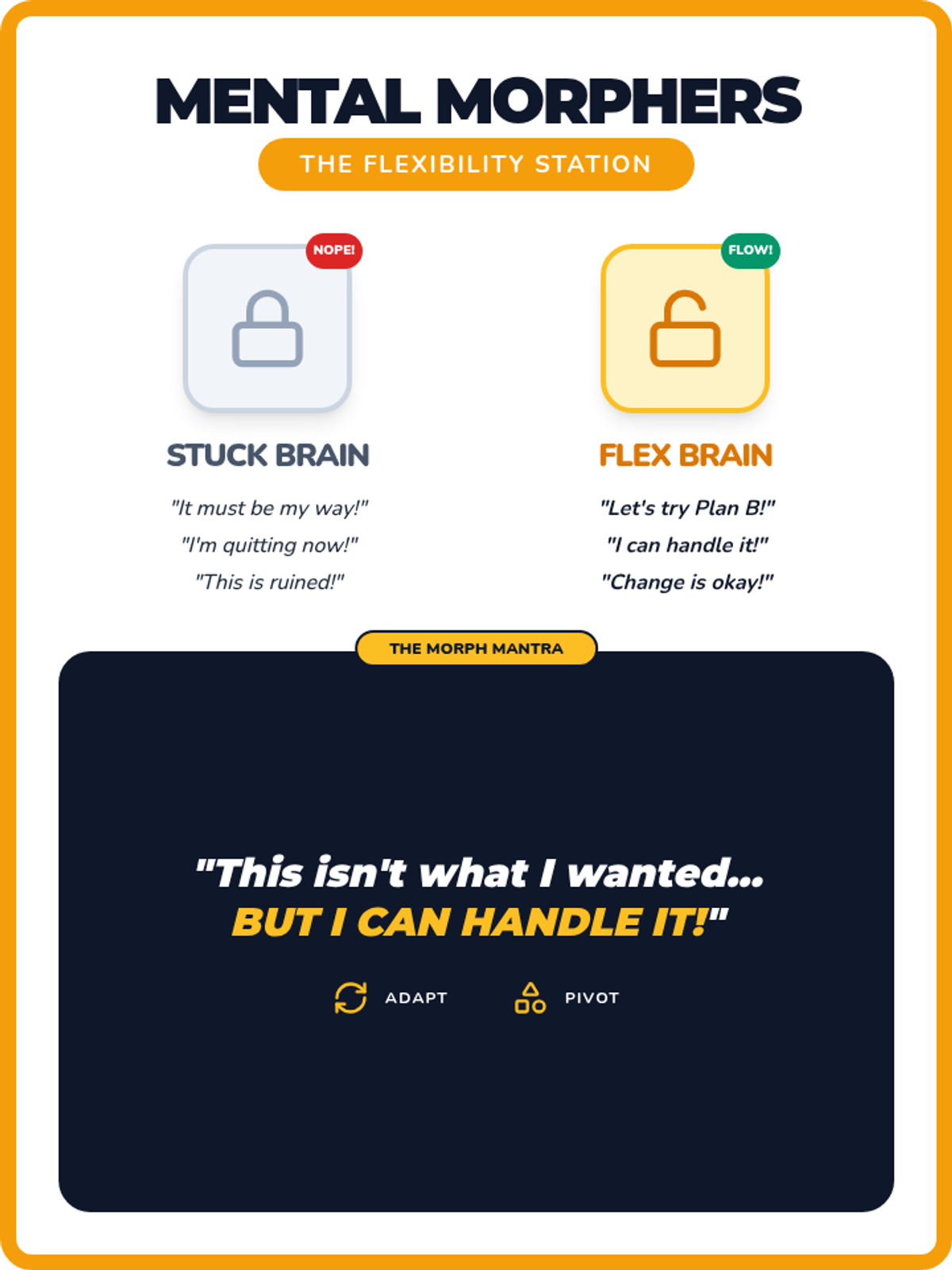
A high-contrast anchor chart for flexible thinking. It visually contrasts 'Stuck Brain' versus 'Flex Brain' and features the 'Mental Morph' mantra in a bold call-out box for easy classroom reference.