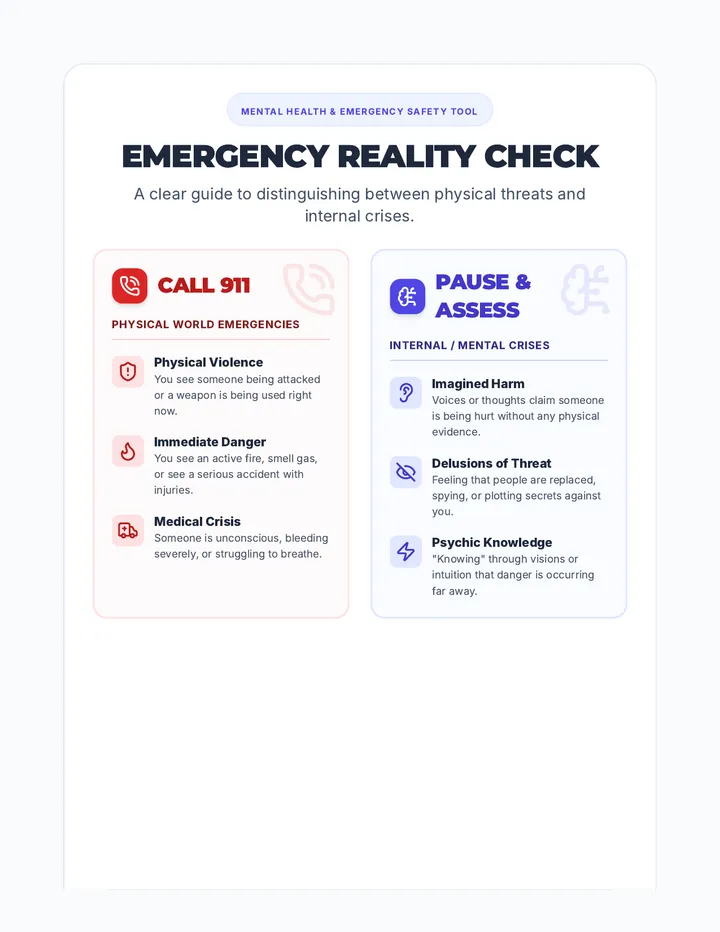
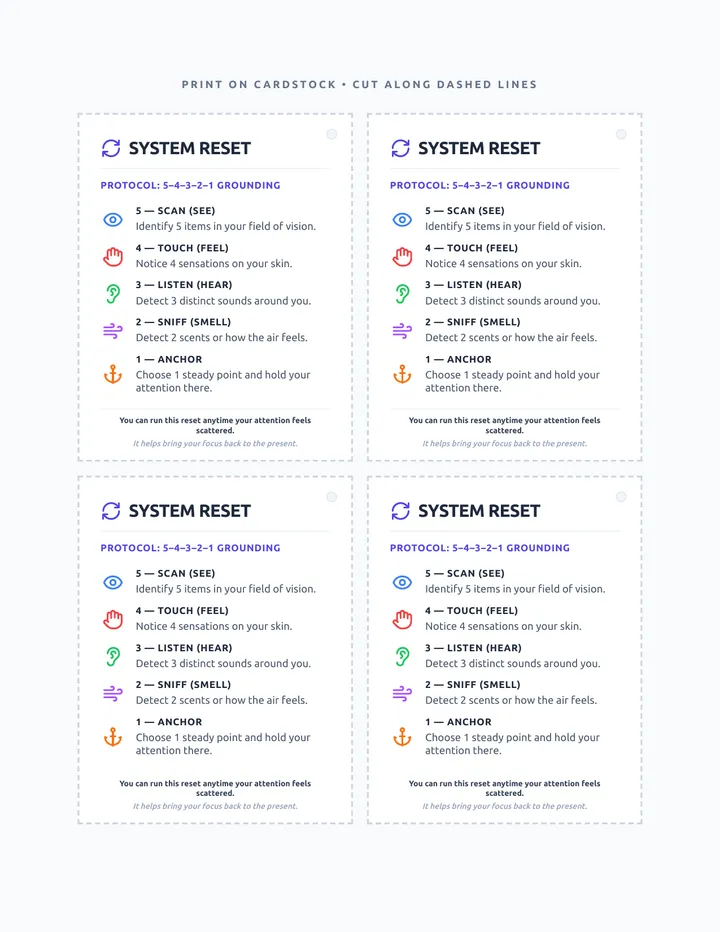
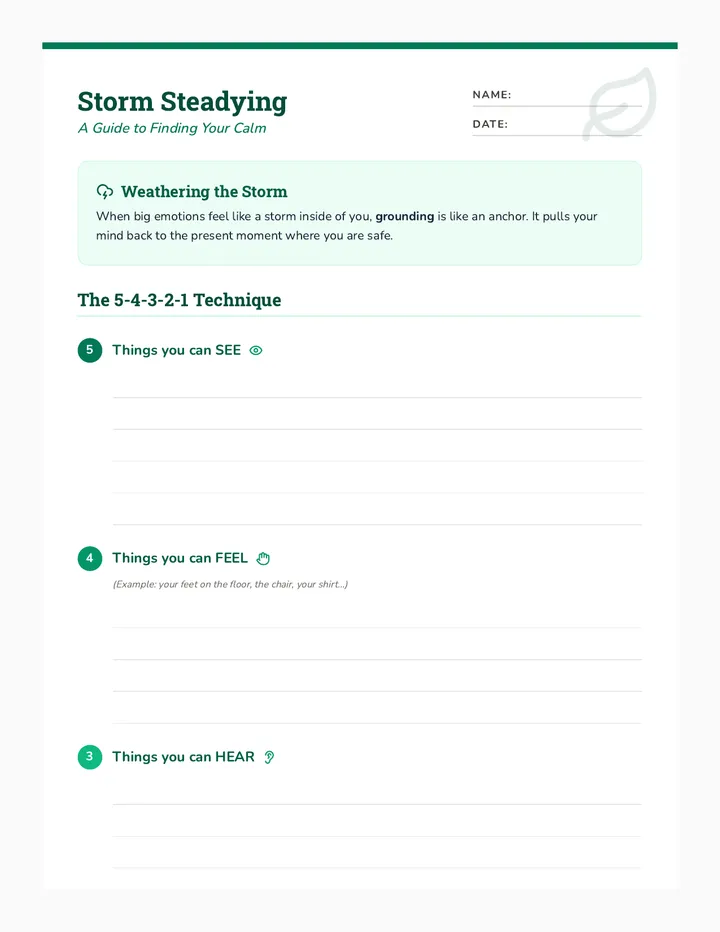
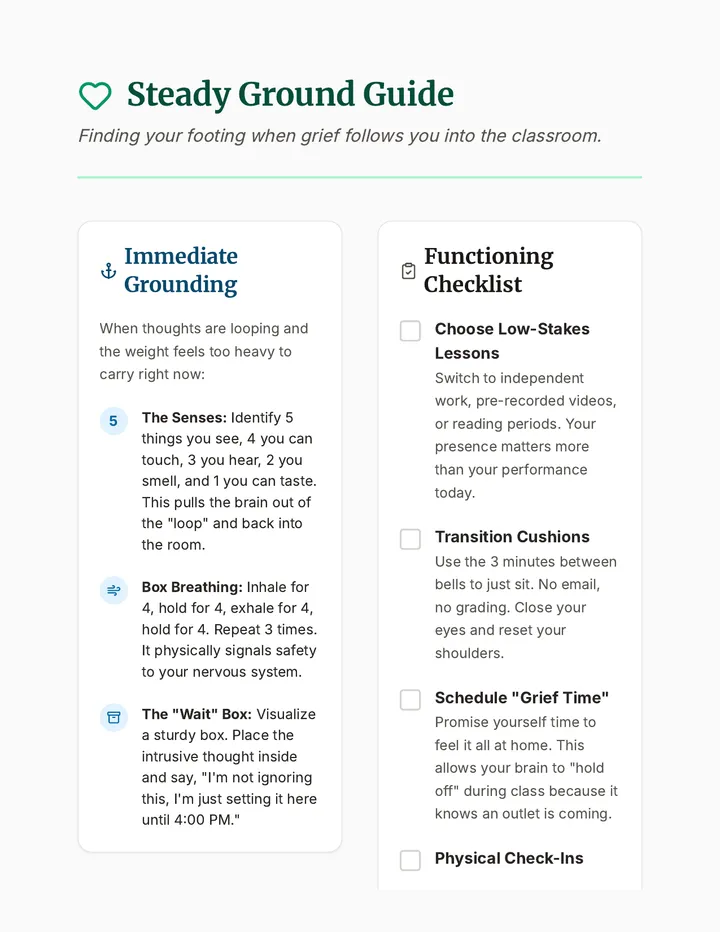
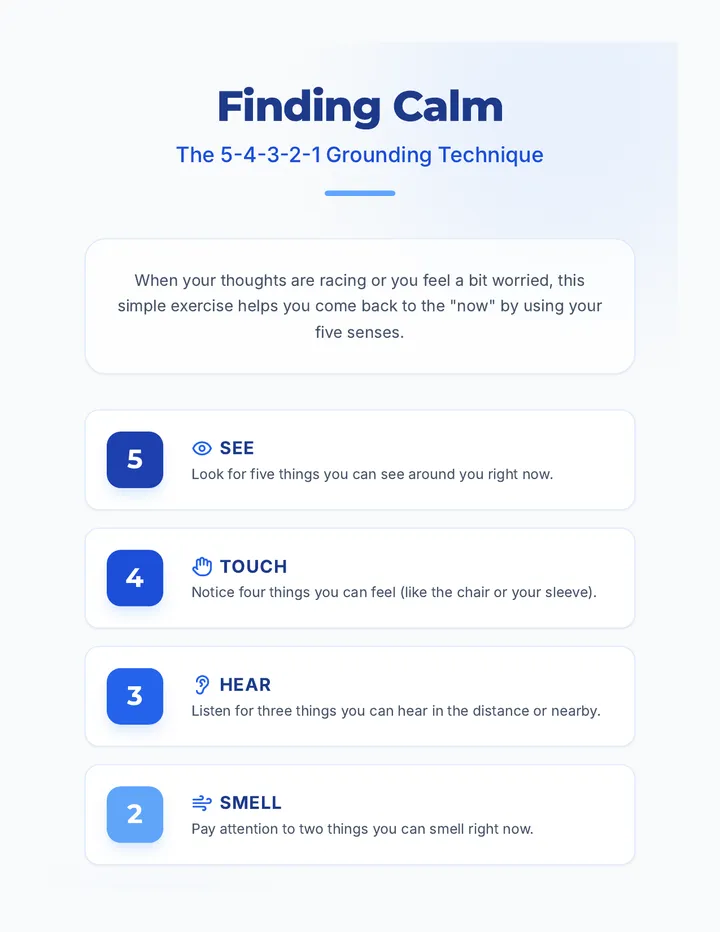
Identifies mental health crises and suicide warning signs while developing personal safety plans and grounding techniques. Equips users with peer gatekeeper skills and direct pathways to professional crisis resources and hotlines.
A comprehensive facilitator guide for the Mind Matters lesson, featuring step-by-step instructions, discussion prompts with video timestamps, and activity management tips.
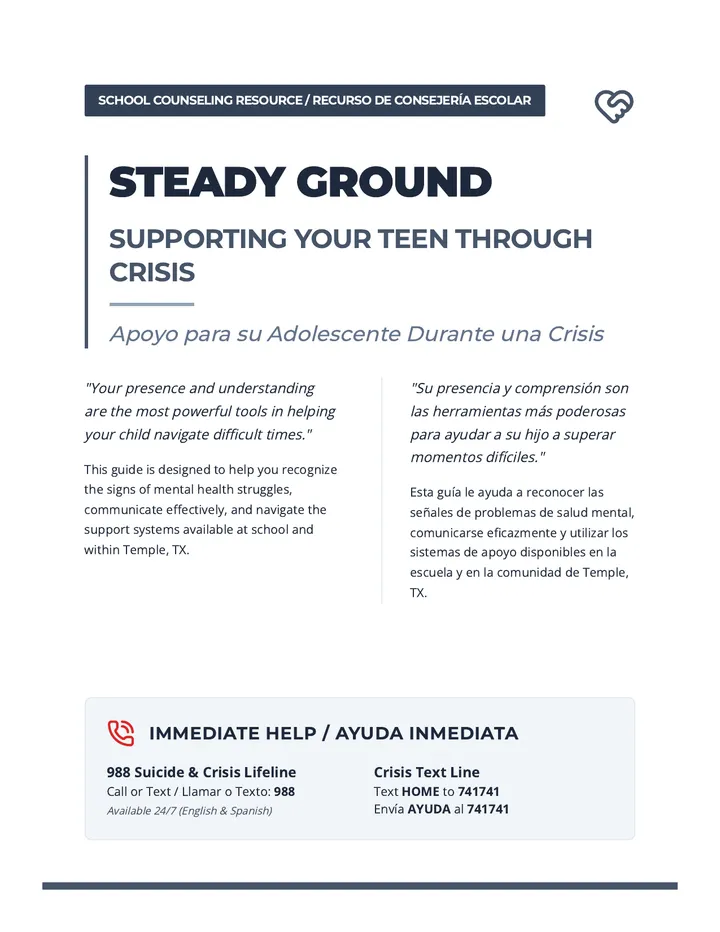
A reference guide for parents containing emergency contact numbers, explanations of mental health roles, and prompts for discussing concerns with a pediatrician.
A student activity sheet for designing a 'Recovery Pie Chart' to visualize healthy lifestyle choices that support mental health. includes space for brainstorming and a pie chart template.
A student note-catcher for the workshop, allowing parents to reflect on communication, track symptoms from the video, and develop a personal support plan.
A student-facing directory of school mental health resources, including counselors, nurses, and crisis hotlines, with space for personalization.
A guide for teachers to prepare and deliver the "Stress Myth" lesson, including pacing, local resource preparation, and facilitation tips.
A concise reference handout for parents including the 3-step conversation framework, biological drug facts, and emergency contact information like 988.
A visual presentation for a parent workshop on teenage depression, featuring video integration, symptom "translation," and treatment overview slides.
A slide deck for a 7th-grade SEL lesson on mental health. It includes a video embed about depressive disorders, discussion prompts on key criteria, and instructions for a creative lifestyle pie chart activity.
Scenarios and prompts for a role-play activity, helping parents practice using biological facts in supportive conversations with their teens.
A handout containing realistic high school scenarios for practicing help-seeking behaviors and sharing mental health resources.
A comprehensive facilitator guide for a parent workshop on teenage depression, featuring a detailed timeline, discussion prompts, and instructional tips.
A formal yet welcoming invitation letter for parents to attend 'The Stress Shield' workshop, explaining the biology-first approach and workshop goals.
Printable templates for "Resource Wallet Cards" that students can fill out and carry with them, including national crisis numbers and spaces for local resources.
Printable wallet-sized resource cards for parents, featuring Crisis Text Line and NAMI contact information for quick access during mental health distress.
A comprehensive teacher guide for the 'Early Help' lesson, including pacing, discussion prompts for specific video timestamps, and activity instructions.
A visual presentation for a parent workshop covering teen stress, biological impacts of substances, and role-playing instructions. Includes embedded video and key talking points.
A comprehensive rubric for evaluating the 'Close the Gap' advocacy campaign, focusing on content requirements, audience alignment, visual design, and impact.
A comprehensive slide deck for a high school advisory lesson on stress, substance use myths, and mental health resources, including embedded video, pause points, and activity instructions.
A follow-up letter for parents that summarizes key workshop takeaways, emphasizes the importance of early intervention, and provides a warm message of support and partnership.
An assessment rubric for the final Community Charter project, evaluating theory application, safety planning, and sustainability.
Final project rubric for evaluating the Community Care Initiative, focusing on rationale, boundaries, referral pathways, and sustainability.
Student design workbook for planning the Community Care initiative, covering problem definition, logistics, safety boundaries, and sustainability.
A design framework for a community care plan, producing a 'Community Charter' for peer support in a specific campus context.
Final project brief for the Community Care initiative, detailing requirements, core components, and the "Department Pitch" assessment.
Visual slide deck for Lesson 5, introducing the concepts of mutual aid, sustainable networks, and the "Community Charter" project.
Observation and feedback tool for students to use while observing peer-led group facilitation simulations, focusing on psychological safety and dynamic management.
A brainstorming worksheet for identifying collective coping strategies for common undergraduate stressors.
Practical script for students to lead a brief check-in circle, featuring opening ground rules, modeling prompts, and intervention strategies.
A sorting activity where students categorize shared stressors from an anonymous "drop box" into personal or systemic categories to facilitate normalization.
Facilitation Fundamentals Slides focusing on group dynamics, psychological safety, and managing difficult participants.
Visual slide deck for Lesson 4, introducing group facilitation skills, the power of normalization, and the distinction between individual and systemic stressors.
Reference guide and template for students to identify professional resources and practice the "warm handoff" referral protocol.
A resource guide template for students to collect and categorize campus professional resources.
Case studies focusing on temporal and emotional boundary failures in peer support, including scripting exercises for boundary resetting.
Sustainable Support Slides focusing on compassion fatigue, different types of boundaries, and the professional referral process.
Case study scenarios for Lesson 3 focusing on identifying red flags, setting internal limits, and drafting referral scripts.
Reference sheet for students featuring micro-skills definitions, validation hierarchy levels, and helpful open-ended question prompts.
Visual slide deck for Lesson 3, covering the scope of peer support, referral red flags, and the prevention of compassion fatigue.
Student activity sheet featuring "Bad Listener" exercises and specific role-play scenarios for practicing the validation hierarchy.
A comprehensive teacher guide for the Lifeline Launchpad lesson, including pacing, facilitator tips for handling tough conversations, and an analysis key for the scenario activity.
A personal directory worksheet for students to identify their own trusted support network, pre-filled with national crisis resources and space for drafting a help-seeking script.
A set of realistic scenarios for 10th-grade students to practice identifying support resources and drafting communication scripts for academic, social, and personal challenges.
An academic-focused presentation for 10th graders that addresses the "academic ego," maps out school-based support resources, and teaches professional communication scripts for seeking help from teachers and peers.
A detailed facilitation guide for educators or counselors leading the 'Real Talk' workshop, including instructional scripts, discussion prompts, and pacing advice.
An activity worksheet for parents to practice empathetic questioning, identify personal communication barriers, and define their first steps toward professional support.
A comprehensive resource list for parents, including national crisis hotlines, space for local clinical resources, and recommended educational websites.
A comprehensive slide presentation for the 'Real Talk' parent workshop, covering warning signs of depression, comparisons between sadness and depression, and strategies for empathetic communication.
An introductory letter to parents and families explaining the purpose and importance of the 'Real Talk' workshop on adolescent depression.
A set of 12 real-world scenario cards for students to cut out and sort into independent or support-required categories.
A large-format sorting mat for students to categorize problem scenarios into 'Independent Zone' or 'Support Required' zones.
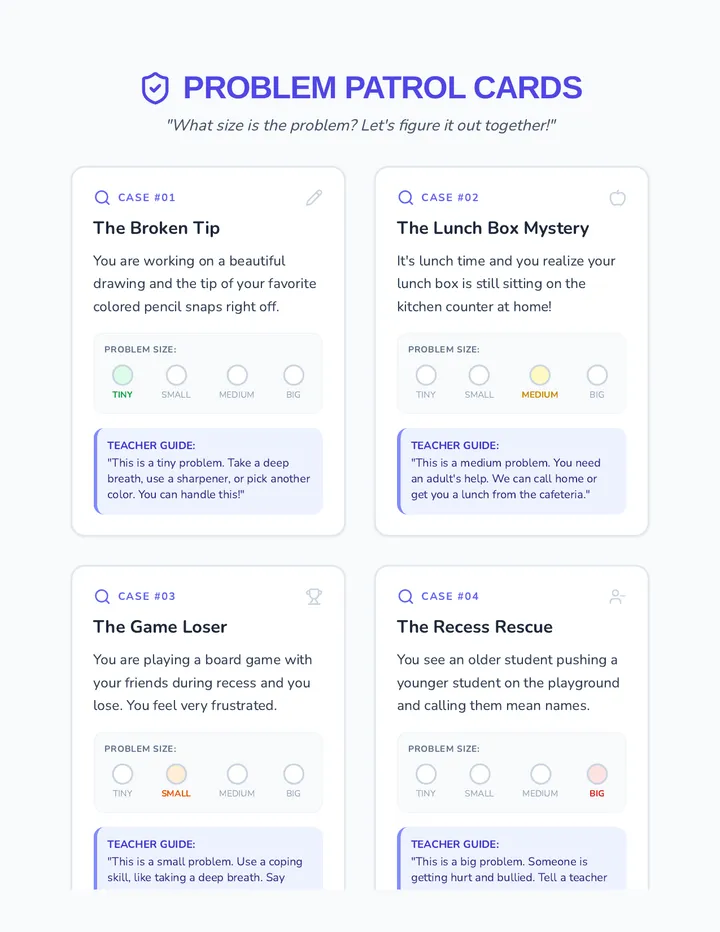
A visual presentation for 7th graders that defines help-seeking, problem sizing, and provides a decision-making flowchart for independent vs. collaborative problem solving.
A comprehensive teacher facilitation guide for a 30-minute lesson on help-seeking skills, featuring objectives, procedures, and instructional tips.
A comprehensive two-page scoring form and rubric for the Psychological Impact Screener, featuring specific domain considerations and scoring descriptions integrated into a structured table format.
A comprehensive two-page scoring form and rubric for the Psychological Impact Screener, featuring specific domain considerations, scoring selections, and a decision matrix for tiered support planning.
A comprehensive staff training presentation for the Psychological Impact Screener, covering the purpose of assessment, domain overviews, scoring criteria, and interpretation of the decision matrix.
A comprehensive 3-page scoring rubric for the Psychological Impact Screener, featuring data collection areas for all 6 domains and a final decision matrix for tiered transition support planning.
A project guide for students to plan their 'Close the Gap' advocacy campaign, including requirements, video quotes, and brainstorming space.
A visual presentation for the 'Mind the Gap' lesson, including the 11-year delay statistics, the advocacy video, and project instructions for peer leaders.
A comprehensive reference sheet listing national crisis hotlines and providing blank spaces for local school and community mental health resources.
A teacher facilitation guide for the 'Mind the Gap' advocacy lesson, including pacing, discussion prompts, and video timestamps for 11th-12th grade peer leaders.
A printable resource handout for students containing school support placeholders and national mental health hotlines, including the POWER Program for early psychosis.
A comprehensive facilitator guide for teachers, including pacing, discussion prompts, video pause points, and an extension activity for a lesson on psychosis.
A reflective exit ticket for high school students to demonstrate their understanding of psychosis symptoms, the 'Notice and Ask' technique, and the importance of early intervention.
Four realistic role-play scenarios for high school students to practice identifying early signs of psychosis and using the 'Notice and Ask' communication technique.
A slide deck for high school students introducing the concept of psychosis through the 'Safety Net Friends' framework, featuring a video embed, key symptom breakdown, and communication strategies. Revised to ensure minimum font size requirements.
A printable 'Help Signal Hero' badge for students to personalize after learning about reporting unkind behavior to adults.
Slides for Lesson 3 that distinguish between 'tattling' and 'reporting' and identify trusted adults who can help.
An activity sheet where students draw themselves and a friend inside a 'Kindness Cape' to represent standing together.
Slides for Lesson 2 that teach students how to be an 'upstander' by standing with a friend and inviting them to play elsewhere.
A student worksheet for Lesson 1 where children color a stop sign, trace their hand, and practice writing the word 'STOP'.
Engaging slides for Lesson 1 that teach students how to identify 'mean moments' and use the 'Stop' hand signal and a strong voice.
A professional guide for teachers on how to facilitate classroom discussions and debriefs following a school incident, focusing on de-escalation and restoring a sense of safety.
A visual presentation for students and staff outlining the Peace Protocol, emphasizing roles during an incident and the restorative process afterward.
A student-facing reflection sheet to be completed after witnessing or being involved in a conflict, designed to process emotions and gather factual accounts.
A comprehensive flowchart outlining the necessary steps for students and staff to take during and after a school conflict, featuring multilingual support and clear visual cues.
A friendly, one-page handout for middle school students explaining the school counselor's role, services offered, and clear instructions on how to access support.
A handout for parents containing three realistic role-play scenarios to practice empathetic listening and validation techniques, with space for reflection.
A visual presentation for the Supportive Connections workshop, including discussion prompts, key statistics on treatment delays, and the embedded NAMI educational video.
A comprehensive facilitator guide for the Supportive Connections workshop, including a detailed timeline, discussion prompts, and key talking points on teen mental health and early intervention.
A crisis resources handout for parents with local and national emergency numbers, conversation starters, and a warning signs checklist.
Four printable discussion cards for parents to use in small groups, covering empathy, behavioral signs, myth-busting, and communication strategies.
A visual presentation for a PTA meeting covering the statistics, symptoms, and warning signs of adolescent psychosis, including the YouTube video embed and discussion prompts.
A visual worksheet teaching the DBT STOP skill (Stop, Take a breath, Observe, Proceed) as a technique for pausing before reacting in high-pressure situations.
A student-facing visual guide to the DBT TIPP skills, presented as 'Emergency Overrides' for high-intensity emotional moments.
A set of small, cuttable reference cards for the student to carry, featuring the Calm Protocol steps on one side and grounding strategies on the other.
A formal safety plan for the student, detailing the 'Calm Protocol' activation steps, safe space locations, and trusted contacts to ensure safety during high-stress moments.
A teacher-facing instructional guide providing context on the student's emotional disability and home life, along with specific co-regulation strategies and a response plan for classroom teachers.
A personalized worksheet for a 6th-grade student to identify their unique early warning signs of dysregulation and select specific grounding strategies and mantras to use in the classroom.
A modern, high-impact slide deck for a 6th-grade student that explains emotional dysregulation as a 'power surge' and introduces key grounding strategies like square breathing and the 5-4-3-2-1 technique.
The final worksheet for the Healing Horizons program, focusing on goal-setting and a final affirmation of strength and resilience.
Facilitator's guide for the final session of the Healing Horizons program, focusing on resilience, future goal-setting, and therapeutic closure.
A worksheet focusing on the 'Before' and 'After' identity of the teenager, helping them process the internal changes caused by loss.
Facilitator's guide for Session 5, helping the teen navigate the identity shifts and role changes that follow a significant loss.
A worksheet for teenagers to build an 'Emergency Response Plan' for managing sudden waves of grief (grief bursts) and identifying triggers.
Facilitator's guide for Session 4, focusing on identifying triggers and teaching self-regulation skills for 'grief bursts.'
A blueprint-themed worksheet helping teenagers identify shared values and memories to create a continuing bond with their lost loved one.
Facilitator's guide for Session 3, introducing the concept of continuing bonds and helping the teen identify positive attributes to carry forward.
A worksheet for Session 2 using weather metaphors to help teenagers track and normalize their grief-related emotions.
Facilitator's guide for Session 2, focusing on emotional literacy and normalizing the complex 'weather' of grief.
Introductory slide deck for the first session of the Healing Horizons program, introducing group norms and the backpack metaphor.
A reflective worksheet for adolescent boys to identify and sketch their primary and secondary losses using the 'Grief Backpack' metaphor.
A comprehensive facilitator's guide for the first session of the Healing Horizons grief treatment plan, introducing core metaphors and establishing therapeutic rapport.
A comprehensive interview preparation guide featuring a master bank of potential questions for Site Coordinators, categorized by leadership, operations, and student engagement.
A strategic guide for Site Coordinators on program sustainability and professional growth, focusing on content evolution, leadership pipelines, and community partnerships.
A guide for Site Coordinators on how to celebrate recruitment milestones, featuring tiered celebration strategies for staff, students, and school partners.
A specialized guide and reflection tool for Site Coordinators to analyze the success of their engagement plans through data, feedback, and iterative pivots.
A practical three-step action plan designed to help a Site Coordinator implement an engagement strategy during their first 30 days, focusing on intelligence, activation, and ownership.
A clear, sequential five-step strategy for increasing student participation and retention in high school after-school programs.
A specialized guide outlining the four critical steps for building authentic relationships with high school students, designed to support Site Coordinators in fostering trust and engagement.
A set of printable exit tickets for students to identify a trusted person they can talk to, featuring 4 slips per page with a matching 'Wellness Path' theme.