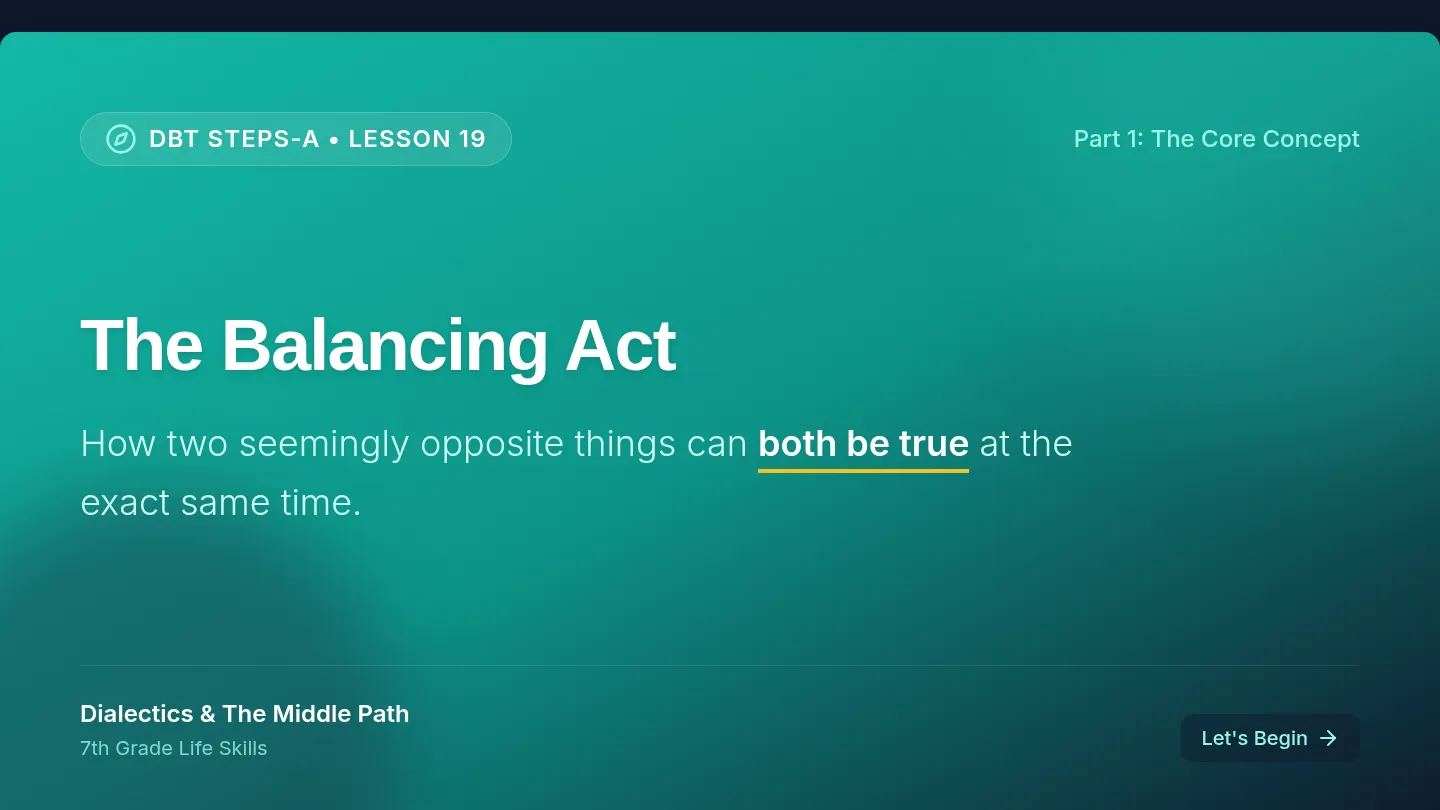
A visual presentation for 7th graders that defines help-seeking, problem sizing, and provides a decision-making flowchart for independent vs. collaborative problem solving.
A one-page reference checklist for students featuring 'circuit breaker' coping skills to use when feeling emotionally overwhelmed or 'sucked into' a friend's mood.
A comprehensive facilitator's guide for teachers or counselors, providing a roadmap for individual and dyad sessions, key talking points, observation checklists, and troubleshooting tips for addressing trauma bonding.
A two-page individual 'self-repair' guide for students featuring grounding exercises, strength identification, the 'Yet' reframing technique, and daily journaling prompts to build personal resilience.
A one-page 'pocket guide' for students featuring conversation scripts, a friendship agreement, and a menu of emotional regulation tools to maintain healthy boundaries.
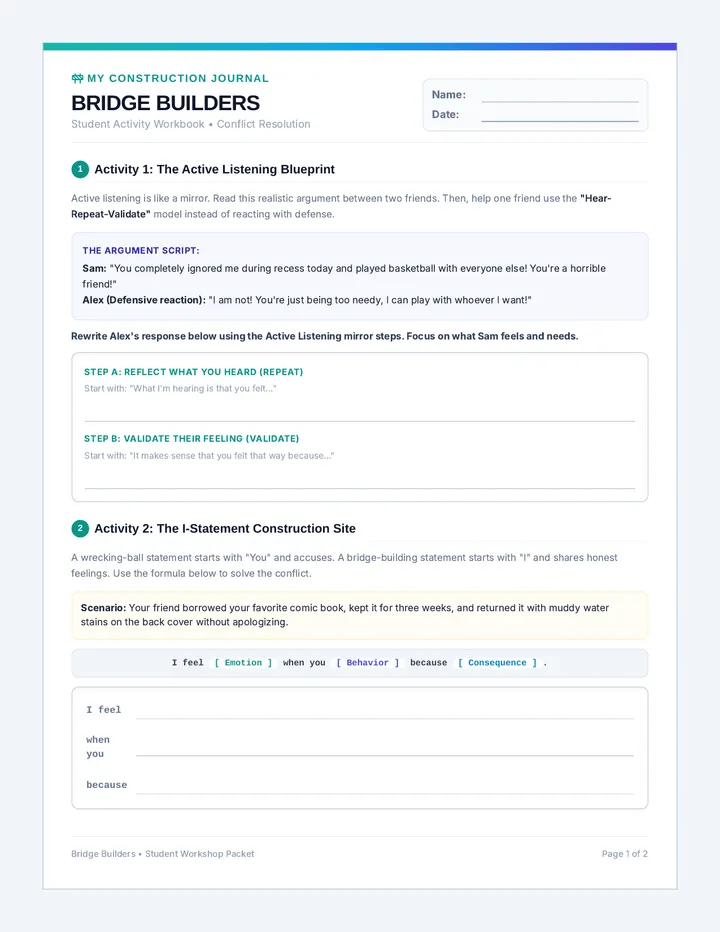
A two-page student activity featuring 'The Backpack Exercise' for identifying emotional ownership and three 'Upgrade the Moment' scenarios for practicing healthy boundaries and responses.
A two-page student-facing fact sheet and reflection guide that explains the concept of 'emotional mirroring' (trauma bonding) and introduces the 'both can be true' mindset for healthy friendship boundaries.
A comprehensive one-page master checklist of all coping skills, organized by tactical 'Sectors' (Hardware, Software, Base Camp, Toolkits, Advanced Ops) with rating and field note sections.
A refined one-page master checklist of coping skills for middle school students, featuring a tactical 'Master Inventory' aesthetic with space for ratings and observations.
A handout for middle schoolers focusing on journaling, mental games, art-based expression, and visualization as creative 'Mental Toolkits' for anxiety.
Updated master list and tracking worksheet that includes all four phases of coping skills (Hardware, Software, Base Camp, and Toolkits) for student rating and pattern recognition.
A handout for middle schoolers explaining the biological importance of sleep, exercise, and emotional labeling as foundational 'Base Camp' maintenance for managing anxiety.
A tactical handout focused on Cognitive Behavioral Therapy (CBT) and Acceptance and Commitment Therapy (ACT) techniques, explained as 'software overrides' for the brain.
Updated technical handout for middle schoolers explaining breathing, PMR, and grounding skills through the lens of nervous system biology.
A visually striking slide deck titled 'Iron Character' designed for a large-group SEL lesson, featuring interactive prompts, discussion frameworks, and structured activity instructions.
A reflective student handout titled 'Character Compass' that guides students through identifying their core values, reflecting on ethical challenges, and planning personal growth.
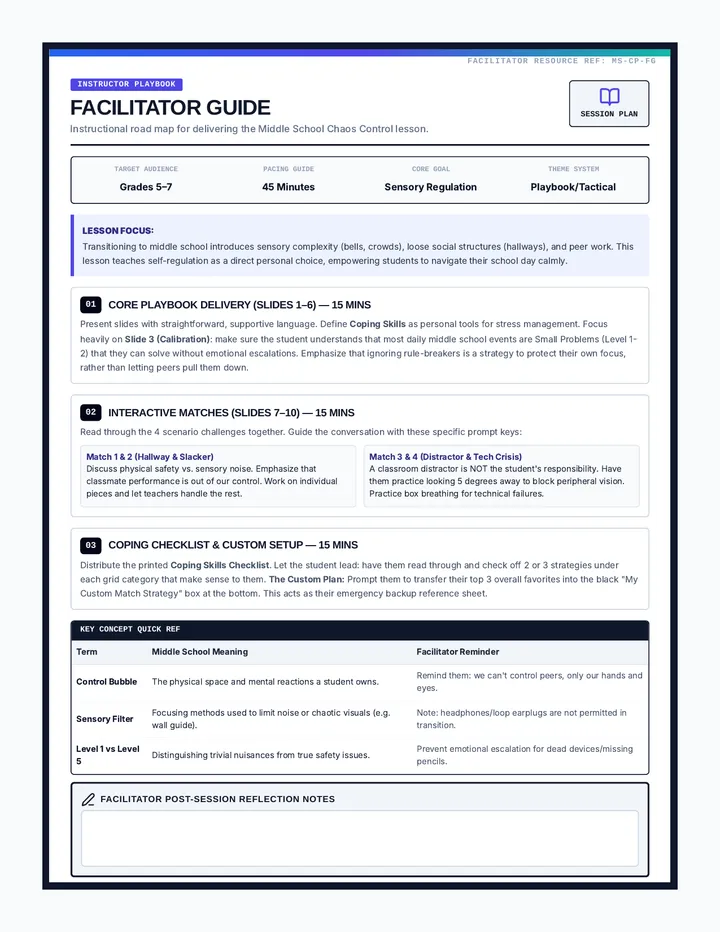
A comprehensive facilitator guide for a large-group SEL lesson on character, featuring session objectives, a minute-by-minute breakdown, and management tips for large groups.
An advanced version of the Calm Cards matching game specifically tailored for middle schoolers. Features 12 pairs of sophisticated coping strategies like cognitive reframing, digital boundaries, and assertive communication, with a mature journal-style design.
Engaging slides for a middle school counseling lesson on reading social signals, understanding perspectives, and choosing responses with natural consequences. This version separates the definition of natural consequences from the escalation/de-escalation outcomes and inquiry questions into three distinct slides.
A printer-optimized set of 24 matching cards (12 pairs) with tightened layout and fixed height grids to ensure zero content cutoff during printing. Includes clear cutting guides and compact instructional header.
Engaging slides for a middle school counseling lesson on reading social signals, understanding perspectives, and choosing responses with natural consequences. updated to include examples, non-examples, inquiry questions, and the original escalation/de-escalation concept.
An assessment rubric for evaluating student understanding of academic integrity, focusing on four key criteria: understanding pressure, impact analysis, ethical strategy, and self-reflection.