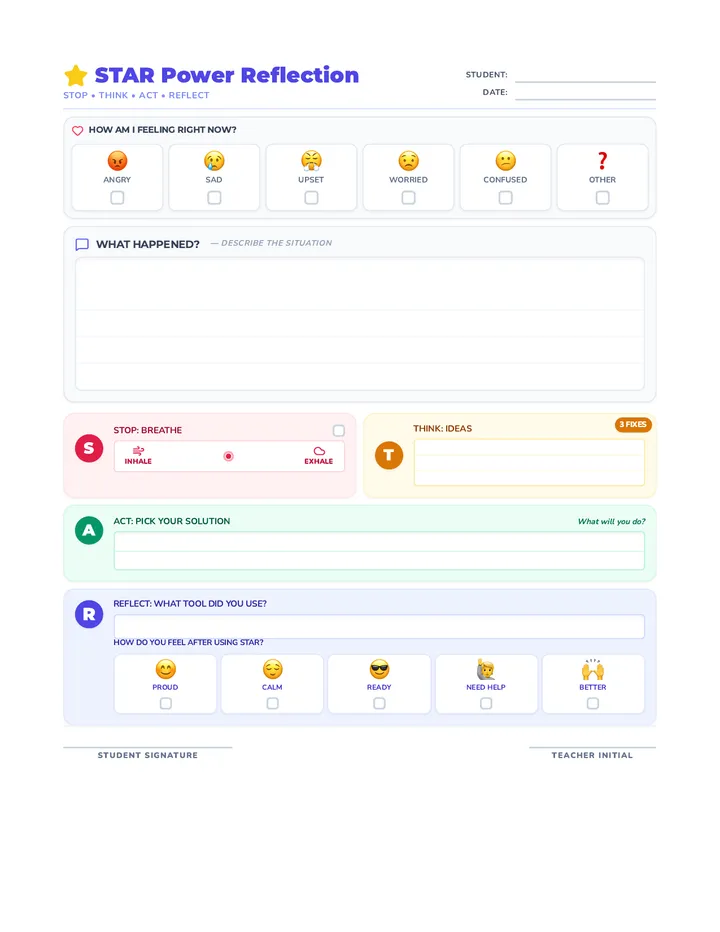
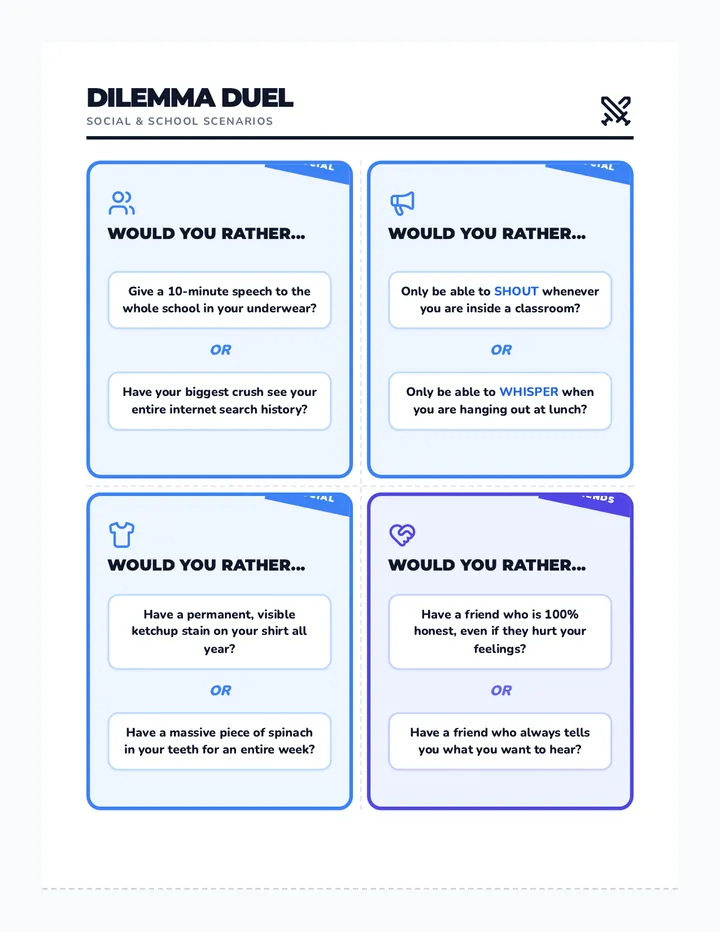
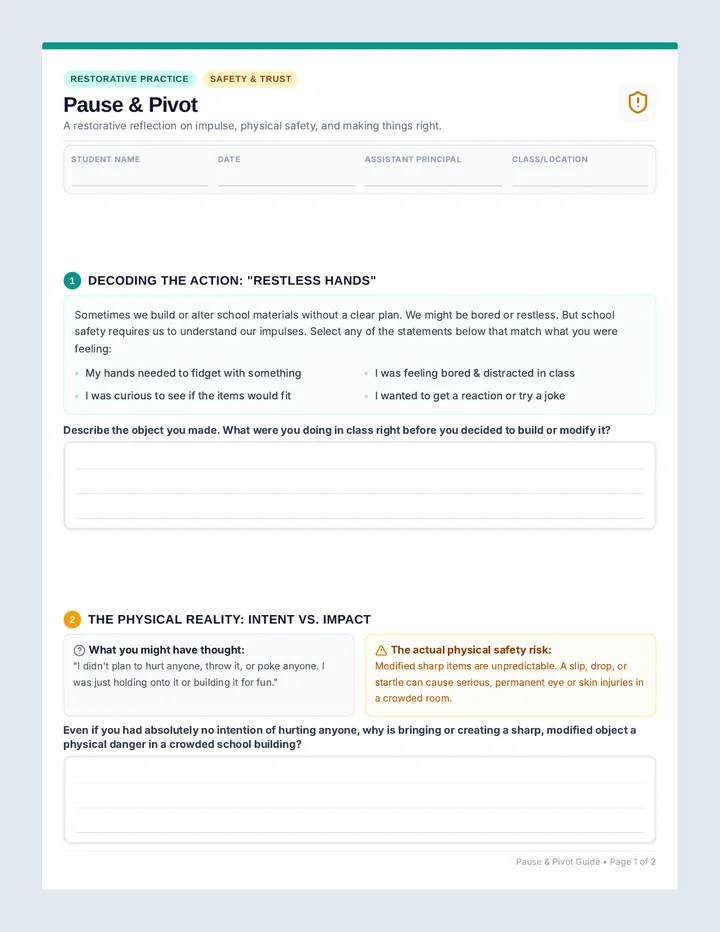
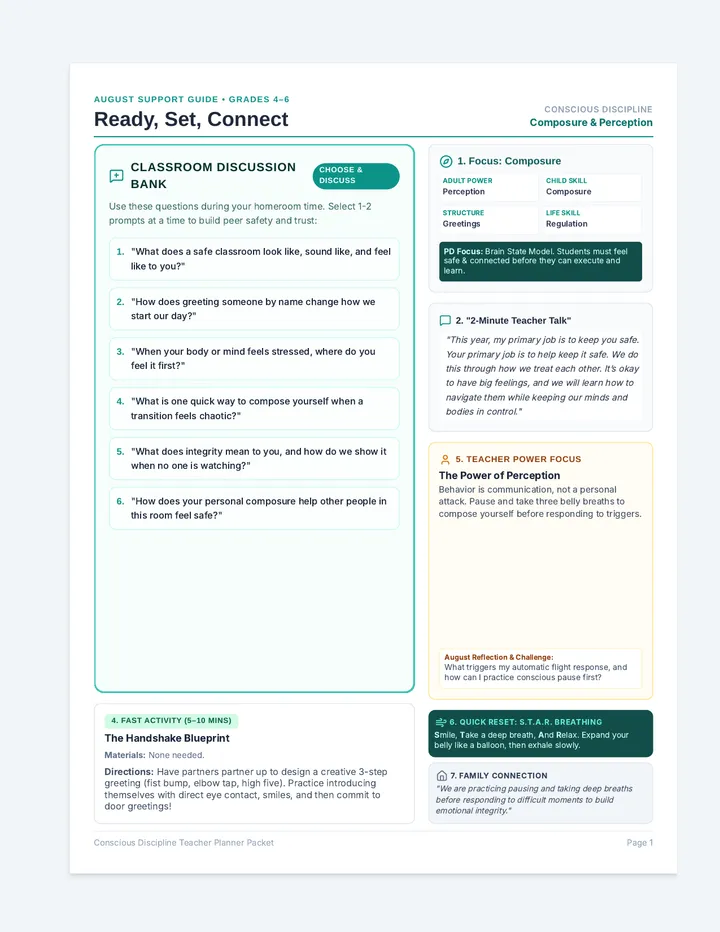
Root cause analysis and brainstorming techniques for everyday problem-solving. Equips learners with ethical frameworks and risk-benefit evaluation skills to predict consequences and make informed choices.
A report template for students to document their findings from the mock compliance audit, identifying legal violations and recommending corrective actions.
A comprehensive evidence file containing fictional company documents, transcripts, and complaints for students to analyze during the mock compliance audit.
A teacher resource for Lesson 5: The Judicial Review. It includes the correct categorization of assessment scenarios, detailed legal justifications for each, and a grading rubric for student responses.
The final assessment worksheet for Lesson 5. Students categorize complex workplace scenarios as Personality Conflict, Unprofessional, or Illegal Harassment, providing legal justifications for each verdict.
Educational slides for Lesson 5: The Judicial Review. This deck sets up the final simulation, defines the three categories (Conflict, Unprofessional, Harassment), and outlines the assessment task.
A student worksheet for Lesson 4 where they analyze a week's worth of workplace journal entries to identify a pattern of microaggressions. It focuses on the cumulative effect of small behaviors.
Educational slides for Lesson 4: The Pattern of Toxicity. This deck explains how microaggressions contribute to a hostile work environment over time, emphasizing the distinction between isolated incidents and pervasive patterns.
A simulation worksheet where students act as an HR committee to review accommodation requests and determine legal compliance under the ADA.
A student project guide for Lesson 3. Students act as HR consultants to draft a 'Digital Professionalism Policy' for a remote company, defining boundaries for instant messaging, video calls, and social media.
Slide deck explaining ADA terminology, the concept of reasonable accommodation, and the criteria for undue hardship.
Educational slides for Lesson 3: Digital Professional Conduct. This deck covers how workplace harassment translates to digital spaces, the impact of social media interactions between coworkers, and the 'permanence' of digital evidence.
Teacher facilitation notes for Lesson 2: The Impact Standard. It includes guiding questions for the case studies and tips for addressing common student concerns about the "Reasonable Person Standard."
A worksheet where students analyze scenarios to distinguish between disparate treatment and disparate impact, including a case analysis of business necessity.
A student case study analysis for Lesson 2 focusing on the 'Intent vs. Impact' legal standard. Students analyze two workplace scenarios to determine how intent differs from the actual impact on the victim and the environment.
Slide deck explaining the legal theories of disparate treatment (intentional) and disparate impact (unintentional) with case examples.
Educational slides for Lesson 2: The Impact Standard. This deck explains the legal shift from harasser intent to victim impact, introducing the 'Reasonable Person Standard' and debunking the 'just joking' defense.
A graphic organizer for students to map the historical evolution of major federal anti-discrimination acts and analyze their collective impact on workplace rights.
A teacher resource for Lesson 1: Defining Workplace Boundaries. It includes lesson objectives, facilitation tips for the hook, a complete answer key for the student worksheet, and notes on common misconceptions.
Slide deck detailing Title VII of the Civil Rights Act, the ADEA, and the ADA, including historical context and legal requirements.
A student worksheet for Lesson 1 where they categorize workplace scenarios as Quid Pro Quo or Hostile Work Environment. It includes space for reasoning and critical reflection on power dynamics.
The final instructional slide deck for Lesson 5, guiding students through synthesizing their research into a "Joy Menu" and practicing their new skills through role-play.
A decorative cover for the student's final 'Star Power' portfolio, featuring space for a self-portrait and recognition of their growth mindset journey.
A student-facing restaurant-style menu template for synthesizing and illustrating personal mood-lifting activities and coping strategies.
Comprehensive teacher guide for the final celebration lesson, outlining the 'Soapbox of Pride' activity, gallery walk facilitation, and portfolio assembly.
Colorful slides for the final lesson celebration, focusing on internal pride, self-reflection, and the ongoing journey of growth for Pre-K students.
A teacher guide for Lesson 5, focusing on synthesis of learned coping strategies into a personalized "Joy Menu" and providing instructions for role-play scenarios.
Printable medals for Pre-K students to color and wear, celebrating their achievements as 'Little Leaders' and 'Kind Teachers'.
A student worksheet for sorting personal joy activities into High Energy (Drain) and Low Energy (Fill) categories for strategic emotional regulation.
A teacher implementation guide for the Strategic Prioritization sequence. Includes an instructional arc, facilitation tips, common misconceptions, Special Education accommodation strategies, and answer keys.
Facilitation guide for Lesson 4, teaching Pre-K students how to engage in peer-to-peer coaching and leadership through skill sharing.
An instructional slide deck for Lesson 4 that teaches students how to strategically match activities to their current emotional energy levels.
A comprehensive teacher guide for the Joy Architect sequence, outlining the instructional arc, key concepts for each lesson, and the core skills developed.
Slides for Pre-K students exploring the concept of peer teaching as a way to reinforce mastery and build social-emotional competence.
A culminating project worksheet where students synthesize their time audit data, non-negotiables, and triage routines into a personalized "User Manual" for managing their time and commitments.
A teacher guide for Lesson 4, focusing on strategic selection of activities based on emotional energy levels (High Energy vs. Low Energy).
Student reflection sheet for the final lesson. Features 'resilience scenarios' for practicing flexible thinking and a final reflection on the unit's key takeaways.
Large-format visual prompts for Pre-K students to use during moments of frustration, teaching 'Pizza Breath' and 'Brave Talk'.
A lesson plan for teaching Pre-K students how to handle frustration during mastery building, including a puppet role-play script and regulation techniques.
An instructional slide deck for Lesson 3 that introduces sensory mood boosters and guides students through a series of "laboratory" experiments with smell, sound, and touch.
Final slide deck for Lesson 5. Focuses on resilience, 'flexible thinking' when routines are disrupted, and celebrates students' progress as 'Joy Architects'.
A comprehensive teacher facilitation guide covering the instruction, discussion prompts, activities, and specific listening lab scripts for both behavioral lessons.
A detective-themed worksheet for first graders to practice following multi-step directions, sequencing steps, and analyzing behavior scenarios.
A detective-themed presentation for first graders focusing on the four steps of following directions: Stop, Look, Listen, and Do.
A scenario-based worksheet for first graders to identify and differentiate between positive classroom behaviors and rule-breaking actions using a 'Rule Ranger' theme.
An engaging slide deck for first graders that introduces classroom rules through a 'Rule Rangers' theme, featuring interactive scenarios and clear behavioral expectations.
An answer key for the Humor Filter worksheet, providing correct categorizations for scenarios and an expanded list of suggested boundary-setting scripts.
A student activity sheet for categorizing different types of classroom humor and practicing boundary-setting scripts to address aggressive or mean-spirited jokes, now featuring 6 scenarios and 6 expanded boundary scripts.
A visual presentation for a 5th-grade SEL lesson on distinguishing between playful banter and aggressive humor, featuring interactive discussion prompts and an expanded set of 6 boundary-setting scripts.
A comprehensive teacher guide for a 30-minute social-emotional learning lesson focused on identifying and addressing aggressive humor and mean-spirited 'jokes' in the classroom. Now includes an expanded scenario bank and 6 boundary scripts.
A facilitation guide for the counselor, providing specific strategies for rapport building, framing impulse control as 'power,' and navigating the student's unique home dynamics as an oldest sibling.
A visual aid and checklist that reframes being the oldest sibling as a leadership role, encouraging positive behaviors (Hero Habits) and fostering discussion about home dynamics.
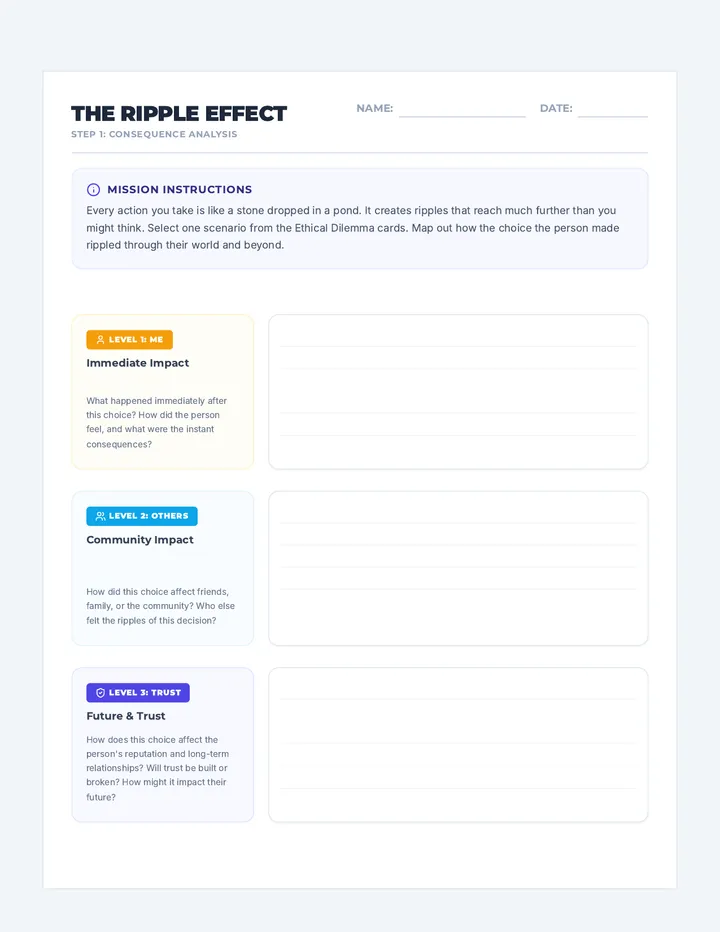
An activity sheet that visualizes the 'Ripple Effect' of social behavior, helping students understand how their actions (both positive and negative) affect family members and peers.
An activity sheet for practicing 'Pulse Pilot' techniques, identifying physical triggers (The Spark), and mapping out alternative reactions to common stressors.
Visual aids to introduce the 'Pulse Pilot' concept, focusing on identifying the physical 'spark' of impulsivity and using a mental remote control.
An advanced version of the Calm Cards matching game specifically tailored for middle schoolers. Features 12 pairs of sophisticated coping strategies like cognitive reframing, digital boundaries, and assertive communication, with a mature journal-style design.
Engaging slides for a middle school counseling lesson on reading social signals, understanding perspectives, and choosing responses with natural consequences. This version separates the definition of natural consequences from the escalation/de-escalation outcomes and inquiry questions into three distinct slides.
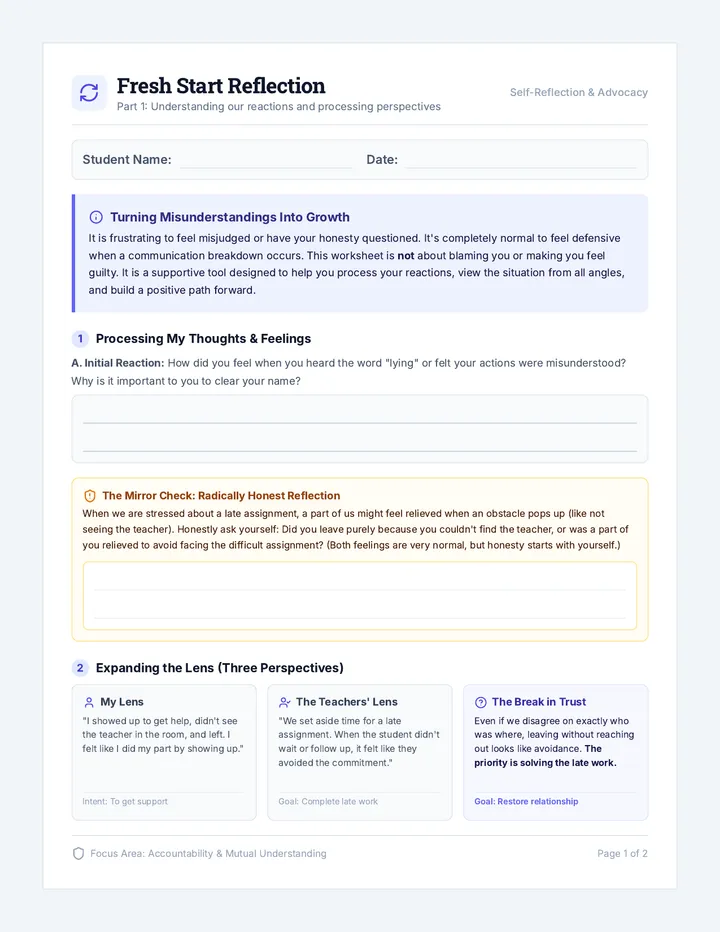
A reflection worksheet for 4th graders to practice decision-making in honesty scenarios, explore the feelings associated with lying, and sign an 'Integrity Promise.'
A visual presentation for 4th graders on honesty and trust, featuring the 'Tangled Web' and 'Trust Bridge' metaphors, plus practical tips for telling the hard truth.
A comprehensive teacher guide for teaching 4th graders about honesty, featuring 'The Tangled Web' yarn activity, scenario analysis, and discussion prompts.
A printer-optimized set of 24 matching cards (12 pairs) with tightened layout and fixed height grids to ensure zero content cutoff during printing. Includes clear cutting guides and compact instructional header.
Grading rubric and evaluation guide for teachers to assess the final "Reframing Guide" projects while maintaining student confidentiality.
Final project guide and template for students to create their personalized "Reframing Guide," applying CBT techniques to their three most recurring stressors.
Final synthesis presentation showing the shift from anxious narratives to balanced reframing, preparing students for their final project.
Discussion prompts on cards designed to spark dialogue about academic pressure, "Duck Syndrome," and the relationship between grades and self-worth.
A worksheet for auditing academic effort using the Pareto Principle, helping students identify over-invested tasks and define "good enough" for better mental balance.
Visual presentation on the "Perfectionist Paradox," utilizing the Pareto Principle to discuss academic anxiety and the diminishing returns of perfectionist striving.
Worksheet for deconstructing an anxious thought through evidence collection and Socratic questioning, concluding with a "Balanced Narrative" verdict.
A comprehensive reference sheet containing categorized Socratic questions for students to use when challenging their own automatic negative thoughts.
Presentation introducing Socratic questioning techniques and the "Thought Trial" concept to evaluate the evidence for and against anxious thoughts.
Instructional guide for teachers with facilitation prompts, pacing suggestions, and strategies for navigating common student difficulties with the ABC model.
A structured worksheet for students to deconstruct a personal stressor using the ABC model, helping them identify the underlying beliefs driving their anxiety.
Presentation explaining the ABC Model (Activating event, Belief, Consequence) and how interpretation drives emotional responses to stress.
Worksheet featuring two student case studies where learners must identify specific cognitive distortions and brainstorm counter-evidence.
A technical reference guide defining common cognitive distortions with examples, designed for undergraduate students to keep in their notebooks.
Visual presentation introducing cognitive distortions, the anxiety feedback loop, and clinical labels for common negative thought patterns.
A final reflection sheet for students to compare their quiz predictions with their actual grades, evaluating the effectiveness of their metacognitive strategies.
A short Academic English quiz designed to test students' application of their "Watch Out List," including a mandatory pre-grading self-reflection and score prediction section.
Final slides for the sequence focusing on the "Showtime" assessment. It introduces the score prediction challenge and real-time error analysis.
A guide for teachers to help students interpret their error data and connect patterns to specific defensive strategies.
A student worksheet for aggregating error data across multiple assessments and distilling those patterns into a "Watch Out List" for future defense.
A comprehensive facilitator's guide for teachers or counselors, providing a roadmap for individual and dyad sessions, key talking points, observation checklists, and troubleshooting tips for addressing trauma bonding.
A two-page individual 'self-repair' guide for students featuring grounding exercises, strength identification, the 'Yet' reframing technique, and daily journaling prompts to build personal resilience.
A one-page 'pocket guide' for students featuring conversation scripts, a friendship agreement, and a menu of emotional regulation tools to maintain healthy boundaries.
A two-page student activity featuring 'The Backpack Exercise' for identifying emotional ownership and three 'Upgrade the Moment' scenarios for practicing healthy boundaries and responses.
A two-page student-facing fact sheet and reflection guide that explains the concept of 'emotional mirroring' (trauma bonding) and introduces the 'both can be true' mindset for healthy friendship boundaries.
A visually striking slide deck titled 'Iron Character' designed for a large-group SEL lesson, featuring interactive prompts, discussion frameworks, and structured activity instructions.
A reflective student handout titled 'Character Compass' that guides students through identifying their core values, reflecting on ethical challenges, and planning personal growth.
A comprehensive facilitator guide for a large-group SEL lesson on character, featuring session objectives, a minute-by-minute breakdown, and management tips for large groups.
An assessment rubric for evaluating student understanding of academic integrity, focusing on four key criteria: understanding pressure, impact analysis, ethical strategy, and self-reflection.
An interactive student activity featuring three realistic scenarios (Case Files) where students must analyze the pressures to cheat and develop ethical 'Blueprint Actions.' Includes a personal reflection section.
A visual presentation for the 'Honesty Blueprint' lesson, covering the definition of integrity, the 'Pressure Cooker' of why students cheat, and the long-term impact of dishonesty on trust and character.
A comprehensive teacher facilitation guide for the 'Honesty Blueprint' lesson, featuring learning objectives, a minute-by-minute instructional sequence, and pedagogical insights into why students cheat.
A teacher-facing facilitator script for the 30-minute SEL lesson, including timing, speaking prompts, and instructional tips. Updated with improved page breaks.
A student-facing letter template for writing to their future 6th-grade selves, featuring guided prompts and plenty of space for reflection and planning.
Visual presentation for the "Letter to Future Me" lesson, guiding students through reflection on 5th grade growth and planning for middle school challenges.
A student-facing planning sheet to help 5th graders brainstorm their growth and select SEL skills for their letter to their future selves.
Facilitator guide for Lesson 5, outlining the instructional flow, discussion prompts, and key concepts for the maintenance contract and habit formation.
A formal maintenance contract for students to commit to their regulation protocols, establishing maintenance schedules and accountability partners.
Final slide deck for Lesson 5, focusing on habit formation, maintenance schedules, and the commitment to protocol adherence.
Facilitator guide for Lesson 4, outlining the instructional flow, discussion prompts, and key concepts for the digital tool evaluation and UI critique.
Worksheet for students to evaluate mental health apps and digital tools, specifically focusing on their user interface and accessibility during high-stress moments.