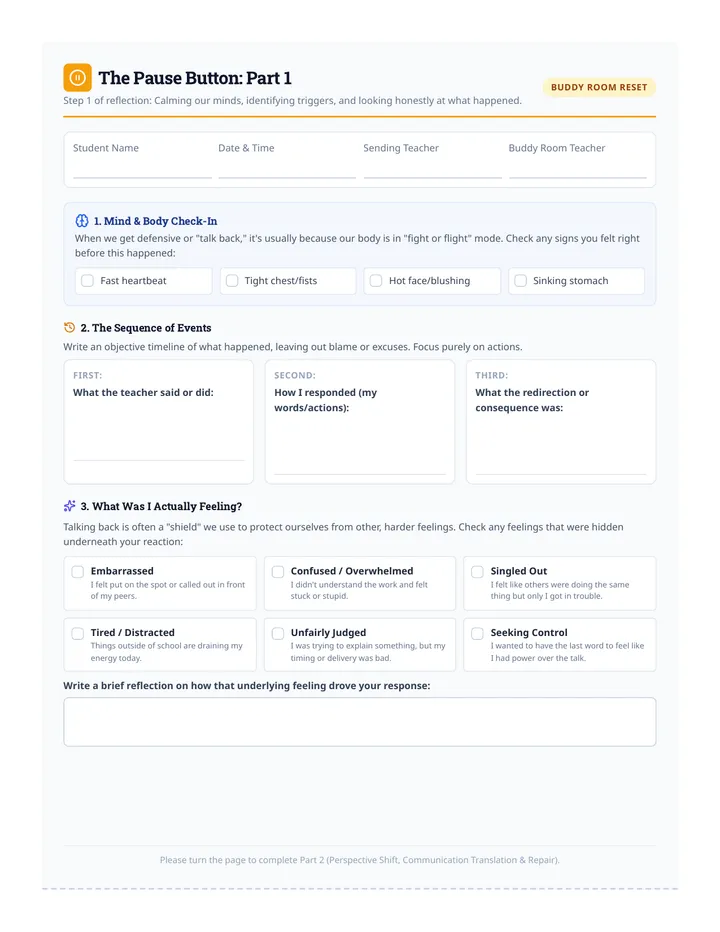
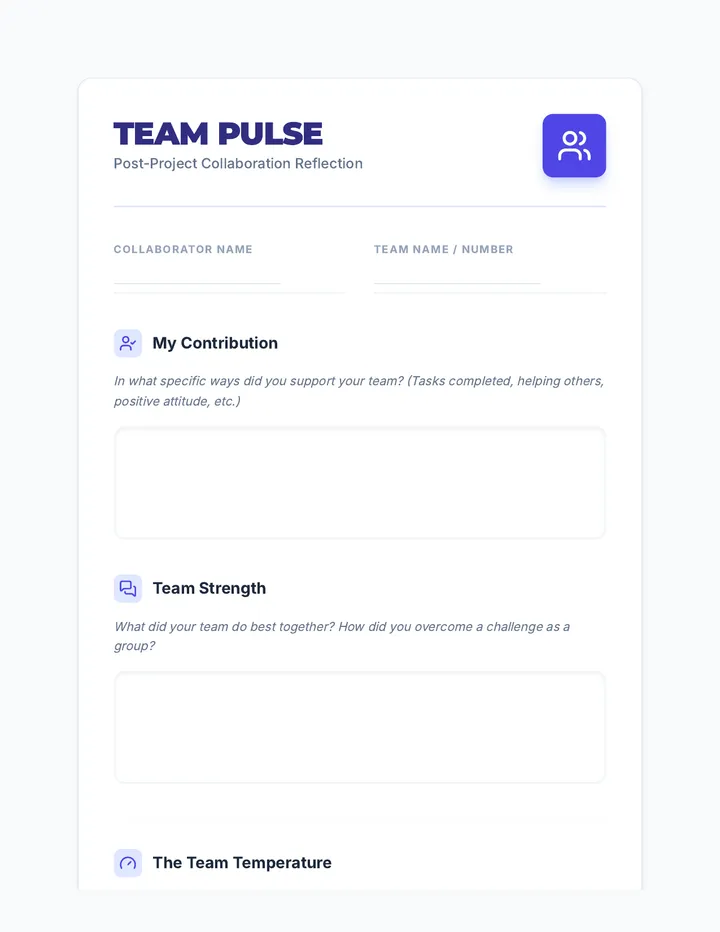
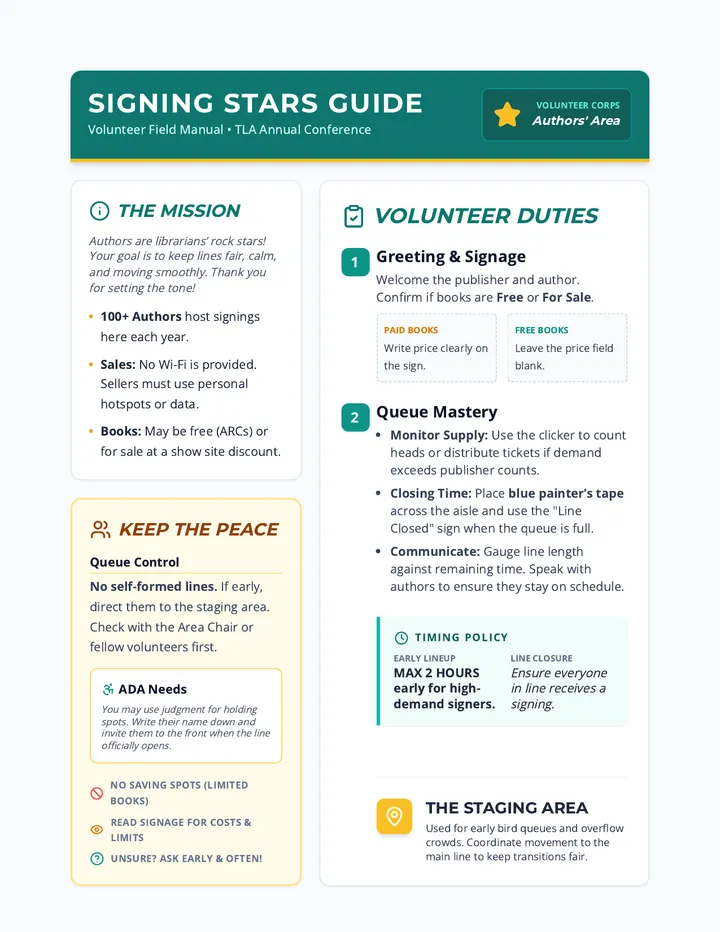
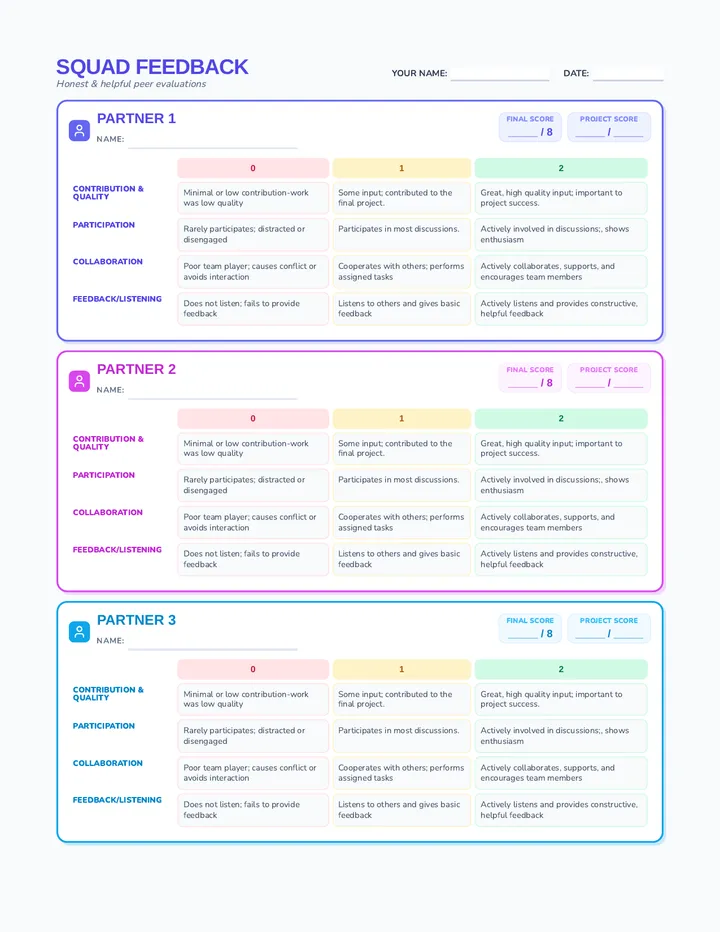
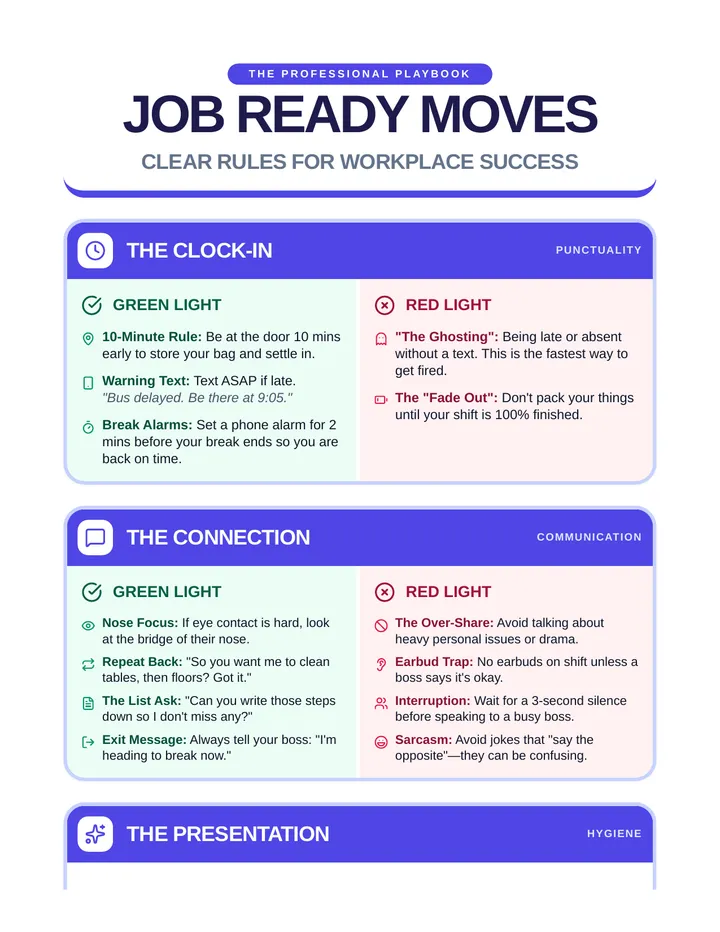
Written and verbal communication standards for the workplace, including email etiquette, presentation delivery, and professional phone conduct. Develops collaborative skills for teamwork, constructive feedback, and efficient time management.
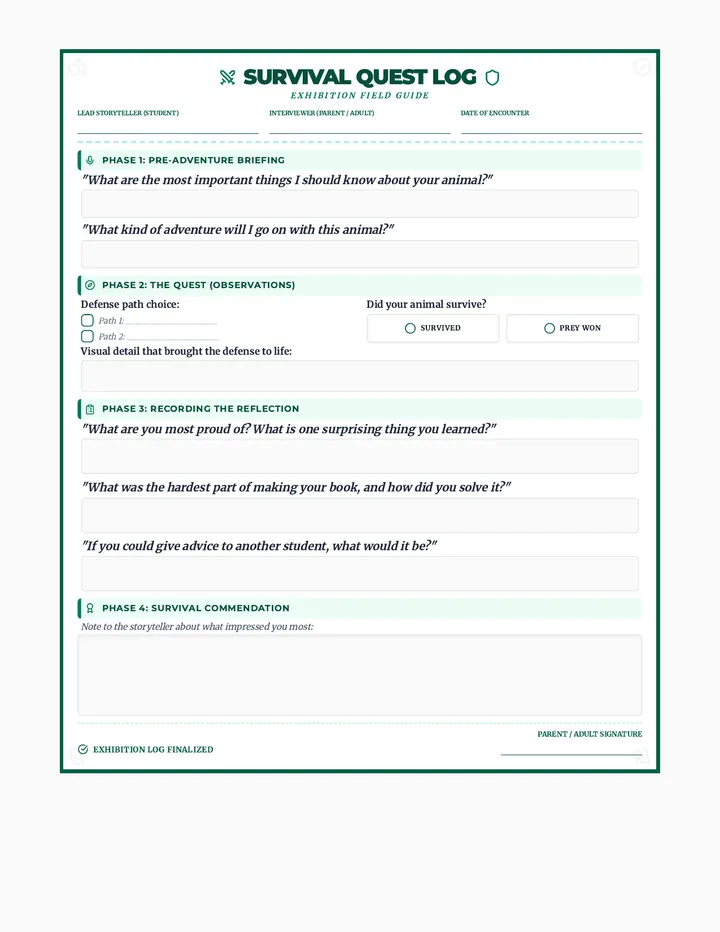
A summative project document where students synthesize everything they have learned into a personal 'Resiliency Blueprint' for real-world application.
A final self-assessment 'Scorecard' for the Mission Balance sequence, allowing students to rate their performance and reflect on their growth in schedule management and resiliency.
Final presentation for the Mission Balance sequence, reviewing core concepts of chaos management, negotiation, and energy management, and introducing the final scorecard activity.
A case study analysis of a student's 'all-nighter' experience, prompting students to evaluate the consequences and identify alternative strategies from the sequence.
A personal crisis management worksheet where students document their specific 'Red Alert' protocols, including triage strategies, support contacts, and recovery plans.
Lesson 4 slides on crisis management protocols, teaching students how to identify burnout, prioritize tasks during 'Red Alert' scenarios, and activate support systems.
A cut-and-paste sorting activity for students to categorize common school and life tasks as either 'High Focus' or 'Low Focus' energy requirements.
A worksheet for students to map their daily energy levels and strategically assign tasks based on their peak focus periods.
Lesson 3 presentation on energy management, teaching students to differentiate between High Focus and Low Focus tasks and to identify their personal peak energy periods.
Teacher facilitation guide for the Lesson 2 role-play simulation, providing scenarios, roles, and assessment criteria for student negotiations.
A professional communication guide for students, featuring scripted templates for digital and in-person deadline negotiations, including a practice exercise.
Slide deck for Lesson 2, teaching students the difference between hard and soft deadlines and providing a professional framework for negotiating extensions.
A set of printable 'Chaos Factor' cards for teachers to use in the Mission Balance simulation, featuring various disruptions to a student's schedule.
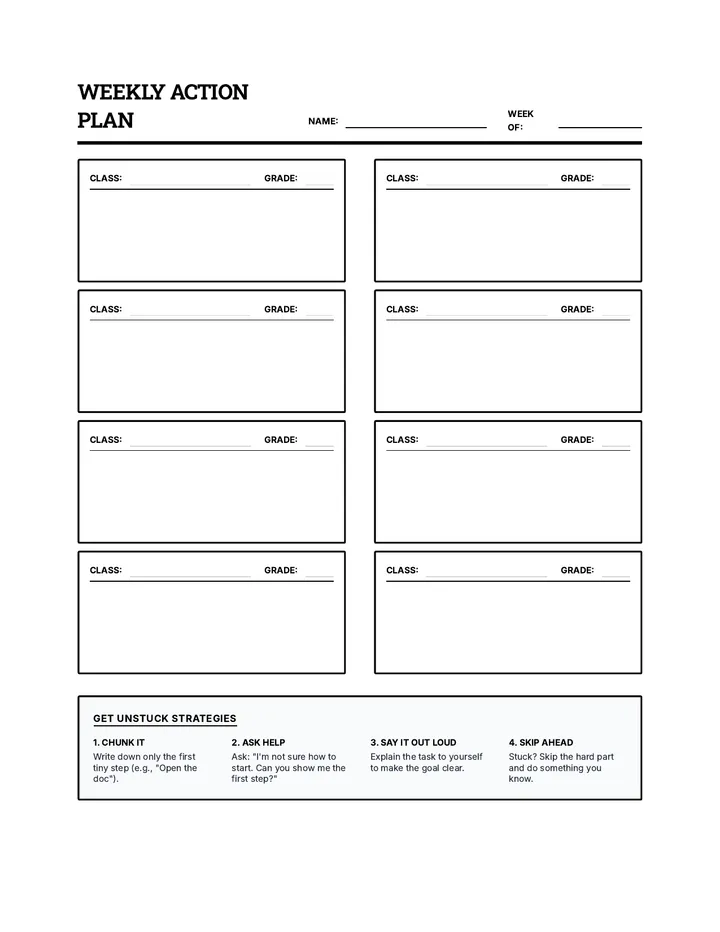
A student-facing weekly scheduling grid designed for the Mission Balance simulation, including a section for analyzing and responding to 'Chaos Factor' disruptions.
Introductory presentation for the Mission Balance sequence, teaching students about the 'Chaos Factor' and the importance of 'Buffer Time' in scheduling.
An emergency triage worksheet that guides students through a simulated crisis scenario, helping them identify which tasks to abandon and how to construct a Minimum Viable Day (MVD).
Lesson 5 slide deck on emergency triage and the 'Minimum Viable Day' concept, teaching students how to prioritize critical tasks during periods of crisis or illness.
A case study document about 'Alex the Ace', a student who takes on too much, designed to help students analyze the consequences of over-commitment and practice setting boundaries.
Teacher-facing rubric for assessing the Final Consultancy Report. Evaluates diagnostic precision, strategic prescription (tools), and professional advocacy (communication).
Lesson 4 slide deck introducing the concept of opportunity cost and providing a "No Bank" of polite but firm scripts for setting boundaries.
A redesigned Monopoly-style game board for the Day Navigator game, featuring a perimeter path with Bedtime (recharge), TV Vortex, and Inertia Trap spaces. Includes updated rules for energy management.
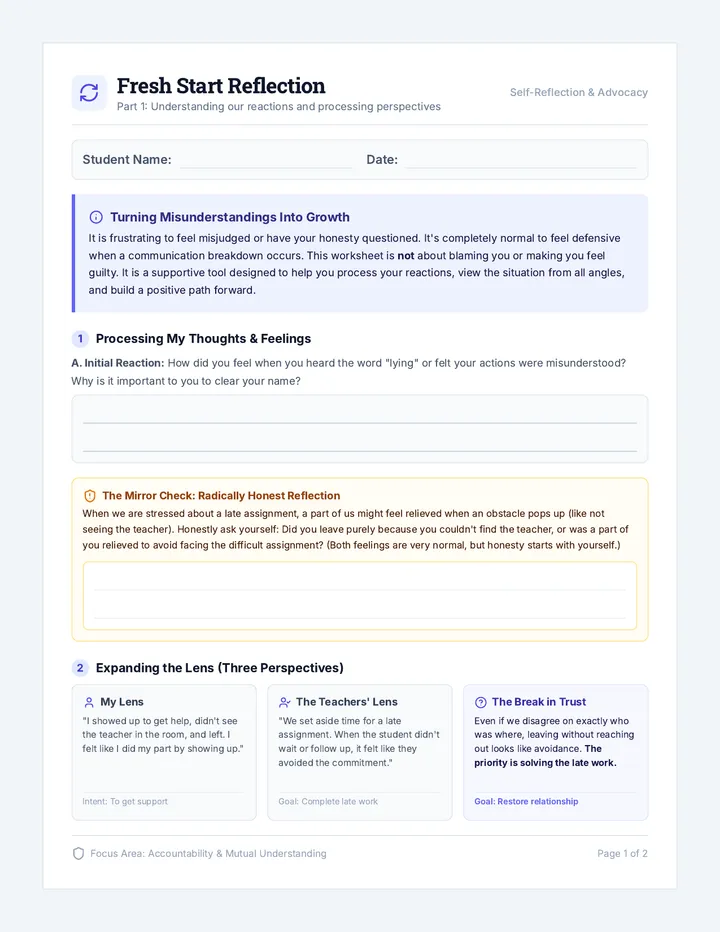
A task-initiation tool for adults with depression, using the '5-Minute Rule' and micro-tasking strategies to overcome inertia.
An interactive 'choose your own adventure' slide deck designed to facilitate group discussion on daily decision-making, phone use, and professional boundaries.
A reflective worksheet designed to help adults with depression identify core values and link them to daily tasks to build intrinsic motivation.
A comprehensive 3-hour facilitation guide for instructors, detailing pacing, instructional strategies for depression-related time management, and discussion prompts.
A teacher-facing facilitation guide providing pacing, discussion prompts, and key insights for delivering the AHS Summer Gig presentation effectively. Updated to include D'Agostino's Deli.
A student worksheet that provides a local employer checklist, an interview preparation area, and an application tracker to help AHS students organize their summer job search. Updated to include D'Agostino's.
A 7-slide presentation designed for Arlington High School students to navigate the local summer job market. It covers local hiring spots, application strategies, and interview tips with a clean, school-themed aesthetic. Updated to include D'Agostino's Deli.
A set of four mini-resume cards used for a fast-paced '6-Second Scan' activity where students practice identifying key information and common errors in a professional format. Expanded text sizes for better print legibility.
A reference sheet for students featuring a model freshman resume and a comprehensive checklist of professional 'do's and don'ts'.
A guided brainstorming worksheet for high school freshmen to map out their first resume, including sections for professional contact info, education, and an 'asset audit' of extracurricular activities. Now expanded to two pages for better writing space.
Visual presentation for the resume lesson, using a high-impact 'Future Builder' theme. Covers the five pillars of a resume, professional headers, and how to identify experience when you haven't had a formal job. Updated with larger text (minimum 24px) for presentation readability.
A comprehensive teacher's guide for the freshman resume lesson, featuring a minute-by-minute timeline, instructional script, and differentiation strategies. Updated to include the 6-Second Scan activity.
A matching worksheet where 1st grade students connect formal and informal greetings to their respective categories and practice writing the sight word 'CALL'.
Visual role-play cards for 1st grade students, featuring six different characters/locations (Teacher, Best Friend, Bank, Mom/Dad, Zoo, Cousin) with suggested greetings for formal and informal contexts.
Printable prop phones for 1st grade students to use during role-play activities. Each phone features the sight word 'CALL' on the screen and a realistic (but static) keypad layout.
A bright, high-contrast slide presentation for the Telephone Talk lesson, including the Call Song video embed and visual cues for sight word recognition and formal/informal language discussion.
A comprehensive facilitator guide for the Telephone Talk lesson, detailing the instructional flow, discussion questions, and activity management for 1st grade students.
A culminating simulation log where students draft their professional responses to randomized hiring outcomes, integrating all skills learned in the unit.
A printable set of outcome cards for the final simulation, determining whether a student receives an offer, a rejection, a second interview, or is ghosted.
A hands-on activity sheet for practicing procedural annotation by highlighting verbs and cautions in an origami instruction manual.
A slide deck introducing strategies for annotating technical manuals and 'how-to' guides, focusing on sequence, warnings, and decision trees.
A worksheet that simulates a shared digital document where students respond to colleague comments using professional workplace etiquette.
A slide deck introducing strategies for collaborative digital annotation and workplace communication etiquette.
A detailed reflection worksheet for students to analyze their simulation performance, identify mistakes, and distinguish between individual and systemic issues.
A case study worksheet where students analyze a simplified lease agreement to solve a deposit dispute using color-coded annotation.
Visual presentation for the final debrief of the simulation, identifying system failures versus individual choices and reflecting on professional growth.
A slide deck introducing strategies for annotating legal leases, focusing on color-coding rights, obligations, and deadlines.
A professional communication guide providing specific scripts for "polite but firm" refusal and negotiation in common workplace scenarios.
A graphic organizer to help students track the 'Main Thread' of a digital text while 'queuing' hyperlinks to avoid distractions.
Visual presentation for Lesson 4, teaching students about assertive communication, professional boundaries, and negotiation scripts in high-pressure work environments.
A slide deck focusing on strategies for maintaining focus in non-linear digital environments, including 'link queuing' and anchor-point annotation.
A simulation activity where students must synthesize raw student progress data into professional summaries under distracting conditions.
A handy reference sheet for 12th-grade students outlining digital annotation shortcuts, color-coding strategies, and software tools.
Visual presentation for Lesson 3, teaching students about deep work, the cost of interruptions, and strategies like time batching and defensive communication.
A worksheet for the 'Digital Treasure Hunt' activity where students use search functions to find specific data points in a long digital manual.
A set of scenario cards for the teacher to reveal during the Morning Rush simulation, providing specific interruptions and the 'triage truth' for debriefing.
An introductory slide deck for 12th graders explaining the advantages of digital annotation, showcasing essential tools, and outlining pro-level strategies for managing digital documents.
A planning and tracking worksheet for students to manage their simulated workday and record the impact of unexpected interruptions.
Visual presentation for the Morning Rush simulation, including timers, task lists, and the first unexpected "Inbox Injection."
A formal participation and confidentiality consent form for the Heart of Service training. It outlines voluntary participation, the "safe room" rule for peer privacy, data handling policies, and an agreement to the group support protocols.
A clean, printable attendance form for the Heart of Service training. It features space for session details and a table for up to 18 staff members to sign in, matching the botanical emerald theme.
A personal debriefing form for the presenter to use after facilitating the Heart of Service training. It focuses on self-evaluation of regulation techniques, identifying powerful group moments, and providing a space for the facilitator to "shed" the emotional weight of the session.
A formal report template for the presenter to provide to organization leadership. It summarizes key training themes, identifies systemic barriers to staff wellbeing, and lists aggregated recommendations for organizational shifts to support long-term mission sustainability.
A facilitator guide for interactive group activities across the three-day training. It includes the "Resilient Forest" visualization for Day 1, an expanded set of 8 roleplaying scenario cards for Day 2, and the "Legacy Jar" closure ritual for Day 3.
A single-page sustainability contract for Day 3. It helps staff reflect on their purpose ("The Why"), establish closure rituals, and finalize personal and team care plans to ensure long-term health in trauma-focused work.
A 11-slide presentation for Day 3 of the training, focusing on healing, finding meaning, and creating long-term sustainability plans. The design uses golden and sunrise tones to represent closure and a new beginning.
A single-page resilience toolkit for Day 2 of the training. It includes spaces for grounding exercises, building a personalized coping toolkit (Emergency, Transition, Sustainable), and a structured buddy protocol for peer support.
Updated Day 2 presentation with simpler, conversational language. Complex terms like "Somatic Release" and "Buddy Protocol" have been changed to "Shake it Off" and "The Buddy System" to make the skills and strategies more relatable and easier to implement.
A specialized guide for the presenter to help them manage their own nervous system while delivering the training. It includes slide-by-slide scripts, deep psychological explanations, and specific physical techniques to avoid tension and fidgeting.
A comprehensive facilitator guide for the Heart of Service training session. It includes pacing instructions, key facilitation principles for psychological safety, talking points for activities, and troubleshooting tips for managing heavy emotional content.
A simplified, single-page version of the Reflection Map Worksheet. It consolidates the energy audit, body mapping, and resilience planning into a clean, actionable layout.
A 13-slide training presentation for organizational staff focused on psychological safety, trauma-informed care for employees, and burnout prevention. The design uses a calming botanical theme with deep greens and stone tones.
A comprehensive teacher guide for setting up and managing the Leader Lab workshop, including supply lists, timing, and facilitator coaching tips.
A student worksheet for tracking progress through the Leader Lab stations, featuring reflection prompts and self-assessment for each leadership skill.
Printable instruction cards for each of the three Leader Lab stations, featuring specific missions, roles, and leadership skill focuses.
A set of interactive slides to introduce the Leader Lab session, outlining the core skills of leadership and providing clear instructions for three activity stations.
A facilitation guide for teachers covering pacing, discussion prompts, and differentiation strategies for the Voice Vanguard lesson.
Guidelines for the Mic Drop project, where students research and present on a leader who used their voice for change.
A role-playing worksheet where students analyze scenarios, map perspectives, and draft a blueprint for a difficult conversation.
A polished poster connecting Jenga to team building, with a height carefully set to 840px within the 960px viewport to guarantee a single-page fit on US Letter paper without cutoffs.
Universal teacher guide for the Lead the Way lesson. Includes inquiry-based pacing, a breakdown of the 4 Pillars (Empathy, Integrity, Initiative, Influence), and strategies for teaching social "Steering" and "The Pivot".
Universal leadership worksheet for 6th graders featuring discovery-based reflection, scenario analysis using the 4 Pillars, and a personal leadership commitment.
Universal leadership slide deck for 6th graders focusing on 4 pillars: Empathy, Integrity, Initiative, and Influence. Includes myth-busting, discovery-based brainstorming, and the concept of "Steering the Energy".
An advanced teacher facilitation guide for Lesson 5, focusing on professional digital protocols and strategic responses to online conflict for 11th-grade students.
An advanced visual presentation for 11th graders focusing on the permanent digital record, professional digital protocols, and strategic responses to online conflict.
An advanced teacher facilitation guide for Lesson 4, focusing on strategic de-escalation techniques and professional social capital for 11th-grade students.
An advanced visual presentation for 11th graders focusing on strategic de-escalation (Fogging, Broken Record) and maintaining professional social capital in high-pressure adult scenarios.
An advanced teacher facilitation guide for Lesson 3, focusing on interest-based negotiation and integrative problem-solving for 11th-grade students.
An advanced visual presentation for 11th graders focusing on interest-based negotiation, expanding the pie, and strategic problem-solving in high-stakes adult contexts.
An advanced teacher facilitation guide for Lesson 2, providing sophisticated discussion prompts for teaching assertive communication and deep verification techniques to 11th graders.
An advanced visual presentation for 11th graders focusing on high-fidelity feedback, nuanced 'I' statements, and deep verification techniques for complex social and professional relationships.
An advanced teacher facilitation guide for Lesson 1, specifically tailored for 11th grade students, focusing on the neurobiology of stress and professional emotional regulation.
An advanced visual presentation for 11th graders focusing on the neurobiology of stress, autonomic override protocols, and maintaining professional reputation in high-stakes environments.
A comprehensive teacher facilitation guide for Lesson 5, focusing on applying assertive communication and emotional regulation to digital contexts in a 45-minute discussion format.
A specialized visual presentation for 7th graders focusing on the 'disinhibition effect' of screens and protocols for managing digital conflict without aggression.
A comprehensive teacher facilitation guide for Lesson 4, specifically designed for 7th graders to replace verbal aggression with tactical, assertive communication in a 45-minute discussion format.
A specialized visual presentation for 7th graders focusing on strategic verbal communication, social capital, and assertive 'power phrases' to replace aggression.
A comprehensive teacher facilitation guide for Lesson 3, focusing on synthesizing all skills from the 'Peaceful Power' sequence to resolve a final complex scenario, now formatted for a 45-minute session.
A visual presentation for Lesson 3, providing a structured framework for collaborative problem-solving and a final scenario that synthesizes skills from the entire series.
Visual presentation slides for Lesson 4, distinguishing between adaptive excellence and maladaptive perfectionism while introducing the law of diminishing returns.
Final student synthesis materials for Lesson 5, including a comprehensive Resilience Architecture master plan and a portable, pocket-sized Crisis Card for immediate intervention.
Visual presentation slides for Lesson 3, teaching students how to detach self-worth from academic critique and parse feedback for objective data.
Visual presentation for Lesson 5, synthesizing the sequence and introducing the Resilience Architecture plan and Crisis Card.
Visual presentation slides for Lesson 2, illustrating the ABC model of CBT and common academic cognitive distortions.
A student budgeting activity for Lesson 4 that teaches students how to evaluate opportunities and practice declining them to protect their academic capacity.
The summative student material for the sequence—a Professional Resilience Manifesto template where students synthesize their learning into core commitments and a resilient professional narrative.
Visual presentation for Lesson 4, addressing the economics of energy, role overload, and the "Yes/No/Negotiate" framework in academia.
Teacher facilitation guide for the final lesson, focusing on cognitive rehearsal and the construction of a Professional Resilience Manifesto.
A student handout for Lesson 4 that includes a perfectionism audit, effort allocation grid, and the "80% Rule Challenge" planning guide.
A student blueprint for Lesson 3 to design a personalized shutdown ritual and optimize their sleep environment.
Teacher facilitation guide for Lesson 4, exploring the difference between excellence and perfectionism and introducing the concept of strategic satisficing.
Visual presentation for Lesson 3, focusing on the neurobiology of sleep and the concept of revenge bedtime procrastination.
Student activity sheet for Lesson 3, featuring the "Identity vs. Output" model, feedback parsing practice, and a non-defensive response rehearsal.
Facilitation guide for Lesson 3, focusing on detaching self-worth from academic work and processing professional critique effectively.
A student worksheet for Lesson 2 that helps graduate students audit 'phantom time' lost to anxiety and design a schedule with structural buffers.
A student worksheet for Lesson 2 featuring a distortion reference guide, scenario analysis exercises, and a personal ABC model audit.
Visual presentation for Lesson 2, reframing time management from a productivity lens to a cognitive load reduction lens.
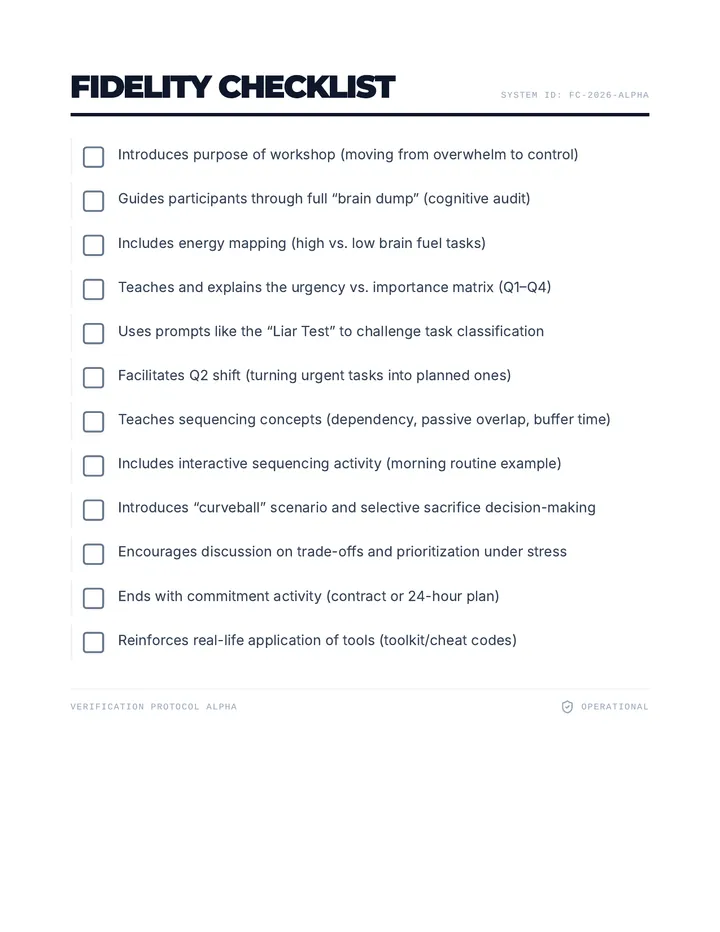
A teacher implementation guide for the Strategic Prioritization sequence. Includes an instructional arc, facilitation tips, common misconceptions, Special Education accommodation strategies, and answer keys.
Teacher facilitation guide for Lesson 2, covering CBT frameworks, the ABC model, and common cognitive distortions in an academic setting.
A teacher guide for facilitating the Human Insight Lab. Includes instructional philosophy for teaching empathy to 8th graders, discussion prompts, look-fors in student work, and differentiation strategies.
A series of four detailed social scenarios (case studies) designed for 8th-grade students to practice empathy through critical analysis. Each scenario includes prompts for decoding non-verbal cues, shifting perspectives, and drafting strategic, validating responses.
A 2-page independent reading and reflection packet for 8th-grade students. It covers decoding non-verbal cues, the concept of 'perspective shifting' (Window vs. Mirror), and practicing validating responses over dismissing ones.
A comprehensive teacher facilitation guide for Lesson 2, providing discussion prompts for teaching I-statements and active listening through the 'Bridge Building' metaphor, now formatted for a 45-minute session.
A visual answer key and assessment guide for the listening skills drawing activity, highlighting common errors and instructional talking points.
A comprehensive teacher script for a 30-minute lesson on respect and directions, with explicit prompts for managing classroom behavior and delivering the listening challenge.
A final evaluation tool for students to complete at the end of the 6-week curriculum, allowing them to reflect on their growth, identify new study strategies, and measure progress against their initial baseline assessment.
A baseline assessment tool for students to complete at the start of the 6-week curriculum, measuring their current self-perceptions of organizational skills, study habits, and familiarity with key academic strategies.
A formal group description and authorization form for parents and students to sign, detailing the group mission, schedule, and expectations for participation and confidentiality.
A guide for parents and guardians that explains the 'Level Up' group's purpose, details the weekly topics, and provides practical tips for supporting students' organizational and study habits at home.
A comprehensive final worksheet for Week 6, allowing students to design their own SMART goals and select a 'Success Loadout' of study and organizational tools from the previous five weeks.
A teacher guide for instructing students on friendship skills, including role-play prompts, troubleshooting tips for common social hurdles, and a progress tracking table.
A 6-page illustrated social story for first graders that teaches the step-by-step process of making friends, updated to use 'Interest Match' verbiage for shared connections.
A handy reference sheet for students summarizing the 'Success Code' protocols for classroom, hallway, and group work environments.
An interactive worksheet where students identify behavioral 'bugs' in common scenarios and write the corresponding 'Success Code' protocols to fix them.