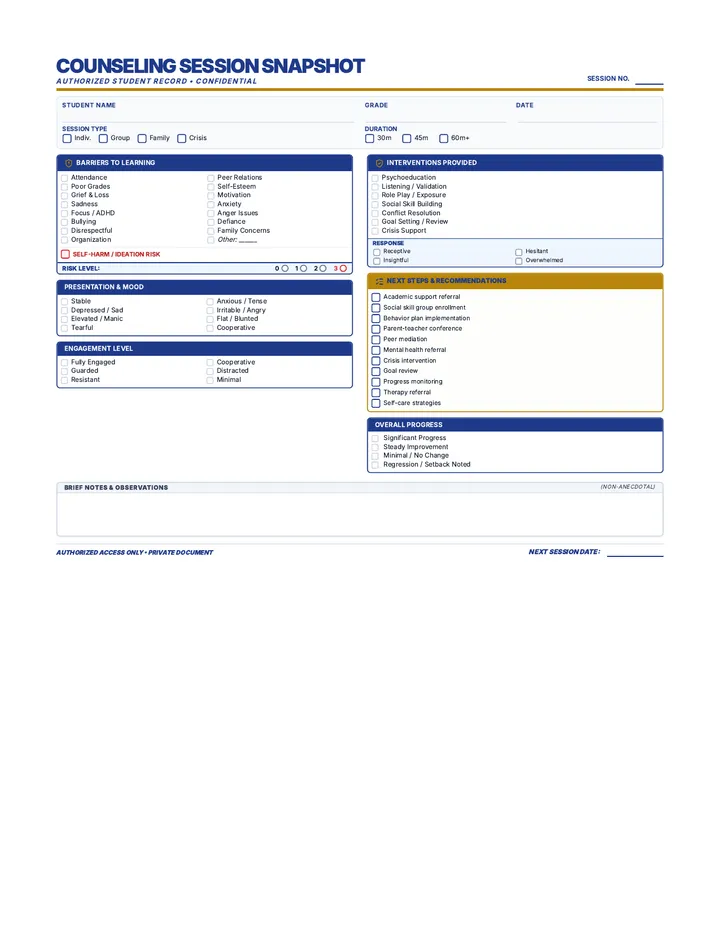
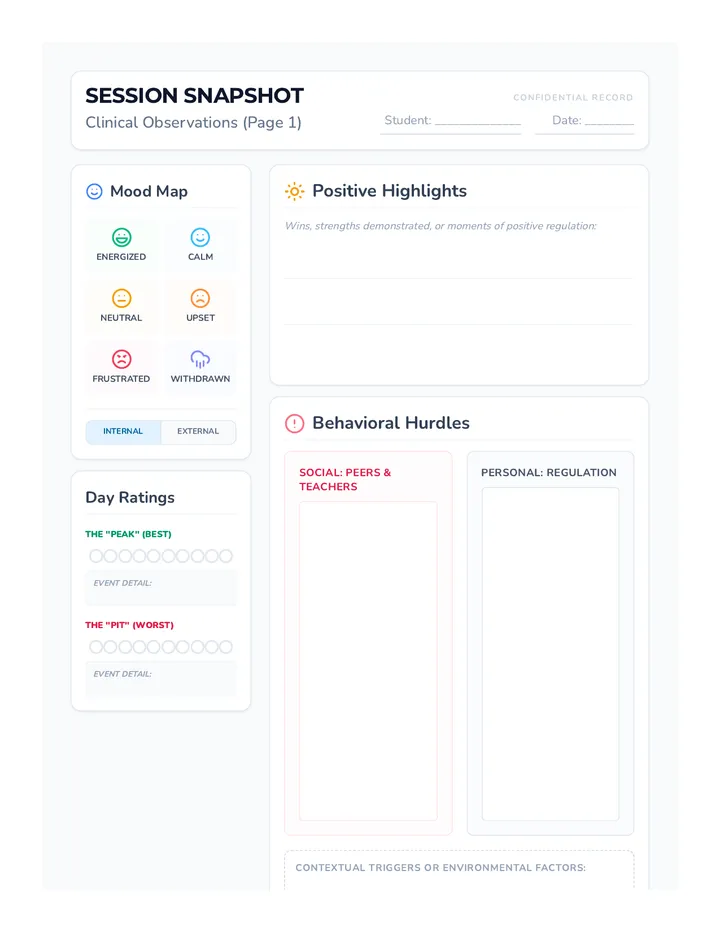
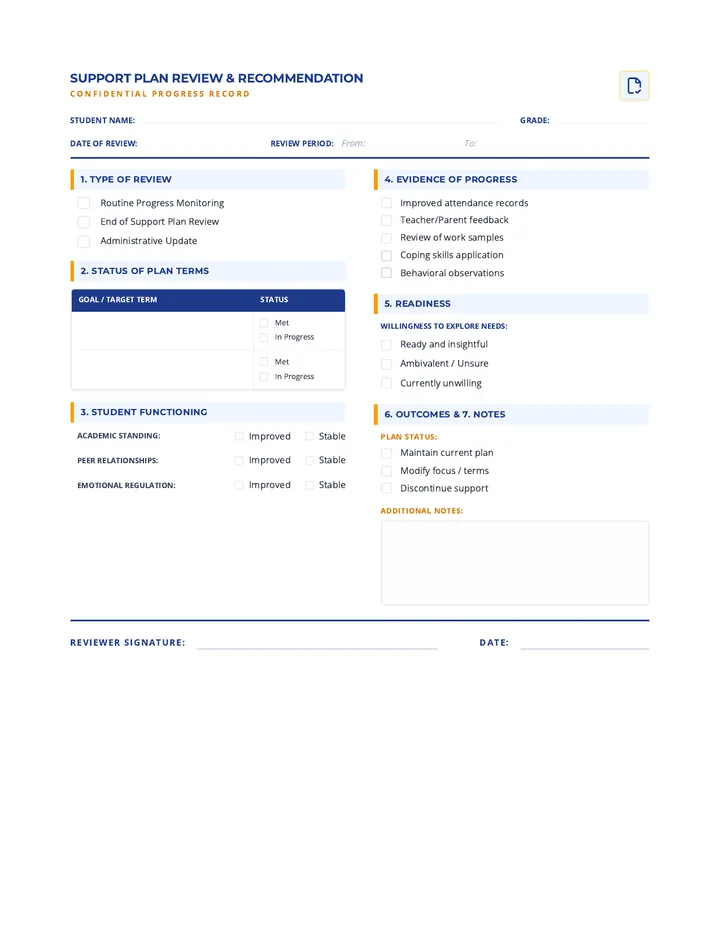
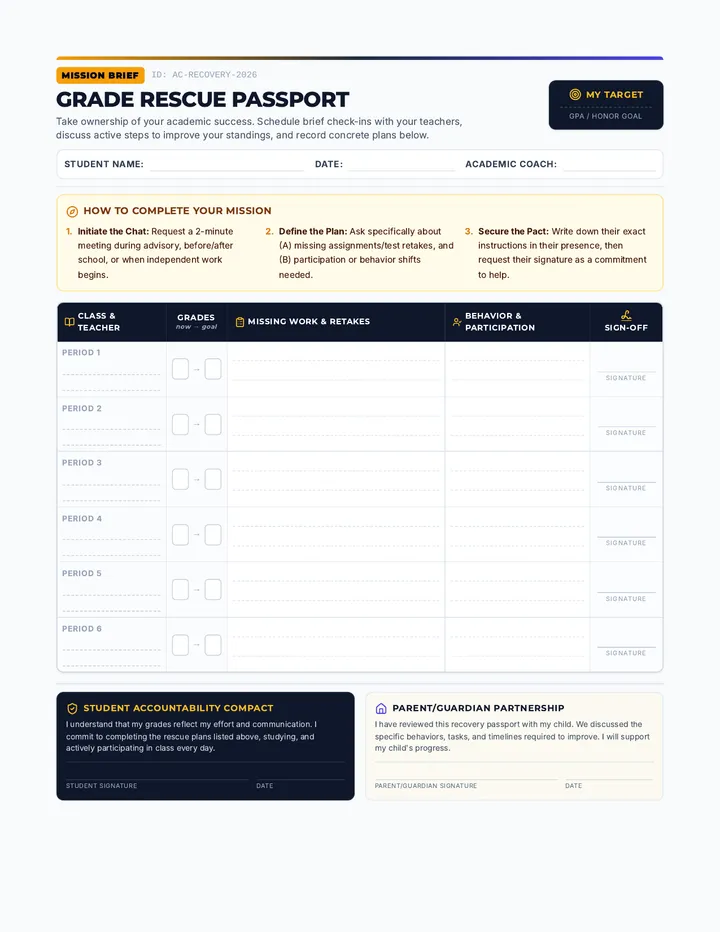
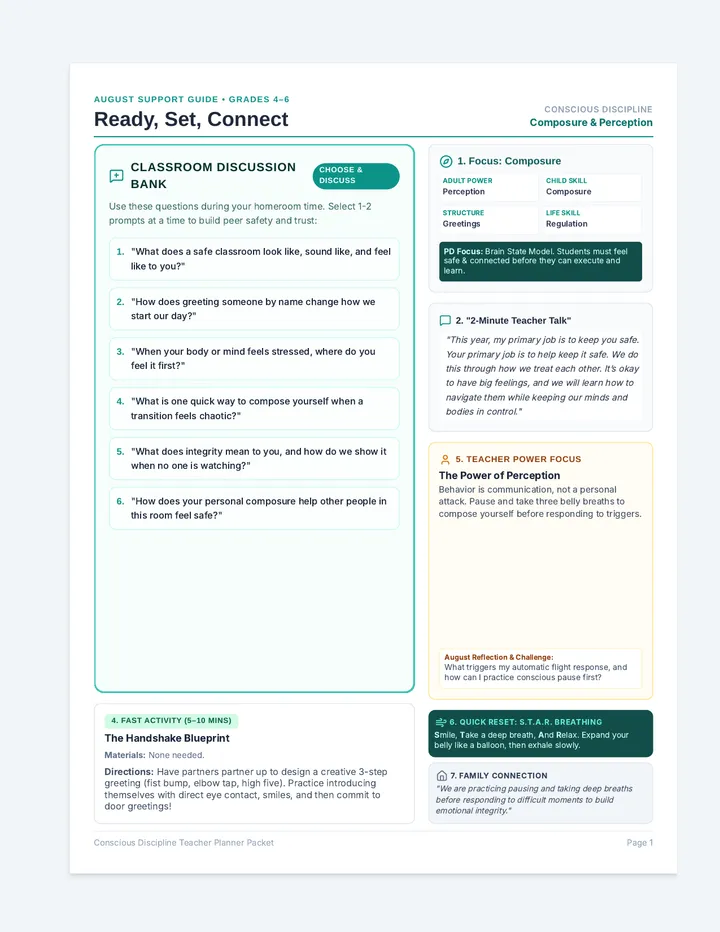
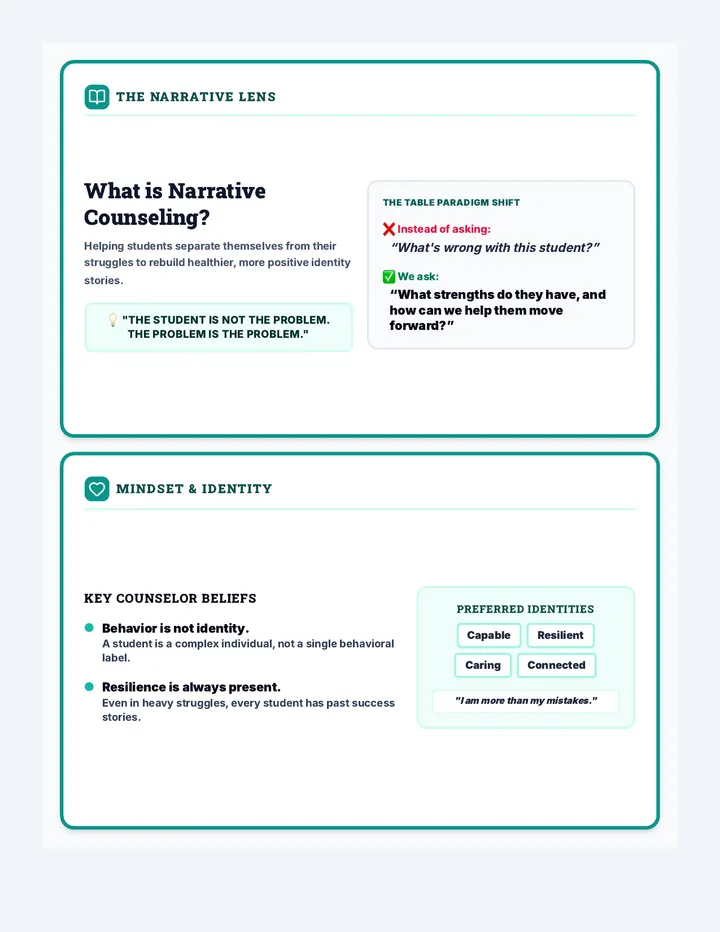
Functional behavior assessment, data tracking, and de-escalation strategies for managing classroom conduct. Addresses positive reinforcement, token economies, and individualized behavior contracts to support student self-regulation.
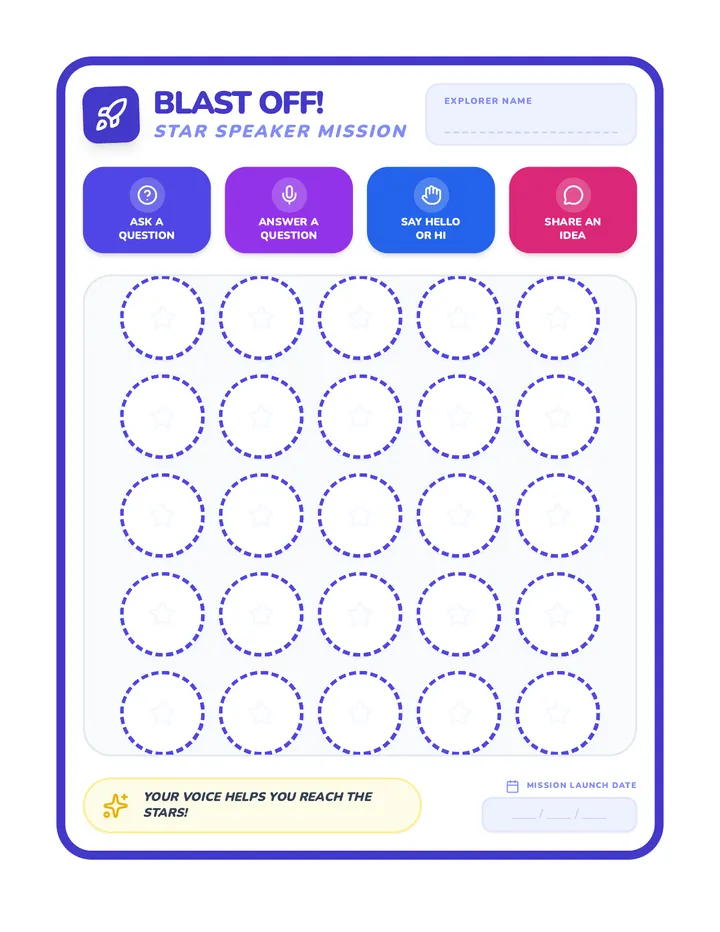
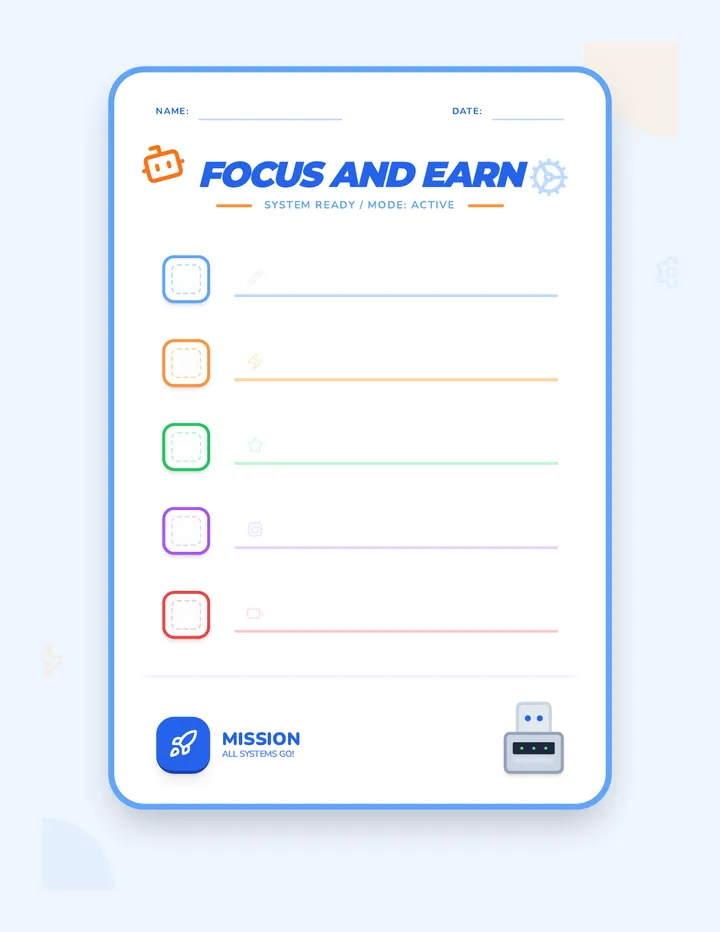
An individual student sticker chart to track work stamina minutes, themed around a rocket ship 'blast off'.
A teacher-facing guide for tracking class stamina building, featuring game rules, graphing tips, and synthesis strategies.
A visual presentation for students focusing on building stamina (endurance) through synthesis of previous task management tools.
A visual checklist for Kindergarten students to self-monitor their work completion by comparing their efforts to a model.
A teacher-facing guide for teaching the concept of task completion, using visual models and 'Finished Bin' routines.
A visual presentation teaching students how to identify task completion by comparing their work to a model and utilizing a 'finished' bin.
A printable First/Then visual board for Kindergarten students, including a variety of task and reward icons for customization.
A teacher-facing guide for implementing First-Then contingencies, including setup for the Mystery Box hook and tips for reinforcement delivery.
A visual presentation teaching the logic of 'First/Then' contingencies for task completion and reward.
A student tracking sheet to record successful completion of timed work intervals, encouraging visual self-monitoring of stamina.
A facilitation guide for teachers to help students understand the concept of time duration using visual timers, featuring modeling tips and common misconceptions.
A visual presentation introducing visual timers and how students can use them to monitor their own work duration.
A cut-and-paste sorting activity for Kindergarten students to categorize behaviors into 'Work Mode' and 'Play Mode'.
A teacher-facing facilitation guide for teaching the difference between 'Work' and 'Play' behaviors, including instructional steps, key vocabulary, and differentiation strategies.
A visual presentation for Kindergarten students to learn the difference between 'Work' and 'Play' behaviors, including a movement-based game and visual behavioral cues.
An activity sheet for students to practice Behavioral Skills Training (BST) by teaching a peer a complex manual task like origami.
A practitioner-focused implementation checklist for the Behavioral Skills Training (BST) model, including prep, the core cycle, and troubleshooting.
Instructional slides for Lesson 5, breaking down the four steps of Behavioral Skills Training (BST) and the importance of mastery-based learning.
A reference guide for managers listing various non-monetary reinforcers categorized by social recognition, privilege, growth, and environment.
A project brief and planning sheet for students to design a gamified safety protocol for a warehouse setting.
A facilitator's guide for the Distress Signal materials. Includes scenario answers, scripts for responding to avoidance (Ghost Signals), and discussion points for reinforcing self-advocacy (Captain's Calls).
A student worksheet for distinguishing between using mental health as an excuse (Ghost Signal) and legitimate self-advocacy (Captain's Call). Includes scenario sorting and a reflection on 'cheap prizes' vs. long-term costs.
A witty, high-impact slide deck for therapeutic sessions. It teaches students to distinguish between 'The Ghost Signal' (using mental health as a cop-out for work avoidance) and 'The Captain's Call' (legitimately asking for tools and support to stay engaged).
Further optimized the layout and font sizes of the 4-page horizontal poster to ensure all content fits comfortably without overflow in the 16:9 slides format. Maintained 24px+ body text for readability while tightening headers and margins.
A high-impact executive summary and leave-behind handout for the CPS District Grant pitch. This version updates the quote attribution to "Think:Kids at MGB" and focuses on project vision, impact data, and long-term sustainability.
Updated the presentation to use 'Collaborative Problem Solving' as the title and consistently reference '$33,000 AEF Grant'. Adjusted slide titles and footers to reflect these changes while ensuring high-impact visual delivery.
A comprehensive bi-fold poster presentation highlighting the AEF-funded CPS initiative. It features implementation details, success stats, and a refined official school seal above the district text, with prominent recognition of the $33,000 AEF grant.
A professional bi-fold poster presentation for the Arlington Public Schools CPS expansion proposal, featuring strategic alignment, rationale, data visualization, and impact metrics.
A collection of professionally written follow-up email and message templates for caregivers, school staff, and students to reinforce the home visit's outcomes and return plan.
A strategic guideline for social workers and school staff to determine the appropriate timing, readiness criteria, and safety protocols for conducting a home visit.
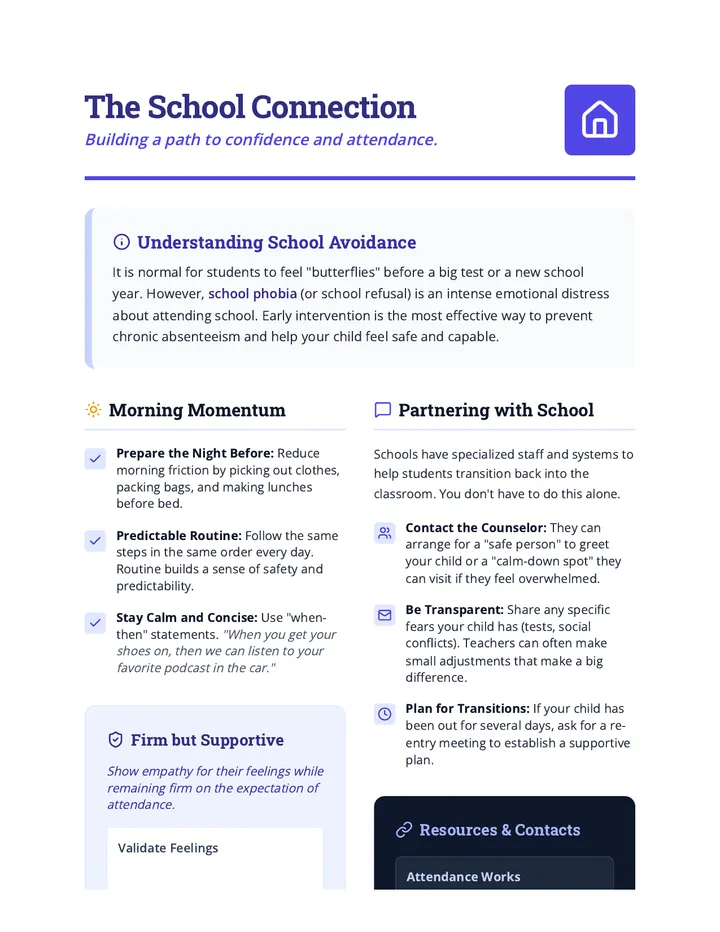
A supportive handout for parents and caregivers with practical strategies for morning routines, setting expectations for home during school hours, and communication tips.
A detailed conversation guide for clinicians with specific prompts, probing questions, and talk-tracks for different phases of the home visit.
A collaborative goal-setting document for students and families to co-create a gradual school return plan with clear weekly milestones and safety protocols.
A visual checklist for students to identify specific triggers for school avoidance and positive engagement "sparks" to aid in return planning.
A comprehensive facilitator guide for social workers conducting home visits for school avoidance, featuring rapport-building strategies, trigger identification frameworks, and a visit checklist.
Large visual cue cards for 'No Biting' and the 'Hand Out' gesture to help young children communicate needs physically and verbally.
An updated professional guide for caregivers on how to use simplified 1-2 word phrase materials to reduce biting.
A simplified visual communication board for a young child using 1-2 word phrases like 'Turn', 'Want that', and 'Help'.
A simplified social story for a young girl using 1-2 word phrases, focusing on using words like 'Turn' and 'Want' instead of biting.
A professional guide for caregivers and teachers on how to effectively use social stories and visual aids to reduce biting behavior.
Engaging slides for a middle school counseling lesson on reading social signals, understanding perspectives, and choosing responses with natural consequences. updated to include examples, non-examples, inquiry questions, and the original escalation/de-escalation concept.
A professional goal-tracking sheet designed to monitor a student's progress in identifying emotions and perspectives across social scenarios, with space for trial data and prompt tracking.
A student worksheet containing 5 realistic social scenarios for middle schoolers to practice identifying emotions, perspectives, and selecting appropriate responses with natural consequences.
Engaging slides for a middle school counseling lesson on reading social signals, understanding perspectives, and choosing responses with natural consequences. now updated with examples, non-examples, and inquiry questions.
A professional counselor's guide for the 'Social Signal Decoder' lesson, featuring lesson pacing, key decoding concepts, discussion prompts, and an overview of natural consequences. updated with inquiry strategy.
A professional rubric for administrators and attendance teams to evaluate the quality and effectiveness of attendance intervention strategies across four key criteria.
A collaborative student support plan for improving attendance, featuring goal setting, barrier identification, action items for school and home, and a four-week progress tracker.
A formal notification letter to parents regarding chronic absenteeism and potential retention risks, including an invitation to an Attendance Support Meeting.
A structured meeting agenda for attendance conferences, featuring sections for data review, barrier identification, and collaborative planning between school and home.
A structured observation tool for teachers to record data on a student's strategy use during the in-class scrimmage, featuring time-stamped logs and outcome analysis.
A comprehensive instructional guide for teachers to facilitate the In-Class Scrimmage lesson, including timing, key talking points, and observation strategies.
A slide deck for students that introduces the concept of a scrimmage, guides them through choosing a strategy, and explains the observation and debriefing process.
A teacher facilitation guide specifically designed for 1-on-1 assessment of autistic students, focusing on neuro-affirming strategies, processing time, and Strength-based pivots.
Individual-focused instructional slides for an autistic student, introducing the concept of 'pivoting' through a solo challenge and self-regulation tools.
A specialized individual observation tracker for an autistic student, focusing on emotional regulation, cognitive flexibility, and task persistence.
An individualized self-reflection questionnaire for an autistic student, featuring clear, concrete scenarios and visual structures to assess adaptability and purpose.
A comprehensive teacher facilitation guide providing pacing, material requirements, and synthesis strategies for the Pivot and Purpose assessment lesson.
An instructional slide deck that introduces 6th-grade students to the concepts of adaptability and purpose through interactive discussion and a "Strategy Shift" challenge.
A teacher-facing observation checklist designed to track resilience, pivoting strategies, and group dynamics during collaborative classroom activities.
A self-reflection questionnaire for 6th-grade students focused on assessing their adaptability, resilience, and sense of purpose through Likert scales, scenarios, and open-ended questions.
A comprehensive teacher assessment tool for tracking student mastery across all four stages of the regulation loop during the final simulation challenge.
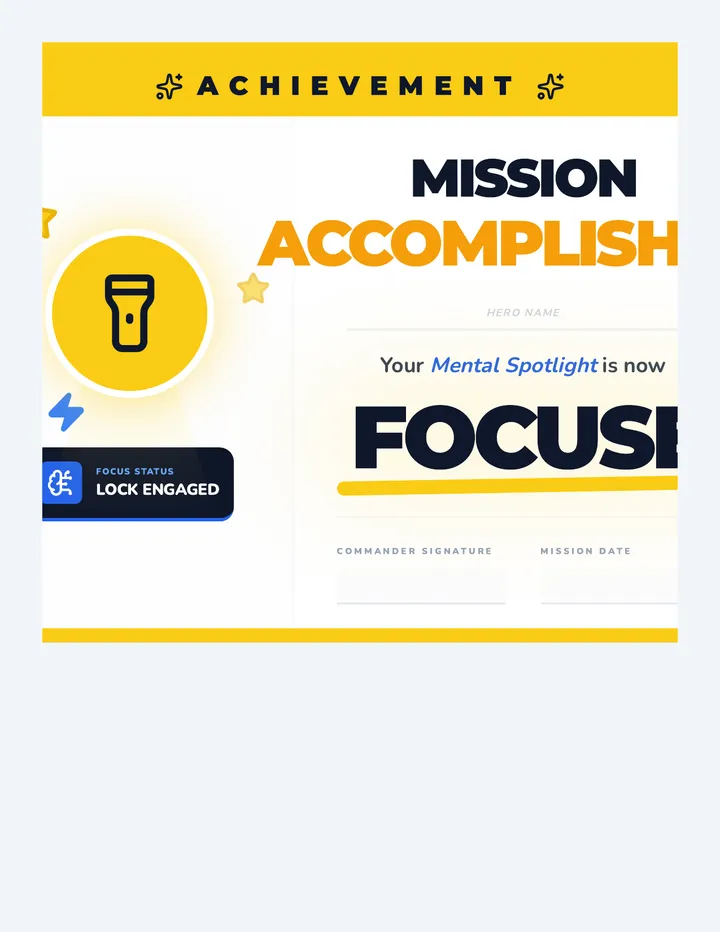
A commemorative certificate for Kindergarten students who have demonstrated mastery of the full regulation loop (Identify, Request, Reset, Return).
A slide deck reviewing the entire four-step regulation loop (Identify, Request, Reset, Return) and setting up a final mastery-based challenge for students.
A teacher observation tool for tracking student mastery of the 3-step return routine (Breath, Clean Up, Soft Walk) during practice drills.
A slide deck focused on the transition from a break back to classroom activities, introducing a structured 3-step return routine.
An anchor chart visual for the classroom Break Zone, clearly outlining the four main behavioral expectations for students while they are resetting.
A sorting activity for Kindergarten students to differentiate between appropriate 'Calm Body' actions and inappropriate 'Busy Body' actions in the Reset Zone.
A visual guide for Kindergarten students on the expectations and rules for the classroom Reset Zone, including the distinction between reset time and play time.
Role-play scenario cards for practicing the use of break cards in various classroom situations, helping students differentiate between needing a break and wanting to change activities.
Printable visual break cards for students to use as part of the 'Stop, Grab, Show' protocol. Includes multiple cards for desk or portable use.
A slide deck introducing the 'Stop, Grab, Show' procedure for requesting a break using visual communication cards.
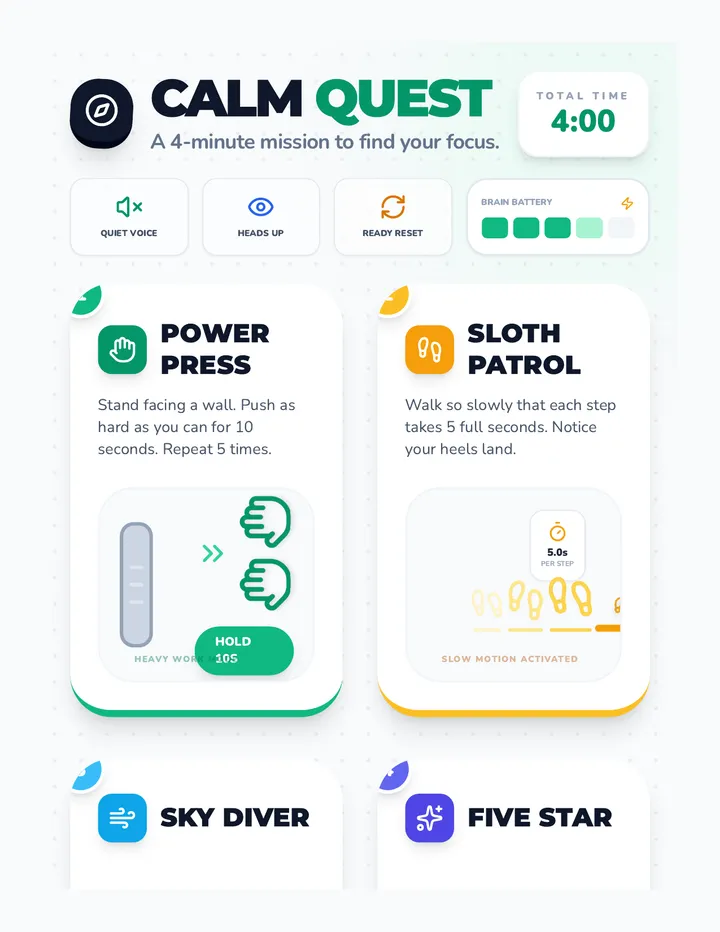
A teacher-facing guide for Lesson 1, including a guided body scan script, key terminology, and differentiation strategies for Kindergarten students.
A student worksheet for identifying physical sensations on a body map and categorizing them using the body thermometer scale.
A visual presentation introducing Kindergarten students to the concept of interoception and identifying physical body signals using a 'Body Thermometer' analogy.
Final 10-question assessment covering the neurobiological foundations, somatic markers, respiratory patterns, and dissociation concepts from the sequence.
Final mastery project for Lesson 5, where students synthesize the entire sequence into a visual/written map of the escalation cycle and corresponding interventions.
Synthesis slides for Lesson 5, covering the intervention window and introducing the final "Escalation Blueprint" project.
Set of 4 discussion cards for Lesson 4, designed to help students explore the empathy and practical intervention aspects of student dissociation.
Teacher guidance for the "Zero Hour" mastery simulation, including staging instructions, escalation levels, and debriefing strategies.
Student case study analysis for Lesson 4, focusing on differentiating between intentional defiance and neurobiological shutdown through the case of 'Marcus'.
A teacher guide and data tracking tool for a counseling lesson on bullying. Includes a 30-minute session pacing guide, answer keys for the student worksheet, and a progress tracker aligned with the student's IEP goal for emotional regulation.
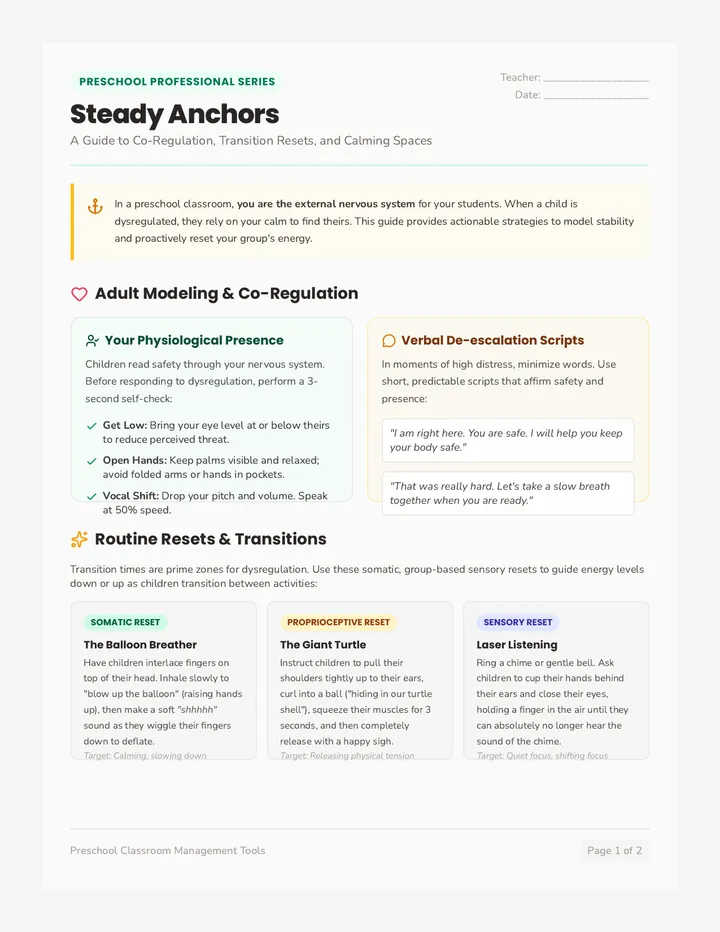
A worksheet for middle school students to accompany a counseling lesson on bullying. It includes fill-in-the-blank definitions, scenario analysis to differentiate bullying from conflict, inquiry-based discussion questions, and a role-play planning section focused on emotional regulation.
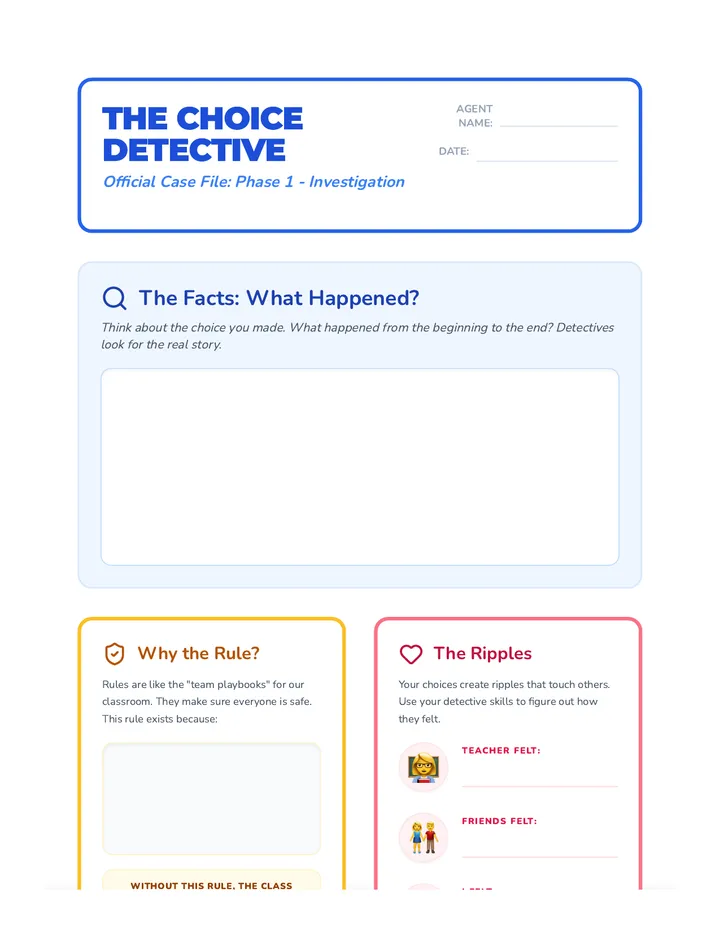
A visual presentation for a middle school counseling lesson on defining bullying. It covers the criteria for bullying (intentional, repeated, power imbalance), differentiates it from conflict, and provides strategic responses for emotional regulation.
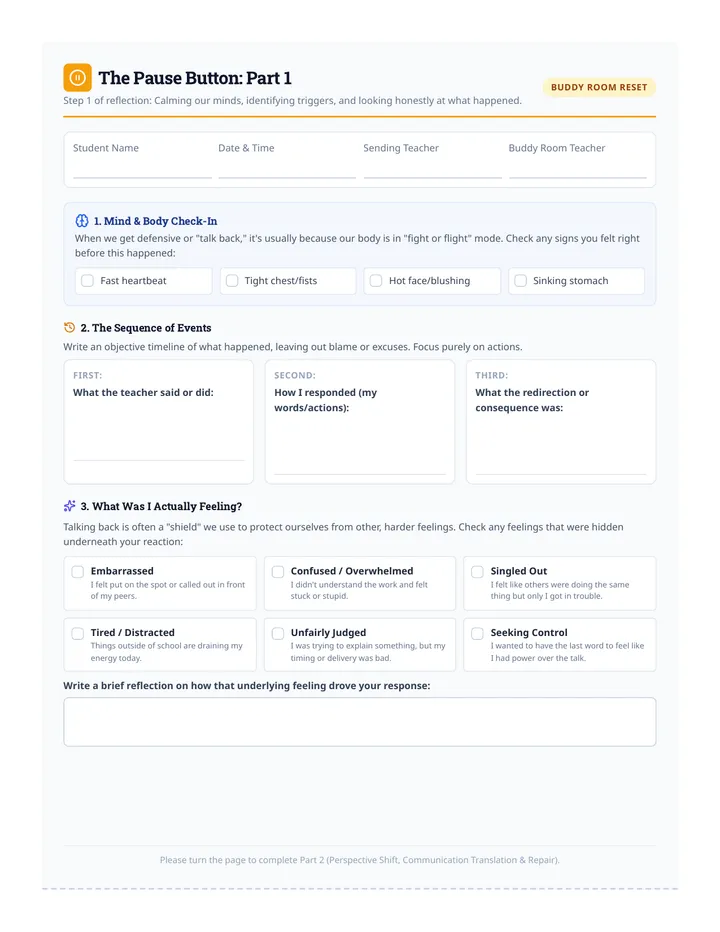
A teacher facilitation guide for the Behavior Blueprint system, including implementation schedules, self-assessment definitions, and communication tips.
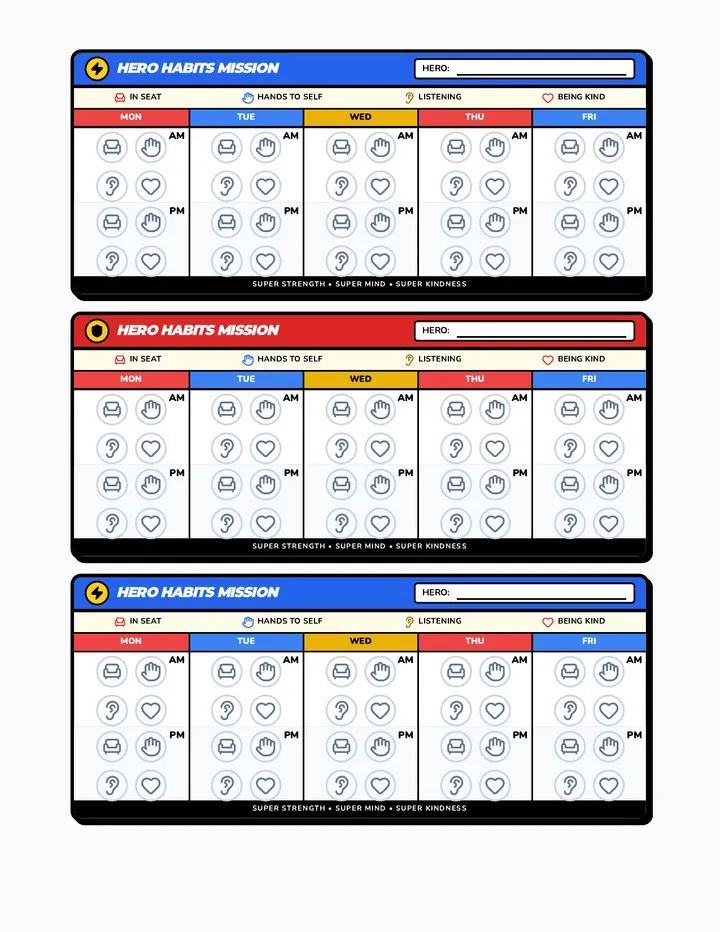
A 5-day behavior self-assessment worksheet for students to track their progress on daily goals related to peer interactions and classroom expectations.
A 5-day mini-lesson slide deck for daily check-ins, focusing on respectful communication, personal space, active listening, transitions, and problem-solving.
A sports-themed student worksheet for identifying daily pressure points and selecting proactive self-regulation strategies from a 'playbook'.
A comprehensive teacher's guide for the Pre-Game Warm-Up lesson, featuring a timed instructional arc, talking points, and facilitation tips for 8th-grade educators.
A sports-themed presentation that guides 8th-grade students through the process of 'scouting' their school day, identifying pressure points, and selecting proactive strategies from their personal playbook.
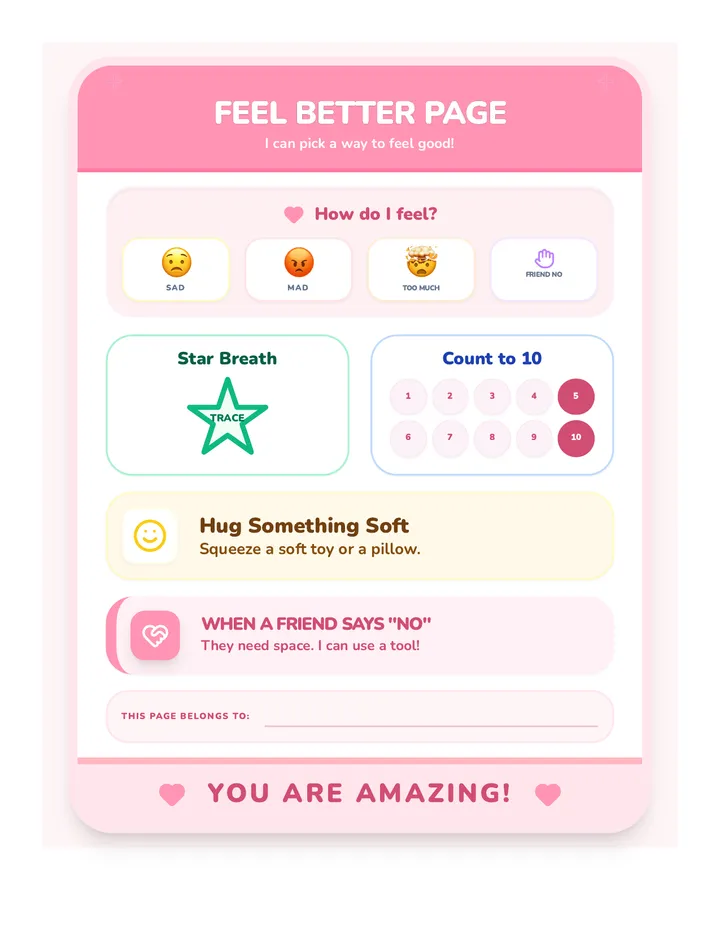
A large, visual regulation tool choice board for first graders, featuring six in-room strategies to help manage emotions without needing to leave the classroom.
A full-page dedicated feelings check-in sheet for first graders to track their emotional zones at specific observation intervals, with expanded space for drawing and reflection.
Updated facilitation guide with coaching prompts specifically targeting "Walking the Room" as an alternative to bathroom breaks for movement seeking.
Updated visual feelings check-in worksheet for first graders with an expanded toolbox of in-room regulation strategies like walking the room, wall push-ups, and fidgets to reduce reliance on bathroom breaks.
An updated facilitation guide for teachers conducting behavioral observations, with specific coaching tips for steering students toward in-room regulation tools rather than just bathroom breaks.
A facilitation guide for teachers or observers conducting a 30-minute behavioral observation using the Mood Map worksheet, including prompting language and note-taking sections.
A formal and reflective commitment contract for 3-5 students to internalize the assembly's message about community impact and personal behavior.
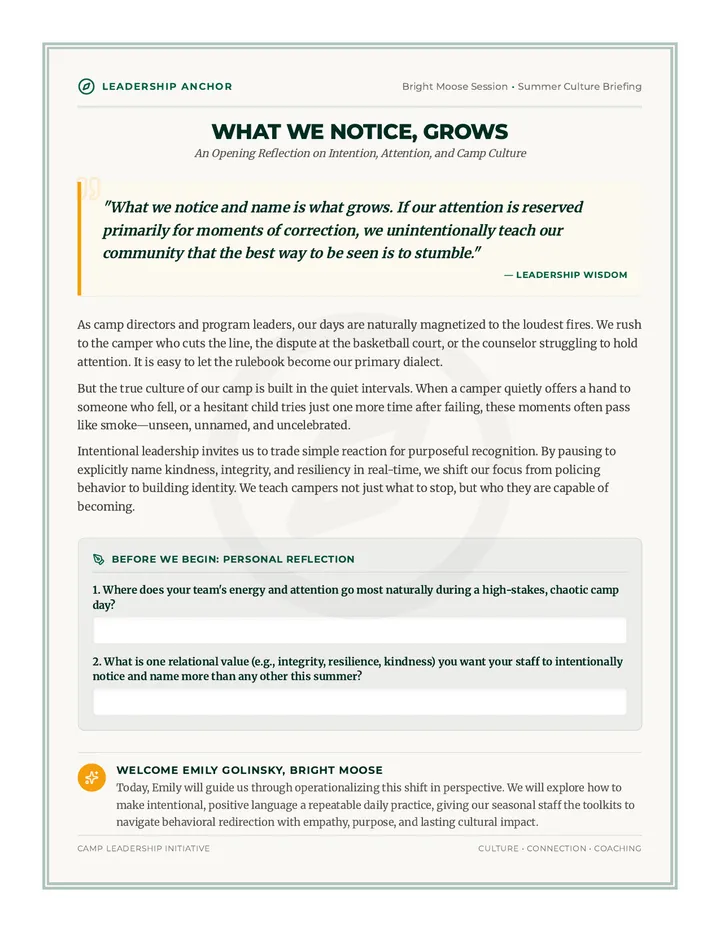
A sophisticated facilitation guide for a 10-minute 3-5 assembly, focusing on community impact, the "Ripple Effect," and restorative language.
A professional and impactful 5-slide presentation for 3-5 students focusing on the "Ripple Effect" of their behavioral choices on the school community.
A student follow-up worksheet for K-2 students to draw themselves as a Super Friend and check off their commitment to safe hands and kind words.
A structured facilitation guide for teachers/administrators to lead a 10-minute K-2 assembly, including a script, pacing, and teacher tips.
A bright, high-energy 5-slide presentation for a K-2 assembly using a superhero theme to teach rules, safe hands, and kind words.
Final 'Master Plan' worksheet and self-agency contract. Features a visioning section, goal-setting blocks, and a formal 'Certificate of Agency' for students to sign with their support person.
Final discussion slides for Week 4 focusing on self-agency and future visioning. Encourages students to take ownership of their reputation and long-term goals as the 'lead architect' of their lives.
Worksheet featuring real-world conflict scenarios for 5th graders to practice de-escalation and response strategies. Includes a 'De-escalation Pledge' to reinforce personal triggers and tools.
Discussion slides for Week 3 focusing on de-escalation tools and conflict resolution strategies. Uses a 'Heat Meter' metaphor to help 5th graders identify when to use their social tools.
Graphic organizer for mapping support systems and identifying healthy relationship traits. Uses architectural metaphors to help students visualize their social foundations.
Discussion slides for Week 2 focusing on healthy foundations in relationships and identifying a support network. Uses architectural metaphors to distinguish between solid friendships and those with 'cracks'.
Updated worksheet for Week 1 including a 'Site Inspection' section to reflect on the incident leading to suspension. Features light backgrounds in student work areas for better legibility.
Visual discussion guide for Week 1, focusing on 'The Impulse Gap' and includes a 'Site Inspection' slide to reflect on the incident that led to suspension.
A set of printable daily check-in cards for students and facilitators to monitor progress and emotional state after returning from suspension.
A one-page student-facing re-entry template focused on restorative reflection, collaborative problem solving, and establishing a support network for middle schoolers. Revised for single-page fit.
Visual goal tracker for students to monitor their progress toward 4 out of 5 successful tactical conflict resolutions. Includes fields for student self-report and staff verification for each 'mission'.
Small, printable 'Tactics Cards' that provide quick visual and verbal reminders of the four coping strategies. Designed for students to keep as a discreet reference in their binder or pocket.
Updated teacher facilitation guide with revised pacing to include auditing current student techniques, exploring new 'tactical upgrades', and facilitating simulation-based discussions.
Updated student worksheet that guides the student through reviewing their current conflict techniques and reasons for using them, exploring new 'tactical upgrades', and tracking their engagement over 5 opportunities.
Engaging slide deck for middle schoolers teaching conflict resolution strategies. Includes sections for reviewing current techniques, exploring the reasons behind them, and introducing new 'tactical upgrades' to stay engaged. All text sized for maximum visibility (28px+).
A guide for Site Coordinators on how to celebrate recruitment milestones, featuring tiered celebration strategies for staff, students, and school partners.
A specialized guide and reflection tool for Site Coordinators to analyze the success of their engagement plans through data, feedback, and iterative pivots.
A practical three-step action plan designed to help a Site Coordinator implement an engagement strategy during their first 30 days, focusing on intelligence, activation, and ownership.
A clear, sequential five-step strategy for increasing student participation and retention in high school after-school programs.
A specialized guide outlining the four critical steps for building authentic relationships with high school students, designed to support Site Coordinators in fostering trust and engagement.
An 'Audit Pack' containing realistic school scenarios and policy excerpts for staff to analyze, along with a structured workspace for redesigning language and policies through a supportive, stigma-free lens.
A comprehensive facilitator guide for the Systemic Stigma Audit professional development session. Includes pacing, discussion prompts, video pause points, and strategies for handling common staff pushback.
A visual presentation for a professional development session on mental health stigma. Includes video integration, definition slides, and activity instructions for school staff.
A set of visual schedule cards for parents to cut out and use at home, providing K-1st grade students with clear, visual cues for their morning routine.
A planning worksheet for parents to design their ideal morning timeline, identify bottlenecks, and commit to night-before preparations.
A visually engaging slide deck for the Morning Momentum Makers parent workshop, featuring strategy breakdowns, visual schedule examples, and tips for handling morning resistance.
A comprehensive facilitator guide for the Morning Momentum Makers workshop, including prep checklists, a timed workshop flow, and discussion prompts for K-1st grade parents.
A planning worksheet for parents to reflect on their current morning routines and design a new, positive flow using visual schedules and gentle transitions. It includes space for a 4-step kid-friendly chart.
A set of printable activity cards for parents to use during the workshop. Each card presents a common morning challenge for K-1st graders with space for brainstorming proactive and positive solutions.
A vibrant and engaging slide deck for the Morning Momentum Makers workshop. It features clean, large-text visuals to help parents understand the core strategies of visual schedules and gentle transitions.
A detailed guide for facilitators leading a workshop for parents of K-1st graders. It includes a timed agenda, key talking points, and specific strategies for promoting calm morning routines.
Visual presentation for Lesson 4, covering the 'freeze' response and dissociation, differentiating between intentional defiance and neurobiological shutdown.
A visual answer key and assessment guide for the listening skills drawing activity, highlighting common errors and instructional talking points.
A comprehensive teacher script for a 30-minute lesson on respect and directions, with explicit prompts for managing classroom behavior and delivering the listening challenge.
A presentation for Lesson 3, teaching the 'Spidey Tingle' and 'Internal Pause Button' strategy for impulse control with the 'Stop, Tingle, Think' protocol.
A worksheet for students to practice the 'Mental Web' strategy (Catch, Repeat, Do) for following directions, including space for logging practice missions and a take-home challenge.
A Spidey-themed presentation for Session 2, teaching the 'Mental Web' strategy (Catch, Repeat, Do) for following directions on the first try with interactive practice levels and a game.
A student self-reflection exit ticket focused on listening accuracy and behavior goal-setting for future lessons.
A professional and clean drawing activity worksheet focused on following multi-step verbal instructions without repeats.
Modern and clean presentation slides for a 5th-grade lesson focusing on the logical importance of respect and following directions.
A reflection worksheet for 4th graders to practice decision-making in honesty scenarios, explore the feelings associated with lying, and sign an 'Integrity Promise.'
A visual presentation for 4th graders on honesty and trust, featuring the 'Tangled Web' and 'Trust Bridge' metaphors, plus practical tips for telling the hard truth.
A comprehensive teacher guide for teaching 4th graders about honesty, featuring 'The Tangled Web' yarn activity, scenario analysis, and discussion prompts.
A simple coloring and checkbox activity for Kindergarteners to identify the body parts used for "Whole Body Listening."
A visual slide deck for Kindergarteners featuring "Whole Body Listening" and the "Fast Follower" concept for classroom expectations.
A teacher guide for a Kindergarten lesson on classroom expectations, providing strategies for teaching "Whole Body Listening" and immediate cooperation through games and positive reinforcement.
An interactive worksheet for 4th graders to build their "Calm Down Kit," identifying physical body signals and selecting personalized coping strategies. Revised with better contrast and student-friendly work areas.
A slide deck for teaching coping skills, featuring the "Inner Weather" metaphor, identifying body signals, and step-by-step guides for breathing and grounding techniques. Revised for better legibility and contrast.
A comprehensive teacher guide for teaching 4th graders coping skills, including discussion prompts, breathing exercises, and sensory grounding techniques.
An activity worksheet for students to brainstorm acts of kindness and plan a 'Secret Kindness Mission' within the school community.
A visual presentation for the Kindness Connection lesson, featuring definitions of kindness, school community roles, and interactive scenarios for class discussion.
A comprehensive teacher guide for leading a lesson on school-wide kindness, including discussion prompts, roleplay scenarios, and instructions for the Kindness Quest activity.
A professional guide for teachers on how to facilitate classroom discussions and debriefs following a school incident, focusing on de-escalation and restoring a sense of safety.
A visual presentation for students and staff outlining the Peace Protocol, emphasizing roles during an incident and the restorative process afterward.
A student-facing reflection sheet to be completed after witnessing or being involved in a conflict, designed to process emotions and gather factual accounts.
A comprehensive flowchart outlining the necessary steps for students and staff to take during and after a school conflict, featuring multilingual support and clear visual cues.
A student-facing worksheet for self-reflection on avoidance triggers (icebergs), coping strategies (buckets), and communication plans (radio check).
A comprehensive teacher facilitation guide covering the instruction, discussion prompts, activities, and specific listening lab scripts for both behavioral lessons.
A detective-themed worksheet for first graders to practice following multi-step directions, sequencing steps, and analyzing behavior scenarios.
A detective-themed presentation for first graders focusing on the four steps of following directions: Stop, Look, Listen, and Do.
A scenario-based worksheet for first graders to identify and differentiate between positive classroom behaviors and rule-breaking actions using a 'Rule Ranger' theme.
An engaging slide deck for first graders that introduces classroom rules through a 'Rule Rangers' theme, featuring interactive scenarios and clear behavioral expectations.
A situational reflection worksheet for students to process emotional outbursts, themed as a site inspection report.
A step-by-step problem-solving flowchart using the S.T.O.P.E. (Stop, Think, Options, Pick, Evaluate) method, themed as a construction blueprint.
A student-facing choice board for self-regulation strategies, organized into 'Heavy Duty', 'Precision', and 'Specialized' tools.
A teacher guide for instructing students on friendship skills, including role-play prompts, troubleshooting tips for common social hurdles, and a progress tracking table.
A 6-page illustrated social story for first graders that teaches the step-by-step process of making friends, updated to use 'Interest Match' verbiage for shared connections.
A comprehensive teacher guide for facilitating impulse control lessons, offering specific instructional steps, prompting questions, and classroom management strategies for supporting students who struggle with blurting.
A set of four printable strategy cards for students, providing specific, physical, and cognitive techniques for waiting their turn to speak and managing impulse control during class.
A visual graphic organizer designed to help students map out the social consequences of blurting, emphasizing empathy and the impact of their actions on peers, teachers, and the classroom environment.
A self-reflection worksheet designed for middle school students to analyze their blurting impulses, recognize physical triggers, and apply the T.H.I.N.K. filter to their communication.
A student-facing post-incident review form using sports terminology like "Watching the Film" and "The Snap." It provides space for reflecting on triggers and feelings, culminating in a specific "Game Plan" commitment for the future.
A facilitator's guide for social workers or counselors to lead a 30-minute "Post-Game Review" debrief session. Includes framing strategies, scripted language, and troubleshooting tips for 8th-grade students.
A 6-slide sports-themed presentation for an 8th-grade social-emotional learning lesson. It frames post-incident debriefing as "watching the game film" to remove blame and focus on future strategy and growth.