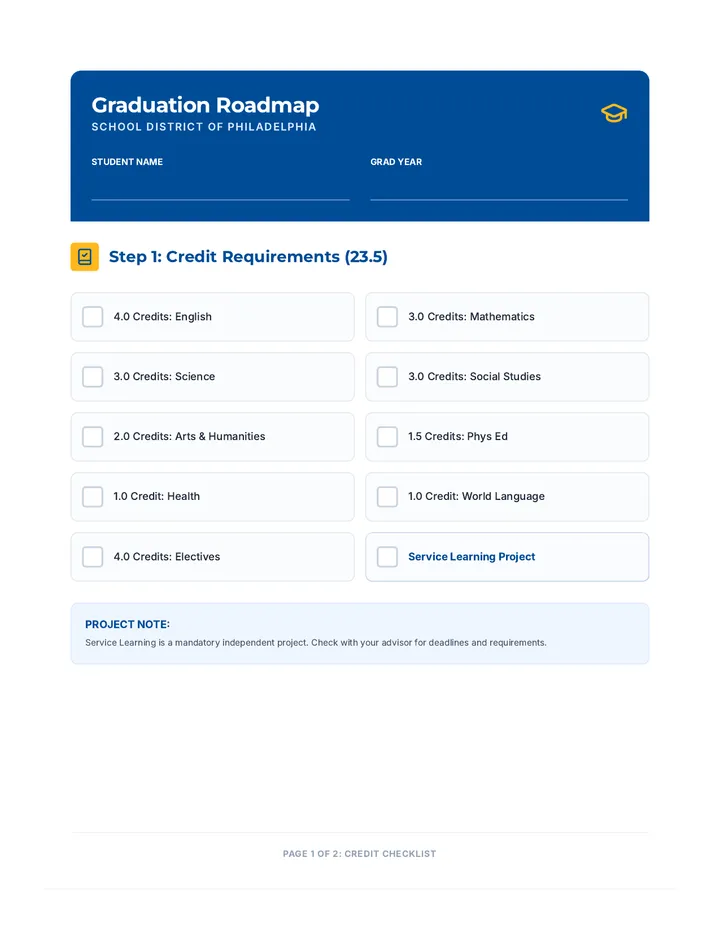
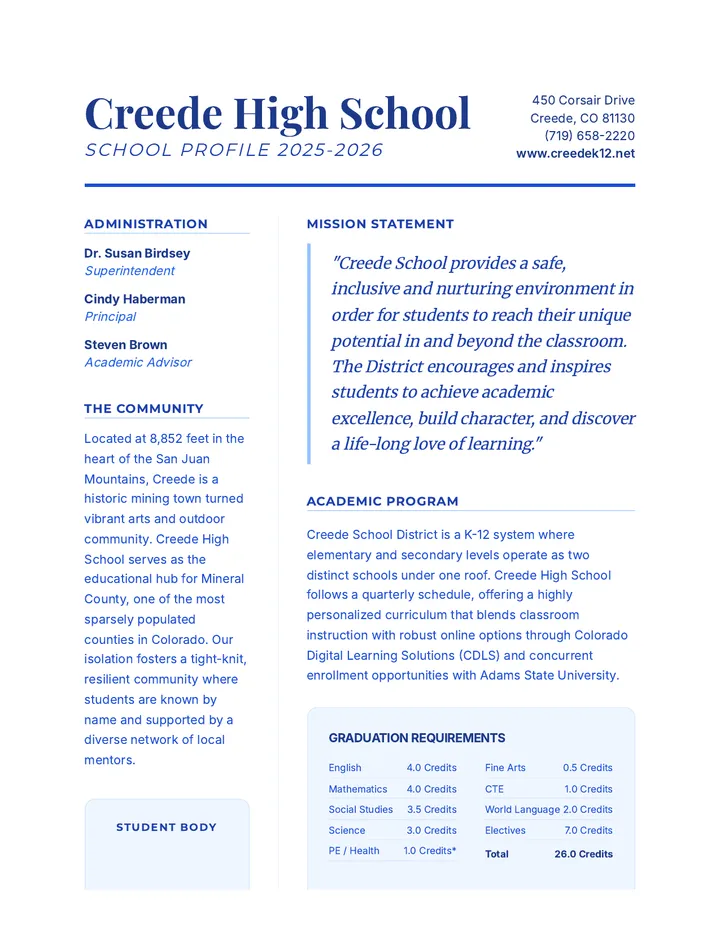
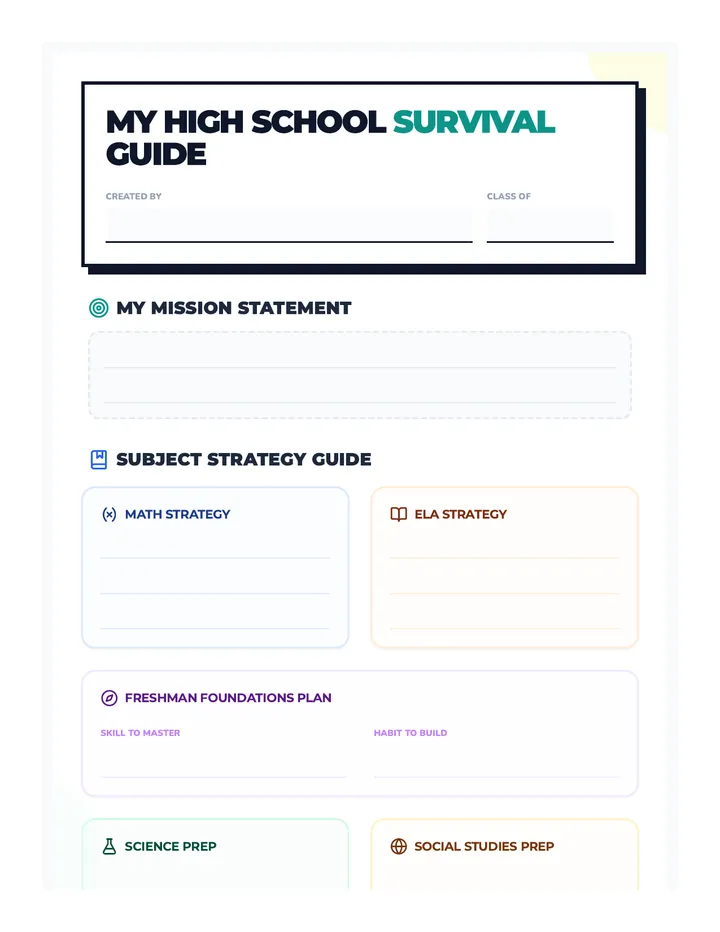
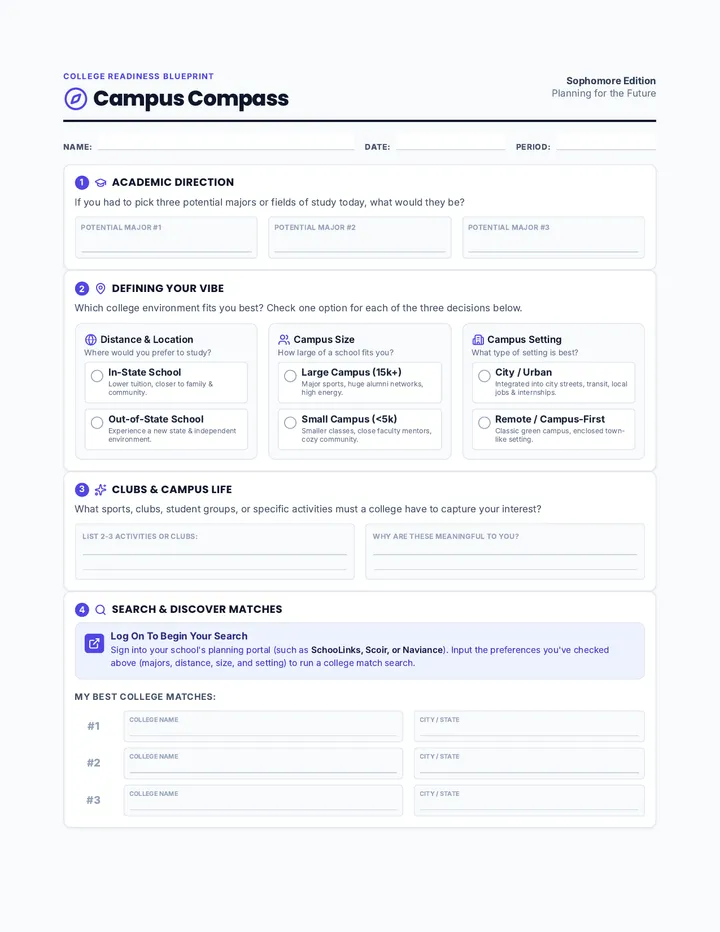
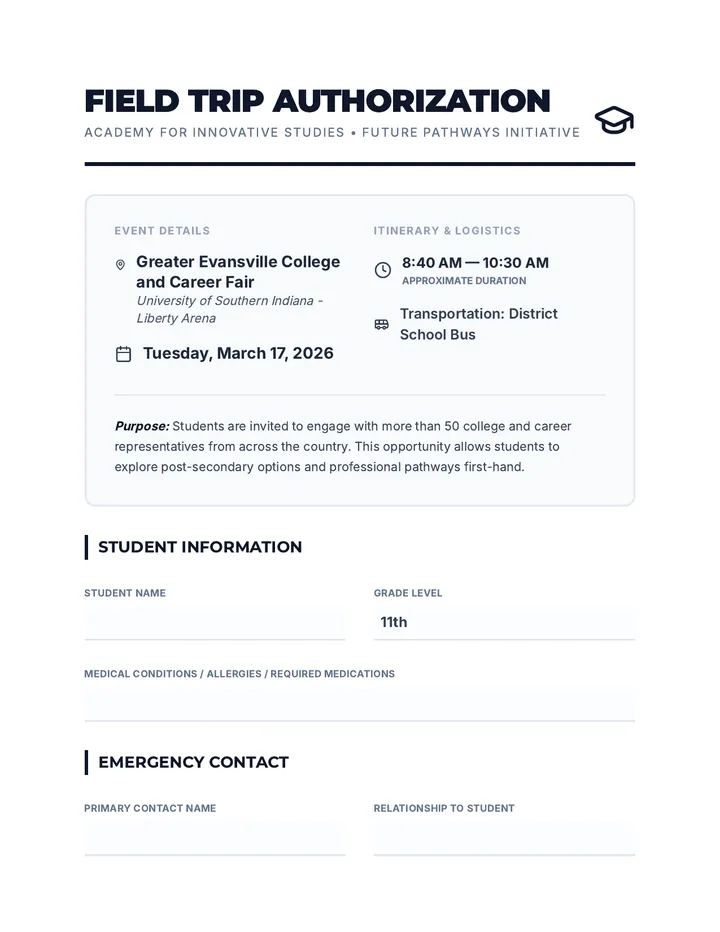
College selection, application workflows, and financial aid navigation including FAFSA and scholarship acquisition. Builds skills in personal statement writing and career exploration to align post-secondary choices with long-term professional goals.
A comprehensive teacher guide for the "Charting the Course" lesson. Includes a detailed timeline, pacing suggestions, specific discussion prompts for video pauses, and facilitation tips for the creative map-making activity and gallery walk.
A visually engaging anchor chart that serves as a classroom reference for the four 'adulting tools' (Telescope, Map, Crew, Treasure) used to reframe post-graduation anxiety into actionable steps.
A student worksheet designed to help learners identify negative 'What-If' spirals and practice reframing them into empowering inquiries using a T-Chart format.
A two-page student worksheet featuring a nautical theme. Page 1 includes a warm-up quick-write and video metaphor definitions; Page 2 provides a framed "Ocean of Possibility" drawing area for students to map their post-secondary support systems and obstacles.
A grading rubric for the Counselor Connection lesson, assessing the student's self-assessment planner, script content, and role-play communication.
A comprehensive slide deck for the 'Ocean Shift' lesson, featuring the embedded YouTube video, discussion prompts for key timestamps, and visual explanations of the reframing tools.
Role-play scenario cards for students to practice initiating conversations with an academic counselor using different student personas.
A nautical-themed slide deck designed to accompany the "Charting the Course" lesson. Features a video embed, interactive discussion prompts based on key timestamps, and clear visual representations of the ocean metaphors for post-secondary planning.
A student worksheet for performing a personal self-assessment and drafting a professional inquiry for an academic counselor.
A detailed facilitation guide for teachers to lead the Ocean Shift lesson, including pacing, critical pause points for the video, and background on key concepts like reframing and post-secondary planning.
A personal reflection journal for students to record their warm-up thoughts and respond to the lesson's core message regarding career flexibility. Includes structured writing spaces for three specific reflection prompts.
Visual presentation for the Counselor Connection lesson, including a video embed, pathway overviews, and instructions for the main activity and role-play.
A structured worksheet for the 'Pathway Research Sprint' activity. It provides designated areas for students to research 3 pros and 3 cons for their assigned post-secondary path and includes a script template for a one-minute class pitch.
A visual presentation deck for 'The Launch Pad' lesson, including a warm-up poll, the embedded 'Life with Maria' video, definitions for the four pathways, instructions for the Research Sprint, and a final reflection prompt.
A teacher guide for the Counselor Connection lesson, including learning objectives, materials, pacing, and step-by-step instructional prompts.
A comprehensive teacher facilitation guide for 'The Launch Pad' lesson, including learning objectives, a detailed 40-minute instructional sequence, and a reference key for the four primary post-secondary pathways.
Answer key and scoring guide for the Pathways Mastery Assessment, featuring a quick-reference grid and counselor implementation tips.
A 21-question assessment (pre/post test) covering TOPS University and TOPS Tech graduation requirements, GPA thresholds, and credit distinctions.
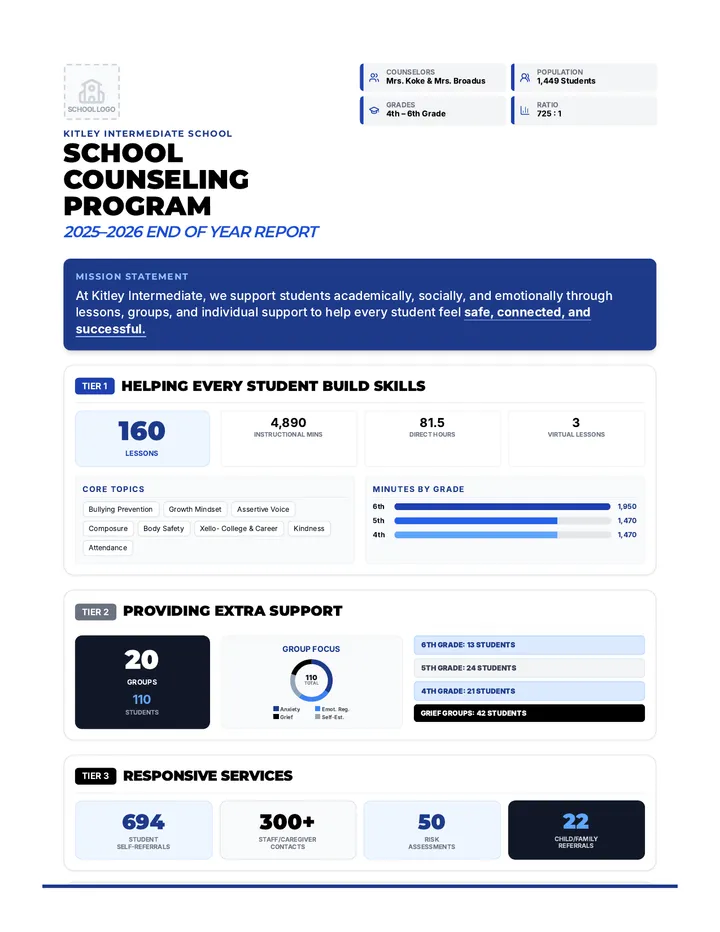
A comprehensive Student Learning Target (SLT) report document for school counselors, including rationale, student population details, ASCA standards alignment, and data tracking sections.
A refined, one-page infographic survival guide for college-bound biology and plant science students. Features a sophisticated botanical aesthetic with study tips, research advice, dorm plant care, and lifestyle balance strategies.
Final presentation slides for the 'Funding Finalists' sequence, covering mock interview setup, professional follow-up etiquette, and outcome management.
A professional rubric for peer evaluation during mock fellowship interviews, focusing on pitch impact, STAR technique, and poise.
An editing workshop sheet for graduate students to practice concision and "ruthless editing" to meet fellowship word count requirements.
The definitive quality control checklist for graduate fellowship submissions, covering technical compliance, visual auditing, and logistical contingency planning.
A structured peer review rubric for graduate students to evaluate and provide feedback on fellowship personal statements.
Final student project worksheet for building a multi-year funding strategy, including a 12-month calendar and a "leverage" plan for negotiations.
A structured worksheet for students to build their versatile 'story bank' using the STAR method, including an adaptability matrix.
Facilitation guide for the Funding Roadmap Masterclass, focusing on long-term strategy and portfolio management.
Visual presentation for the final lesson on quality assurance, technical compliance, PDF sanitization, and professional post-submission etiquette.
A slide deck focusing on the revision process, peer review protocols, and word count optimization for fellowship narratives.
Visual presentation for Lesson 5, focusing on long-term funding strategy, the multi-layered funding model, and the 12-month application cycle.
A worksheet for students to practice translating a paragraph of their narrative between technical/academic and social impact/mission-driven versions.
Instructional slides for crafting and delivering a 90-second research pitch, focusing on clarity, structure, and jargon-free communication.
A digital audit worksheet for graduate students to track search results, checklist professional platform optimizations, and draft a high-impact scholarly bio.
Student activity sheet for drafting professional outreach emails and utilizing an outreach readiness checklist.
Persona cards for a roleplay activity where students simulate the perspectives of different fellowship reviewers.
Visual presentation for Lesson 4 on managing digital footprints, optimizing LinkedIn for academics, and performing professional online audits before application submission.
Facilitation guide for the Unadvertised Outreach lesson, focusing on email etiquette and elevator pitch simulations.
A slide deck teaching graduate students how to adjust their tone, vocabulary, and emphasis for different fellowship funding audiences.
Visual presentation for Lesson 4, covering professional communication strategies for contacting program officers and faculty mentors.
A takeaway handout for parents summarizing the workshop's key communication strategies. Includes a 'Storm vs Crew' comparison table, a visualization of the four nautical tools for navigation, and space for parents to write their own support goals.
A set of 4 sorting card scenarios for parents to practice identifying supportive 'Crew' responses versus pressuring 'Storm' responses. Designed with clear scenario headers and multiple choice-style response cards for group discussion.
An empathetic letter for parents introducing the nautical metaphor of the 'Ocean of Possibility' and encouraging them to move from a pressure-based role to a supportive 'Crew' role. Includes space for counseling team contact info.
A 7-slide presentation for parents featuring nautical metaphors, a YouTube video embed, and discussion prompts about supporting students through post-high school transitions. Follows a high-contrast theme with large, readable text.
A comprehensive 45-minute facilitator guide for a parent workshop focused on student anxiety and supportive communication. Includes detailed pacing, discussion prompts, and activity instructions using nautical metaphors.
A formal community service logging sheet for Arlington High School students to record dates, organizations, descriptions, and supervisor signatures during their summer volunteer work.
A 6-slide presentation for Arlington High School students detailing the benefits of community service, how to use the school's resource page, local volunteer opportunities, and how to log hours.
A detailed teacher guide for the 'Future Tripping' lesson, including pacing, specific video pause points, vocabulary definitions, and tips for facilitating the 'Circle of Control' activity with high school seniors.
A professional slide deck for the 'Future Tripping' lesson, featuring integrated video prompts, discussion anchors, activity instructions for the Circle of Control, and a guided reflection slide. Minimum font size 24px ensured throughout.
A comprehensive student worksheet for the 'Future Tripping' lesson, including sections for a Worst Case/Best Case warm-up, video analysis notes, a large 'Circle of Control' graphic organizer, and a final reflection space.
A high-quality educational anchor chart defining high-functioning anxiety and catastrophizing, featuring a visual 'Circle of Control' diagram to help students differentiate between internal and external stressors.
Updated sorting cards to align with the 4-route degree-focused lesson structure, removing all Threshold references and adding more cards for Route 3 (Curry, Dean, Mitchell) and Route 4.
Updated Pros & Cons worksheet with a choice-based checkbox layout, removing Threshold and focusing on 4 distinct pathways with expanded options for students with LD. Now using table-based layouts for Google Docs compatibility.
A themed letter template for students to write a formal "pep talk" to their future selves, including sections for reflection, advice, and goals.
A brainstorming worksheet to help students organize their thoughts and reflect on their growth before writing their final letter.
A visual presentation deck guiding 5th graders through the reflection process, introducing SEL skills, and providing writing prompts for their future letters.
A concise, step-by-step instructional script for teachers to facilitate the "Letter to Future Me" SEL lesson.
A comprehensive 3-page activity packet designed to guide students through a journey of self-reflection and personal branding. It includes a growth-tracking section for skills and values, a "Star Power" visual mapping tool for personal attributes, and a formal letter-writing exercise to practice positive self-presentation.
A step-by-step drafting and formatting worksheet for students. Revised for improved readability with larger font sizes and clearer instructions.
A professional slide deck for high school seniors explaining the purpose and visual structure of a portfolio paper. Focuses on digital hierarchy, content pillars, and scanability. Minimum font size 24px ensured.
A teacher facilitation guide for a lesson on formatting Capstone Project papers for online portfolios. Includes a lesson timeline, teaching tips, and a comprehensive digital-focused rubric.
An ultra-compact visual anchor chart for high school juniors outlining key scholarship search strategies, guaranteed to fit on a single 8.5x11 page.
A professional evaluation rubric for high school juniors to assess scholarship essay quality, focusing on voice, prompt alignment, evidence, and mechanics.
A structured student handout and worksheet designed for high school juniors to navigate EBSCO PrepStep, incorporating five active learning strategies (Stop & Jot, Sentence Stems, Annotation, Think-Pair-Share, and Questioning).
A worksheet for developing a post-secondary action plan, including goal setting, budgeting, time management reflection, and a checklist of immediate next steps.
A comprehensive teacher facilitation guide for a lesson on financial aid, covering net vs. sticker price, types of aid (grants, scholarships, loans, work-study), and the FAFSA process.
A visual presentation on college application strategies, focusing on institutional fit, essay narrative structure, and understanding various deadline types.
A guide for students to compare trade schools, 2-year community colleges, and 4-year universities, including reflection questions to help narrow down their preferred path.
A comprehensive rubric for a career research project, evaluating job description, educational path, labor market outlook, personal reflection, and presentation.
A teacher-facing facilitator script for the 30-minute SEL lesson, including timing, speaking prompts, and instructional tips. Updated with improved page breaks.
A student-facing letter template for writing to their future 6th-grade selves, featuring guided prompts and plenty of space for reflection and planning.
Visual presentation for the "Letter to Future Me" lesson, guiding students through reflection on 5th grade growth and planning for middle school challenges.
A student-facing planning sheet to help 5th graders brainstorm their growth and select SEL skills for their letter to their future selves.
A facilitator guide for teachers, including pacing instructions, video discussion prompts, and a career reference 'cheat sheet' to support student research.
A student worksheet for the 'Design Your Future' lesson, featuring the Lifestyle Auction ledger, video observation space, and a structured Reverse Engineering table for career mapping.
Instructional slides for the 'Design Your Future' lesson, featuring the Lifestyle Auction, the embedded Maria video, and the Reverse Engineering framework for career planning.
A facilitation guide for teachers to lead the Future Frames lesson. Includes a lesson flow, search keywords, a research exemplar for SCAD, and an evaluation rubric.
Visual presentation slides to introduce the art career research project. Includes slides on the mission, required data points, search strategies, and work time.
A graphic organizer for students to research and document two postsecondary options for cartooning or digital art. Includes fields for program focus, skills, admission requirements, and support services. Removed placeholder text and improved contrast for printability.
A high-contrast checklist for college students to use during the final stage of paper submission, focusing on structural integrity, citation accuracy, and mechanical polish.
A guide for educators or mentors to help college students navigate the psychological and practical challenges of research paper planning, featuring the 35/35/30 rule and common pitfalls.
A structured graphic organizer for college students to map out their research paper timeline, breaking the project into four distinct phases with specific milestones and pacing advice.
A facilitator guide for teachers leading the first Junior ICAP session, featuring a pacing guide, scripting prompts, and strategies for common student hurdles regarding setting end-of-year targets and addressing senior year concerns.
A visual presentation for the initial Junior ICAP session, covering the importance of junior year, self-assessment, and instructions for setting targets for the end of the year.
An instructional guide for teachers to lead the Tech Trouble Detectives lesson, including demonstrations of OCR tools and facilitation for the scavenger hunt.
A teacher resource providing guidance for the final 'Transition Profile' project, instructions for a gallery walk activity, and a mastery rubric.
A student template for creating a professional 'Transition Profile' that summarizes their assistive technology needs, legal rights, and self-advocacy scripts.
A student worksheet for identifying digital barriers on websites and practicing finding technical workarounds or appropriate contact persons for accessibility support.
A student worksheet for drafting professional emails and verbal scripts to request Text-to-Speech accommodations in post-secondary and workplace environments.
A teacher resource providing role-play scenarios, coaching prompts, and a feedback rubric for simulating accommodation requests in college and workplace settings.
A student worksheet featuring three legal scenarios where digital accessibility is a barrier, requiring students to analyze the situation using ADA standards.
A teacher resource outlining the shift from IDEA to ADA, providing discussion prompts, and an answer key for legal case studies.
A student lab report for comparing comprehension and fatigue across different reading modalities (visual, auditory, and combined).
Visual presentation for Lesson 1, introducing Dual Coding Theory and Cognitive Load Theory to contextualize the use of Text-to-Speech technology.
An instructional guide for teachers providing the pedagogical background of Dual Coding Theory and a step-by-step lesson plan for implementing a reading modality lab.
A peer feedback form for students to provide structured critiques on their classmates' independent living plans.
A grading rubric for the final Survival Guide project, assessing PLEASE integration, financial realism, boundary mastery, and sustainability.
A comprehensive wellness plan template for students to outline their maintenance schedule, local resources, and crisis protocols for independent living.
A slide deck for Lesson 4 that introduces the concept of a "Resource Scavenger Hunt" and setting "Non-Negotiable" standards for physical maintenance.
A worksheet where students practice using DEAR MAN to set boundaries around their PLEASE skills in various social scenarios.
A slide deck for Lesson 3 that introduces the concept of "Biological Boundaries" and the conflict between social pressure and physical maintenance.
A budgeting worksheet where students prioritize and allocate funds for their PLEASE skills, identifying trade-offs to maintain emotional stability.
A slide deck for Lesson 2 that introduces the concept of the "Biological Tax" and the financial cost of maintaining PLEASE skills.
A risk assessment worksheet where students map out transition stressors to each PLEASE skill and prioritize them on a heat map.
A comprehensive 18-slide deck that covers all 7 weeks of the college readiness curriculum, from admission plans to FAFSA and career pathways.
A comprehensive 5-page toolkit combining all student handouts, worksheets, and cheat sheets into one convenient packet for the 7-week course.
Teacher answer key for the Readiness Post-test Final, providing comprehensive answers and scoring guidance for all assessment items.
Teacher answer key for the Major Match-Up activity, providing the correct sorting of job titles to majors and degree requirements.
Teacher answer key for the Timing Comparison Worksheet, providing table completions, scenario justifications, and conceptual checks for EA and ED plans.
Teacher answer key for the Readiness Baseline Pre-test, providing correct responses for multiple choice and short answer questions.
A cumulative final assessment to measure student learning and growth across all topics in the 7-week college readiness curriculum.
A comprehensive pre-assessment tool to establish a baseline for student knowledge across admission plans, financial aid, and college majors.
A consolidated answer key for counselors and teachers to grade both the pre-test and post-test college readiness assessments.
A 15-question multiple-choice post-test designed to evaluate student learning after completing the college readiness counseling group.
A 15-question multiple-choice pre-test covering college admissions terminology, financial aid basics, application types, and institutional differences.
Teacher guide for Lesson 5, featuring instructional strategies, technical troubleshooting for FSA ID creation, and discussion prompts for security.
Culminating planning kit for Lesson 5, featuring a documentation inventory, parent conversation script, and a strategic senior year financial aid timeline.
Introductory presentation for Lesson 5, covering documentation gathering, parent conversations, and critical deadlines for financial aid.
Teacher answer key for Lesson 4, featuring correct values for the 1040 scavenger hunt and a cheat sheet for FAFSA-relevant tax lines.
A game-inspired goal-setting worksheet designed as a "Quest Board." Features an avatar drawing area, superpowers (strengths), battle zones (challenges), and loot boxes (goals). Instructional prompts have been added to every section, including "Quest Allies," to help students identify how families and teachers can support their mission. Legibility of prompts has been enhanced for print.
A comprehensive facilitator guide for teachers to implement the Lifestyle Blueprint project, featuring pacing guides, learning objectives, discussion prompts, and a success rubric.
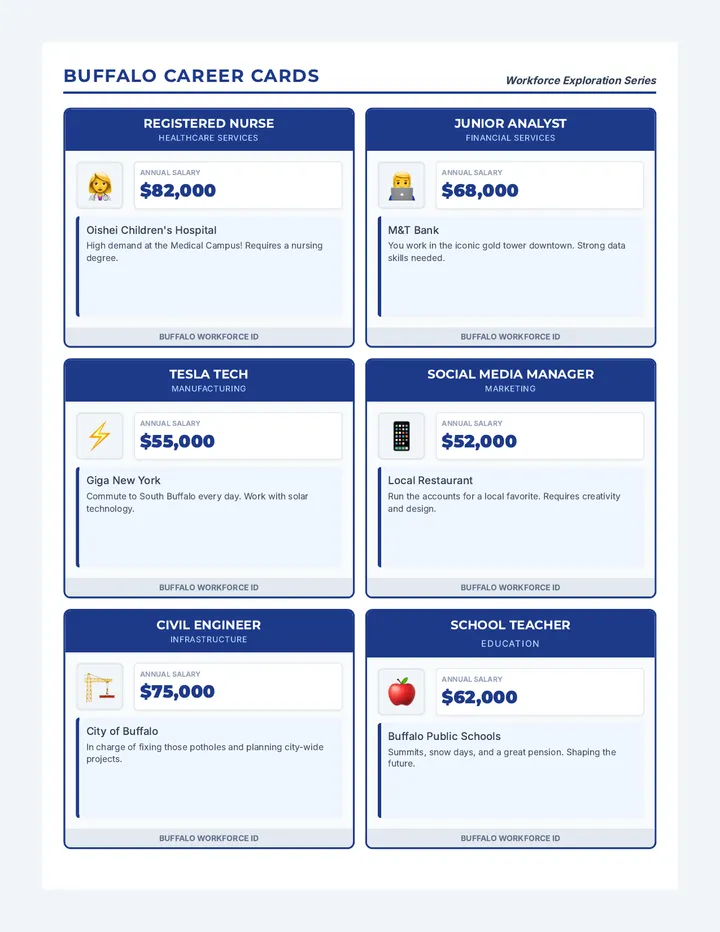
A set of activity cards featuring various financial 'curveball' scenarios (e.g., car trouble, rent hikes, bonuses) to be used for group discussion and budget adjustment exercises.
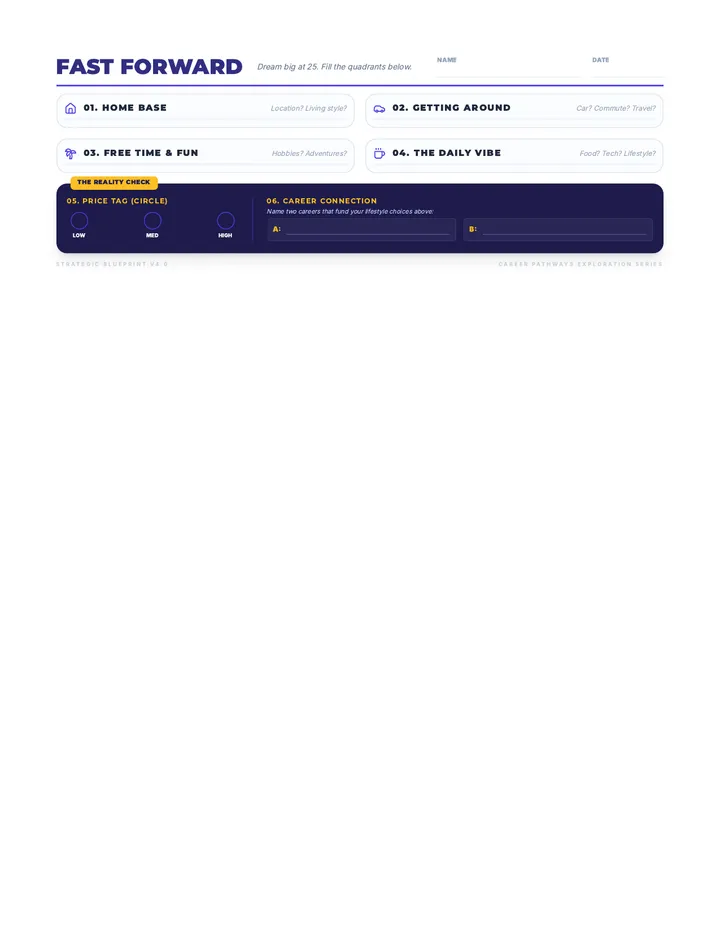
A comprehensive student worksheet for the Lifestyle Blueprint project, guiding students through auditing their Reality Check results, researching career salaries, calculating net pay, and balancing a monthly budget. This version ensures all student input areas have white backgrounds for legibility.
A visual presentation to introduce the Lifestyle Blueprint project, covering key financial concepts like gross vs. net pay and fixed vs. variable expenses, while setting up the project challenge.
A high-energy presentation to lead students through a 20-week reflection, strategy consolidation, and maintenance planning during the 'Seasoned Pro' lesson.
A professional-style 'playbook' handout for students to document their top two strategies, future implementation plan, and support network as they transition to more independent learning.
A comprehensive lesson plan for the 'Seasoned Pro' lesson, detailing a 30-minute instructional arc focused on strategy consolidation, celebration, and future planning.
A guide for Site Coordinators on how to celebrate recruitment milestones, featuring tiered celebration strategies for staff, students, and school partners.
A specialized guide and reflection tool for Site Coordinators to analyze the success of their engagement plans through data, feedback, and iterative pivots.
A practical three-step action plan designed to help a Site Coordinator implement an engagement strategy during their first 30 days, focusing on intelligence, activation, and ownership.
A clear, sequential five-step strategy for increasing student participation and retention in high school after-school programs.
A specialized guide outlining the four critical steps for building authentic relationships with high school students, designed to support Site Coordinators in fostering trust and engagement.
Updated set of visual job explorer cards featuring 6 diverse roles, including new food service positions like Kitchen Helper and Cafe Assistant. Each card details key tasks and specific skills for adult learners.
Updated set of visual job explorer cards including new retail-specific roles such as Stock Associate and Sales Helper. Each card details key tasks and required skills for adult learners.
Updated set of facilitator-facing roleplay cards including new food service scenarios such as clearing tables and bringing water to customers. Designed to build social confidence in restaurant and cafe settings.
Updated interactive worksheet featuring retail-specific scenarios such as cleaning up store displays and assisting customers with product locations. Aids in developing professional decision-making skills.
Updated teacher's answer key and discussion guide for the 'Professional Foundations' lesson. Now includes a dedicated roleplay debriefing section with tips for handling social skill practice with adult learners.
A functional literacy worksheet where students practice filling out their own contact information and emergency contact details in a standardized form format. Now includes icons for visual guidance.
A worksheet exploring professional etiquette through matching activities and 'True/False' (Yes/No) scenarios. It emphasizes key soft skills like punctuality, hygiene, and communication in a clear, high-contrast format.
An activity worksheet where students apply their knowledge of post-secondary routes to fictional student scenarios, helping them practice decision-making based on specific needs. This version includes 6 straightforward scenarios across 3 pages.
A worksheet for students to identify and prioritize their personal college preferences, categorizing them as essential 'must-haves' or optional 'nice-to-haves'.
A visual comparison chart of the four post-secondary routes, summarizing support levels, costs, housing options, class sizes, and timelines for easy student reference.
A teacher facilitation guide for the Route Scouts lesson, including learning objectives, instructional steps, and key concepts like the transition from IEPs to college accommodations.
The master answer key for the Degree Dollars ROI Worksheet, including calculated 10-year ROI values for all case studies and a guide for facilitating the critical thinking discussion questions.
A grading rubric for the "Degree Audit" project, where students research and compare the financial ROI of two different educational paths for a chosen career. Covers research accuracy, math precision, and qualitative analysis.
A student worksheet for calculating 10-year ROI on various college degree paths. Features case studies for Software Engineering vs. Nursing and BFA vs. BA programs, plus critical thinking reflection questions.
A visual presentation for a financial literacy lesson on college degree ROI. Includes definitions, formulas, tuition comparisons, career salary data, and a case study battle.
A detailed lesson plan for teachers including learning objectives, a step-by-step facilitation guide, differentiation strategies, and tips for addressing common misconceptions about college ROI.
A comprehensive teacher facilitation guide for the Horizon Hunt lesson. Includes a detailed timeline, video discussion prompts, group activity support, and path-specific research examples.
A student-facing activity guide for researching post-secondary options. Includes sections for group research, pros and cons analysis, and personal reflection with a nautical exploration theme.
A visually striking slide deck for 11th-12th graders using an ocean exploration theme. Includes embedded video, discussion prompts, and activity instructions for exploring post-secondary paths.
A reflective goal-setting worksheet for students to identify career interests, assess their current workplace skills, and set a target NCRC level.
A concise one-page reference guide for students summarizing the ACT WorkKeys assessments, certificate levels, and the value of the NCRC.
A comprehensive instructional guide for teachers to facilitate the Career Key slide deck, including discussion prompts, key talking points, and an FAQ section.
A professional slide deck designed to inform students about the ACT WorkKeys assessment, focusing on the NCRC, skill validation, and employer benefits.
Updated visual presentation for Arlington, MA students, removing Threshold and focusing on 4 degree-based routes with detailed pros/cons and expanded local examples like Curry PALS and Dean.
Updated lesson plan using table-based layouts for Google Docs compatibility, focusing on the 4-route structure and regional programs like Curry PALS and Middlesex CC.
A comprehensive project guide and rubric for the "Life Blueprint," challenging students to synthesize their research and values into a professional presentation or strategic plan.
A structured, blueprint-styled worksheet for students to record their core values, research post-secondary pathways, and conduct a skill gap analysis to identify actionable steps.
A modern, high-impact slide deck for "Future Focus," featuring a blueprint-inspired aesthetic, clear pathway overviews, and interactive prompts for student reflection.
A professional teacher-facing lesson plan for "Future Focus," featuring instructional procedures, learning objectives, and differentiation strategies in a clean, blueprint-inspired layout.
A facilitator guide for a 25-minute presentation on Massachusetts teacher licensure, including timing breakdowns, talking points, and common misconceptions.
A professional FAQ sheet for Massachusetts teacher licensure candidates, answering common questions about tiers, reciprocity, SEI, and timelines.
A comprehensive 8-slide presentation for adults exploring teacher licensure in Massachusetts, covering tiers, MTELs, and the application process. Revised for larger text and better readability.
A final exit ticket for the "Future Navigators" unit, allowing students to reflect on their learning and current feelings regarding their future post-secondary paths.
A final project document for the "Future Navigators" unit where students design their own post-secondary blueprint, identifying interests, paths, high school goals, and visualizing their future.