Active listening, assertive expression, and boundary-setting strategies for interpersonal success. Develops proficiency in conflict mediation, cooperative teamwork, and the cultivation of healthy romantic and platonic connections.
Student worksheet for Lesson 5, requiring students to analyze a conflict script, diagram a full conflict cycle, and identify strategic intervention points to break negative loops.
Capstome presentation for Lesson 5, synthesizing all previous concepts (Iceberg, Amygdala, Values, Pause) into a 'Conflict Loop' model.
Instructional guide for Lesson 5, providing pacing, discussion prompts, simulation instructions, and a worksheet answer key.
Teacher facilitation guide for Lesson 5, including the 'Conflict Loop' model, pacing, and analysis keys for the culminating script activity.
A formal template for writing final, binding conflict resolution agreements, used by students in both Lesson 4 and Lesson 5.
A student worksheet for practicing the translation of toxic language into neutral problem statements, including identification exercises and reframing challenges.
A formal, professional-looking certificate awarded to students who successfully pass the mock mediation certification, recognizing their skills as a neutral third party.
Student worksheet for Lesson 4, requiring students to practice tactical breathing, grounding techniques, and create a personalized emotional regulation plan.
Teacher-facing facilitation guide and answer keys for the entire Peer Mediation sequence, including coaching tips for mock mediations.
Final exit ticket for the negotiation sequence, assessing students' understanding of compromise, externalizing language, and BATNA.
A set of three complex conflict scenarios for the mock mediation certification, including background stories and secret interests for role-players to reveal during the session.
Visual presentation slides for Lesson 5, focusing on translating toxic language into neutral problem statements.
Final mastery assessment for the unit, testing vocabulary, the Five Whys technique, and deep solution generation.
Student worksheet for identifying and strengthening their BATNA (Best Alternative to a Negotiated Agreement) before entering a conflict resolution.
Introductory presentation for Lesson 4, visually explaining the 'The Power Pause' model and techniques for emotional regulation during conflict.
A formal evaluation rubric for the mock mediation certification, assessing students on process management, neutrality, summarization, communication, and agreement quality.
A worksheet where students identify positions and interests for a specific case study and pitch a solution that addresses underlying human needs.
Instructional guide for Lesson 4, providing pacing, discussion prompts, simulation instructions, and a worksheet answer key.
Visual aids for Lesson 5 explaining the concept of BATNA (Best Alternative to a Negotiated Agreement) to understand their 'walk-away' power.
Role-play scenarios based on common middle school conflicts to be used during the Mediation Lab simulation.
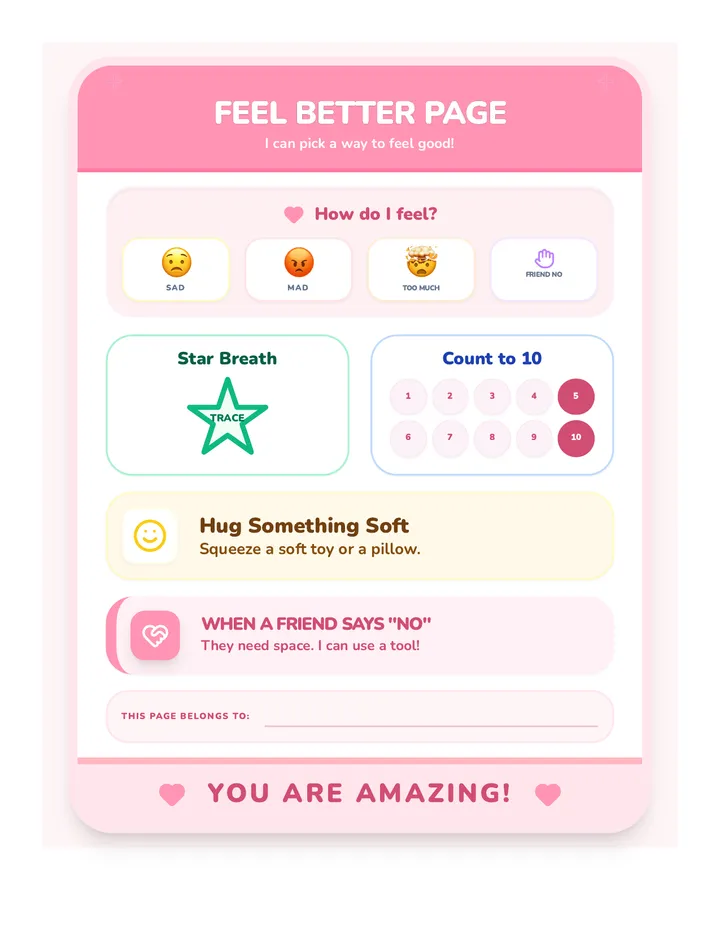
A one-page reference checklist for students featuring 'circuit breaker' coping skills to use when feeling emotionally overwhelmed or 'sucked into' a friend's mood.
A comprehensive facilitator's guide for teachers or counselors, providing a roadmap for individual and dyad sessions, key talking points, observation checklists, and troubleshooting tips for addressing trauma bonding.
A two-page individual 'self-repair' guide for students featuring grounding exercises, strength identification, the 'Yet' reframing technique, and daily journaling prompts to build personal resilience.
A one-page 'pocket guide' for students featuring conversation scripts, a friendship agreement, and a menu of emotional regulation tools to maintain healthy boundaries.
A two-page student activity featuring 'The Backpack Exercise' for identifying emotional ownership and three 'Upgrade the Moment' scenarios for practicing healthy boundaries and responses.
A two-page student-facing fact sheet and reflection guide that explains the concept of 'emotional mirroring' (trauma bonding) and introduces the 'both can be true' mindset for healthy friendship boundaries.
An interview strategy guide providing frameworks like STAR+, "Green Flag" phrases, and specific hints for answering high-stakes Site Coordinator questions.
A comprehensive interview preparation guide featuring a master bank of potential questions for Site Coordinators, categorized by leadership, operations, and student engagement.
A strategic guide for Site Coordinators on program sustainability and professional growth, focusing on content evolution, leadership pipelines, and community partnerships.
A guide for Site Coordinators on how to celebrate recruitment milestones, featuring tiered celebration strategies for staff, students, and school partners.
A specialized guide and reflection tool for Site Coordinators to analyze the success of their engagement plans through data, feedback, and iterative pivots.
A practical three-step action plan designed to help a Site Coordinator implement an engagement strategy during their first 30 days, focusing on intelligence, activation, and ownership.
A clear, sequential five-step strategy for increasing student participation and retention in high school after-school programs.
A specialized guide outlining the four critical steps for building authentic relationships with high school students, designed to support Site Coordinators in fostering trust and engagement.
A student worksheet designed to practice digital empathy. It features two smartphone-styled scenarios where students must draft supportive text messages using the 'Notice-Validate-Stay' framework, emphasizing validation over problem-solving. Revised for improved student work area legibility.
A visual presentation for the 'The Power of Okay' lesson. It includes a hook discussion slide, an embedded YouTube short film, analysis of dismissive advice ('The Dismissal Trap'), and the core 'Notice-Validate-Stay' framework for empathy.
A worksheet designed for students to practice digital empathy. It includes reflection prompts and two smartphone-styled scenarios where students must craft supportive text messages using the film's framework, focusing on validation rather than problem-solving.
A comprehensive teacher facilitation guide for the 'The Power of Okay' lesson, featuring learning objectives, a detailed pacing guide with film timestamps, discussion prompts, and an explanation of the film's visual metaphors.
A comprehensive teacher facilitation guide for the Assertive Breakup lesson. Includes grade-specific objectives, a detailed pacing guide with video pause points, and pedagogical tips for managing discussions on healthy communication.
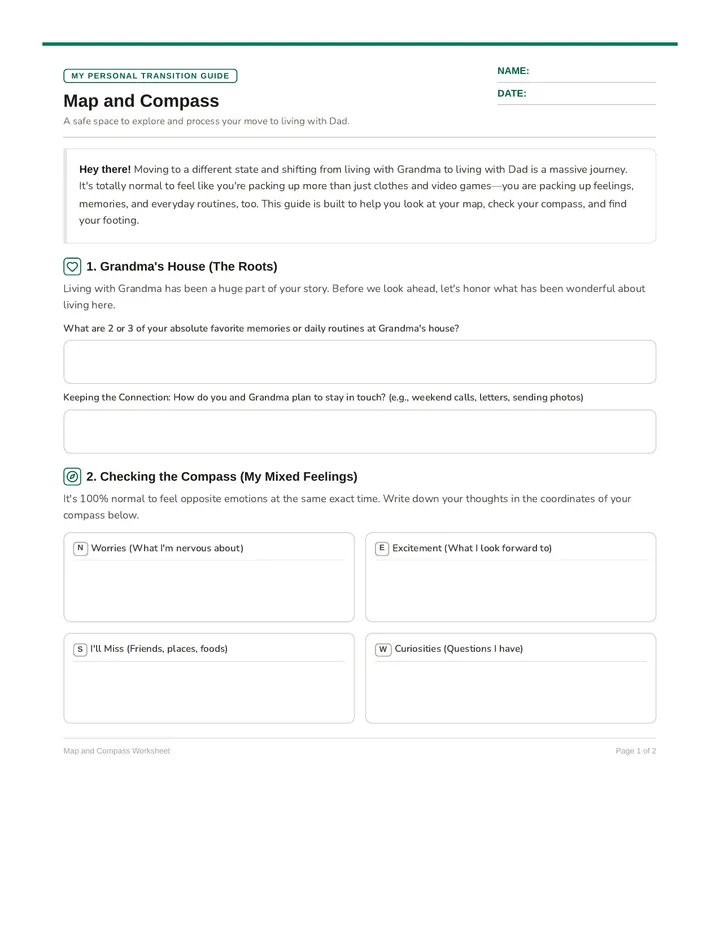
A comprehensive teacher's guide for the Navigating Change lesson, providing pacing, discussion prompts, pause points for the video, and vocabulary definitions.
Final student synthesis materials for Lesson 5, including a comprehensive Resilience Architecture master plan and a portable, pocket-sized Crisis Card for immediate intervention.
Visual presentation for Lesson 5, synthesizing the sequence and introducing the Resilience Architecture plan and Crisis Card.
A student budgeting activity for Lesson 4 that teaches students how to evaluate opportunities and practice declining them to protect their academic capacity.
Visual presentation for Lesson 4, addressing the economics of energy, role overload, and the "Yes/No/Negotiate" framework in academia.
A student blueprint for Lesson 3 to design a personalized shutdown ritual and optimize their sleep environment.
Visual presentation for Lesson 3, focusing on the neurobiology of sleep and the concept of revenge bedtime procrastination.
A student worksheet for Lesson 2 that helps graduate students audit 'phantom time' lost to anxiety and design a schedule with structural buffers.
Visual presentation for Lesson 2, reframing time management from a productivity lens to a cognitive load reduction lens.
Visual presentation for Lesson 1, introducing the concept of the stress cycle, stressors, and the six ways to complete the cycle physiologically.
A student diagnostic worksheet for Lesson 1, including a burnout risk inventory and a structural audit of stress-completion activities.
A comprehensive teacher facilitation guide for Lesson 1, focusing on the neurobiology of the stress cycle and strategies for burnout prevention in graduate academia.
An emergency triage worksheet that guides students through a simulated crisis scenario, helping them identify which tasks to abandon and how to construct a Minimum Viable Day (MVD).
Lesson 5 slide deck on emergency triage and the 'Minimum Viable Day' concept, teaching students how to prioritize critical tasks during periods of crisis or illness.
A case study document about 'Alex the Ace', a student who takes on too much, designed to help students analyze the consequences of over-commitment and practice setting boundaries.
Lesson 4 slide deck introducing the concept of opportunity cost and providing a "No Bank" of polite but firm scripts for setting boundaries.
A self-assessment rubric for students to track their growth in identifying burnout, setting boundaries, negotiating deadlines, and asking for help.
A set of role-play simulation cards for students to practice negotiating scheduling conflicts in various realistic scenarios (sports vs. academics, work vs. family, etc.).
A personal 'Balance Contract' to outline their limits and establish a protocol for managing future stress.
Reviewing the unit and preparing for the final project: the personal Balance Contract.
Lesson 3 slide deck focusing on face-to-face negotiation skills for resolving scheduling conflicts, introducing a 3-step negotiation framework.
A comprehensive teacher facilitation guide covering the instruction, discussion prompts, activities, and specific listening lab scripts for both behavioral lessons.
A detective-themed worksheet for first graders to practice following multi-step directions, sequencing steps, and analyzing behavior scenarios.
A detective-themed presentation for first graders focusing on the four steps of following directions: Stop, Look, Listen, and Do.
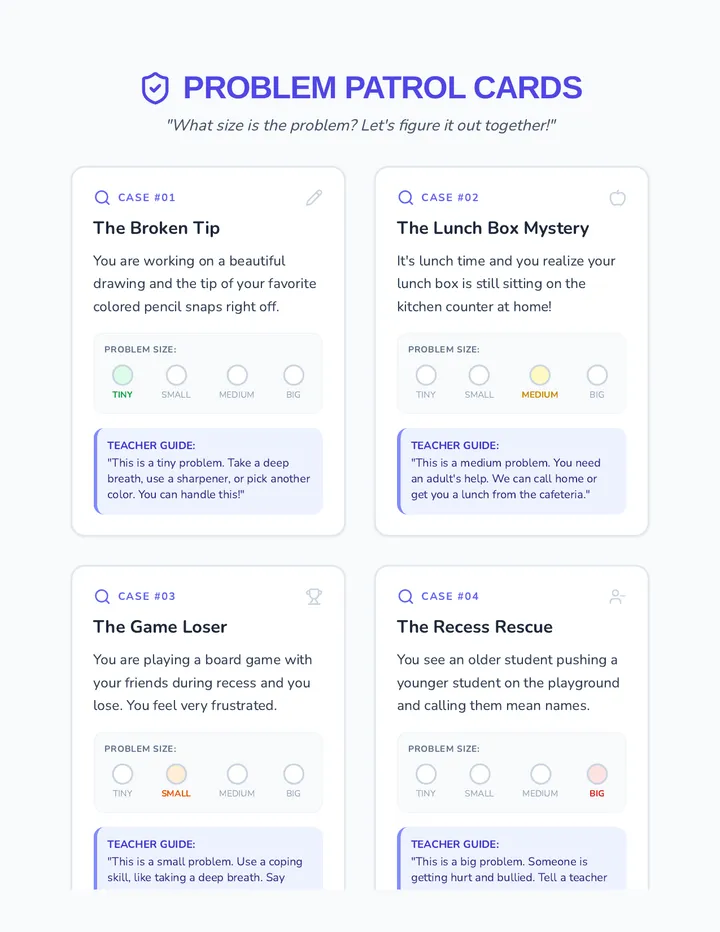
A scenario-based worksheet for first graders to identify and differentiate between positive classroom behaviors and rule-breaking actions using a 'Rule Ranger' theme.
An engaging slide deck for first graders that introduces classroom rules through a 'Rule Rangers' theme, featuring interactive scenarios and clear behavioral expectations.
An answer key for the Humor Filter worksheet, providing correct categorizations for scenarios and an expanded list of suggested boundary-setting scripts.
A student activity sheet for categorizing different types of classroom humor and practicing boundary-setting scripts to address aggressive or mean-spirited jokes, now featuring 6 scenarios and 6 expanded boundary scripts.
A visual presentation for a 5th-grade SEL lesson on distinguishing between playful banter and aggressive humor, featuring interactive discussion prompts and an expanded set of 6 boundary-setting scripts.
A comprehensive teacher guide for a 30-minute social-emotional learning lesson focused on identifying and addressing aggressive humor and mean-spirited 'jokes' in the classroom. Now includes an expanded scenario bank and 6 boundary scripts.
A visual answer key and assessment guide for the listening skills drawing activity, highlighting common errors and instructional talking points.
A comprehensive teacher script for a 30-minute lesson on respect and directions, with explicit prompts for managing classroom behavior and delivering the listening challenge.
A comprehensive teacher facilitation guide for the Heart to Heart Kindness lesson, including objectives, step-by-step instructions, and discussion prompts.
A sweet Valentine-themed worksheet for 1st grade students featuring scenarios to identify kind actions and a drawing area to visualize friendship.
A minute-by-minute instructional script for teachers to deliver the Boundary Blueprint lesson, including slide-specific talking points and transition cues.
Universal teacher guide for the Lead the Way lesson. Includes inquiry-based pacing, a breakdown of the 4 Pillars (Empathy, Integrity, Initiative, Influence), and strategies for teaching social "Steering" and "The Pivot".
Universal leadership worksheet for 6th graders featuring discovery-based reflection, scenario analysis using the 4 Pillars, and a personal leadership commitment.
Universal leadership slide deck for 6th graders focusing on 4 pillars: Empathy, Integrity, Initiative, and Influence. Includes myth-busting, discovery-based brainstorming, and the concept of "Steering the Energy".
A facilitation guide for teachers/coaches to deliver the 30-minute boundary lesson, specifically addressing cross-gender social dynamics and respecting female peers.
A 3-part worksheet for a 7th-grade student to practice identifying boundaries, specifically focusing on respecting the personal space and belongings of female peers.
A comprehensive 6-slide presentation designed for a 7th-grade student with Autism, focusing on personal space, respecting female peers, and the meaning of 'no.'
A story sequencing activity where kindergarteners cut and paste scenes from the Ocean Adventure to put them in order.
A cut-and-paste sorting activity for kindergarteners to distinguish between "Body In" and "Body Out" social behaviors.
Visual presentation slides for the Body in the Group lesson, explaining the Group Plan, physical proximity, and the emotional impact of social cues using an underwater theme.
A comprehensive teacher guide for the Body in the Group ocean adventure lesson, including learning objectives, a scripted hook, and a timed activity mission timeline.
A reflection worksheet for 4th graders to practice decision-making in honesty scenarios, explore the feelings associated with lying, and sign an 'Integrity Promise.'
A visual presentation for 4th graders on honesty and trust, featuring the 'Tangled Web' and 'Trust Bridge' metaphors, plus practical tips for telling the hard truth.
A comprehensive teacher guide for teaching 4th graders about honesty, featuring 'The Tangled Web' yarn activity, scenario analysis, and discussion prompts.
A simple coloring and checkbox activity for Kindergarteners to identify the body parts used for "Whole Body Listening."
A visual slide deck for Kindergarteners featuring "Whole Body Listening" and the "Fast Follower" concept for classroom expectations.
A teacher guide for a Kindergarten lesson on classroom expectations, providing strategies for teaching "Whole Body Listening" and immediate cooperation through games and positive reinforcement.
An interactive worksheet for 4th graders to build their "Calm Down Kit," identifying physical body signals and selecting personalized coping strategies. Revised with better contrast and student-friendly work areas.
A slide deck for teaching coping skills, featuring the "Inner Weather" metaphor, identifying body signals, and step-by-step guides for breathing and grounding techniques. Revised for better legibility and contrast.
A comprehensive teacher guide for teaching 4th graders coping skills, including discussion prompts, breathing exercises, and sensory grounding techniques.
An activity worksheet for students to brainstorm acts of kindness and plan a 'Secret Kindness Mission' within the school community.
A visual presentation for the Kindness Connection lesson, featuring definitions of kindness, school community roles, and interactive scenarios for class discussion.
A comprehensive teacher guide for leading a lesson on school-wide kindness, including discussion prompts, roleplay scenarios, and instructions for the Kindness Quest activity.
A student-facing worksheet for self-reflection on avoidance triggers (icebergs), coping strategies (buckets), and communication plans (radio check).
A facilitation guide for counselors to use the loopable slide deck effectively, focusing on the witty tone, community impact, and communication strategies.
An advanced version of the Calm Cards matching game specifically tailored for middle schoolers. Features 12 pairs of sophisticated coping strategies like cognitive reframing, digital boundaries, and assertive communication, with a mature journal-style design.
A printer-optimized set of 24 matching cards (12 pairs) with tightened layout and fixed height grids to ensure zero content cutoff during printing. Includes clear cutting guides and compact instructional header.
An assessment rubric for evaluating student understanding of academic integrity, focusing on four key criteria: understanding pressure, impact analysis, ethical strategy, and self-reflection.
An interactive student activity featuring three realistic scenarios (Case Files) where students must analyze the pressures to cheat and develop ethical 'Blueprint Actions.' Includes a personal reflection section.
A visual presentation for the 'Honesty Blueprint' lesson, covering the definition of integrity, the 'Pressure Cooker' of why students cheat, and the long-term impact of dishonesty on trust and character.
A comprehensive teacher facilitation guide for the 'Honesty Blueprint' lesson, featuring learning objectives, a minute-by-minute instructional sequence, and pedagogical insights into why students cheat.
A comprehensive rubric for assessing student communication skills across four categories: Verbal Mastery, Vocal Delivery, Visual Impact, and Social Respect.
A high-impact visual anchor chart comparing communication styles and providing the step-by-step 'I' statement formula.
A practice worksheet for students to identify communication styles and practice writing assertive 'I' statements for various social scenarios.
A set of conversation starter cards updated to replace 'Me Too' moments with 'Interest Match' terminology.
A highly visual, full-page checklist for students to track their friendship skills, updated to use 'Interest Match' terminology.
A teacher guide for instructing students on friendship skills, including role-play prompts, troubleshooting tips for common social hurdles, and a progress tracking table.
A 6-page illustrated social story for first graders that teaches the step-by-step process of making friends, updated to use 'Interest Match' verbiage for shared connections.
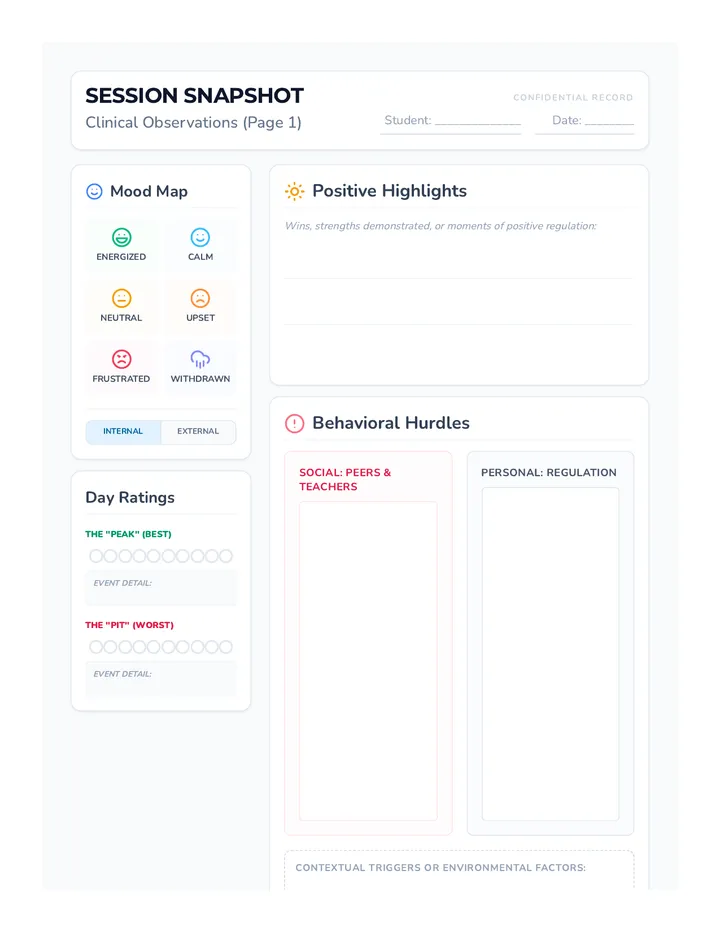
Engaging slides for a middle school counseling lesson on reading social signals, understanding perspectives, and choosing responses with natural consequences. This version separates the definition of natural consequences from the escalation/de-escalation outcomes and inquiry questions into three distinct slides.
An assessment rubric for the final Community Charter project, evaluating theory application, safety planning, and sustainability.
Final project rubric for evaluating the Community Care Initiative, focusing on rationale, boundaries, referral pathways, and sustainability.
Student design workbook for planning the Community Care initiative, covering problem definition, logistics, safety boundaries, and sustainability.
A design framework for a community care plan, producing a 'Community Charter' for peer support in a specific campus context.
Final project brief for the Community Care initiative, detailing requirements, core components, and the "Department Pitch" assessment.
Visual slide deck for Lesson 5, introducing the concepts of mutual aid, sustainable networks, and the "Community Charter" project.
Observation and feedback tool for students to use while observing peer-led group facilitation simulations, focusing on psychological safety and dynamic management.
A brainstorming worksheet for identifying collective coping strategies for common undergraduate stressors.
Practical script for students to lead a brief check-in circle, featuring opening ground rules, modeling prompts, and intervention strategies.
A sorting activity where students categorize shared stressors from an anonymous "drop box" into personal or systemic categories to facilitate normalization.
Facilitation Fundamentals Slides focusing on group dynamics, psychological safety, and managing difficult participants.
Visual slide deck for Lesson 4, introducing group facilitation skills, the power of normalization, and the distinction between individual and systemic stressors.
Reference guide and template for students to identify professional resources and practice the "warm handoff" referral protocol.
A resource guide template for students to collect and categorize campus professional resources.
Case studies focusing on temporal and emotional boundary failures in peer support, including scripting exercises for boundary resetting.
Sustainable Support Slides focusing on compassion fatigue, different types of boundaries, and the professional referral process.
Case study scenarios for Lesson 3 focusing on identifying red flags, setting internal limits, and drafting referral scripts.
Teacher-facing guide for facilitating the end-of-day "Best Part" reflection circle with Pre-K students.
A Kindergarten reflection and gratitude worksheet for the final lesson, where students identify traits they appreciate in their peers.
Reference sheet for students featuring micro-skills definitions, validation hierarchy levels, and helpful open-ended question prompts.
A comprehensive one-page master checklist of all coping skills, organized by tactical 'Sectors' (Hardware, Software, Base Camp, Toolkits, Advanced Ops) with rating and field note sections.
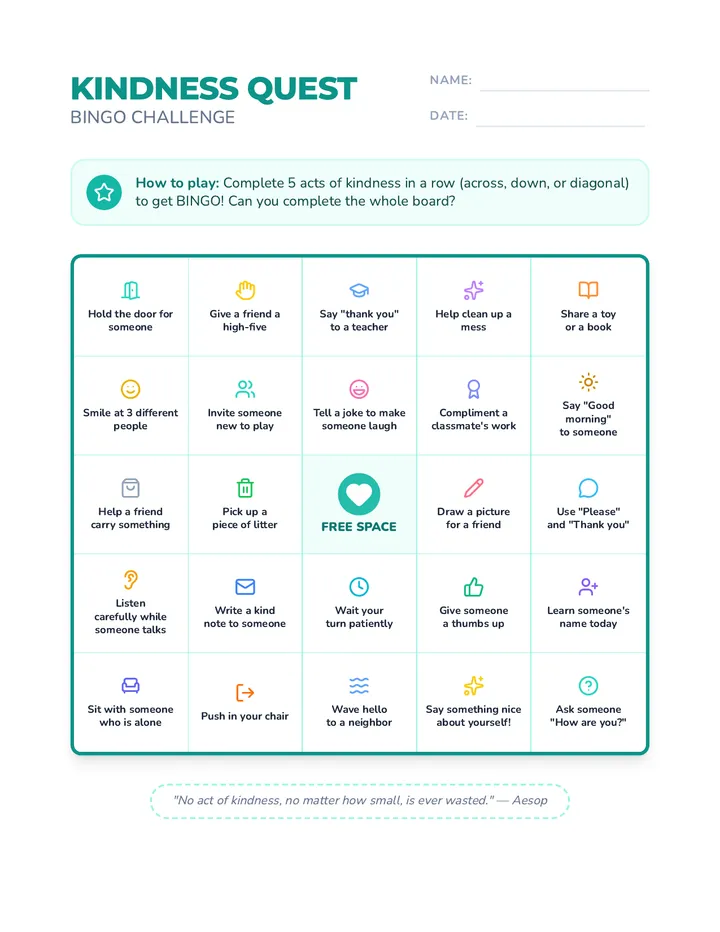
A refined one-page master checklist of coping skills for middle school students, featuring a tactical 'Master Inventory' aesthetic with space for ratings and observations.
A handout for middle schoolers focusing on journaling, mental games, art-based expression, and visualization as creative 'Mental Toolkits' for anxiety.
Updated master list and tracking worksheet that includes all four phases of coping skills (Hardware, Software, Base Camp, and Toolkits) for student rating and pattern recognition.
A handout for middle schoolers explaining the biological importance of sleep, exercise, and emotional labeling as foundational 'Base Camp' maintenance for managing anxiety.
A tactical handout focused on Cognitive Behavioral Therapy (CBT) and Acceptance and Commitment Therapy (ACT) techniques, explained as 'software overrides' for the brain.
Updated technical handout for middle schoolers explaining breathing, PMR, and grounding skills through the lens of nervous system biology.
A celebratory completion certificate for students who have finished the 'Mood Makers' sequence, recognizing them as 'official Mood Makers and Reset Heroes'.
A student worksheet for reflecting on emotional change by creating a visual comic story of identifying a problem, choosing a tool, and achieving a positive mood shift.
A decorative cover for the student's final 'Star Power' portfolio, featuring space for a self-portrait and recognition of their growth mindset journey.
Instructional slides for Lesson 5, reviewing the key concepts of internal weather, movement experiments, and the coping toolbox.
Comprehensive teacher guide for the final celebration lesson, outlining the 'Soapbox of Pride' activity, gallery walk facilitation, and portfolio assembly.
Visual slide deck for Lesson 3, covering the scope of peer support, referral red flags, and the prevention of compassion fatigue.
A student activity sheet where Pre-K children color and decorate their own "Magic Mover" medal for mastering classroom transitions.
A teacher guide for the Community Celebration Circle, facilitating a concluding reflection and peer-compliment activity.
Colorful slides for the final lesson celebration, focusing on internal pride, self-reflection, and the ongoing journey of growth for Pre-K students.
A teacher guide with scripted scenarios and facilitation prompts for role-playing emotional resets and building empathy.
A facilitation guide for the counselor, providing specific strategies for rapport building, framing impulse control as 'power,' and navigating the student's unique home dynamics as an oldest sibling.
A visual aid and checklist that reframes being the oldest sibling as a leadership role, encouraging positive behaviors (Hero Habits) and fostering discussion about home dynamics.
An activity sheet that visualizes the 'Ripple Effect' of social behavior, helping students understand how their actions (both positive and negative) affect family members and peers.
An activity sheet for practicing 'Pulse Pilot' techniques, identifying physical triggers (The Spark), and mapping out alternative reactions to common stressors.
Visual aids to introduce the 'Pulse Pilot' concept, focusing on identifying the physical 'spark' of impulsivity and using a mental remote control.
Engaging slides for a middle school counseling lesson on reading social signals, understanding perspectives, and choosing responses with natural consequences. updated to include examples, non-examples, inquiry questions, and the original escalation/de-escalation concept.