Educational slides for Lesson 3: Digital Professional Conduct. This deck covers how workplace harassment translates to digital spaces, the impact of social media interactions between coworkers, and the 'permanence' of digital evidence.
A one-page reference checklist for students featuring 'circuit breaker' coping skills to use when feeling emotionally overwhelmed or 'sucked into' a friend's mood.
A comprehensive facilitator's guide for teachers or counselors, providing a roadmap for individual and dyad sessions, key talking points, observation checklists, and troubleshooting tips for addressing trauma bonding.
A two-page individual 'self-repair' guide for students featuring grounding exercises, strength identification, the 'Yet' reframing technique, and daily journaling prompts to build personal resilience.
A one-page 'pocket guide' for students featuring conversation scripts, a friendship agreement, and a menu of emotional regulation tools to maintain healthy boundaries.
A two-page student activity featuring 'The Backpack Exercise' for identifying emotional ownership and three 'Upgrade the Moment' scenarios for practicing healthy boundaries and responses.
A two-page student-facing fact sheet and reflection guide that explains the concept of 'emotional mirroring' (trauma bonding) and introduces the 'both can be true' mindset for healthy friendship boundaries.
A set of conversation starter cards updated to replace 'Me Too' moments with 'Interest Match' terminology.
A highly visual, full-page checklist for students to track their friendship skills, updated to use 'Interest Match' terminology.
A teacher guide for instructing students on friendship skills, including role-play prompts, troubleshooting tips for common social hurdles, and a progress tracking table.
A 6-page illustrated social story for first graders that teaches the step-by-step process of making friends, updated to use 'Interest Match' verbiage for shared connections.
A visually striking slide deck titled 'Iron Character' designed for a large-group SEL lesson, featuring interactive prompts, discussion frameworks, and structured activity instructions.
A reflective student handout titled 'Character Compass' that guides students through identifying their core values, reflecting on ethical challenges, and planning personal growth.
A comprehensive facilitator guide for a large-group SEL lesson on character, featuring session objectives, a minute-by-minute breakdown, and management tips for large groups.
A story sequencing activity where kindergarteners cut and paste scenes from the Ocean Adventure to put them in order.
A cut-and-paste sorting activity for kindergarteners to distinguish between "Body In" and "Body Out" social behaviors.
Visual presentation slides for the Body in the Group lesson, explaining the Group Plan, physical proximity, and the emotional impact of social cues using an underwater theme.
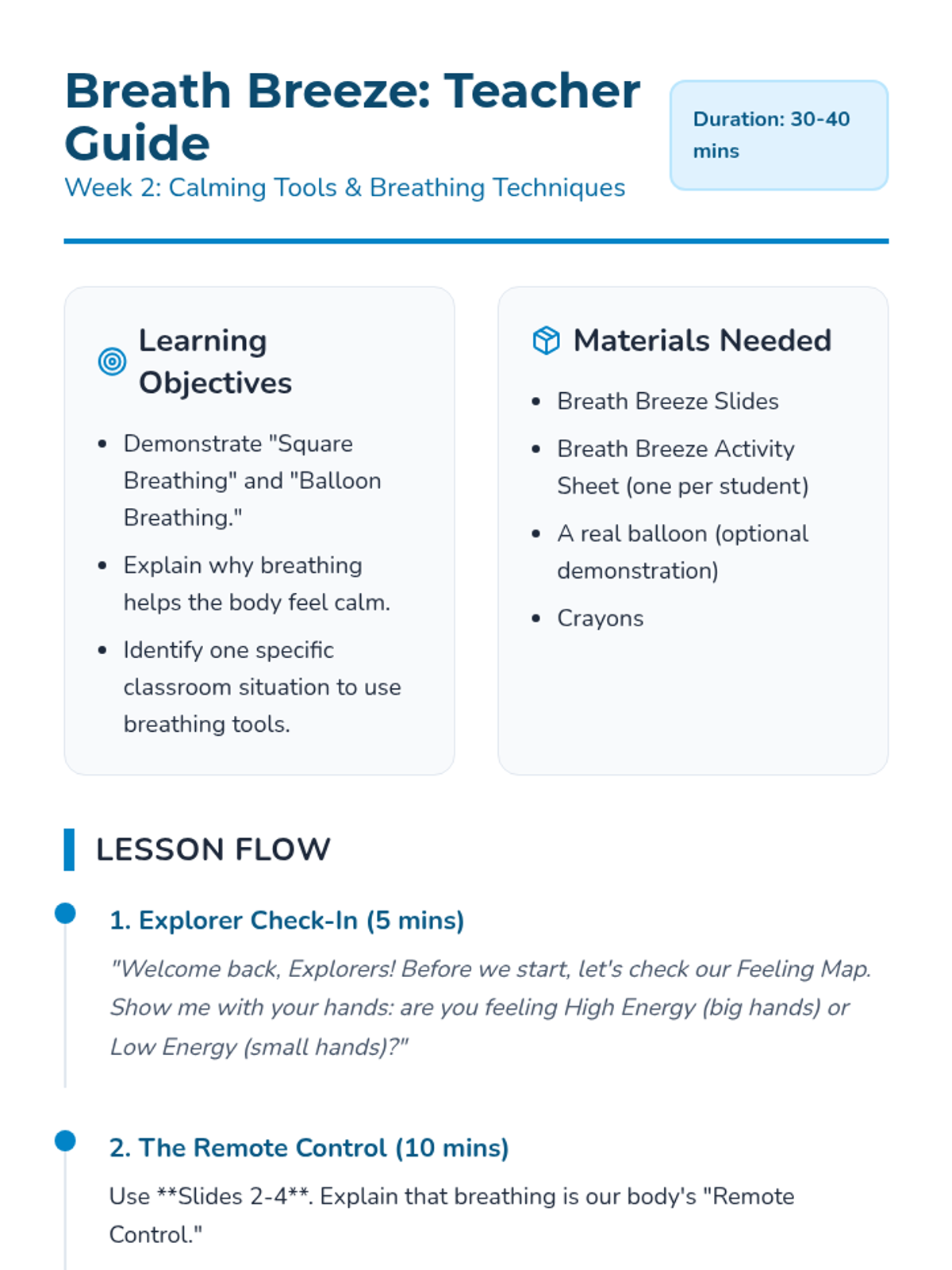
A comprehensive teacher guide for the Body in the Group ocean adventure lesson, including learning objectives, a scripted hook, and a timed activity mission timeline.
Engaging slides for a middle school counseling lesson on reading social signals, understanding perspectives, and choosing responses with natural consequences. This version separates the definition of natural consequences from the escalation/de-escalation outcomes and inquiry questions into three distinct slides.
A reflection worksheet for 4th graders to practice decision-making in honesty scenarios, explore the feelings associated with lying, and sign an 'Integrity Promise.'
A visual presentation for 4th graders on honesty and trust, featuring the 'Tangled Web' and 'Trust Bridge' metaphors, plus practical tips for telling the hard truth.
A comprehensive teacher guide for teaching 4th graders about honesty, featuring 'The Tangled Web' yarn activity, scenario analysis, and discussion prompts.
Engaging slides for a middle school counseling lesson on reading social signals, understanding perspectives, and choosing responses with natural consequences. updated to include examples, non-examples, inquiry questions, and the original escalation/de-escalation concept.