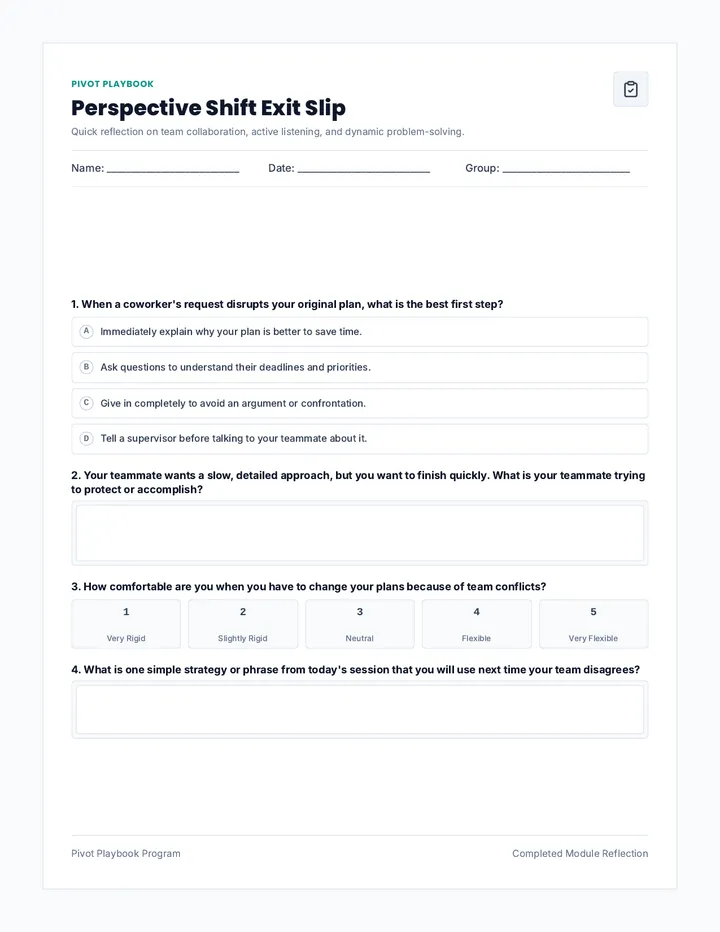
A short multiple-choice and open-response quiz to assess student understanding of stress, eustress, symptoms, and coping strategies.
A teacher-facing answer key and facilitation guide for the Daily Design worksheet, providing exemplary responses and tips for correcting common student misconceptions.
A guided student worksheet formatted as a "blueprint" that leads students through a hypothetical scenario and a personal application of the 5-step decision-making model.
A high-impact slide deck for 7th-grade students introducing the 5-step decision-making model through visual diagrams and a real-world scenario.
A comprehensive teacher guide for leading a 7th-grade lesson on decision-making, featuring an instructional sequence, standards alignment, and facilitation tips.
A visual presentation for the Future Architect lesson, focusing on the concept of reverse engineering goals, identifying the 'why' behind aspirations, and setting immediate action steps.
A project-based goal-setting worksheet where students reverse-engineer a major goal into three milestones, an immediate 24-hour action, and a plan for potential obstacles.
A facilitator guide for the Future Architect lesson, guiding students through the process of reverse-engineering goals, identifying obstacles, and taking immediate action steps.
A visual presentation for the Pressure Relief lesson, exploring the physiology of stress, personal triggers, physical warning signs, and various healthy coping mechanisms.
An interactive stress mapping worksheet designed as a 'system blueprint' where students identify their triggers, physical stress signals, and healthy relief valves.
A facilitator guide for the Pressure Relief lesson, focusing on stress management, identifying physical signals of tension, and creating healthy coping mechanisms.
A visual presentation for the Identity Blueprint lesson, featuring a 30-minute session structure with icebreakers, identity zones breakdown, activity instructions, and discussion prompts.
A printable identity mapping worksheet featuring a concentric 'blueprint' diagram where students categorize their core values, private interests, social roles, and surface appearances.