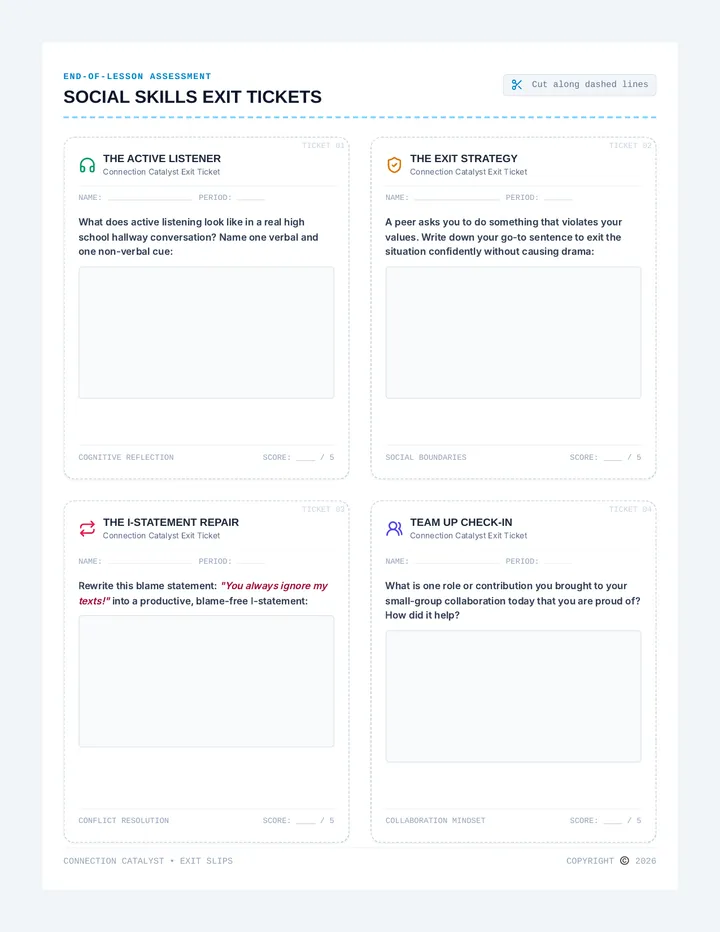
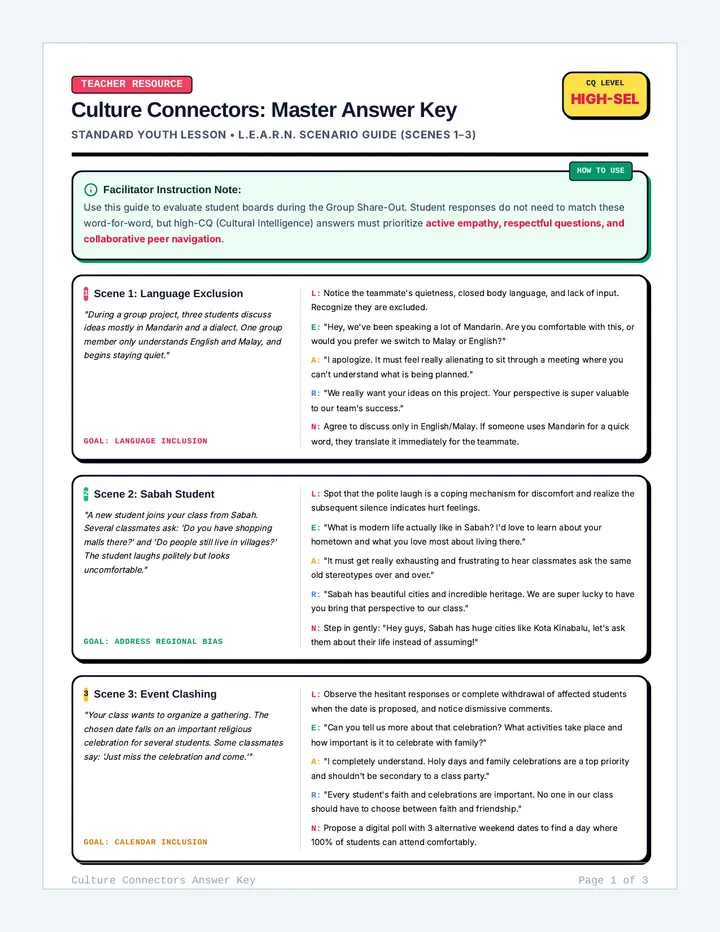
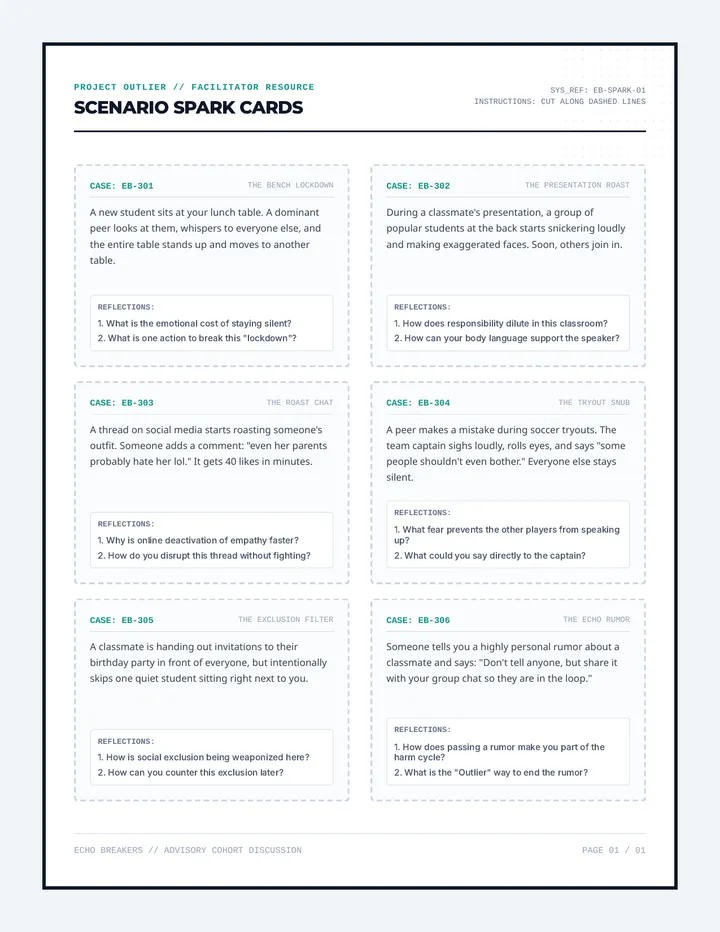
An activity worksheet featuring four real-world bullying scenarios for group role-play and strategy discussion, focusing on exclusion, cyberbullying, physical harassment, and verbal teasing.
A structured worksheet for teenagers to map out their anger triggers, identify physical symptoms on a body map, and create a personalized action plan for emotional regulation.
A visually engaging slide deck for teenagers focused on anger management, defining triggers, physical signals, and immediate cool-down strategies.
A comprehensive facilitator guide for the Heat Control lesson, including instructional flow, discussion prompts, and differentiation strategies for teaching anger management to teenagers.
A combined daily checklist and grounding technique guide featuring the 5-4-3-2-1 method, box breathing instructions, and a weekly habit tracker for building consistent self-care routines.
A reflective worksheet designed to help students identify their stressors, evaluate current coping mechanisms, and practice cognitive reframing to build emotional resilience.
A facilitation guide for educators to deliver the "Cooling the Flame" lesson. Includes discussion prompts, timing suggestions, and tips for managing teen classroom dynamics during sensitive topics.
A personal reflection worksheet for teens to identify their unique physical anger signals, plan de-escalation scripts, and practice cognitive reframing. Use alongside the Flame Tamer Slides.
A high-impact presentation for teenagers focused on practical anger de-escalation. It covers physical warning signs, the "Tactical Pause," grounding techniques, and cognitive reframing with real-world scenarios.
A facilitator guide for practitioners running the Narrative Navigators workshop, including scripts, pacing, and therapeutic de-brief prompts.
A printable creative worksheet for clients to draw their life journey, externalize self-worth challenges, and identify core values through a cartography-themed exercise.
A presentation to guide clients through the concepts of Narrative Therapy and the Life Map activity, featuring key concepts like externalization and re-authoring.
A visual sorting and diagramming activity where students use icons (Flame, Heart, Lightbulb) to categorize brain functions and annotate a realistic brain team map for internal coordination. UK spellings applied. Terminology updated to Neocortex.
A visual presentation introducing the Reptilian Brain, Limbic System, and Neocortex using realistic anatomical diagrams, large icons, and minimal text to explain how these three parts collaborate as a team. Terminology updated to Neocortex with UK English spellings.
A comprehensive teaching guide for facilitating the Brain Blueprint sequence, providing core philosophies, lesson breakdowns, a realistic anatomical brain map, and neuro-affirming facilitation tips. UK spellings applied. Terminology updated to include Neocortex with a lightbulb icon.
A resilience-building worksheet where students practice reframing self-critical labels (like 'lazy' or 'sensitive') into objective problem-solving statements focused on executive function and sensory needs. UK spellings applied. Terminology updated to Neocortex with a lightbulb icon.
A slides deck teaching ADHD and AuDHD students how to reframe self-criticism into objective problem-solving, emphasizing that 'failure' is simply data for finding better tools. UK spellings applied. Terminology updated to Neocortex with a lightbulb icon.
A collaborative matching and brainstorming activity where students pair common neurodivergent 'system errors' with effective strategies and interview peers about their own focus hacks. UK spellings applied. Terminology updated to include lightbulb iconography.
A presentation on practical executive function strategies and sensory tools specifically for ADHD and AuDHD students, framed as 'upgrades' to their brain's workshop. UK spellings applied. Terminology updated to include Neocortex with a lightbulb icon.
An interactive worksheet for students to identify their sensory profiles, dopamine triggers, and executive function challenges, fostering self-awareness and advocacy. UK spellings applied. Terminology updated to include Neocortex and realistic brain diagrams.
A visual guide to the neurobiology of ADHD and AuDHD brains, using an 'engine' and 'operating system' metaphor to explain executive function and sensory processing. UK spellings applied. Terminology updated to Neocortex with a lightbulb icon.
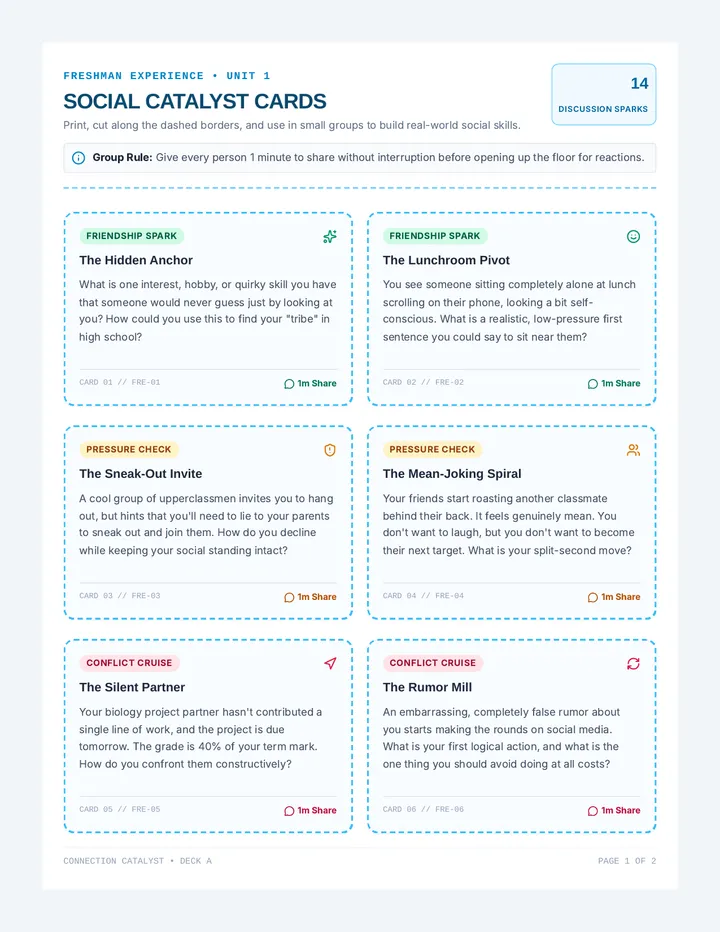
Scenario role-play cards for Session 1, redesigned to fit 6 cards on a single 8.5x11 page with straight dashed cutting lines and optimized spacing for teacher convenience.
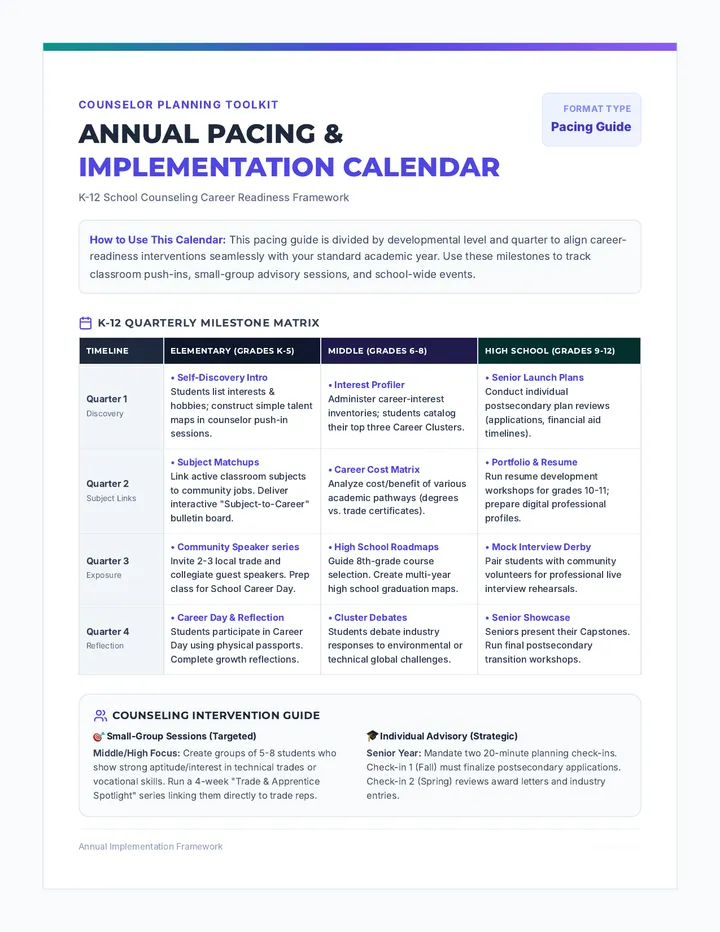
A hands-on graphic organizer titled 'Roadmap Architect' where students visually map out their post-secondary foundation, build phase, and career entry.
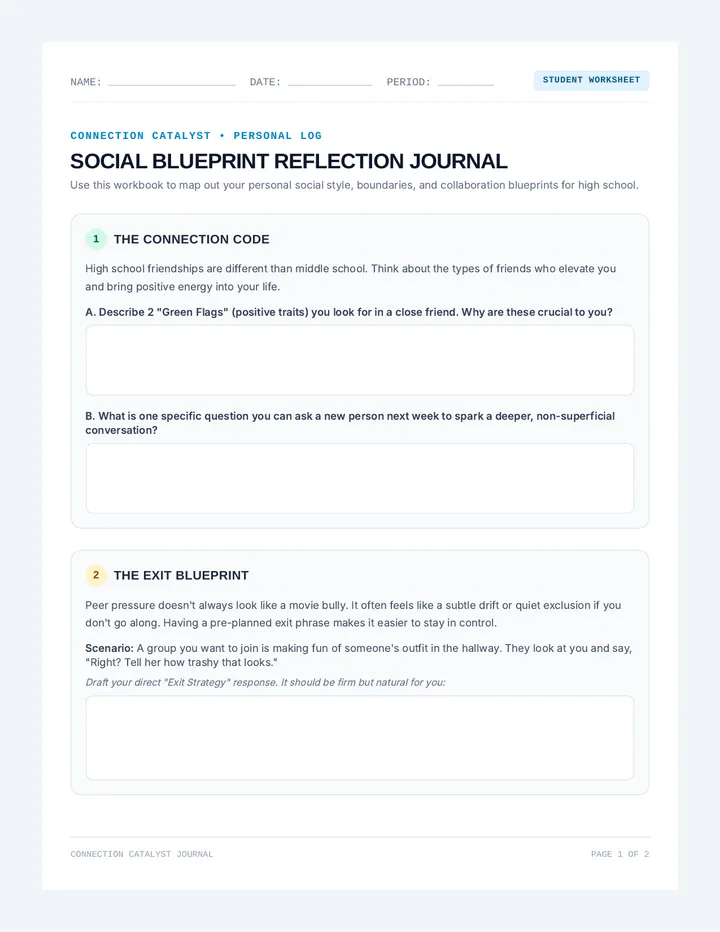
A guided notes and reflection worksheet for students to record information about post-secondary pathways and practice critical thinking about their biases.
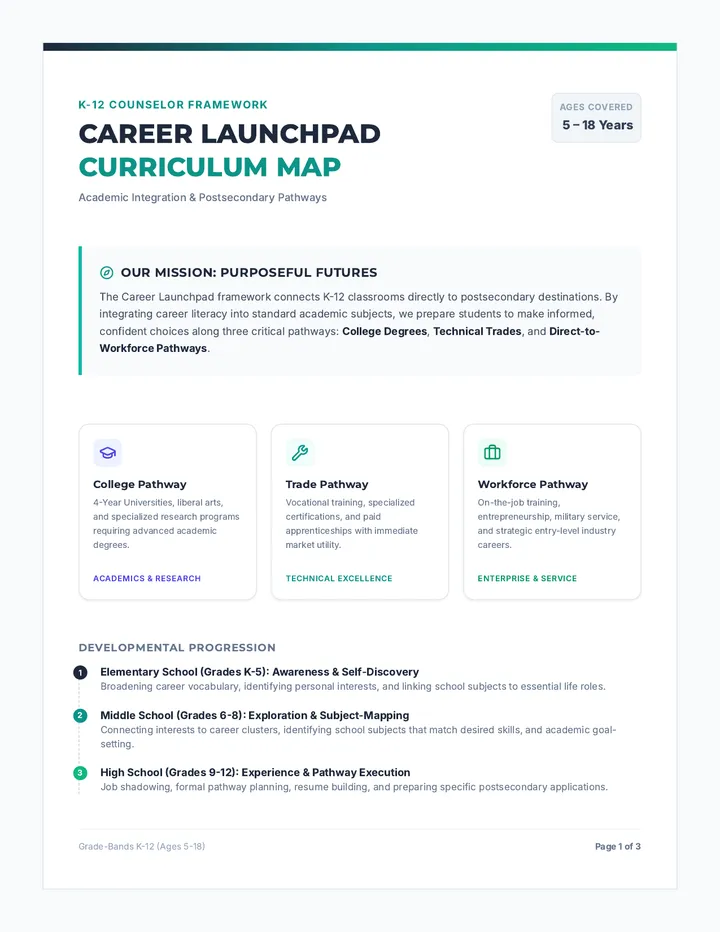
A set of slides for the 'Future Blueprint' lesson, defining post-secondary pathways and prompting critical thinking through structured inquiry.
A teacher guide for the 'Future Blueprint' lesson, outlining instructional strategies, pacing, and facilitation tips for exploring post-secondary pathways.
A comprehensive lesson plan for teachers, detailing objectives, required materials, and a step-by-step pacing guide for delivering the Pro Path Blueprint curriculum. Now includes explicit definitions of key rules and a teacher reflection section.
A social skills checklist for assessing work ethic behaviors in real-time or through self-evaluation. Covers punctuality, professional social cues, and task persistence with clear 'Yes' checkboxes and space for observer notes. Now with improved legibility for handwritten summaries and higher contrast labels.
A student worksheet focusing on the four pillars of work ethic. Includes a self-rating scale, practical strategy planning for punctuality and grit, and a complex workplace scenario for critical thinking and application. Updated with clearer page breaks and internal prompts. Now with improved spacing for handwriting and higher contrast for printing.
A vibrant and professional slide deck designed to teach the four pillars of work ethic: Punctuality, Persistence, Professional Communication, and Time Management. Includes visual metaphors, practical strategies like the 'Early Rule' and 'Eisenhower Matrix', and interactive discussion scenarios.
A 5-day post-intervention accountability journal for students to track their attendance and moments where they chose responsibility over avoidance.
An activity sheet where students analyze hypothetical scenarios to identify the "pivot point" between impulsive avoidance and responsible logic.