A reflective self-assessment tool that helps students evaluate their own proficiency in the four pillars of self-awareness: strengths, growth areas, emotions, and values.
A large-format classroom anchor chart (poster) that visually reinforces the 'Comedy Compass' system. It uses high-contrast icons, bold color-coded zones for Green (Go) and Red (Stop) times, and prominently features the core self-regulation question for students to reference at a glance.
A compact, visually high-contrast reference card for students. It features the Green and Red zones of humor, teacher social cues to watch for, and the core 'Check-In' question to help students self-regulate their classroom jokes.
A teacher guide for the Comedy Compass lesson. It includes objectives, pacing, discussion questions, common misconceptions about humor timing, and differentiation tips for varied learners.
A student worksheet for auditing classroom humor timing. It features signal identification exercises and reflective prompts on how humor impacts classroom dynamics and following teacher cues.
A comprehensive 8-slide presentation designed to help students understand the social nuances of humor in the classroom. It uses a 'Comedy Compass' theme to categorize situations into 'Green Zones' (appropriate times) and 'Red Zones' (focused learning times), emphasizing the importance of following teacher directions and reading social cues.
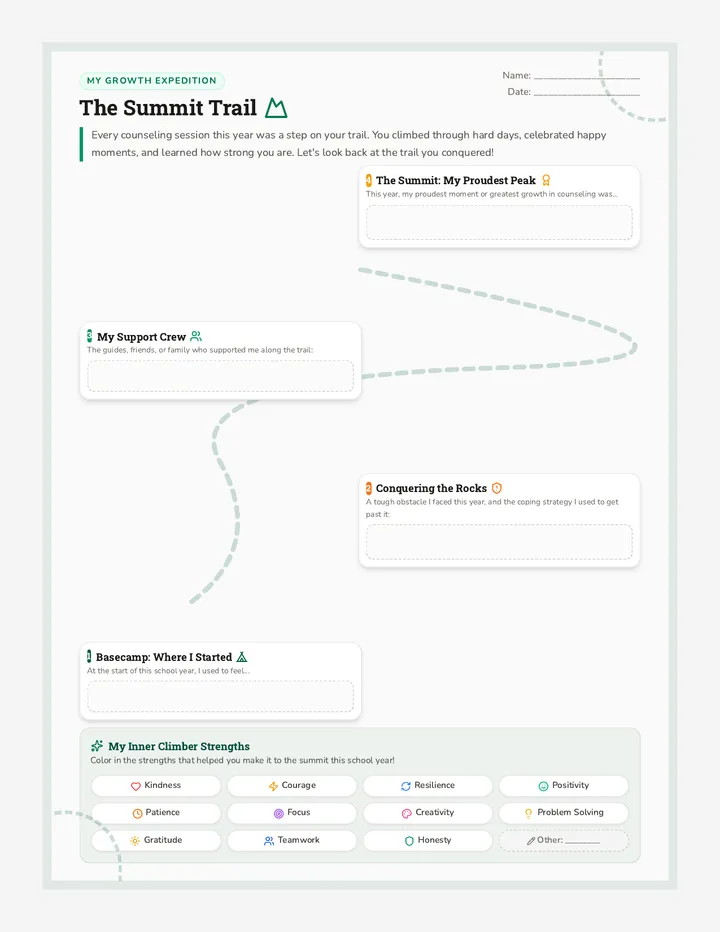
A reflection worksheet for students to complete during their final counseling session to document growth, identify coping tools, and plan for future independence.
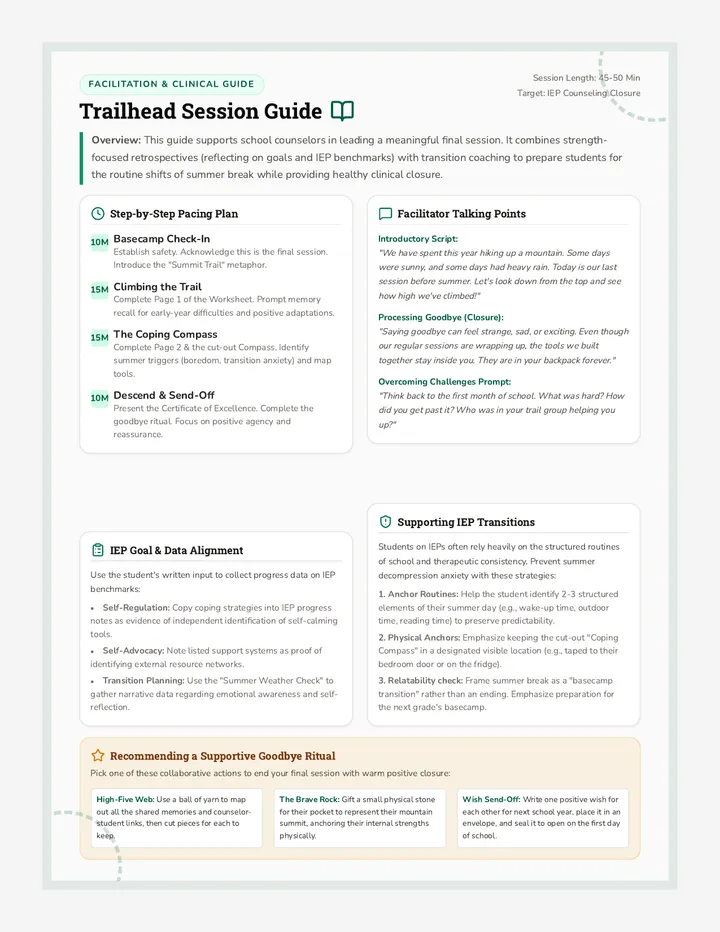
A professional guide for counselors or educators to facilitate effective termination discussions, including prompts, scenarios, and clinical considerations.
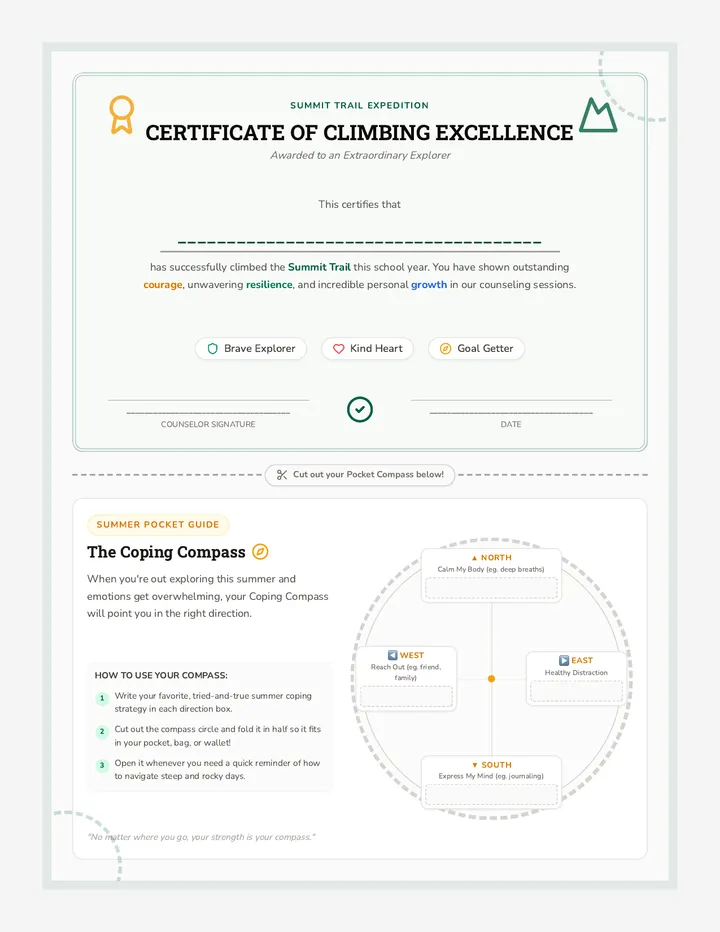
A visual presentation for school counselors to use with students (or for counselor training) to explain the termination process, normalize emotions, and plan for closure.
A refined facilitator guide for the Emotion Connection session, providing clinical strategies and pacing for a 60-minute nature-themed slide presentation.
A calm, nature-themed slide deck for teens focused on the normative and adaptive nature of emotions, featuring interactive discussion prompts, 4 detailed social stories, and an emotion tracking log.
A single-page vertical 'Self-Control Strategy Menu' with 10 grounding and self-control strategies, including 'Pump the Brakes', 5-4-3-2-1, and Muscle Melt. Features the THINK acronym (Thoughtful, Honest, Important, Necessary, Kind/Appropriate) in the footer. Revised for user specific word choices.
Student worksheet for practicing the T.H.I.N.K. filter and 'Pump the Brakes' technique. Includes scenarios for transitions, blurting, and disagreements, plus a cut-out desk strip. Revised to include specific words for the THINK acronym: Thoughtful, Honest, Important, Necessary, Kind/Appropriate. Includes larger legible text for acronym labels.
Teacher facilitation guide updated with the 'Pump the Brakes' car metaphor and the T.H.I.N.K. filter (Thoughtful, Honest, Important, Necessary, Kind/Appropriate). Includes scripts and an observation log.
Printable desk strips for an ADHD student. Features the T.H.I.N.K. filter (Thoughtful, Honest, Important, Necessary, Kind/Appropriate) and the 'Pump the Brakes' car metaphor.
Instructional slides for a 5th grade student focusing on impulse control through the 'Inner Remote' and 'Pump the Brakes' metaphors. Includes specific scenarios for transitions and the T.H.I.N.K. filter (Thoughtful, Honest, Important, Necessary, Kind/Appropriate).
A reflection worksheet for 6th-grade boys to identify physiological signs of anger, personal triggers, and de-escalation strategies in a professional, direct format. Revised for improved student work area spacing and printability.
A facilitator guide for a 30-minute group counseling session for 6th-grade boys, focusing on identifying personal triggers and developing de-escalation strategies without thematic metaphors. Revised for improved layout and guaranteed single-page fit.