A set of eight scenario cards for paraprofessionals to practice communication strategies in teacher collaboration, parent interaction, and student de-escalation for 6th-grade settings.
The answer key for the Pressure Points Quiz, providing correct answers and acceptable response criteria for short-answer questions. Revised to fit on a single page with improved formatting.
A 2-page quiz for the Pressure Points lesson, featuring multiple choice, true/false, and short answer questions covering key concepts and strategies. Revised for improved page breaks and contrast.
A teacher facilitation guide for the Pressure Points lesson, including a pacing guide, discussion prompts, and role-playing tips.
A 2-page student worksheet featuring self-assessment tools, refusal strategy scripts, brain science reflections, and real-world scenario analysis. Revised for improved spacing and student work area sizing.
A 12-slide modern presentation on peer pressure designed for middle and high school students, featuring high-contrast visuals, refusal strategies, and brain science explanations. Revised for better slide transitions and contrast.
A teacher guide for the 'Feeling Detectives' lesson. Includes lesson duration, learning objectives, read-aloud discussion prompts, and step-by-step activity instructions for the worksheet and slides.
A 6-slide presentation for first grade students to accompany the 'Feeling Detectives' lesson. Features interactive discussion prompts and visual 'case files' for Anger, Sadness, and Anxiety, illustrating both internal and external physical clues.
A two-page student worksheet designed for first graders to identify and record physical clues (facial expressions and body sensations) for four primary emotions. Features a detective-themed layout with drawing areas and checkbox clues.
A reflective counseling worksheet designed for students in grades 4-8 to help them understand the psychology of procrastination, identify their personal 'time thieves,' and apply practical strategies to get started on difficult tasks.
A training presentation for clinical staff on integrating Social Awareness and CBT skills. Covers population-specific dynamics, core skills like STOP, and strategic implementation.
A client-facing CBT worksheet designed to help individuals process social interactions, identify cognitive distortions, and apply coping skills in real-time.
A clinician-facing lesson plan for facilitating social awareness and CBT group or individual sessions. Includes structured steps, discussion prompts, and trauma-informed guidance.
A high-density professional reference guide for clinical staff, mapping CBT interventions and social awareness strategies to specific patient populations including BPD, Trauma, and Substance Use.
A reference sheet explaining the technical metaphors used throughout 'The System Architect' program. It translates terms like hardware, software, and glitches into clear SEL concepts for 6th graders.
A final review and celebratory slide deck for 'The System Architect' program. Updated to fix content overflow and ensure white-on-colored text contrast.
A final synthesis worksheet where students create a personalized 'Maintenance Plan'. Updated with enlarged writing areas, personalized tool lines, and higher contrast instructions. themed around the System Architect curriculum.
A facilitator guide for the final week of 'The System Architect' program. It guides the synthesis of all learned skills into a personal 'Maintenance Plan' for long-term anxiety management. Updated to remove the 'Authorization Chief Systems Architect' heading.
A slide deck for Week 7 of 'The System Architect' program. Updated to remove references to 'nodes' and use accessible language for 6th-grade social situations. Now includes a glossary/key slide for technical metaphors.
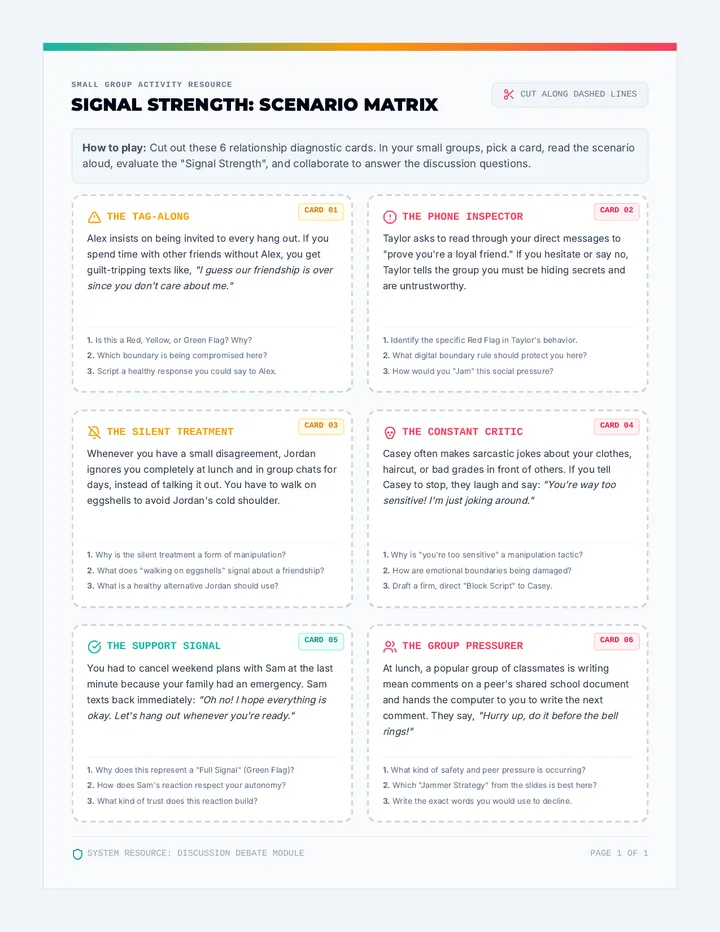
A set of social scenario cards for the 'Network Signals' lesson. Updated to include more scenarios, remove references to people as 'nodes', and improve spacing for student responses.