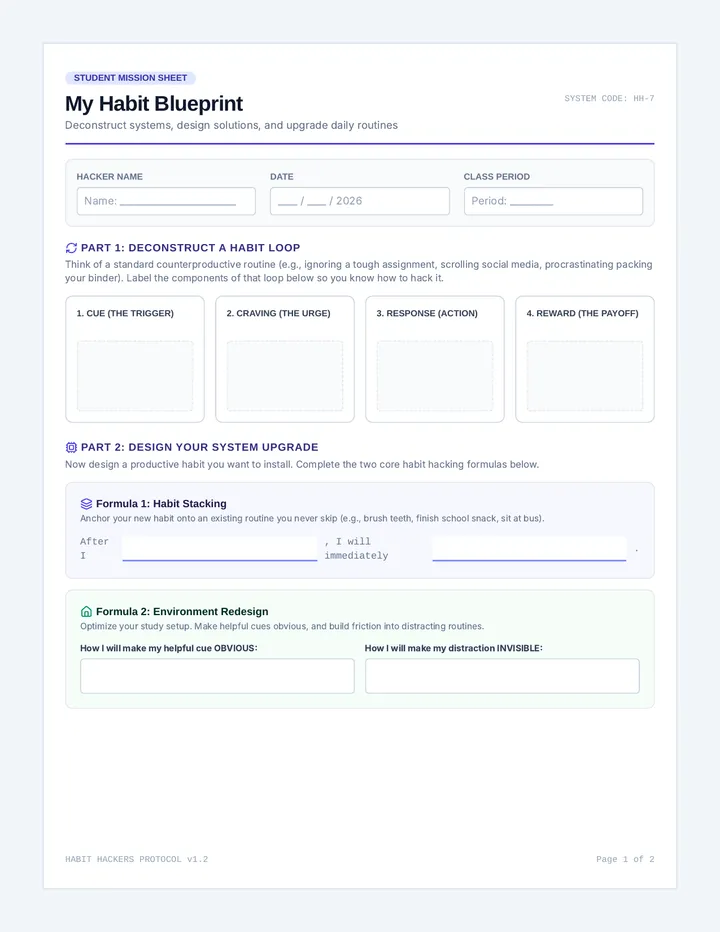
A 7-day habit tracker for students to monitor their consistency in following their new daily routine, including space for daily reflections and a final wrap-up.
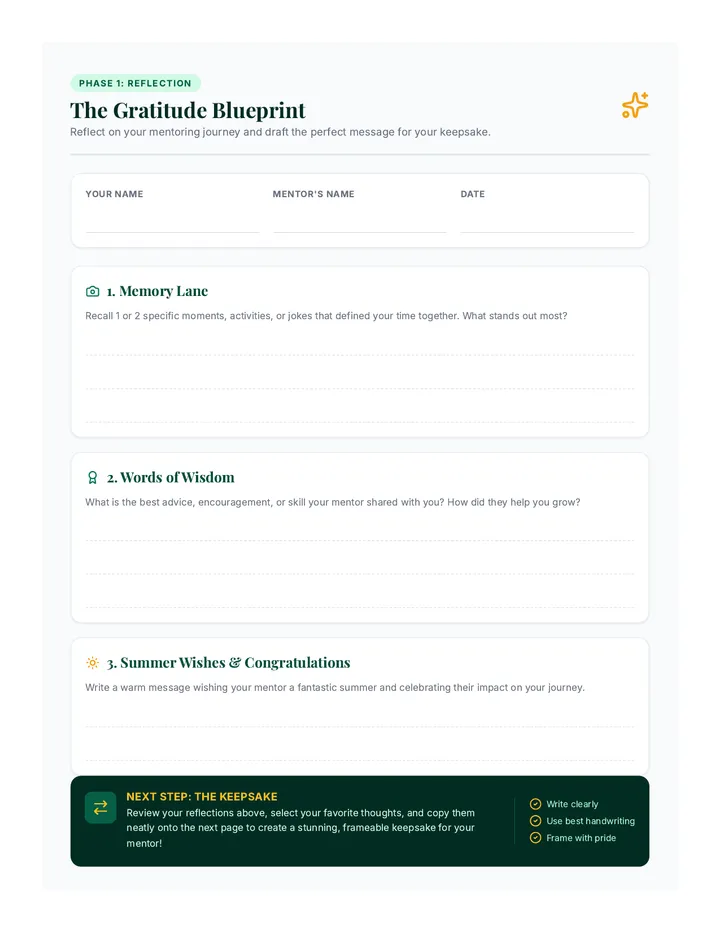
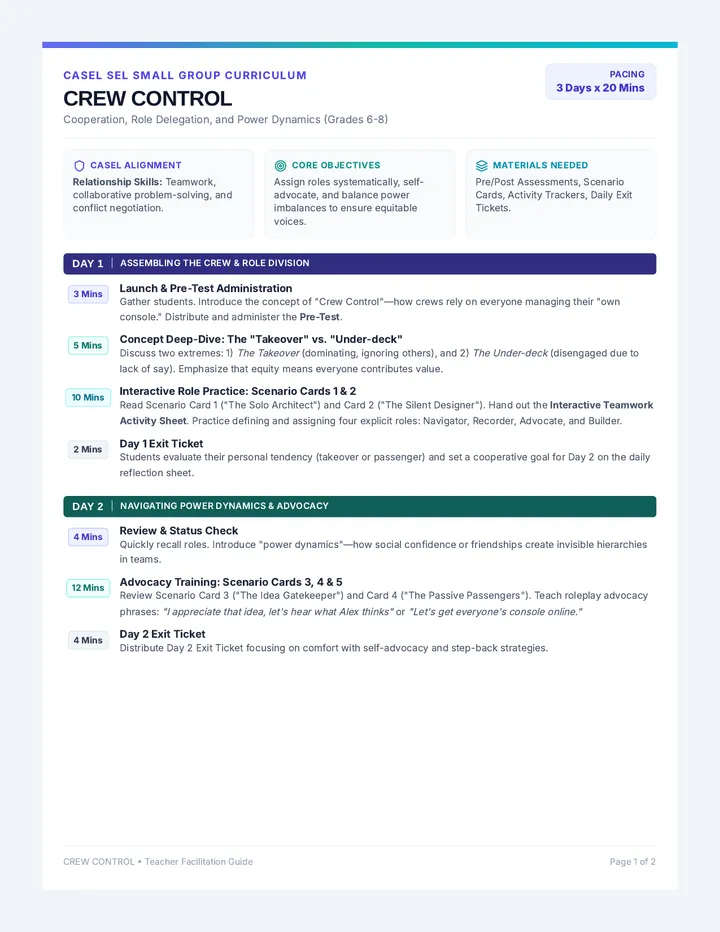
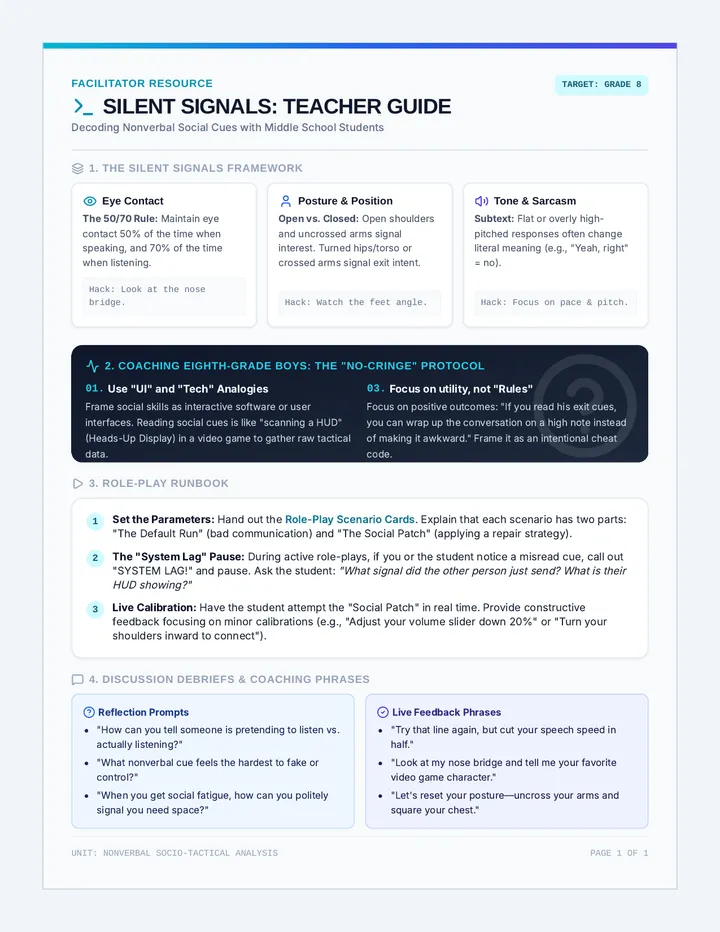
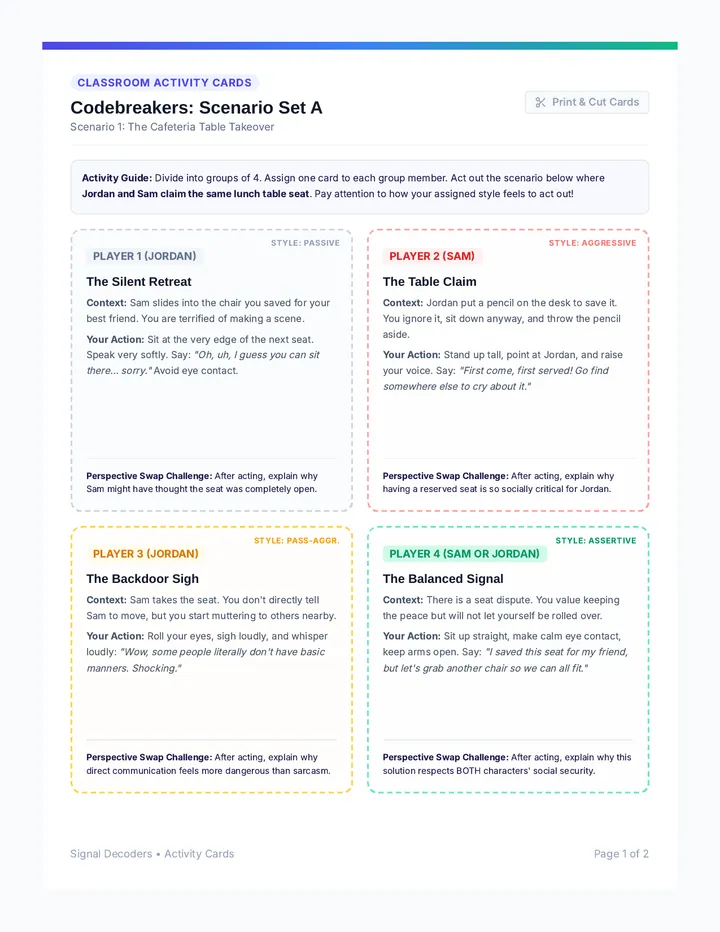
A teacher's facilitation guide with strategies for role-play, corrective prompts, and sensitive framing for teaching social boundaries.
A guide for handling rejection and the difference between 'Not Now' and 'No'. Revised for improved layout, page breaks, and formatting consistency. Highlighting clear boundaries and respectful responses. Includes structured writing lines for student responses.
A student-facing guide focusing on personal space rules, the 'Exit Path' concept, and how to respond when asked to move. Revised for layout consistency, improved diagramming, and optimal page usage. Includes structured writing lines for student responses.
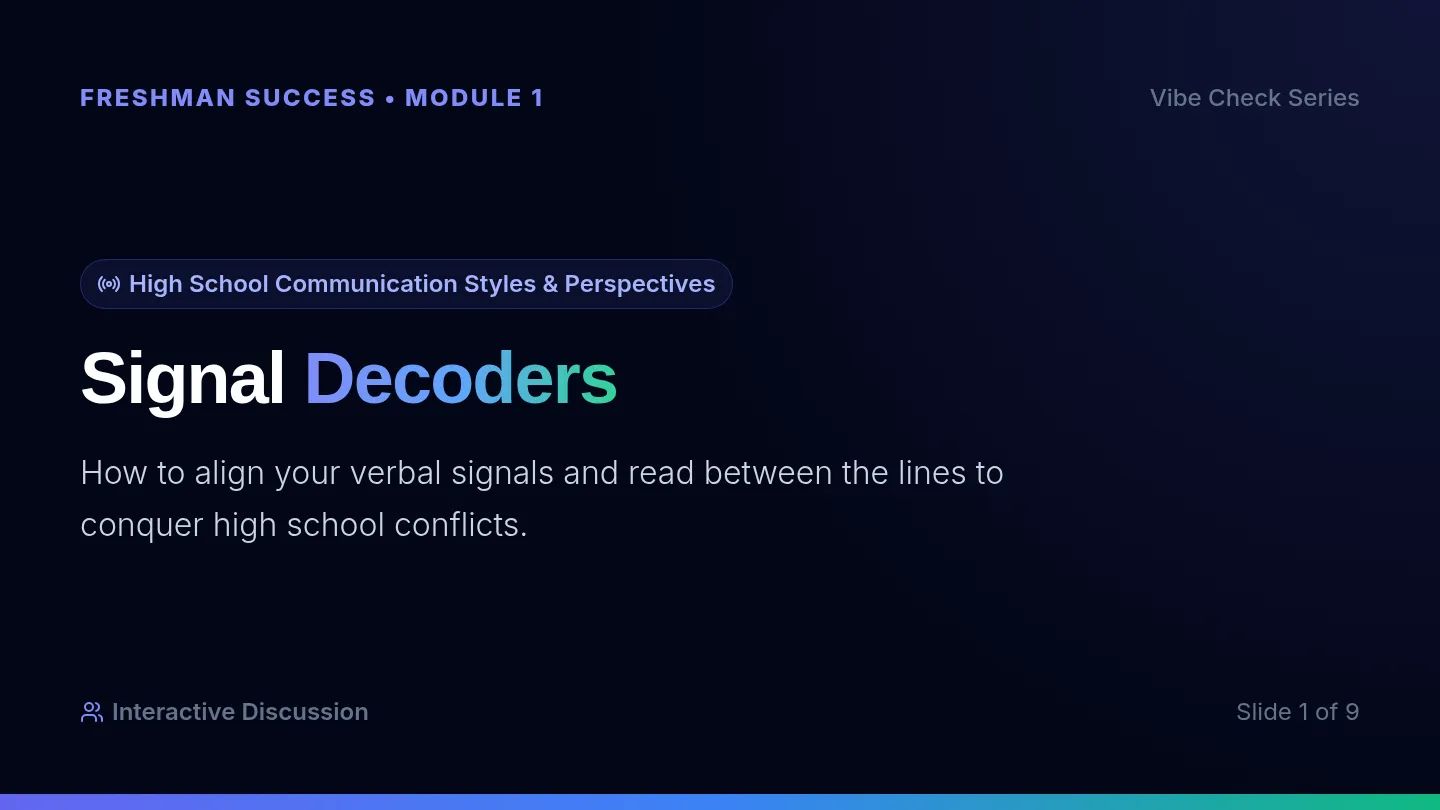
A set of social navigation slides focusing on personal space, responding to 'No', and handling rejection with maturity and respect for 7th grade students.
Trail Guide and Skill Power Map for Helping Others. Rebranded to 'Pathfinder' with zero Ninja terms. Marks graduation as a 'Skill Power Pathfinder' with improved layout and student writing areas.
Teacher guide and student Skill Power Map for Smart Spending. Teaches the 'Spend-Save-Give' strategy using simple language and jar visuals with zero Ninja terminology.
Teacher guide and student playbook for Speaking Up. Teaches assertive communication and confidence using simple language with zero Ninja terminology.
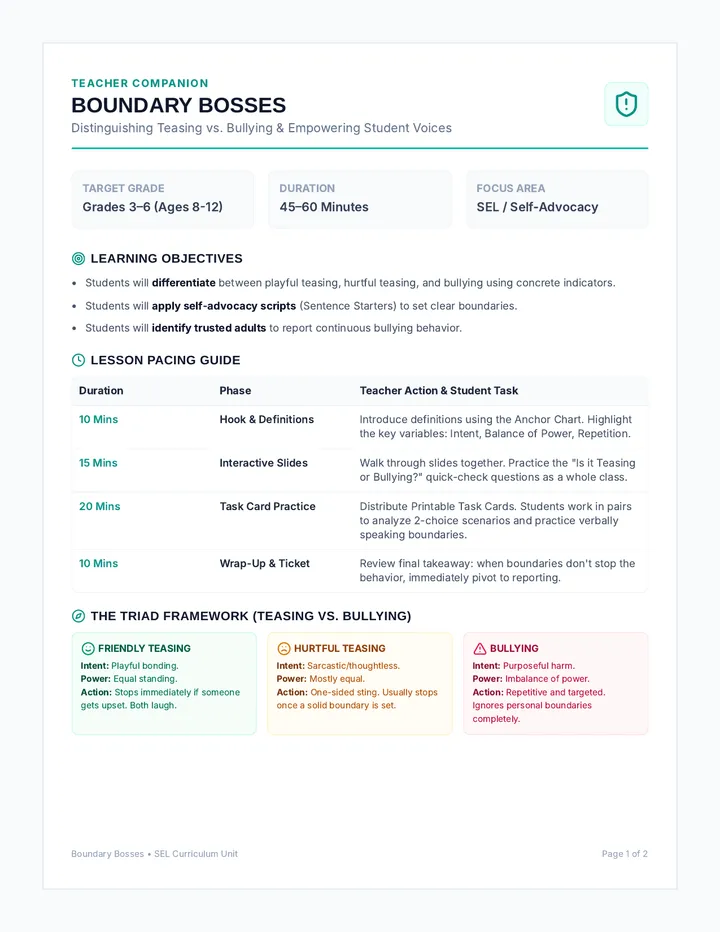
Trail Guide and Skill Power Map for Wait and Think. Rebranded to 'Pathfinder' with no Ninja/Dojo terms. Revised for single-page layout and improved tracing contrast.
Facilitator Trail Guide and student Skill Power Map for Real World Play. Teaches digital wellness and screen-free fun using simple language with zero Ninja terminology.
Trail Guide and Skill Power Map for Paying Attention. Rebranded to 'Pathfinder' with zero Ninja terms. Revised for single-page map layout, larger writing targets, and improved grid activity.
Trail Guide and Skill Power Map for Learning from Mistakes. Rebranded to 'Pathfinder' with zero Ninja terms. Revised for single-page map layout, corrected word scramble logic, and squiggle scaffold for the art activity.
Trail Guide and Skill Power Map for Sticking With It. Rebranded to 'Pathfinder' with zero Ninja/Dojo terms. Revised for single-page map layout, improved writing lines for the 'Yet' activity, and mountain scaffolding.
Trail Guide and Skill Power Map for Sunny Thoughts. Rebranded to 'Pathfinder' with zero Ninja/Dojo terms. Revised for single-page map layout, scrambled matching activity, and improved consistency.
Trail Guide and Skill Power Map for Staying Steady. Rebranded to 'Pathfinder' with zero Ninja terms. Revised for single-page map layout, larger writing spaces for the sensory activity, and improved contrast.
Trail Guide and Skill Power Map for Managing Worries. Rebranded to 'Pathfinder' with zero Ninja/Dojo terms. Revised for single-page map layout, improved contrast, and cloud-shaped activity boxes.
Presentation slides for the Cooling Down workshop. Guides students through identifying anger cues and practicing the Volcano Vent technique with zero Ninja/Dojo terminology. Revised for better viewport fit and text clarity.
Trail Guide and Skill Power Map for the Cooling Down lesson. Rebranded to 'Pathfinder' with all Ninja/Dojo terms removed. Revised for single-page workbook layout and improved writing spaces.
A comprehensive answer key and exemplar response guide for the Brain Lab workbook, covering scientific terminology, mindset flips, and personal reflection prompts.
A robust 10-page facilitation guide for educators to implement the Brain Lab workbook, featuring learning objectives, pacing tables, instructional strategies, differentiation tips, and an assessment rubric.
A comprehensive 10-page student workbook exploring the science of neuroplasticity, brain anatomy, and growth mindset. It features a "Brain Lab" theme with engaging visuals and dedicated student reflection areas.
A professional facilitator's key providing the psychological rationale for the lesson's prompts, tips for handling common teen responses in rehab, and suggested reframing language.
A structured student workbook using architectural metaphors to guide teens in recovery through journaling exercises focused on identifying core values and reconstructing their identity.
A visually striking slide deck for a teen journaling session, using architectural blueprints as a metaphor for self-discovery and recovery. Includes discussion prompts and structured journaling exercises.
A comprehensive facilitator's guide for a journaling session in a recovery setting, utilizing an architectural blueprint metaphor to help teens explore identity and self-discovery.
A vocabulary reference sheet for teenagers, defining core values in accessible language. Organized by categories like Strength, Connection, Growth, and Spirit to aid in self-reflection and art brainstorming.
A student worksheet for planning and reflecting on an art therapy project focused on values. It provides structured space for selecting values, brainstorming visual symbols, and reflecting on the creative process.
A comprehensive facilitator guide for an art therapy lesson on values, specifically tailored for teenagers in rehabilitation. Includes therapeutic goals, materials, a step-by-step lesson plan, and discussion prompts.
A portable reference card for students to keep in their notebook or wallet. It provides quick cognitive reframing statements and three 'Golden Rules' for overcoming the perfectionism-procrastination loop during moments of high stress.
Visual presentation slides for the counseling session, explaining core neurodivergent concepts like Time Blindness, the 'Wall of Awful', and the 'Strategic B-Minus' approach. Designed with a dark, high-contrast aesthetic to maintain focus and reduce visual overwhelm.
A student-facing worksheet designed to help neurodivergent high schoolers break the cycle of perfectionism and procrastination. It features sections for 'shrinking' tasks, battling time blindness through estimation, and conceptualizing 'Strategic B-Minus' work to foster momentum.
A comprehensive facilitator guide for a counseling session focused on the unique intersection of giftedness, ADHD, and procrastination. It includes a structured timeline, core objectives, and troubleshooting tips for counselors working with high-achieving neurodivergent students.
Lesson plan for Session 19: Self-Correction Code. Teaches students how to handle language mistakes with confidence using specific 'patch phrases' and self-acceptance. includes mini-quiz and scenarios. Optimized for one-page print.
Lesson plan for Session 18: Listening Levels. Teaches active listening techniques, mirroring, and paraphrasing in English with added practice scenarios and a final mini-quiz. Optimized for one-page print.
Facilitator word-for-word scripts for the ESL and EQ expansion block (Sessions 17-19). Includes actual role-play text, a Mastery Quiz section, and improved visual hierarchy for spoken lines.
Second ESL extension for the Quest Log workbook, covering Sessions 17-19. Focuses on Empathy validation, Active Listening (Mirroring), and mid-conversation Self-Correction strategies. All content fits on 3 high-contrast pages with improved legibility.
Lesson plan for Session 17: The Empathy Upgrade. Includes learning objectives, detailed facilitator scripts, mind-body awareness activities, and a final mastery mini-quiz. Optimized for one-page print.
A teacher-facing answer key for the final mastery challenge quiz, providing correct responses and pedagogical context for the Level Up curriculum. Consistently titled for ease of reference.
A student-facing final quiz (System Diagnostic) for the Level Up program. Covers the 7 Habits, 6 Pillars, Time Matrix, and emotional regulation techniques with a gamified theme. Optimized for two-page print with improved work areas and matching logic.
A massive expansion pack of 20 additional role-play cards (Scenarios 13-32) for the Level Up program, covering Trust, Digital Wellness, Synergy, Growth Mindset, and Emotional Awareness. Includes scaffolding clues and a consistent 2x2 grid layout.
A massive expansion pack of 16 additional role-play cards (Scenarios 13-28) for the Level Up program, covering Trust, Digital Wellness, Synergy, Growth Mindset, and Emotional Awareness. Includes scaffolding clues and a consistent 2x2 grid layout.
Advanced presentation deck specifically tailored for ESL students. Features 12 detailed scenarios covering the Trust Bank, handling pronunciation mistakes, managing language-barrier frustration, and building daily language habits. Includes facilitator notes and high-contrast visuals.
ESL-specific workbook extension covering emotional vocabulary (The Word Palette), cultural unwritten rules, self-advocacy Survival Phrases, and bicultural legacy planning. Includes lighter handwriting areas and improved header consistency. All content optimized to fit on 4 pages. All sections have increased writing area for student input.
ESL-specific workbook extension covering emotional vocabulary (The Word Palette), cultural unwritten rules, self-advocacy Survival Phrases, and bicultural legacy planning. Includes lighter handwriting areas and improved header consistency. All content optimized to fit on 4 pages.
Final lesson plan for the ESL expansion block (Session 16). Focuses on synthesizing bicultural identity and includes a full facilitator script and closing ceremony guide. Optimized for one-page print.
Lesson plan for Session 15: The Help Button. Focuses on self-advocacy and clarification strategies for ESL students with full facilitator scripts. Updated with full phrase list and improved layout.
Lesson plan for Session 14: Unwritten Rules. Exploring non-verbal communication and cultural codes for ESL students with full facilitator scripts and added cross-cultural scenarios. Optimized for one-page print.
Lesson plan for Session 13: Vibe Check. Focuses on expanding emotional vocabulary for ESL students with full facilitator scripts and a compact one-page layout.
Facilitator word-for-word scripts for the ESL and Life Skills expansion block (Sessions 13-16). Focuses on emotion vocabulary, cultural communication, self-advocacy, and legacy with improved instruction contrast.