A worksheet where students categorize information as 'Private' vs. 'Public' while practicing their reasoning and understanding of digital safety.
A reorganized visual guide for food storage and safety, featuring a clear tabular storage chart, the '2-4-2' rule, discard criteria, and a labeling tutorial with significantly increased font sizes for maximum readability.
A comprehensive teacher's guide for the Kitchen Hacks lesson, including a 50-minute pacing guide, discussion prompts, and strategies for neurodiverse learners and students in temporary housing.
A student practice sheet for applying kitchen safety skills, including labeling exercises and a transformation flowchart activity.
A visually-driven slide deck for a 50-minute session on kitchen safety and food transformation, featuring the 2-4-2 rule and leftover flowcharts.
A reorganized visual guide for food storage and safety, featuring a clear tabular storage chart, the '2-4-2' rule, discard criteria, and a labeling tutorial with increased font sizes for readability.
A coin value worksheet without visual supports. Students convert coin names and quantities (e.g., "4 Dimes") into numerical values and calculate the total for each "bag."
A comprehensive teacher's guide for the Money Mastery unit, including learning objectives, lesson breakdowns, and differentiation strategies for coin counting and budgeting.
Teacher answer key for the Snack Shop Budget Worksheet, including sample affordable combinations and common student pitfalls.
A student worksheet for identifying snack prices, calculating totals for pre-set lists, and making spending choices within a $1.00 budget.
Instructional slides for calculating total costs and making budgeting decisions, featuring "The Golden Rule of Spending" and clear comparison examples.
Teacher answer key for the Coin Detective Worksheet, including visual matching solutions and total value calculations.
A visual slide deck introducing the four main US coins (penny, nickel, dime, quarter) with their identification features and values. features a "Coin Detective" theme.
A coin identification and value worksheet using a "Coin Detective" theme. Includes a field guide, matching activity, and basic counting problems.
A comprehensive teacher/counselor guide for the TK 'Foundations of Calm' lesson. Includes pacing, scripts for delivery, and strategies for physicalizing the concepts of stress and calm.
A foundational worksheet for TK students to identify emotions through coloring and express their calm place through drawing. Features a visual reminder of 'Turtle Breathing'.
A foundational 7-slide presentation for TK students focusing on the difference between 'wiggly' (stressed) and 'still' (calm) bodies. Introduces Turtle Breathing and the Butterfly Hug as essential tools.
An example-filled version of the Kindness Ripple worksheet for teachers to use as a modeling tool during the lesson.
A student worksheet where 4th graders plan a kind act and visualize its ripple effect on the receiver, witnesses, and the wider school community.
A vibrant slide presentation for 4th graders that explains the 'Ripple Effect' of kindness, the 3-Way Win benefit system, and a call to action.
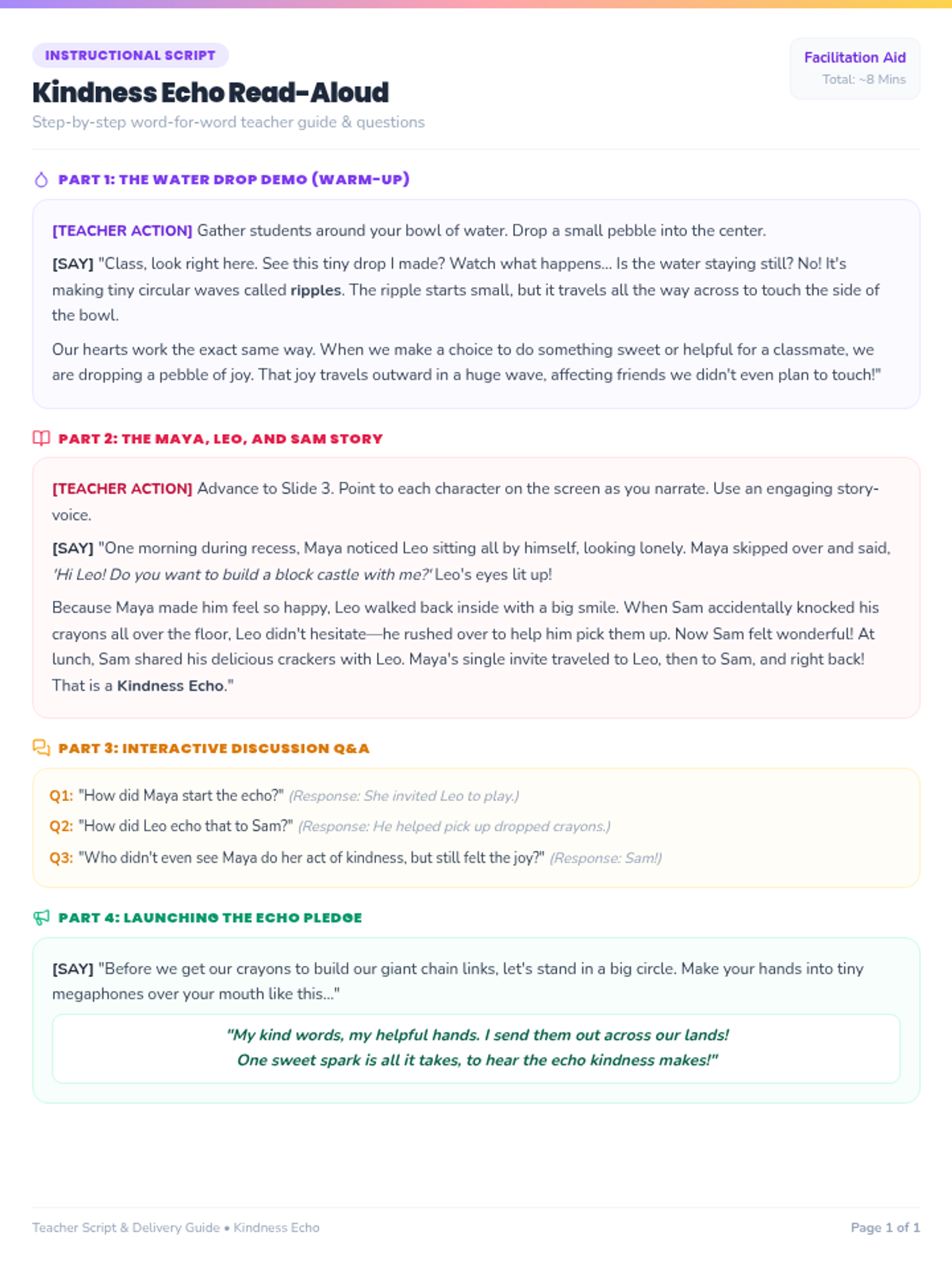
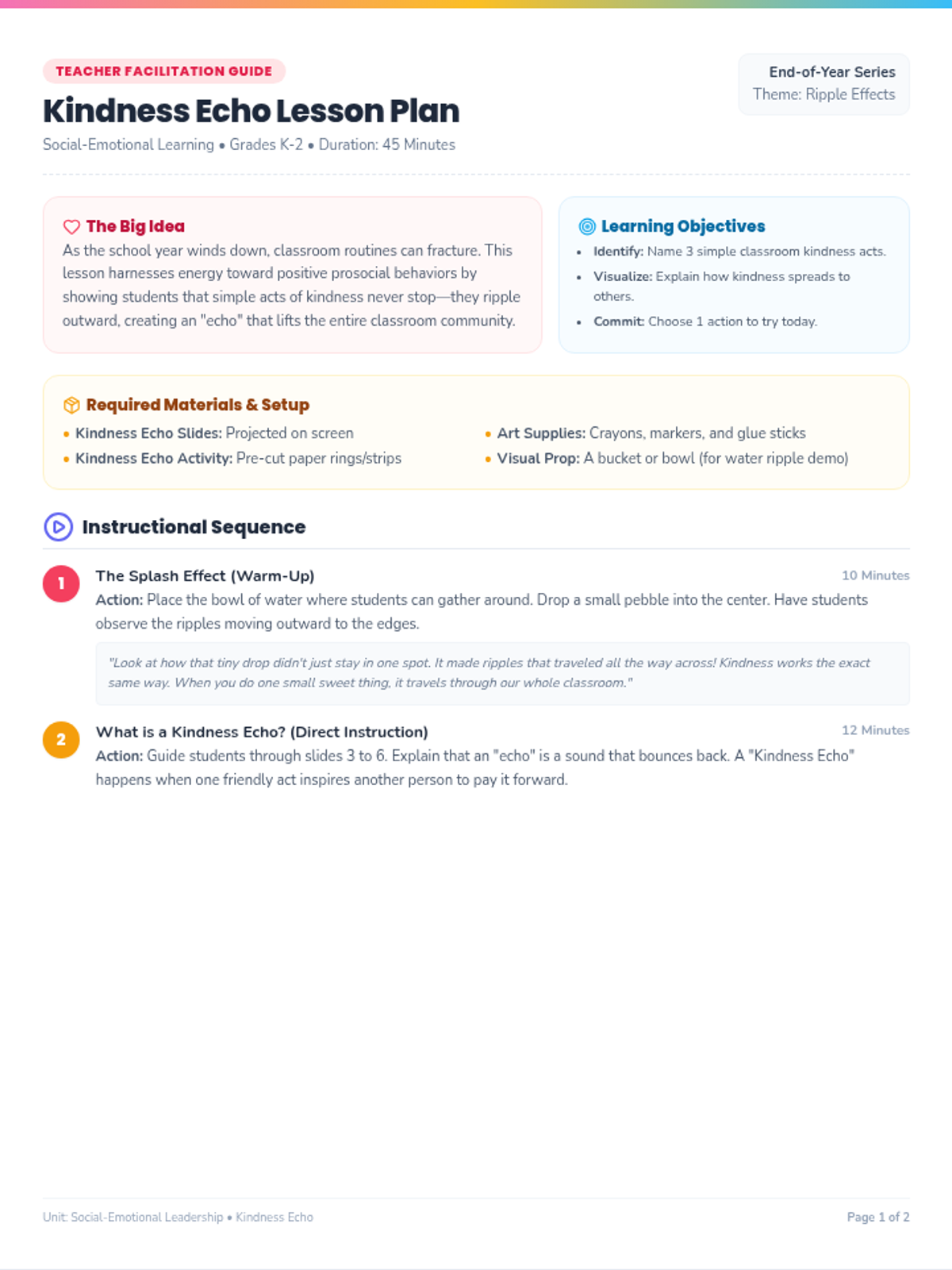
A teacher's instructional guide for a 15-minute lesson on kindness, featuring a timed pacing guide, key discussion questions, and pedagogical tips.
A short illustrated story for kindergarten students featuring two friends, Lily and Rose, who learn to choose soft 'Heart Talk' (petals) over tiny, constant 'Prickly Talk' (thorns).
A comprehensive answer key for the Attendance Ace Worksheet, providing example professional rewrites and instructional guidance for the scenario analysis.
A set of three role-play scripts for practicing professional communication during common call-out scenarios: sudden illness, mechanical emergency, and planned appointments.
A worksheet for employees to practice professional call-out procedures, featuring scenario analysis, a text translator activity, and short-answer protocol questions.
A comprehensive slide deck for employment training on calling out protocols, covering timing, communication methods, professional phrasing, and medical excuses through informative content and case studies.
A guide for teachers to facilitate the Pressure Proof lesson, including pacing, discussion prompts, and role-play tips.
A set of printable discussion cards featuring real-world scenarios across workplace, social, digital, and home environments to facilitate group conversation.
A guided social scripts and role-play handbook featuring scenarios in workplace, financial, digital, and home settings with space for student practice.
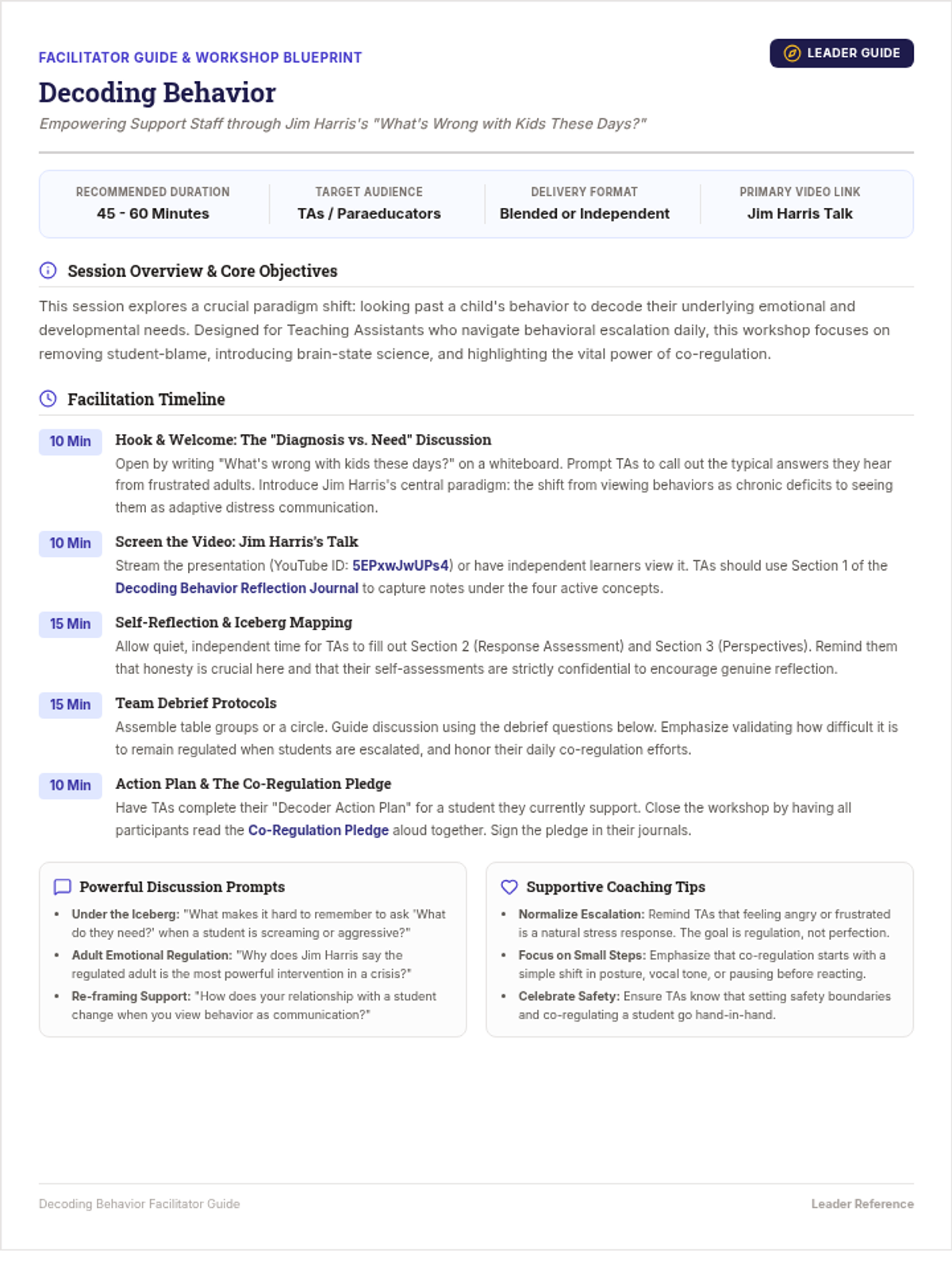
A facilitator's guide for the Respect at Work training session. Includes a suggested timeline, facilitation tips, discussion prompts for case studies, and a complete answer key for the trainee worksheets.
A presentation covering the types of adult peer pressure, the psychological impact of social media, and a toolkit of refusal strategies.
A four-page worksheet bundle for workplace training. Covers personal space, professional tone, handling feedback, and shared resource etiquette with scenario-based exercises and reflection prompts.
A professional slide deck for employment training focusing on workplace respect, personal boundaries, professional tone, feedback, and teamwork. Includes case studies and discussion prompts.
A facilitation guide for instructors, featuring key legal concepts regarding the Fair Labor Standards Act, suggested scripts for case studies, and discussion prompts to encourage self-advocacy in the service industry.
A worksheet featuring three real-world service industry scenarios involving tipping confusion. Students practice identifying core issues and drafting professional scripts to ask for clarification from management.
A visual presentation designed to teach service industry employees about different tipping systems, their legal rights regarding tips, and professional strategies for asking for clarification on pay. It includes specific scripts and identification of red flags in the workplace.
A creative comic-strip worksheet for Lesson 6 where students draw the difference between a 'Filter Slip' and a 'Master Tamer' response.
A practice worksheet for Lesson 4 where students practice using the 5-second brake technique with various scenarios.
A final reflection worksheet for students to review and summarize the strategies learned throughout the 8-week Thought Tamers program.
A celebratory certificate to award to first-grade students once they demonstrate successful use of the Feelings Navigator Chart and verbal communication skills. Designed to reinforce positive behavior and provide a sense of achievement.
A comprehensive teacher facilitation guide for the Calm Communication lesson, including step-by-step instructional sequences, behavioral management tips for eloping and screaming, and an observation log to track student progress.
A set of 6 role-play scenario cards specifically for first graders, focusing on common school triggers like transitions, difficult tasks, and social conflicts. Each card provides a "Practice" section to help students use verbal communication instead of eloping or screaming.
A visual feelings chart designed for first graders, featuring four color-coded emotion zones (Calm, Sad, Worried, Angry) with corresponding "I can say" prompts to encourage verbal communication over eloping or screaming.
A worksheet for Lesson 5 where students identify and analyze classroom 'hotspots' where controlling blurting is most difficult.
A double-sided exit ticket for students to demonstrate their understanding of control zones and practice drafting a single assertive I-statement.
An expanded printable hands-on activity featuring zone labels and 24 situation cards (doubled from original) for students to physically sort factors into three zones of control.
A printable hands-on activity featuring zone labels and 12 situation cards for students to physically sort factors into three zones of control.
A facilitator guide for teachers leading the 'My Control Circle' lesson, including a slide-by-slide script, learning goals, and differentiation tips. Updated to include guidance for 8 practice scenarios and "May be in Control" terminology.
An updated answer key for the 'My Control Circle' worksheet, providing suggested sorting categories and model I-statements for all 8 social scenarios, using "May be in Control" terminology.
An interactive 13-slide presentation matching the 'My Control Circle' graphic organizer, using concrete language to teach three zones of control and assertive I-statements in various social scenarios. Includes 4 specific practice cases and updated "May be in Control" terminology.