A comprehensive teacher lesson plan for the 'Presenting Your Best Self' lesson, including preparation steps, objectives, and a detailed 30-minute instructional sequence.
A visual presentation for the Future Architect lesson, focusing on the concept of reverse engineering goals, identifying the 'why' behind aspirations, and setting immediate action steps.
A project-based goal-setting worksheet where students reverse-engineer a major goal into three milestones, an immediate 24-hour action, and a plan for potential obstacles.
A facilitator guide for the Future Architect lesson, guiding students through the process of reverse-engineering goals, identifying obstacles, and taking immediate action steps.
A visual presentation for the Pressure Relief lesson, exploring the physiology of stress, personal triggers, physical warning signs, and various healthy coping mechanisms.
An interactive stress mapping worksheet designed as a 'system blueprint' where students identify their triggers, physical stress signals, and healthy relief valves.
A facilitator guide for the Pressure Relief lesson, focusing on stress management, identifying physical signals of tension, and creating healthy coping mechanisms.
A visual presentation for the Identity Blueprint lesson, featuring a 30-minute session structure with icebreakers, identity zones breakdown, activity instructions, and discussion prompts.
A printable identity mapping worksheet featuring a concentric 'blueprint' diagram where students categorize their core values, private interests, social roles, and surface appearances.
A detailed facilitator guide for the Identity Blueprint lesson, including a 30-minute session timeline, discussion prompts, and differentiation strategies for middle and high school students.
A unit summary and teacher assessment guide for the entire 'Heart and Head Balance' sequence, featuring a lesson map, debrief prompts, and a comprehensive grading rubric for the final project.
A project planning sheet and student-facing rubric for the 'Relationship Rights' zine, guiding students through drafting their Bill of Rights and ensuring all key concepts from the unit are included.
Final project slides for the 'Relationship Rights' Zine. It introduces the zine format, maps out the required content (non-negotiables, gut signals, self-care), and provides inspiration for a 'Relationship Bill of Rights'.
A decision-making workshop where campers analyze scenarios to distinguish between healthy compromises and controlling 'power plays' in a relationship.
Engaging slides for Lesson 4 that define power dynamics in relationships, highlight subtle signs of control versus equality, and distinguish between healthy compromise and unhealthy compliance.
A student workshop sheet for Lesson 3 focused on cognitive reframing of negative thoughts after rejection and building a personalized self-care toolkit.
Resilience-focused slides for Lesson 3 that normalize rejection through stories of famous figures, teach the 'reframing' technique, and provide a practical self-care toolkit for handling emotional hurt.
A student journal and activity sheet for identifying personal intuition signals, body cues of discomfort, and practicing assertive 'exit lines' for uncomfortable social situations.
Visual slide deck for Lesson 2 focusing on intuition and 'gut feelings'. It defines intuition, maps physical body signals of discomfort, and uses case studies to practice boundary setting.
A visual activity sheet where campers map out their social time distribution and identify 'non-negotiable' activities to protect their personal identity within a relationship.
Engaging presentation slides for the 'Bunkmate Bonds' session that visualize social circles, explain the 'Bubble Effect' of social isolation, and provide discussion scenarios for camp life.
A comprehensive facilitator guide for the 'Bunkmate Bonds' session, featuring a camp-themed movement activity and instructional prompts for discussing social balance and personal identity.
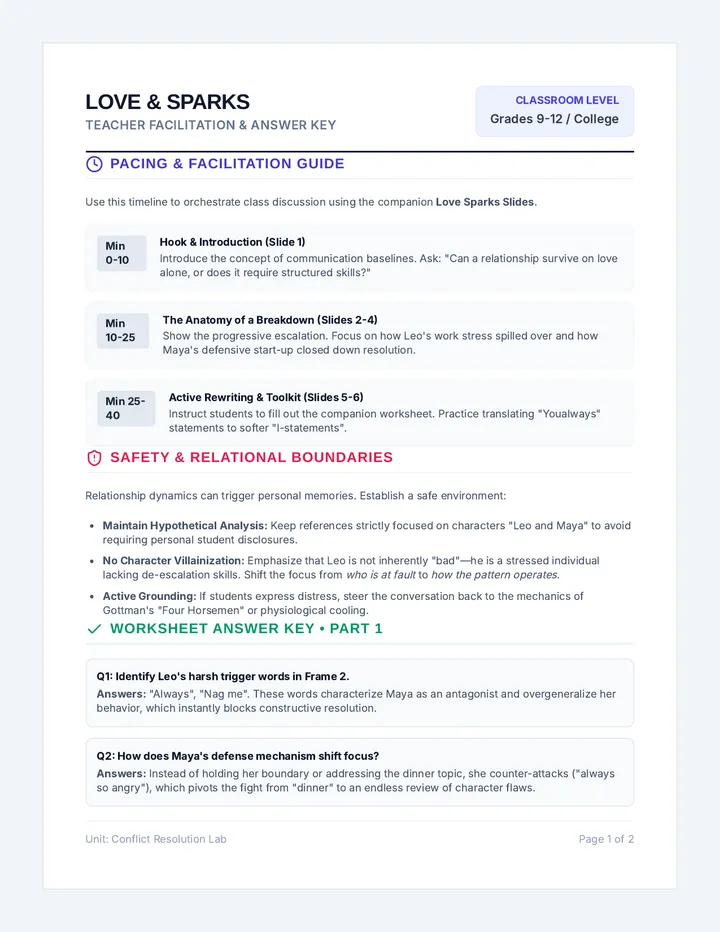
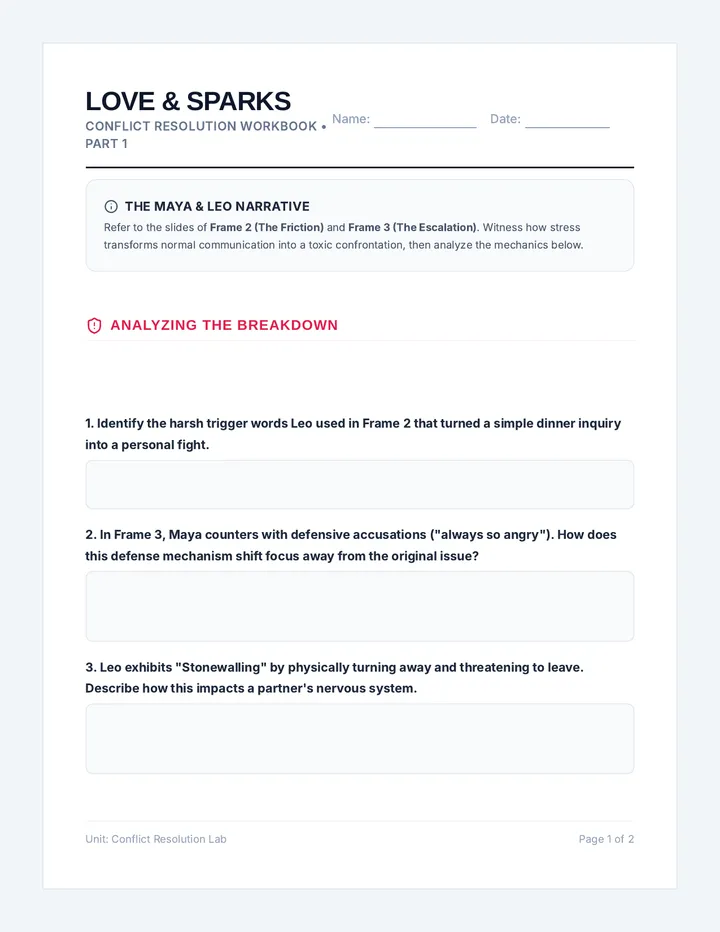
A student reflection worksheet that recaps the 4 steps of the Peace Protocol and challenges students to apply them to a complex classroom scenario involving being late and sent to the office. Fixed page breaks and contrast issues. Updated with larger writing areas.
A comprehensive teacher's guide for Lesson 5, including scam detection keys, discussion prompts about social engineering, and Canadian-specific security tips like e-Transfer autodeposit. Revision: Fixed page breaks to fit on one page. Improved contrast.
A worksheet analyzing fake scam scenarios (phishing and marketplace fraud), featuring a digital security audit and identity safety quiz. Revision: Fixed Task 1 writing lines and improved task borders.
A slide deck introducing fraud prevention, phishing detection, identity theft risks (SIN protection), and the Canadian emergency protocol for financial victims. Revision: Fixed overlaps, contrast, and icon visibility.
A comprehensive teacher's guide for Lesson 4, including the answer key for statement analysis and discussion points about Canadian credit laws and co-signing risks.
A worksheet analyzing a sample credit card statement, identifying interest traps, and exploring factors that influence a Canadian credit score. Revision: Fixed reflection word spacing, increased work areas, improved task circles.
A slide deck introducing credit foundations, covering credit scores in Canada (300-900), the difference between debit and credit, the 5 C's of credit, and the dangers of high-interest debt. Revision: Added icons to Slide 4.
A comprehensive teacher's guide for Lesson 3, featuring the penny-doubling hook, Rule of 72 answer key, and discussion prompts about Canadian savings accounts. Revision: Fixed page breaks to fit on one page.
A practical worksheet focusing on compound interest calculations using the Rule of 72 and setting a personalized SMART financial goal. Revision: Lightened reflection box, improved Task 2 labels, added Canadian context.
A slide deck introducing savings strategies, simple vs. compound interest, Canadian accounts like HISA and TFSA, and the SMART goal-setting framework. Revision: Fixed word-spacing on Slide 4.
A comprehensive teacher's guide for Lesson 2, featuring a Canadian-localized answer key for the ledger activity and discussion prompts about Canadian-specific banking features like NSF fees and e-Transfer security.
A practical ledger-balancing activity for Canadian students featuring Canadian-specific scenarios (Interac e-Transfers, loonies, NSF fees) to calculate a running balance and avoid banking traps.
A practical slide deck teaching Canadian teens how to use debit cards safely (Interac Flash), identify and avoid common Canadian fees (NSF, transaction limits), and use digital tools like Autodeposit.
A comprehensive teacher's guide for Lesson 1, updated with Canadian banking terminology (chequing, SIN, CDIC) and discussion prompts specific to the Canadian financial landscape.
A research-focused worksheet for Canadian students to compare banking institutions (chequing limits, e-Transfer fees, etc.) and verify they have the required Canadian identification and documentation (SIN, Provincial ID).