A structured two-page journal for students to define their SMART goals, break them into actionable steps, and plan for overcoming obstacles using growth mindset principles.
A 'Mastery Glossary' handout for non-native speakers and students who need vocabulary support. Defines the thematic 'system' words used throughout the unit and provides sentence starters for role-play activities.
A peer-review checklist to help teens give and receive feedback on their habit trackers and action plans. Focuses on the 'Micro-step' rule and clear triggers to ensure system effectiveness.
A 'Field Mission Log' to help teens track real-world application of Mastery Mode tools outside of the classroom. Forces students to identify a glitch and the specific 'P' tool they used to solve it.
A detailed facilitator script for Lesson 8 (Mastery Legacy), covering the final calibration hook, the Mastery Dashboard configuration, the 'Performance Capsule' letter-writing, and the final certification ceremony. Revised for better layout and content completeness. Fixed text contrast and page breaks.
A detailed facilitator script for Lesson 7 (Habit Hacker), covering the 'Automation' hook, habit stacking instruction, peer-review protocol for small habits, and the 'Consistency > Intensity' wrap-up. Revised for better layout and content completeness. Fixed page breaks.
A detailed facilitator script for Lesson 6 (Blocker Busters), focusing on 'Defense Training', the Simulation Protocol for the override cards, guided role-play feedback, and a real-world application debrief. Revised for better layout and content completeness.
A detailed facilitator script for Lesson 5 (Mindset Matrix), covering the 'Antivirus' hook, cognitive re-coding instruction, the 'Bad Grade' failure reframe role-play, and the wrap-up integrity quiz. Revised for better layout and content completeness.
A detailed facilitator script for Lesson 4 (Action Architecture), covering the 'hallucination vs plan' hook, system decomposition rules, the 'Complexity Paralysis' role-play, and the wrap-up integrity quiz. Revised for better layout and content completeness.
A detailed facilitator script for Lesson 3 (Purpose Drive), covering the 'GPS' hook, the 5-Why Diagnostic tool instruction, the 'Social Interference' role-play, and the purpose integration wrap-up. Revised for better layout and content completeness.
A detailed facilitator script for Lesson 2 (Passion Engine), including the 'Fuel Check' hook, 'Mapping Fuel' instruction, 'Simulation 2.1' role-play guidance, and the wrap-up quiz. Revised for better layout and content completeness.
A comprehensive word-for-word facilitator script for Lesson 1, detailing the 'Initialization', 'Direct Input', 'Diagnostic', and 'System Review' phases with specific talk-tracks for engaging teenagers. Revised for better layout and content completeness.
A simplified final quiz for the Mastery Mode unit, testing students on their knowledge of the 4 P's and motivation mechanics using easy-to-understand language. Revised to fit one page and ensure uniform styling.
An introductory document for the Mastery Mode unit, explaining the 4 P's performance stack, the skills students will build, and the structure of the upcoming scenario simulations. Revised to fix page breaks.
A comprehensive vision board template styled as a 'Mastery Dashboard', allowing students to visualize their passions, purposes, plans, and mindset reframes for their elite performance goals. Revised for theme consistency.
Role-play scenario cards for Lesson 6, providing students with common motivation blockers (fear, boredom, social pressure, perfectionism) and asking them to apply Mastery Mode strategies to overcome them. Revised with 8 diverse scenarios, helpful system clues, and sentence starters for ELL/ESL support.
A reflective letter-writing activity for the capstone session, where students write a message to their future selves about their Mastery Mode system and goals. Revised for the new theme. Fixed page breaks and contrast.
A simplified habit tracking tool for teens, featuring a "Habit Formula" to help them stack new habits onto existing routines. Includes clues and practice simulations. Revised to fit one page.
A simplified mindset reframing worksheet for teens, using the "Brain Flip" concept to help them turn negative thoughts into helpful actions. Includes clues and role-play simulations. Revised for better contrast and integrated simulation/quiz.
A simplified action-planning tool for teens, using easy language and "Focus Shields" (If-Then planning) to break down large goals into tiny, achievable steps. Revised for better contrast and integrated simulation/quiz.
A simplified journaling worksheet for teens, using a "Why Drill" to help them uncover the deeper purpose behind their goals. Includes role-play scenarios and quick-check questions. Revised to fix page breaks and increase contrast. Added integrated simulation and quiz.
A simplified passion exploration worksheet for teens, using easy-to-understand language and helpful clues to identify core interests and create "Passion Bridges" for boring tasks. Revised for better contrast and integrated simulation/quiz.
A comprehensive facilitator's guide for Lesson 1 within the Mastery Mode theme. Revised to fix markdown issues, add the unit mantra, and improve contrast. Added verbatim talk-tracks for classroom use. Updated with an explicit 'Multilingual Support' section for ELL/ESL students.
A simplified baseline assessment worksheet for teens, using easy-to-understand language and helpful clues to rate themselves on the 4 P's (Passion, Purpose, Plan, Positivity). Revised for better contrast, numbered dots, and legibility.
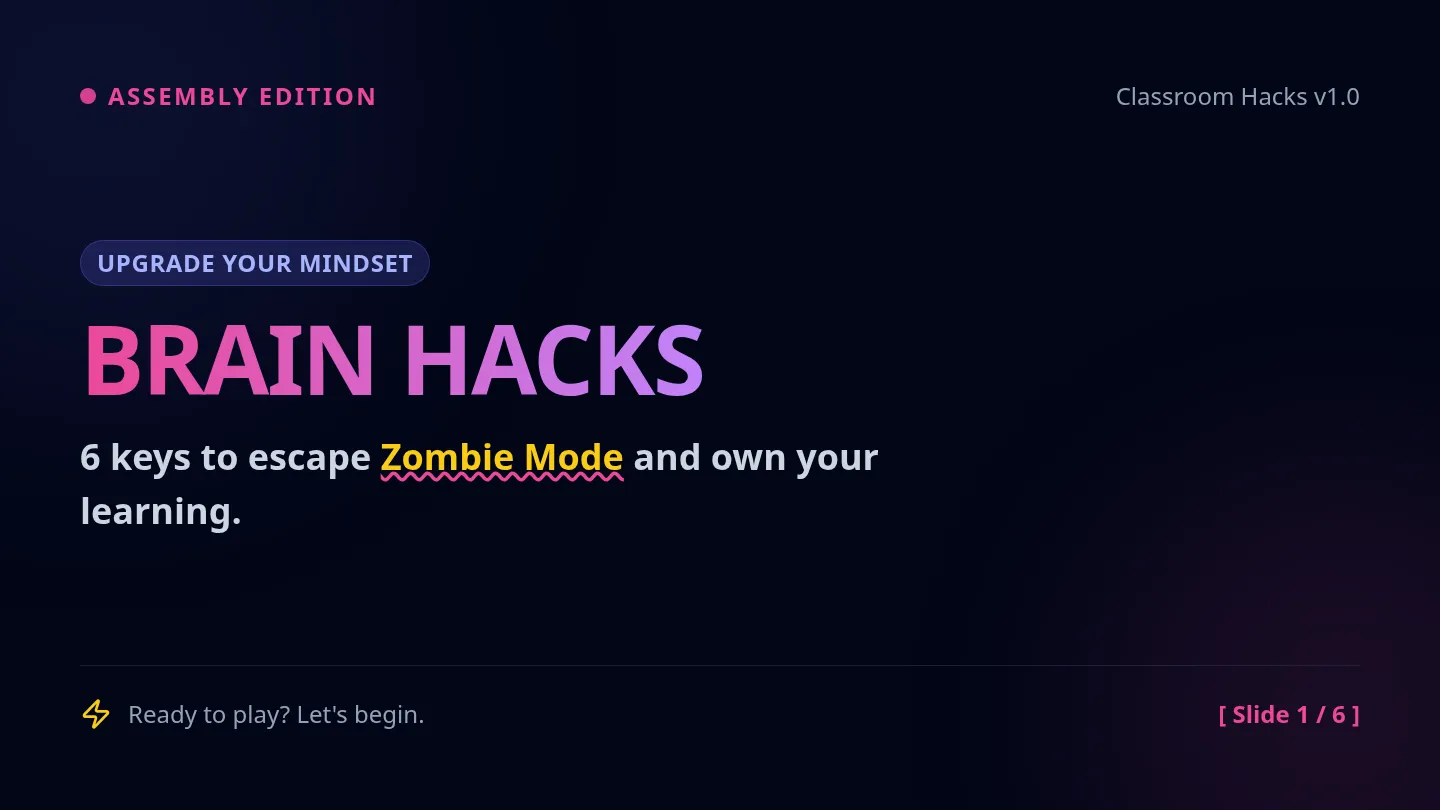
An energetic introductory slide deck for the Mastery Mode unit. Revised for better contrast, additional facilitator notes, and a concluding quiz slide.
A high-impact informational handout that explains the critical link between parental support and a child's long-term success, featuring reflective prompts for parents.
A facilitator's guide featuring three impactful opening questions for the Parenting Journey presentation, along with tips for engaging parents and creating a supportive atmosphere.
A professional feedback form for parents to evaluate the Parenting Journey presentation, including rating scales and reflection questions.
A professional and welcoming presentation slide for Burlington Public Schools' Parenting Journey program, highlighting key benefits for parents at all stages.
A comprehensive facilitator's guide for the session, providing step-by-step instructions and strategies using the new 'Start the Convo, Say What You Need, Make a Plan' framework. Includes timing and instructions for the Scenarios Handout and Practice Notes. Updated for better spacing and single-page printability.
A post-activity reflection sheet designed for student self-assessment. It helps students identify their strengths and growth areas in self-advocacy and includes a section for drafting a personal 'Professor Pitch' using the new student-friendly blueprint framework. Optimized for printability and ease of use.
A clear, three-role guide for students to use during advocacy role-play. It includes specific goals for the Advocate, the Authority, and the Observer, along with a student-friendly fill-in-the-blank script for extra support using the updated 'Start the Convo, Say What You Need, Make a Plan' framework.
A collection of four realistic scenarios focusing on college and workplace self-advocacy. Each scenario includes a "twist" to make the role-play more challenging. Includes a combined practice and reflection area for students to draft conversational starters and reflect on the experience. Optimized for single-page printability.
A professional and engaging 9-slide presentation designed for high school seniors. It covers the transition to college advocacy, provides a three-step script (Start the Convo, Say What You Need, Make a Plan) for communicating needs, and sets up real-world role-play scenarios. Updated for improved contrast and layout clarity.
A professional facilitator's key providing the psychological rationale for the lesson's prompts, tips for handling common teen responses in rehab, and suggested reframing language.
A structured student workbook using architectural metaphors to guide teens in recovery through journaling exercises focused on identifying core values and reconstructing their identity.
A visually striking slide deck for a teen journaling session, using architectural blueprints as a metaphor for self-discovery and recovery. Includes discussion prompts and structured journaling exercises.
A comprehensive facilitator's guide for a journaling session in a recovery setting, utilizing an architectural blueprint metaphor to help teens explore identity and self-discovery.
A vocabulary reference sheet for teenagers, defining core values in accessible language. Organized by categories like Strength, Connection, Growth, and Spirit to aid in self-reflection and art brainstorming.
A student worksheet for planning and reflecting on an art therapy project focused on values. It provides structured space for selecting values, brainstorming visual symbols, and reflecting on the creative process.
A comprehensive facilitator guide for an art therapy lesson on values, specifically tailored for teenagers in rehabilitation. Includes therapeutic goals, materials, a step-by-step lesson plan, and discussion prompts.
A portable reference card for students to keep in their notebook or wallet. It provides quick cognitive reframing statements and three 'Golden Rules' for overcoming the perfectionism-procrastination loop during moments of high stress.
Visual presentation slides for the counseling session, explaining core neurodivergent concepts like Time Blindness, the 'Wall of Awful', and the 'Strategic B-Minus' approach. Designed with a dark, high-contrast aesthetic to maintain focus and reduce visual overwhelm.
A student-facing worksheet designed to help neurodivergent high schoolers break the cycle of perfectionism and procrastination. It features sections for 'shrinking' tasks, battling time blindness through estimation, and conceptualizing 'Strategic B-Minus' work to foster momentum.
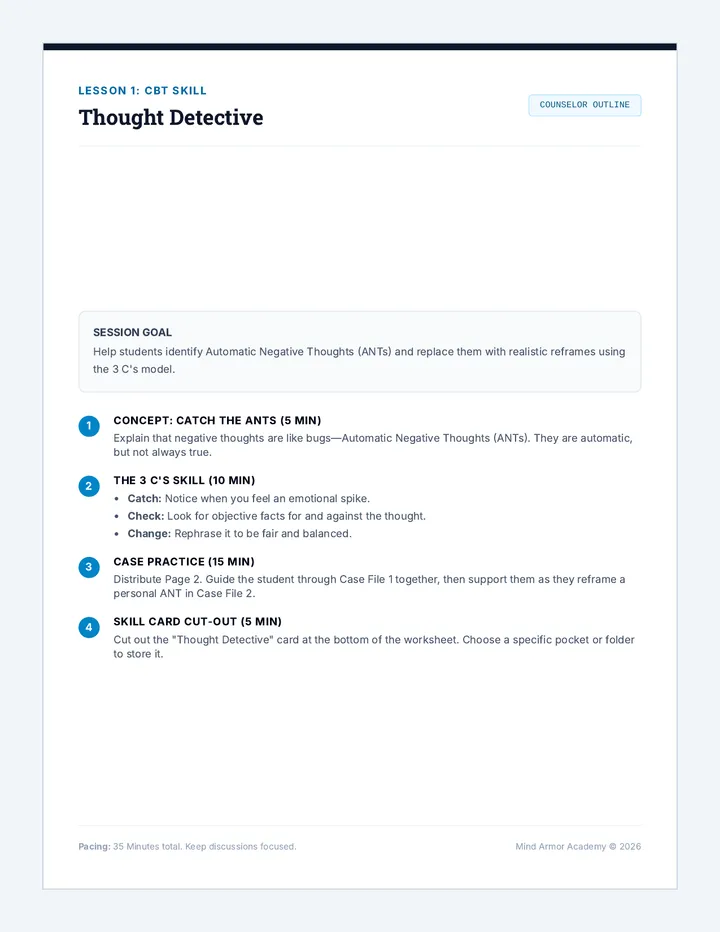
A comprehensive facilitator guide for a counseling session focused on the unique intersection of giftedness, ADHD, and procrastination. It includes a structured timeline, core objectives, and troubleshooting tips for counselors working with high-achieving neurodivergent students.
Lesson plan for Session 19: Self-Correction Code. Teaches students how to handle language mistakes with confidence using specific 'patch phrases' and self-acceptance. includes mini-quiz and scenarios. Optimized for one-page print.
Lesson plan for Session 18: Listening Levels. Teaches active listening techniques, mirroring, and paraphrasing in English with added practice scenarios and a final mini-quiz. Optimized for one-page print.
Facilitator word-for-word scripts for the ESL and EQ expansion block (Sessions 17-19). Includes actual role-play text, a Mastery Quiz section, and improved visual hierarchy for spoken lines.
Second ESL extension for the Quest Log workbook, covering Sessions 17-19. Focuses on Empathy validation, Active Listening (Mirroring), and mid-conversation Self-Correction strategies. All content fits on 3 high-contrast pages with improved legibility.