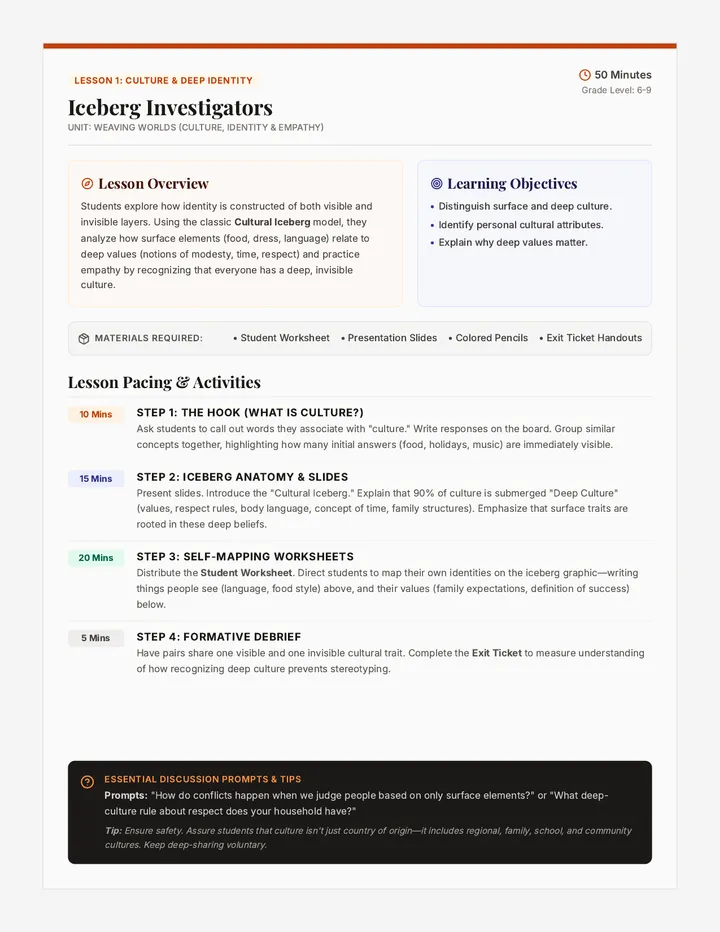
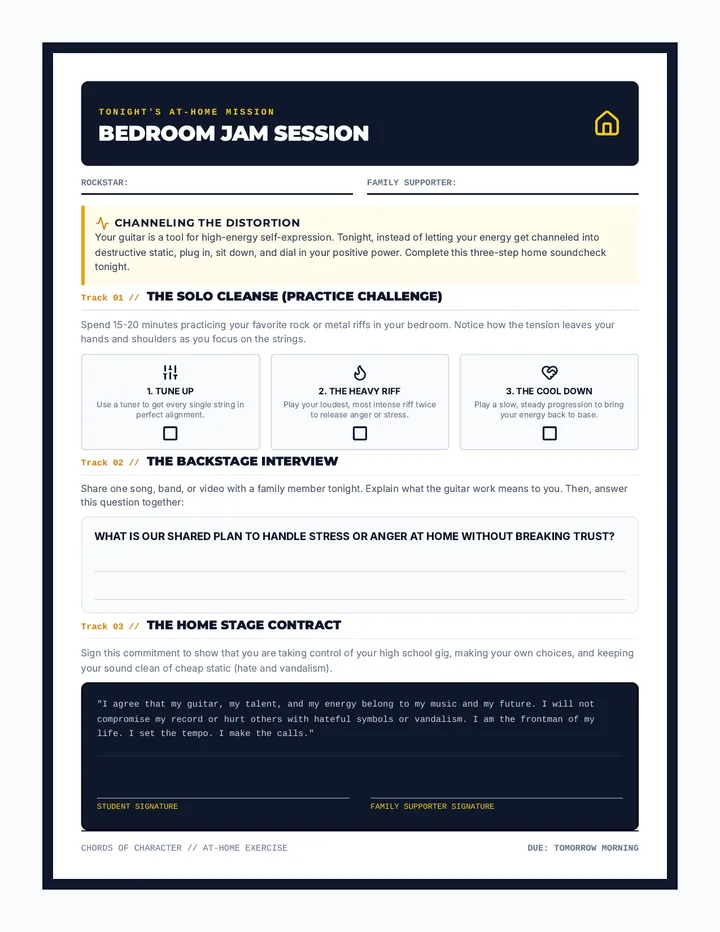
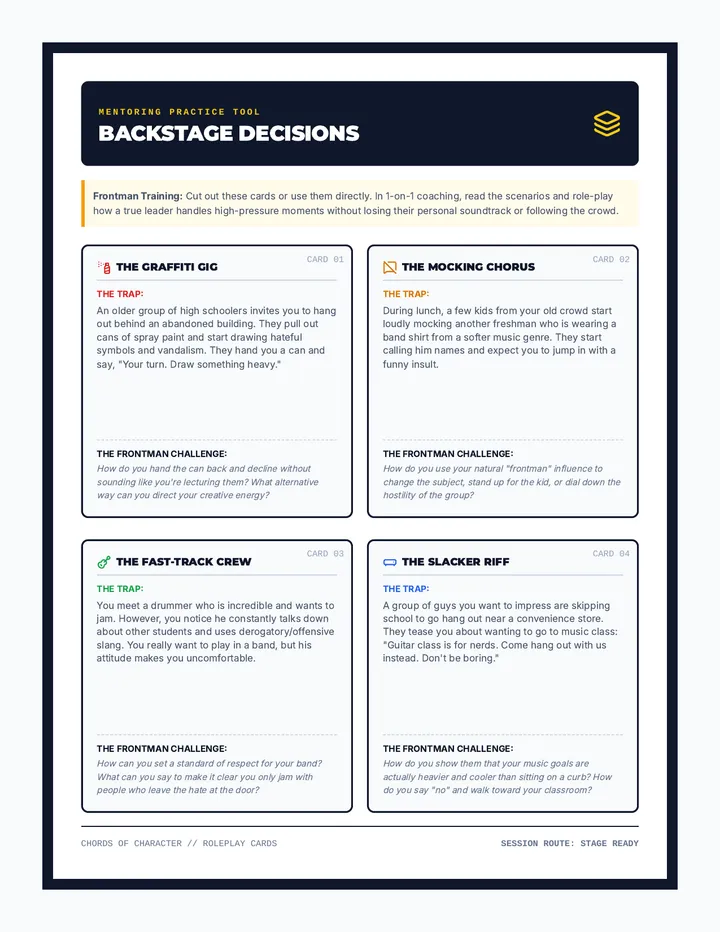
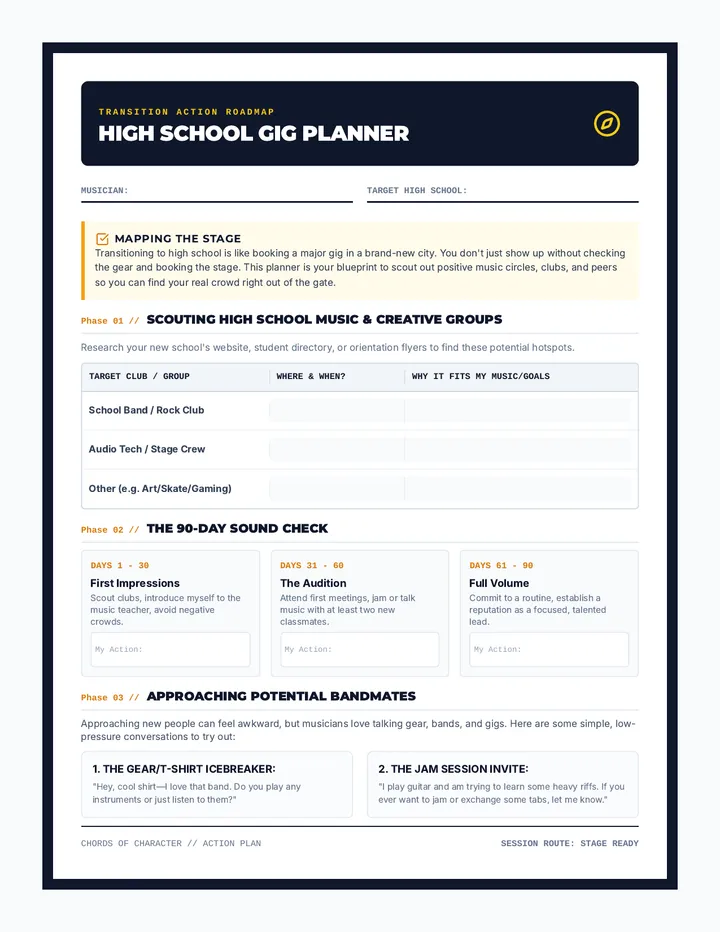
A concise lesson plan for high school educators focusing on career exploration through self-reflection, slide-deck discussion, and interactive mapping.

A performance rubric for evaluating students' mastery of the 5-4-3-2-1 grounding technique, themed as a system diagnostic scorecard. Assesses precision, speed, stealth, and stabilization success.
A detailed teacher instructional script for the 'System Reset' lesson, using a technical metaphor to teach the 5-4-3-2-1 grounding technique. Includes timed sections, speaker prompts, and activity cues.
A printable set of 4 'System Reset' grounding cards with updated text, colored icons for each sensory step, and a clear 5-4-3-2-1 protocol layout.
A coding-themed mindfulness worksheet titled 'System Reset Protocol' with multi-colored sensory sections and a professional tech aesthetic. Guides students through a 5-4-3-2-1 grounding exercise. Removed Node, Telemetry, and gray backgrounds. Corrected spelling in the reflection log. Revised layout to fit exactly on two pages. Made the '05 // NEW' badge larger and replaced calibration status with body sensation lines. Standardized line weights for better visibility. Added non-breaking spaces to reflection log prompts to ensure correct word separation.
Facilitator script for Lesson 1 (Junior 6-8) of the Mind Mechanics program. Focuses on introducing brain "parts" using simple language, an ELL-friendly story review, and a basic grammar focus on prepositions "in" and "on." Includes Habit 1 integration.
Facilitator script for Lesson 12 of the Mind Mechanics program. Focuses on the final "Master Mechanic" certification ceremony, self-reflection using Habit 7 (Sharpen the Saw), and present perfect grammar review. Includes the Mechanic's Oath.
Visual anchor chart for Lesson 11, summarizing the "Master Workflow". Revised for single-page layout, addition of requested checkboxes, and fixed visual continuity for the connection line. High-contrast industrial design.
Puzzle-style student logbook sheet for Lesson 11. Includes an assembly flowchart integrating multiple "Mind Mechanic" tools (Reaction Engine, Coolant, POV, Choice), a grammar zone for sequence markers, and a Habit 6 reflection check. Industrial, heavy-duty design.
Facilitator script for Lesson 11 of the Mind Mechanics program. Focuses on integrating all previous skills into a final "Assembly Line" project. Includes sequence grammar, 60-minute breakdown, and Habit 6 integration.
Visual anchor chart for Lesson 10, outlining the "Choice Circuit" logic. Includes a flowchart for decision mapping and Habit 3 integration with checkboxes for student engagement. High-contrast electrical theme.
Puzzle-style student logbook sheet for Lesson 10. Includes a circuit mapping challenge to link choices to consequences, a grammar zone for conditionals (if/then), and a Habit 3 reflection check. High-contrast electrical theme.
Facilitator script for Lesson 10 of the Mind Mechanics program. Focuses on evaluating choices and consequences using the "Choice Circuit" metaphor. Includes tiered prompts, simple language for ELL, and Habit 3 integration.
Visual anchor chart for Lesson 9, illustrating "The Logic Loom" weaving process for solving "Why" and "How" questions. Includes requested checkboxes and high-contrast technical aesthetics.
Puzzle-style student logbook sheet for Lesson 9. Includes a thread-weaving investigation task matching evidence to schema, a grammar zone for causal connectors (because/since), and a Habit 2 reflection check. Theme-consistent with weaving/loom visuals.
Facilitator script for Lesson 9 of the Mind Mechanics program. Focuses on inferential reasoning and answering "Why" questions by "weaving" text evidence and personal knowledge (schema). Includes tiered prompts and Habit 2 integration.
Visual anchor chart for Lesson 8, illustrating the "POV Goggles" metaphor and providing the "Switch Protocol" for perspective-taking. Includes checkboxes for student engagement and high-contrast, professional "Mind Mechanic" aesthetics.
Puzzle-style student logbook sheet for Lesson 8. Includes a split-drawing perspective challenge, a grammar zone for contrast markers (but/however), and a Habit 4 (Think Win-Win) reflection audit. Theme-consistent with cyan/blue lens visuals.
Facilitator script for Lesson 8 of the Mind Mechanics program. Focuses on empathy and perspective through the "POV Goggles" metaphor. Includes tiered prompts for 6-14 year olds, simple language for ELL, and Habit 4 integration.
Visual anchor chart for Lesson 7, detailing "Social Frequencies" (Red, Yellow, Blue) and providing a step-by-step guide for scanning social signals with checkboxes for student engagement. High-contrast, technical "Mind Mechanic" aesthetics.